

A brief psychological intervention to reduce repetition of self-harm in patients admitted to hospital following a suicide attempt: a randomised controlled trial
Open accessThe DOI matches its Crossref record; 37 of the 37 references it cites were found in a registry or an index.
Abstract
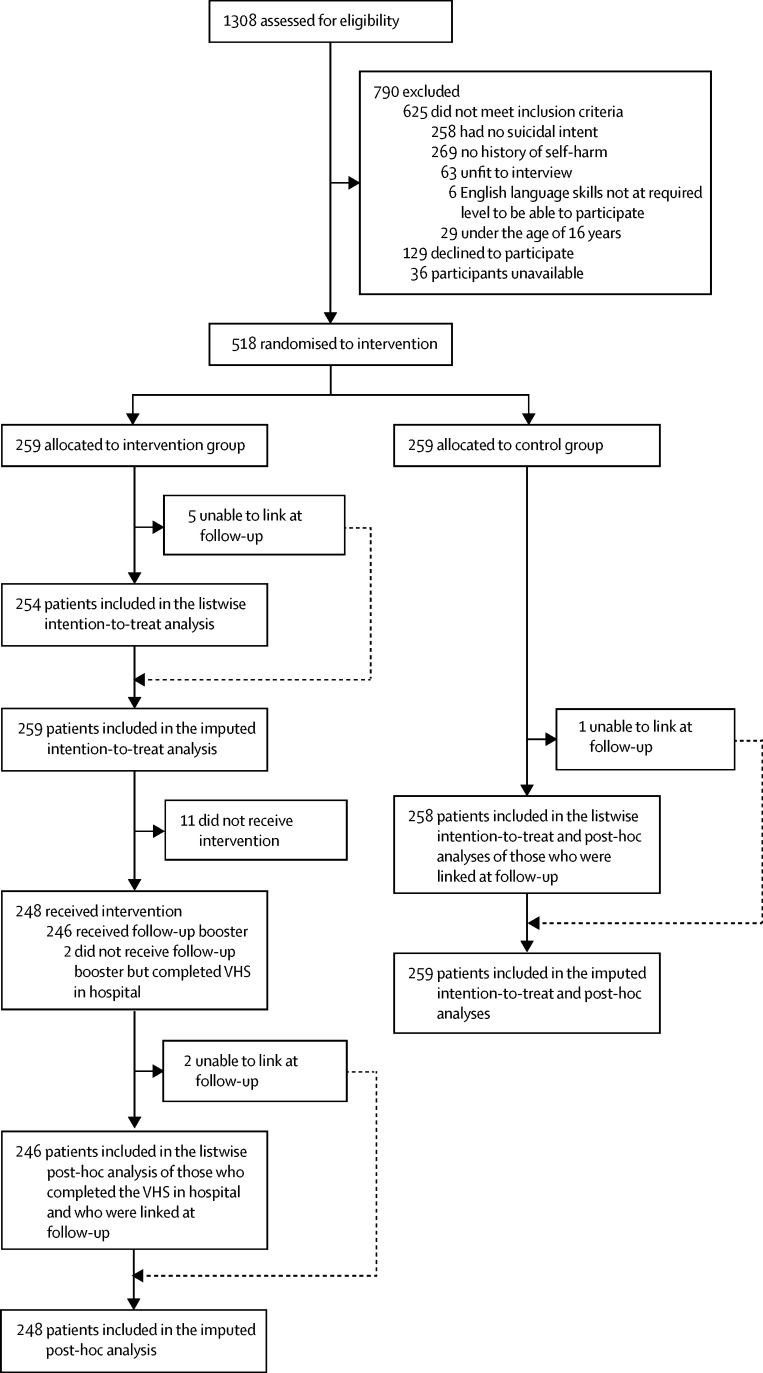
BACKGROUND: We investigated whether a volitional helpsheet (VHS), a brief psychological intervention, could reduce repeat self-harm in the 6 months following a suicide attempt. METHODS: We did a prospective, single-site, randomised controlled trial. Patients admitted to a hospital in Edinburgh, UK, after a suicide attempt were deemed eligible for the study if they were over the age of 16 years, had a self-reported history of self-harm, were fluent in English, were medically fit to interview, and were not participating in other research studies within the hospital. Eligible patients were randomly assigned (1:1), via web-based randomisation, to receive either VHS plus usual treatment (intervention group) or only treatment as usual (control group). Randomisation was stratified by sex and self-reported past self-harm history. The Information Services Division of the National Health Service (NHS-ISD) staff and those extracting data from medical notes were masked to the study group the participant was allocated to. Clinical staff working within the hospital were also masked to participants' randomisation status. There were three primary outcomes: the proportion of paticipants who re-presented to hospital with self-harm during the 6-month follow-up period; the number of times a participant re-presented to hospital with self-harm during the 6-month follow-up period; and cost-effectiveness of the VHS as measured by estimated incremental cost per self-harm event averted. Primary outcomes were analysed in all randomised patients. Follow-up data collection was extracted from the Information Services Division of the NHS and from patient medical records. The trial is registered with International Standard Randomised Controlled Trial Number Registry, number ISRCTN99488269. FINDINGS: Between May 9, 2012, and Feb 24, 2014, we assessed 1308 people for eligibility. Of these, 259 patients were randomly assigned to the intervention group and 259 to the control group. We obtained complete follow-up data on 512 (99%) of 518 patients (five participants were lost to follow-up in the intervention group and one in the control group). 11 patients assigned to the intervention group did not complete the VHS in hospital. Overall, the intervention did not affect the number of people who re-presented with self-harm (67 [26%] of 254 patients in the intervention group vs 71 [28%] of 258 patients in the control group, odds ratio [OR] 0·90, 95% CI 0·58-1·39, p=0·63). The intervention had no effect on the number of re-presentations per patient (mean 0·67 [SD 2·55] re-presentations for the intervention group vs 0·85 [2·79] for the control group, incident rate ratio [IRR] 1·65, 95% CI 0·74-3·67, p=0·21). Mean total costs per person for NHS hospital services in the VHS intervention group over the 6 months were £513 versus £561 in the control group but this difference was not significant (95% CI-£353 to £257, p=0·76). Three patients died by suicide in the 6 months following their index suicide attempt (one in the intervention group and two in the control group). There were no reported unintended effects or adverse events in either group. INTERPRETATION: For the primary outcomes, there were no significant differences between groups. Although the VHS had no overall effect, post-hoc analyses suggest VHS might be effective in reducing the number of self-harm repetitions following a suicide attempt in people who complete the helpsheet and who have been previously admitted to hospital with self-harm. This is the first study to investigate the usefulness of the VHS to reduce self-harm among those who have attempted suicide. These subgroup findings require replication. The potential use of the VHS in those who self-harm for different motives requires further exploration. FUNDING: Chief Scientist Office (CZH/4/704).
Overview
The claims and statistics of this paper haven’t been checked yet.
Free: it reads the open-access text and checks the first 5 claims that cite a source we can check. Create a free account to check every claim.
Integrity signals
Registry
Cites
Statistics
Figures
Verification
Claims the paper makes
The claims and statistics of this paper haven’t been checked yet.
Free: it reads the open-access text and checks the first 5 claims that cite a source we can check. Create a free account to check every claim.
Claims other papers make about this one
Each is checked against this paper’s own text: does it say what the citing paper says it does?
The source backs part of the claim, not all of it — or backs it for a different population, condition or comparison.
In the citing paper
“While reductions in reattempts were modest”
From Targeting Psychological Pain After a Suicide Attempt: Scoping Review and Intervention Protocol (2026) · cites this paper as [41]
Experimental — accuracy not yet measuredThe check wasn’t confident either way, so it gives no verdict — never disputed.
In the citing paper
“In addition, ASSIP led to fewer suicide attempts but had no effect on suicidal ideation 288 .”
From Suicide and suicide risk (2019) · cites this paper as [288]
Experimental — accuracy not yet measuredThe check wasn’t confident either way, so it gives no verdict — never disputed.
In the citing paper
“Notably, these PPV estimates are in line with risk thresholds used for primary prevention of other similarly impactful conditions.”
From Accuracy requirements for cost-effective suicide risk prediction among primary care patients in the US (2021) · cites this paper as [38]
Experimental — accuracy not yet measuredThe check wasn’t confident either way, so it gives no verdict — never disputed.
In the citing paper
“qualitative analyses suggest that empathic contact may reduce ‘emotional loneliness’ and acute distress—core features of psychological pain.”
From Targeting Psychological Pain After a Suicide Attempt: Scoping Review and Intervention Protocol (2026) · cites this paper as [41]
Experimental — accuracy not yet measuredThe check wasn’t confident either way, so it gives no verdict — never disputed.
In the citing paper
“One recent study has demonstrated an 80% reduced risk of participants making at least one repeat suicide attempt when ASSIP was administered in addition to usual clinical treatment, compared with usual treatment with a single assessment interview 288 .”
From Suicide and suicide risk (2019) · cites this paper as [288]
Experimental — accuracy not yet measured
1 more claim about this paper
Create a free account to see every claim other papers make about this one.
Self-check
Percentages, sums and reported differences re-computed from the paper’s own numbers.
The self-check needs the paper’s full text.
Citations
Cites
Practical Statistics for Medical Research.
Walter, S. D., & Altman, D. G. (1992) · Biometrics · doi:10.2307/2532320 · Cited by 11,668
Multiple imputation using chained equations: Issues and guidance for practice
White, I. R., Royston, P., & Wood, A. M. (2011) · Statistics in Medicine · doi:10.1002/sim.4067 · Cited by 9,792
Stages and processes of self-change of smoking: Toward an integrative model of change.
Prochaska, J. O., & DiClemente, C. C. (1983) · Journal of Consulting and Clinical Psychology · doi:10.1037/0022-006x.51.3.390 · Cited by 9,098
Posner, K., Brown, G. K., Stanley, B., Brent, D. A., Yershova, K. V., Oquendo, M. A., Currier, G. W., Melvin, G. A., Greenhill, L., Shen, S., et al. (2011) · American Journal of Psychiatry · doi:10.1176/appi.ajp.2011.10111704 · Cited by 5,157
Implementation intentions and goal achievement: a meta-analysis of effects and processes
Gollwitzer, P. M., & Sheeran, P. (2006) · Advances in Experimental Social Psychology · doi:10.1016/s0065-2601(06)38002-1 · Cited by 3,236
Suicide and suicidal behaviour
Turecki, G., & Brent, D. A. (2016) · The Lancet · doi:10.1016/s0140-6736(15)00234-2 · Cited by 2,338
Self-harm and suicide in adolescents
Hawton, K., Saunders, K. E., & O'Connor, R. C. (2012) · The Lancet · doi:10.1016/s0140-6736(12)60322-5 · Cited by 2,306
Self-citationFatal and non-fatal repetition of self-harm: Systematic review
Owens, D., Horrocks, J., & House, A. (2002) · British Journal of Psychiatry · doi:10.1192/bjp.181.3.193 · Cited by 1,241
The psychology of suicidal behaviour
O'Connor, R. C., & Nock, M. K. (2014) · The Lancet Psychiatry · doi:10.1016/s2215-0366(14)70222-6 · Cited by 1,193
Self-citationMadge, N., Hewitt, A., Hawton, K., Wilde, E. J. D., Corcoran, P., Fekete, S., Heeringen, K. V., Leo, D. D., & Ystgaard, M. (2008) · Journal of Child Psychology and Psychiatry · doi:10.1111/j.1469-7610.2008.01879.x · Cited by 750
Cited by
The integrated motivational–volitional model of suicidal behaviour
O'Connor, R. C., & Kirtley, O. J. (2018) · Philosophical Transactions of the Royal Society B: Biological Sciences · doi:10.1098/rstb.2017.0268 · Cited by 1,781
Self-citationTurecki, G., Brent, D. A., Gunnell, D., O’Connor, R. C., Oquendo, M. A., Pirkis, J., & Stanley, B. H. (2019) · Nature Reviews Disease Primers · doi:10.1038/s41572-019-0121-0 · Cited by 1,074
Self-citationThe Lancet Psychiatry Commission on psychological treatments research in tomorrow's science
Holmes, E. A., Ghaderi, A., Harmer, C. J., Ramchandani, P. G., Cuijpers, P., Morrison, A. P., Roiser, J. P., Bockting, C. L. H., O'Connor, R. C., Shafran, R., et al. (2018) · The Lancet Psychiatry · doi:10.1016/s2215-0366(17)30513-8 · Cited by 624
Self-citationPsychological therapies for people with borderline personality disorder
Storebø, O. J., Stoffers-Winterling, J. M., Völlm, B. A., Kongerslev, M. T., Mattivi, J. T., Jørgensen, M. S., Faltinsen, E., Todorovac, A., Sales, C. P., Callesen, H. E., et al. (2020) · Cochrane Database of Systematic Reviews · doi:10.1002/14651858.cd012955.pub2 · Cited by 450
Psychosocial interventions for self-harm in adults
Hawton, K., Witt, K. G., Taylor Salisbury, T. L., Arensman, E., Gunnell, D., Hazell, P., Townsend, E., & van Heeringen, K. (2016) · Cochrane Database of Systematic Reviews · doi:10.1002/14651858.cd012189 · Cited by 310
O’Connor, R. C., & Portzky, G. (2018) · Frontiers in Psychology · doi:10.3389/fpsyg.2018.02139 · Cited by 143
Self-citationJuul, S., Gluud, C., Simonsen, S., Frandsen, F. W., Kirsch, I., & Jakobsen, J. C. (2021) · BMJ Evidence-Based Medicine · doi:10.1136/bmjebm-2020-111407 · Cited by 135
Psychosocial interventions for self-harm in adults
Witt, K. G., Hetrick, S. E., Rajaram, G., Hazell, P., Taylor Salisbury, T. L., Townsend, E., & Hawton, K. (2021) · Cochrane Database of Systematic Reviews · doi:10.1002/14651858.cd013668.pub2 · Cited by 124
Effectiveness of brief psychological interventions for suicidal presentations: a systematic review
McCabe, R., Garside, R., Backhouse, A., & Xanthopoulou, P. (2018) · BMC Psychiatry · doi:10.1186/s12888-018-1663-5 · Cited by 102
Risk factors for self-harm repetition in adolescents: A systematic review
Rahman, F., Webb, R. T., & Wittkowski, A. (2021) · Clinical Psychology Review · doi:10.1016/j.cpr.2021.102048 · Cited by 110
Ross, E. L., Zuromski, K. L., Reis, B. Y., Nock, M. K., Kessler, R. C., & Smoller, J. W. (2021) · JAMA Psychiatry · doi:10.1001/jamapsychiatry.2021.0089 · Cited by 65
Cramer, R. J., Rasmussen, S. A., & Tucker, R. P. (2019) · Psychiatry Research · doi:10.1016/j.psychres.2019.112550 · Cited by 68
Souza, K., Sosu, E. M., Thomson, S., & Rasmussen, S. (2024) · Health Psychology Review · doi:10.1080/17437199.2024.2336013 · Cited by 56
Tsiachristas, A., Geulayov, G., Casey, D., Ness, J., Waters, K., Clements, C., Kapur, N., McDaid, D., Brand, F., & Hawton, K. E. (2020) · Epidemiology and Psychiatric Sciences · doi:10.1017/s2045796020000189 · Cited by 66
“, 2017) to help improve referral to appropriate care pathways, as well as economic evaluations of psychological and other follow-up care (O’Connor et al., 2017; Haga et al., 2018; Park et al., 2018).”
Self-citationHuxley, E., Lewis, K. L., Coates, A. D., Borg, W. M., Miller, C. E., Townsend, M. L., & Grenyer, B. F. S. (2019) · BMC Psychiatry · doi:10.1186/s12888-019-2308-z · Cited by 52
Buus, N., Erlangsen, A., River, J., Andreasson, K., Frandsen, H., Larsen, J. L. S., Nordentoft, M., & Juel, A. (2018) · Archives of Suicide Research · doi:10.1080/13811118.2018.1489319 · Cited by 38
“Similar, preprinted plans have been offered in other settings (O ’ Connor et al., 2017).”
BackgroundWang, M., Swaraj, S., Chung, D., Stanton, C., Kapur, N., & Large, M. M. B. (2019) · Acta Psychiatrica Scandinavica · doi:10.1111/acps.13023 · Cited by 35
Höller, I., & Forkmann, T. (2021) · Nursing Open · doi:10.1002/nop2.1130 · Cited by 33
“Multiple helpful prevention ideas and interventions have been derived from those theories (Joiner, van Orden, Witte & Rudd, 2009; O'Connor et al., 2017).”
MethodKeyworth, C., O’Connor, R. C., Quinlivan, L. M., & Armitage, C. J. (2021) · Journal of Medical Internet Research · doi:10.2196/28349 · Cited by 35
Self-citationRisk Factors Associated With Peripartum Suicide Attempts in Japan
Akaishi, T., Tarasawa, K., Fushimi, K., Hamada, H., Saito, M., Kobayashi, N., Kikuchi, S., Tomita, H., Ishii, T., Fujimori, K., et al. (2023) · JAMA Network Open · doi:10.1001/jamanetworkopen.2022.50661 · Cited by 29
Lengvenytė, A., Olié, É., Strumila, R., Navickas, A., González-Pinto, A. M., & Courtet, P. (2021) · The World Journal of Biological Psychiatry · doi:10.1080/15622975.2021.1907712 · Cited by 27
“2019) and three preliminary studies (O’Connor et al. 2017; Kennard et al. 2018; Wharff et al. 2019) also failed to demonstrate the difference from the comparator.”
BackgroundWitt, K. (2017) · The Lancet Psychiatry · doi:10.1016/s2215-0366(17)30152-9 · Cited by 24
Keyworth, C., Quinlivan, L. M., Leather, J. Z., & Armitage, C. J. (2022) · BJPsych Open · doi:10.1192/bjo.2022.568 · Cited by 26
Self-citationThe Neuroscience of Suicidal Behavior
van Heeringen, K. (2018) · Cambridge University Press eBooks · doi:10.1017/9781316563205 · Cited by 45
Robb, K. A., Young, B., Murphy, M. K., Duklas, P., McConnachie, A., Hollands, G. J., McCowan, C., Macdonald, S., O’Carroll, R. E., O’Connor, R. C., et al. (2025) · The Lancet · doi:10.1016/s0140-6736(24)02813-7 · Cited by 23
“…Indeed, there is some evidence that there can be more utility with established behaviours where the cognitive link between a critical situation (if) and a solution (then) have previously been experienced 27 or in combining a planning tool with a motivational rather than a volitional intervention.”
Self-citationMichel, K. (2021) · International Journal of Environmental Research and Public Health · doi:10.3390/ijerph18105301 · Cited by 26
“In a clinical application this model on suicide attempters did not reduce the risk of reattempts [23].”
BackgroundBrief Cognitive-Behavioral Therapy for Suicidal Inpatients
Diefenbach, G. J., Rudd, M. D., Merling, L. F., Davies, C. D., Katz, B. W., & Tolin, D. F. (2020) · Cognitive and Behavioral Practice · doi:10.1016/j.cbpra.2020.09.010 · Cited by 27
Kotzur, M., Macdonald, S., O’Carroll, R. E., O’Connor, R. C., Irvine, A., Steele, R. J., & Robb, K. A. (2022) · BMJ Open · doi:10.1136/bmjopen-2022-062738 · Cited by 24
Self-citationRethinking Suicide Risk With a New Generation of Suicide Theories
Keefner, T. P., & Stenvig, T. E. (2020) · Research and theory for nursing practice · doi:10.1891/rtnp-d-19-00128 · Cited by 29
Brinkhof, L. P., Ridderinkhof, K. R., Murre, J. M. J., Krugers, H. J., & de Wit, S. (2023) · BMC Psychology · doi:10.1186/s40359-023-01259-3 · Cited by 23
“, [65, 66]) or, most commonly, focusing on improving adaptive behaviors that could accelerate recovery and treatment of symptoms (e.”
BackgroundO’Connor, R. C., Lundy, J.-M., Stewart, C., Smillie, S., McClelland, H., Syrett, S., Gavigan, M., McConnachie, A., Smith, M. J., Smıth, D. J., et al. (2019) · BMJ Open · doi:10.1136/bmjopen-2018-025591 · Cited by 18
Self-citationKawanishi, C., Ishii, T., Yonemoto, N., Yamada, M., Tachikawa, H., Kishimoto, T., Tsujii, N., Hashimoto, S., Kinoshita, T., Mimura, M., et al. (2018) · BMJ Open · doi:10.1136/bmjopen-2017-020517 · Cited by 16
The Role of Habits in Maladaptive Behaviour and Therapeutic Interventions
Verhoeven, A. A. C., & de Wit, S. (2018) · Springer eBooks · doi:10.1007/978-3-319-97529-0_16 · Cited by 23
Juul, S., Faltermeier, P., Petersen, J. J., Olsen, M. H., Andersen, R. K., Kamp, C. B., Siddiqui, F., Simonsen, S., Mbuagbaw, L. C. E., Thabane, L., et al. (2024) · BMC Psychiatry · doi:10.1186/s12888-024-06263-4 · Cited by 16
Self-harm and suicide in adults: will safety plans keep people safe after self-harm?
House, A. (2021) · BJPsych Bulletin · doi:10.1192/bjb.2020.150 · Cited by 13
Azizi, H., Fakhari, A., Farahbakhsh, M., Esmaeili, E. D., Chattu, V. K., Asghari, N. A., Nazemipour, M., & Mansournia, M. A. (2023) · Journal of Prevention · doi:10.1007/s10935-023-00747-x · Cited by 15
Wright-Hughes, A. M., Farrin, A. J., Fonagy, P., Ougrin, D., Stahl, D. R., Wright, J. M., Irving, D., Mughal, F., Truscott, A., Diggins, E., et al. (2025) · Journal of the American Academy of Child & Adolescent Psychiatry · doi:10.1016/j.jaac.2025.01.017 · Cited by 15
Self-citationMcDaid, D., Park, A., Tsiachristas, A., Brand, F., Casey, D., Clements, C., Geulayov, G., Kapur, N., Ness, J., Waters, K., et al. (2022) · European Psychiatry · doi:10.1192/j.eurpsy.2022.5 · Cited by 14
Self-citationAn economic perspective on suicide across the five continents
McDaid, D., Kennelly, B., Ahern, S., & McElroy, B. (2021) · doi:10.1093/med/9780198834441.003.0049 · Cited by 14
Self-citationHusain, N., Kiran, T., Chaudhry, I. B., Williams, C. J., Emsley, R., Arshad, U., Ansari, M. A., Bassett, P., Bee, P., Bhatia, M. R., et al. (2023) · BMC Medicine · doi:10.1186/s12916-023-02983-8 · Cited by 11
Huggett, C., Peters, S., Gooding, P. A., Berry, N., & Pratt, D. (2024) · Clinical Psychology Review · doi:10.1016/j.cpr.2024.102469 · Cited by 16
Kiani, A., Rashid, S., & Ramezani, S. (2019) · Iranian Journal of Psychiatry and Clinical Psychology · doi:10.32598/ijpcp.25.2.194 · Cited by 13
Coutinho, A. P. D. O., Henriques, M. I. R. S., Rothes, I., Zortea, T. C., Santos, J. C., & Cuijpers, P. J. (2021) · Systematic Reviews · doi:10.1186/s13643-021-01609-5 · Cited by 11
“mented in the ED, either individually or associated with each other, such as universal screening for ED-specific suicide risk [23, 26]; individual information sessions [24]; assertive case management interventions [10]; volitional helpsheets—brief psychological interventions [27]; brief contact interventions (BCIs) th…”
BackgroundRobb, K. A., Kotzur, M., Young, B., McCowan, C., Hollands, G. J., Irvine, A., Macdonald, S., McConnachie, A., O’Carroll, R. E., O’Connor, R. C., et al. (2023) · BMJ Open · doi:10.1136/bmjopen-2022-066136 · Cited by 11
Self-citationChee, K. Y., Muhdi, N., Ali, N. H., Amir, N., Bernardo, C., Chan, L. F., Ho, R., Ittasakul, P., Kwansanit, P., Mariano, M. P. V., et al. (2022) · BMC Psychiatry · doi:10.1186/s12888-022-04140-6 · Cited by 10
“Volitional help sheet was found to be effective in reducing the repetition of self-harm following a suicide attempt [78] while the Attempted Suicide Short Intervention program reduced the number of suicide attempts [79].”
BackgroundLengvenytė, A., Giner, L., Jardon, V., Olié, É., Pérez, V., Sáiz, P. A., González-Pinto, A. M., & Courtet, P. (2023) · Revista de Psiquiatría y Salud Mental · doi:10.1016/j.sjpmh.2023.12.001 · Cited by 19
Krysinska, K. E., Finlayson-Short, L., Hetrick, S. E., Harris, M., Salom, C., Bailey, E., & Robinson, J. (2018) · Advances in Mental Health · doi:10.1080/18387357.2018.1502614 · Cited by 9
How should cost-of-illness studies be interpreted?
Kennelly, B. (2017) · The Lancet Psychiatry · doi:10.1016/s2215-0366(17)30364-4 · Cited by 11
Evidence that implementation intentions reduce self‐harm in the community
Paterson, A., Elliott, M. A., Brown, L. A., & Rasmussen, S. A. (2023) · British Journal of Health Psychology · doi:10.1111/bjhp.12682 · Cited by 9
Xu, X., Song, J., & Jia, L. (2024) · Journal of Psychiatric and Mental Health Nursing · doi:10.1111/jpm.13055 · Cited by 7
Keyworth, C., Quinlivan, L. M., Leather, J. Z., O’Connor, R. C., & Armitage, C. J. (2022) · BMC Psychiatry · doi:10.1186/s12888-021-03625-0 · Cited by 5
“One approach might be to incorporate specific behaviour change interventions into treatment programmes that can be used as part of patient healthcare [32, 33], in order to help support people to develop effective coping plans when experiencing COVID-19-specific fear.”
BackgroundSelf-citationIsmail, A. H., Armitage, C. J., Munro, K. J., Marsden, A., & Dawes, P. (2022) · Ear and Hearing · doi:10.1097/aud.0000000000001195 · Cited by 5
“Such ‘if-then’ plans have been applied across various health behaviors (e.g., to reduce selfharm among patients who have attempted suicide, O’Connor et al. 2017, and to prevent emotional eating, Armitage, 2015).”
BackgroundSelf-citationSuicide Prevention Interventions in the Emergency Department: A Scoping Review
Jensen, M. V., Gallagher, K., O’Driscoll, M., Østervang, C., Christiansen, E., & Stenager, E. N. (2025) · Journal of Emergency Nursing · doi:10.1016/j.jen.2025.05.002 · Cited by 7
Schmeckenbecher, J., Rattner, K., Cramer, R. J., Plener, P. L., Baran, A., & Kapusta, N. D. (2022) · BJPsych Open · doi:10.1192/bjo.2022.526 · Cited by 6
Keyworth, C., Armitage, C. J., Johnson, J., Epton, T., Vogt, K. S., & Conner, M. T. (2025) · Social Science & Medicine · doi:10.1016/j.socscimed.2025.118729 · Cited by 4
Self-citationMavranezouli, I., Pelone, F., Connolly, R., Mughal, F., Witt, K., Hawton, K. E., Lascelles, K. M., Wildgoose, A., Childs, A., Pilling, S., et al. (2024) · BMJ Mental Health · doi:10.1136/bmjment-2024-301220 · Cited by 6
“…conducted alongside RCTs suggested that various interventions for adults and CYP who have self-harmed, including a brief ED-based intervention 29 and DBT 30 for adults, as well as family therapy 23 31 and group-based psychotherapy 32 for CYP, were uncertain or unlikely to be cost-effective…”
Embracing Emotional Pain: A Case Study of Adolescent Suicidality and Spirituality
Keefner, T. P., Minton, M. E., & Antonen, K. (2022) · Journal of the American Psychiatric Nurses Association · doi:10.1177/10783903221118932 · Cited by 7
“Similarly, the Integrated Motivational–Volitional Model of Suicidal Behavior (IMV model; O’Connor et al., 2016) identifies thwarted belongingness and perceived burdensomeness as a social isolation factor preceding a suicide attempt.”
BackgroundForkmann, T., Serebriakova, J., & Teismann, T. (2025) · Die Psychotherapie · doi:10.1007/s00278-025-00775-4 · Cited by 3
Targeting Psychological Pain After a Suicide Attempt: Scoping Review and Intervention Protocol
Comendador, L., Palao, D. J., Sanz, A., Andreo-Jover, J., Baca-García, E., Barrigón, M. L., Bobes-Bascarán, M. T., Botí, M. Á., Diaz-Marsá, M., Elices, M., et al. (2026) · Journal of Clinical Medicine · doi:10.3390/jcm15083124 · Cited by 2
van Eijk, N. L., Creemers, D. H. M., Marchand, A. C. E., de Winter, R. F. P., Schweren, L., Gilissen, R., & van Ballegooijen, W. (2026) · Journal of Affective Disorders · doi:10.1016/j.jad.2026.121806 · Cited by 5
Stress, Vulnerability, and Suicide: The Stress–Diathesis Model
van Heeringen, K. (2018) · Cambridge University Press eBooks · doi:10.1017/9781316563205.003 · Cited by 3
Hwang, I., Chen, Y., Armitage, C. J., Hsu, C., & Chang, S. (2023) · BJPsych Open · doi:10.1192/bjo.2023.78 · Cited by 1
Self-citationRandomised controlled trial of a brief theory-based online intervention to reduce self-harm
Keyworth, C., Leather, J. Z., Quinlivan, L. M., O’Connor, R. C., & Armitage, C. J. (2025) · BJPsych Open · doi:10.1192/bjo.2025.2 · Cited by 1
“14 It was further encouraging that no significant increases in self-harm outcomes were observed; this was in contrast to the increasing levels of psychological distress reported during the early phases of the COVID-19 pandemic, 33 a time during which data collection for the present study occurred.”
InfluentialSelf-citationMelson, A. J., Wetherall, K., O’Neill, K., Maxwell, M., Calveley, E., McCoy, M., & O’Connor, R. C. (2025) · BMC Health Services Research · doi:10.1186/s12913-025-12469-3 · Cited by 2
“∙ DBI Toolkit : A range of established distress management, coping, and behavioural change techniques and strategies were rendered as easy-to-use tools, support sheets, activities, and tasks that can be introduced during the Level 2 response [58–68, 71, 73, 76].”
Self-citationCacciacarro, M. F., Roncete, G. P., Damiano, B. B. F., Beiram, L., Medeiros, G. C., de Figueiredo, L. L., Nery, L. D. D. M., Baruzzi, M. M., Zanetti, M. V., & Damiano, R. F. (2026) · Psychiatric Annals · doi:10.3928/00485713-20260313-03 · Cited by 1
Cottrell, D. J., Wright-Hughes, A. M., Farrin, A. J., Walwyn, R. E. A., Mughal, F., Truscott, A., Diggins, E., Irving, D., Fonagy, P., Ougrin, D., et al. (2024) · Health Technology Assessment · doi:10.3310/gtnt6331 · Cited by 1
Elliott, M. A., McGroarty, A., Robertson, D. J., & Anderson, H. P. (2025) · British Journal of Educational Psychology · doi:10.1111/bjep.70014 · Cited by 2
“However, while participants in some previous studies (e.g., O'Connor et al., 2017) have been asked to re-read their stated implementation intentions (articulatory rehearsal) or re-specify them anew, after initial specification (elaborative rehearsal), no previous studies have tested whether mental…”
What Is Suicidal Behavior, and Can It Be Prevented?
van Heeringen, K. (2018) · Cambridge University Press eBooks · doi:10.1017/9781316563205.002
“In my end is my beginning”: A Neurodevelopmental Perspective on Suicidal Behavior*
van Heeringen, K. (2018) · Cambridge University Press eBooks · doi:10.1017/9781316563205.008
I Predict, Therefore I Cannot Be: A Predictive Coding Account of Suicidal Behavior
van Heeringen, K. (2018) · Cambridge University Press eBooks · doi:10.1017/9781316563205.009
Predicting the Unpredictable: Neuroscience Contributions to Suicide Prediction
van Heeringen, K. (2018) · Cambridge University Press eBooks · doi:10.1017/9781316563205.010
The Dark Side of the Brain: Neuroscience Approaches to Suicidal Behavior
van Heeringen, K. (2018) · Cambridge University Press eBooks · doi:10.1017/9781316563205.004
The Treatment of Suicide Risk: Neuroscience Aspects
van Heeringen, K. (2018) · Cambridge University Press eBooks · doi:10.1017/9781316563205.011
Images of the Suicidal Brain: Systems Neuroscience and Suicide
van Heeringen, K. (2018) · Cambridge University Press eBooks · doi:10.1017/9781316563205.007
Ruane‐McAteer, E., Corcoran, P. E., Browne, J. P., Hursztyn, P., & Griffin, E. (2021) · BMJ Open · doi:10.1136/bmjopen-2020-044993
I Think, Therefore I Do Not Want to Be: The Cognitive Neuroscience of Suicidal Behavior
van Heeringen, K. (2018) · Cambridge University Press eBooks · doi:10.1017/9781316563205.006
van Heeringen, K. (2018) · Cambridge University Press eBooks · doi:10.1017/9781316563205.013
van Heeringen, K. (2018) · Cambridge University Press eBooks · doi:10.1017/9781316563205.015
van Heeringen, K. (2018) · Cambridge University Press eBooks · doi:10.1017/9781316563205.001
Lethal Signals: The Molecular Neuroscience of Suicidal Behavior
van Heeringen, K. (2018) · Cambridge University Press eBooks · doi:10.1017/9781316563205.005
van Heeringen, K. (2018) · Cambridge University Press eBooks · doi:10.1017/9781316563205.012
van Heeringen, K. (2018) · Cambridge University Press eBooks · doi:10.1017/9781316563205.014
Elliott, M. A., Orr, S., Paterson, A., Coyle, M. M., Gallacher, M., Hunter, A., McGeehan, L., Molloy, R., Noble, J., Peattie, L., et al. (2025) · Transportation Research Part F Traffic Psychology and Behaviour · doi:10.1016/j.trf.2025.103339 · Cited by 1
Brinkhof, L. P., Ridderinkhof, K. R., Murre, J. M. J., Krugers, H. J., & de Wit, S. (2024) · Figshare · doi:10.6084/m9.figshare.26608626
Özkıyım Davranışlarında Kısa Acil Girişimler ve Acil Psikoterapi Yaklaşımları
Batmaz, S. (2025) · ASA Dergisi · doi:10.71313/asa.1729111
Reducing self-harm in adolescents: the RISA-IPD comprehensive synopsis
Cottrell, D. J., Walwyn, R. E. A., Farrin, A. J., Irving, D., Fonagy, P., Ougrin, D., Stahl, D. R., Wright, J., & Wright-Hughes, A. M. (2026) · Health Technology Assessment · doi:10.3310/kkbb1164
Economic evaluations of preventive interventions for self-harm and suicide: a systematic review
Le, L. K., Le, D. Q., Le, P. H., Tan, E. J., Neil, A. L., Andriessen, K., Pirkis, J., Mihalopoulos, C., & Reifels, L. (2026) · Psychological Medicine · doi:10.1017/s0033291726104814
“…self-harm, based on 10 studies of average (Denchev et al., 2018) to high (Borschmann et al., 2013; Gallien et al., 2025; Le et al., 2023; Lindkvist et al., 2024; Martínez-Alés et al., 2021; O ’ Connor et al., 2017; Richardson, Mark, & McKeon, 2014; Ryan, 2015; Stelmach et al., 2022) quality.”
Keyworth, C., Vogt, K. S., Conner, M., Armitage, C. J., Epton, T., & Johnson, J. (2026) · British Journal of Health Psychology · doi:10.1111/bjhp.70087
“…been found to be effective in a number of studies, including alcohol consumption, smoking, physical activity and self-harm (Armitage & Arden, 2010, 2012; O'Connor et al., 2017), but have not been tested in the context of supporting healthcare professionals to deliver behaviour change interventions.”
Self-citation
Metadata
- Authors
- O'Connor, R. C., Ferguson, E., Scott, F., Smyth, R., McDaid, D., Park, A.-L., Beautrais, A., & Armitage, C. J.
- Affiliations
- University of Nottingham (GB)
- University of Glasgow (GB)
- Edinburgh Royal Infirmary (GB)
- London School of Economics and Political Science (GB)
- University of Canterbury (NZ)
- University of Manchester (GB)
- Venue
- The Lancet Psychiatry
- Publisher
- Elsevier BV
- Published
- 2017-06
- Volume
- 4
- Issue
- 6
- Pages
- 451-460
- ISSN
- 2215-0366 (ISSN-L)
- PMC
- PMC5447136
- OpenAlex
- W2607428882
- Cited by
- 88
- References
- 37
- Citations by year
- 2026: 5 · 2025: 10 · 2024: 7 · 2023: 9 · 2022: 8 · 2021: 11 · 2020: 5 · 2019: 6 · 2018: 24 · 2017: 2
- FWCI
- 12.52
- Type
- journal article
- Language
- en
- Open access
- hybrid
- doi.org
- Licence
- cc-by
- www.elsevier.com/tdm/userlicense/1.0/ (tdm)
- creativecommons.org/licenses/by/4.0/ (vor)
- Locations
- The Lancet Psychiatry (publishedVersion, cc-by)
- Europe PMC (PubMed Central) (publishedVersion, other-oa)
- PubMed Central (publishedVersion, cc-by)
- PubMed (publishedVersion)
- ENLIGHTEN (Jurnal Bimbingan dan Konseling Islam) (acceptedVersion)
- London School of Economics and Political Science Theses Online (London School of Economics and Political Science) (acceptedVersion)
- London School of Economics and Political Science Research Online (London School of Economics and Political Science) (acceptedVersion)
- Nottingham ePrints (University of Nottingham) (submittedVersion, cc-by-nc-nd)
- Repository@Nottingham (University of Nottingham) (submittedVersion, cc-by)
- Research Explorer (The University of Manchester) (submittedVersion, cc-by)
- Funders
- Chief Scientist Office, Scotland (CZH/4/704)
- Topics
- Social Sciences › Psychology › Clinical Psychology › Suicide and Self-Harm Studies
- Social Sciences › Psychology › Clinical Psychology › Psychiatric care and mental health services
- Health Sciences › Medicine › Epidemiology › Substance Abuse Treatment and Outcomes
- Keywords
- self-harm, suicide attempts, repeat self-harm, brief psychological intervention, hospitalization, cost-effectiveness, hospital readmission, suicide prevention, help-seeking, self-harm history
- MeSH terms
- Adult, Cost-Benefit Analysis, Female, United Kingdom, Hospitalization, Humans, Male, Middle Aged, Prospective Studies, Psychotherapy, Brief, Suicide, Attempted, Volition, Incidence, Self-Injurious Behavior, Outcome Assessment, Health Care
About these checks
Registry, retraction, Cites and statistics results are computed, not judged, with one exception: a printed reference that no index lists is read once by a model before it counts as a citation error. Claims are extracted by a model and kept only when their quote appears verbatim in the text; each cited source is then checked, with a model’s help, for whether it says what the claim relies on. Those verdicts can be wrong — read the claim’s quote and the cited source before relying on one.
Statistics and arithmetic are recomputed, not judged.
Confidence bands are shown only for fields calibrated on our annotated test set. None is calibrated yet, so no band is shown.
What counts as a claim ›How we measure confidence ›How we check this ›
Are you an author, or do you see a problem with this page? Request a review
Data sources
Bibliographic data: Semantic Scholar, OpenAlex, Crossref.
Contains information from the Semantic Scholar Academic Graph Datasets, made available under the ODC Attribution License (ODC-BY 1.0).
Semantic Scholar’s data is described in: Kinney, R., et al. (2023). The Semantic Scholar Open Data Platform. arXiv:2301.10140.
