

The DOI matches its Crossref record; 50 of the 50 references it cites were found in a registry or an index; 19 of the 35 sources its claims cite were checked for support.
Comparative efficacy and tolerability of medications for attention-deficit hyperactivity disorder in children, adolescents, and adults: a systematic review and network meta-analysis
Open accessAbstract
BACKGROUND: The benefits and safety of medications for attention-deficit hyperactivity disorder (ADHD) remain controversial, and guidelines are inconsistent on which medications are preferred across different age groups. We aimed to estimate the comparative efficacy and tolerability of oral medications for ADHD in children, adolescents, and adults. METHODS: We did a literature search for published and unpublished double-blind randomised controlled trials comparing amphetamines (including lisdexamfetamine), atomoxetine, bupropion, clonidine, guanfacine, methylphenidate, and modafinil with each other or placebo. We systematically contacted study authors and drug manufacturers for additional information. Primary outcomes were efficacy (change in severity of ADHD core symptoms based on teachers' and clinicians' ratings) and tolerability (proportion of patients who dropped out of studies because of side-effects) at timepoints closest to 12 weeks, 26 weeks, and 52 weeks. We estimated summary odds ratios (ORs) and standardised mean differences (SMDs) using pairwise and network meta-analysis with random effects. We assessed the risk of bias of individual studies with the Cochrane risk of bias tool and confidence of estimates with the Grading of Recommendations Assessment, Development, and Evaluation approach for network meta-analyses. This study is registered with PROSPERO, number CRD42014008976. FINDINGS: 133 double-blind randomised controlled trials (81 in children and adolescents, 51 in adults, and one in both) were included. The analysis of efficacy closest to 12 weeks was based on 10 068 children and adolescents and 8131 adults; the analysis of tolerability was based on 11 018 children and adolescents and 5362 adults. The confidence of estimates varied from high or moderate (for some comparisons) to low or very low (for most indirect comparisons). For ADHD core symptoms rated by clinicians in children and adolescents closest to 12 weeks, all included drugs were superior to placebo (eg, SMD -1·02, 95% CI -1·19 to -0·85 for amphetamines, -0·78, -0·93 to -0·62 for methylphenidate, -0·56, -0·66 to -0·45 for atomoxetine). By contrast, for available comparisons based on teachers' ratings, only methylphenidate (SMD -0·82, 95% CI -1·16 to -0·48) and modafinil (-0·76, -1·15 to -0·37) were more efficacious than placebo. In adults (clinicians' ratings), amphetamines (SMD -0·79, 95% CI -0·99 to -0·58), methylphenidate (-0·49, -0·64 to -0·35), bupropion (-0·46, -0·85 to -0·07), and atomoxetine (-0·45, -0·58 to -0·32), but not modafinil (0·16, -0·28 to 0·59), were better than placebo. With respect to tolerability, amphetamines were inferior to placebo in both children and adolescents (odds ratio [OR] 2·30, 95% CI 1·36-3·89) and adults (3·26, 1·54-6·92); guanfacine was inferior to placebo in children and adolescents only (2·64, 1·20-5·81); and atomoxetine (2·33, 1·28-4·25), methylphenidate (2·39, 1·40-4·08), and modafinil (4·01, 1·42-11·33) were less well tolerated than placebo in adults only. In head-to-head comparisons, only differences in efficacy (clinicians' ratings) were found, favouring amphetamines over modafinil, atomoxetine, and methylphenidate in both children and adolescents (SMDs -0·46 to -0·24) and adults (-0·94 to -0·29). We did not find sufficient data for the 26-week and 52-week timepoints. INTERPRETATION: Our findings represent the most comprehensive available evidence base to inform patients, families, clinicians, guideline developers, and policymakers on the choice of ADHD medications across age groups. Taking into account both efficacy and safety, evidence from this meta-analysis supports methylphenidate in children and adolescents, and amphetamines in adults, as preferred first-choice medications for the short-term treatment of ADHD. New research should be funded urgently to assess long-term effects of these drugs. FUNDING: Stichting Eunethydis (European Network for Hyperkinetic Disorders), and the UK National Institute for Health Research Oxford Health Biomedical Research Centre.
Overview
AI snapshot
Written from the paper’s full text.
TL;DR
This systematic review and network meta-analysis of 133 double-blind randomised controlled trials found that most ADHD medications were more efficacious than placebo for short-term treatment, but efficacy and tolerability varied by age group and drug. The authors conclude that methylphenidate is supported as first-choice in children and adolescents, and amphetamines in adults, for short-term ADHD treatment.
Key findings
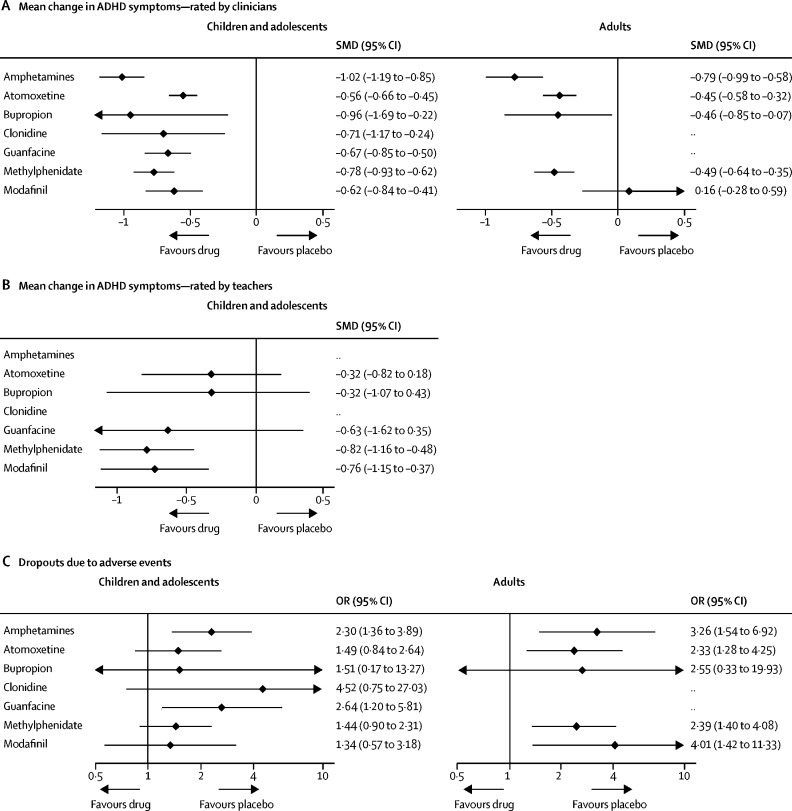
- For clinician-rated ADHD core symptoms closest to 12 weeks in children and adolescents, all included drugs were superior to placebo, including amphetamines (SMD −1·02, 95% CI −1·19 to −0·85), methylphenidate (−0·78, −0·93 to −0·62), and atomoxetine (−0·56, −0·66 to −0·45). For teacher-rated outcomes, only methylphenidate (−0·82, −1·16 to −0·48) and modafinil (−0·76, −1·15 to −0·37) were superior to placebo.
- In adults, clinician-rated efficacy was superior to placebo for amphetamines (SMD −0·79, 95% CI −0·99 to −0·58), methylphenidate (−0·49, −0·64 to −0·35), bupropion (−0·46, −0·85 to −0·07), and atomoxetine (−0·45, −0·58 to −0·32), but not modafinil (0·16, −0·28 to 0·59).
- Tolerability: amphetamines were inferior to placebo in children and adolescents (OR 2·30, 95% CI 1·36–3·89) and adults (3·26, 1·54–6·92); guanfacine was inferior in children and adolescents only (2·64, 1·20–5·81); atomoxetine (2·33, 1·28–4·25), methylphenidate (2·39, 1·40–4·08), and modafinil (4·01, 1·42–11·33) were less well tolerated than placebo in adults only.
- In head-to-head comparisons, only efficacy differences were found, favouring amphetamines over modafinil, atomoxetine, and methylphenidate in children and adolescents (SMDs −0·46 to −0·24) and adults (−0·94 to −0·29). No sufficient data were found for 26-week and 52-week timepoints.
Methods
- Systematic review and network meta-analysis of published and unpublished double-blind randomised controlled trials of oral monotherapy with amphetamines (including lisdexamfetamine), atomoxetine, bupropion, clonidine, guanfacine, methylphenidate, or modafinil versus each other or placebo in children, adolescents, and adults with ADHD.
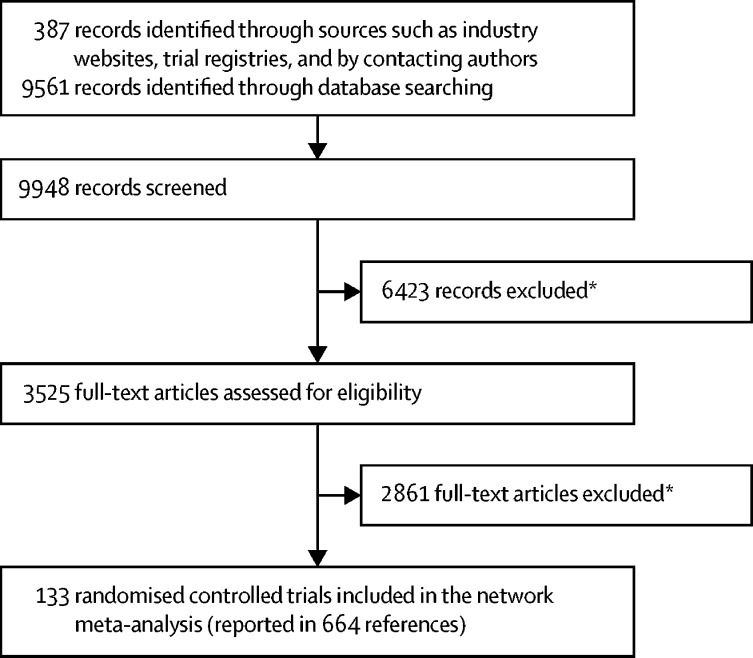
- Searched multiple databases and trial registries from inception to April 7, 2017, with no language restrictions, and contacted authors and manufacturers for unpublished data; 133 trials were included (81 in children and adolescents, 51 in adults, one in both).
- Primary outcomes were efficacy (change in ADHD core symptoms by clinicians’ ratings; teachers’ ratings also for children and adolescents) and tolerability (dropout due to side-effects) at timepoints closest to 12 weeks, 26 weeks, and 52 weeks; random-effects pairwise and network meta-analyses estimated SMDs and ORs, with Cochrane risk-of-bias and GRADE assessments.
Limitations
- The paper states that missing information cannot be ruled out, the latest study update was April 2017, some network nodes included few studies, most included studies compared active drug with placebo, and comparative efficacy was frequently based on indirect comparisons.
- The paper states that few data were available for 26-week and 52-week outcomes, so analyses at these timepoints were not possible; findings can inform only short-term medication treatment.
- The paper states that confidence in estimates was low or very low for many comparisons, especially indirect comparisons, and that paucity of data prevented all planned sensitivity analyses; evident from the text, risk of bias was unclear or high in most included studies, and the authors could not assess some prespecified effect modifiers such as gender, age within paediatric groups, low risk of bias, medication status, and industry sponsorship.
Model-written summary. Check it against the paper before relying on it.
Integrity signals
Registry
Cites
Statistics
Figures
Verification
Claims the paper makes
89 Own result · 21 Own interpretation · 14 Own method · 5 No basis given · 4 Supported · 3 Partly supported · 2 Supported so far · 2 Sources not found · 2 No full text of the sources · accuracy not yet measured
Every source the paper cites for this claim was checked and supports it.
In the paper
“For children and adolescents, we also considered teachers' ratings as a primary efficacy outcome because they provide a complementary view to clinicians' ratings, and information from multiple raters increases the validity of ADHD diagnosis.34”
§ Comparative efficacy and tolerability of medications for attention-deficit hyperactivity disorder in children, adolescents, and adults: a systematic review and network meta-analysis > Methods > Outcomes
What the sources say
- Supportedcites [34] Martel, 2015, Integration of symptom ratings from multiple informants in ADHD diagnosis: a psychometric model with clinical utility, Psychol Assess source
The Abstract explicitly concludes that information from multiple raters increases the validity of ADHD diagnosis. The study examined ratings for children aged 6–17, matching the citing sentence’s population. (LLM, conf=0.95)
plaindirect- Asserted: passes — The authors put it forward as true.
- Checkable: passes — It can be checked against evidence.
- Load-bearing: passes — The paper’s conclusions depend on it.
- Based: passes — The paper gives a reason why it holds.
- Supported
The cited sources support only part of this claim — read each source’s verdict below.
In the paper
“Furthermore, current guidelines are inconsistent in their treatment recommendations.9, 10, 11, 12, 13, 14”
§ Comparative efficacy and tolerability of medications for attention-deficit hyperactivity disorder in children, adolescents, and adults: a systematic review and network meta-analysis > Introduction
What the sources say
- Not matchedcites [9]
Couldn’t be matched to a paper in Crossref, so it can’t be checked.
- Not checked — no full text of the sourcecites [10] Bolea-Alamanac, 2014, Evidence-based guidelines for the pharmacological management of attention deficit hyperactivity disorder: update on recommendations from the British Association for Psychopharmacology, J Psychopharmacol source
- Partly supportedcites [11] Kooij, 2010, European consensus statement on diagnosis and treatment of adult ADHD: the European Network Adult ADHD, BMC Psychiatry sourceExperimental — accuracy not yet measured
The Background section (Stigma in general and among professionals; page unavailable) says NICE recommends stimulants as usual first-line treatment for adults, while their use remains controversial and licensing differs across countries. The Conclusions also acknowledge that local regulatory rules may dictate differently. These passages support variation in treatment policy, but do not establish that guidelines themselves make inconsistent treatment recommendations. (LLM, conf=0.78)
- Not checked — no full text of the sourcecites [12] Pliszka, 2007, Practice parameter for the assessment and treatment of children and adolescents with attention-deficit/hyperactivity disorder, J Am Acad Child Adolesc Psychiatry source
- Could not verifycites [13] Wolraich, 2011, ADHD: clinical practice guideline for the diagnosis, evaluation, and treatment of attention-deficit/hyperactivity disorder in children and adolescents, Pediatrics sourceExperimental — accuracy not yet measured
The Introduction describes this guideline’s treatment recommendations and says its medication recommendations are similar to those of the previous AAP guideline. Our copy does not compare current ADHD guidelines or say their treatment recommendations are inconsistent (searched for inconsistency and differences in treatment recommendations). (LLM, conf=0.75)
- Not matchedcites [14]
Couldn’t be matched to a paper in Crossref, so it can’t be checked.
plain- Asserted: passes — The authors put it forward as true.
- Checkable: passes — It can be checked against evidence.
- Load-bearing: passes — The paper’s conclusions depend on it.
- Based: passes — The paper gives a reason why it holds.
- Not matched
The cited sources support only part of this claim — read each source’s verdict below.
In the paper
“Whereas previous pairwise16, 51 or network meta-analyses19 of ADHD medications rated all comparisons as low or very low quality, attributable in part to unpublished information that we gathered and a more nuanced assessment, we could rate some comparisons as high or moderate quality.”
§ Comparative efficacy and tolerability of medications for attention-deficit hyperactivity disorder in children, adolescents, and adults: a systematic review and network meta-analysis > Discussion
What the sources say
- Supportedcites [16] Punja, 2016, Amphetamines for attention deficit hyperactivity disorder (ADHD) in children and adolescents, Cochrane Database Syst Rev source
The review’s “Quality of the evidence” section says its overall GRADE ratings ranged from low to very low for amphetamines in children and adolescents with ADHD. This supports citing it as a previous pairwise review with low or very low evidence ratings; the citing authors’ higher ratings are their own finding, not one attributed to this source. No page number is available in our copy. (LLM, conf=0.91)
- Not matchedcites [51] Storebo, 2015, Methylphenidate for children and adolescents with attention deficit hyperactivity disorder (ADHD), Cochrane Database Syst Rev
Couldn’t be matched to a paper in Crossref, so it can’t be checked.
- Supportedcites [19] Catala-Lopez, 2017, The pharmacological and non-pharmacological treatment of attention deficit hyperactivity disorder in children and adolescents: a systematic review with network meta-analyses of randomised trials, PLoS One source
The Discussion states that this network meta-analysis rated the overall quality of its evidence from low to very low, and the Results tables show comparisons rated low or very low. The citing authors’ statement that they rated some comparisons high or moderate describes their own analysis, not a finding attributed to this source. (LLM, conf=0.92)
hedged- Asserted: passes — The authors put it forward as true.
- Checkable: passes — It can be checked against evidence.
- Load-bearing: passes — The paper’s conclusions depend on it.
- Based: passes — The paper gives a reason why it holds.
- Supported
Every source the paper cites for this claim was checked and supports it.
In the paper
“We did a PubMed search in May, 2018, and found only three additional studies that met our inclusion critieria.48, 49, 50”
§ Comparative efficacy and tolerability of medications for attention-deficit hyperactivity disorder in children, adolescents, and adults: a systematic review and network meta-analysis > Discussion
What the sources say
- Supportedcites [48] Weisler, 2017, Efficacy and safety of SHP465 mixed amphetamine salts in the treatment of attention-deficit/hyperactivity disorder in adults: results of a randomized, double-blind, placebo-controlled, forced-dose clinical study, CNS Drugs source
The citation identifies one of the additional studies found by the citing authors, rather than attributing their May 2018 PubMed search to this paper. The Materials and Methods section identifies this source as a phase III randomized, double-blind, placebo-controlled study in adults with ADHD. The source cannot establish the citing authors’ total of three studies, but it supports its role as an identified study. (LLM, conf=0.85)
- Supportedcites [49] Brams, 2018, SHP465 mixed amphetamine salts in the treatment of attention-deficit/hyperactivity disorder in children and adolescents: results of a randomized, double-blind placebo-controlled study, J Child Adolesc Psychopharmacol source
The citation identifies this paper as one of the additional studies. Its Methods (Study design and treatment; page not provided) describe a randomized, double-blind, placebo-controlled study, so it is a study of the kind being cited. The May 2018 PubMed search and the count of three are the citing authors’ own account, not findings attributed to this paper. (LLM, conf=0.88)
- Supportedcites [50] Griffiths, 2018, Response inhibition and emotional cognition improved by atomoxetine in children and adolescents with ADHD: the ACTION randomized controlled trial, J Psychiatr Res source
The cited paper’s Methods (Study treatment) describe a randomized atomoxetine-versus-placebo study in children and adolescents with ADHD, so it supports its identification as one of the additional studies. The May 2018 PubMed search and the count of three are the citing authors’ own account, not claims attributed to this paper. (LLM, conf=0.88)
plain- Asserted: passes — The authors put it forward as true.
- Checkable: passes — It can be checked against evidence.
- Load-bearing: unclear — It is unclear whether the paper’s conclusions depend on it.
- Based: passes — The paper gives a reason why it holds.
- Supported
A result the paper reports from its own data — it cites no other source for it, so there is none to check. The quote shows it is in the paper.
In the paper
“For ADHD core symptoms rated by clinicians in children and adolescents closest to 12 weeks, all included drugs were superior to placebo (eg, SMD −1·02, 95% CI −1·19 to −0·85 for amphetamines, −0·78, −0·93 to −0·62 for methylphenidate, −0·56, −0·66 to −0·45 for atomoxetine).”
§ Comparative efficacy and tolerability of medications for attention-deficit hyperactivity disorder in children, adolescents, and adults: a systematic review and network meta-analysis > Abstract > Findings
plaindirectn = 68- Asserted: passes — The authors put it forward as true.
- Checkable: passes — It can be checked against evidence.
- Load-bearing: passes — The paper’s conclusions depend on it.
- Based: passes — The paper gives a reason why it holds.
- The authors state this as an assumption: The heterogeneity parameter τ is equal across all comparisons in the network meta-analysis.
A result the paper reports from its own data — it cites no other source for it, so there is none to check. The quote shows it is in the paper.
In the paper
“In head-to-head comparisons, only differences in efficacy (clinicians' ratings) were found, favouring amphetamines over modafinil, atomoxetine, and methylphenidate in both children and adolescents (SMDs −0·46 to −0·24) and adults (−0·94 to −0·29).”
§ Comparative efficacy and tolerability of medications for attention-deficit hyperactivity disorder in children, adolescents, and adults: a systematic review and network meta-analysis > Abstract > Findings
plaindirect- Asserted: passes — The authors put it forward as true.
- Checkable: passes — It can be checked against evidence.
- Load-bearing: passes — The paper’s conclusions depend on it.
- Based: passes — The paper gives a reason why it holds.
- The authors state this as an assumption: The heterogeneity parameter τ is equal across all comparisons in the network meta-analysis.
A result the paper reports from its own data — it cites no other source for it, so there is none to check. The quote shows it is in the paper.
In the paper
“In adults (clinicians' ratings), amphetamines (SMD −0·79, 95% CI −0·99 to −0·58), methylphenidate (−0·49, −0·64 to −0·35), bupropion (−0·46, −0·85 to −0·07), and atomoxetine (−0·45, −0·58 to −0·32), but not modafinil (0·16, −0·28 to 0·59), were better than placebo.”
§ Comparative efficacy and tolerability of medications for attention-deficit hyperactivity disorder in children, adolescents, and adults: a systematic review and network meta-analysis > Abstract > Findings
plaindirectn = 8,131- Asserted: passes — The authors put it forward as true.
- Checkable: passes — It can be checked against evidence.
- Load-bearing: passes — The paper’s conclusions depend on it.
- Based: passes — The paper gives a reason why it holds.
- The authors state this as an assumption: The heterogeneity parameter τ is equal across all comparisons in the network meta-analysis.
A result the paper reports from its own data — it cites no other source for it, so there is none to check. The quote shows it is in the paper.
In the paper
“For ADHD core symptoms rated by clinicians in children and adolescents closest to 12 weeks, all included drugs were superior to placebo (eg, SMD −1·02, 95% CI −1·19 to −0·85 for amphetamines, −0·78, −0·93 to −0·62 for methylphenidate, −0·56, −0·66 to −0·45 for atomoxetine).”
§ Comparative efficacy and tolerability of medications for attention-deficit hyperactivity disorder in children, adolescents, and adults: a systematic review and network meta-analysis > Abstract > Findings
plaindirectn = 68- Asserted: passes — The authors put it forward as true.
- Checkable: passes — It can be checked against evidence.
- Load-bearing: passes — The paper’s conclusions depend on it.
- Based: passes — The paper gives a reason why it holds.
- The authors state this as an assumption: The heterogeneity parameter τ is equal across all comparisons in the network meta-analysis.
A result the paper reports from its own data — it cites no other source for it, so there is none to check. The quote shows it is in the paper.
In the paper
“We did not find sufficient data for the 26-week and 52-week timepoints.”
§ Comparative efficacy and tolerability of medications for attention-deficit hyperactivity disorder in children, adolescents, and adults: a systematic review and network meta-analysis > Abstract > Findings
plain- Asserted: passes — The authors put it forward as true.
- Checkable: passes — It can be checked against evidence.
- Load-bearing: unclear — It is unclear whether the paper’s conclusions depend on it.
- Based: passes — The paper gives a reason why it holds.
A result the paper reports from its own data — it cites no other source for it, so there is none to check. The quote shows it is in the paper.
In the paper
“In adults (clinicians' ratings), amphetamines (SMD −0·79, 95% CI −0·99 to −0·58), methylphenidate (−0·49, −0·64 to −0·35), bupropion (−0·46, −0·85 to −0·07), and atomoxetine (−0·45, −0·58 to −0·32), but not modafinil (0·16, −0·28 to 0·59), were better than placebo.”
§ Comparative efficacy and tolerability of medications for attention-deficit hyperactivity disorder in children, adolescents, and adults: a systematic review and network meta-analysis > Abstract > Findings
plainn = 8,131- Asserted: passes — The authors put it forward as true.
- Checkable: passes — It can be checked against evidence.
- Load-bearing: passes — The paper’s conclusions depend on it.
- Based: passes — The paper gives a reason why it holds.
- The authors state this as an assumption: The heterogeneity parameter τ is equal across all comparisons in the network meta-analysis.
- It may state two separate claims as one. 24
- Probably not a substantial claim. 20
Every source the paper cites for this claim was checked and supports it.
In the paper
“Finally, to investigate possible differences between lisdexamfetamine and other amphetamines, we did a post-hoc analysis separating this compound, because lisdexamfetamine is metabolised differently from other amphetamines, which could affect its efficacy and tolerability.45”
§ Comparative efficacy and tolerability of medications for attention-deficit hyperactivity disorder in children, adolescents, and adults: a systematic review and network meta-analysis > Methods > Statistical analysis
What the sources say
- Supportedcites [45] Ermer, 2016, Lisdexamfetamine dimesylate: prodrug delivery, amphetamine exposure and duration of efficacy, Clin Drug Investig source
The Conclusions (page not provided) state that hydrolysis of lisdexamfetamine produces a different d-amphetamine exposure profile from an equivalent dose of immediate-release d-amphetamine and may help explain its longer therapeutic action. The Conclusions also link that profile to reduced drug liking, while the Safety section discusses effects relevant to tolerability. The citing sentence appropriately says these differences *could* affect efficacy and tolerability, rather than claiming a demonstrated overall tolerability advantage. (LLM, conf=0.88)
hedgedconditional- Asserted: passes — The authors put it forward as true.
- Checkable: passes — It can be checked against evidence.
- Load-bearing: passes — The paper’s conclusions depend on it.
- Based: passes — The paper gives a reason why it holds.
It may state two separate claims as one.
- Supported
The cited sources support only part of this claim — read each source’s verdict below.
In the paper
“However, even though recommended in clinical guidelines,9, 10, 11, 12, 13, 14 the efficacy and safety of ADHD medications remains controversial.15, 16, 17”
§ Comparative efficacy and tolerability of medications for attention-deficit hyperactivity disorder in children, adolescents, and adults: a systematic review and network meta-analysis > Introduction
What the sources say
- Partly supportedcites [15] Banaschewski, 2016, Methylphenidate for ADHD in children and adolescents: throwing the baby out with the bathwater, Evid Based Ment Health sourceExperimental — accuracy not yet measured
The Abstract describes a dispute over methylphenidate’s efficacy, and the ‘Serious adverse effects (SAEs) of MPH’ section disputes how its safety evidence was interpreted. This supports the existence of controversy for methylphenidate in children and adolescents, but the paper does not establish the claim for ADHD medications generally. The indexed passages provide no page numbers. (LLM, conf=0.83)
- Partly supportedcites [16] Punja, 2016, Amphetamines for attention deficit hyperactivity disorder (ADHD) in children and adolescents, Cochrane Database Syst Rev sourceExperimental — accuracy not yet measured
The review’s “Why it is important to do this review” section calls psychostimulant use a major controversy in ADHD treatment. Its authors’ conclusions report short-term benefit from amphetamines alongside adverse events and limited long-term evidence. The cited review concerns amphetamines in children and adolescents, so it does not establish the claim for all ADHD medications. (LLM, conf=0.84)
- Not checked — no full text of the sourcecites [17] Romanos, 2016, Methylphenidate for attention-deficit/hyperactivity disorder, JAMA source
plain- Asserted: passes — The authors put it forward as true.
- Checkable: fails — It may be too vague to check against evidence.
- Load-bearing: passes — The paper’s conclusions depend on it.
- Based: passes — The paper gives a reason why it holds.
Probably not a substantial claim. It may be too vague to check against evidence.
- Partly supported
Every source the paper cites for this claim was checked and supports it.
In the paper
“We estimated the certainty of evidence with the Grading of Recommendations Assessment, Development, and Evaluation (GRADE) approach for network meta-analyses (appendix pp 18, 19).33”
§ Comparative efficacy and tolerability of medications for attention-deficit hyperactivity disorder in children, adolescents, and adults: a systematic review and network meta-analysis > Methods > Procedures
What the sources say
- Supportedcites [33] Salanti, 2014, Evaluating the quality of evidence from a network meta-analysis, PLoS One source
The Introduction describes a GRADE-inspired approach to evaluating evidence from a network meta-analysis. The section on confidence in each effect size says the authors follow the standard GRADE approach with modifications specific to network meta-analysis, supporting the citation as identification of the method. (LLM, conf=0.94)
hedged- Asserted: passes — The authors put it forward as true.
- Checkable: passes — It can be checked against evidence.
- Load-bearing: passes — The paper’s conclusions depend on it.
- Based: passes — The paper gives a reason why it holds.
Probably not a substantial claim.
- Supported
The sources with a verdict support this claim; the rest weren’t checked yet, have no full text we could read, or their verdicts aren’t rated yet.
In the paper
“Previous network meta-analyses in ADHD have focused on either children and adolescents19, 20, 21, 22, 23, 24 or adults only,25, 26, 27, 28 have typically compared only a few drugs,24, 25, 27, 29 or have addressed exclusively the safety of treatments.26”
§ Comparative efficacy and tolerability of medications for attention-deficit hyperactivity disorder in children, adolescents, and adults: a systematic review and network meta-analysis > Introduction
What the sources say
- Supportedcites [19] Catala-Lopez, 2017, The pharmacological and non-pharmacological treatment of attention deficit hyperactivity disorder in children and adolescents: a systematic review with network meta-analyses of randomised trials, PLoS One source
The citation is attached to the clause about network meta-analyses focused on children and adolescents, not the clauses about adults, drug counts, or safety alone. The Introduction identifies this paper as a network meta-analysis of ADHD treatments in children and adolescents. (LLM, conf=0.94)
- Not checked — no full text of the sourcecites [20] Joseph, 2014, Systematic literature review and mixed treatment comparison of Gxr versus other treatments in children and adolescents with attention deficit hyperactivity disorder (ADHD), Value Health source
- Supportedcites [21] Joseph, 2017, Comparative efficacy and safety of attention-deficit/hyperactivity disorder pharmacotherapies, including guanfacine extended release: a mixed treatment comparison, Eur Child Adolesc Psychiatry source
The citation to this paper supports the children-and-adolescents portion of the sentence, not the separately cited claims about adult-only analyses, few-drug comparisons, or safety-only analyses. The Background and Methods describe a network meta-analysis of ADHD pharmacotherapies in children and adolescents aged 6–17 years. (LLM, conf=0.93)
- Not checked — no full text of the sourcecites [22] Li, 2017, An evaluation on the efficacy and safety of treatments for attention deficit hyperactivity disorder in children and adolescents: a comparison of multiple treatments, Mol Neurobiol source
- Supportedcites [23] Luan, 2017, Efficacy and tolerability of different interventions in children and adolescents with attention deficit hyperactivity disorder, Front Psychiatry source
The Inclusion Criteria restrict participants to children and adolescents aged 6–18. The Introduction describes this as a network meta-analysis of six named drugs, supporting its use as an example of a previous analysis limited to that age group and a defined set of drugs. This citation is not attached to the sentence’s adult-only or safety-only claims. (LLM, conf=0.86)
- Supportedcites [24] Roskell, 2014, Systematic evidence synthesis of treatments for ADHD in children and adolescents: indirect treatment comparisons of lisdexamfetamine with methylphenidate and atomoxetine, Curr Med Res Opin source
The Discussion describes this network meta-analysis as covering children and adolescents with ADHD. The Inclusion criteria limit the drug comparisons to lisdexamfetamine, atomoxetine and methylphenidate formulations, supporting the cited description of a pediatric analysis comparing a few drugs. No page numbers are available in our copy. (LLM, conf=0.91)
- Not checked — no full text of the sourcecites [25] Bushe, 2016, A network meta-analysis of atomoxetine and osmotic release oral system methylphenidate in the treatment of attention-deficit/hyperactivity disorder in adult patients, J Psychopharmacol source
- Not checked — no full text of the sourcecites [26] de Chierrito, 2017, Safety of treatments for ADHD in adults: pairwise and network meta-analyses, J Atten Disord source
- Supportedcites [27] Zimovetz, 2018, A cost-effectiveness analysis of lisdexamfetamine dimesylate in the treatment of adults with attention-deficit/hyperactivity disorder in the UK, Eur J Health Econ source
The citation is attached to the claim that previous ADHD network meta-analyses compared only a few drugs. In Model parameter inputs > Efficacy and safety (page not available), this paper's network meta-analysis reports results for three drugs: lisdexamfetamine, atomoxetine, and extended-release methylphenidate. (LLM, conf=0.91)
- Not checked — no full text of the sourcecites [28] Peterson, 2008, Comparative benefits and harms of competing medications for adults with attention-deficit hyperactivity disorder: a systematic review and indirect comparison meta-analysis, Psychopharmacology (Berl) source
plain- Asserted: passes — The authors put it forward as true.
- Checkable: passes — It can be checked against evidence.
- Load-bearing: passes — The paper’s conclusions depend on it.
- Based: passes — The paper gives a reason why it holds.
It may state two separate claims as one.
- Supported
The sources with a verdict support this claim; the rest weren’t checked yet, have no full text we could read, or their verdicts aren’t rated yet.
In the paper
“We have addressed the limitations of previous network meta-analyses, which focused selectively on children and adolescents19, 20, 21, 22, 23, 24 or adults,25, 26, 27, 28 or included only published material,21, 22, 23, 24, 26 non-blinded trials,19, 21, 22, 23, 24 or non-core ADHD outcomes.19, 22, 25, 28”
§ Comparative efficacy and tolerability of medications for attention-deficit hyperactivity disorder in children, adolescents, and adults: a systematic review and network meta-analysis > Discussion
What the sources say
- Supportedcites [19] Catala-Lopez, 2017, The pharmacological and non-pharmacological treatment of attention deficit hyperactivity disorder in children and adolescents: a systematic review with network meta-analyses of randomised trials, PLoS One source
The paper studies children and adolescents (Introduction) and describes sensitivity analyses that excluded unblinded trials, indicating those trials were included in the main analyses (Methods, Sensitivity analyses performed). Its primary response outcome could use global functioning rather than core ADHD symptoms, with Clinical Global Impression results preferred when multiple scales were reported (Methods, Eligibility criteria). The claims about adults and published-only material are not attached to this citation. (LLM, conf=0.90)
- Not checked — no full text of the sourcecites [20] Joseph, 2014, Systematic literature review and mixed treatment comparison of Gxr versus other treatments in children and adolescents with attention deficit hyperactivity disorder (ADHD), Value Health source
- Supportedcites [21] Joseph, 2017, Comparative efficacy and safety of attention-deficit/hyperactivity disorder pharmacotherapies, including guanfacine extended release: a mixed treatment comparison, Eur Child Adolesc Psychiatry source
The Methods (Search strategy and inclusion/exclusion criteria; page not provided) identify this as a mixed treatment comparison restricted to ADHD trials involving children and adolescents aged 6–17. It therefore supports the attributed example of a previous analysis focused on that age group; the citing authors’ description of this focus as a limitation is their own framing. (LLM, conf=0.91)
plain- Asserted: passes — The authors put it forward as true.
- Checkable: passes — It can be checked against evidence.
- Load-bearing: passes — The paper’s conclusions depend on it.
- Based: passes — The paper gives a reason why it holds.
It may state two separate claims as one.
- Supported
A result the paper reports from its own data — it cites no other source for it, so there is none to check. The quote shows it is in the paper.
In the paper
“The risk of bias was overall low in 27·5% of studies in adults, unclear in 56·8%, and high in 15·7% (appendix pp 382–458).”
§ Comparative efficacy and tolerability of medications for attention-deficit hyperactivity disorder in children, adolescents, and adults: a systematic review and network meta-analysis > Results
plainn = 51- Asserted: passes — The authors put it forward as true.
- Checkable: passes — It can be checked against evidence.
- Load-bearing: unclear — It is unclear whether the paper’s conclusions depend on it.
- Based: passes — The paper gives a reason why it holds.
It may state two separate claims as one.
A result the paper reports from its own data — it cites no other source for it, so there is none to check. The quote shows it is in the paper.
In the paper
“133 double-blind randomised controlled trials (81 in children and adolescents, 51 in adults, and one in both) were included.”
- Also stated in: § Results · plain
“133 studies were retained for the network meta-analysis, 81 in children and adolescents, 51 in adults, and one including children, adolescents, and adults.”
§ Comparative efficacy and tolerability of medications for attention-deficit hyperactivity disorder in children, adolescents, and adults: a systematic review and network meta-analysis > Abstract > Findings
plainn = 81- Asserted: passes — The authors put it forward as true.
- Checkable: passes — It can be checked against evidence.
- Load-bearing: passes — The paper’s conclusions depend on it.
- Based: passes — The paper gives a reason why it holds.
It may state two separate claims as one.
- Also stated in: § Results · plain
A result the paper reports from its own data — it cites no other source for it, so there is none to check. The quote shows it is in the paper.
In the paper
“The risk of bias was rated overall low in 23·5% of studies in children and adolescents, unclear in 65·4%, and high in 11·1%.”
§ Comparative efficacy and tolerability of medications for attention-deficit hyperactivity disorder in children, adolescents, and adults: a systematic review and network meta-analysis > Results
plainn = 81- Asserted: passes — The authors put it forward as true.
- Checkable: passes — It can be checked against evidence.
- Load-bearing: unclear — It is unclear whether the paper’s conclusions depend on it.
- Based: passes — The paper gives a reason why it holds.
It may state two separate claims as one.
A result the paper reports from its own data — it cites no other source for it, so there is none to check. The quote shows it is in the paper.
In the paper
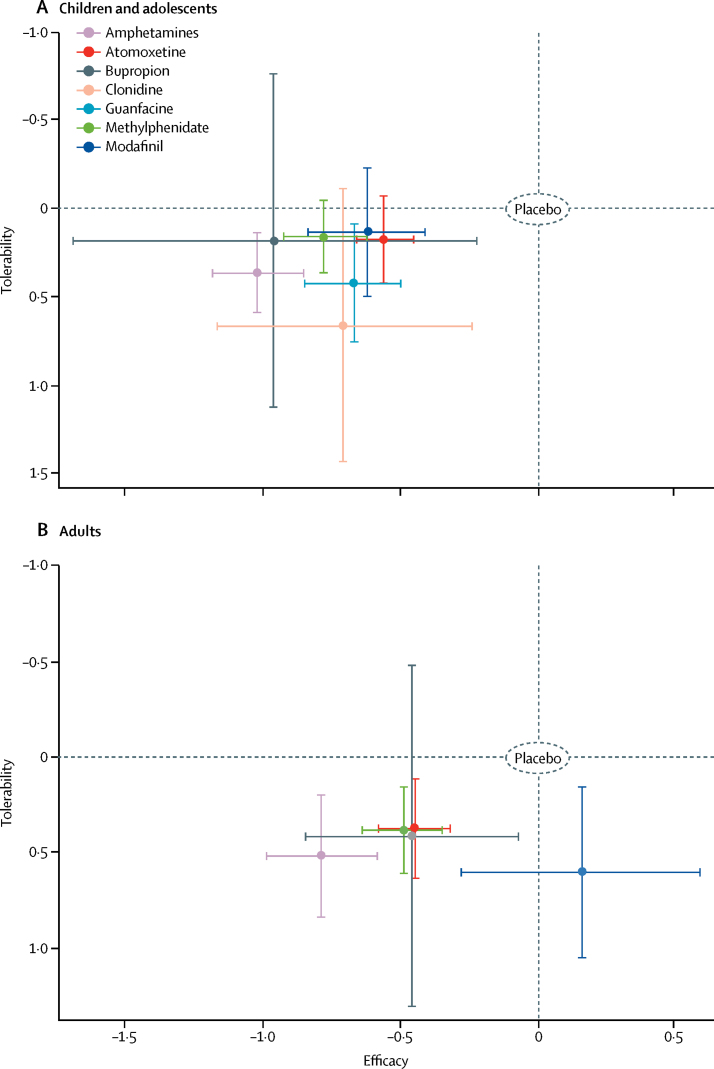
“Medications for ADHD were less efficacious and less well tolerated in adults than in children and adolescents.”
§ Comparative efficacy and tolerability of medications for attention-deficit hyperactivity disorder in children, adolescents, and adults: a systematic review and network meta-analysis > Abstract > Funding
plaincorrelational- Asserted: passes — The authors put it forward as true.
- Checkable: passes — It can be checked against evidence.
- Load-bearing: passes — The paper’s conclusions depend on it.
- Based: passes — The paper gives a reason why it holds.
It may state two separate claims as one.
- The authors state this as an assumption: The heterogeneity parameter τ is equal across all comparisons in the network meta-analysis.
A result the paper reports from its own data — it cites no other source for it, so there is none to check. The quote shows it is in the paper.
In the paper
“However, included drugs were not equivalent, and their profile in terms of efficacy, tolerability, and acceptability varied across age groups.”
§ Comparative efficacy and tolerability of medications for attention-deficit hyperactivity disorder in children, adolescents, and adults: a systematic review and network meta-analysis > Abstract > Funding
plaincorrelational- Asserted: passes — The authors put it forward as true.
- Checkable: passes — It can be checked against evidence.
- Load-bearing: passes — The paper’s conclusions depend on it.
- Based: passes — The paper gives a reason why it holds.
It may state two separate claims as one.
- The authors state this as an assumption: The heterogeneity parameter τ is equal across all comparisons in the network meta-analysis.
The paper states this without a source or data behind it here, so there is nothing to check it against. The quote shows it is in the paper.
In the paper
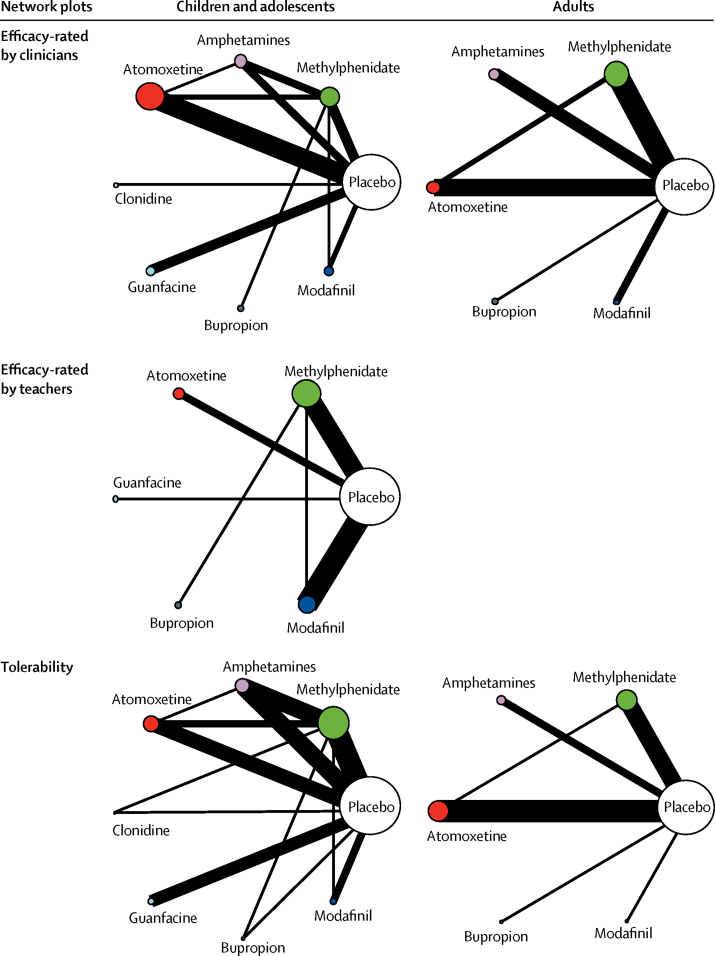
“No teacher ratings were available for clonidine.”
§ Comparative efficacy and tolerability of medications for attention-deficit hyperactivity disorder in children, adolescents, and adults: a systematic review and network meta-analysis > Results
plain- Asserted: passes — The authors put it forward as true.
- Checkable: passes — It can be checked against evidence.
- Load-bearing: fails — The paper’s conclusions may not depend on it.
- Based: passes — The paper gives a reason why it holds.
Probably not a substantial claim. The paper’s conclusions may not depend on it.
The paper states this without a source or data behind it here, so there is nothing to check it against. The quote shows it is in the paper.
In the paper
“For 83% of studies, additional data and information not reported in the full-text paper were used.”
§ Comparative efficacy and tolerability of medications for attention-deficit hyperactivity disorder in children, adolescents, and adults: a systematic review and network meta-analysis > Results
plain- Asserted: passes — The authors put it forward as true.
- Checkable: passes — It can be checked against evidence.
- Load-bearing: fails — The paper’s conclusions may not depend on it.
- Based: passes — The paper gives a reason why it holds.
Probably not a substantial claim. The paper’s conclusions may not depend on it.
A result the paper reports from its own data — it cites no other source for it, so there is none to check. The quote shows it is in the paper.
In the paper
“Of 59 indirect comparisons, the confidence in estimate was very low in 37 comparisons, low in 20, and moderate in two (appendix pp 589–623, 633–43).”
§ Comparative efficacy and tolerability of medications for attention-deficit hyperactivity disorder in children, adolescents, and adults: a systematic review and network meta-analysis > Results
plain- Asserted: passes — The authors put it forward as true.
- Checkable: passes — It can be checked against evidence.
- Load-bearing: unclear — It is unclear whether the paper’s conclusions depend on it.
- Based: passes — The paper gives a reason why it holds.
It may state two separate claims as one.
- The authors state this as an assumption: The network meta-analysis assumes transitivity across comparisons.
A result the paper reports from its own data — it cites no other source for it, so there is none to check. The quote shows it is in the paper.
In the paper
“In general, we found no substantial differences in either efficacy or tolerability across the various medications when the maximum dose allowed was the dose defined by the FDA or by guidelines (suggesting in general higher maximum doses than the FDA).”
§ Comparative efficacy and tolerability of medications for attention-deficit hyperactivity disorder in children, adolescents, and adults: a systematic review and network meta-analysis > Discussion
hedged- Asserted: passes — The authors put it forward as true.
- Checkable: passes — It can be checked against evidence.
- Load-bearing: passes — The paper’s conclusions depend on it.
- Based: passes — The paper gives a reason why it holds.
It may state two separate claims as one.
- The authors state this as an assumption: The network meta-analysis assumes transitivity across comparisons.
A result the paper reports from its own data — it cites no other source for it, so there is none to check. The quote shows it is in the paper.
In the paper
“In general, results for the primary outcomes were robust in our sensitivity analyses, suggesting that trials of short duration (<3 weeks), presence of psychiatric comorbidities, low IQ as an inclusion criterion, dose comparisons that we judged unfair, crossover design, and missing data imputation did not significantly affect the results.”
§ Comparative efficacy and tolerability of medications for attention-deficit hyperactivity disorder in children, adolescents, and adults: a systematic review and network meta-analysis > Discussion
hedged- Asserted: passes — The authors put it forward as true.
- Checkable: passes — It can be checked against evidence.
- Load-bearing: passes — The paper’s conclusions depend on it.
- Based: passes — The paper gives a reason why it holds.
It may state two separate claims as one.
- The authors state this as an assumption: The network meta-analysis assumes transitivity across comparisons.
A result the paper reports from its own data — it cites no other source for it, so there is none to check. The quote shows it is in the paper.
In the paper
“Most included studies compared an active drug with placebo and the number of actual head-to-head trials was quite small, so comparative efficacy between interventions was frequently based on indirect comparisons.”
§ Comparative efficacy and tolerability of medications for attention-deficit hyperactivity disorder in children, adolescents, and adults: a systematic review and network meta-analysis > Discussion
plaindirect- Asserted: passes — The authors put it forward as true.
- Checkable: passes — It can be checked against evidence.
- Load-bearing: passes — The paper’s conclusions depend on it.
- Based: passes — The paper gives a reason why it holds.
It may state two separate claims as one.
- The authors state this as an assumption: The network meta-analysis assumes transitivity across comparisons.
The paper states this without a source or data behind it here, so there is nothing to check it against. The quote shows it is in the paper.
In the paper
“Of note, these comparisons included the most commonly used drugs for ADHD (ie, methylphenidate and amphetamines).”
§ Comparative efficacy and tolerability of medications for attention-deficit hyperactivity disorder in children, adolescents, and adults: a systematic review and network meta-analysis > Discussion
plain- Asserted: passes — The authors put it forward as true.
- Checkable: passes — It can be checked against evidence.
- Load-bearing: fails — The paper’s conclusions may not depend on it.
- Based: passes — The paper gives a reason why it holds.
Probably not a substantial claim. The paper’s conclusions may not depend on it.
A result the paper reports from its own data — it cites no other source for it, so there is none to check. The quote shows it is in the paper.
In the paper
“Of 42 mixed comparisons (ie, combining direct and indirect evidence), the confidence in estimate for primary outcome comparisons was rated as very low in 13 comparisons, low in 18, moderate in ten, and high in one.”
§ Comparative efficacy and tolerability of medications for attention-deficit hyperactivity disorder in children, adolescents, and adults: a systematic review and network meta-analysis > Results
plain- Asserted: passes — The authors put it forward as true.
- Checkable: passes — It can be checked against evidence.
- Load-bearing: passes — The paper’s conclusions depend on it.
- Based: passes — The paper gives a reason why it holds.
It may state two separate claims as one.
- The authors state this as an assumption: The network meta-analysis assumes transitivity across comparisons.
What the paper did — it cites no source for this, so there is none to check. The quote shows it is in the paper.
In the paper
“The funder had no role in study design, data collection, data analysis, data interpretation, or writing of the report.”
§ Comparative efficacy and tolerability of medications for attention-deficit hyperactivity disorder in children, adolescents, and adults: a systematic review and network meta-analysis > Methods > Role of the funding source
plain- Asserted: passes — The authors put it forward as true.
- Checkable: passes — It can be checked against evidence.
- Load-bearing: fails — The paper’s conclusions may not depend on it.
- Based: passes — The paper gives a reason why it holds.
Probably not a substantial claim. The paper’s conclusions may not depend on it.
In the paper
“The methods used for sequencing these recommendations are not always specified and most commonly—including the 2018 UK National Institute for Health and Care Excellence (NICE) guidelines9—incorporate national drug licencing regulatory approval and cost-effectiveness with expert opinion in conjunction with the few head-to-head comparisons that are available.”
§ Comparative efficacy and tolerability of medications for attention-deficit hyperactivity disorder in children, adolescents, and adults: a systematic review and network meta-analysis > Introduction
What the sources say
- Not matchedcites [9]
Couldn’t be matched to a paper in Crossref, so it can’t be checked.
plain- Asserted: passes — The authors put it forward as true.
- Checkable: passes — It can be checked against evidence.
- Load-bearing: unclear — It is unclear whether the paper’s conclusions depend on it.
- Based: passes — The paper gives a reason why it holds.
It may state two separate claims as one.
- Not matched
What the paper did — it cites no source for this, so there is none to check. The quote shows it is in the paper.
In the paper
“We included double-blind randomised controlled trials (parallel group, crossover, or cluster), of at least 1 week's duration, that enrolled children (aged ≥5 years and <12 years), adolescents (aged ≥12 years and <18 years), or adults (≥18 years) with a primary diagnosis of ADHD according to DSM-III, DSM III-R, DSM-IV(TR), DSM-5, ICD-9, or ICD-10.”
§ Comparative efficacy and tolerability of medications for attention-deficit hyperactivity disorder in children, adolescents, and adults: a systematic review and network meta-analysis > Methods > Search strategy and selection criteria
plain- Asserted: passes — The authors put it forward as true.
- Checkable: passes — It can be checked against evidence.
- Load-bearing: passes — The paper’s conclusions depend on it.
- Based: passes — The paper gives a reason why it holds.
Probably not a substantial claim.
What the paper did — it cites no source for this, so there is none to check. The quote shows it is in the paper.
In the paper
“Data were extracted by at least two independent investigators.”
§ Comparative efficacy and tolerability of medications for attention-deficit hyperactivity disorder in children, adolescents, and adults: a systematic review and network meta-analysis > Methods > Procedures
plain- Asserted: passes — The authors put it forward as true.
- Checkable: passes — It can be checked against evidence.
- Load-bearing: fails — The paper’s conclusions may not depend on it.
- Based: passes — The paper gives a reason why it holds.
Probably not a substantial claim. The paper’s conclusions may not depend on it.
In the paper
“We followed the PRISMA extension for network meta-analyses.31”
§ Comparative efficacy and tolerability of medications for attention-deficit hyperactivity disorder in children, adolescents, and adults: a systematic review and network meta-analysis > Methods > Search strategy and selection criteria
What the sources say
- Not checked — no full text of the sourcecites [31] Hutton, 2015, The PRISMA extension statement for reporting of systematic reviews incorporating network meta-analyses of health care interventions: checklist and explanations, Ann Intern Med source
plain- Asserted: passes — The authors put it forward as true.
- Checkable: passes — It can be checked against evidence.
- Load-bearing: fails — The paper’s conclusions may not depend on it.
- Based: passes — The paper gives a reason why it holds.
Probably not a substantial claim. The paper’s conclusions may not depend on it.
What the paper did — it cites no source for this, so there is none to check. The quote shows it is in the paper.
In the paper
“We also contacted study authors and drug manufacturers to gather unpublished information and data (appendix p 15).”
§ Comparative efficacy and tolerability of medications for attention-deficit hyperactivity disorder in children, adolescents, and adults: a systematic review and network meta-analysis > Methods > Search strategy and selection criteria
plain- Asserted: passes — The authors put it forward as true.
- Checkable: passes — It can be checked against evidence.
- Load-bearing: fails — The paper’s conclusions may not depend on it.
- Based: passes — The paper gives a reason why it holds.
Probably not a substantial claim. The paper’s conclusions may not depend on it.
What the paper did — it cites no source for this, so there is none to check. The quote shows it is in the paper.
In the paper
“Our study protocol was registered with PROSPERO (number CRD42014008976) and published.30”
§ Comparative efficacy and tolerability of medications for attention-deficit hyperactivity disorder in children, adolescents, and adults: a systematic review and network meta-analysis > Methods > Search strategy and selection criteria
plain- Asserted: passes — The authors put it forward as true.
- Checkable: passes — It can be checked against evidence.
- Load-bearing: fails — The paper’s conclusions may not depend on it.
- Based: passes — The paper gives a reason why it holds.
Probably not a substantial claim. The paper’s conclusions may not depend on it.
What the paper did — it cites no source for this, so there is none to check. The quote shows it is in the paper.
In the paper
“SCo, NA, CDG, and AC had full access to all data in the study, and AC was responsible for the final decision to submit for publication.”
§ Comparative efficacy and tolerability of medications for attention-deficit hyperactivity disorder in children, adolescents, and adults: a systematic review and network meta-analysis > Methods > Role of the funding source
plain- Asserted: passes — The authors put it forward as true.
- Checkable: passes — It can be checked against evidence.
- Load-bearing: fails — The paper’s conclusions may not depend on it.
- Based: passes — The paper gives a reason why it holds.
Probably not a substantial claim. The paper’s conclusions may not depend on it. It may state two separate claims as one.
In the paper
“Network meta-analyses facilitate estimation of the comparative efficacy and tolerability of two or more interventions, even when they have not been investigated head-to-head in randomised controlled trials.18 Thus, compared with standard pairwise meta-analyses, network meta-analyses have been found to increase the precision of the estimates.18”
§ Comparative efficacy and tolerability of medications for attention-deficit hyperactivity disorder in children, adolescents, and adults: a systematic review and network meta-analysis > Introduction
What the sources say
- Not checked — no full text of the sourcecites [18] Cipriani, 2013, Conceptual and technical challenges in network meta-analysis, Ann Intern Med source
plaindirect- Asserted: passes — The authors put it forward as true.
- Checkable: passes — It can be checked against evidence.
- Load-bearing: passes — The paper’s conclusions depend on it.
- Based: passes — The paper gives a reason why it holds.
It may state two separate claims as one.
What the paper did — it cites no source for this, so there is none to check. The quote shows it is in the paper.
In the paper
“We excluded studies with enrichment designs (eg, trials selecting drug responders only after a run-in phase), because these types of trial can potentially inflate efficacy and tolerability estimates.”
§ Comparative efficacy and tolerability of medications for attention-deficit hyperactivity disorder in children, adolescents, and adults: a systematic review and network meta-analysis > Methods > Search strategy and selection criteria
plain- Asserted: passes — The authors put it forward as true.
- Checkable: passes — It can be checked against evidence.
- Load-bearing: passes — The paper’s conclusions depend on it.
- Based: passes — The paper gives a reason why it holds.
Probably not a substantial claim.
- Rests on an assumption: Enrichment designs can potentially inflate efficacy and tolerability estimates.
In the paper
“We assessed risk of bias with the Cochrane risk of bias tool.32”
§ Comparative efficacy and tolerability of medications for attention-deficit hyperactivity disorder in children, adolescents, and adults: a systematic review and network meta-analysis > Methods > Procedures
What the sources say
- Not matchedcites [32]
Couldn’t be matched to a paper in Crossref, so it can’t be checked.
plain- Asserted: passes — The authors put it forward as true.
- Checkable: passes — It can be checked against evidence.
- Load-bearing: fails — The paper’s conclusions may not depend on it.
- Based: passes — The paper gives a reason why it holds.
Probably not a substantial claim. The paper’s conclusions may not depend on it.
- Not matched
What the paper did — it cites no source for this, so there is none to check. The quote shows it is in the paper.
In the paper
“Moreover, because of a paucity of data, we were unable to properly undertake all the planned sensitivity analyses.”
§ Comparative efficacy and tolerability of medications for attention-deficit hyperactivity disorder in children, adolescents, and adults: a systematic review and network meta-analysis > Discussion
plaindirect- Asserted: passes — The authors put it forward as true.
- Checkable: passes — It can be checked against evidence.
- Load-bearing: fails — The paper’s conclusions may not depend on it.
- Based: passes — The paper gives a reason why it holds.
Probably not a substantial claim. The paper’s conclusions may not depend on it.
A conclusion the paper draws from its own results — it cites no other source for it, so there is none to check. The quote shows it is in the paper.
In the paper
“This scarcity of data reflects ethical issues associated with doing long-term, placebo-controlled, randomised controlled trials of effective treatments.”
§ Comparative efficacy and tolerability of medications for attention-deficit hyperactivity disorder in children, adolescents, and adults: a systematic review and network meta-analysis > Discussion
plaincorrelational- Asserted: passes — The authors put it forward as true.
- Checkable: passes — It can be checked against evidence.
- Load-bearing: passes — The paper’s conclusions depend on it.
- Based: passes — The paper gives a reason why it holds.
Probably not a substantial claim.
- Rests on an assumption: Long-term, placebo-controlled, randomised controlled trials of effective treatments raise ethical issues.
A conclusion the paper draws from its own results — it cites no other source for it, so there is none to check. The quote shows it is in the paper.
In the paper
“These characteristics were quite evenly distributed across the included studies and across the different nodes in the network, therefore, even if they contributed to statistical heterogeneity, it is unlikely that they have implications in terms of clinical heterogeneity and affected the validity of our results.”
§ Comparative efficacy and tolerability of medications for attention-deficit hyperactivity disorder in children, adolescents, and adults: a systematic review and network meta-analysis > Discussion
hedged- Asserted: passes — The authors put it forward as true.
- Checkable: passes — It can be checked against evidence.
- Load-bearing: passes — The paper’s conclusions depend on it.
- Based: passes — The paper gives a reason why it holds.
It may state two separate claims as one.
What the paper did — it cites no source for this, so there is none to check. The quote shows it is in the paper.
In the paper
“These characteristics were quite evenly distributed across the included studies and across the different nodes in the network, therefore, even if they contributed to statistical heterogeneity, it is unlikely that they have implications in terms of clinical heterogeneity and affected the validity of our results.”
§ Comparative efficacy and tolerability of medications for attention-deficit hyperactivity disorder in children, adolescents, and adults: a systematic review and network meta-analysis > Discussion
plain- Asserted: passes — The authors put it forward as true.
- Checkable: passes — It can be checked against evidence.
- Load-bearing: passes — The paper’s conclusions depend on it.
- Based: unclear — It is unclear why the paper says it holds.
It may state two separate claims as one.
- The authors state this as an assumption: The network meta-analysis assumes transitivity across comparisons.
What the paper did — it cites no source for this, so there is none to check. The quote shows it is in the paper.
In the paper
“We planned to do analyses for outcomes closest to 12 weeks, 26 weeks, and 52 weeks, but few data were available for 26 weeks and 52 weeks and analyses at these timepoints were, therefore, not possible.”
§ Comparative efficacy and tolerability of medications for attention-deficit hyperactivity disorder in children, adolescents, and adults: a systematic review and network meta-analysis > Discussion
plain- Asserted: passes — The authors put it forward as true.
- Checkable: passes — It can be checked against evidence.
- Load-bearing: passes — The paper’s conclusions depend on it.
- Based: passes — The paper gives a reason why it holds.
Probably not a substantial claim. It may state two separate claims as one.
A conclusion the paper draws from its own results — it cites no other source for it, so there is none to check. The quote shows it is in the paper.
In the paper
“Notwithstanding these caveats, our findings represent the best currently available evidence base (not constrained by local costs and licencing) to inform future guidelines internationally and shared decision-making between patients, carers, and clinicians, when a balance has to be made between efficacy and tolerability of ADHD medications.”
§ Comparative efficacy and tolerability of medications for attention-deficit hyperactivity disorder in children, adolescents, and adults: a systematic review and network meta-analysis > Discussion
plain- Asserted: passes — The authors put it forward as true.
- Checkable: fails — It may be too vague to check against evidence.
- Load-bearing: passes — The paper’s conclusions depend on it.
- Based: passes — The paper gives a reason why it holds.
Probably not a substantial claim. It may be too vague to check against evidence.
What the paper did — it cites no source for this, so there is none to check. The quote shows it is in the paper.
In the paper
“Although we included studies that used different rating scales to assess the core symptoms of ADHD, we selected carefully only validated scales that measure exclusively the same triad of symptoms—ie, inattention, hyperactivity, and impulsivity.”
§ Comparative efficacy and tolerability of medications for attention-deficit hyperactivity disorder in children, adolescents, and adults: a systematic review and network meta-analysis > Discussion
plain- Asserted: passes — The authors put it forward as true.
- Checkable: passes — It can be checked against evidence.
- Load-bearing: passes — The paper’s conclusions depend on it.
- Based: passes — The paper gives a reason why it holds.
Probably not a substantial claim. It may state two separate claims as one.
A conclusion the paper draws from its own results — it cites no other source for it, so there is none to check. The quote shows it is in the paper.
In the paper
“Additionally, amphetamines significantly increased diastolic blood pressure in children and adolescents, but not in adults.”
§ Comparative efficacy and tolerability of medications for attention-deficit hyperactivity disorder in children, adolescents, and adults: a systematic review and network meta-analysis > Discussion
plaindirect- Asserted: passes — The authors put it forward as true.
- Checkable: passes — It can be checked against evidence.
- Load-bearing: passes — The paper’s conclusions depend on it.
- Based: passes — The paper gives a reason why it holds.
It may state two separate claims as one.
What the paper did — it cites no source for this, so there is none to check. The quote shows it is in the paper.
In the paper
“Although we did our best to include all available trials and retrieve unpublished data, we cannot rule out the possibility of missing information.”
§ Comparative efficacy and tolerability of medications for attention-deficit hyperactivity disorder in children, adolescents, and adults: a systematic review and network meta-analysis > Discussion
hedged- Asserted: passes — The authors put it forward as true.
- Checkable: passes — It can be checked against evidence.
- Load-bearing: fails — The paper’s conclusions may not depend on it.
- Based: passes — The paper gives a reason why it holds.
Probably not a substantial claim. The paper’s conclusions may not depend on it.
A conclusion the paper draws from its own results — it cites no other source for it, so there is none to check. The quote shows it is in the paper.
In the paper
“Accounting for all included outcomes, our results support methylphenidate in children and adolescents, and amphetamines in adults, as the first pharmacological choice for ADHD.”
§ Comparative efficacy and tolerability of medications for attention-deficit hyperactivity disorder in children, adolescents, and adults: a systematic review and network meta-analysis > Discussion
plaindirect- Asserted: passes — The authors put it forward as true.
- Checkable: passes — It can be checked against evidence.
- Load-bearing: passes — The paper’s conclusions depend on it.
- Based: passes — The paper gives a reason why it holds.
It may state two separate claims as one.
What the paper did — it cites no source for this, so there is none to check. The quote shows it is in the paper.
In the paper
“Finally, we did not include studies of antipsychotic or tricyclic antidepressant compounds because, although commonly prescribed for patients with ADHD, they are not used routinely to treat ADHD core symptoms, and their inclusion would, therefore, violate the assumption of transitivity in the networks.”
§ Comparative efficacy and tolerability of medications for attention-deficit hyperactivity disorder in children, adolescents, and adults: a systematic review and network meta-analysis > Discussion
plaindirect- Asserted: passes — The authors put it forward as true.
- Checkable: passes — It can be checked against evidence.
- Load-bearing: passes — The paper’s conclusions depend on it.
- Based: passes — The paper gives a reason why it holds.
It may state two separate claims as one.
- The authors state this as an assumption: The network meta-analysis assumes transitivity across comparisons.
- Rests on an assumption: Antipsychotic or tricyclic antidepressant compounds are not used routinely to treat ADHD core symptoms.
A conclusion the paper draws from its own results — it cites no other source for it, so there is none to check. The quote shows it is in the paper.
In the paper
“However, the included medications were not equivalent in relation to their mean effect size, which ranged from moderate to high and varied according to the type of rater.”
§ Comparative efficacy and tolerability of medications for attention-deficit hyperactivity disorder in children, adolescents, and adults: a systematic review and network meta-analysis > Discussion
plaincorrelational- Asserted: passes — The authors put it forward as true.
- Checkable: passes — It can be checked against evidence.
- Load-bearing: passes — The paper’s conclusions depend on it.
- Based: passes — The paper gives a reason why it holds.
It may state two separate claims as one.
The authors state this as an assumption.
The heterogeneity parameter τ is equal across all comparisons in the network meta-analysis.
“We did network meta-analyses within a frequentist framework assuming equal heterogeneity parameter τ across all comparisons and accounting for correlations induced by multiarm studies.37, 38”
The paper relies on this without support.
Enrichment designs can potentially inflate efficacy and tolerability estimates.
“We excluded studies with enrichment designs (eg, trials selecting drug responders only after a run-in phase), because these types of trial can potentially inflate efficacy and tolerability estimates.”
The authors state this as an assumption.
The network meta-analysis assumes transitivity across comparisons.
“To adhere to the assumption of transitivity and reduce the risk of biased estimates (for instance, those that included enrichment designs), we had to discard many studies that were initially selected as potentially relevant (appendix pp 26–235).”
The paper relies on this without support.
There is considerable interindividual variation in terms of the most effective dose.
“There is considerable interindividual variation in terms of most effective dose.”
The paper relies on this without support.
Antipsychotic or tricyclic antidepressant compounds are not used routinely to treat ADHD core symptoms.
“Finally, we did not include studies of antipsychotic or tricyclic antidepressant compounds because, although commonly prescribed for patients with ADHD, they are not used routinely to treat ADHD core symptoms, and their inclusion would, therefore, violate the assumption of transitivity in the networks.”
The paper relies on this without support.
Long-term, placebo-controlled, randomised controlled trials of effective treatments raise ethical issues.
“This scarcity of data reflects ethical issues associated with doing long-term, placebo-controlled, randomised controlled trials of effective treatments.”
The paper relies on this without support.
Doses higher than those recommended in available guidelines poorly reflect common clinical practice.
“We excluded some studies9, 46, 47 because they included doses higher than those recommended in available guidelines, thus poorly reflecting common clinical practice.”
The paper relies on this without support.
Patients seen in real-world clinical practice tend to have similar variations.
“On the contrary, heterogeneity can be seen as increasing the external validity of our findings, because the patients seen in real-world clinical practice tend to have similar variations.”
Claims other papers make about this one
Each is checked against this paper’s own text: does it say what the citing paper says it does?
The source backs part of the claim, not all of it — or backs it for a different population, condition or comparison.
In the citing paper
“There are two main stimulant families: the amphetamines are usually slightly more efficacious than the methylphenidate derivates which are usually better tolerated [49].”
From An Update on Psychopharmacological Treatment of Autism Spectrum Disorder (2022) · cites this paper as [49]
Experimental — accuracy not yet measuredThe source backs part of the claim, not all of it — or backs it for a different population, condition or comparison.
In the citing paper
“However, the tolerability of guanfacine in children with ADHD is poor. It has the most drop-outs due to side effects of all tested medications according to a network meta-analysis, closely followed by amphetamine-based medication such as lisdexamfetamine (25).”
From Differential effects of a single dose of Lisdexamfetamine and Guanfacine on cognitive function in children with ADHD (2025) · cites this paper as [25]
Experimental — accuracy not yet measuredThe source backs part of the claim, not all of it — or backs it for a different population, condition or comparison.
In the citing paper
“Meta-analyses have shown efficacy of lisdexamfetamine in improving ADHD symptoms with large effect sizes (32, 33).”
From Differential effects of a single dose of Lisdexamfetamine and Guanfacine on cognitive function in children with ADHD (2025) · cites this paper as [32]
Experimental — accuracy not yet measuredThe source backs part of the claim, not all of it — or backs it for a different population, condition or comparison.
In the citing paper
“The newer licensed non-stimulant guanfacine which is an α2-adrenergic receptor agonist reduces ADHD symptoms with medium effect-sizes (0.5) in children with ADHD (25).”
From Differential effects of a single dose of Lisdexamfetamine and Guanfacine on cognitive function in children with ADHD (2025) · cites this paper as [25]
Experimental — accuracy not yet measuredThe source backs part of the claim, not all of it — or backs it for a different population, condition or comparison.
In the citing paper
“Although ADHD is distinct from new-onset post-RRSO executive functioning problems, the management of ADHD can be informative as LDX is a preferred treatment [25,26].”
From Treating new-onset cognitive complaints after risk-reducing salpingo-oophorectomy: A randomized controlled crossover trial of lisdexamfetamine (2024) · cites this paper as [25]
Experimental — accuracy not yet measured
The source backs part of the claim, not all of it — or backs it for a different population, condition or comparison.
In the citing paper
“Stimulants have generally been used as first-line pharmacologic treatment owing to a higher efficacy in symptomatology reduction compared to nonstimulant medications in all groups of age (children, adolescents and adults) [17, 33, 34].”
From Molecular Characterisation of the Mechanism of Action of Stimulant Drugs Lisdexamfetamine and Methylphenidate on ADHD Neurobiology: A Review (2022) · cites this paper as [34]
Experimental — accuracy not yet measuredThe source backs part of the claim, not all of it — or backs it for a different population, condition or comparison.
In the citing paper
“Common exclusion criteria in RCTs of ADHD medications include the presence of psychiatric or neurodevelopmental comorbidities (eg, major depressive disorder, autism spectrum disorder, psychosis, or intellectual disability) or other medical conditions (eg, cardiovascular disease).2”
From Evaluating ADHD medication trial representativeness: a Swedish population-based study comparing hypothetically trial-eligible and trial-ineligible individuals (2025) · cites this paper as [2]
Experimental — accuracy not yet measuredThe cited source says what the claim attributes to it.
In the citing paper
“Robust evidence supports the efficacy of stimulant medications (e.g., methylphenidate, amphetamines) and non-stimulants (e.g., atomoxetine) in reducing core symptoms of ADHD [142,143].”
From ADHD in Adulthood: Clinical Presentation, Comorbidities, and Treatment Perspectives (2025) · cites this paper as [142]
The cited source says what the claim attributes to it.
In the citing paper
“In this sense, a systematic review and network meta-analysis carried out in 2018 using 133 double-blind randomised controlled trials positioned MPH in children and adolescents, and amphetamines in adults, as preferred first-choice medications for the short-term treatment of ADHD [34].”
From Molecular Characterisation of the Mechanism of Action of Stimulant Drugs Lisdexamfetamine and Methylphenidate on ADHD Neurobiology: A Review (2022) · cites this paper as [34]
The cited source says what the claim attributes to it.
In the citing paper
“This dataset of double-blind RCTs of ADHD medications was initially created by the European ADHD Guidelines Group to conduct the systematic review and network meta-analysis by Cortese and colleagues.2 We used data from RCTs included in the most recent update of MED-ADHD (on Jan 22, 2024), encompassing 164 eligible RCTs.”
In the citing paper
“Data from randomized trials, systematic reviews, and meta-analyses show that atomoxetine and alpha-2-adrenergic agonists are more effective than placebo in reducing the core symptoms of ADHD, but as a class, they are less effective than stimulants [49, 55, 56].”
From An Update on Psychopharmacological Treatment of Autism Spectrum Disorder (2022) · cites this paper as [49]
In the citing paper
“In a systematic review and network meta-analysis that included 81 published and unpublished randomized trials in > 10,000 neurotypical children, amphetamines were slightly more efficacious than methylphenidate in reducing clinician-rated core symptoms of ADHD at approximately 12 weeks; however, amphetamines were less tolerable than placebo and methylphenidate was better tolerated than amphetamines”
From An Update on Psychopharmacological Treatment of Autism Spectrum Disorder (2022) · cites this paper as [49]
Self-check
Percentages, sums and reported differences re-computed from the paper’s own numbers.
Each contradiction between two passages listed here was confirmed by an independent check.
Rated minor: it would not touch a result — a value no result rests on, a p-value that stays on the same side of the significance level, or a conflict that is clerical, resolved elsewhere in the paper, or outside its own findings.
In the paper
§ Comparative efficacy and tolerability of medications for attention-deficit hyperactivity disorder in children, adolescents, and adults: a systematic review and network meta-analysis > Results
“Use of amphetamines (0·21, 0·12–0·31), atomoxetine (0·28, 0·18–0·37), and methylphenidate (0·24, 0·14–0·33) in children and adults”
§ Comparative efficacy and tolerability of medications for attention-deficit hyperactivity disorder in children, adolescents, and adults: a systematic review and network meta-analysis > Discussion
“Additionally, amphetamines significantly increased diastolic blood pressure in children and adolescents, but not in adults.”
Citations
Cites
Diagnostic and Statistical Manual of Mental Disorders
Williams, J. B. W., & First, M. B. (2013) · Oxford University Press eBooks · doi:10.1093/acrefore/9780199975839.013.104 · Cited by 109,845
Measuring inconsistency in meta-analyses
Higgins, J. P. T., Thompson, S. G., Deeks, J. J., & Altman, D. G. (2003) · BMJ · doi:10.1136/bmj.327.7414.557 · Cited by 63,139
Meta-analysis in clinical trials
DerSimonian, R., & Laird, N. (1986) · Controlled Clinical Trials · doi:10.1016/0197-2456(86)90046-2 · Cited by 39,552
Hutton, B., Salanti, G., Caldwell, D. M., Chaimani, A., Schmid, C. H., Cameron, C., Ioannidis, J. P. A., Straus, S., Thorlund, K., Jansen, J. P., et al. (2015) · Annals of Internal Medicine · doi:10.7326/m14-2385 · Cited by 8,269
The worldwide prevalence of ADHD: a systematic review and metaregression analysis
Polanczyk, G., de Lima, M. S., Horta, B. L., Biederman, J., & Rohde, L. A. (2007) · American Journal of Psychiatry · doi:10.1176/ajp.2007.164.6.942 · Cited by 5,346
Salanti, G., Ades, A. E., & Ioannidis, J. P. A. (2011) · Journal of Clinical Epidemiology · doi:10.1016/j.jclinepi.2010.03.016 · Cited by 3,766
Assessing Risk of Bias in Included Studies
Higgins, J. P., & Altman, D. G. (2008) · Cochrane Handbook for Systematic Reviews of Interventions · doi:10.1002/9780470712184.ch8 · Cited by 3,396
Subcommittee on Attention-Deficit/Hyperactivity Disorder, S. C. O. Q. I. A. M. (2011) · Pediatrics · doi:10.1542/peds.2011-2654 · Cited by 2,185
Consistency and inconsistency in network meta-analysis: concepts and models for multi-arm studies
Higgins, J. P. T., Jackson, D., Barrett, J. K., Lu, G., Ades, A. E., & White, I. R. (2012) · Research Synthesis Methods · doi:10.1002/jrsm.1044 · Cited by 2,098
Pliszka, S. (2007) · Journal of the American Academy of Child & Adolescent Psychiatry · doi:10.1097/chi.0b013e318054e724 · Cited by 1,765
Cited by
Sorted by citations
Items 201–300 of 1,400
Brauer, H., Breitling-Ziegler, C., Moliadze, V., Galling, B., & Prehn‐Kristensen, A. (2021) · Progress in brain research · doi:10.1016/bs.pbr.2021.01.013 · Cited by 27
Long-term medication for ADHD and development of cognitive functions in children and adolescents
Johnson, M., Johnels, J. Å., Östlund, S., Cedergren, K., Omanovic, Z., Hjalmarsson, K., Jakobsson, K., Högstedt, J., & Billstedt, E. (2021) · Journal of Psychiatric Research · doi:10.1016/j.jpsychires.2021.07.055 · Cited by 27
“Being ADHD”: a Qualitative Study
Redshaw, R., & McCormack, L. (2022) · Advances in Neurodevelopmental Disorders · doi:10.1007/s41252-021-00227-5 · Cited by 35
Ter-Minassian, L., Viani, N., Wickersham, A., Cross, L., Stewart, R. J., Velupillai, S. U., & Downs, J. M. (2022) · BMJ Open · doi:10.1136/bmjopen-2021-058058 · Cited by 29
Hermosillo, R. J. M., Mooney, M. A., Feczko, E., Earl, E., Marr, M. C., Sturgeon, D., Perrone, A. J., Miranda-Domínguez, Ó., Faraone, S. V., Wilmot, B., et al. (2019) · Biological Psychiatry Cognitive Neuroscience and Neuroimaging · doi:10.1016/j.bpsc.2019.11.014 · Cited by 31
Vasiliadis, H., Lunghi, C., Rahme, E., Rochette, L., Gignac, M., Massamba, V. K., Diallo, F. B., Fansi, A. K., Cortese, S., & LESAGE, A. D. (2024) · Translational Psychiatry · doi:10.1038/s41398-024-02825-y · Cited by 28
Self-citationPharmacological management of gambling disorder: A systematic review and network meta-analysis
Ioannidis, K., Giovane, C. D., Tzagarakis, C., Solly, J. E., Westwood, S. J., Parlatini, V., Bowden‐Jones, H., Grant, J. E., Cortese, S., & Chamberlain, S. R. (2024) · Comprehensive Psychiatry · doi:10.1016/j.comppsych.2024.152566 · Cited by 32
Self-citationPatterns of long-term ADHD medication use in Australian children
Efron, D., Mulraney, M., Sciberras, E., Hiscock, H., Hearps, S. J. C., & Coghill, D. (2020) · Archives of Disease in Childhood · doi:10.1136/archdischild-2019-317997 · Cited by 25
Self-citationNøvik, T. S., Haugan, A.-L. J., Lydersen, S., Thomsen, P. H., Young, S., & Sund, A. M. (2020) · BMJ Open · doi:10.1136/bmjopen-2019-032839 · Cited by 25
Criaud, M., Wulff, M., Alegría, A. A., Barker, G. J., Giampietro, V., & Rubia, K. (2020) · NeuroImage Clinical · doi:10.1016/j.nicl.2020.102311 · Cited by 26
Ivanov, I., Bjork, J. M., Blair, J., & Newcorn, J. H. (2022) · Neuroscience & Biobehavioral Reviews · doi:10.1016/j.neubiorev.2022.104575 · Cited by 26
Houghton, R., de Vries, F., & Loss, G. J. (2019) · CNS Drugs · doi:10.1007/s40263-019-00686-4 · Cited by 25
Schachar, R. J. (2023) · Neuroscience & Biobehavioral Reviews · doi:10.1016/j.neubiorev.2023.105461 · Cited by 28
Farhat, L. C., Lannes, A., Giovane, C. D., Parlatini, V., Garcia‐Argibay, M., Ostinelli, E. G., Tomlinson, A., Chang, Z., Larsson, H., Fava, C., et al. (2025) · The Lancet Psychiatry · doi:10.1016/s2215-0366(25)00062-8 · Cited by 26
Self-citationCervelló, X. C., Ramon, M., Cunill, R., Olivé, C., & Serrano, D. (2020) · Journal of Attention Disorders · doi:10.1177/1087054720903372 · Cited by 27
Approach to Evaluating and Managing Adult Attention-Deficit/Hyperactivity Disorder in Primary Care
Huang, H. Y., Huang, H., Spottswood, M., & Ghaemi, S. N. (2020) · Harvard Review of Psychiatry · doi:10.1097/hrp.0000000000000248 · Cited by 26
Lam, S.-L., Criaud, M., Alegría, A. A., Barker, G. J., Giampietro, V., & Rubia, K. (2020) · NeuroImage Clinical · doi:10.1016/j.nicl.2020.102291 · Cited by 26
Mykletun, A., Widding‐Havneraas, T., Chaulagain, A., Lyhmann, I., Bjelland, I., Halmøy, A., Elwert, F., Butterworth, P., Markussen, S., Zachrisson, H. D., et al. (2021) · BMJ Open · doi:10.1136/bmjopen-2020-041698 · Cited by 26
Intentional Discontinuation of Psychostimulants Used to Treat ADHD in Youth: A Review and Analysis
Lohr, W. D., Wanta, J. W., Baker, M., Grudnikoff, E., Morgan, W. S., Chhabra, D., & Lee, T. (2021) · Frontiers in Psychiatry · doi:10.3389/fpsyt.2021.642798 · Cited by 30
Ota, T., Yamamuro, K., Okazaki, K., & Kishimoto, T. (2021) · Drug Design Development and Therapy · doi:10.2147/dddt.s221126 · Cited by 26
Westwood, S. J., Bozhilova, N. S., Criaud, M., Lam, S.-L., Lukito, S., Wallace-Hanlon, S., Kowalczyk, O. S., Kostara, A., Mathew, J. P., Wexler, B. E., et al. (2021) · IBRO Neuroscience Reports · doi:10.1016/j.ibneur.2021.12.005 · Cited by 26
The schizophrenia and gut microbiota: A bibliometric and visual analysis
Yang, C., Lin, X., Wang, X., Liu, H., Huang, J., & Wang, S. (2022) · Frontiers in Psychiatry · doi:10.3389/fpsyt.2022.1022472 · Cited by 26
Current and future directions of drug delivery for the treatment of mental illnesses
Brewster, P. R., Bari, S. M. I., Walker, G. M., & Werfel, T. A. (2023) · Advanced Drug Delivery Reviews · doi:10.1016/j.addr.2023.114824 · Cited by 28
Serra, M., Simola, N., Pollack, A. E., & Costa, G. (2023) · Neural Regeneration Research · doi:10.4103/1673-5374.390971 · Cited by 25
Chen, V. C., Chan, H., Wu, S., Lu, M., Dewey, M. E., Stewart, R. J., & Lee, C. T. (2020) · The British Journal of Psychiatry · doi:10.1192/bjp.2020.129 · Cited by 25
Immediate-release methylphenidate for attention deficit hyperactivity disorder (ADHD) in adults
Cândido, R. C. F., de Padua, C. A. M., Golder, S., & Junqueira, D. R. (2021) · Cochrane Database of Systematic Reviews · doi:10.1002/14651858.cd013011.pub2 · Cited by 35
Elsayed, N. A., Yamamoto, K. M., & Froehlich, T. E. (2020) · CNS Drugs · doi:10.1007/s40263-020-00702-y · Cited by 23
Solmi, M., Dragioti, E., Croatto, G., Raduà, J., Borgwardt, S., Carvalho, A. F., Demurtas, J., Mosina, A., Kurotschka, P. K., Shin, J. I., et al. (2021) · Neuroscience & Biobehavioral Reviews · doi:10.1016/j.neubiorev.2021.03.014 · Cited by 22
Diallo, F., Pelletier, É., Vasiliadis, H., Rochette, L., Vincent, A., Palardy, S., Lunghi, C., Gignac, M., & Lesage, A. (2021) · International Journal of Methods in Psychiatric Research · doi:10.1002/mpr.1903 · Cited by 19
Young, S., Abbasian, C., Al‐Attar, Z., Branney, P., Colley, B., Cortese, S., Cubbin, S., Deeley, Q., Gudjonsson, G. H., Hill, P., et al. (2023) · World Journal of Psychiatry · doi:10.5498/wjp.v13.i3.84 · Cited by 27
Self-citationParlatini, V., Raduà, J., Solanes, A., Wichers, R., Maltezos, S., Sanefuji, M., Dell’Acqua, F., Catani, M., de Schotten, M. T., & Murphy, D. (2023) · Translational Psychiatry · doi:10.1038/s41398-023-02598-w · Cited by 23
Chen, J.-W., & Zhu, K. (2023) · Journal of Attention Disorders · doi:10.1177/10870547231217321 · Cited by 25
Banaschewski, T., Häge, A., Hohmann, S., & Mechler, K. (2024) · Frontiers in Psychiatry · doi:10.3389/fpsyt.2023.1289157 · Cited by 29
Self-citationShah, R., Grover, S., & Avasthi, A. (2019) · Indian Journal of Psychiatry · doi:10.4103/psychiatry.indianjpsychiatry_543_18 · Cited by 23
Psychosis during Attention Deficit–Hyperactivity Disorder Treatment with Stimulants
Cortese, S. (2019) · New England Journal of Medicine · doi:10.1056/nejme1900502 · Cited by 23
Self-citationHai, T., Swansburg, R. M., MacMaster, F. P., & Lemay, J.-F. (2021) · Frontiers in Education · doi:10.3389/feduc.2021.614181 · Cited by 24
The selectivity of α‐adrenoceptor agonists for the human α1A, α1B, and α1D‐adrenoceptors
Proudman, R. G. W., & Baker, J. G. (2021) · Pharmacology Research & Perspectives · doi:10.1002/prp2.799 · Cited by 25
Prediction of sleep side effects following methylphenidate treatment in ADHD youth
Yoo, J. H., Sharma, V., Kim, J. W., McMakin, D. L., Hong, S.-B., Zalesky, A., Kim, B.-N., & Ryan, N. D. (2019) · NeuroImage Clinical · doi:10.1016/j.nicl.2019.102030 · Cited by 23
Cervelló, X. C., Sáez, M., Barcheni, M., Cunill, R., Serrano, D., López, B., & Lissa, C. J. V. (2021) · The International Journal of Neuropsychopharmacology · doi:10.1093/ijnp/pyab054 · Cited by 22
Galéra, C., Cortese, S., Orri, M., Collet, O. A., van der Waerden, J. E. B., Melchior, M., Boivin, M., Tremblay, R. E., & Côté, S. M. (2021) · Molecular Psychiatry · doi:10.1038/s41380-021-01357-x · Cited by 23
Self-citationFantozzi, P., Sesso, G., Muratori, P., Milone, A., & Masi, G. (2021) · Brain Sciences · doi:10.3390/brainsci11111399 · Cited by 25
Attention Deficit Hyperactivity Disorder and Substance Use Disorder: A Narrative Review
Srichawla, B. S., Telles, C. C., Schweitzer, M., & Darwish, B. (2022) · Cureus · doi:10.7759/cureus.24068 · Cited by 25
Neural Markers of Methylphenidate Response in Children With Attention Deficit Hyperactivity Disorder
Arnett, A. B., Rutter, T. M., & Stein, M. A. (2022) · Frontiers in Behavioral Neuroscience · doi:10.3389/fnbeh.2022.887622 · Cited by 22
Schein, J. R., Cloutier, M., Gauthier‐Loiselle, M., Bungay, R., Guérin, A., & Childress, A. C. (2022) · Current Medical Research and Opinion · doi:10.1080/03007995.2022.2122228 · Cited by 25
Denyer, H., Ramos‐Quiroga, J. A., Folarin, A., Ramos, C., Nemeth, P., Bilbow, A., Woodward, E., Whitwell, S., Müller-Sedgwick, U., Larsson, H., et al. (2022) · BMC Psychiatry · doi:10.1186/s12888-022-04429-6 · Cited by 22
MCKenna, C. R., Moyo, B., & Goodwin, J. (2024) · International Journal of Mental Health Nursing · doi:10.1111/inm.13302 · Cited by 23
Setting the Foundations of Developmental Precision Psychiatry for ADHD
Cortese, S. (2021) · American Journal of Psychiatry · doi:10.1176/appi.ajp.2021.21050549 · Cited by 21
Self-citationImmediate-release methylphenidate for attention deficit hyperactivity disorder (ADHD) in adults
Cândido, R. C. F., Menezes de Padua, C. A., Golder, S., & Junqueira, D. R. (2021) · White Rose Research Online (University of Leeds, The University of Sheffield, University of York) · Cited by 20
Associated predictors of functional impairment among adolescents with ADHD—a cross-sectional study
Meyer, J., Alaie, I., Ramklint, M., & Isaksson, J. (2022) · Child and Adolescent Psychiatry and Mental Health · doi:10.1186/s13034-022-00463-0 · Cited by 26
Segenreich, D. (2022) · Frontiers in Psychiatry · doi:10.3389/fpsyt.2022.852664 · Cited by 22
Evidence-based prescribing of medications for ADHD: where are we in 2023?
Cortese, S. (2023) · Expert Opinion on Pharmacotherapy · doi:10.1080/14656566.2023.2169604 · Cited by 22
Self-citationExercise intervention and improvement of negative emotions in children: a meta-analysis
Li, J., Jiang, X., Huang, Z., & Shao, T. (2023) · BMC Pediatrics · doi:10.1186/s12887-023-04247-z · Cited by 29
Haijen, E. C. H. M., Hurks, P. P. M., & Kuypers, K. P. C. (2022) · Neuroscience Applied · doi:10.1016/j.nsa.2022.101012 · Cited by 20
Chen, J.-W., Du, W.-Q., & Zhu, K. (2024) · Journal of Psychiatric Research · doi:10.1016/j.jpsychires.2024.03.051 · Cited by 22
Rapoport, I. L., & Groenman, A. P. (2025) · Journal of Attention Disorders · doi:10.1177/10870547251315601 · Cited by 25
Miller, J., Perera, B., & Shankar, R. (2020) · Expert Opinion on Pharmacotherapy · doi:10.1080/14656566.2020.1790524 · Cited by 23
Neurotherapeutics for ADHD : Do they work?
Rubia, K. (2022) · PsyCh Journal · doi:10.1002/pchj.544 · Cited by 20
Carucci, S., Romaniello, R., Demuru, G., Curatolo, P., Grelloni, C., Masi, G., Liboni, F., Mereu, A., Contu, P., Lamberti, M., et al. (2022) · European Archives of Psychiatry and Clinical Neuroscience · doi:10.1007/s00406-022-01428-2 · Cited by 24
Self-citationSchein, J. R., Childress, A. C., Adams, J., Gagnon‐Sanschagrin, P., Maitland, J., Qu, W., Cloutier, M., & Guérin, A. (2022) · BMC Psychiatry · doi:10.1186/s12888-022-04188-4 · Cited by 24
Therapeutic Approaches for ADHD by Developmental Stage and Clinical Presentation
Gálvez‐Contreras, A. Y., Cruz, I., Beltrán-Navarro, B., González-Castañeda, R. E., & González-Pérez, Ó. (2022) · International Journal of Environmental Research and Public Health · doi:10.3390/ijerph191912880 · Cited by 24
Neurofeedback in ADHD: A qualitative study of strategy use in slow cortical potential training
Hasslinger, J., Souto, M. D., Folkesson, L., & Bölte, S. (2020) · PLoS ONE · doi:10.1371/journal.pone.0233343 · Cited by 21
Neurostimulation in Treating ADHD.
Wong, H. C., & Zaman, R. (2019) · PubMed · Cited by 20
Attention deficit hyperactivity disorder in adults: What the non-specialist needs to know
Johnson, J., Morris, S., & George, S. (2020) · British Journal of Hospital Medicine · doi:10.12968/hmed.2019.0188 · Cited by 18
Ghirardi, L., Chen, Q., Chang, Z., Kuja‐Halkola, R., Skoglund, C., Quinn, P. D., D'Onofrio, B. M., & Larsson, H. (2020) · Journal of Child Psychology and Psychiatry · doi:10.1111/jcpp.13136 · Cited by 20
“A recent meta-analysis of randomized controlled trials (RCTs) supports efficacy of pharmacological treatment for ADHD in reducing core symptoms of the disorder (Cortese et al., 2018).”
MethodFarhat, L. C., Flores, J. M., Avila-Quintero, V. J., Polanczyk, G. V., Cipriani, A., Furukawa, T. A., Bloch, M. H., & Cortese, S. (2023) · JAMA Psychiatry · doi:10.1001/jamapsychiatry.2023.3985 · Cited by 20
Self-citationSong, Y., Jia, S., Wang, X., Wang, A., Ma, T., Li, S., Chen, J.-W., Guo, Z., Ding, F., Ren, Y., et al. (2025) · Frontiers in Pediatrics · doi:10.3389/fped.2024.1479615 · Cited by 27
ADHS im Übergang in das Erwachsenenalter: Prävalenz, Symptomatik, Risiken und Versorgung
Philipsen, A., & Döpfner, M. (2020) · Bundesgesundheitsblatt - Gesundheitsforschung - Gesundheitsschutz · doi:10.1007/s00103-020-03175-y · Cited by 19
Faraone, S. V., Goméni, R., Hull, J. T., Chaturvedi, S. A., Busse, G. D., Melyan, Z., O’Neal, W., Rubin, J. S., & Nasser, A. F. (2022) · Psychiatry Research · doi:10.1016/j.psychres.2022.114922 · Cited by 19
Xu, X., Zhuo, L., Zhang, L., Peng, H., Lyu, Y., Sun, H., Zhai, Y., Luo, D., Wang, X., Li, X., et al. (2023) · Psychiatry Research · doi:10.1016/j.psychres.2023.115172 · Cited by 19
O’Connor, L., Carbone, S., Gobbo, A., Gamble, H., & Faraone, S. V. (2023) · Expert Review of Clinical Pharmacology · doi:10.1080/17512433.2023.2249414 · Cited by 24
Riccioni, A., Raduà, J., Ashaye, F. O., Solmi, M., & Cortese, S. (2023) · Journal of the American Academy of Child & Adolescent Psychiatry · doi:10.1016/j.jaac.2023.09.544 · Cited by 19
Self-citationFeng, A., Zhi, D., Feng, Y., Jiang, R., Fu, Z., Ming, X., Zhao, M., Yu, S. P., Stevens, M. C. G., Sun, L., et al. (2024) · EClinicalMedicine · doi:10.1016/j.eclinm.2024.102876 · Cited by 19
Hou, Y., Yu, L., Liu, D., Wilson, E., Wu, X., Moreira, J. P., Mujica, B. F., Mukhopadhyay, E. S., Novotney, A., & Payne, J. M. (2024) · Journal of the American Academy of Child & Adolescent Psychiatry · doi:10.1016/j.jaac.2024.09.011 · Cited by 24
Jensen, D. A., Halmøy, A., Stubberud, J., Haavik, J., Lundervold, A. J., & Sørensen, L. (2021) · Frontiers in Psychology · doi:10.3389/fpsyg.2021.659480 · Cited by 21
Overuse of methylphenidate: an analysis of Swedish pharmacy dispensing data
Bjerkeli, P. J., Perez Vicente, R., Mulinari, S., Johnell, K., & Merlo, J. (2018) · Clinical Epidemiology · doi:10.2147/clep.s178638 · Cited by 18
“Two Cochrane meta-analyses have concluded that the evidence supporting safety(5) and effect(6) for treatment of children and adolescents with ADHD is low, whereas another recent meta-analysis has found support for use of methylphenidate in children and adolescents with ADHD, at least in the available evidence for shor…”
ResultSafety and Efficacy of Repeated Low-Dose LSD for ADHD Treatment in Adults
Mueller, L., de Jesus, J. S., Schmid, Y., Müller, F., Becker, A., Klaiber, A., Straumann, I., Luethi, D., Haijen, E. C. H. M., Hurks, P. P. M., et al. (2025) · JAMA Psychiatry · doi:10.1001/jamapsychiatry.2025.0044 · Cited by 21
Asherson, P. J., Johansson, L. C., Holland, R., Fahy, T., Forester, A., Howitt, S., Lawrie, S. M., Strang, J., Young, S., Landau, S., et al. (2019) · Trials · doi:10.1186/s13063-019-3705-9 · Cited by 18
Strategies for improving ADHD medication adherence.
Kamimura-Nishimura, K. I., Brinkman, W. B., & Froehlich, T. E. (2019) · PubMed · Cited by 18
Using fNIRS to evaluate ADHD medication effects on neuronal activity: A systematic literature review
Poliakova, E., Conrad, A. L., Schieltz, K. M., & O’Brien, M. J. (2023) · Frontiers in Neuroimaging · doi:10.3389/fnimg.2023.1083036 · Cited by 20
Vertessen, K., Luman, M., Swanson, J. M., Bottelier, M. A., Stoffelsen, R., Bet, P. M., Wisse, A., Twisk, J. W. R., & Oosterlaan, J. (2023) · European Child & Adolescent Psychiatry · doi:10.1007/s00787-023-02176-x · Cited by 20
Lawrence‐Sidebottom, D., Huffman, L. G., Huberty, J., Beatty, C. C., Roots, M., Roots, K., Parikh, A., Guerra, R., & Weiser, J. (2023) · JMIR Formative Research · doi:10.2196/46578 · Cited by 20
Sun, C.-H., Mai, J.-X., Shi, Z.-M., Zheng, W., Jiang, W., Li, Z., Huang, X., Yang, X.-H., & Zheng, W. (2023) · Frontiers in Psychiatry · doi:10.3389/fpsyt.2023.1200738 · Cited by 18
Primary care provision for young people with ADHD: a multi-perspective qualitative study
Gudka, R., Becker, K., Ward, J., Smith, J. R., Mughal, F., Meléndez‐Torres, G. J., Newlove‐Delgado, T., & Price, A. (2024) · British Journal of General Practice · doi:10.3399/bjgp.2023.0626 · Cited by 18
Baweja, R. K., Faraone, S. V., Childress, A. C., Weiss, M. D., Loo, S. K., Wilens, T. E., & Waxmonsky, J. G. (2024) · Journal of Child and Adolescent Psychopharmacology · doi:10.1089/cap.2024.0022 · Cited by 18
ADHD Medication in the Longer Term
Taylor, E. A. (2019) · Zeitschrift für Kinder- und Jugendpsychiatrie und Psychotherapie · doi:10.1024/1422-4917/a000664 · Cited by 24
Sani, S. H. Z., Fathirezaie, Z., Sadeghi‐Bazargani, H., Bădicu, G., Ebrahimi, S., Grosz, W. R., Bahmani, D. S., & Brand, S. (2020) · International Journal of Environmental Research and Public Health · doi:10.3390/ijerph17145238 · Cited by 20
Huang, Y., Yeh, C., Chen, C.-H., Shang, C., & Gau, S. S. (2021) · Journal of Child and Adolescent Psychopharmacology · doi:10.1089/cap.2020.0104 · Cited by 19
Stevenson, M. P., McEwan, J., Bentsen, P., Schilhab, T. S. S., Glue, P., Trani, P., Wheeler, B. J., & Healey, D. M. (2021) · Journal of Environmental Psychology · doi:10.1016/j.jenvp.2021.101679 · Cited by 22
Braeckman, R. A., Guenther, S. M., Mickle, T. C., Barrett, A. C., Smith, A. J., & Oh, C. (2022) · Journal of Child and Adolescent Psychopharmacology · doi:10.1089/cap.2022.0015 · Cited by 18
Socioeconomic status and prescribing of ADHD medications: a study of ICB-level data in England
Khan, M. U., & Hasan, S. S. (2025) · BMJ Mental Health · doi:10.1136/bmjment-2024-301384 · Cited by 19
Lee, S., Hill, T. R., Johnson, B. P., Testa, R., Priya, V., Spencer‐Smith, M. M., & Coghill, D. (2022) · Journal of Child and Adolescent Psychopharmacology · doi:10.1089/cap.2022.0028 · Cited by 19
Self-citationSätilä, H., Jolma, M., Meriläinen-Nipuli, M., & Koivu‐Jolma, M. (2022) · Children · doi:10.3390/children9121847 · Cited by 17
RETRACTED: Universal Design for Learning for Children with ADHD
Frolli, A., Cerciello, F., Esposito, C., Ricci, M., Laccone, R., & Bisogni, F. (2023) · Children · doi:10.3390/children10081350 · Cited by 21
RetractedTreatments in the pipeline for attention-deficit/hyperactivity disorder (ADHD) in adults
Veronesi, G. F., Gabellone, A., Tomlinson, A., Solmi, M., Correll, C. U., & Cortese, S. (2024) · Neuroscience & Biobehavioral Reviews · doi:10.1016/j.neubiorev.2024.105774 · Cited by 21
Self-citationCerebellar network alterations in adult attention-deficit/hyperactivity disorder
Parkkinen, S., Raduà, J., Andrews, D. S., Murphy, D., Dell’Acqua, F., & Parlatini, V. (2024) · Journal of Psychiatry and Neuroscience · doi:10.1503/jpn.230146 · Cited by 18
Refining treatment choices for ADHD
Arnett, A. B., & Stein, M. A. (2018) · The Lancet Psychiatry · doi:10.1016/s2215-0366(18)30295-5 · Cited by 17
Yan, L.-X., Wang, S., Yuan, Y., & Zhang, J. (2019) · Evidence-Based Mental Health · doi:10.1136/ebmental-2019-300088 · Cited by 18
Childress, A. C., Hoo-Cardiel, A., & Lang, P. (2020) · Expert Opinion on Pharmacotherapy · doi:10.1080/14656566.2019.1706480 · Cited by 20
Vold, J., Aas, C., Skurtveit, S., Odsbu, I., Chalabianloo, F., Halmøy, A., Johansson, K., & Fadnes, L. (2020) · BMC Psychiatry · doi:10.1186/s12888-020-02526-y · Cited by 11
Vaddadi, S., Czelatka, N., Gutierrez, B. D., Maddineni, B., Torres-Teran, C. D., Tron, D. N., McCall, K. L., & Piper, B. J. (2021) · PeerJ · doi:10.7717/peerj.12619 · Cited by 17
Metadata
- Authors
- Cortese, S., Adamo, N., Del Giovane, C., Mohr-Jensen, C., Hayes, A. J., Carucci, S., Atkinson, L. Z., Tessari, L., Banaschewski, T., Coghill, D., Hollis, C., Simonoff, E., Zuddas, A., Barbui, C., Purgato, M., Steinhausen, H.-C., Shokraneh, F., Xia, J., & Cipriani, A.
- Affiliations
- University of Nottingham (GB)
- King's College London (GB)
- Oxford Health NHS Foundation Trust (GB)
- University of Cagliari (IT)
- Heidelberg University (DE)
- The University of Melbourne (AU)
- University of Verona (IT)
- University of Southern Denmark (DK)
- University of Nottingham Ningbo China (CN)
- Corresponding author
- Cipriani, Andrea
- ORCID
- Venue
- The Lancet Psychiatry
- Publisher
- Elsevier BV
- Published
- 2018-09
- Volume
- 5
- Issue
- 9
- Pages
- 727-738
- ISSN
- 2215-0366 (ISSN-L)
- PMC
- PMC6109107
- OpenAlex
- W2886298463
- Semantic Scholar
- db08057f3bcd37f42f541c90fdcbb0ba5deb7538
- Cited by
- 1,402
- References
- 50
- Citations by year
- 2026: 204 · 2025: 200 · 2024: 223 · 2023: 189 · 2022: 182 · 2021: 172 · 2020: 130 · 2019: 74 · 2018: 17
- FWCI
- 17.83
- Type
- journal article
- Language
- en
- Open access
- hybrid
- doi.org
- Locations
- The Lancet Psychiatry (publishedVersion, cc-by)
- PubMed (publishedVersion)
- VBN Forskningsportal (Aalborg Universitet) (publishedVersion, cc-by)
- Zurich Open Repository and Archive (University of Zurich) (acceptedVersion, cc-by)
- Research Information System of Ardabil University of Medical Sciences (Ardabil University of Medical Sciences) (acceptedVersion)
- ePrints Soton (University of Southampton) (acceptedVersion)
- UNICA IRIS Institutional Research Information System (University of Cagliari) (submittedVersion, other-oa)
- IRIS UNIMORE (University of Modena and Reggio Emilia) (submittedVersion, cc-by)
- Research Portal (King's College London) (submittedVersion, cc-by)
- Europe PMC (PubMed Central) (submittedVersion, other-oa)
- PubMed Central (submittedVersion, cc-by)
- BORIS (University Library Bern) (submittedVersion, cc-by)
- Discovery Research Portal (University of Dundee) (submittedVersion, cc-by)
- Nottingham ePrints (University of Nottingham) (submittedVersion, cc-by)
- Repository@Nottingham (University of Nottingham) (submittedVersion, cc-by)
- Bristol Research (University of Bristol) (submittedVersion)
- University of Southern Denmark Research Portal (University of Southern Denmark) (submittedVersion, cc-by)
- Zurich Open Repository and Archive (University of Zurich) (submittedVersion, cc-by)
- Zurich Open Repository and Archive (University of Zurich)
- Funders
- Eli Lilly and Company
- University of Pennsylvania
- Ohio State University
- Emory University
- Cincinnati Children's Hospital Medical Center
- Harvard University
- State University of New York
- University of Washington
- Brandeis University
- Lehigh University
- Pennsylvania State University
- Universität Basel
- McGill University
- University of South Carolina
- University of Texas Health Science Center at Houston
- Università degli Studi di Cagliari
- University of Connecticut Health Center
- York University
- National Institute for Health and Care Research (BRC‐1215‐20005, NF-SI-0514-10073, NF-SI-0514-10119)
- University of Southampton
- King's College London
- University of Sydney
- Universiteit van Amsterdam
- Radboud Universiteit
- Vrije Universiteit Amsterdam
- Albert-Ludwigs-Universität Freiburg
- Bar-Ilan University
- Dalhousie University
- Universitat de València
- University of Toronto
- Karolinska Institutet
- Ben-Gurion University of the Negev
- Yancheng Teachers University
- Universität zu Köln
- Rheinische Friedrich-Wilhelms-Universität Bonn
- Region Sjælland
- Sykehuset Østfold
- Stony Brook University
- University of California, Irvine
- State University of New York Upstate Medical University
- Penn State College of Medicine
- School of Pharmacy, University College London
- NIHR Nottingham Biomedical Research Centre
- National Institute of Mental Health
- Topics
- Health Sciences › Medicine › Psychiatry and Mental health › Attention Deficit Hyperactivity Disorder
- Health Sciences › Medicine › Pediatrics, Perinatology and Child Health › Pharmaceutical studies and practices
- Health Sciences › Medicine › Pharmacology (medical) › Pharmacology and Obesity Treatment
- Keywords
- attention deficit hyperactivity disorder, ADHD medication, drug efficacy comparison, tolerability, amphetamine, lisdexamfetamine, atomoxetine, bupropion, clonidine, guanfacine, methylphenidate, modafinil, children and adolescents, adults, adverse effects, age differences in treatment response
- MeSH terms
- Network Meta-Analysis, Adolescent, Adult, Central Nervous System Stimulants, Attention Deficit Disorder with Hyperactivity, Child, Clonidine, Dose-Response Relationship, Drug, Humans, Methylphenidate, Randomized Controlled Trials as Topic, Bupropion, Adrenergic alpha-2 Receptor Agonists
About these checks
Registry, retraction, Cites and statistics results are computed, not judged, with one exception: a printed reference that no index lists is read once by a model before it counts as a citation error. Claims are extracted by a model and kept only when their quote appears verbatim in the text; each cited source is then checked, with a model’s help, for whether it says what the claim relies on. Those verdicts can be wrong — read the claim’s quote and the cited source before relying on one.
A language model drew the claims from the paper on 2026-10-16, under version 3 of the claim definition (model deepseek-v4.1-flash, prompt extract-v3).
A second model labelled each claim on 2026-10-16 (model jev-1.13-20260917, definition revision gold-guideline-v0.2).
Cited sources are checked with a language model’s help (gpt-6-sol).
Statistics and arithmetic are recomputed, not judged.
Confidence bands are shown only for fields calibrated on our annotated test set. None is calibrated yet, so no band is shown.
What counts as a claim ›How we measure confidence ›How we check this ›
Are you an author, or do you see a problem with this page? Request a review
