

The DOI matches its Crossref record; 29 of the 29 references it cites were found in a registry or an index.
Prevalence of non-suicidal self-harm and service contact in England, 2000-14: repeated cross-sectional surveys of the general population
Open accessAbstract
BACKGROUND: The number of people presenting to hospital emergency departments after self-harming has increased in England. However, most people who self-harm do not present to hospitals, so whether this rise reflects an increase in the prevalence of self-harm in the community is unknown. Also unknown is whether the prevalence of non-suicidal self-harm (NSSH) or suicidal self-harm, or both, has increased. We aimed to establish temporal trends in the prevalence of NSSH in England. METHODS: We analysed data from participants in the 2000 (n=7243), 2007 (n=6444), and 2014 (n=6477) Adult Psychiatric Morbidity Surveys of the general population, selecting those aged 16-74 years and living in England. We used weighted data and controlled for complex survey design. We generated temporal trends in lifetime prevalence and methods of, and motivations for, NSSH, and consequent service contact. We used multiple variable logistic regression analyses to investigate factors associated with service contact. FINDINGS: The prevalence of self-reported lifetime NSSH increased from 2·4% (95% CI 2·0-2·8) in 2000, to 6·4% (5·8-7·2) in 2014. Increases in prevalence were noted in both sexes and across age groups-most notably in women and girls aged 16-24 years, in whom prevalence increased from 6·5% (4·2-10·0) in 2000, to 19·7% (15·7-24·5) in 2014. The proportion of the population reporting NSSH to relieve unpleasant feelings of anger, tension, anxiety, or depression increased from 1·4% (95% CI 1·0-2·0) to 4·0% (3·2-5·0) in men and boys, and from 2·1% (1·6-2·7) to 6·8% (6·0-7·8) in women and girls, between 2000 and 2014. In 2014, 59·4% (95% CI 54·7-63·9) of participants who had engaged in NSSH reported no consequent medical or psychological service contact, compared with 51·2% (42·2-60·0) in 2000 and 51·8% (47·3-56·4) in 2007. Male participants and those aged 16-34 years were less likely to have contact with health services than were female participants and older people. INTERPRETATION: The prevalence of NSSH has increased in England, but resultant service contact remains low. In 2014, about one in five female 16-24-year-olds reported NSSH. There are potential lifelong implications of NSSH, such as an increased frequency of suicide, especially if the behaviours are adopted as a long-term coping strategy. Self-harm needs to be discussed with young people without normalising it. Young people should be offered help by primary care, educational, and other services to find safer ways to deal with emotional stress. FUNDING: NHS Digital, English Department of Health and Social Care, and the National Institute for Health Research.
Overview
The claims and statistics of this paper haven’t been checked yet.
Run the check — free, no account needed. It reads the open-access text and checks the sources it cites.
Integrity signals
Registry
Cites
Statistics
Figures
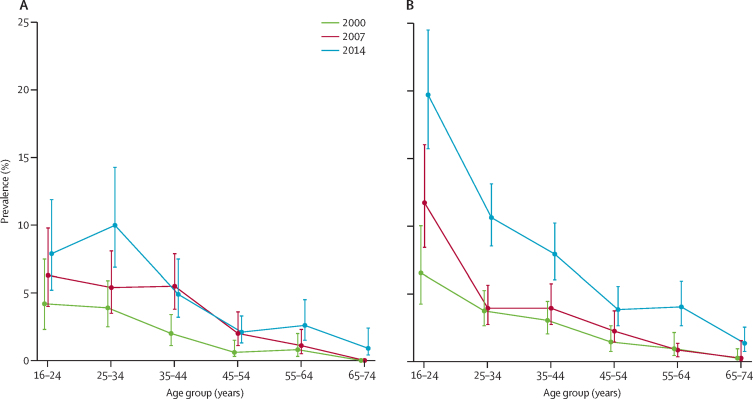
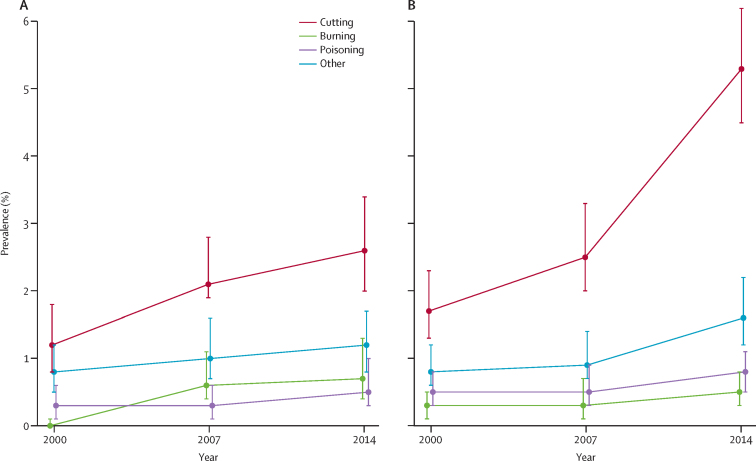
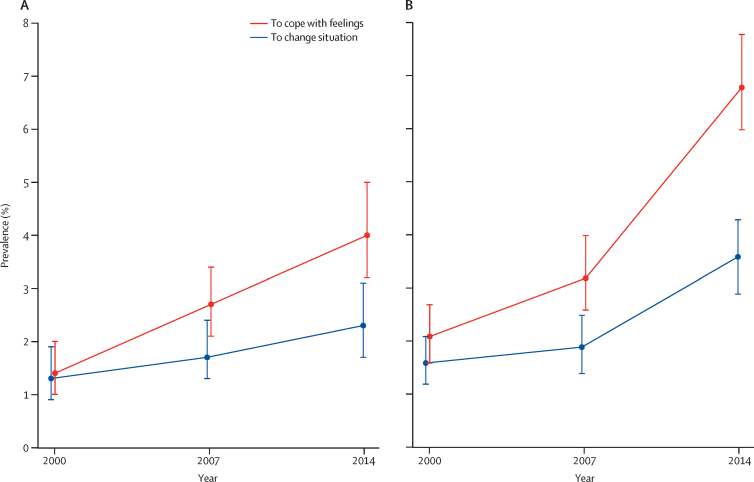
Verification
Claims the paper makes
The claims and statistics of this paper haven’t been checked yet.
Run the check — free, no account needed. It reads the open-access text and checks the sources it cites.
Claims other papers make about this one
Each is checked against this paper’s own text: does it say what the citing paper says it does?
The cited source says what the claim attributes to it.
In the citing paper
“despite self-harm being a common and high-burden issue in the general population (McManus et al., 2019).”
From Prospective Longitudinal Associations Between Adverse Childhood Experiences and Adult Mental Health Outcomes: Systematic Review and Meta-Analysis (2026) · cites this paper as McManus et al., 2019
In the citing paper
“These increases appear to have been accompanied by other signals of deteriorating mental health among young people (McManus et al., 2014; McManus et al., 2019; Twenge et al., 2019).”
From Social media use, economic recession and income inequality in relation to trends in youth suicide in high-income countries: a time trends analysis (2020) · cites this paper as McManus et al., 2019
In the citing paper
“For example, the prevalence of common mental disorders and self-harm in the United Kingdom (UK) rose between 2000-2014, particularly among 16-24 year old females (McManus et al., 2014; McManus et al., 2019).”
From Social media use, economic recession and income inequality in relation to trends in youth suicide in high-income countries: a time trends analysis (2020) · cites this paper as McManus et al., 2019
Self-check
Percentages, sums and reported differences re-computed from the paper’s own numbers.
The self-check needs the paper’s full text.
Citations
Cites
Diagnostic and Statistical Manual of Mental Disorders
Williams, J. B. W., & First, M. B. (2013) · Oxford University Press eBooks · doi:10.1093/acrefore/9780199975839.013.104 · Cited by 109,845
The Psychology of Survey Response
Tourangeau, R., Rips, L. J., & Rasinski, K. (2000) · doi:10.1017/cbo9780511819322 · Cited by 4,734
Lewis, G., Pelosi, A. J., Araya, R., & Dunn, G. (1992) · Psychological Medicine · doi:10.1017/s0033291700030415 · Cited by 1,487
International prevalence of adolescent non-suicidal self-injury and deliberate self-harm
Muehlenkamp, J. J., Claes, L., Havertape, L., & Plener, P. L. (2012) · Child and Adolescent Psychiatry and Mental Health · doi:10.1186/1753-2000-6-10 · Cited by 1,296
Psychiatric morbidity among adults living in private households, 2000
Singleton, N., Bumpstead, R., O'Brien, M. S., Lee, A., & Meltzer, H. (2003) · International Review of Psychiatry · doi:10.1080/0954026021000045967 · Cited by 896
Adult psychiatric morbidity in England, 2007: Results of a household survey
Mcmanus, S., Meltzer, H., Brugha, T., Bebbington, P., & Jenkins, R. (2009) · Unpublished · doi:10.13140/2.1.1563.5205 · Cited by 814
Self-citation(2016) · City Research Online (City University London) · Cited by 747
Self-citationNonsuicidal Self-Harm Among Community Adolescents: Understanding the “Whats” and “Whys” of Self-Harm
Laye-Gindhu, A., & Schonert-Reichl, K. A. (2005) · Journal of Youth and Adolescence · doi:10.1007/s10964-005-7262-z · Cited by 746
Nonsuicidal Self-injury: A Systematic Review
Cipriano, A., Cella, S., & Cotrufo, P. (2017) · Frontiers in Psychology · doi:10.3389/fpsyg.2017.01946 · Cited by 693
Gender differences in the prevalence of nonsuicidal self-injury: A meta-analysis
Bresin, K., & Schoenleber, M. (2015) · Clinical Psychology Review · doi:10.1016/j.cpr.2015.02.009 · Cited by 678
Mars, B., Heron, J., Klonsky, E. D., Moran, P., O'Connor, R. C., Tilling, K., Wilkinson, P., & Gunnell, D. (2019) · The Lancet Psychiatry · doi:10.1016/s2215-0366(19)30030-6 · Cited by 546
Self-citationNonsuicidal Self-Injury: What We Know, and What We Need to Know
Klonsky, E. D., Victor, S. E., & Saffer, B. Y. (2014) · The Canadian Journal of Psychiatry · doi:10.1177/070674371405901101 · Cited by 465
Non-suicidal self-injury v. attempted suicide: new diagnosis or false dichotomy?
Kapur, N., Cooper, J., O’Connor, R. C., & Hawton, K. E. (2013) · The British Journal of Psychiatry · doi:10.1192/bjp.bp.112.116111 · Cited by 422
Morgan, C., Webb, R. T., Carr, M. J., Kontopantelis, E., Green, J., Chew-Graham, C. A., Kapur, N., & Ashcroft, D. M. (2017) · BMJ · doi:10.1136/bmj.j4351 · Cited by 374
Hawton, K., Linsell, L., Adeniji, T., Sariaslan, A., & Fazel, S. (2014) · The Lancet · doi:10.1016/s0140-6736(13)62118-2 · Cited by 357
The Health Status of Nonparticipants in a Population-based Health Study: The Hordaland Health Study
Knudsen, A. K., Hotopf, M., Skogen, J. C., Overland, S., & Mykletun, A. (2010) · American Journal of Epidemiology · doi:10.1093/aje/kwq257 · Cited by 322
Geulayov, G., Casey, D., McDonald, K. C., Foster, P., Pritchard, K., Wells, C., Clements, C., Kapur, N., Ness, J., Waters, K., et al. (2017) · The Lancet Psychiatry · doi:10.1016/s2215-0366(17)30478-9 · Cited by 319
Griffin, E., McMahon, E. M., McNicholas, F., Corcoran, P. E., Perry, I. J., & Arensman, E. (2018) · Social Psychiatry and Psychiatric Epidemiology · doi:10.1007/s00127-018-1522-1 · Cited by 232
Adolescent mental health in crisis
Gunnell, D., Kidger, J., & Elvidge, H. (2018) · BMJ · doi:10.1136/bmj.k2608 · Cited by 228
Self-citationGeulayov, G., Kapur, N., Turnbull, P., Clements, C., Waters, K., Ness, J., Townsend, E., & Hawton, K. E. (2016) · BMJ Open · doi:10.1136/bmjopen-2015-010538 · Cited by 221
Mars, B., Heron, J., Crane, C., Hawton, K. E., Kidger, J., Lewis, G., Macleod, J., Tilling, K. M., & Gunnell, D. (2014) · Journal of Affective Disorders · doi:10.1016/j.jad.2014.07.009 · Cited by 206
Self-citationDeaths from all causes in a long-term follow-up study of 11583 deliberate self-harm patients
Hawton, K. E., Harriss, L. R., & Zahl, D. L. (2006) · Psychological Medicine · doi:10.1017/s0033291705006914 · Cited by 129
Suicide attempts and non-suicidal self-harm: national prevalence study of young adults
O’Connor, R. C., Wetherall, K., Cleare, S., Eschle, S., Drummond, J., Ferguson, E., O'Connor, D. B., & O’Carroll, R. E. (2018) · BJPsych Open · doi:10.1192/bjo.2018.14 · Cited by 113
Incidence Rates of Deliberate Self-Harm in Denmark 1994–2011
Morthorst, B. R., Soegaard, B., Nordentoft, M., & Erlangsen, A. (2016) · Crisis · doi:10.1027/0227-5910/a000391 · Cited by 100
Mental Health of Children and Young People in England, 2017: Trends and characteristics
Sadler, K. E., Vizard, T., Ford, T. J., Goodman, A., Goodman, R., & McManus, S. (2018) · City Research Online (City University London) · Cited by 87
Self-citationWiens, K., Williams, J. V. A., Lavorato, D. H., Duffy, A. C., Pringsheim, T. M., Sajobi, T. T., & Patten, S. B. (2016) · Journal of Affective Disorders · doi:10.1016/j.jad.2016.11.018 · Cited by 50
Making sense of Labour Force Survey response rates
Barnes, W., Bright, G., & Hewat, C. (2008) · Economic & Labour Market Review · doi:10.1057/elmr.2008.185 · Cited by 8
Nonsuicidal self-injury: a condition for further study
Plener, P. L., & Fegert, J. M. (2015) · Child and Adolescent Psychiatry and Mental Health · doi:10.1186/s13034-015-0067-2 · Cited by 7
Trends in Self-Harm in Kuala Lumpur, 2005–2011
Armitage, C. J., Rahim, W. A., Rowe, R., & O’Connor, R. C. (2015) · Archives of Suicide Research · doi:10.1080/13811118.2015.1004493 · Cited by 5
Cited by
Sorted by citations
Pierce, M., Hope, H., Ford, T., Hatch, S., Hotopf, M., John, A., Kontopantelis, E., Webb, R., Wessely, S., McManus, S., et al. (2020) · The Lancet Psychiatry · doi:10.1016/s2215-0366(20)30308-4 · Cited by 2,621
Self-citationPerinatal mental health: a review of progress and challenges
Howard, L. M., & Khalifeh, H. (2020) · World Psychiatry · doi:10.1002/wps.20769 · Cited by 1,118
Self-citationLawrance, E. L., Thompson, R., Newberry Le Vay, J., Page, L., & Jennings, N. (2022) · International Review of Psychiatry · doi:10.1080/09540261.2022.2128725 · Cited by 500
OECD (2021) · OECD Health Policy Studies · doi:10.1787/4ed890f6-en · Cited by 407
Foulkes, L., & Andrews, J. L. (2023) · New Ideas in Psychology · doi:10.1016/j.newideapsych.2023.101010 · Cited by 329
Metadata
- Authors
- McManus, S., Gunnell, D., Cooper, C., Bebbington, P. E., Howard, L. M., Brugha, T., Jenkins, R., Hassiotis, A., Weich, S., & Appleby, L.
- Affiliations
- NatCen Social Research (GB)
- University Hospitals Bristol NHS Foundation Trust (GB)
- University College London (GB)
- King's College London (GB)
- University of Leicester (GB)
- University of Sheffield (GB)
- University of Manchester (GB)
- Corresponding author
- McManus, Sally
- ORCID
- Venue
- The Lancet Psychiatry
- Publisher
- Elsevier BV
- Published
- 2019-07
- Volume
- 6
- Issue
- 7
- Pages
- 573-581
- ISSN
- 2215-0366 (ISSN-L)
- PMC
- PMC7646286
- OpenAlex
- W2948102438
- Cited by
- 415
- References
- 29
- Citations by year
- 2026: 28 · 2025: 61 · 2024: 47 · 2023: 68 · 2022: 64 · 2021: 91 · 2020: 44 · 2019: 12
- FWCI
- 61.61
- Type
- journal article
- Language
- en
- Open access
- hybrid
- doi.org
- Licence
- Locations
- The Lancet Psychiatry (publishedVersion, cc-by)
- PubMed Central (publishedVersion, cc-by)
- PubMed (publishedVersion)
- Research Explorer (The University of Manchester) (publishedVersion, other-oa)
- Bristol Research (University of Bristol) (publishedVersion, cc-by)
- White Rose Research Online (University of Leeds, The University of Sheffield, University of York) (acceptedVersion)
- City Research Online (City University London) (acceptedVersion)
- UCL Discovery (University College London) (submittedVersion)
- Figshare (submittedVersion, cc-by)
- Research Portal (King's College London) (submittedVersion, cc-by)
- Leicester Research Archive (University of Leicester) (submittedVersion, other-oa)
- Funders
- University Hospitals Bristol NHS Foundation Trust
- South London and Maudsley NHS Foundation Trust
- National Institute for Health Research (PHPEHF50/27, 023/0167)
- Topics
- Social Sciences › Psychology › Clinical Psychology › Suicide and Self-Harm Studies
- Social Sciences › Sociology and Political Science › Homicide, Infanticide, and Child Abuse
- Health Sciences › Medicine › Psychiatry and Mental health › Mental Health Treatment and Access
- Keywords
- non-suicidal self-injury, prevalence trends, temporal trends, service contact, mental health service utilization, self-harm methods, suicidal self-harm, young women, gender differences, England, Adult Psychiatric Morbidity Survey, general population, mental health services funding, mental health professionals
- MeSH terms
- Adolescent, Adult, Aged, Cross-Sectional Studies, Emergency Service, Hospital, England, Female, Humans, Male, Middle Aged, Risk Factors, Prevalence, Self-Injurious Behavior, Age Distribution, Sex Distribution, Young Adult
About these checks
Registry, retraction, Cites and statistics results are computed, not judged, with one exception: a printed reference that no index lists is read once by a model before it counts as a citation error. Claims are extracted by a model and kept only when their quote appears verbatim in the text; each cited source is then checked, with a model’s help, for whether it says what the claim relies on. Those verdicts can be wrong — read the claim’s quote and the cited source before relying on one.
Statistics and arithmetic are recomputed, not judged.
Confidence bands are shown only for fields calibrated on our annotated test set. None is calibrated yet, so no band is shown.
What counts as a claim ›How we measure confidence ›How we check this ›
Are you an author, or do you see a problem with this page? Request a review
