

The DOI matches its Crossref record; 29 of the 29 references it cites were found in a registry or an index.
Prevalence of non-suicidal self-harm and service contact in England, 2000-14: repeated cross-sectional surveys of the general population
Open accessAbstract
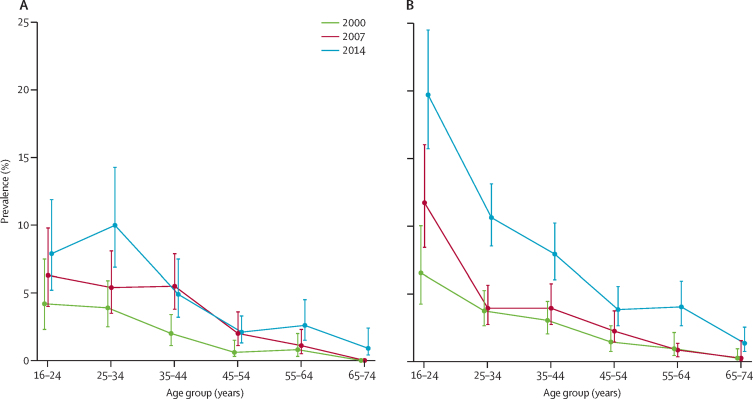
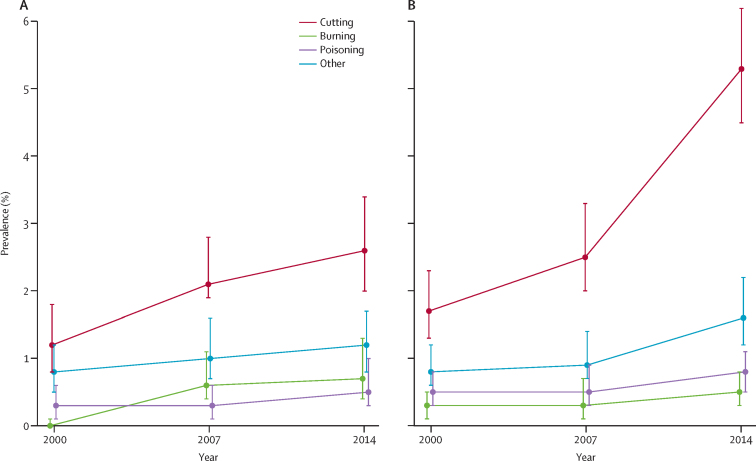
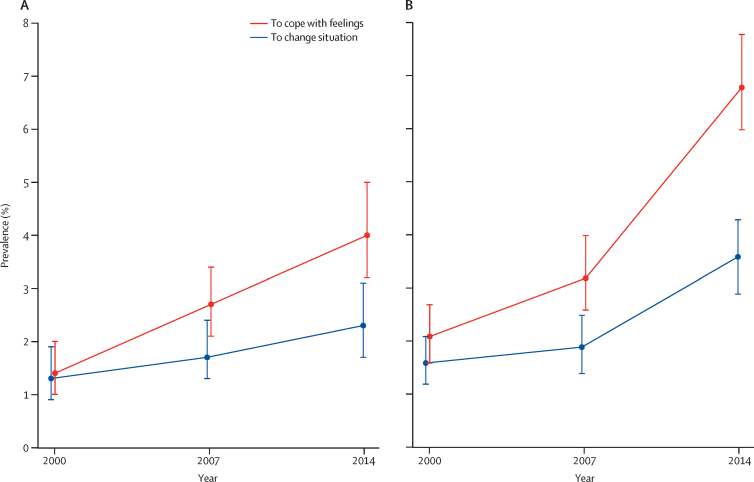
BACKGROUND: The number of people presenting to hospital emergency departments after self-harming has increased in England. However, most people who self-harm do not present to hospitals, so whether this rise reflects an increase in the prevalence of self-harm in the community is unknown. Also unknown is whether the prevalence of non-suicidal self-harm (NSSH) or suicidal self-harm, or both, has increased. We aimed to establish temporal trends in the prevalence of NSSH in England. METHODS: We analysed data from participants in the 2000 (n=7243), 2007 (n=6444), and 2014 (n=6477) Adult Psychiatric Morbidity Surveys of the general population, selecting those aged 16-74 years and living in England. We used weighted data and controlled for complex survey design. We generated temporal trends in lifetime prevalence and methods of, and motivations for, NSSH, and consequent service contact. We used multiple variable logistic regression analyses to investigate factors associated with service contact. FINDINGS: The prevalence of self-reported lifetime NSSH increased from 2·4% (95% CI 2·0-2·8) in 2000, to 6·4% (5·8-7·2) in 2014. Increases in prevalence were noted in both sexes and across age groups-most notably in women and girls aged 16-24 years, in whom prevalence increased from 6·5% (4·2-10·0) in 2000, to 19·7% (15·7-24·5) in 2014. The proportion of the population reporting NSSH to relieve unpleasant feelings of anger, tension, anxiety, or depression increased from 1·4% (95% CI 1·0-2·0) to 4·0% (3·2-5·0) in men and boys, and from 2·1% (1·6-2·7) to 6·8% (6·0-7·8) in women and girls, between 2000 and 2014. In 2014, 59·4% (95% CI 54·7-63·9) of participants who had engaged in NSSH reported no consequent medical or psychological service contact, compared with 51·2% (42·2-60·0) in 2000 and 51·8% (47·3-56·4) in 2007. Male participants and those aged 16-34 years were less likely to have contact with health services than were female participants and older people. INTERPRETATION: The prevalence of NSSH has increased in England, but resultant service contact remains low. In 2014, about one in five female 16-24-year-olds reported NSSH. There are potential lifelong implications of NSSH, such as an increased frequency of suicide, especially if the behaviours are adopted as a long-term coping strategy. Self-harm needs to be discussed with young people without normalising it. Young people should be offered help by primary care, educational, and other services to find safer ways to deal with emotional stress. FUNDING: NHS Digital, English Department of Health and Social Care, and the National Institute for Health Research.
Overview
The claims and statistics of this paper haven’t been checked yet.
Run the check — free, no account needed. It reads the open-access text and checks the sources it cites.
Integrity signals
Registry
Cites
Statistics
Figures
Verification
Claims the paper makes
The claims and statistics of this paper haven’t been checked yet.
Run the check — free, no account needed. It reads the open-access text and checks the sources it cites.
Claims other papers make about this one
Each is checked against this paper’s own text: does it say what the citing paper says it does?
The cited source says what the claim attributes to it.
In the citing paper
“despite self-harm being a common and high-burden issue in the general population (McManus et al., 2019).”
From Prospective Longitudinal Associations Between Adverse Childhood Experiences and Adult Mental Health Outcomes: Systematic Review and Meta-Analysis (2026) · cites this paper as McManus et al., 2019
In the citing paper
“These increases appear to have been accompanied by other signals of deteriorating mental health among young people (McManus et al., 2014; McManus et al., 2019; Twenge et al., 2019).”
From Social media use, economic recession and income inequality in relation to trends in youth suicide in high-income countries: a time trends analysis (2020) · cites this paper as McManus et al., 2019
In the citing paper
“For example, the prevalence of common mental disorders and self-harm in the United Kingdom (UK) rose between 2000-2014, particularly among 16-24 year old females (McManus et al., 2014; McManus et al., 2019).”
From Social media use, economic recession and income inequality in relation to trends in youth suicide in high-income countries: a time trends analysis (2020) · cites this paper as McManus et al., 2019
Self-check
Percentages, sums and reported differences re-computed from the paper’s own numbers.
The self-check needs the paper’s full text.
Citations
Cites
Diagnostic and Statistical Manual of Mental Disorders
Williams, J. B. W., & First, M. B. (2013) · Oxford University Press eBooks · doi:10.1093/acrefore/9780199975839.013.104 · Cited by 109,845
The Psychology of Survey Response
Tourangeau, R., Rips, L. J., & Rasinski, K. (2000) · doi:10.1017/cbo9780511819322 · Cited by 4,734
Lewis, G., Pelosi, A. J., Araya, R., & Dunn, G. (1992) · Psychological Medicine · doi:10.1017/s0033291700030415 · Cited by 1,487
International prevalence of adolescent non-suicidal self-injury and deliberate self-harm
Muehlenkamp, J. J., Claes, L., Havertape, L., & Plener, P. L. (2012) · Child and Adolescent Psychiatry and Mental Health · doi:10.1186/1753-2000-6-10 · Cited by 1,296
Psychiatric morbidity among adults living in private households, 2000
Singleton, N., Bumpstead, R., O'Brien, M. S., Lee, A., & Meltzer, H. (2003) · International Review of Psychiatry · doi:10.1080/0954026021000045967 · Cited by 896
Adult psychiatric morbidity in England, 2007: Results of a household survey
Mcmanus, S., Meltzer, H., Brugha, T., Bebbington, P., & Jenkins, R. (2009) · Unpublished · doi:10.13140/2.1.1563.5205 · Cited by 814
Self-citation(2016) · City Research Online (City University London) · Cited by 747
Self-citationNonsuicidal Self-Harm Among Community Adolescents: Understanding the “Whats” and “Whys” of Self-Harm
Laye-Gindhu, A., & Schonert-Reichl, K. A. (2005) · Journal of Youth and Adolescence · doi:10.1007/s10964-005-7262-z · Cited by 746
Nonsuicidal Self-injury: A Systematic Review
Cipriano, A., Cella, S., & Cotrufo, P. (2017) · Frontiers in Psychology · doi:10.3389/fpsyg.2017.01946 · Cited by 693
Gender differences in the prevalence of nonsuicidal self-injury: A meta-analysis
Bresin, K., & Schoenleber, M. (2015) · Clinical Psychology Review · doi:10.1016/j.cpr.2015.02.009 · Cited by 678
Cited by
Sorted by citations
Pierce, M., Hope, H., Ford, T., Hatch, S., Hotopf, M., John, A., Kontopantelis, E., Webb, R., Wessely, S., McManus, S., et al. (2020) · The Lancet Psychiatry · doi:10.1016/s2215-0366(20)30308-4 · Cited by 2,621
Self-citationPerinatal mental health: a review of progress and challenges
Howard, L. M., & Khalifeh, H. (2020) · World Psychiatry · doi:10.1002/wps.20769 · Cited by 1,118
Self-citationLawrance, E. L., Thompson, R., Newberry Le Vay, J., Page, L., & Jennings, N. (2022) · International Review of Psychiatry · doi:10.1080/09540261.2022.2128725 · Cited by 500
OECD (2021) · OECD Health Policy Studies · doi:10.1787/4ed890f6-en · Cited by 407
Foulkes, L., & Andrews, J. L. (2023) · New Ideas in Psychology · doi:10.1016/j.newideapsych.2023.101010 · Cited by 329
Knipe, D. W., Padmanathan, P., Newton‐Howes, G., Chan, L. F., & Kapur, N. (2022) · The Lancet · doi:10.1016/s0140-6736(22)00173-8 · Cited by 374
Abuse, self-harm and suicidal ideation in the UK during the COVID-19 pandemic.
Iob, E., Steptoe, A., & Fancourt, D. (2020) · The British Journal of Psychiatry · doi:10.1192/bjp.2020.130 · Cited by 297
Mental health of children and young people during pandemic
Ford, T., John, A., & Gunnell, D. (2021) · BMJ · doi:10.1136/bmj.n614 · Cited by 203
Self-citationWorsley, J. D., Pennington, A., & Corcoran, R. (2022) · PLOS ONE · doi:10.1371/journal.pone.0266725 · Cited by 205
Underestimating digital media harm
Twenge, J. M., Haidt, J., Joiner, T. E., & Campbell, W. K. (2020) · Nature Human Behaviour · doi:10.1038/s41562-020-0839-4 · Cited by 219
Lavis, A., & Winter, R. (2020) · Journal of Child Psychology and Psychiatry · doi:10.1111/jcpp.13245 · Cited by 170
Marquez, J., & Long, E. (2020) · Child Indicators Research · doi:10.1007/s12187-020-09788-8 · Cited by 151
Barthorpe, A., Winstone, L., Mars, B., & Moran, P. (2020) · Journal of Affective Disorders · doi:10.1016/j.jad.2020.05.106 · Cited by 158
Rodway, C., Tham, S.-G., Ibrahim, S. A., Turnbull, P., Kapur, N., & Appleby, L. (2020) · BJPsych Open · doi:10.1192/bjo.2020.33 · Cited by 128
Self-citationMcManus, S., Walby, S., Barbosa, E. C., Appleby, L., Brugha, T. S., Bebbington, P., Cook, E. A., & Knipe, D. W. (2022) · The Lancet Psychiatry · doi:10.1016/s2215-0366(22)00151-1 · Cited by 133
Self-citationThe Lancet Commission on self-harm
Moran, P., Chandler, A., Dudgeon, P., Kirtley, O. J., Knipe, D. W., Pirkis, J., Sinyor, M., Allister, R., Ansloos, J. P., Ball, M. A., et al. (2024) · The Lancet · doi:10.1016/s0140-6736(24)01121-8 · Cited by 143
Voss, C., Hoyer, J., Venz, J., Pieper, L., & Beesdo‐Baum, K. (2020) · Acta Psychiatrica Scandinavica · doi:10.1111/acps.13237 · Cited by 108
McManus, S., & Gunnell, D. (2019) · Social Psychiatry and Psychiatric Epidemiology · doi:10.1007/s00127-019-01797-5 · Cited by 69
Self-citationSvensson, R., Johnson, B., & Olsson, A. (2022) · BMC Public Health · doi:10.1186/s12889-022-12670-7 · Cited by 92
Wardle, H., & McManus, S. (2021) · The Lancet Public Health · doi:10.1016/s2468-2667(20)30232-2 · Cited by 80
Self-citationQu, D., Wang, Y., Zhang, Z., Meng, L., Zhu, F., Zheng, T., He, K., Zhou, Y. H., Li, C., Bu, H., et al. (2022) · Frontiers in Psychiatry · doi:10.3389/fpsyt.2021.755857 · Cited by 72
Padmanathan, P., Bould, H., Winstone, L., Moran, P., & Gunnell, D. (2020) · Journal of Affective Disorders · doi:10.1016/j.jad.2020.05.057 · Cited by 67
“For example, the prevalence of common mental disorders and self-harm in the United Kingdom (UK) rose between 2000-2014, particularly among 16-24 year old females (McManus et al., 2014; McManus et al., 2019).”
BackgroundSelf-citationThe relationship between self‐harm and alexithymia: A systematic review and meta‐analysis
Norman, H., Oskis, A., Marzano, L., & Coulson, M. (2020) · Scandinavian Journal of Psychology · doi:10.1111/sjop.12668 · Cited by 68
Data resource profile: Adult Psychiatric Morbidity Survey (APMS)
McManus, S., Bebbington, P. E., Jenkins, R., Morgan, Z., Brown, L., Collinson, D., & Brugha, T. (2020) · International Journal of Epidemiology · doi:10.1093/ije/dyz224 · Cited by 62
Self-citationDeterminants and Outcomes of Suicidal Behavior Among Patients With Major Depressive Disorder
Lundberg, J., Cars, T., Lampa, E., Selling, K. E., Levál, A., Gannedahl, A., Själin, M., Björkholm, C., & Hellner, C. (2023) · JAMA Psychiatry · doi:10.1001/jamapsychiatry.2023.2833 · Cited by 69
Green space quality and adolescent mental health: do personality traits matter?
Feng, X., Astell‐Burt, T., Standl, M., Flexeder, C., Heinrich, J., & Markevych, I. (2021) · Environmental Research · doi:10.1016/j.envres.2021.112591 · Cited by 68
Lim, K. X., Rijsdijk, F. V., Hagenaars, S. P., Socrates, A., Choi, S. W., Coleman, J. R. I., Glanville, K. P., Lewis, C. M., & Pingault, J. (2020) · PLoS Medicine · doi:10.1371/journal.pmed.1003137 · Cited by 59
The relationship between rumination and NSSI: A systematic review and meta‐analysis
Coleman, S. E., Dunlop, B. J., Hartley, S., & Taylor, P. J. (2021) · British Journal of Clinical Psychology · doi:10.1111/bjc.12350 · Cited by 64
Wardle, H., John, A. M., Dymond, S., & McManus, S. (2020) · Public Health · doi:10.1016/j.puhe.2020.03.024 · Cited by 56
Self-citationSinyor, M., Williams, M., Mitchell, R. H. B., Zaheer, R., Bryan, C. J., Schaffer, A., Westreich, N., Ellis, J., Goldstein, B. I., Cheung, A., et al. (2020) · Journal of Affective Disorders · doi:10.1016/j.jad.2020.01.178 · Cited by 59
Two Pathways to Self-Harm in Adolescence
Uh, S., Dalmaijer, E. S., Šiugždaitė, R., Ford, T. J., & Astle, D. E. (2021) · Journal of the American Academy of Child & Adolescent Psychiatry · doi:10.1016/j.jaac.2021.03.010 · Cited by 54
Mancinelli, E., Ruocco, E., Napolitano, S., & Salcuni, S. (2021) · Comprehensive Psychiatry · doi:10.1016/j.comppsych.2021.152285 · Cited by 54
Pitman, A., Marston, L., Lewis, G., Semlyen, J. K., McManus, S., & King, M. (2021) · Psychological Medicine · doi:10.1017/s0033291721000052 · Cited by 51
Self-citationPuddephatt, J., Jones, A., Gage, S. H., Fear, N. T., Field, M., McManus, S., McBride, O., & Goodwin, L. (2020) · Drug and Alcohol Dependence · doi:10.1016/j.drugalcdep.2020.108463 · Cited by 44
Self-citationPatalay, P., & Fitzsimons, E. (2021) · The British Journal of Psychiatry · doi:10.1192/bjp.2020.258 · Cited by 46
mHealth Interventions for Self-Harm: Scoping Review
Cliffe, B., Tingley, J., Greenhalgh, I., & Stallard, P. N. (2021) · Journal of Medical Internet Research · doi:10.2196/25140 · Cited by 44
Child suicide rates during the COVID-19 pandemic in England
Odd, D., Williams, T. G. S., Appleby, L., Gunnell, D., & Luyt, K. (2021) · Journal of Affective Disorders Reports · doi:10.1016/j.jadr.2021.100273 · Cited by 41
Self-citationLloyd, C. E. M., & Panagopoulos, M. C. (2022) · Pastoral Psychology · doi:10.1007/s11089-022-01005-3 · Cited by 43
Distinguishing prisoners who think about suicide from those who attempt suicide
Favril, L., & O’Connor, R. C. (2019) · Psychological Medicine · doi:10.1017/s0033291719003118 · Cited by 40
Seif, N. A., Bastien, R. J., Wang, B., Davies, J., Isaken, M., Ball, E., Pitman, A., & Rowe, S. L. (2022) · BJPsych Open · doi:10.1192/bjo.2021.1081 · Cited by 36
Responding to the rising prevalence of self-harm
Borschmann, R., & Kinner, S. A. (2019) · The Lancet Psychiatry · doi:10.1016/s2215-0366(19)30210-x · Cited by 36
Healthcare professionals’ implementation of national guidelines with patients who self-harm
Leather, J. Z., O’Connor, R. C., Quinlivan, L. M., Kapur, N., Campbell, S., & Armitage, C. J. (2020) · Journal of Psychiatric Research · doi:10.1016/j.jpsychires.2020.08.031 · Cited by 35
Digital access constraints predict worse mental health among adolescents during COVID-19
Metherell, T., Ghai, S., McCormick, E. M., Ford, T., & Orben, A. (2022) · Scientific Reports · doi:10.1038/s41598-022-23899-y · Cited by 24
Haw, R., Hartley, S., Trelfa, S., & Taylor, P. J. (2023) · British Journal of Clinical Psychology · doi:10.1111/bjc.12414 · Cited by 32
Marquez, J. (2023) · Child & Youth Care Forum · doi:10.1007/s10566-023-09756-7 · Cited by 32
Steeg, S., Carr, M., Mok, P. L. H., Pedersen, C. B., Antonsen, S., Ashcroft, D. M., Kapur, N., Erlangsen, A., Nordentoft, M., & Webb, R. T. (2019) · Social Psychiatry and Psychiatric Epidemiology · doi:10.1007/s00127-019-01794-8 · Cited by 32
Brennan, C. A., Crosby, H., Sass, C., Farley, K., Bryant, L. D., Rodriquez-Lopez, R., Romeu, D., Mitchell, E., House, A. O., & Guthrie, E. (2022) · Journal of Public Health · doi:10.1093/pubmed/fdac022 · Cited by 32
Zhou, Y., Yu, R., Ai, M., Cao, J., Li, X., Hong, S., Huang, Q., Dai, L., Wang, L., Zhao, L., et al. (2022) · Frontiers in Psychiatry · doi:10.3389/fpsyt.2022.925672 · Cited by 32
Chen, S., Ford, T. J., Jones, P. B., & Cardinal, R. N. (2022) · The Lancet Regional Health - Europe · doi:10.1016/j.lanepe.2022.100368 · Cited by 36
Warne, N., Heron, J., Mars, B., Solmi, F., Biddle, L., Gunnell, D., Hammerton, G., Moran, P., Munafo, M. R., Penton‐Voak, I. S., et al. (2022) · Journal of Child Psychology and Psychiatry · doi:10.1111/jcpp.13738 · Cited by 36
Self-citationAsking about self-harm and suicide in primary care: Moral and practical dimensions
Ford, J. B., Thomas, F., Byng, R., & McCabe, R. (2020) · Patient Education and Counseling · doi:10.1016/j.pec.2020.09.037 · Cited by 29
Pierret, A. C. S., Anderson, J., Ford, T. J., & Burn, A. (2020) · Child and Adolescent Mental Health · doi:10.1111/camh.12436 · Cited by 29
Tang, Y. C., Wan, Y., Xu, S., Zhang, S., Hao, J., & Tao, F. (2021) · BMC Psychiatry · doi:10.1186/s12888-021-03539-x · Cited by 31
Simonsson, O., Engberg, H., Bjureberg, J., Ljótsson, B., Stensils, J., Sahlin, H., & Hellner, C. (2021) · JMIR Formative Research · doi:10.2196/17910 · Cited by 32
Linking Leeds: A Social Prescribing Service for Children and Young People
Brettell, M., Fenton, C., & Foster, E. (2022) · International Journal of Environmental Research and Public Health · doi:10.3390/ijerph19031426 · Cited by 28
Fang, J., Wan, Y., Zhang, X., Su, P., Tao, F., & Sun, Y. (2021) · European Child & Adolescent Psychiatry · doi:10.1007/s00787-021-01768-9 · Cited by 28
An exploration of the genetic epidemiology of non-suicidal self-harm and suicide attempt
Russell, A. E., Hemani, G., Jones, H. J., Ford, T. J., Gunnell, D., Heron, J., Joinson, C. J., Moran, P., Relton, C. L., Suderman, M. J., et al. (2021) · BMC Psychiatry · doi:10.1186/s12888-021-03216-z · Cited by 32
Self-citationKeyworth, C., O’Connor, R. C., Quinlivan, L. M., & Armitage, C. J. (2021) · Journal of Medical Internet Research · doi:10.2196/28349 · Cited by 28
Youth mental health: risks and opportunities in the digital world
Hollis, C. P. (2022) · World Psychiatry · doi:10.1002/wps.20929 · Cited by 28
Cadorna, G., Juan, N. V. S., Staples, H., Johnson, S., & Appleton, R. (2023) · Child and Adolescent Mental Health · doi:10.1111/camh.12683 · Cited by 27
Patient safety and suicide prevention in mental health services: time for a new paradigm?
Quinlivan, L. M., Littlewood, D. L., Webb, R. T., & Kapur, N. (2020) · Journal of Mental Health · doi:10.1080/09638237.2020.1714013 · Cited by 29
The Violence of the Cut: Gendering Self-Harm
Chandler, A., & Simopoulou, Z. (2021) · International Journal of Environmental Research and Public Health · doi:10.3390/ijerph18094650 · Cited by 28
Cox, J. A., Mills, L., Hermens, D. F., Read, G. J. M., & Salmon, P. M. (2024) · Adolescent Research Review · doi:10.1007/s40894-024-00241-3 · Cited by 27
Correlates of Non-suicidal Self-Injury in Adolescent Psychiatric Patients in China
Zhang, J.-J., Liu, Y.-D., Zhang, H., Huang, Z., Wang, F., Yang, J.-J., Wang, S., Jia, F., & Hou, C.-L. (2022) · Frontiers in Psychiatry · doi:10.3389/fpsyt.2022.864150 · Cited by 29
Melia, R., Monahan, L., Duggan, J., Bogue, J., O’Sullivan, M., Young, K. L., Chambers, D., & McInerney, S. J. (2021) · BMC Psychiatry · doi:10.1186/s12888-021-03426-5 · Cited by 25
Geulayov, G., Borschmann, R., Mansfield, K. L., Hawton, K. E., Moran, P., & Fazel, M. S. (2022) · Frontiers in Psychiatry · doi:10.3389/fpsyt.2022.881248 · Cited by 31
Kidd, G., Marston, L., Nazareth, I., Osborn, D., & Pitman, A. (2023) · Social Psychiatry and Psychiatric Epidemiology · doi:10.1007/s00127-023-02490-4 · Cited by 24
Measurement and stratification of nonsuicidal self-injury in adolescents
Aspeqvist, E., Andersson, H., Korhonen, L., Dahlström, Ö., & Zetterqvist, M. (2024) · BMC Psychiatry · doi:10.1186/s12888-024-05535-3 · Cited by 28
Mughal, F., Dikomitis, L., Babatunde, O. O., & Chew-Graham, C. A. (2021) · British Journal of General Practice · doi:10.3399/bjgp.2021.0091 · Cited by 27
Noel, C. W., Eskander, A. E., Sutradhar, R., Mahar, A. L., Vigod, S. N., Isenberg‐Grzeda, E., Bolton, J. M., Deleemans, J. M., Chan, W. C., Vasdev, R., et al. (2021) · JAMA Network Open · doi:10.1001/jamanetworkopen.2021.26822 · Cited by 24
Bilello, D., Townsend, E., Broome, M. R., Armstrong, G., & Heyes, S. B. (2024) · The Lancet Psychiatry · doi:10.1016/s2215-0366(24)00170-6 · Cited by 27
Russell, K., Rasmussen, S. A., & Hunter, S. C. (2020) · International Journal of Environmental Research and Public Health · doi:10.3390/ijerph17186771 · Cited by 23
Gendered experiences of unemployment, suicide and self-harm: a population-level record linkage study
Cunningham, R., Milner, A. J., Gibb, S., Rijnberg, V., Disney, G., & Kavanagh, A. M. (2021) · Psychological Medicine · doi:10.1017/s0033291721000994 · Cited by 26
Wong, B. H.-C., Vaezinejad, M., Plener, P. L., Mehdi, T., Romaniuk, L., Barrett, E., Hussain, H., Lloyd, A., Tolmac, J., Rao, M., et al. (2022) · BJPsych Open · doi:10.1192/bjo.2022.41 · Cited by 24
Yan, H., & Yue, W. (2023) · Interdisciplinary Nursing Research · doi:10.1097/nr9.0000000000000023 · Cited by 28
Bird, K., Arcelus, J., Matsagoura, L., O'Shea, B. A., & Townsend, E. (2024) · Heliyon · doi:10.1016/j.heliyon.2024.e26074 · Cited by 32
Moloney, F., Amini, J., Sinyor, M., Schaffer, A., Lanctôt, K. L., & Mitchell, R. H. B. (2025) · Journal of Child Psychology and Psychiatry · doi:10.1111/jcpp.14114 · Cited by 24
Griffin, E., Kavalidou, K., Bonner, B., O’Hagan, D., & Corcoran, P. E. (2020) · EClinicalMedicine · doi:10.1016/j.eclinm.2020.100378 · Cited by 23
Wang, Y., Zhou, X., Cao, B., Chen, L., Wang, R., Qi, L., Meng, L., Zeng, L., Liu, X., Wang, W., et al. (2021) · Journal of Affective Disorders · doi:10.1016/j.jad.2021.10.130 · Cited by 22
Rodway, C., Tham, S.-G., Richards, N., Ibrahim, S., Turnbull, P., Kapur, N., & Appleby, L. (2022) · Psychological Medicine · doi:10.1017/s0033291722001258 · Cited by 21
Self-citationThurston, C., Murray, A. L., Franchino-Olsen, H., Silima, M., Hemady, C. L., & Meinck, F. (2026) · Trauma, Violence, & Abuse · doi:10.1177/15248380251358223 · Cited by 25
“The evidence base on self-harm was especially limited, with only one study meeting inclusion criteria, despite self-harm being a common and high-burden issue in the general population (McManus et al., 2019).”
Ghadiri, P., Yaffe⃰, M. J., Adams, A. M., & Rahimi, S. A. (2024) · BMC Family Practice · doi:10.1186/s12875-024-02417-1 · Cited by 24
Motivations for Self-Harm in Young People and Their Correlates: A Systematic Review
Tang, S., Hoye, A. M., Slade, A., Tang, B., Holmes, G., Fujimoto, H., Zheng, W., Ravindra, S., Christensen, H. M., & Calear, A. L. (2025) · Clinical Child and Family Psychology Review · doi:10.1007/s10567-024-00511-5 · Cited by 21
Quinlivan, L. M., Gorman, L. S., Littlewood, D. L., Monaghan, E., Barlow, S. J., Campbell, S., Webb, R. T., & Kapur, N. (2021) · Australian & New Zealand Journal of Psychiatry · doi:10.1177/00048674211011262 · Cited by 21
Nawaz, R. F., Anderson, J., Colville, L., Fraser‐Andrews, C., & Ford, T. J. (2023) · Child and Adolescent Mental Health · doi:10.1111/camh.12634 · Cited by 28
Shafti, M., Taylor, P. J., Forrester, A., Handerer, F., & Pratt, D. (2023) · Frontiers in Psychiatry · doi:10.3389/fpsyt.2023.1083271 · Cited by 21
Uddin, T., Pitman, A., Benson, G., Kamal, Z., Hawton, K. E., & Rowe, S. L. (2023) · Psychological Medicine · doi:10.1017/s0033291723002805 · Cited by 27
Masi, G., Pisano, S., Sesso, G., Mazzullo, C., Berloffa, S., Fantozzi, P., Narzisi, A., Placini, F., Valente, E., Viglione, V., et al. (2023) · Brain Sciences · doi:10.3390/brainsci13050755 · Cited by 21
Lim, K. X., Krebs, G., Rimfeld, K., Pingault, J., & Rijsdijk, F. V. (2021) · Psychological Medicine · doi:10.1017/s0033291721000040 · Cited by 21
Bebbington, P., McManus, S., Coid, J. W., Garside, R., & Brugha, T. S. (2021) · Social Psychiatry and Psychiatric Epidemiology · doi:10.1007/s00127-021-02066-0 · Cited by 21
Self-citationWaller, G., Newbury‐Birch, D., Simpson, D., Armstrong, E., James, B., Chapman, L., Ahmed, F., & Ferguson, J. (2023) · BMC Public Health · doi:10.1186/s12889-023-15046-7 · Cited by 19
Gomez, K. U., McBride, O., Roberts, E., Angus, C., Keyes, K. M., Drummond, C., Buchan, I. E., Fleming, K. M., Gilmore, I. T., Donoghue, K., et al. (2023) · BMC Psychiatry · doi:10.1186/s12888-023-04577-3 · Cited by 25
Bergen, C., Bortolotti, L., Temple, R., Fadashe, C., Lee, C., Lim, M. C., & McCabe, R. (2023) · Frontiers in Psychiatry · doi:10.3389/fpsyt.2023.1197512 · Cited by 21
Hospital-presenting self-harm and ideation: Comparison of incidence, profile and risk of repetition
Griffin, E., Bonner, B., O’Hagan, D., Kavalidou, K., & Corcoran, P. E. (2019) · General Hospital Psychiatry · doi:10.1016/j.genhosppsych.2019.10.009 · Cited by 20
A cross-sectional study of non-suicidal self-injury in a Chinese adolescent inpatient cohort
Sun, K., Li, A., Li, Y., Xie, J., Tong, Y., Ma, J., & Wu, Y. (2023) · Frontiers in Psychiatry · doi:10.3389/fpsyt.2023.1109334 · Cited by 21
McManus, S., Bebbington, P., Tanczer, L. M., Scott, S., & Howard, L. M. (2021) · Social Psychiatry and Psychiatric Epidemiology · doi:10.1007/s00127-021-02113-w · Cited by 18
Self-citationBlackburn, R. M., Ajetunmobi, O., Grath-Lone, L. M., Hardelid, P., Shafran, R., Gilbert, R. E., & Wijlaars, L. P. M. M. (2021) · BJPsych Open · doi:10.1192/bjo.2021.1058 · Cited by 18
Mughal, F., Troya, M. I., Dikomitis, L., Tierney, S., Evans, N., Townsend, E., & Chew-Graham, C. A. (2022) · EClinicalMedicine · doi:10.1016/j.eclinm.2022.101437 · Cited by 17
Yang, J., Chen, Y., Yao, G., Wang, Z., Fu, X., Tian, Y., & Li, Y. (2022) · Frontiers in Public Health · doi:10.3389/fpubh.2022.1049069 · Cited by 20
Tsujii, N., Shirakawa, O., Atsushi, N., Yonemoto, N., Kawanishi, C., Yamamoto, K., Sugimoto, T., & Hirayasu, Y. (2020) · Journal of Affective Disorders · doi:10.1016/j.jad.2020.04.037 · Cited by 17
Metadata
- Authors
- McManus, S., Gunnell, D., Cooper, C., Bebbington, P. E., Howard, L. M., Brugha, T., Jenkins, R., Hassiotis, A., Weich, S., & Appleby, L.
- Affiliations
- NatCen Social Research (GB)
- University Hospitals Bristol NHS Foundation Trust (GB)
- University College London (GB)
- King's College London (GB)
- University of Leicester (GB)
- University of Sheffield (GB)
- University of Manchester (GB)
- Corresponding author
- McManus, Sally
- ORCID
- Venue
- The Lancet Psychiatry
- Publisher
- Elsevier BV
- Published
- 2019-07
- Volume
- 6
- Issue
- 7
- Pages
- 573-581
- ISSN
- 2215-0366 (ISSN-L)
- PMC
- PMC7646286
- OpenAlex
- W2948102438
- Cited by
- 415
- References
- 29
- Citations by year
- 2026: 28 · 2025: 61 · 2024: 47 · 2023: 68 · 2022: 64 · 2021: 91 · 2020: 44 · 2019: 12
- FWCI
- 61.61
- Type
- journal article
- Language
- en
- Open access
- hybrid
- doi.org
- Licence
- Locations
- The Lancet Psychiatry (publishedVersion, cc-by)
- PubMed Central (publishedVersion, cc-by)
- PubMed (publishedVersion)
- Research Explorer (The University of Manchester) (publishedVersion, other-oa)
- Bristol Research (University of Bristol) (publishedVersion, cc-by)
- White Rose Research Online (University of Leeds, The University of Sheffield, University of York) (acceptedVersion)
- City Research Online (City University London) (acceptedVersion)
- UCL Discovery (University College London) (submittedVersion)
- Figshare (submittedVersion, cc-by)
- Research Portal (King's College London) (submittedVersion, cc-by)
- Leicester Research Archive (University of Leicester) (submittedVersion, other-oa)
- Funders
- University Hospitals Bristol NHS Foundation Trust
- South London and Maudsley NHS Foundation Trust
- National Institute for Health Research (PHPEHF50/27, 023/0167)
- Topics
- Social Sciences › Psychology › Clinical Psychology › Suicide and Self-Harm Studies
- Social Sciences › Sociology and Political Science › Homicide, Infanticide, and Child Abuse
- Health Sciences › Medicine › Psychiatry and Mental health › Mental Health Treatment and Access
- Keywords
- non-suicidal self-injury, prevalence trends, temporal trends, service contact, mental health service utilization, self-harm methods, suicidal self-harm, young women, gender differences, England, Adult Psychiatric Morbidity Survey, general population, mental health services funding, mental health professionals
- MeSH terms
- Adolescent, Adult, Aged, Cross-Sectional Studies, Emergency Service, Hospital, England, Female, Humans, Male, Middle Aged, Risk Factors, Prevalence, Self-Injurious Behavior, Age Distribution, Sex Distribution, Young Adult
About these checks
Registry, retraction, Cites and statistics results are computed, not judged, with one exception: a printed reference that no index lists is read once by a model before it counts as a citation error. Claims are extracted by a model and kept only when their quote appears verbatim in the text; each cited source is then checked, with a model’s help, for whether it says what the claim relies on. Those verdicts can be wrong — read the claim’s quote and the cited source before relying on one.
Statistics and arithmetic are recomputed, not judged.
Confidence bands are shown only for fields calibrated on our annotated test set. None is calibrated yet, so no band is shown.
What counts as a claim ›How we measure confidence ›How we check this ›
Are you an author, or do you see a problem with this page? Request a review
