

Long-term outcomes of childhood sexual abuse: an umbrella review
Open accessThe DOI matches its Crossref record; 88 of the 101 references it cites were found in a registry or an index; 19 of the 62 sources its claims cite were checked for support.
Abstract
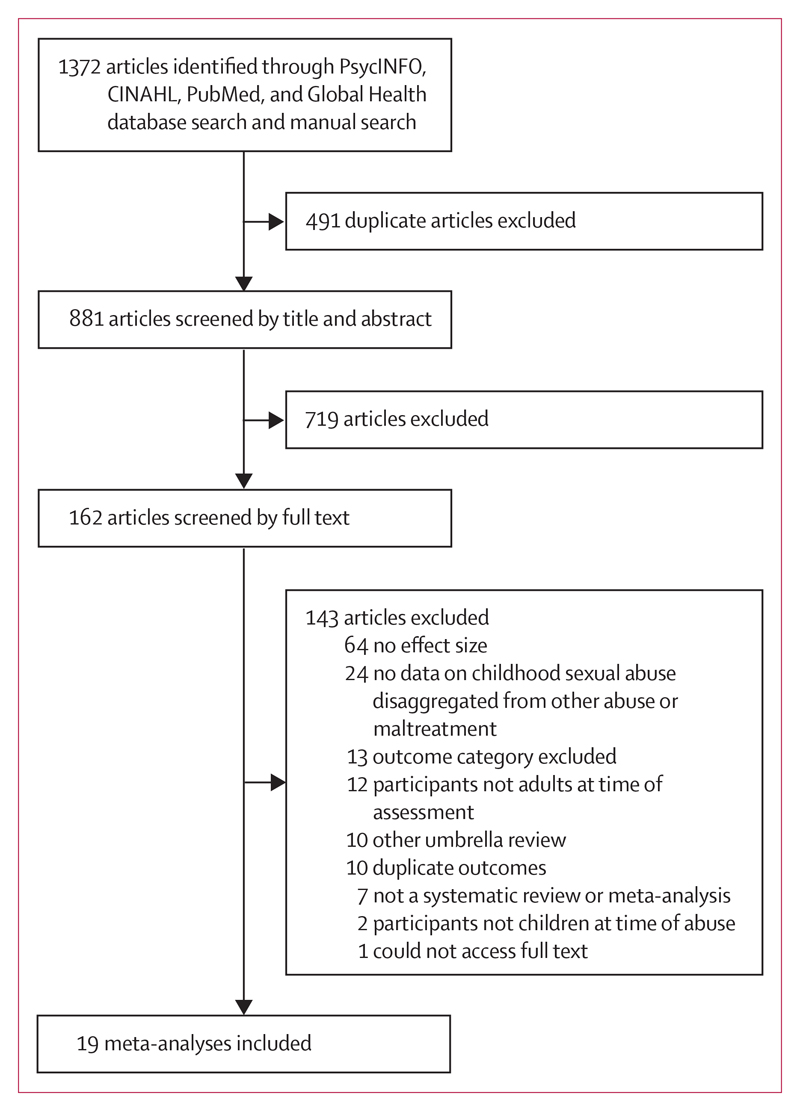
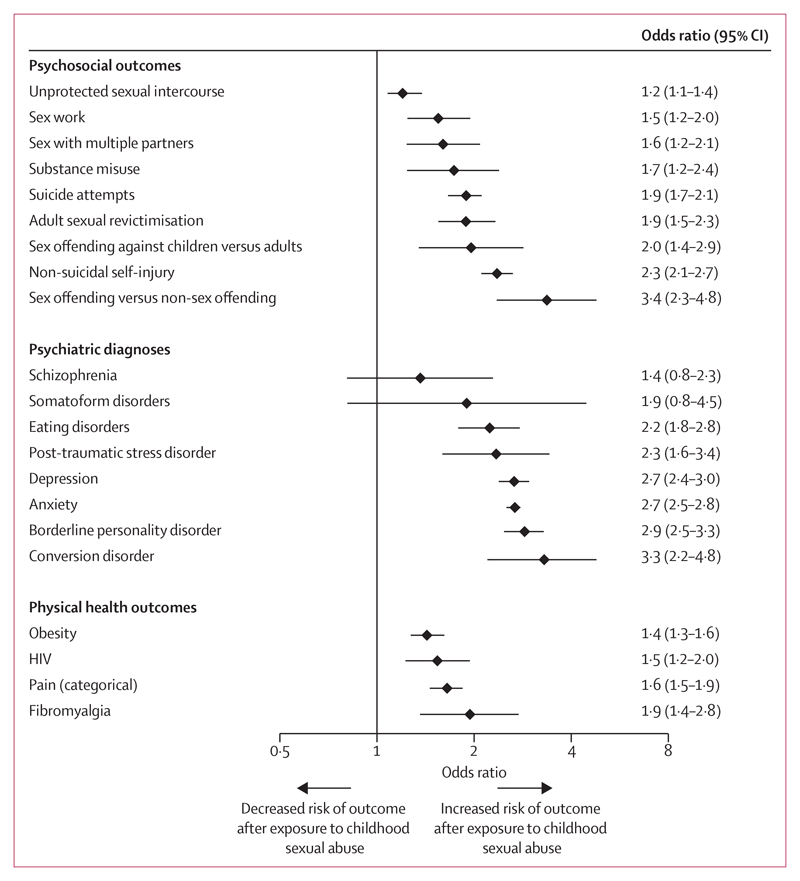
BACKGROUND: Although many meta-analyses have examined the association between childhood sexual abuse and subsequent outcomes, the scope, validity, and quality of this evidence has not been comprehensively assessed. We aimed to systematically review existing meta-analyses on a wide range of long-term psychiatric, psychosocial, and physical health outcomes of childhood sexual abuse, and evaluate the quality of the literature. METHODS: In this umbrella review, we searched four databases (PsycINFO, PubMed, Cumulative Index to Nursing and Allied Health Literature, and Global Health) from inception to Dec 31, 2018, to identify meta-analyses of observational studies that examined the association between childhood sexual abuse (before 18 years of age) and long-term consequences (after 18 years). We compared odds ratios (ORs) across different outcomes. We also examined measures of quality, including heterogeneity between studies and evidence for publication bias. This study is registered with PROSPERO, CRD42016049701. FINDINGS: We identified 19 meta-analyses that included 559 primary studies, covering 28 outcomes in 4 089 547 participants. Childhood sexual abuse was associated with 26 of 28 specific outcomes: specifically, six of eight adult psychiatric diagnoses (ORs ranged from 2·2 [95% CI 1·8-2·8] to 3·3 [2·2-4·8]), all studied negative psychosocial outcomes (ORs ranged from 1·2 [1·1-1·4] to 3·4 [2·3-4·8]), and all physical health conditions (ORs ranged from 1·4 [1·3-1·6] to 1·9 [1·4-2·8]). Strongest psychiatric associations with childhood sexual abuse were reported for conversion disorder (OR 3·3 [95% CI 2·2-4·8]), borderline personality disorder (2·9 [2·5-3·3]), anxiety (2·7 [2·5-2·8]), and depression (2·7 [2·4-3·0]). The systematic reviews for two psychiatric outcomes (post-traumatic stress disorder and schizophrenia) and one psychosocial outcome (substance misuse) met high quality standards. Quality was low for meta-analyses on borderline personality disorder and anxiety, and moderate for conversion disorder. Assuming causality, population attributable risk fractions for outcomes ranged from 1·7% (95% CI 0·7-3·3) for unprotected sexual intercourse to 14·4% (8·8-19·9) for conversion disorder. INTERPRETATION: Although childhood sexual abuse was associated with a wide range of psychosocial and health outcomes, systematic reviews on only two psychiatric disorders (post-traumatic stress disorder and schizophrenia) and one psychosocial outcome (substance misuse) were of a high quality. Whether services should prioritise interventions that mitigate developing certain psychiatric disorders following childhood abuse requires further review. Higher-quality meta-analyses for specific outcomes and more empirical studies on the developmental pathways from childhood sexual abuse to later outcomes are necessary. FUNDING: Wellcome Trust.
Overview
CoChat Summary
TL;DR
This umbrella review synthesizes 19 meta-analyses covering 559 primary studies and 4,089,547 participants to assess long-term outcomes of childhood sexual abuse. Childhood sexual abuse was associated with 26 of 28 outcomes, but only post-traumatic stress disorder, schizophrenia, and substance misuse had high-quality systematic review evidence.
Key findings
- Across 28 outcomes, childhood sexual abuse was associated with 26; odds ratios ranged from 2·2 (95% CI 1·8–2·8) to 3·3 (2·2–4·8) for psychiatric outcomes, 1·2 (1·1–1·4) to 3·4 (2·3–4·8) for psychosocial outcomes, and 1·4 (1·3–1·6) to 1·9 (1·4–2·8) for physical health outcomes.
- Strongest associations were sexual versus non-sexual offending (OR 3·4 [95% CI 2·3–4·8]), conversion disorder (3·3 [2·2–4·8]), borderline personality disorder (2·9 [2·5–3·3]), anxiety (2·7 [2·5–2·8]), and depression (2·7 [2·4–3·0]).
- High-quality systematic reviews were identified for post-traumatic stress disorder, schizophrenia, and substance misuse; quality was low for borderline personality disorder and anxiety (1/5) and moderate for conversion disorder and sexual versus non-sexual offending (3/5).
- Population attributable fractions ranged from 1·7% (95% CI 0·7–3·3) for unprotected sexual intercourse to 14·4% (8·8–19·9) for conversion disorder, with the highest at 14·7% (9·6–19·9) for sexual versus non-sexual offending; absolute rates in high-quality outcomes were 503/1809 (28%) for substance misuse and 36/96 (38%) for post-traumatic stress disorder.
Methods
- Umbrella review searching PsycINFO, PubMed, Cumulative Index to Nursing and Allied Health Literature, and Global Health from inception to Dec 31, 2018, with no language restriction, plus secondary searches and citation chaining; registered with PROSPERO, CRD42016049701.
- Included meta-analyses of observational studies reporting outcomes for childhood sexual abuse before age 18 and long-term outcomes after age 18, disaggregated from other abuse, with aggregate quantitative effect sizes; when overlapping, the most recent or largest meta-analysis was selected, and the minimum was three primary studies.
- Effect sizes were converted to odds ratios; population attributable fractions were calculated assuming causality and a 10% prevalence estimate; quality was assessed with AMSTAR, I² heterogeneity, excess significance, small study effects, and prediction intervals, yielding an aggregate 0–5 score.
Limitations
- The paper states that few included reviews explored heterogeneity by age or study design; familial factors, abuse characteristics, and overlap with other forms of child abuse were not accounted for and might overestimate effect sizes.
- The paper states that primary studies often relied on retrospective recall of childhood sexual abuse, that high co-occurrence with other abuse could not be addressed due to insufficient data, and that evidence was inconsistent with likely publication bias favoring significant findings.
- Evident from the text: population attributable fractions were calculated without confounder adjustment and with a conservative 10% prevalence estimate, so the authors note these figures will likely be overestimated; no confounder-adjusted effect sizes were reported.
Model-written summary. Check it against the paper before relying on it.
Integrity signals
Registry
Cites
Statistics
Figures
Verification
Claims the paper makes
11 Valid · 3 Not valid · 14 Not checked · 58 Own results and interpretations
The cited sources that could be checked couldn’t confirm or dispute this claim.
In the paper
“and 36 (38%) of 96 developed post-traumatic stress disorder.57”
§ Long-term outcomes of childhood sexual abuse: an umbrella review > Results
What the sources say
- Could not verifycites [57] Dube SR Anda RF Felitti VJ Chapman DP Giles WH Childhood abuse, neglect and household dysfunction and the risk of illicit drug use: the Adverse Childhood Experience Study Pediatrics 2003 111 564 72 12612237 sourceExperimental — accuracy not yet measured
The Discussion (p. 11) reports the prevalence of childhood sexual abuse, but not subsequent PTSD diagnoses. Searches for PTSD, post-traumatic stress disorder, and the figures 36, 38%, and 96 found no passage supporting the claimed outcome. (LLM, conf=0.76)
plain- Asserted: passes — The authors put it forward as true.
- Checkable: passes — It can be checked against evidence.
- Load-bearing: unclear — It is unclear whether the paper’s conclusions depend on it.
- Based: passes — The paper gives a reason why it holds.
- Could not verify
The cited sources that could be checked couldn’t confirm or dispute this claim.
In the paper
“by gender on depression,53”
§ Long-term outcomes of childhood sexual abuse: an umbrella review > Results
What the sources say
- Could not verifycites [53] Irish L Kobayashi I Delahanty DL Long-term physical health consequences of childhood sexual abuse: a meta-analytic review J Pediatr Psychol 2010 35 450 61 20022919 PMC2910944 sourceExperimental — accuracy not yet measured
The Abstract identifies depression as a psychological outcome associated with childhood sexual abuse, but says this review examines physical health outcomes. The Results report no suggestive findings for sex as a moderator of physical health outcomes; they do not report whether the effect on depression differs by gender. Searched for gender differences in depression and female–male moderation. (LLM, conf=0.77)
plain- Asserted: passes — The authors put it forward as true.
- Checkable: passes — It can be checked against evidence.
- Load-bearing: unclear — It is unclear whether the paper’s conclusions depend on it.
- Based: passes — The paper gives a reason why it holds.
- Could not verify
The cited sources support only part of this claim — read each source’s verdict below.
In the paper
“by study design on obesity and psychosis,7,9”
§ Long-term outcomes of childhood sexual abuse: an umbrella review > Results
What the sources say
- Partly supportedcites [7] Varese F Smeets F Drukker M Childhood adversities increase the risk of psychosis: a meta-analysis of patient-control, prospective- and cross-sectional cohort studies Schizophr Bull 2012 38 661 71 22461484 PMC3406538 sourceExperimental — accuracy not yet measured
The Results section, “Overall Association Between Adverse Childhood Events and Psychosis” (page unavailable), reports no significant difference by study design in the overall association between childhood adversity and psychosis. The separate sexual-abuse analysis reports an association with psychosis, but the Methods say those adversity-specific effects were not compared by study design. The paper does not address obesity. (LLM, conf=0.87)
- Not checked — no full text of the sourcecites [9] Danese A Tan M Childhood maltreatment and obesity: systematic review and meta-analysis Mol Psychiatry 2014 19 544 54 23689533 source
plain- Asserted: passes — The authors put it forward as true.
- Checkable: passes — It can be checked against evidence.
- Load-bearing: unclear — It is unclear whether the paper’s conclusions depend on it.
- Based: passes — The paper gives a reason why it holds.
- Partly supported
The sources with a verdict support this claim; the rest weren’t checked yet, have no full text we could read, or their verdicts aren’t rated yet.
In the paper
“Previous attempts to synthesise the large number of meta-analytical reviews in the field have mostly considered solely mental health outcomes or a single outcome, such as depression, anxiety disorders, suicide and self-injury, or substance misuse.12–15”
§ Long-term outcomes of childhood sexual abuse: an umbrella review > Introduction
What the sources say
- Supportedcites [12] Maniglio R Child sexual abuse in the etiology of depression: a systematic review of reviews Depress Anxiety 2010 27 631 42 20336807 source
The Methods section says this systematic review included only reviews investigating depressive symptoms or disorders following childhood sexual abuse. The Results section reports that it included four reviews, making this paper an example of a synthesis focused on a single outcome—depression. It does not need to establish the sentence’s broader claim about what most previous syntheses considered. (LLM, conf=0.91)
- Not checked — no full text of the sourcecites [13] Maniglio R Child sexual abuse in the etiology of anxiety disorders: a systematic review of reviews Trauma Violence Abuse 2013 14 96 112 23262751 source
- Not checked — no full text of the sourcecites [14] Maniglio R The role of child sexual abuse in the etiology of suicide and non-suicidal self-injury Acta Psychiatr Scand 2011 124 30 41 20946202 source
- Not checked — no full text of the sourcecites [15] Maniglio R The role of child sexual abuse in the etiology of substance-related disorders J Addict Dis 2011 30 216 28 21745044 source
plain- Asserted: passes — The authors put it forward as true.
- Checkable: passes — It can be checked against evidence.
- Load-bearing: passes — The paper’s conclusions depend on it.
- Based: passes — The paper gives a reason why it holds.
- Supported
Every source the paper cites for this claim was checked and supports it.
In the paper
“Research has indicated the effectiveness of interventions for post-traumatic stress disorder in individuals who have experienced childhood sexual abuse77,78”
§ Long-term outcomes of childhood sexual abuse: an umbrella review > Discussion
What the sources say
- Supportedcites [77] Ehring T Welboren R Morina N Wicherts JM Freitag J Emmelkamp PMG Meta-analysis of psychological treatments for posttraumatic stress disorder in adult survivors of childhood abuse Clin Psychol Rev 2014 34 645 57 25455628 source
The Discussion reports that psychological interventions for PTSD in adult survivors of childhood abuse are efficacious. The Abstract also reports reduced PTSD symptom severity following psychological interventions for adult survivors of childhood sexual abuse. The evidence concerns adult survivors, rather than children currently receiving treatment. (LLM, conf=0.90)
- Supportedcites [78] Trask EV Walsh K DiLillo D Treatment effects for common outcomes of child sexual abuse: a current meta-analysis Aggress Violent Behav 2011 16 6 19 21603060 PMC3095890 source
The Discussion states that treatment is effective in reducing PTSD symptoms among child victims of sexual abuse. The meta-analysis concerns youth under 18, so its evidence is specifically about treatment of PTSD symptoms in that group. (LLM, conf=0.88)
hedgedstates a possible cause- Asserted: passes — The authors put it forward as true.
- Checkable: passes — It can be checked against evidence.
- Load-bearing: unclear — It is unclear whether the paper’s conclusions depend on it.
- Based: passes — The paper gives a reason why it holds.
- Supported
54 more claims · 7 with their cited sources checked
Create a free account to see all 86 claims and to verify the 4 references still open.
- It may state two separate claims as one. 21
- Probably not a substantial claim. 13
Claims other papers make about this one
Each is checked against this paper’s own text: does it say what the citing paper says it does?
The cited source doesn’t support the claim as written.
In the citing paper
“the authors concluded that only two outcomes (PTSD and substance misuse) reached high-quality meta-analytic standards (and thus should be prioritized) and that little credence should be given to other disorders.”
From Child Sexual Abuse as a Unique Risk Factor for the Development of Psychopathology: The Compounded Convergence of Mechanisms (2021) · cites this paper as Hailes et al. 2019
Checked by a reasoning model — may be wrong.
Experimental — accuracy not yet measuredThe source backs part of the claim, not all of it — or backs it for a different population, condition or comparison.
In the citing paper
“reported aggregate odds ratios (ORs) of 3.3 for conversion disorder, 2.9 for borderline personality disorder (BPD), 2.7 for both anxiety and depression, 2.3 for posttraumatic stress disorder (PTSD), 2.2 for eating disorders, 1.9 for somatoform disorders, 1.7 for substance misuse, and 1.4 for schizophrenia.”
From Child Sexual Abuse as a Unique Risk Factor for the Development of Psychopathology: The Compounded Convergence of Mechanisms (2021) · cites this paper as Hailes et al. 2019
Experimental — accuracy not yet measuredThe source backs part of the claim, not all of it — or backs it for a different population, condition or comparison.
In the citing paper
“Quality ratings were based on aggregate assessments across all meta-analyses within diagnostic sets without regard for potential quality exemplars, and there were no distinctions between ORs that were adjusted versus unadjusted for potential confounds”
From Child Sexual Abuse as a Unique Risk Factor for the Development of Psychopathology: The Compounded Convergence of Mechanisms (2021) · cites this paper as Hailes et al. 2019
Experimental — accuracy not yet measuredIn the citing paper
“An umbrella review reported that anxiety [OR = 2.7 (95% CI: 2.5–2.8)], and depression [OR = 2.7 (95% CI: 2.4–3.0)] frequently occurred one after another among adults over 18 years with experiencing sexual abuse as a child [ 11 ].”
From Anxiety and Depression Symptoms among Youth Survivors of Childhood Sexual Abuse: A Network Analysis (2023) · cites this paper as [11]
In the citing paper
“Reviews also reported that persons with a history of CSA are potentially at risk of long-term anxiety and depression diagnoses [ 11 , 12 ].”
From Anxiety and Depression Symptoms among Youth Survivors of Childhood Sexual Abuse: A Network Analysis (2023) · cites this paper as [11]
1 more claim about this paper
Create a free account to see every claim other papers make about this one.
Self-check
Percentages, sums and reported differences re-computed from the paper’s own numbers.
Each contradiction between two passages listed here was confirmed by an independent check.
Rated minor: it would not touch a result — a value no result rests on, a p-value that stays on the same side of the significance level, or a conflict that is clerical, resolved elsewhere in the paper, or outside its own findings.
In the paper
§ Long-term outcomes of childhood sexual abuse: an umbrella review > Results
“Population attributable fractions ranged from 1·7% (95% CI 0·7–3·3) for unprotected sexual intercourse to 14·4% (8·8–19·9) for conversion disorder.”
§ Long-term outcomes of childhood sexual abuse: an umbrella review > Results
“The highest population attributable fraction was 14·7% (9·6–19·9) for sexual offending versus non-sexual offending (table 2).”
Citations
Cites
Child abuse: Adolescent records vs. adult recall
Femina, D. D., Yeager, C. A., & Lewis, D. O. (1990) · Child Abuse & Neglect · doi:10.1016/0145-2134(90)90033-p · Cited by 8,820
The Handbook of Research Synthesis and Meta-Analysis
(2019) · doi:10.7758/9781610448864 · Cited by 4,553
Development of AMSTAR: A measurement tool to assess the methodological quality of systematic reviews
Shea, B. J., Grimshaw, J. M., Wells, G. A., Boers, M., Andersson, N., Hamel, C., Porter, A. C., Tugwell, P., Moher, D., & Bouter, L. M. (2007) · BMC Medical Research Methodology · doi:10.1186/1471-2288-7-10 · Cited by 4,374
Overweight, Obesity, and Depression: A Systematic Review and Meta-analysis of Longitudinal Studies
Luppino, F. S., de Wit, L. M., Bouvy, P. F., Stijnen, T., Cuijpers, P., Penninx, B. W. J. H., & Zitman, F. G. (2010) · Archives of General Psychiatry · doi:10.1001/archgenpsychiatry.2010.2 · Cited by 4,322
Zhang, J., & Yu, K. F. (1998) · JAMA · doi:10.1001/jama.280.19.1690 · Cited by 4,138 · cited 1×
“33 36 The AMSTAR (a measurement tool to assess systematic reviews) checklist was used to assess the methodological quality of the included systematic reviews, 37 and some items were modified for this umbrella review (appendix pp 6–7).”
Burden and consequences of child maltreatment in high-income countries
Gilbert, R., Widom, C. S., Browne, K., Fergusson, D., Webb, E., & Janson, S. (2009) · The Lancet · doi:10.1016/s0140-6736(08)61706-7 · Cited by 3,876 · cited 1×
“60 For example, childhood sexual abuse is associated with risky sexual behaviours, 61,62 which could lead to HIV.”
Varese, F., Smeets, F., Drukker, M., Lieverse, R., Lataster, T., Viechtbauer, W., Read, J., van Os, J., & Bentall, R. P. (2012) · Schizophrenia Bulletin · doi:10.1093/schbul/sbs050 · Cited by 2,436
Dube, S. R., Felitti, V. J., Dong, M., Chapman, D. P., Giles, W. H., & Anda, R. F. (2003) · Pediatrics · doi:10.1542/peds.111.3.564 · Cited by 2,333
Plea for routinely presenting prediction intervals in meta-analysis.
IntHout, J., Ioannidis, J. P. A., Rovers, M. M., & Goeman, J. J. (2016) · BMJ Open · doi:10.1136/bmjopen-2015-010247 · Cited by 2,264 · cited 1×
“42 We created an overall quality assessment.”
A Global Perspective on Child Sexual Abuse: Meta-Analysis of Prevalence Around the World
Stoltenborgh, M., van IJzendoorn, M. H., Euser, E. M., & Bakermans-Kranenburg, M. J. (2011) · Child Maltreatment · doi:10.1177/1077559511403920 · Cited by 2,010
Research works printed but not linked: 3
- Hailes HP Fazel S Yu R Longterm outcomes of childhood sexual abuse: an umbrella review PROSPERO Int Prospect Regist Syst Rev 2016 CRD42016049701
- Quinones-Munoz SL Psychological effects of childhood sexual abuse in adult males Diss Abstr Int Sect B Sci Eng 2001 62 2074
- Liel C Parenting programs for mothers who are at risk or indicated for child abuse and neglect—a systematic review of the international research literature Psychol Erziehung und Unterr 2013 60 11 25
Cited by
Items 101–200 of 806
Santo, T., Campbell, G., Gisev, N., & Degenhardt, L. J. (2021) · Drug and Alcohol Dependence · doi:10.1016/j.drugalcdep.2021.109199 · Cited by 27
Zhou, P., Deng, M., Wu, J., Lan, Q., Yang, H., & Zhang, C. (2021) · Molecular Neurobiology · doi:10.1007/s12035-020-02278-6 · Cited by 24
Krause-Utz, A., Dierick, T., Josef, T., Chatzaki, E., Willem, A., Hoogenboom, J., & Elzinga, B. M. (2021) · Borderline Personality Disorder and Emotion Dysregulation · doi:10.1186/s40479-021-00150-0 · Cited by 28
Kira, I. A., Aljakoub, J., Ibraheem, B. A., Shuwiekh, H. A. M., & Ashby, J. S. (2022) · Journal of Loss and Trauma · doi:10.1080/15325024.2022.2028094 · Cited by 28
“The type III-b subtype includes exposure to prolonged childhood adversities as the experience of children in foster care (e.g., Finkelhor et al., 2011; Ford & Delker, 2020; Hailes et al., 2019; Landers et al., 2021), which was the primary focus of current CPTSD literature.”
BackgroundJungilligens, J., Popkirov, S., Perez, D. L., & Diez, I. P. (2022) · Psychiatry Research Neuroimaging · doi:10.1016/j.pscychresns.2022.111533 · Cited by 25
Letourneau, E. J., Schaeffer, C. M., Bradshaw, C. P., Ruzicka, A. E., Assini‐Meytin, L. C., Nair, R., & Thorne, E. (2022) · Child Maltreatment · doi:10.1177/10775595221130737 · Cited by 29
Fine, N. B., Helpman, L., Armon, D. B., Gurevitch, G., Sheppes, G., Seligman, Z., Hendler, T., & Bloch, M. (2023) · Psychiatry and Clinical Neurosciences · doi:10.1111/pcn.13591 · Cited by 24
Shao, N., Gong, Y., Wang, X., Wei, J., Shi, J., Ding, H., Zhang, M., Kang, C., Wang, S., Chen, L., et al. (2020) · Journal of Affective Disorders · doi:10.1016/j.jad.2020.12.114 · Cited by 24
Yang, Y., Liu, M., Cao, N., Li, X., Chen, Z., & Kelifa, M. O. (2023) · European Journal of Psychotraumatology · doi:10.1080/20008066.2023.2172650 · Cited by 26
“A meta-analysis revealed that childhood sexual abuse was related to suicide attempts (Hailes et al., 2019).”
BackgroundEmotion Induced Monoamine Neuromodulator Release Affects Functional Neurological Disorders
Liang, F., Xu, Q., Jiang, M. C., Feng, R., Jiang, S., Yuan, B., Xu, S., Wu, T., Wang, F., & Huang, J. H. (2021) · Frontiers in Cell and Developmental Biology · doi:10.3389/fcell.2021.633048 · Cited by 25
Attrash-Najjar, A., Jacobson, M., & Katz, C. (2024) · Children and Youth Services Review · doi:10.1016/j.childyouth.2024.107818 · Cited by 21
Hammond, S. P., Cooper, N. J., & Jordan, P. (2021) · Cambridge Journal of Education · doi:10.1080/0305764x.2021.1919057 · Cited by 27
“Anxiety Disorder, depression and Post-Traumatic Stress Disorder (Hailes et al., 2019), each of which can have major detrimental effects on educational engagement and achievement.”
BackgroundChildhood Sexual Abuse and Exposure to Peer Bullying Victimization
Kennedy, R. S., Font, S. A., Haag, A., & Noll, J. G. (2021) · Journal of Interpersonal Violence · doi:10.1177/08862605211037420 · Cited by 24
“CSA is uniquely associated with reduced psychosocial, psychiatric, and physical wellbeing (Hailes et al., 2019; Noll, 2021) and increased rates of exposure to additional forms of victimization (Lacelle et al.”
BackgroundPatterns of polysomnography parameters in 27 neuropsychiatric diseases: an umbrella review
Zhang, Y., Ren, R., Yang, L., Zhang, H., Shi, Y., Vitiello, M. V., Sanford, L. D., & Tang, X. (2022) · Psychological Medicine · doi:10.1017/s0033291722001581 · Cited by 26
Stress, Environment and Early Psychosis
Xenaki, L., Dimitrakopoulos, S., Selaković, M., & Stefanis, N. C. (2023) · Current Neuropharmacology · doi:10.2174/1570159x21666230817153631 · Cited by 27
“CT associated with psychosis risk includes abuse (physical, sexual, and emotional), neglect (physical or psychological) [4, 14, 128, 149, 150], active and/or passive peer victimization (in particular bullying) [14, 149, 151], and exposure to the familial disrupted environment, including parental…”
BackgroundMotives and Manifestations of Sex as Self-Injury
Fredlund, C., Wadsby, M., & Jonsson, L. S. (2019) · The Journal of Sex Research · doi:10.1080/00224499.2019.1689377 · Cited by 28
Venter, M. D., Elzinga, B. M., Eede, F. V. D., Wouters, K., Hal, G. F. V., Veltman, D. J., Sabbe, B., & Penninx, B. W. J. H. (2020) · European Psychiatry · doi:10.1192/j.eurpsy.2020.70 · Cited by 26
Rajan, G., Wachtler, C., Lee, S., Wändell, P. E., Philips, B., Wahlström, L., Svedin, C. G., & Carlsson, A. C. (2020) · Journal of Interpersonal Violence · doi:10.1177/0886260520965973 · Cited by 25
Hashim, M., Iqbal, N., Halligan, S. L., Alimoradi, Z., Pfaltz, M. C., Farooqi, S. R., Khan, I., Galán, C. A., & Vostanis, P. (2024) · Trauma Violence & Abuse · doi:10.1177/15248380241281365 · Cited by 32
“More specifically, three comprehensive reviews consisting of 32 meta-analyses have extensively analyzed the association between CSA and adult psychopathological outcomes (Hailes et al., 2019; Hillberg et al., 2011; Maniglio, 2009).”
Orri, M., Ahun, M. N., Naicker, S. N., Besharati, S. N., & Richter, L. (2022) · PLoS Medicine · doi:10.1371/journal.pmed.1003946 · Cited by 26
Haag, A., Bonanno, G. A., Chen, S., Herd, T., Strong-Jones, S., Sunshine, S., & Noll, J. G. (2022) · Development and Psychopathology · doi:10.1017/s0954579422000475 · Cited by 22
“…stress trajectories; resilience (Received 5 January 2022; revised 21 March 2022; accepted 20 April 2022) Childhood sexual abuse (CSA) has been shown to be associated with a wide range of psychosocial and health outcomes, including posttraumatic stress (reviewed in Hailes et al., 2019; Noll, 2021).”
BackgroundInfluentialLuo, B., Yang, Y., Zhang, D., Zhang, Q., Liu, Z., Wang, S., Shi, Y., Xia, L., Wang, J., Liu, Z., et al. (2022) · Frontiers in Psychiatry · doi:10.3389/fpsyt.2022.993284 · Cited by 23
Gindt, M., Fernandez, A., Zeghari, R., Ménard, M.-L., Nachon, O., Richez, A., Auby, P., Battista, M., & Askenazy-Gittard, F. (2022) · Frontiers in Psychiatry · doi:10.3389/fpsyt.2022.1010957 · Cited by 23
Clinical Stakes of Sexual Abuse in Adolescent Psychiatry
Robin, M., Schupak, T., Bonnardel, L., Polge, C., Couture, M.-B., Bellone, L., Shadili, G., Essadek, A., & Corcos, M. (2023) · International Journal of Environmental Research and Public Health · doi:10.3390/ijerph20021071 · Cited by 20
“There is evidence that CSA is now considered as a general, nonspecific risk factor for psychopathology (including psychologically, behaviorally, and sexually related problems and later revictimization as well as somatizations) [11].”
BackgroundSelf-reported child maltreatment and cardiometabolic risk in 30-year-old adults
Kisely, S., Siskind, D., Scott, J. G., & Najman, J. M. (2023) · Internal Medicine Journal · doi:10.1111/imj.15824 · Cited by 18
Sexual Violence in Sport: Expanding Awareness and Knowledge for Sports Medicine Providers
Joy, E. A., Herring, S. A., Nelson, C., Cohen, J. A., Dugan, S. A., Flatt, R. E., Goldfarb, L., Greinig, S., Koontz, J. S., Schmitz, K. H., et al. (2021) · Current Sports Medicine Reports · doi:10.1249/jsr.0000000000000891 · Cited by 19
A Review of Childhood Sexual Abuse Perpetration Prevention Programs
Stephens, S., Elchuk, D. L., Davidson, M., & Williams, S. K. (2022) · Current Psychiatry Reports · doi:10.1007/s11920-022-01375-8 · Cited by 25
Child Maltreatment Types by Age: Implications for Prevention
Guastaferro, K., & Shipe, S. L. (2023) · International Journal of Environmental Research and Public Health · doi:10.3390/ijerph21010020 · Cited by 28
Akinyemi, O. A., Ogundare, T., Fasokun, M., Ogunyankin, F., Ugochukwu, N., Ajisafe, W., Ikugbayigbe, S., Eze, O., Hughes, K., & Michael, M. B. (2025) · Frontiers in Psychiatry · doi:10.3389/fpsyt.2024.1528914 · Cited by 32
Nakayama, M., Hori, H., Itoh, M., Lin, M., Niwa, M., Ino, K., Imai, R., Ogawa, S., Sekiguchi, A., Matsui, M., et al. (2020) · Frontiers in Psychiatry · doi:10.3389/fpsyt.2020.00344 · Cited by 24
Clusters of Adversity Types Among U.S. Youth: Associations With Mental Health
Grummitt, L. R., Keyes, K. M., Rajan, S., Kelly, E. V., Barrett, E. L., & Newton, N. C. (2022) · American Journal of Preventive Medicine · doi:10.1016/j.amepre.2022.03.016 · Cited by 20
Adverse childhood experiences growing up in East or West Germany or abroad
Schulz, A.-C., Kasinger, C., Beutel, M. E., Fegert, J. M., Clemens, V., & Brähler, E. (2022) · Frontiers in Psychiatry · doi:10.3389/fpsyt.2022.908668 · Cited by 21
Moffa, G., Kuipers, J., Carrà, G., Crocamo, C., Kuipers, E., Angermeyer, M. C., Brugha, T. S., Toumi, M., & Bebbington, P. (2021) · Psychological Medicine · doi:10.1017/s0033291721002920 · Cited by 21
Joleby, M., Landström, S., Lunde, C., & Jonsson, L. S. (2024) · Child Protection and Practice · doi:10.1016/j.chipro.2024.100062 · Cited by 21
Naidoo, L., & Hout, M. C. V. (2021) · Journal of Child Sexual Abuse · doi:10.1080/10538712.2021.1890296 · Cited by 29
“Hence the study provides evidence to support the cycle of violence related to the association between childhood sexual abuse and subsequent pedophilia or sexual offending (DeLisi et al., 2014; Drury et al., 2019; Hailes et al., 2019; King et al., 2019; Leroux et al., 2020; Levenson et al., 2016; Seghorn et al., 1987).”
BackgroundOnline Sexual Solicitation of Children and Adolescents in a High-Risk Population.
Hornor, G., Billa, A., Daniels, A., Ibrahim, A., Landers, T., Prince, C., Wilkinson, K., & Wolfe, K. (2022) · Journal of Pediatric Health Care · doi:10.1016/j.pedhc.2022.04.010 · Cited by 16
Jeglic, E. L., & Winters, G. M. (2023) · Children · doi:10.3390/children10081306 · Cited by 25
“The scope of CSA is extensive, with numerous negative long-term consequences to the victim, their family, and the community [3].”
BackgroundLinking childhood trauma to the psychopathology of schizophrenia: the role of oxytocin
Chen, Y.-J., Lu, M., Chiu, Y.-H., Chen, C., Santos, V. H. J., & Goh, K. K. (2024) · Schizophrenia · doi:10.1038/s41537-024-00433-9 · Cited by 23
“For instance, the literature presents mixed evidence on sexual abuse ’ s connection with schizophrenia, with some studies indicating a particular association with positive symptoms, while others do not fi nd a strong link to negative symptoms 78 – 81 .”
BackgroundWeb-Based Initiatives to Prevent Sexual Offense Perpetration: A Systematic Review
Hillert, J., Haubrock, L. S., Dekker, A., & Briken, P. (2024) · Current Psychiatry Reports · doi:10.1007/s11920-024-01489-1 · Cited by 22
“It is well-established that sexual violence (SV) vic-timization, of both children and adults, is associated with a multitude of negative psychosocial consequences for the victim as well as for society [1, 2].”
BackgroundPsychological evaluation of children victims of sexual abuse: development of a protocol
Marques, N. M., Belizário, G. O., Rocca, C. C. D. A., Saffi, F., de Barros, D. M., & Serafim, A. D. P. (2020) · Heliyon · doi:10.1016/j.heliyon.2020.e03552 · Cited by 22
“The adverse effects of childhood maltreatment on mental health as well as on cognition have been discussed in the literature (Harpur et al., 2015; O'Brien et al., 2016; Münzer et al., 2016).”
BackgroundGuha, A., Luebbers, S., Papalia, N. L., & Ogloff, J. R. P. (2020) · Child Abuse & Neglect · doi:10.1016/j.chiabu.2020.104538 · Cited by 22
Abuso sexual infantil en México: conductas de riesgo e indicadores de salud mental en adolescentes
Santiago, R. V., Villalobos, A., Arenas‐Monreal, L., Celis, K. F., & Lira, L. R. (2020) · Salud Pública de México · doi:10.21149/11924 · Cited by 32
Steine, I. M., Skogen, J. C., Hysing, M., Puigvert, L., Schønning, V., & Sivertsen, B. (2021) · Journal of Sleep Research · doi:10.1111/jsr.13338 · Cited by 21
“…and assault with mental health problems, adverse educational and work- related outcomes (Barrett et al., 2014; Dworkin, 2018; Dworkin et al., 2017; Hailes et al., 2019; Paolucci et al., 2001), and later academic career opportunities (Amon, 2017; Edmunds et al., 2016; Sharoni & Klocke, 2019).”
BackgroundGroot, B. C., Haveman, A., Buree, M., van Zuijlen, R., van Zuijlen, J., & Abma, T. (2022) · International Journal of Environmental Research and Public Health · doi:10.3390/ijerph19041927 · Cited by 22
The prevalence of sexual grooming behaviors among survivors of childhood sexual abuse
Winters, G. M., Jeglic, E. L., Johnson, B. N., & Chou, C. (2024) · Child Abuse & Neglect · doi:10.1016/j.chiabu.2024.106842 · Cited by 17
A review of child sexual abuse cases presenting to a paediatric emergency department
Lee, M. H., Ganapathy, S., Low, S. M., Chua, C., Chong, S., Ma, E., & Wong, P. C. (2021) · Annals of the Academy of Medicine Singapore · doi:10.47102/annals-acadmedsg.2021127 · Cited by 17
Jaroenkajornkij, N., Lev‐Wiesel, R., & Binson, B. (2022) · Children · doi:10.3390/children9060868 · Cited by 24
“, general health, gynecological pain, cardiopulmonary symptoms, and obesity [14].”
BackgroundMASIANO, S. P., Yu, X., Tembo, T. A., Wetzel, E., Mphande, M., Khama, I., Mkandawire, A., Chitani, M., Liwimbi, O., Udedi, M. M., et al. (2022) · Journal of Affective Disorders · doi:10.1016/j.jad.2022.06.028 · Cited by 16
Aktaş, G. A., Alpay, E. H., & Aydın, A. (2023) · Journal of Aggression Maltreatment & Trauma · doi:10.1080/10926771.2022.2164533 · Cited by 20
“Child maltreatment, including physical, sexual, and emotional abuse, physical and emotional neglect, is a global public health problem and encompasses a wide range of adverse outcomes, including physical and mental health problems later in life (Danese & Widom, 2020; Hailes et al., 2019).”
BackgroundKisely, S. R., Leske, S., Arnautovska, U., Siskind, D. J., Warren, N., Northwood, K. S., Suetani, S., & Najman, J. M. (2023) · BJPsych Open · doi:10.1192/bjo.2023.29 · Cited by 16
Helmus, L. M., & Kyne, A. (2023) · International Journal of Environmental Research and Public Health · doi:10.3390/ijerph20095727 · Cited by 31
Prevalence of Child Sexual Abuse in Spain: A Survey Study
Pineda, D., Muris, P., Martínez-Martínez, A., & Piqueras, J. A. (2023) · The European Journal of Psychology Applied to Legal Context · doi:10.5093/ejpalc2023a9 · Cited by 38
Woolweaver, A. B., Khalaf, N. A., Espelage, D. L., Zhou, Z., Marmolejos, R. R., Calnan, M., & Mirsen, R. (2024) · Trauma Violence & Abuse · doi:10.1177/15248380241226618 · Cited by 30
“…systematic reviews have discussed various nuanced outcomes of sexual violence later in life (see Domhardt et al., 2015; Gewirtz-Meydan et al., 2022; Hailes et al., 2019; Havig, 2008; Hillberg, 2011; Maniglio, 2009), we are unaware of any systematic review that discusses the various outcomes…”
BackgroundBala, J. W., Newson, J. J., & Thiagarajan, T. C. (2024) · BMJ Open · doi:10.1136/bmjopen-2023-075095 · Cited by 39
Bull, C. F., Trott, M., Najman, J. M., Arnautovska, U., Siskind, D. J., Warren, N., & Kisely, S. R. (2024) · Addiction · doi:10.1111/add.16479 · Cited by 17
Burghart, M., & Backhaus, S. (2024) · Journal of Family Violence · doi:10.1007/s10896-024-00768-y · Cited by 36
“Reviews without quantitative data (e.g., narrative reviews), or an exclusive focus on non-longitudinal primary studies, childhood neglect, and sexual abuse (has been done else-where: Hailes et al., 2019) were excluded.”
Persönlichkeitsfunktionsniveau, maladaptive Traits und Kindheitstraumata
Back, S. N., Zettl, M., Bertsch, K., & Taubner, S. (2020) · Psychotherapeut · doi:10.1007/s00278-020-00445-7 · Cited by 20
“…empirisch umstritten, da die Heterogenität in den Befunden hoch ist, die Effektstärken in metaanalytischen Untersuchungen klein bismoderat ausfallen und bisherige Untersuchungen zu Trauma und Borderline-PS als qualitativ unbefriedigend eingestuft wurden (Tyrka et al. 2009; Hailes et al., 2019).”
BackgroundTsur, N., Katz, C., & Klebanov, B. (2020) · Journal of Interpersonal Violence · doi:10.1177/0886260520958653 · Cited by 17
“The literature on CSA has dedicated considerable attention to its longterm physical and mental consequences (Hailes et al., 2019; Irish et al., 2010).”
BackgroundAbuso sexual, de conciencia y de poder: hacia una nueva definición
Murillo, J. A. (2020) · Estudios Eclesiásticos Revista de investigación e información teológica y canónica · doi:10.14422/ee.v95.i373.y2020.005 · Cited by 15
Trust, entrusting and the role of trustworthiness for adult survivors of child sexual abuse
Alyce, S., Taggart, D., & Turton, J. (2024) · Journal of Mental Health · doi:10.1080/09638237.2024.2390366 · Cited by 29
“CSA leaves mental, emotional and physical distress, frequently resulting in mental health diagnoses (Hailes et al., 2019; Ingrassia, 2018).”
Li, Y., Zhang, T., Sun, J., & Liu, N. (2022) · Frontiers in Cellular and Infection Microbiology · doi:10.3389/fcimb.2022.899845 · Cited by 20
“When qualified studies contained multiple types of results, we only extracted the pooled effect estimates of RCTs (Hailes et al., 2019; Kim et al., 2019).”
BackgroundInfluentialEfrati, Y., & Gewirtz‐Meydan, A. (2022) · Sexuality Research and Social Policy · doi:10.1007/s13178-022-00778-9 · Cited by 15
“Prior research has indicated that CSA has significant negative effects in both the short and long term, including post-traumatic stress disorder (PTSD); various psychiatric disorders such as depression, anxiety, suicide, and suicide attempts; substance use; neurobiological effects; poor physical health; eating disorde…”
BackgroundStea, T. H., Steigen, A. M., Dangmann, C. R., Granrud, M. D., & Bonsaksen, T. (2023) · BMC Public Health · doi:10.1186/s12889-023-16261-y · Cited by 19
“0 to classify participants into those with the average scores of quite distressed or higher [1] and those with lower scores (0).”
BackgroundSelai, C. E., Lee, C.-H., Simeoni, S., Pakzad, M. H., Joyce, E. M., Petrochilos, P., Rantell, K. R., Boico, V., & Panicker, J. N. (2024) · The Journal of Urology · doi:10.1097/ju.0000000000003983 · Cited by 15
“32 In a recent systematic review of studies that explored LUT dysfunction in survivors of sexual abuse, sexual abuse prevalences ranged between 1.3% and 49.6%.”
BackgroundResultInfluentialBeier, K. M., Nentzl, J., von Heyden, M., Fishere, M., & Amelung, T. R. (2024) · Journal of Prevention · doi:10.1007/s10935-024-00792-0 · Cited by 27
Feitosa, S. O., Noll, M. A., Mendonça, C. R., Silveira, É. A., Sorpreso, I. C. E., & Noll, P. R. E. S. (2021) · Child Abuse & Neglect · doi:10.1016/j.chiabu.2021.105347 · Cited by 16
An analysis of child sexual grooming legislation in the United States
Kaylor, L. E., Winters, G. M., Jeglic, E. L., & Cilli, J. (2022) · Psychology Crime and Law · doi:10.1080/1068316x.2022.2043313 · Cited by 22
“Given the long-term negative impact of childhood sexual abuse (e.g. depression, anxiety, post-traumatic stress disorder, substance misuse; Hailes et al., 2019), having legislation to enable prosecution for preparatory acts can aid CSA prevention e ff orts and potentially stop child sex crimes before…”
Lombardi, B. N., Jensen, T. M., Parisi, A. B., Jenkins, M. R., & Bledsoe, S. E. (2021) · Trauma Violence & Abuse · doi:10.1177/15248380211021611 · Cited by 15
Racine, N. M., Zhu, J., Hartwick, C., & Madigan, S. L. (2022) · Frontiers in Psychiatry · doi:10.3389/fpsyt.2021.789329 · Cited by 19
Guyon, R., Fernet, M., Couture, S., Tardif, M., Cousineau, M., & Godbout, N. (2023) · Archives of Sexual Behavior · doi:10.1007/s10508-023-02693-5 · Cited by 23
Difficult lives explain depression better than broken brains
Moncrieff, J., Cooper, R. E., Stockmann, T., Amendola, S., Hengartner, M. P., & Horowitz, M. A. (2024) · Molecular Psychiatry · doi:10.1038/s41380-024-02462-3 · Cited by 17
“…common to modify quality rating scales, including the AMSTAR (e.g. in umbrella reviews where the identified studies were not just RCTs[32] or in other cases when criteria were modified to reflect the included studies[33]), and the modified scale was only applied to two of our included studies.”
Brosch, K., & Dhamala, E. (2024) · Biology of Sex Differences · doi:10.1186/s13293-024-00674-4 · Cited by 16
Factors associated with childhood sexual abuse and adolescent pregnancy
McNiss, C., Kalarchian, M. A., & Laurent, J. S. (2021) · Child Abuse & Neglect · doi:10.1016/j.chiabu.2021.105183 · Cited by 23
Factors related to delayed disclosure among victims of child sexual abuse in Singapore
Hemanth, P., Fang, L., Chong, S., & Tan, L. J. (2024) · Child Abuse & Neglect · doi:10.1016/j.chiabu.2024.106647 · Cited by 12
Zhang, M., Liu, X., Xia, W., Zhang, W., Yu, H., Ma, H., Yin, Y., Peng, Z., Yang, Y., Yuan, T., et al. (2024) · International Journal of Mental Health and Addiction · doi:10.1007/s11469-024-01344-7 · Cited by 13
“Adequate evidence from meta-analyses has also indicated that childhood maltreatment and its subtypes, especially sexual abuse, emotional abuse, and neglect, are associated with NSSI behavior (Hailes et al., 2019; R. T. Liu et al., 2018).”
Rajan, G., Wahlström, L., Philips, B., Wändell, P. E., Wachtler, C., Svedin, C. G., & Carlsson, A. C. (2021) · Nordic Journal of Psychiatry · doi:10.1080/08039488.2020.1868573 · Cited by 16
Abuso sexual temprano y su impacto en el bienestar actual del adulto
Murillo, J. A., Mendiburo‐Seguel, A., Santelices, M. P., Araya, P., Narváez, S., Piraino, C., Martínez, J., & Hamilton, J. (2021) · Psicoperspectivas Individuo y Sociedad · doi:10.5027/psicoperspectivas-vol20-issue1-fulltext-2043 · Cited by 15
Parent, S., Clermont, C., Radziszewski, S., Vertommen, T., & Dion, J. (2023) · Social Sciences · doi:10.3390/socsci12060336 · Cited by 18
“…(CM), defined as “the physical and emotional mistreatment, sexual abuse, neglect and negligent treatment of children, as well as their commercial or other exploitation” (WHO 2006, p. 7) is associated with numerous deleterious outcomes that can persist into adulthood (Hailes et al. 2019).”
BackgroundShoib, S., Amanda, T. W., Saeed, F., Armiya’u, A. Y., Patel, V., Chandradasa, M., & Berardis, D. D. (2022) · Psychiatry Research Communications · doi:10.1016/j.psycom.2022.100066 · Cited by 18
Hall, K. E., Stafford, J., & Cho, B. (2023) · Journal of Interpersonal Violence · doi:10.1177/08862605231159630 · Cited by 28
“CSA has long-term psychological consequences for many survivors (Hailes et al., 2019).”
BackgroundBochicchio, L. A., Xu, M., Veldhuis, C. B., McTavish, C., & Hughes, T. L. (2024) · Psychological Trauma Theory Research Practice and Policy · doi:10.1037/tra0001476 · Cited by 17
Fix, R. L., Newman, A. T., Assini‐Meytin, L. C., & Letourneau, E. J. (2023) · Child Abuse & Neglect · doi:10.1016/j.chiabu.2023.106447 · Cited by 30
Briere, J., Runtz, M., & Rodd, K. (2024) · Journal of Interpersonal Violence · doi:10.1177/08862605231225524 · Cited by 17
Association of Contact Sexual Violence Victimization and Health in the U.S.
Basile, K. C., Chen, J., Friar, N. W., Smith, S. G., & Leemis, R. W. (2024) · American Journal of Preventive Medicine · doi:10.1016/j.amepre.2024.01.022 · Cited by 14
Slavin, A. Z., Fischer, I. C., & Pietrzak, R. H. (2024) · Journal of Psychiatric Research · doi:10.1016/j.jpsychires.2024.02.040 · Cited by 14
Escalante‐Barrios, E. L., Fàbregues, S., Meneses, J., García-Vita, M. D. M., Jabba, D., Barreto, C. R., & Ferreira-Pérez, S. P. (2020) · International Journal of Environmental Research and Public Health · doi:10.3390/ijerph17218248 · Cited by 13
“Although published evidence indicates a high frequency of male children and boys experiencing sexual assaults, research on male CSA is scarce, especially compared to the higher number of studies carried out with female victims [5,22].”
ResultParental Migration and Risk of Sexual Assault Against Children in Rural China
Chen, X., Wu, Y., & Qu, J. (2021) · Crime & Delinquency · doi:10.1177/0011128721989072 · Cited by 13
“Numerous studies demonstrate that childhood sexual victimization leads to a variety of adverse developmental outcomes, including depression and anxiety, academic problems, suicidal ideation, and self-harm (Hailes et al., 2019; Jespersen et al., 2009; Luo et al., 2008).”
BackgroundAzzopardi, C., Shih, C. S.-Y., Burke, A. M., Kirkland-Burke, M., Moddejonge, J. M., Smith, T. D., & Eliav, J. (2022) · Canadian Psychology/Psychologie canadienne · doi:10.1037/cap0000298 · Cited by 13
Wong, R. S. M., Tung, K. T. S., Ho, F. K. W., Lee, T. M. C., Chan, K. L., Bacon‐Shone, J., Coghill, D., Man, K. K. C., Sham, P. C., Wong, W. H. S., et al. (2022) · Translational Psychiatry · doi:10.1038/s41398-022-01986-y · Cited by 14
“While the emotional consequences of childhood sexual abuse are known [34], our findings suggest that children and adolescents high in depressive symptoms could be prone to sexual abuse events.”
BackgroundVarese, F., White, C., Longden, E., Charalambous, C., Meehan, K., Partington, I., Ashman, E., Marsh, L., Yule, E., Mohamed, L., et al. (2023) · BMJ Open · doi:10.1136/bmjopen-2022-062961 · Cited by 13
Association between childhood trauma and white matter deficits in first-episode schizophrenia
Xie, M., Cai, J. C., Liu, Y., Wei, W., Zhao, Z., Dai, M., Wu, Y., Huang, Y., Tang, Y., Xiao, L., et al. (2023) · Psychiatry Research · doi:10.1016/j.psychres.2023.115111 · Cited by 13
Card, K. G., Grewal, A., Closson, K., Martin, G., Baracaldo, L., Allison, S., Kruger, D. J., & Walsh, Z. (2023) · Journal of Psychoactive Drugs · doi:10.1080/02791072.2023.2268640 · Cited by 13
“Adverse childhood experiences, including abuse, neglect, life course disruption, have cascading health and social consequences (Hailes et al. 2019; Kalmakis and Chandler 2015; Petruccelli, Davis, and Berman 2019; Sahle et al. 2022).”
Gilbert, L. K., Matthews, S., Dube, S. R., & Annor, F. (2023) · Child Abuse & Neglect · doi:10.1016/j.chiabu.2023.106542 · Cited by 12
“Childhood SV is a well-established risk factor for poor mental health outcomes (Hailes et al., 2019).”
BackgroundLeblanc, N. M., Alexander, K. A., Carter, S. E., Crean, H. F., Ingram, L., Kobie, J., & McMahon, J. M. (2020) · Women s Health Reports · doi:10.1089/whr.2019.0027 · Cited by 14
“The associations between sexual CHT and sexual health outcomes and behaviors are well established.(28) Early experiences of inappropriate and nonconsensual sexualization compromise one’s physical, mental, and sexual health development.”
BackgroundConsequences of Child Abuse and Neglect
Dodaj, A. (2020) · The Central European Journal of Paediatrics · doi:10.5457/p2005-114.275 · Cited by 17
“Exposure to childhood sexual abuse (CSA) may result in short and long-term health impairments (34).”
BackgroundYoung People’s Experiences of Attending a Theater-in-Education Program on Child Sexual Exploitation
May, H., Kloess, J. A., Davies, K., & Hamilton-Giachritsis, C. E. (2021) · Frontiers in Psychology · doi:10.3389/fpsyg.2020.609958 · Cited by 11
Barral, R., Kelley, M. A., Harrison, M. E., Svetaz, M. V., Efevbera, Y., Bhave, S., & Kanbur, N. (2022) · Seminars in Reproductive Medicine · doi:10.1055/s-0042-1742347 · Cited by 12
A study on child sexual abuse reported by urban indian college students
Chacko, A. Z., Paul, J. G., Vishwanath, R., Sreevathsan, S., Bennet, D., Livingstone, P., & John, J. K. (2022) · Journal of Family Medicine and Primary Care · doi:10.4103/jfmpc.jfmpc_1081_21 · Cited by 17
“[1] This problem needs to be tackled directly as there is evidence that abuse during childhood may lead to lifelong adverse psychosocial and economic consequences for survivors.[2] One solution to this lack of awareness is to periodically publish the results of surveys in communities to heighten social consciousness o…”
BackgroundBrown, M. J., Amoatika, D. A., Addo, P. N. O., Kaur, A., Haider, M. R., Merrell, M. A., & Crouch, E. L. (2023) · Journal of Applied Gerontology · doi:10.1177/07334648231175299 · Cited by 11
“Childhood sexual abuse (CSA) is a traumatic event that has detrimental effects in adulthood (Hailes et al., 2019).”
Wen, L., YANG, K. Y., Cao, Y., Qu, M., & Xiu, M. (2023) · European Archives of Psychiatry and Clinical Neuroscience · doi:10.1007/s00406-023-01717-4 · Cited by 16
“…have varied across previous studies due to different populations [40] and confounding factors [41], a substantial body of evidence confirms that child sexual abuse is strongly associated with long-term anxiety [42], and that emotional abuse has a negative impact on anxiety and resilience [43–45].”
Metadata
- Authors
- Hailes, H. P., Yu, R., Danese, A., & Fazel, S.
- Affiliations
- University of Oxford (GB)
- National Health Service (GB)
- Corresponding author
- Fazel, Seena
- Venue
- The Lancet Psychiatry
- Publisher
- Elsevier BV
- Published
- 2019-10
- Volume
- 6
- Issue
- 10
- Pages
- 830-839
- ISSN
- 2215-0366 (ISSN-L)
- PMC
- PMC7015702
- OpenAlex
- W2972999459
- Cited by
- 827
- References
- 101
- Citations by year
- 2026: 142 · 2025: 151 · 2024: 140 · 2023: 136 · 2022: 116 · 2021: 92 · 2020: 44 · 2019: 5
- FWCI
- 10.13
- Type
- journal article
- Language
- en
- Open access
- hybrid
- doi.org
- Licence
- cc-by
- www.elsevier.com/tdm/userlicense/1.0/ (tdm)
- www.elsevier.com/legal/tdmrep-license (tdm)
- creativecommons.org/licenses/by/4.0/ (vor)
- Locations
- The Lancet Psychiatry (publishedVersion, cc-by)
- PubMed (publishedVersion)
- Research Portal (King's College London) (publishedVersion, other-oa)
- PubMed Central (acceptedVersion, cc-by)
- Funders
- King's College London
- Economic and Social Research Council
- Wellcome Trust (202836/Z/16/Z)
- National Institute for Health Research Biomedical Research Centre at Moorfields Eye Hospital NHS Foundation Trust and UCL Institute of Ophthalmology
- Nederlandse Organisatie voor Wetenschappelijk Onderzoek (446-15-002)
- Topics
- Social Sciences › Psychology › Clinical Psychology › Child Abuse and Trauma
- Social Sciences › Sociology and Political Science › Military, Security, and Education Studies
- Social Sciences › Gender Studies › Sexual Assault and Victimization Studies
- Keywords
- child sexual abuse, long-term outcomes, mental illness, conversion disorder, borderline personality disorder, anxiety, depression, substance abuse, post-traumatic stress disorder, schizophrenia, psychosocial outcomes, physical health, quality of evidence, publication bias, population attributable risk, causal inference, substance use disorders, physical health conditions
- MeSH terms
- Mental Disorders, Child, Child Abuse, Sexual, Health Status, Humans
About these checks
Registry, retraction, Cites and statistics results are computed, not judged, with one exception: a printed reference that no index lists is read once by a model before it counts as a citation error. Claims are extracted by a model and kept only when their quote appears verbatim in the text; each cited source is then checked, with a model’s help, for whether it says what the claim relies on. Those verdicts can be wrong — read the claim’s quote and the cited source before relying on one.
The claim verdicts this report counts are experimental: their accuracy is not yet measured.
A language model drew the claims from the paper on 2026-10-10, under version 3 of the claim definition (model deepseek-v4.1-flash, prompt extract-v3).
A second model labelled each claim on 2026-10-10 (model jev-1.13-20260917, definition revision gold-guideline-v0.2).
Cited sources are checked with a language model’s help (gpt-6-sol).
Statistics and arithmetic are recomputed, not judged.
Confidence bands are shown only for fields calibrated on our annotated test set. None is calibrated yet, so no band is shown.
What counts as a claim ›How we measure confidence ›How we check this ›
Are you an author, or do you see a problem with this page? Request a review
Data sources
Bibliographic data: Semantic Scholar, OpenAlex, Crossref.
Contains information from the Semantic Scholar Academic Graph Datasets, made available under the ODC Attribution License (ODC-BY 1.0).
Semantic Scholar’s data is described in: Kinney, R., et al. (2023). The Semantic Scholar Open Data Platform. arXiv:2301.10140.
