

Long-term outcomes of childhood sexual abuse: an umbrella review
Open accessThe DOI matches its Crossref record; 88 of the 101 references it cites were found in a registry or an index; 19 of the 62 sources its claims cite were checked for support.
Abstract
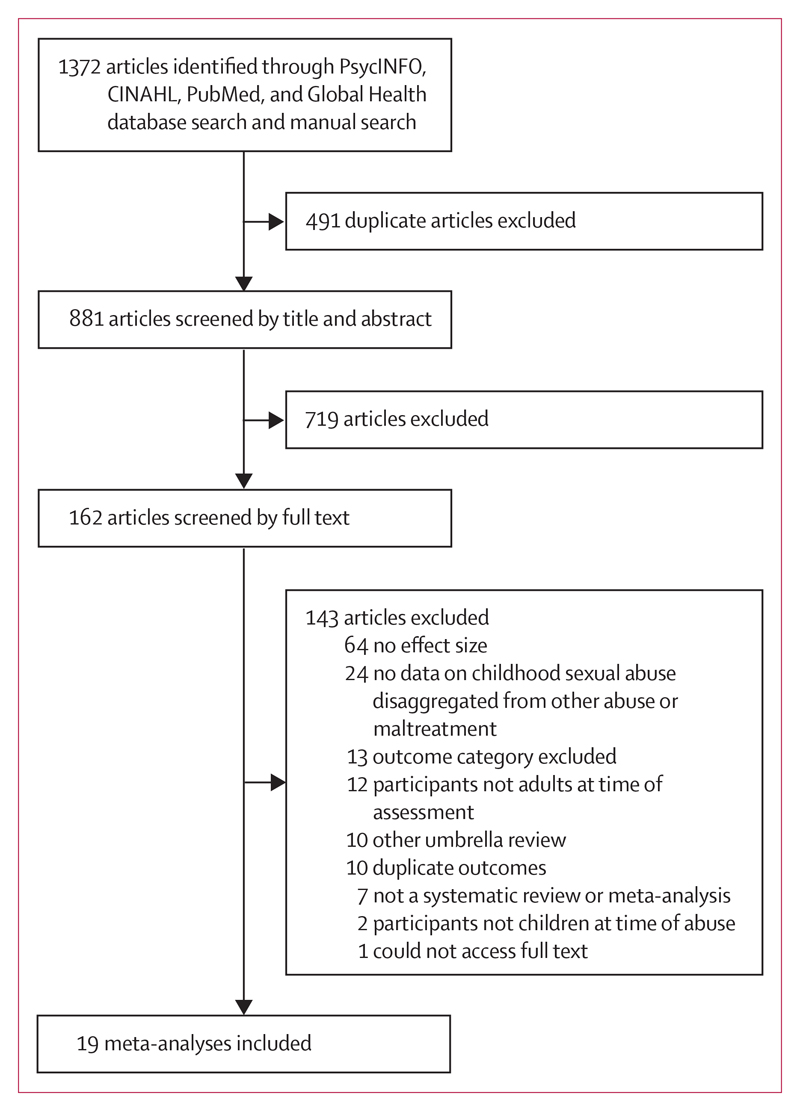
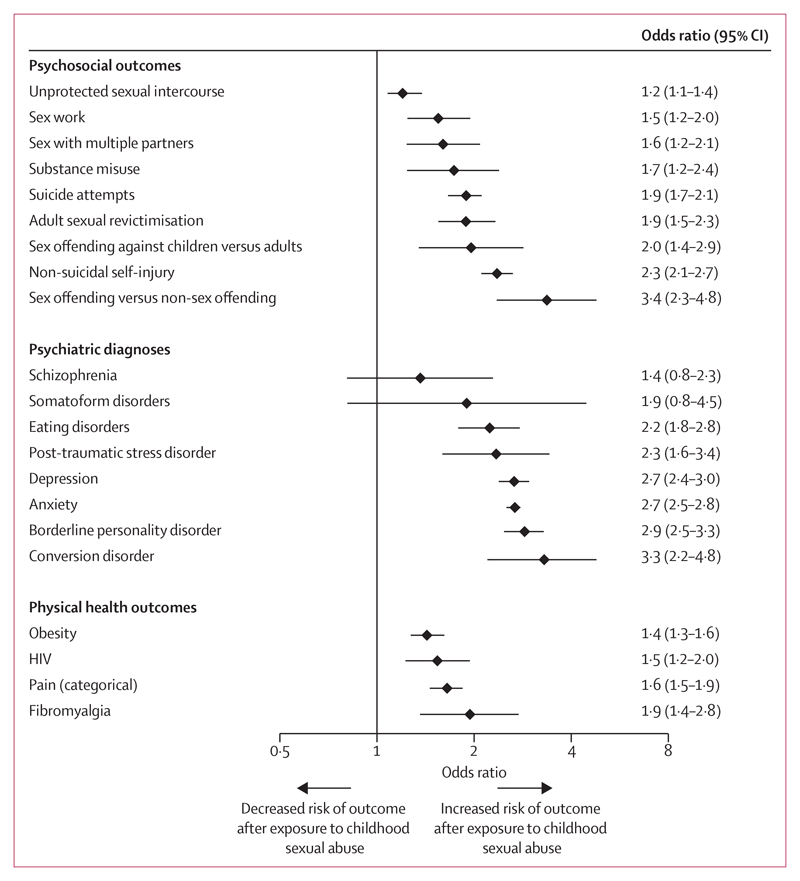
BACKGROUND: Although many meta-analyses have examined the association between childhood sexual abuse and subsequent outcomes, the scope, validity, and quality of this evidence has not been comprehensively assessed. We aimed to systematically review existing meta-analyses on a wide range of long-term psychiatric, psychosocial, and physical health outcomes of childhood sexual abuse, and evaluate the quality of the literature. METHODS: In this umbrella review, we searched four databases (PsycINFO, PubMed, Cumulative Index to Nursing and Allied Health Literature, and Global Health) from inception to Dec 31, 2018, to identify meta-analyses of observational studies that examined the association between childhood sexual abuse (before 18 years of age) and long-term consequences (after 18 years). We compared odds ratios (ORs) across different outcomes. We also examined measures of quality, including heterogeneity between studies and evidence for publication bias. This study is registered with PROSPERO, CRD42016049701. FINDINGS: We identified 19 meta-analyses that included 559 primary studies, covering 28 outcomes in 4 089 547 participants. Childhood sexual abuse was associated with 26 of 28 specific outcomes: specifically, six of eight adult psychiatric diagnoses (ORs ranged from 2·2 [95% CI 1·8-2·8] to 3·3 [2·2-4·8]), all studied negative psychosocial outcomes (ORs ranged from 1·2 [1·1-1·4] to 3·4 [2·3-4·8]), and all physical health conditions (ORs ranged from 1·4 [1·3-1·6] to 1·9 [1·4-2·8]). Strongest psychiatric associations with childhood sexual abuse were reported for conversion disorder (OR 3·3 [95% CI 2·2-4·8]), borderline personality disorder (2·9 [2·5-3·3]), anxiety (2·7 [2·5-2·8]), and depression (2·7 [2·4-3·0]). The systematic reviews for two psychiatric outcomes (post-traumatic stress disorder and schizophrenia) and one psychosocial outcome (substance misuse) met high quality standards. Quality was low for meta-analyses on borderline personality disorder and anxiety, and moderate for conversion disorder. Assuming causality, population attributable risk fractions for outcomes ranged from 1·7% (95% CI 0·7-3·3) for unprotected sexual intercourse to 14·4% (8·8-19·9) for conversion disorder. INTERPRETATION: Although childhood sexual abuse was associated with a wide range of psychosocial and health outcomes, systematic reviews on only two psychiatric disorders (post-traumatic stress disorder and schizophrenia) and one psychosocial outcome (substance misuse) were of a high quality. Whether services should prioritise interventions that mitigate developing certain psychiatric disorders following childhood abuse requires further review. Higher-quality meta-analyses for specific outcomes and more empirical studies on the developmental pathways from childhood sexual abuse to later outcomes are necessary. FUNDING: Wellcome Trust.
Overview
CoChat Summary
TL;DR
This umbrella review synthesizes 19 meta-analyses covering 559 primary studies and 4,089,547 participants to assess long-term outcomes of childhood sexual abuse. Childhood sexual abuse was associated with 26 of 28 outcomes, but only post-traumatic stress disorder, schizophrenia, and substance misuse had high-quality systematic review evidence.
Key findings
- Across 28 outcomes, childhood sexual abuse was associated with 26; odds ratios ranged from 2·2 (95% CI 1·8–2·8) to 3·3 (2·2–4·8) for psychiatric outcomes, 1·2 (1·1–1·4) to 3·4 (2·3–4·8) for psychosocial outcomes, and 1·4 (1·3–1·6) to 1·9 (1·4–2·8) for physical health outcomes.
- Strongest associations were sexual versus non-sexual offending (OR 3·4 [95% CI 2·3–4·8]), conversion disorder (3·3 [2·2–4·8]), borderline personality disorder (2·9 [2·5–3·3]), anxiety (2·7 [2·5–2·8]), and depression (2·7 [2·4–3·0]).
- High-quality systematic reviews were identified for post-traumatic stress disorder, schizophrenia, and substance misuse; quality was low for borderline personality disorder and anxiety (1/5) and moderate for conversion disorder and sexual versus non-sexual offending (3/5).
- Population attributable fractions ranged from 1·7% (95% CI 0·7–3·3) for unprotected sexual intercourse to 14·4% (8·8–19·9) for conversion disorder, with the highest at 14·7% (9·6–19·9) for sexual versus non-sexual offending; absolute rates in high-quality outcomes were 503/1809 (28%) for substance misuse and 36/96 (38%) for post-traumatic stress disorder.
Methods
- Umbrella review searching PsycINFO, PubMed, Cumulative Index to Nursing and Allied Health Literature, and Global Health from inception to Dec 31, 2018, with no language restriction, plus secondary searches and citation chaining; registered with PROSPERO, CRD42016049701.
- Included meta-analyses of observational studies reporting outcomes for childhood sexual abuse before age 18 and long-term outcomes after age 18, disaggregated from other abuse, with aggregate quantitative effect sizes; when overlapping, the most recent or largest meta-analysis was selected, and the minimum was three primary studies.
- Effect sizes were converted to odds ratios; population attributable fractions were calculated assuming causality and a 10% prevalence estimate; quality was assessed with AMSTAR, I² heterogeneity, excess significance, small study effects, and prediction intervals, yielding an aggregate 0–5 score.
Limitations
- The paper states that few included reviews explored heterogeneity by age or study design; familial factors, abuse characteristics, and overlap with other forms of child abuse were not accounted for and might overestimate effect sizes.
- The paper states that primary studies often relied on retrospective recall of childhood sexual abuse, that high co-occurrence with other abuse could not be addressed due to insufficient data, and that evidence was inconsistent with likely publication bias favoring significant findings.
- Evident from the text: population attributable fractions were calculated without confounder adjustment and with a conservative 10% prevalence estimate, so the authors note these figures will likely be overestimated; no confounder-adjusted effect sizes were reported.
Model-written summary. Check it against the paper before relying on it.
Integrity signals
Registry
Cites
Statistics
Figures
Verification
Claims the paper makes
11 Valid · 3 Not valid · 14 Not checked · 58 Own results and interpretations
The cited sources that could be checked couldn’t confirm or dispute this claim.
In the paper
“and 36 (38%) of 96 developed post-traumatic stress disorder.57”
§ Long-term outcomes of childhood sexual abuse: an umbrella review > Results
What the sources say
- Could not verifycites [57] Dube SR Anda RF Felitti VJ Chapman DP Giles WH Childhood abuse, neglect and household dysfunction and the risk of illicit drug use: the Adverse Childhood Experience Study Pediatrics 2003 111 564 72 12612237 sourceExperimental — accuracy not yet measured
The Discussion (p. 11) reports the prevalence of childhood sexual abuse, but not subsequent PTSD diagnoses. Searches for PTSD, post-traumatic stress disorder, and the figures 36, 38%, and 96 found no passage supporting the claimed outcome. (LLM, conf=0.76)
plain- Asserted: passes — The authors put it forward as true.
- Checkable: passes — It can be checked against evidence.
- Load-bearing: unclear — It is unclear whether the paper’s conclusions depend on it.
- Based: passes — The paper gives a reason why it holds.
- Could not verify
The cited sources that could be checked couldn’t confirm or dispute this claim.
In the paper
“by gender on depression,53”
§ Long-term outcomes of childhood sexual abuse: an umbrella review > Results
What the sources say
- Could not verifycites [53] Irish L Kobayashi I Delahanty DL Long-term physical health consequences of childhood sexual abuse: a meta-analytic review J Pediatr Psychol 2010 35 450 61 20022919 PMC2910944 sourceExperimental — accuracy not yet measured
The Abstract identifies depression as a psychological outcome associated with childhood sexual abuse, but says this review examines physical health outcomes. The Results report no suggestive findings for sex as a moderator of physical health outcomes; they do not report whether the effect on depression differs by gender. Searched for gender differences in depression and female–male moderation. (LLM, conf=0.77)
plain- Asserted: passes — The authors put it forward as true.
- Checkable: passes — It can be checked against evidence.
- Load-bearing: unclear — It is unclear whether the paper’s conclusions depend on it.
- Based: passes — The paper gives a reason why it holds.
- Could not verify
The cited sources support only part of this claim — read each source’s verdict below.
In the paper
“by study design on obesity and psychosis,7,9”
§ Long-term outcomes of childhood sexual abuse: an umbrella review > Results
What the sources say
- Partly supportedcites [7] Varese F Smeets F Drukker M Childhood adversities increase the risk of psychosis: a meta-analysis of patient-control, prospective- and cross-sectional cohort studies Schizophr Bull 2012 38 661 71 22461484 PMC3406538 sourceExperimental — accuracy not yet measured
The Results section, “Overall Association Between Adverse Childhood Events and Psychosis” (page unavailable), reports no significant difference by study design in the overall association between childhood adversity and psychosis. The separate sexual-abuse analysis reports an association with psychosis, but the Methods say those adversity-specific effects were not compared by study design. The paper does not address obesity. (LLM, conf=0.87)
- Not checked — no full text of the sourcecites [9] Danese A Tan M Childhood maltreatment and obesity: systematic review and meta-analysis Mol Psychiatry 2014 19 544 54 23689533 source
plain- Asserted: passes — The authors put it forward as true.
- Checkable: passes — It can be checked against evidence.
- Load-bearing: unclear — It is unclear whether the paper’s conclusions depend on it.
- Based: passes — The paper gives a reason why it holds.
- Partly supported
The sources with a verdict support this claim; the rest weren’t checked yet, have no full text we could read, or their verdicts aren’t rated yet.
In the paper
“Previous attempts to synthesise the large number of meta-analytical reviews in the field have mostly considered solely mental health outcomes or a single outcome, such as depression, anxiety disorders, suicide and self-injury, or substance misuse.12–15”
§ Long-term outcomes of childhood sexual abuse: an umbrella review > Introduction
What the sources say
- Supportedcites [12] Maniglio R Child sexual abuse in the etiology of depression: a systematic review of reviews Depress Anxiety 2010 27 631 42 20336807 source
The Methods section says this systematic review included only reviews investigating depressive symptoms or disorders following childhood sexual abuse. The Results section reports that it included four reviews, making this paper an example of a synthesis focused on a single outcome—depression. It does not need to establish the sentence’s broader claim about what most previous syntheses considered. (LLM, conf=0.91)
- Not checked — no full text of the sourcecites [13] Maniglio R Child sexual abuse in the etiology of anxiety disorders: a systematic review of reviews Trauma Violence Abuse 2013 14 96 112 23262751 source
- Not checked — no full text of the sourcecites [14] Maniglio R The role of child sexual abuse in the etiology of suicide and non-suicidal self-injury Acta Psychiatr Scand 2011 124 30 41 20946202 source
- Not checked — no full text of the sourcecites [15] Maniglio R The role of child sexual abuse in the etiology of substance-related disorders J Addict Dis 2011 30 216 28 21745044 source
plain- Asserted: passes — The authors put it forward as true.
- Checkable: passes — It can be checked against evidence.
- Load-bearing: passes — The paper’s conclusions depend on it.
- Based: passes — The paper gives a reason why it holds.
- Supported
Every source the paper cites for this claim was checked and supports it.
In the paper
“Research has indicated the effectiveness of interventions for post-traumatic stress disorder in individuals who have experienced childhood sexual abuse77,78”
§ Long-term outcomes of childhood sexual abuse: an umbrella review > Discussion
What the sources say
- Supportedcites [77] Ehring T Welboren R Morina N Wicherts JM Freitag J Emmelkamp PMG Meta-analysis of psychological treatments for posttraumatic stress disorder in adult survivors of childhood abuse Clin Psychol Rev 2014 34 645 57 25455628 source
The Discussion reports that psychological interventions for PTSD in adult survivors of childhood abuse are efficacious. The Abstract also reports reduced PTSD symptom severity following psychological interventions for adult survivors of childhood sexual abuse. The evidence concerns adult survivors, rather than children currently receiving treatment. (LLM, conf=0.90)
- Supportedcites [78] Trask EV Walsh K DiLillo D Treatment effects for common outcomes of child sexual abuse: a current meta-analysis Aggress Violent Behav 2011 16 6 19 21603060 PMC3095890 source
The Discussion states that treatment is effective in reducing PTSD symptoms among child victims of sexual abuse. The meta-analysis concerns youth under 18, so its evidence is specifically about treatment of PTSD symptoms in that group. (LLM, conf=0.88)
hedgedstates a possible cause- Asserted: passes — The authors put it forward as true.
- Checkable: passes — It can be checked against evidence.
- Load-bearing: unclear — It is unclear whether the paper’s conclusions depend on it.
- Based: passes — The paper gives a reason why it holds.
- Supported
54 more claims · 7 with their cited sources checked
Create a free account to see all 86 claims and to verify the 4 references still open.
- It may state two separate claims as one. 21
- Probably not a substantial claim. 13
Claims other papers make about this one
Each is checked against this paper’s own text: does it say what the citing paper says it does?
The cited source doesn’t support the claim as written.
In the citing paper
“the authors concluded that only two outcomes (PTSD and substance misuse) reached high-quality meta-analytic standards (and thus should be prioritized) and that little credence should be given to other disorders.”
From Child Sexual Abuse as a Unique Risk Factor for the Development of Psychopathology: The Compounded Convergence of Mechanisms (2021) · cites this paper as Hailes et al. 2019
Checked by a reasoning model — may be wrong.
Experimental — accuracy not yet measuredThe source backs part of the claim, not all of it — or backs it for a different population, condition or comparison.
In the citing paper
“reported aggregate odds ratios (ORs) of 3.3 for conversion disorder, 2.9 for borderline personality disorder (BPD), 2.7 for both anxiety and depression, 2.3 for posttraumatic stress disorder (PTSD), 2.2 for eating disorders, 1.9 for somatoform disorders, 1.7 for substance misuse, and 1.4 for schizophrenia.”
From Child Sexual Abuse as a Unique Risk Factor for the Development of Psychopathology: The Compounded Convergence of Mechanisms (2021) · cites this paper as Hailes et al. 2019
Experimental — accuracy not yet measuredThe source backs part of the claim, not all of it — or backs it for a different population, condition or comparison.
In the citing paper
“Quality ratings were based on aggregate assessments across all meta-analyses within diagnostic sets without regard for potential quality exemplars, and there were no distinctions between ORs that were adjusted versus unadjusted for potential confounds”
From Child Sexual Abuse as a Unique Risk Factor for the Development of Psychopathology: The Compounded Convergence of Mechanisms (2021) · cites this paper as Hailes et al. 2019
Experimental — accuracy not yet measuredIn the citing paper
“An umbrella review reported that anxiety [OR = 2.7 (95% CI: 2.5–2.8)], and depression [OR = 2.7 (95% CI: 2.4–3.0)] frequently occurred one after another among adults over 18 years with experiencing sexual abuse as a child [ 11 ].”
From Anxiety and Depression Symptoms among Youth Survivors of Childhood Sexual Abuse: A Network Analysis (2023) · cites this paper as [11]
In the citing paper
“Reviews also reported that persons with a history of CSA are potentially at risk of long-term anxiety and depression diagnoses [ 11 , 12 ].”
From Anxiety and Depression Symptoms among Youth Survivors of Childhood Sexual Abuse: A Network Analysis (2023) · cites this paper as [11]
1 more claim about this paper
Create a free account to see every claim other papers make about this one.
Self-check
Percentages, sums and reported differences re-computed from the paper’s own numbers.
Each contradiction between two passages listed here was confirmed by an independent check.
Rated minor: it would not touch a result — a value no result rests on, a p-value that stays on the same side of the significance level, or a conflict that is clerical, resolved elsewhere in the paper, or outside its own findings.
In the paper
§ Long-term outcomes of childhood sexual abuse: an umbrella review > Results
“Population attributable fractions ranged from 1·7% (95% CI 0·7–3·3) for unprotected sexual intercourse to 14·4% (8·8–19·9) for conversion disorder.”
§ Long-term outcomes of childhood sexual abuse: an umbrella review > Results
“The highest population attributable fraction was 14·7% (9·6–19·9) for sexual offending versus non-sexual offending (table 2).”
Citations
Cites
Child abuse: Adolescent records vs. adult recall
Femina, D. D., Yeager, C. A., & Lewis, D. O. (1990) · Child Abuse & Neglect · doi:10.1016/0145-2134(90)90033-p · Cited by 8,820
The Handbook of Research Synthesis and Meta-Analysis
(2019) · doi:10.7758/9781610448864 · Cited by 4,553
Development of AMSTAR: A measurement tool to assess the methodological quality of systematic reviews
Shea, B. J., Grimshaw, J. M., Wells, G. A., Boers, M., Andersson, N., Hamel, C., Porter, A. C., Tugwell, P., Moher, D., & Bouter, L. M. (2007) · BMC Medical Research Methodology · doi:10.1186/1471-2288-7-10 · Cited by 4,374
Overweight, Obesity, and Depression: A Systematic Review and Meta-analysis of Longitudinal Studies
Luppino, F. S., de Wit, L. M., Bouvy, P. F., Stijnen, T., Cuijpers, P., Penninx, B. W. J. H., & Zitman, F. G. (2010) · Archives of General Psychiatry · doi:10.1001/archgenpsychiatry.2010.2 · Cited by 4,322
Zhang, J., & Yu, K. F. (1998) · JAMA · doi:10.1001/jama.280.19.1690 · Cited by 4,138 · cited 1×
“33 36 The AMSTAR (a measurement tool to assess systematic reviews) checklist was used to assess the methodological quality of the included systematic reviews, 37 and some items were modified for this umbrella review (appendix pp 6–7).”
Burden and consequences of child maltreatment in high-income countries
Gilbert, R., Widom, C. S., Browne, K., Fergusson, D., Webb, E., & Janson, S. (2009) · The Lancet · doi:10.1016/s0140-6736(08)61706-7 · Cited by 3,876 · cited 1×
“60 For example, childhood sexual abuse is associated with risky sexual behaviours, 61,62 which could lead to HIV.”
Varese, F., Smeets, F., Drukker, M., Lieverse, R., Lataster, T., Viechtbauer, W., Read, J., van Os, J., & Bentall, R. P. (2012) · Schizophrenia Bulletin · doi:10.1093/schbul/sbs050 · Cited by 2,436
Dube, S. R., Felitti, V. J., Dong, M., Chapman, D. P., Giles, W. H., & Anda, R. F. (2003) · Pediatrics · doi:10.1542/peds.111.3.564 · Cited by 2,333
Plea for routinely presenting prediction intervals in meta-analysis.
IntHout, J., Ioannidis, J. P. A., Rovers, M. M., & Goeman, J. J. (2016) · BMJ Open · doi:10.1136/bmjopen-2015-010247 · Cited by 2,264 · cited 1×
“42 We created an overall quality assessment.”
A Global Perspective on Child Sexual Abuse: Meta-Analysis of Prevalence Around the World
Stoltenborgh, M., van IJzendoorn, M. H., Euser, E. M., & Bakermans-Kranenburg, M. J. (2011) · Child Maltreatment · doi:10.1177/1077559511403920 · Cited by 2,010
Research works printed but not linked: 3
- Hailes HP Fazel S Yu R Longterm outcomes of childhood sexual abuse: an umbrella review PROSPERO Int Prospect Regist Syst Rev 2016 CRD42016049701
- Quinones-Munoz SL Psychological effects of childhood sexual abuse in adult males Diss Abstr Int Sect B Sci Eng 2001 62 2074
- Liel C Parenting programs for mothers who are at risk or indicated for child abuse and neglect—a systematic review of the international research literature Psychol Erziehung und Unterr 2013 60 11 25
Cited by
McKay, M. T., Cannon, M., Chambers, D., Conroy, R. M., Coughlan, H., Dodd, P., Healy, C., O’Donnell, L., & Clarke, M. C. (2021) · Acta Psychiatrica Scandinavica · doi:10.1111/acps.13268 · Cited by 548
Maj, M., van Os, J., De Hert, M., Gaebel, W., Galderisi, S., Green, M. F., Guloksuz, S., Harvey, P. D., Jones, P. B., Malaspina, D., et al. (2021) · World Psychiatry · doi:10.1002/wps.20809 · Cited by 285
Bohus, M., Kleindienst, N., Hahn, C., Müller-Engelmann, M., Ludäscher, P., Steil, R., Fydrich, T., Kuehner, C., Resick, P. A., Stiglmayr, C., et al. (2020) · JAMA Psychiatry · doi:10.1001/jamapsychiatry.2020.2148 · Cited by 265
“Early remission was achieved under predefined conditions, all of which had to be fulfilled: (1) the patient claimed recovery prior to session 45; (2) the therapist agreed; (3) the therapist’s supervisor agreed; and (4) a blinded rater assessed that the patient no longer met the PTSD diagnosis (Clinician-Administered P…”
BackgroundIndividual-level risk factors for suicide mortality in the general population: an umbrella review
Favril, L., Yu, R., Geddes, J. R., & Fazel, S. (2023) · The Lancet Public Health · doi:10.1016/s2468-2667(23)00207-4 · Cited by 193
“39 Each identified risk factor was assigned a score of zero (low quality) or one (high quality) on five criteria: between-study heterogeneity, prediction intervals, small-study effects, excess significance, and risk of bias.”
BackgroundMethodSelf-citationA framework for understanding the pathophysiology of functional neurological disorder
Drane, D. L., Fani, N., Hallett, M., Khalsa, S. S., Perez, D. L., & Roberts, N. A. (2021) · CNS Spectrums · doi:10.1017/s1092852920001789 · Cited by 189
Noll, J. G. (2021) · Annual Review of Clinical Psychology · doi:10.1146/annurev-clinpsy-081219-112621 · Cited by 164
Fitton, L., Yu, R., & Fazel, S. (2020) · Trauma, Violence, & Abuse · doi:10.1177/1524838018795269 · Cited by 164
Self-citationRisk factors for eating disorders: an umbrella review of published meta-analyses
Solmi, M., Radua, J., Stubbs, B., Ricca, V., Moretti, D., Busatta, D., Carvalho, A. F., Dragioti, E., Favaro, A., Monteleone, A. M., et al. (2021) · Brazilian Journal of Psychiatry · doi:10.1590/1516-4446-2020-1099 · Cited by 148
McKay, M. T., Kilmartin, L., Meagher, A., Cannon, M. D., Healy, C., & Clarke, M. C. (2022) · Journal of Psychiatric Research · doi:10.1016/j.jpsychires.2022.10.015 · Cited by 171
Trauma and US minority children and youth
Pumariega, A. J., Jo, Y., Beck, B., & Rahmani, M. (2022) · Current Psychiatry Reports · doi:10.1007/s11920-022-01336-1 · Cited by 122
Xiao, Z., Murat Baldwin, M., Wong, S. C., Obsuth, I., Meinck, F., & Murray, A. L. (2023) · Trauma, Violence, & Abuse · doi:10.1177/15248380221122816 · Cited by 118
“A recent umbrella review, for example, suggested that the negative impacts of child sexual abuse included self-injury, somatization, schizophrenia, depression, anxiety, and psychosis (Hailes et al., 2019).”
BackgroundPapalia, N., Mann, E., & Ogloff, J. R. P. (2021) · Child Maltreatment · doi:10.1177/1077559520932665 · Cited by 113
Management of eating disorders for people with higher weight: clinical practice guideline
Ralph, A. F., Brennan, L., Byrne, S., Caldwell, B., Farmer, J., Hart, L. M., Heruc, G. A., Maguire, S., Piya, M. K., Quin, J., et al. (2022) · Journal of Eating Disorders · doi:10.1186/s40337-022-00622-w · Cited by 107
Spencer, C. N., Khalil, M., Herbert, M., Aravkin, A. Y., Arrieta, A., Baeza, M. J., Bustreo, F., Cagney, J., Calderon-Anyosa, R. J. C., Carr, S., et al. (2023) · Nature Medicine · doi:10.1038/s41591-023-02629-5 · Cited by 104
“It is likely that the health impacts of intimate partner violence and childhood sexual abuse exposure are mediated through certain physical health risk factors such as high body mass index and smoking, as indicated by our descriptive review of studies and existing meta-analyses 5 .”
ResultThe Impact of Different Types of Abuse on Depression
Radell, M. L., Hamza, E. A., Daghustani, W. H., Perveen, A., & Moustafa, A. A. (2021) · Depression Research and Treatment · doi:10.1155/2021/6654503 · Cited by 156
“While the literature on abuse is extensive, it is also abundant with mixed findings, spurring several recent umbrella reviews (see [9, 20, 22, 23]).”
BackgroundLee, K. H., Seong, H. J., Kim, G., Jeong, G. H., Kim, J. Y., Park, H., Jung, E., Kronbichler, A., Eisenhut, M., Stubbs, B., et al. (2020) · Advances in Nutrition · doi:10.1093/advances/nmaa055 · Cited by 109
“Excess significance was calculated as a ratio of the effect size of the largest individual study (the study with the smallest variance) in each metaanalysis to the summary effect size of the meta-analysis, with a ratio <1 indicating the presence of excess significance bias (32).”
MethodKampling, H., Kruse, J., Lampe, A., Nolte, T., Hettich, N., Brähler, E., Sachser, C., Fegert, J. M., Gingelmaier, S., Fonagy, P., et al. (2022) · Frontiers in Psychiatry · doi:10.3389/fpsyt.2022.919191 · Cited by 116
“We add to previous research demonstrating an association of ACEs and PTSD as well as cPTSD, emphasizing the importance of a persons’ history of child maltreatment and adverse experiences for developing these psychopathologies (13, 15, 17, 59).”
MethodSatinsky, E. N., Kakuhikire, B., Baguma, C., Rasmussen, J. D., Ashaba, S., Cooper‐Vince, C. E., Perkins, J. M., Kiconco, A., Namara, E. B., Bangsberg, D. R., et al. (2021) · PLoS Medicine · doi:10.1371/journal.pmed.1003642 · Cited by 103
“An umbrella review of 19 meta-analyses found strong associations between childhood sexual abuse and depression in adulthood, as well as other psychosocial and psychiatric outcomes [19].”
BackgroundTidmarsh, L. V., Harrison, R. N., Ravindran, D., Matthews, S. L., & Finlay, K. A. (2022) · Frontiers in Pain Research · doi:10.3389/fpain.2022.923866 · Cited by 115
“The pervasive detrimental physical, social and psychological outcomes from chronic pain also commonly present in people who have experienced greater childhood adversity (14, 15).”
BackgroundInfluentialGlobal Prevalence of Sexual Violence Against Children: A Systematic Review and Meta-Analysis
Piolanti, A., Schmid, I. E., Fiderer, F. J., Ward, C. L., Stöckl, H., & Foran, H. M. (2025) · Archives of Pediatrics and Adolescent Medicine · doi:10.1001/jamapediatrics.2024.5326 · Cited by 131
Evidence That Nine Autistic Women Out of Ten Have Been Victims of Sexual Violence
Cazalis, F., Reyes, E., Leduc, S., & Gourion, D. (2022) · Frontiers in Behavioral Neuroscience · doi:10.3389/fnbeh.2022.852203 · Cited by 134
Cagney, J., Spencer, C. N., Flor, L. S., Herbert, M. E., Khalil, M., O’Connell, E. M., Mullany, E. C., Bustreo, F., Chandan, J. S., Metheny, N., et al. (2025) · The Lancet · doi:10.1016/s0140-6736(25)00311-3 · Cited by 142
“5,6 In addition to its direct impacts on health, violence against children limits individual development, hindering both educational attainment and economic achievement, 7,8 ultimately leading to diminished wellbeing trajectories for survivors.”
Morbidity and mortality in schizophrenia with comorbid substance use disorders
Lähteenvuo, M., Batalla, A., Luykx, J. J., Mittendorfer‐Rutz, E., Tanskanen, A. J., Tiihonen, J., & Taipale, H. T. (2021) · Acta Psychiatrica Scandinavica · doi:10.1111/acps.13291 · Cited by 90
Work related sexual harassment and risk of suicide and suicide attempts: prospective cohort study
Hanson, L. L. M., Nyberg, A., Mittendorfer‐Rutz, E., Bondestam, F., & Madsen, I. E. H. (2020) · BMJ · doi:10.1136/bmj.m2984 · Cited by 95
Child Maltreatment During the COVID-19 Pandemic
Rapp, A., Fall, G., Radomsky, A. C., & Santarossa, S. (2021) · Pediatric Clinics of North America · doi:10.1016/j.pcl.2021.05.006 · Cited by 76
“Parental stress also increased during the COVID-19 pandemic: fear of the virus, job loss, new rules and mandates, and transitions to virtual work and schooling, among other stressors, were rampant during this time.(4,18) Additionally, it is documented that economic hardship is a predictor of child neglect.”
BackgroundPries, L.-K., van Os, J., ten Have, M., de Graaf, R., van Dorsselaer, S., Bak, M., Lin, B. D., van Eijk, K. R., Kenis, G., Richards, A., et al. (2020) · JAMA Psychiatry · doi:10.1001/jamapsychiatry.2020.2304 · Cited by 77
A systematic review of factors associated with disclosure of child sexual abuse
Latiff, M. A., Fang, L., Goh, D. A., & Tan, L. J. (2023) · Child Abuse & Neglect · doi:10.1016/j.chiabu.2023.106564 · Cited by 130
Functional neurological disorder is a feminist issue
McLoughlin, C., Hoeritzauer, I., Cabreira, V., Aybek, S., Adams, C. N., Alty, J., Ball, H. A., Baker, J., Bullock, K. D., Burness, C., et al. (2023) · Journal of Neurology Neurosurgery & Psychiatry · doi:10.1136/jnnp-2022-330192 · Cited by 91
Bigras, N., Vaillancourt-Morel, M.-P., Nolin, M.-C., & Bergeron, S. (2021) · Journal of Child Sexual Abuse · doi:10.1080/10538712.2020.1825148 · Cited by 71
“…use, posttraumatic stress disorder, depression and anxiety disorders as well as chronic pain (Fergusson et al., CONTACT Noémie Bigras noemie.bigras@umontreal.ca Departement of Psychology, Université De Montréal, Montréal, Québec H3C 3J7, Canada © 2020 Taylor & Francis 2013; Hailes et al., 2019).”
BackgroundGuiney, H., Caspi, A., Ambler, A., Belsky, J., Kokaua, J., Broadbent, J., Cheyne, K., Dickson, N., Hancox, R. J., Harrington, H., et al. (2024) · Development and Psychopathology · doi:10.1017/s0954579422001146 · Cited by 64
“Finally, the multidisciplinary, long-duration approach using consistent measures across adulthood helped mitigate problems associated with differences in definition and design that those seeking to synthesize the literature lament (Hailes et al., 2019).”
BackgroundInfluentialChow, R. T. S., Whiting, D., Favril, L., Ostinelli, E. G., Cipriani, A., & Fazel, S. (2023) · Neuroscience & Biobehavioral Reviews · doi:10.1016/j.neubiorev.2023.105454 · Cited by 66
“…adaptations of the standard AMSTAR 2 criteria were made: 1) for item 7, the inclusion of a full list of references was not practical in most cases, (Hailes et al., 2019) and so this criterion was modified to state that a summary of excluded studies, in the form of PRISMA flow-chart or equivalent…”
MethodSelf-citationAssociation between Childhood Maltreatment and Suicidal Ideation: A Path Analysis Study
Berardelli, I., Sarubbi, S., Rogante, E., Erbuto, D., Giuliani, C., Lamis, D. A., Innamorati, M., & Pompili, M. (2022) · Journal of Clinical Medicine · doi:10.3390/jcm11082179 · Cited by 67
“Childhood sexual abuse has serious, long-term medical and psychological consequences [74,75], and produces a cascade of neurobiological events linked also to suicidal ideation [76].”
BackgroundFazel, S., Hurton, C., Burghart, M., DeLisi, M., & Yu, R. (2024) · Journal of Criminal Justice · doi:10.1016/j.jcrimjus.2024.102197 · Cited by 96
Self-citationAbate, B. B., Sendekie, A. K., Faris, A. M., Abebe, G. K., Azmeraw, M., Alamaw, A. W., Zemariam, A. B., Kitaw, T. A., Kassaw, A., Wodaynew, T., et al. (2024) · Neuropsychobiology · doi:10.1159/000542392 · Cited by 75
“Adults who experienced physical or sexual abuse as children have been found to have higher levels of anxiety, despair, and distress as well as a variety of adult psychiatric diagnoses, adverse psychosocial consequences, and poor physical health outcomes [40, 66].”
Macpherson, J. M., Gray, S. R., Ip, P., McCallum, M., Hanlon, P., Welsh, P. I., Chan, K. L., Mair, F. S., Celis-Morales, C. A., Minnis, H., et al. (2021) · The Lancet Regional Health - Europe · doi:10.1016/j.lanepe.2021.100224 · Cited by 56
“ACEs have been shown to lead to adverse mental disorders in adulthood, most notably depression, anxiety, and posttraumatic stress disorder (PTSD) [3,4] with a dose-response relationship.”
BackgroundInfluentialStigma in functional neurological disorder (FND) – A systematic review
McLoughlin, C., McWhirter, L., Pisegna, K., Tijssen, M. A. J., Tak, L. M., Carson, A. J., & Stone, J. (2024) · Clinical Psychology Review · doi:10.1016/j.cpr.2024.102460 · Cited by 69
Quidé, Y., Tozzi, L., Corcoran, M., Cannon, D. M., & Dauvermann, M. R. (2020) · Neuropsychiatric Disease and Treatment · doi:10.2147/ndt.s285540 · Cited by 66
Sexual violence and cardiovascular disease risk: A systematic review and meta-analysis
Jakubowski, K., Murray, V., Stokes, N., & Thurston, R. C. (2021) · Maturitas · doi:10.1016/j.maturitas.2021.07.014 · Cited by 67
Janiri, D., Moccia, L., Dattoli, L., Pepe, M., Molinaro, M., Martin, V. D., Chieffo, D. R. P., Nicola, M. D., Fiorillo, A., Janiri, L., et al. (2021) · Australian & New Zealand Journal of Psychiatry · doi:10.1177/0004867421998802 · Cited by 57
“sexual, physical, emotional abuse and neglect) differently impact on multiple psychiatric disorders, modulating independently their clinical expression (Hailes and Yu, 2020).”
BackgroundInfluentialGewirtz‐Meydan, A., & Godbout, N. (2023) · Child Abuse & Neglect · doi:10.1016/j.chiabu.2023.106195 · Cited by 87
“Childhood sexual abuse (CSA) is a central transdiagnostic stressor with potentially meaningful risks for maladaptation in biological and psychological development (Hailes et al., 2019; Shenk et al., 2022).”
Botngård, A., Eide, A. H., Mosqueda, L. A., Blekken, L. E., & Malmedal, W. (2021) · BMC Health Services Research · doi:10.1186/s12913-021-06227-4 · Cited by 72
“Psychological problems stemming from work-related factors depend on staff’s personalities and experiences [70], and it is well documented that adverse childhood experiences are associated with an array of mental and physical health issues in later life [71].”
BackgroundWang, S., Xu, H., Zhang, S., Yang, R., Li, D., Sun, Y., Wan, Y., & Tao, F. (2020) · Journal of Interpersonal Violence · doi:10.1177/0886260520918571 · Cited by 58
Waters, R. C., & Gould, E. (2022) · Frontiers in Systems Neuroscience · doi:10.3389/fnsys.2022.860847 · Cited by 57
Leucht, S., Siafis, S., McGrath, J. J., McGorry, P. D., Howes, O. D., Tamminga, C. A., Carr, R., Bighelli, I., Schneider‐Thoma, J., Priller, J., et al. (2025) · Nature Reviews Disease Primers · doi:10.1038/s41572-025-00667-6 · Cited by 81
Fazel, S., Burghart, M., Wolf, A., Whiting, D., & Yu, R. (2023) · Trauma Violence & Abuse · doi:10.1177/15248380231195880 · Cited by 63
“Across all ages, increased risks of psychiatric symptoms and diagnoses, suicidal behaviors, and further violence have been reported (de Ruiter et al., 2022; Hailes et al., 2019; MacIsaac et al., 2017; Smith et al., 2020; Wright et al., 2019).”
BackgroundSelf-citationAdverse childhood experiences and mental health in adulthood: Evidence from North Carolina
Mwachofi, A., Imai, S., & Bell, R. A. (2020) · Journal of Affective Disorders · doi:10.1016/j.jad.2020.02.021 · Cited by 56
Collin‐Vézina, D., Sablonnière-Griffin, M. D. L., Sivagurunathan, M., Lateef, R., Alaggia, R., McElvaney, R., & Simpson, M. (2021) · Borderline Personality Disorder and Emotion Dysregulation · doi:10.1186/s40479-020-00142-6 · Cited by 54
Bussières, A., Hartvigsen, J., Ferreira, M. L., Ferreira, P. H., Hancock, M. J., Stone, L. S., Wideman, T. H., Boruff, J., & Elklit, A. (2020) · Systematic Reviews · doi:10.1186/s13643-020-01474-8 · Cited by 40
Psychobiological Consequences of Childhood Sexual Abuse: Current Knowledge and Clinical Implications
Iacono, L. L., Trentini, C., & Carola, V. (2021) · Frontiers in Neuroscience · doi:10.3389/fnins.2021.771511 · Cited by 84
Pries, L.-K., Moore, T. M., Visoki, E., Sotelo, I., Barzilay, R., & Gülöksüz, S. (2022) · Biological Psychiatry Global Open Science · doi:10.1016/j.bpsgos.2022.05.005 · Cited by 49
Bellis, M. A., Hughes, K. E., Cresswell, K., & Ford, K. (2023) · BMJ Open · doi:10.1136/bmjopen-2023-072916 · Cited by 45
Wang, Y., Sun, Y., Missmer, S. A., Rexrode, K. M., Roberts, A. L., Chavarro, J. E., & Rich-Edwards, J. W. (2023) · BMJ · doi:10.1136/bmj-2022-073613 · Cited by 49
Forensic Interview Techniques in Child Sexual Abuse Cases: A Scoping Review
Fernandes, D., Gomes, J. P., Albuquerque, P. B., & de Matos, M. A. V. (2023) · Trauma Violence & Abuse · doi:10.1177/15248380231177317 · Cited by 66
“Child sexual abuse (CSA) 1 is a global public health problem that devastates victims, their families, and society (Goodyear-Brown et al., 2012; Hailes et al., 2019).”
BackgroundMcCabe, S. E., Hughes, T. L., Beal, S. J., Evans‐Polce, R. J., Kcomt, L., Engstrom, C. W., West, B. T., Veliz, P. T., Leary, K., McCabe, V. V., et al. (2021) · Child Abuse & Neglect · doi:10.1016/j.chiabu.2021.105377 · Cited by 46
Exploitation, Labor and Sex Trafficking of Children and Adolescents: Health Care Needs of Patients
Greenbaum, J., Kaplan, D. M., Young, J., Haney, S. B., Sirotnak, A. P., Asnes, A. G., Gavril, A. R., Gilmartin, A. B. H., Girardet, R. G., Heavilin, N. D., et al. (2022) · PEDIATRICS · doi:10.1542/peds.2022-060416 · Cited by 55
Miele, C., Maquigneau, A., Joyal, C. C., Bertsch, I., Gangi, O., Gonthier, H., Rawlinson, C., Vigourt-Oudart, S., Symphorien, É., Heasman, A., et al. (2023) · Child Abuse & Neglect · doi:10.1016/j.chiabu.2023.106497 · Cited by 64
Fernandes, G., Fernandes, M., Vaidya, N., Souza, P. D., Plotnikova, E., Geddes, R., Holla, B., Sharma, E., Benegal, V., & Choudhry, V. (2021) · BMJ Open · doi:10.1136/bmjopen-2020-044983 · Cited by 52
Livestreaming Technology and Online Child Sexual Exploitation and Abuse: A Scoping Review
Drejer, C., Riegler, M. A., Halvorsen, P., Johnson, M. S., & Baugerud, G. A. (2023) · Trauma Violence & Abuse · doi:10.1177/15248380221147564 · Cited by 69
“Further, it increases the risk of poor health outcomes throughout the lifespan (Hailes et al., 2019; Murray et al., 2014).”
BackgroundRudolph, J. I., van Berkel, S. R., Zimmer‐Gembeck, M. J., Walsh, K., Straker, D., & Campbell, T. (2023) · Trauma Violence & Abuse · doi:10.1177/15248380231156408 · Cited by 65
“…poor quality of life, loss of productivity and reduced income, alcohol and drug misuse, revictimization, family breakdown, chronic health conditions, and treatment and healthcare costs (Bonomi et al., 2009; Hailes et al., 2019; Kamiya et al., 2016; Macmillan, 2000; Stoltenborgh et al., 2011).”
BackgroundSchizophrenia, a disease of impaired dynamic metabolic flexibility: A new mechanistic framework
Sarnyai, Z., & Ben‐Shachar, D. (2024) · Psychiatry Research · doi:10.1016/j.psychres.2024.116220 · Cited by 43
“Early life stress and trauma have been consistently identified through extensive meta-analyses and umbrella reviews as major risk factors in schizophrenia (Bailey et al. 2018; van Winkel et al. 2008; Hailes et al. 2019; Varese et al. 2012).”
BackgroundRussell, D. H., Trew, S., Harris, L. G., Dickson, J., Walsh, K., Higgins, D. J., & Smith, R. (2024) · Trauma Violence & Abuse · doi:10.1177/15248380241235895 · Cited by 83
“Given the continuing high prevalence rates for CSA (e.g., Mathews et al., 2023), its serious effects (Hailes et al., 2019), and the associated economic burden (Letourneau, Brown, et al., 2018), there is a pressing need for effective prevention efforts to which all members of children’s social…”
BackgroundReis, D. J., Kaizer, A. M., Kinney, A. R., Bahraini, N. H., Holliday, R. P., Forster, J. E., & Brenner, L. A. (2022) · Psychological Trauma Theory Research Practice and Policy · doi:10.1037/tra0001316 · Cited by 41
Childhood abuse and neglect, and mortality risk in adulthood: A systematic review and meta-analysis
D’Arcy-Bewick, S., Terracciano, A., Turiano, N. A., Sutin, A. R., Long, R. M., & O’Súilleabháin, P. S. (2022) · Child Abuse & Neglect · doi:10.1016/j.chiabu.2022.105922 · Cited by 56
History of Childhood Trauma and Association With Borderline and Dissociative Features
Tschoeke, S., Bichescu-Burian, D. M., Steinert, T., & Flammer, E. (2020) · The Journal of Nervous and Mental Disease · doi:10.1097/nmd.0000000000001270 · Cited by 48
“A recent review on the long-term outcomes of childhood sexual abuse found the strongest associations with mental disorders between a history of childhood sexual abuse and conversion disorders (Hailes et al., 2019).”
BackgroundMYERS, B. J., Bantjes, J. R., Löchner, C., Mortier, P., Kessler, R. C., & Stein, D. J. (2021) · Social Psychiatry and Psychiatric Epidemiology · doi:10.1007/s00127-020-01992-9 · Cited by 40
Primary Psychosis: Risk and Protective Factors and Early Detection of the Onset
Brasso, C., Giordano, B., Badino, C., Bellino, S., Bozzatello, P., Montemagni, C., & Rocca, P. (2021) · Diagnostics · doi:10.3390/diagnostics11112146 · Cited by 47
The Association Between Child Abuse and Aggressive Behavior: A Three-Level Meta-Analysis
Ran, G., Zhang, Q., Zhang, Q., Li, J., & Chen, J. (2022) · Trauma Violence & Abuse · doi:10.1177/15248380221129596 · Cited by 47
“This might be due to the fact that one individual experiencing psychological abuse in early childhood showed a high risk of externalizing problems (e.g., aggressive behavior) than a person encountering sexual abuse (Hailes et al., 2019; Hodgdon et al., 2018).”
BackgroundDevakumar, D., Palfreyman, A., Uthayakumar-Cumarasamy, A., Ullah, N., Ranasinghe, C., Minckas, N., Nadkarni, A., Oram, S., Osrin, D., & Mannell, J. (2021) · Conflict and Health · doi:10.1186/s13031-021-00410-4 · Cited by 46
“Sexual violence in particular is associated with a long-term increased risk of mental and physical illness [6].”
BackgroundPredictors of Online Child Sexual Abuse in a U.S. National Sample
Turner, H. A., Finkelhor, D., & Colburn, D. (2023) · Journal of Interpersonal Violence · doi:10.1177/08862605221149090 · Cited by 46
“Like other forms of childhood sexual victimization (Collin-Vézina et al., 2013; Hailes et al., 2019; Maniglio, 2010; Noll, 2021) OCSA has a variety of negative psychological outcomes, including PTSD, suicidality, depression, anxiety, and general psychopathology (Bates, 2016; Eaton et al.”
BackgroundAn ecological approach to understanding the impact of sexual violence: a systematic meta-review
Stockman, D., Haney, L., Uzieblo, K., Littleton, H., Keygnaert, I., Lemmens, G. M. D., & Verhofstadt, L. (2023) · Frontiers in Psychology · doi:10.3389/fpsyg.2023.1032408 · Cited by 49
“Similar meta-reviews on the impact of child sexual abuse already exist (Maniglio, 2009; Hailes et al., 2019), but we are not aware of any published meta-reviews on the impact of adolescent and adult sexual violence (i.”
BackgroundAdolescent health outcomes: associations with child maltreatment and peer victimization
Salmon, S., Dávila, I. G., Taillieu, T., Stewart-Tufescu, A., Duncan, L., Fortier, J., Struck, S., Georgiades, K., MacMillan, H. L., Kimber, M., et al. (2022) · BMC Public Health · doi:10.1186/s12889-022-13310-w · Cited by 43
Singh, S., & Nambiar, V. (2024) · Journal of Applied Security Research · doi:10.1080/19361610.2024.2331885 · Cited by 43
“Exposure to abuse in childhood can potentially impact children’s physical and mental health (Hailes et al., 2019; Shenk et al., 2022).”
Nobels, A., Vandeviver, C., Beaulieu, M. J., Inescu, A. C., Nisen, L., Noortgate, N. J. V. D., Beken, T. V., Lemmens, G. M. D., & Keygnaert, I. (2020) · International Journal of Environmental Research and Public Health · doi:10.3390/ijerph17114117 · Cited by 39
“Moreover, child sexual abuse can result in several long-term consequences that might persist throughout adulthood [18,19] and presumably later life.”
BackgroundSvedin, C. G., Donevan, M., Bladh, M. K., Priebe, G., Fredlund, C., & Jonsson, L. S. (2022) · European Child & Adolescent Psychiatry · doi:10.1007/s00787-022-01992-x · Cited by 48
Marshall, C., Langevin, R., & Cabecinha‐Alati, S. (2022) · International Journal of Child and Adolescent Resilience · doi:10.54488/ijcar.2022.283 · Cited by 42
Haginoya, S., Ibe, T., Yamamoto, S., Yoshimoto, N., Mizushi, H., & Santtila, P. O. (2023) · Frontiers in Psychology · doi:10.3389/fpsyg.2023.1133621 · Cited by 41
“Given the harm caused by CSA on individuals’ psychological, relational, and somatic health (Hailes et al., 2019), it is paramount to prevent CSA but also to investigate suspected cases effectively.”
BackgroundAnxiety and Depression Symptoms among Youth Survivors of Childhood Sexual Abuse: A Network Analysis
Li, J., Jin, Y., Xu, S., Luo, X., Wilson, A., Li, H., Wang, X., Sun, X., & Wang, Y. (2023) · BMC Psychology · doi:10.1186/s40359-023-01275-3 · Cited by 29
“Reviews also reported that persons with a history of CSA are potentially at risk of long-term anxiety and depression diagnoses [11, 12].”
BackgroundTurniansky, H., Ben-Dor, D., Krivoy, A., Weizman, A., & Shoval, G. (2019) · Child Abuse & Neglect · doi:10.1016/j.chiabu.2019.104222 · Cited by 29
Child Sexual Abuse Prevention: Parental Discussion, Protective Practices and Attitudes
Rudolph, J. I., Walsh, K., Shanley, D. C., & Zimmer-Gembeck, M. J. (2022) · Journal of Interpersonal Violence · doi:10.1177/08862605211072258 · Cited by 29
“Child sexual abuse (CSA) continues to be a significant global problem, with short and long-term adverse consequences for individuals, families and communities (Blanco et al., 2015; Hailes et al., 2019).”
BackgroundHeterogeneity of patients with functional/dissociative seizures: Three multidimensional profiles
Hingray, C., Ertan, D., Reuber, M., Lother, A.-S., Chrusciel, J., Tarrada, A., Michel, N., Meyer, M., Klemina, I., Maillard, L. G., et al. (2022) · Epilepsia · doi:10.1111/epi.17230 · Cited by 35
Piolanti, A., Jouriles, E. N., & Foran, H. M. (2022) · JAMA Network Open · doi:10.1001/jamanetworkopen.2022.40895 · Cited by 44
Telemedical Interventions for Chronic Obstructive Pulmonary Disease Management: Umbrella Review
Koh, J. H., Chong, L. C. Y., Koh, G. C., & Tyagi, S. (2023) · Journal of Medical Internet Research · doi:10.2196/33185 · Cited by 38
“In conducting this review, we took reference from a recent umbrella review by Hailes et al [16].”
Quraish Shihab and Buya Hamka: The Concept of Multicultural Education from a Qur'anic Perspective
Putri, L. R., Vera, A., & Visconte, A. (2023) · International Journal of Educational Narratives · doi:10.55849/ijen.v1i1.236 · Cited by 43
Silva, R. C., Oliva, F., Barlati, S., Perusi, G., Meattini, M., Dashi, E., Colombi, N., Vaona, A., Carletto, S., & Minelli, A. (2024) · Psychiatry Research · doi:10.1016/j.psychres.2024.115881 · Cited by 44
“…majority of studies concerning early life stress (ELS) and the risk of developing psychiatric disorders have usually focused on generic childhood adversities, often concentrating on physical and sexual abuse (Chen et al., 2010; Fergusson et al., 2008; Hailes et al., 2019; Werbeloff et al., 2021).”
BackgroundLanda–Blanco, M., Vásquez, G., Portillo, G., Sproviero, F., & Echenique, Y. (2024) · Frontiers in Psychiatry · doi:10.3389/fpsyt.2024.1352824 · Cited by 33
“…also have a greater incidence of engaging in behavior risks (27), lower positive mental health (28), deteriorated health-related quality of life (29), conversion disorder, borderline personality disorder, anxiety, depression, post-traumatic stress disorder, schizophrenia, and substance abuse (30).”
BackgroundHutsebaut, J., & Aleva, A. (2020) · Current Opinion in Psychology · doi:10.1016/j.copsyc.2020.06.004 · Cited by 38
Erzın, G., Pries, L.-K., van Os, J., Fusar‐Poli, L., Delespaul, P., Kenis, G., Luykx, J. J., Lin, B. D., Richards, A. L., Akdede, B. B., et al. (2021) · European Psychiatry · doi:10.1192/j.eurpsy.2021.19 · Cited by 33
“, sexual abuse) on mental and physical outcomes in the general population [10], as well as its relation with service engagement and medication adherence in patient populations [11].”
BackgroundWerbeloff, N., Thygesen, J. H., Hayes, J., Viding, E. M., Johnson, S., & Osborn, D. (2021) · Acta Psychiatrica Scandinavica · doi:10.1111/acps.13302 · Cited by 30
Sousa, M., Andrade, J., Rodrigues, A. D. C., & Gonçalves, R. A. (2022) · Trauma Violence & Abuse · doi:10.1177/15248380221082080 · Cited by 37
“Along with the high prevalence of this problem, the literature has shown its profound and negative consequences for the victims and society (Hailes et al., 2019; Wurtele, 2016).”
BackgroundFlor, L. S., Spencer, C. N., Cagney, J., Gil, G., Aalruz, H., ElHafeez, S. A., Abdelwahab, S. İ., Abdoun, M., Abebe, M., Abebe, Y., et al. (2025) · The Lancet · doi:10.1016/s0140-6736(25)02503-6 · Cited by 66
Rosenfield, P., Jiang, D., & Pauselli, L. (2021) · Schizophrenia Research · doi:10.1016/j.schres.2021.06.005 · Cited by 34
Pompedda, F., Zhang, Y., Haginoya, S., & Santtila, P. O. (2022) · Journal of Police and Criminal Psychology · doi:10.1007/s11896-022-09509-7 · Cited by 34
“It is also clear that CSA is associated with a plethora of negative psychological, relational, and somatic health consequences (Hailes et al. 2019).”
BackgroundPredicting disclosure latency in substantiated cases of child sexual abuse
Gewehr, E., Hensel, B., & Volbert, R. (2021) · Child Abuse & Neglect · doi:10.1016/j.chiabu.2021.105346 · Cited by 29
Bemmouna, D., Lagzouli, A., & Weiner, L. (2023) · Molecular Autism · doi:10.1186/s13229-023-00580-3 · Cited by 28
“On the CTQ-SF (childhood maltreatment), the Sexual abuse subscale score was signi�cantly higher in autistic women than autistic men (W = -5.00, p = 0.001) and comparable to the BPD group, although they tended to be lower than the latter group (W= 1.46, p = 0.056).”
ResultInfluentialHébert, M., Smith, K., Caouette, J., Cénat, J. M., Karray, A., Cartierre, N., Veuillet‐Combier, C., Mazoyer, A.-V., & Dérivois, D. (2020) · Journal of Affective Disorders · doi:10.1016/j.jad.2020.12.100 · Cited by 31
Wiss, D. A., Brewerton, T. D., & Tomiyama, A. J. (2021) · Eating and Weight Disorders - Studies on Anorexia Bulimia and Obesity · doi:10.1007/s40519-021-01293-3 · Cited by 30
A Systematic Review of Community-Level Protective Factors in Children Exposed to Maltreatment
Jean-Thorn, A., Tremblay‐Perreault, A., Dubé, V., & Hébert, M. (2022) · Trauma Violence & Abuse · doi:10.1177/15248380221117234 · Cited by 36
“Child maltreatment is a global public health issue that requires the collaboration of several institutions to not only implement efficient prevention strategies, but also to document the associated consequences that emerge throughout the life span, such as a variety of deleterious outcomes including behavioral and emo…”
BackgroundThe bridge symptoms of childhood trauma, sleep disorder and depressive symptoms: a network analysis
Guo, W., Zhao, Y., Chen, H., Liu, J., Chen, X., Tang, H., Zhou, J., & Wang, X. (2023) · Child and Adolescent Psychiatry and Mental Health · doi:10.1186/s13034-023-00635-6 · Cited by 32
“Meanwhile, the heterogeneity of trauma as well as its impacts might have led to great differences in the degree of damage to the mental health of individuals [18]; therefore, we look to explore the network structure between CT and SD using the approach of network analysis as well as to identify the bridge of the sympt…”
Høye, A., Jacobsen, B. K., Bramness, J. G., Nesvåg, R., Reichborn‐Kjennerud, T., & Heiberg, I. H. (2021) · Social Psychiatry and Psychiatric Epidemiology · doi:10.1007/s00127-021-02055-3 · Cited by 27
The Effectiveness of Schema Therapy in Individuals Who Committed Crimes: A Systematic Review
Sousa, M., Gouveia, C. P. F., Cunha, O. S., & Rodrigues, A. D. C. (2024) · Trauma Violence & Abuse · doi:10.1177/15248380241254082 · Cited by 29
“Perpetrators of crimes can cause much harm to the victims and society (Guay et al., 2019; Hailes et al., 2019).”
Background
Metadata
- Authors
- Hailes, H. P., Yu, R., Danese, A., & Fazel, S.
- Affiliations
- University of Oxford (GB)
- National Health Service (GB)
- Corresponding author
- Fazel, Seena
- Venue
- The Lancet Psychiatry
- Publisher
- Elsevier BV
- Published
- 2019-10
- Volume
- 6
- Issue
- 10
- Pages
- 830-839
- ISSN
- 2215-0366 (ISSN-L)
- PMC
- PMC7015702
- OpenAlex
- W2972999459
- Cited by
- 827
- References
- 101
- Citations by year
- 2026: 142 · 2025: 151 · 2024: 140 · 2023: 136 · 2022: 116 · 2021: 92 · 2020: 44 · 2019: 5
- FWCI
- 10.13
- Type
- journal article
- Language
- en
- Open access
- hybrid
- doi.org
- Licence
- cc-by
- www.elsevier.com/tdm/userlicense/1.0/ (tdm)
- www.elsevier.com/legal/tdmrep-license (tdm)
- creativecommons.org/licenses/by/4.0/ (vor)
- Locations
- The Lancet Psychiatry (publishedVersion, cc-by)
- PubMed (publishedVersion)
- Research Portal (King's College London) (publishedVersion, other-oa)
- PubMed Central (acceptedVersion, cc-by)
- Funders
- King's College London
- Economic and Social Research Council
- Wellcome Trust (202836/Z/16/Z)
- National Institute for Health Research Biomedical Research Centre at Moorfields Eye Hospital NHS Foundation Trust and UCL Institute of Ophthalmology
- Nederlandse Organisatie voor Wetenschappelijk Onderzoek (446-15-002)
- Topics
- Social Sciences › Psychology › Clinical Psychology › Child Abuse and Trauma
- Social Sciences › Sociology and Political Science › Military, Security, and Education Studies
- Social Sciences › Gender Studies › Sexual Assault and Victimization Studies
- Keywords
- child sexual abuse, long-term outcomes, mental illness, conversion disorder, borderline personality disorder, anxiety, depression, substance abuse, post-traumatic stress disorder, schizophrenia, psychosocial outcomes, physical health, quality of evidence, publication bias, population attributable risk, causal inference, substance use disorders, physical health conditions
- MeSH terms
- Mental Disorders, Child, Child Abuse, Sexual, Health Status, Humans
About these checks
Registry, retraction, Cites and statistics results are computed, not judged, with one exception: a printed reference that no index lists is read once by a model before it counts as a citation error. Claims are extracted by a model and kept only when their quote appears verbatim in the text; each cited source is then checked, with a model’s help, for whether it says what the claim relies on. Those verdicts can be wrong — read the claim’s quote and the cited source before relying on one.
The claim verdicts this report counts are experimental: their accuracy is not yet measured.
A language model drew the claims from the paper on 2026-10-10, under version 3 of the claim definition (model deepseek-v4.1-flash, prompt extract-v3).
A second model labelled each claim on 2026-10-10 (model jev-1.13-20260917, definition revision gold-guideline-v0.2).
Cited sources are checked with a language model’s help (gpt-6-sol).
Statistics and arithmetic are recomputed, not judged.
Confidence bands are shown only for fields calibrated on our annotated test set. None is calibrated yet, so no band is shown.
What counts as a claim ›How we measure confidence ›How we check this ›
Are you an author, or do you see a problem with this page? Request a review
Data sources
Bibliographic data: Semantic Scholar, OpenAlex, Crossref.
Contains information from the Semantic Scholar Academic Graph Datasets, made available under the ODC Attribution License (ODC-BY 1.0).
Semantic Scholar’s data is described in: Kinney, R., et al. (2023). The Semantic Scholar Open Data Platform. arXiv:2301.10140.
