

Long-term outcomes of childhood sexual abuse: an umbrella review
Open accessThe DOI matches its Crossref record; 88 of the 101 references it cites were found in a registry or an index; 19 of the 62 sources its claims cite were checked for support.
Abstract
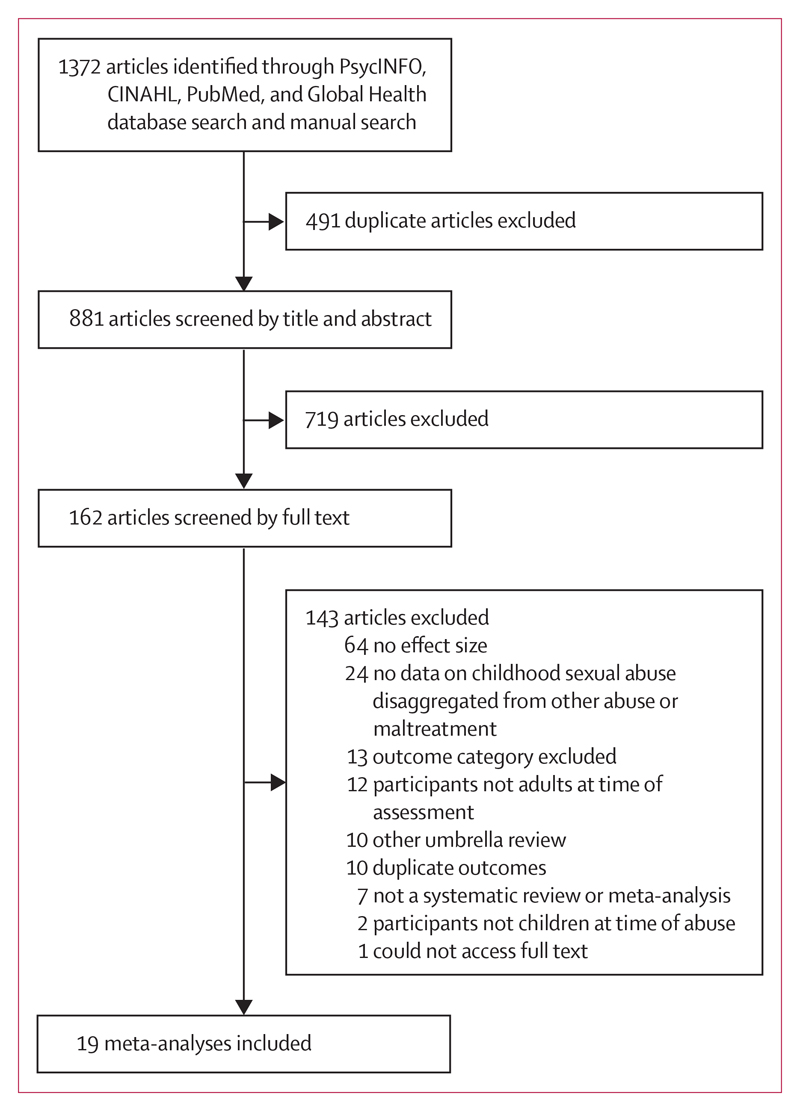
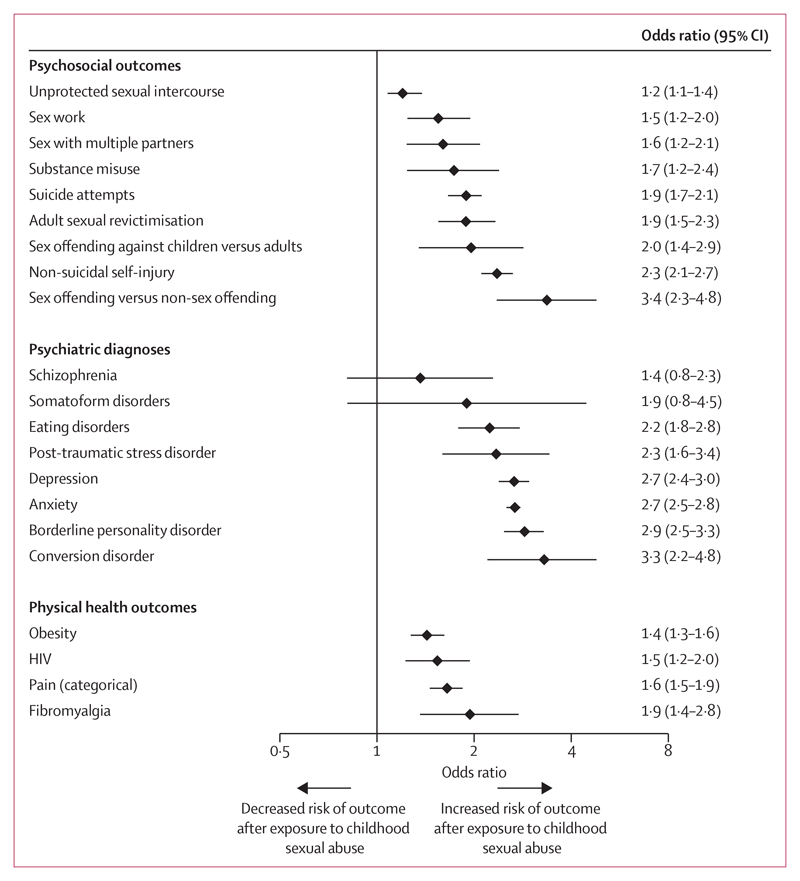
BACKGROUND: Although many meta-analyses have examined the association between childhood sexual abuse and subsequent outcomes, the scope, validity, and quality of this evidence has not been comprehensively assessed. We aimed to systematically review existing meta-analyses on a wide range of long-term psychiatric, psychosocial, and physical health outcomes of childhood sexual abuse, and evaluate the quality of the literature. METHODS: In this umbrella review, we searched four databases (PsycINFO, PubMed, Cumulative Index to Nursing and Allied Health Literature, and Global Health) from inception to Dec 31, 2018, to identify meta-analyses of observational studies that examined the association between childhood sexual abuse (before 18 years of age) and long-term consequences (after 18 years). We compared odds ratios (ORs) across different outcomes. We also examined measures of quality, including heterogeneity between studies and evidence for publication bias. This study is registered with PROSPERO, CRD42016049701. FINDINGS: We identified 19 meta-analyses that included 559 primary studies, covering 28 outcomes in 4 089 547 participants. Childhood sexual abuse was associated with 26 of 28 specific outcomes: specifically, six of eight adult psychiatric diagnoses (ORs ranged from 2·2 [95% CI 1·8-2·8] to 3·3 [2·2-4·8]), all studied negative psychosocial outcomes (ORs ranged from 1·2 [1·1-1·4] to 3·4 [2·3-4·8]), and all physical health conditions (ORs ranged from 1·4 [1·3-1·6] to 1·9 [1·4-2·8]). Strongest psychiatric associations with childhood sexual abuse were reported for conversion disorder (OR 3·3 [95% CI 2·2-4·8]), borderline personality disorder (2·9 [2·5-3·3]), anxiety (2·7 [2·5-2·8]), and depression (2·7 [2·4-3·0]). The systematic reviews for two psychiatric outcomes (post-traumatic stress disorder and schizophrenia) and one psychosocial outcome (substance misuse) met high quality standards. Quality was low for meta-analyses on borderline personality disorder and anxiety, and moderate for conversion disorder. Assuming causality, population attributable risk fractions for outcomes ranged from 1·7% (95% CI 0·7-3·3) for unprotected sexual intercourse to 14·4% (8·8-19·9) for conversion disorder. INTERPRETATION: Although childhood sexual abuse was associated with a wide range of psychosocial and health outcomes, systematic reviews on only two psychiatric disorders (post-traumatic stress disorder and schizophrenia) and one psychosocial outcome (substance misuse) were of a high quality. Whether services should prioritise interventions that mitigate developing certain psychiatric disorders following childhood abuse requires further review. Higher-quality meta-analyses for specific outcomes and more empirical studies on the developmental pathways from childhood sexual abuse to later outcomes are necessary. FUNDING: Wellcome Trust.
Overview
CoChat Summary
TL;DR
This umbrella review synthesizes 19 meta-analyses covering 559 primary studies and 4,089,547 participants to assess long-term outcomes of childhood sexual abuse. Childhood sexual abuse was associated with 26 of 28 outcomes, but only post-traumatic stress disorder, schizophrenia, and substance misuse had high-quality systematic review evidence.
Key findings
- Across 28 outcomes, childhood sexual abuse was associated with 26; odds ratios ranged from 2·2 (95% CI 1·8–2·8) to 3·3 (2·2–4·8) for psychiatric outcomes, 1·2 (1·1–1·4) to 3·4 (2·3–4·8) for psychosocial outcomes, and 1·4 (1·3–1·6) to 1·9 (1·4–2·8) for physical health outcomes.
- Strongest associations were sexual versus non-sexual offending (OR 3·4 [95% CI 2·3–4·8]), conversion disorder (3·3 [2·2–4·8]), borderline personality disorder (2·9 [2·5–3·3]), anxiety (2·7 [2·5–2·8]), and depression (2·7 [2·4–3·0]).
- High-quality systematic reviews were identified for post-traumatic stress disorder, schizophrenia, and substance misuse; quality was low for borderline personality disorder and anxiety (1/5) and moderate for conversion disorder and sexual versus non-sexual offending (3/5).
- Population attributable fractions ranged from 1·7% (95% CI 0·7–3·3) for unprotected sexual intercourse to 14·4% (8·8–19·9) for conversion disorder, with the highest at 14·7% (9·6–19·9) for sexual versus non-sexual offending; absolute rates in high-quality outcomes were 503/1809 (28%) for substance misuse and 36/96 (38%) for post-traumatic stress disorder.
Methods
- Umbrella review searching PsycINFO, PubMed, Cumulative Index to Nursing and Allied Health Literature, and Global Health from inception to Dec 31, 2018, with no language restriction, plus secondary searches and citation chaining; registered with PROSPERO, CRD42016049701.
- Included meta-analyses of observational studies reporting outcomes for childhood sexual abuse before age 18 and long-term outcomes after age 18, disaggregated from other abuse, with aggregate quantitative effect sizes; when overlapping, the most recent or largest meta-analysis was selected, and the minimum was three primary studies.
- Effect sizes were converted to odds ratios; population attributable fractions were calculated assuming causality and a 10% prevalence estimate; quality was assessed with AMSTAR, I² heterogeneity, excess significance, small study effects, and prediction intervals, yielding an aggregate 0–5 score.
Limitations
- The paper states that few included reviews explored heterogeneity by age or study design; familial factors, abuse characteristics, and overlap with other forms of child abuse were not accounted for and might overestimate effect sizes.
- The paper states that primary studies often relied on retrospective recall of childhood sexual abuse, that high co-occurrence with other abuse could not be addressed due to insufficient data, and that evidence was inconsistent with likely publication bias favoring significant findings.
- Evident from the text: population attributable fractions were calculated without confounder adjustment and with a conservative 10% prevalence estimate, so the authors note these figures will likely be overestimated; no confounder-adjusted effect sizes were reported.
Model-written summary. Check it against the paper before relying on it.
Integrity signals
Registry
Cites
Statistics
Figures
Verification
Claims the paper makes
11 Valid · 3 Not valid · 14 Not checked · 58 Own results and interpretations
The cited sources that could be checked couldn’t confirm or dispute this claim.
In the paper
“and 36 (38%) of 96 developed post-traumatic stress disorder.57”
§ Long-term outcomes of childhood sexual abuse: an umbrella review > Results
What the sources say
- Could not verifycites [57] Dube SR Anda RF Felitti VJ Chapman DP Giles WH Childhood abuse, neglect and household dysfunction and the risk of illicit drug use: the Adverse Childhood Experience Study Pediatrics 2003 111 564 72 12612237 sourceExperimental — accuracy not yet measured
The Discussion (p. 11) reports the prevalence of childhood sexual abuse, but not subsequent PTSD diagnoses. Searches for PTSD, post-traumatic stress disorder, and the figures 36, 38%, and 96 found no passage supporting the claimed outcome. (LLM, conf=0.76)
plain- Asserted: passes — The authors put it forward as true.
- Checkable: passes — It can be checked against evidence.
- Load-bearing: unclear — It is unclear whether the paper’s conclusions depend on it.
- Based: passes — The paper gives a reason why it holds.
- Could not verify
The cited sources that could be checked couldn’t confirm or dispute this claim.
In the paper
“by gender on depression,53”
§ Long-term outcomes of childhood sexual abuse: an umbrella review > Results
What the sources say
- Could not verifycites [53] Irish L Kobayashi I Delahanty DL Long-term physical health consequences of childhood sexual abuse: a meta-analytic review J Pediatr Psychol 2010 35 450 61 20022919 PMC2910944 sourceExperimental — accuracy not yet measured
The Abstract identifies depression as a psychological outcome associated with childhood sexual abuse, but says this review examines physical health outcomes. The Results report no suggestive findings for sex as a moderator of physical health outcomes; they do not report whether the effect on depression differs by gender. Searched for gender differences in depression and female–male moderation. (LLM, conf=0.77)
plain- Asserted: passes — The authors put it forward as true.
- Checkable: passes — It can be checked against evidence.
- Load-bearing: unclear — It is unclear whether the paper’s conclusions depend on it.
- Based: passes — The paper gives a reason why it holds.
- Could not verify
The cited sources support only part of this claim — read each source’s verdict below.
In the paper
“by study design on obesity and psychosis,7,9”
§ Long-term outcomes of childhood sexual abuse: an umbrella review > Results
What the sources say
- Partly supportedcites [7] Varese F Smeets F Drukker M Childhood adversities increase the risk of psychosis: a meta-analysis of patient-control, prospective- and cross-sectional cohort studies Schizophr Bull 2012 38 661 71 22461484 PMC3406538 sourceExperimental — accuracy not yet measured
The Results section, “Overall Association Between Adverse Childhood Events and Psychosis” (page unavailable), reports no significant difference by study design in the overall association between childhood adversity and psychosis. The separate sexual-abuse analysis reports an association with psychosis, but the Methods say those adversity-specific effects were not compared by study design. The paper does not address obesity. (LLM, conf=0.87)
- Not checked — no full text of the sourcecites [9] Danese A Tan M Childhood maltreatment and obesity: systematic review and meta-analysis Mol Psychiatry 2014 19 544 54 23689533 source
plain- Asserted: passes — The authors put it forward as true.
- Checkable: passes — It can be checked against evidence.
- Load-bearing: unclear — It is unclear whether the paper’s conclusions depend on it.
- Based: passes — The paper gives a reason why it holds.
- Partly supported
The sources with a verdict support this claim; the rest weren’t checked yet, have no full text we could read, or their verdicts aren’t rated yet.
In the paper
“Previous attempts to synthesise the large number of meta-analytical reviews in the field have mostly considered solely mental health outcomes or a single outcome, such as depression, anxiety disorders, suicide and self-injury, or substance misuse.12–15”
§ Long-term outcomes of childhood sexual abuse: an umbrella review > Introduction
What the sources say
- Supportedcites [12] Maniglio R Child sexual abuse in the etiology of depression: a systematic review of reviews Depress Anxiety 2010 27 631 42 20336807 source
The Methods section says this systematic review included only reviews investigating depressive symptoms or disorders following childhood sexual abuse. The Results section reports that it included four reviews, making this paper an example of a synthesis focused on a single outcome—depression. It does not need to establish the sentence’s broader claim about what most previous syntheses considered. (LLM, conf=0.91)
- Not checked — no full text of the sourcecites [13] Maniglio R Child sexual abuse in the etiology of anxiety disorders: a systematic review of reviews Trauma Violence Abuse 2013 14 96 112 23262751 source
- Not checked — no full text of the sourcecites [14] Maniglio R The role of child sexual abuse in the etiology of suicide and non-suicidal self-injury Acta Psychiatr Scand 2011 124 30 41 20946202 source
- Not checked — no full text of the sourcecites [15] Maniglio R The role of child sexual abuse in the etiology of substance-related disorders J Addict Dis 2011 30 216 28 21745044 source
plain- Asserted: passes — The authors put it forward as true.
- Checkable: passes — It can be checked against evidence.
- Load-bearing: passes — The paper’s conclusions depend on it.
- Based: passes — The paper gives a reason why it holds.
- Supported
Every source the paper cites for this claim was checked and supports it.
In the paper
“Research has indicated the effectiveness of interventions for post-traumatic stress disorder in individuals who have experienced childhood sexual abuse77,78”
§ Long-term outcomes of childhood sexual abuse: an umbrella review > Discussion
What the sources say
- Supportedcites [77] Ehring T Welboren R Morina N Wicherts JM Freitag J Emmelkamp PMG Meta-analysis of psychological treatments for posttraumatic stress disorder in adult survivors of childhood abuse Clin Psychol Rev 2014 34 645 57 25455628 source
The Discussion reports that psychological interventions for PTSD in adult survivors of childhood abuse are efficacious. The Abstract also reports reduced PTSD symptom severity following psychological interventions for adult survivors of childhood sexual abuse. The evidence concerns adult survivors, rather than children currently receiving treatment. (LLM, conf=0.90)
- Supportedcites [78] Trask EV Walsh K DiLillo D Treatment effects for common outcomes of child sexual abuse: a current meta-analysis Aggress Violent Behav 2011 16 6 19 21603060 PMC3095890 source
The Discussion states that treatment is effective in reducing PTSD symptoms among child victims of sexual abuse. The meta-analysis concerns youth under 18, so its evidence is specifically about treatment of PTSD symptoms in that group. (LLM, conf=0.88)
hedgedstates a possible cause- Asserted: passes — The authors put it forward as true.
- Checkable: passes — It can be checked against evidence.
- Load-bearing: unclear — It is unclear whether the paper’s conclusions depend on it.
- Based: passes — The paper gives a reason why it holds.
- Supported
54 more claims · 7 with their cited sources checked
Create a free account to see all 86 claims and to verify the 4 references still open.
- It may state two separate claims as one. 21
- Probably not a substantial claim. 13
Claims other papers make about this one
Each is checked against this paper’s own text: does it say what the citing paper says it does?
The cited source doesn’t support the claim as written.
In the citing paper
“the authors concluded that only two outcomes (PTSD and substance misuse) reached high-quality meta-analytic standards (and thus should be prioritized) and that little credence should be given to other disorders.”
From Child Sexual Abuse as a Unique Risk Factor for the Development of Psychopathology: The Compounded Convergence of Mechanisms (2021) · cites this paper as Hailes et al. 2019
Checked by a reasoning model — may be wrong.
Experimental — accuracy not yet measuredThe source backs part of the claim, not all of it — or backs it for a different population, condition or comparison.
In the citing paper
“reported aggregate odds ratios (ORs) of 3.3 for conversion disorder, 2.9 for borderline personality disorder (BPD), 2.7 for both anxiety and depression, 2.3 for posttraumatic stress disorder (PTSD), 2.2 for eating disorders, 1.9 for somatoform disorders, 1.7 for substance misuse, and 1.4 for schizophrenia.”
From Child Sexual Abuse as a Unique Risk Factor for the Development of Psychopathology: The Compounded Convergence of Mechanisms (2021) · cites this paper as Hailes et al. 2019
Experimental — accuracy not yet measuredThe source backs part of the claim, not all of it — or backs it for a different population, condition or comparison.
In the citing paper
“Quality ratings were based on aggregate assessments across all meta-analyses within diagnostic sets without regard for potential quality exemplars, and there were no distinctions between ORs that were adjusted versus unadjusted for potential confounds”
From Child Sexual Abuse as a Unique Risk Factor for the Development of Psychopathology: The Compounded Convergence of Mechanisms (2021) · cites this paper as Hailes et al. 2019
Experimental — accuracy not yet measuredIn the citing paper
“An umbrella review reported that anxiety [OR = 2.7 (95% CI: 2.5–2.8)], and depression [OR = 2.7 (95% CI: 2.4–3.0)] frequently occurred one after another among adults over 18 years with experiencing sexual abuse as a child [ 11 ].”
From Anxiety and Depression Symptoms among Youth Survivors of Childhood Sexual Abuse: A Network Analysis (2023) · cites this paper as [11]
In the citing paper
“Reviews also reported that persons with a history of CSA are potentially at risk of long-term anxiety and depression diagnoses [ 11 , 12 ].”
From Anxiety and Depression Symptoms among Youth Survivors of Childhood Sexual Abuse: A Network Analysis (2023) · cites this paper as [11]
1 more claim about this paper
Create a free account to see every claim other papers make about this one.
Self-check
Percentages, sums and reported differences re-computed from the paper’s own numbers.
Each contradiction between two passages listed here was confirmed by an independent check.
Rated minor: it would not touch a result — a value no result rests on, a p-value that stays on the same side of the significance level, or a conflict that is clerical, resolved elsewhere in the paper, or outside its own findings.
In the paper
§ Long-term outcomes of childhood sexual abuse: an umbrella review > Results
“Population attributable fractions ranged from 1·7% (95% CI 0·7–3·3) for unprotected sexual intercourse to 14·4% (8·8–19·9) for conversion disorder.”
§ Long-term outcomes of childhood sexual abuse: an umbrella review > Results
“The highest population attributable fraction was 14·7% (9·6–19·9) for sexual offending versus non-sexual offending (table 2).”
Citations
Cites
Child abuse: Adolescent records vs. adult recall
Femina, D. D., Yeager, C. A., & Lewis, D. O. (1990) · Child Abuse & Neglect · doi:10.1016/0145-2134(90)90033-p · Cited by 8,820
The Handbook of Research Synthesis and Meta-Analysis
(2019) · doi:10.7758/9781610448864 · Cited by 4,553
Development of AMSTAR: A measurement tool to assess the methodological quality of systematic reviews
Shea, B. J., Grimshaw, J. M., Wells, G. A., Boers, M., Andersson, N., Hamel, C., Porter, A. C., Tugwell, P., Moher, D., & Bouter, L. M. (2007) · BMC Medical Research Methodology · doi:10.1186/1471-2288-7-10 · Cited by 4,374
Overweight, Obesity, and Depression: A Systematic Review and Meta-analysis of Longitudinal Studies
Luppino, F. S., de Wit, L. M., Bouvy, P. F., Stijnen, T., Cuijpers, P., Penninx, B. W. J. H., & Zitman, F. G. (2010) · Archives of General Psychiatry · doi:10.1001/archgenpsychiatry.2010.2 · Cited by 4,322
Zhang, J., & Yu, K. F. (1998) · JAMA · doi:10.1001/jama.280.19.1690 · Cited by 4,138 · cited 1×
“33 36 The AMSTAR (a measurement tool to assess systematic reviews) checklist was used to assess the methodological quality of the included systematic reviews, 37 and some items were modified for this umbrella review (appendix pp 6–7).”
Burden and consequences of child maltreatment in high-income countries
Gilbert, R., Widom, C. S., Browne, K., Fergusson, D., Webb, E., & Janson, S. (2009) · The Lancet · doi:10.1016/s0140-6736(08)61706-7 · Cited by 3,876 · cited 1×
“60 For example, childhood sexual abuse is associated with risky sexual behaviours, 61,62 which could lead to HIV.”
Varese, F., Smeets, F., Drukker, M., Lieverse, R., Lataster, T., Viechtbauer, W., Read, J., van Os, J., & Bentall, R. P. (2012) · Schizophrenia Bulletin · doi:10.1093/schbul/sbs050 · Cited by 2,436
Dube, S. R., Felitti, V. J., Dong, M., Chapman, D. P., Giles, W. H., & Anda, R. F. (2003) · Pediatrics · doi:10.1542/peds.111.3.564 · Cited by 2,333
Plea for routinely presenting prediction intervals in meta-analysis.
IntHout, J., Ioannidis, J. P. A., Rovers, M. M., & Goeman, J. J. (2016) · BMJ Open · doi:10.1136/bmjopen-2015-010247 · Cited by 2,264 · cited 1×
“42 We created an overall quality assessment.”
A Global Perspective on Child Sexual Abuse: Meta-Analysis of Prevalence Around the World
Stoltenborgh, M., van IJzendoorn, M. H., Euser, E. M., & Bakermans-Kranenburg, M. J. (2011) · Child Maltreatment · doi:10.1177/1077559511403920 · Cited by 2,010
Research works printed but not linked: 3
- Hailes HP Fazel S Yu R Longterm outcomes of childhood sexual abuse: an umbrella review PROSPERO Int Prospect Regist Syst Rev 2016 CRD42016049701
- Quinones-Munoz SL Psychological effects of childhood sexual abuse in adult males Diss Abstr Int Sect B Sci Eng 2001 62 2074
- Liel C Parenting programs for mothers who are at risk or indicated for child abuse and neglect—a systematic review of the international research literature Psychol Erziehung und Unterr 2013 60 11 25
Cited by
Items 601–700 of 806
Consequences of Sexual Grooming
Winters, G. M., & Jeglic, E. L. (2022) · Springer eBooks · doi:10.1007/978-3-031-07222-2_4 · Cited by 1
The Longitudinal Effects of Second Step Child Protection Unit on Children: Gender as a Moderator
Kim, S., Kim, T. E., & Nickerson, A. B. (2023) · Journal of Child Sexual Abuse · doi:10.1080/10538712.2022.2154729 · Cited by 1
“Long-term consequences beyond childhood include lifetime psychopathology (Dinwiddie et al., 2000) and substance misuse (Hailes et al., 2019).”
BackgroundGirls victims of sexual aggression in Baixada Fluminense
de Araújo, A. R., Monteiro, D. L. M., Araújo, E. D. S. P., et al. (2023) · Revista da Associação Médica Brasileira · doi:10.1590/1806-9282.20221580
Complications of Rape in Adolescents and Rehabilitation of the victims: A Narrative Review Article
Khodarahmi, S., Tavakol, Z., & Simbar, M. (2022) · Scientific Journal of Kurdistan University of Medical Sciences · doi:10.52547/sjku.27.3.115 · Cited by 1
Belet, B., Demeulemeester, E., Ghestem, L., Dupont, F., Trimbur, M., Wathelet, M., D’Hondt, F., Thomas, P., & Bouchard, J. (2023) · Annales Médico-psychologiques revue psychiatrique · doi:10.1016/j.amp.2023.04.003
Gee, G., Black, C., Mulder, S., et al. (2023) · Research Square · doi:10.21203/rs.3.rs-3168623/v1
Experiences of Dietetic Interns Taking a Trauma-Informed Care Educational InterventionPreprint
Torres-Cruz, R., Gonzales‐Pacheco, D., Byham-Gray, L. D., et al. (2023) · Research Square · doi:10.21203/rs.3.rs-3260022/v1
The Use of Child-Centered Play Therapy for Children Who Have Experienced Sexual Abuse
Ibharim, N. S., Ismail, W. M. R. W., Jalil, N. I. A., & Musa, A. Z. (2023) · International Journal of Academic Research in Business and Social Sciences · doi:10.6007/ijarbss/v13-i8/18159 · Cited by 2
ZHANG, L., Zou, J., Wang, Z., Ning, J., Jiang, B., Liang, Y., & Zhang, Y. (2023) · Research Square · doi:10.21203/rs.3.rs-3262120/v1
Dóra, B., Koós, M., Nagy, L., Demetrovics, Z., & Bőthe, B. (2023) · doi:10.31234/osf.io/v7mtc
Kindler, H. (2023) · Springer Reference Medizin · doi:10.1007/978-3-662-49289-5_85-1
Olabarria, A., Burgués, A., de Aguileta, A. L., Zubiri-Esnaola, H., Torras-Gómez, E., Joanpere, M., de Aguileta, G. L., Álvarez-Guerrero, G., Aiello, E., Pulido, C., et al. (2023) · Children · doi:10.3390/children10121857
“In the particular case of CSA, an umbrella review [27] investigating the association between childhood sexual abuse and various long-term psychiatric, psychosocial, and physical health outcomes revealed that childhood sexual abuse is significantly associated with outcomes including various…”
BackgroundCrisanti, A. S., Quazi, M. A., Kincaid, T. W., Romero, A. D. W., Wu, X., Bowen, N. A., & Altschul, D. B. (2023) · International Journal on Homelessness · doi:10.5206/ijoh.2023.3.16357
“…were controlled for in the analysis based on their demonstrated relationships to PTSD symptom severity and QOL, the potential for confounding, and for which data were available (Flanagan et al., 2016; Hailes et al., 2019; McCauley et al., 2012; Senneseth et al., 2012; Stevens et al., 2020).”
MethodGilsanz, M. M., & Rappaport, C. (2023) · Neuropsychiatrie de l Enfance et de l Adolescence · doi:10.1016/j.neurenf.2023.11.006 · Cited by 1
Child Sexual Abuse Documentation in Primary Care Settings
MacPherson, S. C., Golonka, M. M., Liu, Y., Terrell, L., Evans, K. E., Hurst, J. H., & Gifford, E. J. (2023) · Clinical Pediatrics · doi:10.1177/00099228231218536
Costa, E. C. V., Simões, J., Correia, P., McIntyre, T. M., & Pereira, M. (2024) · Journal of Sexual Aggression · doi:10.1080/13552600.2023.2300478
“Childhood abuse, adulthood rape, emotion dysregulation, and low perceived social support during adulthood may increase depression and PTSD among low-income women in primary care settings (Dvir et al., 2014; Hailes et al., 2019; Lueger-Schuster et al., 2015; Oshodi et al., 2020).”
Relationship Between Sexual Abuse and Substance Use Among Students from Caribbean Colombian
Caballero‐Domínguez, C. C., Campo‐Arias, A., & Jiménez‐Villamizar, M. P. (2024) · Journal of Child Sexual Abuse · doi:10.1080/10538712.2024.2314756
“Hence, future research needs to consider the effect of sexual abuse and subsequent use of substance use in adulthood (Hailes et al., 2019).”
BackgroundChildhood Sexual Abuse and Psychopathology
Rossi, E., Cassioli, E., Maggi, M., Ricca, V., & Castellini, G. (2023) · Trends in andrology and sexual medicine · doi:10.1007/978-3-031-47892-5_13
Prior trauma experiences among state patients charged with murder: A retrospective records review
Subramaney, U., Minty, N., Himlok, C. M., Adetiba, D., Ahmed, H., Barnard, E., Mahachi, Y. R., Selekana, K., Smith, J. R., & Iyaloo, S. (2024) · South African Journal of Psychiatry · doi:10.4102/sajpsychiatry.v30i0.2190 · Cited by 1
Education for the prevention of sexual abuse in the early years
Walsh, K., Berthelsen, D. C., & Nicholson, J. M. (2024) · Cambridge University Press eBooks · doi:10.1017/9781009339506.010
Omarova, J. M. (2023) · ԴԱՏԱԿԱՆ ՓՈՐՁԱՔՆՆՈՒԹՅԱՆ ԵՎ ՔՐԵԱԳԻՏՈՒԹՅԱՆ ՀԱՅԿԱԿԱՆ ՀԱՆԴԵՍ · doi:10.53587/25792865-2023.10-79
Outlining the Profile of Child Sexual Abuse in Greece: Data from Official Police Records
Mavridakis, G., & Brouskeli, V. (2024) · Psychology · doi:10.4236/psych.2024.154032
The Promise and Pitfalls of the Psychopathy Checklist-Revised in Sexual Offense Evaluations
Erickson, S. K., Martinez, M. A., & DeMatteo, D. S. (2024) · Journal of Forensic Psychology Research and Practice · doi:10.1080/24732850.2024.2339339 · Cited by 2
“Sexual abuse is associated with the subsequent development of numerous adverse effects among victims, particularly children (Dworkin et al., 2017; Hailes et al., 2019; Noll, 2021).”
Τόγκας, Κ. (2024) · Koinōnikī Ergasia · doi:10.12681/socialwork-rss.37548
“Σε μια άλλη ανασκόπηση 19 μετα-αναλύσεων βρέθηκε ότι η παιδική σεξουαλική κακοποίηση συσχετίζεται ισχυρά με την κατάθλιψη στην ενήλικη ζωή καθώς και με άλλες ψυχιατρικές διαταραχές (Hailes et al., 2019).”
History, Statistics, and Prevalence
Gummadi, R., Dasari, N., Pindiprolu, S. K. S. S., & Balla, S. (2024) · Springer eBooks · doi:10.1007/978-981-99-8745-0_1
Traumatic Stress and Psychological Changes in Sexually Abused Children
Dasari, N., Masa, A., Kaligithi, S., & Pindiprolu, S. K. S. S. (2024) · Springer eBooks · doi:10.1007/978-981-99-8745-0_10 · Cited by 1
Emergence of Abnormal Psychology Following Different Forms of Abuse and Neglect
Bennett, M. R. (2024) · Springer eBooks · doi:10.1007/978-981-97-2803-9_2
Hornor, G., & Jennings, S. F. (2024) · Journal of Forensic Nursing · doi:10.1097/jfn.0000000000000503
“Children who experience sexual abuse often suffer from a wide range of health problems throughout their lifespan, with acute concerns that include sexually transmitted infections, physical injuries, and psychological trauma (Hailes et al., 2019; Hornor, 2017; Ports et al., 2016).”
BackgroundKindler, H. (2024) · Springer Reference Medizin · doi:10.1007/978-3-662-66744-6_85
Experiential Group Work with Adult Survivors of Relational Trauma and Childhood Sexual Abuse
Giacomucci, S., & Briggs, H. (2024) · Oxford University Press eBooks · doi:10.1093/oso/9780197657928.003.0017
Les violences croisées : exemple des troubles des conduites alimentaires
Scoffier‐Mériaux, S. (2024) · Elsevier eBooks · doi:10.1016/b978-2-294-77879-7.00008-7
Une santé physique et mentale en péril
Coste, O. (2024) · Elsevier eBooks · doi:10.1016/b978-2-294-77879-7.00016-6
Kerr, K., Mellor, R., Bennett, D., Wellauer, R., & McGaw, V. E. (2024) · Australian & New Zealand Journal of Psychiatry · doi:10.1177/00048674241289027 · Cited by 1
“…and reprocessing therapy, and cognitive processing therapy, have been shown to be effective interventions for PTSD, including those stemming directly from CSA (Ehring et al., 2014; Hailes et al., 2019; O’Cleirigh et al., 2019) or MST (Christ et al., 2022; Tiet et al., 2015; Walter et al., 2014).”
Guimond, C., Jean-Thorn, A., Paradis, A., & Hébert, M. (2024) · Revue de psychoéducation · doi:10.7202/1114498ar
Mansouri, F., & Jamshidimanesh, M. (2024) · Nursing and Midwifery Journal · doi:10.61186/unmf.22.7.577
Gholamrezaei, H., Falsafinejad, M. R., & Khodabakhshi‐Koolaee, A. (2024) · international journal high risk behaviors & addiction · doi:10.5812/ijhrba-150810
Efectividad de una intervención escolar parala prevención del abuso sexual infantil
Guerrero, É. G. P., Jiménez-Ariza, L. M., & Ramírez-Durán, J. I. (2024) · Revista Latinoamericana de Ciencias Sociales Niñez y Juventud · doi:10.11600/rlcsnj.23.1.6418 · Cited by 3
“Según una revisión realizada por Hailes et al. (2019), se encontró evidencia sobre los efectos en diferentes dimensiones: en cuanto a los diag-nósticos psi q uiátricos, se asocia con un mayor riesgo de depresión, ansiedad, trastorno de estrés postraumático, es q uizofrenia, trastornos somatomorfos…”
Online recruitment of young people for research on problematic sexual behavior (Preprint)Preprint
Bright, M. A., Bődi, C. B., & Boyce, S. C. (2024) · doi:10.2196/preprints.70006
Impaired decision-making in child sexual offenders: Findings and prospects
Lacambre, M., Alacreu‐Crespo, A., Huguet, H., Mura, T., & Courtet, P. (2024) · Journal of Psychiatric Research · doi:10.1016/j.jpsychires.2024.12.035 · Cited by 2
Physical and mental health after traumatic brain injury
(2025) · Nature Mental Health · doi:10.1038/s44220-024-00362-7
Child Health and Disease Nursing IV
Arslan, G., Ekici, B., Başdemir, S., Yılmaz, H. B., GEÇTAN, E., Doğan, P., Karakısla, F. S., Özdemir, H. N. Ç., İzci, A., İzci, S. M., et al. (2025) · Akademisyen Kitabevi eBooks · doi:10.37609/akya.3462
Salavati, M., & Selby, E. A. (2024) · Springer eBooks · doi:10.1007/978-3-031-75503-3_13
Tsur, N., Klebanov, B., Talmon, A., & Katz, C. (2025) · Social Science & Medicine · doi:10.1016/j.socscimed.2025.117796
Asad, M. M., Ka, S. K., & Asad, O. E. (2025) · Safer Communities · doi:10.1108/sc-07-2024-0047 · Cited by 3
Child Sexual Abuse Attributions: Are They Different Depending on Mothers versus Fathers’ Reactions?
Magalhães, E., Gomes, A., Graça, J., Antunes, C., Chim, I., Ferreira, C., & Costa, P. (2025) · Anuario de Psicología Jurídica · doi:10.5093/apj2025a5 · Cited by 1
“…and cognitive consequences, such as low self-esteem, social and interpersonal difficulties, anxiety, and depressive or dissociative disorders that may persist into adulthood (e.g., Fergusson et al., 2013; Greene et al., 2016; Hailes et al., 2019; Maniglio, 2009; Pérez-Fuentes et al., 2013).”
Folgen des sexuellen Groomings
Winters, G. M., & Jeglic, E. L. (2024) · Springer eBooks · doi:10.1007/978-3-031-73131-0_4
Associations between child maltreatment and dating violence among Brazilian college students
Lorandi, J. M., Filho, S. R. P., Giacomozzi, A. I., & Assini‐Meytin, L. C. (2025) · Child Protection and Practice · doi:10.1016/j.chipro.2025.100118 · Cited by 3
Nagai, S., & Shinozaki, E. (2024) · Journal of Japan Academy of Nursing Science · doi:10.5630/jans.44.678
Ndibalekera, M., Bangirana, C. A., Amollo, M., Olido, K., Kafuko, A., Opobo, T., & Ssenyonga, R. (2025) · Child Protection and Practice · doi:10.1016/j.chipro.2025.100123
Belau, M. H., Wiessner, C., Sehner, S., Dekker, A., & Briken, P. (2025) · BMC Public Health · doi:10.1186/s12889-025-22117-4
“An umbrella review of the long-term health effects of child abuse found that the odds of developing depressive disorders were 3 times higher [52].”
Rothman, E. F., Chase, M., Scaramella, R., Haberer, B., Caplan, R., Chiang, M., Storch, J., Erwin, V. M., & Holmes, L. G. (2025) · Research in Autism · doi:10.1016/j.reia.2025.202549
Gálvez, A. L. B., Sánchez, D. S., & Hernández, C. (2025) · Clínica Contemporánea · doi:10.5093/cc2025a3 · Cited by 5
A Pilot Study of the Child and Family Traumatic Stress Intervention
Magnusdottir, T., Weyler, H., Svedin, C. G., & Shahnavaz, S. (2025) · Child Care in Practice · doi:10.1080/13575279.2025.2480578
“Children who are exposed to abuse and trauma are at risk of developing posttraumatic stress disorder (PTSD), and later develop psychiatric, somatic, and behavioral health problems (Bomysoad & Francis, 2020; Hailes et al., 2019; Putnam, 2006).”
Sexual abuse against minors in the communes of Abomey-Calavi and So-Ava in Southern Benin
Kossouoh, E., Houinato, D. S., Kpatchavi, A. C., Sossa, C. J., & Aguèmon, B. (2025) · International Journal of Community Medicine and Public Health · doi:10.18203/2394-6040.ijcmph20251357
Investigative interviews with individuals who perpetrated sex crimes: A scoping review
Sousa, M., Gouveia, C. P. F., Rodrigues, A. D. C., Caridade, S., & Cunha, O. S. (2025) · Journal of Forensic and Legal Medicine · doi:10.1016/j.jflm.2025.102889 · Cited by 1
Hasson, R., Talmon, A., & Ginzburg, K. (2025) · The Journal of Sex Research · doi:10.1080/00224499.2025.2501625
“Childhood sexual abuse is a critical global health issue that has profound and enduring effects on the mental and physical well-being, including sexual health, of individuals (Hailes et al., 2019).”
Song, C. R., Pae, C., Bang, M., Kim, H.-J., & Lee, S.-H. (2025) · Journal of Affective Disorders · doi:10.1016/j.jad.2025.119589
Sjögran, L., Örmon, K., Sjöström, K., & Sunnqvist, C. (2025) · Issues in Mental Health Nursing · doi:10.1080/01612840.2025.2516064
“…behavior in the household) are potentially traumatic life events that may influence one’s future in a negative way (Felitti et al., 1998) by increasing the risk for several psychiatric disorders later in life (e.g. Felitti et al., 1998; Hailes et al., 2019; Hughes et al., 2017; McKay et al., 2021).”
Leibovich, I., Goldner, L., Hadar, D., & Lev‐Wiesel, R. (2025) · Child and Adolescent Social Work Journal · doi:10.1007/s10560-025-01029-7
“This absence of findings may indicate the complexity of abuse and its far-reaching consequences, which affect multiple facets of victims’ lives (e.g., Dovran et al., 2019; Hailes et al., 2019) and cannot be explained by a single factor.”
Experiences of Child and Youth Care Workers in Working with Victims of Child Sexual Abuse
Mkhize, L. V., Masuku, A. S., Hlengwa, R. T., & Sibiya, M. N. (2025) · African Journal of Inter/Multidisciplinary Studies · doi:10.51415/ajims.v7i1.1350 · Cited by 1
Maroyi, R., Vandenput, S., Goffin, F., Blavier, A., Moureau, M. K., Rozema, Z. A., Botalatala, J. B., & Mukwege, D. M. (2025) · International Journal of Gynecology & Obstetrics · doi:10.1002/ijgo.70332 · Cited by 1
“29,30 This review highlights the need to improve the assessment of significantly impact QoL and contribute to personal and interpersonal stress.”
Begjani, J., Dizaji, N. N., Mirlashari, J., Mohseni, L., & Rajabi, M. M. (2025) · BMC Public Health · doi:10.1186/s12889-025-23447-z · Cited by 3
Music Therapy in Mental Health and Well-being
Krüger, V., & Murphy, K. M. (2025) · Springer eBooks · doi:10.1007/978-3-031-85724-9_6
Caring for the sexually assaulted child: Follow-up matters
Aoyama, R., Leow, O., & Chan, S. M. (2025) · Annals of the Academy of Medicine Singapore · doi:10.47102/annals-acadmedsg.2025190
Irmak, T. Y., Kızıltepe, R., Eslek, D., Kütük, B., & Güney, O. (2025) · Journal of Child and Family Studies · doi:10.1007/s10826-025-03109-9
“…of child sexual abuse (CSA) and its adverse short-and long-term consequences, including self-injury, depression, and substance and alcohol abuse (Hailes et al., 2019; Li et al., 2020; Stoltenborgh et al., 2011), prevention programs have gained popularity to prevent CSA over the last four…”
Childhood sexual abuse: Its complexities and long-term consequences
Prakash, J., Ali, T., Chaudhury, S., & Srivastava, K. (2025) · Industrial Psychiatry Journal · doi:10.4103/ipj.ipj_17_25 · Cited by 1
“[2] Globally, the lifetime burden of CSA is estimated to be 41% for females and 29.5% for males.”
InfluentialMaltraitance infantile : comment la violence actuelle induit la violence future
Belzung, C. (2023) · The Conversation · doi:10.64628/aak.c4ergfukj
Healing from child sexual abuse is often difficult but not impossible
Khan, M. (2024) · The Conversation · doi:10.64628/aai.crx3aw7uw
Gee, G., Black, C., Mulder, S., Brown, S., Gibbs, J., Biggs, L. J., Kennedy, H., & Milroy, H. (2025) · First Nations Health and Wellbeing - The Lowitja Journal · doi:10.1016/j.fnhli.2025.100076 · Cited by 1
Vers une physiopathologie intégrative du trauma complexe
Robin, M., Spodenkiewicz, M., Belbèze, J., & Corcos, M. (2025) · L Encéphale · doi:10.1016/j.encep.2025.06.007
Adversité, troubles psychiatriques adolescents et trauma complexe : comorbidités ou superposition ?
Belbèze, J., Lamas, C., Silva, J., Corcos, M., & Robin, M. (2025) · L Encéphale · doi:10.1016/j.encep.2025.06.009
Development of a Retrospective Measure of Childhood Sexual Maltreatment in Pakistan
Saleem, G., Achakzai, N. K., Asad, A., Asad, M., & Islam, R. (2025) · Pakistan Journal of Psychological Research · doi:10.33824/pjpr.2025.40.3.31
Diverging paths: Health-care inequities by age among sexually abused children with disabilities
Pu, C., Chou, Y., & Hou, C. (2025) · Child Abuse & Neglect · doi:10.1016/j.chiabu.2025.107723 · Cited by 1
Mapping current research on biomarkers associated with the diagnosis of pedophilia: a scoping review
Karanikola, M. N. K., Riz, A. T. E., & Chatzittofis, A. (2025) · Frontiers in Psychiatry · doi:10.3389/fpsyt.2025.1627198
“An umbrella review by Hailes et al. (2019), found signi fi cant associations between childhood sexual abuse and a wide range of psychiatric, psychosocial, and physical health outcomes (6).”
White, K. R., Rolock, N., Gillani, B., Bai, R., Koh, E. H., Jeon, J., Ringeisen, H. L., Domanico, R., & George, J. (2025) · Journal of Child and Family Studies · doi:10.1007/s10826-025-03189-7 · Cited by 3
“In addition, adoptive parents and other family members may need support to process these troubling or challenging reactions to prior trauma, given the deleterious impacts of sexual abuse, including long-term mental and physical health challenges (e.g., depression; Hailes et al., 2019).”
Chen, Y., Drini, E., Appleton, R., Billings, J., & Talwar, S. (2025) · PLOS mental health. · doi:10.1371/journal.pmen.0000454
“These patterns mirror international evidence on adult CSA survivors in non-UK settings [38].”
French validation of the Core Beliefs Inventory and the Event-Related Rumination Inventory
Gendre, E., Soubelet, A., Henson, C., & Callahan, S. (2025) · Journal of Affective Disorders Reports · doi:10.1016/j.jadr.2025.100990 · Cited by 1
Sexual Violence in Swedish Youth Intimate Partnerships: Prevalence, Severity, and Symptoms of Trauma
Jenstav, M., Svedin, C. G., Landberg, Å., Kassman, A. V., & Jonsson, L. S. (2025) · Journal of Family Violence · doi:10.1007/s10896-025-01003-y
Dadalı, M., Köken, A. H., & Büken, N. Ö. (2025) · Medical Humanities · doi:10.1136/medhum-2025-013448
“One study reported that the prevalence rates of these disorders in individuals with a history of childhood sexual abuse were significantly higher compared with the general population (Hailes et al .”
Children’s and Neurodevelopmental Aspects of Mental Health
Dahoun, T., & Danese, A. (2025) · Cambridge University Press eBooks · doi:10.1017/9781009028967.012
Self-citationPesca, C., Iacono, L. L., Bussone, S., Comincini, S., Trentini, C., & Carola, V. (2025) · European Journal of Psychotraumatology · doi:10.1080/20008066.2025.2571050
“At the psychological level, CM has been strongly linked to internalising and externalising symptoms, conversion disorders, eating disorders, and an increased risk for substance use, suicidal ideation, and reduced life opportunities in adulthood (Currie & Widom, 2010; Hailes et al., 2019).”
Aiquoc, K. M., de Souza, T. A., Medeiros, A. D. A., & Barbosa, I. R. (2025) · Ciência & Saúde Coletiva · doi:10.1590/1413-812320253010.15302025 · Cited by 1
Pastor, T. C., Sierra, J. O., & García, A. G. (2025) · Behavioral Sciences · doi:10.3390/bs15121607
“Furthermore, greater emphasis is needed on digital sexual violence, particularly salient among young populations (Ybarra et al., 2016), as well as on the long-term psychological consequences, in accordance with the recommendations of Hailes et al. (2019).”
van Ham, K., Brilleslijper‐Kater, S. N., Teeuw, R., Bicanic, I., van Rijn, R. R., van Goudoever, J. B., & van der Lee, J. H. (2025) · BMJ Paediatrics Open · doi:10.1136/bmjpo-2025-003950
Lee, S.-E., & Song, J. (2025) · Korean Journal of Child Studies · doi:10.5723/kjcs.2025.46.4.57
Relational-Cultural Theory in Sand Therapy for Survivors of Child Sexual Abuse with CPTSD
Haiyasoso, M. (2025) · World Journal for Sand Therapy Practice® · doi:10.58997/wjstp.v3i4.135
Miettunen, J., Ruotsalainen, H., Vainio, N., AlSaadi, H., Jääskeläinen, E., & Rautio, N. (2025) · Psychological Medicine · doi:10.1017/s0033291725102584 · Cited by 3
“Regarding childhood sexual abuse, a large umbrella review by Hailes, Yu, Danese, & Fazel (2019) concludes that higher-quality meta-analyses for specific outcomes and more empirical studies on the developmental pathways from childhood sexual abuse to later outcomes are needed.”
Li, J., Xu, X., Sun, Y. B., Fu, Y., Tan, X. W., Wang, N., Lu, Y., Li, J., & Wang, B. (2025) · European Journal of Psychotraumatology · doi:10.1080/20008066.2025.2599612 · Cited by 1
“In contrast, sexual abuse, which has traditionally been associated with adverse outcomes in previous studies (Hailes et al., 2019), showed no significant associations with dementia and PD.”
Aiquoc, K. M., de Souza, T. A., Medeiros, A. D. A., et al. (2025) · Ciência & Saúde Coletiva · doi:10.1590/1413-812320253010.15302025en
Facilitators and Barriers to Mental Health Services for Black and Latino Children After Sexual Abuse
Fong, H., Alegria, M. M., Nakash, O., Rodriguez, Y. L., Caldas, A., Bair‐Merritt, M. H., Beardslee, W. R., McKay, M. M., & Lindsey, M. A. (2025) · Academic Pediatrics · doi:10.1016/j.acap.2025.103209 · Cited by 1
Klapisch, O., Gueta, K., & Shlomi, I. (2026) · European Journal of Trauma & Dissociation · doi:10.1016/j.ejtd.2026.100634 · Cited by 1
Bentz, L. K., Scholz, J. L., Drenkhahn, K., & Winter, S. (2025) · Praxis der Kinderpsychologie und Kinderpsychiatrie · doi:10.13109/prkk.2025.74.8.718
Menhart, R., & Winter, S. (2025) · Praxis der Kinderpsychologie und Kinderpsychiatrie · doi:10.13109/prkk.2025.74.8.649 · Cited by 1
Unprotected and Unheard: Professionals’ Perspectives on Sexual Violence Against SGM Youth
Gewirtz‐Meydan, A., Berkowitz, R., & Maoz, S. (2026) · Journal of Child Sexual Abuse · doi:10.1080/10538712.2026.2615992 · Cited by 2
Forensic Perspectives on Child Sexual Abuse Disclosure in Greece: A Retrospective Study
Dimitriou, K., Efthymiou, V., Fragkou, K., Peyron, P., Martrille, L., Baccino, É., Bacopoulou, F., & Papadodima, S. A. (2026) · Pediatric Reports · doi:10.3390/pediatric18010012 · Cited by 1
Dealing with defilement cases in Ghana: Intricacies of law, sociology and psychology
Agboli, J. M. (2026) · Sexual Offending Theory Research and Prevention · doi:10.5964/sotrap.14305
“CSA has also been linked to personality disorders and conversion disorders (Hailes et al., 2019).”
Schuyler, A. C., Catania, J. A., Canchola, J. A., & Dolcini, M. M. (2026) · Sexes · doi:10.3390/sexes7010003
Belbèze, J., Silva, J., Corcos, M., & Robin, M. (2026) · Child Abuse & Neglect · doi:10.1016/j.chiabu.2025.107871
Teachers’ Reporting Attitude Scale for Child Sexual Abuse: An Italian Adaptation
Fabris, M. A., Longobardi, C., Mastrokoukou, S., Cardoso, B. L. A., & Lima, D. C. (2026) · Behavioral Sciences · doi:10.3390/bs16020168 · Cited by 1
Metadata
- Authors
- Hailes, H. P., Yu, R., Danese, A., & Fazel, S.
- Affiliations
- University of Oxford (GB)
- National Health Service (GB)
- Corresponding author
- Fazel, Seena
- Venue
- The Lancet Psychiatry
- Publisher
- Elsevier BV
- Published
- 2019-10
- Volume
- 6
- Issue
- 10
- Pages
- 830-839
- ISSN
- 2215-0366 (ISSN-L)
- PMC
- PMC7015702
- OpenAlex
- W2972999459
- Cited by
- 827
- References
- 101
- Citations by year
- 2026: 142 · 2025: 151 · 2024: 140 · 2023: 136 · 2022: 116 · 2021: 92 · 2020: 44 · 2019: 5
- FWCI
- 10.13
- Type
- journal article
- Language
- en
- Open access
- hybrid
- doi.org
- Licence
- cc-by
- www.elsevier.com/tdm/userlicense/1.0/ (tdm)
- www.elsevier.com/legal/tdmrep-license (tdm)
- creativecommons.org/licenses/by/4.0/ (vor)
- Locations
- The Lancet Psychiatry (publishedVersion, cc-by)
- PubMed (publishedVersion)
- Research Portal (King's College London) (publishedVersion, other-oa)
- PubMed Central (acceptedVersion, cc-by)
- Funders
- King's College London
- Economic and Social Research Council
- Wellcome Trust (202836/Z/16/Z)
- National Institute for Health Research Biomedical Research Centre at Moorfields Eye Hospital NHS Foundation Trust and UCL Institute of Ophthalmology
- Nederlandse Organisatie voor Wetenschappelijk Onderzoek (446-15-002)
- Topics
- Social Sciences › Psychology › Clinical Psychology › Child Abuse and Trauma
- Social Sciences › Sociology and Political Science › Military, Security, and Education Studies
- Social Sciences › Gender Studies › Sexual Assault and Victimization Studies
- Keywords
- child sexual abuse, long-term outcomes, mental illness, conversion disorder, borderline personality disorder, anxiety, depression, substance abuse, post-traumatic stress disorder, schizophrenia, psychosocial outcomes, physical health, quality of evidence, publication bias, population attributable risk, causal inference, substance use disorders, physical health conditions
- MeSH terms
- Mental Disorders, Child, Child Abuse, Sexual, Health Status, Humans
About these checks
Registry, retraction, Cites and statistics results are computed, not judged, with one exception: a printed reference that no index lists is read once by a model before it counts as a citation error. Claims are extracted by a model and kept only when their quote appears verbatim in the text; each cited source is then checked, with a model’s help, for whether it says what the claim relies on. Those verdicts can be wrong — read the claim’s quote and the cited source before relying on one.
The claim verdicts this report counts are experimental: their accuracy is not yet measured.
A language model drew the claims from the paper on 2026-10-10, under version 3 of the claim definition (model deepseek-v4.1-flash, prompt extract-v3).
A second model labelled each claim on 2026-10-10 (model jev-1.13-20260917, definition revision gold-guideline-v0.2).
Cited sources are checked with a language model’s help (gpt-6-sol).
Statistics and arithmetic are recomputed, not judged.
Confidence bands are shown only for fields calibrated on our annotated test set. None is calibrated yet, so no band is shown.
What counts as a claim ›How we measure confidence ›How we check this ›
Are you an author, or do you see a problem with this page? Request a review
Data sources
Bibliographic data: Semantic Scholar, OpenAlex, Crossref.
Contains information from the Semantic Scholar Academic Graph Datasets, made available under the ODC Attribution License (ODC-BY 1.0).
Semantic Scholar’s data is described in: Kinney, R., et al. (2023). The Semantic Scholar Open Data Platform. arXiv:2301.10140.
