

Long-term outcomes of childhood sexual abuse: an umbrella review
Open accessThe DOI matches its Crossref record; 88 of the 101 references it cites were found in a registry or an index; 19 of the 62 sources its claims cite were checked for support.
Abstract
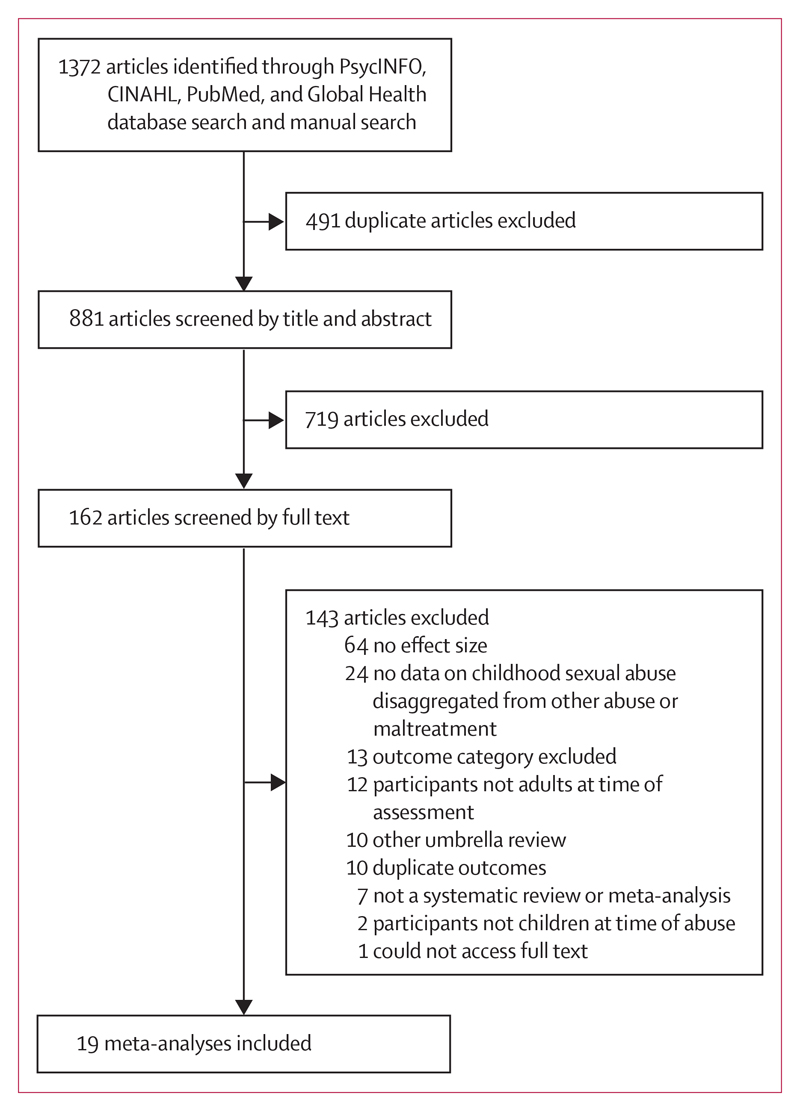
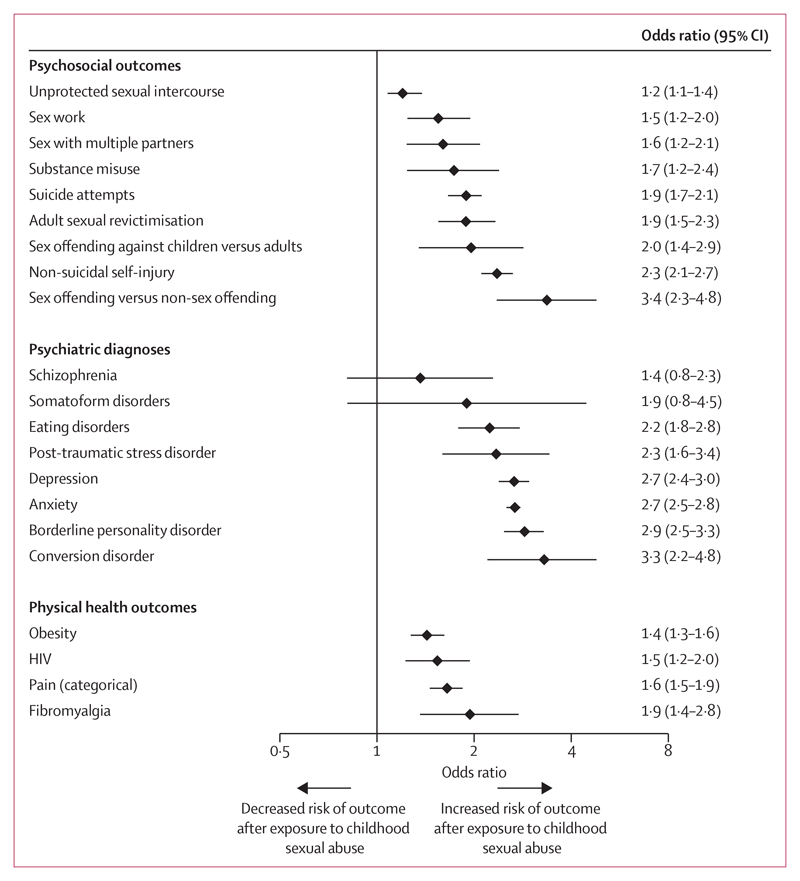
BACKGROUND: Although many meta-analyses have examined the association between childhood sexual abuse and subsequent outcomes, the scope, validity, and quality of this evidence has not been comprehensively assessed. We aimed to systematically review existing meta-analyses on a wide range of long-term psychiatric, psychosocial, and physical health outcomes of childhood sexual abuse, and evaluate the quality of the literature. METHODS: In this umbrella review, we searched four databases (PsycINFO, PubMed, Cumulative Index to Nursing and Allied Health Literature, and Global Health) from inception to Dec 31, 2018, to identify meta-analyses of observational studies that examined the association between childhood sexual abuse (before 18 years of age) and long-term consequences (after 18 years). We compared odds ratios (ORs) across different outcomes. We also examined measures of quality, including heterogeneity between studies and evidence for publication bias. This study is registered with PROSPERO, CRD42016049701. FINDINGS: We identified 19 meta-analyses that included 559 primary studies, covering 28 outcomes in 4 089 547 participants. Childhood sexual abuse was associated with 26 of 28 specific outcomes: specifically, six of eight adult psychiatric diagnoses (ORs ranged from 2·2 [95% CI 1·8-2·8] to 3·3 [2·2-4·8]), all studied negative psychosocial outcomes (ORs ranged from 1·2 [1·1-1·4] to 3·4 [2·3-4·8]), and all physical health conditions (ORs ranged from 1·4 [1·3-1·6] to 1·9 [1·4-2·8]). Strongest psychiatric associations with childhood sexual abuse were reported for conversion disorder (OR 3·3 [95% CI 2·2-4·8]), borderline personality disorder (2·9 [2·5-3·3]), anxiety (2·7 [2·5-2·8]), and depression (2·7 [2·4-3·0]). The systematic reviews for two psychiatric outcomes (post-traumatic stress disorder and schizophrenia) and one psychosocial outcome (substance misuse) met high quality standards. Quality was low for meta-analyses on borderline personality disorder and anxiety, and moderate for conversion disorder. Assuming causality, population attributable risk fractions for outcomes ranged from 1·7% (95% CI 0·7-3·3) for unprotected sexual intercourse to 14·4% (8·8-19·9) for conversion disorder. INTERPRETATION: Although childhood sexual abuse was associated with a wide range of psychosocial and health outcomes, systematic reviews on only two psychiatric disorders (post-traumatic stress disorder and schizophrenia) and one psychosocial outcome (substance misuse) were of a high quality. Whether services should prioritise interventions that mitigate developing certain psychiatric disorders following childhood abuse requires further review. Higher-quality meta-analyses for specific outcomes and more empirical studies on the developmental pathways from childhood sexual abuse to later outcomes are necessary. FUNDING: Wellcome Trust.
Overview
CoChat Summary
TL;DR
This umbrella review synthesizes 19 meta-analyses covering 559 primary studies and 4,089,547 participants to assess long-term outcomes of childhood sexual abuse. Childhood sexual abuse was associated with 26 of 28 outcomes, but only post-traumatic stress disorder, schizophrenia, and substance misuse had high-quality systematic review evidence.
Key findings
- Across 28 outcomes, childhood sexual abuse was associated with 26; odds ratios ranged from 2·2 (95% CI 1·8–2·8) to 3·3 (2·2–4·8) for psychiatric outcomes, 1·2 (1·1–1·4) to 3·4 (2·3–4·8) for psychosocial outcomes, and 1·4 (1·3–1·6) to 1·9 (1·4–2·8) for physical health outcomes.
- Strongest associations were sexual versus non-sexual offending (OR 3·4 [95% CI 2·3–4·8]), conversion disorder (3·3 [2·2–4·8]), borderline personality disorder (2·9 [2·5–3·3]), anxiety (2·7 [2·5–2·8]), and depression (2·7 [2·4–3·0]).
- High-quality systematic reviews were identified for post-traumatic stress disorder, schizophrenia, and substance misuse; quality was low for borderline personality disorder and anxiety (1/5) and moderate for conversion disorder and sexual versus non-sexual offending (3/5).
- Population attributable fractions ranged from 1·7% (95% CI 0·7–3·3) for unprotected sexual intercourse to 14·4% (8·8–19·9) for conversion disorder, with the highest at 14·7% (9·6–19·9) for sexual versus non-sexual offending; absolute rates in high-quality outcomes were 503/1809 (28%) for substance misuse and 36/96 (38%) for post-traumatic stress disorder.
Methods
- Umbrella review searching PsycINFO, PubMed, Cumulative Index to Nursing and Allied Health Literature, and Global Health from inception to Dec 31, 2018, with no language restriction, plus secondary searches and citation chaining; registered with PROSPERO, CRD42016049701.
- Included meta-analyses of observational studies reporting outcomes for childhood sexual abuse before age 18 and long-term outcomes after age 18, disaggregated from other abuse, with aggregate quantitative effect sizes; when overlapping, the most recent or largest meta-analysis was selected, and the minimum was three primary studies.
- Effect sizes were converted to odds ratios; population attributable fractions were calculated assuming causality and a 10% prevalence estimate; quality was assessed with AMSTAR, I² heterogeneity, excess significance, small study effects, and prediction intervals, yielding an aggregate 0–5 score.
Limitations
- The paper states that few included reviews explored heterogeneity by age or study design; familial factors, abuse characteristics, and overlap with other forms of child abuse were not accounted for and might overestimate effect sizes.
- The paper states that primary studies often relied on retrospective recall of childhood sexual abuse, that high co-occurrence with other abuse could not be addressed due to insufficient data, and that evidence was inconsistent with likely publication bias favoring significant findings.
- Evident from the text: population attributable fractions were calculated without confounder adjustment and with a conservative 10% prevalence estimate, so the authors note these figures will likely be overestimated; no confounder-adjusted effect sizes were reported.
Model-written summary. Check it against the paper before relying on it.
Integrity signals
Registry
Cites
Statistics
Figures
Verification
Claims the paper makes
11 Valid · 3 Not valid · 14 Not checked · 58 Own results and interpretations
The cited sources that could be checked couldn’t confirm or dispute this claim.
In the paper
“and 36 (38%) of 96 developed post-traumatic stress disorder.57”
§ Long-term outcomes of childhood sexual abuse: an umbrella review > Results
What the sources say
- Could not verifycites [57] Dube SR Anda RF Felitti VJ Chapman DP Giles WH Childhood abuse, neglect and household dysfunction and the risk of illicit drug use: the Adverse Childhood Experience Study Pediatrics 2003 111 564 72 12612237 sourceExperimental — accuracy not yet measured
The Discussion (p. 11) reports the prevalence of childhood sexual abuse, but not subsequent PTSD diagnoses. Searches for PTSD, post-traumatic stress disorder, and the figures 36, 38%, and 96 found no passage supporting the claimed outcome. (LLM, conf=0.76)
plain- Asserted: passes — The authors put it forward as true.
- Checkable: passes — It can be checked against evidence.
- Load-bearing: unclear — It is unclear whether the paper’s conclusions depend on it.
- Based: passes — The paper gives a reason why it holds.
- Could not verify
The cited sources that could be checked couldn’t confirm or dispute this claim.
In the paper
“by gender on depression,53”
§ Long-term outcomes of childhood sexual abuse: an umbrella review > Results
What the sources say
- Could not verifycites [53] Irish L Kobayashi I Delahanty DL Long-term physical health consequences of childhood sexual abuse: a meta-analytic review J Pediatr Psychol 2010 35 450 61 20022919 PMC2910944 sourceExperimental — accuracy not yet measured
The Abstract identifies depression as a psychological outcome associated with childhood sexual abuse, but says this review examines physical health outcomes. The Results report no suggestive findings for sex as a moderator of physical health outcomes; they do not report whether the effect on depression differs by gender. Searched for gender differences in depression and female–male moderation. (LLM, conf=0.77)
plain- Asserted: passes — The authors put it forward as true.
- Checkable: passes — It can be checked against evidence.
- Load-bearing: unclear — It is unclear whether the paper’s conclusions depend on it.
- Based: passes — The paper gives a reason why it holds.
- Could not verify
The cited sources support only part of this claim — read each source’s verdict below.
In the paper
“by study design on obesity and psychosis,7,9”
§ Long-term outcomes of childhood sexual abuse: an umbrella review > Results
What the sources say
- Partly supportedcites [7] Varese F Smeets F Drukker M Childhood adversities increase the risk of psychosis: a meta-analysis of patient-control, prospective- and cross-sectional cohort studies Schizophr Bull 2012 38 661 71 22461484 PMC3406538 sourceExperimental — accuracy not yet measured
The Results section, “Overall Association Between Adverse Childhood Events and Psychosis” (page unavailable), reports no significant difference by study design in the overall association between childhood adversity and psychosis. The separate sexual-abuse analysis reports an association with psychosis, but the Methods say those adversity-specific effects were not compared by study design. The paper does not address obesity. (LLM, conf=0.87)
- Not checked — no full text of the sourcecites [9] Danese A Tan M Childhood maltreatment and obesity: systematic review and meta-analysis Mol Psychiatry 2014 19 544 54 23689533 source
plain- Asserted: passes — The authors put it forward as true.
- Checkable: passes — It can be checked against evidence.
- Load-bearing: unclear — It is unclear whether the paper’s conclusions depend on it.
- Based: passes — The paper gives a reason why it holds.
- Partly supported
The sources with a verdict support this claim; the rest weren’t checked yet, have no full text we could read, or their verdicts aren’t rated yet.
In the paper
“Previous attempts to synthesise the large number of meta-analytical reviews in the field have mostly considered solely mental health outcomes or a single outcome, such as depression, anxiety disorders, suicide and self-injury, or substance misuse.12–15”
§ Long-term outcomes of childhood sexual abuse: an umbrella review > Introduction
What the sources say
- Supportedcites [12] Maniglio R Child sexual abuse in the etiology of depression: a systematic review of reviews Depress Anxiety 2010 27 631 42 20336807 source
The Methods section says this systematic review included only reviews investigating depressive symptoms or disorders following childhood sexual abuse. The Results section reports that it included four reviews, making this paper an example of a synthesis focused on a single outcome—depression. It does not need to establish the sentence’s broader claim about what most previous syntheses considered. (LLM, conf=0.91)
- Not checked — no full text of the sourcecites [13] Maniglio R Child sexual abuse in the etiology of anxiety disorders: a systematic review of reviews Trauma Violence Abuse 2013 14 96 112 23262751 source
- Not checked — no full text of the sourcecites [14] Maniglio R The role of child sexual abuse in the etiology of suicide and non-suicidal self-injury Acta Psychiatr Scand 2011 124 30 41 20946202 source
- Not checked — no full text of the sourcecites [15] Maniglio R The role of child sexual abuse in the etiology of substance-related disorders J Addict Dis 2011 30 216 28 21745044 source
plain- Asserted: passes — The authors put it forward as true.
- Checkable: passes — It can be checked against evidence.
- Load-bearing: passes — The paper’s conclusions depend on it.
- Based: passes — The paper gives a reason why it holds.
- Supported
Every source the paper cites for this claim was checked and supports it.
In the paper
“Research has indicated the effectiveness of interventions for post-traumatic stress disorder in individuals who have experienced childhood sexual abuse77,78”
§ Long-term outcomes of childhood sexual abuse: an umbrella review > Discussion
What the sources say
- Supportedcites [77] Ehring T Welboren R Morina N Wicherts JM Freitag J Emmelkamp PMG Meta-analysis of psychological treatments for posttraumatic stress disorder in adult survivors of childhood abuse Clin Psychol Rev 2014 34 645 57 25455628 source
The Discussion reports that psychological interventions for PTSD in adult survivors of childhood abuse are efficacious. The Abstract also reports reduced PTSD symptom severity following psychological interventions for adult survivors of childhood sexual abuse. The evidence concerns adult survivors, rather than children currently receiving treatment. (LLM, conf=0.90)
- Supportedcites [78] Trask EV Walsh K DiLillo D Treatment effects for common outcomes of child sexual abuse: a current meta-analysis Aggress Violent Behav 2011 16 6 19 21603060 PMC3095890 source
The Discussion states that treatment is effective in reducing PTSD symptoms among child victims of sexual abuse. The meta-analysis concerns youth under 18, so its evidence is specifically about treatment of PTSD symptoms in that group. (LLM, conf=0.88)
hedgedstates a possible cause- Asserted: passes — The authors put it forward as true.
- Checkable: passes — It can be checked against evidence.
- Load-bearing: unclear — It is unclear whether the paper’s conclusions depend on it.
- Based: passes — The paper gives a reason why it holds.
- Supported
54 more claims · 7 with their cited sources checked
Create a free account to see all 86 claims and to verify the 4 references still open.
- It may state two separate claims as one. 21
- Probably not a substantial claim. 13
Claims other papers make about this one
Each is checked against this paper’s own text: does it say what the citing paper says it does?
The cited source doesn’t support the claim as written.
In the citing paper
“the authors concluded that only two outcomes (PTSD and substance misuse) reached high-quality meta-analytic standards (and thus should be prioritized) and that little credence should be given to other disorders.”
From Child Sexual Abuse as a Unique Risk Factor for the Development of Psychopathology: The Compounded Convergence of Mechanisms (2021) · cites this paper as Hailes et al. 2019
Checked by a reasoning model — may be wrong.
Experimental — accuracy not yet measuredThe source backs part of the claim, not all of it — or backs it for a different population, condition or comparison.
In the citing paper
“reported aggregate odds ratios (ORs) of 3.3 for conversion disorder, 2.9 for borderline personality disorder (BPD), 2.7 for both anxiety and depression, 2.3 for posttraumatic stress disorder (PTSD), 2.2 for eating disorders, 1.9 for somatoform disorders, 1.7 for substance misuse, and 1.4 for schizophrenia.”
From Child Sexual Abuse as a Unique Risk Factor for the Development of Psychopathology: The Compounded Convergence of Mechanisms (2021) · cites this paper as Hailes et al. 2019
Experimental — accuracy not yet measuredThe source backs part of the claim, not all of it — or backs it for a different population, condition or comparison.
In the citing paper
“Quality ratings were based on aggregate assessments across all meta-analyses within diagnostic sets without regard for potential quality exemplars, and there were no distinctions between ORs that were adjusted versus unadjusted for potential confounds”
From Child Sexual Abuse as a Unique Risk Factor for the Development of Psychopathology: The Compounded Convergence of Mechanisms (2021) · cites this paper as Hailes et al. 2019
Experimental — accuracy not yet measuredIn the citing paper
“An umbrella review reported that anxiety [OR = 2.7 (95% CI: 2.5–2.8)], and depression [OR = 2.7 (95% CI: 2.4–3.0)] frequently occurred one after another among adults over 18 years with experiencing sexual abuse as a child [ 11 ].”
From Anxiety and Depression Symptoms among Youth Survivors of Childhood Sexual Abuse: A Network Analysis (2023) · cites this paper as [11]
In the citing paper
“Reviews also reported that persons with a history of CSA are potentially at risk of long-term anxiety and depression diagnoses [ 11 , 12 ].”
From Anxiety and Depression Symptoms among Youth Survivors of Childhood Sexual Abuse: A Network Analysis (2023) · cites this paper as [11]
1 more claim about this paper
Create a free account to see every claim other papers make about this one.
Self-check
Percentages, sums and reported differences re-computed from the paper’s own numbers.
Each contradiction between two passages listed here was confirmed by an independent check.
Rated minor: it would not touch a result — a value no result rests on, a p-value that stays on the same side of the significance level, or a conflict that is clerical, resolved elsewhere in the paper, or outside its own findings.
In the paper
§ Long-term outcomes of childhood sexual abuse: an umbrella review > Results
“Population attributable fractions ranged from 1·7% (95% CI 0·7–3·3) for unprotected sexual intercourse to 14·4% (8·8–19·9) for conversion disorder.”
§ Long-term outcomes of childhood sexual abuse: an umbrella review > Results
“The highest population attributable fraction was 14·7% (9·6–19·9) for sexual offending versus non-sexual offending (table 2).”
Citations
Cites
Child abuse: Adolescent records vs. adult recall
Femina, D. D., Yeager, C. A., & Lewis, D. O. (1990) · Child Abuse & Neglect · doi:10.1016/0145-2134(90)90033-p · Cited by 8,820
The Handbook of Research Synthesis and Meta-Analysis
(2019) · doi:10.7758/9781610448864 · Cited by 4,553
Development of AMSTAR: A measurement tool to assess the methodological quality of systematic reviews
Shea, B. J., Grimshaw, J. M., Wells, G. A., Boers, M., Andersson, N., Hamel, C., Porter, A. C., Tugwell, P., Moher, D., & Bouter, L. M. (2007) · BMC Medical Research Methodology · doi:10.1186/1471-2288-7-10 · Cited by 4,374
Overweight, Obesity, and Depression: A Systematic Review and Meta-analysis of Longitudinal Studies
Luppino, F. S., de Wit, L. M., Bouvy, P. F., Stijnen, T., Cuijpers, P., Penninx, B. W. J. H., & Zitman, F. G. (2010) · Archives of General Psychiatry · doi:10.1001/archgenpsychiatry.2010.2 · Cited by 4,322
Zhang, J., & Yu, K. F. (1998) · JAMA · doi:10.1001/jama.280.19.1690 · Cited by 4,138 · cited 1×
“33 36 The AMSTAR (a measurement tool to assess systematic reviews) checklist was used to assess the methodological quality of the included systematic reviews, 37 and some items were modified for this umbrella review (appendix pp 6–7).”
Burden and consequences of child maltreatment in high-income countries
Gilbert, R., Widom, C. S., Browne, K., Fergusson, D., Webb, E., & Janson, S. (2009) · The Lancet · doi:10.1016/s0140-6736(08)61706-7 · Cited by 3,876 · cited 1×
“60 For example, childhood sexual abuse is associated with risky sexual behaviours, 61,62 which could lead to HIV.”
Varese, F., Smeets, F., Drukker, M., Lieverse, R., Lataster, T., Viechtbauer, W., Read, J., van Os, J., & Bentall, R. P. (2012) · Schizophrenia Bulletin · doi:10.1093/schbul/sbs050 · Cited by 2,436
Dube, S. R., Felitti, V. J., Dong, M., Chapman, D. P., Giles, W. H., & Anda, R. F. (2003) · Pediatrics · doi:10.1542/peds.111.3.564 · Cited by 2,333
Plea for routinely presenting prediction intervals in meta-analysis.
IntHout, J., Ioannidis, J. P. A., Rovers, M. M., & Goeman, J. J. (2016) · BMJ Open · doi:10.1136/bmjopen-2015-010247 · Cited by 2,264 · cited 1×
“42 We created an overall quality assessment.”
A Global Perspective on Child Sexual Abuse: Meta-Analysis of Prevalence Around the World
Stoltenborgh, M., van IJzendoorn, M. H., Euser, E. M., & Bakermans-Kranenburg, M. J. (2011) · Child Maltreatment · doi:10.1177/1077559511403920 · Cited by 2,010
Research works printed but not linked: 3
- Hailes HP Fazel S Yu R Longterm outcomes of childhood sexual abuse: an umbrella review PROSPERO Int Prospect Regist Syst Rev 2016 CRD42016049701
- Quinones-Munoz SL Psychological effects of childhood sexual abuse in adult males Diss Abstr Int Sect B Sci Eng 2001 62 2074
- Liel C Parenting programs for mothers who are at risk or indicated for child abuse and neglect—a systematic review of the international research literature Psychol Erziehung und Unterr 2013 60 11 25
Cited by
Items 701–800 of 806
Sperandio, G., Moliadze, V., Attal, N., Bouhassira, D., Banaschewski, T., Barker, G. J., Bokde, A. L. W., Desrivières, S., Grigis, A., Garavan, H., et al. (2026) · PAIN Reports · doi:10.1097/pr9.0000000000001388
“44,71,74 Interestingly, with increased level of parental violence, the depression levels tended to decrease.”
Eaton, L. A., Watson, R. J., Lawrence, S. E., Moody, R. L., Babcock, N., & Paceley, M. S. (2026) · Journal of Interpersonal Violence · doi:10.1177/08862605251414450
Pereira, N. G., Varma, P., Krishnan, S. R. G., & D’souza, T. B. (2026) · Child & Youth Services · doi:10.1080/0145935x.2026.2628072
Mashumba, L. (2026) · International Journal of Sexual Health · doi:10.1080/19317611.2026.2618268
“Family rejection has been identified as a central source of trauma, manifesting through emotional neglect, physical violence, and expulsion from family homes (Easton & Kong, 2017; Hailes et al., 2019; Ryan et al., 2010).”
Imanishi, Y., Iorini, M., Wada, I., Jwa, S., Tabuchi, T., & Uchida, M. (2026) · Vaccine · doi:10.1016/j.vaccine.2026.128299
Etiological Factors and Dark Personality Traits of Pedophiles: A Multiple Case Study
Sabir, T., & Ullah, A. (2026) · Journal of Forensic Psychology Research and Practice · doi:10.1080/24732850.2026.2638359
Opening the Discussion on the Costs of Pedophilic Disorder as a Mental Health Concern
Amelung, T. R., Lehmann, R., Schmidt, A. F., Hoyer, A., & Beier, K. M. (2026) · Archives of Sexual Behavior · doi:10.1007/s10508-025-03406-w
“Longer-term direct costs include healthcare costs for both mental and physical disorders related to child sexual victimization (Hailes et al., 2019; Irish et al., 2010).”
Dimitriadis, M., Kokkeler, K. J. E., Hoogendijk, E. O., Marijnissen, R. M., Aprahamian, I., Jeuring, H. W., & Voshaar, R. C. O. (2026) · Age and Ageing · doi:10.1093/ageing/afag050 · Cited by 5
“Adverse childhood experiences (ACEs) are defined as traumatic experiences of people before the age of 18 that have lasting consequences for their somatic and mental health [1].”
Mahfir, A., & Parameswari, J. (2026) · International Journal on Child Maltreatment Research Policy and Practice · doi:10.1007/s42448-026-00254-6 · Cited by 1
“The situation is further complicated by the stigma and societal taboos surrounding the reporting of such abuse (Hailes et al., 2019), making accurate statistics challenging to obtain for other forms of maltreatment, such as physical and emotional abuse.”
Meaning-making following sexual abuse: a scoping review and meta-synthesis
Smid, G. E., Lind, J., & Kruizinga, R. (2026) · Frontiers in Psychology · doi:10.3389/fpsyg.2026.1798844 · Cited by 2
“…mental health conditions associated with sexual abuse include post-traumatic stress disorder (PTSD), bipolar, depressive, and anxiety disorders, eating disorders, obsessive-compulsive disorder, sleep disorders, suicidality, and substance use disorders (Dworkin et al., 2017; Hailes et al., 2019).”
[Assessment of disorders presented by sexually abused children].
Romano, H. (2026) · Soins Pédiatrie/Puériculture · doi:10.1016/j.spp.2026.01.011
Sousa, M., Cunha, O. S., Cruz, A. R., Gonçalves, R. A., & Rodrigues, A. D. C. (2026) · Crime & Delinquency · doi:10.1177/00111287261428419
Evaluation of sexual abuse cases: 12 years of child protection unit experience
Usluoğulları, F. H., Tıplamaz, S., Kalaman, T., & İnanıcı, M. A. (2026) · Child Abuse & Neglect · doi:10.1016/j.chiabu.2026.108019 · Cited by 1
Kinder und Jugendliche als Betroffene von sexualisierter Gewalt
Verlinden, K., & Urbann, K. (2026) · Springer eBooks · doi:10.1007/978-3-658-48467-5_12
Adhikari, B., Dahal, A., Mishra, A., Mshamu, S., Shrestha, N., von Seidlein, L., & Vallières, F. (2026) · BMJ Paediatrics Open · doi:10.1136/bmjpo-2025-004423 · Cited by 2
Chipalo, E., & Odii, I. O. (2026) · Journal of Child & Adolescent Trauma · doi:10.1007/s40653-026-00861-y · Cited by 1
“Similar to other forms of child maltreatment, sexual abuse is a potent risk factor for numerous physical and mental health conditions that can last for a lifetime (Chi-palo, 2024c; Chipalo and Odii 2023, 2025b; Hailes et al. 2019; Kisely et al. 2018 ).”
Online Recruitment of Young People for Research on Problematic Sexual Behavior
Bright, M. A., Bődi, C. B., & Boyce, S. C. (2026) · Journal of Child Sexual Abuse · doi:10.1080/10538712.2026.2656794
Using metaphors in the care of childhood sexual abuse: a review essay
Ravichander, A., Bohl, C., Piper, K. N., Donaruma‐Kwoh, M., & Higinbotham, S. (2026) · Medical Humanities · doi:10.1136/medhum-2025-013712
Schemmel, J., Zell, K., Senberg, A., Anna-Luisa.Sahlfeld, Otzipka, J., Volbert, R., & Zumbach, J. (2026) · Trauma Violence & Abuse · doi:10.1177/15248380261429518 · Cited by 3
Boone, D., Versluis, A., Delforterie, M. J., & Didden, R. (2026) · Journal of Mental Health Research in Intellectual Disabilities · doi:10.1080/19315864.2026.2655129 · Cited by 1
“…population have shown that sexual abuse in childhood is associated with a greater risk of developing various mental health disorders (Cutajar et al., 2010; Hailes et al., 2019), in particular mood disorders, compared to sexual abuse experienced during adolescence or adulthood (Dunn et al., 2017).”
InfluentialTalking About Sex: Sexual Communication in the Context of Sexual Revictimization
Beckham, E. E., Thompson, M. S., Duckworth, J. C., & Jaffe, A. E. (2026) · Journal of Child Sexual Abuse · doi:10.1080/10538712.2026.2656300
“Sexual victimization has been associated with a breadth of psychosocial problems including risky sexual behaviors (Arriola et al., 2005), suicide and non-suicidal self-injury (Dworkin et al., 2022; Maniglio, 2011), and psychological disorders (Amado et al., 2015; Dworkin, 2020; Hailes et al., 2019).”
Spagnolo, G., Ferrarese, D., Vincenzo, F. D., Iaccarino, J., Murgiano, M., Vecchione, M., Sicilia, G., Napolitano, D., D’Onofrio, A. M., Gasbarrini, A., et al. (2026) · Advances in Therapy · doi:10.1007/s12325-026-03587-3
Brenner, I., Mintz-Malchi, K., Ludmir, E., Lachter, R., Lurie, I., Peleg, A. N., Spector-Dagan, C., & Ari, L. L. (2026) · Child Abuse & Neglect · doi:10.1016/j.chiabu.2026.108293 · Cited by 1
Wang, K., Emery, C. R., & Ho, R. (2026) · Trauma Violence & Abuse · doi:10.1177/15248380261439129 · Cited by 1
How do non-specialist police officers engage with child witnesses?
Danby, M., & Sharman, S. J. (2026) · Policing and Society: An International Journal of Research and Policy · doi:10.1080/10439463.2026.2659911
“These crimes can cause long-lasting impacts for children; they can develop substance abuse issues, mental illnesses, learning and behaviour deficits, relationship dysfunction and suffer poor education and employment outcomes into adult-hood (Hailes et al. 2019, Sinnamon 2019).”
Whitten, T., Cale, J., & Salter, M. (2026) · Trauma Violence & Abuse · doi:10.1177/15248380261439140 · Cited by 1
BARUT, B., & Polat, G. (2026) · Children and Youth Services Review · doi:10.1016/j.childyouth.2026.108989
Winters, G. M., Jeglic, E. L., & Johnson, B. N. (2026) · Journal of Family Violence · doi:10.1007/s10896-026-01071-8
Imanishi, Y., Tabuchi, T., & Uchida, M. (2026) · Journal of Interpersonal Violence · doi:10.1177/08862605261442579 · Cited by 1
“An umbrella review indicated broad psychiatric and physical harms following childhood sexual abuse (Hailes et al., 2019).”
InfluentialNiu, F., Dhamayanti, M., Setiawati, E. P., & Arisanti, N. (2026) · BMC Family Practice · doi:10.1186/s12875-026-03352-z · Cited by 1
Maternal childhood sexual abuse and perpetration of neglect: Exploring risk factors
Gusler, S., Sprang, G., Whitt‐Woosley, A., & Gifford, H. H. (2026) · Child Abuse & Neglect · doi:10.1016/j.chiabu.2026.108100
Ismiyati, Suminah, Sukamto, I. S., & Demartoto, A. (2026) · Social Sciences & Humanities Open · doi:10.1016/j.ssaho.2026.102887 · Cited by 1
Kaladelfos, A., & Featherstone, L. (2026) · Genders and sexualities in history · doi:10.1007/978-3-032-10800-5_4
Biedermann, J., Yoon, D., Misch, S., & Stresow, G. (2026) · Forensische Psychiatrie Psychologie Kriminologie · doi:10.1007/s11757-026-00941-7
Conway, S., Evans, S., & Johnson, D. (2026) · Journal of Child Sexual Abuse · doi:10.1080/10538712.2026.2673342
Soares, C. (2026) · International Journal on Child Maltreatment Research Policy and Practice · doi:10.1007/s42448-026-00264-4
“…outcomes such as Post-Traumatic Stress Disorder (PTSD), anxiety and depression, as well as dissociation, and feelings of shame and self-blame are particularly well documented (Allnock et al., 2022; Alves et al., 2024; Fisher et al., 2017; Hailes et al., 2019 ; Hamilton‐Giachritsis et al., 2020).”
Machado, A. (2026) · Springer eBooks · doi:10.1007/978-3-031-38971-9_657-1
Bayrak, N. G., Helvaci, F. Ç., & Çalışkan, B. B. (2026) · Current Psychology · doi:10.1007/s12144-026-09540-5
“These results suggest that not only clinical symptoms but also social and psychological experiences of patients should be taken into account in the treatment and care process in bipolar disorder.”
Punjani, N. S., Hussain, A., Martin, J., Milne, L., Salami, B. O., Hartling, L., & Scott, S. D. (2026) · Research Square · doi:10.21203/rs.3.rs-9568683/v1
Mkhonta, T. T., Lee, Y.-N., Huang, N., & Chen, C. (2026) · Child Abuse & Neglect · doi:10.1016/j.chiabu.2026.108130 · Cited by 1
Technology-Facilitated Sexual Victimization: Correlates and Outcomes Among Emerging Adults
Rogowski, B., Harsey, S. J., McEntarffer, H., Wickham, R. E., Barger, S. D., & Noll, L. K. (2026) · The Journal of Sex Research · doi:10.1080/00224499.2026.2677207
Deng, Y., Li, Y., Zhang, Y., Liu, Y., & Wen, J. (2026) · Acta Psychologica · doi:10.1016/j.actpsy.2026.107130
Sousa, M., Félix, S., Padinha, C., Caridade, S., Rodrigues, A. D. C., & Cunha, O. S. (2026) · Trauma Violence & Abuse · doi:10.1177/15248380261451838 · Cited by 2
Abourjaily, E., Abuchaibe, V., Dahlen, A., Self‐Brown, S., Jones, R., Kemner, A. L., & Guastaferro, K. (2026) · Frontiers in Public Health · doi:10.3389/fpubh.2026.1819565
Miedema, S. S., Simuzingili, M., Annor, F., Stewart, K., Pérez, A. I., Haardörfer, R., Avery, L., & Massetti, G. M. (2026) · Journal of Interpersonal Violence · doi:10.1177/08862605261444006
“Sexual violence (SV) against children and youth violates their personal free-doms and rights and engenders significant lifelong consequences (Hailes et al., 2019; Reza et al., 2009; United Nations Children’s Fund, 2020).”
Yang, Q., Wu, M., Wang, X., Qin, X., Tang, Y., Yu, J., Gao, L.-N., & Li, M. (2026) · Psychiatry Research · doi:10.1016/j.psychres.2026.117265
Suicidality Following Sexual Abuse Among Children Aged 10 to 17 Years
Sornabala, D., Duffy, B., Bista, S., O’Malley, F., Smith, G. A., Crichton, K. G., & Michaels, N. L. (2026) · PEDIATRICS · doi:10.1542/peds.2025-073356 · Cited by 1
Soler, J., Elices, M., Canosa, I., Schmidt, C., Lupo, W., Valiente-Gómez, A., Amann, B. L., Pérez, V., & Pascual, J. C. (2026) · Borderline Personality Disorder and Emotion Dysregulation · doi:10.1186/s40479-026-00351-5 · Cited by 1
“Furthermore, BPD diagnoses are more frequent in individuals who have experienced childhood abuse and neglect [3–5].”
Ellenbogen, S., Danbrook, M. C., Pollitt, D. T., Collin‐Vézina, D., & Parsons, A. (2026) · Journal of Child & Adolescent Trauma · doi:10.1007/s40653-026-00913-3
Mentalization-based treatment for individuals convicted of a sex offense: a proof of principle study
Boersma, G. J., Sligter, B. H. L., Scharft, H., Karsten, J., & Lancel, M. (2026) · Journal of Forensic Practice · doi:10.1108/jfp-02-2026-0022
Sousa, M., Cunha, O. S., Gonçalves, R. A., & Rodrigues, A. D. C. (2026) · Behavioral Sciences · doi:10.3390/bs16060991
“Child Sexual Abuse (CSA) is a serious public health issue and a violation of human rights, with negative, severe and lasting consequences for victims, their families, and society (Hailes et al., 2019).”
Demographic Characteristics of Minor Victims of Sexual Offenses in Romania—A Retrospective Study
Andrei, Ș., Hemeș, D., Dubas, A., Frunză, A., Andrei, D. G., Chivu, C., Anna, F., Dragodan, M., Merfu, A., Pădure, B., et al. (2026) · Forensic Sciences · doi:10.3390/forensicsci6020054
“…psychiatric diagnoses, with odds ratios (ORs) around 2–3 for depression, anxiety, and PTSD, and around 3 for borderline personality disorder and conversion disorder [7] Other meta-analyses reported medium effects for PTSD, depression, suicidality, and sexual risk behaviors (d ≈ 0.3–0.6) [8,9].”
InfluentialExamining sexual grooming behaviors of children: Variations by relationship to the perpetrator
Jeglic, E. L., Winters, G. M., Johnson, B. N., Steedman, L. A., & Rasol, A. (2026) · Child Abuse & Neglect · doi:10.1016/j.chiabu.2026.108174 · Cited by 2
Song, X., Huang, D., Yan, S., Zhong, Q., Wang, Y. Y., Zhang, Y. S., Zhang, J., Liu, S., Zhong, S., & Jia, Y. (2026) · Behavioural Brain Research · doi:10.1016/j.bbr.2026.116338
da Cruz, T. R. S., Alvarenga, G. D. S., de Jesus, C. S., Prado, L. D. S. R., Velasco, A. T., Brunner, M. C. D. A., de Almeida, D. C., & de Jesus, M. L. (2026) · Revista Multidisciplinar do Nordeste Mineiro · doi:10.66104/0bjz8z33
Lyons, O., Fallon, B., King, B., & Collin‐Vézina, D. (2026) · Child Protection and Practice · doi:10.1016/j.chipro.2026.100331
Molero-Zafra, M., Hernández-Jiménez, M. J., Fernández‐García, O., & Pérez‐Marín, M. (2026) · Psychiatry International · doi:10.3390/psychiatryint7040148 · Cited by 1
“…associated with an increased risk of a wide range of psychopathological outcomes, including depression, anxiety, post-traumatic stress disorder (PTSD), and dissociative disorders, as well as impairments in self-esteem, emotional regulation, interpersonal relationships, and overall well-being [2–4].”
van Duin, E. M., Tsang, V. M. W., Widdershoven, G. A. M., Verhoeff, A. P., Lindauer, R., Brilleslijper‐Kater, S. N., & Verlinden, E. (2026) · Child Abuse & Neglect · doi:10.1016/j.chiabu.2026.108203
Daignault, I. V., St-Hilaire, J., Thivierge, S. C., Pitre, C., & Hébert, M. (2026) · Child Abuse & Neglect · doi:10.1016/j.chiabu.2026.108189
Childhood Sexual Abuse and Rates of Loneliness in Adulthood
Akinyemi, O. A., Fasokun, M., Ogunyankin, F., Singleton, D., Ogunsakin, A., Eze, O., Khalil, S., Gordon, K., Michael, M. B., Hughes, K., et al. (2026) · JAMA Network Open · doi:10.1001/jamanetworkopen.2026.22180
Wang, J., Gong, F., Gan, Q., He, H., Li, X., Xu, T., Yang, X. L., & Hu, Y. (2026) · Frontiers in Psychology · doi:10.3389/fpsyg.2026.1751101
“College students occupy a crucial transitional phase between adolescence and adulthood, where early maltreatment experiences may disrupt self-identity formation, emotional regulation, and interpersonal relationship development, giving rise to problematic behavior (Hailes et al., 2019; Park, 2025).”
Lewin, T., Black, B., Socolof, M. L., & Talmon, A. (2026) · Child Abuse & Neglect · doi:10.1016/j.chiabu.2026.108215
Liz, M., & Vásquez‐Echeverría, A. (2026) · Child Indicators Research · doi:10.1007/s12187-026-10414-2
“…sexual abuse —characterized by higher internalizing difficulties and cognitive differences but comparatively smaller motor effects— is consistent with theoretical models emphasizing trauma-related hyper - vigilance, shame, and emotional dysregulation as primary mechanisms (Hailes et al., 2019 ).”
McMinn, L. E., Kloess, J. A., & Stephenson, Z. (2026) · Child Abuse & Neglect · doi:10.1016/j.chiabu.2026.108213
Mathews, B., Do, H. P., Finkelhor, D., Lawrence, D. M., Scott, J. G., Higgins, D. J., Erskine, H. E., Afifi, T. O., & Noll, J. G. (2026) · The Lancet Regional Health - Western Pacific · doi:10.1016/j.lanwpc.2026.101923
“5 The traumagenic dynamics model 13 elucidates this, positing CSA distorts sexual scripts and induces traumatic sexualisation, powerlessness, and stigmatisation, which motivate risky sexual behaviour and reduce capacity to negotiate safer sex.”
Johnson, S. K., & Lichlyter-Klein, M. K. (2026) · Journal of Religion & Spirituality in Social Work Social Thought · doi:10.1080/15426432.2026.2700724
Online Sexual Abuse: 5‐Year Child Advocacy Centre Experience
Usluoğulları, F. H., & Kalaman, T. (2026) · Child Abuse Review · doi:10.1002/car.70153
The Effectiveness of Forensic Interview Procedures in Child Sexual Abuse Cases: A Systematic Review
Fernandes, D., Gomes, J. P., de Matos, M. A. V., et al. (2026) · Journal of Child Sexual Abuse · doi:10.1080/10538712.2026.2681210
“Along with this alarming prevalence, CSA is associated with numerous adverse short-and long-term consequences for victims, their families, and society (Goodyear-Brown et al., 2012; Hailes et al., 2019).”
Arràez, L. A. (2026) · European Journal of Criminology · doi:10.1177/14773708261468151
Intoxication During Physical Sexual Victimization of Adolescents
Hautamäki, S., & Oksanen, A. (2026) · Substance Use & Misuse · doi:10.1080/10826084.2026.2698849
Reeson, M., Pazderka, H., Polzin, W., Wei, Y., Greenshaw, A., & Silverstone, P. H. (2026) · PLoS ONE · doi:10.1371/journal.pone.0354692 · Cited by 1
“Supporting the need for future research to also contain control groups is exemplified by recent literature suggesting that untreated CSA can lead to negative long-term outcomes and significant economic strain on social and health programs [65,66].”
Amédée, L. M., Cyr, C. P., & Hébert, M. (2026) · Journal of Child Sexual Abuse · doi:10.1080/10538712.2026.2706496 · Cited by 1
Sexual Violence Against Women, Incest, and Honor Killing in Arab Countries: A Sociological Appraisal
Hreish, K., & Khamaysa, I. S. (2026) · Humanities and Social Sciences · doi:10.11648/j.hss.20261404.11
Profile of sexual abuse among child survivors attending a tertiary health care centre
Chaudhari, V. A., Mathew, D., Chaturvedula, L., Mukherjee, M. P., Shaha, K. K., & Biswal, N. (2026) · Journal of Forensic and Legal Medicine · doi:10.1016/j.jflm.2026.103220
Lenin, B. (2026) · IGI Global eBooks · doi:10.4018/979-8-3373-6294-6.ch006
He, Y., Yang, J., Duan, Y., Sun, Y., Hu, J., Chen, N., & Liu, W. (2026) · BMC Psychiatry · doi:10.1186/s12888-026-08451-w · Cited by 1
“These findings align with previous research indicating that childhood sexual abuse is a significant risk factor for internalizing disorders, with anxiety and depression being especially prominent among adolescents [55, 56].”
Altun, S., & Çimen, İ. D. (2026) · Journal of Trauma & Dissociation · doi:10.1080/15299732.2026.2714965
“Such sequelae can disrupt self-protection, problem-solving, behavioral regulation, and emotional control skills (Hailes et al., 2019).”
Troubles neurologiques fonctionnels de l’enfant et de l’adolescent
Ouss, L. (2025) · Elsevier eBooks · doi:10.1016/b978-2-294-78710-2.00023-7
Child Sexual Abuse and the Fragmented Trajectory of Rehabilitation in India
Jain, R., & Sonowal, B. (2026) · International Criminology · doi:10.1007/s43576-026-00241-4
Zong, Z. Y., Wang, S. S., Patton, E. E., Peddle, A. K., George, W. H., Davis, K. C., & Stappenbeck, C. A. (2026) · Journal of Child Sexual Abuse · doi:10.1080/10538712.2026.2653526 · Cited by 1
Frankenburg, R., Levy, D., & Ayalon, L. (2026) · Journal of Community Psychology · doi:10.1002/jcop.70139
“Sexual abuse is characterized by diverse and long‐term negative implications (Keller‐Halamish et al. 2022; Basile et al. 2022; Hailes et al. 2019).”
Lee, B., Laras, L., Laras, L., & Vega, S. (2026) · Children and Youth Services Review · doi:10.1016/j.childyouth.2026.109226
Collin‐Vézina, D., Joh-Carnella, N., Trocmé, N., Fallon, B., Mathews, B., & Billard, D. (2026) · Child Maltreatment · doi:10.1177/10775595261476595 · Cited by 1
Adverse and Positive Childhood Experiences and Emotion Regulation in Incarcerated Women
Dias, A. C., Raimundo, B. D. M., Sousa, M., Rodrigues, A. C., Cruz, A. R., & Cunha, O. S. (2026) · Women & Criminal Justice · doi:10.1080/08974454.2026.2716755
Genç, M., İzciler, F., & Aslan, N. (2026) · Healthcare · doi:10.3390/healthcare14162607
“…in high-risk sexual behavior later in life; substance abuse; conversion disorder; borderline personality disorder; schizophrenia; depression; anxiety; posttraumatic stress disorder; externalization symptoms; sleep disorders; and a high risk of suicidal and self-harming thoughts [1,2,5–7].”
Contextual Stressors for Black and Latino Families After Child Sexual Abuse
Fong, H., Nakash, O., Lindsey, M. A., Rodriguez, Y. L., Caldas, A., Bair‐Merritt, M. H., McKay, M. M., Beardslee, W. R., & Alegria, M. M. (2026) · Child Maltreatment · doi:10.1177/10775595261478844
M.Yusof, N., Yahaya, R., Bin, L. X., et al. (2026) · Malaysian Journal of Medicine and Health Sciences · doi:10.47836/mjmhs.22.s4.18
Tang, G., & Yin, W. (2026) · Annals of Medicine · doi:10.1080/07853890.2026.2720364
“A comprehensive meta-analysis (over 4 million participants) found that childhood sexual violence is significantly linked to 26 of 28 long-term outcomes, including psychiatric, psychosocial, and physical conditions [29].”
Mandated Reporting of Child Maltreatment: The Role of Pediatric-Focused Advanced Practice Nurses
Quinones, S. G., Westphaln, K. K., Morris, K., Dudley, R., Hornor, G., Armstrong, A. B., Chiocca, E. M., Apodaca, S., Quick, C., & Halasz, T. W. (2026) · Journal of Pediatric Health Care · doi:10.1016/j.pedhc.2026.03.001
Motivators of Sexual Violence Disclosures and Mental Health: A Mixed Methods Investigation
Sigurvinsdóttir, R., Þorvaldsdóttir, K. B., Jónsdóttir, E. K., & Ásgeirsdóttir, B. B. (2026) · Violence Against Women · doi:10.1177/10778012261484116
Zheng, W., Cao, Y., Wang, J., Dong, H., Du, Y., & Qu, M. (2026) · Research Square · doi:10.21203/rs.3.rs-10606771/v1
Defying dualism in functional neurological disorder … again: response to Scamvougeras and Castle
Stone, J. (2026) · Cognitive Neuropsychiatry · doi:10.1080/13546805.2026.2641667
“I was the senior author on a Lancet Psychiatry meta-analysis of psychological stressors in FND, which showed they have one of the highest odds ratios for adverse childhood experience of any condition in medicine and psychiatry (Hailes et al., 2019; Ludwig et al., 2018).”
Kulaoğlu, S. (2026) · Sosyal sağlık dergisi. · doi:10.69514/sosyalsaglik.2006034
de Castro‐Manglano, P., Borrajo, R. H., Morera, B., Barba, A. C., & Manzanero, A. L. (2026) · Psychiatry Psychology and Law · doi:10.1080/13218719.2026.2698569
Veltman, E., Smith, A., Lyon, D., & Hitchcock, C. (2026) · European Journal of Psychotraumatology · doi:10.1080/20008066.2026.2713962
“CSA is associated with poor mental health outcomes, including chronic post-traumatic stress (e.g. Post-Traumatic Stress Disorder (PTSD) or Complex Post-Traumatic-Stress Disorder (CPTSD) symptoms), depression, and anxiety (Hailes et al., 2019; Heise et al., 2002).”
Childhood sexual violence and eating disorders: A systematic review and meta-analysis
Klaimy, M., Fareng, M., & El-Khoury, F. (2026) · Psychiatry Research Communications · doi:10.1016/j.psycom.2026.100290
Hallab, A., The Health and Aging Brain Study (HABS-HD) Study Team*, O’Bryant, S. E., Yaffe, K. S., Toga, A. W., Rissman, R. A., Johnson, L. A., Braskie, M. N., King, K., Hall, J. R., et al. (2026) · Scientific Reports · doi:10.1038/s41598-026-69096-z · Cited by 5
Dhivagar, K., Arjun, G., Vidya, M., Kidiyoor, A., & Chatterjee, S. (2026) · International Journal of Community Medicine and Public Health · doi:10.18203/2394-6040.ijcmph20263610 · Cited by 1
Wojciechowski, T. W., & Waldspurger, E. (2026) · Journal of Child Sexual Abuse · doi:10.1080/10538712.2026.2741852
Metadata
- Authors
- Hailes, H. P., Yu, R., Danese, A., & Fazel, S.
- Affiliations
- University of Oxford (GB)
- National Health Service (GB)
- Corresponding author
- Fazel, Seena
- Venue
- The Lancet Psychiatry
- Publisher
- Elsevier BV
- Published
- 2019-10
- Volume
- 6
- Issue
- 10
- Pages
- 830-839
- ISSN
- 2215-0366 (ISSN-L)
- PMC
- PMC7015702
- OpenAlex
- W2972999459
- Cited by
- 827
- References
- 101
- Citations by year
- 2026: 142 · 2025: 151 · 2024: 140 · 2023: 136 · 2022: 116 · 2021: 92 · 2020: 44 · 2019: 5
- FWCI
- 10.13
- Type
- journal article
- Language
- en
- Open access
- hybrid
- doi.org
- Licence
- cc-by
- www.elsevier.com/tdm/userlicense/1.0/ (tdm)
- www.elsevier.com/legal/tdmrep-license (tdm)
- creativecommons.org/licenses/by/4.0/ (vor)
- Locations
- The Lancet Psychiatry (publishedVersion, cc-by)
- PubMed (publishedVersion)
- Research Portal (King's College London) (publishedVersion, other-oa)
- PubMed Central (acceptedVersion, cc-by)
- Funders
- King's College London
- Economic and Social Research Council
- Wellcome Trust (202836/Z/16/Z)
- National Institute for Health Research Biomedical Research Centre at Moorfields Eye Hospital NHS Foundation Trust and UCL Institute of Ophthalmology
- Nederlandse Organisatie voor Wetenschappelijk Onderzoek (446-15-002)
- Topics
- Social Sciences › Psychology › Clinical Psychology › Child Abuse and Trauma
- Social Sciences › Sociology and Political Science › Military, Security, and Education Studies
- Social Sciences › Gender Studies › Sexual Assault and Victimization Studies
- Keywords
- child sexual abuse, long-term outcomes, mental illness, conversion disorder, borderline personality disorder, anxiety, depression, substance abuse, post-traumatic stress disorder, schizophrenia, psychosocial outcomes, physical health, quality of evidence, publication bias, population attributable risk, causal inference, substance use disorders, physical health conditions
- MeSH terms
- Mental Disorders, Child, Child Abuse, Sexual, Health Status, Humans
About these checks
Registry, retraction, Cites and statistics results are computed, not judged, with one exception: a printed reference that no index lists is read once by a model before it counts as a citation error. Claims are extracted by a model and kept only when their quote appears verbatim in the text; each cited source is then checked, with a model’s help, for whether it says what the claim relies on. Those verdicts can be wrong — read the claim’s quote and the cited source before relying on one.
The claim verdicts this report counts are experimental: their accuracy is not yet measured.
A language model drew the claims from the paper on 2026-10-10, under version 3 of the claim definition (model deepseek-v4.1-flash, prompt extract-v3).
A second model labelled each claim on 2026-10-10 (model jev-1.13-20260917, definition revision gold-guideline-v0.2).
Cited sources are checked with a language model’s help (gpt-6-sol).
Statistics and arithmetic are recomputed, not judged.
Confidence bands are shown only for fields calibrated on our annotated test set. None is calibrated yet, so no band is shown.
What counts as a claim ›How we measure confidence ›How we check this ›
Are you an author, or do you see a problem with this page? Request a review
Data sources
Bibliographic data: Semantic Scholar, OpenAlex, Crossref.
Contains information from the Semantic Scholar Academic Graph Datasets, made available under the ODC Attribution License (ODC-BY 1.0).
Semantic Scholar’s data is described in: Kinney, R., et al. (2023). The Semantic Scholar Open Data Platform. arXiv:2301.10140.
