

Long-term outcomes of childhood sexual abuse: an umbrella review
Open accessThe DOI matches its Crossref record; 88 of the 101 references it cites were found in a registry or an index; 19 of the 62 sources its claims cite were checked for support.
Abstract
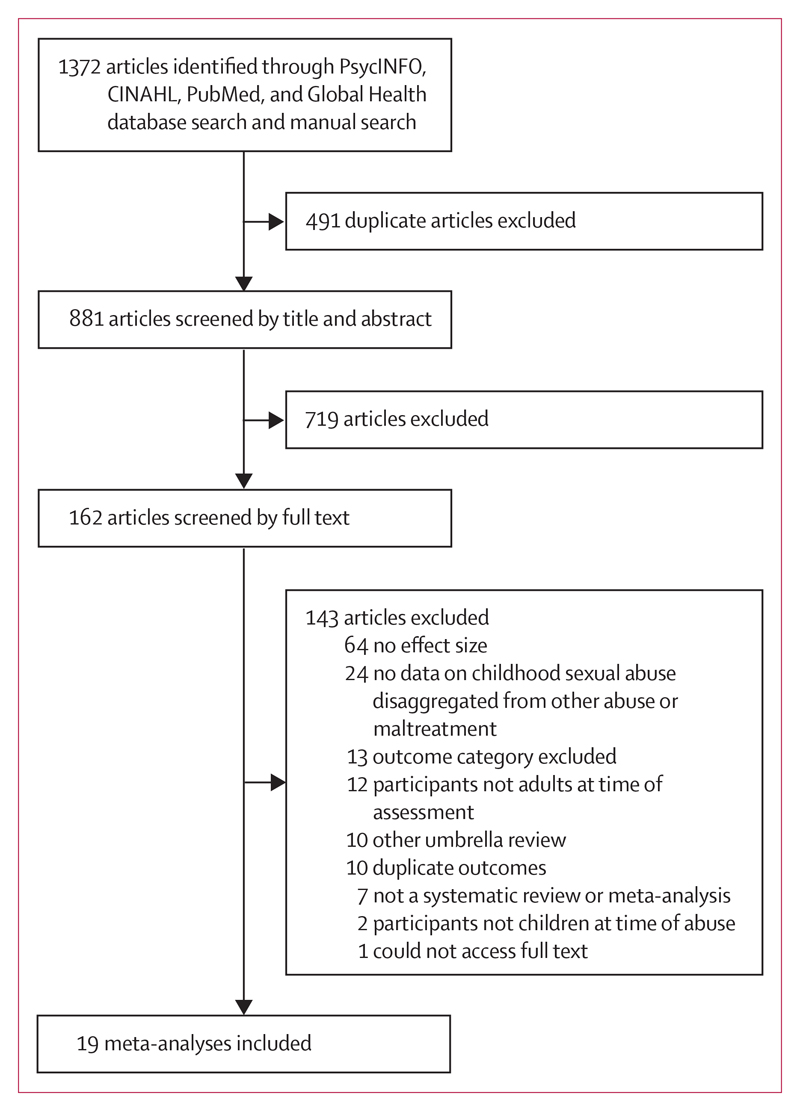
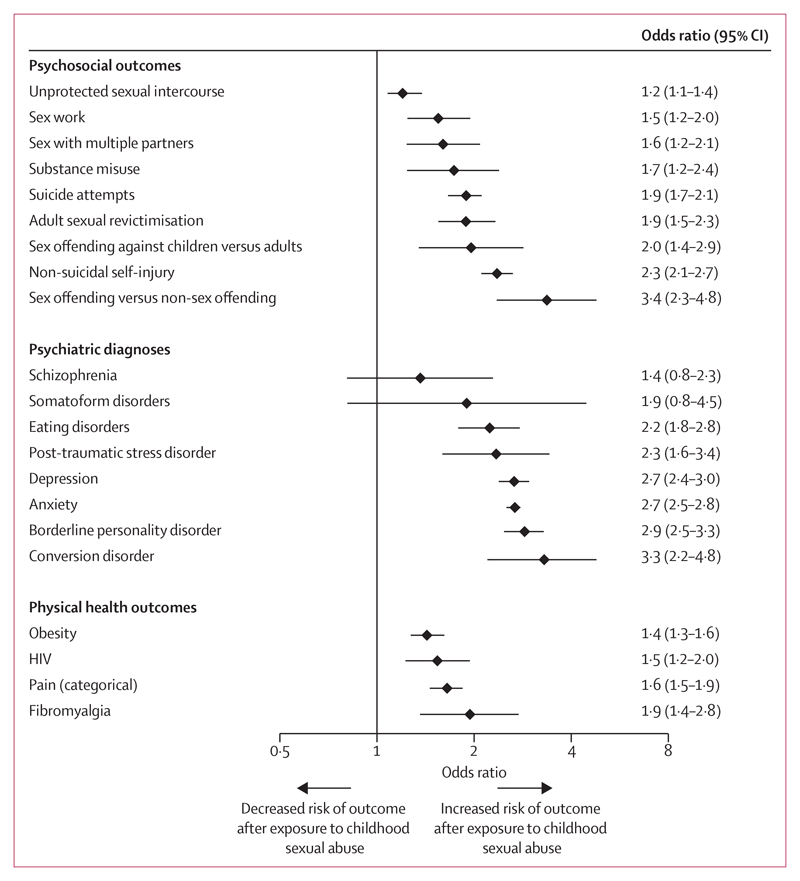
BACKGROUND: Although many meta-analyses have examined the association between childhood sexual abuse and subsequent outcomes, the scope, validity, and quality of this evidence has not been comprehensively assessed. We aimed to systematically review existing meta-analyses on a wide range of long-term psychiatric, psychosocial, and physical health outcomes of childhood sexual abuse, and evaluate the quality of the literature. METHODS: In this umbrella review, we searched four databases (PsycINFO, PubMed, Cumulative Index to Nursing and Allied Health Literature, and Global Health) from inception to Dec 31, 2018, to identify meta-analyses of observational studies that examined the association between childhood sexual abuse (before 18 years of age) and long-term consequences (after 18 years). We compared odds ratios (ORs) across different outcomes. We also examined measures of quality, including heterogeneity between studies and evidence for publication bias. This study is registered with PROSPERO, CRD42016049701. FINDINGS: We identified 19 meta-analyses that included 559 primary studies, covering 28 outcomes in 4 089 547 participants. Childhood sexual abuse was associated with 26 of 28 specific outcomes: specifically, six of eight adult psychiatric diagnoses (ORs ranged from 2·2 [95% CI 1·8-2·8] to 3·3 [2·2-4·8]), all studied negative psychosocial outcomes (ORs ranged from 1·2 [1·1-1·4] to 3·4 [2·3-4·8]), and all physical health conditions (ORs ranged from 1·4 [1·3-1·6] to 1·9 [1·4-2·8]). Strongest psychiatric associations with childhood sexual abuse were reported for conversion disorder (OR 3·3 [95% CI 2·2-4·8]), borderline personality disorder (2·9 [2·5-3·3]), anxiety (2·7 [2·5-2·8]), and depression (2·7 [2·4-3·0]). The systematic reviews for two psychiatric outcomes (post-traumatic stress disorder and schizophrenia) and one psychosocial outcome (substance misuse) met high quality standards. Quality was low for meta-analyses on borderline personality disorder and anxiety, and moderate for conversion disorder. Assuming causality, population attributable risk fractions for outcomes ranged from 1·7% (95% CI 0·7-3·3) for unprotected sexual intercourse to 14·4% (8·8-19·9) for conversion disorder. INTERPRETATION: Although childhood sexual abuse was associated with a wide range of psychosocial and health outcomes, systematic reviews on only two psychiatric disorders (post-traumatic stress disorder and schizophrenia) and one psychosocial outcome (substance misuse) were of a high quality. Whether services should prioritise interventions that mitigate developing certain psychiatric disorders following childhood abuse requires further review. Higher-quality meta-analyses for specific outcomes and more empirical studies on the developmental pathways from childhood sexual abuse to later outcomes are necessary. FUNDING: Wellcome Trust.
Overview
CoChat Summary
TL;DR
This umbrella review synthesizes 19 meta-analyses covering 559 primary studies and 4,089,547 participants to assess long-term outcomes of childhood sexual abuse. Childhood sexual abuse was associated with 26 of 28 outcomes, but only post-traumatic stress disorder, schizophrenia, and substance misuse had high-quality systematic review evidence.
Key findings
- Across 28 outcomes, childhood sexual abuse was associated with 26; odds ratios ranged from 2·2 (95% CI 1·8–2·8) to 3·3 (2·2–4·8) for psychiatric outcomes, 1·2 (1·1–1·4) to 3·4 (2·3–4·8) for psychosocial outcomes, and 1·4 (1·3–1·6) to 1·9 (1·4–2·8) for physical health outcomes.
- Strongest associations were sexual versus non-sexual offending (OR 3·4 [95% CI 2·3–4·8]), conversion disorder (3·3 [2·2–4·8]), borderline personality disorder (2·9 [2·5–3·3]), anxiety (2·7 [2·5–2·8]), and depression (2·7 [2·4–3·0]).
- High-quality systematic reviews were identified for post-traumatic stress disorder, schizophrenia, and substance misuse; quality was low for borderline personality disorder and anxiety (1/5) and moderate for conversion disorder and sexual versus non-sexual offending (3/5).
- Population attributable fractions ranged from 1·7% (95% CI 0·7–3·3) for unprotected sexual intercourse to 14·4% (8·8–19·9) for conversion disorder, with the highest at 14·7% (9·6–19·9) for sexual versus non-sexual offending; absolute rates in high-quality outcomes were 503/1809 (28%) for substance misuse and 36/96 (38%) for post-traumatic stress disorder.
Methods
- Umbrella review searching PsycINFO, PubMed, Cumulative Index to Nursing and Allied Health Literature, and Global Health from inception to Dec 31, 2018, with no language restriction, plus secondary searches and citation chaining; registered with PROSPERO, CRD42016049701.
- Included meta-analyses of observational studies reporting outcomes for childhood sexual abuse before age 18 and long-term outcomes after age 18, disaggregated from other abuse, with aggregate quantitative effect sizes; when overlapping, the most recent or largest meta-analysis was selected, and the minimum was three primary studies.
- Effect sizes were converted to odds ratios; population attributable fractions were calculated assuming causality and a 10% prevalence estimate; quality was assessed with AMSTAR, I² heterogeneity, excess significance, small study effects, and prediction intervals, yielding an aggregate 0–5 score.
Limitations
- The paper states that few included reviews explored heterogeneity by age or study design; familial factors, abuse characteristics, and overlap with other forms of child abuse were not accounted for and might overestimate effect sizes.
- The paper states that primary studies often relied on retrospective recall of childhood sexual abuse, that high co-occurrence with other abuse could not be addressed due to insufficient data, and that evidence was inconsistent with likely publication bias favoring significant findings.
- Evident from the text: population attributable fractions were calculated without confounder adjustment and with a conservative 10% prevalence estimate, so the authors note these figures will likely be overestimated; no confounder-adjusted effect sizes were reported.
Model-written summary. Check it against the paper before relying on it.
Integrity signals
Registry
Cites
Statistics
Figures
Verification
Claims the paper makes
11 Valid · 3 Not valid · 14 Not checked · 58 Own results and interpretations
The cited sources that could be checked couldn’t confirm or dispute this claim.
In the paper
“and 36 (38%) of 96 developed post-traumatic stress disorder.57”
§ Long-term outcomes of childhood sexual abuse: an umbrella review > Results
What the sources say
- Could not verifycites [57] Dube SR Anda RF Felitti VJ Chapman DP Giles WH Childhood abuse, neglect and household dysfunction and the risk of illicit drug use: the Adverse Childhood Experience Study Pediatrics 2003 111 564 72 12612237 sourceExperimental — accuracy not yet measured
The Discussion (p. 11) reports the prevalence of childhood sexual abuse, but not subsequent PTSD diagnoses. Searches for PTSD, post-traumatic stress disorder, and the figures 36, 38%, and 96 found no passage supporting the claimed outcome. (LLM, conf=0.76)
plain- Asserted: passes — The authors put it forward as true.
- Checkable: passes — It can be checked against evidence.
- Load-bearing: unclear — It is unclear whether the paper’s conclusions depend on it.
- Based: passes — The paper gives a reason why it holds.
- Could not verify
The cited sources that could be checked couldn’t confirm or dispute this claim.
In the paper
“by gender on depression,53”
§ Long-term outcomes of childhood sexual abuse: an umbrella review > Results
What the sources say
- Could not verifycites [53] Irish L Kobayashi I Delahanty DL Long-term physical health consequences of childhood sexual abuse: a meta-analytic review J Pediatr Psychol 2010 35 450 61 20022919 PMC2910944 sourceExperimental — accuracy not yet measured
The Abstract identifies depression as a psychological outcome associated with childhood sexual abuse, but says this review examines physical health outcomes. The Results report no suggestive findings for sex as a moderator of physical health outcomes; they do not report whether the effect on depression differs by gender. Searched for gender differences in depression and female–male moderation. (LLM, conf=0.77)
plain- Asserted: passes — The authors put it forward as true.
- Checkable: passes — It can be checked against evidence.
- Load-bearing: unclear — It is unclear whether the paper’s conclusions depend on it.
- Based: passes — The paper gives a reason why it holds.
- Could not verify
The cited sources support only part of this claim — read each source’s verdict below.
In the paper
“by study design on obesity and psychosis,7,9”
§ Long-term outcomes of childhood sexual abuse: an umbrella review > Results
What the sources say
- Partly supportedcites [7] Varese F Smeets F Drukker M Childhood adversities increase the risk of psychosis: a meta-analysis of patient-control, prospective- and cross-sectional cohort studies Schizophr Bull 2012 38 661 71 22461484 PMC3406538 sourceExperimental — accuracy not yet measured
The Results section, “Overall Association Between Adverse Childhood Events and Psychosis” (page unavailable), reports no significant difference by study design in the overall association between childhood adversity and psychosis. The separate sexual-abuse analysis reports an association with psychosis, but the Methods say those adversity-specific effects were not compared by study design. The paper does not address obesity. (LLM, conf=0.87)
- Not checked — no full text of the sourcecites [9] Danese A Tan M Childhood maltreatment and obesity: systematic review and meta-analysis Mol Psychiatry 2014 19 544 54 23689533 source
plain- Asserted: passes — The authors put it forward as true.
- Checkable: passes — It can be checked against evidence.
- Load-bearing: unclear — It is unclear whether the paper’s conclusions depend on it.
- Based: passes — The paper gives a reason why it holds.
- Partly supported
The sources with a verdict support this claim; the rest weren’t checked yet, have no full text we could read, or their verdicts aren’t rated yet.
In the paper
“Previous attempts to synthesise the large number of meta-analytical reviews in the field have mostly considered solely mental health outcomes or a single outcome, such as depression, anxiety disorders, suicide and self-injury, or substance misuse.12–15”
§ Long-term outcomes of childhood sexual abuse: an umbrella review > Introduction
What the sources say
- Supportedcites [12] Maniglio R Child sexual abuse in the etiology of depression: a systematic review of reviews Depress Anxiety 2010 27 631 42 20336807 source
The Methods section says this systematic review included only reviews investigating depressive symptoms or disorders following childhood sexual abuse. The Results section reports that it included four reviews, making this paper an example of a synthesis focused on a single outcome—depression. It does not need to establish the sentence’s broader claim about what most previous syntheses considered. (LLM, conf=0.91)
- Not checked — no full text of the sourcecites [13] Maniglio R Child sexual abuse in the etiology of anxiety disorders: a systematic review of reviews Trauma Violence Abuse 2013 14 96 112 23262751 source
- Not checked — no full text of the sourcecites [14] Maniglio R The role of child sexual abuse in the etiology of suicide and non-suicidal self-injury Acta Psychiatr Scand 2011 124 30 41 20946202 source
- Not checked — no full text of the sourcecites [15] Maniglio R The role of child sexual abuse in the etiology of substance-related disorders J Addict Dis 2011 30 216 28 21745044 source
plain- Asserted: passes — The authors put it forward as true.
- Checkable: passes — It can be checked against evidence.
- Load-bearing: passes — The paper’s conclusions depend on it.
- Based: passes — The paper gives a reason why it holds.
- Supported
Every source the paper cites for this claim was checked and supports it.
In the paper
“Research has indicated the effectiveness of interventions for post-traumatic stress disorder in individuals who have experienced childhood sexual abuse77,78”
§ Long-term outcomes of childhood sexual abuse: an umbrella review > Discussion
What the sources say
- Supportedcites [77] Ehring T Welboren R Morina N Wicherts JM Freitag J Emmelkamp PMG Meta-analysis of psychological treatments for posttraumatic stress disorder in adult survivors of childhood abuse Clin Psychol Rev 2014 34 645 57 25455628 source
The Discussion reports that psychological interventions for PTSD in adult survivors of childhood abuse are efficacious. The Abstract also reports reduced PTSD symptom severity following psychological interventions for adult survivors of childhood sexual abuse. The evidence concerns adult survivors, rather than children currently receiving treatment. (LLM, conf=0.90)
- Supportedcites [78] Trask EV Walsh K DiLillo D Treatment effects for common outcomes of child sexual abuse: a current meta-analysis Aggress Violent Behav 2011 16 6 19 21603060 PMC3095890 source
The Discussion states that treatment is effective in reducing PTSD symptoms among child victims of sexual abuse. The meta-analysis concerns youth under 18, so its evidence is specifically about treatment of PTSD symptoms in that group. (LLM, conf=0.88)
hedgedstates a possible cause- Asserted: passes — The authors put it forward as true.
- Checkable: passes — It can be checked against evidence.
- Load-bearing: unclear — It is unclear whether the paper’s conclusions depend on it.
- Based: passes — The paper gives a reason why it holds.
- Supported
54 more claims · 7 with their cited sources checked
Create a free account to see all 86 claims and to verify the 4 references still open.
- It may state two separate claims as one. 21
- Probably not a substantial claim. 13
Claims other papers make about this one
Each is checked against this paper’s own text: does it say what the citing paper says it does?
The cited source doesn’t support the claim as written.
In the citing paper
“the authors concluded that only two outcomes (PTSD and substance misuse) reached high-quality meta-analytic standards (and thus should be prioritized) and that little credence should be given to other disorders.”
From Child Sexual Abuse as a Unique Risk Factor for the Development of Psychopathology: The Compounded Convergence of Mechanisms (2021) · cites this paper as Hailes et al. 2019
Checked by a reasoning model — may be wrong.
Experimental — accuracy not yet measuredThe source backs part of the claim, not all of it — or backs it for a different population, condition or comparison.
In the citing paper
“reported aggregate odds ratios (ORs) of 3.3 for conversion disorder, 2.9 for borderline personality disorder (BPD), 2.7 for both anxiety and depression, 2.3 for posttraumatic stress disorder (PTSD), 2.2 for eating disorders, 1.9 for somatoform disorders, 1.7 for substance misuse, and 1.4 for schizophrenia.”
From Child Sexual Abuse as a Unique Risk Factor for the Development of Psychopathology: The Compounded Convergence of Mechanisms (2021) · cites this paper as Hailes et al. 2019
Experimental — accuracy not yet measuredThe source backs part of the claim, not all of it — or backs it for a different population, condition or comparison.
In the citing paper
“Quality ratings were based on aggregate assessments across all meta-analyses within diagnostic sets without regard for potential quality exemplars, and there were no distinctions between ORs that were adjusted versus unadjusted for potential confounds”
From Child Sexual Abuse as a Unique Risk Factor for the Development of Psychopathology: The Compounded Convergence of Mechanisms (2021) · cites this paper as Hailes et al. 2019
Experimental — accuracy not yet measuredIn the citing paper
“An umbrella review reported that anxiety [OR = 2.7 (95% CI: 2.5–2.8)], and depression [OR = 2.7 (95% CI: 2.4–3.0)] frequently occurred one after another among adults over 18 years with experiencing sexual abuse as a child [ 11 ].”
From Anxiety and Depression Symptoms among Youth Survivors of Childhood Sexual Abuse: A Network Analysis (2023) · cites this paper as [11]
In the citing paper
“Reviews also reported that persons with a history of CSA are potentially at risk of long-term anxiety and depression diagnoses [ 11 , 12 ].”
From Anxiety and Depression Symptoms among Youth Survivors of Childhood Sexual Abuse: A Network Analysis (2023) · cites this paper as [11]
1 more claim about this paper
Create a free account to see every claim other papers make about this one.
Self-check
Percentages, sums and reported differences re-computed from the paper’s own numbers.
Each contradiction between two passages listed here was confirmed by an independent check.
Rated minor: it would not touch a result — a value no result rests on, a p-value that stays on the same side of the significance level, or a conflict that is clerical, resolved elsewhere in the paper, or outside its own findings.
In the paper
§ Long-term outcomes of childhood sexual abuse: an umbrella review > Results
“Population attributable fractions ranged from 1·7% (95% CI 0·7–3·3) for unprotected sexual intercourse to 14·4% (8·8–19·9) for conversion disorder.”
§ Long-term outcomes of childhood sexual abuse: an umbrella review > Results
“The highest population attributable fraction was 14·7% (9·6–19·9) for sexual offending versus non-sexual offending (table 2).”
Citations
Cites
Child abuse: Adolescent records vs. adult recall
Femina, D. D., Yeager, C. A., & Lewis, D. O. (1990) · Child Abuse & Neglect · doi:10.1016/0145-2134(90)90033-p · Cited by 8,820
The Handbook of Research Synthesis and Meta-Analysis
(2019) · doi:10.7758/9781610448864 · Cited by 4,553
Development of AMSTAR: A measurement tool to assess the methodological quality of systematic reviews
Shea, B. J., Grimshaw, J. M., Wells, G. A., Boers, M., Andersson, N., Hamel, C., Porter, A. C., Tugwell, P., Moher, D., & Bouter, L. M. (2007) · BMC Medical Research Methodology · doi:10.1186/1471-2288-7-10 · Cited by 4,374
Overweight, Obesity, and Depression: A Systematic Review and Meta-analysis of Longitudinal Studies
Luppino, F. S., de Wit, L. M., Bouvy, P. F., Stijnen, T., Cuijpers, P., Penninx, B. W. J. H., & Zitman, F. G. (2010) · Archives of General Psychiatry · doi:10.1001/archgenpsychiatry.2010.2 · Cited by 4,322
Zhang, J., & Yu, K. F. (1998) · JAMA · doi:10.1001/jama.280.19.1690 · Cited by 4,138 · cited 1×
“33 36 The AMSTAR (a measurement tool to assess systematic reviews) checklist was used to assess the methodological quality of the included systematic reviews, 37 and some items were modified for this umbrella review (appendix pp 6–7).”
Burden and consequences of child maltreatment in high-income countries
Gilbert, R., Widom, C. S., Browne, K., Fergusson, D., Webb, E., & Janson, S. (2009) · The Lancet · doi:10.1016/s0140-6736(08)61706-7 · Cited by 3,876 · cited 1×
“60 For example, childhood sexual abuse is associated with risky sexual behaviours, 61,62 which could lead to HIV.”
Varese, F., Smeets, F., Drukker, M., Lieverse, R., Lataster, T., Viechtbauer, W., Read, J., van Os, J., & Bentall, R. P. (2012) · Schizophrenia Bulletin · doi:10.1093/schbul/sbs050 · Cited by 2,436
Dube, S. R., Felitti, V. J., Dong, M., Chapman, D. P., Giles, W. H., & Anda, R. F. (2003) · Pediatrics · doi:10.1542/peds.111.3.564 · Cited by 2,333
Plea for routinely presenting prediction intervals in meta-analysis.
IntHout, J., Ioannidis, J. P. A., Rovers, M. M., & Goeman, J. J. (2016) · BMJ Open · doi:10.1136/bmjopen-2015-010247 · Cited by 2,264 · cited 1×
“42 We created an overall quality assessment.”
A Global Perspective on Child Sexual Abuse: Meta-Analysis of Prevalence Around the World
Stoltenborgh, M., van IJzendoorn, M. H., Euser, E. M., & Bakermans-Kranenburg, M. J. (2011) · Child Maltreatment · doi:10.1177/1077559511403920 · Cited by 2,010
Research works printed but not linked: 3
- Hailes HP Fazel S Yu R Longterm outcomes of childhood sexual abuse: an umbrella review PROSPERO Int Prospect Regist Syst Rev 2016 CRD42016049701
- Quinones-Munoz SL Psychological effects of childhood sexual abuse in adult males Diss Abstr Int Sect B Sci Eng 2001 62 2074
- Liel C Parenting programs for mothers who are at risk or indicated for child abuse and neglect—a systematic review of the international research literature Psychol Erziehung und Unterr 2013 60 11 25
Cited by
Items 301–400 of 806
Fang, X., Ren, J., Kang, J., Ligiero, D., Fry, D. A., Annor, F., Burrows, S., Butchart, A., Diaz, K. J., Fang, Z., et al. (2026) · Nature Human Behaviour · doi:10.1038/s41562-026-02436-1 · Cited by 13
“Sexual violence against children (SVAC) is a critical global public health and development issue, with devastating consequences for millions of children worldwide 1 .”
Jahic, I., Trulson, C. R., Caudill, J. W., Bonner, T., Slemaker, A., & DeLisi, M. (2021) · International Journal of Environmental Research and Public Health · doi:10.3390/ijerph182111307 · Cited by 10
Boyd, D. T., Abu-Ba’are, G. R., LoVette, A., Whitfield, D. L., Turpin, R., Ramos, S. R., Quinn, C. R., & Hickson, D. A. (2022) · International Journal of Environmental Research and Public Health · doi:10.3390/ijerph192113930 · Cited by 5
Does Forgiveness Enhance Or Detract From Relationship Quality Among Sexual Abuse Survivors?
Fitzgerald, M., Wright, L., & Bishop, A. J. (2023) · Journal of Child Sexual Abuse · doi:10.1080/10538712.2023.2174469 · Cited by 6
“Most research on CSA has focused on the detrimental mental health consequences (Hailes et al., 2019) and it was not until the 21st century that research focused on relational outcomes.”
BackgroundThe relationship of university students' childhood mental trauma with depression, anxiety and stress
Bahar, A. (2023) · The European Research Journal · doi:10.18621/eurj.1233618 · Cited by 8
Assini‐Meytin, L. C., Giacomozzi, A. I., Filho, S. R. P., Lorandi, J. M., & Laurinaitytė, I. (2023) · Journal of Child & Adolescent Trauma · doi:10.1007/s40653-023-00572-8 · Cited by 9
“Our study also showed a high proportion of child sexual abuse victimization (one-third of the sample), an ACE type strongly associated with an array of adverse mental health outcomes and risky behaviors (Hailes et al., 2019).”
Trew, S., & Russell, D. H. (2024) · Trauma Violence & Abuse · doi:10.1177/15248380241241024 · Cited by 9
“Evidence in the literature across different populations highlights how, as with sexual abuse perpetrated by adults, the use and display of HSBs by children and adolescents can be traumatic to both others and themselves (Hailes et al., 2019; Wamser-Nanney & Campbell, 2020).”
BackgroundDeschênes, S. S., Nearchou, F., McInerney, A. M., Schmitz, N., Pouwer, F., & Nouwen, A. (2024) · Journal of Health Psychology · doi:10.1177/13591053241243285 · Cited by 9
“Childhood sexual abuse is one of the most profound adverse childhood experiences linked to long-term outcomes including mental disorders and physical health conditions (Hailes et al., 2019).”
Trott, M., Bull, C. F., Arnautovska, U., Siskind, D. J., Warren, N., Najman, J. M., & Kisely, S. R. (2024) · Child Maltreatment · doi:10.1177/10775595241264009 · Cited by 5
“…sexual abuse was not associated with injuries was surprising, as previous sexual abuse has been consistently associated with several negative outcomes in adulthood, including substance misuse, suicide attempts, sexual revictimization, and non-suicidal self-injury (Hailes et al., 2019).”
Aloi, M., de Filippis, R., Carbone, E. A., Rania, M., Bertuca, A., Golia, M., Nicoletta, R., Segura‐Garcìa, C., & Fazio, P. D. (2024) · Schizophrenia · doi:10.1038/s41537-024-00514-9 · Cited by 8
“This association of variables also fi nds support in the literature, if we consider how sexual abuse in childhood impacts the possibility of developing major psychiatric disorders in adulthood 42,43 .”
ResultFrom child sexual abuse to psychiatric diagnoses and complex trauma in adolescence
Rousset, M., Essadek, A., Corcos, M., & Robin, M. (2025) · European Child & Adolescent Psychiatry · doi:10.1007/s00787-025-02682-0 · Cited by 5
“However, existing literature reports associations with odds ratios ranging from 1.7 to 2.7 [13 , 14 , 31].”
InfluentialAdult Clergy Sexual Abuse and PTSD: The Impact on Protestant Female Survivors
Pooler, D. K., & Droesch, R. M. (2025) · Pastoral Psychology · doi:10.1007/s11089-025-01228-0 · Cited by 8
“Systematic reviews demonstrate a relationship between sexual abuse and psychiatric disorders such as PTSD, depression, suicide attempts, and eating disorders (Hailes et al., 2019; Jumper, 1995; Paolucci et al., 2001; Smolak & Murnen, 2002).”
Radcliffe, P. J., & Patihis, L. (2025) · Memory · doi:10.1080/09658211.2025.2498929 · Cited by 8
Bao, R.-H., Zhao, N., Jiang, X., Cong, Z.-H., Liu, J., Kang, L., Chen, Y.-H., Sun, J., Xing, W.-Y., Liu, J.-X., et al. (2025) · EClinicalMedicine · doi:10.1016/j.eclinm.2025.103277 · Cited by 6
“The exclusion criteria were as follows: Systematic reviews without quantitative analysis; Studies that focused on observational studies, laboratory studies, or animal studies; Studies without comprehensive data (such as 95% con fi dence intervals [CIs], effect sizes, and the number of participants); Studies involving p…”
InfluentialThe role of embodied sense of self in the relationship of childhood abuse types to distress and fear
Ong, L. E., Davis, B. M., Horodyski, A. M., Cole, T. A., & Orcutt, H. K. (2025) · Journal of Affective Disorders · doi:10.1016/j.jad.2025.119698 · Cited by 7
Fadeeva, A., Obolenskaya, P., Barbosa, E. C., Feder, G. S., & McManus, S. (2025) · The Lancet Healthy Longevity · doi:10.1016/j.lanhl.2025.100738 · Cited by 6
Psychological intervention with adult victims of sexual abuse: A comprehensive review
Fávero, M., Moreira, D. S., Abreu, B. M. V., Sánchez, A. D. C., Moreira, D. S., & Sousa‐Gomes, V. (2021) · Clinical Psychology & Psychotherapy · doi:10.1002/cpp.2598 · Cited by 11
Edwards, D., Collin‐Vézina, D., Danbrook, M. C., & Wekerle, C. (2022) · Child Abuse & Neglect · doi:10.1016/j.chiabu.2022.105742 · Cited by 7
Hulme, P. A., Wegehaupt, M. S., Kupzyk, K. A., & French, J. A. (2022) · Archives of Psychiatric Nursing · doi:10.1016/j.apnu.2022.12.003 · Cited by 5
Nkrumah, R. O., von Schröder, C., Demirakça, T., Schmahl, C. G., & Ende, G. (2023) · Neurobiology of Stress · doi:10.1016/j.ynstr.2023.100586 · Cited by 12
“Adverse childhood experiences (ACE) are associated with higher rates of psychiatric disorders later in life (Hailes et al., 2019), and include sexual, physical or emotional abuse and/or neglect experiences.”
Schubach, A., Quigley, B. M., Lackner, J. M., & Gudleski, G. D. (2024) · Journal of Clinical Gastroenterology · doi:10.1097/mcg.0000000000001974 · Cited by 6
“32 Patients with somatoform disorder are also more likely to report childhood experiences of trauma than patients with major depression.”
Ross, R., Sheppard, F. H., Almotairy, M. M., et al. (2024) · Nursing Reports · doi:10.3390/nursrep14020097 · Cited by 5
“Furthermore, experiencing child sexual abuse has been linked to various adverse psychosocial outcomes in adulthood, including substance misuse, decreased life satisfaction, and increased risk of suicidal behaviors [10–12].”
BackgroundNeelakantan, L., Fry, D. A., Florian, L., Silion, D., Filip, M., Thabeng, M., Te, K., Sunglao, J. A., Lu, M., Ward, C. L., et al. (2024) · Child Abuse & Neglect · doi:10.1016/j.chiabu.2024.106931 · Cited by 7
Fan, X., Liu, Y., Liu, Q., Zhao, X., Zhou, Y., & Liu, L. (2025) · Journal of Affective Disorders · doi:10.1016/j.jad.2024.12.111 · Cited by 5
Tsur, N., Katz, C., & Talmon, A. (2021) · Child Abuse & Neglect · doi:10.1016/j.chiabu.2021.105224 · Cited by 7
Parra-Barrera, S. M., Sánchez-Fuentes, M. D. M., Iglesias, C. F., & Pasamar, M. Á. B. (2021) · International Journal of Environmental Research and Public Health · doi:10.3390/ijerph181910460 · Cited by 11
Child Sexual Abuse—Challenging Conditions for Adult Oral Health: A Qualitative Study
Wolf, E., Månsson, S., Wallin, L., & Priebe, G. (2021) · JDR Clinical & Translational Research · doi:10.1177/23800844211053775 · Cited by 9
“Child sexual abuse (CSA) can have short- and long-term physical and mental sequelae (Paras et al. 2009; Hailes et al. 2019), incurring considerable expense for the individual and society (National Board of Health and Welfare 2006).”
BackgroundSexual Assault/Domestic Violence
Yemane, R. E. H., & Sokkary, N. A. (2022) · Obstetrics and Gynecology Clinics of North America · doi:10.1016/j.ogc.2022.02.020 · Cited by 9
Palma-Álvarez, R. F., Daigre, C., Ros‐Cucurull, E., Perea-Ortueta, M., Ortega‐Hernández, G., Ríos-Landeo, A., Roncero, C., Ramos‐Quiroga, J. A., & Grau‐López, L. (2023) · Psychiatry Research · doi:10.1016/j.psychres.2023.115147 · Cited by 7
Youth Reported Perpetrators of Victimization Within a Foster Care Sample
Bennett, A., Clement, A. C., Walton, R., Jackson, Y., & Gabrielli, J. (2023) · Child Maltreatment · doi:10.1177/10775595231163452 · Cited by 8
“Childhood sexual abuse victims are at increased risk for substance abuse, PTSD, schizophrenia, anxiety, psychosis, and personality disorders (Cutajar et al., 2010; Hailes et al., 2019).”
BackgroundMokros, A., Schemmel, J., Körner, A., Oeberst, A., Imhoff, R., Suchotzki, K., Oberlader, V. A., Banse, R., Kannegießer, A., Gubi‐Kelm, S., et al. (2024) · Psychologische Rundschau · doi:10.1026/0033-3042/a000663 · Cited by 7
Giang, T.-V., Le, D.-H., Nguyen, T.-H., Huynh, V.-S., & Nguyen-Thi, D.-M. (2021) · F1000Research · doi:10.12688/f1000research.55227.2 · Cited by 4
“This SAT experience, aswell as expressions of long-term effects, is quite similar to that of survivors in other cultures (Hailes et al., 2019).”
ResultUnderstanding and responding to the long-term burdens of childhood sexual abuse
Sanci, L. A. (2019) · The Lancet Psychiatry · doi:10.1016/s2215-0366(19)30329-3 · Cited by 7
Haginoya, S., Ibe, T., Yamamoto, S., et al. (2022) · doi:10.31234/osf.io/pyqxb · Cited by 5
Tselenti, D., Carvalho, J., Azevedo, V., Gomes, H. S., Haubrock, L. S., Hillert, J., Rahm, C., Briken, P., Dekker, A., Joleby, M., et al. (2025) · Policing & Society · doi:10.1080/10439463.2024.2447842 · Cited by 9
“Child sexual exploitation and abuse (CSEA) is a critical public health problem that transcends nation-state borders and can have enduring effects on victims’ physical, interpersonal, and psychological functioning (Hailes et al. 2019).”
Hesapçıoğlu, S. T., Okuyucu, M., Uslu, Ş. B. A., Hacıosmanoğlu, C. D., & Ceylan, M. F. (2025) · Journal of Psychiatric Research · doi:10.1016/j.jpsychires.2025.02.020 · Cited by 4
Niu, W., Feng, Y., Li, J., Xu, S., Ma, Z., & Wang, Y. Y. (2025) · Translational Psychiatry · doi:10.1038/s41398-025-03360-0 · Cited by 9
“More importantly, exposure to CSA leads to prominently increased suicidality and a higher incidence of suicide attempts [8 – 10].”
Kenny, M. C., Hambrick, M., Assini‐Meytin, L. C., Borelus, T., & Chang, M. (2025) · Child Maltreatment · doi:10.1177/10775595251340025 · Cited by 4
“…than people who did not experience CSA to experience poor health outcomes, including cardiovascular disease (Jakubowski et al., 2021), depression (Hailes et al., 2019; Li et al., 2020), post-traumatic stress disorder (McTavish et al., 2019), and reproductive health problems (Brunton & Dryer,…”
Forensic Psychological Harm in Victims of Child Sexual Abuse: A Meta-analytic Review
Cea, B., Montes, Á., Trinidad, A., & Fernández, R. A. (2025) · The European Journal of Psychology Applied to Legal Context · doi:10.5093/ejpalc2025a10 · Cited by 10
Martijn, F. M., Blagden, N., Baguley, T. S., Leroux, E. J., Mackay, J., & Seto, M. C. (2025) · Clinical Psychology Review · doi:10.1016/j.cpr.2025.102690 · Cited by 7
Amédée, L. M., Cyr, C. P., & Hébert, M. (2024) · Development and Psychopathology · doi:10.1017/s0954579424001196 · Cited by 5
Liu, N., Bao, R.-H., Chang, Y.-J., Liu, F.-H., Wu, L., Wang, J.-Y., Niu, Z.-P., Ma, S., Men, Y.-X., Liu, K.-X., et al. (2024) · BMC Medicine · doi:10.1186/s12916-024-03680-w · Cited by 5
Coping patterns among sexually abused children: A latent profile analysis
Dassylva, O., Amédée, L. M., Paradis, A., & Hébert, M. (2024) · Children and Youth Services Review · doi:10.1016/j.childyouth.2024.108083 · Cited by 6
Geller, J. A., & Whitney, E. (2024) · Current Psychiatry Reports · doi:10.1007/s11920-024-01577-2 · Cited by 6
Armon, D. B., Fine, N. B., Seligman, Z., Ginzburg, K., & Ben‐Zion, Z. (2021) · Journal of Affective Disorders Reports · doi:10.1016/j.jadr.2021.100252 · Cited by 3
“Sexual assault survivors suffer from a range of psychiatric comorbidities and especially high rates of depression and anxiety (Hailes et al., 2019), a plethora of somatic health problems (Springer et al., 2003), elevated health anxiety (Reiser et al., 2014), high rates of functional impairment and…”
Mental Health and Negative Sexual Experiences of Bahamian University Students
Williams, E. J., Fielding, W. J., & Ballance, V. C. F. (2021) · International Journal of Bahamian Studies · doi:10.15362/ijbs.v27i0.395 · Cited by 4
“The longterm effects of child sexual abuse on the mental health of adult females include anger, depression, and sexual problems (Hailes et al., 2019).”
BackgroundDovi, A. T., Macaulay, J. L., Repine, A., Jong, A. D., Williams, R. E., & Deutsch, S. A. (2022) · Delaware Journal of Public Health · doi:10.32481/djph.2022.05.004 · Cited by 7
Perceived Help and Support for Sex as Self-Injury: A Qualitative Study of a Swedish Sample
Fredlund, C., & Jonsson, L. S. (2022) · Archives of Sexual Behavior · doi:10.1007/s10508-022-02437-x · Cited by 19
“The association between earlier sexual abuse and later sexual risk-taking behaviors is well described in the literature, including increased risk of a greater numbers of sexual partners, a higher frequency of sexually transmitted infections, teenage pregnancy, selling sex, and younger age of sexual debut (Abajobir et…”
BackgroundCumulative trauma in bipolar disorder: An examination of prevalence and outcomes across the lifespan
Rowe, A., Perich, T., & Meade, T. (2022) · Journal of Affective Disorders · doi:10.1016/j.jad.2022.12.041 · Cited by 7
Bengtson, S., & Giraldi, A. G. E. (2023) · Acta Psychiatrica Scandinavica · doi:10.1111/acps.13584 · Cited by 4
“, depression, anxiety, substance use disorder, suicidality).(2) Mental health disorders have also been identified as overrepresented in individuals convicted of sexual offending (ICSO) compared with general offending populations and the general population, with prevalence rates of any mental disorders ranging from 60%…”
BackgroundAdolescents’ experiences of psychotherapy following child sexual abuse
McElvaney, R., Monaghan, A. I. C., Treacy, C., & Delaney, N. (2023) · Research in Psychotherapy Psychopathology Process and Outcome · doi:10.4081/ripppo.2023.630 · Cited by 9
“(Hailes et al., 2019) and provides a strong rationale for early in-”
Pebole, M. M., Singleton, C. R., Hall, K. S. M., Petruzzello, S. J., Alston, R. J., Darroch, F., & Gobin, R. L. (2023) · Journal of Interpersonal Violence · doi:10.1177/08862605231188058 · Cited by 5
“…stress disorder (PTSD), psychological distress, anxiety and depression, and anger (Easton & Kong, 2017; Easton et al., 2019; Haegerich & Hall, 2011; Hailes et al., 2019; Jakubowski et al., 2021; Smith et al., 2022; Snow et al., 2021), which can lead to a downward spiral of self-harm and…”
BackgroundWhat do adults who experienced child sexual abuse want to convey about therapy?
Glucklich, T., Attrash-Najjar, A., Massarweh, N., & Katz, C. (2023) · Child Abuse & Neglect · doi:10.1016/j.chiabu.2023.106435 · Cited by 6
Rong, Z., He, J., Lin, Y., Rongzhe, C., Liao, M., Xin, L., & Ping, Z. (2024) · BMC Public Health · doi:10.1186/s12889-024-17767-9 · Cited by 7
“As a result, the experience of CSA may increase the likelihood of risky sexual behaviours and adverse reproductive health outcomes in early adulthood [18], which may also lead to long-term adverse effects [21, 22].”
BackgroundMozid, N.-E., Espinosa, R. N., Grayson, C., Falode, O., Yang, Y., Glaudin, C., & Guastaferro, K. (2024) · International Journal of Environmental Research and Public Health · doi:10.3390/ijerph21020149 · Cited by 7
Fung, H. W., Lam, C. C., Yuan, G. F., Chan, C. T. L., Liu, C., & Wang, E. K. S. (2024) · European Journal of Trauma & Dissociation · doi:10.1016/j.ejtd.2024.100393 · Cited by 4
The impact of childhood sexual abuse on interpersonal violence in men: A systematic review
Hui, A., Salkovskis, P. M., & Rumble-Browne, J. (2024) · Aggression and Violent Behavior · doi:10.1016/j.avb.2024.101928 · Cited by 8
Association between pathogenic beliefs and personality disorders
Jintanachote, V., Wongpakaran, T., & Wongpakaran, N. (2024) · Heliyon · doi:10.1016/j.heliyon.2024.e37183 · Cited by 4
“Furthermore, borderline personality disorder is closely associated with childhood trauma, which directly correlates with the development of pathogenic beliefs [54 – 56].”
Backgroundvan der Burgt, M. C. A., Widdershoven, G. A. M., Verhoeff, A. P., & Hein, I. M. (2024) · Child Abuse & Neglect · doi:10.1016/j.chiabu.2024.107069 · Cited by 12
Järvilehto, L., Sun, Y., Korkman, J., Pakkanen, T., Shen, C., Bader, F. M., & Santtila, P. O. (2025) · Psychology Crime and Law · doi:10.1080/1068316x.2025.2531391 · Cited by 9
Pesavento, F., & Rossi, A. A. (2025) · Frontiers in Psychology · doi:10.3389/fpsyg.2025.1665790 · Cited by 4
“Specifically, CT are associated with increased risk of depressive disorders, substance abuse, and suicidal behaviors in adulthood (Norman et al., 2012; Hailes et al., 2019; Li et al., 2016), as well as difficulties in managing one’s internal states (Schimmenti, 2018).”
Elkjær, H. K., Lau, M. E., Mortensen, E. L., Kristensen, E., & Poulsen, S. (2021) · European Journal of Psychotraumatology · doi:10.1080/20008198.2020.1855887 · Cited by 8
Healing from sexual violence among young women in South Korea
Cha, C., & Lee, M. (2021) · International Journal of Mental Health Nursing · doi:10.1111/inm.12931 · Cited by 4
Karakaş, M., & Çingöl, N. (2021) · Perspectives In Psychiatric Care · doi:10.1111/ppc.12962 · Cited by 9
Chen, X., Pan, Y., Xu, P., Huang, Y., Li, N., & Song, Y. M. (2021) · BMC Psychiatry · doi:10.1186/s12888-021-03566-8 · Cited by 9
Nonoffending Caregiver Support After Child Sexual Abuse: Essentials for the Forensic Nurse
Hornor, G. (2022) · Journal of Forensic Nursing · doi:10.1097/jfn.0000000000000360 · Cited by 4
Otterman, G. J., Nurmatov, U. B., Akhlaq, A., Naughton, A., Kemp, A., Korhonen, L., Jud, A., Vollmer‐Sandholm, M. J., Mora-Theuer, E. A., Moultrie, S., et al. (2023) · BMJ Open · doi:10.1136/bmjopen-2022-064008 · Cited by 5
Differential Profiles of Sexually Abused Adolescent Boys
Gauthier-Duchesne, A., Hébert, M., Blais, M., & Wekerle, C. (2023) · Journal of Child Sexual Abuse · doi:10.1080/10538712.2023.2226652 · Cited by 7
“Male victims vary considerably in regard to the characteristics of the CSA they experience (Gewirtz-Meydan & Finkelhor, 2020) and the associated symptoms they develop (Hailes et al., 2019).”
BackgroundTouloumakos, A. Κ., Adamopoulou, E., & Evangelou-Tsitiridou, M. (2023) · Psychology the Journal of the Hellenic Psychological Society · doi:10.12681/psy_hps.26786 · Cited by 6
Trauma Informed Care for Nursing Action Bachelor of Science in Nursing Course
Schimmels, J., & Schneider, J. (2024) · Journal of Nursing Education · doi:10.3928/01484834-20240207-06 · Cited by 6
Puno, A., Kim, J., Bhatia, A., Jeong, J., & Kim, R. (2024) · Journal of Adolescent Health · doi:10.1016/j.jadohealth.2024.02.034 · Cited by 10
Watts, J. R., Lazzareschi, N. R., Warwick, L., & Gaa, M. (2024) · Journal of Counseling & Development · doi:10.1002/jcad.12534 · Cited by 10
Rethinking Lifetime Abuse in Old Age
Band‐Winterstein, T., Shulyaev, K., & Eisikovits, Z. C. (2024) · Journal of Interpersonal Violence · doi:10.1177/08862605241264533 · Cited by 3
“…onset (Kaplow & Widom, 2007), the severity of abusive life events (Jonas et al., 2011), relationship to the abuser (Roberto, 2017), the escalating dynamics of abuse (Eisikovits et al., 2002), long-term outcomes (Hailes et al., 2019), and intergenerational transmission (Anderson et al., 2018).”
Zych, I., & Marín‐López, I. (2024) · Campbell Systematic Reviews · doi:10.1002/cl2.70000 · Cited by 5
“Mental health problems are a common long ‐ term consequence of child sexual abuse (Chen et al., 2010; Guiney et al., 2024; Hailes et al., 2019; Noll, 2021).”
BackgroundPatel, H., Easterbrook, B., Ralston, F. A., Shariff, D., Lester, H., Landaverde, D., Lau, E., Davis, I. S., Aks, I. R., Brown, S. A., et al. (2025) · Early Intervention in Psychiatry · doi:10.1111/eip.70051 · Cited by 5
Easton, S. D., Kong, J., Renner, L. M., & McKetchnie, S. M. (2025) · Journal of Interpersonal Violence · doi:10.1177/08862605251339641 · Cited by 6
Gezahegn, Y., Dubale, B. W., Pain, C., & Mihretu, A. (2025) · BMJ Open · doi:10.1136/bmjopen-2024-091138 · Cited by 3
Characteristics and Prognosis of Functional Movement Disorders in China: FMD –China Registry Study
Wang, J., Cheng, O., Xu, G., Xu, S., Liu, X., Ma, S., Huang, W., Chen, W., Hu, X., Liu, Y., et al. (2025) · European Journal of Neurology · doi:10.1111/ene.70372 · Cited by 3
“Longitudinal evidence further indicates that adverse childhood experiences may predispose individuals to FMDs in adulthood [7–9].”
Measuring early experiences: Challenges and future directions
Humphreys, K. L., & King, L. S. (2025) · Developmental Cognitive Neuroscience · doi:10.1016/j.dcn.2025.101637 · Cited by 8
“…abuse, etc.) and variations within the “ normative ” range (such as the quality and quantity of parenting behaviors like language input, degree of sensitivity, and enriching activities) influence developmental trajectories (Farber et al., 2022; Hailes et al., 2019; van IJzendoorn et al., 2020).”
Spry, E., Aarsman, S. R., Dashti, S. G., McAnally, H. M., Greenwood, C. J., Guiney, H., Catalão, R., Belsky, J., Macdonald, J. A., Letcher, P., et al. (2026) · The Lancet Obstetrics Gynaecology & Women s Health · doi:10.1016/s3050-5038(25)00177-3 · Cited by 4
dos Santos, K. B., Leme, V. B. R., dos Santos, A. C. F., & Murta, S. G. (2026) · Psicologia Reflexão e Crítica · doi:10.1186/s41155-026-00390-5 · Cited by 8
“These barriers underscore that social resistance to openly discussing sexuality and sexual violence remains a significant obstacle to implementing CSE (Hailes et al., 2019; Santos et al., 2021).”
Bobbio, A., Piumetto, V., Bruera, J., & Arbach, K. (2023) · Revista de Investigación en Psicología · doi:10.15381/rinvp.v26i1.24741 · Cited by 5
Adolescent victims of sexual abuse and music therapy: A systematic review
Suzuki, D. C., Monge, A. B., da Silva, B. S., Viana, J. A., Suzuki, P. R., Neto, R. A., & Vitalle, M. S. D. S. (2023) · Research Society and Development · doi:10.33448/rsd-v12i6.42356 · Cited by 7
Distinguishing Types of Sexual Assault Among Young People: A Latent Class Analysis Approach
Frøyland, L. R., Stefansen, K., & Andersen, P. L. (2023) · Young · doi:10.1177/11033088231171494 · Cited by 5
“An umbrella review of meta-analyses on associations between sexual abuse and assaults before the age of 18 and adverse long-term outcomes highlighted studies on PTSD, schizophrenia and substance misuse as being of particularly high quality (Hailes et al., 2019).”
BackgroundNaidoo, L., Rasool, S., & Hout, M. C. V. (2023) · Child Abuse & Neglect · doi:10.1016/j.chiabu.2023.106485 · Cited by 6
Lev‐Wiesel, R., Trebatická, J., Girish, M., Matzová, S., Goldner, L., Vatrál, M., Weiner, N., Vášáryová, D., Oryan, I., Zaksh, Y., et al. (2024) · International Journal of Adolescence and Youth · doi:10.1080/02673843.2024.2307501 · Cited by 5
“Other studies have reported that ED and suicidality may be long-term outcomes of sexual abuse (Hailes et al., 2019).”
Understanding Post-Traumatic Growth in Adolescent Survivors of Childhood Sexual Abuse
Goldner, L., Leibovich, I., Hadar, D., & Lev‐Wiesel, R. (2024) · Journal of Loss and Trauma · doi:10.1080/15325024.2024.2377631 · Cited by 5
“…the deleterious short and long-term consequences of CSA that include, but are not limited to, depression, anxiety, post-traumatic symptomatology (PTS), eating disorders, low self-esteem, suicidal ideation, feelings of guilt, and stigmatization (e.g., Hailes et al., 2019; Lo Iacono et al., 2021).”
Celik, P., & Lithari, E. (2024) · Sex Education · doi:10.1080/14681811.2024.2420936 · Cited by 4
“The survivors of child sexual abuse are more likely to develop mental health problems later in life including depression, anxiety, and post-traumatic stress disorder (Khadr et al. 2018; Hailes et al. 2019).”
Sheerin, K. M., Brown, C. E., Park, S. J., & Schopen, J. (2025) · Research on Child and Adolescent Psychopathology · doi:10.1007/s10802-025-01301-5 · Cited by 4
Gıca, Ş. (2021) · Dusunen Adam The Journal of Psychiatry and Neurological Sciences · doi:10.14744/dajpns.2021.00132 · Cited by 10
Adverse Lifelong Experiences in Portuguese People Living With HIV: A Retrospective Study
Gonçalves, M., & Maia, Â. (2021) · Journal of the Association of Nurses in AIDS Care · doi:10.1097/jnc.0000000000000300 · Cited by 3
Tschoeke, S., Flammer, E., Bichescu-Burian, D. M., & Steinert, T. (2022) · Journal of Trauma & Dissociation · doi:10.1080/15299732.2022.2064576 · Cited by 3
“Traumatic life events (TLE) are a common risk factor for the development of mental disorders (Felitti et al., 1998; Hailes et al., 2019) and are generally associated with the development of heterogeneous adult symptomatology (Steine et al.”
BackgroundConsecuencias neurobiológicas del abuso sexual en la infancia: revisión de literatura
Lozano, L. C., Fernández, M. V. P., Muñoz-Otero, D. F., Becerra-González, N., Montero-Molina, D. S., & Luna-Samboní, D. S. (2022) · ENTRAMADO · doi:10.18041/1900-3803/entramado.2.7808 · Cited by 10
Adverse Childhood Experiences and Child Sexual Exploitation in Ghana
Amo‐Adjei, J., Agbemavi, W., Bansal, A., Yoshikawa, M., Deliege, A., Khan, M. R., & Bae, W. (2023) · Journal of Family Violence · doi:10.1007/s10896-023-00660-1 · Cited by 6
Wagner, B., Böhm, M., & Grafiadeli, R. (2023) · Child Abuse & Neglect · doi:10.1016/j.chiabu.2023.106557 · Cited by 5
To Be or Not to Be Empathic: the Role of Empathy in Child Sexual Offending
Sousa, M., Cunha, O. S., Gonçalves, R. A., & Rodrigues, A. D. C. (2023) · European Journal on Criminal Policy and Research · doi:10.1007/s10610-023-09567-5 · Cited by 4
“Child sexual abuse is an extreme form of child maltreatment with several negative conse‑ quences for the victims and their families (Hailes et al., 2019).”
Child Sexual Abuse and Wellbeing Among LGBTQ + Individuals: The Role of Family in Healing
Krishnan, S. R. G., Alan Godfrey, A., Daly, C., & Avinash, A. (2024) · LGBTQ+ Family An Interdisciplinary Journal · doi:10.1080/27703371.2024.2327056 · Cited by 3
Silva, A., Durães, R. S. S., Saffi, F., & Serafim, A. D. P. (2024) · Journal of Forensic Psychology Research and Practice · doi:10.1080/24732850.2024.2331714 · Cited by 3
“…associated with a variety of negative health outcomes, such as impacts on cognition, mental health, and adaptation and school functioning (Clayton et al., 2018; Hébert et al., 2021; Humphreys et al., 2020; Laajasalo et al., 2022; Russin & Stein, 2022; Sanjeevi et al., 2018; Hailes et al., 2019).”
Tukhtaeva, D. A., & Луковцева, З. В. (2024) · Psychology and Law · doi:10.17759/psylaw.2024140103 · Cited by 4
El-Khoury, F., Héroin, V., & Fareng, M. (2024) · European Journal of Trauma & Dissociation · doi:10.1016/j.ejtd.2024.100482 · Cited by 4
Metadata
- Authors
- Hailes, H. P., Yu, R., Danese, A., & Fazel, S.
- Affiliations
- University of Oxford (GB)
- National Health Service (GB)
- Corresponding author
- Fazel, Seena
- Venue
- The Lancet Psychiatry
- Publisher
- Elsevier BV
- Published
- 2019-10
- Volume
- 6
- Issue
- 10
- Pages
- 830-839
- ISSN
- 2215-0366 (ISSN-L)
- PMC
- PMC7015702
- OpenAlex
- W2972999459
- Cited by
- 827
- References
- 101
- Citations by year
- 2026: 142 · 2025: 151 · 2024: 140 · 2023: 136 · 2022: 116 · 2021: 92 · 2020: 44 · 2019: 5
- FWCI
- 10.13
- Type
- journal article
- Language
- en
- Open access
- hybrid
- doi.org
- Licence
- cc-by
- www.elsevier.com/tdm/userlicense/1.0/ (tdm)
- www.elsevier.com/legal/tdmrep-license (tdm)
- creativecommons.org/licenses/by/4.0/ (vor)
- Locations
- The Lancet Psychiatry (publishedVersion, cc-by)
- PubMed (publishedVersion)
- Research Portal (King's College London) (publishedVersion, other-oa)
- PubMed Central (acceptedVersion, cc-by)
- Funders
- King's College London
- Economic and Social Research Council
- Wellcome Trust (202836/Z/16/Z)
- National Institute for Health Research Biomedical Research Centre at Moorfields Eye Hospital NHS Foundation Trust and UCL Institute of Ophthalmology
- Nederlandse Organisatie voor Wetenschappelijk Onderzoek (446-15-002)
- Topics
- Social Sciences › Psychology › Clinical Psychology › Child Abuse and Trauma
- Social Sciences › Sociology and Political Science › Military, Security, and Education Studies
- Social Sciences › Gender Studies › Sexual Assault and Victimization Studies
- Keywords
- child sexual abuse, long-term outcomes, mental illness, conversion disorder, borderline personality disorder, anxiety, depression, substance abuse, post-traumatic stress disorder, schizophrenia, psychosocial outcomes, physical health, quality of evidence, publication bias, population attributable risk, causal inference, substance use disorders, physical health conditions
- MeSH terms
- Mental Disorders, Child, Child Abuse, Sexual, Health Status, Humans
About these checks
Registry, retraction, Cites and statistics results are computed, not judged, with one exception: a printed reference that no index lists is read once by a model before it counts as a citation error. Claims are extracted by a model and kept only when their quote appears verbatim in the text; each cited source is then checked, with a model’s help, for whether it says what the claim relies on. Those verdicts can be wrong — read the claim’s quote and the cited source before relying on one.
The claim verdicts this report counts are experimental: their accuracy is not yet measured.
A language model drew the claims from the paper on 2026-10-10, under version 3 of the claim definition (model deepseek-v4.1-flash, prompt extract-v3).
A second model labelled each claim on 2026-10-10 (model jev-1.13-20260917, definition revision gold-guideline-v0.2).
Cited sources are checked with a language model’s help (gpt-6-sol).
Statistics and arithmetic are recomputed, not judged.
Confidence bands are shown only for fields calibrated on our annotated test set. None is calibrated yet, so no band is shown.
What counts as a claim ›How we measure confidence ›How we check this ›
Are you an author, or do you see a problem with this page? Request a review
Data sources
Bibliographic data: Semantic Scholar, OpenAlex, Crossref.
Contains information from the Semantic Scholar Academic Graph Datasets, made available under the ODC Attribution License (ODC-BY 1.0).
Semantic Scholar’s data is described in: Kinney, R., et al. (2023). The Semantic Scholar Open Data Platform. arXiv:2301.10140.
