

The effect of multiple adverse childhood experiences on health: a systematic review and meta-analysis.
Open accessThe DOI matches its Crossref record; 66 of the 70 references it cites were found in a registry or an index; 23 of the 40 sources its claims cite were checked for support.
Abstract
BACKGROUND: A growing body of research identifies the harmful effects that adverse childhood experiences (ACEs; occurring during childhood or adolescence; eg, child maltreatment or exposure to domestic violence) have on health throughout life. Studies have quantified such effects for individual ACEs. However, ACEs frequently co-occur and no synthesis of findings from studies measuring the effect of multiple ACE types has been done. METHODS: In this systematic review and meta-analysis, we searched five electronic databases for cross-sectional, case-control, or cohort studies published up to May 6, 2016, reporting risks of health outcomes, consisting of substance use, sexual health, mental health, weight and physical exercise, violence, and physical health status and conditions, associated with multiple ACEs. We selected articles that presented risk estimates for individuals with at least four ACEs compared with those with none for outcomes with sufficient data for meta-analysis (at least four populations). Included studies also focused on adults aged at least 18 years with a sample size of at least 100. We excluded studies based on high-risk or clinical populations. We extracted data from published reports. We calculated pooled odds ratios (ORs) using a random-effects model. FINDINGS: of >75%) between estimates for almost half of the outcomes. INTERPRETATION: To have multiple ACEs is a major risk factor for many health conditions. The outcomes most strongly associated with multiple ACEs represent ACE risks for the next generation (eg, violence, mental illness, and substance use). To sustain improvements in public health requires a shift in focus to include prevention of ACEs, resilience building, and ACE-informed service provision. The Sustainable Development Goals provide a global platform to reduce ACEs and their life-course effect on health. FUNDING: Public Health Wales.
Overview
CoChat Summary
TL;DR
This systematic review and meta-analysis of 37 studies and 253,719 participants found that adults with at least four adverse childhood experiences (ACEs) had increased odds of all 23 health outcomes compared with those with no ACEs. The strongest associations were for problematic drug use and interpersonal and self-directed violence, while physical inactivity, overweight or obesity, and diabetes showed weaker associations.
Key findings
- Across 37 included studies providing risk estimates for 23 outcomes, 57% of 252,467 participants reported at least one ACE and 13% of 244,979 reported at least four.
- Pooled odds ratios (ORs) were weak or modest for physical inactivity (1·25, 95% CI 1·03–1·52), overweight or obesity (1·39, 1·13–1·71), and diabetes (1·52, 1·23–1·89); moderate for smoking (2·82, 2·38–3·34), heavy alcohol use (2·20, 1·74–2·78), poor self-rated health (2·24, 1·97–2·54), cancer (2·31, 1·82–2·95), cardiovascular disease (2·07, 1·66–2·59), and respiratory disease (3·05, 2·47–3·77).
- Stronger associations included multiple sexual partners (3·64, 3·02–4·40), anxiety (3·70, 2·62–5·22), early sexual initiation (3·72, 2·88–4·80), teenage pregnancy (4·20, 2·98–5·92), low life satisfaction (4·36, 3·72–5·10), depression (4·40, 3·54–5·46), illicit drug use (5·62, 4·46–7·07), problematic alcohol use (5·84, 3·99–8·56), and sexually transmitted infections (5·92, 3·21–10·92).
- The strongest pooled ORs were for violence victimisation (7·51, 5·60–10·08), violence perpetration (8·10, 5·87–11·18), problematic drug use (10·22, 7·62–13·71), and suicide attempt (30·14, 14·73–61·67); considerable heterogeneity (I² >75%) was identified for almost half of outcomes.
Methods
- Systematic review and meta-analysis searching five electronic databases for cross-sectional, case-control, or cohort studies published up to May 6, 2016, reporting health outcomes associated with multiple ACEs; included studies focused predominantly on adults aged at least 18 years, had sample sizes of at least 100, used a cumulative measure of at least four ACEs spanning direct and indirect types, and reported risk estimates for at least four ACEs versus none.
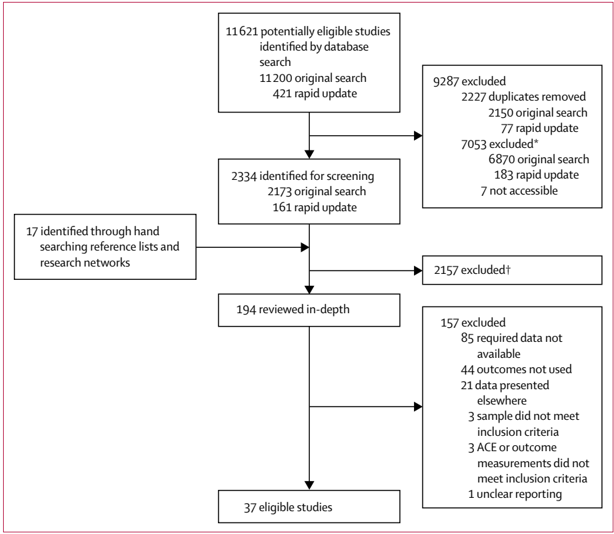
- From 11,621 references, 37 studies were included, providing risk estimates for 23 outcomes and 253,719 participants; most studies were from high-income countries, with nine samples from middle-income countries and none from low-income countries; 26 articles used cross-sectional data and 11 used cohort data, and all used retrospective, self-reported ACEs.
- Pooled ORs with 95% CIs were calculated using a random-effects model in StatsDirect; heterogeneity was assessed with I², publication bias with Begg-Mazumdar and Egger tests and funnel plots where at least ten samples were available, and sensitivity analyses and meta-regression were done in Stata.
Limitations
- The paper states that all included studies used retrospective ACE reports, which could be affected by recall or reporting bias; the number and types of ACEs varied, and summing ACEs does not account for different combinations or for variation in age at or length of exposure; confounding factors varied and some studies included no adjustments; genetic and environmental risks were largely unmeasured.
- The paper states that focusing on community settings likely excluded those with the most complex health problems (eg, homeless populations) and those who had already had ACE-related premature mortality; outcome measurement varied, rarer outcomes were less well covered by population surveys, and the study could only measure associations rather than establish causality.
- Evident from the text: most included samples came from high-income countries, with nine middle-income samples and none from low-income countries; heterogeneity was high for many outcomes; and visual funnel-plot assessment suggested possible missing small studies for smoking and early sexual initiation, although statistical tests for smoking were nonsignificant.
Model-written summary. Check it against the paper before relying on it.
Integrity signals
Registry
Cites
Statistics
Figures
Verification
Claims the paper makes
18 Valid · 0 Not valid · 4 Not checked · 126 Own results and interpretations
The sources with a verdict support this claim; the rest weren’t checked yet, have no full text we could read, or their verdicts aren’t rated yet.
In the paper
“However, five of the seven samples comprised students aged 18-25; 13 pooling of the remaining two samples 8,18 resulted in an OR of 12·53 (6·71-23·37; appendix).”
What the sources say
- Not checked — no full text of the sourcecites [8] 8 Ramiro LS, Madrid BJ, Brown DW. Adverse childhood experiences (ACE) and health-risk behaviors among adults in a developing country setting. Child Abuse Negl 2010; 34: 842-55. source
- Supportedcites [18] 18 Dube SR, Felitti VJ, Dong M, Giles WH, Anda RF. The impact of adverse childhood experiences on health problems: evidence from four birth cohorts dating back to 1900. Prev Med 2003; 37: 268-77 . source
The citation follows “the remaining two samples,” identifying studies used in the citing authors’ pooling rather than attributing the pooled estimate to either study. The cited paper’s Abstract describes a study of 17,337 adult HMO members that examined suicide attempts; its Methods identify the population as adult Kaiser Health Plan members. The OR of 12.53 is presented as the citing authors’ pooled result, not a result attributed to this source. (LLM, conf=0.85)
plainstates an associationn = 2- Asserted: passes — The authors put it forward as true.
- Checkable: passes — It can be checked against evidence.
- Load-bearing: unclear — It is unclear whether the paper’s conclusions depend on it.
- Based: passes — The paper gives a reason why it holds.
Every source the paper cites for this claim was checked and supports it.
In the paper
“However, five of the seven samples comprised students aged 18-25; 13 pooling of the remaining two samples 8,18 resulted in an OR of 12·53 (6·71-23·37; appendix).”
What the sources say
- Supportedcites [13] 13 Bellis MA, Hughes K, Leckenby N, et al. Adverse childhood experiences and associations with health-harming behaviours in young adults: surveys in eight eastern European countries. Bull World Health Organ 2014; 92: 641-55. source
The Attempted suicide section says respondents in seven of the eight countries were asked about suicide attempts. The Methods describe classroom surveys of students and state that the multi-study analyses were limited to respondents aged 18–25, supporting this paper's inclusion among the student samples described in the citing sentence. (LLM, conf=0.90)
plainn = 5- Asserted: passes — The authors put it forward as true.
- Checkable: passes — It can be checked against evidence.
- Load-bearing: unclear — It is unclear whether the paper’s conclusions depend on it.
- Based: passes — The paper gives a reason why it holds.
- Supported
The sources with a verdict support this claim; the rest weren’t checked yet, have no full text we could read, or their verdicts aren’t rated yet.
In the paper
“Supported by international work to standardise measurement of ACEs and their effects on health, these findings have since been replicated in studies from low-income and middle-income 7,8 and high-income 2,9 countries.”
What the sources say
- Not checked — no full text of the sourcecites [7] 7 Almuneef M, Qayad M, Aleissa M, Albuhairan F. Adverse childhood experiences, chronic diseases, and risky health behaviors in Saudi Arabian adults: a pilot study. Child Abuse Negl 2014; 38: 1787-93. source
- Not checked — no full text of the sourcecites [8] 8 Ramiro LS, Madrid BJ, Brown DW. Adverse childhood experiences (ACE) and health-risk behaviors among adults in a developing country setting. Child Abuse Negl 2010; 34: 842-55. source
- Supportedcites [2] 2 Bellis MA, Hughes K, Leckenby N, Hardcastle KA, Perkins C, Lowey H. Measuring mortality and the burden of adult disease associated with adverse childhood experiences in England: a national survey. J Public Health 2015; 37: 445-54. source
The citation to this paper supports the high-income-country part of the sentence: its English national survey found a strong association between ACEs and adult morbidity and premature mortality. The low- and middle-income-country studies are attributed to other citations. The decisive passage is in “What this study adds”; no page number is supplied in our copy. (LLM, conf=0.90)
- Supportedcites [9] 9 Bellis MA, Hughes K, Leckenby N, Perkins C, Lowey H. National household survey of adverse childhood experiences and their relationship with resilience to health-harming behaviors in England. BMC Med 2014; 12: 72. source
Citation 9 is attached to the high-income-country portion of the sentence. The Methods describe a national household survey in England, and the Results report that adverse childhood experiences were associated with multiple health-harming behaviors after adjustment for deprivation and other demographics. The indexed copy does not provide page numbers. (LLM, conf=0.91)
plainstates an association- Asserted: passes — The authors put it forward as true.
- Checkable: passes — It can be checked against evidence.
- Load-bearing: unclear — It is unclear whether the paper’s conclusions depend on it.
- Based: passes — The paper gives a reason why it holds.
The cited sources support only part of this claim — read each source’s verdict below.
In the paper
“For teenage pregnancy, four studies 9,33-35 had measured unintended teenage pregnancy and these studies reported higher estimates than did those measuring any teenage pregnancy 8,14,21 (appendix).”
What the sources say
- Supportedcites [9] 9 Bellis MA, Hughes K, Leckenby N, Perkins C, Lowey H. National household survey of adverse childhood experiences and their relationship with resilience to health-harming behaviors in England. BMC Med 2014; 12: 72. source
The paper is one of the studies identified in the citing sentence as measuring unintended teenage pregnancy. Its Results report an adjusted odds ratio of 5.86 for that outcome among respondents with four or more ACEs versus none. The comparison with studies measuring any teenage pregnancy is the citing authors’ cross-study synthesis, not a comparison attributed to this individual paper. (LLM, conf=0.88)
- Not checked — no full text of the sourcecites [33] 33 Bellis MA, Lowey H, Leckenby N, Hughes K, Harrison D. Adverse childhood experiences: retrospective study to determine their impact on adult health behaviours and health outcomes in a UK population. J Public Health 2014; 36: 81-91. source
- Partly supportedcites [34] 34 Bellis MA, Ashton K, Hughes K, Ford K, Bishop J, Paranjothy S. Adverse childhood experiences and their impact on health-harming behaviours in the Welsh adult population. Cardiff: Public Health Wales, 2015. sourceExperimental — accuracy not yet measured
The section ‘ACEs and their association with unintended teenage pregnancy’ reports an estimate for unintended teenage pregnancy, so this paper supports its identification as a study measuring that outcome. It does not compare its estimate with studies measuring any teenage pregnancy or establish that four studies reported higher estimates. (LLM, conf=0.83)
- Not matchedcites [35] 35 Ford K, Butler N, Hughes K, Quigg Z, Bellis MA. Adverse childhood experiences (ACEs) in Hertfordshire, Luton and Northamptonshire. Liverpool: Liverpool John Moores University, 2016.
Its entry has no title and year that we can search by.
- Not checked — no full text of the sourcecites [8] 8 Ramiro LS, Madrid BJ, Brown DW. Adverse childhood experiences (ACE) and health-risk behaviors among adults in a developing country setting. Child Abuse Negl 2010; 34: 842-55. source
- Not checked yetcites [14] 14 Anda RF, Chapman DP, Felitti VJ, et al. Adverse childhood experiences and risk of paternity in teen pregnancy. Obstet Gynecol 2002; 100: 37-45. source
Checked before — its earlier verdict is held back until a new check runs.
- Not checked — no full text of the sourcecites [21] 21 Hillis SD, Anda RF, Dube SR, Felitti VJ, Marchbanks PA, Marks JS. The association between adverse childhood experiences and adolescent pregnancy, long-term psychosocial consequences, and fetal death. Pediatrics 2004; 113: 320-27 . source
plainstates an association- Asserted: passes — The authors put it forward as true.
- Checkable: passes — It can be checked against evidence.
- Load-bearing: unclear — It is unclear whether the paper’s conclusions depend on it.
- Based: passes — The paper gives a reason why it holds.
- Supported
Every source the paper cites for this claim was checked and supports it.
In the paper
“However, our criteria also meant that studies were excluded because of alternative data analysis methods (eg, analysis of the World Mental Health Surveys 51 ).”
What the sources say
- Supportedcites [51] 51 Kessler RC, McLaughlin KA, Green JG, et al. Childhood adversities and adult psychopathology in the WHO World Mental Health Surveys. Br J Psychiatry 2010; 97: 378-85. source
The Analysis methods section identifies this paper as an analysis of the World Mental Health Surveys and describes its discrete-time survival analysis using person-years. The statement that the citing review excluded it under its own criteria is the citing authors’ decision, not a claim the source needs to make. (LLM, conf=0.88)
plainstates a cause- Asserted: passes — The authors put it forward as true.
- Checkable: passes — It can be checked against evidence.
- Load-bearing: unclear — It is unclear whether the paper’s conclusions depend on it.
- Based: passes — The paper gives a reason why it holds.
- Supported
53 more claims · 2 with their cited sources checked
Create a free account to see all 148 claims and to verify the 1 reference still open.
- It may state two separate claims as one. 44
- Probably not a substantial claim. 27
- The quote only partly states this claim. 31
Claims other papers make about this one
Each is checked against this paper’s own text: does it say what the citing paper says it does?
The source backs part of the claim, not all of it — or backs it for a different population, condition or comparison.
In the citing paper
“Early adverse life experiences, negative affectivity, neuroticism, depression, and anxiety have been identified as psycho logical predisposing conditions for persistent physical symptoms”
From Persistent physical symptoms: definition, genesis, and management (2024) · cites this paper as [64]
Experimental — accuracy not yet measuredThe source backs part of the claim, not all of it — or backs it for a different population, condition or comparison.
In the citing paper
“The impact of childhood abuse, neglect, and violence exposure on adult physical and emotional health and behaviors is significant and well documented”
From Intergenerational effects of childhood maltreatment: A systematic review of the parenting practices of adult survivors of childhood abuse, neglect, and violence. (2020) · cites this paper as Hughes et al., 2017
Experimental — accuracy not yet measuredThe source backs part of the claim, not all of it — or backs it for a different population, condition or comparison.
In the citing paper
“Early institutional rearing is associated with adverse biological and health outcomes in later life, including accelerated cellular aging as measured by telomere length.”
From Telomere trajectories from early adolescence to adulthood following early institutionalization: Protective effects of foster care in the Bucharest Early Intervention Project (2026) · cites this paper as Hughes et al., 2017
Experimental — accuracy not yet measuredThe source backs part of the claim, not all of it — or backs it for a different population, condition or comparison.
In the citing paper
“Individuals exposed to early life adversity are at increased risk of developing a broad spectrum of age-related illnesses at a young age, resulting in shorter health span, referring to the period of life free from chronic disease (Chandan et al., 2020; Hughes et al., 2017).”
From Telomere trajectories from early adolescence to adulthood following early institutionalization: Protective effects of foster care in the Bucharest Early Intervention Project (2026) · cites this paper as Hughes et al., 2017
Experimental — accuracy not yet measuredThe source backs part of the claim, not all of it — or backs it for a different population, condition or comparison.
In the citing paper
“This aligns with findings that ACEs are linked not only with SUD onset, but also with broader emotional and interpersonal dysregulation [4, 6].”
From The link of adverse childhood experiences and attachment to maladaptive personality traits in adults diagnosed with substance use disorder (2025) · cites this paper as [4]
Experimental — accuracy not yet measured
7 more claims about this paper
Create a free account to see every claim other papers make about this one.
Self-check
Percentages, sums and reported differences re-computed from the paper’s own numbers.
Each contradiction between two passages listed here was confirmed by an independent check.
Rated minor: it would not touch a result — a value no result rests on, a p-value that stays on the same side of the significance level, or a conflict that is clerical, resolved elsewhere in the paper, or outside its own findings.
In the paper
§ Summary
“respiratory disease (ORs of two to three)”
§ Discussion
“| Respiratory disease | 3·05 (2·47-3·77)”
Citations
Cites
Felitti, V. J., Anda, R. F., Nordenberg, D., Williamson, D. F., Spitz, A. M., Edwards, V., Koss, M. P., & Marks, J. S. (1998) · American Journal of Preventive Medicine · doi:10.1016/s0749-3797(98)00017-8 · Cited by 18,943
Global status report on noncommunicable diseases 2010.
Alwan, A. (2011) · Cited by 8,494
Forouzanfar, M. H., Afshin, A., Alexander, L. T., Anderson, H. R., Bhutta, Z. A., Biryukov, S., Brauer, M., Burnett, R., Cercy, K., Charlson, F. J., et al. (2016) · The Lancet · doi:10.1016/s0140-6736(16)31679-8 · Cited by 7,698
Wang, H., Naghavi, M., Allen, C., Barber, R. M., Bhutta, Z. A., Carter, A., Casey, D. C., Charlson, F. J., Chen, A. Z., Coates, M. M., et al. (2016) · The Lancet · doi:10.1016/s0140-6736(16)31012-1 · Cited by 6,596
Anda, R. F., Felitti, V. J., Bremner, J. D., Walker, J. D., Whitfield, C., Perry, B. D., Dube, S. R., & Giles, W. H. (2006) · European archives of psychiatry and clinical neuroscience · doi:10.1007/s00406-005-0624-4 · Cited by 4,292
Norman, R. E., Byambaa, M., De, R., Butchart, A., Scott, J., & Vos, T. (2012) · PLoS Medicine · doi:10.1371/journal.pmed.1001349 · Cited by 3,387
Self-citationValidity of adult retrospective reports of adverse childhood experiences: review of the evidence
Hardt, J., & Rutter, M. (2004) · Journal of Child Psychology and Psychiatry · doi:10.1111/j.1469-7610.2004.00218.x · Cited by 2,827
Childhood adversities and adult psychopathology in the WHO World Mental Health Surveys
Kessler, R. C., McLaughlin, K. A., Green, J. G., Gruber, M. J., Sampson, N. A., Zaslavsky, A. M., Aguilar-Gaxiola, S., Alhamzawi, A. O., Alonso, J., Angermeyer, M., et al. (2010) · British Journal of Psychiatry · doi:10.1192/bjp.bp.110.080499 · Cited by 2,640
Impact of child sexual abuse: A review of the research.
Browne, A., & Finkelhor, D. (1986) · Psychological Bulletin · doi:10.1037/0033-2909.99.1.66 · Cited by 2,590
Adverse childhood experiences, allostasis, allostatic load and age-related disease
Danese, A., & McEwen, B. S. (2012) · Physiology & Behavior · doi:10.1016/j.physbeh.2011.08.019 · Cited by 2,140
Cited by
Items 2,801–2,900 of 5,221
dos Santos, A. C. G., da Silva, A. B., Libório, M. P., Nobre, C. N., Mannan, H., & D’Ângelo, M. F. S. V. (2025) · PLoS ONE · doi:10.1371/journal.pone.0326239 · Cited by 3
“Going beyond the prevailing focus on child maltreatment, particularly sexual and physical abuse, in high-income countries [23], the adverse childhood experiences in this study address other factors that also increase the risk of mental disorders in children and adolescents in low and middle-income…”
InfluentialEsposito, R., Schettino, E. M., Buonincontri, V., Vitale, C., Santangelo, G., & Maggi, G. (2025) · Behavioral Sciences · doi:10.3390/bs15070850 · Cited by 3
“Brown et al., 2017; Hughes et al., 2017).”
Liu, P., Song, D., Guo, Y., & Zhang, H. (2025) · Biological Psychiatry Cognitive Neuroscience and Neuroimaging · doi:10.1016/j.bpsc.2025.06.007 · Cited by 5
Cansever, B. K., Sira, N., Lamson, A. L. S., & Caldwell, A. E. (2025) · Adversity and Resilience Science · doi:10.1007/s42844-025-00175-2 · Cited by 8
“…previous systematic reviews have underscored the robust link between ACEs and long-term health risks, such as chronic diseases, mental health disorders, and behavioral issues, reinforcing the need for trauma-informed practices in healthcare settings (Hughes et al., 2017; Petruccelli et al., 2019).”
Cooke, K., Ridgway, K., Pecora, L. A., Westrupp, E. M., Hedley, D., Hooley, M., & Stokes, M. A. (2025) · Trauma Violence & Abuse · doi:10.1177/15248380251357618 · Cited by 5
“…population, ACEs are associated with numerous adverse psychological, emotional, and social outcomes (Haahr-Pedersen et al., 2020), with exposure to multiple childhood adversities being associated with an elevated risk of detrimental health outcomes throughout one’s life (see Hughes et al., 2017).”
InfluentialWang, X., Si, H., Li, Y., Yu, J., Zhou, W., Chen, H., & Wang, C. (2025) · Maturitas · doi:10.1016/j.maturitas.2025.108695 · Cited by 4
Li, X., Yang, B., Nie, L., Ren, Z., Sun, Y., & Liu, J. (2025) · Child Abuse & Neglect · doi:10.1016/j.chiabu.2025.107642 · Cited by 4
Hinwood, M., Kluge, M. G., Ilicic, M., & Walker, F. R. (2019) · Current Opinion in Behavioral Sciences · doi:10.1016/j.cobeha.2019.01.001 · Cited by 3
Swindle, T., Phelps, J. A., Schrick, B., Selig, J. P., Hu, Z., Kopparapu, A., & Johnson, S. L. (2019) · Journal of Hunger & Environmental Nutrition · doi:10.1080/19320248.2019.1697407 · Cited by 3
Chandan, J. S., Hughes, N., Thomas, T. R., Nirantharakumar, K., Bandyopadhyay, S., & Taylor, J. S. (2020) · Child Abuse Review · doi:10.1002/car.2614 · Cited by 7
Pannebakker, N. M., Kocken, P., van Dommelen, P., van Mourik, K., Reis, R., Reijneveld, S. A., & Numans, M. E. (2020) · PLoS ONE · doi:10.1371/journal.pone.0231620 · Cited by 3
Adverse childhood experiences in women with externalisation and internalisation disorders
Gąsior, K., & Chodkiewicz, J. (2020) · Current Issues in Personality Psychology · doi:10.5114/cipp.2020.96087 · Cited by 4
Williams, W. A., Jain, M., Laguna, T. A., & McColley, S. A. (2020) · Pediatric Pulmonology · doi:10.1002/ppul.25243 · Cited by 4
Rice, A. J., Schvey, N. A., Shank, L. M., Neyland, M. K. H., Lavender, J. M., Solomon, S., Hennigan, K., Schindler, R., Sbrocco, T., Jorgensen, S., et al. (2021) · Childhood Obesity · doi:10.1089/chi.2020.0256 · Cited by 3
“Prior studies indicating that the healthrelated effects of adverse childhood events may manifest in adulthood lend possible support for this.(62,63) Although no study has assessed the long-term effects of WBT on cardiometabolic health, research linking adverse childhood events, such as bullying (not specifically due t…”
BackgroundMarcynyszyn, L. A., McCarty, C. A., Rivara, F. P., Johnson, A. M., Wang, J., & Zatzick, D. (2020) · Journal of Pediatric Psychology · doi:10.1093/jpepsy/jsaa128 · Cited by 3
“ACES have been associated with parental depression (PD; Hughes et al., 2017) and, in turn, with problems with maternal attachment avoidance and attachment anxiety among parents of young children (Cooke et al., 2019).”
BackgroundVitriol, V. G., Sciolla, A., Cancino, A., Contreras, F., Mansilla, C., Muñoz, M. I., Suazo, C., & Jara, M. (2020) · Revista chilena de neuro-psiquiatría · doi:10.4067/s0717-92272020000400348 · Cited by 6
Kuhn, M., Pepanyan, M., & Tallakson, D. A. (2021) · Journal for Learning through the Arts · doi:10.21977/d916145418 · Cited by 1
“Hughes, K., Bellis, M. A., Hardcastle, K. A., Sethi, D., Butchart, A., Mikton, C., … Dunne, M. P. (2017).”
Steen, J. T., Straussner, S. L. A., & Senreich, E. (2021) · Smith College Studies in Social Work · doi:10.1080/00377317.2021.1887790 · Cited by 11
Salminen-Tuomaala, M. H., Tiainen, J., & Paavilainen, E. (2021) · Issues in Mental Health Nursing · doi:10.1080/01612840.2021.1913682 · Cited by 12
“Maltreatment can be seen as a major part of a larger phenomenon, Adverse Childhood Experiences (ACE’s) (Hughes et al., 2017).”
BackgroundNiclasen, B. V.-L., Røssell, E., Becker, U., & Nielsen, A. S. (2021) · Nordic Journal of Psychiatry · doi:10.1080/08039488.2021.1912171 · Cited by 3
Children: paying the price of Bolsonaro’s social policy reform in Brazil
Barbosa, R. D. S., Spolander, G., & Garcia, M. L. T. (2021) · Critical and Radical Social Work · doi:10.1332/204986021x16177218821095 · Cited by 3
Social Influences on Child Health
Weitzman, M. L. (2021) · Pediatrics in Review · doi:10.1542/pir.2020-004897 · Cited by 3
Seçginli, S., Yaş, M. A., İlhan, N., & Olsen, J. M. (2021) · Journal of Psychosocial Nursing and Mental Health Services · doi:10.3928/02793695-20210915-02 · Cited by 3
Adverse Lifelong Experiences in Portuguese People Living With HIV: A Retrospective Study
Gonçalves, M., & Maia, Â. (2021) · Journal of the Association of Nurses in AIDS Care · doi:10.1097/jnc.0000000000000300 · Cited by 3
“, 2018) and in adulthood (Hughes et al., 2017), especially of IDU (Hughes et al.”
BackgroundChild neglect and eating habits in primary schoolchildren: A prospective study in Wuhan, China
Yu, H., Liu, X., Zheng, M., Zhang, M., Liu, M., & He, Q. (2021) · Appetite · doi:10.1016/j.appet.2021.105756 · Cited by 6
Unpacking Violent Behavior in Young Adulthood: The Relative Importance of Hazardous Alcohol Use
Lawler, S., Stapinski, L. A., Teesson, M., Prior, K., Basto-Pereira, M., Newton, N. C., & Barrett, E. L. (2021) · Journal of Interpersonal Violence · doi:10.1177/08862605211044103 · Cited by 4
“Adverse childhood experiences (ACEs) are associated with negative health outcomes across physiological, cognitive, and affective domains that in turn increase vulnerability to antisocial behavior such as violence (Braga et al., 2017; Felitti et al., 1998; Hughes et al., 2017).”
BackgroundMethodBrattabø, I. V., Lie, S. A., & Åstrøm, A. N. (2021) · Acta Odontologica Scandinavica · doi:10.1080/00016357.2021.2003428 · Cited by 3
“a child’s physical and mental development [1,2].”
Son, E., Lee, H., Cho, H., Choi, Y. J., & Seon, J. (2021) · Health & Social Care in the Community · doi:10.1111/hsc.13656 · Cited by 3
THE EFFECT OF AN EDUCATION PROGRAM ON RECOGNIZING CHILD ABUSE AND NEGLECT IN TURKEY
Işık, N. A. (2021) · The Journal of School and University Medicine · doi:10.51546/jsum.2021.8402 · Cited by 3
“Child abuse and neglect (CA&N) is a major public health and social problem, with potentially devastating consequences [1,2,3].”
BackgroundMurray, H., Wild, J., & Ehlers, A. (2021) · Elsevier eBooks · doi:10.1016/b978-0-12-818697-8.00229-6 · Cited by 3
Mutumba, M., Bhattacharya, S., & Ssewamala, F. M. (2022) · Global Public Health · doi:10.1080/17441692.2022.2037149 · Cited by 3
“Multi-generational impacts of SV have been widely documented: children who experience any form of violence are more likely to abuse others (Fulu et al., 2017; Hughes et al., 2017).”
BackgroundKerley, L., Meredith, P. J., & Harnett, P. H. (2022) · British Journal of Occupational Therapy · doi:10.1177/03080226221107763 · Cited by 7
“Childhood adversity is often measured by counting the frequency and/or types of adverse childhood experiences that occurred during an individual’s childhood and adolescence (Hughes et al., 2017).”
BackgroundInfluentialDussault, É., Girard, M., Fernet, M., & Godbout, N. (2022) · Journal of Child Sexual Abuse · doi:10.1080/10538712.2022.2090477 · Cited by 9
“…suggest that adverse childhood experiences (i.e., CIT and other difficulties such as mental illness, substance abuse, parental separation, or divorce) may lead to long-term suffering, as reflected in participants’ lower relational and sexual well-being and in previous studies (Hughes et al., 2017).”
Umeda, M., Kawakami, N., Shimoda, H., Miyamoto, K., Ishikawa, H., Tachimori, H., & Takeshima, T. (2022) · Psychiatry and Clinical Neurosciences Reports · doi:10.1002/pcn5.16 · Cited by 4
“Because early ‐ life adversities often co ‐ occurred and had a complex interweaving effect on later mental health, 28,29 a wider range of childhood indicators need to be considered for a more rigorous assessment of the prolonged impact of early menarche.”
BackgroundExperiences of Trauma and DNA Methylation Profiles among African American Mothers and Children
Barcelona, V., Huang, Y., Caceres, B. A., Newhall, K. P., Hui, Q., Cerdeña, J. P., Crusto, C. A., Sun, Y. V., & Taylor, J. Y. (2022) · International Journal of Molecular Sciences · doi:10.3390/ijms23168951 · Cited by 6
“These findings may, consequently, support our tissue choice of saliva, as ACEs are associated with negative mental health outcomes [45].”
BackgroundDevine, C., & Cohen‐Cline, H. (2022) · International Journal of Environmental Research and Public Health · doi:10.3390/ijerph191710578 · Cited by 3
“Consistent with previous literature, we calculated the ACE score as the count of ACEs a participant experienced at any time between 0 and 18 years of age [6,41]; scores ranged from 0 (none of the events occurred) to 10 (all the events occurred).”
MethodNeagoe, I. M., & Papasteri, C. (2022) · Child & Youth Care Forum · doi:10.1007/s10566-022-09712-x · Cited by 7
Woloshchuk, C. J., Frietze, G. A., & Cooper, T. V. (2022) · Child Abuse & Neglect · doi:10.1016/j.chiabu.2022.105859 · Cited by 6
Gartland, D., Riggs, E., Giallo, R., Glover, K., Stowe, M., Mongta, S., Weetra, D., & Brown, S. (2022) · BMJ Open · doi:10.1136/bmjopen-2021-060229 · Cited by 8
Addressing Adverse Childhood Experiences and Psychological Symptoms Among Bariatric Patients
Tabone, J. K., Cox, S. J., Aylward, L., Abunnaja, S., Szoka, N. L., & Tabone, L. E. (2022) · Journal of Child & Adolescent Trauma · doi:10.1007/s40653-022-00491-0 · Cited by 5
Upenieks, L., & Ford‐Robertson, J. (2022) · Journal of Religion and Health · doi:10.1007/s10943-022-01682-7 · Cited by 8
“Early exposure to childhood abuse is associated with serious ramifications further on in the life course, including health problems (Hughes et al., 2017), depression (Young & Widom, 2014) and lowered self-esteem (Kim & Cicchetti, 2006; Waldron et al., 2018).”
BackgroundUccellini, O., Benlodi, A., Caroppo, E., Cena, L., Esposito, G., Fernández, I., Ghazanfar, M., Imbasciati, A., Longo, F., Mazza, M., et al. (2022) · International Journal of Environmental Research and Public Health · doi:10.3390/ijerph192416741 · Cited by 4
Traumatismes complexes et services psycholégaux : vers des pratiques sensibles au trauma
Roy, L., Keays, N., Lemieux, A. J., Nicole, M., & Crocker, A. G. (2022) · Santé mentale au Québec · doi:10.7202/1094143ar · Cited by 5
“…personnes utilisatrices de services psycholégaux, ainsi que les pratiques développées en réponse à ce phénomène. mots clés organisation des services, politiques publiques, trauma, trouble mental most common consequence of exposure to trauma is violence towards self and others (Hughes et al., 2017).”
Guidetti, C., Brogna, P., Chieffo, D. R. P., Turrini, I., Arcangeli, V., Rausa, A., Bianchetti, M., Rolleri, E., Santomassimo, C., Cesare, G. D., et al. (2023) · Journal of Personalized Medicine · doi:10.3390/jpm13020200 · Cited by 38
“The negative long-term consequences of ACEs on physical and mental health are well-documented [8], with a substantial body of literature linking ACEs to an increased likelihood of developing ADHD [4–8].”
BackgroundShaped by your childhood: Adult chronic pain in relation to psychological trauma in childhood
University of Akureyri, T. F. D. O. Á. M., Pálsdóttir, V. H., Jónsdóttir, Þ., University of Akureyri, Óskarsson, G. K., & University of Akureyri (2023) · Læknablaðið · doi:10.17992/lbl.2023.02.728 · Cited by 3
Lee, J. O., Yoon, Y., Duan, L., Oxford, M. L., & Cederbaum, J. A. (2023) · The Journal of Early Adolescence · doi:10.1177/02724316231151999 · Cited by 4
“Experiences of adversity in childhood are well-established risk factors for negative health outcomes later in life (Hughes et al., 2017; Kalmakis & Chandler, 2015; McLaughlin, 2016), including externalizing problems in adolescence (Fava et al., 2019; Negriff, 2020).”
Campbell, T. S., & Roth, T. L. (2023) · Elsevier eBooks · doi:10.1016/b978-0-12-821785-6.00013-x · Cited by 3
Sorsa, M. A., Bryngeirsdottir, H. S., & Paavilainen, E. (2023) · International Journal of Environmental Research and Public Health · doi:10.3390/ijerph20075389 · Cited by 10
“According to research on risk and adverse childhood experiences [20], vulnerability exists and can be transferred across generations if the individuals who experience and perpetrate violence do not get the help that they need to end the intergenerational transmission of such behaviour.”
BackgroundPredictors of substance use disorder symptoms among women in Katsina State, Nigeria
Agwogie, M. O., Kliewer, W. L., & Ibrahim, M. B. (2023) · Drug and Alcohol Dependence · doi:10.1016/j.drugalcdep.2023.109866 · Cited by 5
Athletic Trainers’ Perceptions of and Experience with Social Determinants of Health
Picha, K. J., Bacon, C. E. W., Bay, R. C., Lewis, J. H., & Valier, A. R. S. (2023) · International Journal of Environmental Research and Public Health · doi:10.3390/ijerph20085602 · Cited by 5
“Although there is evidence to suggest early childhood experiences influence not only immediate health outcomes, but health outcomes throughout life [35], this SDH may be difficult to observe during patient interactions and not as easy to discuss with patients.”
BackgroundNewby‐Kew, A., Marshall, L. M., Zane, S., Putz, J. W., & Parrish, J. W. (2023) · Annals of Epidemiology · doi:10.1016/j.annepidem.2023.04.020 · Cited by 4
Baishya, M. L., Zisman‐Ilani, Y., Hoadley, A., Litsas, D. C., Roth, S. C., & Collins, B. N. (2023) · BMJ Open · doi:10.1136/bmjopen-2022-066796 · Cited by 2
Spencer, L., Alderson, H., Scott, S., Kaner, E., & Ling, J. (2023) · International Journal of Environmental Research and Public Health · doi:10.3390/ijerph20115967 · Cited by 8
What are the differences between children and adolescents who deliberately light fires?
Lambie, I., Randell, I., Ioane, J., Best, C., & Reed, P. (2023) · Fire Safety Journal · doi:10.1016/j.firesaf.2023.103837 · Cited by 5
Bhattarai, A., Dimitropoulos, G., Bulloch, A. G. M., Tough, S., & Patten, S. B. (2023) · PLoS ONE · doi:10.1371/journal.pone.0287015 · Cited by 2
“Thus, preventing or minimizing depression among people with lived experience of such childhood adversities may substantially reduce hospitalizations [6, 52, 53].”
BackgroundLópez‐Gil, J. F., Smith, L., Gaya, A. R., Victoria‐Montesinos, D., Gutiérrez‐Espinoza, H., Herrera-Gutiérrez, E., & García‐Hermoso, A. (2023) · Scientific Reports · doi:10.1038/s41598-023-37529-8 · Cited by 4
Bryan, R. H., & Beitz, J. M. (2023) · Journal of Wound Ostomy and Continence Nursing · doi:10.1097/won.0000000000000985 · Cited by 3
“24 Essential principles guiding the use of TIC include: (1) awareness that trauma effects are pervasive; (2) the effects are lifelong; (3) trauma affects both clinicians and patients; (4) healing or amelioration of these negative effects is possible; and (5) resilience can be nurtured.”
BackgroundAbbas, H., Takeuchi, K., Kiuchi, S., Kondo, K., & Osaka, K. (2023) · Journal of Public Health Dentistry · doi:10.1111/jphd.12582 · Cited by 4
Dicker, R. A., & Brohi, K. (2023) · British journal of surgery · doi:10.1093/bjs/znad246 · Cited by 3
Wijayanti, A. P., & Iqbal, M. M. (2023) · International Journal of Engineering Business and Social Science · doi:10.58451/ijebss.v1i06.68 · Cited by 3
“There is a high risk of multiple ACEs re-occurrence in the next generation and future health problems (Hughes et al., 2017).”
Dekkers, D., & Vos, M. K. (2024) · International Journal of Forensic Mental Health · doi:10.1080/14999013.2023.2257641 · Cited by 3
“The aforementioned forms of ACEs often co-occur (Dong et al., 2004; Hughes et al., 2017).”
BackgroundBlack, T. (2023) · Frontiers in Psychiatry · doi:10.3389/fpsyt.2023.1159843 · Cited by 3
Ramaj, K., & Eisner, M. (2023) · Violence Against Women · doi:10.1177/10778012231203659 · Cited by 5
Adverse Childhood Experiences and Child Sexual Exploitation in Ghana
Amo‐Adjei, J., Agbemavi, W., Bansal, A., Yoshikawa, M., Deliege, A., Khan, M. R., & Bae, W. (2023) · Journal of Family Violence · doi:10.1007/s10896-023-00660-1 · Cited by 6
Ross, A. J., Russotti, J. M., Toth, S. L., Cicchetti, D., & Handley, E. D. (2023) · Development and Psychopathology · doi:10.1017/s0954579423001347 · Cited by 5
“Childhood adversity represents a robust risk factor for the development of harmful substance use (Hughes et al., 2017; Dube et al., 2003) and substance use disorders (SUDs; Brown & Shillington, 2017), with over 25% of all cases of SUD attributed to experiencing early adversity (Kessler et al.,…”
Powe, P. M., VanHook, C., Collier, A., Nakhla, M., Crum, I., Hamm, M., & Miller, E. P. (2023) · Families in Society The Journal of Contemporary Social Services · doi:10.1177/10443894231193867 · Cited by 4
“Early adversities have cumulative negative effects (Hughes et al., 2017) and while every type of adversity is not preventable, many types are.”
Thoma, M. V., Goreis, A., Rohner, S. L., Nater, U. M., Heim, E., & Höltge, J. (2023) · Mental Health Religion & Culture · doi:10.1080/13674676.2023.2255144 · Cited by 4
Baxter, V., Boydell, V., & McPherson, S. (2023) · Journal of Social Welfare and Family Law · doi:10.1080/09649069.2023.2281840 · Cited by 5
“2010, Hughes et al .”
Johnson, D., Browne, D. T., Prime, H., Heron, J. E., & Wade, M. (2023) · Child Abuse & Neglect · doi:10.1016/j.chiabu.2023.106554 · Cited by 3
Verger, N. B., Roberts, J., Guiller, J., & McAloney‐Kocaman, K. (2023) · Creativity Theories – Research – Applications · doi:10.2478/ctra-2023-0007 · Cited by 6
Resilience of families with complex needs whose children manifest behavioural and emotional problems
Mirosavljević, A., Maurović, I., & Liebenberg, L. (2023) · Hrvatska revija za rehabilitacijska istraživanja · doi:10.31299/hrri.59.2.1 · Cited by 6
“Exposure to four or more such stressors during childhood increases mental health problems tenfold in childhood (Rut-ter 1978) and fourfold in adulthood (Hughes et al., 2017).”
Hege, A. (2024) · North Carolina Medical Journal · doi:10.18043/001c.91428 · Cited by 3
“…associated with many of the health behaviors (smoking, physical inactivity, poor nutrition, alcohol/substance misuse) deemed as risk factors for outcomes including obesity, diabetes, hypertension, and high cholesterol; each of these contribute to the development of cardiovascular disease [4–6].”
Paone, E., Trani, M. D., Visani, E., Monte, C. D., Campedelli, V., Silecchia, G., & Lai, C. (2024) · Eating and Weight Disorders - Studies on Anorexia Bulimia and Obesity · doi:10.1007/s40519-024-01638-8 · Cited by 6
“Studies focused on childhood traumatic experiences have established the strong association between these events and adverse health outcomes among adults [3, 4].”
BackgroundCardiovascular Disease and Risk Factors in Individuals With a History of Out-of-home Care
Hjern, A., Vinnerljung, B., & Brännström, L. (2024) · PEDIATRICS · doi:10.1542/peds.2023-063174 · Cited by 3
Fjeldheim, H., Werner, A., Anke, T. M. S., Moe, V., Norheim, H. S., & Aalberg, M. (2024) · Infant Mental Health Journal · doi:10.1002/imhj.22100 · Cited by 5
Liu, H., Li, Y., & Barnes, J. C. (2024) · Journal of Experimental Criminology · doi:10.1007/s11292-023-09608-3 · Cited by 3
“In particular, adverse experiences in early life likely have more pronounced effects on individuals’ health trajectories compared to those occurring later (Hughes et al., 2017).”
Psychological Trauma Predicts Obesity in Welsh Secure Mental Health Inpatients
Davies, J. L., Lawrence, D., Bagshaw, R., Watt, A. A., Mills, S., & Seage, C. H. (2024) · International Journal of Forensic Mental Health · doi:10.1080/14999013.2024.2314544 · Cited by 3
“Obesity research in the general population has provided an insight into the deleterious effects that exposure to traumatic experiences in early life can have on mental and physical health outcomes throughout the life course (Hughes et al., 2017).”
Clarke, S. D., Riser, D. K., & Schmidt, M. S. (2024) · Journal of Child & Adolescent Trauma · doi:10.1007/s40653-024-00621-w · Cited by 8
“Meta-analytic evidence shows that in addition to poor health, childhood trauma predicts maladaptive coping behaviors such as sexual risk taking, alcohol and drug abuse, suicide, and inter-and intra-personal violence (Hughes et al., 2017).”
BackgroundProstitution in the shadow of life-long sexual abuse: Arab women’s retrospective experiences
Gnaim‐Mwassi, N., Avieli, H., & Band‐Winterstein, T. (2024) · Journal of Elder Abuse & Neglect · doi:10.1080/08946566.2024.2331503 · Cited by 5
The trajectory of anxiety in therapy: The role of ACEs
Witting, A. B., Anderson, S. R., Johnson, L. N., Barrow, B. H., & Peery, A. (2024) · Journal of Marital and Family Therapy · doi:10.1111/jmft.12703 · Cited by 3
Halvorsen, M. S., Stige, S. H., Halvorsen, J. E., Binder, P., Måkestad, E., Albæk, A. U., & Andersen, A. C. (2024) · International Journal of Mental Health Systems · doi:10.1186/s13033-024-00632-y · Cited by 4
Revitalizing Psychodynamics in Psychiatric Training: An Intergenerational Perspective
Holoshitz, Y., Lindy, D. C., & Albright, K. (2024) · Academic Psychiatry · doi:10.1007/s40596-024-01970-2 · Cited by 3
“These influences start early: it is well established that childhood abuse and neglect increase vulnerability to psychiatric conditions in addition to chronic medical illnesses in adulthood [12].”
Beijers, R. (2024) · Edward Elgar Publishing eBooks · doi:10.4337/9781803922348.00029 · Cited by 3
Stressful life events and the occurrence of skin cancer
Shidlo, N., Lazarov, A., & Benyamini, Y. (2024) · Psycho-Oncology · doi:10.1002/pon.6343 · Cited by 3
Charting the Course for the Future of Psychiatric Residency Education: Guiding Considerations
Hobbs, J. A., Cowley, D. S., Crapanzano, K. A., Soman, A., Camp, M. E., Houston, L. J., New, A. S., Young, J. Q., Idicula, S. A., Brown, G. P., et al. (2024) · Academic Psychiatry · doi:10.1007/s40596-024-01977-9 · Cited by 4
“A 2017 systematic review and meta-analysis of 37 studies showed strong associations between having ≥ 4 ACEs and higher rates of sexual risk taking, mental ill health, problematic alcohol and drug use, interpersonal violence, and self-harm (odds ratios 3–7) [27].”
Price, A. M. H., Zhang, J., Goldfeld, S. R., et al. (2024) · International Journal for Population Data Science · doi:10.23889/ijpds.v9i2.2400 · Cited by 3
Testing a sequential path analysis from early complex trauma to regulation of psychological needs
Faustino, B., & Vasco, A. B. (2024) · European Journal of Trauma & Dissociation · doi:10.1016/j.ejtd.2024.100422 · Cited by 3
Wijkander, M., Svedberg, P., Narusyte, J., Alaie, I., Lindfors, P., Xu, T., & Hanson, L. L. M. (2024) · BMC Public Health · doi:10.1186/s12889-024-19000-z · Cited by 3
“…disposition and vulnerability to disease. instance, the experience of multiple childhood adversities, such as household substance abuse, criminality, economic adversity or parental mental illness, have been found to increase the risk for negative health outcomes, including mental ill-health [64].”
BackgroundArmer, J. S., Oh, W., Davis, M. T., Issa, M., Sexton, M. B., & Muzik, M. (2024) · Journal of Affective Disorders · doi:10.1016/j.jad.2024.06.010 · Cited by 5
Li, C., Zhang, X., Ding, N., & Xie, K. (2024) · Children and Youth Services Review · doi:10.1016/j.childyouth.2024.107719 · Cited by 4
Schroeder, K., Dumenci, L., Day, S. E., Konty, K., Noll, J. G., Henry, K., Suglia, S. F., Wheeler, D. C., Argenio, K. L., & Sarwer, D. B. (2024) · Childhood Obesity · doi:10.1089/chi.2024.0215 · Cited by 3
Eisman, A. B., Palinkas, L. A., Koffkey, C., Lafta, H., Fridline, J., Harvey, C., & Kilbourne, A. M. (2024) · Translational Behavioral Medicine · doi:10.1093/tbm/ibae038 · Cited by 3
Franchino-Olsen, H., Spreckelsen, T. F., Orkin, M. M., & Meinck, F. (2024) · Child Indicators Research · doi:10.1007/s12187-024-10155-0 · Cited by 3
“Violence experienced in early childhood and through adolescence is a recognized public health concern and has been linked with poor physical and mental health effects in adolescence and into adulthood (Hughes et al., 2017 ; Kessler et al., 2010; Leeb et al., 2011; Norman et al., 2012 ).”
Early Life Interventions: Impact on Aging and Longevity
Yuan, R., Adlimoghaddam, A., Zhu, Y. X., Han, X., & Bartke, A. (2024) · Aging and Disease · doi:10.14336/ad.202.0516 · Cited by 9
“Previous studies revealed that adverse childhood experiences including abuse, famine, and lower socioeconomic position are related to unfavorable body composition, cardiovascular disease, type 2 diabetes, and other health problems in various human populations [8-17].”
Wang, Y., Ge, F., Aspelund, T., Ask, H., Hauksdóttir, A., Hu, K., Jakobsdóttir, J., Zoëga, H., Shen, Q., Whalley, H. C., et al. (2024) · BMC Medicine · doi:10.1186/s12916-024-03399-8 · Cited by 6
“Previous studies have demonstrated the role of childhood maltreatment in multiple adverse health outcomes across the lifespan, including psychiatric disorders, cardiovascular diseases, cancers, and some infectious diseases [13–17].”
BackgroundMethodInfluentialDong, Z., Jiang, L., & Han, H. (2024) · Journal of Asian Public Policy · doi:10.1080/17516234.2024.2391935 · Cited by 4
Adverse childhood experiences: A health risk in emerging adulthood
Quezada-Gaibor, K., Pomares, A. G., & Villanueva, L. (2024) · Journal of Health Psychology · doi:10.1177/13591053241275592 · Cited by 5
“Therefore, the results obtained in this study support previous studies suggesting that the accumulation of ACEs is linked to both problems (Hughes et al., 2017; Lietze´n et al., 2021), regardless of the culture or country in which people are located.”
Paliliunas, D., Burke, R. V., Taylor, S., Belisle, J., Frizell, C. B., & Sickman, E. (2024) · Behavior Analysis in Practice · doi:10.1007/s40617-024-01005-0 · Cited by 3
“Students had an average of 5.7 adverse childhood experiences (ACEs; e.g., Hughes et al., 2017), two or more comorbid mental health diagnoses, and presented a high level of social, emotional, behavioral and academic challenges.”
InfluentialAdverse childhood experiences predict anxiety during postpartum and early childhood parenting
Walker-Mao, C., Farewell, C. V., Nagle-Yang, S. M., Blackwell, S., & Leiferman, J. A. (2024) · Journal of Psychosomatic Obstetrics & Gynecology · doi:10.1080/0167482x.2024.2410203 · Cited by 4
“Outcomes most strongly associated with multiple aces—mental illness, substance use, violence, and suicide [15,18]— represent ace risks for subsequent generations. higher rates of aces are found among women [17].”
de Stigter, R. W., Nelen, W. B. L., Delsing, M. J. M. H., de Berk, A., Kooijmans, R., Offerman, E., Asselman, M. W., Nijhof, K. S., Lindauer, R., & Helmond, P. (2024) · Journal of Child & Adolescent Trauma · doi:10.1007/s40653-024-00663-0 · Cited by 14
“Prevalence rates of children experiencing four or more ACEs range from 1 to 38% in a non-clinical sample (Hughes et al., 2017).”
Metadata
- Authors
- Hughes, K., Bellis, M. A., Hardcastle, K. A., Sethi, D., Butchart, A., Mikton, C., Jones, L., & Dunne, M. P.
- Affiliations
- Bangor University (GB)
- Public Health Wales (GB)
- World Health Organization Regional Office for Europe (DK)
- World Health Organization (CH)
- University of the West of England (GB)
- Liverpool John Moores University (GB)
- Queensland University of Technology (AU)
- Corresponding author
- Bellis, Mark A
- Venue
- The Lancet Public Health
- Publisher
- Elsevier BV
- Published
- 2017-08
- Volume
- 2
- Issue
- 8
- Pages
- e356-e366
- ISSN
- 2468-2667 (ISSN-L)
- OpenAlex
- W2740726397
- Semantic Scholar
- cdd633b48c3e902b5a7a012711d868cf5745c677
- Cited by
- 5,255
- References
- 70
- Citations by year
- 2026: 750 · 2025: 849 · 2024: 817 · 2023: 711 · 2022: 698 · 2021: 626 · 2020: 464 · 2019: 232 · 2018: 97 · 2017: 7
- FWCI
- 33.48
- Type
- journal article
- Language
- en
- Open access
- gold
- doi.org
- Licence
- cc-by-nc-nd
- www.elsevier.com/tdm/userlicense/1.0/ (tdm)
- creativecommons.org/licenses/by-nc-nd/4.0/ (vor)
- Locations
- The Lancet Public Health (publishedVersion, cc-by-nc-nd)
- PubMed (publishedVersion)
- Liverpool John Moores University (acceptedVersion)
- QUT ePrints (Queensland University of Technology) (submittedVersion, cc-by-nc-nd)
- UWE Research Repository (UWE Bristol) (submittedVersion, cc-by-nc-nd)
- DOAJ (DOAJ: Directory of Open Access Journals) (submittedVersion, cc-by-sa)
- Funders
- World Health Organization
- Public Health Wales
- Topics
- Social Sciences › Psychology › Clinical Psychology › Child Abuse and Trauma
- Social Sciences › Sociology and Political Science › Child Welfare and Adoption
- Social Sciences › Health › Intimate Partner and Family Violence
- Keywords
- adverse childhood experiences, child abuse, domestic violence exposure, substance use, sexual health, mental health, violence, physical health, physical activity, weight, resilience
- MeSH terms
- Health Status, Humans, Life Change Events
About these checks
Registry, retraction, Cites and statistics results are computed, not judged, with one exception: a printed reference that no index lists is read once by a model before it counts as a citation error. Claims are extracted by a model and kept only when their quote appears verbatim in the text; each cited source is then checked, with a model’s help, for whether it says what the claim relies on. Those verdicts can be wrong — read the claim’s quote and the cited source before relying on one.
The claim verdicts this report counts are experimental: their accuracy is not yet measured.
A language model drew the claims from the paper on 2026-09-28, under version 3 of the claim definition (prompt extract-v3).
A second model labelled each claim on 2026-09-28 (model jev-1.13-20260917, definition revision gold-guideline-v0.2).
Cited sources are checked with a language model’s help (gpt-6-sol).
Statistics and arithmetic are recomputed, not judged.
Confidence bands are shown only for fields calibrated on our annotated test set. None is calibrated yet, so no band is shown.
What counts as a claim ›How we measure confidence ›How we check this ›
Are you an author, or do you see a problem with this page? Request a review
Data sources
Bibliographic data: Semantic Scholar, OpenAlex, Crossref.
Contains information from the Semantic Scholar Academic Graph Datasets, made available under the ODC Attribution License (ODC-BY 1.0).
Semantic Scholar’s data is described in: Kinney, R., et al. (2023). The Semantic Scholar Open Data Platform. arXiv:2301.10140.
