

Traumatic brain injury in homeless and marginally housed individuals: a systematic review and meta-analysis
Open accessThe DOI matches its Crossref record; 65 of the 65 references it cites were found in a registry or an index; 45 of the 178 sources its claims cite were checked for support.
Abstract
BACKGROUND: Homelessness is a global public health concern, and traumatic brain injury (TBI) could represent an underappreciated factor in the health trajectories of homeless and marginally housed individuals. We aimed to evaluate the lifetime prevalence of TBI in this population, and to summarise findings on TBI incidence and the association between TBI and health-related or functioning-related outcomes. METHODS: For this systematic review and meta-analysis, we searched without date restrictions for original research studies in English that reported data on the prevalence or incidence of TBI, or the association between TBI and one or more health-related or function-related outcome measures. Studies were included if they had a group or clearly identifiable subgroup of individuals who were homeless, marginally housed, or seeking services for homeless people. With use of random-effects models, we calculated pooled estimates of the lifetime prevalence of any severity of TBI and the lifetime prevalence of moderate or severe TBI. We used meta-regression and subgroup analysis to evaluate potential moderators of prevalence estimates and the leave-one-out method for sensitivity analyses. We then summarised findings from all studies that evaluated TBI incidence and the association between TBI and health-related or functioning-related outcomes. All statistical analyses were done using R version 3.5.1. The study is registered with PROSPERO, number CRD42019119678. FINDINGS: =99%). The method used to ascertain TBI history, the age of the sample, and the sample size significantly moderated estimated lifetime prevalence of any severity of TBI. TBI was consistently associated with poorer self-reported physical and mental health, higher suicidality and suicide risk, memory concerns, and increased health service use and criminal justice system involvement. INTERPRETATION: The lifetime prevalence of TBI is high among homeless and marginally housed individuals, and a history of TBI is associated with poorer health and general functioning. Health-care providers and public health officials should have an increased awareness of the burden of TBI in this population. Prospective and longitudinal studies are needed to better understand how the health of this population is affected by TBI. FUNDING: Canadian Institutes of Health Research.
Overview
CoChat Summary
TL;DR
This systematic review and meta-analysis found that lifetime TBI prevalence is high among homeless and marginally housed individuals: 53·1% for any severity and 22·5% for moderate or severe TBI. TBI was consistently associated with poorer self-reported health, higher suicidality and suicide risk, memory concerns, and increased health service and criminal justice system involvement.
Key findings
- Pooled lifetime prevalence of any severity of TBI was 53·1% (95% CI 46·4–59·7; I²=97%) across 18 studies (n=9702); pooled lifetime prevalence of moderate or severe TBI was 22·5% (95% CI 13·5–35·0; I²=99%) across nine studies (n=5787).
- In multivariable meta-regression, older age of sample (p=0·045), larger total sample size (p=0·047), and use of the OSU TBI-ID structured interview versus a single question or series of questions (p=0·0035) were significantly associated with higher estimated lifetime prevalence of any severity of TBI.
- TBI was consistently associated with poorer self-reported physical and mental health, higher suicidality and suicide risk, self-reported memory concerns, increased health service use, and criminal justice system involvement.
- Across six studies, 51–92% of participants experienced their first TBI before their first experience of homelessness or marginal housing; weighted mean age at first TBI was 15·8 years. Only five studies assessed incident TBI, with estimates ranging from 0·5% over 1 year to 28% over 1 year.
Methods
- Systematic review and meta-analysis following PRISMA and MOOSE guidelines; searched MEDLINE, Embase, PsycINFO, CINAHL, and Web of Science without date restrictions on Dec 14, 2018, for original English peer-reviewed studies reporting TBI prevalence, incidence, or associations with health- or functioning-related outcomes in homeless, marginally housed, or service-seeking populations.
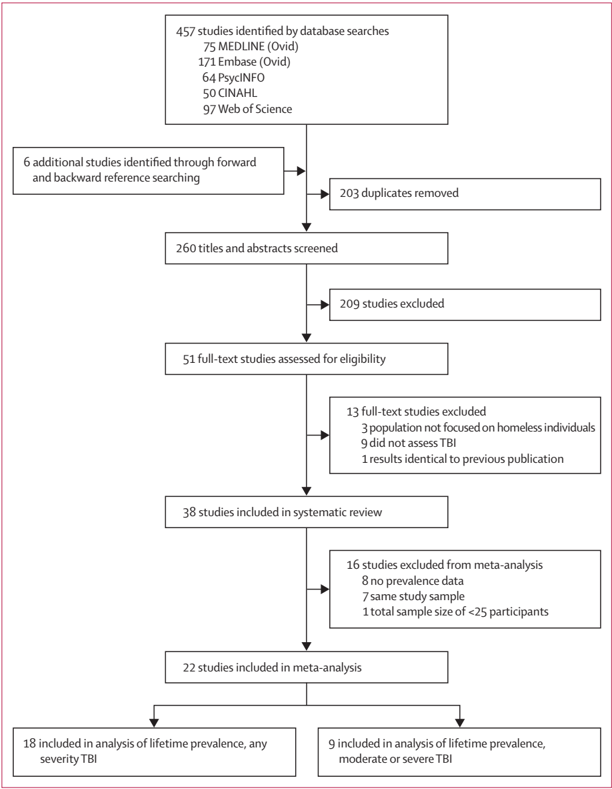
- Of 463 potentially eligible studies, 38 were included in the systematic review and 22 in the meta-analysis; random-effects models pooled lifetime prevalence of any severity TBI and moderate or severe TBI, with meta-regression and subgroup analysis for moderators, leave-one-out sensitivity analyses, and Egger’s test for small-study effects.
- Screening, full-text review, risk of bias assessment, and data extraction were done independently by two authors; inter-rater reliability was κ=0·95 for titles/abstracts and κ=0·96 for full texts; analyses used R version 3.5.1; protocol registered with PROSPERO (CRD42019119678).
Limitations
- The paper states that included studies were almost exclusively retrospective, precluding interpretation of directionality, and that the search was limited to peer-reviewed publications, excluding grey literature.
- The paper states that only five studies assessed incident TBI, precluding a methodologically robust meta-analysis of incidence.
- Evident from the text: heterogeneity was very high (I²=97% for any severity TBI; I²=99% for moderate or severe TBI), and methodological variation was substantial—17 of 38 studies did not clearly define homelessness or marginal housing, 20 of 38 did not clearly describe the TBI definition, and samples were generally predominantly male.
Model-written summary. Check it against the paper before relying on it.
Integrity signals
Registry
Cites
Statistics
Figures
Verification
Claims the paper makes
26 Valid · 1 Not valid · 88 Not checked · 63 Own results and interpretations
Every source the paper cites for this claim was checked and supports it.
In the paper
“Only three studies identified by the previous review evaluated severity of TBI, precluding systematic evaluation of the effects of more clinically significant brain injuries.”
What the sources say
- Supportedcites [15] 15 Topolovec-Vranic J, Ennis N, Colantonio A, et al. Traumatic brain injury among people who are homeless: a systematic review. BMC Public Health 2012; 12: 1059. source
The Results (Section 3) state 'Injury details, such as severity, and age at time of injury were only explored in three studies [7,25,27] (Table 2)', and the Limitations of the evidence base repeats that 'Only three studies provided details on the severity of injury, and age at injury [7,25,27]' while noting 'Few of the reviewed studies provided injury related details such as severity or symptoms related to TBI.' The Discussion adds that the severity pattern 'was only examined in three studies, and in one of the studies severity of injury was only determined for first injury, not for the most severe injury,' which supports the claim's consequence clause that the effects of more clinically significant injuries could not be systematically evaluated. Table 2 confirms the three severity-reporting studies (Oddy 2012, Hwang 2008, Kim 2007). (LLM, conf=0.85)
plain- Asserted: passes — The authors put it forward as true.
- Checkable: passes — It can be checked against evidence.
- Load-bearing: passes — The paper’s conclusions depend on it.
- Based: passes — The paper gives a reason why it holds.
- Supported
The sources with a verdict support this claim; the rest weren’t checked yet, have no full text we could read, or their verdicts aren’t rated yet.
In the paper
“Associated with having seizures in three studies 19,39,60”
What the sources say
- Not checked yetcites [19] 19 Vila-Rodriguez F, Panenka WJ, Lang DJ, et al. The hotel study: multimorbidity in a community sample living in marginal housing. Am J Psychiatry 2013; 170: 1413-22. source
- Supportedcites [39] 39 Hwang SW, Colantonio A, Chiu S, et al. The effect of traumatic brain injury on the health of homeless people. CMAJ 2008; 179: 779-84. source
The Results report that a history of traumatic brain injury was significantly associated with seizures among homeless participants. This paper supports the association as one of the three cited studies; it does not need to establish the findings of the other two. (LLM, conf=0.93)
- Supportedcites [60] 60 Topolovec-Vranic J, Schuler A, Gozdzik A, et al. The high burden of traumatic brain injury and comorbidities amongst homeless adults with mental illness. J Psychiatr Res 2017; 87: 53-60. source
The Results report that homeless adults with mental illness who had a history of TBI with loss of consciousness had a significantly higher prevalence of epilepsy or seizures than those without that history. This supports the association attributed to this study; the citing sentence lists it as one of three studies, not as evidence that this paper examined three studies. (LLM, conf=0.92)
plainstates an association- Asserted: passes — The authors put it forward as true.
- Checkable: passes — It can be checked against evidence.
- Load-bearing: unclear — It is unclear whether the paper’s conclusions depend on it.
- Based: passes — The paper gives a reason why it holds.
The sources with a verdict support this claim; the rest weren’t checked yet, have no full text we could read, or their verdicts aren’t rated yet.
In the paper
“Associated with poorer self-reported physical health in three studies 39,53,58”
What the sources say
- Supportedcites [39] 39 Hwang SW, Colantonio A, Chiu S, et al. The effect of traumatic brain injury on the health of homeless people. CMAJ 2008; 179: 779-84. source
The Results report that homeless participants with a history of traumatic brain injury had poorer physical health on the SF-12 health survey than those without such a history. This supports the finding for which this paper is cited; the sentence’s three-study count refers to its three citations collectively. (LLM, conf=0.91)
- Not checked yetcites [53] 53 Schmitt T, Thornton AE, Rawtaer I, et al. Traumatic brain injury in a community-based cohort of homeless and vulnerably housed individuals. J Neurotrauma 2017; 34: 3301-10. source
- Supportedcites [58] 58 To MJ, O'Brien K, Palepu A, et al. Healthcare utilization, legal incidents, and victimization following traumatic brain injury in homeless and vulnerably housed individuals: a prospective cohort study. J Head Trauma Rehabil 2015; 30: 270-76. source
The Results report that homeless and vulnerably housed participants with a history of TBI had lower SF-12 physical component scores than those without TBI (p < 0.001). This supports the association attributed to this paper; the citing sentence’s “three studies” refers to its three citations, not to three studies within this source. (LLM, conf=0.92)
plainstates an association- Asserted: passes — The authors put it forward as true.
- Checkable: passes — It can be checked against evidence.
- Load-bearing: unclear — It is unclear whether the paper’s conclusions depend on it.
- Based: passes — The paper gives a reason why it holds.
- Supported
Every source the paper cites for this claim was checked and supports it.
In the paper
“Similarly, residential instability was associated with a higher incidence of TBI. 48”
What the sources say
- Supportedcites [48] 48 Nikoo M, Gadermann A, To MJ, Krausz M, Hwang SW, Palepu A. Incidence and associated risk factors of traumatic brain injury in a cohort of homeless and vulnerably housed adults in 3 Canadian cities. J Head Trauma Rehabil 2017; 32: E19-26. source
The Results section reports that in the final multivariable mixed-effects logistic regression, residential stability was associated with decreased odds of incident TBI during follow-up (AOR = 0.75; 95% CI: 0.57, 0.99), which is the complement of instability raising risk. The Discussion and Conclusion state explicitly that those with residential instability are at increased risk of future TBI events in this cohort of homeless and vulnerably housed adults in 3 Canadian cities. The citing paraphrase ('associated with a higher incidence of TBI') matches the source's incidence-based cohort finding, with the population qualifier intact. (LLM, conf=0.90)
plainstates an association- Asserted: passes — The authors put it forward as true.
- Checkable: passes — It can be checked against evidence.
- Load-bearing: unclear — It is unclear whether the paper’s conclusions depend on it.
- Based: passes — The paper gives a reason why it holds.
- Supported
The cited sources support only part of this claim — read each source’s verdict below.
In the paper
“In the general population, excluding individuals with a head injury and alteration (but not loss) of consciousness would miss approximately 80% of all injuries considered to be TBIs by commonly used definitions.”
What the sources say
- Partly supportedcites [5] 5 Maas AIR, Menon DK, Adelson PD, et al. Traumatic brain injury: integrated approaches to improve prevention, clinical care, and research. Lancet Neurol 2017; 16: 987-1048. sourceExperimental — accuracy not yet measured
Panel 2 (page unavailable) includes alteration in mental state, even without loss of consciousness, among the criteria in a commonly used definition of mild TBI. The Prevalence of TBI section (page unavailable) gives population estimates but does not establish that excluding those individuals would miss approximately 80% of TBIs in the general population. (LLM, conf=0.86)
- Not checked yetcites [63] 63 Menon DK, Schwab K, Wright DW, Maas AI. Position statement: definition of traumatic brain injury. Arch Phys Med Rehabil 2010; 91: 1637-40. source
- Not checked yetcites [64] 64 American Congress of Rehabilitation Medicine. Definition of mild traumatic brain injury. J Head Trauma Rehabil 1993; 8: 86-87 . source
plainstates a cause- Asserted: passes — The authors put it forward as true.
- Checkable: passes — It can be checked against evidence.
- Load-bearing: unclear — It is unclear whether the paper’s conclusions depend on it.
- Based: passes — The paper gives a reason why it holds.
- Partly supported
109 more claims · 19 with their cited sources checked
Create a free account to see all 178 claims and to verify the 133 references still open.
- Probably not a substantial claim. 44
- It may state two separate claims as one. 29
- The quote only partly states this claim. 6
Claims other papers make about this one
Each is checked against this paper’s own text: does it say what the citing paper says it does?
The source backs part of the claim, not all of it — or backs it for a different population, condition or comparison.
In the citing paper
“More formal education is also needed on health presentations that are overrepresented in the homeless population, such as traumatic brain injuries and neurodevelopmental disorders (Stone et al., 2019; Stubbs et al., 2020)”
From Harm reduction outcomes and practices in Housing First: A mixed-methods systematic review (2021) · cites this paper as Stubbs et al., 2020
Experimental — accuracy not yet measured
Self-check
Percentages, sums and reported differences re-computed from the paper’s own numbers.
Each contradiction between two passages listed here was confirmed by an independent check.
Rated major: it would touch a result — a value a result rests on, reported and recomputed p-values on opposite sides of the significance level, two passages that conflict with no sign which is right, or a cited work retracted before this paper was published.
In the paper
§ Results · p. 10
“52·1% (46·4-59·7)”
§ Results · p. 4
“The overall pooled estimate of the lifetime prevalence of TBI was 53·1% (95% CI 46·4-59·7, 95% PI 25·9-78·6; figure 2).”
Citations
Cites
R: A Language and Environment for Statistical Computing
R Core Team (2025) · doi:10.32614/r.manuals · Cited by 352,181
Preferred Reporting Items for Systematic Reviews and Meta-Analyses: the PRISMA statement
Moher, D., Liberati, A., Tetzlaff, J., Altman, D. G., & for the PRISMA Group (2009) · BMJ · doi:10.1136/bmj.b2535 · Cited by 83,823
Measuring inconsistency in meta-analyses
Higgins, J. P. T., Thompson, S. G., Deeks, J. J., & Altman, D. G. (2003) · BMJ · doi:10.1136/bmj.327.7414.557 · Cited by 63,139
Bias in meta-analysis detected by a simple, graphical test
Egger, M., Smith, G. D., Schneider, M., & Minder, C. (1997) · BMJ · doi:10.1136/bmj.315.7109.629 · Cited by 56,722
Preferred reporting items for systematic reviews and meta-analyses: the PRISMA Statement.
(2009) · PubMed Central · Cited by 44,859
Meta-analysis of Observational Studies in Epidemiology<SUBTITLE>A Proposal for Reporting</SUBTITLE>
Stroup, D. F. (2000) · JAMA · doi:10.1001/jama.283.15.2008 · Cited by 20,623
Conducting Meta-Analyses in R with the metafor Package
Viechtbauer, W. (2010) · Journal of Statistical Software · doi:10.18637/jss.v036.i03 · Cited by 20,464
Interpretation of random effects meta-analyses
Riley, R. D., Higgins, J. P. T., & Deeks, J. J. (2011) · BMJ · doi:10.1136/bmj.d549 · Cited by 2,884
Traumatic brain injury: integrated approaches to improve prevention, clinical care, and research
Maas, A. I. R., Menon, D. K., Adelson, P. D., Andelic, N., Bell, M. J., Belli, A., Bragge, P., Brazinova, A., Büki, A., Chesnut, R. M., et al. (2017) · The Lancet Neurology · doi:10.1016/s1474-4422(17)30371-x · Cited by 2,609
Definition of mild traumatic brain injury
&NA;, &. (1993) · Journal of Head Trauma Rehabilitation · doi:10.1097/00001199-199309000-00010 · Cited by 1,910
Research works printed but not linked: 4
- 25 Schwarzer G. meta: an R package for meta-analysis. R News 2007; 7: 40-45.
- 34 Cotman A, Sandman C. Cognitive deficits and their remediation in the homeless. J Cogn Rehabil 1997; 15: 16-23.
- 40 Kim DK, Jwa CS, Kim GH, Kang JK. An experience of management of homeless neurosurgical patients. J Korean Neurosurg Soc 2007; 42: 191-94.
- 51 Palladino B, Montgomery AE, Sommers M, Fargo JD. Risk of suicide among veterans with traumatic brain injury experiencing homelessness. J Mil Veterans Health 2017; 25: 34-38.
Cited by
Mielke, M. M., Aggarwal, N. T., Vila‐Castelar, C., Agarwal, P., Arenaza‐Urquijo, E. M., Brett, B., Brugulat‐Serrat, A., DuBose, L. E., Eikelboom, W. S., Flatt, J., et al. (2022) · Alzheimer's & Dementia · doi:10.1002/alz.12662 · Cited by 198
Homelessness, housing instability and mental health: making the connections
Padgett, D. K. (2020) · BJPsych Bulletin · doi:10.1192/bjb.2020.49 · Cited by 143
Liu, M., Luong, L., Lachaud, J., Edalati, H., Reeves, A., & Hwang, S. W. (2021) · The Lancet Public Health · doi:10.1016/s2468-2667(21)00189-4 · Cited by 174
Prevalence of mental disorders among people who are homeless: an umbrella review
Hossain, M. M., Sultana, A., Tasnim, S., Fan, Q., Ma, P., McKyer, E. L. J., & Purohit, N. (2020) · International Journal of Social Psychiatry · doi:10.1177/0020764020924689 · Cited by 105
Valente, J. H., Anderson, J. D., Paolo, W. F., Sarmiento, K., Tomaszewski, C., Haukoos, J. S., Diercks, D. B., Diercks, D. B., Anderson, J. D., Byyny, R. L., et al. (2023) · Annals of Emergency Medicine · doi:10.1016/j.annemergmed.2023.01.014 · Cited by 94
The relevance of social and commercial determinants for neurological health
Walsh, S., Merrick, R., & Brayne, C. (2022) · The Lancet Neurology · doi:10.1016/s1474-4422(22)00428-8 · Cited by 55
Jones, A. A., Gicas, K. M., Seyedin, S., Willi, T. S., Leonova, O., Vila-Rodriguez, F., Procyshyn, R. M., Smith, G. N., Schmitt, T. A., Vertinsky, A. T., et al. (2020) · PLOS Medicine · doi:10.1371/journal.pmed.1003172 · Cited by 46
Self-citationHarm reduction outcomes and practices in Housing First: A mixed-methods systematic review
Kerman, N., Polillo, A., Bardwell, G., Gran-Ruaz, S., Savage, C., Felteau, C., & Tsemberis, S. (2021) · Drug and Alcohol Dependence · doi:10.1016/j.drugalcdep.2021.109052 · Cited by 42
Zhao, Z., Yan, L., Wen, J., Satyanarayanan, S. K., Feng, Y., Lu, J., Liu, Y., & Su, H. (2023) · Burns & Trauma · doi:10.1093/burnst/tkad033 · Cited by 49
Fornaro, M., Dragioti, E., Prisco, M. D., Billeci, M., Mondin, A. M., Calati, R., Smith, L., Hatcher, S., Kaluzienski, M., Fiedorowicz, J. G., et al. (2022) · BMC Medicine · doi:10.1186/s12916-022-02423-z · Cited by 65
Nanoparticle-based drug delivery for the treatment of traumatic brain injury
Mohammed, F. S., Omay, S. B., Sheth, K. N., & Zhou, J. (2022) · Expert Opinion on Drug Delivery · doi:10.1080/17425247.2023.2152001 · Cited by 46
“The incidence of TBIs spans all ages and affects particularly racial and ethnic minorities [4], military and public service members [5], people experiencing houselessness [6], and victims of assault and motor vehicle crashes [7].”
BackgroundDisability and the COVID-19 Pandemic: A Survey of Individuals With Traumatic Brain Injury
Morrow, E. L., Patel, N. N., & Duff, M. C. (2021) · Archives of Physical Medicine and Rehabilitation · doi:10.1016/j.apmr.2021.01.064 · Cited by 52
Xiong, A., Xiong, R., Yu, J., Liu, Y., Liu, K., Jin, G., Xu, J., & Yan, J. (2021) · Burns & Trauma · doi:10.1093/burnst/tkaa050 · Cited by 44
New insights into metabolism dysregulation after TBI
Oft, H., Simon, D. W., & Sun, D. (2024) · Journal of Neuroinflammation · doi:10.1186/s12974-024-03177-6 · Cited by 46
“They also experience unique barriers to TBI detection and care [5, 8, 9].”
BackgroundKerman, N., Ecker, J., Tiderington, E., Gaetz, S., & Kidd, S. A. (2022) · Journal of Mental Health · doi:10.1080/09638237.2021.2022629 · Cited by 38
“Support needs are diverse among the homeless population given the high rates of behavioural health problems, chronic medical conditions, and traumatic brain injuries, and other cognitive impairments (Fazel et al., 2014; Stone et al., 2019; Stubbs et al., 2020).”
BackgroundDuff, M. C., Morrow, E. L., Edwards, M., McCurdy, R. A., Clough, S., Patel, N. N., Walsh, K., & Covington, N. V. (2022) · Frontiers in Behavioral Neuroscience · doi:10.3389/fnbeh.2022.846919 · Cited by 33
“…isolation (Rigon et al., 2019a), unemployment (Keyser-Marcus et al., 2002; Ownsworth and McKenna, 2004; Gormley et al., 2019), housing insecurity (Stubbs et al., 2020), interactions with the legal system (McIsaac et al., 2016), interpersonal violence (Ivany and Schminkey, 2016; Valera, 2020),…”
Schreiter, S., Speerforck, S., Schomerus, G., & Gutwinski, S. (2021) · Current Opinion in Psychiatry · doi:10.1097/yco.0000000000000715 · Cited by 27
Mejía-Lancheros, C., Lachaud, J., Stergiopoulos, V., Matheson, F. I., Nisenbaum, R. A., O'Campo, P. J., & Hwang, S. W. (2020) · BMJ Open · doi:10.1136/bmjopen-2020-038443 · Cited by 33
The use of eHealth interventions among persons experiencing homelessness: A systematic review
Polillo, A., Gran-Ruaz, S., Sylvestre, J. C., & Kerman, N. (2021) · Digital Health · doi:10.1177/2055207620987066 · Cited by 38
Chan, V., Estrella, M. J., Baddeliyanage, R., Shah, R., Babineau, J., & Colantonio, A. (2022) · Frontiers in Medicine · doi:10.3389/fmed.2022.916602 · Cited by 29
Erdődi, L. A. (2023) · Behavioral Sciences & the Law · doi:10.1002/bsl.2609 · Cited by 25
Traumatic brain injury and homelessness: from prevalence to prevention
Young, J. T., & Hughes, N. (2019) · The Lancet Public Health · doi:10.1016/s2468-2667(19)30225-7 · Cited by 26
Neuroethics across the Disorders of Consciousness Care Continuum
Young, M. J., & Peterson, A. H. (2022) · Seminars in Neurology · doi:10.1055/a-1883-0701 · Cited by 27
Measuring long-term outcomes after injury: current issues and future directions
Salim, A., Stein, D. M., Zarzaur, B. L., & Livingston, D. H. (2023) · Trauma Surgery & Acute Care Open · doi:10.1136/tsaco-2022-001068 · Cited by 25
AI-Based Decision Support System for Traumatic Brain Injury: A Survey
Rajaei, F., Cheng, S., Williamson, C. A., Wittrup, E. M., & Najarian, K. (2023) · Diagnostics · doi:10.3390/diagnostics13091640 · Cited by 30
“Changes in the decision-making process, attention deficiency, memory concern, lack of impulse control, increased aggregation, and higher suicidality are observed in individuals with a history of TBI [5,10–12] and are heightened if the injury happens during childhood [13–16].”
BackgroundMai, Y., Zhang, X., Li, Z., Wu, X., Zeng, B., Fang, Y., Zou, L., Zhao, J., & Hummel, T. R. (2020) · Neuropsychology Review · doi:10.1007/s11065-020-09438-4 · Cited by 23
Currie, J., Grech, E., Longbottom, E., Yee, J., Hastings, R., Aitkenhead, A., Cason, A., & Obrecht, K. (2021) · PLoS ONE · doi:10.1371/journal.pone.0254100 · Cited by 20
“Often secondary to unintentional injury [9], the lifetime prevalence of TBI is high among those experiencing homelessness and associated with poorer health outcomes and higher suicidality [30].”
BackgroundMejía-Lancheros, C., Lachaud, J., Aubry, T., Wiens, K., O'Campo, P. J., Stergiopoulos, V., & Hwang, S. W. (2021) · Social Psychiatry and Psychiatric Epidemiology · doi:10.1007/s00127-021-02093-x · Cited by 20
“This shows that long-term impairment from head trauma can impact the social, health, and housing welfare of homeless people [44, 73].”
BackgroundDisparities in triage and management of the homeless and the elderly trauma patient
Schaffer, K. B., Wang, J., Nasrallah, F. S., Bayat, D., Dandan, T. H., Ferkich, A., & Biffl, W. L. (2020) · Injury Epidemiology · doi:10.1186/s40621-020-00262-1 · Cited by 18
Luong, L., Lachaud, J., Kouyoumdjian, F. G., Hwang, S. W., & Mejía-Lancheros, C. (2020) · Canadian Journal of Public Health · doi:10.17269/s41997-020-00433-z · Cited by 23
Booth, R. G., Dasgupta, M., Forchuk, C., & Shariff, S. Z. (2024) · The Lancet Public Health · doi:10.1016/s2468-2667(24)00022-7 · Cited by 21
Estrella, M. J., Kirsh, B. H., Kontos, P., Grigorovich, A., Colantonio, A., Chan, V., & Nalder, E. J. (2021) · International Journal of Environmental Research and Public Health · doi:10.3390/ijerph182212211 · Cited by 21
Progress Toward a Multiomic Understanding of Traumatic Brain Injury: A Review
Kocheril, P. A., Moore, S. C., Lenz, K. D., Mukundan, H., & Lilley, L. M. (2022) · Biomarker Insights · doi:10.1177/11772719221105145 · Cited by 17
Stubbs, J. L., Thornton, A. E., Gicas, K. M., O’Connor, T. A., Livingston, E. M., Lu, H. Y., Mehta, A. K., Lang, D. J., Vertinsky, A. T., Field, T. S., et al. (2022) · The Canadian Journal of Psychiatry · doi:10.1177/07067437211000665 · Cited by 15
“than a recent meta-analytic estimate of the lifetime prevalence of TBI in this population, and our estimate of the lifetime prevalence of moderate-severe TBI is approximately in line with this recent estimate.(8) Consistent with the extant literature, our findings also indicate that the prevalence of any TBI, and of m…”
BackgroundResultInfluentialSelf-citationGrewal, J. K., Kennedy, C. J., Mamman, R., Biagioni, J. B., García-Barrera, M. A., & Schmidt, J. (2024) · BMC Health Services Research · doi:10.1186/s12913-024-11316-1 · Cited by 18
“%) focused on military service members, and none specifically focused on under-served or marginalized populations (e.g., homeless or marginally housed, Indigenous) in which ABI occurrence is disproportionally high, and long-term outcomes are poorer relative to the general population [25–27].”
BackgroundDavies, J., Dinyarian, C., Wheeler, A. L., Dale, C., & Cleverley, K. (2022) · Journal of Head Trauma Rehabilitation · doi:10.1097/htr.0000000000000780 · Cited by 16
Health Care of People Experiencing Homelessness: Part I
Taylor, S. N., & Munson, D. (2023) · NEJM Evidence · doi:10.1056/evidra2300123 · Cited by 21
Hyzak, K. A., Bunger, A. C., Bogner, J. A., Davis, A. K., & Corrigan, J. D. (2023) · Implementation Science · doi:10.1186/s13012-023-01289-w · Cited by 16
Traumatic brain injury in the homeless: health, injury mechanisms, and hospital course
Dell, K. C., Staph, J., & Hillary, F. G. (2021) · Brain Injury · doi:10.1080/02699052.2021.1958009 · Cited by 13
Traumatic brain injury in precariously housed persons: Incidence and risks
O’Connor, T. A., Panenka, W. J., Livingston, E. M., Stubbs, J. L., Askew, J., Sahota, C. S., Feldman, S. J., Buchanan, T., Xu, L., Hu, X. J., et al. (2022) · EClinicalMedicine · doi:10.1016/j.eclinm.2022.101277 · Cited by 19
Self-citationWord Learning as a Window to Memory and Rehabilitation Outcomes in Traumatic Brain Injury
Morrow, E. L., & Duff, M. C. (2022) · American Journal of Speech-Language Pathology · doi:10.1044/2022_ajslp-22-00073 · Cited by 11
Health status and health behaviour of the Hungarian homeless people
Nagy-Borsy, E., Vági, Z., Skerlecz, P., Szeitl, B., Kiss, I., & Rákosy, Z. (2021) · Archives of Public Health · doi:10.1186/s13690-021-00534-2 · Cited by 11
“Homeless people are also at greater risk of developing multiple morbidities [12], including respiratory and circulatory conditions [13–15]; injury (particularly through violence) [16], poor oral health [17], feet problems [2].”
BackgroundFearn-Smith, E. M., Scanlan, J. N., & Hancock, N. (2023) · International Journal of Environmental Research and Public Health · doi:10.3390/ijerph20043440 · Cited by 11
Liu, M., Mejía-Lancheros, C., Lachaud, J., Latimer, E. A., Aubry, T., Somers, J. M., Distasio, J., Stergiopoulos, V., & Hwang, S. W. (2021) · The Canadian Journal of Psychiatry · doi:10.1177/0706743721989158 · Cited by 14
Cognitive Dysfunction, Brain Volumes, and Traumatic Brain Injury in Homeless Persons
Cusimano, M. D., Saha, A., Zhang, D., Zhang, S., Casey, J., Rabski, J., Carpino, M., & Hwang, S. W. (2021) · Neurotrauma Reports · doi:10.1089/neur.2020.0031 · Cited by 13
Theadom, A., Meehan, L., McCallum, S., & Pacheco, G. A. (2023) · Frontiers in Psychiatry · doi:10.3389/fpsyt.2023.1154707 · Cited by 13
Current and prospective roles of magnetic resonance imaging in mild traumatic brain injury
Sassani, M., Ghafari, T., Arachchige, P. R. W., Idrees, I., Gao, Y., Waitt, A. E., Weaver, S. R., Mazaheri, A., Lyons, H., Grech, O., et al. (2025) · Brain Communications · doi:10.1093/braincomms/fcaf120 · Cited by 13
Chassman, S., Calhoun, K. H., Bacon, B., Rucobo, S. C., Goodwin, E., Gorgens, K. A., & Brisson, D. (2022) · Social Sciences · doi:10.3390/socsci11080376 · Cited by 12
Wynn, J. K., Gabrielian, S. E., Hellemann, G. S., Horan, W. P., Kern, R. S., Lee, J., Marder, S. R., Sugar, C. A., & Green, M. F. (2020) · Psychological Medicine · doi:10.1017/s0033291720001609 · Cited by 12
“A further limitation is that we did not consider whether socioenvironmental factors (e.g. pollution, crime rate, poverty rate, etc.) or important neurological factors, such as traumatic brain injuries (Stubbs et al., 2020), impact community integration.”
BackgroundKennedy, C. J., Grewal, J. K., Warren, G., Schmidt, J., Biagioni, J. B., & García-Barrera, M. A. (2025) · BMC Health Services Research · doi:10.1186/s12913-025-12835-1 · Cited by 12
“Meta-analytical evidence has shown that over 50% of those experiencing homelessness have a history of TBI [10], a rate which is 2.5 to 4-times higher than the general population [11].”
InfluentialCole, K. L., Findlay, M. C., Earl, E. R., Sherrod, B. A., Cutler, C. B., Nguyen, S. E., Grandhi, R., & Menacho, S. T. (2023) · Neurosurgery · doi:10.1227/neu.0000000000002408 · Cited by 8
Kennedy, C. J., Woodin, E. M., Schmidt, J., Biagioni, J. B., & García-Barrera, M. A. (2024) · Health Expectations · doi:10.1111/hex.14136 · Cited by 9
“Second, some populations known to have high rates of ABI are also disproportionately affected by MHA, such as people who are experiencing homelessness [25 – 28] or who experience intimate partner violence [29 – 31], confounding the recognition and cause ‐ and ‐ effect issues.”
BackgroundTate, A., Edwards, K., Holmes, N., Buffer, S. W., Fusfeld, Z. H., Baronet, W., & Frasso, R. (2021) · International Journal of Social Psychiatry · doi:10.1177/0020764021989385 · Cited by 10
“an estimated 12-21% in the general population) and is associated with ‘poorer self-reported physical and mental health, higher suicidality and suicide risk, memory concerns, and increased health service use and criminal justice system involvement’ (Stubbs et al., 2020).”
BackgroundChan, V., Estrella, M. J., Hanafy, S., Colclough, Z., Joyce, J. M., Babineau, J., & Colantonio, A. (2023) · EClinicalMedicine · doi:10.1016/j.eclinm.2023.102152 · Cited by 11
Warren, G. C., Kennedy, C. J., Gavas, N., Schmidt, J., Woodin, E. M., Biagioni, J. B., & García-Barrera, M. A. (2025) · Frontiers in Public Health · doi:10.3389/fpubh.2025.1643689 · Cited by 11
“Previous research has also highlighted this barrier (14, 16, 37), with some recommendations suggesting lowered thresholds for referrals to additional support among this population (16).”
InfluentialAction Collaborative on Traumatic Brain Injury Care: Adapted Clinical Practice Guideline
Silverberg, N. D., Lee, K., Mikolić, A., Bayley, M. T., Brody, D. L., Ely, E. W., Giacino, J. T., Halabi, C., Hammond, F. M., Ignacio, D. A., et al. (2025) · Journal of Neurotrauma · doi:10.1177/08977151251378894 · Cited by 9
Self-citationUnhoused and Injured: Injury Characteristics and Outcomes in Unhoused Trauma Patients
Park, S., Kim, S. M., Kim, H. K., Tabarsi, E., Hom, B. M., Gallagher, S. P., Ugarte, C., Clark, D. H., Schellenberg, M. A., Martin, M. J., et al. (2024) · Journal of Surgical Research · doi:10.1016/j.jss.2024.06.021 · Cited by 7
Synovec, C. E. (2020) · Occupational Therapy in Mental Health · doi:10.1080/0164212x.2020.1838400 · Cited by 9
“Studies have reported a high prevalence of mental health and substance use diagnoses, brain injury, and chronic conditions among those experiencing homelessness (Fazel et al., 2014; Stubbs et al., 2020; Topolovec-Vranic et al., 2017; Zlotnick & Zerger, 2009).”
Chassman, S., Sasser, G., Rucobo, S. C., Calhoun, K., Barman‐Adhikari, A., Bacon, B., Gorgens, K. A., & Brisson, D. (2023) · Psychoactives · doi:10.3390/psychoactives2020010 · Cited by 11
Prevalence of traumatic brain injury among the guests at a low-barrier homeless shelter
Ang, N. B., & Wasserman, J. A. (2021) · BMC Research Notes · doi:10.1186/s13104-021-05452-8 · Cited by 9
“A single sample difference of proportions test using the binomial distribution was used to compare prevalence of TBI with parameters derived from existing literature on TBI prevalence among both the general population and the general population of individuals experiencing homelessness [3, 5, 6, 8, 10].”
BackgroundMethodChan, V., Estrella, M. J., Babineau, J., & Colantonio, A. (2021) · BMJ Open · doi:10.1136/bmjopen-2021-052942 · Cited by 11
Osborn, E., & Young, R. L. (2022) · Journal of Social Distress and the Homeless · doi:10.1080/10530789.2022.2086669 · Cited by 9
“…and physical health (Ayano et al., 2019; Backer & Howard, 2007; Fazel et al., 2008; Schreiter et al., 2017; Spence et al., 2004; Stone et al., 2019; Stubbs et al., 2020), and those who experience homelessness are more likely to su ff er from adverse mental health conditions, physical health issues,…”
BackgroundSkinner, M., Quinn, R., Nance, J., Wright, S. M., & Kendall, M. B. (2022) · Brain Impairment · doi:10.1017/brimp.2022.21 · Cited by 6
“…also experience a high incidence of co-morbidity (Xiong et al., 2019), are over-represented in the criminal system (Farrer & Hedges, 2011), have very high rates of homelessness (Stubbs et al., 2020) and low workforce participation (Van Velzen, van Bennekom, Edelaar, Sluiter & Frings-Dresen, 2009).”
BackgroundStubbs, J. L., Jones, A. A., Wolfman, D., Chan, R. C. Y., Vila‐Rodriguez, F., Vertinsky, A. T., Heran, M. K. S., Su, W., Lang, D. J., Field, T. S., et al. (2023) · BMJ Neurology Open · doi:10.1136/bmjno-2022-000349 · Cited by 7
“Future studies are needed to characterise the focal brain changes and dose–response characteristics associated with these risk factors.”
BackgroundSelf-citationMejía-Lancheros, C., Lachaud, J., To, M. J., Lee, P., Nisenbaum, R. A., O'Campo, P. J., Stergiopoulos, V., & Hwang, S. W. (2021) · Journal of Primary Care & Community Health · doi:10.1177/21501327211027102 · Cited by 10
Macro MI: Using Motivational Interviewing to Address Socially-engineered Trauma
Avruch, D. O., & Shaia, W. E. (2022) · Journal of Progressive Human Services · doi:10.1080/10428232.2022.2063622 · Cited by 21
“Data has documented how the experience of homelessness is both traumatic in itself (Deck & Platt, 2015; Tsai et al., 2020) and also can increase one’s risk of exposure to other forms of trauma (e.g., brain injury [Stubbs et al., 2020]).”
BackgroundChan, V., Estrella, M. J., Beaulieu-Dearman, Z., Babineau, J., & Colantonio, A. (2022) · PLoS ONE · doi:10.1371/journal.pone.0269696 · Cited by 6
“This protocol also considers experiences of homelessness, as TBI is associated with both the CJS and homelessness [48].”
BackgroundNemeth, J. M., Glasser, A., Hinton, A. M., Macisco, J. M., Wermert, A., Smith, R., Kemble, H., & Sasser, G. (2023) · International Journal of Environmental Research and Public Health · doi:10.3390/ijerph20065169 · Cited by 7
Eshun, E., Burke, O., Do, F., Maciver, A., Mathur, A., Mayne, C., Mohamed Jemseed, A. A., Novak, L., Siddique, A., Smith, E., et al. (2024) · International Journal of Environmental Research and Public Health · doi:10.3390/ijerph21060769 · Cited by 6
“The prevalence of brain injury in this cohort was also consistent with previous studies exploring TBI in people experiencing homelessness [2,6,7,10].”
ResultBowpitt, G. (2020) · Housing Care and Support · doi:10.1108/hcs-07-2020-0010 · Cited by 6
Jahan, N., Velasco, M., Vranceanu, A., Alegria, M. M., & Saadi, A. (2024) · Disability and Rehabilitation · doi:10.1080/09638288.2024.2356014 · Cited by 5
“The under-detection of TBI in the ASR population is similar to under-detection in other marginalized groups, including but not limited to IPV survivors, [21,28,34] precariously housed persons [35,36], and incarcerated people [37,38].”
Degeneffe, C. E., Tucker, M. S., Ross, M., & Umucu, E. (2022) · Rehabilitation Counseling Bulletin · doi:10.1177/00343552211067576 · Cited by 5
“…service expenditures was exploratory and not theory-based, a backward stepwise procedure helped create a parsimonious model inclusive of State VR expenditure variables most relevant to understanding employment outcomes attained by participants (Hosmer & Lemeshow, 2000; Tabachnick & Fidell, 2001).”
MethodRangu, N., Frank-Pearce, S. G., Alexander, A. C., Hébert, E. T., Ra, C. K., Kendzor, D. E., & Businelle, M. S. (2022) · Frontiers in Human Neuroscience · doi:10.3389/fnhum.2022.958169 · Cited by 9
“1%, which suggests that TBIs are a serious and common health problem affecting this underserved population (Stubbs et al., 2019).”
BackgroundFlavel, J., Wood, L. J., Freeman, T., Vallesi, S., Foley, K. M., Parry, Y., & Baum, F. E. (2022) · Australian Journal of Social Issues · doi:10.1002/ajs4.253 · Cited by 5
Engel, L., Ewesesan, R., Arowolo, I., Latulipe, C., Karpa, J. V., & Khan, M. N. (2024) · Archives of Rehabilitation Research and Clinical Translation · doi:10.1016/j.arrct.2024.100324 · Cited by 4
“24,25 26-30 Yet, limited published literature has speci fi cally examined in-depth the FC and FWB experiences and realities of people living with ABI.”
BackgroundShayegi-Nik, S., Honer, W. G., Vila‐Rodriguez, F., Nanditha, N. G. A., Patterson, T. L., Guillemi, S. A., Nathani, H., Trigg, J., Yin, W., Fonseca-Cuevas, A., et al. (2024) · BMJ Public Health · doi:10.1136/bmjph-2023-000627 · Cited by 4
“We tried to compensate by including comorbidities and housing instability variables that may be proxies for these lifestyle and socioeconomic variables.”
Self-citationPriorities for quality of life after traumatic brain injury
Grewal, J., Citton, K., Sing, G., Biagioni, J. B., & Schmidt, J. (2024) · PLoS ONE · doi:10.1371/journal.pone.0306524 · Cited by 7
Neuropsychological functioning of homeless people in Paris: An exploratory study
Chevreau, G., Coll, M., Barbot, F., Castillo, M.-C., & Vallat‐Azouvi, C. (2023) · Applied Neuropsychology Adult · doi:10.1080/23279095.2023.2175321 · Cited by 6
“Furthermore, this rate seems relatively low, as compared with other reports (for a meta-analysis, see Stubbs et al., 2020).”
InfluentialMental health services for single homeless people
Timms, P. W., & Drife, J. (2020) · BJPsych Advances · doi:10.1192/bja.2020.54 · Cited by 7
Rigney, G. H., Leith, J., Lennon, M. J., Reeves, A., & Chrisinger, B. W. (2022) · Journal of Health Care for the Poor and Underserved · doi:10.1353/hpu.2022.0056 · Cited by 6
“…recently published in a systematic review and meta-analysis to decrease the threshold required for referral to neuroimaging specialists, 10 the results here indicate that all homeless individuals with a suspected TBI should be screened for any neuropsychiatric illnesses and vice versa.”
Chan, V., Estrella, M. J., Babineau, J., & Colantonio, A. (2022) · Frontiers in Medicine · doi:10.3389/fmed.2022.815660 · Cited by 6
“One such disadvantaged group is individuals with lived experience of homelessness (20, 21), where TBI has been found to be disproportionately prevalent (22).”
BackgroundJalali, R., Godlewska, I., Fadrowska-Szleper, M., Pypkowska, A., Kern, A., Bil, J., Manta, J., & Romaszko, J. (2023) · Journal of Personalized Medicine · doi:10.3390/jpm13121724 · Cited by 4
“TBI is more frequent among homeless people and marginally housed individuals due to alcohol and drug dependence, mental health problems, suicide attempts, and sociological problems [6,7].”
BackgroundMarshall, C. A., Cooke, A., Holmes, J., Bengall, J., Aryobi, S., Phillips, B., Lysaght, R. M., & Gewurtz, R. E. (2024) · PLoS ONE · doi:10.1371/journal.pone.0302900 · Cited by 7
Mullins, A., Scalise, O., Carpio-Paez, B., Deshaw, V., Jennings, K., Kitchens, R. F., Hilton, C. L., & Mani, K. (2025) · Work · doi:10.1177/10519815251317411 · Cited by 4
Chloride Channel-3 promotes ferroptosis of traumatic brain injury via SGK1/GSK3β pathway
Nie, Z., Fu, H., Lu, C., Tan, L., Zhou, J., Niu, J., Liang, R., Fang, L., Fu, Y., Zheng, L., et al. (2025) · Free Radical Biology and Medicine · doi:10.1016/j.freeradbiomed.2025.10.288 · Cited by 3
Saúde dos indivíduos em situação de rua
Gomes, R. S., Passoni, L. C. D. L., Sirigatti, R. D. P., Rozin, L., Sanches, L. D. C., & Cavassin, F. B. (2022) · Revista Brasileira de Medicina de Família e Comunidade · doi:10.5712/rbmfc17(44)3233 · Cited by 3
Chassman, S., Bacon, B., Rucobo, S. C., Sasser, G., Calhoun, K., Goodwin, E., Gorgens, K. A., & Brisson, D. (2023) · Trauma Care · doi:10.3390/traumacare3010004 · Cited by 3
Executive function and adult homelessness, true impairment or frontal lobology?
Pluck, G. C. (2024) · Frontiers in Human Neuroscience · doi:10.3389/fnhum.2024.1359027 · Cited by 4
Management of Pain and Headache After Traumatic Brain Injury
Nanda, U., Zhang, G., Underhill, D., & Pangarkar, S. S. (2024) · Physical Medicine and Rehabilitation Clinics of North America · doi:10.1016/j.pmr.2024.02.009 · Cited by 3
Lam, J., Hurwitz, M. B., Ngankam, D. A., & Leland, N. E. (2024) · BMJ Case Reports · doi:10.1136/bcr-2024-262462 · Cited by 3
Does a Targeted Engagement and Diversion program reduce emergency department utilization?
Seliga, R. K., Yadav, K., Hodgins, C., Jaramillo, M., Master, C. L., Muckle, J., Nemnom, M., Hendin, A., Eagles, D. A., & Patel, R. V. (2025) · Canadian Journal of Emergency Medicine · doi:10.1007/s43678-025-00888-4 · Cited by 3
Gyöngyösi, K., Erdőhegyi, M., & Balog, G. (2021) · Esély - Társadalom- és szociálpolitikai folyóirat · doi:10.48007/esely.2021.2.7 · Cited by 4
Evaluation of Functional Cognition in People Experiencing Homelessness: A Scoping Review
Synovec, C. E., Boland, L., & Westover, L. A. (2023) · International Journal on Homelessness · doi:10.5206/ijoh.2023.3.16454 · Cited by 4
Traumatic Brain Injury and Its Risk Factors in a Homeless Population
Bennett, N., Chung, J. S., Lundstern, M., & Bymaster, A. (2024) · Archives of Physical Medicine and Rehabilitation · doi:10.1016/j.apmr.2024.07.017 · Cited by 3
Worthington, A. D., Edwards, L., & Joiner, L. (2020) · The Neuropsychologist · doi:10.53841/bpsneur.2020.1.9.47 · Cited by 4
Jubinville, W., Ducharme, R., Hendryckx, C., Roy, L., & Bottari, C. L. (2025) · Disability and Rehabilitation · doi:10.1080/09638288.2025.2496359 · Cited by 4
“It is estimated that one in two individuals experiencing homelessness has sustained at least one TBI in their lifetime [9].”
InfluentialLisik, D., Shah, S. A., Basna, R., Dinh, D.-T., Browne, R. P., Andrews, J. L., Wallace, M. L., Ezugwu, A. E.-S., Marušić, A., Tran, D., et al. (2025) · BMJ Open · doi:10.1136/bmjopen-2025-099609 · Cited by 2
Atkin, G., Reece, J., & Moran, I. J. (2025) · Journal of Osteopathic Medicine · doi:10.1515/jom-2025-0083 · Cited by 3
“The prevalence of TBI for those living in a homeless shelter [4] is more than twice that of individuals who are stably housed [5] (53.1 vs. 21.7 %, respectively).”
Influential(2026) · The Lancet Global Health · doi:10.1016/s2214-109x(26)00063-x · Cited by 2
The educational needs of Canadian homeless shelter workers related to traumatic brain injury
Formosa, A., Dobronyi, I., & Topolovec‐Vranic, J. (2021) · Work · doi:10.3233/wor-205111 · Cited by 2
Metadata
- Authors
- Stubbs, J. L., Thornton, A. E., Sevick, J. M., Silverberg, N. D., Barr, A. M., Honer, W. G., & Panenka, W. J.
- Affiliations
- University of British Columbia (CA)
- Simon Fraser University (CA)
- Corresponding author
- Stubbs, Jacob L
- ORCID
- Venue
- The Lancet Public Health
- Publisher
- Elsevier BV
- Published
- 2020-01
- Volume
- 5
- Issue
- 1
- Pages
- e19-e32
- ISSN
- 2468-2667 (ISSN-L)
- OpenAlex
- W2990942557
- Semantic Scholar
- f331cc3dd5cf3885da93717960c023b8b0ae0f2c
- Cited by
- 173
- References
- 65
- Citations by year
- 2026: 19 · 2025: 33 · 2024: 29 · 2023: 22 · 2022: 28 · 2021: 26 · 2020: 15
- FWCI
- 2.55
- Type
- journal article
- Language
- en
- Update notices
- erratum (2020-01-01)
- Open access
- gold
- doi.org
- Licence
- cc-by-nc-nd
- www.elsevier.com/tdm/userlicense/1.0/ (tdm)
- www.elsevier.com/legal/tdmrep-license (tdm)
- creativecommons.org/licenses/by-nc-nd/4.0/ (vor)
- Locations
- The Lancet Public Health (publishedVersion, cc-by-nc-nd)
- PubMed (publishedVersion)
- DOAJ (DOAJ: Directory of Open Access Journals) (submittedVersion)
- Funders
- Michael Smith Foundation for Health Research
- Topics
- Health Sciences › Medicine › Clinical Neurology › Traumatic Brain Injury Research
- Social Sciences › Sociology and Political Science › Homelessness and Social Issues
- Health Sciences › Medicine › Clinical Neurology › Traumatic Brain Injury and Neurovascular Disturbances
- Keywords
- traumatic brain injury, homelessness, marginal housing, lifetime prevalence, TBI incidence, self-reported physical health, mental health, suicidality, suicide risk, memory impairment, health care utilization, criminal justice involvement, health-related functioning
- MeSH terms
- Brain Injuries, Traumatic, Ill-Housed Persons, Housing, Humans, Incidence, Prevalence, Randomized Controlled Trials as Topic, Treatment Outcome
About these checks
Registry, retraction, Cites and statistics results are computed, not judged, with one exception: a printed reference that no index lists is read once by a model before it counts as a citation error. Claims are extracted by a model and kept only when their quote appears verbatim in the text; each cited source is then checked, with a model’s help, for whether it says what the claim relies on. Those verdicts can be wrong — read the claim’s quote and the cited source before relying on one.
The claim verdicts this report counts are experimental: their accuracy is not yet measured.
A language model drew the claims from the paper on 2026-10-05, under version 3 of the claim definition (model deepseek-v4.1-flash, prompt extract-v3).
A second model labelled each claim on 2026-10-05 (model jev-1.13-20260917, definition revision gold-guideline-v0.2).
Cited sources are checked with a language model’s help (qwen3.8-omni-flash and gpt-6-sol).
Statistics and arithmetic are recomputed, not judged.
Confidence bands are shown only for fields calibrated on our annotated test set. None is calibrated yet, so no band is shown.
What counts as a claim ›How we measure confidence ›How we check this ›
Are you an author, or do you see a problem with this page? Request a review
Data sources
Bibliographic data: Semantic Scholar, OpenAlex, Crossref.
Contains information from the Semantic Scholar Academic Graph Datasets, made available under the ODC Attribution License (ODC-BY 1.0).
Semantic Scholar’s data is described in: Kinney, R., et al. (2023). The Semantic Scholar Open Data Platform. arXiv:2301.10140.
