

Traumatic brain injury in homeless and marginally housed individuals: a systematic review and meta-analysis
Open accessThe DOI matches its Crossref record; 65 of the 65 references it cites were found in a registry or an index; 45 of the 178 sources its claims cite were checked for support.
Abstract
BACKGROUND: Homelessness is a global public health concern, and traumatic brain injury (TBI) could represent an underappreciated factor in the health trajectories of homeless and marginally housed individuals. We aimed to evaluate the lifetime prevalence of TBI in this population, and to summarise findings on TBI incidence and the association between TBI and health-related or functioning-related outcomes. METHODS: For this systematic review and meta-analysis, we searched without date restrictions for original research studies in English that reported data on the prevalence or incidence of TBI, or the association between TBI and one or more health-related or function-related outcome measures. Studies were included if they had a group or clearly identifiable subgroup of individuals who were homeless, marginally housed, or seeking services for homeless people. With use of random-effects models, we calculated pooled estimates of the lifetime prevalence of any severity of TBI and the lifetime prevalence of moderate or severe TBI. We used meta-regression and subgroup analysis to evaluate potential moderators of prevalence estimates and the leave-one-out method for sensitivity analyses. We then summarised findings from all studies that evaluated TBI incidence and the association between TBI and health-related or functioning-related outcomes. All statistical analyses were done using R version 3.5.1. The study is registered with PROSPERO, number CRD42019119678. FINDINGS: =99%). The method used to ascertain TBI history, the age of the sample, and the sample size significantly moderated estimated lifetime prevalence of any severity of TBI. TBI was consistently associated with poorer self-reported physical and mental health, higher suicidality and suicide risk, memory concerns, and increased health service use and criminal justice system involvement. INTERPRETATION: The lifetime prevalence of TBI is high among homeless and marginally housed individuals, and a history of TBI is associated with poorer health and general functioning. Health-care providers and public health officials should have an increased awareness of the burden of TBI in this population. Prospective and longitudinal studies are needed to better understand how the health of this population is affected by TBI. FUNDING: Canadian Institutes of Health Research.
Overview
CoChat Summary
TL;DR
This systematic review and meta-analysis found that lifetime TBI prevalence is high among homeless and marginally housed individuals: 53·1% for any severity and 22·5% for moderate or severe TBI. TBI was consistently associated with poorer self-reported health, higher suicidality and suicide risk, memory concerns, and increased health service and criminal justice system involvement.
Key findings
- Pooled lifetime prevalence of any severity of TBI was 53·1% (95% CI 46·4–59·7; I²=97%) across 18 studies (n=9702); pooled lifetime prevalence of moderate or severe TBI was 22·5% (95% CI 13·5–35·0; I²=99%) across nine studies (n=5787).
- In multivariable meta-regression, older age of sample (p=0·045), larger total sample size (p=0·047), and use of the OSU TBI-ID structured interview versus a single question or series of questions (p=0·0035) were significantly associated with higher estimated lifetime prevalence of any severity of TBI.
- TBI was consistently associated with poorer self-reported physical and mental health, higher suicidality and suicide risk, self-reported memory concerns, increased health service use, and criminal justice system involvement.
- Across six studies, 51–92% of participants experienced their first TBI before their first experience of homelessness or marginal housing; weighted mean age at first TBI was 15·8 years. Only five studies assessed incident TBI, with estimates ranging from 0·5% over 1 year to 28% over 1 year.
Methods
- Systematic review and meta-analysis following PRISMA and MOOSE guidelines; searched MEDLINE, Embase, PsycINFO, CINAHL, and Web of Science without date restrictions on Dec 14, 2018, for original English peer-reviewed studies reporting TBI prevalence, incidence, or associations with health- or functioning-related outcomes in homeless, marginally housed, or service-seeking populations.
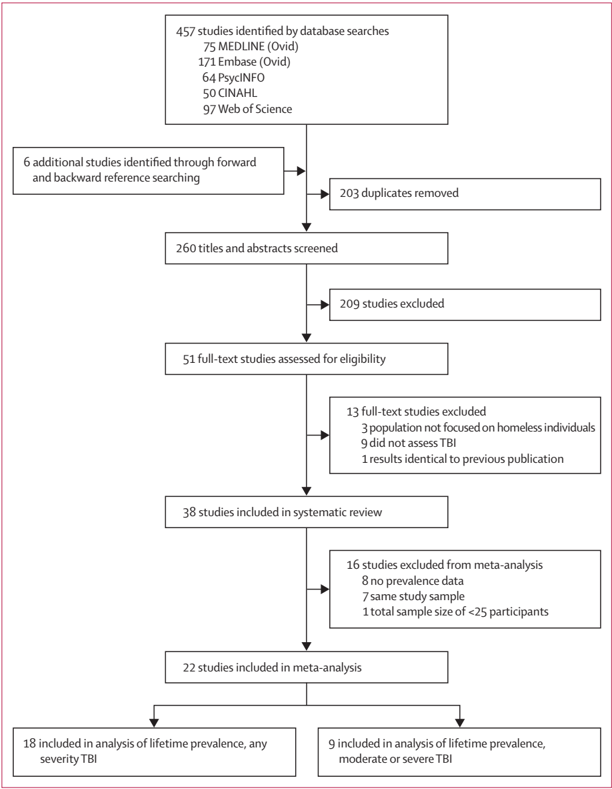
- Of 463 potentially eligible studies, 38 were included in the systematic review and 22 in the meta-analysis; random-effects models pooled lifetime prevalence of any severity TBI and moderate or severe TBI, with meta-regression and subgroup analysis for moderators, leave-one-out sensitivity analyses, and Egger’s test for small-study effects.
- Screening, full-text review, risk of bias assessment, and data extraction were done independently by two authors; inter-rater reliability was κ=0·95 for titles/abstracts and κ=0·96 for full texts; analyses used R version 3.5.1; protocol registered with PROSPERO (CRD42019119678).
Limitations
- The paper states that included studies were almost exclusively retrospective, precluding interpretation of directionality, and that the search was limited to peer-reviewed publications, excluding grey literature.
- The paper states that only five studies assessed incident TBI, precluding a methodologically robust meta-analysis of incidence.
- Evident from the text: heterogeneity was very high (I²=97% for any severity TBI; I²=99% for moderate or severe TBI), and methodological variation was substantial—17 of 38 studies did not clearly define homelessness or marginal housing, 20 of 38 did not clearly describe the TBI definition, and samples were generally predominantly male.
Model-written summary. Check it against the paper before relying on it.
Integrity signals
Registry
Cites
Statistics
Figures
Verification
Claims the paper makes
26 Valid · 1 Not valid · 88 Not checked · 63 Own results and interpretations
Every source the paper cites for this claim was checked and supports it.
In the paper
“Only three studies identified by the previous review evaluated severity of TBI, precluding systematic evaluation of the effects of more clinically significant brain injuries.”
What the sources say
- Supportedcites [15] 15 Topolovec-Vranic J, Ennis N, Colantonio A, et al. Traumatic brain injury among people who are homeless: a systematic review. BMC Public Health 2012; 12: 1059. source
The Results (Section 3) state 'Injury details, such as severity, and age at time of injury were only explored in three studies [7,25,27] (Table 2)', and the Limitations of the evidence base repeats that 'Only three studies provided details on the severity of injury, and age at injury [7,25,27]' while noting 'Few of the reviewed studies provided injury related details such as severity or symptoms related to TBI.' The Discussion adds that the severity pattern 'was only examined in three studies, and in one of the studies severity of injury was only determined for first injury, not for the most severe injury,' which supports the claim's consequence clause that the effects of more clinically significant injuries could not be systematically evaluated. Table 2 confirms the three severity-reporting studies (Oddy 2012, Hwang 2008, Kim 2007). (LLM, conf=0.85)
plain- Asserted: passes — The authors put it forward as true.
- Checkable: passes — It can be checked against evidence.
- Load-bearing: passes — The paper’s conclusions depend on it.
- Based: passes — The paper gives a reason why it holds.
- Supported
The sources with a verdict support this claim; the rest weren’t checked yet, have no full text we could read, or their verdicts aren’t rated yet.
In the paper
“Associated with having seizures in three studies 19,39,60”
What the sources say
- Not checked yetcites [19] 19 Vila-Rodriguez F, Panenka WJ, Lang DJ, et al. The hotel study: multimorbidity in a community sample living in marginal housing. Am J Psychiatry 2013; 170: 1413-22. source
- Supportedcites [39] 39 Hwang SW, Colantonio A, Chiu S, et al. The effect of traumatic brain injury on the health of homeless people. CMAJ 2008; 179: 779-84. source
The Results report that a history of traumatic brain injury was significantly associated with seizures among homeless participants. This paper supports the association as one of the three cited studies; it does not need to establish the findings of the other two. (LLM, conf=0.93)
- Supportedcites [60] 60 Topolovec-Vranic J, Schuler A, Gozdzik A, et al. The high burden of traumatic brain injury and comorbidities amongst homeless adults with mental illness. J Psychiatr Res 2017; 87: 53-60. source
The Results report that homeless adults with mental illness who had a history of TBI with loss of consciousness had a significantly higher prevalence of epilepsy or seizures than those without that history. This supports the association attributed to this study; the citing sentence lists it as one of three studies, not as evidence that this paper examined three studies. (LLM, conf=0.92)
plainstates an association- Asserted: passes — The authors put it forward as true.
- Checkable: passes — It can be checked against evidence.
- Load-bearing: unclear — It is unclear whether the paper’s conclusions depend on it.
- Based: passes — The paper gives a reason why it holds.
The sources with a verdict support this claim; the rest weren’t checked yet, have no full text we could read, or their verdicts aren’t rated yet.
In the paper
“Associated with poorer self-reported physical health in three studies 39,53,58”
What the sources say
- Supportedcites [39] 39 Hwang SW, Colantonio A, Chiu S, et al. The effect of traumatic brain injury on the health of homeless people. CMAJ 2008; 179: 779-84. source
The Results report that homeless participants with a history of traumatic brain injury had poorer physical health on the SF-12 health survey than those without such a history. This supports the finding for which this paper is cited; the sentence’s three-study count refers to its three citations collectively. (LLM, conf=0.91)
- Not checked yetcites [53] 53 Schmitt T, Thornton AE, Rawtaer I, et al. Traumatic brain injury in a community-based cohort of homeless and vulnerably housed individuals. J Neurotrauma 2017; 34: 3301-10. source
- Supportedcites [58] 58 To MJ, O'Brien K, Palepu A, et al. Healthcare utilization, legal incidents, and victimization following traumatic brain injury in homeless and vulnerably housed individuals: a prospective cohort study. J Head Trauma Rehabil 2015; 30: 270-76. source
The Results report that homeless and vulnerably housed participants with a history of TBI had lower SF-12 physical component scores than those without TBI (p < 0.001). This supports the association attributed to this paper; the citing sentence’s “three studies” refers to its three citations, not to three studies within this source. (LLM, conf=0.92)
plainstates an association- Asserted: passes — The authors put it forward as true.
- Checkable: passes — It can be checked against evidence.
- Load-bearing: unclear — It is unclear whether the paper’s conclusions depend on it.
- Based: passes — The paper gives a reason why it holds.
- Supported
Every source the paper cites for this claim was checked and supports it.
In the paper
“Similarly, residential instability was associated with a higher incidence of TBI. 48”
What the sources say
- Supportedcites [48] 48 Nikoo M, Gadermann A, To MJ, Krausz M, Hwang SW, Palepu A. Incidence and associated risk factors of traumatic brain injury in a cohort of homeless and vulnerably housed adults in 3 Canadian cities. J Head Trauma Rehabil 2017; 32: E19-26. source
The Results section reports that in the final multivariable mixed-effects logistic regression, residential stability was associated with decreased odds of incident TBI during follow-up (AOR = 0.75; 95% CI: 0.57, 0.99), which is the complement of instability raising risk. The Discussion and Conclusion state explicitly that those with residential instability are at increased risk of future TBI events in this cohort of homeless and vulnerably housed adults in 3 Canadian cities. The citing paraphrase ('associated with a higher incidence of TBI') matches the source's incidence-based cohort finding, with the population qualifier intact. (LLM, conf=0.90)
plainstates an association- Asserted: passes — The authors put it forward as true.
- Checkable: passes — It can be checked against evidence.
- Load-bearing: unclear — It is unclear whether the paper’s conclusions depend on it.
- Based: passes — The paper gives a reason why it holds.
- Supported
The cited sources support only part of this claim — read each source’s verdict below.
In the paper
“In the general population, excluding individuals with a head injury and alteration (but not loss) of consciousness would miss approximately 80% of all injuries considered to be TBIs by commonly used definitions.”
What the sources say
- Partly supportedcites [5] 5 Maas AIR, Menon DK, Adelson PD, et al. Traumatic brain injury: integrated approaches to improve prevention, clinical care, and research. Lancet Neurol 2017; 16: 987-1048. sourceExperimental — accuracy not yet measured
Panel 2 (page unavailable) includes alteration in mental state, even without loss of consciousness, among the criteria in a commonly used definition of mild TBI. The Prevalence of TBI section (page unavailable) gives population estimates but does not establish that excluding those individuals would miss approximately 80% of TBIs in the general population. (LLM, conf=0.86)
- Not checked yetcites [63] 63 Menon DK, Schwab K, Wright DW, Maas AI. Position statement: definition of traumatic brain injury. Arch Phys Med Rehabil 2010; 91: 1637-40. source
- Not checked yetcites [64] 64 American Congress of Rehabilitation Medicine. Definition of mild traumatic brain injury. J Head Trauma Rehabil 1993; 8: 86-87 . source
plainstates a cause- Asserted: passes — The authors put it forward as true.
- Checkable: passes — It can be checked against evidence.
- Load-bearing: unclear — It is unclear whether the paper’s conclusions depend on it.
- Based: passes — The paper gives a reason why it holds.
- Partly supported
109 more claims · 19 with their cited sources checked
Create a free account to see all 178 claims and to verify the 133 references still open.
- Probably not a substantial claim. 44
- It may state two separate claims as one. 29
- The quote only partly states this claim. 6
Claims other papers make about this one
Each is checked against this paper’s own text: does it say what the citing paper says it does?
The source backs part of the claim, not all of it — or backs it for a different population, condition or comparison.
In the citing paper
“More formal education is also needed on health presentations that are overrepresented in the homeless population, such as traumatic brain injuries and neurodevelopmental disorders (Stone et al., 2019; Stubbs et al., 2020)”
From Harm reduction outcomes and practices in Housing First: A mixed-methods systematic review (2021) · cites this paper as Stubbs et al., 2020
Experimental — accuracy not yet measured
Self-check
Percentages, sums and reported differences re-computed from the paper’s own numbers.
Each contradiction between two passages listed here was confirmed by an independent check.
Rated major: it would touch a result — a value a result rests on, reported and recomputed p-values on opposite sides of the significance level, two passages that conflict with no sign which is right, or a cited work retracted before this paper was published.
In the paper
§ Results · p. 10
“52·1% (46·4-59·7)”
§ Results · p. 4
“The overall pooled estimate of the lifetime prevalence of TBI was 53·1% (95% CI 46·4-59·7, 95% PI 25·9-78·6; figure 2).”
Citations
Cites
R: A Language and Environment for Statistical Computing
R Core Team (2025) · doi:10.32614/r.manuals · Cited by 352,181
Preferred Reporting Items for Systematic Reviews and Meta-Analyses: the PRISMA statement
Moher, D., Liberati, A., Tetzlaff, J., Altman, D. G., & for the PRISMA Group (2009) · BMJ · doi:10.1136/bmj.b2535 · Cited by 83,823
Measuring inconsistency in meta-analyses
Higgins, J. P. T., Thompson, S. G., Deeks, J. J., & Altman, D. G. (2003) · BMJ · doi:10.1136/bmj.327.7414.557 · Cited by 63,139
Bias in meta-analysis detected by a simple, graphical test
Egger, M., Smith, G. D., Schneider, M., & Minder, C. (1997) · BMJ · doi:10.1136/bmj.315.7109.629 · Cited by 56,722
Preferred reporting items for systematic reviews and meta-analyses: the PRISMA Statement.
(2009) · PubMed Central · Cited by 44,859
Meta-analysis of Observational Studies in Epidemiology<SUBTITLE>A Proposal for Reporting</SUBTITLE>
Stroup, D. F. (2000) · JAMA · doi:10.1001/jama.283.15.2008 · Cited by 20,623
Conducting Meta-Analyses in R with the metafor Package
Viechtbauer, W. (2010) · Journal of Statistical Software · doi:10.18637/jss.v036.i03 · Cited by 20,464
Interpretation of random effects meta-analyses
Riley, R. D., Higgins, J. P. T., & Deeks, J. J. (2011) · BMJ · doi:10.1136/bmj.d549 · Cited by 2,884
Traumatic brain injury: integrated approaches to improve prevention, clinical care, and research
Maas, A. I. R., Menon, D. K., Adelson, P. D., Andelic, N., Bell, M. J., Belli, A., Bragge, P., Brazinova, A., Büki, A., Chesnut, R. M., et al. (2017) · The Lancet Neurology · doi:10.1016/s1474-4422(17)30371-x · Cited by 2,609
Definition of mild traumatic brain injury
&NA;, &. (1993) · Journal of Head Trauma Rehabilitation · doi:10.1097/00001199-199309000-00010 · Cited by 1,910
Position statement: definition of traumatic brain injury
Menon, D. K., Schwab, K., Wright, D. W., & Maas, A. I. (2010) · Archives of Physical Medicine and Rehabilitation · doi:10.1016/j.apmr.2010.05.017 · Cited by 1,678
Evidence-based cognitive rehabilitation: updated review of the literature from 2003 through 2008
Cicerone, K. D., Langenbahn, D. M., Braden, C., Malec, J. F., Kalmar, K., Fraas, M., Felicetti, T., Laatsch, L., Harley, J. P., Bergquist, T., et al. (2011) · Archives of Physical Medicine and Rehabilitation · doi:10.1016/j.apmr.2010.11.015 · Cited by 1,599
Fazel, S., Geddes, J. R., & Kushel, M. (2014) · The Lancet · doi:10.1016/s0140-6736(14)61132-6 · Cited by 1,568
Fazel, S., Khosla, V., Doll, H., & Geddes, J. (2008) · PLoS Medicine · doi:10.1371/journal.pmed.0050225 · Cited by 1,033
Aldridge, R. W., Story, A., Hwang, S. W., Nordentoft, M., Luchenski, S. A., Hartwell, G., Tweed, E. J., Lewer, D., Vittal Katikireddi, S., & Hayward, A. C. (2018) · The Lancet · doi:10.1016/s0140-6736(17)31869-x · Cited by 905
Initial Reliability and Validity of the Ohio State University TBI Identification Method
Corrigan, J. D., & Bogner, J. (2007) · Journal of Head Trauma Rehabilitation · doi:10.1097/01.htr.0000300227.67748.77 · Cited by 816
Incidental findings on brain magnetic resonance imaging: systematic review and meta-analysis
Morris, Z., Whiteley, W. N., Longstreth, W. T., Weber, F., Lee, Y.-C., Tsushima, Y., Alphs, H., Ladd, S. C., Warlow, C., Wardlaw, J. M., et al. (2009) · BMJ · doi:10.1136/bmj.b3016 · Cited by 792
Incidence of traumatic brain injury in New Zealand: a population-based study
Feigin, V. L., Theadom, A., Barker-Collo, S., Starkey, N. J., McPherson, K., Kahan, M., Dowell, A., Brown, P., Parag, V., Kydd, R., et al. (2013) · The Lancet Neurology · doi:10.1016/s1474-4422(12)70262-4 · Cited by 729
Epidemiology of traumatic brain injuries in Europe: a cross-sectional analysis
Majdan, M., Plancikova, D., Brazinova, A., Rusnak, M., Nieboer, D., Feigin, V., & Maas, A. (2016) · The Lancet Public Health · doi:10.1016/s2468-2667(16)30017-2 · Cited by 507
Perry, D. C., Sturm, V. E., Peterson, M. J., Pieper, C. F., Bullock, T., Boeve, B. F., Miller, B. L., Guskiewicz, K. M., Berger, M. S., Kramer, J. H., et al. (2016) · Journal of Neurosurgery · doi:10.3171/2015.2.jns14503 · Cited by 440
Prevalence of traumatic brain injury in the general adult population: a meta-analysis
Frost, R. B., Farrer, T. J., Primosch, M., & Hedges, D. W. (2013) · Neuroepidemiology · doi:10.1159/000343275 · Cited by 361
Beijer, U., Wolf, A., & Fazel, S. (2012) · The Lancet Infectious Diseases · doi:10.1016/s1473-3099(12)70177-9 · Cited by 357
Stergiopoulos, V., Hwang, S. W., Gozdzik, A., Nisenbaum, R., Latimer, E., Rabouin, D., Adair, C. E., Bourque, J., Connelly, J., Frankish, J., et al. (2015) · JAMA · doi:10.1001/jama.2015.1163 · Cited by 260 · cited 1×
“…25·9–78·6 A Lifetime history of any TBI B Lifetime history of moderate or severe TBI Brenner et al (2017)31 Bymaster et al (2017)33 Hwang et al (2008)39 Nielssen et al (2018)20 Oddy et al (2012)50 Solliday-McRoy et al (2004)54 Stergiopoulos et al (2015)56 Topolovec-Vranic et al (2014)59…”
BackgroundThe effect of traumatic brain injury on the health of homeless people
Hwang, S. W., Colantonio, A., Chiu, S., Tolomiczenko, G., Kiss, A., Cowan, L., Redelmeier, D. A., & Levinson, W. (2008) · Canadian Medical Association Journal · doi:10.1503/cmaj.080341 · Cited by 194
Standardizing Data Collection in Traumatic Brain Injury
Maas, A. I. R., Harrison-Felix, C. L., Menon, D., Adelson, P. D., Balkin, T., Bullock, R., Engel, D. C., Gordon, W., Langlois-Orman, J., Lew, H. L., et al. (2011) · Journal of Neurotrauma · doi:10.1089/neu.2010.1617 · Cited by 174
Screening for Traumatic Brain Injury: Findings and Public Health Implications
Dams-O'Connor, K., Cantor, J. B., Brown, M., Dijkers, M. P., Spielman, L. A., & Gordon, W. A. (2014) · Journal of Head Trauma Rehabilitation · doi:10.1097/htr.0000000000000099 · Cited by 156
Zieman, G., Bridwell, A., & Cárdenas, J. F. (2017) · Journal of Neurotrauma · doi:10.1089/neu.2016.4579 · Cited by 118
Traumatic brain injury among people who are homeless: a systematic review
Topolovec-Vranic, J., Ennis, N., Colantonio, A., Cusimano, M. D., Hwang, S. W., Kontos, P., Ouchterlony, D., & Stergiopoulos, V. (2012) · BMC Public Health · doi:10.1186/1471-2458-12-1059 · Cited by 115
Walker, W. C., Cifu, D. X., Hudak, A. M., Goldberg, G., Kunz, R. D., & Sima, A. P. (2015) · Journal of Neurotrauma · doi:10.1089/neu.2014.3433 · Cited by 97
The Hotel Study: Multimorbidity in a Community Sample Living in Marginal Housing
Vila-Rodriguez, F., Panenka, W. J., Lang, D. J., Thornton, A. E., Vertinsky, T., Wong, H., Barr, A. M., Procyshyn, R. M., Sidhu, J. J., Smith, G. N., et al. (2013) · American Journal of Psychiatry · doi:10.1176/appi.ajp.2013.12111439 · Cited by 94
Self-citationNeurocognitive impairment in a large sample of homeless adults with mental illness
Stergiopoulos, V., Cusi, A., Bekele, T., Skosireva, A., Latimer, E., Schütz, C., Fernando, I., & Rourke, S. B. (2015) · Acta Psychiatrica Scandinavica · doi:10.1111/acps.12391 · Cited by 81
Hospitalizations and Emergency Department Visits for TBI in Ontario
Colantonio, A., Saverino, C., Zagorski, B., Swaine, B., Lewko, J., Jaglal, S., & Vernich, L. (2010) · Canadian Journal of Neurological Sciences / Journal Canadien des Sciences Neurologiques · doi:10.1017/s0317167100051441 · Cited by 79
The prevalence of traumatic brain injury in the homeless community in a UK city
Oddy, M., Moir, J. F., Fortescue, D., & Chadwick, S. (2012) · Brain Injury · doi:10.3109/02699052.2012.667595 · Cited by 78
Mackelprang, J. L., Harpin, S. B., Grubenhoff, J. A., & Rivara, F. P. (2014) · American Journal of Public Health · doi:10.2105/ajph.2014.302087 · Cited by 74
Factors associated with geriatric syndromes in older homeless adults
Brown, R. T., Kiely, D. K., Bharel, M., & Mitchell, S. L. (2013) · Journal of Health Care for the Poor and Underserved · doi:10.1353/hpu.2013.0077 · Cited by 71
Neuropsychological functioning of homeless men
Solliday-McRoy, C., Campbell, T. C., Melchert, T. P., Young, T. J., & Cisler, R. A. (2004) · Journal of Nervous & Mental Disease · doi:10.1097/01.nmd.0000131962.30547.26 · Cited by 62
Cognitive training for post-acute traumatic brain injury: a systematic review and meta-analysis
Hallock, H., Collins, D., Lampit, A., Deol, K., Fleming, J., & Valenzuela, M. (2016) · Frontiers in Human Neuroscience · doi:10.3389/fnhum.2016.00537 · Cited by 60
Topolovec-Vranic, J., Ennis, N., Howatt, M., Ouchterlony, D., Michalak, A., Masanic, C., Colantonio, A., Hwang, S. W., Kontos, P., Stergiopoulos, V., et al. (2014) · CMAJ Open · doi:10.9778/cmajo.20130046 · Cited by 60
Lifetime prevalence of traumatic brain injury with loss of consciousness
Corrigan, J. D., Yang, J., Singichetti, B., Manchester, K., & Bogner, J. (2018) · Injury Prevention · doi:10.1136/injuryprev-2017-042371 · Cited by 60
Hurstak, E., Johnson, J. K., Tieu, L., Guzman, D., Ponath, C., Lee, C. T., Jamora, C. W., & Kushel, M. (2017) · Drug and Alcohol Dependence · doi:10.1016/j.drugalcdep.2017.06.002 · Cited by 56
Topolovec-Vranic, J., Schuler, A., Gozdzik, A., Somers, J., Bourque, P.-É., Frankish, C. J., Jbilou, J., Pakzad, S., Palma Lazgare, L. I., & Hwang, S. W. (2017) · Journal of Psychiatric Research · doi:10.1016/j.jpsychires.2016.12.004 · Cited by 55
Cognitive Function and Duration of Rooflessness in Entrants to a Hostel for Homeless Men
Bremner, A. J., Duke, P. J., Nelson, H. E., Pantelis, C., & Barnes, T. R. E. (1996) · British Journal of Psychiatry · doi:10.1192/bjp.169.4.434 · Cited by 54
Screening for traumatic brain injury
Hux, K., Schneider, T., & Bennett, K. (2009) · Brain Injury · doi:10.1080/02699050802590353 · Cited by 52
Head injury and mortality in the homeless
McMillan, T. M., Laurie, M., Oddy, M., Menzies, M., Stewart, E., & Wainman-Lefley, J. (2015) · Journal of Neurotrauma · doi:10.1089/neu.2014.3387 · Cited by 43
To, M. J., O'Brien, K., Palepu, A., Hubley, A. M., Farrell, S., Aubry, T., Gogosis, E., Muckle, W., & Hwang, S. W. (2015) · Journal of Head Trauma Rehabilitation · doi:10.1097/htr.0000000000000044 · Cited by 42
GONZALEZ, E. A., DIETER, J. N. I., NATALE, R. A., & TANNER, S. L. (2001) · The Journal of Nervous and Mental Disease · doi:10.1097/00005053-200103000-00006 · Cited by 41
Characteristics of people attending psychiatric clinics in inner Sydney homeless hostels
Nielssen, O. B., Stone, W., Jones, N., Challis, S., Nielssen, A., Elliott, G., Burns, N., Rogoz, A., Cooper, L., & Large, M. M. B. (2018) · The Medical Journal of Australia · doi:10.5694/mja17.00858 · Cited by 40
A longitudinal study of suicidal ideation among homeless, mentally ill individuals
Noël, F., Moniruzzaman, A., Somers, J. M., Frankish, J., Strehlau, V., Schütz, C. G., & Krausz, M. R. (2015) · Social Psychiatry and Psychiatric Epidemiology · doi:10.1007/s00127-015-1142-y · Cited by 39
Kozloff, N., Stergiopoulos, V., Adair, C. E., Cheung, A. H., Misir, V., Townley, G., Bourque, J., Krausz, M., & Goering, P. (2016) · Psychiatric Services · doi:10.1176/appi.ps.201500461 · Cited by 36
LePage, J. P., Bradshaw, L. D., Cipher, D. J., Crawford, A. M., & Hoosyhar, D. (2014) · Public Health · doi:10.1016/j.puhe.2014.07.004 · Cited by 35
Traumatic brain injury and cognitive impairment in men who are homeless
Andersen, J., Kot, N., Ennis, N., Colantonio, A., Ouchterlony, D., Cusimano, M. D., & Topolovec-Vranic, J. (2014) · Disability and Rehabilitation · doi:10.3109/09638288.2014.895870 · Cited by 32
Russell, L. M., Devore, M. D., Barnes, S. M., Forster, J. E., Hostetter, T. A., Montgomery, A. E., Casey, R., Kane, V., & Brenner, L. A. (2013) · American Journal of Public Health · doi:10.2105/ajph.2013.301485 · Cited by 32
Childhood trauma and lifetime traumatic brain injury among individuals who are homeless
Song, M. J., Nikoo, M., Choi, F., Schütz, C. G., Jang, K., & Krausz, R. M. (2018) · Journal of Head Trauma Rehabilitation · doi:10.1097/htr.0000000000000310 · Cited by 31
Hospital care and costs for homeless people
McCormick, B., & White, J. (2016) · Clinical Medicine · doi:10.7861/clinmedicine.16-6-506 · Cited by 29
Traumatic brain injury in a community-based cohort of homeless and vulnerably housed individuals
Schmitt, T., Thornton, A. E., Rawtaer, I., Barr, A. M., Gicas, K. M., Lang, D. J., Vertinsky, A. T., Rauscher, A., Procyshyn, R. M., Buchanan, T., et al. (2017) · Journal of Neurotrauma · doi:10.1089/neu.2017.5076 · Cited by 27
Self-citationChronic Physical Health Conditions Among Homeless
Nikoo, N., Motamed, M., Nikoo, M. A., Strehlau, V., Neilson, E. K., Saddicha, S., & Krausz, M. R. (2014) · Journal of health disparities research and practice · Cited by 25
Brenner, L. A., Hostetter, T. A., Barnes, S. M., Stearns-Yoder, K. A., Soberay, K. A., & Forster, J. E. (2017) · Brain Injury · doi:10.1080/02699052.2017.1376758 · Cited by 24
Nikoo, M., Gadermann, A., To, M. J., Krausz, M., Hwang, S. W., & Palepu, A. (2017) · Journal of Head Trauma Rehabilitation · doi:10.1097/htr.0000000000000262 · Cited by 22
Characteristics of traumatic brain injuries sustained among veterans seeking homeless services
Barnes, S. M., Russell, L. M., Hostetter, T. A., Forster, J. E., Devore, M. D., & Brenner, L. A. (2015) · Journal of Health Care for the Poor and Underserved · doi:10.1353/hpu.2015.0010 · Cited by 20
High rates of head injury among homeless and low-income housed men: a retrospective cohort study
Svoboda, T., & Ramsay, J. T. (2014) · Emergency Medicine Journal · doi:10.1136/emermed-2012-201761 · Cited by 20
Montgomery, A. E., Dichter, M. E., Thomasson, A. M., Roberts, C. B., & Byrne, T. (2015) · Psychiatric Services · doi:10.1176/appi.ps.201400014 · Cited by 19
Gargaro, J., Gerber, G. J., & Nir, P. (2016) · Canadian Journal of Community Mental Health · doi:10.7870/cjcmh-2016-034 · Cited by 16 · cited 1×
“Prevalence, % (95% CI) n Bremner et al (1996)30 Brown et al (2013)32 Bymaster et al (2017)33 Gargaro et al (2016)35 Gonzalez et al (2001)36 Hurstak et al (2017)37 Hux et al (2009)38 Hwang et al (2008)39 Kozloff et al (2016)41 Mackelprang et al (2014)43 Nikoo et al (2017)47 Oddy et al (2012)50…”
A Pediatric Profile of a Homeless Patient in San Jose, California
Bymaster, A., Chung, J. S., Banke, A., Choi, H. J., & Laird, C. (2017) · Journal of Health Care for the Poor and Underserved · doi:10.1353/hpu.2017.0041 · Cited by 11
Perceptuomotor function of homeless males in alcohol rehabilitation
Zlotnick, C., Fischer, P. J., & Agnew, J. (1995) · Journal of Substance Abuse · doi:10.1016/0899-3289(95)90007-1 · Cited by 6
Is bipolar disorder associated with tramautic brain injury in the homeless?
Bacciardi, S., Maremmani, A. G. I., Nikoo, N., Cambioli, L., Schütz, C., Jang, K., & Krausz, M. (2017) · Rivista di Psichiatria · doi:10.1708/2631.27053
Research works printed but not linked: 4
- 25 Schwarzer G. meta: an R package for meta-analysis. R News 2007; 7: 40-45.
- 34 Cotman A, Sandman C. Cognitive deficits and their remediation in the homeless. J Cogn Rehabil 1997; 15: 16-23.
- 40 Kim DK, Jwa CS, Kim GH, Kang JK. An experience of management of homeless neurosurgical patients. J Korean Neurosurg Soc 2007; 42: 191-94.
- 51 Palladino B, Montgomery AE, Sommers M, Fargo JD. Risk of suicide among veterans with traumatic brain injury experiencing homelessness. J Mil Veterans Health 2017; 25: 34-38.
Cited by
Mielke, M. M., Aggarwal, N. T., Vila‐Castelar, C., Agarwal, P., Arenaza‐Urquijo, E. M., Brett, B., Brugulat‐Serrat, A., DuBose, L. E., Eikelboom, W. S., Flatt, J., et al. (2022) · Alzheimer's & Dementia · doi:10.1002/alz.12662 · Cited by 198
Homelessness, housing instability and mental health: making the connections
Padgett, D. K. (2020) · BJPsych Bulletin · doi:10.1192/bjb.2020.49 · Cited by 143
Liu, M., Luong, L., Lachaud, J., Edalati, H., Reeves, A., & Hwang, S. W. (2021) · The Lancet Public Health · doi:10.1016/s2468-2667(21)00189-4 · Cited by 174
Prevalence of mental disorders among people who are homeless: an umbrella review
Hossain, M. M., Sultana, A., Tasnim, S., Fan, Q., Ma, P., McKyer, E. L. J., & Purohit, N. (2020) · International Journal of Social Psychiatry · doi:10.1177/0020764020924689 · Cited by 105
Valente, J. H., Anderson, J. D., Paolo, W. F., Sarmiento, K., Tomaszewski, C., Haukoos, J. S., Diercks, D. B., Diercks, D. B., Anderson, J. D., Byyny, R. L., et al. (2023) · Annals of Emergency Medicine · doi:10.1016/j.annemergmed.2023.01.014 · Cited by 94
Metadata
- Authors
- Stubbs, J. L., Thornton, A. E., Sevick, J. M., Silverberg, N. D., Barr, A. M., Honer, W. G., & Panenka, W. J.
- Affiliations
- University of British Columbia (CA)
- Simon Fraser University (CA)
- Corresponding author
- Stubbs, Jacob L
- ORCID
- Venue
- The Lancet Public Health
- Publisher
- Elsevier BV
- Published
- 2020-01
- Volume
- 5
- Issue
- 1
- Pages
- e19-e32
- ISSN
- 2468-2667 (ISSN-L)
- OpenAlex
- W2990942557
- Cited by
- 173
- References
- 65
- Citations by year
- 2026: 19 · 2025: 33 · 2024: 29 · 2023: 22 · 2022: 28 · 2021: 26 · 2020: 15
- FWCI
- 2.55
- Type
- journal article
- Language
- en
- Update notices
- erratum (2020-01-01)
- Open access
- gold
- doi.org
- Licence
- cc-by-nc-nd
- www.elsevier.com/tdm/userlicense/1.0/ (tdm)
- www.elsevier.com/legal/tdmrep-license (tdm)
- creativecommons.org/licenses/by-nc-nd/4.0/ (vor)
- Locations
- The Lancet Public Health (publishedVersion, cc-by-nc-nd)
- PubMed (publishedVersion)
- DOAJ (DOAJ: Directory of Open Access Journals) (submittedVersion)
- Funders
- Michael Smith Foundation for Health Research
- Topics
- Health Sciences › Medicine › Clinical Neurology › Traumatic Brain Injury Research
- Social Sciences › Sociology and Political Science › Homelessness and Social Issues
- Health Sciences › Medicine › Clinical Neurology › Traumatic Brain Injury and Neurovascular Disturbances
- Keywords
- traumatic brain injury, homelessness, marginal housing, lifetime prevalence, TBI incidence, self-reported physical health, mental health, suicidality, suicide risk, memory impairment, health care utilization, criminal justice involvement, health-related functioning
- MeSH terms
- Brain Injuries, Traumatic, Ill-Housed Persons, Housing, Humans, Incidence, Prevalence, Randomized Controlled Trials as Topic, Treatment Outcome
About these checks
Registry, retraction, Cites and statistics results are computed, not judged, with one exception: a printed reference that no index lists is read once by a model before it counts as a citation error. Claims are extracted by a model and kept only when their quote appears verbatim in the text; each cited source is then checked, with a model’s help, for whether it says what the claim relies on. Those verdicts can be wrong — read the claim’s quote and the cited source before relying on one.
The claim verdicts this report counts are experimental: their accuracy is not yet measured.
A language model drew the claims from the paper on 2026-10-05, under version 3 of the claim definition (model deepseek-v4.1-flash, prompt extract-v3).
A second model labelled each claim on 2026-10-05 (model jev-1.13-20260917, definition revision gold-guideline-v0.2).
Cited sources are checked with a language model’s help (qwen3.8-omni-flash and gpt-6-sol).
Statistics and arithmetic are recomputed, not judged.
Confidence bands are shown only for fields calibrated on our annotated test set. None is calibrated yet, so no band is shown.
What counts as a claim ›How we measure confidence ›How we check this ›
Are you an author, or do you see a problem with this page? Request a review
Data sources
Bibliographic data: Semantic Scholar, OpenAlex, Crossref.
Contains information from the Semantic Scholar Academic Graph Datasets, made available under the ODC Attribution License (ODC-BY 1.0).
Semantic Scholar’s data is described in: Kinney, R., et al. (2023). The Semantic Scholar Open Data Platform. arXiv:2301.10140.
