

Effects of non-pharmaceutical interventions on COVID-19 cases, deaths, and demand for hospital services in the UK: a modelling study
Open accessPublished version of a preprint
The DOI matches its Crossref record; 44 of the 44 references it cites were found in a registry or an index.
Abstract
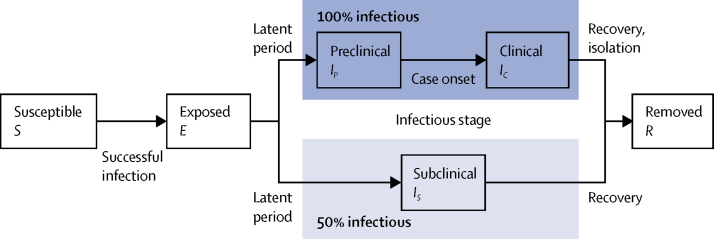
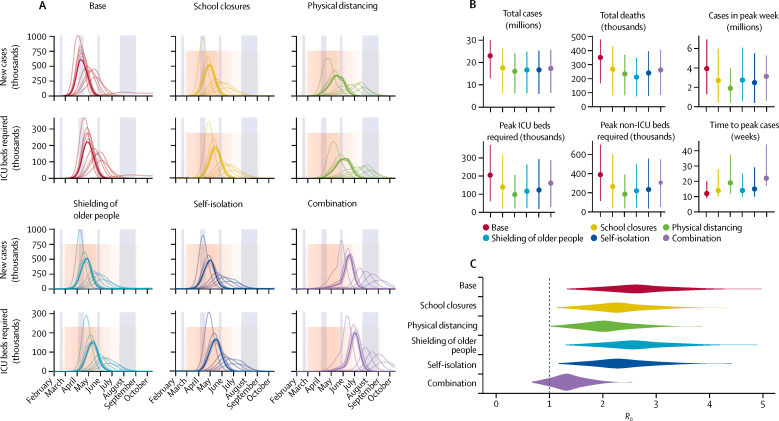
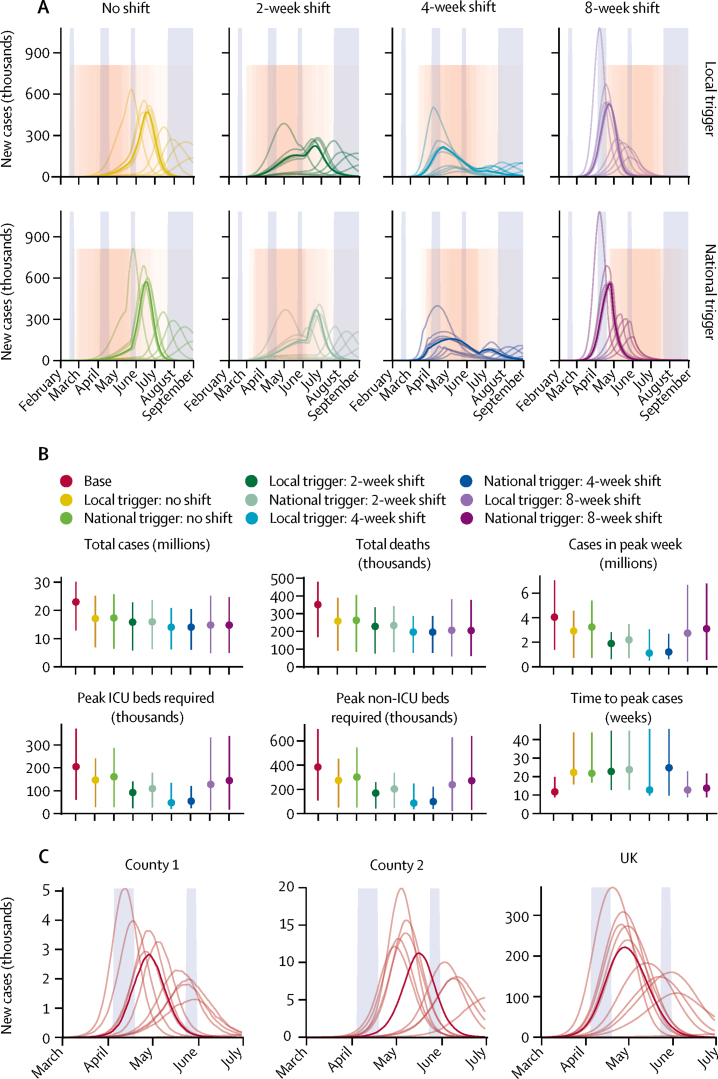
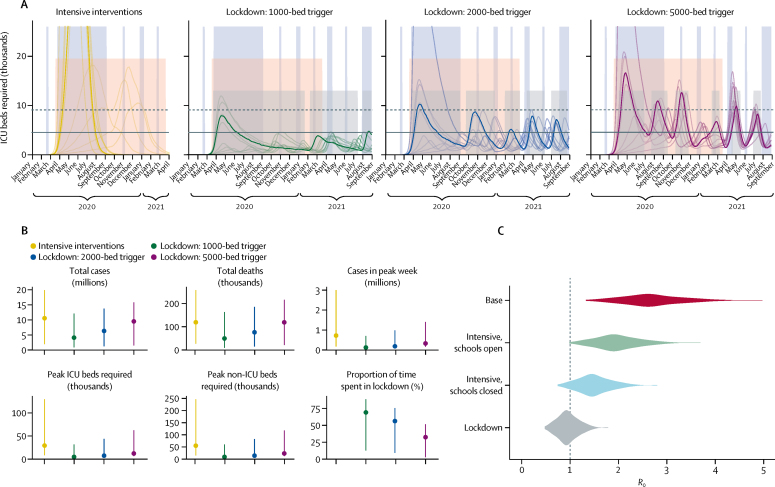
Background Non-pharmaceutical interventions have been implemented to reduce transmission of severe acute respiratory syndrome coronavirus 2 (SARS-CoV-2) in the UK. Projecting the size of an unmitigated epidemic and the potential effect of different control measures has been crucial to support evidence-based policy making during the early stages of the epidemic. This study assesses the potential impact of different control measures for mitigating the burden of COVID-19 in the UK. Methods We used a stochastic age-structured transmission model to explore a range of intervention scenarios, tracking 66·4 million people aggregated to 186 county-level administrative units in England, Wales, Scotland, and Northern Ireland. The four base interventions modelled were school closures, physical distancing, shielding of people aged 70 years or older, and self-isolation of symptomatic cases. We also modelled the combination of these interventions, as well as a programme of intensive interventions with phased lockdown-type restrictions that substantially limited contacts outside of the home for repeated periods. We simulated different triggers for the introduction of interventions, and estimated the impact of varying adherence to interventions across counties. For each scenario, we projected estimated new cases over time, patients requiring inpatient and critical care (ie, admission to the intensive care units [ICU]) treatment, and deaths, and compared the effect of each intervention on the basic reproduction number, R 0 . Findings We projected a median unmitigated burden of 23 million (95% prediction interval 13–30) clinical cases and 350 000 deaths (170 000–480 000) due to COVID-19 in the UK by December, 2021. We found that the four base interventions were each likely to decrease R 0 , but not sufficiently to prevent ICU demand from exceeding health service capacity. The combined intervention was more effective at reducing R 0 , but only lockdown periods were sufficient to bring R 0 near or below 1; the most stringent lockdown scenario resulted in a projected 120 000 cases (46 000–700 000) and 50 000 deaths (9300–160 000). Intensive interventions with lockdown periods would need to be in place for a large proportion of the coming year to prevent health-care demand exceeding availability. Interpretation The characteristics of SARS-CoV-2 mean that extreme measures are probably required to bring the epidemic under control and to prevent very large numbers of deaths and an excess of demand on hospital beds, especially those in ICUs. Funding Medical Research Council.
Overview
The claims and statistics of this paper haven’t been checked yet.
Free: it reads the open-access text and checks the first 5 claims that cite a source we can check. Create a free account to check every claim.
Integrity signals
Registry
Cites
Statistics
Figures
Verification
Claims the paper makes
The claims and statistics of this paper haven’t been checked yet.
Free: it reads the open-access text and checks the first 5 claims that cite a source we can check. Create a free account to check every claim.
Self-check
Percentages, sums and reported differences re-computed from the paper’s own numbers.
The self-check needs the paper’s full text.
Citations
Cites
Clinical features of patients infected with 2019 novel coronavirus in Wuhan, China
Huang, C., Wang, Y., Li, X., Ren, L., Zhao, J., Hu, Y., Zhang, L., Fan, G., Xu, J., Gu, X., et al. (2020) · The Lancet · doi:10.1016/s0140-6736(20)30183-5 · Cited by 48,884
Early transmission dynamics in Wuhan, China, of novel coronavirus-infected pneumonia
Li, Q., Guan, X., Wu, P., Wang, X., Zhou, L., Tong, Y., Ren, R., Leung, K. S. M., Lau, E. H. Y., Wong, J. Y., et al. (2020) · New England Journal of Medicine · doi:10.1056/nejmoa2001316 · Cited by 16,575
Self-citationA Trial of Lopinavir–Ritonavir in Adults Hospitalized with Severe Covid-19
Cao, B., Wang, Y., Wen, D., Liu, W., Wang, J., Fan, G., Ruan, L., Song, B., Cai, Y., Wei, M., et al. (2020) · New England Journal of Medicine · doi:10.1056/nejmoa2001282 · Cited by 5,187
Self-citationWu, J. T., Leung, K., & Leung, G. M. (2020) · The Lancet · doi:10.1016/s0140-6736(20)30260-9 · Cited by 4,389
How will country-based mitigation measures influence the course of the COVID-19 epidemic?
Anderson, R. M., Heesterbeek, H., Klinkenberg, D., & Hollingsworth, T. D. (2020) · The Lancet · doi:10.1016/s0140-6736(20)30567-5 · Cited by 3,648
Ferguson, N. M., Laydon, D. J., Nedjati-Gilani, G. L., Imai, N., Ainslie, K. E. C., Baguelin, M., Bhatia, S., Boonyasiri, A., Cucunubá, Z. M., Cuomo-Dannenburg, G., et al. (2020) · Spiral (Imperial College London) · doi:10.25561/77482 · Cited by 3,281
Social Contacts and Mixing Patterns Relevant to the Spread of Infectious Diseases
Mossong, J., Hens, N., Jit, M., Beutels, P., Auranen, K., Mikolajczyk, R., Massari, M., Salmaso, S., Tomba, G. S., Wallinga, J., et al. (2008) · PLoS Medicine · doi:10.1371/journal.pmed.0050074 · Cited by 2,900 · cited 3×
“We used mixing matrices for the UK measured in 2006, 17 and changes in contact patterns since then might alter the potential effect of interventions.”
Self-citationCDC Weekly, C., & The Novel Coronavirus Pneumonia Emergency Response Epidemiology Team (2020) · China CDC Weekly · doi:10.46234/ccdcw2020.032 · Cited by 2,889
Early dynamics of transmission and control of COVID-19: a mathematical modelling study
Kucharski, A. J., Russell, T. W., Diamond, C., Liu, Y., Edmunds, J., Funk, S., Eggo, R. M., Sun, F., Jit, M., Munday, J. D., et al. (2020) · The Lancet Infectious Diseases · doi:10.1016/s1473-3099(20)30144-4 · Cited by 2,671
Self-citationProjecting the transmission dynamics of SARS-CoV-2 through the postpandemic period
Kissler, S. M., Tedijanto, C., Goldstein, E., Grad, Y. H., & Lipsitch, M. (2020) · Science · doi:10.1126/science.abb5793 · Cited by 2,611 · cited 3×
“12 However, the latter study suggests that short-term projections (ie, approximately 1 year), such as those presented here, are relatively insensitive to assumptions about the duration of immunity.”
Influential
Cited by
Items 601–700 of 947
Empowerment of mosque community with ultraviolet light sterilisator robot
Suwarno, I., Raharja, N. M., Ma’arif, A., Adiningrat, A., Nurjanah, A., Rijalusalam, D. U., & Sánchez-López, C. (2021) · Jurnal Pengabdian dan Pemberdayaan Masyarakat Indonesia · doi:10.59247/jppmi.v1i3.12 · Cited by 4
Brown, L., Horváth, L., & Stevens, D. (2021) · Journal of Elections Public Opinion and Parties · doi:10.1080/17457289.2021.1924739 · Cited by 4
Ji, H. L., Dai, Q., Jin, H., Xu, K., Ai, J., Fang, X., Shi, N., Huang, H., Wu, Y., Peng, Z., et al. (2021) · Medical Science Monitor · doi:10.12659/msm.929986 · Cited by 4
Cao, W., Dai, H., Zhu, J., Tian, Y., & Peng, F. (2021) · ISPRS International Journal of Geo-Information · doi:10.3390/ijgi10070480 · Cited by 4
Naffeti, B. S., Ounissi, Z., Srivastav, A. K., Stollenwerk, N., Van-Dierdonck, J. B., & Aguiar, M. (2025) · BMC Infectious Diseases · doi:10.1186/s12879-024-10342-y · Cited by 4
Xiao, P., Zhao, D., Shen, S., Liao, Q., Wang, W., Cao, Y., Liao, J., Lv, X., Liu, Y., Ma, L., et al. (2024) · Sustainable Cities and Society · doi:10.1016/j.scs.2024.105383 · Cited by 4
Self-citationLockdown contra a Covid-19 funciona ou não? Um estudo de caso com o município de Araraquara
Colnago, M., Casaca, W. C. D. O., Oishi, C. M., Amaral, F., & Cuminato, J. A. (2021) · Proceeding Series of the Brazilian Society of Computational and Applied Mathematics · doi:10.5540/03.2021.008.01.0429 · Cited by 4
Ortega-Quijano, D., & Ortega-Quijano, N. (2021) · International Journal of Epidemiology · doi:10.1093/ije/dyab043 · Cited by 3
Colbourn, T., Waites, W., Manheim, D., Foster, D., Sturniolo, S., Sculpher, M., Kerr, C. C., Colbourn, G., Bowie, C., Godfrey, K. M., et al. (2020) · F1000Research · doi:10.12688/f1000research.27980.1 · Cited by 3
Temporal and Probabilistic Comparisons of Epidemic Interventions
Boudreau, M. C., Allen, A. J., Roberts, N. J., Allard, A., & Hébert‐Dufresne, L. (2023) · Bulletin of Mathematical Biology · doi:10.1007/s11538-023-01220-w · Cited by 3
Mathematical modelling for Covid-19
Kumar, R., Saxena, B., Shrivastava, R., & Bhardwaj, R. (2025) · AIP conference proceedings · doi:10.1063/5.0247445 · Cited by 3
Navigating economic turmoil: Chilean businesses during COVID-19 lockdowns and vaccine rollouts
Pertuzé, J. A., Montégu, J. P., González, C., Araos, R., & Daza, P. (2023) · Health Policy and Technology · doi:10.1016/j.hlpt.2023.100813 · Cited by 3
Kharya, P., Koparkar, A. R., Dixit, A. M., Joshi, H. S., & Rath, R. S. (2021) · Cureus · doi:10.7759/cureus.15393 · Cited by 3
Das, K., Zaman, S., Khan, A., Sadhu, A., Bhattacharjee, S., Khan, F. S., & Sarkar, B. (2023) · IET Quantum Communication · doi:10.1049/qtc2.12068 · Cited by 3
Pop, C. S., Preda, C. M., Mănuc, M., Gheorghe, L. S., Istrătescu, D., Chifulescu, A. E., Voiosu, T. A., Diculescu, M., Ţieranu, C. G., & Iliescu, L. E. (2020) · Journal of Gastrointestinal and Liver Diseases · doi:10.15403/jgld-3148 · Cited by 3
Fighting Hepatitis C in a COVID-19 ecosystem. Public health policies are needed more than ever
Lopes, H., Baptista‐Leite, R., Franco, D., Kundurzhiev, T., Mateva, L., Jelev, D., & Simonova, M. (2020) · Journal of Gastrointestinal and Liver Diseases · doi:10.15403/jgld-2794 · Cited by 3
Fear itself. Is fear a determinant of the efficacy of lockdowns?
Alfano, V., & Ercolano, S. (2023) · Socio-Economic Planning Sciences · doi:10.1016/j.seps.2023.101644 · Cited by 3
Schmidt, P. N., Nelson, E. C., Kearney, G. D., Kraft, S. A., & Oliver, B. J. (2021) · International Journal for Quality in Health Care · doi:10.1093/intqhc/mzab074 · Cited by 3
Sanstead, E. C., Li, Z., McKearnan, S. B., Kao, S. Z., Mink, P. J., Simon, A. B., Kuntz, K. M., Gildemeister, S., & Enns, E. A. (2023) · MDM Policy & Practice · doi:10.1177/23814683231202716 · Cited by 3
McCabe, R., Danelian, G., Panovska‐Griffiths, J., & Donnelly, C. A. (2024) · Infectious Disease Modelling · doi:10.1016/j.idm.2024.01.011 · Cited by 3
Taranga, K., & Fernando, G. H. S. (2021) · International Journal of Community Resilience · doi:10.51595/injcr/11111117 · Cited by 3
Limitations of models for guiding policy in the COVID-19 pandemicPreprint
McKeigue, P., & Wood, S. N. (2022) · medRxiv · doi:10.1101/2022.06.30.22277091 · Cited by 3
Trajectories of COVID-19: A longitudinal analysis of many nations and subnational regions
Burg, D. F., & Ausubel, J. H. (2023) · PLoS ONE · doi:10.1371/journal.pone.0281224 · Cited by 3
Medidas de distaciamento social e uso da máscara no contexto da COVID-19: impactos e desafios
da Silveira, I. H., Ortelan, N., Pescarini, J. M., Ferreira, A. J. F., de Souza-Filho, J. A., Leite, L., Aquino, R., & Aquino, E. M. L. (2020) · EDUFBA eBooks · doi:10.9771/9786556300757.007 · Cited by 3
Calabrese, J. M., Schüler, L., Fu, X., Gawel, E., Zozmann, H., Bumberger, J., Quaas, M. F., Wolf, G., & Attinger, S. (2024) · Journal of The Royal Society Interface · doi:10.1098/rsif.2024.0301 · Cited by 3
Inference under superspreading: Determinants of SARS‐CoV‐2 transmission in Germany
Schmidt, P. (2024) · Statistics in Medicine · doi:10.1002/sim.10046 · Cited by 3
Krumkamp, R., Kreuels, B., Jaeger, V. K., May, J., Mikolajczyk, R., & Karch, A. (2021) · BMC Medical Research Methodology · doi:10.1186/s12874-021-01361-3 · Cited by 3
Zhang, Y., Gong, C., Li, D., Wang, Z., Pu, S. D., Robertson, A. W., Yu, H. Z., & Parrington, J. (2021) · Scientific Reports · doi:10.1038/s41598-021-87882-9 · Cited by 3
Bouzalmat, I. (2024) · Nonlinear Dynamics · doi:10.1007/s11071-024-09996-9 · Cited by 3
Hendy, S. C., Wiles, S., Binny, R. N., & Plank, M. J. (2022) · New Zealand Economic Papers · doi:10.1080/00779954.2022.2034176 · Cited by 3
Patón, M., Hosani, F. I. A., Stanciole, A. E., Aden, B., Timoshkin, A., Sadani, A., Najim, O., Cherian, C. A., Acuna, J. M., & Rodríguez, J. (2022) · Infectious Disease Modelling · doi:10.1016/j.idm.2022.08.003 · Cited by 3
Li, J., Yu, L., Yang, X., Zhang, T., Sun, G., Lv, J., & Liu, Q.-H. (2025) · Chaos Solitons & Fractals · doi:10.1016/j.chaos.2025.117001 · Cited by 3
Stochastic simulation of successive waves of COVID-19 in the province of Barcelona
Bosman, M., Esteve, A., Gabbanelli, L., Parra, J. J., López‐Gay, A., Manera, M., Martínez, M., Masjuan, P., Mir, L. M., Paradells, J., et al. (2022) · Infectious Disease Modelling · doi:10.1016/j.idm.2022.12.005 · Cited by 3
COVID-19: The Lessons We Should Have Learned from Existing Literature
Jefferson, M. (2020) · Biophysical Economics and Sustainability · doi:10.1007/s41247-020-00079-y · Cited by 3
Albassam, D., Nouh, M., & Hosoi, A. E. (2023) · International Journal of Environmental Research and Public Health · doi:10.3390/ijerph20075343 · Cited by 3
Quilty, B. J., Chapman, L. A. C., Munday, J. D., Wong, K. L., Gimma, A., Pickering, S., Neil, S. J. D., Galão, R. P., Edmunds, W. J., Jarvis, C. I., et al. (2026) · PLoS Computational Biology · doi:10.1371/journal.pcbi.1014715 · Cited by 3
Self-citationHe, Y., Martínez, L., Ge, Y., Feng, Y., Chen, Y., Tan, J., Westbrook, A. L., Li, C., Cheng, W., Feng, L., et al. (2023) · Epidemiology and Infection · doi:10.1017/s0950268823001292 · Cited by 3
Acharya, B. K., Khanal, L., Alnwisi, S. M. M., Ruan, Z., Yang, Y., Adhikari, S. K., Pandit, S., Neupane, B. K., Paudel, B. K., & Lin, H. (2020) · medRxiv · doi:10.1101/2020.11.07.20227520 · Cited by 3
Pritchard, C., Kutikova, L., Pitman, R., Lai, K. Z. H., Beyhaghi, H., Gibbons, I., Erbe, A., Gojovic, M. Z., Cosgrove, C. A., Sculpher, M., et al. (2025) · Vaccines · doi:10.3390/vaccines13020187 · Cited by 3
Beira, M. J., Kumar, A., Perfeito, L., Gonçalves-Sá, J., & Sebastião, P. J. (2020) · medRxiv · doi:10.1101/2020.08.15.20175588 · Cited by 3
Non-pharmaceutical strategies win coronavirus disease 2019 battle in New Zealand
Nhamo, G., Kandawasvika, G. Q., & Sibanda, M. (2020) · Jàmbá Journal of Disaster Risk Studies · doi:10.4102/jamba.v12i1.1010 · Cited by 3
Alebna, P. L., Chung, J., Rashid, M. O., Hoban, D., LaForgia, M., Khera, S. P., & Loftus, M. (2022) · PLoS ONE · doi:10.1371/journal.pone.0279208 · Cited by 3
An improved methodology for estimating the prevalence of SARS-CoV-2Preprint
Patel, V., McCarthy, C., Taylor, R. A. W., Moir, R., Kelly, L. A., & Snary, E. (2020) · medRxiv · doi:10.1101/2020.08.04.20168187 · Cited by 3
Moran, R., Billig, A. J., Cullen, M., Razi, A., Daunizeau, J., Leech, R., & Friston, K. J. (2020) · medRxiv · doi:10.1101/2020.06.11.20128611 · Cited by 3
Magnoni, M. (2021) · Epidemiologic Methods · doi:10.1515/em-2020-0047 · Cited by 3
Effect of non-pharmacological interventions on the COVID-19 epidemic in Saudi Arabia
AlJohani, N. I., & Mutai, K. (2021) · Epidemiology and Infection · doi:10.1017/s0950268821002612 · Cited by 3
Culaste, H. F. C., Torres, N. J. D., Lachica, Z. P., Lorono, H. G. P., Inguillo, R. F., Mata, M. A., & Namoco, R. A. (2023) · Frontiers in Applied Mathematics and Statistics · doi:10.3389/fams.2023.1140434 · Cited by 3
Emergence of SARS-CoV-2 Variants Are Induced by Coinfections With Dengue
Al‐Emran, H. M., Rahman, F., Sarkar, L., Das, P. K., Mondol, P., Yesmin, S., Sultana, P., Ahammed, T., Parvez, R., Hasan, M. S., et al. (2024) · Bioinformatics and Biology Insights · doi:10.1177/11779322241272399 · Cited by 3
Koestner, C., Letzel, S., Eggert, V., Beutel, T., & Dietz, P. (2021) · European Journal of Public Health · doi:10.1093/eurpub/ckab196 · Cited by 3
Why We Need More Data before the Next Pandemic
Gilbert, N., Chattoe‐Brown, E., Watts, C., & Robertson, D. (2022) · Sociologica · doi:10.6092/issn.1971-8853/13221 · Cited by 3
Breastfeeding rates in the Covid-19 era: The experience of a Greek “Baby Friendly Hospital”
Boutsikou, Τ., Iliodromiti, Z., Pouliakis, A., Soulai, A., Tzounakou, L., Volaki, P., Petropoulou, C., Sokou, R., & Iacovidou, N. M. (2021) · Journal of Translational Science · doi:10.15761/jts.1000451 · Cited by 3
How to remove the testing bias in CoV-2 statisticsPreprint
Wälde, K. (2020) · medRxiv · doi:10.1101/2020.10.14.20212431 · Cited by 3
Reproduction as a Means of Evaluating Policy Models: A Case Study of a COVID-19 SimulationPreprint
Chattoe‐Brown, E., Gilbert, N., Robertson, D. A., & Watts, C. (2021) · medRxiv · doi:10.1101/2021.01.29.21250743 · Cited by 3
Jorgensen, P. E. W., Ruiz, A. B., Galvañ, V. G., Llenas‐García, J., Seguí‐Ripoll, J. M., Serrano, J. M. S., Borrajo, E., Sánchez, J. M. I., Garcia-Sabater, J. P., & Marin-Garcia, J. A. (2022) · medRxiv · doi:10.1101/2022.11.03.22281898 · Cited by 3
Ng, V., Fazil, A., Waddell, L. A., Bancej, C. M., Turgeon, P., Otten, A., Atchessi, N., & Ogden, N. H. (2020) · Canadian Medical Association Journal · doi:10.1503/cmaj.200990-f · Cited by 2
Canário, J. P., Ferreira, M. V., Freire, J., Carvalho, M. C., & Rios, R. A. (2022) · Multimedia Tools and Applications · doi:10.1007/s11042-022-12806-2 · Cited by 2
Miller, E. F., Neumann, J., Chen, Y., Mallela, A., Lin, Y. T., Hlavacek, W. S., & Posner, R. G. (2023) · PLOS Global Public Health · doi:10.1371/journal.pgph.0001490 · Cited by 2
Wen, H., Shi, F., Liu, Y., Xie, C. H., Qin, G., Wang, F., Liu, X., Bai, J., Hong, Q., Ma, R., et al. (2022) · Frontiers in Medicine · doi:10.3389/fmed.2022.914732 · Cited by 2
Self-citationCardenas, V. M., Cardenas, I. C., Ocaranza, H. I., Castillo, R., Ortega-Madani, A., Barrera, S., Urrea, C., & Mora, A. (2023) · American Journal of Field Epidemiology · doi:10.59273/ajfe.v1i1.7471 · Cited by 2
Walkowiak, M. P., Walkowiak, D., & Walkowiak, J. (2023) · Frontiers in Public Health · doi:10.3389/fpubh.2023.1221964 · Cited by 2
Reinforcement learning for policymaking in epidemic control: A scoping review
Bolshov, O. O., & Chumachenko, D. (2026) · PLoS ONE · doi:10.1371/journal.pone.0351176 · Cited by 2
Oyebola, K. M., Ligali, F. C., Owoloye, A. J., Erinwusi, B., Musa, A. Z., Aina, O. O., & Salako, B. L. (2025) · International Health · doi:10.1093/inthealth/ihae065 · Cited by 2
Ajiputra, E. S., Kugitama, B., Lee, J., & Hendriana, E. (2021) · Contemporary Management Research · doi:10.7903/cmr.21052 · Cited by 2
Liver injury in COVID-19 patients - a multidisciplinary experience and a call for national consensus
Roman, A., Georgescu, A. M., Moldovan, S. A., Stoian, M., & Dobru, D. E. (2020) · Journal of Gastrointestinal and Liver Diseases · doi:10.15403/jgld-3119 · Cited by 2
Unraveling the COVID-19 hospitalization dynamics in Spain using Bayesian inference
Aleta, A., Blas-Laína, J. L., Anglés, G. T., & Moreno, Y. (2023) · BMC Medical Research Methodology · doi:10.1186/s12874-023-01842-7 · Cited by 2
Estimating the Level of Asymptomatic COVID-19 Infections in Northern Ireland in 2020
Hall, P. A., Kiss, G., Kuhn, T. E., Moutari, S., Patterson, E., & Smith, E. (2022) · Open Journal of Modelling and Simulation · doi:10.4236/ojmsi.2022.102011 · Cited by 2
SAFE GYMS: IoT Systems for Safe and Healthy Sport and Working Environments
Pluchino, P., Nenna, F., Bettelli, A., Santus, V., Zordan, F., Spagnolli, A., Renoffio, N., Marani, P., Delfitto, P., Zanella, A., et al. (2024) · Lecture notes in bioengineering · doi:10.1007/978-3-031-63913-5_2 · Cited by 2
Evolution of COVID-19 Patients in Mexico City Using Markov Chains
Villarreal-Calva, R. C., Escamilla-Ambrosio, P. J., Rodríguez-Mota, A., & Ramírez, J. M. (2020) · Communications in computer and information science · doi:10.1007/978-3-030-62554-2_23 · Cited by 2
Preparing for the Next Pandemic: Learning Lessons from the Recent Past
Elderd, B. D., Dallas, T., Foster, G., & Richards, R. L. (2024) · Springer eBooks · doi:10.1007/978-3-030-93954-0_49-1 · Cited by 2
Simons, D., Perski, O., Shahab, L., Brown, J., & Bailey, R. L. (2022) · F1000Research · doi:10.12688/f1000research.55502.3 · Cited by 2
Sahu, P. S., Kumar, S., Kumar, N., & Prakash, V. P. (2024) · Applied Microbiology Theory & Technology · doi:10.37256/amtt.5120243753 · Cited by 2
Asymmetry in the peak in Covid-19 daily cases and the pandemic R-parameterPreprint
Bhatkar, S., Ma, M., Zsolway, M., Tarafder, A., Doniach, S., & Bhanot, G. (2023) · medRxiv · doi:10.1101/2023.07.23.23292960 · Cited by 2
Multiple epidemic waves in a switching system with multi-thresholds triggered alternate control
Li, Q., Tang, B., & Xiao, Y. (2024) · Nonlinear Dynamics · doi:10.1007/s11071-024-09533-8 · Cited by 2
COVID-19 Pandemic and Children’s Health – Mitigating Unintended Consequences
Aishworiya, R., Biswas, A., Tan, M. L. N., Ho, W. L. C., & Joseph, R. (2020) · Annals of the Academy of Medicine Singapore · doi:10.47102/annals-acadmedsg.2020345 · Cited by 2
Liu, C. Y., Smith, S., Chamberlain, A. T., Gandhi, N. R., Khan, F. N., Williams, S., & Shah, S. (2022) · Annals of Epidemiology · doi:10.1016/j.annepidem.2022.09.010 · Cited by 2
Harris, T. E., Jayasundara, P., Ragonnet, R. R., Trauer, J. M., Geard, N. L., & Zachreson, C. (2026) · Epidemics · doi:10.1016/j.epidem.2026.100940 · Cited by 2
Data-driven modeling of COVID-19 spread in France to inform pandemic response
Domenico, L. D. (2022) · theses.fr (ABES) · doi:10.70675/74cb72f2z2942z43dfza52fz2e3c0e5b38f5 · Cited by 2
SEIRS epidemiology model for the COVID-19 pandemy in the extreme case of no acquired immunityPreprint
Ilnytskyi, J. (2020) · arXiv (Cornell University) · doi:10.48550/arxiv.2012.06890 · Cited by 2
Ahmed, M. U., Ahamad, M. G., Hasan, M. M., & Amin, S. K. (2025) · BMC Research Notes · doi:10.1186/s13104-025-07381-2 · Cited by 2
Reduzindo iniquidades: uma defesa da reabertura de escolas no Brasil
Neto, R. L. C. (2021) · Revista Brasileira de Medicina de Família e Comunidade · doi:10.5712/rbmfc16(43)2695 · Cited by 2
Preparing for a challenging winter 2020/21
Holgate, S. T., & Cesare, M. D. (2020) · Middlesex University Research Repository (Middlesex University Of London) · Cited by 2
Klingwort, J., Broe, S. M. M. G. D., & Brocker, S. A. (2022) · International Journal for Population Data Science · doi:10.23889/ijpds.v5i4.1688 · Cited by 2
Measuring Public Policy Effectiveness in the Age of Data and AI: Insights from COVID-19
Tibebu, H., Mekonnen, E., Kakadiaris, I. A., & Silva, D. (2023) · IEEE IAS Global Conference on Emerging Technologies (GlobConET) · doi:10.1109/globconet56651.2023.10150134 · Cited by 2
Liu, J., Gao, B., Bao, H. X. H., & Shi, Z. (2021) · BMJ Open · doi:10.1136/bmjopen-2022-060996 · Cited by 2
Ji, W., Zhang, K., Li, M., Wang, S., Sun, L., Huang, Y. M., Bai, J., Zhang, M., & Zheng, J. (2022) · BMC Anesthesiology · doi:10.1186/s12871-022-01951-8 · Cited by 2
Iirmdu, T. O., & Donaldson, R. (2024) · Modern Geográfia · doi:10.15170/mg.2024.19.04.03 · Cited by 2
Policy and Law Assessment of COVID‐19 Based on Smooth Transition Autoregressive Model
Lei, J., Wang, X., Zhang, Y., Zhu, L., & Zhang, L. (2021) · Complexity · doi:10.1155/2021/6659117 · Cited by 2
Yang, L., Hu, M., Zeng, H., Liang, W., & Zhu, J. (2023) · Frontiers in Public Health · doi:10.3389/fpubh.2023.1202996 · Cited by 2
Exploring epidemic control policies using nonlinear programming and mathematical models
Montes-Olivas, S., Kucharski, A. J., Gravenor, M. B., & Frost, S. D. W. (2026) · PLoS Computational Biology · doi:10.1371/journal.pcbi.1014238 · Cited by 2
Self-citationModeling and Simulation of the SARS-COV-2 Lung Infection and Immune Response with Cell-DEVS
Ayadi, A., Frydman, C., & Le, Q. T. (2023) · Winter Simulation Conference · doi:10.1109/wsc60868.2023.10407137 · Cited by 2
Implications of COVID-19 Towards Islamic Banks Practices in the Risk Management
Shafiai, S., Ali, E. R. A. E., Hassan, R. B., Rashid, I. M. A., Kadir, M. S. A., & Gazali, H. M. (2022) · Springer eBooks · doi:10.1007/978-981-19-2390-6_14 · Cited by 2
Markov modeling and performance analysis of infectious diseases with asymptomatic patients
Li, Q., Wang, C., Yang, F., & Zhang, C. (2023) · Mathematical Biosciences & Engineering · doi:10.3934/mbe.2023792 · Cited by 2
Tsuzuki, S. (2020) · The Lancet Regional Health - Western Pacific · doi:10.1016/j.lanwpc.2020.100030 · Cited by 2
Kiss, I. Z., Blyuss, K. B., Kyrychko, Y. N., Middleton, J., Roland, D. R., Bertini, L., Bogen‐Johnston, L., Wood, W., Sharp, R., Forder, J., et al. (2021) · Epidemiology and Infection · doi:10.1017/s0950268821002727 · Cited by 2
Host Viral Load During Triple Coinfection of SARS-CoV-2, Influenza Virus, and Syncytial Virus
Taye, M. A. (2023) · Contemporary Mathematics · doi:10.37256/cm.4320232500 · Cited by 2
CoSIR: Optimal control of SIR epidemic dynamics by mapping to Lotka-Volterra SystemPreprint
Maheshwari, H., Shetty, S., Bannur, N., & Merugu, S. (2020) · medRxiv · doi:10.1101/2020.11.10.20211995 · Cited by 2
Alser, M., Kim, J. S., Alserr, N. A., Tell, S. W., & Mutlu, O. (2021) · arXiv (Cornell University) · doi:10.3929/ethz-b-000528437 · Cited by 2
Effects of nonpharmaceutical interventions for coronavirus disease 2019
Choi, J. H. (2022) · Korean Journal of Pediatrics · doi:10.3345/cep.2021.01830 · Cited by 2
The macroeconomic and epidemiological impacts of Covid-19 in PakistanPreprint
Jensen, H. T., Keogh-Brown, M. R., Eggo, R. M., Pearson, C. A. B., Rueda, S. T., Huda, M., Khalid, M., Zulfiqar, W., CMMID COVID-19 Working Group, Smith, R., et al. (2023) · medRxiv · doi:10.1101/2023.10.06.23296657 · Cited by 1
Self-citation
Metadata
- Authors
- Davies, N. G., Kucharski, A. J., Eggo, R. M., Gimma, A., Edmunds, W. J., Jombart, T., O'Reilly, K., Endo, A., Hellewell, J., Nightingale, E. S., Quilty, B. J., Jarvis, C. I., Russell, T. W., Klepac, P., Bosse, N. I., Funk, S., Abbott, S., Medley, G. F., Gibbs, H., Pearson, C. A. B., Flasche, S., Jit, M., Clifford, S., Prem, K., Diamond, C., Emery, J., Deol, A. K., Procter, S. R., van Zandvoort, K., Sun, Y. F., Munday, J. D., Rosello, A., Auzenbergs, M., Knight, G., Houben, R. M. G. J., & Liu, Y.
- Affiliations
- London School of Hygiene & Tropical Medicine (GB)
- Corresponding author
- Davies, Nicholas G
- ORCID
- Davies, Nicholas G
- Kucharski, Adam J
- Eggo, Rosalind M
- Gimma, Amy
- Edmunds, W John
- Jombart, Thibaut
- Endo, Akira
- Hellewell, Joel
- Nightingale, Emily S
- Quilty, Billy J
- Jarvis, Christopher I
- Russell, Timothy W
- Klepac, Petra
- Bosse, Nikos I
- Funk, Sebastian
- Abbott, Sam
- Medley, Graham F
- Gibbs, Hamish
- Pearson, Carl A B
- Flasche, Stefan
- Jit, Mark
- Clifford, Samuel
- Prem, Kiesha
- Diamond, Charlie
- Emery, Jon
- Deol, Arminder K
- Procter, Simon R
- Munday, James D
- Auzenbergs, Megan
- Houben, Rein M G J
- Liu, Yang
- Venue
- The Lancet Public Health
- Publisher
- Elsevier BV
- Published
- 2020-07
- Volume
- 5
- Issue
- 7
- Pages
- e375-e385
- ISSN
- 2468-2667 (ISSN-L)
- PMC
- PMC7266572
- OpenAlex
- W3032725243
- Semantic Scholar
- e521c7526af84f53b982cb96279c0b892164674d
- Cited by
- 848
- References
- 44
- Citations by year
- 2026: 20 · 2025: 30 · 2024: 56 · 2023: 90 · 2022: 173 · 2021: 304 · 2020: 173
- FWCI
- 29.41
- Type
- journal article
- Language
- en
- Open access
- gold
- doi.org
- Licence
- cc-by
- www.elsevier.com/tdm/userlicense/1.0/ (tdm)
- www.elsevier.com/legal/tdmrep-license (tdm)
- creativecommons.org/licenses/by/4.0/ (vor)
- Locations
- The Lancet Public Health (publishedVersion, cc-by)
- medRxiv (acceptedVersion, cc-by)
- PubMed Central (publishedVersion, cc-by)
- PubMed (publishedVersion)
- LSHTM Research Online (London School of Hygiene and Tropical Medicine) (acceptedVersion)
- DOAJ (DOAJ: Directory of Open Access Journals) (submittedVersion, cc-by-sa)
- reponame:Expeditio Repositorio Institucional UJTL
- Funders
- Medical Research Council (MC_PC 19065)
- National Institute for Health and Care Research (HPRU-2012-10096)
- Wellcome Trust (206250/Z/17/Z, OPP1180644, 208812/Z/17/Z, 757699)
- Bill and Melinda Gates Foundation (OPP1191821)
- Economic and Social Research Council (INV-003174)
- National Institute for Health Research Health Protection Research Unit
- Alan Turing Institute
- Research Councils UK
- Department of Health and Social Care (ITCRZ 03010, OPP1184344)
- Heiwa Nakajima Foundation
- Global Challenges Research Fund
- Department for International Development, UK Government (MR/P014658/1, PR-OD-1017-20002)
- Topics
- Physical Sciences › Mathematics › Modeling and Simulation › COVID-19 epidemiological studies
- Social Sciences › Sociology and Political Science › COVID-19 Prevention and Impact
- Physical Sciences › Mathematics › Applied Mathematics › Mathematical and Theoretical Epidemiology and Ecology Models
- Keywords
- COVID-19 pandemic, SARS-CoV-2, non-pharmaceutical interventions, school closures, social distancing, self-isolation, lockdown, basic reproduction number, hospital demand, intensive care capacity, epidemic projection, intervention adherence, age-structured transmission model, health service capacity, death, clinical case, combined intervention
- MeSH terms
- COVID-19, United Kingdom, Health Services Needs and Demand, Hospitalization, Humans, Intensive Care Units, Models, Theoretical, Pneumonia, Viral, Program Evaluation, Coronavirus Infections, Epidemics, Pandemics
About these checks
Registry, retraction, Cites and statistics results are computed, not judged, with one exception: a printed reference that no index lists is read once by a model before it counts as a citation error. Claims are extracted by a model and kept only when their quote appears verbatim in the text; each cited source is then checked, with a model’s help, for whether it says what the claim relies on. Those verdicts can be wrong — read the claim’s quote and the cited source before relying on one.
Statistics and arithmetic are recomputed, not judged.
Confidence bands are shown only for fields calibrated on our annotated test set. None is calibrated yet, so no band is shown.
What counts as a claim ›How we measure confidence ›How we check this ›
Are you an author, or do you see a problem with this page? Request a review
Data sources
Bibliographic data: Semantic Scholar, OpenAlex, Crossref.
Contains information from the Semantic Scholar Academic Graph Datasets, made available under the ODC Attribution License (ODC-BY 1.0).
Semantic Scholar’s data is described in: Kinney, R., et al. (2023). The Semantic Scholar Open Data Platform. arXiv:2301.10140.
