

Sex differences and the role of education in cognitive ageing: analysis of two UK-based prospective cohort studies
Open accessThe DOI matches its Crossref record; 34 of the 34 references it cites were found in a registry or an index.
Abstract
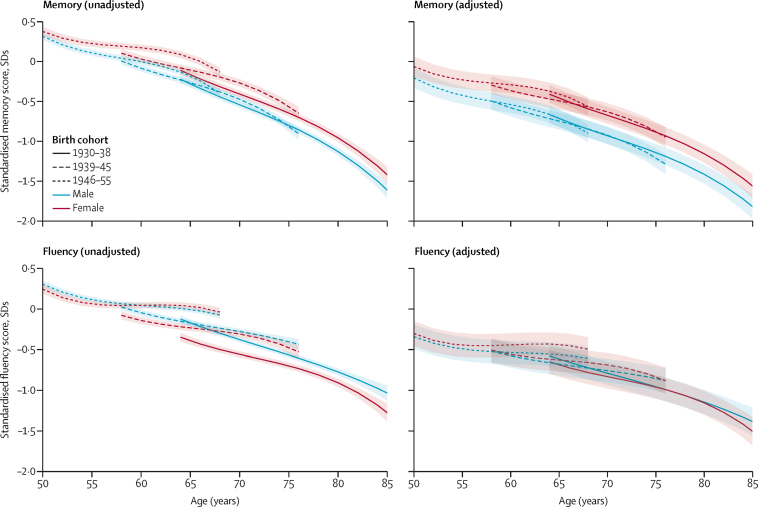
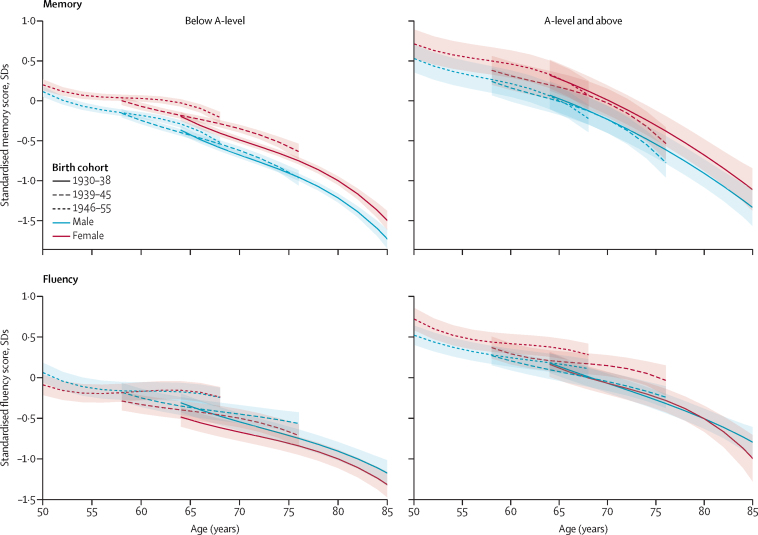
BACKGROUND: Previous studies have shown an excess risk of Alzheimer's disease and related dementias among women. Education is thought to have a causal association with dementia onset. We aimed to investigate the role of education in influencing sex differences in cognitive ageing. METHODS: We analysed data from two prospective cohort studies in the UK; the English Longitudinal Study of Ageing (ELSA) and the Whitehall II study, to assess sex differences in cognitive performance and cognitive decline by birth cohort (birth year 1930-38, 1939-45, or 1946-55), before and after adjustment for education, and by high and low education level. Memory was assessed using immediate recall, for which data were available from all waves of the ELSA (2002-14) and Whitehall II (1997-2015) studies. Fluency was assessed using a semantic fluency test based on an animal naming task, with data available from all waves of the Whitehall II study and waves one to five (2002-10) and wave seven (2014) of the ELSA study. Cognitive scores were standardised separately in each study based on the mean and SD of the corresponding test among participants aged 50-59 years with secondary education. FINDINGS: 15 924 participants were included from the two studies. In pooled analyses, women had better memory scores than men in all birth cohorts, irrespective of adjustment for education (eg, at age 60 years, birth cohort 1930-38, mean difference between sexes [male scores minus female scores] -0·25 SDs [95% CI -0·32 to -0·19] after adjustment for education), and in both education level groups. Memory decline was faster in men than in women (at age 60 years, birth cohort 1946-55, mean difference in 13-year change -0·15 SDs [-0·20 to -0·09]; after adjustment for education -0·14 SDs [-0·20 to -0·08]). Men had better fluency scores than women in earlier birth cohorts and in the low education group (at age 60 years, birth cohort 1930-38, mean difference 0·20 SDs [95% CI 0·05 to 0·36]); but women had better fluency scores than men in later birth cohorts and in the high education group (at age 60 years, birth cohort 1946-55, mean difference -0·17 SDs [-0·24 to -0·10]). No sex differences were observed for fluency decline. INTERPRETATION: Our findings suggest that decreasing disparities between sexes in education, due to secular increases in educational opportunities, could attenuate sex differences in dementia risk and cognitive decline in the future. FUNDING: National Institute on Aging, National Institutes of Health; UK Medical Research Council; British Heart Foundation; and National Institute for Health Research.
Overview
The claims and statistics of this paper haven’t been checked yet.
Free: it reads the open-access text and checks the first 5 claims that cite a source we can check. Create a free account to check every claim.
Integrity signals
Registry
Cites
Statistics
Figures
Verification
Claims the paper makes
The claims and statistics of this paper haven’t been checked yet.
Free: it reads the open-access text and checks the first 5 claims that cite a source we can check. Create a free account to check every claim.
Claims other papers make about this one
Each is checked against this paper’s own text: does it say what the citing paper says it does?
The cited source doesn’t support the claim as written.
In the citing paper
“A UK study of 15,924 participants found that women born more recently were catching up with me n's higher memory and fluency scores, as women's access to education increases.(59)”
From Dementia prevention, intervention, and care: 2024 report of the Lancet standing Commission (2024) · cites this paper as [59]
Checked by a reasoning model — may be wrong.
Experimental — accuracy not yet measured
Self-check
Percentages, sums and reported differences re-computed from the paper’s own numbers.
The self-check needs the paper’s full text.
Citations
Cites
Kyu, H. H., Abate, D., Abate, K. H., Abay, S. M., Abbafati, C., Abbasi, N., Abbastabar, H., Abd-Allah, F., Abdela, J., Abdelalim, A., et al. (2018) · The Lancet · doi:10.1016/s0140-6736(18)32335-3 · Cited by 4,081
Hay, S. I., Abajobir, A. A., Abate, K. H., Abbafati, C., Abbas, K. M., Abd-Allah, F., Abdulkader, R. S., Abdulle, A. M., Abebo, T. A., Abera, S. F., et al. (2017) · The Lancet · doi:10.1016/s0140-6736(17)32130-x · Cited by 2,083
Cohort profile: The English longitudinal study of ageing
Steptoe, A., Breeze, E., Banks, J., & Nazroo, J. (2013) · International Journal of Epidemiology · doi:10.1093/ije/dys168 · Cited by 1,779
Self-citationPechtel, P., & Pizzagalli, D. A. (2011) · Psychopharmacology · doi:10.1007/s00213-010-2009-2 · Cited by 1,352
Clinical epidemiology of Alzheimer’s disease: assessing sex and gender differences
Mielke, M., Vemuri, P., & Rocca, W. (2014) · Clinical Epidemiology · doi:10.2147/clep.s37929 · Cited by 1,021
Understanding the impact of sex and gender in Alzheimer’s disease: A call to action
Nebel, R. A., Aggarwal, N. T., Barnes, L. L., Gallagher, A., Goldstein, J. M., Kantarci, K., Mallampalli, M. P., Mormino, E. C., Scott, L., Yu, W. H., et al. (2018) · Alzheimer's & Dementia · doi:10.1016/j.jalz.2018.04.008 · Cited by 839
Timing of onset of cognitive decline: results from Whitehall II prospective cohort study
Singh-Manoux, A., Kivimaki, M., Glymour, M. M., Elbaz, A., Berr, C., Ebmeier, K. P., Ferrie, J. E., & Dugravot, A. (2012) · BMJ · doi:10.1136/bmj.d7622 · Cited by 836
Self-citationCohort Profile: The Whitehall II study
Marmot, M., & Brunner, E. (2005) · International Journal of Epidemiology · doi:10.1093/ije/dyh372 · Cited by 788
Gao, S., Hendrie, H. C., Hall, K. S., & Hui, S. (1998) · Archives of General Psychiatry · doi:10.1001/archpsyc.55.9.809 · Cited by 754
Considering sex and gender in Alzheimer disease and other dementias
Podcasy, J. L., & Epperson, C. N. (2016) · Dialogues in Clinical Neuroscience · doi:10.31887/dcns.2016.18.4/cepperson · Cited by 707
Research works printed but not linked: 1
- 23. Office for National Statistics 2001 Census: aggregate data 10.5257/census/aggregate-2001-2 May, 2011 · doi:10.5257/census/aggregate-2001-2
Cited by
Dementia prevention, intervention, and care: 2024 report of the Lancet standing Commission
Livingston, G., Huntley, J., Liu, K. Y., Costafreda, S. G., Selbæk, G., Alladi, S., Ames, D., Banerjee, S., Burns, A., Brayne, C., et al. (2024) · The Lancet · doi:10.1016/s0140-6736(24)01296-0 · Cited by 3,860
Self-citationSex and gender differences in cognitive resilience to aging and Alzheimer's disease
Arenaza‐Urquijo, E. M., Boyle, R., Casaletto, K., Anstey, K. J., Vila‐Castelar, C., Colverson, A., Palpatzis, E., Eissman, J. M., Kheng Siang Ng, T., Raghavan, S., et al. (2024) · Alzheimer's & Dementia · doi:10.1002/alz.13844 · Cited by 223
“75 In Europe, a study reported that the magnitude of sex differences in three separate cognitive domains varied systematically by birth cohort and region, and was confounded by gender-specific changes in living conditions and levels of cognitive enrichment.”
Mielke, M. M., Aggarwal, N. T., Vila‐Castelar, C., Agarwal, P., Arenaza‐Urquijo, E. M., Brett, B., Brugulat‐Serrat, A., DuBose, L. E., Eikelboom, W. S., Flatt, J., et al. (2022) · Alzheimer's & Dementia · doi:10.1002/alz.12662 · Cited by 198
Payne, A., Nahashon, S., Taka, E., Adinew, G. M., & Soliman, K. F. A. (2022) · Biomolecules · doi:10.3390/biom12030371 · Cited by 165
“[119] evaluated cognitive decline and performance correlated to aging and education and found that women had stronger memory and lesser memory decline than men regardless of education level.”
BackgroundMcGrattan, A., Pakpahan, E., Siervo, M., Mohan, D., Reidpath, D. D., Prina, M. A., Allotey, P. A., Zhu, Y., Shulin, C., Yates, J., et al. (2022) · Alzheimer s & Dementia Translational Research & Clinical Interventions · doi:10.1002/trc2.12267 · Cited by 111
Udeh-Momoh, C., & Watermeyer, T. (2021) · Ageing Research Reviews · doi:10.1016/j.arr.2021.101459 · Cited by 67
An Early and Unequal Decline: Life Course Trajectories of Cognitive Aging in the United States
Yang, Y. C., Walsh, C., Shartle, K., Stebbins, R. C., Aiello, A. E., Belsky, D. W., Harris, K. M., Chanti‐Ketterl, M., & Plassman, B. L. (2023) · Journal of Aging and Health · doi:10.1177/08982643231184593 · Cited by 68
“…based on older adults and shows mixed results of differential baseline cognitive performance and rates of change with age by population sub-groups (Ardila et al., 2000; Bloomberg et al., 2021; Brown, 2010; Brown & Mutambudzi, 2022; Karlamangla et al., 2009; Levine et al., 2021; Weuve et al., 2018).”
BackgroundMortality and morbidity in ageing men: Biology, Lifestyle and Environment
Zhao, E., & Crimmins, E. M. (2022) · Reviews in Endocrine and Metabolic Disorders · doi:10.1007/s11154-022-09737-6 · Cited by 73
Zotcheva, E., Håberg, A. K., Wisløff, U., Salvesen, Ø., Selbæk, G., Stensvold, D., & Ernstsen, L. (2022) · Sports Medicine · doi:10.1007/s40279-021-01608-5 · Cited by 43
“Additionally, several studies indicate higher resilience to age-related cognitive decline in women as opposed to men [46, 47].”
BackgroundSex/gender and socioeconomic differences in modifiable risk factors for dementia
Geraets, A. F. J., & Leist, A. K. (2023) · Scientific Reports · doi:10.1038/s41598-022-27368-4 · Cited by 43
Construction of a risk prediction model for Alzheimer’s disease in the elderly population
Wang, L., Li, P., Hou, M., Zhang, X., Cao, X., & Li, H. (2021) · BMC Neurology · doi:10.1186/s12883-021-02276-8 · Cited by 49
Lowry, E., McInerney, A. M., Schmitz, N., & Deschênes, S. S. (2022) · Social Psychiatry and Psychiatric Epidemiology · doi:10.1007/s00127-022-02315-w · Cited by 44
“Educational level was modelled as a dichotomous variable in line with previous work [52]: 0–11 years of schooling (up to O-levels) was classified as ‘low’ and 12 + years of schooling (A-levels and above) was classified as ‘high.”
MethodBloomberg, M., Dugravot, A., Sommerlad, A., Kivimäki, M., Singh-Manoux, A., & Sabia, S. (2023) · Age and Ageing · doi:10.1093/ageing/afad019 · Cited by 34
Self-citationEducation and cognitive function among older adults in Brazil and Mexico
Gonçalves, N. G., Avila, J. C., Bertola, L., Obregón, A. M., Ferri, C. P., Wong, R., & Suemoto, C. K. (2023) · Alzheimer s & Dementia Diagnosis Assessment & Disease Monitoring · doi:10.1002/dad2.12470 · Cited by 45
LaPlume, A. A., McKetton, L., Levine, B., Anderson, N. D., & Troyer, A. K. (2022) · Alzheimer s & Dementia Diagnosis Assessment & Disease Monitoring · doi:10.1002/dad2.12301 · Cited by 34
Sex‐specific genetic architecture of late‐life memory performance
Eissman, J. M., Archer, D. B., Mukherjee, S., Lee, M. L., Choi, S., Scollard, P., Trittschuh, E. H., Mez, J., Bush, W. S., Kunkle, B. W., et al. (2023) · Alzheimer s & Dementia · doi:10.1002/alz.13507 · Cited by 28
Poorer sleep impairs brain health at midlife
Namsrai, T., Ambikairajah, A., & Cherbuin, N. (2023) · Scientific Reports · doi:10.1038/s41598-023-27913-9 · Cited by 30
Urbano, T., Chiari, A., Malagoli, C., Cherubini, A., Bedin, R., Costanzini, S., Teggi, S., Maffeis, G., Vinceti, M., & Filippini, T. (2023) · Environmental Research · doi:10.1016/j.envres.2023.115425 · Cited by 28
Hofbauer, L. M., & Rodriguez, F. S. (2021) · International Psychogeriatrics · doi:10.1017/s1041610221000995 · Cited by 26
Sayfullaeva, J., McLoughlin, J., & Kwakowsky, A. (2024) · Journal of Alzheimer s Disease · doi:10.3233/jad-240899 · Cited by 28
Tu, L., Lv, X., Yuan, C., Chen, H., Yu, X., Wang, H., & Zhang, Q. (2024) · International Journal of Geriatric Psychiatry · doi:10.1002/gps.6072 · Cited by 21
“42 Second, with poor education comes poor baseline MMSE scores.”
BackgroundWeßel, M. (2021) · Medicine Health Care and Philosophy · doi:10.1007/s11019-021-10052-1 · Cited by 22
Vlachantoni, A., Falkingham, J., Evandrou, M., & Qin, M. (2023) · Journal of Applied Gerontology · doi:10.1177/07334648231153385 · Cited by 18
Kim, R., & Chung, W. (2022) · Healthcare · doi:10.3390/healthcare10061062 · Cited by 16
“genders by improving opportunities for learning could attenuate gender differences in cognitive decline in the future [60].”
BackgroundHong, C., Liu, Z., Liu, Y., Jin, Y., & Luo, Y. (2023) · The Journals of Gerontology Series A · doi:10.1093/gerona/glad232 · Cited by 22
A case for seeking sex-specific treatments in Alzheimer’s disease
Lynch, M. A. (2024) · Frontiers in Aging Neuroscience · doi:10.3389/fnagi.2024.1346621 · Cited by 21
Birth Cohorts and Cognitive Reserve Influence Cognitive Performances in Older Adults
Turcotte, V., Initiative, A. D. N., Potvin, O., Dadar, M., Hudon, C., & Duchesne, S. (2021) · Journal of Alzheimer s Disease · doi:10.3233/jad-215044 · Cited by 17
“Our results are similar to those of Bloomberg et al. [35] who report that women in all birth cohorts (1930 to 1938, 1939–1945, 1946–1955) outperformed men in verbal episodic memory (i.e., immediate recall of a word list) and language and semantic memory (i.e., semantic verbal fluency – animal).”
InfluentialWetterberg, H., Najar, J., Sterner, T. R., Rydén, L., Falk, H., Sacuiu, S. F., Kern, S., Zettergren, A., & Skoog, I. G. (2023) · The Journals of Gerontology Series A · doi:10.1093/gerona/glad071 · Cited by 16
“As higher education is associated with a lower risk of dementia (21), and women have had an increasing access to education during the past century which has led to increased cognitive function in women (22), we also hypothesized that this decrease was more accentuated among women.”
Westrick, A. C., Avila‐Rieger, J. F., Gross, A. L., Hohman, T. J., Vonk, J. M. J., Zahodne, L. B., & Kobayashi, L. C. (2023) · Alzheimer s & Dementia · doi:10.1002/alz.13404 · Cited by 13
“Given that biological sex differences that may affect memory are not considered to vary across these populations, these cross-national variations in the magnitude and direction of gender disparities in later-life memory may be due to differences in societal gender inequities between the United…”
BackgroundThe effect of age on executive functions in adults is not sex specific
Lemire, M., Soulières, I., & Saint‐Amour, D. (2024) · Journal of the International Neuropsychological Society · doi:10.1017/s1355617723011487 · Cited by 15
Badham, S. P. (2024) · Developmental Review · doi:10.1016/j.dr.2024.101124 · Cited by 18
Incidence of dementia over a period of 20 years in a Norwegian population
Johnsen, B., Martinaityte, I., Wilsgaard, T., & Schirmer, H. (2023) · Alzheimer s & Dementia Diagnosis Assessment & Disease Monitoring · doi:10.1002/dad2.12479 · Cited by 14
Female advantage in verbal learning revisited: a HUNT study
Kljajević, V., Evensmoen, H. R., Sokołowski, D. R., Pani, J., Hansen, T. I., & Haberg, A. K. (2023) · Memory · doi:10.1080/09658211.2023.2203431 · Cited by 14
“, 2013), while another study showed a female advantage when the lists were 10 and 20 words long (Bloomberg et al., 2021).”
BackgroundInfluentialRahman, M. S., Harrison, E., Biggs, H., Seikus, C., Elliott, P., Breen, G. D., Kingston, N., Bradley, J. R., Hill, S. M., Tom, B. D. M., et al. (2024) · Nature Medicine · doi:10.1038/s41591-024-02960-5 · Cited by 15
“Although several previous studies reported differences in cognition between males and females, these have been inconsistent 17–22 .”
Zhu, Y., Li, C., Gao, D., Huang, X., Zhang, Y., Ji, M., Zheng, F., & Xie, W. (2024) · The Journal of Prevention of Alzheimer s Disease · doi:10.14283/jpad.2024.91 · Cited by 12
“All three tests have been proved with good validity and reliability (16-18).”
Sex differences in cognitive decline among middle-aged and older adults: a cohort study in Europe
Wolfová, K., Fryčová, B., Šeblová, D., Tom, S. E., Skirbekk, V., & Kearns, P. B. (2024) · Age and Ageing · doi:10.1093/ageing/afae078 · Cited by 12
Besser, L. M., Fuentes, A. J., Zhang, J., O’Shea, D. M., & Galvin, J. E. (2024) · Journal of Alzheimer s Disease · doi:10.1177/13872877241283823 · Cited by 9
“40 In that study, women in all birth cohorts (1930 – 1955) scored better on memory than men, men with lower education had higher semantic fl uency, and women with greater education performed better on semantic fl uency.”
X‐chromosome-wide association study for Alzheimer’s disease
Borgne, J. L., Gomez, L., Heikkinen, S., Amin, N., Ahmad, S., Choi, S. H., Bis, J. C., Grenier‐Boley, B., Rodriguez, O. G., Kleineidam, L., et al. (2024) · Molecular Psychiatry · doi:10.1038/s41380-024-02838-5 · Cited by 14
Bloomberg, M., & Steptoe, A. (2025) · Age and Ageing · doi:10.1093/ageing/afaf067 · Cited by 10
Self-citationMachado‐Fragua, M. D., Dugravot, A., Dumurgier, J., Kivimäki, M., Sommerlad, A., Landré, B., Fayossé, A., Sabia, S., & Singh‐Manoux, A. (2021) · The Lancet Healthy Longevity · doi:10.1016/s2666-7568(21)00117-3 · Cited by 10
Self-citationKarstens, A. J., Maynard, T. R., & Tremont, G. N. (2023) · Journal of the International Neuropsychological Society · doi:10.1017/s1355617723000085 · Cited by 11
Selbæk, G. (2021) · The Lancet Public Health · doi:10.1016/s2468-2667(21)00010-4 · Cited by 9
Latent change‐on‐change between amyloid accumulation and cognitive decline
Klinger, H. M., Healy, B. C., Hanseeuw, B. J., Jones, R. N., Boyle, R. T., Townsend, D. L., Properzi, M. J., Coughlan, G., Seto, M., Birkenbihl, C., et al. (2024) · Alzheimer s & Dementia · doi:10.1002/alz.14326 · Cited by 7
Krijnen, E. A., van Dam, M., Bajrami, A., Bouman, P. M., Noteboom, S., Barkhof, F., Uitdehaag, B. M. J., Steenwijk, M. D., Klawiter, E. C., Koubiyr, I., et al. (2024) · Annals of Clinical and Translational Neurology · doi:10.1002/acn3.52261 · Cited by 10
Merten, N., Pinto, A. A., Paulsen, A. J., Chen, Y., Schubert, C. R., & Cruickshanks, K. J. (2022) · Maturitas · doi:10.1016/j.maturitas.2022.04.002 · Cited by 15
Torres, J. M., Calderon, L. E., Kogut, K. R., MacCuish, K., Warner, M. L., Rodríguez, M. T. G., Garcia, L., Romero, M., Morga, N., McDowell-Sanchez, A. K., et al. (2025) · American Journal of Epidemiology · doi:10.1093/aje/kwaf036 · Cited by 10
Han, F., Kong, X., Lv, W., Li, S., Sun, Y., & Wu, Y. (2022) · Archives of Gerontology and Geriatrics · doi:10.1016/j.archger.2022.104827 · Cited by 10
Caminiti, S. P., Gallo, S., Menegon, F., Naldi, A., Comi, C., & Tondo, G. (2023) · CNS & Neurological Disorders - Drug Targets · doi:10.2174/1871527322666230616121213 · Cited by 9
Resciniti, N. V., Farina, M. P., Merchant, A. T., & Lohman, M. C. (2022) · Journal of Aging and Health · doi:10.1177/08982643221100688 · Cited by 8
“The findings that males experience greater cognitive decline has been consistently reported previously (Bloomberg et al., 2021; McCarrey et al., 2016).”
ResultJohnsen, B., Strand, B. H., Martinaityte, I., Lorem, G. F., & Schirmer, H. (2022) · Frontiers in Aging Neuroscience · doi:10.3389/fnagi.2022.906678 · Cited by 6
“For short-term memory, data from a large prospective cohort showed that women had better memory scores than men, and memory decline was faster for men than for women (Bloomberg et al., 2021).”
BackgroundSantoso, C. M. A., Stückler, D., & Ihle, A. (2022) · Scientific Reports · doi:10.1038/s41598-022-25143-z · Cited by 8
Chen, C., Khanthiyong, B., Charoenlappanit, S., Roytrakul, S., Reynolds, G. P., Thanoi, S., & Nudmamud‐Thanoi, S. (2023) · PLoS ONE · doi:10.1371/journal.pone.0278080 · Cited by 6
“This idea was partially supported by earlier findings that education as well as closing the gap between males and females in educational opportunities, promote cognitive performance in females [18], and the skills required for efficient completion of the WCST may be closely associated with those taught and required in…”
BackgroundResultHoonte, F. T., Rietman, M. L., Wesenhagen, K. E. J., Picavet, H. S. J., & Verschuren, W. M. M. (2026) · International Journal of Obesity · doi:10.1038/s41366-026-02034-1 · Cited by 11
“For example, sex differences in cognitive function have been documented [5 – 7].”
Wong, J. Y. H., & Zang, E. X. (2025) · Health & Place · doi:10.1016/j.healthplace.2025.103475 · Cited by 5
Liew, T. M., & Ang, L. C. (2024) · Social Science & Medicine · doi:10.1016/j.socscimed.2024.116845 · Cited by 5
Variation in Adult Cognition Across Domains and Life Course Place Effects in the UK
Topping, M., Fletcher, J. M., & Kim, J. (2024) · Journal of Aging and Health · doi:10.1177/08982643241264586 · Cited by 5
“Some prior work that has looked at two cohorts in the UK fi nds that women in the earlier cohort had lower cognitive scores than males, which could be a function of differences in access to educational opportunities at the time (Bloomberg et al., 2021).”
Martínez, L. A., & Arrázola, M. B. V. (2024) · Health Education · doi:10.1108/he-10-2023-0104 · Cited by 5
Sex Differences in Longitudinal Trajectories of Cognitive Aging in Zaragoza, Spain
Lobo, E., Lobo, A., Gracia‐García, P., López‐Antón, R., Saz, P., & de la Cámara, C. (2023) · American Journal of Geriatric Psychiatry · doi:10.1016/j.jagp.2023.04.012 · Cited by 6
Cognitive ageing: sex and life course social class differences in England
Richards, L., Maharani, A., & Präg, P. (2025) · Social Science & Medicine · doi:10.1016/j.socscimed.2025.118787 · Cited by 4
Nichols, E., Jones, R. N., Gross, A. L., Hayat, S. A., Zaninotto, P., & Lee, J. (2024) · Alzheimer s & Dementia · doi:10.1002/alz.14175 · Cited by 7
Souza, M. A., Bomfim, L. G. P., de Barros, V. L., Júnior, R. C. M., Ginsicke, D. C., Colovati, M. E. S., Daly, T. P., & Zanesco, A. (2022) · Journal of Alzheimer s Disease · doi:10.3233/jad-220517 · Cited by 5
“Nevertheless, the impact of schooling level on cognition is quite complex when sex-related differences are examined [9].”
Sin, J. E., Kim, H., Hwang, I., & Noh, M. (2023) · BMC Oral Health · doi:10.1186/s12903-023-03724-2 · Cited by 4
“…a recent analysis of two UK-based prospective cohort studies, including 15,924 participants from the English Longitudinal Study of Ageing (ELSA) and the Whitehall II study, revealed that disparities between sexes in education yielded sex differences in cognitive outcomes in older adults [83].”
BackgroundBohn, L., Han, A. Y., McFall, G. P., Drouin, S. M., Pettersen, J. A., Rajah, M. N., Einstein, G., Anstey, K. J., & Dixon, R. A. (2024) · Innovation in Aging · doi:10.1093/geroni/igae094 · Cited by 3
Verona, A. P., Júnior, C. S. D., Leocádio, V. A., & Faerstein, E. (2023) · Dados · doi:10.1590/dados.2024.67.1.311 · Cited by 5
Simeone, P. G., Vadini, F., Tripaldi, R., Liani, R., Ciotti, S., Di Castelnuovo, A., Cipollone, F., & Santilli, F. (2021) · Frontiers in Aging Neuroscience · doi:10.3389/fnagi.2021.632655 · Cited by 3
“While sex-differences in most of cognitive functions may be attributed to sex hormones, as discussed above, or to historical differences in education and cognitive reserve (Bloomberg et al., 2021), memory trajectories appear to be independent of education, and diverse mechanisms should be advocated to explain reported…”
BackgroundSexual education for adolescents: parent role in rural area
Waliyanti, E., & Dewantari, R. A. (2021) · Journal of Health Technology Assessment in Midwifery · doi:10.31101/jhtam.2050 · Cited by 6
Online learning resources recommendation model based on improved NSGA-Ⅱ algorithm
Li, H., Gong, R., Hou, P., Xing, L., Jia, D., & Li, H. (2023) · Electronic Research Archive · doi:10.3934/era.2023153 · Cited by 2
A life course approach to neurodegeneration
James, S., Schott, J. M., & Ben‐Shlomo, Y. (2025) · Oxford University Press eBooks · doi:10.1093/oso/9780198895961.003.0011 · Cited by 2
Forsberg, A., Belletier, C., Graham, A. J., Rhodes, S., Barrouillet, P., Camos, V., Cowan, N., Naveh‐Benjamin, M., & Logie, R. H. (2025) · Quarterly Journal of Experimental Psychology · doi:10.1177/17470218251351307 · Cited by 3
“Females were overrepresented to similar extents across the age groups (see Table 1), although some prior research has reported faster memory decline in men than in women (e.g. Bloomberg et al., 2021).”
How Does the Risk of Dementia Change With Each Additional Year of Education?
Cha, H., Farina, M. P., & Hayward, M. D. (2025) · Demography · doi:10.1215/00703370-12231508 · Cited by 2
Ricciardi, E., Spano, G., Giannico, V., Lopez, A., Tinella, L., Napoletano, R., Traficante, S., Sanesi, G., Bosco, A., & Caffò, A. O. (2025) · Aging & Mental Health · doi:10.1080/13607863.2025.2564724 · Cited by 4
“Among them, age, gender, and education were selected in order to examine the potential moderating effect, based on their relevance as core socio-demographic determinants of both cognitive functioning and greenspace exposure (Bloomberg et al., 2021; Braçe et al., 2021; Núñez et al., 2022).”
Cognitive co-ageing with inequitable political ecologies: Deconditioning & urban public transport
Fletcher, J. R. (2025) · Social Science & Medicine · doi:10.1016/j.socscimed.2025.118727 · Cited by 3
Real-world evidence from 50,000 online participants using MoCA-XpressO for cognitive prescreening
Huijbers, W., Wischmann, H.-A., Gruber, J., Pistoia, K. H., Krieger, J., Gillies, M., & Nasreddine, Z. S. (2026) · Scientific Reports · doi:10.1038/s41598-026-35640-0 · Cited by 2
Bohn, L., Vandenberg, P., Fah, H., Rajah, M. N., Einstein, G., & Dixon, R. A. (2026) · Biology of Sex Differences · doi:10.1186/s13293-026-00864-2 · Cited by 3
“Education has been studied as gender-related for this cohort of aging adults [10], as well as in related large-scale longitudinal studies [7, 49, 50].”
Nugroho, D., Risvana, A. A., & Fajri, T. (2023) · SETARA Jurnal Studi Gender dan Anak · doi:10.32332/jsga.v5i01.6848 · Cited by 8
“the risk of dementia and cognitive decline in the future (Bloomberg et al., 2021).”
BackgroundShaffer, C., Andreano, J. M., Touroutoglou, A., Barrett, L. F., Dickerson, B. C., & Wong, B. (2024) · Brain Sciences · doi:10.3390/brainsci14020171 · Cited by 6
“Sex-specific differences in cognitive abilities are well established ([50,51], although these may be mediated by education differences; [52,53]) and higher proportions of female Superagers as opposed to male Su-peragers have been reported [54].”
BackgroundChen, Y., Shipley, M. J., Anand, A., Kimenai, D. M., Ebmeier, K. P., Sabia, S., Singh‐Manoux, A., Deanfield, J. E., Kivimäki, M., Livingston, G., et al. (2025) · European Heart Journal · doi:10.1093/eurheartj/ehaf834 · Cited by 5
Self-citationBonberg, N., Wulms, N., Berger, K., & Minnerup, H. (2022) · Frontiers in Aging Neuroscience · doi:10.3389/fnagi.2022.804842 · Cited by 4
“In general, comparable to our findings, reported sex differences in the rates of cognitive decline were generally small in other studies and mostly affected only some cognitive domains (McCarrey et al., 2016; Reas et al., 2017; Bloomberg et al., 2021; Levine et al., 2021; van Zutphen et al., 2021).”
BackgroundResultDementia and Cognitive Impairment
Chong, Y. F. V., & Tang, S. (2024) · Elsevier eBooks · doi:10.1016/b978-0-323-99967-0.00134-4 · Cited by 2
Dias, C. R. C., Rocha, S. V., Ferreira, B. M. P., Cardoso, J. P., Conceição, A. F., & dos Santos, C. A. (2023) · RIAGE - Revista Ibero-Americana de Gerontologia · doi:10.61415/riage.81 · Cited by 1
Toopchiani, S. T., Sindi, S., Poulter, N. R., Kang, S., Udeh‐Momoh, C. T., Price, G. J., Kivipelto, M., Middleton, L. T., & Robinson, O. (2025) · Journal of Alzheimer s Disease · doi:10.1177/13872877251339833 · Cited by 1
“11,37 The female advantage observed can also be explained by their ability to access and date their memories more ef fi - ciently 38,39 compared to men.”
InfluentialPerianayagam, A., Dandona, R., Selvamani, Y., Salvi, S., Surpum, S., Albanese, E., & Zanwar, P. (2026) · Social Science & Medicine · doi:10.1016/j.socscimed.2026.119185 · Cited by 1
Aspects of Sex and Gender in Disease
Gong, J. (2024) · Springer eBooks · doi:10.1007/978-3-031-32046-0_120-1 · Cited by 2
Kim, G., Joo, Y. Y., Ahn, G., Wang, H., Moon, S., Kim, H., Ahn, W., & Cha, J. (2021) · doi:10.31219/osf.io/5x9hb · Cited by 1
Chen, C., Khanthiyong, B., Charoenlappanit, S., Roytrakul, S., Thanoi, S., & Nudmamud‐Thanoi, S. (2022) · bioRxiv (Cold Spring Harbor Laboratory) · doi:10.1101/2022.11.10.515954 · Cited by 1
Diverging Patterns of Cognitive Decline by Sex and Race-Ethnicity in Seriously Ill Older AmericansPreprint
Mejía‐Guevara, I., & Periyakoil, V. S. (2024) · medRxiv · doi:10.1101/2024.06.27.24309609 · Cited by 1
Chen, Y., Shipley, M. J., Anand, A., Kimenai, D. M., Ebmeier, K. P., Sabia, S., Singh‐Manoux, A., Deanfield, J. E., Mika Kivimaki, B., Livingston, G., et al. (2024) · medRxiv · doi:10.1101/2024.11.19.24317589 · Cited by 1
Self-citationSex Differences in the Associations between Education, Neuropathology, and CognitionPreprint
Raeesi, S., Zeighami, Y., Morrison, C., & Dadar, M. (2026) · medRxiv · doi:10.64898/2026.09.03.26362216 · Cited by 1
INDICATORS OF FUNCTIONAL FITNESS AND COGNITIVE COMMITMENT IN ELDERLY
Dias, C. R. C., Rocha, S. V., Cardoso, J. P., Ferreira, B. M. P., Conceição, A. F., & dos Santos, C. A. (2023) · Revista Brasileira de Medicina do Esporte · doi:10.1590/1517-8692202430022022_0414i · Cited by 2
INDICADORES DE APTIDÃO FUNCIONAL E COMPROMETIMENTO COGNITIVO EM IDOSOS
Dias, C. R. C., Rocha, S. V., Cardoso, J. P., Ferreira, B. M. P., Conceição, A. F., & dos Santos, C. A. (2023) · Revista Brasileira de Medicina do Esporte · doi:10.1590/1517-8692202430022022_0414p
Abbafati, C., Nieddu, L., Bizzozero‐Peroni, B., Christodoulou, G. N., da Silva, D. D., Dziedzic, A. M., Ferreira, N. R., Fornari, A., Jozwiak, J. J., Lanfranchi, F., et al. (2025) · SSRN Electronic Journal · doi:10.2139/ssrn.5220236
Sex Differences in Alzheimer Disease-Related Biomarkers and Dementia Risk
Toopchiani, S. T., Njogu, A. N., Smith, C., Sindi, S., Okoye, O., Watermeyer, T., & Udeh‐Momoh, C. T. (2025) · Springer eBooks · doi:10.1007/978-3-031-80849-4_19 · Cited by 1
Wu, T.-K., Chang, J., Ku, L. E., Chiu, C., & Hu, S. C. (2025) · Aging Neuropsychology and Cognition · doi:10.1080/13825585.2025.2555433
“Regarding the demographic factors, consistent with previous studies, this study found that age was an essential factor associated with cognitive functions (Bloomberg et al., 2021; Morris et al., 2018).”
Hamal, C., Grothe, M., Gross, S., Baijot, J., Schependom, J. V., de Steen, F. V., Penner, I., & Nagels, G. (2025) · Multiple Sclerosis and Related Disorders · doi:10.1016/j.msard.2025.106766
Aspects of Sex and Gender in Disease
Gong, J. (2025) · Springer eBooks · doi:10.1007/978-3-031-73363-5_120
Moe, K., Susumu, O., Yamashiro, D., Kobayashi, M., Yu, N., Sanmei, C., Narazaki, K., Kawai, H., Murayama, H., Kumagai, S., et al. (2025) · Research Square · doi:10.21203/rs.3.rs-7504458/v1
Sin, J.-E., Kim, H.-S., Hwang, I., & Noh, M. (2023) · Figshare · doi:10.6084/m9.figshare.24804241
Ariño-Braña, P., Vieira, R., Soriano‐Mas, C., Raduà, J., & Picó‐Pérez, M. (2026) · NeuroImage · doi:10.1016/j.neuroimage.2026.121777
Lobo, E., de la Cámara, C., Gracia‐García, P., López‐Antón, R., Saz, P., Vaquero-Puyuelo, D., & Lobo, A. (2026) · GeroScience · doi:10.1007/s11357-026-02145-7
“The impact of sex on cognitive decline remains a subject of ongoing controversy [18–20] and warrants further clarification [21].”
NORRISK 2 score is associated with dementia and MCI—the HUNT study
Kleven, S., Ernstsen, L., Kvello-Alme, M., Lydersen, S., Selbæk, G., & Eldholm, R. S. (2026) · Frontiers in Aging Neuroscience · doi:10.3389/fnagi.2026.1750636
Metadata
- Authors
- Bloomberg, M., Dugravot, A., Dumurgier, J., Kivimaki, M., Fayosse, A., Steptoe, A., Britton, A., Singh-Manoux, A., & Sabia, S.
- Affiliations
- University College London (GB)
- Inserm (FR)
- Corresponding author
- Bloomberg, Mikaela
- Venue
- The Lancet Public Health
- Publisher
- Elsevier BV
- Published
- 2021-02
- Volume
- 6
- Issue
- 2
- Pages
- e106-e115
- ISSN
- 2468-2667 (ISSN-L)
- PMC
- PMC8141610
- OpenAlex
- W3125813472
- Cited by
- 114
- References
- 34
- Citations by year
- 2026: 22 · 2025: 17 · 2024: 24 · 2023: 25 · 2022: 15 · 2021: 11
- FWCI
- 13.34
- Type
- journal article
- Language
- en
- Open access
- gold
- doi.org
- Licence
- cc-by
- www.elsevier.com/tdm/userlicense/1.0/ (tdm)
- www.elsevier.com/legal/tdmrep-license (tdm)
- creativecommons.org/licenses/by/4.0/ (vor)
- Locations
- The Lancet Public Health (publishedVersion, cc-by)
- PubMed Central (publishedVersion, cc-by)
- PubMed (publishedVersion)
- DOAJ (DOAJ: Directory of Open Access Journals) (submittedVersion, cc-by-sa)
- UCL Discovery (University College London) (submittedVersion)
- Funders
- Academy of Finland
- Medical Research Council
- NordForsk
- Economic and Social Research Council
- National Institute for Health Research
- National Institutes of Health (R01AG056477, RF1AG062553)
- British Heart Foundation (R01AG017644, RG/16/11/32334)
- Agence Nationale de la Recherche
- Helsinki Institute of Life Science, Helsingin Yliopisto
- National Institute on Aging
- Topics
- Health Sciences › Medicine › Psychiatry and Mental health › Dementia and Cognitive Impairment Research
- Social Sciences › Psychology › Experimental and Cognitive Psychology › Cognitive Abilities and Testing
- Health Sciences › Medicine › Endocrinology, Diabetes and Metabolism › Menopause: Health Impacts and Treatments
- Keywords
- sex differences, cognitive aging, education, cognitive decline, memory, semantic fluency, birth cohort, Alzheimer's disease, dementia risk, women's cognitive performance, English Longitudinal Study of Ageing, Whitehall II study, older adults, sex differences in dementia risk
- MeSH terms
- Age Factors, Aged, Aged, 80 and over, Aging, Alzheimer Disease, Dementia, Educational Status, Female, United Kingdom, Humans, Longitudinal Studies, Male, Middle Aged, Prospective Studies, Risk Factors, Sex Factors, Cognitive Dysfunction
About these checks
Registry, retraction, Cites and statistics results are computed, not judged, with one exception: a printed reference that no index lists is read once by a model before it counts as a citation error. Claims are extracted by a model and kept only when their quote appears verbatim in the text; each cited source is then checked, with a model’s help, for whether it says what the claim relies on. Those verdicts can be wrong — read the claim’s quote and the cited source before relying on one.
Statistics and arithmetic are recomputed, not judged.
Confidence bands are shown only for fields calibrated on our annotated test set. None is calibrated yet, so no band is shown.
What counts as a claim ›How we measure confidence ›How we check this ›
Are you an author, or do you see a problem with this page? Request a review
Data sources
Bibliographic data: Semantic Scholar, OpenAlex, Crossref.
Contains information from the Semantic Scholar Academic Graph Datasets, made available under the ODC Attribution License (ODC-BY 1.0).
Semantic Scholar’s data is described in: Kinney, R., et al. (2023). The Semantic Scholar Open Data Platform. arXiv:2301.10140.
