

Sex differences and the role of education in cognitive ageing: analysis of two UK-based prospective cohort studies
Open accessThe DOI matches its Crossref record; 35 of the 35 references it cites were found in a registry or an index.
Abstract
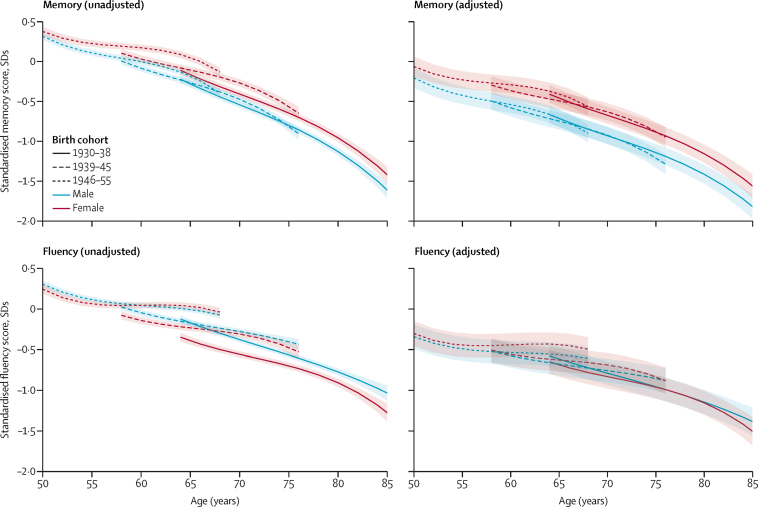
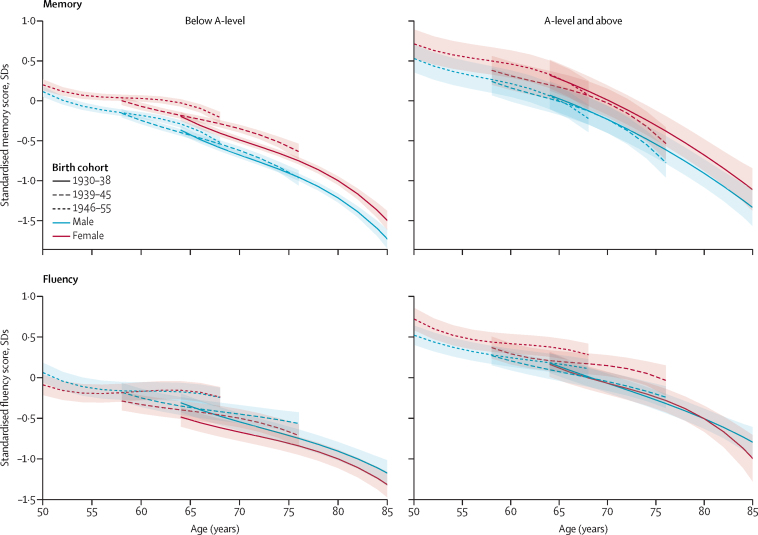
BACKGROUND: Previous studies have shown an excess risk of Alzheimer's disease and related dementias among women. Education is thought to have a causal association with dementia onset. We aimed to investigate the role of education in influencing sex differences in cognitive ageing. METHODS: We analysed data from two prospective cohort studies in the UK; the English Longitudinal Study of Ageing (ELSA) and the Whitehall II study, to assess sex differences in cognitive performance and cognitive decline by birth cohort (birth year 1930-38, 1939-45, or 1946-55), before and after adjustment for education, and by high and low education level. Memory was assessed using immediate recall, for which data were available from all waves of the ELSA (2002-14) and Whitehall II (1997-2015) studies. Fluency was assessed using a semantic fluency test based on an animal naming task, with data available from all waves of the Whitehall II study and waves one to five (2002-10) and wave seven (2014) of the ELSA study. Cognitive scores were standardised separately in each study based on the mean and SD of the corresponding test among participants aged 50-59 years with secondary education. FINDINGS: 15 924 participants were included from the two studies. In pooled analyses, women had better memory scores than men in all birth cohorts, irrespective of adjustment for education (eg, at age 60 years, birth cohort 1930-38, mean difference between sexes [male scores minus female scores] -0·25 SDs [95% CI -0·32 to -0·19] after adjustment for education), and in both education level groups. Memory decline was faster in men than in women (at age 60 years, birth cohort 1946-55, mean difference in 13-year change -0·15 SDs [-0·20 to -0·09]; after adjustment for education -0·14 SDs [-0·20 to -0·08]). Men had better fluency scores than women in earlier birth cohorts and in the low education group (at age 60 years, birth cohort 1930-38, mean difference 0·20 SDs [95% CI 0·05 to 0·36]); but women had better fluency scores than men in later birth cohorts and in the high education group (at age 60 years, birth cohort 1946-55, mean difference -0·17 SDs [-0·24 to -0·10]). No sex differences were observed for fluency decline. INTERPRETATION: Our findings suggest that decreasing disparities between sexes in education, due to secular increases in educational opportunities, could attenuate sex differences in dementia risk and cognitive decline in the future. FUNDING: National Institute on Aging, National Institutes of Health; UK Medical Research Council; British Heart Foundation; and National Institute for Health Research.
Overview
The claims and statistics of this paper haven’t been checked yet.
Free: it reads the open-access text and checks the first 5 claims that cite a source we can check. Create a free account to check every claim.
Integrity signals
Registry
Cites
Statistics
Figures
Verification
Claims the paper makes
The claims and statistics of this paper haven’t been checked yet.
Free: it reads the open-access text and checks the first 5 claims that cite a source we can check. Create a free account to check every claim.
Claims other papers make about this one
Each is checked against this paper’s own text: does it say what the citing paper says it does?
The cited source doesn’t support the claim as written.
In the citing paper
“A UK study of 15,924 participants found that women born more recently were catching up with me n's higher memory and fluency scores, as women's access to education increases.(59)”
From Dementia prevention, intervention, and care: 2024 report of the Lancet standing Commission (2024) · cites this paper as [59]
Checked by a reasoning model — may be wrong.
Experimental — accuracy not yet measured
Self-check
Percentages, sums and reported differences re-computed from the paper’s own numbers.
The self-check needs the paper’s full text.
Citations
Cites
Kyu, H. H., Abate, D., Abate, K. H., Abay, S. M., Abbafati, C., Abbasi, N., Abbastabar, H., Abd-Allah, F., Abdela, J., Abdelalim, A., et al. (2018) · The Lancet · doi:10.1016/s0140-6736(18)32335-3 · Cited by 4,081
Hay, S. I., Abajobir, A. A., Abate, K. H., Abbafati, C., Abbas, K. M., Abd-Allah, F., Abdulkader, R. S., Abdulle, A. M., Abebo, T. A., Abera, S. F., et al. (2017) · The Lancet · doi:10.1016/s0140-6736(17)32130-x · Cited by 2,083
Cohort profile: The English longitudinal study of ageing
Steptoe, A., Breeze, E., Banks, J., & Nazroo, J. (2013) · International Journal of Epidemiology · doi:10.1093/ije/dys168 · Cited by 1,779
Self-citationPechtel, P., & Pizzagalli, D. A. (2011) · Psychopharmacology · doi:10.1007/s00213-010-2009-2 · Cited by 1,352
Clinical epidemiology of Alzheimer’s disease: assessing sex and gender differences
Mielke, M., Vemuri, P., & Rocca, W. (2014) · Clinical Epidemiology · doi:10.2147/clep.s37929 · Cited by 1,021
Understanding the impact of sex and gender in Alzheimer’s disease: A call to action
Nebel, R. A., Aggarwal, N. T., Barnes, L. L., Gallagher, A., Goldstein, J. M., Kantarci, K., Mallampalli, M. P., Mormino, E. C., Scott, L., Yu, W. H., et al. (2018) · Alzheimer's & Dementia · doi:10.1016/j.jalz.2018.04.008 · Cited by 839
Timing of onset of cognitive decline: results from Whitehall II prospective cohort study
Singh-Manoux, A., Kivimaki, M., Glymour, M. M., Elbaz, A., Berr, C., Ebmeier, K. P., Ferrie, J. E., & Dugravot, A. (2012) · BMJ · doi:10.1136/bmj.d7622 · Cited by 836
Self-citationCohort Profile: The Whitehall II study
Marmot, M., & Brunner, E. (2005) · International Journal of Epidemiology · doi:10.1093/ije/dyh372 · Cited by 788
Gao, S., Hendrie, H. C., Hall, K. S., & Hui, S. (1998) · Archives of General Psychiatry · doi:10.1001/archpsyc.55.9.809 · Cited by 754
Considering sex and gender in Alzheimer disease and other dementias
Podcasy, J. L., & Epperson, C. N. (2016) · Dialogues in Clinical Neuroscience · doi:10.31887/dcns.2016.18.4/cepperson · Cited by 707
Cited by
Items 101–114 of 114
Life-course socioeconomic trajectories and cognitive aging in Chinese middle-aged and older adults
Gao, M., Cai, W., Ma, Y., Yang, M., He, L., Li, L., & Fang, Y. (2026) · Innovation in Aging · doi:10.1093/geroni/igag030
“4,8,38,41 Therefore, sex-stratified LMMs were applied in the subsequent analyses.”
Niazi, M., Andel, R., Saenz, J. L., Lim, J., Sheardová, K., Pavlik, J., Vališ, M., Amlerová, J., & Hort, J. (2026) · Aging & Mental Health · doi:10.1080/13607863.2026.2656223
“Many participants, particularly women born in the post-World War II period, may have had more limited educational opportunities, which could influence both cognitive reserve and later-life cognitive health (Bloomberg et al., 2021).”
Sex Also Matters: Menopause, Memory, and Mood
Hayden, S. (2026) · Springer eBooks · doi:10.1007/978-3-032-21818-6_8
Sex differences in modifiable risk profiles for cognitive decline: findings from DeCo Chair ProjectPreprint
García-Zamora, M., Gil‐Peinado, M., Pardo, J., & Royo, L. (2026) · Research Square · doi:10.21203/rs.3.rs-9265483/v1
Cognitive functioning and dementia in aging women
Mielke, M. M., Lee, J., & Yaffe, K. S. (2026) · Elsevier eBooks · doi:10.1016/b978-0-443-45863-7.00109-8
Schonberg, M. A. (2026) · Elsevier eBooks · doi:10.1016/b978-0-443-45863-7.00139-6
An, Y. A., Bolduc, M.-È., Pula, G., Selvanathan, T., Brouillette, J., Brossard‐Racine, M., Grewal, J., Kovacs, A. H., & Field, C. T. S. (2026) · CJC Pediatric and Congenital Heart Disease · doi:10.1016/j.cjcpc.2026.06.002
Le, T., Gilleen, J., Lee, A. J., & Maharani, A. (2026) · BMJ Public Health · doi:10.1136/bmjph-2025-004693
“Extending longitudinal analyses to other cognitive domains and incident dementia would clarify whether similar mechanisms operate across outcomes, while validation of retrospective measures through administrative data or sibling comparisons would further enhance causal inference.”
Choi, J., Homer, B., & Kim, S. (2026) · Frontiers in Psychology · doi:10.3389/fpsyg.2026.1738928
“Similarly, women frequently exhibit advantages in baseline episodic memory (Asperholm et al., 2019; Bloomberg et al., 2021), a pattern mirrored in female subgroups here.”
Wang, J. Y., & Ansorage, O. (2026) · BMC Women s Health · doi:10.1186/s12905-026-04712-8
“However, it is still debated whether the protective effect of education on AD is due to larger ‘cognitive reserve’ or better health behaviours [31].”
Gender differences in the associations between cognition and expectations regarding aging
Leung, Y., Sabatini, S., Ginnivan, N., Eramudugolla, R., Mortby, M. E., Peters, R. K., & Anstey, K. J. (2026) · Journal of Women & Aging · doi:10.1080/08952841.2026.2707245
Education, Personality, and Lifestyle Pathways to Cognition Across Groups
Ivleva, V., & Kairys, A. (2026) · GeroPsych · doi:10.1024/1662-9647/a000370
Drouin, S. M., Potvin, O., Fah, H., Anstey, K. J., Masellis, M., Duchesne, S., & Dixon, R. A. (2026) · Neurobiology of Aging · doi:10.1016/j.neurobiolaging.2026.09.002
Metadata
- Authors
- Bloomberg, M., Dugravot, A., Dumurgier, J., Kivimaki, M., Fayosse, A., Steptoe, A., Britton, A., Singh-Manoux, A., & Sabia, S.
- Affiliations
- University College London (GB)
- Inserm (FR)
- Corresponding author
- Bloomberg, Mikaela
- Venue
- The Lancet Public Health
- Publisher
- Elsevier BV
- Published
- 2021-02
- Volume
- 6
- Issue
- 2
- Pages
- e106-e115
- ISSN
- 2468-2667 (ISSN-L)
- PMC
- PMC8141610
- OpenAlex
- W3125813472
- Semantic Scholar
- 62cc1054ba766f9917b760d19089f641a28faa7d
- Cited by
- 114
- References
- 34
- Citations by year
- 2026: 22 · 2025: 17 · 2024: 24 · 2023: 25 · 2022: 15 · 2021: 11
- FWCI
- 13.34
- Type
- journal article
- Language
- en
- Open access
- gold
- doi.org
- Licence
- cc-by
- www.elsevier.com/tdm/userlicense/1.0/ (tdm)
- www.elsevier.com/legal/tdmrep-license (tdm)
- creativecommons.org/licenses/by/4.0/ (vor)
- Locations
- The Lancet Public Health (publishedVersion, cc-by)
- PubMed Central (publishedVersion, cc-by)
- PubMed (publishedVersion)
- DOAJ (DOAJ: Directory of Open Access Journals) (submittedVersion, cc-by-sa)
- UCL Discovery (University College London) (submittedVersion)
- Funders
- Academy of Finland
- Medical Research Council
- NordForsk
- Economic and Social Research Council
- National Institute for Health Research
- National Institutes of Health (R01AG056477, RF1AG062553)
- British Heart Foundation (R01AG017644, RG/16/11/32334)
- Agence Nationale de la Recherche
- Helsinki Institute of Life Science, Helsingin Yliopisto
- National Institute on Aging
- Topics
- Health Sciences › Medicine › Psychiatry and Mental health › Dementia and Cognitive Impairment Research
- Social Sciences › Psychology › Experimental and Cognitive Psychology › Cognitive Abilities and Testing
- Health Sciences › Medicine › Endocrinology, Diabetes and Metabolism › Menopause: Health Impacts and Treatments
- Keywords
- sex differences, cognitive aging, education, cognitive decline, memory, semantic fluency, birth cohort, Alzheimer's disease, dementia risk, women's cognitive performance, English Longitudinal Study of Ageing, Whitehall II study, older adults, sex differences in dementia risk
- MeSH terms
- Age Factors, Aged, Aged, 80 and over, Aging, Alzheimer Disease, Dementia, Educational Status, Female, United Kingdom, Humans, Longitudinal Studies, Male, Middle Aged, Prospective Studies, Risk Factors, Sex Factors, Cognitive Dysfunction
About these checks
Registry, retraction, Cites and statistics results are computed, not judged, with one exception: a printed reference that no index lists is read once by a model before it counts as a citation error. Claims are extracted by a model and kept only when their quote appears verbatim in the text; each cited source is then checked, with a model’s help, for whether it says what the claim relies on. Those verdicts can be wrong — read the claim’s quote and the cited source before relying on one.
Statistics and arithmetic are recomputed, not judged.
Confidence bands are shown only for fields calibrated on our annotated test set. None is calibrated yet, so no band is shown.
What counts as a claim ›How we measure confidence ›How we check this ›
Are you an author, or do you see a problem with this page? Request a review
Data sources
Bibliographic data: Semantic Scholar, OpenAlex, Crossref.
Contains information from the Semantic Scholar Academic Graph Datasets, made available under the ODC Attribution License (ODC-BY 1.0).
Semantic Scholar’s data is described in: Kinney, R., et al. (2023). The Semantic Scholar Open Data Platform. arXiv:2301.10140.
