

The DOI matches its Crossref record; 24 of the 25 references it cites were found in a registry or an index, and 1 are not checked yet; none of the 18 sources its claims cite is checked for support yet.
Changes in symptomatology, reinfection, and transmissibility associated with the SARS-CoV-2 variant B.1.1.7: an ecological study
Open accessAbstract
Background The SARS-CoV-2 variant B.1.1.7 was first identified in December, 2020, in England. We aimed to investigate whether increases in the proportion of infections with this variant are associated with differences in symptoms or disease course, reinfection rates, or transmissibility. Methods We did an ecological study to examine the association between the regional proportion of infections with the SARS-CoV-2 B.1.1.7 variant and reported symptoms, disease course, rates of reinfection, and transmissibility. Data on types and duration of symptoms were obtained from longitudinal reports from users of the COVID Symptom Study app who reported a positive test for COVID-19 between Sept 28 and Dec 27, 2020 (during which the prevalence of B.1.1.7 increased most notably in parts of the UK). From this dataset, we also estimated the frequency of possible reinfection, defined as the presence of two reported positive tests separated by more than 90 days with a period of reporting no symptoms for more than 7 days before the second positive test. The proportion of SARS-CoV-2 infections with the B.1.1.7 variant across the UK was estimated with use of genomic data from the COVID-19 Genomics UK Consortium and data from Public Health England on spike-gene target failure (a non-specific indicator of the B.1.1.7 variant) in community cases in England. We used linear regression to examine the association between reported symptoms and proportion of B.1.1.7. We assessed the Spearman correlation between the proportion of B.1.1.7 cases and number of reinfections over time, and between the number of positive tests and reinfections. We estimated incidence for B.1.1.7 and previous variants, and compared the effective reproduction number, R t , for the two incidence estimates. Findings From Sept 28 to Dec 27, 2020, positive COVID-19 tests were reported by 36 920 COVID Symptom Study app users whose region was known and who reported as healthy on app sign-up. We found no changes in reported symptoms or disease duration associated with B.1.1.7. For the same period, possible reinfections were identified in 249 (0·7% [95% CI 0·6–0·8]) of 36 509 app users who reported a positive swab test before Oct 1, 2020, but there was no evidence that the frequency of reinfections was higher for the B.1.1.7 variant than for pre-existing variants. Reinfection occurrences were more positively correlated with the overall regional rise in cases (Spearman correlation 0·56–0·69 for South East, London, and East of England) than with the regional increase in the proportion of infections with the B.1.1.7 variant (Spearman correlation 0·38–0·56 in the same regions), suggesting B.1.1.7 does not substantially alter the risk of reinfection. We found a multiplicative increase in the R t of B.1.1.7 by a factor of 1·35 (95% CI 1·02–1·69) relative to pre-existing variants. However, R t fell below 1 during regional and national lockdowns, even in regions with high proportions of infections with the B.1.1.7 variant. Interpretation The lack of change in symptoms identified in this study indicates that existing testing and surveillance infrastructure do not need to change specifically for the B.1.1.7 variant. In addition, given that there was no apparent increase in the reinfection rate, vaccines are likely to remain effective against the B.1.1.7 variant. Funding Zoe Global, Department of Health (UK), Wellcome Trust, Engineering and Physical Sciences Research Council (UK), National Institute for Health Research (UK), Medical Research Council (UK), Alzheimer's Society.
Checked 2026-10-06 · 1 reference not checked yet
Overview
AI snapshot
Written from the paper’s full text.
TL;DR
In this ecological study, increasing regional prevalence of SARS-CoV-2 variant B.1.1.7 was not associated with changes in self-reported symptoms or disease duration, nor with higher reinfection frequency. B.1.1.7 was associated with increased transmissibility, with a mean multiplicative increase in Rt of 1·35, but Rt fell below 1 during regional and national lockdowns even in areas with high B.1.1.7 prevalence.
Key findings
- Among 36 920 COVID Symptom Study app users reporting positive COVID-19 tests between Sept 28 and Dec 27, 2020, there was no evidence of an association between the regional proportion of B.1.1.7 infections and reported symptoms, number of symptoms, asymptomatic infection, self-reported hospital visits, or long symptom duration after adjustment and false-discovery-rate control.
- Possible reinfection was identified in 249 (0·7% [95% CI 0·6–0·8]) of 36 509 app users who reported a positive swab before Oct 1, 2020; reinfection frequency was not higher with B.1.1.7. Reinfection occurrences correlated more with overall regional rises in cases (Spearman correlation 0·56–0·69 for South East, London, and East of England) than with regional increases in B.1.1.7 proportion (0·38–0·56 in the same regions).
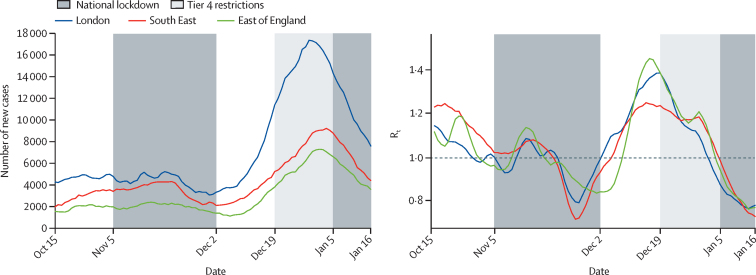
- B.1.1.7 was associated with a mean multiplicative increase in Rt of 1·35 (95% CI 1·02–1·69) and a mean additive increase of 0·34 (95% CI 0·02–0·66) relative to pre-existing variants. After the second lockdown, the mean multiplicative increase was 1·28 (95% CI 1·02–1·61); using SGTF data after Dec 1, 2020, it was 1·25 (95% CI 1·17–1·34).
- Rt fell to around 0·8 in London, the South East, and East of England during the national lockdown beginning Jan 5, 2021, where at least 80% of infections were likely due to B.1.1.7.
Methods
- Ecological study combining longitudinal self-reported symptom and test data from the COVID Symptom Study app (1 767 914 UK users active Sept 28–Dec 27, 2020; symptom analyses focused on 36 920 positive-test users with known region and healthy at sign-up) with COG-UK genomic surveillance and Public Health England spike-gene target failure (SGTF) data.
- Linear regression examined associations between regional B.1.1.7 proportion and reported symptoms, adjusted for age, sex, regional temperature, and humidity, with false discovery rate control. Possible reinfection was defined as two reported positive tests separated by more than 90 days with more than 7 symptom-free days before the second positive test; Spearman correlations and Mann-Whitney U tests compared reinfection correlations.
- Incidence was decomposed into B.1.1.7 and pre-existing variant time-series using COG-UK proportions; Rt was estimated separately for each using a Poisson process and Markov Chain Monte-Carlo methods, assuming a gamma-distributed serial interval with α=6·0 and β=1·5, and compared when regional B.1.1.7 proportion exceeded 3%.
Limitations
- The paper states that the ecological design cannot support causal interpretation, assumes all non-B.1.1.7 variants had the same symptoms, immune response, and transmissibility, and notes that undetected variants with different characteristics cannot be ruled out.
- The paper states that participatory app data have demographic biases, possible ascertainment or collider bias, and self-report errors; asymptomatic and hospital-admission assessments are limited because most users test only when symptomatic and severe hospitalised cases may not self-report, and mortality could not be assessed.
- The paper states that reinfection was inferred from test timing rather than sequencing, prolonged PCR positivity cannot be ruled out, and seasonal effects may not have been fully accounted for despite adjustment for temperature and humidity.
Model-written summary. Check it against the paper before relying on it.
Integrity signals
Registry
Cites
Statistics
Figures
Verification
Claims the paper makes
33 Own result · 14 Own method · 12 Not checked yet · 9 Own interpretation · 5 Sources not found · 1 No basis given
A result the paper reports from its own data — it cites no other source for it, so there is none to check. The quote shows it is in the paper.
In the paper
“For the same period, possible reinfections were identified in 249 (0·7% [95% CI 0·6–0·8]) of 36 509 app users who reported a positive swab test before Oct 1, 2020”
§ Changes in symptomatology, reinfection, and transmissibility associated with the SARS-CoV-2 variant B.1.1.7: an ecological study > Abstract > Findings
hedged- Asserted: passes — The authors put it forward as true.
- Checkable: passes — It can be checked against evidence.
- Load-bearing: passes — The paper’s conclusions depend on it.
- Based: passes — The paper gives a reason why it holds.
- Rests on an assumption: The COVID Symptom Study app users are representative of the UK population for assessing symptoms and reinfection rates.
- Rests on an assumption: Self-reported positive tests and symptom logs in the app are accurate enough to measure infection and symptoms.
A result the paper reports from its own data — it cites no other source for it, so there is none to check. The quote shows it is in the paper.
In the paper
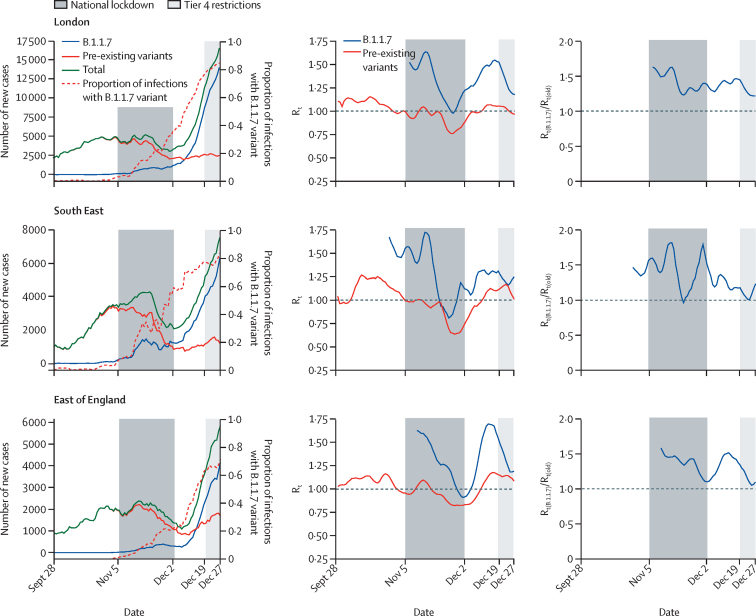
“We found a multiplicative increase in the Rt of B.1.1.7 by a factor of 1·35 (95% CI 1·02–1·69) relative to pre-existing variants.”
- Also stated in: § Introduction · plain
“We found a multiplicative increase in the effective reproduction number, Rt, of the B.1.1.7 variant by a factor of 1·35 (95% CI 1·02–1·69) compared with pre-existing variants.”
§ Changes in symptomatology, reinfection, and transmissibility associated with the SARS-CoV-2 variant B.1.1.7: an ecological study > Abstract > Findings
plaindirect- Asserted: passes — The authors put it forward as true.
- Checkable: passes — It can be checked against evidence.
- Load-bearing: passes — The paper’s conclusions depend on it.
- Based: passes — The paper gives a reason why it holds.
- Rests on an assumption: The COG-UK sequencing sample is representative of all SARS-CoV-2 cases in the regions.
- Also stated in: § Introduction · plain
A result the paper reports from its own data — it cites no other source for it, so there is none to check. The quote shows it is in the paper.
In the paper
“However, Rt fell below 1 during regional and national lockdowns, even in regions with high proportions of infections with the B.1.1.7 variant.”
- Also stated in: § Introduction · plain
“However, we found that Rt fell below 1 during regional and national lockdowns, even in regions with high proportions of infections with the B.1.1.7 variant.”
§ Changes in symptomatology, reinfection, and transmissibility associated with the SARS-CoV-2 variant B.1.1.7: an ecological study > Abstract > Findings
plain- Asserted: passes — The authors put it forward as true.
- Checkable: passes — It can be checked against evidence.
- Load-bearing: passes — The paper’s conclusions depend on it.
- Based: passes — The paper gives a reason why it holds.
- Rests on an assumption: The COG-UK sequencing sample is representative of all SARS-CoV-2 cases in the regions.
- Also stated in: § Introduction · plain
A result the paper reports from its own data — it cites no other source for it, so there is none to check. The quote shows it is in the paper.
In the paper
“From Sept 28 to Dec 27, 2020, positive COVID-19 tests were reported by 36 920 COVID Symptom Study app users whose region was known and who reported as healthy on app sign-up.”
- Also stated in: § Results · plain
“we investigated the symptom reports of the 36 920 of those with a positive test whose region was known and who reported as healthy on app sign-up.”
§ Changes in symptomatology, reinfection, and transmissibility associated with the SARS-CoV-2 variant B.1.1.7: an ecological study > Abstract > Findings
plain- Asserted: passes — The authors put it forward as true.
- Checkable: passes — It can be checked against evidence.
- Load-bearing: passes — The paper’s conclusions depend on it.
- Based: passes — The paper gives a reason why it holds.
- Also stated in: § Results · plain
A result the paper reports from its own data — it cites no other source for it, so there is none to check. The quote shows it is in the paper.
In the paper
“but there was no evidence that the frequency of reinfections was higher for the B.1.1.7 variant than for pre-existing variants.”
§ Changes in symptomatology, reinfection, and transmissibility associated with the SARS-CoV-2 variant B.1.1.7: an ecological study > Abstract > Findings
plain- Asserted: passes — The authors put it forward as true.
- Checkable: passes — It can be checked against evidence.
- Load-bearing: passes — The paper’s conclusions depend on it.
- Based: passes — The paper gives a reason why it holds.
- Rests on an assumption: The COVID Symptom Study app users are representative of the UK population for assessing symptoms and reinfection rates.
- Rests on an assumption: The regional proportion of B.1.1.7 infections is a valid proxy for the variant infecting individual app users in that region.
- Rests on an assumption: Self-reported positive tests and symptom logs in the app are accurate enough to measure infection and symptoms.
A result the paper reports from its own data — it cites no other source for it, so there is none to check. The quote shows it is in the paper.
In the paper
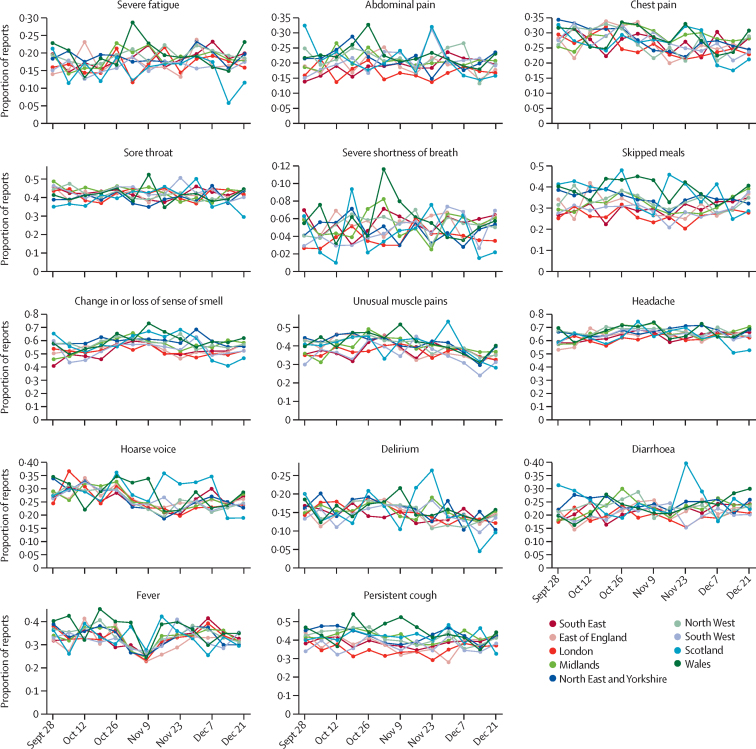
“We found no changes in reported symptoms or disease duration associated with B.1.1.7.”
- Also stated in: § Results · hedged
“When correcting for mean age, sex, and ambient temperature and humidity, there was no evidence of an association between the proportion of infections with the B.1.1.7 variant and the number of symptoms reported over a 4-week period, the number of admissions to hospital, long symptom duration, or the proportion of asymptomatic cases (appendix p 8).”
§ Changes in symptomatology, reinfection, and transmissibility associated with the SARS-CoV-2 variant B.1.1.7: an ecological study > Abstract > Findings
plain- Asserted: passes — The authors put it forward as true.
- Checkable: passes — It can be checked against evidence.
- Load-bearing: passes — The paper’s conclusions depend on it.
- Based: passes — The paper gives a reason why it holds.
- Rests on an assumption: The COVID Symptom Study app users are representative of the UK population for assessing symptoms and reinfection rates.
- Rests on an assumption: The regional proportion of B.1.1.7 infections is a valid proxy for the variant infecting individual app users in that region.
- Rests on an assumption: Self-reported positive tests and symptom logs in the app are accurate enough to measure infection and symptoms.
- Also stated in: § Results · hedged
A result the paper reports from its own data — it cites no other source for it, so there is none to check. The quote shows it is in the paper.
In the paper
“We found no changes in reported symptoms or disease duration associated with B.1.1.7.”
- Also stated in: § Results · plain
“Linear regression (both unadjusted and adjusted for participant age and sex, and regional temperature and humidity) did not show evidence of an association between the proportion of infections with the B.1.1.7 variant and symptoms reported, after controlling for the false discovery rate (appendix p 6).”
- Also stated in: § Results · plain
“Analysis of the variation in symptom occurrence over time showed no qualitative change in the proportion of users reporting each symptom with an increasing proportion of infections with the B.1.1.7 variant (figure 2; appendix p 2).”
§ Changes in symptomatology, reinfection, and transmissibility associated with the SARS-CoV-2 variant B.1.1.7: an ecological study > Abstract > Findings
plain- Asserted: passes — The authors put it forward as true.
- Checkable: passes — It can be checked against evidence.
- Load-bearing: passes — The paper’s conclusions depend on it.
- Based: passes — The paper gives a reason why it holds.
- Rests on an assumption: The COVID Symptom Study app users are representative of the UK population for assessing symptoms and reinfection rates.
- Rests on an assumption: The regional proportion of B.1.1.7 infections is a valid proxy for the variant infecting individual app users in that region.
- Rests on an assumption: Self-reported positive tests and symptom logs in the app are accurate enough to measure infection and symptoms.
- Also stated in: § Results · plain
A result the paper reports from its own data — it cites no other source for it, so there is none to check. The quote shows it is in the paper.
In the paper
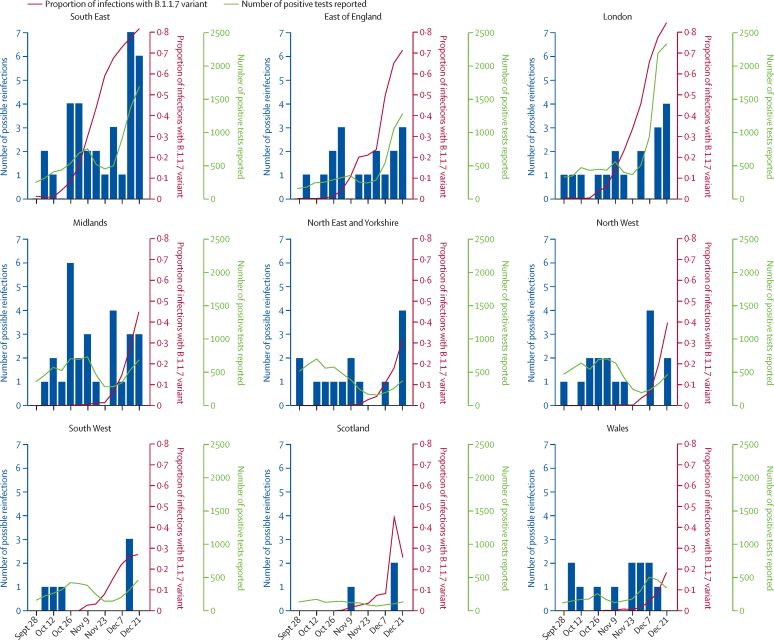
“Reinfection occurrences were more positively correlated with the overall regional rise in cases (Spearman correlation 0·56–0·69 for South East, London, and East of England) than with the regional increase in the proportion of infections with the B.1.1.7 variant (Spearman correlation 0·38–0·56 in the same regions)”
§ Changes in symptomatology, reinfection, and transmissibility associated with the SARS-CoV-2 variant B.1.1.7: an ecological study > Abstract > Findings
plaincorrelational- Asserted: passes — The authors put it forward as true.
- Checkable: passes — It can be checked against evidence.
- Load-bearing: passes — The paper’s conclusions depend on it.
- Based: passes — The paper gives a reason why it holds.
- Rests on an assumption: The COVID Symptom Study app users are representative of the UK population for assessing symptoms and reinfection rates.
- Rests on an assumption: The regional proportion of B.1.1.7 infections is a valid proxy for the variant infecting individual app users in that region.
- Rests on an assumption: Self-reported positive tests and symptom logs in the app are accurate enough to measure infection and symptoms.
A result the paper reports from its own data — it cites no other source for it, so there is none to check. The quote shows it is in the paper.
In the paper
“When assessing the incidence and Rt for pre-existing variants and the B.1.1.7 variant in the three regions in England with the highest proportion of infections with the B.1.1.7 variant, the Rt of the B.1.1.7 variant was consistently greater than that of other variants (figure 4).”
§ Changes in symptomatology, reinfection, and transmissibility associated with the SARS-CoV-2 variant B.1.1.7: an ecological study > Results
plaincorrelational- Asserted: passes — The authors put it forward as true.
- Checkable: passes — It can be checked against evidence.
- Load-bearing: passes — The paper’s conclusions depend on it.
- Based: passes — The paper gives a reason why it holds.
- The authors state this as an assumption: All non-B.1.1.7 variants in circulation at the time of study give rise to the same range of symptoms and immune response, and have the same transmissibility.
A result the paper reports from its own data — it cites no other source for it, so there is none to check. The quote shows it is in the paper.
In the paper
“When correcting for mean age, sex, and ambient temperature and humidity, there was no evidence of an association between the proportion of infections with the B.1.1.7 variant and the number of symptoms reported over a 4-week period, the number of admissions to hospital, long symptom duration, or the proportion of asymptomatic cases (appendix p 8).”
§ Changes in symptomatology, reinfection, and transmissibility associated with the SARS-CoV-2 variant B.1.1.7: an ecological study > Results
plain- Asserted: passes — The authors put it forward as true.
- Checkable: passes — It can be checked against evidence.
- Load-bearing: passes — The paper’s conclusions depend on it.
- Based: passes — The paper gives a reason why it holds.
- Rests on an assumption: The COVID Symptom Study app users are representative of the UK population for assessing symptoms and reinfection rates.
- Rests on an assumption: The regional proportion of B.1.1.7 infections is a valid proxy for the variant infecting individual app users in that region.
- Rests on an assumption: Self-reported positive tests and symptom logs in the app are accurate enough to measure infection and symptoms.
- It may state two separate claims as one. 12
- Probably not a substantial claim. 15
A result the paper reports from its own data — it cites no other source for it, so there is none to check. The quote shows it is in the paper.
In the paper
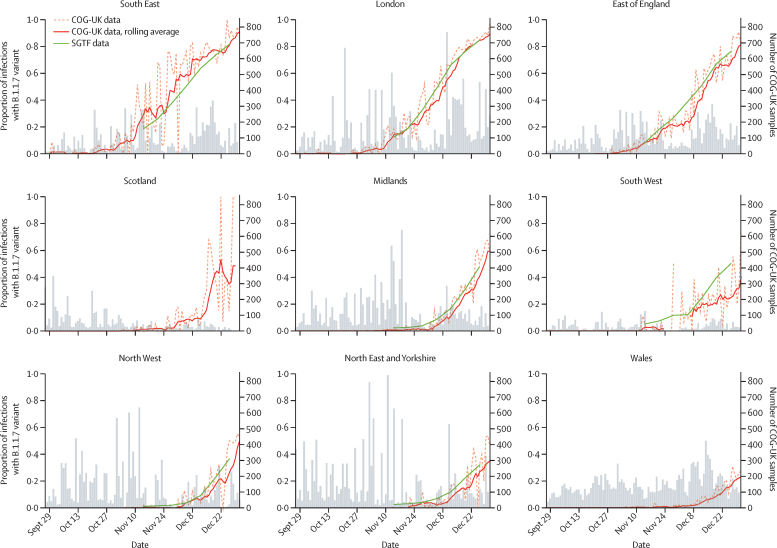
“Considering the mean of the rolling average across December, 2020, the three regions with the largest proportion of infections with the B.1.1.7 variant were the South East, London, and East of England. The three regions with the lowest proportion were Wales, the North East and Yorkshire, and the North West.”
§ Changes in symptomatology, reinfection, and transmissibility associated with the SARS-CoV-2 variant B.1.1.7: an ecological study > Results
plain- Asserted: passes — The authors put it forward as true.
- Checkable: passes — It can be checked against evidence.
- Load-bearing: unclear — It is unclear whether the paper’s conclusions depend on it.
- Based: passes — The paper gives a reason why it holds.
It may state two separate claims as one.
- Rests on an assumption: The COG-UK sequencing sample is representative of all SARS-CoV-2 cases in the regions.
In the paper
“Between Sept 27 and Dec 31, 2020, 98 170 sequences were made available by COG-UK, corresponding to 4·4% of the 2 207 476 cases recorded during this period.12 16 224 (16·5%) sequences were of variant B.1.1.7.”
§ Changes in symptomatology, reinfection, and transmissibility associated with the SARS-CoV-2 variant B.1.1.7: an ecological study > Results
What the sources say
- Not checked yetcites [12] Public Health England UK COVID-19 dashboard https://coronavirus.data.gov.uk/
plainn = 2,207,476- Asserted: passes — The authors put it forward as true.
- Checkable: passes — It can be checked against evidence.
- Load-bearing: unclear — It is unclear whether the paper’s conclusions depend on it.
- Based: passes — The paper gives a reason why it holds.
It may state two separate claims as one.
- Rests on an assumption: The COG-UK sequencing sample is representative of all SARS-CoV-2 cases in the regions.
The paper states this without a source or data behind it here, so there is nothing to check it against. The quote shows it is in the paper.
In the paper
“In January, the proportion of infections with the B.1.1.7 variant in London, the South East, and the East of England (these three regions had the largest proportion of infections with the B.1.1.7 variant in England) was at least 80%, assuming the proportion had not decreased from the end of December.”
§ Changes in symptomatology, reinfection, and transmissibility associated with the SARS-CoV-2 variant B.1.1.7: an ecological study > Results
plain- Asserted: passes — The authors put it forward as true.
- Checkable: passes — It can be checked against evidence.
- Load-bearing: fails — The paper’s conclusions may not depend on it.
- Based: fails — The paper may give no reason why it holds.
Probably not a substantial claim. The paper’s conclusions may not depend on it. The paper may give no reason why it holds.
- The authors state this as an assumption: The proportion of infections with the B.1.1.7 variant in London, the South East, and the East of England had not decreased from the end of December 2020 to January 2021.
In the paper
“Evidence suggests that the B.1.1.7 variant increases the risk of admission to hospital and death.6”
§ Changes in symptomatology, reinfection, and transmissibility associated with the SARS-CoV-2 variant B.1.1.7: an ecological study > Introduction
What the sources say
- Not checked yetcites [6] New and Emerging Respiratory Virus Threats Advisory Group (NERVTAG) on SARS-CoV-2 variant B.1.1.7. NERVTAG: update note on B.1.1.7 severity https://www.gov.uk/government/publications/nervtag-update-note-on-b117-severity-11-february-2021 Feb 12, 2021
hedgeddirect- Asserted: passes — The authors put it forward as true.
- Checkable: passes — It can be checked against evidence.
- Load-bearing: unclear — It is unclear whether the paper’s conclusions depend on it.
- Based: passes — The paper gives a reason why it holds.
It may state two separate claims as one.
What the paper did — it cites no source for this, so there is none to check. The quote shows it is in the paper.
In the paper
“In the same period, 497 989 users reported a swab test, of whom 55 192 reported a positive test, and we investigated the symptom reports of the 36 920 of those with a positive test whose region was known and who reported as healthy on app sign-up.”
§ Changes in symptomatology, reinfection, and transmissibility associated with the SARS-CoV-2 variant B.1.1.7: an ecological study > Results
plain- Asserted: passes — The authors put it forward as true.
- Checkable: passes — It can be checked against evidence.
- Load-bearing: passes — The paper’s conclusions depend on it.
- Based: passes — The paper gives a reason why it holds.
Probably not a substantial claim. It may state two separate claims as one.
What the paper did — it cites no source for this, so there is none to check. The quote shows it is in the paper.
In the paper
“The drop in reporting of fever in early November was caused by a change in the wording of the question; this wording was subsequently reverted a week later.”
§ Changes in symptomatology, reinfection, and transmissibility associated with the SARS-CoV-2 variant B.1.1.7: an ecological study > Results
plaindirect- Asserted: passes — The authors put it forward as true.
- Checkable: passes — It can be checked against evidence.
- Load-bearing: unclear — It is unclear whether the paper’s conclusions depend on it.
- Based: passes — The paper gives a reason why it holds.
It may state two separate claims as one.
What the paper did — it cites no source for this, so there is none to check. The quote shows it is in the paper.
In the paper
“We adjusted for the age and sex of users, as well as for two seasonal environmental confounders: regional temperature and humidity.”
§ Changes in symptomatology, reinfection, and transmissibility associated with the SARS-CoV-2 variant B.1.1.7: an ecological study > Methods > Statistical analysis
plain- Asserted: passes — The authors put it forward as true.
- Checkable: passes — It can be checked against evidence.
- Load-bearing: passes — The paper’s conclusions depend on it.
- Based: passes — The paper gives a reason why it holds.
Probably not a substantial claim.
What the paper did — it cites no source for this, so there is none to check. The quote shows it is in the paper.
In the paper
“For example, respondents signing up to a participatory platform such as the COVID Symptom Study app are likely to be more interested in health and COVID-19 than the wider population, and might exhibit different behaviours.”
§ Changes in symptomatology, reinfection, and transmissibility associated with the SARS-CoV-2 variant B.1.1.7: an ecological study > Discussion
hedgedcorrelational- Asserted: passes — The authors put it forward as true.
- Checkable: passes — It can be checked against evidence.
- Load-bearing: fails — The paper’s conclusions may not depend on it.
- Based: fails — The paper may give no reason why it holds.
Probably not a substantial claim. The paper’s conclusions may not depend on it. The paper may give no reason why it holds. It may state two separate claims as one.
In the paper
“Genomic surveillance revealed that this new variant, termed B.1.1.7, has several mutations of immunological significance and has been spreading rapidly, with cases increasing in frequency.2”
§ Changes in symptomatology, reinfection, and transmissibility associated with the SARS-CoV-2 variant B.1.1.7: an ecological study > Introduction
What the sources say
- Not matchedcites [2] Public Health England Investigation of novel SARS-COV-2 variant: variant of concern 202012/01. Technical briefing 2 https://assets.publishing.service.gov.uk/government/uploads/system/uploads/attachment_data/file/959361/Technical_Briefing_VOC202012-2_Briefing_2.pdf Dec 28, 2020
Couldn’t be matched to a paper in Crossref, so it can’t be checked.
plain- Asserted: passes — The authors put it forward as true.
- Checkable: passes — It can be checked against evidence.
- Load-bearing: unclear — It is unclear whether the paper’s conclusions depend on it.
- Based: passes — The paper gives a reason why it holds.
It may state two separate claims as one.
- Not matched
In the paper
“Repeated positive testing has been reported shortly after hospital discharge,27 with PCR positivity detected up to 28 days after symptom resolution.”
§ Changes in symptomatology, reinfection, and transmissibility associated with the SARS-CoV-2 variant B.1.1.7: an ecological study > Discussion
What the sources say
- Not checked yetcites [27] Zheng J Zhou R Chen F Incidence, clinical course and risk factor for recurrent PCR positivity in discharged COVID-19 patients in Guangzhou, China: a prospective cohort study PLoS Negl Trop Dis 14 2020 e0008648 PMC7505432 32866168
plain- Asserted: passes — The authors put it forward as true.
- Checkable: passes — It can be checked against evidence.
- Load-bearing: passes — The paper’s conclusions depend on it.
- Based: passes — The paper gives a reason why it holds.
It may state two separate claims as one.
What the paper did — it cites no source for this, so there is none to check. The quote shows it is in the paper.
In the paper
“Our data also offer the ability to provide a valuable complementary measure to existing measurements of the increased transmissibility of the B.1.1.7 variant: we were able to use real-time, representative incidence estimates to measure Rt, whereas other studies have relied on deaths and admissions to hospital, which are lagged, or community case numbers, which do not reflect true infection numbers”
§ Changes in symptomatology, reinfection, and transmissibility associated with the SARS-CoV-2 variant B.1.1.7: an ecological study > Discussion
plain- Asserted: passes — The authors put it forward as true.
- Checkable: passes — It can be checked against evidence.
- Load-bearing: passes — The paper’s conclusions depend on it.
- Based: passes — The paper gives a reason why it holds.
It may state two separate claims as one.
What the paper did — it cites no source for this, so there is none to check. The quote shows it is in the paper.
In the paper
“Although we were able to correct for some of these factors, such as age and sex, in our analysis, others are more difficult to characterise and correct for.”
§ Changes in symptomatology, reinfection, and transmissibility associated with the SARS-CoV-2 variant B.1.1.7: an ecological study > Discussion
plain- Asserted: passes — The authors put it forward as true.
- Checkable: passes — It can be checked against evidence.
- Load-bearing: fails — The paper’s conclusions may not depend on it.
- Based: passes — The paper gives a reason why it holds.
Probably not a substantial claim. The paper’s conclusions may not depend on it. It may state two separate claims as one.
In the paper
“Previous publications from our group have found that population-level estimates of disease prevalence from our app triangulate well with those obtained from studies designed to be representative of the population.11”
§ Changes in symptomatology, reinfection, and transmissibility associated with the SARS-CoV-2 variant B.1.1.7: an ecological study > Discussion
What the sources say
- Not checked yetcites [11] Varsavsky T Graham MS Canas LS Detecting COVID-19 infection hotspots in England using large-scale self-reported data from a mobile application: a prospective, observational study Lancet Public Health 6 2021 e21 e29 33278917 PMC7785969
boostedcorrelational- Asserted: passes — The authors put it forward as true.
- Checkable: passes — It can be checked against evidence.
- Load-bearing: fails — The paper’s conclusions may not depend on it.
- Based: passes — The paper gives a reason why it holds.
Probably not a substantial claim. The paper’s conclusions may not depend on it.
What the paper did — it cites no source for this, so there is none to check. The quote shows it is in the paper.
In the paper
“Although the chosen cutoff of 90 days between two positive tests is unlikely to be due to prolonged PCR positivity, this cannot be ruled out; however, this would probably only affect a small number of cases.”
§ Changes in symptomatology, reinfection, and transmissibility associated with the SARS-CoV-2 variant B.1.1.7: an ecological study > Discussion
hedged- Asserted: passes — The authors put it forward as true.
- Checkable: passes — It can be checked against evidence.
- Load-bearing: passes — The paper’s conclusions depend on it.
- Based: passes — The paper gives a reason why it holds.
It may state two separate claims as one.
In the paper
“Davies and colleagues4 found the B.1.1.7 variant to be 43–90% (95% CI 38–130) more transmissible than pre-existing variants”
§ Changes in symptomatology, reinfection, and transmissibility associated with the SARS-CoV-2 variant B.1.1.7: an ecological study > Introduction
What the sources say
- Not checked yetcites [4] Davies NG Abbott S Barnard RC Estimated transmissibility and impact of SARS-CoV-2 lineage B.1.1.7 in England Science 2021 published online March 3. 10.1126/science.abg3055 PMC8128288 33658326 source
plaindirect- Asserted: passes — The authors put it forward as true.
- Checkable: passes — It can be checked against evidence.
- Load-bearing: passes — The paper’s conclusions depend on it.
- Based: passes — The paper gives a reason why it holds.
Probably not a substantial claim.
What the paper did — it cites no source for this, so there is none to check. The quote shows it is in the paper.
In the paper
“The large, longitudinal nature of the COVID Symptom Study data, with good coverage of the UK population, provides a unique opportunity to study potential changes in symptomatology and disease duration.”
§ Changes in symptomatology, reinfection, and transmissibility associated with the SARS-CoV-2 variant B.1.1.7: an ecological study > Discussion
plain- Asserted: passes — The authors put it forward as true.
- Checkable: passes — It can be checked against evidence.
- Load-bearing: passes — The paper’s conclusions depend on it.
- Based: passes — The paper gives a reason why it holds.
Probably not a substantial claim.
What the paper did — it cites no source for this, so there is none to check. The quote shows it is in the paper.
In the paper
“We excluded users living in Northern Ireland because of the low number of users who signed up (38 976 users), as well as 383 352 users without information on sex, and 2 175 979 who had not logged responses in the app between Sept 28 and Dec 27, 2020, leaving a total of 1 767 914 users.”
§ Changes in symptomatology, reinfection, and transmissibility associated with the SARS-CoV-2 variant B.1.1.7: an ecological study > Results
plain- Asserted: passes — The authors put it forward as true.
- Checkable: passes — It can be checked against evidence.
- Load-bearing: fails — The paper’s conclusions may not depend on it.
- Based: passes — The paper gives a reason why it holds.
Probably not a substantial claim. The paper’s conclusions may not depend on it.
What the paper did — it cites no source for this, so there is none to check. The quote shows it is in the paper.
In the paper
“We controlled for the false discovery rate to account for multiple comparisons.”
§ Changes in symptomatology, reinfection, and transmissibility associated with the SARS-CoV-2 variant B.1.1.7: an ecological study > Methods > Statistical analysis
plain- Asserted: passes — The authors put it forward as true.
- Checkable: passes — It can be checked against evidence.
- Load-bearing: fails — The paper’s conclusions may not depend on it.
- Based: passes — The paper gives a reason why it holds.
Probably not a substantial claim. The paper’s conclusions may not depend on it.
A conclusion the paper draws from its own results — it cites no other source for it, so there is none to check. The quote shows it is in the paper.
In the paper
“The discrepancy between our results and those of the COVID-19 Infection Survey might be explained by sampling at different points in the disease course.”
§ Changes in symptomatology, reinfection, and transmissibility associated with the SARS-CoV-2 variant B.1.1.7: an ecological study > Discussion
hedgedconditional- Asserted: passes — The authors put it forward as true.
- Checkable: passes — It can be checked against evidence.
- Load-bearing: fails — The paper’s conclusions may not depend on it.
- Based: passes — The paper gives a reason why it holds.
Probably not a substantial claim. The paper’s conclusions may not depend on it.
In the paper
“This failure results in a marker that is sensitive, but not necessarily specific, to the B.1.1.7 variant, as other circulating variants also contain the mutation leading to an SGTF.”
§ Changes in symptomatology, reinfection, and transmissibility associated with the SARS-CoV-2 variant B.1.1.7: an ecological study > Methods > Data sources
What the sources say
- Not matchedcites [1] Public Health England Investigation of novel SARS-COV-2 variant: variant of concern 202012/01. Technical briefing 1 https://assets.publishing.service.gov.uk/government/uploads/system/uploads/attachment_data/file/959438/Technical_Briefing_VOC_SH_NJL2_SH2.pdf Dec 21, 2020
Couldn’t be matched to a paper in Crossref, so it can’t be checked.
plaindirect- Asserted: passes — The authors put it forward as true.
- Checkable: passes — It can be checked against evidence.
- Load-bearing: passes — The paper’s conclusions depend on it.
- Based: passes — The paper gives a reason why it holds.
It may state two separate claims as one.
- Not matched
None of the sources cited for this claim have been checked yet.
In the paper
“Preliminary evidence from epidemiological studies suggests that the B.1.1.7 variant is more transmissible than pre-existing variants.”
§ Changes in symptomatology, reinfection, and transmissibility associated with the SARS-CoV-2 variant B.1.1.7: an ecological study > Introduction
What the sources say
- Not checked yetcites [4] Davies NG Abbott S Barnard RC Estimated transmissibility and impact of SARS-CoV-2 lineage B.1.1.7 in England Science 2021 published online March 3. 10.1126/science.abg3055 PMC8128288 33658326 source
- Not checked yetcites [5] Volz E Mishra S Chand M Assessing transmissibility of SARS-CoV-2 lineage B.1.1.7 in England Nature 2021 published online March 25. 10.1038/s41586-021-03470-x 33767447 source
hedgedconditional- Asserted: passes — The authors put it forward as true.
- Checkable: passes — It can be checked against evidence.
- Load-bearing: passes — The paper’s conclusions depend on it.
- Based: passes — The paper gives a reason why it holds.
Probably not a substantial claim.
In the paper
“Second, data obtained from participatory digital platforms have well documented25 biases in demographics.”
§ Changes in symptomatology, reinfection, and transmissibility associated with the SARS-CoV-2 variant B.1.1.7: an ecological study > Discussion
What the sources say
- Not checked yetcites [25] Baltrusaitis K Santillana M Crawley AW Chunara R Smolinski M Brownstein JS Determinants of participants' follow-up and characterization of representativeness in flu near you, a participatory disease surveillance system JMIR Public Health Surveill 3 2017 e18 28389417 PMC5400887
boosted- Asserted: passes — The authors put it forward as true.
- Checkable: passes — It can be checked against evidence.
- Load-bearing: fails — The paper’s conclusions may not depend on it.
- Based: passes — The paper gives a reason why it holds.
Probably not a substantial claim. The paper’s conclusions may not depend on it.
What the paper did — it cites no source for this, so there is none to check. The quote shows it is in the paper.
In the paper
“Self-report also carries the risk of data input errors, although the design of the app seeks to minimise this; for example, each time a user submits a log in the app, they are shown the full history of their test results and are given the option to amend incorrect entries.”
§ Changes in symptomatology, reinfection, and transmissibility associated with the SARS-CoV-2 variant B.1.1.7: an ecological study > Discussion
plaindirect- Asserted: passes — The authors put it forward as true.
- Checkable: passes — It can be checked against evidence.
- Load-bearing: fails — The paper’s conclusions may not depend on it.
- Based: passes — The paper gives a reason why it holds.
Probably not a substantial claim. The paper’s conclusions may not depend on it.
In the paper
“Participatory studies might also suffer from ascertainment or collider bias.26”
§ Changes in symptomatology, reinfection, and transmissibility associated with the SARS-CoV-2 variant B.1.1.7: an ecological study > Discussion
What the sources say
- Not checked yetcites [26] Griffith GJ Morris TT Tudball MJ Collider bias undermines our understanding of COVID-19 disease risk and severity Nat Commun 11 2020 5749 PMC7665028 33184277
hedgedconditional- Asserted: passes — The authors put it forward as true.
- Checkable: passes — It can be checked against evidence.
- Load-bearing: fails — The paper’s conclusions may not depend on it.
- Based: passes — The paper gives a reason why it holds.
Probably not a substantial claim. The paper’s conclusions may not depend on it.
The paper relies on this without support.
The COVID Symptom Study app users are representative of the UK population for assessing symptoms and reinfection rates.
“We used data from the COVID Symptom Study,7 a longitudinal dataset providing symptom reports and test results from a population of more than 4 million adults living in the UK”
“We included users living in the UK who had logged responses through the app at least once in the period between Sept 28 and Dec 27, 2020.”
The paper relies on this without support.
The regional proportion of B.1.1.7 infections is a valid proxy for the variant infecting individual app users in that region.
“We did ecological studies to assess the symptoms, disease course, rates of reinfection, and transmissibility associated with increasing proportions of infections with the B.1.1.7 variant in the UK population.”
The paper relies on this without support.
Vaccine-induced immunity and immunity from natural infection are similar enough that lack of increased reinfection implies vaccines remain effective against B.1.1.7.
“given that there was no apparent increase in the reinfection rate, vaccines are likely to remain effective against the B.1.1.7 variant.”
The paper relies on this without support.
Self-reported positive tests and symptom logs in the app are accurate enough to measure infection and symptoms.
“Users are asked to record each day whether they feel physically normal and, if not, to log any symptoms. After a user reports any symptoms, they are asked “Where are you right now?”, with the options “At home”, “At hospital with suspected COVID-19 symptoms”, or “Back from hospital”. Users are also asked to maintain a record of any COVID-19 tests and their date, type, and result in the app.”
The paper relies on this without support.
The COG-UK sequencing sample is representative of all SARS-CoV-2 cases in the regions.
“These data were produced by sequencing a sample of PCR tests done in the community.”
The authors state this as an assumption.
The proportion of infections with the B.1.1.7 variant in London, the South East, and the East of England had not decreased from the end of December 2020 to January 2021.
“assuming the proportion had not decreased from the end of December.”
The authors state this as an assumption.
All non-B.1.1.7 variants in circulation at the time of study give rise to the same range of symptoms and immune response, and have the same transmissibility.
“Our work assumes that all non-B.1.1.7 variants in circulation at the time of study give rise to the same range of symptoms and immune response, and have the same transmissibility.”
The authors state this as an assumption.
Testing positive for SARS-CoV-2 infection after an interval of 90 days with at least a 7-day period with an absence of symptoms is consistent with reinfection.
“Another limitation was that we assumed that testing positive for SARS-CoV-2 infection after an interval of 90 days with at least a 7-day period with an absence of symptoms is consistent with reinfection.”
Claims other papers make about this one
Each is checked against this paper’s own text: does it say what the citing paper says it does?
In the citing paper
“The fact that the Alpha variant is rarely associated with reduced susceptibility to convalescent plasma is consistent with it not being associated with an increased risk of reinfection 207 .”
From The biological and clinical significance of emerging SARS-CoV-2 variants (2021) · cites this paper as [207]
Self-check
Percentages, sums and reported differences re-computed from the paper’s own numbers.
Each contradiction between two passages listed here was confirmed by an independent check.
Rated minor: it would not touch a result — a value no result rests on, a p-value that stays on the same side of the significance level, or a conflict that is clerical, resolved elsewhere in the paper, or outside its own findings.
In the paper
§ Changes in symptomatology, reinfection, and transmissibility associated with the SARS-CoV-2 variant B.1.1.7: an ecological study > Methods > Statistical analysis
“using a previously published definition of continuous symptoms reported for at least 28 days.”
§ Changes in symptomatology, reinfection, and transmissibility associated with the SARS-CoV-2 variant B.1.1.7: an ecological study > Discussion
“defined as recording symptoms for more than 28 days without a break of more than 7 days.”
Rated minor: it would not touch a result — a value no result rests on, a p-value that stays on the same side of the significance level, or a conflict that is clerical, resolved elsewhere in the paper, or outside its own findings.
In the paper
§ Changes in symptomatology, reinfection, and transmissibility associated with the SARS-CoV-2 variant B.1.1.7: an ecological study > Methods > Statistical analysis
“We defined possible reinfection as the presence of two reported positive tests separated by more than 90 days with a period of reporting no symptoms for more than 7 days before the second positive test.”
§ Changes in symptomatology, reinfection, and transmissibility associated with the SARS-CoV-2 variant B.1.1.7: an ecological study > Results
“We identified 304 individuals who reported two positive tests separated by an interval of at least 90 days. Among these individuals, symptom reporting allowed us to identify 249 users for whom there was a period of at least 7 symptom-free days in between positive tests”
Citations
Cites
Attributes and predictors of long COVID
Sudre, C. H., Murray, B., Varsavsky, T., Graham, M. S., Penfold, R. S., Bowyer, R. C., Pujol, J. C., Klaser, K., Antonelli, M., Canas, L. S., et al. (2021) · Nature Medicine · doi:10.1038/s41591-021-01292-y · Cited by 2,707
Self-citationEstimated transmissibility and impact of SARS-CoV-2 lineage B.1.1.7 in England
Davies, N. G., Abbott, S., Barnard, R. C., Jarvis, C. I., Kucharski, A. J., Munday, J. D., Pearson, C. A. B., Russell, T. W., Tully, D. C., Washburne, A. D., et al. (2021) · Science · doi:10.1126/science.abg3055 · Cited by 2,581
Self-citationEstimated transmissibility and impact of SARS-CoV-2 lineage B.1.1.7 in England
Davies, N. G., Abbott, S., Barnard, R. C., Jarvis, C. I., Kucharski, A. J., Munday, J. D., Pearson, C. A. B., Russell, T. W., Tully, D. C., Washburne, A. D., et al. (2020) · doi:10.1101/2020.12.24.20248822 · Cited by 2,557
Assessing transmissibility of SARS-CoV-2 lineage B.1.1.7 in England
The COVID-19 Genomics UK (COG-UK) consortium, Volz, E., Mishra, S., Chand, M., Barrett, J. C., Johnson, R., Geidelberg, L., Hinsley, W. R., Laydon, D. J., Dabrera, G., et al. (2021) · Nature · doi:10.1038/s41586-021-03470-x · Cited by 1,611
Collider bias undermines our understanding of COVID-19 disease risk and severity
Griffith, G. J., Morris, T. T., Tudball, M. J., Herbert, A., Mancano, G., Pike, L., Sharp, G. C., Sterne, J., Palmer, T. M., Davey Smith, G., et al. (2020) · Nature Communications · doi:10.1038/s41467-020-19478-2 · Cited by 826
Xie, X., Liu, Y., Liu, J., Zhang, X., Zou, J., Fontes-Garfias, C. R., Xia, H., Swanson, K. A., Cutler, M., Cooper, D., et al. (2021) · Nature Medicine · doi:10.1038/s41591-021-01270-4 · Cited by 628
Neutralization of SARS-CoV-2 lineage B.1.1.7 pseudovirus by BNT162b2 vaccine–elicited human sera
Muik, A., Wallisch, A.-K., Sänger, B., Swanson, K. A., Mühl, J., Chen, W., Cai, H., Maurus, D., Sarkar, R., Türeci, Ö., et al. (2021) · Science · doi:10.1126/science.abg6105 · Cited by 515
Wu, K., Werner, A. P., Moliva, J. I., Koch, M., Choi, A., Stewart-Jones, G. B. E., Bennett, H., Boyoglu-Barnum, S., Shi, W., Graham, B. S., et al. (2021) · doi:10.1101/2021.01.25.427948 · Cited by 419
Rapid implementation of mobile technology for real-time epidemiology of COVID-19
Drew, D. A., Nguyen, L. H., Steves, C. J., Menni, C., Freydin, M., Varsavsky, T., Sudre, C. H., Cardoso, M. J., Ourselin, S., Wolf, J., et al. (2020) · Science · doi:10.1126/science.abc0473 · Cited by 389
Self-citation
Cited by
Sorted by citations
Items 201–300 of 305
Koopsen, J., Dekker, M., Thung, P., Jonges, M., Vennema, H., Leenstra, T., Eggink, D., Welkers, M. R. A., Struijs, P. A. A., Reusken, C. B. E. M., et al. (2021) · Antimicrobial Resistance and Infection Control · doi:10.1186/s13756-021-01008-4 · Cited by 5
A case series of SARS-CoV-2 reinfections caused by the variant of concern Gamma in BrazilPreprint
Naveca, F. G., do Nascimento, V. A., Nascimento, F., Ogrzewalska, M., Pauvolid‐Corrêa, A., de Araújo, M. F., Arantes, I., Batista, É. L. R., Magalhães, A. L. Á., Vinhal, F. A., et al. (2021) · medRxiv · doi:10.1101/2021.11.29.21266109 · Cited by 5
Self-citationPyar, K. P., Hla, S. A., Aung, S. M., Wunn, D., Aung, Z. N. H., Maung, N. L., Win, T., Aung, L. H., Kyaw, A. P., Ya, K. Z., et al. (2021) · Journal of Biomedical Research & Environmental Sciences · doi:10.37871/jbres1303 · Cited by 5
Putra, W. F. (2022) · Jurnal Kedokteran Meditek · doi:10.36452/jkdoktmeditek.v28i1.2243 · Cited by 6
Patel, M., Shamim, U., Umang, U., Pandey, R., & Narayan, J. (2025) · PLoS neglected tropical diseases · doi:10.1371/journal.pntd.0012918 · Cited by 4
Self-citationCOVID-19 reinfection after pregnancy
Gobin, L., Vallée, A., Zucman, D., Carbonnel, M., Laperrelle, J., Brugière, O., Martín, A. I. C., Ayoubi, J. M., & Farfour, É. (2022) · Infectious Diseases Now · doi:10.1016/j.idnow.2022.01.002 · Cited by 4
Viral immunogenic footprints conferring T cell cross-protection to SARS-CoV-2 and its variants
Antonio, E. C., Meireles, M. R., Bragatte, M. A. D. S., & Vieira, G. F. (2022) · Frontiers in Immunology · doi:10.3389/fimmu.2022.931372 · Cited by 4
Ryalat, S. T., Alduraidi, H., AlRyalat, S. A., Alzubi, M., Zyoud, M. A., Odeh, N. W., & Alrawabdeh, J. A. (2022) · Vaccines · doi:10.3390/vaccines10081258 · Cited by 4
Zhou, R., & Lu, H. (2022) · Infectious Medicine · doi:10.1016/j.imj.2022.10.004 · Cited by 4
Ma, Y., Zhang, P., & Hou, M. (2023) · Immunity Inflammation and Disease · doi:10.1002/iid3.1109 · Cited by 4
Self-citationKukreti, S., Yeh, C., Chen, Y.-J., Lu, M.-T., Li, M.-C., Lai, Y.-Y., Li, C., & Ko, N. (2024) · Journal of Infection and Public Health · doi:10.1016/j.jiph.2024.05.052 · Cited by 4
Caracterización genómica y variantes del virus SARS-CoV-2
Wong‐Chew, R. M., Ramírez, J. B. D., Velázquez, X. V., Maldonado, L. A. C., Osorno, Z. R. G., Medina, L. Á. P., Velázquez, I. O. R., Vilchis, H. J., Bautista, D. G., Martínez, E. E. M., et al. (2021) · Acta Médica Grupo Ángeles · doi:10.35366/101743 · Cited by 7
The Cross-Protective Immunity Landscape Among Different SARS-CoV-2 Variant RBDs
Sun, W., He, L., Lou, H., Fan, W., Yang, L., Cheng, G., Liu, W., & Sun, L. (2022) · Frontiers in Immunology · doi:10.3389/fimmu.2022.898520 · Cited by 4
Xiang, B., Zhang, Y., Ling, Q., Xie, Z., Li, N., & Wu, D. (2022) · PubMed Central · Cited by 4
Bhatia, S., Wardle, J., Nash, R. K., Nouvellet, P., & Cori, A. (2021) · medRxiv · doi:10.1101/2021.11.26.21266899 · Cited by 4
SPEAR: Systematic ProtEin AnnotatoR
Crown, M. R., Teruel, N., Najmanovich, R., & Bashton, M. (2022) · Bioinformatics · doi:10.1093/bioinformatics/btac391 · Cited by 3
Self-citationThe mechanism shaping the logistic growth of mutation proportion in epidemics at population scale
Zhao, S., Hu, I., Lou, J., Chong, K. C., Cao, L., He, D., Zee, B. C.-Y., & Wang, M. H. (2022) · Infectious Disease Modelling · doi:10.1016/j.idm.2022.12.006 · Cited by 4
Comparison of Outcomes between Vaccinated versus Non-Vaccinated Covid-19 Patients
Safdar, T., Shafqat, F., Ansari, A. M., Ali, A., Bilal, M., & Imran, M. A. (2021) · Pakistan Journal of Medical and Health Sciences · doi:10.53350/pjmhs211592572 · Cited by 3
Pallett, S. J. C., Wake, R. M., Youngs, J., Pope, C. F., Tan, N. K., Taylor, J., Hawkins, L., Witney, A. A., Laing, K. G., Monahan, I. M., et al. (2021) · British Journal of Haematology · doi:10.1111/bjh.17957 · Cited by 3
Self-citationStriking lineage diversity of severe acute respiratory syndrome coronavirus 2 from non-human sources
Muñoz, M., Patiño, L. H., Ballesteros, N., Castañeda, S., Luna, N., Noguera, L. A. D., Hernández‐Pereira, C. E., Shaban, M. V., Muñoz, S. A., Paniz‐Mondolfi, A., et al. (2021) · One Health · doi:10.1016/j.onehlt.2021.100363 · Cited by 3
Carro, B. (2021) · All Life · doi:10.1080/26895293.2021.1977186 · Cited by 2
Gobeil, P., Pillet, S., Boulay, I., Charland, N., Lorin, A., Cheng, M. P., Vinh, D. C., Boutet, P., der Most, R. G. V., Roman, F. P., et al. (2021) · medRxiv · doi:10.1101/2021.08.04.21261507 · Cited by 3
Akçeşme, F. B., Köprülü, T. K., Çam, B. E., İş, Ş., Keskin, B. C., Akçeşme, B., Baydili, K. N., Gezer, B., Balkan, J., Uçar, B., et al. (2022) · bioRxiv (Cold Spring Harbor Laboratory) · doi:10.1101/2022.04.19.488722 · Cited by 3
Martin‐Blondel, G., Lescure, F.-X., Assoumou, L., Charpentier, C., Chapplain, J.-M., Perpoint, T., Grouteau, G., Cordel, H., Pialoux, G., Pacanowski, J., et al. (2021) · BMC Infectious Diseases · doi:10.1186/s12879-022-07508-x · Cited by 4
Predictive Models of within- and between-Species SARS-CoV-2 Transmissibility
Soares, R., Vieira, C. P., & Vieira, J. (2022) · Viruses · doi:10.3390/v14071565 · Cited by 2
COVID‐19 infection in nursing staff: A cohort study
Nogueira, L. D. S., Poveda, V. D. B., Lemos, C. D. S., Bruna, C. Q. D. M., & Moura, B. R. S. (2023) · International Journal of Nursing Practice · doi:10.1111/ijn.13147 · Cited by 1
Olorunfemi, A. B., Suliman, S. A. R., Tran, T. T., James, A. B., Fowora, M. A., Iwalokun, B. A., Olowe, O. A., Opaleye, O. O., Osman, M., Salako, B. L., et al. (2024) · IJID Regions · doi:10.1016/j.ijregi.2024.01.005 · Cited by 2
The importance of effect sizes when comparing cycle threshold values of SARS-CoV-2 variants
Brinkmann, C., Gohl, P., Mack, D., Pfeifer, J., Fenés, M. P., Harzer, O., & Zöllner, B. (2022) · PLoS ONE · doi:10.1371/journal.pone.0271808 · Cited by 2
López-Orozco, W., Mendoza-Huízar, L. H., Álvarez‐Romero, G. A., & Torres-Valencia, J. M. (2023) · PÄDI Boletín Científico de Ciencias Básicas e Ingenierías del ICBI · doi:10.29057/icbi.v10i20.9755 · Cited by 2
Development and characterization of SARS-CoV-2 variant-neutralizing monoclonal antibodies
Qiu, H., Yuan, X.-Y., Cabral, T. M., Manguiat, K., Robinson, A., Wood, H., Grant, C., McQueen, P., Westmacott, G., Beniac, D. R., et al. (2021) · Antiviral Research · doi:10.1016/j.antiviral.2021.105206 · Cited by 4
Epidemiological Algorithm for Early Detection of COVID-19 Cases in a Mexican Oncologic Center
González-Escamilla, M., Pérez-Ibave, D. C., Burciaga-Flores, C. H., Ortiz-Murillo, V. N., Ramirez‐Correa, G. A., Rodríguez-Niño, P., Piñeiro-Retif, R., Rodríguez-Gutiérrez, H. F., Alcorta-Núñez, F., González-Guerrero, J. F., et al. (2022) · Healthcare · doi:10.3390/healthcare10030462 · Cited by 2
SARS-CoV-2 Transmission in the Military during the Early Phase of the Pandemic—A Systematic Analysis
Gwee, S. X. W., Chua, P. E. Y., & Pang, J. (2022) · International Journal of Environmental Research and Public Health · doi:10.3390/ijerph19127418 · Cited by 2
COVID-19 Impact on Host at Pathophysiological and Cellular Level
Indari, O., Jakhmola, S., Kashyap, D., Baral, B., Verma, T., Jain, K., & Jha, H. C. (2022) · Springer eBooks · doi:10.1007/978-3-031-08045-6_5 · Cited by 2
Histochemical Evidence for Reduced Immune Response in Nasal Mucosa of Patients with COVID-19
Guerra, N. P., Bierkämper, M., Pablik, J., Hummel, T. R., & Witt, M. (2024) · International Journal of Molecular Sciences · doi:10.3390/ijms25084427 · Cited by 2
COVID-19 aus biopsychosozialer Perspektive
Nolting, T. (2022) · Tectum – ein Verlag in der Nomos Verlagsgesellschaft eBooks · doi:10.5771/9783828878754 · Cited by 2
Braybrook, E., Pandey, S., Vryonis, E., Anderson, N. R., Young, L. S., & Grammatopoulos, D. K. (2021) · medRxiv · doi:10.1101/2021.06.18.21258699 · Cited by 2
Self-citationSchroeder, A., & MacLeod, M. R. (2021) · medRxiv · doi:10.1101/2021.08.13.21261151 · Cited by 2
Siam, M. H. B., Hasan, M. M., Rahman, M. M., Rouf, R. R., & Hossain, M. S. (2021) · Research Square · doi:10.21203/rs.3.rs-1157047/v1 · Cited by 2
COVID-19 Reinfection in Healthcare Workers: An Original Comprehensive Longitudinal StudyPreprint
Karimi, Y., Abdollahi, A., Ahmadi, S. A. Y., Riahi, T., Kalantari, S., Nafissi, N., Shokri, S., Baradaran, H. R., & Goodarzi, A. (2023) · Research Square · doi:10.21203/rs.3.rs-3596390/v1 · Cited by 2
Schlör, H., & Schubert, S. A. (2021) · Environmental footprints and eco-design of products and processes · doi:10.1007/978-981-16-3856-5_1 · Cited by 1
Wahyudi, F., Nugraheni, A., Margawati, A., Pramono, D., Adespin, D. A., Nugroho, T. W., & Pramana, C. (2023) · GERMS · doi:10.18683/germs.2023.1365 · Cited by 1
Wearable Internet-of-Things Device for COVID-19 Detection, Monitoring and Prevention: A Review
Surantha, N., Nico, G., Henry, M. J., Chandra, W., & Soewito, B. (2021) · Lecture notes in networks and systems · doi:10.1007/978-3-030-89899-1_6 · Cited by 1
Unraveling the hCoV-19 Informational Architecture
Aguilar-Valdez, S., Morales, J. A., & Paredes, O. (2021) · Annual International Conference of the IEEE Engineering in Medicine and Biology Society (EMBC) · doi:10.1109/embc46164.2021.9630954 · Cited by 1
Dunajcik, A., Haire, K., Thomas, J. D., Moriarty, L. F., Springer, Y. P., Villanueva, J. M., MacNeil, A., Silk, B. J., Nemhauser, J. B., Byrkit, R., et al. (2023) · PLOS Global Public Health · doi:10.1371/journal.pgph.0001252 · Cited by 1
Self-citationDo we need coronavirus vaccination today?
Tikhomirova, K. K., & Михайловна, Х. С. (2023) · Journal Infectology · doi:10.22625/2072-6732-2023-15-3-5-14 · Cited by 1
Mao, B., Le‐Trilling, V. T. K., Tang, H., Hu, J., Schmitz, M., Barbet, K., Xu, D., Wei, Z., Guo, B., Mennerich, D., et al. (2024) · Virus Research · doi:10.1016/j.virusres.2024.199485 · Cited by 1
Martins, T. C. D. F., Pereira, A. M. M., Machado, C. V., de Freitas, C. M., & Guimarães, R. M. (2025) · PLoS ONE · doi:10.1371/journal.pone.0332883 · Cited by 1
Borges, M. A. S. B., Guilarde, A. O., Tomich, L. G. M. D. M., & Turchi, M. D. (2021) · The Brazilian Journal of Infectious Diseases · doi:10.1016/j.bjid.2021.101648 · Cited by 1
Genomics and epidemiology of SARS-CoV-2 lineage
Sukegawa, S., & Takeuchi, H. (2021) · Uirusu · doi:10.2222/jsv.71.19 · Cited by 1
Shah, S. S. T. H., Naeem, I., & Naeem, S. (2023) · BioScientific Review · doi:10.32350/bsr.51.02 · Cited by 1
Infectiousness in omicron variant strain and bA.2 variant in JapanPreprint
Kurita, J., Sugawara, T., & Ohkusa, Y. (2021) · medRxiv · doi:10.1101/2021.06.20.21259209 · Cited by 1
Basile, K., Agius, J. E., Fong, W., McPhie, K. A., Fennel, M., Ko, D., Heuston, L., Lam, C., Arnott, A., Chen, S. C. ‐., et al. (2023) · bioRxiv (Cold Spring Harbor Laboratory) · doi:10.1101/2023.09.24.558921 · Cited by 1
Contact structure and population immunity shape the selective advantage of emerging variantsPreprint
Simin, P. T., Taube, J. C., Vergu, E., Opatowski, L., Bansal, S., & Poletto, C. (2025) · medRxiv · doi:10.1101/2025.11.07.25339691 · Cited by 1
Alpha variant versus D614G strain in the Syrian hamster modelPreprint
Cochin, M., Lucıanı, L., Touret, F., Driouich, J., Petit, P.-R., Moureau, G., Baronti, C., Laprie, C., Thirion, L., Maes, P., et al. (2021) · bioRxiv (Cold Spring Harbor Laboratory) · doi:10.1101/2021.04.19.440435
Population Impact of SARS-CoV-2 Variants with Enhanced Transmissibility and/or Partial Immune EscapePreprint
Bushman, M., Kahn, R. J., Taylor, B. P., Lipsitch, M., & Hanage, W. P. (2021) · SSRN Electronic Journal · doi:10.2139/ssrn.3924614
Self-citationYang, J., Libing, M., Guo, L., Zhang, T., Leng, Z., Jia, M., Chen, F., Qi, W., Zhang, X., Wang, Q., et al. (2021) · Research Square · doi:10.21203/rs.3.rs-961631/v1
Variantes Alpha y Gamma del SARS-CoV-2: revisión rápida para contribuir en la toma de decisiones
Vargas-Sandoval, G., Díaz-Jiménez, D. P., Hilarión-Gaitán, L., Maldonado, L. A. M., Obregón, K. H., Alvis-Zakzuk, N. J., Ruíz, R. C., Lozano, J., Chaparro, P., & Castañeda-Orjuela, C. A. (2021) · Salud UIS · doi:10.18273/saluduis.53.e:21023
Characterization of Specific Humoral Immunity in Asymptomatic SARS-CoV-2 Infection
Deng, Y., Zheng, J., Lin, Y., & Huang, A. (2021) · Infectious Diseases & Immunity · doi:10.1097/id9.0000000000000024
Cai, J., Yang, J., Deng, X., Cheng, P., Chen, X., Wu, Q., Liu, H., Zhang, J., Zheng, W., Zou, J., et al. (2021) · SSRN Electronic Journal · doi:10.2139/ssrn.3929961
Chipmunk facies’ in treated post-covid rhino-orbito-cerebral mucormycosis cases
Kadapathri, A., Shandilya, V., & Singh, K. (2021) · IP Indian Journal of Anatomy and Surgery of Head Neck and Brain · doi:10.18231/j.ijashnb.2021.016
B.1.1.7 Variant Outbreak in an Air Force Military Base—Real-World Data
Nitecki, M., Savitsky, B., Akavian, I., Yakhin, A., Narkiss, T., Michael, Y. B., Shapira, S., & Friedensohn, L. (2021) · Military Medicine · doi:10.1093/milmed/usab451
Gali, J. H., Musku, M., Reddy, D. P., Thomas, V., & Khan, E. A. (2022) · Asian Journal of Medical Sciences · doi:10.3126/ajms.v13i1.40630
Albuquerque, A. M. S., dos Santos, J. V. G., Torres, S. A., Santos, C. N. O., Magalhães, L. S., dos Santos, C. A., Cavalcante, T. F., Filho, P. G. D. G., Correia, D., Silva, J. S., et al. (2022) · Research Society and Development · doi:10.33448/rsd-v11i3.26792
Chopra, M., Gupta, A., Shafin Babu, P. S., Kapoor, R., Sirohi, Y. S., & Nilakantan, A. (2022) · Medical Journal Armed Forces India · doi:10.1016/j.mjafi.2022.04.004
Filonets, T., Solovchuk, M., & Gao, W. (2022) · medRxiv · doi:10.1101/2022.06.06.22276025
Predicting the Disease Severity of Virus Infection
Qi, X., Shen, L., Chen, J., Shi, M., & Shen, B. (2022) · Advances in experimental medicine and biology · doi:10.1007/978-981-16-8969-7_6
Bailey, S. F., & Akter, M. (2022) · Springer eBooks · doi:10.1007/978-981-19-1356-3_5
Comparison of SARS-COV-2 Wuhan and Alpha variants: Clinical and Laboratory Highlights
timur, D., Demirpek, U., Ertek, E., Aydın, Ö. Ç., Karabıyık, T., & Kayadibi, H. (2022) · International journal of medical biochemistry/International journal of medical biochemistry : · doi:10.14744/ijmb.2022.69772
Updates in Management of SARS-CoV-2 Infection
Flisiak, R. (2022) · MDPI eBooks · doi:10.3390/books978-3-0365-5390-0
Seden, N. (2022) · Praxis of Otorhinolaryngology · doi:10.5606/kbbu.2022.75047
Ioakeimidis, N. S., Arvanitakis, K., Vakfari, A., Kourtparasidou, S., Lazou, M., Tsolakis, Z., Chalkidou, M., Dervidou, Z., Moraiti, E., Polychronaki, M., et al. (2022) · Infectious Diseases in Clinical Practice · doi:10.1097/ipc.0000000000001154
Brinkmann, C., Gohl, P., Mack, D., Pfeifer, J., Fenés, M. P., Harzer, O., & Zöllner, B. (2021) · SSRN Electronic Journal · doi:10.2139/ssrn.3960546
Ergenç, Z., Ergenç, H., Öztürk, A., Kaya, G., Ocak, Ö. K., & İnce, Ö. (2022) · Journal of Acute Disease · doi:10.4103/2221-6189.362815
Vukovikj, M., Boshevska, G., Janchevska, E., Buzharova, T., Preshova, A., Simova, M., Peshnacka, A., Kochinski, D., Kuzmanovska, G., Memeti, S., et al. (2023) · Frontiers in Virology · doi:10.3389/fviro.2022.1064882 · Cited by 1
Chang, J. J. ‐., Grimley, S. L., Tran, B. M., Deliyannis, G., Tumpach, C., Steinig, E. J., Wong, S. L., Waters, S. A., Stinear, T. P., Pitt, M. E., et al. (2023) · bioRxiv (Cold Spring Harbor Laboratory) · doi:10.1101/2023.03.04.531075
SARS-CoV-2: Structure, Pathogenesis, and Diagnosis
Goverdhan, A. (2023) · Elsevier eBooks · doi:10.1016/b978-0-323-87539-4.00002-6
Abdelfatah, F. A., El-Hamid, A. A., Emara, A. S., & Rezk, E. F. (2024) · Benha Medical Journal · doi:10.21608/bmfj.2024.216972.1838
Kurita, J., & Iwasaki, Y. (2024) · Online Journal of Public Health Informatics · doi:10.2196/44931
Difference of Cycle Threshold Value, Oxygen Saturation and D-dimer to COVID-19 Vaccination
Harioputro, D. R., Ramadhan, A. D., Nurhayatun, E., Susilo, S. B., & Prabowo, N. A. (2023) · JURNAL INFO KESEHATAN · doi:10.31965/infokes.vol21.iss2.1204
Swallow, B., Grier, J., & Panovska‐Griffiths, J. (2024) · medRxiv · doi:10.1101/2024.08.14.24311985
Akçeşme, F., Köprülü, T., Çam, B. E., Is, S., Keskin, B., Akcesme, B., Baydili, K., Gezer, B., Balkan, J., Uçar, B., et al. (2024) · Biochemical Genetics · doi:10.1007/s10528-024-10962-8
Nguyen, C. T., Nakayama, M., Yasui, F., Ishigaki, H., Otaki, K., Yamamoto, N., Sanada, T., Yamaji, K., Honda, T., Matsumoto, Y., et al. (2024) · SSRN Electronic Journal · doi:10.2139/ssrn.5041819
Advancements in Structural Basis of Covalent Inhibitors Targeting SARS-CoV-2 Essential Proteins
Fatima, I., Alshabrmi, F. M., Alkhayl, F. F. A., Qasim, M., Shafqat, A., Batool, S., Jawad, M. T., Qamar, M. T. U., & Rehman, A. (2025) · Current Medicinal Chemistry · doi:10.2174/0109298673323348241208080419
Role of COVID-19 infection status on the prediction of future infection: Immunity or susceptibility
Nikbakht, F., Miri, H. H., Mosafarkhani, E., Sharifjafari, F., & Taghipour, A. (2025) · PLoS ONE · doi:10.1371/journal.pone.0317959
Chen, Z.-G., Zhang, Z., Huang, Y.-E., Du, Z., Chen, R., Chen, N., Liu, T., Cheng, Y.-P., Wang, H.-L., Xiong, H.-W., et al. (2026) · Transboundary and Emerging Diseases · doi:10.1155/tbed/5590977
Nugraheni, A., Anies, Himawan, A. B., Wulandari, D. R., Adespin, D. A., & Son, D. (2025) · Yonago acta medica · doi:10.33160/yam.2025.08.005
Wang, C., Liu, Z., Mei, J., Jia, M., Ahmad, S., & Ai, H. (2025) · Physical Chemistry Chemical Physics · doi:10.1039/d5cp01710f
Self-citationBasile, K., Agius, J. E., Fong, W., McPhie, K. A., Fennel, M., Ko, D., Heuston, L., Lam, C., Arnott, A., Chen, S. C.-A., et al. (2025) · Viruses · doi:10.3390/v17091161 · Cited by 1
Montesinos-López, J. C., Daza–Torres, M. L., Montesinos‐López, A., Chen, J., Bischel, H. N., & Nuno, M. A. (2025) · Environments · doi:10.3390/environments12120475
Chen, Y., Zhu, W., Han, X., Chen, M., Li, X., Huang, H., Zhang, M., Wei, R., Zhang, H., Yang, C., et al. (2024) · Figshare · doi:10.6084/m9.figshare.26696391
Chen, Y., Zhu, W., Han, X., Chen, M., Li, X., Huang, H., Zhang, M., Wei, R., Zhang, H., Yang, C., et al. (2024) · Figshare · doi:10.6084/m9.figshare.26696376
Chen, Y., Zhu, W., Han, X., Chen, M., Li, X., Huang, H., Zhang, M., Wei, R., Zhang, H., Yang, C., et al. (2024) · Figshare · doi:10.6084/m9.figshare.26696388
Chen, Y., Zhu, W., Han, X., Chen, M., Li, X., Huang, H., Zhang, M., Wei, R., Zhang, H., Yang, C., et al. (2024) · Figshare · doi:10.6084/m9.figshare.26696382
Chen, Y., Zhu, W., Han, X., Chen, M., Li, X., Huang, H., Zhang, M., Wei, R., Zhang, H., Yang, C., et al. (2024) · Figshare · doi:10.6084/m9.figshare.26696385
Chen, Y., Zhu, W., Han, X., Chen, M., Li, X., Huang, H., Zhang, M., Wei, R., Zhang, H., Yang, C., et al. (2024) · Figshare · doi:10.6084/m9.figshare.26696379
Chen, Y., Zhu, W., Han, X., Chen, M., Li, X., Huang, H., Zhang, M., Wei, R., Zhang, H., Yang, C., et al. (2024) · Figshare · doi:10.6084/m9.figshare.26696394
Chen, Y., Zhu, W., Han, X., Chen, M., Li, X., Huang, H., Zhang, M., Wei, R., Zhang, H., Yang, C., et al. (2024) · Figshare · doi:10.6084/m9.figshare.25459546
Chen, Y., Zhu, W., Han, X., Chen, M., Li, X., Huang, H., Zhang, M., Wei, R., Zhang, H., Yang, C., et al. (2024) · Figshare · doi:10.6084/m9.figshare.25459675
The Attributes of Commonly Used Cultural Artefacts and their Relations to Diverse Cultural Practices
P., V., Kaa, R., Effendi, R. A., Dolah, M. S., & Santhidran, S. (2026) · International Journal of Engineering & Technology · doi:10.14419/ijet.v8i1.9.26792 · Cited by 1
Metadata
- Authors
- Graham, M. S., Sudre, C. H., May, A., Antonelli, M., Murray, B., Varsavsky, T., Kläser, K., Canas, L. S., Molteni, E., Modat, M., Drew, D. A., Nguyen, L. H., Polidori, L., Selvachandran, S., Hu, C., Capdevila, J., Koshy, C., Ash, A., Wise, E., Moore, N., Mori, M., Cortes, N., Lynch, J., Kidd, S., Fairley, D. J., Curran, T., McKenna, J. P., Adams, H., Fraser, C., Golubchik, T., Bonsall, D., Hassan-Ibrahim, M. O., Malone, C. S., Cogger, B. J., Wantoch, M., Reynolds, N., Warne, B., Maksimovic, J., Spellman, K., McCluggage, K., John, M., Beer, R., Afifi, S., Morgan, S., Marchbank, A., Price, A., Kitchen, C., Gulliver, H., Merrick, I., Southgate, J., Guest, M., Munn, R., Workman, T., Connor, T. R., Fuller, W., Bresner, C., Snell, L. B., Patel, A., Charalampous, T., Nebbia, G., Batra, R., Edgeworth, J., Robson, S. C., Beckett, A. H., Aanensen, D. M., Underwood, A. P., Yeats, C. A., Abudahab, K., Taylor, B. E., Menegazzo, M., Clark, G., Smith, W., Khakh, M., Fleming, V. M., Lister, M. M., Howson-Wells, H. C., Berry, L., Boswell, T., Joseph, A., Willingham, I., Jones, C., Holmes, C., Bird, P., Helmer, T., Fallon, K., Tang, J., Raviprakash, V., Campbell, S., Sheriff, N., Blakey, V., Williams, L.-A., Loose, M. W., Holmes, N., Moore, C., Carlile, M., Wright, V., Sang, F., Debebe, J., Coll, F., Signell, A. W., Betancor, G., Wilson, H. D., Eldirdiri, S., Kenyon, A., Davis, T., Pybus, O. G., du Plessis, L., Zarebski, A. E., Raghwani, J., Kraemer, M. U., Francois, S., Attwood, S. W., Vasylyeva, T. I., Escalera Zamudio, M., Gutierrez, B., Torok, M. E., Hamilton, W. L., Goodfellow, I. G., Hall, G., Jahun, A. S., Chaudhry, Y., Hosmillo, M., Pinckert, M. L., Georgana, I., Moses, S., Lowe, H., Bedford, L., Moore, J., Stonehouse, S., Fisher, C. L., Awan, A. R., BoYes, J., Breuer, J., Harris, K. A., Brown, J. R., Shah, D., Atkinson, L., Lee, J. C., Storey, N., Flaviani, F., Alcolea-Medina, A., Williams, R., Vernet, G., Chapman, M. R., Levett, L. J., Heaney, J., Chatterton, W., Pusok, M., Xu-McCrae, L., Smith, D. L., Bashton, M., Young, G. R., Holmes, A., Randell, P. A., Cox, A., Madona, P., Bolt, F., Price, J., Mookerjee, S., Ragonnet-Cronin, M., Nascimento, F. F., Jorgensen, D., Siveroni, I., Johnson, R., Boyd, O., Geidelberg, L., Volz, E. M., Rowan, A., Taylor, G. P., Smollett, K. L., Loman, N. J., Quick, J., McMurray, C., Stockton, J., Nicholls, S., Rowe, W., Poplawski, R., McNally, A., Martinez Nunez, R. T., Mason, J., Robinson, T. I., O'Toole, E., Watts, J., Breen, C., Cowell, A., Sluga, G., Machin, N. W., Ahmad, S. S. Y., George, R. P., Halstead, F., Sivaprakasam, V., Hogsden, W., Illingworth, C. J., Jackson, C., Thomson, E. C., Shepherd, J. G., Asamaphan, P., Niebel, M. O., Li, K. K., Shah, R. N., Jesudason, N. G., Tong, L., Broos, A., Mair, D., Nichols, J., Carmichael, S. N., Nomikou, K., Aranday-Cortes, E., Johnson, N., Starinskij, I., da Silva Filipe, A., Robertson, D. L., Orton, R. J., Hughes, J., Vattipally, S., Singer, J. B., Nickbakhsh, S., Hale, A. D., Macfarlane-Smith, L. R., Harper, K. L., Carden, H., Taha, Y., Payne, B. A., Burton-Fanning, S., Waugh, S., Collins, J., Eltringham, G., Rushton, S., O'Brien, S., Bradley, A., Maclean, A., Mollett, G., Blacow, R., Templeton, K. E., McHugh, M. P., Dewar, R., Wastenge, E., Dervisevic, S., Stanley, R., Meader, E. J., Coupland, L., Smith, L., Graham, C., Barton, E., Padgett, D., Scott, G., Swindells, E., Greenaway, J., Nelson, A., McCann, C. M., Yew, W. C., Andersson, M., Peto, T., Justice, A., Eyre, D., Crook, D., Sloan, T. J., Duckworth, N., Walsh, S., Chauhan, A. J., Glaysher, S., Bicknell, K., Wyllie, S., Elliott, S., Lloyd, A., Impey, R., Levene, N., Monaghan, L., Bradley, D. T., Wyatt, T., Allara, E., Pearson, C., Osman, H., Bosworth, A., Robinson, E., Muir, P., Vipond, I. B., Hopes, R., Pymont, H. M., Hutchings, S., Curran, M. D., Parmar, S., Lackenby, A., Mbisa, T., Platt, S., Miah, S., Bibby, D., Manso, C., Hubb, J., Chand, M., Dabrera, G., Ramsay, M., Bradshaw, D., Thornton, A., Myers, R., Schaefer, U., Groves, N., Gallagher, E., Lee, D., Williams, D., Ellaby, N., Harrison, I., Hartman, H., Manesis, N., Patel, V., Bishop, C., Chalker, V., Ledesma, J., Twohig, K. A., Holden, M. T. G., Shaaban, S., Birchley, A., Adams, A., Davies, A., Gaskin, A., Plimmer, A., Gatica-Wilcox, B., McKerr, C., Moore, C., Williams, C., Heyburn, D., De Lacy, E., Hilvers, E., Downing, F., Shankar, G., Jones, H., Asad, H., Coombes, J., Watkins, J., Evans, J. M., Fina, L., Gifford, L., Gilbert, L., Graham, L., Perry, M., Morgan, M., Bull, M., Cronin, M., Pacchiarini, N., Craine, N., Jones, R., Howe, R., Corden, S., Rey, S., Kumziene-SummerhaYes, S., Taylor, S., Cottrell, S., Jones, S., Edwards, S., O'Grady, J., Page, A. J., Mather, A. E., Baker, D. J., Rudder, S., Aydin, A., Kay, G. L., Trotter, A. J., Alikhan, N.-F., de Oliveira Martins, L., Le-Viet, T., Meadows, L., Casey, A., Ratcliffe, L., Simpson, D. A., Molnar, Z., Thompson, T., Acheson, E., Masoli, J. A., Knight, B. A., Ellard, S., Auckland, C., Jones, C. R., Mahungu, T. W., Irish-Tavares, D., Haque, T., Hart, J., Witele, E., Fenton, M. L., Dadrah, A., Symmonds, A., Saluja, T., Bourgeois, Y., Scarlett, G. P., Loveson, K. F., Goudarzi, S., Fearn, C., Cook, K., Dent, H., Paul, H., Partridge, D. G., Raza, M., Evans, C., Johnson, K., Liggett, S., Baker, P., Bonner, S., Essex, S., Lyons, R. A., Saeed, K., Mahanama, A. I. K., Samaraweera, B., Silveira, S., Pelosi, E., Wilson-Davies, E., Williams, R. J., Kristiansen, M., Roy, S., Williams, C. A., Cotic, M., Bayzid, N., Westhorpe, A. P., Hartley, J. A., Jannoo, R., Lowe, H. L., Karamani, A., Ensell, L., Prieto, J. A., Jeremiah, S., Grammatopoulos, D., Pandey, S., Berry, L., Jones, K., Richter, A., Beggs, A., Best, A., Percival, B., Mirza, J., Megram, O., Mayhew, M., Crawford, L., Ashcroft, F., Moles-Garcia, E., Cumley, N., Smith, C. P., Bucca, G., Hesketh, A. R., Blane, B., Girgis, S. T., Leek, D., Sridhar, S., Forrest, S., Cormie, C., Gill, H. K., Dias, J., Higginson, E. E., Maes, M., Young, J., Kermack, L. M., Gupta, R. K., Ludden, C., Peacock, S. J., Palmer, S., Churcher, C. M., Hadjirin, N. F., Carabelli, A. M., Brooks, E., Smith, K. S., Galai, K., McManus, G. M., Ruis, C., Davidson, R. K., Rambaut, A., Williams, T., Balcazar, C. E., Gallagher, M. D., O'Toole, Á., Rooke, S., Hill, V., Williamson, K. A., Stanton, T. D., Michell, S. L., Bewshea, C. M., Temperton, B., Michelsen, M. L., Warwick-Dugdale, J., Manley, R., Farbos, A., Harrison, J. W., Sambles, C. M., Studholme, D. J., Jeffries, A. R., Darby, A. C., Hiscox, J. A., Paterson, S., Iturriza-Gomara, M., Jackson, K. A., Lucaci, A. O., Vamos, E. E., Hughes, M., Rainbow, L., Eccles, R., Nelson, C., Whitehead, M., Turtle, L., Haldenby, S. T., Gregory, R., Gemmell, M., Wierzbicki, C., Webster, H. J., de Silva, T. I., Smith, N., Angyal, A., Lindsey, B. B., Groves, D. C., Green, L. R., Wang, D., Freeman, T. M., Parker, M. D., Keeley, A. J., Parsons, P. J., Tucker, R. M., Brown, R., Wyles, M., Whiteley, M., Zhang, P., Gallis, M., Louka, S. F., Constantinidou, C., Unnikrishnan, M., Ott, S., Cheng, J. K. J., Bridgewater, H. E., Frost, L. R., Taylor-Joyce, G., Stark, R., Baxter, L., Alam, M. T., Brown, P. E., Aggarwal, D., Cerda, A. C., Merrill, T. V., Wilson, R. E., McClure, P. C., Chappell, J. G., Tsoleridis, T., Ball, J., Buck, D., Todd, J. A., Green, A., Trebes, A., MacIntyre-Cockett, G., de Cesare, M., Alderton, A., Amato, R., Ariani, C. V., Beale, M. A., Beaver, C., Bellis, K. L., Betteridge, E., Bonfield, J., Danesh, J., Dorman, M. J., Drury, E., Farr, B. W., Foulser, L., Goncalves, S., Goodwin, S., Gourtovaia, M., Harrison, E. M., Jackson, D. K., Jamrozy, D., Johnston, I., Kane, L., Kay, S., Keatley, J.-P., Kwiatkowski, D., Langford, C. F., Lawniczak, M., Letchford, L., Livett, R., Lo, S., Martincorena, I., McGuigan, S., Nelson, R., Palmer, S., Park, N. R., Patel, M., Prestwood, L., Puethe, C., Quail, M. A., Rajatileka, S., Scott, C., Shirley, L., Sillitoe, J., Spencer Chapman, M. H., Thurston, S. A., Tonkin-Hill, G., Weldon, D., Rajan, D., Bronner, I. F., Aigrain, L., Redshaw, N. M., Lensing, S. V., Davies, R., Whitwham, A., Liddle, J., Lewis, K., Tovar-Corona, J. M., Leonard, S., Durham, J., Bassett, A. R., McCarthy, S., Moll, R. J., James, K., Oliver, K., Makunin, A., Barrett, J., Gunson, R. N., Hammers, A., Chan, A. T., Wolf, J., Spector, T. D., Steves, C. J., & Ourselin, S.
- Affiliations
- King's College London (GB)
- ZOE (United Kingdom) (GB)
- Harvard University (US)
- Corresponding author
- Graham, Mark S
- ORCID
- Graham, Mark S
- Sudre, Carole H
- Antonelli, Michela
- Murray, Benjamin
- Varsavsky, Thomas
- Kläser, Kerstin
- Canas, Liane S
- Molteni, Erika
- Nguyen, Long H
- Hu, Christina
- Wise, Emma
- Mori, Matilde
- Lynch, Jessica
- Kidd, Stephen
- Fairley, Derek J
- McKenna, James P
- Fraser, Christophe
- Golubchik, Tanya
- Bonsall, David
- Wantoch, Michelle
- Warne, Ben
- Marchbank, Angela
- Price, Anna
- Merrick, Ian
- Southgate, Joel
- Workman, Trudy
- Connor, Thomas R
- Fuller, William
- Bresner, Catherine
- Snell, Luke B
- Patel, Amita
- Charalampous, Themoula
- Nebbia, Gaia
- Batra, Rahul
- Robson, Samuel C
- Beckett, Angela H
- Aanensen, David M
- Yeats, Corin A
- Taylor, Ben EW
- Clark, Gemma
- Lister, Michelle M
- Joseph, Amelia
- Willingham, Iona
- Holmes, Christopher
- Bird, Paul
- Tang, Julian
- Raviprakash, Veena
- Loose, Matthew W
- Holmes, Nadine
- Wright, Victoria
- Sang, Fei
- Debebe, Johnny
- Coll, Francesc
- Signell, Adrian W
- Betancor, Gilberto
- Wilson, Harry D
- Eldirdiri, Sahar
- Pybus, Oliver G
- Zarebski, Alex E
- Raghwani, Jayna
- Kraemer, Moritz UG
- Attwood, Stephen W
- Vasylyeva, Tetyana I
- Goodfellow, Ian G
- Hall, Grant
- Jahun, Aminu S
- Chaudhry, Yasmin
- Hosmillo, Myra
- Pinckert, Malte L
- Georgana, Iliana
- Moses, Samuel
- Bedford, Luke
- Breuer, Judith
- Harris, Kathryn Ann
- Brown, Julianne Rose
- Shah, Divya
- Lee, Jack CD
- Storey, Nathaniel
- Flaviani, Flavia
- Alcolea-Medina, Adela
- Williams, Rebecca
- Vernet, Gabrielle
- Chapman, Michael R
- Bashton, Matthew
- Young, Gregory R
- Holmes, Alison
- Randell, Paul Anthony
- Bolt, Frances
- Price, James
- Mookerjee, Siddharth
- Jorgensen, David
- Siveroni, Igor
- Geidelberg, Lily
- Volz, Erik M
- Rowan, Aileen
- Taylor, Graham P
- Smollett, Katherine L
- Loman, Nicholas J
- Quick, Joshua
- McMurray, Claire
- Stockton, Joanne
- Poplawski, Radoslaw
- McNally, Alan
- Ahmad, Shazaad S Y
- Halstead, Fenella
- Sivaprakasam, Venkat
- Thomson, Emma C
- Shepherd, James G
- Asamaphan, Patawee
- Niebel, Marc O
- Li, Kathy K
- Shah, Rajiv N
- Jesudason, Natasha G
- Tong, Lily
- Broos, Alice
- Mair, Daniel
- Nichols, Jenna
- Carmichael, Stephen N
- Nomikou, Kyriaki
- Starinskij, Igor
- Robertson, David L
- Orton, Richard J
- Hughes, Joseph
- Singer, Joshua B
- Carden, Holli
- Payne, Brendan AI
- Collins, Jennifer
- Mollett, Guy
- Blacow, Rachel
- Templeton, Kate E
- Dewar, Rebecca
- Dervisevic, Samir
- Stanley, Rachael
- Coupland, Lindsay
- Graham, Clive
- Nelson, Andrew
- McCann, Clare M
- Yew, Wen C
- Andersson, Monique
- Eyre, David
- Crook, Derrick
- Sloan, Tim J
- Walsh, Sarah
- Chauhan, Anoop J
- Glaysher, Sharon
- Bicknell, Kelly
- Wyllie, Sarah
- Bradley, Declan T
- Allara, Elias
- Bosworth, Andrew
- Muir, Peter
- Pymont, Hannah M
- Hutchings, Stephanie
- Curran, Martin D
- Parmar, Surendra
- Lackenby, Angie
- Miah, Shahjahan
- Bibby, David
- Hubb, Jonathan
- Chand, Meera
- Dabrera, Gavin
- Ramsay, Mary
- Bradshaw, Daniel
- Myers, Richard
- Groves, Natalie
- Gallagher, Eileen
- Lee, David
- Ellaby, Nicholas
- Harrison, Ian
- Hartman, Hassan
- Ledesma, Juan
- Twohig, Katherine A
- Holden, Matthew T.G.
- Shaaban, Sharif
- Davies, Alisha
- Plimmer, Amy
- McKerr, Caoimhe
- Moore, Catherine
- Jones, Hannah
- Asad, Hibo
- Perry, Malorie
- Morgan, Mari
- Bull, Matthew
- Pacchiarini, Nicole
- Rey, Sara
- Cottrell, Simon
- Edwards, Sue
- Page, Andrew J
- Mather, Alison E
- Rudder, Steven
- Aydin, Alp
- Kay, Gemma L
- Trotter, Alexander J
- Alikhan, Nabil-Fareed
- Le-Viet, Thanh
- Simpson, David A
- Thompson, Thomas
- Masoli, Jane AH
- Knight, Bridget A
- Ellard, Sian
- Auckland, Cressida
- Jones, Christopher R
- Haque, Tanzina
- Bourgeois, Yann
- Scarlett, Garry P
- Fearn, Christopher
- Cook, Kate
- Partridge, David G
- Raza, Mohammad
- Evans, Cariad
- Johnson, Kate
- Liggett, Steven
- Baker, Paul
- Bonner, Stephen
- Essex, Sarah
- Lyons, Ronan A
- Saeed, Kordo
- Samaraweera, Buddhini
- Silveira, Siona
- Pelosi, Emanuela
- Wilson-Davies, Eleri
- Williams, Rachel J
- Roy, Sunando
- Williams, Charlotte A
- Cotic, Marius
- Bayzid, Nadua
- Westhorpe, Adam P
- Hartley, John A
- Lowe, Helen L
- Ensell, Leah
- Prieto, Jacqui A
- Grammatopoulos, Dimitris
- Jones, Katie
- Richter, Alex
- Beggs, Andrew
- Best, Angus
- Percival, Benita
- Mirza, Jeremy
- Megram, Oliver
- Mayhew, Megan
- Crawford, Liam
- Cumley, Nicola
- Smith, Colin P
- Bucca, Giselda
- Blane, Beth
- Girgis, Sophia T
- Leek, Danielle
- Sridhar, Sushmita
- Cormie, Claire
- Higginson, Ellen E
- Maes, Mailis
- Young, Jamie
- Ludden, Catherine
- Peacock, Sharon J
- Carabelli, Alessandro M
- Davidson, Rose K
- Rambaut, Andrew
- Williams, Thomas
- Rooke, Stefan
- Hill, Verity
- Williamson, Kathleen A
- Bewshea, Claire M
- Temperton, Ben
- Warwick-Dugdale, Joanna
- Farbos, Audrey
- Sambles, Christine M
- Studholme, David J
- Jeffries, Aaron R
- Darby, Alistair C
- Hiscox, Julian A
- Paterson, Steve
- Jackson, Kathryn A
- Eccles, Richard
- Whitehead, Mark
- Turtle, Lance
- Haldenby, Sam T
- Gemmell, Matthew
- Wierzbicki, Claudia
- Webster, Hermione J
- Angyal, Adrienn
- Lindsey, Benjamin B
- Green, Luke R
- Wang, Dennis
- Keeley, Alexander J
- Parsons, Paul J
- Tucker, Rachel M
- Brown, Rebecca
- Whiteley, Max
- Gallis, Marta
- Louka, Stavroula F
- Constantinidou, Chrystala
- Unnikrishnan, Meera
- Ott, Sascha
- Cheng, Jeffrey K.J.
- Bridgewater, Hannah E.
- Frost, Lucy R.
- Baxter, Laura
- Brown, Paul E
- Aggarwal, Dinesh
- Chappell, Joseph G
- Tsoleridis, Theocharis
- Ball, Jonathan
- Buck, David
- Todd, John A
- Trebes, Amy
- Ariani, Cristina V
- Beale, Mathew A
- Bonfield, James
- Danesh, John
- Dorman, Matthew J
- Drury, Eleanor
- Jackson, David K
- Jamrozy, Dorota
- Johnston, Ian
- Kane, Leanne
- Kwiatkowski, Dominic
- Lawniczak, Mara
- Lo, Stephanie
- Nelson, Rachel
- Rajatileka, Shavanthi
- Bronner, Iraad F
- Aigrain, Louise
- Davies, Robert
- Whitwham, Andrew
- Tovar-Corona, Jaime M
- Oliver, Karen
- Makunin, Alex
- Gunson, Rory N
- Hammers, Alexander
- Chan, Andrew T
- Wolf, Jonathan
- Spector, Tim D
- Steves, Claire J
- Venue
- The Lancet Public Health
- Publisher
- Elsevier BV
- Published
- 2021-05
- Volume
- 6
- Issue
- 5
- Pages
- e335-e345
- ISSN
- 2468-2667 (ISSN-L)
- PMC
- PMC8041365
- OpenAlex
- W3155952134
- Semantic Scholar
- 15e9050536b354de7a7b4118467db8026e190ed4
- Cited by
- 304
- References
- 25
- Citations by year
- 2026: 7 · 2025: 11 · 2024: 28 · 2023: 37 · 2022: 115 · 2021: 106
- FWCI
- 22.65
- Type
- journal article
- Language
- en
- Open access
- gold
- doi.org
- Licence
- Locations
- The Lancet Public Health (publishedVersion, cc-by)
- PubMed Central (publishedVersion, cc-by)
- PubMed (publishedVersion)
- ePrints Soton (University of Southampton) (acceptedVersion)
- UEA Digital Repository (University of East Anglia) (acceptedVersion)
- Cronfa (Swansea University) (acceptedVersion)
- ENLIGHTEN (Jurnal Bimbingan dan Konseling Islam) (acceptedVersion, cc-by-sa)
- LSHTM Research Online (London School of Hygiene and Tropical Medicine) (acceptedVersion)
- Acceda (Universidad de Las Palmas de Gran Canaria) (submittedVersion)
- DOAJ (DOAJ: Directory of Open Access Journals) (submittedVersion, cc-by-sa)
- IRIS eCampus Telematic University (Università degli Studi eCampus) (submittedVersion)
- Research Portal (King's College London) (submittedVersion, cc-by)
- University of Birmingham Research Portal (University of Birmingham) (submittedVersion, cc-by)
- Spiral (Imperial College London) (submittedVersion, other-oa)
- Funders
- MRC
- Wellcome Trust
- Topics
- Health Sciences › Medicine › Infectious Diseases › SARS-CoV-2 and COVID-19 Research
- Physical Sciences › Mathematics › Modeling and Simulation › COVID-19 epidemiological studies
- Health Sciences › Medicine › Infectious Diseases › COVID-19 Clinical Research Studies
- Keywords
- COVID-19 pandemic, symptomatology, reinfection, transmissibility, effective reproduction number, clinical course, COVID-19 incidence, United Kingdom
- MeSH terms
- Reinfection, COVID-19, SARS-CoV-2, Adolescent, Adult, Aged, Female, United Kingdom, Humans, Male, Middle Aged, Young Adult
About these checks
Registry, retraction, Cites and statistics results are computed, not judged, with one exception: a printed reference that no index lists is read once by a model before it counts as a citation error. Claims are extracted by a model and kept only when their quote appears verbatim in the text; each cited source is then checked, with a model’s help, for whether it says what the claim relies on. Those verdicts can be wrong — read the claim’s quote and the cited source before relying on one.
A language model drew the claims from the paper on 2026-10-06, under version 3 of the claim definition (model deepseek-v4.1-flash, prompt extract-v3).
A second model labelled each claim on 2026-10-06 (model jev-1.13-20260917, definition revision gold-guideline-v0.2).
Statistics and arithmetic are recomputed, not judged.
Confidence bands are shown only for fields calibrated on our annotated test set. None is calibrated yet, so no band is shown.
What counts as a claim ›How we measure confidence ›How we check this ›
Are you an author, or do you see a problem with this page? Request a review
