

Climate change and child health: a scoping review and an expanded conceptual framework
Open accessThe DOI matches its Crossref record; 147 of the 148 references it cites were found in a registry or an index; 18 of the 72 sources its claims cite were checked for support.
Abstract
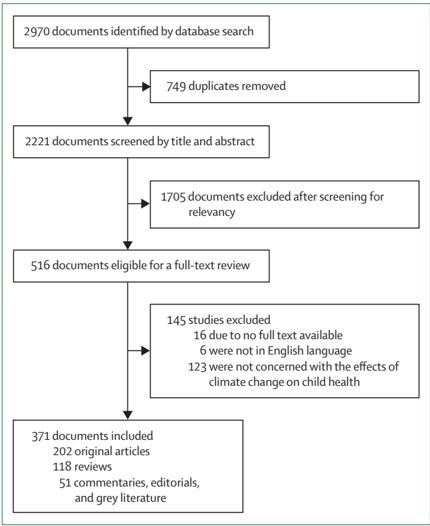
Climate change can have detrimental effects on child health and wellbeing. Despite the imperative for a fuller understanding of how climate change affects child health and wellbeing, a systematic approach and focus solely on children (aged <18 years) has been lacking. In this Scoping Review, we did a literature search on the impacts of climate change on child health from January, 2000, to June, 2019. The included studies explicitly linked an alteration of an exposure to a risk factor for child health to climate change or climate variability. In total, 2970 original articles, reviews, and other documents were identified, of which 371 were analysed. Employing an expanded framework, our analysis showed that the effects of climate change on child health act through direct and indirect pathways, with implications for determinants of child health as well as morbidity and mortality from a range of diseases. This understanding can be further enhanced by using a broader range of research methods, studying overlooked populations and geographical regions, investigating the costs and benefits of mitigation and adaptation for child health, and considering the position of climate change and child health within the UN Sustainable Development Goals. Present and future generations of children bear and will continue to bear an unacceptably high disease burden from climate change.
Overview
CoChat Summary
TL;DR
This scoping review synthesizes evidence on how climate change affects child health through direct and indirect pathways and proposes an expanded conceptual framework. It finds a large but uneven literature, with most studies from high-income or upper-middle-income settings and substantial gaps in qualitative, longitudinal, and equity-focused research.
Key findings
- From 2,970 identified documents, 371 were reviewed: 202 original articles, 118 reviews, and 51 other document types. Most original articles were quantitative (92.6%), and only 32.2% disaggregated results by sex.
- Single-country original articles were concentrated in high-income countries (41.3%), with only 12.2% from low-income countries; Asia (36.0%) and Africa (22.7%) were the most represented regions.
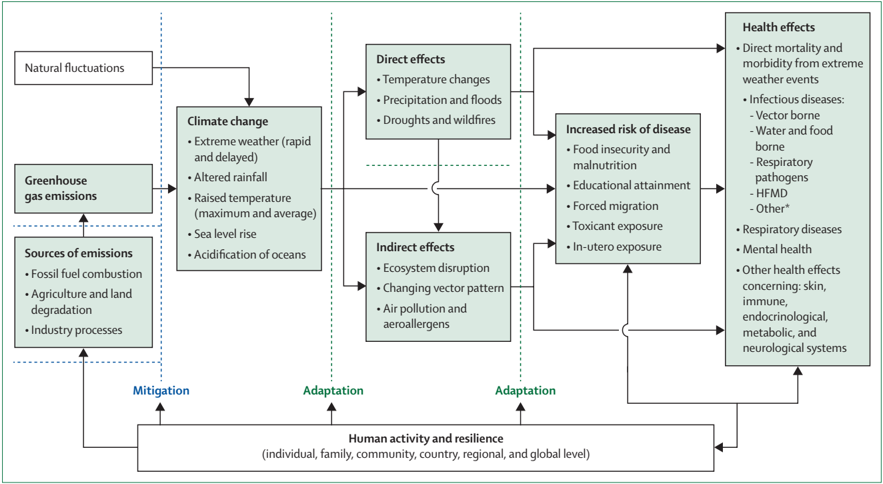
- Climate change affects child health via direct effects (temperature changes, precipitation and floods, droughts and wildfires) and indirect effects (ecosystem disruption, changing vector patterns, air pollution and aeroallergens, mental health), with implications for food insecurity, education, migration, toxicant exposure, and in-utero exposure.
- The review cites projected child health impacts including a 10–15% increase in malaria-related under-5 mortality in sub-Saharan Africa without mitigation/adaptation, up to 20% increased stunting in sub-Saharan Africa under RCP 8.5, a 13% increase in childhood diarrhoea in northern India by 2040, a 20% increase in Lyme disease incidence in the USA by mid-century under RCP 4.5, a 14% increase in US asthma emergency department visits from aeroallergens under RCP 8.5, and a 3–5% increase in hand, foot, and mouth disease in China by end of century.
Methods
- Scoping review following PRISMA Extension for Scoping Reviews, with a predetermined protocol; searches in PubMed, Web of Science, Cochrane Library, Global Health, and WHO regional databases for English-language documents from Jan 1, 2000, to June 11, 2019.
- Search combined child terms (“child”, “infant”, “adolescent”) with climate change terms (“climate change”, “global warming”, “greenhouse effect”, “climate adaptation”); inclusion required children younger than 18 years and a climate-related exposure as a risk factor for child health.
- Screening by one investigator (DH), full-text review by DH and CA, with MN and TA independently validating a random 10% sample; data abstraction used a chart based on published climate-health frameworks, open coding, and iterative development of an expanded conceptual framework. Fourteen articles with severe quality gaps were reviewed but excluded from analysis.
Limitations
- The paper states: search was restricted by time, language, and few search terms; publication bias is likely; the protocol was not published due to time limitations; only one investigator screened documents, risking selection bias; and no uncertainty appraisal was provided for each association, so actual climate change impact in a particular population cannot be asserted.
- The paper also states: many studies included children only as a subpopulation; most research was from high-income and upper-middle-income countries; few articles disaggregated by sex and age; outcomes varied too much to compare across studies; and qualitative and longitudinal research was lacking.
- Evident from the text: the review did not critically appraise study quality systematically, and the included evidence is heterogeneous in exposure definitions, age groups, and outcome measures, limiting generalisability.
Model-written summary. Check it against the paper before relying on it.
Integrity signals
Registry
Cites
Statistics
Figures
Verification
Claims the paper makes
15 Valid · 3 Not valid · 33 Not checked · 39 Own results and interpretations
Every source the paper cites for this claim was checked and supports it.
In the paper
“Heatwaves might also result in an increase in unintentional injuries.37”
§ Climate change and child health: a scoping review and an expanded conceptual framework > Temperature changes
What the sources say
- Supportedcites [37] Otte im Kampe E, Kovats S, Hajat S. Impact of high ambient temperature on unintentional injuries in high-income countries: a narrative systematic literature review. BMJ Open 2016; 6: e010399. source
The Results section ('Mortality due to injuries or poisoning (one study)') states that during major heat waves in France an excess mortality due to injuries and poisoning was observed, with Rey et al estimating 3–14% excess injury/poisoning mortality across heat waves, and the Results table records this for defined heatwave periods (≥3 days above the 95th centile). The Discussion ('In sum, 11 out of 13 studies showed an increase in unintentional injuries in relation to high temperatures'; concluding paragraph) supports a temperature–injury link and explicitly proposes informing heat wave plans with these findings. Because the same review reports decreases during heat waves in Australia (Nitschke et al) and on extreme temperature days, the citing sentence's hedge ('might') matches the state of the evidence rather than overstating it. (LLM, conf=0.80)
hedgedstates a possible cause- Asserted: passes — The authors put it forward as true.
- Checkable: passes — It can be checked against evidence.
- Load-bearing: unclear — It is unclear whether the paper’s conclusions depend on it.
- Based: passes — The paper gives a reason why it holds.
- Supported
The cited sources support only part of this claim — read each source’s verdict below.
In the paper
“Subsequent studies emphasised an increased overall mortality risk from heatwaves in children, particularly infants, 24,25”
§ Climate change and child health: a scoping review and an expanded conceptual framework > Temperature changes
What the sources say
- Partly supportedcites [24] Auger N, Fraser WD, Smargiassi A, Kosatsky T. Ambient heat and sudden infant death: a case-crossover study spanning 30 years in Montreal, Canada. Environ Health Perspect 2015; 123: 712-16. sourceExperimental — accuracy not yet measured
Auger et al. (2015) support the infant-death part only in a narrow, cause-specific form: the Abstract Results and Discussion report that same-day maximum temperature ≥29°C was associated with 2.78-fold greater odds of SIDS (stronger at 3–12 months), i.e. sudden infant death rather than overall/all-cause mortality, and the exposure was daily ambient temperature in April–October, not heat waves as such. The Conclusions (p. final) hedge the heat-wave link explicitly — 'Potential effects of heat waves on SIDS need to be better understood' and infants are 'a group that may be independently at risk' — so the claim's assertion of an established increased mortality risk from heatwaves is stronger than the source. Nothing in our copy addresses children generally; the Introduction credits extreme-heat mortality findings to the elderly (Baccini et al. 2008; Basagaña et al. 2011; Smargiassi et al. 2009). (LLM, conf=0.72)
- Not checked yetcites [25] Son JY, Lee JT, Bell ML. Is ambient temperature associated with risk of infant mortality? A multi-city study in Korea. Environ Res 2017; 158: 748-52. source
plainstates a cause- Asserted: passes — The authors put it forward as true.
- Checkable: passes — It can be checked against evidence.
- Load-bearing: unclear — It is unclear whether the paper’s conclusions depend on it.
- Based: passes — The paper gives a reason why it holds.
- Partly supported
The cited sources support only part of this claim — read each source’s verdict below.
In the paper
“Combining socio economic and demographic factors with spatial modelling can forecast at-risk locations for increased heatwave-related mortality and morbidity.38”
§ Climate change and child health: a scoping review and an expanded conceptual framework > Temperature changes
What the sources say
- Partly supportedcites [38] Ho HC, Knudby A, Chi G, Aminipouri M, Yuk-FoLai D. Spatiotemporal analysis of regional socio-economic vulnerability change associated with heat risks in Canada. Appl Geogr 2018; 95: 61-70. sourceExperimental — accuracy not yet measured
Our copy supports the modelling half of the claim: the paper builds heat vulnerability indices from 2006/2011 Canadian census socio-economic and demographic variables (Data and Methods > Heat Vulnerability Index) and uses spatial statistics (multi-criteria analysis plus Moran's local I hot-spot mapping, Data and Methods > Mapping vulnerability change; Results) to identify 'locations that may be increasingly vulnerable to heat' (Abstract). However, the mortality/morbidity link is stated only as a possibility and is credited to another work: the Introduction says quantifying spatiotemporal vulnerability change and identifying its spatial clusters 'could help estimating heat-related mortality or morbidity during future extreme heat events (Chow et al., 2012)'. The paper itself forecasts increasing socio-economic vulnerability, not heatwave-related deaths or illness, so the citing sentence's unqualified 'can forecast at-risk locations for increased heatwave-related mortality and morbidity' overstates both the certainty and the outcome of this source. (LLM, conf=0.78)
plainstates a cause- Asserted: passes — The authors put it forward as true.
- Checkable: passes — It can be checked against evidence.
- Load-bearing: unclear — It is unclear whether the paper’s conclusions depend on it.
- Based: passes — The paper gives a reason why it holds.
- Partly supported
The cited sources support only part of this claim — read each source’s verdict below.
In the paper
“whereas a rapid change of temperature and humidity levels can significantly affect respiratory and infectious diseases in children.41,42”
§ Climate change and child health: a scoping review and an expanded conceptual framework > Temperature changes
What the sources say
- Not checked yetcites [41] Cong X, Xu X, Zhang Y, Wang Q, Xu L, Huo X. Temperature drop and the risk of asthma: a systematic review and meta-analysis. Environ Sci Pollut Res Int 2017; 24: 22535-46. source
- Partly supportedcites [42] Liu Y, Guo Y, Wang C, et al. Association between temperature change and outpatient visits for respiratory tract infections among children in Guangzhou, China. Int J Environ Res Public Health 2015; 12: 439-54. sourceExperimental — accuracy not yet measured
The temperature component is supported: the Discussion (p. 4, Limitations) states 'our results indicate that temperature change was associated with an increased number of outpatient visits for RTIs in children', and the Results (p. 3, Table 2 discussion) report significant relative risks for a sharp drop in temperature (e.g., -6.2 °C, RR 1.08; 95% CI 1.05–1.11) in children aged <1 and 1–2 years, with the Introduction framing the hypothesis around 'a sharp temperature change between consecutive days'. The humidity component is not supported: Section 2.3 (Meteorological Data) and 2.5 (Statistical Analyses) show relative humidity was merely collected and entered as NS(Hum,3) a covariate adjusted for in the DLNM, and no passage of our copy reports an effect of humidity or humidity change on childhood respiratory/infectious disease. Our copy is also confined to respiratory tract infections, not 'respiratory and infectious diseases' generally. (LLM, conf=0.85)
plainstates a cause- Asserted: passes — The authors put it forward as true.
- Checkable: passes — It can be checked against evidence.
- Load-bearing: unclear — It is unclear whether the paper’s conclusions depend on it.
- Based: passes — The paper gives a reason why it holds.
The cited sources support only part of this claim — read each source’s verdict below.
In the paper
“However, the underlying evidence of how climate change could directly affect adverse health outcomes is limited.10,20”
§ Climate change and child health: a scoping review and an expanded conceptual framework > Direct effects
What the sources say
- Partly supportedcites [10] Sheffield PE, Landrigan PJ. Global climate change and children's health: threats and strategies for prevention. Environ Health Perspect 2011; 119: 291-98. sourceExperimental — accuracy not yet measured
Sheffield et al. (2011) supports only part of the claim. Its Conclusion states that climate change will produce "wide-scale, but still inadequately quantified, increases in disease and death" and that "more thorough quantification of child-specific health impacts... is urgently needed," and its section on extreme heat/storms says "we found limited studies... quantifying the cognitive effects of increased heat on student learning," with pregnancy/renal effects described as "emerging research" (Abstract Data synthesis; Pregnancy and prenatal complications section). But the paper nowhere characterises the underlying evidence for direct climate-health effects as generally limited: the Abstract Data synthesis lists "documented health effects" (vector-borne disease ranges, diarrheal and respiratory disease, extreme-weather morbidity and mortality, toxic-chemical exposures) and quantifies a burden of >150,000 deaths in 2000 with 88% in children, and the Conclusion says the literature on "proven and plausible health impacts... now covers virtually every organ system." So the overstatement is the blanket 'evidence is limited' framing; what the source actually reports as thin is quantification, and evidence for specific direct heat-related outcomes. (LLM, conf=0.72)
- Not checked yetcites [20] Amegah AK, Rezza G, Jaakkola JJK. Temperature-related morbidity and mortality in sub-Saharan Africa: a systematic review of the empirical evidence. Environ Int 2016; 91: 133-49. source
hedged- Asserted: passes — The authors put it forward as true.
- Checkable: passes — It can be checked against evidence.
- Load-bearing: unclear — It is unclear whether the paper’s conclusions depend on it.
- Based: passes — The paper gives a reason why it holds.
- Partly supported
39 more claims · 9 with their cited sources checked
Create a free account to see all 90 claims and to verify the 54 references still open.
- It may state two separate claims as one. 29
- Probably not a substantial claim. 23
- The quote only partly states this claim. 1
Claims other papers make about this one
Each is checked against this paper’s own text: does it say what the citing paper says it does?
The cited source says what the claim attributes to it.
In the citing paper
“Existing reviews have also identified a lack of evidence on the association between climate change and child health in LMICs [28,63].”
From A Scoping Review of Climate Change, Climate-Related Disasters, and Mental Disorders among Children in Low- and Middle-Income Countries (2022) · cites this paper as [28]
The cited source says what the claim attributes to it.
In the citing paper
“a 2021 review found that children of present and future generations will bear an unacceptably high disease burden from climate change, 17”
From Climate anxiety in children and young people and their beliefs about government responses to climate change: a global survey (2021) · cites this paper as [17]
In the citing paper
“Helldén and colleagues [28] analyzed 371 records, only 12% of which focused on LMICs and an even smaller proportion on mental health.”
From A Scoping Review of Climate Change, Climate-Related Disasters, and Mental Disorders among Children in Low- and Middle-Income Countries (2022) · cites this paper as [28]
Citations
Cites
PRISMA Extension for Scoping Reviews (PRISMA-ScR): Checklist and Explanation
Tricco, A. C., Lillie, E., Zarin, W., O'Brien, K. K., Colquhoun, H., Levac, D., Moher, D., Peters, M. D. J., Horsley, T., Weeks, L., et al. (2018) · Annals of Internal Medicine · doi:10.7326/m18-0850 · Cited by 43,565
Transforming Our World: The 2030 Agenda for Sustainable Development
(2018) · A New Era in Global Health · doi:10.1891/9780826190123.ap02 · Cited by 19,351
Munn, Z., Peters, M. D. J., Stern, C., Tufanaru, C., McArthur, A., & Aromataris, E. (2018) · BMC Medical Research Methodology · doi:10.1186/s12874-018-0611-x · Cited by 11,385
Methods for the thematic synthesis of qualitative research in systematic reviews
Thomas, J., & Harden, A. (2008) · BMC Medical Research Methodology · doi:10.1186/1471-2288-8-45 · Cited by 9,312
Managing the health effects of climate change
Costello, A., Abbas, M., Allen, A., Ball, S., Bell, S., Bellamy, R., Friel, S., Groce, N., Johnson, A., Kett, M., et al. (2009) · The Lancet · doi:10.1016/s0140-6736(09)60935-1 · Cited by 3,102
The Global Syndemic of Obesity, Undernutrition, and Climate Change: The Lancet Commission report
Swinburn, B. A., Kraak, V. I., Allender, S., Atkins, V. J., Baker, P. I., Bogard, J. R., Brinsden, H., Calvillo, A., De Schutter, O., Devarajan, R., et al. (2019) · The Lancet · doi:10.1016/s0140-6736(18)32822-8 · Cited by 3,081
A scoping review of scoping reviews: advancing the approach and enhancing the consistency
Pham, M. T., Rajić, A., Greig, J. D., Sargeant, J. M., Papadopoulos, A., & McEwen, S. A. (2014) · Research Synthesis Methods · doi:10.1002/jrsm.1123 · Cited by 3,078
Whitmee, S., Haines, A., Beyrer, C., Boltz, F., Capon, A. G., de Souza Dias, B. F., Ezeh, A., Frumkin, H., Gong, P., Head, P., et al. (2015) · The Lancet · doi:10.1016/s0140-6736(15)60901-1 · Cited by 2,998
Watts, N., Amann, M., Arnell, N., Ayeb-Karlsson, S., Belesova, K., Boykoff, M., Byass, P., Cai, W., Campbell-Lendrum, D., Capstick, S., et al. (2019) · The Lancet · doi:10.1016/s0140-6736(19)32596-6 · Cited by 1,472
Self-citation
Research works printed but not linked: 2
- Intergovernmental Panel on Climate Change. AR5 climate change 2014: impacts, adaptation, and vulnerability. Cambridge, UK and New York, NY, USA: Cambridge University Press, 2014.
- Akachi Y, Goodman D, Parker D. Global climate change and child health: a review of pathways, impacts and measures to improve the evidence base. Florence: UNICEF, 2009.
Cited by
Hickman, C., Marks, E., Pihkala, P., Clayton, S., Lewandowski, R. E., Mayall, E. E., Wray, B., Mellor, C., & van Susteren, L. (2021) · The Lancet Planetary Health · doi:10.1016/s2542-5196(21)00278-3 · Cited by 2,324
“16 This distress is understandable, given that a 2021 review found that children of present and future generations will bear an unacceptably high disease burden from climate change, 17 and a 2021 UNICEF report estimates that one billion children are at extremely high risk as a result.”
Climate change, fossil-fuel pollution, and children's health
Perera, F., & Nadeau, K. (2022) · New England Journal of Medicine · doi:10.1056/nejmra2117706 · Cited by 420
Climate Change and Children’s Mental Health: A Developmental Perspective
Vergunst, F., & Berry, H. L. (2022) · Clinical Psychological Science · doi:10.1177/21677026211040787 · Cited by 197
“Studies of climate-change-related exposures and mental-health outcomes of children remain scarce, especially over the long term (Magalhaes et al., 2020; Berrang-Ford et al., 2021; Helldén et al., 2021).”
BackgroundYoung People's Voices on Climate Anxiety, Government Betrayal and Moral Injury: A Global Phenomenon
Hickman, C., Marks, E., Pihkala, P., Clayton, S., Lewandowski, E. R., Mayall, E. E., Wray, B., Mellor, C., & van Susteren, L. (2021) · SSRN Electronic Journal · doi:10.2139/ssrn.3918955 · Cited by 189
Clayton, S. D., Pihkala, P., Wray, B., & Marks, E. (2023) · Sustainability · doi:10.3390/su15043540 · Cited by 191
Justice in climate change education: a systematic review
Trott, C. D., Lam, S., Roncker, J., Gray, E.-S., Courtney, R. H., & Even, T. L. (2023) · Environmental Education Research · doi:10.1080/13504622.2023.2181265 · Cited by 239
“…and oldest populations of the world, as well as low-income, Black, Brown, indigenous, and Communities of Color, as climate change exacerbates age-based physiological vulnerabilities and intensifies existing social, economic, and health inequities (Benevolenza and DeRigne 2019; Helldén et al. 2021).”
BackgroundThe next 1000 days: building on early investments for the health and development of young children
Draper, C. E., Yousafzai, A. K., McCoy, D. C., Cuartas, J. A., Obradović, J., Bhopal, S., Fisher, J., Jeong, J., Klingberg, S., Milner, K. M., et al. (2024) · The Lancet · doi:10.1016/s0140-6736(24)01389-8 · Cited by 183
The Effects of Climate Change on Child and Adolescent Mental Health: Clinical Considerations
van Nieuwenhuizen, A. O., Hudson, K. E., Chen, X., & Hwong, A. R. (2021) · Current Psychiatry Reports · doi:10.1007/s11920-021-01296-y · Cited by 137
Climate change impacts on child and adolescent health and well-being: A narrative review
Proulx, K., Daelmans, B. M. E. G., Baltag, V., & Banati, P. (2024) · Journal of Global Health · doi:10.7189/jogh.14.04061 · Cited by 149
“Reviews also indicate that high temperatures reduce air quality and are associated with increased childhood asthma and paediatric respiratory diseases [19,21,38].”
BackgroundWright, C. Y., Kapwata, T., Naidoo, N., Asante, K. P., Arku, R. E., Cissé, G., Simane, B., Atuyambe, L. M., & Berhane, K. T. (2024) · Annals of Global Health · doi:10.5334/aogh.4260 · Cited by 101
Williams, P. C. M., Bartlett, A. W., Howard‐Jones, A. R., McMullan, B. J., Khatami, A., Britton, P. N., & Marais, B. J. (2021) · Journal of Paediatrics and Child Health · doi:10.1111/jpc.15681 · Cited by 82
How climate change degrades child health: A systematic review and meta-analysis
Weeda, L. J. Z., Bradshaw, C. J. A., Judge, M. A., Saraswati, C. M., & Souëf, P. N. L. (2024) · The Science of The Total Environment · doi:10.1016/j.scitotenv.2024.170944 · Cited by 81
Amouzou, A., Barros, A. J. D., Requejo, J. H., Fayé, C., Akseer, N., Bendavid, E., Blumenberg, C., Borghi, J., Baz, S. E., Federspiel, F., et al. (2025) · The Lancet · doi:10.1016/s0140-6736(25)00151-5 · Cited by 76
The Effect of High and Low Ambient Temperature on Infant Health: A Systematic Review
Lakhoo, D. P., Blake, H. A., Chersich, M., Nakstad, B., & Kovats, S. R. (2022) · International Journal of Environmental Research and Public Health · doi:10.3390/ijerph19159109 · Cited by 63
Conway, F., Portela, A. G., Filippi, V., Chou, D., & Kovats, S. R. (2024) · Journal of Global Health · doi:10.7189/jogh.14.04128 · Cited by 81
“Infants and children also bear the greater burden climate-related disease (in terms of malnutrition, diarrheal disease, and malaria) given their immature immune systems, impaired thermoregulation, and lack of autonomy [2–6].”
Climate changes, air pollution and allergic diseases in childhood and adolescence
Urrutia‐Pereira, M., Fogelbach, G. G., & Solé, D. (2021) · Jornal de Pediatria · doi:10.1016/j.jped.2021.10.005 · Cited by 77
“As such, understanding how children and adolescent health and well-being could be affected by climate change is an urgent matter.(4) It is impossible to predict the impact of climate change on future generations.”
BackgroundPast and projected climate change impacts on heat-related child mortality in Africa
Chapman, S., Birch, C. E., Marsham, J. H., Part, C., Hajat, S., Chersich, M., Ebi, K. L., Luchters, S. M. F., Nakstad, B., & Kovats, S. R. (2022) · Environmental Research Letters · doi:10.1088/1748-9326/ac7ac5 · Cited by 68
Self-citationThe trends of major issues connecting climate change and the sustainable development goals
Hsieh, Y., & Yeh, S.-C. (2024) · Discover Sustainability · doi:10.1007/s43621-024-00183-9 · Cited by 91
“Cluster 10 emphasizes the need to understand and address the health impacts of climate change as an adaptation measure [88, 89, 96].”
A framework for ageing and health vulnerabilities in a changing climate
Tipaldo, J. F., Balk, D. L., & Hunter, L. M. (2024) · Nature Climate Change · doi:10.1038/s41558-024-02156-2 · Cited by 71
Ambient air pollution and infant health: a narrative review
Lin, L., Chen, J., Yu, Y., & Dong, G. (2023) · EBioMedicine · doi:10.1016/j.ebiom.2023.104609 · Cited by 70
Sharpe, I., & Davison, C. M. (2022) · International Journal of Environmental Research and Public Health · doi:10.3390/ijerph19052896 · Cited by 48
Climate Change and Child Health Inequality: A Review of Reviews
Arpin, E., Gauffin, K., Kerr, M. V., Hjern, A., Mashford‐Pringle, A., Barros, A. J. D., Rajmil, L., Choonara, I., & Spencer, N. J. (2021) · International Journal of Environmental Research and Public Health · doi:10.3390/ijerph182010896 · Cited by 62
Zangerl, K. E., Hoernke, K., Andreas, M., Dalglish, S. L., Kelman, I., Nilsson, M., Rocklöv, J., Bärnighausen, T., & McMahon, S. A. (2024) · The Lancet Child & Adolescent Health · doi:10.1016/s2352-4642(24)00084-1 · Cited by 56
“8 However, evidence is notably scarce on the scope, nature, and effectiveness of child health-specific climate change adaptation domains, 2,55,56 or predominantly centred on adult health.”
Self-citationApproaches to Address the Anemia Challenge
Loechl, C., Datta-Mitra, A., Fenlason, L., Green, R., Hackl, L., Itzkowitz, L., Koso-Thomas, M. W., Moorthy, D., Owino, V. O., Pachón, H., et al. (2023) · Journal of Nutrition · doi:10.1016/j.tjnut.2023.07.017 · Cited by 67
Mank, I., Belesova, K., Bliefernicht, J., Traoré, I., Wilkinson, P., Danquah, I., & Sauerborn, R. (2021) · Frontiers in Public Health · doi:10.3389/fpubh.2021.693281 · Cited by 37
Tan, M. J. T., Kasireddy, H. R., Satriya, A. B., Karim, H. B. A., & AlDahoul, N. (2025) · Frontiers in Public Health · doi:10.3389/fpubh.2024.1522673 · Cited by 62
Arunda, M. O., Sorcher, R., Canabarro, A. P. F., Svallfors, S., Endler, M., Gemzell‐Danielsson, K., Kågesten, A., Ali, M., Bahamondes, L. G., Barreix, M., et al. (2024) · BMJ Public Health · doi:10.1136/bmjph-2024-001090 · Cited by 65
Impact of climate change on paediatric respiratory health: pollutants and aeroallergens
Domingo, K. N., Gabaldon, K. L., Hussari, M. N., Yap, J. M., Valmadrid, L. C., Robinson, K. F., & Leibel, S. A. (2024) · European Respiratory Review · doi:10.1183/16000617.0249-2023 · Cited by 52
Mortality rate, carbon emissions, renewable energy and per capita income nexus in Sub-Saharan Africa
Adeleye, B. N., Olohunlana, A. O., Ibukun, C. O., Soremi, T., & Suleiman, B. M. (2022) · PLoS ONE · doi:10.1371/journal.pone.0274447 · Cited by 37
“Furthermore, to check if the outcomes of Eqs [1] and [2] differ by income group classification, the sample is divided into three (Note: Upper-middle and lower-middle income countries are classified as middle-income countries) distinct groups: (i) high income, (ii) middle income and (iii) low-income countries.”
BackgroundMethodInfluentialEarly life cold and heat exposure impacts white matter development in children
Granés, L., Essers, E., Ballester, J., Petricola, S., Tiemeier, H. W., Iñiguez, C., Soriano‐Mas, C., & Guxens, M. (2024) · Nature Climate Change · doi:10.1038/s41558-024-02027-w · Cited by 45
“Both cold and heat exposure may have negative impacts on children’s health, including mental health 8 .”
Morrison, S. A., Meh, K., Sember, V., Starc, G., & Jurak, G. (2021) · Frontiers in Public Health · doi:10.3389/fpubh.2021.785679 · Cited by 41
“Thus, the purpose of this study was (1) to evaluate changes in children’s 24-HMB using a robust repeated-measures design to inherently control for external factors like socioeconomic status, location, family dynamics, etc.”
BackgroundMethodInfluentialWeather shocks across seasons and child health: Evidence from a panel study in the Kyrgyz Republic
Freudenreich, H., Aladysheva, A., & Brück, T. (2022) · World Development · doi:10.1016/j.worlddev.2021.105801 · Cited by 47
Climate Change and Health of Children: Our Borrowed Future
Leffers, J. (2021) · Journal of Pediatric Health Care · doi:10.1016/j.pedhc.2021.09.002 · Cited by 37
McGushin, A., Gasparri, G., Graef, V., Ngendahayo, C., Timilsina, S., Bustreo, F., & Costello, A. M. D. L. (2022) · BMJ · doi:10.1136/bmj-2022-071690 · Cited by 42
Xu, J., Su, Z., Liu, C., Nie, Y., & Cui, L. (2025) · Environmental Health and Preventive Medicine · doi:10.1265/ehpm.24-00243 · Cited by 44
Warm-season temperatures and emergency department visits among children with health insurance
Stowell, J., Sun, Y., Spangler, K. R., Milando, C. W., Bernstein, A. S., Weinberger, K. R., Sun, S., & Wellenius, G. A. (2022) · Environmental Research Health · doi:10.1088/2752-5309/ac78fa · Cited by 34
“Providing those who care for children with a better understanding of the potential adverse health impacts of heat may help protect children’s health during periods of extreme heat [23, 24].”
Berger, S. E., Ordway, M. R., Schoneveld, E., Lucchini, M., Thakur, S., Anders, T. F., Natale, L., & Barnett, N. R. (2023) · Scientific Reports · doi:10.1038/s41598-023-37111-2 · Cited by 37
Heat exposure and respiratory diseases health outcomes: An umbrella review
Zhu, Z., Ji, B., Tian, J., & Yin, P. (2025) · The Science of The Total Environment · doi:10.1016/j.scitotenv.2025.179052 · Cited by 39
Rother, H., Hayward, R. A., Paulson, J. A., Etzel, R. A., Shelton, M., & Theron, L. C. (2021) · The Journal of Climate Change and Health · doi:10.1016/j.joclim.2021.100087 · Cited by 36
Ethical considerations regarding the effects of climate change and planetary health on children
Williams, P. C. M., Marais, B. J., Isaacs, D., & Preisz, A. (2021) · Journal of Paediatrics and Child Health · doi:10.1111/jpc.15704 · Cited by 36
Australian young people's perspectives about the political determinants of the climate crisis
Arnot, G., Thomas, S. L., Pitt, H., & Warner, E. (2023) · Health Promotion Journal of Australia · doi:10.1002/hpja.734 · Cited by 26
Moving in a hotter world: Maintaining adequate childhood fitness as a climate change countermeasure
Morrison, S. A. (2022) · Temperature · doi:10.1080/23328940.2022.2102375 · Cited by 34
“While the world is getting hotter[3], children are becoming less fit [4–6] and more obese [7], and climate change will increase the likelihood of novel vector-borne diseases entering the human population [8,9], rendering the possibility of further movement restrictions to novel disease outbreaks likely, itself creatin…”
BackgroundThe United European Gastroenterology green paper—climate change and gastroenterology
Duijvestein, M., Sidhu, R., Zimmermann, K., Carrington, E. V., Hann, A., Sousa, P., Touw, H. R. W., van Hooft, J. E., & Müller, M. (2024) · United European Gastroenterology Journal · doi:10.1002/ueg2.12698 · Cited by 28
Ghafouri‐Azar, M., Diamond, S. L., Bowes, J., & Gholamalizadeh, E. (2023) · Sustainable Development · doi:10.1002/sd.2537 · Cited by 27
Lee, T. T., Dalvie, M. A., Röösli, M., Merten, S., Kwiatkowski, M., Mahomed, H., Sweijd, N., & Cissé, G. (2023) · Infectious Diseases of Poverty · doi:10.1186/s40249-023-01127-7 · Cited by 30
“changing infectious disease incidence and distribution), it may exacerbate existing inequities, increasing poverty rates and migration, and lowering educational attainment [9].”
BackgroundImpact of flooding on the social and mental health of older adults- A scoping review
Song, C., Atún, F., Blanford, J. I., & Anthonj, C. (2025) · Water Security · doi:10.1016/j.wasec.2025.100190 · Cited by 35
Hanneman, K. A., Alahmad, B., Ghosh, A., Khatana, S. A. M., Huang, M., Liu, J., Abadi, A. M., Khraishah, H., Beckie, T. M., Rajagopalan, S., et al. (2026) · Circulation · doi:10.1161/cir.0000000000001419 · Cited by 32
Xu, H., Li, C., Hu, Y., Kong, R., Wang, Q., & Zhou, Y. (2024) · Urban Climate · doi:10.1016/j.uclim.2024.102085 · Cited by 26
Effects of climate change in the elderly’s health: a scoping review protocol
Montoro-Ramírez, E. M., Parra‐Anguita, L., Álvarez‐Nieto, C., Parra, G., & López‐Medina, I. M. (2022) · BMJ Open · doi:10.1136/bmjopen-2021-058063 · Cited by 25
Sewell, K., Paul, S., Polt, K. D., Sugg, M. M., Leeper, R. D., Rao, Y. D., & Runkle, J. D. (2024) · Discover Mental Health · doi:10.1007/s44192-023-00055-0 · Cited by 30
“The impacts of the climate crisis on child mental health is a growing area of concern, particularly when considering the potential impact these events may have on childrens’ rapidly developing brains [22, 23].”
BackgroundClimate change effects in older people's health: A scoping review
Montoro-Ramírez, E. M., Parra‐Anguita, L., Álvarez‐Nieto, C., Parra, G., & López‐Medina, I. M. (2024) · Journal of Advanced Nursing · doi:10.1111/jan.16270 · Cited by 30
“A recent scoping review of climate change effects focusing on children (Helldén et al., 2021) highlights the need for such a review also on the effects of climate change on older adults, as another group vulnerable to such effects.”
The GDL Vulnerability Index (GVI)
Smits, J. P. J. M., & Huisman, J. (2024) · Social Indicators Research · doi:10.1007/s11205-024-03399-4 · Cited by 29
“Children are particularly susceptible to dehydration and infectious diseases (Hellden et al., 2021).”
BackgroundThe exposome approach to study children's health
Handakas, E., Robinson, O., & Laine, J. E. (2023) · Current Opinion in Environmental Science & Health · doi:10.1016/j.coesh.2023.100455 · Cited by 29
Mohamed, M., Amin, S., Lever, E., Montini, A., Machida, K., Rajagopalan, S., Costello, A. M. D. L., McGushin, A., Jennings, B., Benoit, L., et al. (2025) · The Lancet Planetary Health · doi:10.1016/s2542-5196(25)00061-0 · Cited by 32
“32 We mapped health studies according to whether they focused on mortality, morbidity (using causes of disability-adjusted life-years [DALYs] from the 2021 Global Burden of Disease Level 2 classification system), or only general health care-seeking behaviour.”
The Impact of Changing Climate on Children's Nutritional Status in Bangladesh
Hanifi, S. M. M. A., Menon, N., & Quisumbing, A. R. (2021) · Social Science & Medicine · doi:10.1016/j.socscimed.2022.114704 · Cited by 27
The developmental consequences of early exposure to climate change-related risks
Cuartas, J. A., McCoy, D. C., Torres, I., Burghardt, L. C., Shonkoff, J. P., & Yoshikawa, H. (2024) · Child Development Perspectives · doi:10.1111/cdep.12503 · Cited by 23
Benoit, L., Lowe, S. R., Thomas, I., Amsalem, D., & Martin, A. (2025) · Child and Adolescent Psychiatry and Mental Health · doi:10.1186/s13034-025-00872-x · Cited by 32
“The impact of climate change-related disasters on young people’s mental health is clear [3, 4] and so is the cumulative burden of climate change on their health [1, 16, 27].”
The impact of climate change and biodiversity loss on the health of children: An ethical perspective
Williams, P. C. M., Beardsley, J., Isaacs, D., Preisz, A., & Marais, B. J. (2023) · Frontiers in Public Health · doi:10.3389/fpubh.2022.1048317 · Cited by 29
Environment and child well-being: A scoping review of reviews to guide policies
Wallerich, L., Fillol, A., Rivadeneyra, A., Vandentorren, S., Wittwer, J., & Cambon, L. (2023) · Health Promotion Perspectives · doi:10.34172/hpp.2023.20 · Cited by 21
COVID-19 Pandemic and the Developmental Health of Kindergarteners
Perrigo, J. L., Morales, J., JACKSON, N. J., Janus, M., Stanley, L., Wong, M. D., & Halfon, N. (2025) · Archives of Pediatrics and Adolescent Medicine · doi:10.1001/jamapediatrics.2024.7057 · Cited by 20
Food Systems Transformation for Child Health and Well-Being: The Essential Role of Dairy
Miller, G. D., Kanter, M., Rycken, L., Comerford, K. B., Gardner, N. M., & Brown, K. A. (2021) · International Journal of Environmental Research and Public Health · doi:10.3390/ijerph181910535 · Cited by 25
Sanz-Mas, M., Continente, X., Brugueras, S., Marí-Dell’Olmo, M., Oliveras, L., & López, M. J. (2024) · Landscape and Urban Planning · doi:10.1016/j.landurbplan.2024.105206 · Cited by 33
Time Trends in the Burden of Environmental Heat and Cold Exposure Among Children and Adolescents
He, Y.-S., Cao, F., Hu, X., Liu, Y.-C., Tao, S.-S., Wang, P., Hou, S., & Pan, H.-F. (2024) · Archives of Pediatrics and Adolescent Medicine · doi:10.1001/jamapediatrics.2024.4392 · Cited by 24
Oh, J., Kim, E., Kwag, Y., An, H., Kim, H. S., Shah, S., Lee, J. H., & Ha, E. (2023) · Environmental Research · doi:10.1016/j.envres.2023.117561 · Cited by 21
‘When the Sun Gets Very Hot’: Young Children’s Perceptions of Climate Change
Spiteri, J., & Pace, P. (2023) · Journal of Education for Sustainable Development · doi:10.1177/09734082231183481 · Cited by 25
“Specifically, climate change denies children the rights for survival and development (Article 6) and health (Article 24), with lifelong implications (Cheney & Duderstadt, 2022; Helldén et al., 2021; UNICEF, 2019, 2021).”
BackgroundThe global health community at international climate change negotiations
van Daalen, K. R., Wyma, N., Schauer-Berg, J., Blom, I. M., Mattijsen, J. C., Othman, R., Eissa, M., Parks, R. M., Wyns, A., Aboushady, A. T., et al. (2024) · BMJ Global Health · doi:10.1136/bmjgh-2024-015292 · Cited by 18
Ayalon, L., & Roy, S. (2023) · PLoS ONE · doi:10.1371/journal.pone.0286901 · Cited by 17
Ma, J., Zhou, W., Guo, S., Deng, X., Song, J., & Xu, D. (2022) · Climatic Change · doi:10.1007/s10584-022-03463-3 · Cited by 19
“life (Helldén et al. 2021), agricultural production (Crost et al.”
BackgroundMank, I., Sorgho, R., Zerbo, F., Kagoné, M., Coulibaly, B., Oguso, J. K., Mbata, M., Khagayi, S., Muok, E. M. O., Sié, A., et al. (2022) · Trials · doi:10.1186/s13063-022-06423-5 · Cited by 14
Managing Extreme Heat and Smoke: A Focus Group Study of Vulnerable People in Darwin, Australia
Campbell, S. L., Anderson, C. C., Wheeler, A. J., Cook, S., Muster, T. H., & Johnston, F. H. (2022) · Sustainability · doi:10.3390/su142113805 · Cited by 15
“Similarly, while the negative health impacts of extreme heat on children were well-known from a number of epidemiological studies [33,34], an understanding of the impacts of these conditions on institutions and carers was not well established, especially for warmer climates.”
BackgroundDevkota, N., Kmeco, Ľ., Thapa, S., Houška, P., & Poudel, U. R. (2022) · Journal of Tourism and Services · doi:10.29036/jots.v13i25.388 · Cited by 19
“Helldén et al. (2021) discussed that the majority of parasites have little direct influence on human health, and the potential detrimental consequences of climate change on most animal parasites remain mostly unproven.”
Climate, weather and child health in Burkina Faso
Dasgupta, S., & Robinson, E. J. Z. (2023) · Australian Journal of Agricultural and Resource Economics · doi:10.1111/1467-8489.12530 · Cited by 14
Climate Change Imperils Pediatric Health: Child Advocacy Through Fossil Fuel Divestment
Jee, S. H., Friedman, E., Etzel, R. A., Nguyen, V. T., Sack, T. L., & Kemper, K. J. (2023) · The Yale Journal of Biology and Medicine · doi:10.59249/zodd9375 · Cited by 16
“Health effects attributable to climate change disproportionately affect vulnerable populations such as children [16-20] and are magnified by underlying health disparities related to structural racism, immigration status, and intergenerational trauma [21].”
BackgroundChen, L., Liu, D., Guo, Y., Wen, B., Wu, Y. Y., Xing, Y., Zhang, Y., Song, X., Wang, R., Jiang, J., et al. (2025) · Journal of Infection · doi:10.1016/j.jinf.2025.106547 · Cited by 17
Nahian, M. A. (2023) · Challenges · doi:10.3390/challe14010004 · Cited by 26
“CC will have a catastrophic impact on child health and wellbeing—the range, scale, and magnitude is unknown and mostly overlooked [47].”
BackgroundKinder- und Jugendgesundheit in der Klimakrise
Eichinger, M., Andreas, M., Hoeppe, A., Nisius, K., & Rink, K. (2023) · Monatsschrift Kinderheilkunde · doi:10.1007/s00112-022-01685-4 · Cited by 14
Climate and Environmental Change: A Generation at Risk
Chalupka, S. M., Latter, A., & Trombley, J. (2023) · MCN The American Journal of Maternal/Child Nursing · doi:10.1097/nmc.0000000000000924 · Cited by 15
“Air pollution may be associated with neuroendocrine complications, development of Type I diabetes mellitus, high blood pressure, obesity, congenital hypothyroidism, and insulin resistance in offspring (Heo & Kim, 2021; Shang et al., 2019; Zhang et al., 2018).”
BackgroundPicetti, R., Juel, R., Milner, J., Bonell, A., Karakas, F., Dangour, A. D., Yeung, S., Wilkinson, P., & Hughes, R. C. (2023) · Environmental Research · doi:10.1016/j.envres.2023.117102 · Cited by 14
Temperature exposure and health inequality
Zhang, X., Chen, F., Chen, Z., & Zhang, J. (2024) · Journal of Asian Economics · doi:10.1016/j.asieco.2024.101748 · Cited by 13
Climate, weather, and child health: quantifying health co-benefits
Dasgupta, S., & ROBINSON, E. J. Z. (2024) · Environmental Research Letters · doi:10.1088/1748-9326/ad5d09 · Cited by 16
“Further, most studies are from in high-and upper-middle-income countries or are focused on a small subset of countries (Helldén et al 2021, Lakhoo et al 2022, Phung et al 2023).”
Natural disasters and missing children
Ponnusamy, S. (2021) · Health Economics · doi:10.1002/hec.4458 · Cited by 12
Spatial Aspects of Health—Developing a Conceptual Framework
Augustin, J., Andrees, V., Walsh, D., Reintjes, R., & Koller, D. (2023) · International Journal of Environmental Research and Public Health · doi:10.3390/ijerph20031817 · Cited by 21
“In other conceptual models, the spatial aspect is mentioned, but is not the focus of analysis [78] or the spatial scale is present for the specific framework (such as for urban health or rural health) [79].”
BackgroundFine particulate matter exposure and pediatric mental health outcomes: An integrative review
Trombley, J. (2023) · Journal of Nursing Scholarship · doi:10.1111/jnu.12888 · Cited by 16
Growing up in Victoria, Australia, in the midst of the climate emergency
Chavez, K. M., Quinn, P., Gibbs, L. F., Block, K., Leppold, C., Stanley, J., & Vella‐Brodrick, D. (2023) · International Journal of Behavioral Development · doi:10.1177/01650254231205239 · Cited by 13
“The global mental health burden for children and adolescents (from now on referred to as young people) is rapidly increasing due to climate change (Hellden et al., 2021; Hickman et al., 2021; Vergunst & Berry, 2022).”
BackgroundClimate change and its impact on children and adolescents sleep
Lopes, M. C. (2024) · Jornal de Pediatria · doi:10.1016/j.jped.2024.10.009 · Cited by 14
“34,35 The projection of insuf fi cient sleep, when associated with changes in nighttime temperature, and the impact of environmental warming on insuf fi cient sleep is observed cumulatively and in short sleep attributed to temperature for all Table 1 Habits to improve sleep health.”
Grassroots and Youth-Led Climate Solutions From The Gambia
Bonell, A., Badjie, J., Jammeh, S., Ali, Z., Hydara, M., Davies, A. D., Faal, M., Ahmed, A. N., Hand, W., Prentice, A. M., et al. (2022) · Frontiers in Public Health · doi:10.3389/fpubh.2022.784915 · Cited by 17
“Children, now and in the future, will be the ones to bear the burden of humanity’s environmental impacts, both in terms of direct impacts on their health but also in a multitude of indirect effects ranging from food security to economic impacts (6).”
BackgroundFoudjo, S. I., & Massil, J. K. (2024) · Social Science & Medicine · doi:10.1016/j.socscimed.2024.116979 · Cited by 13
Unconventional cold vortex as precursor to historic early summer heatwaves in North China 2023
Liu, B., Duan, Y., Ma, S., Yan, Y., & Zhu, C. (2024) · npj Climate and Atmospheric Science · doi:10.1038/s41612-024-00718-x · Cited by 15
“These extreme events present substantial risks to ecosystems, public health, and social security 3 – 6 .”
The smarter the city develops, the healthier the child grows? Evidence from China
Xu, L., Yu, H., & Shao, S. (2024) · Cities · doi:10.1016/j.cities.2024.105195 · Cited by 11
Chongwo, E. J., Aoko, B., Kaniala, M., Esala, M., Magoma, P., Njoroge, E., Nyamanya, S., Marangu, J., Khamis, A., Ng’asike, J. T., et al. (2025) · PLoS ONE · doi:10.1371/journal.pone.0316679 · Cited by 19
Pinchoff, J., Etim, E.-O. E., Babatunde, D., Blomstrom, E., Ainul, S., Akomolafe, T., Carranza, B. M., Valle, Á. D., & Austrian, K. (2025) · BMJ Global Health · doi:10.1136/bmjgh-2024-016788 · Cited by 25
Logie, C. H., Hasham, A., Kagunda, J., Evelia, H., Gachoki, C., Omondi, B., Wanjiru, M., Gittings, L., Borek, S. V., Newman, P. A., et al. (2025) · BMJ Global Health · doi:10.1136/bmjgh-2024-016637 · Cited by 14
An urgent need to reassess climate change and child labour in agriculture
Greenfield, M. H. (2022) · The Lancet Planetary Health · doi:10.1016/s2542-5196(22)00118-8 · Cited by 10
Otto, A., & Thieken, A. H. (2024) · Climate Risk Management · doi:10.1016/j.crm.2024.100597 · Cited by 9
“…rates, various morbidities and emergency department visits within this group increase during and shortly after heatwaves (Campbell et al., 2018; Fuller et al., 2022; WHO, 2021; Helld ´ en et al., 2021; I ˜ niguez et al., 2016; Basu and Ostro, 2008; Bernstein et al., 2022; Sheffield et al., 2018).”
Boafo, Y. A., Ohemeng, F., Ayivor, J., Ayitiah, J. N. A., Yirenya-Tawiah, D. R., Mensah, A. M., Datsa, C., Annang, T. Y., & Adom, L. (2024) · Frontiers in Public Health · doi:10.3389/fpubh.2024.1352275 · Cited by 21
Impact of climate change on child outcomes: an evidence gap map review
Meherali, S. M., Aynalem, Y. A., Nisa, S., Kennedy, M., Salami, B. O., Adjorlolo, S., Ali, P. A., Silva, K. L., Aziato, L., Richter, S. M., et al. (2024) · BMJ Paediatrics Open · doi:10.1136/bmjpo-2024-002592 · Cited by 10
Association of humidity and precipitation with asthma: a systematic review and meta-analysis
Gu, W., Xie, D., Li, Q. Y., Feng, H., Xue, Y., Chen, Y., Tang, J., Zhou, Y., Wang, D., Tong, S., et al. (2024) · Frontiers in Allergy · doi:10.3389/falgy.2024.1483430 · Cited by 9
Aydos, E. H., Güder, S. Y., Alabay, E., & Demir, G. (2025) · Child Indicators Research · doi:10.1007/s12187-025-10248-4 · Cited by 12
Food Transfers and Child Nutrition: Evidence from India's Public Distribution System†
Shrinivas, A., Baylis, K., & Crost, B. (2025) · American Economic Journal Applied Economics · doi:10.1257/app.20220505 · Cited by 23
Tang, H., & Di, Q. (2022) · International Journal of Environmental Research and Public Health · doi:10.3390/ijerph19052523 · Cited by 9
Metadata
- Authors
- Helldén, D., Andersson, C., Nilsson, M., Ebi, K. L., Friberg, P., & Alfvén, T.
- Affiliations
- Karolinska Institutet (SE)
- Umeå University (SE)
- University of Washington (US)
- Royal Swedish Academy of Sciences (SE)
- Corresponding author
- Helldén, Daniel
- Venue
- The Lancet Planetary Health
- Publisher
- Elsevier BV
- Published
- 2021-03
- Volume
- 5
- Issue
- 3
- Pages
- e164-e175
- ISSN
- 2542-5196 (ISSN-L)
- OpenAlex
- W3135535939
- Semantic Scholar
- 7c69e190f976e9dccc6756901855226f8a67f279
- Cited by
- 332
- References
- 148
- Citations by year
- 2026: 71 · 2025: 79 · 2024: 79 · 2023: 51 · 2022: 32 · 2021: 20
- FWCI
- 4.38
- Type
- journal article
- Language
- en
- Open access
- gold
- doi.org
- Licence
- cc-by-nc-nd
- www.elsevier.com/tdm/userlicense/1.0/ (tdm)
- www.elsevier.com/legal/tdmrep-license (tdm)
- creativecommons.org/licenses/by-nc-nd/4.0/ (vor)
- Locations
- The Lancet Planetary Health (publishedVersion, cc-by-nc-nd)
- PubMed (publishedVersion)
- DiVA at Umeå University (Umeå University) (submittedVersion, other-oa)
- Funders
- Svenska Forskningsrådet Formas
- Topics
- Physical Sciences › Environmental Science › Health, Toxicology and Mutagenesis › Climate Change and Health Impacts
- Physical Sciences › Environmental Science › Health, Toxicology and Mutagenesis › Air Quality and Health Impacts
- Social Sciences › Health › Occupational Health and Global Justice
- Keywords
- climate change, child health, child well-being, climate variability, child morbidity, child mortality, disease burden, climate change exposure, climate change adaptation, climate change mitigation, Sustainable Development Goals, conceptual framework
- MeSH terms
- Child Health, Food Insecurity, Air Pollution, Child, Communicable Diseases, Environmental Exposure, Humans, Mental Health, Risk, Socioeconomic Factors, Weather, Climate Change
About these checks
Registry, retraction, Cites and statistics results are computed, not judged, with one exception: a printed reference that no index lists is read once by a model before it counts as a citation error. Claims are extracted by a model and kept only when their quote appears verbatim in the text; each cited source is then checked, with a model’s help, for whether it says what the claim relies on. Those verdicts can be wrong — read the claim’s quote and the cited source before relying on one.
The claim verdicts this report counts are experimental: their accuracy is not yet measured.
A language model drew the claims from the paper on 2026-10-07, under version 3 of the claim definition (model deepseek-v4.1-flash, prompt extract-v3).
A second model labelled each claim on 2026-10-07 (model jev-1.13-20260917, definition revision gold-guideline-v0.2).
Cited sources are checked with a language model’s help (qwen3.8-omni-flash).
Statistics and arithmetic are recomputed, not judged.
Confidence bands are shown only for fields calibrated on our annotated test set. None is calibrated yet, so no band is shown.
What counts as a claim ›How we measure confidence ›How we check this ›
Are you an author, or do you see a problem with this page? Request a review
Data sources
Bibliographic data: Semantic Scholar, OpenAlex, Crossref.
Contains information from the Semantic Scholar Academic Graph Datasets, made available under the ODC Attribution License (ODC-BY 1.0).
Semantic Scholar’s data is described in: Kinney, R., et al. (2023). The Semantic Scholar Open Data Platform. arXiv:2301.10140.
