

Climate change and child health: a scoping review and an expanded conceptual framework
Open accessThe DOI matches its Crossref record; 147 of the 148 references it cites were found in a registry or an index; 18 of the 72 sources its claims cite were checked for support.
Abstract
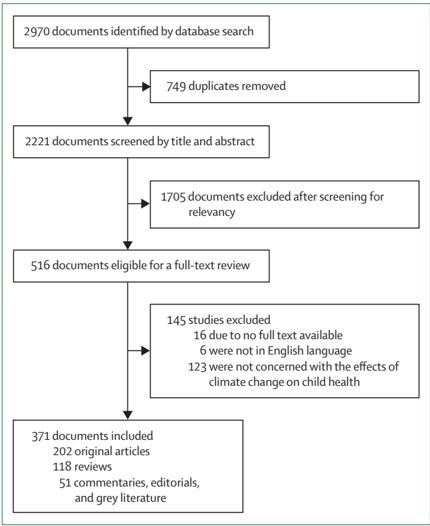
Climate change can have detrimental effects on child health and wellbeing. Despite the imperative for a fuller understanding of how climate change affects child health and wellbeing, a systematic approach and focus solely on children (aged <18 years) has been lacking. In this Scoping Review, we did a literature search on the impacts of climate change on child health from January, 2000, to June, 2019. The included studies explicitly linked an alteration of an exposure to a risk factor for child health to climate change or climate variability. In total, 2970 original articles, reviews, and other documents were identified, of which 371 were analysed. Employing an expanded framework, our analysis showed that the effects of climate change on child health act through direct and indirect pathways, with implications for determinants of child health as well as morbidity and mortality from a range of diseases. This understanding can be further enhanced by using a broader range of research methods, studying overlooked populations and geographical regions, investigating the costs and benefits of mitigation and adaptation for child health, and considering the position of climate change and child health within the UN Sustainable Development Goals. Present and future generations of children bear and will continue to bear an unacceptably high disease burden from climate change.
Overview
CoChat Summary
TL;DR
This scoping review synthesizes evidence on how climate change affects child health through direct and indirect pathways and proposes an expanded conceptual framework. It finds a large but uneven literature, with most studies from high-income or upper-middle-income settings and substantial gaps in qualitative, longitudinal, and equity-focused research.
Key findings
- From 2,970 identified documents, 371 were reviewed: 202 original articles, 118 reviews, and 51 other document types. Most original articles were quantitative (92.6%), and only 32.2% disaggregated results by sex.
- Single-country original articles were concentrated in high-income countries (41.3%), with only 12.2% from low-income countries; Asia (36.0%) and Africa (22.7%) were the most represented regions.
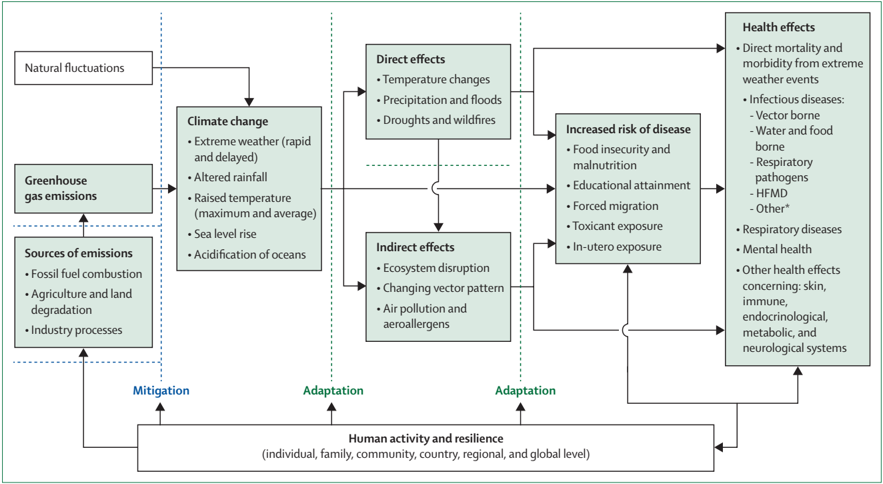
- Climate change affects child health via direct effects (temperature changes, precipitation and floods, droughts and wildfires) and indirect effects (ecosystem disruption, changing vector patterns, air pollution and aeroallergens, mental health), with implications for food insecurity, education, migration, toxicant exposure, and in-utero exposure.
- The review cites projected child health impacts including a 10–15% increase in malaria-related under-5 mortality in sub-Saharan Africa without mitigation/adaptation, up to 20% increased stunting in sub-Saharan Africa under RCP 8.5, a 13% increase in childhood diarrhoea in northern India by 2040, a 20% increase in Lyme disease incidence in the USA by mid-century under RCP 4.5, a 14% increase in US asthma emergency department visits from aeroallergens under RCP 8.5, and a 3–5% increase in hand, foot, and mouth disease in China by end of century.
Methods
- Scoping review following PRISMA Extension for Scoping Reviews, with a predetermined protocol; searches in PubMed, Web of Science, Cochrane Library, Global Health, and WHO regional databases for English-language documents from Jan 1, 2000, to June 11, 2019.
- Search combined child terms (“child”, “infant”, “adolescent”) with climate change terms (“climate change”, “global warming”, “greenhouse effect”, “climate adaptation”); inclusion required children younger than 18 years and a climate-related exposure as a risk factor for child health.
- Screening by one investigator (DH), full-text review by DH and CA, with MN and TA independently validating a random 10% sample; data abstraction used a chart based on published climate-health frameworks, open coding, and iterative development of an expanded conceptual framework. Fourteen articles with severe quality gaps were reviewed but excluded from analysis.
Limitations
- The paper states: search was restricted by time, language, and few search terms; publication bias is likely; the protocol was not published due to time limitations; only one investigator screened documents, risking selection bias; and no uncertainty appraisal was provided for each association, so actual climate change impact in a particular population cannot be asserted.
- The paper also states: many studies included children only as a subpopulation; most research was from high-income and upper-middle-income countries; few articles disaggregated by sex and age; outcomes varied too much to compare across studies; and qualitative and longitudinal research was lacking.
- Evident from the text: the review did not critically appraise study quality systematically, and the included evidence is heterogeneous in exposure definitions, age groups, and outcome measures, limiting generalisability.
Model-written summary. Check it against the paper before relying on it.
Integrity signals
Registry
Cites
Statistics
Figures
Verification
Claims the paper makes
15 Valid · 3 Not valid · 33 Not checked · 39 Own results and interpretations
Every source the paper cites for this claim was checked and supports it.
In the paper
“Heatwaves might also result in an increase in unintentional injuries.37”
§ Climate change and child health: a scoping review and an expanded conceptual framework > Temperature changes
What the sources say
- Supportedcites [37] Otte im Kampe E, Kovats S, Hajat S. Impact of high ambient temperature on unintentional injuries in high-income countries: a narrative systematic literature review. BMJ Open 2016; 6: e010399. source
The Results section ('Mortality due to injuries or poisoning (one study)') states that during major heat waves in France an excess mortality due to injuries and poisoning was observed, with Rey et al estimating 3–14% excess injury/poisoning mortality across heat waves, and the Results table records this for defined heatwave periods (≥3 days above the 95th centile). The Discussion ('In sum, 11 out of 13 studies showed an increase in unintentional injuries in relation to high temperatures'; concluding paragraph) supports a temperature–injury link and explicitly proposes informing heat wave plans with these findings. Because the same review reports decreases during heat waves in Australia (Nitschke et al) and on extreme temperature days, the citing sentence's hedge ('might') matches the state of the evidence rather than overstating it. (LLM, conf=0.80)
hedgedstates a possible cause- Asserted: passes — The authors put it forward as true.
- Checkable: passes — It can be checked against evidence.
- Load-bearing: unclear — It is unclear whether the paper’s conclusions depend on it.
- Based: passes — The paper gives a reason why it holds.
- Supported
The cited sources support only part of this claim — read each source’s verdict below.
In the paper
“Subsequent studies emphasised an increased overall mortality risk from heatwaves in children, particularly infants, 24,25”
§ Climate change and child health: a scoping review and an expanded conceptual framework > Temperature changes
What the sources say
- Partly supportedcites [24] Auger N, Fraser WD, Smargiassi A, Kosatsky T. Ambient heat and sudden infant death: a case-crossover study spanning 30 years in Montreal, Canada. Environ Health Perspect 2015; 123: 712-16. sourceExperimental — accuracy not yet measured
Auger et al. (2015) support the infant-death part only in a narrow, cause-specific form: the Abstract Results and Discussion report that same-day maximum temperature ≥29°C was associated with 2.78-fold greater odds of SIDS (stronger at 3–12 months), i.e. sudden infant death rather than overall/all-cause mortality, and the exposure was daily ambient temperature in April–October, not heat waves as such. The Conclusions (p. final) hedge the heat-wave link explicitly — 'Potential effects of heat waves on SIDS need to be better understood' and infants are 'a group that may be independently at risk' — so the claim's assertion of an established increased mortality risk from heatwaves is stronger than the source. Nothing in our copy addresses children generally; the Introduction credits extreme-heat mortality findings to the elderly (Baccini et al. 2008; Basagaña et al. 2011; Smargiassi et al. 2009). (LLM, conf=0.72)
- Not checked yetcites [25] Son JY, Lee JT, Bell ML. Is ambient temperature associated with risk of infant mortality? A multi-city study in Korea. Environ Res 2017; 158: 748-52. source
plainstates a cause- Asserted: passes — The authors put it forward as true.
- Checkable: passes — It can be checked against evidence.
- Load-bearing: unclear — It is unclear whether the paper’s conclusions depend on it.
- Based: passes — The paper gives a reason why it holds.
- Partly supported
The cited sources support only part of this claim — read each source’s verdict below.
In the paper
“Combining socio economic and demographic factors with spatial modelling can forecast at-risk locations for increased heatwave-related mortality and morbidity.38”
§ Climate change and child health: a scoping review and an expanded conceptual framework > Temperature changes
What the sources say
- Partly supportedcites [38] Ho HC, Knudby A, Chi G, Aminipouri M, Yuk-FoLai D. Spatiotemporal analysis of regional socio-economic vulnerability change associated with heat risks in Canada. Appl Geogr 2018; 95: 61-70. sourceExperimental — accuracy not yet measured
Our copy supports the modelling half of the claim: the paper builds heat vulnerability indices from 2006/2011 Canadian census socio-economic and demographic variables (Data and Methods > Heat Vulnerability Index) and uses spatial statistics (multi-criteria analysis plus Moran's local I hot-spot mapping, Data and Methods > Mapping vulnerability change; Results) to identify 'locations that may be increasingly vulnerable to heat' (Abstract). However, the mortality/morbidity link is stated only as a possibility and is credited to another work: the Introduction says quantifying spatiotemporal vulnerability change and identifying its spatial clusters 'could help estimating heat-related mortality or morbidity during future extreme heat events (Chow et al., 2012)'. The paper itself forecasts increasing socio-economic vulnerability, not heatwave-related deaths or illness, so the citing sentence's unqualified 'can forecast at-risk locations for increased heatwave-related mortality and morbidity' overstates both the certainty and the outcome of this source. (LLM, conf=0.78)
plainstates a cause- Asserted: passes — The authors put it forward as true.
- Checkable: passes — It can be checked against evidence.
- Load-bearing: unclear — It is unclear whether the paper’s conclusions depend on it.
- Based: passes — The paper gives a reason why it holds.
- Partly supported
The cited sources support only part of this claim — read each source’s verdict below.
In the paper
“whereas a rapid change of temperature and humidity levels can significantly affect respiratory and infectious diseases in children.41,42”
§ Climate change and child health: a scoping review and an expanded conceptual framework > Temperature changes
What the sources say
- Not checked yetcites [41] Cong X, Xu X, Zhang Y, Wang Q, Xu L, Huo X. Temperature drop and the risk of asthma: a systematic review and meta-analysis. Environ Sci Pollut Res Int 2017; 24: 22535-46. source
- Partly supportedcites [42] Liu Y, Guo Y, Wang C, et al. Association between temperature change and outpatient visits for respiratory tract infections among children in Guangzhou, China. Int J Environ Res Public Health 2015; 12: 439-54. sourceExperimental — accuracy not yet measured
The temperature component is supported: the Discussion (p. 4, Limitations) states 'our results indicate that temperature change was associated with an increased number of outpatient visits for RTIs in children', and the Results (p. 3, Table 2 discussion) report significant relative risks for a sharp drop in temperature (e.g., -6.2 °C, RR 1.08; 95% CI 1.05–1.11) in children aged <1 and 1–2 years, with the Introduction framing the hypothesis around 'a sharp temperature change between consecutive days'. The humidity component is not supported: Section 2.3 (Meteorological Data) and 2.5 (Statistical Analyses) show relative humidity was merely collected and entered as NS(Hum,3) a covariate adjusted for in the DLNM, and no passage of our copy reports an effect of humidity or humidity change on childhood respiratory/infectious disease. Our copy is also confined to respiratory tract infections, not 'respiratory and infectious diseases' generally. (LLM, conf=0.85)
plainstates a cause- Asserted: passes — The authors put it forward as true.
- Checkable: passes — It can be checked against evidence.
- Load-bearing: unclear — It is unclear whether the paper’s conclusions depend on it.
- Based: passes — The paper gives a reason why it holds.
The cited sources support only part of this claim — read each source’s verdict below.
In the paper
“However, the underlying evidence of how climate change could directly affect adverse health outcomes is limited.10,20”
§ Climate change and child health: a scoping review and an expanded conceptual framework > Direct effects
What the sources say
- Partly supportedcites [10] Sheffield PE, Landrigan PJ. Global climate change and children's health: threats and strategies for prevention. Environ Health Perspect 2011; 119: 291-98. sourceExperimental — accuracy not yet measured
Sheffield et al. (2011) supports only part of the claim. Its Conclusion states that climate change will produce "wide-scale, but still inadequately quantified, increases in disease and death" and that "more thorough quantification of child-specific health impacts... is urgently needed," and its section on extreme heat/storms says "we found limited studies... quantifying the cognitive effects of increased heat on student learning," with pregnancy/renal effects described as "emerging research" (Abstract Data synthesis; Pregnancy and prenatal complications section). But the paper nowhere characterises the underlying evidence for direct climate-health effects as generally limited: the Abstract Data synthesis lists "documented health effects" (vector-borne disease ranges, diarrheal and respiratory disease, extreme-weather morbidity and mortality, toxic-chemical exposures) and quantifies a burden of >150,000 deaths in 2000 with 88% in children, and the Conclusion says the literature on "proven and plausible health impacts... now covers virtually every organ system." So the overstatement is the blanket 'evidence is limited' framing; what the source actually reports as thin is quantification, and evidence for specific direct heat-related outcomes. (LLM, conf=0.72)
- Not checked yetcites [20] Amegah AK, Rezza G, Jaakkola JJK. Temperature-related morbidity and mortality in sub-Saharan Africa: a systematic review of the empirical evidence. Environ Int 2016; 91: 133-49. source
hedged- Asserted: passes — The authors put it forward as true.
- Checkable: passes — It can be checked against evidence.
- Load-bearing: unclear — It is unclear whether the paper’s conclusions depend on it.
- Based: passes — The paper gives a reason why it holds.
- Partly supported
39 more claims · 9 with their cited sources checked
Create a free account to see all 90 claims and to verify the 54 references still open.
- It may state two separate claims as one. 29
- Probably not a substantial claim. 23
- The quote only partly states this claim. 1
Claims other papers make about this one
Each is checked against this paper’s own text: does it say what the citing paper says it does?
The cited source says what the claim attributes to it.
In the citing paper
“Existing reviews have also identified a lack of evidence on the association between climate change and child health in LMICs [28,63].”
From A Scoping Review of Climate Change, Climate-Related Disasters, and Mental Disorders among Children in Low- and Middle-Income Countries (2022) · cites this paper as [28]
The cited source says what the claim attributes to it.
In the citing paper
“a 2021 review found that children of present and future generations will bear an unacceptably high disease burden from climate change, 17”
From Climate anxiety in children and young people and their beliefs about government responses to climate change: a global survey (2021) · cites this paper as [17]
In the citing paper
“Helldén and colleagues [28] analyzed 371 records, only 12% of which focused on LMICs and an even smaller proportion on mental health.”
From A Scoping Review of Climate Change, Climate-Related Disasters, and Mental Disorders among Children in Low- and Middle-Income Countries (2022) · cites this paper as [28]
Citations
Cites
PRISMA Extension for Scoping Reviews (PRISMA-ScR): Checklist and Explanation
Tricco, A. C., Lillie, E., Zarin, W., O'Brien, K. K., Colquhoun, H., Levac, D., Moher, D., Peters, M. D. J., Horsley, T., Weeks, L., et al. (2018) · Annals of Internal Medicine · doi:10.7326/m18-0850 · Cited by 43,565
Transforming Our World: The 2030 Agenda for Sustainable Development
(2018) · A New Era in Global Health · doi:10.1891/9780826190123.ap02 · Cited by 19,351
Munn, Z., Peters, M. D. J., Stern, C., Tufanaru, C., McArthur, A., & Aromataris, E. (2018) · BMC Medical Research Methodology · doi:10.1186/s12874-018-0611-x · Cited by 11,385
Methods for the thematic synthesis of qualitative research in systematic reviews
Thomas, J., & Harden, A. (2008) · BMC Medical Research Methodology · doi:10.1186/1471-2288-8-45 · Cited by 9,312
Managing the health effects of climate change
Costello, A., Abbas, M., Allen, A., Ball, S., Bell, S., Bellamy, R., Friel, S., Groce, N., Johnson, A., Kett, M., et al. (2009) · The Lancet · doi:10.1016/s0140-6736(09)60935-1 · Cited by 3,102
The Global Syndemic of Obesity, Undernutrition, and Climate Change: The Lancet Commission report
Swinburn, B. A., Kraak, V. I., Allender, S., Atkins, V. J., Baker, P. I., Bogard, J. R., Brinsden, H., Calvillo, A., De Schutter, O., Devarajan, R., et al. (2019) · The Lancet · doi:10.1016/s0140-6736(18)32822-8 · Cited by 3,081
A scoping review of scoping reviews: advancing the approach and enhancing the consistency
Pham, M. T., Rajić, A., Greig, J. D., Sargeant, J. M., Papadopoulos, A., & McEwen, S. A. (2014) · Research Synthesis Methods · doi:10.1002/jrsm.1123 · Cited by 3,078
Whitmee, S., Haines, A., Beyrer, C., Boltz, F., Capon, A. G., de Souza Dias, B. F., Ezeh, A., Frumkin, H., Gong, P., Head, P., et al. (2015) · The Lancet · doi:10.1016/s0140-6736(15)60901-1 · Cited by 2,998
Watts, N., Amann, M., Arnell, N., Ayeb-Karlsson, S., Belesova, K., Boykoff, M., Byass, P., Cai, W., Campbell-Lendrum, D., Capstick, S., et al. (2019) · The Lancet · doi:10.1016/s0140-6736(19)32596-6 · Cited by 1,472
Self-citation
Research works printed but not linked: 2
- Intergovernmental Panel on Climate Change. AR5 climate change 2014: impacts, adaptation, and vulnerability. Cambridge, UK and New York, NY, USA: Cambridge University Press, 2014.
- Akachi Y, Goodman D, Parker D. Global climate change and child health: a review of pathways, impacts and measures to improve the evidence base. Florence: UNICEF, 2009.
Cited by
Items 201–300 of 333
Children and Climate Change Vulnerability Indices: a Scoping Review
Iliscupidez, L., Dennett, L., Lau, S., Osornio-Vargas, Á. R., & Yamamoto, S. S. (2025) · Child Indicators Research · doi:10.1007/s12187-025-10250-w · Cited by 5
“Climate change and health research focused on children has been conducted (Helldén et al., 2021), but this has yet to be incorporated extensively”
Janoš, T., Ballester, J., Turrubiates, R. F. M., Čupr, P., & Achebak, H. (2025) · International Journal of Epidemiology · doi:10.1093/ije/dyaf051 · Cited by 4
“37 37–40 With increasing age towards adolescence and young adulthood, the possible range of explanations seems to be shifted more to behavioural factors.”
The impact of social crises on nursing students’ mental health: a cross-sectional study
Saçıkara, Z., Koçoğlu, D., & Dengiz, K. S. (2025) · BMC Nursing · doi:10.1186/s12912-025-03706-5 · Cited by 4
Climate-related challenges to brain health: A European perspective review
Reis, J. J., Buguet, A., Tülek, Z., Landtblom, A., Radomski, M. W., Öztürk, Ş., Pugliatti, M., Kallweit, U., & Spencer, P. S. (2025) · Revue Neurologique · doi:10.1016/j.neurol.2025.07.010 · Cited by 1
Logie, C. H., Leggett, R., Sivan, O., Mackenzie, F., Okumu, M., Loutet, M. G., Lukone, S. O., Kisubi, N., Gittings, L., Otika, L., et al. (2025) · International Journal of Qualitative Studies on Health and Well-Being · doi:10.1080/17482631.2025.2549033 · Cited by 1
“…EWE and bodily harm (e.g., drowning (Walika et al., 2023), infrastructure collapse) (Chekuri et al., 2024) to identify other direct risks via animals and insects, as well as indirect pathways via sociocultural practices (i.e., bush-burning) (Helldén et al., 2021; Schuster et al., 2024).”
Phiri, K., Chauke, F., Mathuthu, T., Moyo, N., & Silaigwana, S. (2025) · Journal of Asian and African Studies · doi:10.1177/00219096251359235 · Cited by 2
“Research consistently proves that exposure to extreme weather conditions during pregnancy and early childhood negatively impacts children’s nutritional outcomes in sub-Saharan Africa (SSA; Helldén et al., 2021; Phalkey et al., 2015).”
Wanda, D., Jacinta, H. A., Hakim, A. R., Ahdika, A., Susanti, S. S., & Syuhada, K. I. A. (2025) · Diseases · doi:10.3390/diseases13090303 · Cited by 1
“See also a study by Helldén et al. [27], which found these to be common diseases faced by children due to climate change.”
Walton, A. H., Taylor, T., Longo, A., & Derbyshire, D. (2026) · Food Policy · doi:10.1016/j.foodpol.2025.103002 · Cited by 1
The influence of climate change on children attending primary care in Isiolo County, Northern Kenya
Muhu, B. W., Lokotola, C. L., & Robert, M. (2026) · African Journal of Primary Health Care & Family Medicine · doi:10.4102/phcfm.v18i1.5259 · Cited by 1
Annan, H., King, N., Baran, I., & Bechard, M. (2026) · Canadian Journal of Emergency Medicine · doi:10.1007/s43678-026-01113-6 · Cited by 1
“The health impacts of climate change are profound and well described [1–3].”
Wong, S., Ulrich-Cech, C., Best, K., Rothrock, B., Adams, C., Rao, S., & Happel, C. (2026) · Population and Environment · doi:10.1007/s11111-026-00526-w · Cited by 2
“…impacts include people of color (Bolin & Kurtz, 2018), communities with lower income (Fothergill & Peek, 2004), women (Vésier & Urban, 2023), older adults (Meade et al., 2020), children (Helldén et al., 2021), and people with disabilities and pre-existing health conditions (Gaskin et al., 2017 ).”
Logie, C. H., MacNeil, A., Hasham, A., Kagunda, J., Evelia, H., Gachoki, C., Omondi, B., Wanjiru, M., Borek, S. V., Gittings, L., et al. (2026) · Sexual Health · doi:10.1071/sh25161 · Cited by 1
Holzinger, D., Zangerl, K. E., & Hoernke, K. (2026) · Springer eBooks · doi:10.1007/978-3-662-71302-0_1 · Cited by 3
Environmental determinants of child health: present challenges and future outlook
Roberta, R., Sgrulletti, M., Manuela, C., Gloria, M., & Moschese, V. (2026) · Global Pediatrics · doi:10.1016/j.gpeds.2026.100358 · Cited by 3
Climate Change and the Increasing Burden of Allergies in Children
Koumpagioti, D., Boutopoulou, B., Grammeniatis, V., Douros, K., & Moriki, D. (2026) · Allergies · doi:10.3390/allergies6030025 · Cited by 2
Kalnoky, M., Pairault, G., Long, J. E., Gao, L., Buhayar, A., & Helldén, D. (2026) · Environmental Research Health · doi:10.1088/2752-5309/ae9634 · Cited by 1
“Similarly, children suffer mortality and morbidity from extreme weather events, respiratory illnesses associated with poor air quality, malnutrition linked to food insecurity and infectious diseases that become more prevalent as well as mental health issues associated with climate change [5, 6].”
Self-citationAge-specific exposure to human-induced increases in humid heat
Pietroiusti, R., Fischer, E. M., Stuart-Smith, R. F., Harrington, L. J., Brimicombe, C., Mengel, M., Savaresi, A., Adelman, S., & Thiery, W. (2026) · Science Advances · doi:10.1126/sciadv.aeb3232 · Cited by 1
“Excessive heat has been shown to aggravate asthma, respiratory illness, and kidney-related diseases in children ( 16 , 17 , 19 – 21 ); to negatively affect learning abilities ( 16 , 19 , 22 ); and to have negative repercussions on mental health ( 18 , 19 ).”
Climate Change and Maternal Child Health
Hawkins, J. E., & Tremblay, B. (2023) · MCN The American Journal of Maternal/Child Nursing · doi:10.1097/nmc.0000000000000925 · Cited by 1
Tsagkaris, C., Bartková, J., Saridi, M. I., Panagopoulos, P., & Zil‐E‐Ali, A. (2023) · Journal of Pediatric Surgery · doi:10.1016/j.jpedsurg.2023.10.002 · Cited by 1
Assessment of Climate Change Anxiety in High School Youths of Kwale County, Kenya
Mutua, P. M., Kauti, M. K., Mwangangi, L., & Nzilani, M. S. (2023) · African Journal of Climate Change and Resource Sustainability · doi:10.37284/ajccrs.2.1.1610 · Cited by 4
Unraveling the Missing Piece in Children's Health Equity
Hussein, M. (2024) · Journal of Pediatric Health Care · doi:10.1016/j.pedhc.2024.03.001 · Cited by 1
Conceptual Foundations of Climate Distress in Young People
Haase, E., & Hudson, K. (2024) · Cambridge University Press eBooks · doi:10.1017/9781009252904.001 · Cited by 1
Harrison, J., Williams, P. C. M., Raynes‐Greenow, C. H., Fairlie, S., Nga, P. T., Ton, T. N., Pratt, A., Thanh, H. N., Payne, D., McBrearty, C., et al. (2024) · The Lancet Regional Health - Western Pacific · doi:10.1016/j.lanwpc.2024.101113 · Cited by 1
Pengaruh Perubahan Iklim Terhadap Pemenuhan Hak Anak
Zuhairini, Y., Fauzan, A. A., & Dhamayanti, M. (2024) · Sari Pediatri · doi:10.14238/sp25.6.2024.414-9 · Cited by 1
Kadın ve çocuk sağlığını etkileyen iklim değişikliği mekanizmaları
Güray, S., & Akgün, Ö. (2024) · Anatolian Journal of Health Research · doi:10.61534/anatoljhr.1431073 · Cited by 4
Çocuk Hakları Çalışmalarının Bibliyometrik Analizi
Çelik, M., Ergişi, M. B., & Güven, E. G. (2024) · Anadolu Journal Of Educational Sciences International · doi:10.18039/ajesi.1491518 · Cited by 1
Children’s voices and the climate crisis: a report from the RCPCH
Γώγου, Μ., Chana, S., Kamal-Uddin, S., Yao, S., & Rose, K. (2024) · Archives of Disease in Childhood · doi:10.1136/archdischild-2024-327387 · Cited by 1
The effects of rural -urban migration on service delivery demand increase in South African cities
Nkabinde, B., & Lekhanya, L. M. (2024) · International Journal of Research in Business and Social Science (2147-4478) · doi:10.20525/ijrbs.v13i7.3682 · Cited by 2
Empowering Children as Agents of Climate Resilience: Integrating Education for SDG 13
Rahman, N. H. A., & Rosli, Y. (2024) · E3S Web of Conferences · doi:10.1051/e3sconf/202459905001 · Cited by 1
“Grasping these challenges and rights is vital for formulating effective strategies to alleviate climate change's negative impacts on children, thereby safeguarding their well-being and development, as emphasized by SDG 13 (Hellden et al., 2021).”
Understanding children’s exposure to landslides in Nicaragua
Velásquez-Espinoza, G., Garnica-Peña, R. J., & Alcántara-Ayala, I. (2025) · AUC GEOGRAPHICA · doi:10.14712/23361980.2025.8 · Cited by 1
The import of panela in the peasant economy of the municipality of San José del Fragua
Cuervo, M. R. L., Castillo, V. S., & Patiño, G. R. (2021) · Community and Interculturality in Dialogue · doi:10.56294/cid202111 · Cited by 1
Alergia alimentaria y contaminación ambiental
Urrutia‐Pereira, M., & Solé, D. (2023) · Revista Alergia México · doi:10.29262/ram.v70i4.1342 · Cited by 2
A healthy future for children and adolescents
Hughes, R. C., Antonio, M., Osborne, R., Mayhew, S., & Haines, A. (2022) · The Lancet · doi:10.1016/s0140-6736(22)01605-1 · Cited by 1
Children's Environmental Health
Trousdale, K. (2023) · Elsevier eBooks · doi:10.1016/b978-0-12-824315-2.00671-0 · Cited by 1
Climate change and child health: An expanded conceptual framework
(2021) · Journal of Paediatrics and Child Health · doi:10.1111/jpc.15735
HUBUNGAN DUKUNGAN SOSIAL DENGAN TINGKAT KECEMASAN ORANG TUA ANAK BALITA PADA MASA PANDEMI COVID-19
Hasanah, P. N. (2022) · Jurnal Kesehatan · doi:10.38165/jk.v13i1.301
Pérez, E. C. A., Lora, H. R., Diaz, M., & Rojas, A. M. S. (2022) · Revista Peruana de Medicina Integrativa · doi:10.26722/rpmi.2022.v7n1.25
Basnyat, B., O’Hea, J., & Zafren, K. (2023) · Elsevier eBooks · doi:10.1016/b978-0-7020-7959-7.00078-6
Klimawandel – eine Gefahr für die Gesundheit und Zukunft unserer Kinder
Knüpfer, M. M. (2023) · Kinder- und Jugendmedizin · doi:10.1055/a-2106-4886
Climate changes impacting children’s health globally and in Europe
Pettoello‐Mantovani, M. (2023) · Liječnički vjesnik · doi:10.26800/lv-145-supl5-5
“According to a Lancet study 10 , the more children are exposed to extreme heat, the greater the risk of respiratory and kidney disease, fever and electrolyte imbalance that can alter a range of critical functions.”
BackgroundAddressing Planetary Health through the Blockchain—Hype or Hope? A Scoping Review
Issa, R., Wood, C., Rajagopalan, S., Chestnov, R., Chesters, H., & Shannon, G. D. (2023) · Challenges · doi:10.3390/challe15010003 · Cited by 1
“Key terms relating to planetary health and blockchain were informed by previous reviews [6,17], including terms relating to global health, one health, environmental health, healthcare financing, the social determinants of health, population health, health equity, ecology and health, and climate…”
BackgroundSíndrome polen-alimento (síndrome de alergia por vía oral)
Gutiérrez, M. I. R., & González, D. B. (2023) · Revista Alergia México · doi:10.29262/ram.v70i4.1315 · Cited by 1
Babu, S. C., & Bhattacharjee, M. K. (2024) · Springer eBooks · doi:10.1007/978-3-319-57365-6_387-1 · Cited by 1
Rochimah, N., Karnia, N., Ferianto, F., Ajijah, M. N., & Khoerunissa, T. (2024) · Jurnal Pengabdian kepada Masyarakat Nusantara · doi:10.55338/jpkmn.v5i1.2381
“…ketersedian air bersih, kondisi tersebut tentu meningkatkan risiko malnutrisi pada anak usia dini (World Bank, 2021), ancaman penyakit akibat perubahan iklim yang semakin tidak menentu juga berdampak pada Kesehatan anak usia dini, baik secara langsung maupun tidak langsung (Helldén et al., 2021).”
BackgroundBeshir, A. A., Reddu, D., & Alemayehu, E. (2024) · SSRN Electronic Journal · doi:10.2139/ssrn.4857862
Persson, L. Å., & Arifeen, S. E. (2024) · Springer eBooks · doi:10.1007/978-1-4614-6625-3_84-1 · Cited by 3
Tragedy of pollution: Does air pollution hinder China’s progress toward achieving common prosperity?
Liu, Y., Wang, K., & Wang, J. (2024) · Economic Change and Restructuring · doi:10.1007/s10644-024-09838-z
“These susceptible communities frequently encounter restricted access to healthcare resources and are more prone to inhabit regions characterized by elevated pollution levels, which exacerbates preexisting social disparities (Hellden et al. 2021; Mogge et al. 2023).”
Key Learnings, Challenges, and What Next
Davis, J. M., Elliott, S., & Ärlemalm‐Hagsér, E. (2024) · Springer briefs in education · doi:10.1007/978-981-97-8405-9_6
Krízisben. Az elmúlt 10 év történéseinek hatása a gyermekek mentális egészségére
Lassú, Z. F. (2024) · Gyermeknevelés Tudományos Folyóirat · doi:10.31074/gyntf.2024.3.186.215
González, A., & Sim, A. L. (2025) · Child Abuse & Neglect · doi:10.1016/j.chiabu.2024.107225 · Cited by 2
Castro, J. A. G. (2025) · SSRN Electronic Journal · doi:10.2139/ssrn.5071191
Effects of Climate Change, Maternal and Child Health Nutrition
Phadke, M., Menon, P. G., Nair, R., & Ray, S. (2025) · Journal of Marine Medical Society · doi:10.4103/jmms.jmms_119_24
Synchronicity of climate change and outbreaks of infectious diseases in children
Paintsil, E. (2025) · Current Opinion in Pediatrics · doi:10.1097/mop.0000000000001443
Pearson, D. L. (2025) · Hygiene and Environmental Health Advances · doi:10.1016/j.heha.2025.100122 · Cited by 1
Transformative Approaches to an Ecologically Sustainable Welfare State
Bock‐Schappelwein, J., Egger, A., Falkner, K., Famira-Mühlberger, U., Köppl, A., Liebeswar, C., Mayrhuber, C., & Schratzenstaller, M. (2024) · Vierteljahreshefte zur Arbeits- und Wirtschaftsforschung · doi:10.3790/vaw.2024.1454904 · Cited by 1
Ventura, A. (2025) · Medico e Bambino · doi:10.53126/meb44147
Karakas, F., Bonell, A., Yeung, S., Part, C., Juel, R., Kovats, S. R., Hajat, S., Hughes, R. C., & Milner, J. (2025) · SSRN Electronic Journal · doi:10.2139/ssrn.5197490
Gesundheit von Kindern und Jugendlichen im Kontext der Planetaren Gesundheit
Ludewig, M., & Holzinger, D. (2025) · Praxis der Kinderpsychologie und Kinderpsychiatrie · doi:10.13109/prkk.2025.74.4.324
Extreme Weather Events and Violence Against ChildrenPreprint
Roeckert, J., Kraehnert, K., & Hoffmann, R. (2025) · SSRN Electronic Journal · doi:10.2139/ssrn.5276920
Exploring early childhood development programming in Kenya’s arid and semi-arid lands
Magoma, P. M., Abubakar, A. A., Kaniala, M., Aoko, B., Esala, M., Marangu, J., Nyamanya, S., Kabue, M. N., Guyo, S., Baasba, A., et al. (2025) · South African Journal of Childhood Education · doi:10.4102/sajce.v15i1.1649 · Cited by 6
Ecological grief: Young professionals transformed by and transforming conservation work
McNelly, C., Melis, É., Moreland, H. R., Roy, N., Dalili, N., Wells, E., Palme, C. D., & Hoed, D. C. D. (2025) · Marine Policy · doi:10.1016/j.marpol.2024.106362
Costa, P. R. D. F., Ribeiro‐Silva, R. D. C., dos Santos, R. O., da Silva, K. B. B., Cerqueira, E. S., Rocha, A. D. S., Luz, L. P., Ribeiro, L. H., Ranzani, O., da Silveira, I. H., et al. (2025) · Research Square · doi:10.21203/rs.3.rs-6404122/v1
Higher temperatures and household nutrition: Evidence from India
Gupta, A. D., Datta, A., & Gupta, R. (2025) · Food Policy · doi:10.1016/j.foodpol.2025.102919 · Cited by 3
Pentingnya pendidikan perubahan iklim pada anak: berpotensi cegah penyakit
Ns.Sp.Kep.M.B, A., Safitri, R., & Latipah, S. (2024) · doi:10.64628/aan.39y46q97d
Nadarajah, K., Pavic, T., Brun, L., Bordel, S., & Somat, A. (2025) · Psychiatry International · doi:10.3390/psychiatryint6030105
Children's Health and Environmental Sustainability: A Call for Collaboration
Hume, C., Milazzo, A., & Williams, C. (2025) · Health Promotion Journal of Australia · doi:10.1002/hpja.70110
Climate Change and the Risk of Illness
da Silva, C. B. C., Maurício, T. F., de Sousa, T. C., Freire, V. E. C. D. S., Cavalcante, T. F., Costa, A. C., & Moreira, R. P. (2025) · Sustainable development goals series · doi:10.1007/978-3-031-94777-3_2
Measuring and monitoring child health and well-being—an integral part of the climate change agenda
Requejo, J. H., Weigel, R., Lazzerini, M., Cerna-Turoff, I., Billah, S. M., Horiuchi, S., Black, M. M., Schellenberg, J., the Child Health Accountability Tracking Technical Advisory Group, Aboud, F. E., et al. (2025) · Health Policy and Planning · doi:10.1093/heapol/czaf070
“…frameworks, or response plans at global, regional, or country level mention child health or include comprehensive child-specific adaptation measures (Helldén et al. 2021, Intergovernmental Panel on Climate Change 2023, Cerna-Turnoff et al. 2024, Zangerl et al. 2024) and just a fraction (2.4”
InfluentialStandardising the measurement of child health indicators within global climate adaptation
Cerna-Turoff, I., Horiuchi, S., Lazzerini, M., Huicho, L., Billah, S. M., Weigel, R., Muñiz, M., & Strong, K. (2025) · The Lancet Planetary Health · doi:10.1016/j.lanplh.2025.101320
Mind the gap: bringing adolescents and young adults and emotional resilience into climate action
Kohli, A., Igras, S. M., & Ramirez, L. (2025) · Frontiers in Climate · doi:10.3389/fclim.2025.1657851 · Cited by 1
Climate Change Risks: An Overview
Khapekar, Y., Sankathala, S., Chaturvedi, K., Shrivastav, A., & Das, S. (2025) · IGI Global eBooks · doi:10.4018/979-8-3373-3972-6.ch002
Jung, Y. S., Afroz, S., Mow, S., Wang, X., Sarpy, C., Islam, M. F., Husain, M. N., Hossain, M. S., Sania, A. R., Mostofa, M. G., et al. (2025) · International Journal of Environmental Research and Public Health · doi:10.3390/ijerph22111639
“Biological factors such as narrower airways, developing nervous and immune systems, and higher air, water, and food intake per body mass make children highly vulnerable [4,5].”
Climate anomalies and child health outcomes in the South Asian region
Chalise, P. P., Kostandini, G., & Smith, T. A. (2025) · Population and Environment · doi:10.1007/s11111-025-00509-3
“A substantial body of literature has shown that climate change negatively affects children’s health and well-being through multiple pathways (Ebi & Paulson, 2007; O’Neill & Ebi, 2009; Seal & Vasudevan, 2011; Philipsborn & Chan, 2018; Helldén et al., 2021).”
Hybrid Reaction–Diffusion Epidemic Models: Dynamics and Emergence of Oscillations
Tajani, A., Silva, C. J., & Cantin, G. (2025) · Mathematical Methods in the Applied Sciences · doi:10.1002/mma.70334
“…transmission rate of infectious diseases–such as ecological changes, air quality, climate, human behavior, demographics, and virus mutations, which can occur randomly (see, e.g., [44–46])–by coupling the reaction–diffusion system with a probabilistic process operating at discrete time intervals.”
Lee, T. T., Dalvie, M. A., Röösli, M., Merten, S., Kwiatkowski, M., Mahomed, H., Sweijd, N., & Cissé, G. (2024) · Figshare · doi:10.6084/m9.figshare.26611130
Lee, T. T., Dalvie, M. A., Röösli, M., Merten, S., Kwiatkowski, M., Mahomed, H., Sweijd, N., & Cissé, G. (2024) · Figshare · doi:10.6084/m9.figshare.26611127
Raffetti, E., Döring, S., Messori, G., & Zuccolo, L. (2026) · Nature Health · doi:10.1038/s44360-025-00030-9 · Cited by 1
Wright, C. Y., Jaca, A., Kapwata, T., Naidoo, N., Awokola, B. I., Bainomugisha, E., Berhane, K. T., Blesić, S., Kehbila, A. G., Naidoo, R. N., et al. (2026) · npj Health Systems · doi:10.1038/s44401-025-00057-w · Cited by 1
“Whilepreviousscopingreviewshaveconsideredclimate changeimpactsonmentalhealth 15 , child health 16 and neurological health 17 , none of these reviews have used data science as an inclusion criterion hence our consideration that this may be the fi rst review of its kind.”
The Future of Pediatric Education: Challenges, Opportunities and Innovation
Aylor, M. E., Barber, A. N., & Weisgerber, M. (2026) · Springer eBooks · doi:10.1007/978-3-032-12952-9_31 · Cited by 1
Protecting Children from Extreme Heat and Cold
Ikäheimo, T. M. (2026) · Educating the young child · doi:10.1007/978-3-032-13683-1_10
Impact du changement climatique sur les maladies infectieuses en pédiatrie
Goutines, J. (2026) · Perfectionnement en Pédiatrie · doi:10.1016/j.perped.2026.01.003
Kurt, A., & Avci, E. (2026) · Journal of Pediatric Nursing · doi:10.1016/j.pedn.2026.02.029
Yaşar, S. D., & Alagöz, E. (2026) · Journal of Health Sciences and Medicine · doi:10.32322/jhsm.1831083
Ndejjo, R., Karuhanga, S., Helldén, D., Mohamed, I. S., Marten, R., Alfvén, T., & Wanyenze, R. K. (2026) · PLOS Global Public Health · doi:10.1371/journal.pgph.0005887 · Cited by 1
“During drought, dust storms can increase air pollution exacerbating respiratory conditions such as asthma [34], which were also reported.”
Self-citationAnthropogenic climate change amplifies autumn heatwave risks for children during school reopening
Ye, Y., Qian, C., Dai, A., Li, S., Li, T., Cui, X., Ji, J. S., & Zhang, X. (2026) · Weather and Climate Extremes · doi:10.1016/j.wace.2026.100892 · Cited by 1
Climate Change and Children’s Health: A Global Perspective
Marwah, H. K., McShane, M., & Schapiro, L. H. (2026) · Pediatric Clinics of North America · doi:10.1016/j.pcl.2026.02.003
Climate Change and Pediatric Population Health Management
Nerlinger, A. L., Brokamp, C., Swiatek, W., Koster, A., & Beck, A. F. (2026) · Pediatric Clinics of North America · doi:10.1016/j.pcl.2026.01.002
İklim Değişikliği ve Çocuk Sağlığı: Etkiler, Önlemler, Hemşirelik Yaklaşımı
Genç, C., & Akarsu, Ö. (2026) · Sağlık Bilimleri Üniversitesi Hemşirelik Dergisi · doi:10.48071/sbuhemsirelik.1738358 · Cited by 1
Amoako, M., Oguah, R., Mensah, C., Essiam, F. A. A. P., Martyn‐Dickens, C., Hamzah, D. S., & Amekudzi, L. (2026) · Heliyon · doi:10.1016/j.heliyon.2026.e44885 · Cited by 2
Education in ashes: The impact of wildfires on students’ academic performance
de Oliveira, A. G. N., Wink, M. V., Dalcin, A. K., & Paese, L. H. Z. (2026) · International Journal of Educational Development · doi:10.1016/j.ijedudev.2026.103581
د انتاني ناروغیو په خپرېدو کې د اقلیمي بدلون ونډه
عثماني, ع. ا., & چوپان, ع. (2026) · Journal of Natural Sciences – Kabul University · doi:10.62810/jns.v8ispecial.issue.494
Climate Change and Human Health
Okunji, P. O., & Ameyaw, M. (2026) · IGI Global eBooks · doi:10.4018/979-8-3373-2680-1.ch002
Climate change and child health in Europe: a scoping review of emerging impacts
van den Berg, S., van der Stadt, D., Khamas, S. S., Sondaal, F. L., van Etten‐Jamaludin, F. S., van Baardewijk, L., Vijverberg, S. J. H., & Kapitein, B. (2026) · European Journal of Pediatrics · doi:10.1007/s00431-026-06966-8
“However, a comprehensive overview of climate-related health effects on children in Europe is not available and could help identify knowledge gaps and guide future research, policy development, and practices [9].”
Standl, M., & Hardelid, P. (2026) · Environmental Research Health · doi:10.1088/2752-5309/ae6f41
“A recent scoping review indicated a specific lack of longitudinal studies on how climate change will impact children, particularly in low income settings [35].”
Beeretz, I., Jung, L., Kobbe, R., & Schöbi, N. (2026) · Springer eBooks · doi:10.1007/978-3-662-71302-0_4
Moniruzzaman, M. (2026) · The Science of The Total Environment · doi:10.1016/j.scitotenv.2026.181919
Climate change, inequality, and childhood stunting in African countries
Pradhan, N., Ludwig-Borycz, E. F., & Agrawal, A. (2026) · Proceedings of the National Academy of Sciences · doi:10.1073/pnas.2518179123
Detriment of Climate Change on Children
Shahid, S. K. (2026) · Eurasian Journal of Family Medicine · doi:10.33880/ejfm.2026150201
Mulondo, M. A., Carter, T., Thompson, M. P., & Ndlovu, S. (2026) · African Journal of Primary Health Care & Family Medicine · doi:10.4102/phcfm.v18i1.5154
“29 A South African study by Subramaney et al .”
Metadata
- Authors
- Helldén, D., Andersson, C., Nilsson, M., Ebi, K. L., Friberg, P., & Alfvén, T.
- Affiliations
- Karolinska Institutet (SE)
- Umeå University (SE)
- University of Washington (US)
- Royal Swedish Academy of Sciences (SE)
- Corresponding author
- Helldén, Daniel
- Venue
- The Lancet Planetary Health
- Publisher
- Elsevier BV
- Published
- 2021-03
- Volume
- 5
- Issue
- 3
- Pages
- e164-e175
- ISSN
- 2542-5196 (ISSN-L)
- OpenAlex
- W3135535939
- Semantic Scholar
- 7c69e190f976e9dccc6756901855226f8a67f279
- Cited by
- 332
- References
- 148
- Citations by year
- 2026: 71 · 2025: 79 · 2024: 79 · 2023: 51 · 2022: 32 · 2021: 20
- FWCI
- 4.38
- Type
- journal article
- Language
- en
- Open access
- gold
- doi.org
- Licence
- cc-by-nc-nd
- www.elsevier.com/tdm/userlicense/1.0/ (tdm)
- www.elsevier.com/legal/tdmrep-license (tdm)
- creativecommons.org/licenses/by-nc-nd/4.0/ (vor)
- Locations
- The Lancet Planetary Health (publishedVersion, cc-by-nc-nd)
- PubMed (publishedVersion)
- DiVA at Umeå University (Umeå University) (submittedVersion, other-oa)
- Funders
- Svenska Forskningsrådet Formas
- Topics
- Physical Sciences › Environmental Science › Health, Toxicology and Mutagenesis › Climate Change and Health Impacts
- Physical Sciences › Environmental Science › Health, Toxicology and Mutagenesis › Air Quality and Health Impacts
- Social Sciences › Health › Occupational Health and Global Justice
- Keywords
- climate change, child health, child well-being, climate variability, child morbidity, child mortality, disease burden, climate change exposure, climate change adaptation, climate change mitigation, Sustainable Development Goals, conceptual framework
- MeSH terms
- Child Health, Food Insecurity, Air Pollution, Child, Communicable Diseases, Environmental Exposure, Humans, Mental Health, Risk, Socioeconomic Factors, Weather, Climate Change
About these checks
Registry, retraction, Cites and statistics results are computed, not judged, with one exception: a printed reference that no index lists is read once by a model before it counts as a citation error. Claims are extracted by a model and kept only when their quote appears verbatim in the text; each cited source is then checked, with a model’s help, for whether it says what the claim relies on. Those verdicts can be wrong — read the claim’s quote and the cited source before relying on one.
The claim verdicts this report counts are experimental: their accuracy is not yet measured.
A language model drew the claims from the paper on 2026-10-07, under version 3 of the claim definition (model deepseek-v4.1-flash, prompt extract-v3).
A second model labelled each claim on 2026-10-07 (model jev-1.13-20260917, definition revision gold-guideline-v0.2).
Cited sources are checked with a language model’s help (qwen3.8-omni-flash).
Statistics and arithmetic are recomputed, not judged.
Confidence bands are shown only for fields calibrated on our annotated test set. None is calibrated yet, so no band is shown.
What counts as a claim ›How we measure confidence ›How we check this ›
Are you an author, or do you see a problem with this page? Request a review
Data sources
Bibliographic data: Semantic Scholar, OpenAlex, Crossref.
Contains information from the Semantic Scholar Academic Graph Datasets, made available under the ODC Attribution License (ODC-BY 1.0).
Semantic Scholar’s data is described in: Kinney, R., et al. (2023). The Semantic Scholar Open Data Platform. arXiv:2301.10140.
