

Climate change and child health: a scoping review and an expanded conceptual framework
Open accessThe DOI matches its Crossref record; 147 of the 148 references it cites were found in a registry or an index; 18 of the 72 sources its claims cite were checked for support.
Abstract
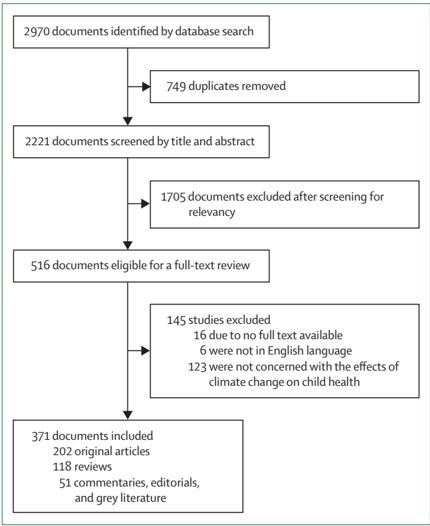
Climate change can have detrimental effects on child health and wellbeing. Despite the imperative for a fuller understanding of how climate change affects child health and wellbeing, a systematic approach and focus solely on children (aged <18 years) has been lacking. In this Scoping Review, we did a literature search on the impacts of climate change on child health from January, 2000, to June, 2019. The included studies explicitly linked an alteration of an exposure to a risk factor for child health to climate change or climate variability. In total, 2970 original articles, reviews, and other documents were identified, of which 371 were analysed. Employing an expanded framework, our analysis showed that the effects of climate change on child health act through direct and indirect pathways, with implications for determinants of child health as well as morbidity and mortality from a range of diseases. This understanding can be further enhanced by using a broader range of research methods, studying overlooked populations and geographical regions, investigating the costs and benefits of mitigation and adaptation for child health, and considering the position of climate change and child health within the UN Sustainable Development Goals. Present and future generations of children bear and will continue to bear an unacceptably high disease burden from climate change.
Overview
CoChat Summary
TL;DR
This scoping review synthesizes evidence on how climate change affects child health through direct and indirect pathways and proposes an expanded conceptual framework. It finds a large but uneven literature, with most studies from high-income or upper-middle-income settings and substantial gaps in qualitative, longitudinal, and equity-focused research.
Key findings
- From 2,970 identified documents, 371 were reviewed: 202 original articles, 118 reviews, and 51 other document types. Most original articles were quantitative (92.6%), and only 32.2% disaggregated results by sex.
- Single-country original articles were concentrated in high-income countries (41.3%), with only 12.2% from low-income countries; Asia (36.0%) and Africa (22.7%) were the most represented regions.
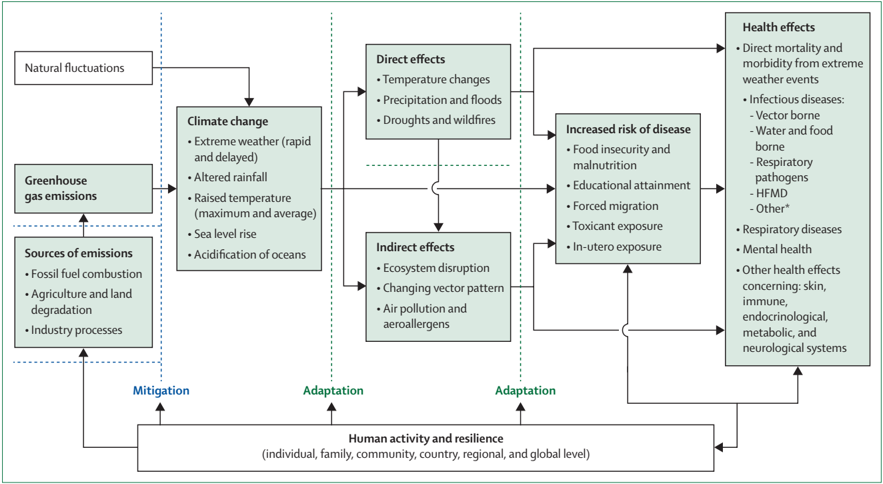
- Climate change affects child health via direct effects (temperature changes, precipitation and floods, droughts and wildfires) and indirect effects (ecosystem disruption, changing vector patterns, air pollution and aeroallergens, mental health), with implications for food insecurity, education, migration, toxicant exposure, and in-utero exposure.
- The review cites projected child health impacts including a 10–15% increase in malaria-related under-5 mortality in sub-Saharan Africa without mitigation/adaptation, up to 20% increased stunting in sub-Saharan Africa under RCP 8.5, a 13% increase in childhood diarrhoea in northern India by 2040, a 20% increase in Lyme disease incidence in the USA by mid-century under RCP 4.5, a 14% increase in US asthma emergency department visits from aeroallergens under RCP 8.5, and a 3–5% increase in hand, foot, and mouth disease in China by end of century.
Methods
- Scoping review following PRISMA Extension for Scoping Reviews, with a predetermined protocol; searches in PubMed, Web of Science, Cochrane Library, Global Health, and WHO regional databases for English-language documents from Jan 1, 2000, to June 11, 2019.
- Search combined child terms (“child”, “infant”, “adolescent”) with climate change terms (“climate change”, “global warming”, “greenhouse effect”, “climate adaptation”); inclusion required children younger than 18 years and a climate-related exposure as a risk factor for child health.
- Screening by one investigator (DH), full-text review by DH and CA, with MN and TA independently validating a random 10% sample; data abstraction used a chart based on published climate-health frameworks, open coding, and iterative development of an expanded conceptual framework. Fourteen articles with severe quality gaps were reviewed but excluded from analysis.
Limitations
- The paper states: search was restricted by time, language, and few search terms; publication bias is likely; the protocol was not published due to time limitations; only one investigator screened documents, risking selection bias; and no uncertainty appraisal was provided for each association, so actual climate change impact in a particular population cannot be asserted.
- The paper also states: many studies included children only as a subpopulation; most research was from high-income and upper-middle-income countries; few articles disaggregated by sex and age; outcomes varied too much to compare across studies; and qualitative and longitudinal research was lacking.
- Evident from the text: the review did not critically appraise study quality systematically, and the included evidence is heterogeneous in exposure definitions, age groups, and outcome measures, limiting generalisability.
Model-written summary. Check it against the paper before relying on it.
Integrity signals
Registry
Cites
Statistics
Figures
Verification
Claims the paper makes
15 Valid · 3 Not valid · 33 Not checked · 39 Own results and interpretations
Every source the paper cites for this claim was checked and supports it.
In the paper
“Heatwaves might also result in an increase in unintentional injuries.37”
§ Climate change and child health: a scoping review and an expanded conceptual framework > Temperature changes
What the sources say
- Supportedcites [37] Otte im Kampe E, Kovats S, Hajat S. Impact of high ambient temperature on unintentional injuries in high-income countries: a narrative systematic literature review. BMJ Open 2016; 6: e010399. source
The Results section ('Mortality due to injuries or poisoning (one study)') states that during major heat waves in France an excess mortality due to injuries and poisoning was observed, with Rey et al estimating 3–14% excess injury/poisoning mortality across heat waves, and the Results table records this for defined heatwave periods (≥3 days above the 95th centile). The Discussion ('In sum, 11 out of 13 studies showed an increase in unintentional injuries in relation to high temperatures'; concluding paragraph) supports a temperature–injury link and explicitly proposes informing heat wave plans with these findings. Because the same review reports decreases during heat waves in Australia (Nitschke et al) and on extreme temperature days, the citing sentence's hedge ('might') matches the state of the evidence rather than overstating it. (LLM, conf=0.80)
hedgedstates a possible cause- Asserted: passes — The authors put it forward as true.
- Checkable: passes — It can be checked against evidence.
- Load-bearing: unclear — It is unclear whether the paper’s conclusions depend on it.
- Based: passes — The paper gives a reason why it holds.
- Supported
The cited sources support only part of this claim — read each source’s verdict below.
In the paper
“Subsequent studies emphasised an increased overall mortality risk from heatwaves in children, particularly infants, 24,25”
§ Climate change and child health: a scoping review and an expanded conceptual framework > Temperature changes
What the sources say
- Partly supportedcites [24] Auger N, Fraser WD, Smargiassi A, Kosatsky T. Ambient heat and sudden infant death: a case-crossover study spanning 30 years in Montreal, Canada. Environ Health Perspect 2015; 123: 712-16. sourceExperimental — accuracy not yet measured
Auger et al. (2015) support the infant-death part only in a narrow, cause-specific form: the Abstract Results and Discussion report that same-day maximum temperature ≥29°C was associated with 2.78-fold greater odds of SIDS (stronger at 3–12 months), i.e. sudden infant death rather than overall/all-cause mortality, and the exposure was daily ambient temperature in April–October, not heat waves as such. The Conclusions (p. final) hedge the heat-wave link explicitly — 'Potential effects of heat waves on SIDS need to be better understood' and infants are 'a group that may be independently at risk' — so the claim's assertion of an established increased mortality risk from heatwaves is stronger than the source. Nothing in our copy addresses children generally; the Introduction credits extreme-heat mortality findings to the elderly (Baccini et al. 2008; Basagaña et al. 2011; Smargiassi et al. 2009). (LLM, conf=0.72)
- Not checked yetcites [25] Son JY, Lee JT, Bell ML. Is ambient temperature associated with risk of infant mortality? A multi-city study in Korea. Environ Res 2017; 158: 748-52. source
plainstates a cause- Asserted: passes — The authors put it forward as true.
- Checkable: passes — It can be checked against evidence.
- Load-bearing: unclear — It is unclear whether the paper’s conclusions depend on it.
- Based: passes — The paper gives a reason why it holds.
- Partly supported
The cited sources support only part of this claim — read each source’s verdict below.
In the paper
“Combining socio economic and demographic factors with spatial modelling can forecast at-risk locations for increased heatwave-related mortality and morbidity.38”
§ Climate change and child health: a scoping review and an expanded conceptual framework > Temperature changes
What the sources say
- Partly supportedcites [38] Ho HC, Knudby A, Chi G, Aminipouri M, Yuk-FoLai D. Spatiotemporal analysis of regional socio-economic vulnerability change associated with heat risks in Canada. Appl Geogr 2018; 95: 61-70. sourceExperimental — accuracy not yet measured
Our copy supports the modelling half of the claim: the paper builds heat vulnerability indices from 2006/2011 Canadian census socio-economic and demographic variables (Data and Methods > Heat Vulnerability Index) and uses spatial statistics (multi-criteria analysis plus Moran's local I hot-spot mapping, Data and Methods > Mapping vulnerability change; Results) to identify 'locations that may be increasingly vulnerable to heat' (Abstract). However, the mortality/morbidity link is stated only as a possibility and is credited to another work: the Introduction says quantifying spatiotemporal vulnerability change and identifying its spatial clusters 'could help estimating heat-related mortality or morbidity during future extreme heat events (Chow et al., 2012)'. The paper itself forecasts increasing socio-economic vulnerability, not heatwave-related deaths or illness, so the citing sentence's unqualified 'can forecast at-risk locations for increased heatwave-related mortality and morbidity' overstates both the certainty and the outcome of this source. (LLM, conf=0.78)
plainstates a cause- Asserted: passes — The authors put it forward as true.
- Checkable: passes — It can be checked against evidence.
- Load-bearing: unclear — It is unclear whether the paper’s conclusions depend on it.
- Based: passes — The paper gives a reason why it holds.
- Partly supported
The cited sources support only part of this claim — read each source’s verdict below.
In the paper
“whereas a rapid change of temperature and humidity levels can significantly affect respiratory and infectious diseases in children.41,42”
§ Climate change and child health: a scoping review and an expanded conceptual framework > Temperature changes
What the sources say
- Not checked yetcites [41] Cong X, Xu X, Zhang Y, Wang Q, Xu L, Huo X. Temperature drop and the risk of asthma: a systematic review and meta-analysis. Environ Sci Pollut Res Int 2017; 24: 22535-46. source
- Partly supportedcites [42] Liu Y, Guo Y, Wang C, et al. Association between temperature change and outpatient visits for respiratory tract infections among children in Guangzhou, China. Int J Environ Res Public Health 2015; 12: 439-54. sourceExperimental — accuracy not yet measured
The temperature component is supported: the Discussion (p. 4, Limitations) states 'our results indicate that temperature change was associated with an increased number of outpatient visits for RTIs in children', and the Results (p. 3, Table 2 discussion) report significant relative risks for a sharp drop in temperature (e.g., -6.2 °C, RR 1.08; 95% CI 1.05–1.11) in children aged <1 and 1–2 years, with the Introduction framing the hypothesis around 'a sharp temperature change between consecutive days'. The humidity component is not supported: Section 2.3 (Meteorological Data) and 2.5 (Statistical Analyses) show relative humidity was merely collected and entered as NS(Hum,3) a covariate adjusted for in the DLNM, and no passage of our copy reports an effect of humidity or humidity change on childhood respiratory/infectious disease. Our copy is also confined to respiratory tract infections, not 'respiratory and infectious diseases' generally. (LLM, conf=0.85)
plainstates a cause- Asserted: passes — The authors put it forward as true.
- Checkable: passes — It can be checked against evidence.
- Load-bearing: unclear — It is unclear whether the paper’s conclusions depend on it.
- Based: passes — The paper gives a reason why it holds.
The cited sources support only part of this claim — read each source’s verdict below.
In the paper
“However, the underlying evidence of how climate change could directly affect adverse health outcomes is limited.10,20”
§ Climate change and child health: a scoping review and an expanded conceptual framework > Direct effects
What the sources say
- Partly supportedcites [10] Sheffield PE, Landrigan PJ. Global climate change and children's health: threats and strategies for prevention. Environ Health Perspect 2011; 119: 291-98. sourceExperimental — accuracy not yet measured
Sheffield et al. (2011) supports only part of the claim. Its Conclusion states that climate change will produce "wide-scale, but still inadequately quantified, increases in disease and death" and that "more thorough quantification of child-specific health impacts... is urgently needed," and its section on extreme heat/storms says "we found limited studies... quantifying the cognitive effects of increased heat on student learning," with pregnancy/renal effects described as "emerging research" (Abstract Data synthesis; Pregnancy and prenatal complications section). But the paper nowhere characterises the underlying evidence for direct climate-health effects as generally limited: the Abstract Data synthesis lists "documented health effects" (vector-borne disease ranges, diarrheal and respiratory disease, extreme-weather morbidity and mortality, toxic-chemical exposures) and quantifies a burden of >150,000 deaths in 2000 with 88% in children, and the Conclusion says the literature on "proven and plausible health impacts... now covers virtually every organ system." So the overstatement is the blanket 'evidence is limited' framing; what the source actually reports as thin is quantification, and evidence for specific direct heat-related outcomes. (LLM, conf=0.72)
- Not checked yetcites [20] Amegah AK, Rezza G, Jaakkola JJK. Temperature-related morbidity and mortality in sub-Saharan Africa: a systematic review of the empirical evidence. Environ Int 2016; 91: 133-49. source
hedged- Asserted: passes — The authors put it forward as true.
- Checkable: passes — It can be checked against evidence.
- Load-bearing: unclear — It is unclear whether the paper’s conclusions depend on it.
- Based: passes — The paper gives a reason why it holds.
- Partly supported
39 more claims · 9 with their cited sources checked
Create a free account to see all 90 claims and to verify the 54 references still open.
- It may state two separate claims as one. 29
- Probably not a substantial claim. 23
- The quote only partly states this claim. 1
Claims other papers make about this one
Each is checked against this paper’s own text: does it say what the citing paper says it does?
The cited source says what the claim attributes to it.
In the citing paper
“Existing reviews have also identified a lack of evidence on the association between climate change and child health in LMICs [28,63].”
From A Scoping Review of Climate Change, Climate-Related Disasters, and Mental Disorders among Children in Low- and Middle-Income Countries (2022) · cites this paper as [28]
The cited source says what the claim attributes to it.
In the citing paper
“a 2021 review found that children of present and future generations will bear an unacceptably high disease burden from climate change, 17”
From Climate anxiety in children and young people and their beliefs about government responses to climate change: a global survey (2021) · cites this paper as [17]
In the citing paper
“Helldén and colleagues [28] analyzed 371 records, only 12% of which focused on LMICs and an even smaller proportion on mental health.”
From A Scoping Review of Climate Change, Climate-Related Disasters, and Mental Disorders among Children in Low- and Middle-Income Countries (2022) · cites this paper as [28]
Citations
Cites
PRISMA Extension for Scoping Reviews (PRISMA-ScR): Checklist and Explanation
Tricco, A. C., Lillie, E., Zarin, W., O'Brien, K. K., Colquhoun, H., Levac, D., Moher, D., Peters, M. D. J., Horsley, T., Weeks, L., et al. (2018) · Annals of Internal Medicine · doi:10.7326/m18-0850 · Cited by 43,565
Transforming Our World: The 2030 Agenda for Sustainable Development
(2018) · A New Era in Global Health · doi:10.1891/9780826190123.ap02 · Cited by 19,351
Munn, Z., Peters, M. D. J., Stern, C., Tufanaru, C., McArthur, A., & Aromataris, E. (2018) · BMC Medical Research Methodology · doi:10.1186/s12874-018-0611-x · Cited by 11,385
Methods for the thematic synthesis of qualitative research in systematic reviews
Thomas, J., & Harden, A. (2008) · BMC Medical Research Methodology · doi:10.1186/1471-2288-8-45 · Cited by 9,312
Managing the health effects of climate change
Costello, A., Abbas, M., Allen, A., Ball, S., Bell, S., Bellamy, R., Friel, S., Groce, N., Johnson, A., Kett, M., et al. (2009) · The Lancet · doi:10.1016/s0140-6736(09)60935-1 · Cited by 3,102
The Global Syndemic of Obesity, Undernutrition, and Climate Change: The Lancet Commission report
Swinburn, B. A., Kraak, V. I., Allender, S., Atkins, V. J., Baker, P. I., Bogard, J. R., Brinsden, H., Calvillo, A., De Schutter, O., Devarajan, R., et al. (2019) · The Lancet · doi:10.1016/s0140-6736(18)32822-8 · Cited by 3,081
A scoping review of scoping reviews: advancing the approach and enhancing the consistency
Pham, M. T., Rajić, A., Greig, J. D., Sargeant, J. M., Papadopoulos, A., & McEwen, S. A. (2014) · Research Synthesis Methods · doi:10.1002/jrsm.1123 · Cited by 3,078
Whitmee, S., Haines, A., Beyrer, C., Boltz, F., Capon, A. G., de Souza Dias, B. F., Ezeh, A., Frumkin, H., Gong, P., Head, P., et al. (2015) · The Lancet · doi:10.1016/s0140-6736(15)60901-1 · Cited by 2,998
Watts, N., Amann, M., Arnell, N., Ayeb-Karlsson, S., Belesova, K., Boykoff, M., Byass, P., Cai, W., Campbell-Lendrum, D., Capstick, S., et al. (2019) · The Lancet · doi:10.1016/s0140-6736(19)32596-6 · Cited by 1,472
Self-citation
Research works printed but not linked: 2
- Intergovernmental Panel on Climate Change. AR5 climate change 2014: impacts, adaptation, and vulnerability. Cambridge, UK and New York, NY, USA: Cambridge University Press, 2014.
- Akachi Y, Goodman D, Parker D. Global climate change and child health: a review of pathways, impacts and measures to improve the evidence base. Florence: UNICEF, 2009.
Cited by
Items 101–200 of 333
Böse‐O’Reilly, S., O’Reilly, F., & Roeßler, C. (2023) · Monatsschrift Kinderheilkunde · doi:10.1007/s00112-022-01682-7 · Cited by 11
“Internationale Studien deuten darauf hin, dass Kleinkinder und insbesondere Säuglinge ein erhöhtes Mortalitätsrisiko während Hitzewellen aufweisen [13, 27].”
BackgroundClimate changes, economic downturn and children's health
Buonocore, G., & Pettoello‐Mantovani, M. (2023) · Global Pediatrics · doi:10.1016/j.gpeds.2023.100053 · Cited by 9
Scientific Studies on Climate Change, Children and Education: Current Situation and Suggestions
Ozturk, E. (2023) · Journal of Education in Science Environment and Health · doi:10.55549/jeseh.1231249 · Cited by 9
Xue, T., Wu, J., Li, F., Tong, M., Liu, H., Yang, W., & Li, P. (2024) · Global Environmental Change · doi:10.1016/j.gloenvcha.2024.102879 · Cited by 8
How do extreme weather events contribute to violence against children?
Datzberger, S., Howard‐Merrill, L., Parkes, J., & Iorfa, S. K. (2024) · Child Abuse & Neglect · doi:10.1016/j.chiabu.2024.107093 · Cited by 12
“…as: droughts, water scarcity, coastal and riverine floods, heatwaves) have been associated with poor health outcomes and death among children, affecting especially children under the age of five (Cooper et al., 2019; Ghirardi et al., 2015; Helld ´ en et al., 2021; Sheffield & Landrigan, 2011).”
InfluentialKamiya, Y., Kishida, T., & Tanou, M. (2025) · Journal of Health Population and Nutrition · doi:10.1186/s41043-025-00808-3 · Cited by 9
“Studies have consistently demonstrated that exposure to extreme weather conditions during pregnancy and early childhood adversely affects child nutritional outcomes in SSA [6, 7].”
Wu, Y., Yang, J., Wei, J., Cheng, B., Wang, Y., Li, C., Wang, P., Sun, H. W., & Huang, L. (2025) · Communications Earth & Environment · doi:10.1038/s43247-025-02409-8 · Cited by 10
Donger, E., Bhatia, A., Pegram, J., & Kelly, O. M. (2025) · Nature Communications · doi:10.1038/s41467-025-60266-7 · Cited by 11
“…a recent systematic review of the literature on children, climate and health, which found “ a striking lack of focus ” on children, who are often included in studies without disaggregation by age or gender, or consideration of the underlying social, political and economic determinants of health 2 .”
Helldén, D., Ndejjo, R., Sturm, A., Persson, I., Wanyenze, R. K., Ebi, K. L., Nilsson, M., & Alfvén, T. (2023) · Environmental Research Health · doi:10.1088/2752-5309/acc2dd · Cited by 11
“Taking a broader scoping review approach, albeit not focusing directly on adaptation, the literature (371 documents including grey literature) provided by Helldén et al [3] offers some insights.”
BackgroundSelf-citationNexus between health poverty and climatic variability in Pakistan: a geospatial analysis
Khan, S. U., Sheikh, M. R., Dimén, L., Batool, H., Abbas, A., & Nuţă, A. C. (2023) · Frontiers in Environmental Science · doi:10.3389/fenvs.2023.1180556 · Cited by 8
“A bunch of previous literature has shown that climate change has a substantial impact on child health (Thompson et al., 2012; Bennett and Friel, 2014; Davenport et al., 2017; Bhandari et al., 2020; Helldén et al., 2021), or maternal health (Giulia et al.”
BackgroundProjections of climate change vulnerability along the Shared Socioeconomic Pathways 2020–2100
Huisman, J., Martyr, R., Rott, R., & Smits, J. P. J. M. (2025) · Scientific Data · doi:10.1038/s41597-025-05732-z · Cited by 13
Perera, F. P., & Lau, K. (2024) · The Journal of Climate Change and Health · doi:10.1016/j.joclim.2024.100369 · Cited by 8
Cascading impacts of climate change on child survival and health in Africa
Diep, L., Godfrey, S., Tunhuma, F., Campos, L. C., Lakhanpaul, M., & Parikh, P. (2025) · Nature Climate Change · doi:10.1038/s41558-024-02197-7 · Cited by 13
Impacts of climate change during pregnancy, perinatal period and infancy: a systematic review
Persson, I., Sturm, A., Manchikanti, S., Nilsson, M., Ebi, K. L., Solomon, A., Alfvén, T., & Helldén, D. (2025) · BMJ Paediatrics Open · doi:10.1136/bmjpo-2024-002895 · Cited by 15
Self-citationAn Ecological Approach for Advancing the Understanding of Nutrition and Health
Raiten, D. J., & Bremer, A. A. (2023) · Archives of Pediatrics and Adolescent Medicine · doi:10.1001/jamapediatrics.2023.1613 · Cited by 7
Mitigating the effects of climate change in children’s outdoor play environments
Bäckström, M. K., Lundgreen, E., & Slaug, B. (2023) · Scandinavian Journal of Occupational Therapy · doi:10.1080/11038128.2023.2275697 · Cited by 13
“Climate change is a human driven global health challenge with a more frequent and intensified occurrence of extreme weather hazards, such as heatwaves, storms and floods, which can indirectly impact food security, air, water quality, human and animal security and health [1–3].”
Hannah, E., Etter‐Phoya, R., Lopez, M., Hall, S. G., & O'Hare, B. A.-M. (2024) · PLOS Global Public Health · doi:10.1371/journal.pgph.0002721 · Cited by 7
Accountants will save the world!
Ross, A. (2022) · Water International · doi:10.1080/02508060.2022.2133796 · Cited by 7
Eco-anxiety: An adaptive behavior or a mental disorder? Results of a psychometric study
Micoulaud‐Franchi, J., Coelho, J., Geoffroy, P. A., Vecchierini, M., Poirot, I., Royant‐Parola, S., Hartley, S., Cugy, D., Gronfier, C., Gauld, C., et al. (2024) · L Encéphale · doi:10.1016/j.encep.2023.08.009 · Cited by 9
How do Climate Change and Environmental Degradation contribute to Violence against Children?Preprint
Datzberger, S., Howard‐Merrill, L., Iorfa, S. K., & Parkes, J. (2023) · SocArXiv (OSF Preprints) · doi:10.31235/osf.io/zpxc8 · Cited by 10
Children With Cardiac Disease and Heat Exposure: Catastrophic Converging Consequences?
Souilla, L., Amédro, P., & Morrison, S. A. (2024) · Pediatric Exercise Science · doi:10.1123/pes.2023-0086 · Cited by 8
“By 2100, 75% of the world ’ s population may be subject to at least 20 days of “ extreme heat conditions ” per year (26) as the frequency, intensity, and duration of heat waves (14) will also increase (23).”
Kurt, A., Dinç, F., Şan, E. G., & Uzun, İ. B. (2024) · International Journal of Environmental Health Research · doi:10.1080/09603123.2024.2382903 · Cited by 6
“Academics from various fields and disciplines have conducted numerous studies on the relationship between climate change and the health protection behaviors of adolescents (Wang et al. 2016; Helldén et al. 2021).”
Cairns, L. O., Fambasayi, R., Katsidzira, R. S., Milić, P., Cilliers, E. J., & Barros, P. (2024) · Urban Planning · doi:10.17645/up.8264 · Cited by 6
“Children, especially in high‐risk environments, face disproportionate impacts from climate‐related threats, such as droughts, floods, and natural disasters, leading to dire consequences for their health, security, and well‐being (Helldén et al., 2021).”
BackgroundUnder-five mortality burden in low- and middle-income countries set to increase under future warming
Zhu, Y., He, C., Bachwenkizi, J., Fatmi, Z., Zhou, L., Liu, C., Liu, S., Kan, H., & Chen, R. (2025) · One Earth · doi:10.1016/j.oneear.2025.101424 · Cited by 10
Pediatric Health at the Crossroads of Climate Change, Food Insecurity, and Malnutrition
Scirocco, T., Martini, D., Agostoni, C., Raviglione, M. C., Bocchi, S., & Berti, C. (2026) · Advances in Nutrition · doi:10.1016/j.advnut.2026.100658 · Cited by 7
“There is a rising body of scientific evidence on the negative impacts of climate-related exposures and child health [6].”
InfluentialLi, J., Yuan, J., Huang, Y., & Zhang, Y. (2023) · Humanities and Social Sciences Communications · doi:10.1057/s41599-023-01907-4 · Cited by 7
Climate change, poverty and child health inequality: evidence from Vietnam’s provincial analysis
Huynh, C. M., & Tran, B. K. (2024) · Economic Change and Restructuring · doi:10.1007/s10644-024-09743-5 · Cited by 8
“Helldén et al. (2021) show that climate change causes direct and indirect effects to children health.”
BRIKER, S. M., Tran, K. T., Visoki, E., Gordon, J. H., Hoffman, K. W., & Barzilay, R. (2024) · JAACAP Open · doi:10.1016/j.jaacop.2024.09.009 · Cited by 10
“6 In fact, a scoping review of 371 articles exploring the impact of climate change on children ’ s health, including mental health, emphasized the need for more longitudinal studies.”
Climate change will impact childhood cancer risks, care and outcomes
Thompson, H. M., Sheffield, P. E., Shakeel, O., Wood, N., & Miller, M. D. (2025) · BMJ Paediatrics Open · doi:10.1136/bmjpo-2024-003123 · Cited by 6
Factors to be Considered in Advancing Pediatric Critical Care Across the World
Argent, A. C., Ranjit, S., Peters, M. J., Arnim, A. V. S. A.-V., Chisti, M. J., Jabornisky, R., Musa, N. L., & Kissoon, N. “. (2022) · Critical Care Clinics · doi:10.1016/j.ccc.2022.07.001 · Cited by 10
The contribution of school social work to climate change education and mental health support
Wiedebusch, S. (2024) · European Journal of Social Work · doi:10.1080/13691457.2024.2344005 · Cited by 7
“Exposure to extreme weather events or natural disasters such as uncontrollable forest fi res or droughts can have serious mental health consequences for children and adolescents, including the development of post-traumatic stress disorder or depression (Hellden et al., 2021; Clemens et al., 2022).”
BackgroundClimate Distress among Young People: An Overview
Clayton, S., & Crandon, T. (2024) · Cambridge University Press eBooks · doi:10.1017/9781009252904.002 · Cited by 9
Nursing students' conceptualization of environmental problems: a descriptive cross-sectional study
Koçoğlu, D., Dengiz, K. S., & Saçıkara, Z. (2024) · Nurse Education Today · doi:10.1016/j.nedt.2024.106296 · Cited by 8
Maritano, S., Richiardi, L., Quaglia, S., Rusconi, F., Maule, M. M., & Moirano, G. (2025) · Environment International · doi:10.1016/j.envint.2025.109303 · Cited by 6
“Nevertheless, several studies addressing these associations concentrate on single exposure types and investigate their short-term effects on acute outcomes (Perera and Nadeau, 2022; Helld ´ en et al., 2021; Kline and Prunicki, 2023; Makrufardi et al., 2023).”
Atalell, K. A., Pereira, G. F., Duko, B., Nyadanu, S. D., O’Donnell, M., & Tessema, G. A. (2025) · Environment International · doi:10.1016/j.envint.2025.109642 · Cited by 5
Intergenerational Climate Justice: Applying Theory to Policy in the Anthropocene
Bessant, J., Prost, A., & Watts, R. (2025) · Journal of Applied Youth Studies · doi:10.1007/s43151-025-00191-0 · Cited by 15
Delprato, M., & Shephard, D. D. (2024) · International Journal of Educational Development · doi:10.1016/j.ijedudev.2024.103129 · Cited by 6
Moody, M. D., & Satcher, L. A. (2024) · Early Childhood Research Quarterly · doi:10.1016/j.ecresq.2023.12.015 · Cited by 6
Weather-Related Pediatric Fatalities in the United States: 2001 to 2021
Stephens, C. Q., Cairo, S. B., Fallat, M. E., Melhado, C. G., Godfred‐Cato, S., Ong, H., & Newton, C. R. (2025) · PEDIATRICS · doi:10.1542/peds.2024-067567 · Cited by 5
Fagbemi, F., Olufolahan, T. J., Akinyele, O. D., & Olatunde, O. S. (2025) · Sustainable Geosciences People Planet and Prosperity · doi:10.1016/j.susgeo.2025.100002 · Cited by 11
Stella, A. B., & Morrison, S. A. (2022) · International Journal of Environmental Research and Public Health · doi:10.3390/ijerph19031601 · Cited by 5
Climate Change, Air Pollution, and Children’s Mental Health
Yu, W., & Weitzman, M. L. (2022) · Journal of Applied Research on Children Informing Policy for Children at Risk · doi:10.58464/2155-5834.1491 · Cited by 7
Morrison, S. A., Jurak, G., Starc, G., Kovač, M., Golobiĉ, M., Samardžija, P. P., Gabrijelčič, M., Kotnik, P., Meh, K., Primožič, M., et al. (2023) · Journal of Exercise Science & Fitness · doi:10.1016/j.jesf.2023.06.003 · Cited by 24
Wu, Y., Wei, J., Cheng, B., Sun, H. W., Zhou, Y., Li, C., Wang, P., Zhang, H., Wang, Y., Huang, L., et al. (2025) · npj Mental Health Research · doi:10.1038/s44184-025-00132-y · Cited by 4
“As climate change intensi fi es extreme weather events 55 , sustained attention to composite exposure is crucial to safeguarding childhood mental well-being.”
Cao, G., Liu, J., & Liu, M. (2025) · International Journal of Surgery · doi:10.1097/js9.0000000000003131 · Cited by 12
Impacts of climate change on childhood obesity: an updated systematic literature review
Guo, M., Wen, L. M., Li, M., Jiang, H., Kan, H., He, G., Farrell, P., & Zhang, Y. (2025) · BMJ Open · doi:10.1136/bmjopen-2025-104383 · Cited by 5
“11 Given the complex interplay between climate change and childhood obesity, several pathways have been proposed through which climate dynamics may contribute to obesity risk among children.”
Coleman, M. C., Khan, P. Y., Linde, L., Williams, P. C. M., & Marais, B. J. (2025) · Current Opinion in Pediatrics · doi:10.1097/mop.0000000000001442 · Cited by 5
Juel, R., Bwire, C., Eddine, H. C., Mariyam, D., Umesh, H., Alobeid, R., Bonnet, G., Milner, J., Yeung, S., & Hughes, R. C. (2025) · Cities · doi:10.1016/j.cities.2025.106137 · Cited by 5
Mulondo, M. A., Hege, A., Tsoka-Gwegweni, J. M., & Ndirangu, J. (2025) · PLOS Global Public Health · doi:10.1371/journal.pgph.0004897 · Cited by 7
Li, P., Wu, J., Xue, T., & Zhu, T. (2025) · Communications Medicine · doi:10.1038/s43856-025-01101-4 · Cited by 6
“Previous studies have suggested several biological mechanisms underlying the health impacts of long-term temperature exposure and temperature anomalies 34,35 .”
Black, M. M., Bruening, M. M., Carroll‐Scott, A., Dave, J. M., Ebi, K. L., Iannotti, L. L., Johnson, S. L., Ritchie, L. D., Jimenez, E. Y., Steiber, A. L., et al. (2025) · Journal of Nutrition · doi:10.1016/j.tjnut.2025.10.020 · Cited by 11
Self-citationZhang, D., Liang, F., Li, Q., Chen, J., An, X., Luo, S., Liu, Q., Wu, X., Chen, L., & Xs, L. (2026) · European Heart Journal · doi:10.1093/eurheartj/ehaf1086 · Cited by 7
Climate Change and the Health of Children in Southern Africa – The Time to Act is Now
Coovadia, A. H., Chersich, M., Roux, A. L., & Wright, C. Y. (2022) · Wits Journal of Clinical Medicine · doi:10.18772/26180197.2022.v4n3a5 · Cited by 4
Maessen, S. E., Taylor, B. J., Gillon, G. T., Barnes, H. M., Firestone, R. T., Taylor, R. W., Milne, B. J., Hetrick, S. E., Cargo, T., McNeill, B., et al. (2023) · Journal of the Royal Society of New Zealand · doi:10.1080/03036758.2023.2173257 · Cited by 6
“…disadvantaged are most at risk from consequences to education, nutrition, wellbeing, and physical and mental health (Currie and Deschênes 2016; Hellden et al. 2021; Le ff ers 2022), it is unlikely that any of today ’ s children or those yet to be born will entirely escape these wide-reaching e…”
BackgroundClimate change-related mass migration requires health system resilience
Clark‐Ginsberg, A., & Chandra, A. (2023) · Environmental Research Health · doi:10.1088/2752-5309/ace5ca · Cited by 7
“Children, for instance, depend on their parents for a protective ‘buffer’ that can be disrupted during crises (Helldén et al 2021, Vos et al 2021).”
BackgroundLi, J., Pin, W., Sutton, C., Harker, R., Xue, T., & Chen, K. (2024) · Environmental Science & Technology · doi:10.1021/acs.est.4c04307 · Cited by 4
Newborn and Child Health Services in Urban India: Challenges and the Way Forward
Gopal, K. M., Venkatnarayan, K., Gopal, K. S. U., Sharma, T., Kumar, S., & Lahariya, C. (2025) · Preventive Medicine Research & Reviews · doi:10.4103/pmrr.pmrr_27_24 · Cited by 4
da Silveira, I. H., Rebouças, P., Pescarini, J. M., Cortes, T. R., de Oliveira, B. F. A., Neves, D. J. D., Rocha, A. D. S., Ribeiro‐Silva, R. D. C., Barreto, M. L., Ranzani, O., et al. (2025) · Environmental Research · doi:10.1016/j.envres.2025.122683 · Cited by 9
The Untapped Potential of Early Childhood Education for Planetary Health: A Narrative Review
Spiteri, J. (2022) · Climate change management · doi:10.1007/978-3-031-09879-6_17 · Cited by 8
Protecting Children's Health: Asthma and Climate Change
McDermott‐Levy, R., Pennea, E., & Moore, C. H. (2023) · MCN The American Journal of Maternal/Child Nursing · doi:10.1097/nmc.0000000000000927 · Cited by 7
Planetary health: an imperative for pediatric radiology
Kim, H. H. R., Leschied, J. R., Noda, S. M., Sarma, A., Pruthi, S., & Iyer, R. S. (2023) · Pediatric Radiology · doi:10.1007/s00247-023-05807-2 · Cited by 4
“The incidence rate of Lyme disease in the USA is projected to increase by 20% in the coming decade compared to its current rate [56].”
Verbruggen, S. C. A. T., den Otter, S. C., Bakker, J., Briassoulis, G. C., Ilia, S., Latten, L., Joosten, K. F. M., Rooze, S., van Zanten, E., Beattie, R. M., et al. (2024) · Frontline Gastroenterology · doi:10.1136/flgastro-2023-102478 · Cited by 6
Editorial: The Effects of Climate Change and Environmental Factors on Exercising Children and Youth
Morrison, S. A., Périard, J. D., Boever, P. D., & Daanen, H. A. M. (2021) · Frontiers in Sports and Active Living · doi:10.3389/fspor.2021.690171 · Cited by 4
Singh, T., Tushir, B., Mittal, S., & Kaur, H. (2024) · Springer eBooks · doi:10.1007/978-981-92-1288-0_145 · Cited by 4
A Review of Qualitative Studies of Parents’ Perspectives on Climate Change
Graham, H. M., Lampard, P., & Golder, S. (2025) · Societies · doi:10.3390/soc15040104 · Cited by 5
Impact of the Climate Crisis on Childhood Health
Henning, A., & Kache, S. (2025) · Pediatrics in Review · doi:10.1542/pir.2024-006712 · Cited by 4
Logie, C. H., Sivan, O., Leggett, R., Okumu, M., Loutet, M. G., MacKenzie, F., Lukone, S. O., Kisubi, N., Gittings, L., Kyambadde, P., et al. (2025) · SSM - Mental Health · doi:10.1016/j.ssmmh.2025.100579 · Cited by 3
de Freitas, F., Fogagnolo, C., Dornfeld, R. L., Vítolo, M. R., Antônio, M. Â., & Bellomo‐Brandão, M. A. (2026) · Cadernos de Saúde Pública · doi:10.1590/0102-311xen131825 · Cited by 3
“Prolonged exposure to intense heat can compromise physical and mental well-being, negatively affect cognitive performance, and increase the occurrence of heat-related health problems such as dehydration, thermal exhaustion, and heat stroke 19,20 .”
Park, J. L., Deneault, A., McArthur, B. A., Tough, S., & Madigan, S. L. (2026) · Child and Adolescent Mental Health · doi:10.1111/camh.70076 · Cited by 5
“…facing both direct (e.g., malnutrition, lack of clean water, infectious disease) and indirect threats (e.g., fear or anxiety after learning about climate change and its impacts) to their health and well-being (Cuartas et al., 2024; Helld ´ en et al., 2021; Sanson & Bel-lemo, 2021; UNICEF, 2021).”
Szakemberek a klímaválság gyermekekre és fiatalokra gyakorolt hatásáról (szöveghű fordítás)
Kovács, Z. (2021) · Egészségfejlesztés · doi:10.24365/ef.v62i3.6688 · Cited by 3
To pollute or not to pollute? Decreasing the ecological footprint of pediatrics in the COVID-19 era
Gözderesi, Y., Tsagkaris, C., Eleftheriades, A., & Pervanidou, P. (2022) · The Journal of Climate Change and Health · doi:10.1016/j.joclim.2022.100141 · Cited by 3
Climate Change: Implications for Community Mental Health
Sullenbarger, J., Schutzenhofer, E., & Haase, E. (2022) · Springer eBooks · doi:10.1007/978-3-031-10239-4_31 · Cited by 5
Meka, K., Jacob, C. M., Modi, N., Bustreo, F., Renzo, G. C. D., Malamitsi‐Puchner, A., Briana, D. D., Iaia, D. G., Fogstad, H., Tamvada, J. P., et al. (2023) · Acta Paediatrica · doi:10.1111/apa.16677 · Cited by 3
Souho, T., Bomboma, D., Compaoré, E. W. R., Essowèréou, A. A., Ouadja, B., Kabassina, M. E., Pilo, M., Yao, R., & Kou’santa, A. (2023) · Food Production Processing and Nutrition · doi:10.1186/s43014-023-00145-0 · Cited by 4
Climate Change, COVID-19, and Flood disasters in Pakistan
Muhammad, A., & Noor, S. (2023) · Journal of the Pakistan Medical Association · doi:10.47391/jpma.9231 · Cited by 3
COVID-19 and its effects on food producers: panel data evidence from Burkina Faso
Druetz, T., Brenes-Garita, S., Bicaba, F., Tiendrebeogo, C. O., & Bicaba, A. (2024) · BMC Nutrition · doi:10.1186/s40795-024-00942-x · Cited by 4
Holzinger, D. (2024) · Kindheit und Entwicklung · doi:10.1026/0942-5403/a000464 · Cited by 3
Programming long-term health: Nutrition and diet in infants aged 6 months to 1 year
Kalhoff, H., & Kersting, M. (2022) · Elsevier eBooks · doi:10.1016/b978-0-12-824389-3.00003-9 · Cited by 5
Ryan, P., Newman, N. C., Yolton, K. A., Meinzen‐Derr, J. K., Glauser, T. A., Cheng, T. L., Shah, S., Patel, M., Ragavan, M. I., Lorch, S. A., et al. (2024) · Pediatric Research · doi:10.1038/s41390-024-03559-9 · Cited by 2
Children’s health and the ocean: a vital connection
Whitman, E. M., Fleming, L. E., & Landrigan, P. J. (2024) · BMJ Paediatrics Open · doi:10.1136/bmjpo-2024-003028 · Cited by 2
Temperature rising is threatening adolescent mental health in China
Hao, Z., Yuan, X., & Xie, Y. (2025) · Climatic Change · doi:10.1007/s10584-025-04008-0 · Cited by 3
Kalbarczyk, E., & Kalbarczyk, R. (2025) · Cities · doi:10.1016/j.cities.2025.106672 · Cited by 3
Phakisi, T. K., Weimann, E., & Rother, H. (2025) · Children · doi:10.3390/children12121634 · Cited by 2
Syal, R., Alfvén, T., Ashorn, P., Black, R. E., Chersich, M., Das, J. K., Maimela, G., Neufeld, L. M., Phillips, D. E., Portela, A. G., et al. (2026) · The Lancet Global Health · doi:10.1016/s2214-109x(25)00539-x · Cited by 7
Self-citationThe environmental impact of diagnostic imaging: opportunities for pediatric radiologists
Gross, J., Pruthi, S., Omary, R. A., & Snyder, E. (2026) · Pediatric Radiology · doi:10.1007/s00247-026-06656-5 · Cited by 2
“Rising temperatures are associated with the increased rates of several infectious diseases such as vector-born illnesses like malaria and dengue [1].”
InfluentialBenschop, N. D., Chironda, G., Naidoo, S., Jafta, N., Ramsay, L. F., & Naidoo, R. N. (2023) · Global perspectives on health geography · doi:10.1007/978-3-031-38878-1_21 · Cited by 2
Wu, J., Yang, R., Yu, H., Chen, H., Wu, Y., Qin, X., Wu, T., Shang, S., & Hu, Y. (2024) · Urban Climate · doi:10.1016/j.uclim.2024.101891 · Cited by 2
Trends in environmental risk and child health research: A bibliometric study, 1990–2022
Shaw, S., Chattopadhyay, A., & Bhutia, L. T. (2024) · Clinical Epidemiology and Global Health · doi:10.1016/j.cegh.2024.101651 · Cited by 5
The Effects of Climate Change on Maternal, Fetal and Neonatal Health: An in-Depth Review
Dalkıran, İ. Ö., & Keleş, N. Ç. (2024) · Eurasian Journal of Health Technology Assessment · doi:10.52148/ehta.1439406 · Cited by 3
Risk perceptions of Italian paediatricians for the impact of climate change on children’s health
Moraca, S., Indinnimeo, L., & Nuntiis, P. D. (2024) · The Italian Journal of Pediatrics/Italian journal of pediatrics · doi:10.1186/s13052-024-01736-4 · Cited by 2
“…the source of childhood problems that can continue into adulthood [1, 5, 15], – Increased exposure per unit of body weight: Babies eat, drink, and breathe more per unit of body weight than adults do, increasing their relative exposure to pollutants of all kinds when compared to adults [1, 5, 15], –”
BackgroundInfluentialChildren-specific environmental protection strategies are needed in China
Zhang, J., Jiang, W. J., Tao, F., Ding, G., Li, F., Tian, Y., & Tao, S. (2025) · Eco-Environment & Health · doi:10.1016/j.eehl.2025.01.001 · Cited by 3
Akhtar, T. N., Maiorano, N., Cosma, A. P., & Hadfield, K. (2025) · Perspectives in Public Health · doi:10.1177/17579139251371589 · Cited by 5
“21 27 However, there is limited research on the specific mental health effects of ewes on child survivors, 12,28,29 and what does exist tends to focus on children living in high-income countries, rather than those in LMiC settings, leaving the vast majority of the world’s children under-represented…”
Durrwachter-Erno, K., Huerta-Montañez, G., Nguyen, V. M., Levy, A. A., Lawson, J. M., & Nguyen, V. (2021) · Journal of Applied Research on Children Informing Policy for Children at Risk · doi:10.58464/2155-5834.1451 · Cited by 1
Climate Change and Its Effects on Children and Adolescents: a Call to Action
Goldstein, M. A. (2022) · Current Pediatrics Reports · doi:10.1007/s40124-022-00263-2 · Cited by 3
Rubin, I. L., & Witherspoon, N. O. (2021) · Journal of Applied Research on Children Informing Policy for Children at Risk · doi:10.58464/2155-5834.1466 · Cited by 2
Stronger efforts are needed to safeguard the nutrition of school aged children
Nilsson, M., Emilsson, C., Johansson, A., Tomson, G., Meijer, S., Östman, L., & Magnusson, U. (2022) · British medical journal · doi:10.1136/bmj.o623 · Cited by 1
Self-citationNurturing children and protecting our planet from climate change
Alfvén, T., & Bhutta, Z. A. (2024) · BMJ · doi:10.1136/bmj.q2056 · Cited by 2
Self-citationClimate change and its impact on women's living
Özer, E. (2024) · Journal of Health Sciences and Medicine · doi:10.32322/jhsm.1481918 · Cited by 2
Climate Change and Human Health: Time to Recognize the New Threat
Anupama, Y. J. (2024) · APIK Journal of Internal Medicine · doi:10.4103/ajim.ajim_93_24 · Cited by 1
A literature review of climate change-related risk factors for cancer development
da Silva, V. E., Wang, X., Montelpare, W. J., & Kınay, P. (2025) · Environmental Research Health · doi:10.1088/2752-5309/adcfb9 · Cited by 3
“Elevated CO2 concentrations and heat stress can decrease crop nutritional value (Hall et al 2021, Helldén et al 2021).”
Metadata
- Authors
- Helldén, D., Andersson, C., Nilsson, M., Ebi, K. L., Friberg, P., & Alfvén, T.
- Affiliations
- Karolinska Institutet (SE)
- Umeå University (SE)
- University of Washington (US)
- Royal Swedish Academy of Sciences (SE)
- Corresponding author
- Helldén, Daniel
- Venue
- The Lancet Planetary Health
- Publisher
- Elsevier BV
- Published
- 2021-03
- Volume
- 5
- Issue
- 3
- Pages
- e164-e175
- ISSN
- 2542-5196 (ISSN-L)
- OpenAlex
- W3135535939
- Semantic Scholar
- 7c69e190f976e9dccc6756901855226f8a67f279
- Cited by
- 332
- References
- 148
- Citations by year
- 2026: 71 · 2025: 79 · 2024: 79 · 2023: 51 · 2022: 32 · 2021: 20
- FWCI
- 4.38
- Type
- journal article
- Language
- en
- Open access
- gold
- doi.org
- Licence
- cc-by-nc-nd
- www.elsevier.com/tdm/userlicense/1.0/ (tdm)
- www.elsevier.com/legal/tdmrep-license (tdm)
- creativecommons.org/licenses/by-nc-nd/4.0/ (vor)
- Locations
- The Lancet Planetary Health (publishedVersion, cc-by-nc-nd)
- PubMed (publishedVersion)
- DiVA at Umeå University (Umeå University) (submittedVersion, other-oa)
- Funders
- Svenska Forskningsrådet Formas
- Topics
- Physical Sciences › Environmental Science › Health, Toxicology and Mutagenesis › Climate Change and Health Impacts
- Physical Sciences › Environmental Science › Health, Toxicology and Mutagenesis › Air Quality and Health Impacts
- Social Sciences › Health › Occupational Health and Global Justice
- Keywords
- climate change, child health, child well-being, climate variability, child morbidity, child mortality, disease burden, climate change exposure, climate change adaptation, climate change mitigation, Sustainable Development Goals, conceptual framework
- MeSH terms
- Child Health, Food Insecurity, Air Pollution, Child, Communicable Diseases, Environmental Exposure, Humans, Mental Health, Risk, Socioeconomic Factors, Weather, Climate Change
About these checks
Registry, retraction, Cites and statistics results are computed, not judged, with one exception: a printed reference that no index lists is read once by a model before it counts as a citation error. Claims are extracted by a model and kept only when their quote appears verbatim in the text; each cited source is then checked, with a model’s help, for whether it says what the claim relies on. Those verdicts can be wrong — read the claim’s quote and the cited source before relying on one.
The claim verdicts this report counts are experimental: their accuracy is not yet measured.
A language model drew the claims from the paper on 2026-10-07, under version 3 of the claim definition (model deepseek-v4.1-flash, prompt extract-v3).
A second model labelled each claim on 2026-10-07 (model jev-1.13-20260917, definition revision gold-guideline-v0.2).
Cited sources are checked with a language model’s help (qwen3.8-omni-flash).
Statistics and arithmetic are recomputed, not judged.
Confidence bands are shown only for fields calibrated on our annotated test set. None is calibrated yet, so no band is shown.
What counts as a claim ›How we measure confidence ›How we check this ›
Are you an author, or do you see a problem with this page? Request a review
Data sources
Bibliographic data: Semantic Scholar, OpenAlex, Crossref.
Contains information from the Semantic Scholar Academic Graph Datasets, made available under the ODC Attribution License (ODC-BY 1.0).
Semantic Scholar’s data is described in: Kinney, R., et al. (2023). The Semantic Scholar Open Data Platform. arXiv:2301.10140.
