

Foresight-a generative pretrained transformer for modelling of patient timelines using electronic health records: a retrospective modelling study
Open accessThe DOI matches its Crossref record; 37 of the 37 references it cites were found in a registry or an index; 13 of the 15 sources its claims cite were checked for support.
Abstract
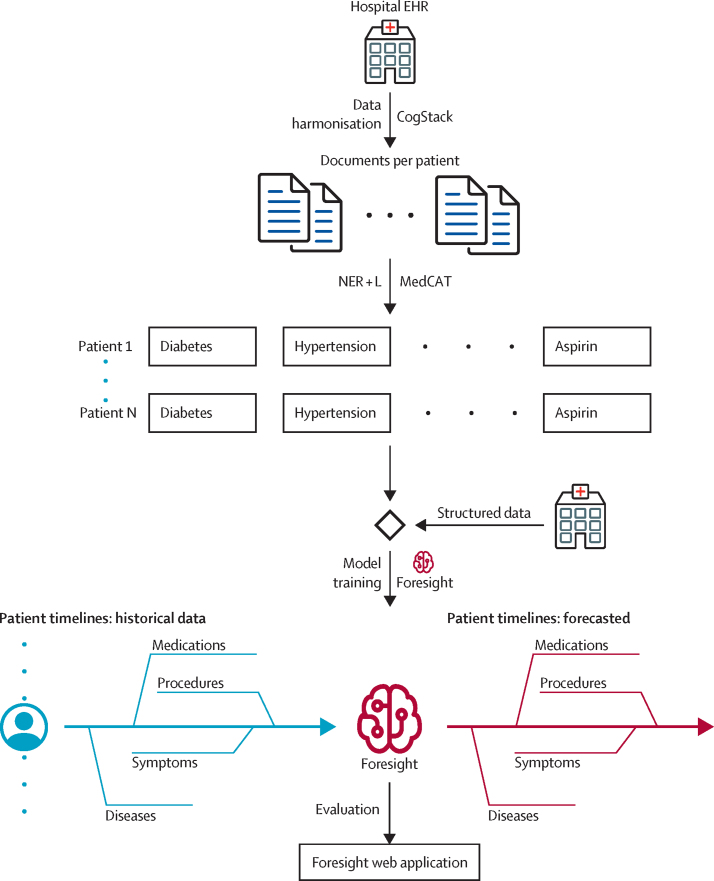
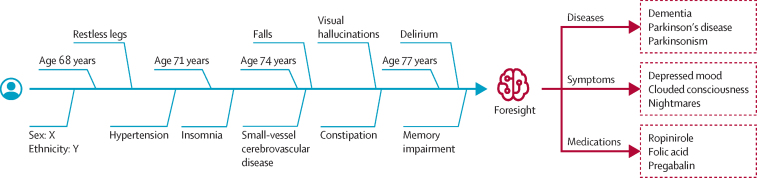
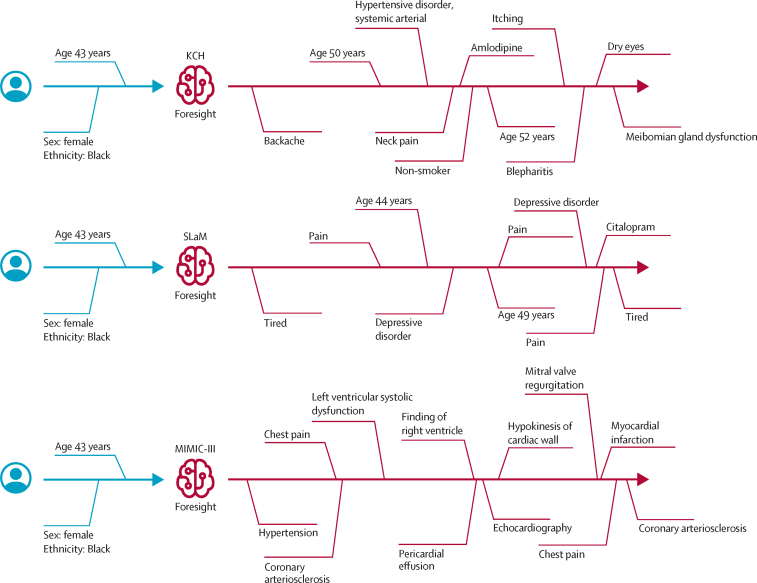
BACKGROUND: An electronic health record (EHR) holds detailed longitudinal information about a patient's health status and general clinical history, a large portion of which is stored as unstructured, free text. Existing approaches to model a patient's trajectory focus mostly on structured data and a subset of single-domain outcomes. This study aims to evaluate the effectiveness of Foresight, a generative transformer in temporal modelling of patient data, integrating both free text and structured formats, to predict a diverse array of future medical outcomes, such as disorders, substances (eg, to do with medicines, allergies, or poisonings), procedures, and findings (eg, relating to observations, judgements, or assessments). METHODS: Foresight is a novel transformer-based pipeline that uses named entity recognition and linking tools to convert EHR document text into structured, coded concepts, followed by providing probabilistic forecasts for future medical events, such as disorders, substances, procedures, and findings. The Foresight pipeline has four main components: (1) CogStack (data retrieval and preprocessing); (2) the Medical Concept Annotation Toolkit (structuring of the free-text information from EHRs); (3) Foresight Core (deep-learning model for biomedical concept modelling); and (4) the Foresight web application. We processed the entire free-text portion from three different hospital datasets (King's College Hospital [KCH], South London and Maudsley [SLaM], and the US Medical Information Mart for Intensive Care III [MIMIC-III]), resulting in information from 811 336 patients and covering both physical and mental health institutions. We measured the performance of models using custom metrics derived from precision and recall. FINDINGS: Foresight achieved a precision@10 (ie, of 10 forecasted candidates, at least one is correct) of 0·68 (SD 0·0027) for the KCH dataset, 0·76 (0·0032) for the SLaM dataset, and 0·88 (0·0018) for the MIMIC-III dataset, for forecasting the next new disorder in a patient timeline. Foresight also achieved a precision@10 value of 0·80 (0·0013) for the KCH dataset, 0·81 (0·0026) for the SLaM dataset, and 0·91 (0·0011) for the MIMIC-III dataset, for forecasting the next new biomedical concept. In addition, Foresight was validated on 34 synthetic patient timelines by five clinicians and achieved a relevancy of 33 (97% [95% CI 91-100]) of 34 for the top forecasted candidate disorder. As a generative model, Foresight can forecast follow-on biomedical concepts for as many steps as required. INTERPRETATION: Foresight is a general-purpose model for biomedical concept modelling that can be used for real-world risk forecasting, virtual trials, and clinical research to study the progression of disorders, to simulate interventions and counterfactuals, and for educational purposes. FUNDING: National Health Service Artificial Intelligence Laboratory, National Institute for Health and Care Research Biomedical Research Centre, and Health Data Research UK.
Overview
CoChat Summary
TL;DR
Foresight is a GPT-2-based generative transformer that converts EHR free text into SNOMED concepts and forecasts future biomedical concepts across three hospital datasets. It achieved high precision@10 for next new disorders and concepts and clinician-rated relevancy on synthetic timelines, but the authors caution it reflects historical practice and is not ready for clinical decision support.
Key findings
- For forecasting the next new disorder, Foresight achieved precision@10 of 0.68 (SD 0.0027) for KCH, 0.76 (0.0032) for SLaM, and 0.88 (0.0018) for MIMIC-III; for the next new biomedical concept, precision@10 was 0.80 (0.0013), 0.81 (0.0026), and 0.91 (0.0011), respectively.
- In clinician validation on 34 synthetic patient timelines, the top forecasted candidate disorder was rated relevant in 33 of 34 cases (97% [95% CI 91–100]); overall interannotator agreement was 86%.
- Forecasting recurring concepts worked better than forecasting new concepts, and an LSTM-based approach performed 40% worse than the GPT-based model on next-concept prediction on the KCH dataset.
- MedCAT named entity recognition and linking achieved precision 0.9549 (95% CI 0.9519–0.9579), recall 0.8077 (0.8017–0.8137), and F1 0.8752 (0.8702–0.8802) with precision bias; without precision bias, precision was 0.9314 (0.9274–0.9354), recall 0.8959 (0.8909–0.9009), and F1 0.9133 (0.9093–0.9173).
Methods
- Retrospective modelling study using three EHR datasets: King’s College Hospital (KCH), South London and Maudsley (SLaM), and MIMIC-III; after preprocessing, the study covered 811,336 patients.
- The Foresight pipeline used CogStack for retrieval/preprocessing, MedCAT for named entity recognition and linking of free text to SNOMED concepts, Foresight Core (a GPT-2-based transformer for causal language modelling over biomedical concept tokens plus structured age, ethnicity, and sex), and a web application. Datasets were split randomly into 95% training and 5% test sets.
- Performance was measured with precision@N and recall@N (N=1, 5, or 10), where a forecast was considered correct if the concept appeared in a future time range of 30 days, 1 year, or infinity; outputs were filtered to match ground-truth concept type and new versus recurring status. Five clinicians generated 34 synthetic timelines and scored relevancy of forecasted disorders.
Limitations
- The authors state Foresight is derived from historical common practice, may not match contemporary recommended guidelines, and should not be used for clinical decision support; it prioritises probability over urgency and impact, rare diseases were removed for privacy, hallucinations are possible especially in long simulations, and the dataset does not fully encompass patient history and is weighted toward secondary/tertiary care.
- The authors state that considerably more tests are needed to validate long simulations forecasting many steps into the future.
- Evident from the text: evaluation is limited to three datasets—two UK NHS trusts and one US critical care dataset—so generalisability to other settings and populations is not established.
Model-written summary. Check it against the paper before relying on it.
Integrity signals
Registry
Cites
Statistics
Figures

Verification
Claims the paper makes
11 Valid · 0 Not valid · 1 Not checked · 51 Own results and interpretations
The cited sources support only part of this claim — read each source’s verdict below.
In the paper
“the disease profile would be weighted to conditions and scenarios in secondary and tertiary care-ie, it would be weighted towards more comorbidity because patients with lower complexity or earlystage conditions who are completely dealt with in primary care would be underrepresented in our dataset.23”
§ Foresight-a generative pretrained transformer for modelling of patient timelines using electronic health records: a retrospective modelling study > Discussion
What the sources say
- Partly supportedcites [23] Bean DM, Kraljevic Z, Shek A, Teo J, Dobson RJB. Hospitalwide natural language processing summarising the health data of 1 million patients. PLOS Digit Health 2023; 2: e0000218. sourceExperimental — accuracy not yet measured
Split into 2 atoms — 0 confirmed, 2 partially supported, 0 disputed, 0 misattributed, 0 unverifiable. Expand the claim to see per-atom verdicts.
hedgedstates a cause- Asserted: passes — The authors put it forward as true.
- Checkable: passes — It can be checked against evidence.
- Load-bearing: unclear — It is unclear whether the paper’s conclusions depend on it.
- Based: passes — The paper gives a reason why it holds.
- Rests on an assumption not shown here.
- Partly supported
The cited sources support only part of this claim — read each source’s verdict below.
In the paper
“because about 80% of patient data are found in freetext format.1,2”
§ Foresight-a generative pretrained transformer for modelling of patient timelines using electronic health records: a retrospective modelling study > Introduction
What the sources say
- Partly supportedcites [1] Jackson R, Kartoglu I, Stringer C, et al. CogStack-experiences of deploying integrated information retrieval and extraction services in a large National Health Service Foundation Trust hospital. BMC Med Inform Decis Mak 2018; 18: 47. sourceExperimental — accuracy not yet measured
The Background says that nearly all clinical information is recorded as unstructured clinical narrative, including free-text notes, discharge summaries, and referral letters. It does not give an 80% estimate, so it supports the general point but not the claimed figure. No page number is available in our copy. (LLM, conf=0.88)
- Could not verifycites [2] Hardy F, Heyl J, Tucker K, et al. Data consistency in the English Hospital Episodes Statistics database. BMJ Health Care Inform 2022; 29: e100633. sourceExperimental — accuracy not yet measured
The Methods section (Study design and data collection; page unavailable) says HES data are taken from clinical notes and discharge summaries and entered by clinical coders. It gives no estimate of the proportion of patient data in free-text format. Searches for the 80% figure and for the share of unstructured patient records found no supporting passage. (LLM, conf=0.72)
plain- Asserted: passes — The authors put it forward as true.
- Checkable: passes — It can be checked against evidence.
- Load-bearing: passes — The paper’s conclusions depend on it.
- Based: passes — The paper gives a reason why it holds.
- Partly supported
A result the paper reports from its own data — it cites no other source for it, so there is none to check. The quote shows it is in the paper.
In the paper
“The overall interannotator agreement was 86% (among the five clinicians).”
§ Foresight-a generative pretrained transformer for modelling of patient timelines using electronic health records: a retrospective modelling study > Results
plain- Asserted: passes — The authors put it forward as true.
- Checkable: passes — It can be checked against evidence.
- Load-bearing: unclear — It is unclear whether the paper’s conclusions depend on it.
- Based: passes — The paper gives a reason why it holds.
A result the paper states — it cites no source for it, so there is none to check. The quote shows it is in the paper.
In the paper
“Forecasting of recurring concepts worked much better than forecasting of new concepts (simply the case that someone with, for example, heart failure in their past timeline is likely to have it appear in their future timeline; table 2).”
§ Foresight-a generative pretrained transformer for modelling of patient timelines using electronic health records: a retrospective modelling study > Results
plainstates an association- Asserted: passes — The authors put it forward as true.
- Checkable: passes — It can be checked against evidence.
- Load-bearing: unclear — It is unclear whether the paper’s conclusions depend on it.
- Based: passes — The paper gives a reason why it holds.
A result the paper reports from its own data — it cites no other source for it, so there is none to check. The quote shows it is in the paper.
In the paper
“We also tested a LSTMbased approach, but the perfor mance on the task of nextconcept prediction (for the category of all concept types) was 40% worse than the GPT based model on the KCH dataset (appendix p 6).”
§ Foresight-a generative pretrained transformer for modelling of patient timelines using electronic health records: a retrospective modelling study > Results
plain- Asserted: passes — The authors put it forward as true.
- Checkable: passes — It can be checked against evidence.
- Load-bearing: passes — The paper’s conclusions depend on it.
- Based: passes — The paper gives a reason why it holds.
8 more claims
Create a free account to see all 63 claims and every source verdict.
- Probably not a substantial claim. 18
- It may state two separate claims as one. 43
Claims other papers make about this one
Each is checked against this paper’s own text: does it say what the citing paper says it does?
The check wasn’t confident either way, so it gives no verdict — never disputed.
In the citing paper
“Additionally, AI can predict how patients will respond to specific drugs based on their unique genetic makeup, facilitating the choice of the most suitable medication and dosage.94”
From A foundational architecture for AI agents in healthcare (2025) · cites this paper as [94]
Experimental — accuracy not yet measured
Self-check
Percentages, sums and reported differences re-computed from the paper’s own numbers.
Each contradiction between two passages listed here was confirmed by an independent check.
Rated minor: it would not touch a result — a value no result rests on, a p-value that stays on the same side of the significance level, or a conflict that is clerical, resolved elsewhere in the paper, or outside its own findings.
In the paper
§ Foresight-a generative pretrained transformer for modelling of patient timelines using electronic health records: a retrospective modelling study > Discussion
“the F1 scores were 0•9280”
§ Foresight-a generative pretrained transformer for modelling of patient timelines using electronic health records: a retrospective modelling study > Discussion
“(0•9240-0•8320) for experiencer”
Citations
Cites
BERT: Pre-training of Deep Bidirectional Transformers for Language Understanding
Devlin, J., Chang, M.-W., Lee, K., & Toutanova, K. (2018) · arXiv · doi:10.48550/arxiv.1810.04805 · Cited by 73,173
BERT: Pre-training of Deep Bidirectional Transformers for Language Understanding
Devlin, J., Chang, M.-W., Lee, K., & Toutanova, K. (2019) · Proceedings of the 2019 Conference of the North American Chapter of the Association for Computational Linguistics: Human Language Technologies, Volume 1 (Long and Short Papers) · doi:10.18653/v1/n19-1423 · Cited by 54,325
Language Models are Few-Shot Learners
Brown, T. B., Mann, B., Ryder, N., Subbiah, M., Kaplan, J., Dhariwal, P., Neelakantan, A., Shyam, P., Sastry, G., Askell, A., et al. (2020) · arXiv · doi:10.48550/arxiv.2005.14165 · Cited by 23,372
Learning Transferable Visual Models From Natural Language Supervision
Radford, A., Kim, J. W., Hallacy, C., Ramesh, A., Goh, G., Agarwal, S., Sastry, G., Askell, A., Mishkin, P., Clark, J., et al. (2021) · arXiv · doi:10.48550/arxiv.2103.00020 · Cited by 15,293 · cited 1×
“…on the generated timelines with, for example, a learningtorank model similar to how the contrastive language–image pretraining (CLIP) model 21 works with DALLE. 22 Additionally, an intriguing future use case would be whether the knowledge representation of a historical EHR can be used as…”
Kaugeranna, R., Kaugeranna, E., & Aion, (. S. 4. 6. (2023) · DROPS (Schloss Dagstuhl – Leibniz Center for Informatics) · doi:10.4230/lipics.giscience.2023.43 · Cited by 13,690
Survey of Hallucination in Natural Language Generation
Ji, Z., Lee, N., Frieske, R., Yu, T., Su, D., Xu, Y., Ishii, E., Bang, Y. J., Madotto, A., & Fung, P. (2023) · ACM Computing Surveys · doi:10.1145/3571730 · Cited by 5,025 · cited 1×
“Finally, hallucinations are also well described in transformerbased generative models, 24,25 including the recent ChatGPT, so such relevancy and mitigation systems would need to be built before the model would be suitable for clinical decision support.”
Survey of Hallucination in Natural Language Generation
Ji, Z., Lee, N., Frieske, R., Yu, T., Su, D., Xu, Y., Ishii, E., Bang, Y., Chen, D., Dai, W., et al. (2022) · arXiv · doi:10.48550/arxiv.2202.03629 · Cited by 4,981 · cited 1×
“Finally, hallucinations are also well described in transformerbased generative models, 24,25 including the recent ChatGPT, so such relevancy and mitigation systems would need to be built before the model would be suitable for clinical decision support.”
Zero-shot text-to-image generation
Ramesh, A., Pavlov, M., Goh, G., Gray, S., Voss, C., Radford, A., Chen, M., & Sutskever, I. (2021) · arXiv · doi:10.48550/arxiv.2102.12092 · Cited by 2,417 · cited 2×
“…timelines with, for example, a learningtorank model similar to how the contrastive language–image pretraining (CLIP) model 21 works with DALLE. 22 Additionally, an intriguing future use case would be whether the knowledge representation of a historical EHR can be used as a measure of…”
Rasmy, L., Xiang, Y., Xie, Z., Tao, C., & Zhi, D. (2021) · npj Digital Medicine · doi:10.1038/s41746-021-00455-y · Cited by 886
Vasey, B., Nagendran, M., Campbell, B., Clifton, D. A., Collins, G. S., Denaxas, S., Denniston, A. K., Faes, L., Geerts, B., Ibrahim, M., et al. (2022) · BMJ · doi:10.1136/bmj-2022-070904 · Cited by 665
Research works printed but not linked: 1
- Ramesh A, Pavlov M, Goh G, et al. Zeroshot texttoimage generation. Proc Mach Learn Res 2021; 139: 8821-31.
Cited by
A Survey of Large Language Models in Medicine: Progress, Application, and Challenge
Zhou, H., Liu, F., Gu, B., Zou, X., Huang, J., Wu, J., Li, Y., Chen, S. S., Zhou, P., Liu, J., et al. (2023) · arXiv · doi:10.48550/arxiv.2311.05112 · Cited by 240
“…generation or summarization has been proven to be more complete and more accurate than the human counterpart [139], there are still concerns with hallucination, as well as a tendency to approach inputs with a literal view instead of an assumption based perspective often taken by human doctors.”
BackgroundAssessing the research landscape and clinical utility of large language models: a scoping review
Park, Y.-J., Pillai, A., Deng, J., Guo, E., Gupta, M., Paget, M., & Naugler, C. (2024) · BMC Medical Informatics and Decision Making · doi:10.1186/s12911-024-02459-6 · Cited by 187
AI chatbots not yet ready for clinical use.
Au Yeung, J., Kraljevic, Z., Luintel, A., Balston, A., Idowu, E., Dobson, R. J., & Teo, J. T. (2023) · Frontiers in Digital Health · doi:10.3389/fdgth.2023.1161098 · Cited by 176
Self-citationAI chatbots not yet ready for clinical use
Yeung, J. A., Kraljevic, Z., Luintel, A., Balston, A., Idowu, E., Dobson, R. J., & Teo, J. T. (2023) · doi:10.1101/2023.03.02.23286705 · Cited by 176
Self-citationFine-Tuning Large Language Models for Specialized Use Cases
Anisuzzaman, D., Malins, J. G., Friedman, P. A., & Attia, Z. I. (2024) · Mayo Clinic Proceedings Digital Health · doi:10.1016/j.mcpdig.2024.11.005 · Cited by 272
Large language models for disease diagnosis: a scoping review
Zhou, S., Xu, Z., Zhang, M., Xu, C., Guo, Y., Zhan, Z., Fang, Y., Ding, S., Wang, J., Xu, K., et al. (2025) · npj Artificial Intelligence · doi:10.1038/s44387-025-00011-z · Cited by 122
Self-citationGenerative artificial intelligence in medicine
Teo, Z. L., Thirunavukarasu, A. J., Elangovan, K., Cheng, H., Moova, P., Soetikno, B., Nielsen, C., Pollreisz, A., Ting, D. S. J., Morris, R. J. T., et al. (2025) · Nature Medicine · doi:10.1038/s41591-025-03983-2 · Cited by 119
“Domain-specific fine-tuning can facilitate superior performance in clinical tasks relative to state-of-the-art models 61 .”
Generative Artificial Intelligence Through ChatGPT and Other Large Language Models in Ophthalmology
Tan, T. F., Thirunavukarasu, A. J., Campbell, J. P., Keane, P. A., Pasquale, L. R., Abramoff, M. D., Kalpathy-Cramer, J., Lum, F., Kim, J. E., Baxter, S. L., et al. (2023) · Ophthalmology Science · doi:10.1016/j.xops.2023.100394 · Cited by 116
Learning the natural history of human disease with generative transformers
Shmatko, A., Jung, A. W., Gaurav, K., Brunak, S., Mortensen, L. H., Birney, E., Fitzgerald, T., & Gerstung, M. (2025) · Nature · doi:10.1038/s41586-025-09529-3 · Cited by 110
“However, despite promising proof of concepts 24 , the potential for comprehensive and generative modeling of multi-morbidity has not been fully assessed yet.”
Artificial intelligence: revolutionizing cardiology with large language models
Boonstra, M., Weissenbacher, D., Moore, J. H., Gonzalez-Hernandez, G., & Asselbergs, F. (2024) · European Heart Journal · doi:10.1093/eurheartj/ehad838 · Cited by 84
Application of large language models in medicine
Liu, F., Zhou, H., Gu, B., Zou, X., Huang, J., Wu, J., Li, Y., Chen, S. S., Hua, Y., Zhou, P., et al. (2025) · Nature Reviews Bioengineering · doi:10.1038/s44222-025-00279-5 · Cited by 94
“Similarly, Foresight 76 is trained on UK hospital patient data and can be used for forecasting the risk of disorders, performing differential diagnoses and suggesting medications.”
Detecting and Remediating Harmful Data Shifts for the Responsible Deployment of Clinical AI Models
Subasri, V., Krishnan, A., Kore, A., Dhalla, A., Pandya, D., Wang, B., Malkin, D., Razak, F., Verma, A. A., Goldenberg, A., et al. (2025) · JAMA Network Open · doi:10.1001/jamanetworkopen.2025.13685 · Cited by 87
Riaz, I. B., Harmon, S. A., Chen, Z., Naqvi, S. A. A., & Cheng, L. (2024) · American Society of Clinical Oncology Educational Book · doi:10.1200/edbk_438516 · Cited by 61
Masters, K., Herrmann-Werner, A., Festl-Wietek, T., & Taylor, D. (2024) · Medical Teacher · doi:10.1080/0142159x.2024.2387802 · Cited by 46
“In the BioPsychoSocial model of patient care, there is even more to process, and all that will need to be included [59].”
A foundational architecture for AI agents in healthcare
Liu, F., Niu, Y., Zhang, Q., Wang, K., Dong, Z., Wong, I. N., Cheng, L., Li, T., Duan, L., Li, K., et al. (2025) · Cell Reports Medicine · doi:10.1016/j.xcrm.2025.102374 · Cited by 41
“94 By continuously learning from patient data and treatment outcomes, AI agents help refine treatment plans in real-time, ensuring the most effective interventions are implemented throughout the course of care.”
Bhattacharya, M., Pal, S., Chatterjee, S., Lee, S., & Chakraborty, C. (2024) · Molecular Therapy — Nucleic Acids · doi:10.1016/j.omtn.2024.102255 · Cited by 54
Clinical insights: A comprehensive review of language models in medicine
Neveditsin, N., Lingras, P., & Mago, V. (2025) · PLOS Digital Health · doi:10.1371/journal.pdig.0000800 · Cited by 37
“Kraljevic et al. introduced Foresight [155], a GPT-2-based pipeline developed for modeling biomedical concepts extracted from clinical narratives.”
AI Advances in ICU with an Emphasis on Sepsis Prediction: An Overview
Stylianides, C., Nicolaou, A., Sulaiman, W. A., Alexandropoulou, C.-A., Panagiotopoulos, I., Karathanasopoulou, K., Dimitrakopoulos, G., Kleanthous, S., Politi, E., Ntalaperas, D., et al. (2025) · Machine Learning and Knowledge Extraction · doi:10.3390/make7010006 · Cited by 28
“Some popular transformer-based models trained specifically on healthcare data are BioBERT [253], MedBERT [254], BEHRT [255], BioGPT [256], Med-Palm [257], Foresight [258], and Gemini [259].”
Liu, F., Ju, Q., Zheng, Q., & Peng, Y. (2024) · Current Opinion in Behavioral Sciences · doi:10.1016/j.cobeha.2024.101452 · Cited by 45
Generative AI Models in Time-Varying Biomedical Data: Scoping Review
He, R., Sarwal, V., Qiu, X., Zhuang, Y., Zhang, L., Liu, Y., & Chiang, J. N. (2025) · Journal of Medical Internet Research · doi:10.2196/59792 · Cited by 43
“In recent years, researchers have also turned to transformer models for prediction tasks [82-84] as they capture more long-range dependencies and provide more interpretability of model weights than RNNs.”
Natural language processing data services for healthcare providers
Yeung, J. A., Shek, A., Searle, T., Kraljević, Ž., Dinu, V., Ratas, M., Al-Agil, M., Foy, A., Rafferty, B., Oliynyk, V., et al. (2024) · BMC Medical Informatics and Decision Making · doi:10.1186/s12911-024-02713-x · Cited by 35
“…concept annotation tool) to uncover valuable insights [2], reveal clinical trends, automating time-consuming administrative tasks, clinical coding [3], monitor disease trends [4], data ano-nymisation [5], forecast patient trajectories [6], summa-rising hospital-wide health data [7] and more (Fig.”
InfluentialSelf-citationTeles, A. S., de Moura, I. R., Silva, F., Roberts, A., & Stahl, D. R. (2025) · Information Fusion · doi:10.1016/j.inffus.2025.102981 · Cited by 27
Ćirković, A., & Katz, T. R. (2023) · JMIR Formative Research · doi:10.2196/51798 · Cited by 22
Duminuco, A., Yeung, J. A., Vaghela, R., Virdee, S. S., Woodley, C., Asirvatham, S., Curto‐García, N., Sriskandarajah, P., O’Sullivan, J., de Lavallade, H., et al. (2024) · HemaSphere · doi:10.1002/hem3.143 · Cited by 16
Self-citationArtificial Intelligence for Cardiovascular Care in Action
Biswas, D., Thangaraj, P., Pedroso, A. F., Ogunniyi, M. O., Maddox, T. M., Ahmad, F. S., & Khera, R. (2025) · JACC Advances · doi:10.1016/j.jacadv.2025.102307 · Cited by 21
Artificial intelligence: a new era in prostate cancer diagnosis and treatment
Vidiyala, N., Parupathi, P. R., Sunkishala, P., Muppavarapu, C. S., Gujja, A., Kanagala, P., Meduri, S. K., & Nyavanandi, D. (2025) · International Journal of Pharmaceutics · doi:10.1016/j.ijpharm.2025.126024 · Cited by 18
Bias and Oversight in Clinical AI: A Review of Decision Support Tools and Equity Frameworks
Adegunle, F., Chhatwal, K., Arab, S., Alabdaljabar, M. S., Raslan, M. A., Sayed, O., & Goldsweig, A. M. (2026) · Journal of General Internal Medicine · doi:10.1007/s11606-026-10229-5 · Cited by 16
Real-world evidence: state-of-the-art and future perspectives
Fitzke, H., Fayzan, T., Watkins, J. D., Galimov, E. R., & Pierce, B. F. (2025) · Journal of Comparative Effectiveness Research · doi:10.57264/cer-2024-0130 · Cited by 17
Yuanyuan, Z., Bensahla, A., Bjelogrlic, M., Zaghir, J., Turbé, H., Bednarczyk, L., Gaudet-Blavignac, C., Ehrsam, J., Marchand‐Maillet, S., & Lovis, C. (2025) · npj Digital Medicine · doi:10.1038/s41746-025-01692-1 · Cited by 22
“Other transformer-based training tasks include next visit code prediction 23,36,45,57 ,medicalcodecategoryprediction 23 ,medication-diagnosis cross prediction 26 , and token replacement detection ELECTRA 58 .”
InfluentialBae, H., Park, S.-Y., & Kim, C.-E. (2024) · Integrative Medicine Research · doi:10.1016/j.imr.2024.101067 · Cited by 14
“This technique involves using generative models, such as generative adversarial networks 78 , 79 or GPT, 80 , 81 to create synthetic patient profiles.”
MethodLiu, K., & Altman, R. B. (2025) · Annual Review of Biomedical Data Science · doi:10.1146/annurev-biodatasci-103123-094844 · Cited by 19
“As highlighted in other reviews (79, 87), the influence of CGMs in medicine would be enhanced by integrating tabular data with complementary modalities, such as free-text clinical notes (86), 3D computed tomography scans (172), or genomic information.”
Artificial intelligence in prostate cancer
Li, W., Hu, R., Zhang, Q., Yu, Z., Deng, L., Zhu, X., Xia, Y., Song, Z., Cimadamore, A., Chen, F., et al. (2025) · Chinese Medical Journal · doi:10.1097/cm9.0000000000003689 · Cited by 11
“The novel model Foresight, [80] Foresight is able to handle a large amount of EHR data, including unstructured free text, and predicts a wide range of future medical outcomes, is scalable, and its performance gets better as the amount of data increases.”
Reviewing clinical knowledge in medical large language models: Training and beyond
Li, Q. Y., Liu, H., Guo, C., Gao, C., Chen, D., Wang, M., Gao, F., van Harmelen, F., & Gu, J. (2025) · Knowledge-Based Systems · doi:10.1016/j.knosys.2025.114215 · Cited by 20
Pharmacometrics in the Age of Large Language Models: A Vision of the Future
Tosca, E. M., Aiello, L., Carlo, A. D., & Magni, P. (2025) · Pharmaceutics · doi:10.3390/pharmaceutics17101274 · Cited by 13
“In healthcare, Foresight [112], a GPT-2-based model trained on tokenized biomedical concepts extracted from EHRs, predicts future clinical events.”
Wang, A., Wu, Y., Ji, X., Wang, X., Hu, J., Zhang, F., Zhang, Z., Pu, D., Tang, L., Ma, S., et al. (2024) · JMIR Research Protocols · doi:10.2196/57001 · Cited by 10
“Purpose-built LLMs such as foresight, effectively predict outcomes using electronic health records [5].”
MethodFeng, R., Brennan, K., Azizi, Z., Goyal, J., Deb, B., Chang, H. J., Ganesan, P., Clopton, P., Pedron, M., Ruipérez-Campillo, S., et al. (2024) · Circulation Arrhythmia and Electrophysiology · doi:10.1161/circep.124.013023 · Cited by 15
“…for coding and classification, assisting in technical writing tasks, and enhancing the process of obtaining informed consent, as summarized by Ghim et al. 64 Kraljevic et al 65 utilized LLMs to predict and prognosticate a wide range of future disorders, substances, procedures or findings.”
Foundation model of electronic medical records for adaptive risk estimation
Renc, P., Grzeszczyk, M. K., Oufattole, N., Goode, D., Jia, Y., Bieganski, S., McDermott, M. B. A., Wąs, J., Samir, A. E., Cunningham, J. W., et al. (2025) · GigaScience · doi:10.1093/gigascience/giaf107 · Cited by 39
“ETHOS is autoregressively pretrained—without any task-specific labels—on over 321 million tokens drawn from 269,741 Patient Health Timelines (PHTs), learning broad, high-dimensional representations that transfer across tasks.”
Redekop, E., Wang, Z., Kulkarni, R., Pleasure, M., Chin, A. T., Hassanzadeh, H. R., Hill, B. L., Emami, M., Speier, W. F., & Arnold, C. W. (2025) · Journal of the American Medical Informatics Association · doi:10.1093/jamia/ocaf160 · Cited by 11
A Systematic Review of Topic Modeling Techniques for Electronic Health Records
Mehmood, I., Zahra, Z., Iqbal, S., Qahmash, A., & Hussain, I. (2026) · Healthcare · doi:10.3390/healthcare14020282 · Cited by 11
Unlocking the Potentials of Large Language Models in Orthodontics: A Scoping Review
Zheng, J., Ding, X., Pu, J. J., Chung, S. M., Ai, Q. Y. H., Hung, K. F., & Shan, Z. (2024) · Bioengineering · doi:10.3390/bioengineering11111145 · Cited by 18
Medical AI trained on whopping 57 million health records
Callaway, E. (2025) · Nature · doi:10.1038/d41586-025-01422-3 · Cited by 7
Auger, S. D., & Scott, G. (2025) · PLoS ONE · doi:10.1371/journal.pone.0334858 · Cited by 8
“Advances in natural language processing techniques enable large-scale extraction of clinical information from EHRs [34–37], and there is a growing use of information captured during routine clinical care and stored within EHRs for research [38–41].”
Learning Health Systems provide a glide path to safe landing for AI in health
Ćurčin, V., Delaney, B. C., Alkhatib, A., Cockburn, N., Dann, O., Kostopoulou, O., Leightley, D., Maddocks, M., Modgil, S., Nirantharakumar, K., et al. (2025) · Artificial Intelligence in Medicine · doi:10.1016/j.artmed.2025.103346 · Cited by 14
Guan, Z., Li, H., Hernández-Jiménez, S. C., Amissah-Arthur, K. N., Schmidt, M. I., Masood, S., Zeng, D., Jia, W., Lim, L.-L., & Sheng, B. (2026) · The Lancet Diabetes & Endocrinology · doi:10.1016/s2213-8587(26)00010-0 · Cited by 9
From Data to Diagnosis: Rethinking Clinical Decision Support With Explainable AI
Ahmad, N., Julaihi, A. A., & Rajalingam, P. (2025) · Computer · doi:10.1109/mc.2025.3572653 · Cited by 5
Wu, J., Biswas, D., Brown, S., Ryan, M., Bernstein, B. S., To, B. T., Searle, T., Rizvi, M., Fairhurst, N., Kaye, G., et al. (2025) · European Heart Journal - Digital Health · doi:10.1093/ehjdh/ztaf107 · Cited by 10
Self-citationKurasawa, H., Waki, K., Seki, T., Chiba, A., Fujino, A., Hayashi, K., Nakahara, E., Haga, T., Noguchi, T., & Ohe, K. (2024) · JMIR AI · doi:10.2196/56700 · Cited by 7
“We should devise model designs based on cutting-edge multimodal modeling using the transformer [52-54].”
MethodWill large language models transform clinical prediction?
Yildiz, Y., Nenadić, G., Jani, M., & Jenkins, D. A. (2025) · Diagnostic and Prognostic Research · doi:10.1186/s41512-025-00211-w · Cited by 10
“Recent studies further demonstrate LLMs’ potential in clinical prediction.”
Yang, Z., Mitra, A., Hu, W., Berlowitz, D. R., & Yu, H. Q. (2025) · Scientific Reports · doi:10.1038/s41598-025-27435-6 · Cited by 7
Generative Medical Event Models Improve with Scale
Waxler, S., Blazek, P., White, D., Sneider, D., Chung, K., Nagarathnam, M., Williams, P., Voeller, H., Wong, K., Swanhorst, M., et al. (2025) · arXiv · doi:10.48550/arxiv.2508.12104 · Cited by 4
Greco, K. F., Yang, Z., Li, M., Tong, H., Sweet, S. M., Geva, A., Mandl, K. D., Raby, B. A., & Cai, T. (2026) · npj Digital Medicine · doi:10.1038/s41746-026-02406-x · Cited by 10
“Models such as BEHRT [43], Med-BERT [44], RatchetEHR [45], and Foresight [46] have achieved strong performance across predictive and classification tasks in both structured and unstructured data.”
Systematic review of foundation models for structured electronic health records
Guo, L. L., Arciniegas, S. E., Yan, A. P., Fries, J., TOMLINSON, G. A., & Sung, L. (2026) · Journal of the American Medical Informatics Association · doi:10.1093/jamia/ocag033 · Cited by 6
Liu, Y., Tan, Z. D., Zhang, Z., Wang, S., Guo, J. S., Liu, H., Chen, T., & Bian, J. (2025) · Knowledge-Based Systems · doi:10.1016/j.knosys.2025.114102 · Cited by 6
Multimodal Medical Code Tokenizer
Su, X., Messica, S., Huang, Y., Johnson, R., Fesser, L., Gao, S., Sahneh, F., & Zitnik, M. (2025) · arXiv · doi:10.48550/arxiv.2502.04397 · Cited by 3
“It is a general tokenizer that sheds light on how optimized tokenization benefits transformer models in medicine. creasing precision across diverse modalities.”
Artificial intelligence in primary ovarian insufficiency management: opportunities and challenges
Zhou, R., Wei, Y., Xiong, Y., Su, B., Xie, J., Hu, L., & Lei, X. (2025) · Journal of Assisted Reproduction and Genetics · doi:10.1007/s10815-025-03660-w · Cited by 4
“NLP can be used to identify clinical text data, which allows psychological monitoring and personality assessment [73].”
A lightweight large language model for regulatory affairs translation in pharmaceutical industry
Chen, T., Mo, H., Wang, T., Jiang, C., Liu, Z., Hou, F., & Gan, J. (2025) · Scientific Reports · doi:10.1038/s41598-025-21867-w · Cited by 3
Radford‐Smith, D. E., & Anthony, D. C. (2026) · BMJ Public Health · doi:10.1136/bmjph-2025-003752 · Cited by 2
“73 Future iterations aim to integrate multiple data sources – from blood tests to imaging and clinical notes 74 – accelerating the shift from reactive to anticipatory care.”
Blocking the Reflection: Milestones and Hurdles for Digital Twins in Mental Health
Verhees, F. G., Wiest, I. C., Kather, J. N., Kambeitz, J., & Mikoláš, P. (2026) · Pharmacopsychiatry · doi:10.1055/a-2816-2869 · Cited by 3
Li, Z., Zhao, J., Huang, L., Chen, X., Wei, J., & Tian, W. (2026) · Annals of Hematology · doi:10.1007/s00277-026-06996-0 · Cited by 8
“For instance, generative models like Foresight have demonstrated the feasibility of building universal temporal models based on large-scale real-world EHRs [ 130 ].”
Generative Artificial Intelligence and Large Language Models in Clinical Oncology
Yu, Y., Zhao, Z., Wang, Z., Lin, R., Tan, Y., Chen, Y., Li, T., Baptista‐Hon, D. T., Zhang, X., Wu, C., et al. (2026) · MedComm · doi:10.1002/mco2.70833 · Cited by 4
“These digital representations can simulate future health trajectories and assess the long-term impact of interventions and comorbidities [ 175 ].”
The influence of AI in medicine
Ellis, H. L., & Teo, J. (2024) · Medicine · doi:10.1016/j.mpmed.2024.09.006 · Cited by 5
Self-citationThe AI inflection point in clinical neuropsychology: a call to action
Serafimovska, A., Challinor, K. L., & Florio, T. (2025) · Journal of Clinical and Experimental Neuropsychology · doi:10.1080/13803395.2025.2561162 · Cited by 2
“In the UK at present, Foresight, an AI model has already been trained on 57 million people within the National Health Service (Kraljevic et al., 2024).”
Integrating Genomics into Multimodal EHR Foundation ModelsPreprint
Amar, J., Liu, E., Breschi, A., Zhang, L., Kheradpour, P., Li, S., Lehmann, L. S., Giulianelli, A., Edwards, M., Jia, Y., et al. (2025) · bioRxiv (Cold Spring Harbor Laboratory) · doi:10.1101/2025.10.26.684668 · Cited by 7
Artificial Intelligence in Uveitis: A 360-Degree Perspective
Agrawal, R. V., See, A. U., Kiosia, A., & Gupta, V. (2026) · Ocular Immunology and Inflammation · doi:10.1080/09273948.2025.2612107 · Cited by 3
“57 61 Similar participatory governance should be encouraged within ophthalmic AI networks.”
Enhancing Antidiabetic Drug Selection Using Transformers: Machine-Learning Model Development
Kurasawa, H., Waki, K., Seki, T., Nakahara, E., Fujino, A., Shiomi, N., Nakashima, H., & Ohe, K. (2025) · JMIR Medical Informatics · doi:10.2196/67748 · Cited by 1
“Foresight [37] was trained with structured data such as laboratory results as well as unstructured data such as free text from 1.5 million patients across three EHR datasets.”
InfluentialData-driven decision-making: Turning insights into action
Ribeiro, L., & O’Brien, T. (2025) · Journal of Clinical Urology · doi:10.1177/20514158251348043 · Cited by 1
Gadd, C., Gokhale, K. M., Acharya, A., Cooper, J., Crowe, F. L., Fitzsimmons, L., Jackson, T., Nirantharakumar, K., Yau, C., Birch, R., et al. (2026) · npj Digital Medicine · doi:10.1038/s41746-026-02709-z · Cited by 7
“Access to CPRD data was approved as part of the “OPTIMising therapies, disease trajectories, and AI assisted clinical management for patients Living with complex multimorbidity" (OPTIMAL) study [31].”
Data-driven computational methods in ophthalmology: A multimodal perspective
Li, J., Huang, J., Xu, S., & Zhang, S. (2026) · Eye Discovery · doi:10.1016/j.edisc.2026.100026 · Cited by 1
Luan, Q. (2026) · Journal of Mechanics in Medicine and Biology · doi:10.1142/s0219519426400373 · Cited by 3
Temporal Learning with Dynamic Range (TLDR) for modeling recurrent exposure and treatment outcomes
Cheng, J., Hügel, J., Tian, J., Azhir, A., Murphy, S. N., Klann, J. G., & Estiri, H. (2026) · Scientific Reports · doi:10.1038/s41598-026-45346-y · Cited by 2
“Recent EHR-specific Transformers such as Med-BERT 29 , ClinicalBERT 27 , and newer architectures like Foresight 32 or the lung cancer diagnostic Transformer 33 achieve impressive benchmarks but remain opaque and resource-intensive, whereas TLDR yields sparse, auditable representations trainable on…”
A Quantum Edge Federated Graph Transformer for Generative and Causal Digital Twin Healthcare
Narne, N. S. R., & Kancharla, G. (2026) · Engineering, Technology & Applied Science Research · doi:10.48084/etasr.16010 · Cited by 1
“Forward models such as TransformEHR [1], HERBERT [29], TECO [30], and Foresight [8] produce better performance than recurrence-based methods in EHR-related risk prediction and disease trajectory modeling.”
Beyond language: generative artificial intelligence as a general computing model for medicine
Sitek, A., & Bates, D. W. (2026) · The Lancet Digital Health · doi:10.1016/j.landig.2026.101011 · Cited by 1
Moving artificial intelligence from research to real-world clinical use in neurology
Teo, J., Eshaghi, A., Richardson, M. P., Jehi, L. E., & Beniczky, S. (2026) · Nature Reviews Neurology · doi:10.1038/s41582-026-01225-8 · Cited by 6
“By contrast, foundation models (single large models used for multiple tasks or disease areas, such as the pan-disease research models Foresight 26 and NYUTron 27 ) require data from millions of individuals for training.”
Self-citationAdvancing cancer detection and treatment using longitudinal routine clinical data
Liu, F., Wang, K., Xu, H., Tang, C., Shen, X., Wang, M., Yang, L., Yang, L., Liu, L., Hu, C., et al. (2026) · Cell · doi:10.1016/j.cell.2026.07.009 · Cited by 4
Humphries, C., Anand, A., Casey, A., Chapman, W. W., Harrison, K., Hillis, J. M., James, E., MacIntyre, D. J., Nicholson, K., Schölin, L., et al. (2026) · Frontiers in Public Health · doi:10.3389/fpubh.2026.1901339 · Cited by 1
Foresight—generative pretrained transformer for the prediction of patient timelines
Hofmann‐Apitius, M., & Fröhlich, H. (2024) · The Lancet Digital Health · doi:10.1016/s2589-7500(24)00045-1 · Cited by 1
Wu, J., Biswas, D., Brown, S., Ryan, M., Bernstein, B. S., To, B. T., Searle, T., Rizvi, M., Fairhurst, N., Kaye, G., et al. (2024) · medRxiv · doi:10.1101/2024.12.24.24319603 · Cited by 1
Self-citationAIM review tool: artificial intelligence for smarter systematic review screening
Mena, S., Rituerto-González, E., Coutts, F., von Trott, J., Jacobs, G. R., Bryant, L., Moles, L., Sirbu, N., Promet, L., Oliver, D., et al. (2026) · npj Artificial Intelligence · doi:10.1038/s44387-026-00080-8
“Importantly, analogous performances and patterns were observed in the extended benchmarking for case studies 4 – 6 from other scienti fi c fi elds.”
Chang, R., Cao, W., Zeng, D., et al. (2024) · China Automation Congress (CAC) · doi:10.1109/cac63892.2024.10864860
“In m edicine, the Foresight m odel integrates free text and te m poral patient data [9].”
Lange, M., Gogarty, E., Martyn, M., Braude, P., Fayez, F., Koutsouleris, N., Howes, O. D., Twumasi, R., & Carter, B. (2025) · BMC Digital Health · doi:10.1186/s44247-025-00170-8
“Furthermore, when using the foresight [49] online tool, which is also trained on MIMIC and CRIS datasets, when searching for ‘cephalosporin antibi-otic’, schizophrenia is the only psychiatric disorder that is associated with the search term, furthering a signal between the two concepts.”
Fu, C., Zheng, Z., Yin, X., Ge, X., Zeng, X., Zha, L., & Li, Y. (2025) · Research Square · doi:10.21203/rs.3.rs-6776346/v1
Data Driven Disease Dynamics ModelsPreprint
Banushkina, P. V., & Krivov, S. V. (2025) · bioRxiv (Cold Spring Harbor Laboratory) · doi:10.1101/2025.08.01.668106 · Cited by 1
“These approaches, often referred to as foundation models, use transformers (or their extensions) to analyze longitudinal clinical or biomedical data [3, 33, 34, 35, 36, 37, 38].”
Sidhu, A., Vino, T., Pushpa, J., et al. (2025) · International Conference on Networks and Cryptology (NETCRYPT) · doi:10.1109/netcrypt65877.2025.11102721
“Healthcare centers up to date adhere to date HIPAA (Medical Insurance Portability and Responsibility Act) policies, which require patient consent to use their records for research functions [16].”
Kalyan Chakravarthy, K. (2025) · SSRN Electronic Journal · doi:10.2139/ssrn.5393117
Exponential distribution optimizer for improving multiple strategies in feature selection
Chen, Y., Wang, J., Chen, Y., Heidari, A. A., Liu, L., Wang, M., & Chen, H. (2025) · Cluster Computing · doi:10.1007/s10586-025-05686-2 · Cited by 1
Oncology’s ongoing struggle with evaluating quality of life limiting, treatment-related toxicity
O’Reilly, S., Gaynor, S., & Mayer, E. L. (2025) · Supportive Care in Cancer · doi:10.1007/s00520-025-10017-7 · Cited by 2
“Preliminary studies assessing large oncology databases elsewhere have identified novel signals and research directions [41] and earlier prediction of treatment-related toxicity [42].”
ClinMamba: Leveraging state–space modeling for medication prediction in Electronic Medical Records
Liu, Y., Wang, Y., Ji, S., & Jiang, Y. (2025) · Alexandria Engineering Journal · doi:10.1016/j.aej.2025.10.013 · Cited by 1
Multimorbidity measurement strategies for predicting hospital visits
Neves, B. D., Moreira, J. M., Gonçalves, S., Cerejo, J., Mota, I., Silva, N. A., Leite, F., & Silva, M. J. (2025) · BMC Health Services Research · doi:10.1186/s12913-025-13817-z
Levina, N., Lifshitz‐Assaf, H., & Sedoc, J. (2025) · The Conversation · doi:10.64628/ab.vted7un6m
Vadisetty, R., Polamarasetti, A., Goyal, M. K., & Yadav, D. (2026) · Smart innovation, systems and technologies · doi:10.1007/978-981-96-8126-6_26
Thoenissen, P., Schaaf, J., Zorn, S., Sader, R. A., Sugahara, K., & Maal, T. (2026) · Innovative Surgical Sciences · doi:10.1515/iss-2025-0051
“Similar approaches are already introduced to general considerations of patients timelines with foresights concerning future medical outcomes or disorders [21].”
Natural language processing applied to psychiatric clinical notes: Scoping review (Preprint)Preprint
Rao, S., Chen, X., Deng, G., Xie, J., Jiang, T., Li, T., Zhang, Y., & Jiang, H. (2026) · doi:10.2196/preprints.91249
Albertyn, C. P., Surodina, S., Świeboda, P., Tan, B., Woods, T., Corner, L., Aarsland, D., & Siow, R. C. M. (2025) · Longevity · doi:10.1080/30653495.2025.2570721
Large Language Models (LLMs) in Medicine and the Human Role: Between Complement and Transformation
Malek, M. A., & García‐Valiña, L. (2026) · Springer eBooks · doi:10.1007/978-3-031-89820-4_17 · Cited by 1
Beyond generalist LLMs: building and validating domain-specific models with the SpAMCQA benchmark
Ji, X., Sun, N., Wang, A., Dong, J., Hu, J., Zhu, J., Huang, F., Zhang, Z., Li, K., Teng, D., et al. (2026) · Artificial Intelligence Surgery · doi:10.20517/ais.2025.93
Error-Controlled Decision Policies for Medical Foundation ModelsPreprint
Moon, I., Jin, Y., Saleh, M., Gusev, A., & Žitnik, M. (2026) · medRxiv · doi:10.64898/2026.02.23.26346927
Yang, J., Yang, S., Shao, Z., Chen, T., Shen, H., Zhou, P., Xia, B., Lei, X., Wang, L., Xue, D., et al. (2026) · Burns & Trauma · doi:10.1093/burnst/tkag026 · Cited by 3
AI-Driven Public Health Information Management and Emergency Decision-Making
邹志新, Kang, Y., Zheng, J., Cobbinah, P., Mariia, R., Xu, R., & Liu, B. (2026) · Journal of Organizational and End User Computing · doi:10.4018/joeuc.407232
Wu, G., Nan, J., Chen, Y., Liu, C., Fu, T., Lü, X., Chen, Y., Zeng, Z., Wu, Y. L., & Gong, M. (2026) · Health care science · doi:10.1002/hcs2.70069
Bouterse, A., Pruneski, J. A., Oettl, F. C., Zsidai, B., Longo, U. G., Tischer, T., Hirschmann, M. T., & Samuelsson, K. (2026) · Knee Surgery Sports Traumatology Arthroscopy · doi:10.1002/ksa.70428
“This platform achieved precision values between 0.68 and 0.76 in the prediction of anticipated medical events when pretrained on over 810,000 patients gathered from NHS datasets [27].”
Influential
Metadata
- Authors
- Kraljevic, Z., Bean, D., Shek, A., Bendayan, R., Hemingway, H., Yeung, J. A., Deng, A., Balston, A., Ross, J., Idowu, E., Teo, J. T., & Dobson, R. J. B.
- Affiliations
- National Health Service (GB)
- King's College London (GB)
- University College London Hospitals NHS Foundation Trust (GB)
- Guy's and St Thomas' NHS Foundation Trust (GB)
- Corresponding author
- Dobson, Richard J B
- ORCID
- Venue
- The Lancet Digital Health
- Publisher
- Elsevier BV
- Published
- 2024-04
- Volume
- 6
- Issue
- 4
- Pages
- e281-e290
- ISSN
- 2589-7500 (ISSN-L)
- PMC
- PMC11220626
- OpenAlex
- W4393021028
- Semantic Scholar
- ba28aee135f525fe64dc4ea3b8951a7444c35a9c
- Cited by
- 169
- References
- 28
- Citations by year
- 2026: 74 · 2025: 58 · 2024: 27
- FWCI
- 17.13
- Type
- journal article
- Language
- en
- Update notices
- erratum (2024-10-01)
- Open access
- gold
- doi.org
- Licence
- cc-by
- www.elsevier.com/tdm/userlicense/1.0/ (tdm)
- www.elsevier.com/legal/tdmrep-license (tdm)
- creativecommons.org/licenses/by/4.0/ (vor)
- Locations
- The Lancet Digital Health (publishedVersion, cc-by)
- PubMed Central (publishedVersion, cc-by)
- PubMed (publishedVersion)
- arXiv (Cornell University) (submittedVersion)
- UCL Discovery (University College London) (submittedVersion, cc-by)
- Research Portal (King's College London) (submittedVersion, cc-by)
- arXiv (Cornell University) (cc-by)
- Funders
- UKRI
- NIHR Maudsley BRC
- Health Data Research UK
- Topics
- Physical Sciences › Computer Science › Artificial Intelligence › Machine Learning in Healthcare
- Health Sciences › Health Professions › Health Information Management › Medical Coding and Health Information
- Health Sciences › Medicine › Health Informatics › Artificial Intelligence in Healthcare and Education
- Keywords
- forecasting, generative pre-trained transformer, electronic health records, named entity recognition, named entity linking, clinical text, temporal modeling, disorder prediction, MIMIC-III, King's College Hospital
- MeSH terms
- Artificial Intelligence, Humans, Mental Health, Retrospective Studies, State Medicine, Electronic Health Records
About these checks
Registry, retraction, Cites and statistics results are computed, not judged, with one exception: a printed reference that no index lists is read once by a model before it counts as a citation error. Claims are extracted by a model and kept only when their quote appears verbatim in the text; each cited source is then checked, with a model’s help, for whether it says what the claim relies on. Those verdicts can be wrong — read the claim’s quote and the cited source before relying on one.
The claim verdicts this report counts are experimental: their accuracy is not yet measured.
A language model drew the claims from the paper on 2026-10-27, under version 3 of the claim definition (model deepseek-v4.1-flash, prompt extract-v3).
A second model labelled each claim on 2026-10-27 (model jev-1.13-20260917, definition revision gold-guideline-v0.2).
Cited sources are checked with a language model’s help (gpt-6-sol).
Statistics and arithmetic are recomputed, not judged.
Confidence bands are shown only for fields calibrated on our annotated test set. None is calibrated yet, so no band is shown.
What counts as a claim ›How we measure confidence ›How we check this ›
Are you an author, or do you see a problem with this page? Request a review
Data sources
Bibliographic data: Semantic Scholar, OpenAlex, Crossref.
Contains information from the Semantic Scholar Academic Graph Datasets, made available under the ODC Attribution License (ODC-BY 1.0).
Semantic Scholar’s data is described in: Kinney, R., et al. (2023). The Semantic Scholar Open Data Platform. arXiv:2301.10140.
