

Association of intrinsic capacity with functional decline and mortality in older adults: a systematic review and meta-analysis of longitudinal studies
Open accessThe DOI matches its Crossref record; 63 of the 63 references it cites were found in a registry or an index.
Abstract
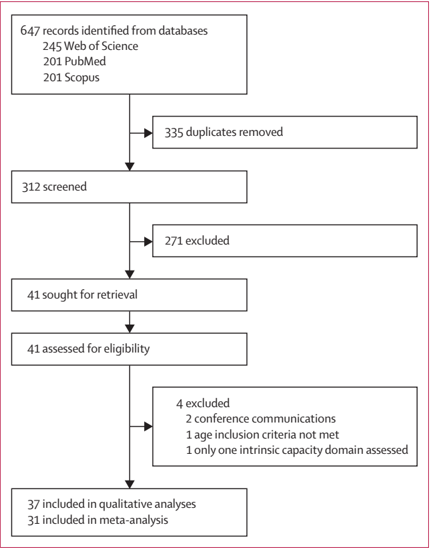
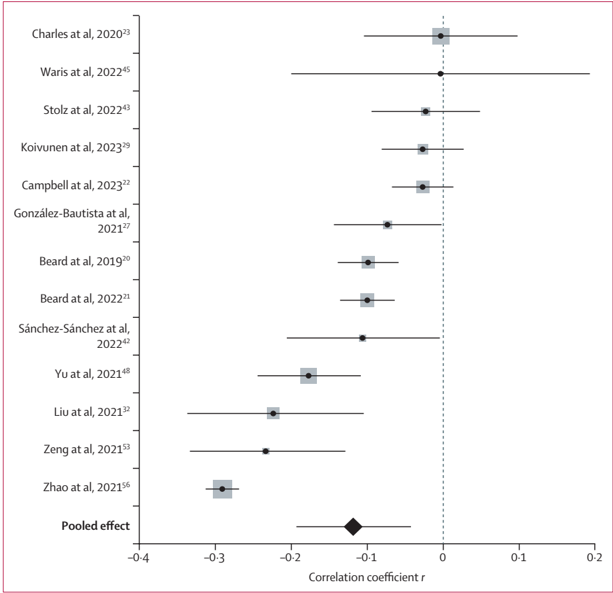
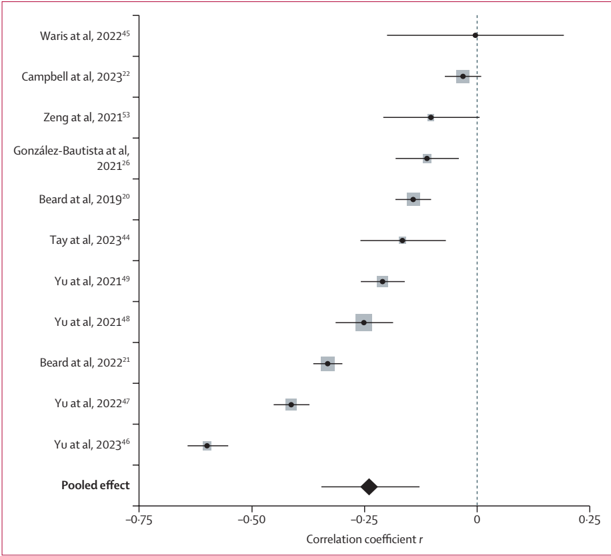
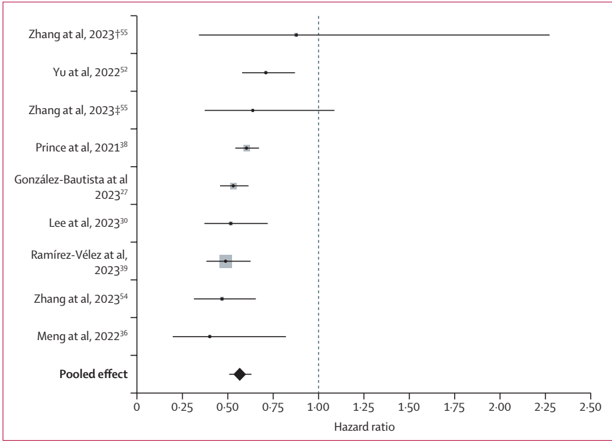
Background Together with environmental factors, intrinsic capacity (the composite of all the physical and mental capacities of an individual) has been proposed as a marker of healthy ageing.However, whether intrinsic capacity predicts major clinical outcomes is unclear.We aimed to explore the association of intrinsic capacity with functional decline and mortality in older adults.Methods In this systematic review and meta-analysis, we conducted a systematic search in MEDLINE (via PubMed), Scopus, and Web of Science from database inception to Feb 14, 2024, of observational longitudinal studies conducted in older adults (age ≥60 years) assessing the association of intrinsic capacity with impairment in basic activities of daily living (BADL) or instrumental activities of daily living (IADL) or risk of mortality.Estimates were extracted by two reviewers (JLS-S and W-HL) and were pooled using three-level meta-analytic models.The quality of each study was independently assessed by two authors (JLS-S and PLV) using the Newcastle-Ottawa Scale for longitudinal studies.Heterogeneity was evaluated using the I² indicator at two levels: within-study (level 2) and between-study (level 3) variation.For associations between intrinsic capacity and IADL and BADL, we transformed data (standardised β coefficients and odds ratios [ORs]) into Pearson product moment correlation coefficients (r) using Pearson and Digby formulas to allow comparability across studies.For associations between intrinsic capacity and risk of mortality, hazard ratios (HRs) with 95% CIs were extracted from survival analyses.This study is registered with PROSPERO, CRD42023460482.Findings We included 37 studies (206 693 participants; average age range 65•3-85•9 years) in the systematic review, of which 31 were included in the meta-analysis on the association between intrinsic capacity and outcomes; three studies (2935 participants) were included in the meta-analysis on the association between intrinsic capacity trajectories and longitudinal changes in BADL or IADL.Intrinsic capacity was inversely associated with longitudinal impairments in BADL (Pearson's r -0•12 [95% CI -0•19 to -0•04]) and IADL (-0•24 [-0•35 to -0•13]), as well as with mortality risk (hazard ratio 0•57 [95% CI 0•51 to 0•63]).An association was also found between intrinsic capacity trajectories and impairment in IADL (but not in BADL), with maintained or improved intrinsic capacity over time associated with a lower impairment in IADL (odds ratio 0•37 [95% CI 0•19 to 0•71]).There was no evidence of publication bias (Egger's test p>0•05) and there was low between-study heterogeneity (I²=18•4%), though withinstudy (I²=63•2%) heterogeneity was substantial.Interpretation Intrinsic capacity is inversely associated with functional decline and mortality risk in older adults.These findings could support the use of intrinsic capacity as a marker of healthy ageing, although further research is needed to refine the structure and operationalisation of this construct across settings and populations.
Overview
The claims and statistics of this paper haven’t been checked yet.
Free: it reads the open-access text and checks the first 5 claims that cite a source we can check. Create a free account to check every claim.
Integrity signals
Registry
Cites
Statistics
Figures
Verification
Claims the paper makes
The claims and statistics of this paper haven’t been checked yet.
Free: it reads the open-access text and checks the first 5 claims that cite a source we can check. Create a free account to check every claim.
Claims other papers make about this one
Each is checked against this paper’s own text: does it say what the citing paper says it does?
In the citing paper
“This, in turn, reduces mortality, promotes functional ability, and healthy aging [32,33]”
From Global consensus on optimal exercise recommendations for enhancing healthy longevity in older adults (ICFSR) (2025) · cites this paper as [33]
In the citing paper
“This, in turn, reduces mortality, promotes functional ability, and healthy aging [32,33].”
From Global consensus on optimal exercise recommendations for enhancing healthy longevity in older adults (ICFSR) (2025) · cites this paper as [33]
Self-check
Percentages, sums and reported differences re-computed from the paper’s own numbers.
The self-check needs the paper’s full text.
Citations
Cites
The PRISMA 2020 statement: An updated guideline for reporting systematic reviews
Page, M. J., McKenzie, J. E., Bossuyt, P. M., Boutron, I., Hoffmann, T. C., Mulrow, C. D., Shamseer, L., Tetzlaff, J. M., Akl, E. A., Brennan, S. E., et al. (2021) · BMJ · doi:10.1136/bmj.n71 · Cited by 108,283
Rayyan-a web and mobile app for systematic reviews.
Ouzzani, M., Hammady, H., Fedorowicz, Z., & Elmagarmid, A. (2016) · Systematic Reviews · doi:10.1186/s13643-016-0384-4 · Cited by 26,092
The PRISMA 2020 statement: an updated guideline for reporting systematic reviews
Page, M. J., McKenzie, J., Bossuyt, P., Boutron, I., Hoffmann, T., mulrow, C., Shamseer, L., Tetzlaff, J., Akl, E., Brennan, S. E., et al. (2020) · doi:10.31222/osf.io/v7gm2_v1 · Cited by 8,090
The PRISMA 2020 statement: an updated guideline for reporting systematic reviews
Page, M. J., McKenzie, J., Bossuyt, P., Boutron, I., Hoffmann, T., mulrow, C., Shamseer, L., Tetzlaff, J., Akl, E., Brennan, S. E., et al. (2020) · doi:10.31222/osf.io/v7gm2 · Cited by 5,177
The World Report on Ageing and Health
Beard, J. R., Officer, A. M., & Cassels, A. K. (2016) · The Gerontologist · doi:10.1093/geront/gnw037 · Cited by 2,843
VII. Mathematical contributions to the theory of evolution.—III. Regression, heredity, and panmixia
Pearson, K. (1896) · Philosophical Transactions of the Royal Society of London. Series A, Containing Papers of a Mathematical or Physical Character · doi:10.1098/rsta.1896.0007 · Cited by 1,788
Evidence for the Domains Supporting the Construct of Intrinsic Capacity
Cesari, M., Araujo de Carvalho, I., Amuthavalli Thiyagarajan, J., Cooper, C., Martin, F. C., Reginster, J.-Y., Vellas, B., & Beard, J. R. (2018) · The Journals of Gerontology: Series A · doi:10.1093/gerona/gly011 · Cited by 745
Meta-analysis with robust variance estimation: Expanding the range of working models
Pustejovsky, J. E., & Tipton, E. (2022) · Prevention Science · doi:10.1007/s11121-021-01246-3 · Cited by 737
Communicating Statistical Information
Hoffrage, U., Lindsey, S., Hertwig, R., & Gigerenzer, G. (2000) · Science · doi:10.1126/science.290.5500.2261 · Cited by 651
The structure and predictive value of intrinsic capacity in a longitudinal study of ageing
Beard, J. R., Jotheeswaran, A. T., Cesari, M., & Araujo de Carvalho, I. (2019) · BMJ Open · doi:10.1136/bmjopen-2018-026119 · Cited by 400
Research works printed but not linked: 1
- Wells G, Wells G, Shea B, et al. The Newcastle-Ottawa Scale (NOS) for assessing the quality of nonrandomised studies in meta- analyses. 2014. https://www.semanticscholar.org/paper/The- Newcastle-Ottawa-Scale-%28NOS%29-for-Assessing-the-Wells- Wells/c293fb316b6176154c3fdbb8340a107d9c8c82bf (accessed Jan 8, 2023).
Cited by
Izquierdo, M., de Souto Barreto, P., Arai, H., Bischoff-Ferrari, H. A., Cadore, E. L., Cesari, M., Chen, L.-K., Coen, P. M., Courneya, K. S., Duque, G., et al. (2025) · The Journal of nutrition, health and aging · doi:10.1016/j.jnha.2024.100401 · Cited by 273
Resilience and Intrinsic Capacity in Older Adults: A Review of Recent Literature
Grigoraș, G., Ilie, A. C., Turcu, A.-M., Albişteanu, S.-M., Lungu, I.-D., Ștefăniu, R., Pîslaru, A. I., Gavrilovici, O., & Alexa, I. D. (2025) · Journal of Clinical Medicine · doi:10.3390/jcm14217729 · Cited by 51
Sánchez‐Sánchez, J. L., Ortolá, R., Banegas, J. R., Lucía, A., Rodríguez-Artalejo, F., Sotos‐Prieto, M., & Valenzuela, P. L. (2025) · The Lancet Healthy Longevity · doi:10.1016/j.lanhl.2024.100681 · Cited by 35
Self-citationXiao, Y., Yuan, Q., Zhou, R., & Wang, M. (2025) · The journal of nutrition health & aging · doi:10.1016/j.jnha.2025.100583 · Cited by 26
“…functioning in older age, encompassing five key domains: locomotor, cognitive, vitality, sensory, and psychological, providing a comprehensive and dynamic perspective on health that reflects a shift from disease-centered aging to a more positive, function-oriented approach to healthy aging [5 – 7].”
Sarcopenia and intrinsic capacity in older adults: A systematic review
Sales, W. B., da Silva, P. N. S., Vital, B. S. B., & Câmara, M. (2025) · Archives of Gerontology and Geriatrics · doi:10.1016/j.archger.2025.105875 · Cited by 27
Cheng, Y., Li, W., Xiao, S., Chen, Y., & Qi, X. (2025) · Archives of Gerontology and Geriatrics · doi:10.1016/j.archger.2025.105860 · Cited by 18
Transitions and trajectories in intrinsic capacity states over time: a systematic review
Wang, Y., Tang, N., Shao, M., Song, J., Su, Q., & Gao, Y. (2025) · BMC Geriatrics · doi:10.1186/s12877-025-05938-1 · Cited by 26
“…study found that a decline in IC trajectories is associated with increased functional decline and death risk in older adults, which is consistent with the findings of Sánchez-Sánchez et al. [54] These connections further emphasize the importance of maintaining and enhancing the IC of older adults.”
Shin, J. H., Sagong, H., & Yoon, J. Y. (2025) · Archives of Gerontology and Geriatrics · doi:10.1016/j.archger.2025.105772 · Cited by 17
Jung, C., Marschall, U., Hennig, B., Giemsa, M., Heramvand, N., Parco, C., Kelm, M., Jacobs, J. M., & Beil, M. (2025) · Intensive Care Medicine · doi:10.1007/s00134-025-08163-x · Cited by 16
Intrinsic capacity assessment works—let's move on actions
Hsiao, F., & Chen, L. (2024) · The Lancet Healthy Longevity · doi:10.1016/s2666-7568(24)00110-7 · Cited by 13
Barreto, P. D. S., Lu, W., Tavassoli, N., Nourhashémi, F., de Mello, R. G. B., Ferriolli, E., Guyonnet, S., Rolland, Y., Martín, M., Vellas, B. J., et al. (2025) · Nature Aging · doi:10.1038/s43587-025-00861-x · Cited by 19
Self-citationCai, S., Gao, J., Li, C., Lu, F., Hu, D., Luo, X., Zhao, Z., Pan, Y., & Duan, G. (2025) · Annals of Medicine · doi:10.1080/07853890.2025.2561227 · Cited by 18
“When studies presented unstandardized regression coefficients, they were converted to standardized beta coefficients by using existing formulas, and were transformed into Pearson correlation coefficients using Pearson and Digby formulas to allow comparability across studies [23].”
György, B., Szatmári, R. Z., Ditrói, T., Torma, F., Pálóczi, K., Balbisi, M., Visnovitz, T., Koltai, E., Nagy, P., Buzás, E. I., et al. (2025) · Biogerontology · doi:10.1007/s10522-024-10177-9 · Cited by 12
Moreno, V. M., Sanz, M. I. M., Fernández, A. M., Maroto, S. G., Fuentes, E. S., Rico, E. P., González, I. S., Gallardo, M. F., Hernando, J. H., Calderón, M. P. B., et al. (2025) · Frontiers in Public Health · doi:10.3389/fpubh.2024.1478897 · Cited by 22
Development and validation of a functional ability index for older adults: a multicohort study
Chang, Y., Sapkota, S., Thapa, B., Ma, L., Sheng, L., Wang, C., Chhetri, J. K., & Chan, P. (2024) · Age and Ageing · doi:10.1093/ageing/afae231 · Cited by 13
Valenzuela, P. L., Izquierdo, M., Martínez‐Velilla, N., Zambom-Ferraresi, F., Cadore, E. L., Ramírez‐Vélez, R., & de Asteasu, M. L. S. (2025) · Age and Ageing · doi:10.1093/ageing/afaf082 · Cited by 12
Self-citationGencer, N. S., Çavdar, S., Koçak, F. Ö. K., Erol, F. B., & Savaş, S. (2025) · BMC Geriatrics · doi:10.1186/s12877-025-06697-9 · Cited by 9
“Although no significant association was observed between IC trajectories and changes in ADL, maintaining or improving IC over time was associated with a lower risk of IADL decline [35].”
Collin, M., Bonnet-Chateau, J., Gilles, V., Dautricourt, S., Gilbert, T., Makaroff, Z., Coste, M.-H., Dauphinot, V., & Garnier‐Crussard, A. (2025) · The journal of nutrition health & aging · doi:10.1016/j.jnha.2025.100541 · Cited by 8
“As IC decline are associated with the risk of frailty, functional decline and disability [10,11] and are potentially reversible after targeted interventions [12,13], better recognition of decreases in IC would open new avenues for specific management of IC decreases in patients with AD and DLB.”
Valenzuela, P. L., Sánchez‐Sánchez, J. L., Bensadoun, P., Lemaître, J.-M., Vellas, B. J., Sourdet, S., & Barreto, P. D. S. (2025) · GeroScience · doi:10.1007/s11357-025-01698-3 · Cited by 7
Self-citationCheng, Y., Xiao, S., Cai, Y., Jing, L., Li, W., & Liu, X. (2025) · The Journals of Gerontology Series A · doi:10.1093/gerona/glaf172 · Cited by 7
Biological Ageing Acceleration and Functional Capacities Across the Lifespan in the INSPIRE‐T Cohort
Sánchez‐Sánchez, J. L., Vellas, B. J., Guyonnet, S., Bensadoun, P., Lemaître, J.-M., Fuentealba, M., Pillard, F., Rolland, Y., Furman, D., & Barreto, P. D. S. (2025) · Journal of Cachexia Sarcopenia and Muscle · doi:10.1002/jcsm.70046 · Cited by 11
Self-citationAdherence to the planetary health diet and healthy aging: A prospective analysis
Maroto-Rodríguez, J., Ortolá, R., García‐Esquinas, E., Rodríguez-Artalejo, F., & Sotos‐Prieto, M. (2025) · Clinical Nutrition · doi:10.1016/j.clnu.2025.106562 · Cited by 7
Zhang, X., Xu, D., Yang, Y., Zeng, Y., Yu, H., Fang, T., Zhu, K., Xiao, Y., Wang, J., Dou, Q., et al. (2026) · The journal of nutrition health & aging · doi:10.1016/j.jnha.2026.100773 · Cited by 11
Zhang, C., Zeng, P., Zhang, Y., Kang, Y., Zhang, J., Li, J., Shi, H., Liu, S., & Shen, J. (2025) · The journal of nutrition health & aging · doi:10.1016/j.jnha.2025.100599 · Cited by 6
Song, F., Hu, M., Xia, J., & Yin, C. (2025) · Open Heart · doi:10.1136/openhrt-2025-003395 · Cited by 8
Keyser, E. D., Tambeur, J., Smedt, E. D., Schwab, L., Vrancken, D., Peersman, W., Annemans, L., Lieten, S., VELDE, D. V. D., VRIENDT, P. D., et al. (2025) · Ageing Research Reviews · doi:10.1016/j.arr.2025.102893 · Cited by 8
Tang, L., Qiu, C., Yu, X., 刘菲, Wang, L., & Zhu, X. (2026) · Journal of the American Heart Association · doi:10.1161/jaha.125.045986 · Cited by 11
“39 The primary limitations of prior epidemiologic studies on IC and CVD outcomes are single timepoint measures.”
Huang, M.-T., Chang, Y., Li, C., Ku, L. E., Chou, Y.-T., Hou, W., Chen, H., Su, H., Wu, Y., Liu, C.-H., et al. (2024) · Preventive Medicine Reports · doi:10.1016/j.pmedr.2024.102897 · Cited by 7
Physical activity, sedentary behaviour, and intrinsic capacity at older ages: get active!
Ma, L. (2025) · The Lancet Healthy Longevity · doi:10.1016/j.lanhl.2025.100687 · Cited by 5
Ge, L., Li, R., & Yap, C. W. (2025) · American Journal of Clinical Nutrition · doi:10.1016/j.ajcnut.2025.07.014 · Cited by 10
The role of intrinsic capacity in predicting cancer mortality – Evidence from the UK Biobank
Calatayud, J., Núñez‐Cortés, R., López‐Bueno, R., Izquierdo, M., & Ramírez‐Vélez, R. (2025) · Maturitas · doi:10.1016/j.maturitas.2025.108709 · Cited by 4
Xuan, Z., Niu, Y., Wang, Y., Wang, Z.-M., Zhao, J., Chang, H., & Xiao, Q. (2025) · Journal of Medical Internet Research · doi:10.2196/76222 · Cited by 9
“Evidence confirmed that IC is an important predictor of functional decline, mortality, and risk of caregiving dependence, providing effective insight into clinical action research [11,12].”
Perianayagam, A., Sadana, R., Prina, M. A., Selvamani, Y., Guntupalli, A. M., Bloom, D. E., Lee, J., & Wu, Y. (2025) · Nature Aging · doi:10.1038/s43587-025-01013-x · Cited by 6
Implementing integrated care for older adults in primary health care: A systematic scoping review
Sun, M., Liu, J., Yi, M., Chen, S., Huang, Y., Zhao, I. Y., Leung, A. Y. M., & Wang, Z. (2026) · International Journal of Nursing Studies · doi:10.1016/j.ijnurstu.2026.105342 · Cited by 8
Lu, W., Guyonnet, S., Raffin, J., Bessou‐Touya, S., Helffer, K. R., Bianchi, P., Digabel, J. L., Bensadoun, P., Lemaître, J.-M., Barreto, P. D. S., et al. (2025) · Aging Cell · doi:10.1111/acel.70190 · Cited by 8
Self-citationImpact of a four-domain intrinsic capacity measure on falls: findings from the EPOSA study
Ceolin, C., Siviero, P., Limongi, F., Noale, M., Sergi, G., & Maggi, S. (2025) · Frontiers in Aging · doi:10.3389/fragi.2025.1645712 · Cited by 3
Song, F., Chhetri, J. K., Hu, M., Li, B., Xia, J., & Yin, C. (2025) · The journal of nutrition health & aging · doi:10.1016/j.jnha.2025.100687 · Cited by 4
“Past studies have shown impaired IC to serve as a robust predictor of adverse health outcomes, including disability and mortality [8 – 10].”
Intrinsic Capacity Predictors of Dementia and Mortality in the Sydney Memory and Ageing Study
Numbers, K. T., Samtani, S., Hanewald, K., Cheung, J., Sachdev, P. S., & Brodaty, H. (2025) · International Journal of Geriatric Psychiatry · doi:10.1002/gps.70156 · Cited by 6
Xiao, L., Dong, J., Zhao, E., Hu, N., Zeng, J., Wu, Z., Yang, Y., Wang, J., Xu, Q. Y., Shi, H., et al. (2025) · BMC Public Health · doi:10.1186/s12889-025-25500-3 · Cited by 4
“Prior research also revealed inconsistencies in the methodology [4], as well as a lack of specific criteria for the intrinsic ability score [28].”
Au, L. S. Y., Azhar, I. E. B., Lee, J. E., Lim, J. S., Lai, A., Chua, B. M., Tan, Y., & Merchant, R. A. (2025) · The Journal of Frailty & Aging · doi:10.1016/j.tjfa.2025.100105 · Cited by 3
Pereira, A. D. D. L., dos Santos, B. M. G., Alves, E. V. D. C., da Costa, D. H. S., de Lima, N. R. S., MOREIRA, R. D. S., Araújo, S. C. D. M., & Silva, V. M. G. D. L. (2026) · Revista Multidisciplinar do Nordeste Mineiro · doi:10.66104/s32vvz33 · Cited by 5
Caballero, O., García‐Hermoso, A., Almonacid, J. G. H., Yáñez-Sepúlveda, R., López-Gil, J. F., & Ezzatvar, Y. (2026) · The Gerontologist · doi:10.1093/geront/gnag079 · Cited by 3
Malkowski, O. S., Davis‐Plourde, K. L., Western, M. J., & Gill, T. M. (2026) · The Lancet Healthy Longevity · doi:10.1016/j.lanhl.2026.100854 · Cited by 3
O'Hara‐Veintimilla, K., Borda, M. G., Alderete, L. M., Salas, M., Millares, M. V., & Mateos, R. (2025) · American Journal of Geriatric Psychiatry · doi:10.1016/j.jagp.2025.06.004 · Cited by 2
Felipe, S. G. B., Printes, C. B., Brauner, F. D. O., Sato, D. K., & Baptista, R. R. (2025) · Frontiers in Aging · doi:10.3389/fragi.2025.1562383 · Cited by 4
Zhao, Q., Wu, Q.-Z., Lai, R., & Luan, S. (2025) · BMJ Open · doi:10.1136/bmjopen-2024-097806 · Cited by 2
“29 Intrinsic capacity encompasses cognitive, psychological, sensory (visual, auditory), vitality and motor domains, representing a comprehensive reflection of the physical and mental capacities of older individuals.”
Intrinsic Capacity as a Predictor of Healthy Longevity: Insights From Four Cohort Studies
Li, Y., Chen, Y., Chen, Y., Ding, X., Pan, Y., & Chen, Y. (2025) · Geriatrics and gerontology international/Geriatrics & gerontology international · doi:10.1111/ggi.70285 · Cited by 2
Zou, T., Liu, J., Zhang, L., Liu, F., Zhang, E., Wang, X., Ju, J., Huang, X., & Fang, Q. (2025) · Experimental Gerontology · doi:10.1016/j.exger.2025.113020 · Cited by 4
Liu, Y., Wang, J., Zhao, X., Li, X., Wang, C., Yang, J., Han, H., Zhou, Q., & Zhang, Y. (2026) · Archives of Gerontology and Geriatrics · doi:10.1016/j.archger.2026.106183 · Cited by 4
Intrinsic capacity in older adults: A concise guide for non-geriatricians
Ronca, A., Morgese, V., Barreto, P. D. S., & Proietti, M. (2026) · European Journal of Internal Medicine · doi:10.1016/j.ejim.2026.106825 · Cited by 2
Hou, W., Nhu, N. T., Jia-ni, X., Jou, Y., Chung, Y.-F., Li, C., & Lee, C. B. (2026) · The journal of nutrition health & aging · doi:10.1016/j.jnha.2026.100933 · Cited by 2
Ishtiak‐Ahmed, K., Jensen‐Dahm, C., Christensen, K. S., Waldemar, G., & Gasse, C. (2024) · International Journal of Geriatric Psychiatry · doi:10.1002/gps.70014 · Cited by 2
Hu, W., Tian, G., Wang, J., Ma, Y., Zheng, Z.-A., Feng, T.-J., Niu, X.-X., Yan, Y.-N., Liu, B.-P., & Jia, C.-X. (2025) · Neurology · doi:10.1212/wnl.0000000000214144 · Cited by 2
Lifestyle interventions in older adults with type 2 diabetes mellitus: The key for healthy ageing
Sánchez‐Sánchez, J. L., & Valenzuela, P. L. (2025) · The journal of nutrition health & aging · doi:10.1016/j.jnha.2025.100546 · Cited by 1
Self-citationIntrinsic capacity in Lewy body dementia: a review
Sanapo, F., Signoret, M., Nodit, M., & Garnier‐Crussard, A. (2025) · The Journal of Frailty & Aging · doi:10.1016/j.tjfa.2025.100076 · Cited by 1
“Like frailty, declines in IC are associated with increased dependency and higher mortality [9].”
Impact of Intrinsic Capacity on 5-year Mortality of Older Patients With Cardiovascular Disease
Wan, Y., Li, W., Liu, J., Chai, K., Wang, H., & Yang, J. (2025) · Reviews in Cardiovascular Medicine · doi:10.31083/rcm37477 · Cited by 1
“Previous studies have demonstrated a strong association between declines in IC and adverse outcomes among older adults; however, these studies have primarily focused on the general population of community-dwelling older adults [5,6,18,19].”
Associations between upper limb flexibility and all-cause mortality in the oldest-old
Zhang, Y., Zhang, C., Hu, J., Kang, Y., Zhang, J., Zhao, J., Shi, H., & Shen, J. (2025) · Journal of Global Health · doi:10.7189/jogh.15.04224 · Cited by 2
Cheng, S., Lei, S., Hou, C., Qin, J., Du, X., Yue, X., & Guo, Y. (2025) · GeroScience · doi:10.1007/s11357-025-01983-1 · Cited by 3
“While most studies on IC have linked its decline to adverse outcomes such as disability and mortality [3], the modifiable lifestyle determinants driving this deterioration remain poorly understood [4].”
InfluentialLai, H., Zhang, S., Otsuka, R., Huang, S., Arai, H., Hsiao, F., & Chen, L. (2025) · JMIR Aging · doi:10.2196/80034 · Cited by 2
“These findings support the potential of IC as a biomarker of healthy aging; however, further research is necessary to refine its measurement and application within diverse populations and settings [56].”
Lin, J.-W., Lin, P., Liao, P.-H., Chen, C., & Huang, H. (2025) · Experimental Gerontology · doi:10.1016/j.exger.2025.112963 · Cited by 1
Cadore, E. L., Pietta-Dias, C., de Asteasu, M. L. S., & Izquierdo, M. (2025) · Geriatrics Gerontology and Aging · doi:10.53886/gga.e0000336_en · Cited by 1
Yu, R., Yu, M., Tong, C., Ho, F., Hui, A., Lui, E., & Woo, J. (2026) · The Journal of Frailty & Aging · doi:10.1016/j.tjfa.2025.100126 · Cited by 1
Cacciatore, S., Schlögl, M., Calvani, R., Russo, A., Tosato, M., Wagg, A., Marzetti, E., & Landi, F. (2026) · Maturitas · doi:10.1016/j.maturitas.2026.108871 · Cited by 1
Bertola, L., Wu, Y., Aliberti, M. J. R., Kingston, A., Hiratsuka, M., Ferriolli, E., Prina, M., Suemoto, C. K., & Brazil-UK Network on Healthy Aging (2026) · The Journals of Gerontology Series A · doi:10.1093/gerona/glag033 · Cited by 1
Deng, W., Li, X., Hu, M., Gao, D., & Huang, J. (2026) · Nutrients · doi:10.3390/nu18050746 · Cited by 1
Su, H., Li, Q., Zhang, Y., & Zhou, Y. (2026) · BMC Geriatrics · doi:10.1186/s12877-026-07174-7 · Cited by 2
“Enhancing and maintaining the intrinsic capacity of older adults is a key strategy for preventing and delaying disability and promoting healthy aging [3].”
Zhang, S., Tange, C., Shimokata, H., Nishita, Y., Otsuka, R., & Arai, H. (2026) · Archives of Gerontology and Geriatrics · doi:10.1016/j.archger.2026.106206 · Cited by 1
Yuan, Y., Wang, Y., Xu, H., & Pan, M. (2026) · Scientific Reports · doi:10.1038/s41598-026-43255-8 · Cited by 4
“Psychological capacity was measured using the Center for Epidemiological Studies Depression Scale-10 (CES-D10) 21–23 .”
Pérès, K., Jiatsa, I. K., Gbessemehlan, A., Bardinet, J., Helmer, C., Tchalla, A. E., & Letenneur, L. (2026) · Age and Ageing · doi:10.1093/ageing/afag051 · Cited by 1
Noordin, N., Siriphorn, A., Yu, C. W., & Justine, M. (2026) · Age and Ageing · doi:10.1093/ageing/afag072 · Cited by 2
Zhou, Y., Si, Y., Carrillo-Larco, R. M., Zhang, Y., & Xu, X. (2026) · The journal of nutrition health & aging · doi:10.1016/j.jnha.2026.100858 · Cited by 1
Yuan, Q., Jia, S., Yue, X., Li, Y., Wang, M., Chen, M., Pan, J., Xia, L., Mao, Z., Xiangyu, D., et al. (2026) · Experimental Gerontology · doi:10.1016/j.exger.2026.113151 · Cited by 3
Ramanauskė, N., & Muliuolytė, K. (2026) · Transformations and Sustainability · doi:10.63775/gcvesw79 · Cited by 1
“These studies show that higher levels of intrinsic capacity are associated with lower risks of functional decline, frailty, and dependency (Sánchez - Sánchez et al., 2024; Zhu et al., 2025; Simões et al., 2025), thereby reinforcing the importance of multidimensional and capacity-based approaches to…”
Intrinsic capacity and the risk of adverse health outcomes in older adults: a population-based study
Gou, X., Li, M., Lu, N., Yang, T., Li, W., Yan, L., Yang, L., Li, Y., & Leng, M. (2026) · BMC Geriatrics · doi:10.1186/s12877-026-07552-1 · Cited by 1
“A recent meta-analysis of 37 studies revealed that reduced IC was associated with an increased risk of functional decline [18].”
Xuan, Z., Niu, Y., Kang, R., Xiao, Q., Jin, S., Zhao, J., Wang, Y., & Chang, H. (2026) · JMIR Aging · doi:10.2196/82867 · Cited by 1
“According to previous studies, IC is a robust predictor of adverse health outcomes, including frailty, falls, health care use, incident disability, hospitalization, and mortality [10,11].”
Bus transit to wellbeing: active aging pathways in China’s most aged megacity
Liu, W., Yu, J., Zhao, J., & Liu, X. (2026) · Transportation Research Part D Transport and Environment · doi:10.1016/j.trd.2026.105449 · Cited by 1
Intrinsic capacity and disability before death: a dynamic relationship
Hanewald, K. (2026) · The Lancet Healthy Longevity · doi:10.1016/j.lanhl.2026.100863 · Cited by 1
Tzemah-Shahar, R., Iktilat, K., & Seligman, B. J. (2026) · GeroScience · doi:10.1007/s11357-026-02456-9 · Cited by 2
Valenzuela, P. L., Buendía‐Romero, Á., Antón‐Rodrigo, I., Sánchez‐Sánchez, J. L., & Herrero, Á. C. (2026) · GeroScience · doi:10.1007/s11357-026-02431-4 · Cited by 1
Self-citationMultidimensional Aging Trajectories Preceding Cardiovascular Events
Phyo, A. Z. Z., Wu, Z., Tonkin, A. M., Vishwanath, S., Espinoza, S. E., Wolfe, R. S., Orchard, S. G., Woods, R. L., González‐Chica, D. A., Stocks, N. P., et al. (2026) · JAMA Cardiology · doi:10.1001/jamacardio.2026.3597 · Cited by 1
Cohort trends in intrinsic capacity in Europe: a population-based longitudinal study
Beard, J., Chen, M., Gu, Y., & Hanewald, K. (2026) · The Lancet Healthy Longevity · doi:10.1016/j.lanhl.2026.100906 · Cited by 1
Peng, R., Yang, F., Xia, W. A. N., Xu, Y., & Zhao, Q. (2024) · Research Square · doi:10.21203/rs.3.rs-5476128/v1
Yu, R., Leung, G. S.-M., Lai, D., Tam, L.-Y., Cheng, C., Kong, S., Tong, C., & Woo, J. (2025) · Journal of Aging Research and Lifestyle · doi:10.1016/j.jarlif.2025.100004 · Cited by 2
“A recent meta-analysis even showed that longitudinal improvement of IC is associated with decreased risk of disability [ 30 ].”
Qiu, L. (2025) · The journal of nutrition health & aging · doi:10.1016/j.jnha.2025.100523
Wang, Y., Yan, P., You, S., Wan, X., Jiang, D., Guo, Y., & Feng, H. (2025) · Geriatric Nursing · doi:10.1016/j.gerinurse.2025.103577 · Cited by 1
Meng, X., Yang, B., Chen, J., He, C., Yin, H., Gu, J., Xu, Z., & Ji, Y. (2025) · Maturitas · doi:10.1016/j.maturitas.2025.108732 · Cited by 2
Cheng, Y., Zhang, Y., Lin, J., Xu, C., & Xu, X. (2025) · npj Primary Care Respiratory Medicine · doi:10.1038/s41533-025-00459-1 · Cited by 1
“Growing evidence has suggested that IC decline is linked to an elevated risk of adverse health outcomes such as disability, functional decline, and mortality 9,10 .”
InfluentialHou, S., Pan, Y., Luo, J., Liu, R., & Wang, X. (2025) · Archives of Gerontology and Geriatrics · doi:10.1016/j.archger.2025.106111 · Cited by 3
Yu, W., Zhou, Y., Gao, X., Han, J., Zhang, L., & Ma, L. (2025) · Experimental Gerontology · doi:10.1016/j.exger.2025.112991
AI-Based Measurement Tools for Intrinsic Capacity in Older Adults: Scoping Review
Yu, C., Lu, P., Zhou, Y., Zhao, J., Yang, X., Tang, D., & Ying, L. (2026) · Journal of Medical Internet Research · doi:10.2196/90411
“Declining IC has been associated with an increased risk of frailty, disability, care dependency, and mortality, making it an important target for early identification and preventive intervention [3,4].”
Guaraldi, G., Milić, J., Gozzi, L., Ambrosio, S., Delmonte, E., Avanzini, I., Castelnuovo, B., & Mussini, C. (2025) · Journal of Aging Research and Lifestyle · doi:10.1016/j.jarlif.2025.100047 · Cited by 6
Vila-Chã, C. J. F., Andreis, F. R., Kristoffersen, S. S., Vaz, C., Negro, F., & Oliveira, A. S. (2026) · Journal of Neurophysiology · doi:10.1152/jn.00334.2025 · Cited by 3
Montoya‐Juárez, R., Fernández-Rodríguez, J., Cabeza-Pérez, R., Leyva, A. F., Esteban‐Burgos, A. A., Iribarne-Durán, L. M., & López-Morales, M. (2026) · BMC Palliative Care · doi:10.1186/s12904-026-01986-5
“It is widely accepted that a decline in functioning [41] and cognitive status [42] is associated with mortality.”
Wang, Q., Ginting, M. L., Ho, E. Y., Goh, S. F., Gao, J., Tan, W. S., Ding, Y. Y., Ng, W. L. D., Ng, J. C. A., Kwek, S. C., et al. (2026) · JMIR Research Protocols · doi:10.2196/84257
Rapport 25-14. Approche clinique de la longévité en bonne santé
Balardy, L., Adnot, S., Gallix, B., Robledo, L. M. F. G., Sourdet, S., & Vellas, B. J. (2026) · Bulletin de l Académie Nationale de Médecine · doi:10.1016/j.banm.2026.02.002 · Cited by 2
李, 文. (2026) · Advances in Clinical Medicine · doi:10.12677/acm.2026.162690
Zhang, L., Ji, T., Bi, J., 隆爱军, Long, Y.-F., Zhang, L., Chen, N., Ma, Y., Chen, C., Wang, S., et al. (2026) · The Journals of Gerontology Series A · doi:10.1093/gerona/glag042
Cao, Y., Deng, Y., Zhao, H., Liu, L., & Xie, W. (2026) · European journal of medical research · doi:10.1186/s40001-026-04093-6
Tian, Y., Zhu, M., Zhang, Y., Zhang, X., & Wen, X. (2026) · BMC Geriatrics · doi:10.1186/s12877-026-07284-2
“Juan Luis Sánchez-Sánchez et al. [12] also found that intrinsic capacity is negatively correlated with functional decline and mortality risk in older adults, with cognition being the strongest predictor of mortality [13].”
Guan, X., Chan, O., Zhong, Y., Zhou, J., Liang, P., Lu, S., Guo, Y., Liu, Y., Luo, H., Wong, G. H. Y., et al. (2026) · Aging & Mental Health · doi:10.1080/13607863.2026.2635534
“…robust structural foundation that has received substantial empirical support, with numerous studies consistently confirming the core associations among intrinsic capacity, environment, and functional ability outcomes (Beard et al., 2019; Ćwirlej-Sozańska et al., 2019; Sánchez-Sánchez et al., 2024).”
Metadata
- Authors
- Sánchez-Sánchez, J. L., Lu, W.-H., Gallardo-Gómez, D., del Pozo Cruz, B., de Souto Barreto, P., Lucia, A., & Valenzuela, P. L.
- Affiliations
- Centre Hospitalier Universitaire de Toulouse (FR)
- Universidad de Alcalá (ES)
- Venue
- The Lancet Healthy Longevity
- Publisher
- Elsevier BV
- Published
- 2024-07
- Volume
- 5
- Issue
- 7
- Pages
- e480-e492
- ISSN
- 2666-7568 (ISSN-L)
- OpenAlex
- W4400066866
- Semantic Scholar
- 9209ce6323a8d41724c49a5e163d4e2845ee8192
- Cited by
- 180
- References
- 61
- Citations by year
- 2026: 119 · 2025: 55 · 2024: 6
- FWCI
- 10.96
- Type
- journal article
- Language
- en
- Open access
- gold
- doi.org
- Licence
- cc-by-nc-nd
- www.elsevier.com/tdm/userlicense/1.0/ (tdm)
- www.elsevier.com/legal/tdmrep-license (tdm)
- creativecommons.org/licenses/by-nc-nd/4.0/ (vor)
- Locations
- The Lancet Healthy Longevity (publishedVersion, cc-by-nc-nd)
- PubMed (publishedVersion)
- University of Southern Denmark Research Portal (University of Southern Denmark) (publishedVersion, cc-by-nc-nd)
- HAL (submittedVersion, cc-by-nc-nd)
- RODIN (Universidad de Cádiz) (submittedVersion, cc-by-nc-nd)
- Deposito de Investigacion Universidad de Sevilla (University of Seville) (submittedVersion, cc-by-nc-nd)
- RUIdeRA - Institutional University Repository (University of Castilla-La Mancha) (submittedVersion, other-oa)
- Funders
- Instituto de Salud Carlos III (CD21/00138)
- European Commission
- Universidad Pública de Navarra
- Universidad de Sevilla (PIF20/VI-PPITUS, EMERGIA 2020/00158)
- Agence Nationale de la Recherche (ANR-23-IAHU-0011)
- Topics
- Health Sciences › Medicine › Geriatrics and Gerontology › Frailty in Older Adults
- Health Sciences › Medicine › Public Health, Environmental and Occupational Health › Aging, Health, and Disability
- Social Sciences › Psychology › Developmental and Educational Psychology › Aging and Gerontology Research
- Keywords
- intrinsic capacity, healthy aging, functional decline, activities of daily living, instrumental activities of daily living, mortality risk, older adults, cognitive function, physical function, frailty, multimorbidity, multimorbidity burden, functional decline prediction, sex differences, socioeconomic status, educational attainment
- MeSH terms
- Activities of Daily Living, Aged, Aged, 80 and over, Female, Humans, Longitudinal Studies, Male, Mortality, Geriatric Assessment
About these checks
Registry, retraction, Cites and statistics results are computed, not judged, with one exception: a printed reference that no index lists is read once by a model before it counts as a citation error. Claims are extracted by a model and kept only when their quote appears verbatim in the text; each cited source is then checked, with a model’s help, for whether it says what the claim relies on. Those verdicts can be wrong — read the claim’s quote and the cited source before relying on one.
Statistics and arithmetic are recomputed, not judged.
Confidence bands are shown only for fields calibrated on our annotated test set. None is calibrated yet, so no band is shown.
What counts as a claim ›How we measure confidence ›How we check this ›
Are you an author, or do you see a problem with this page? Request a review
Data sources
Bibliographic data: Semantic Scholar, OpenAlex, Crossref.
Contains information from the Semantic Scholar Academic Graph Datasets, made available under the ODC Attribution License (ODC-BY 1.0).
Semantic Scholar’s data is described in: Kinney, R., et al. (2023). The Semantic Scholar Open Data Platform. arXiv:2301.10140.
