

Association of intrinsic capacity with functional decline and mortality in older adults: a systematic review and meta-analysis of longitudinal studies
Open accessThe DOI matches its Crossref record; 63 of the 63 references it cites were found in a registry or an index.
Abstract
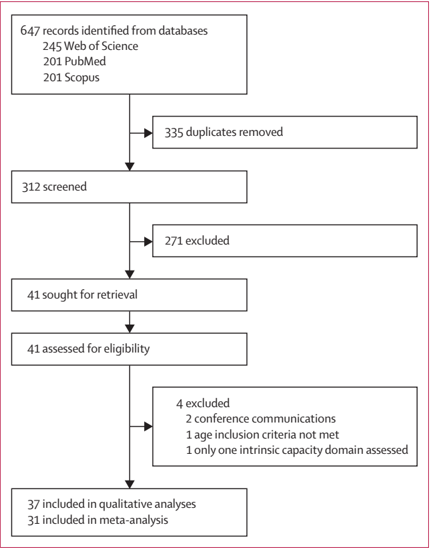
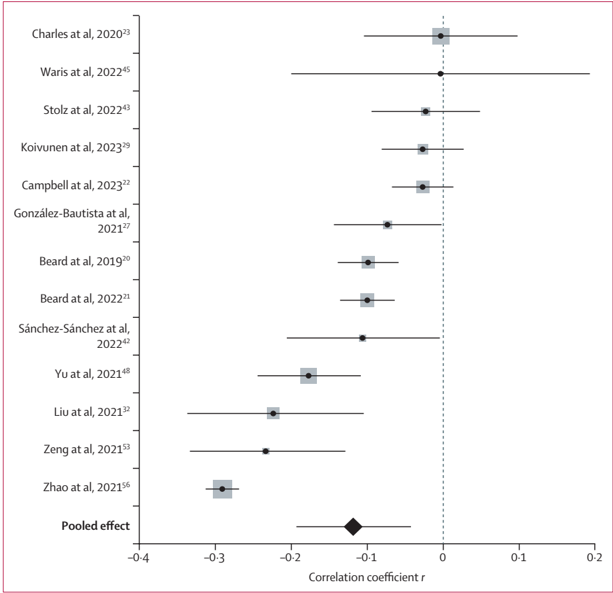
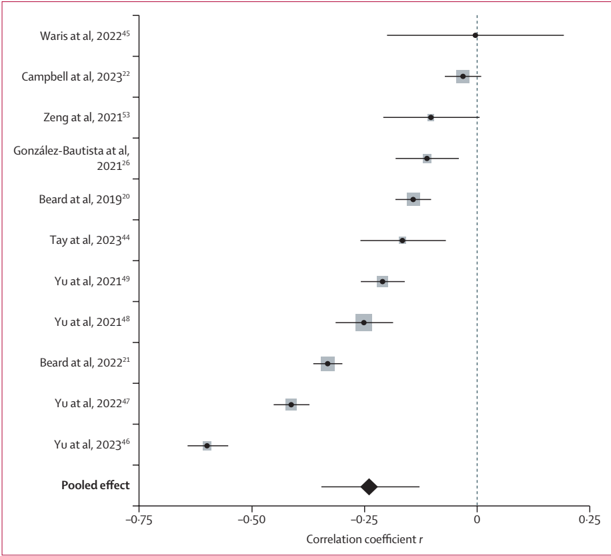
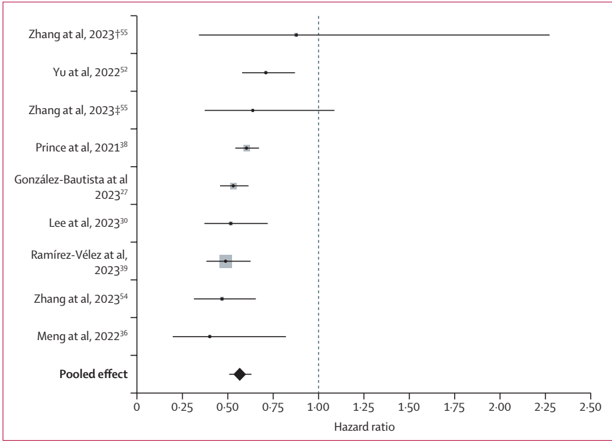
Background Together with environmental factors, intrinsic capacity (the composite of all the physical and mental capacities of an individual) has been proposed as a marker of healthy ageing.However, whether intrinsic capacity predicts major clinical outcomes is unclear.We aimed to explore the association of intrinsic capacity with functional decline and mortality in older adults.Methods In this systematic review and meta-analysis, we conducted a systematic search in MEDLINE (via PubMed), Scopus, and Web of Science from database inception to Feb 14, 2024, of observational longitudinal studies conducted in older adults (age ≥60 years) assessing the association of intrinsic capacity with impairment in basic activities of daily living (BADL) or instrumental activities of daily living (IADL) or risk of mortality.Estimates were extracted by two reviewers (JLS-S and W-HL) and were pooled using three-level meta-analytic models.The quality of each study was independently assessed by two authors (JLS-S and PLV) using the Newcastle-Ottawa Scale for longitudinal studies.Heterogeneity was evaluated using the I² indicator at two levels: within-study (level 2) and between-study (level 3) variation.For associations between intrinsic capacity and IADL and BADL, we transformed data (standardised β coefficients and odds ratios [ORs]) into Pearson product moment correlation coefficients (r) using Pearson and Digby formulas to allow comparability across studies.For associations between intrinsic capacity and risk of mortality, hazard ratios (HRs) with 95% CIs were extracted from survival analyses.This study is registered with PROSPERO, CRD42023460482.Findings We included 37 studies (206 693 participants; average age range 65•3-85•9 years) in the systematic review, of which 31 were included in the meta-analysis on the association between intrinsic capacity and outcomes; three studies (2935 participants) were included in the meta-analysis on the association between intrinsic capacity trajectories and longitudinal changes in BADL or IADL.Intrinsic capacity was inversely associated with longitudinal impairments in BADL (Pearson's r -0•12 [95% CI -0•19 to -0•04]) and IADL (-0•24 [-0•35 to -0•13]), as well as with mortality risk (hazard ratio 0•57 [95% CI 0•51 to 0•63]).An association was also found between intrinsic capacity trajectories and impairment in IADL (but not in BADL), with maintained or improved intrinsic capacity over time associated with a lower impairment in IADL (odds ratio 0•37 [95% CI 0•19 to 0•71]).There was no evidence of publication bias (Egger's test p>0•05) and there was low between-study heterogeneity (I²=18•4%), though withinstudy (I²=63•2%) heterogeneity was substantial.Interpretation Intrinsic capacity is inversely associated with functional decline and mortality risk in older adults.These findings could support the use of intrinsic capacity as a marker of healthy ageing, although further research is needed to refine the structure and operationalisation of this construct across settings and populations.
Overview
The claims and statistics of this paper haven’t been checked yet.
Free: it reads the open-access text and checks the first 5 claims that cite a source we can check. Create a free account to check every claim.
Integrity signals
Registry
Cites
Statistics
Figures
Verification
Claims the paper makes
The claims and statistics of this paper haven’t been checked yet.
Free: it reads the open-access text and checks the first 5 claims that cite a source we can check. Create a free account to check every claim.
Claims other papers make about this one
Each is checked against this paper’s own text: does it say what the citing paper says it does?
In the citing paper
“This, in turn, reduces mortality, promotes functional ability, and healthy aging [32,33]”
From Global consensus on optimal exercise recommendations for enhancing healthy longevity in older adults (ICFSR) (2025) · cites this paper as [33]
In the citing paper
“This, in turn, reduces mortality, promotes functional ability, and healthy aging [32,33].”
From Global consensus on optimal exercise recommendations for enhancing healthy longevity in older adults (ICFSR) (2025) · cites this paper as [33]
Self-check
Percentages, sums and reported differences re-computed from the paper’s own numbers.
The self-check needs the paper’s full text.
Citations
Cites
The PRISMA 2020 statement: An updated guideline for reporting systematic reviews
Page, M. J., McKenzie, J. E., Bossuyt, P. M., Boutron, I., Hoffmann, T. C., Mulrow, C. D., Shamseer, L., Tetzlaff, J. M., Akl, E. A., Brennan, S. E., et al. (2021) · BMJ · doi:10.1136/bmj.n71 · Cited by 108,283
Rayyan-a web and mobile app for systematic reviews.
Ouzzani, M., Hammady, H., Fedorowicz, Z., & Elmagarmid, A. (2016) · Systematic Reviews · doi:10.1186/s13643-016-0384-4 · Cited by 26,092
The PRISMA 2020 statement: an updated guideline for reporting systematic reviews
Page, M. J., McKenzie, J., Bossuyt, P., Boutron, I., Hoffmann, T., mulrow, C., Shamseer, L., Tetzlaff, J., Akl, E., Brennan, S. E., et al. (2020) · doi:10.31222/osf.io/v7gm2_v1 · Cited by 8,090
The PRISMA 2020 statement: an updated guideline for reporting systematic reviews
Page, M. J., McKenzie, J., Bossuyt, P., Boutron, I., Hoffmann, T., mulrow, C., Shamseer, L., Tetzlaff, J., Akl, E., Brennan, S. E., et al. (2020) · doi:10.31222/osf.io/v7gm2 · Cited by 5,177
The World Report on Ageing and Health
Beard, J. R., Officer, A. M., & Cassels, A. K. (2016) · The Gerontologist · doi:10.1093/geront/gnw037 · Cited by 2,843
VII. Mathematical contributions to the theory of evolution.—III. Regression, heredity, and panmixia
Pearson, K. (1896) · Philosophical Transactions of the Royal Society of London. Series A, Containing Papers of a Mathematical or Physical Character · doi:10.1098/rsta.1896.0007 · Cited by 1,788
Evidence for the Domains Supporting the Construct of Intrinsic Capacity
Cesari, M., Araujo de Carvalho, I., Amuthavalli Thiyagarajan, J., Cooper, C., Martin, F. C., Reginster, J.-Y., Vellas, B., & Beard, J. R. (2018) · The Journals of Gerontology: Series A · doi:10.1093/gerona/gly011 · Cited by 745
Meta-analysis with robust variance estimation: Expanding the range of working models
Pustejovsky, J. E., & Tipton, E. (2022) · Prevention Science · doi:10.1007/s11121-021-01246-3 · Cited by 737
Communicating Statistical Information
Hoffrage, U., Lindsey, S., Hertwig, R., & Gigerenzer, G. (2000) · Science · doi:10.1126/science.290.5500.2261 · Cited by 651
The structure and predictive value of intrinsic capacity in a longitudinal study of ageing
Beard, J. R., Jotheeswaran, A. T., Cesari, M., & Araujo de Carvalho, I. (2019) · BMJ Open · doi:10.1136/bmjopen-2018-026119 · Cited by 400
Research works printed but not linked: 1
- Wells G, Wells G, Shea B, et al. The Newcastle-Ottawa Scale (NOS) for assessing the quality of nonrandomised studies in meta- analyses. 2014. https://www.semanticscholar.org/paper/The- Newcastle-Ottawa-Scale-%28NOS%29-for-Assessing-the-Wells- Wells/c293fb316b6176154c3fdbb8340a107d9c8c82bf (accessed Jan 8, 2023).
Cited by
Items 101–178 of 178
Connecting the planetary health diet to intrinsic capacity: Insights and methodological challenges
Gökçe, B., Karabacak, E. C., & Ayçiçek, G. Ş. (2026) · Clinical Nutrition · doi:10.1016/j.clnu.2026.106636
Yen, C.-L., Lim, K.-J., Hung, W.-S., Liao, K., Tsai, T.-S., Ho, W.-B., Lin, C.-Y., Wen, M.-S., & Chen, Y.-J. (2026) · doi:10.2196/preprints.95209
Sotos‐Prieto, M., Maroto-Rodríguez, J., & Rodríguez‐Artalejo, F. (2026) · Clinical Nutrition · doi:10.1016/j.clnu.2026.106640
Luo, L., Tan, S., Luo, Y., Sun, M., Li, Y., Tian, Y., Deng, G., Yuan, R., Yan, J., Zhao, Q., et al. (2026) · Archives of Public Health · doi:10.1186/s13690-026-01898-z
“Furthermore, prior research has established that impaired functional capacity (e.g., instrumental in activities of daily living (IADL) [16]), depressive symptoms (were measured by the EURO-D depression scale, hereafter EURO-D) [17], and social isolation (SISA) [18] strongly predict adverse health…”
Li, W., Liu, A., Zhang, K., Zhang, Y., Huang, S., Liu, M., Luo, B., Shi, Y., Ge, J., & He, P. (2026) · BMC Geriatrics · doi:10.1186/s12877-026-07384-z
“As a core marker of healthy ageing, IC is a dynamic construct that tends to worsen progressively with advancing age, as shown in longitudinal studies [9].”
Chen, L.-K. (2026) · Archives of Gerontology and Geriatrics · doi:10.1016/j.archger.2026.106234
Hu, L., Tan, J., & Pu, C. (2026) · Healthcare · doi:10.3390/healthcare14070936 · Cited by 1
“IC decline has also been linked to various negative health outcomes in older individuals, including frailty [9], falls [10], disability [11], institutionalization [12], and mortality [13].”
Zhu, D., Zheng, B., Cui, J., Yang, Y., Li, D., Sun, L., Wang, Y., & Zhang, X. (2026) · Maturitas · doi:10.1016/j.maturitas.2026.108936
Baltasar‐Fernandez, I., Valenzuela, P. L., Rodríguez‐Gómez, I., Bareiro, F. A. Q., Alegre, L. M., Prokopidis, K., Rodríguez‐Mañas, L., Ara, I., Rosas‐Carrasco, Ó., Williams, L. J., et al. (2026) · The Journals of Gerontology Series A · doi:10.1093/gerona/glag090
“12,13 However, although a recent cross-sectional study showed that osteosarcopenia was associated with impairments in IC, 14 this topic—and particularly whether this association differs from that of individuals with sarcopenia or osteopenia/osteoporosis alone—remains largely unexplored.”
Self-citationA multidomain intrinsic capacity score tracks longitudinal health trajectories in the UK BiobankPreprint
Zhai, T., Babu, M. R., Fuentealba, M., Dajani, S. A., Gladyshev, V. N., Furman, D., & Snyder, M. P. (2026) · medRxiv · doi:10.64898/2026.04.10.26350621
Chen, L. (2026) · Archives of Gerontology and Geriatrics · doi:10.1016/j.archger.2026.106256
Çelik, P., Çelik, Ş., Karababa, A. R., & Biçer, A. A. (2026) · BMC Geriatrics · doi:10.1186/s12877-026-07502-x
“Consistent with our findings in the literature, studies report that particularly for fully dependent older adults, the length of hospital stay, risk of iatrogenic complications, and likelihood of mortality increase [13, 30].”
Zhao, Y., Zhang, W., Yang, J., Fang, Y., Yan, Y., & Zhai, G. (2026) · Frontiers in Cardiovascular Medicine · doi:10.3389/fcvm.2026.1763248
“A recent meta-analysis involving over 40,000 older adults revealed that declines in IC are strongly associated with functional deterioration and mortality, regardless of baseline health status (8, 9).”
Sáenz‐Ravello, G., Baeza, M., Sáenz-Ravello, L., Guarnizo-Herreño, C. C., & Gamonal, J. A. (2026) · International Journal of Environmental Research and Public Health · doi:10.3390/ijerph23040538
Valenzuela, P. L., Sánchez‐Sánchez, J. L., Bensadoun, P., Lemaître, J.-M., Furman, D., Vellas, B. J., Sourdet, S., & Barreto, P. D. S. (2026) · The Journals of Gerontology Series A · doi:10.1093/gerona/glag106
Self-citationYe, Y., Chua, K., Prina, M., & Moreno‐Agostino, D. (2026) · medRxiv · doi:10.64898/2026.05.01.26352139
Intrinsic capacity and survival among older adults in India: LASI-DAD study (wave 1 and wave 2)
Rao, A. R., Bhagwasia, M., Rao, A., Waris, M., Kiruthika, S., George, S. M., Vedula, M., Biswal, S., Mallick, R., Ranganatha, T. S., et al. (2026) · The Lancet Regional Health - Southeast Asia · doi:10.1016/j.lansea.2026.100775 · Cited by 3
“21,22 In contrast to our study, the Beijing Longitudinal Study of Ageing included an older cohort (mean age 73.8 years versus 68 years in our study) and had a longer follow-up duration of eight years.”
InfluentialZhang, Y., Ji, X., Yu, Y., Hu, M., Sun, L., Wang, L., Zhao, L., & 杨秀木 (2026) · BMC Geriatrics · doi:10.1186/s12877-026-07415-9
“When the reserve of IC is sufficient, even in the face of stressors such as illness or injury, the older adults can better maintain physiological homeostasis and achieve functional reconstruction, thereby delaying or avoiding the occurrence of frailty [54].”
Xiao, Q.-A., Song, B.-T., Hong, W., Zhao, Y., Zhang, C., Zhang, J.-C., & Shi, L. (2026) · BMC Public Health · doi:10.1186/s12889-026-27756-9
“IC represents the core of older individual’s functional abilities and can be sub-divided into five domains: locomotion, vitality, psychological status, cognition, and sensory [6].”
Zhang, J., Dong, J., 桂曼, Tang, Z., Han, Y., & Xing, F. (2026) · Maturitas · doi:10.1016/j.maturitas.2026.108999
Azanon-Nogueira, P., García-Lucas, C., Salvador-Huerta, C., Amer-Cuenca, J. J., Martínez, M. P., García-Zamora, M., Lisón, J. F., & Benavent-Caballer, V. (2026) · BMJ Open · doi:10.1136/bmjopen-2025-115440
Ilyas, M. (2026) · International Journal of Health Sciences · doi:10.53730/ijhs.v10ns1.15956
Han, M., Song, P., Jang, E., Han, H., & Lee, K. (2026) · Archives of Gerontology and Geriatrics · doi:10.1016/j.archger.2026.106319
Morikawa, M., Harada, K., Nishijima, C., Fujii, K., Kakita, D., Okuya, T., Soma, K., & Shimada, H. (2026) · The Journals of Gerontology Series A · doi:10.1093/gerona/glag147
Current status and progress of validation studies on the ICOPE scale: a scoping review
Zhao, Y. Q., He, M., Zhao, S., Guo, L., Li, G., Tan, Y., 杨金姣, Lan, B., & Su, Y. (2026) · Frontiers in Public Health · doi:10.3389/fpubh.2026.1817233 · Cited by 1
Chew, J., Chia, J. Q., Lim, J. P., Yeo, A., Tan, C. N., Chan, S. P., Lim, C. L., & Lim, W. S. (2026) · The journal of nutrition health & aging · doi:10.1016/j.jnha.2026.100894 · Cited by 1
Hussein, M. A., Mohamed, S. A., Khalif, I. A., Mohamud, S. Z., & Mohamed, H. A. (2026) · The journal of nutrition health & aging · doi:10.1016/j.jnha.2026.100901
Lee, M., Park, H., Lim, J. Y., Beom, J., & Youm, C. (2026) · Scientific Reports · doi:10.1038/s41598-026-59223-1
“Reflecting this paradigm shift, recent studies have increasingly adopted data-driven approaches grounded in standardized frameworks 2,68 .”
Association between intrinsic capacity, genetic predisposition, and risk of venous thromboembolism
Chen, Y., Xu, J., Shen, R., Huang, K., & Su, Y. (2026) · Journal of Vascular Surgery Venous and Lymphatic Disorders · doi:10.1016/j.jvsv.2026.102567
“Given that VTE and IC are both closely tied to ageing and chronic physiological decline, 6,13,14 investigating the relationship be-tween IC status and VTE risk could provide valuable insights for early risk stratification and VTE prevention within ageing populations.”
Silva, J., de Freitas, P. B., Borges, L. D. S., Dermargos, A., & Hatanaka, E. (2026) · International Journal of Physical Education Fitness and Sports · doi:10.54392/ijpefs2629
“Thus, from a practical perspective, lower fitness levels may be associated with negative health effects, such as decreased energy expenditure during daily activities and increased post-exercise soreness, according to previous literature (Ruiz et al. 2011; Sánchez-Sánchez et al. 2024).”
From health literacy to capacity preservation: advancing the next step in midlife frailty prevention
Nasela, S. J., Peluw, Z., & Umasugi, M. T. (2026) · The Journal of Frailty & Aging · doi:10.1016/j.tjfa.2026.100182
Chen, C., Chen, A., Zhou, Q., Ye, Q., Chen, Y., Chen, H., & Luan, W. (2026) · Journal of Craniofacial Surgery · doi:10.1097/scs.0000000000013102
Wang, N., Yang, Y., Jia, X., Yang, C., Wang, Y., Fan, J., Zhao, C., Niu, Y., Fan, Z., & Shi, X. (2026) · Maturitas · doi:10.1016/j.maturitas.2026.109049
Xie, L., Wu, F., Li, H., Wu, Z., Liang, Z., Liang, K., Hu, J., Huang, Z., Yao, Y., Zeng, J., et al. (2026) · Frontiers in Medicine · doi:10.3389/fmed.2026.1890290
“This is consistent with recent studies linking IC deficits to higher cardiometabolic incidence (56, 57) and functional decline over time (58, 59).”
Zheng, Y., & Wang, R. (2026) · Healthcare · doi:10.3390/healthcare14142043
“BADL refers to an individual’s core self-care abilities [23], whereas IADL refers to the organized, complex activities necessary for independent living in the community [24].”
López-Hernández, D., Sánchez-Hernández, O. E., Anguiano-Velazquez, T. G., Brito-Aranda, L., Carrera-Vite, A. V., Izquierdo-Vega, A. J., Salinas-Palacios, P. V., Vázquez, J. R., Espinoza-Perdomo, A., Reyes, N. E. C., et al. (2026) · Medicina · doi:10.3390/medicina62071325
Oliveri, C. V., Agostino, G., Luca, S., Matteo, C., & Antonino, C. (2026) · Aging Clinical and Experimental Research · doi:10.1007/s40520-026-03456-7
Zhang, X., Han, W., Li, Y., Zheng, X., & Chen, Y. (2026) · The International Journal of Psychiatry in Medicine · doi:10.1177/00912174261469840
Geng, Y., & Zhang, H. (2026) · Archives of Gerontology and Geriatrics Plus · doi:10.1016/j.aggp.2026.100321
Collins, J., Newby, C., Harwood, R., & Gordon, A. L. (2026) · European Geriatric Medicine · doi:10.1007/s41999-026-01558-z
Linares, J. C. C., MONTILLA, J. A. P., & Román, P. Á. L. (2026) · Sensors · doi:10.3390/s26154722
Zhu, Y., Sun, M., Li, J., Sun, Z., Lou, Z., Shi, Y., Wu, Y., Yuan, Y., Qin, S., & Shen, Y. (2026) · Frontiers in Psychology · doi:10.3389/fpsyg.2026.1778636
“This concept enables a holistic and longitudinal evaluation of health status, transcending age limitations and enabling the preemptive identification of decrements in personal capability (Stolz et al., 2022; Merchant et al., 2024; Sánchez-Sánchez et al., 2024).”
Merchant, R. A., Liu, Y., Tan, L. F., Yeo, L., Sandrasageran, S., Tay, Y. K., Seet, A., Chua, L. K. L., Tan, W. M., & Vellas, B. J. (2026) · Journal of the American Medical Directors Association · doi:10.1016/j.jamda.2026.106414
Weng, Y., Wang, D., Ma, L., Wang, P., Wang, X., Zhang, Y., Zhang, P., & Xu, Y. (2026) · BMJ Open · doi:10.1136/bmjopen-2026-122642 · Cited by 1
López-Teros, M. T., Yocupicio, F., Animas-Mijangos, K., Bello‐Chavolla, O. Y., Mimenza-Alvarado, A. J., & Aguilar-Navarro, S. G. (2026) · PLoS ONE · doi:10.1371/journal.pone.0353903
Zhou, K., Ng, Y. S., Tay, E. L., Mah, S. M., & Tay, L. (2026) · The journal of nutrition health & aging · doi:10.1016/j.jnha.2026.100936
“Prior studies reporting associations between IC loss and outcomes such as falls, functional decline, and mortality [11 – 13] included heterogeneous populations with varying frailty status [14].”
Qiu, J., Zhang, S., Chen, Y., Wang, Y., Zhang, Y., Zhang, N., Cao, Q., Sun, G., Zhou, L., Sun, J., et al. (2026) · Frontiers in Public Health · doi:10.3389/fpubh.2026.1853890
Zhang, Z., Tu, Q., Chen, W., Gu, Q., Ye, F., Zang, W., Wu, J., Hou, W., Liu, R., Zheng, J., et al. (2026) · Maturitas · doi:10.1016/j.maturitas.2026.109089
Pan, L., Zhao, G., Yu, Y., & Qin, G. (2026) · Nature Machine Intelligence · doi:10.1038/s42256-026-01285-x
“In NHANES, age and urine albumin showed consistently high importance, consistent with their known associations with ageing-related health status, renal injury, microvascular damage and mortality risk 28,29 .”
Niu, C.-W., Meng, L., Lai, H., Wang, Y.-C., Tseng, S., Lu, W., Peng, L.-N., Hsiao, F., & Chen, L. (2026) · The journal of nutrition health & aging · doi:10.1016/j.jnha.2026.100937
“Declining IC reflects the progressive erosion of an individual's physical and mental capacities and is associated with functional decline, disability, and increased all-cause mortality [5,6].”
Self-citationLi, C., Wang, X., Li, J., Wang, Y., & Song, W. (2026) · Research Square · doi:10.21203/rs.3.rs-10341769/v1
Gómez-Rodríguez, A. P., Hughes-García, M., Galera-Gámez, B. A., Galván-González, V. A., Valerio, N. D. T., Gutiérrez-González, D., Garza‐Silva, A., Fernández‐Chau, I. F., Chong, S. J. C.-V., Selvera, O. A. R., et al. (2026) · Journal of the American Medical Directors Association · doi:10.1016/j.jamda.2026.106418 · Cited by 1
Ren, J., Lv, T., Mao, Q., & Zhang, Y. (2026) · Journal of Diabetes Research · doi:10.1155/jdr/6628845
“BADL disability not only significantly reduces the quality of life of middle-aged and older adults [3] but is also strongly associated with adverse health outcomes, including depression [4], hospitalization [5], and mortality [6, 7].”
Mapping the impact of intrinsic capacity on healthcare use
Chen, I., Lu, W., Hsiao, F., & Chen, L. (2026) · The journal of nutrition health & aging · doi:10.1016/j.jnha.2026.100972
“Furthermore, a meta-analysis of longitudinal studies demonstrated that poorer IC was associated with mortality and impairments in ADL and IADL, while maintaining or improving IC was associated with a lower risk of IADL impairment [9].”
Self-citationLi, W., Yang, Q., Wang, Z., Li, F., & Wang, F. (2026) · Archives of Gerontology and Geriatrics · doi:10.1016/j.archger.2026.106403
Zhou, Y., & Guo, Y. (2026) · The journal of nutrition health & aging · doi:10.1016/j.jnha.2026.100983
“This represents the largest cross-national validation of the WHO ICOPE construct for dementia [18].”
Feng, B., 王洁, Li, Y., Ma, L., Yin, Y., Xu, J., & Dong, Y. (2026) · Frontiers in Public Health · doi:10.3389/fpubh.2026.1859572 · Cited by 1
“Restricting analyses to participants aged ≥ 65 years, excluding participants with unknown chronic disease history, and excluding deaths occurring within the first year of follow-up in mortality analyses did not materially alter the associations of IC and FI with incident disability or all-cause mortality (Supplementar…”
Influentialde Oliveira, H. (2026) · Revista Sociedade Científica · doi:10.61411/rsc2026146119
Wang, M., Xiao, Y., Liu, Q., Zhou, R., Zhou, C., & Xu, J. (2026) · Geriatric Nursing · doi:10.1016/j.gerinurse.2026.104364
Cardiovascular health, as per life’s essential 8, and unhealthy aging trajectories
Gómez-Ángel, D., Sotos‐Prieto, M., García‐Esquinas, E., Carballo‐Casla, A., Peñalvo, J. L., Rodríguez‐Artalejo, F., & Ortolá, R. (2026) · GeroScience · doi:10.1007/s11357-026-02553-9
Wang, S., Tang, Z., Li, M., Wang, Y., Liu, Y., & Bao, M. (2026) · Journal of Oral Rehabilitation · doi:10.1111/joor.70319
Danan, G. (2026) · Geriatrics and Healthcare · doi:10.64187/gh.2026.v1.i3.003
Research progress on intrinsic capacity in elderly patients with chronic diseases
Gong, H.-P., & Ala, M. B. D. (2026) · Frontiers of Nursing · doi:10.2478/fon-2026-0033
Biological aging for the advancement of biogerontology: Between hopes and hypes
Marzetti, E., & Picca, A. (2026) · The journal of nutrition health & aging · doi:10.1016/j.jnha.2026.100992
Bencivenga, L., Vassallo, A., Curcio, G., Zanobbi, V., Ceparano, L. A., Komici, K., Formisano, R., Corbi, G., Femminella, G. D., Maniscalco, M., et al. (2026) · The journal of nutrition health & aging · doi:10.1016/j.jnha.2026.100984
“Baseline characteristics of the study population (551 patients) and association with the 6MWT ratio. premature death [14].”
Silva, F. M. D. A., Duarte‐Mendes, P., Ramalho, A. L. G., Serrano, J., Farinha, C. M. N., & Safons, M. P. (2026) · Cuadernos de Psicología del Deporte · doi:10.6018/cpd.709021
Liu, W., Lv, J., Li, Z., Qin, R., Huang, K., Yang, H., & Chen, L. (2026) · Frontiers in Public Health · doi:10.3389/fpubh.2026.1900440
“At the functional outcome level, Sánchez et al. indicated that maintaining or improving IC seemed negatively correlated with IADL dysfunction (18).”
Intrinsic capacity modifies the risk of depression and anxiety through metabolomic signature
Song, S., Suo, X., Guo, J., Li, C., Lu, S., Zhu, Y., Kou, G., & Bo, Y. (2026) · Psychological Medicine · doi:10.1017/s0033291726106047
“IC has been demonstrated to predict functional decline independently of age, sex, and comorbidities, establishing it as a critical marker of aging-related health trajectories (Ramirez-Velez et al., 2023; Sánchez-Sánchez et al., 2024).”
Kim, S., Luo, L., Shi, S. M., Park, C. M., Pritchard, K. T., Kim, M., Won, C. W., & Kim, D. H. (2026) · The journal of nutrition health & aging · doi:10.1016/j.jnha.2026.101002
Feng, H., Zhao, T., Zhang, Y., & Wang, S. (2026) · Health & Social Care in the Community · doi:10.1155/hsc/2133282
Feng, X., Dai, J., Chen, F., Wang, Z., Wang, B., & Liu, P. (2026) · Archives of Gerontology and Geriatrics · doi:10.1016/j.archger.2026.106451
Hu, Y., Zhang, Y., Ren, Y., Qin, H., Liu, H., & Zhao, H. (2026) · Research Square · doi:10.21203/rs.3.rs-10803376/v1
Du, J., Bai, C., & Liu, X. (2026) · Research Square · doi:10.21203/rs.3.rs-11117836/v1
Liang, Z., Liang, Z., Xie, L., Liang, K., Hu, J., Chen, S., Liu, T., Liang, J., He, G., Wu, F., et al. (2026) · Frontiers in Public Health · doi:10.3389/fpubh.2026.1923924
Yang, L., & Deng, S. (2026) · Research Square · doi:10.21203/rs.3.rs-10822223/v1
Moreno, V. M., Mateos, A. G., Fernández, A. M., Busto, L. F., Serna, B. A., Alay, A. L. V., Sobrados, M. D. C. C., Gallar, J. H., Guerra, J. M., Sanz, M. I. M., et al. (2026) · Frontiers in Aging · doi:10.3389/fragi.2026.1868924
Ryan, J. L., Phyo, A. Z. Z., Wieczorek, M., Espinoza, S. E., Woods, R. L., owen, A., Sheets, K. M., Orchard, S. G., Wolfe, R., Ekram, A. S., et al. (2026) · GeroScience · doi:10.1007/s11357-026-02624-x
Xu, Y., Xu, W., Li, X., Peng, R., & Zhao, Q. (2026) · Frontiers in Cardiovascular Medicine · doi:10.3389/fcvm.2026.1996296
Metadata
- Authors
- Sánchez-Sánchez, J. L., Lu, W.-H., Gallardo-Gómez, D., del Pozo Cruz, B., de Souto Barreto, P., Lucia, A., & Valenzuela, P. L.
- Affiliations
- Centre Hospitalier Universitaire de Toulouse (FR)
- Universidad de Alcalá (ES)
- Venue
- The Lancet Healthy Longevity
- Publisher
- Elsevier BV
- Published
- 2024-07
- Volume
- 5
- Issue
- 7
- Pages
- e480-e492
- ISSN
- 2666-7568 (ISSN-L)
- OpenAlex
- W4400066866
- Cited by
- 180
- References
- 61
- Citations by year
- 2026: 119 · 2025: 55 · 2024: 6
- FWCI
- 10.96
- Type
- journal article
- Language
- en
- Open access
- gold
- doi.org
- Licence
- cc-by-nc-nd
- www.elsevier.com/tdm/userlicense/1.0/ (tdm)
- www.elsevier.com/legal/tdmrep-license (tdm)
- creativecommons.org/licenses/by-nc-nd/4.0/ (vor)
- Locations
- The Lancet Healthy Longevity (publishedVersion, cc-by-nc-nd)
- PubMed (publishedVersion)
- University of Southern Denmark Research Portal (University of Southern Denmark) (publishedVersion, cc-by-nc-nd)
- HAL (submittedVersion, cc-by-nc-nd)
- RODIN (Universidad de Cádiz) (submittedVersion, cc-by-nc-nd)
- Deposito de Investigacion Universidad de Sevilla (University of Seville) (submittedVersion, cc-by-nc-nd)
- RUIdeRA - Institutional University Repository (University of Castilla-La Mancha) (submittedVersion, other-oa)
- Funders
- Instituto de Salud Carlos III (CD21/00138)
- European Commission
- Universidad Pública de Navarra
- Universidad de Sevilla (PIF20/VI-PPITUS, EMERGIA 2020/00158)
- Agence Nationale de la Recherche (ANR-23-IAHU-0011)
- Topics
- Health Sciences › Medicine › Geriatrics and Gerontology › Frailty in Older Adults
- Health Sciences › Medicine › Public Health, Environmental and Occupational Health › Aging, Health, and Disability
- Social Sciences › Psychology › Developmental and Educational Psychology › Aging and Gerontology Research
- Keywords
- intrinsic capacity, healthy aging, functional decline, activities of daily living, instrumental activities of daily living, mortality risk, older adults, cognitive function, physical function, frailty, multimorbidity, multimorbidity burden, functional decline prediction, sex differences, socioeconomic status, educational attainment
- MeSH terms
- Activities of Daily Living, Aged, Aged, 80 and over, Female, Humans, Longitudinal Studies, Male, Mortality, Geriatric Assessment
About these checks
Registry, retraction, Cites and statistics results are computed, not judged, with one exception: a printed reference that no index lists is read once by a model before it counts as a citation error. Claims are extracted by a model and kept only when their quote appears verbatim in the text; each cited source is then checked, with a model’s help, for whether it says what the claim relies on. Those verdicts can be wrong — read the claim’s quote and the cited source before relying on one.
Statistics and arithmetic are recomputed, not judged.
Confidence bands are shown only for fields calibrated on our annotated test set. None is calibrated yet, so no band is shown.
What counts as a claim ›How we measure confidence ›How we check this ›
Are you an author, or do you see a problem with this page? Request a review
Data sources
Bibliographic data: Semantic Scholar, OpenAlex, Crossref.
Contains information from the Semantic Scholar Academic Graph Datasets, made available under the ODC Attribution License (ODC-BY 1.0).
Semantic Scholar’s data is described in: Kinney, R., et al. (2023). The Semantic Scholar Open Data Platform. arXiv:2301.10140.
