

The DOI matches its Crossref record; 26 of the 26 references it cites were found in a registry or an index; none of the 29 sources its claims cite is checked for support yet.
An ounce of prevention: identifying factors associated with whether a school shooting was averted or carried out
Open accessAbstract
School shootings remain a prominent threat in the United States, with a dramatic increase in the number of incidents since 2021. Understanding the factors that distinguish averted school shootings from those that are carried out is critical for improving prevention strategies and policies. This study analyzes 278 incidents from the Averted School Violence database from Safe and Sound Schools to identify factors of whether a school shooting was averted or carried out. Logistic regression models revealed that incidents had higher odds of being carried out when the shooter had experienced a traumatic life event or had a co-conspirator. Schools with active shooter response protocols were associated with higher odds of averted incidents, while those with enhanced security measures had higher odds to be carried-out shootings. These findings highlight the importance of integrating mental health support, behavioral monitoring, and strategic school safety policies to reduce the likelihood of school shootings and foster safer educational environments.
Overview
CoChat Summary
TL;DR
This study analyzes 278 school shooting incidents from the Averted School Violence database to identify factors distinguishing averted from carried-out attacks. In the full logistic regression, traumatic life events and school security countermeasures were associated with higher odds of carried-out incidents, while multiple suspects and school response/training protocols were associated with higher odds of averted incidents.
Key findings
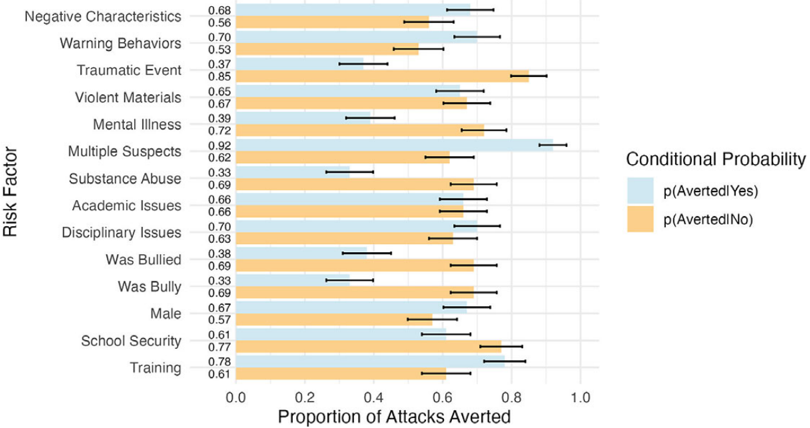
- Of 278 incidents, 184 were averted and 94 were carried out. In the full model, a traumatic life event had an odds ratio of 0.15 for being averted, meaning 6.67 times higher odds of being carried out; school security countermeasures had an odds ratio of 0.39, meaning 2.56 times higher odds of being carried out.
- Also in the full model, multiple suspects had 11.71 times higher odds of an incident being averted, and schools with a response protocol or training plan had 2.91 times higher odds of an incident being averted.
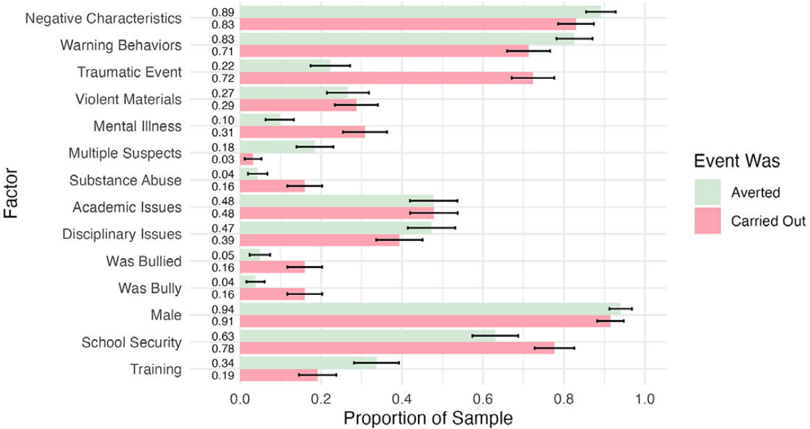
- Chi-squared tests showed carried-out incidents had significantly higher proportions of school security countermeasures, traumatic events, mental illness, substance abuse, being bullied, and bullying others; averted incidents had a significantly higher proportion of schools with response protocols and training. Sex was not significantly different, and age did not significantly differ between averted (M = 18.26, SD = 8.25) and carried-out (M = 21.68, SD = 11.67) incidents (Wilcoxon W = 8072.5, p = .126).
- School-related factors were significant only in the school-related-factors-only model: academic issues OR 0.41 (p = .037), disciplinary issues OR 2.92 (p = .012), was bullied OR 0.32 (p = .012), and was bully OR 0.20 (p = .001); none remained significant in the full model.
Methods
- Data came from the Averted School Violence database, hosted by Safe and Sound Schools, covering 278 incidents in which a firearm was threatened to be used against a school: 184 averted and 94 carried out. Only the primary shooter was used in analysis, and only incidents with no missing data were included.
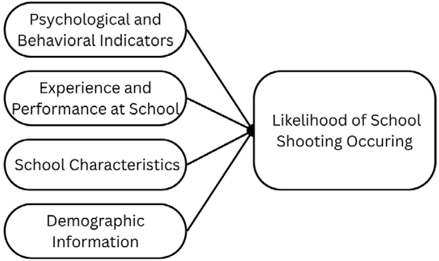
- Factor variables were grouped into psychological and behavioral indicators, school-related factors, suspect demographic information, and school characteristics. Each factor was coded 1 if any subcomponent was present, based on cited evidence rather than respondent opinion.
- Analysis used 2 × 2 chi-squared tests with Benjamini-Hochberg false discovery rate correction, a Wilcoxon rank-sum test for age, and binary logistic regression models (group-specific and full) with averted = 1 and carried out = 0.
Limitations
- The paper states that the ASV database is not comprehensive; incidents are volunteer-submitted and verified, incidents with little media attention are more likely unrecorded, and variables such as mental illness, traumatic life events, and substance abuse are likely underreported, especially for averted events. It also states that documentation availability may shape coding, voluntary reports may overrepresent successful or instructive interventions, factors were collapsed across categories, and the observational, cross-sectional data preclude causal inference and temporal ordering.
- The text also makes evident that the complete-case analysis and primary-shooter-only restriction may reduce sample size and omit details on additional shooters; several factors had low recorded prevalence, such as multiple suspects (13.31%), substance abuse (8.27%), was bullied (8.63%), and was bully (7.91%).
Model-written summary. Check it against the paper before relying on it.
Integrity signals
Registry
Cites
Statistics
Figures
Verification
Claims the paper makes
0 Valid · 1 Not valid · 23 Not checked · 94 Own results and interpretations
A result the paper reports from its own data — it cites no other source for it, so there is none to check. The quote shows it is in the paper.
In the paper
“Incidents that were averted had a significantly higher proportion of schools with response protocols and training in place.”
§ An ounce of prevention: identifying factors associated with whether a school shooting was averted or carried out > 3.2. Association of factors with averted and carried-out events
plainstates an association- Asserted: passes — The authors put it forward as true.
- Checkable: passes — It can be checked against evidence.
- Load-bearing: passes — The paper’s conclusions depend on it.
- Based: passes — The paper gives a reason why it holds.
A result the paper reports from its own data — it cites no other source for it, so there is none to check. The quote shows it is in the paper.
In the paper
“Fewer than half of the incidents contained a suspect who had been recorded experiencing a traumatic life event, owned violent materials, collaborated with other suspects, had a substance abuse problem, had a mental illness, was experiencing academic or disciplinary issues, and was being bullied or bullying others.”
§ An ounce of prevention: identifying factors associated with whether a school shooting was averted or carried out > 3.1. Summary of factors from ASV database
plain- Asserted: passes — The authors put it forward as true.
- Checkable: passes — It can be checked against evidence.
- Load-bearing: unclear — It is unclear whether the paper’s conclusions depend on it.
- Based: passes — The paper gives a reason why it holds.
A result the paper reports from its own data — it cites no other source for it, so there is none to check. The quote shows it is in the paper.
In the paper
“In the school-related factors model, incidents in which the suspect had recorded academic issues had 2.44 times higher odds of being carried out, incidents in which the suspect had been bullied had 3.13 times higher odds of being carried out, and incidents in which the suspect was a bully had 5.00 times higher odds of being carried out.”
§ An ounce of prevention: identifying factors associated with whether a school shooting was averted or carried out > 3.2. Association of factors with averted and carried-out events
plainstates an association- Asserted: passes — The authors put it forward as true.
- Checkable: passes — It can be checked against evidence.
- Load-bearing: passes — The paper’s conclusions depend on it.
- Based: passes — The paper gives a reason why it holds.
A result the paper reports from its own data — it cites no other source for it, so there is none to check. The quote shows it is in the paper.
In the paper
“The majority of incidents contained a primary suspect who had recorded negative characteristics, warning behaviors, and possession of violent materials.”
§ An ounce of prevention: identifying factors associated with whether a school shooting was averted or carried out > 3.1. Summary of factors from ASV database
plain- Asserted: passes — The authors put it forward as true.
- Checkable: passes — It can be checked against evidence.
- Load-bearing: unclear — It is unclear whether the paper’s conclusions depend on it.
- Based: passes — The paper gives a reason why it holds.
A result the paper reports from its own data — it cites no other source for it, so there is none to check. The quote shows it is in the paper.
In the paper
“Fewer than half of the incidents contained a suspect who had been recorded experiencing a traumatic life event, owned violent materials, collaborated with other suspects, had a substance abuse problem, had a mental illness, was experiencing academic or disciplinary issues, and was being bullied or bullying others.”
§ An ounce of prevention: identifying factors associated with whether a school shooting was averted or carried out > 3.1. Summary of factors from ASV database
plain- Asserted: passes — The authors put it forward as true.
- Checkable: passes — It can be checked against evidence.
- Load-bearing: unclear — It is unclear whether the paper’s conclusions depend on it.
- Based: passes — The paper gives a reason why it holds.
68 more claims
Create a free account to see all 118 claims and to verify the 18 references still open.
- Probably not a substantial claim. 32
- It may state two separate claims as one. 18
- The quote only partly states this claim. 4
Self-check
Percentages, sums and reported differences re-computed from the paper’s own numbers.
Each contradiction between two passages listed here was confirmed by an independent check.
Rated major: it would touch a result — a value a result rests on, reported and recomputed p-values on opposite sides of the significance level, two passages that conflict with no sign which is right, or a cited work retracted before this paper was published.
In the paper
§ An ounce of prevention: identifying factors associated with whether a school shooting was averted or carried out > Abstract
“Logistic regression models revealed that incidents had higher odds of being carried out when the shooter had experienced a traumatic life event or had a co-conspirator.”
§ An ounce of prevention: identifying factors associated with whether a school shooting was averted or carried out > 3.2. Association of factors with averted and carried-out events
“incidents with multiple suspects had 11.71 times higher odds of being averted”
Rated major: it would touch a result — a value a result rests on, reported and recomputed p-values on opposite sides of the significance level, two passages that conflict with no sign which is right, or a cited work retracted before this paper was published.
In the paper
§ An ounce of prevention: identifying factors associated with whether a school shooting was averted or carried out > Abstract
“Incidents had higher odds to be averted when schools had established active shooter protocols, multiple conspirators were involved, and suspects had undergone a traumatic life event.”
§ An ounce of prevention: identifying factors associated with whether a school shooting was averted or carried out > 3.2. Association of factors with averted and carried-out events
“In the full model, incidents in which the suspect had experienced a traumatic life event had 6.67 times higher odds of being carried out”
Rated major: it would touch a result — a value a result rests on, reported and recomputed p-values on opposite sides of the significance level, two passages that conflict with no sign which is right, or a cited work retracted before this paper was published.
In the paper
§ An ounce of prevention: identifying factors associated with whether a school shooting was averted or carried out > 3.2. Association of factors with averted and carried-out events
“The demographic information model demonstrated a discrimination value of 0.031, indicating that predicted probabilities for averted versus carried-out incidents differed by about 3.1 percentage points on average.”
§ An ounce of prevention: identifying factors associated with whether a school shooting was averted or carried out > Warning behavior Definition Pathway
“| R 2 Tjur | .314 | | .100 | | .003 | | .073 | | .330 | |”
Rated major: it would touch a result — a value a result rests on, reported and recomputed p-values on opposite sides of the significance level, two passages that conflict with no sign which is right, or a cited work retracted before this paper was published.
In the paper
§ An ounce of prevention: identifying factors associated with whether a school shooting was averted or carried out > e36-10
“0.360, indicating that predicted probabilities for averted versus carried-out incidents differed by about 36.0 percentage points on average.”
§ An ounce of prevention: identifying factors associated with whether a school shooting was averted or carried out > Warning behavior Definition Pathway
“| R 2 Tjur | .314 | | .100 | | .003 | | .073 | | .330 | |”
Rated minor: it would not touch a result — a value no result rests on, a p-value that stays on the same side of the significance level, or a conflict that is clerical, resolved elsewhere in the paper, or outside its own findings.
In the paper
§ An ounce of prevention: identifying factors associated with whether a school shooting was averted or carried out > 3.1. Summary of factors from ASV database
“The majority of incidents contained a primary suspect who had recorded negative characteristics, warning behaviors, and possession of violent materials.”
§ An ounce of prevention: identifying factors associated with whether a school shooting was averted or carried out > Warning behavior Definition Pathway
“| | Violent materials | Recorded | 76 | 27.34 |”
3 more findings
Create a free account to see every finding of this check.
Citations
Cites
The Mental Health Consequences of Mass Shootings
Lowe, S. R., & Galea, S. (2015) · Trauma Violence & Abuse · doi:10.1177/1524838015591572 · Cited by 352
The Role of Warning Behaviors in Threat Assessment: An Exploration and Suggested Typology
Meloy, J. R., Hoffmann, J., Guldimann, A., & James, D. (2011) · Behavioral Sciences & the Law · doi:10.1002/bsl.999 · Cited by 287
Cops and Cameras: Public School Security as a Policy Response to Columbine
Addington, L. A. (2009) · American Behavioral Scientist · doi:10.1177/0002764209332556 · Cited by 250
What Can Be Done About School Shootings?: A Review of the Evidence
Borum, R., Cornell, D. G., Modzeleski, W., & Jimerson, S. R. (2010) · Educational Researcher · doi:10.3102/0013189x09357620 · Cited by 229
Bachman, R. D., Randolph, A., & Brown, B. L. (2010) · Youth & Society · doi:10.1177/0044118x10366674 · Cited by 160
Public Mass Shooters and Firearms: A Cross-National Study of 171 Countries
Lankford, A. (2016) · Violence and Victims · doi:10.1891/0886-6708.vv-d-15-00093 · Cited by 119
The Effect of High School Shootings on Schools and Student Performance
Beland, L., & Kim, D. (2015) · Educational Evaluation and Policy Analysis · doi:10.3102/0162373715590683 · Cited by 118
Preventing School Shootings: The Effectiveness of Safety Measures
Jonson, C. L. (2017) · Victims & Offenders · doi:10.1080/15564886.2017.1307293 · Cited by 89
Tanner‐Smith, E. E., Fisher, B. W., Addington, L. A., & Gardella, J. H. (2017) · American Journal of Criminal Justice · doi:10.1007/s12103-017-9409-3 · Cited by 88
Tanner‐Smith, E. E., & Fisher, B. W. (2015) · Journal of Youth and Adolescence · doi:10.1007/s10964-015-0265-5 · Cited by 70
Averting School Rampage: Student Intervention Amid a Persistent Code of Silence
Madfis, E. (2013) · Youth Violence and Juvenile Justice · doi:10.1177/1541204013497768 · Cited by 69
Mowen, T. J., & Freng, A. B. (2018) · American Journal of Criminal Justice · doi:10.1007/s12103-018-9461-7 · Cited by 69
Situational Crime Prevention: Theory, Practice and Evidence
Eck, J. E., & Clarke, R. V. (2019) · Handbooks of Sociology and Social Research · doi:10.1007/978-3-030-20779-3_18 · Cited by 56
The Hidden Cost of School Security
DeAngelis, K. J., Brent, B. O., & Ianni, D. (2011) · Journal of education finance · doi:10.1353/jef.2011.0004 · Cited by 51
An Examination of US School Mass Shootings, 2017–2022: Findings and Implications
Katsiyannis, A., Rapa, L. J., Whitford, D. K., & Scott, S. N. (2022) · Advances in Neurodevelopmental Disorders · doi:10.1007/s41252-022-00277-3 · Cited by 48
Lankford, A., & Silva, J. R. (2021) · International Review of Psychiatry · doi:10.1080/09540261.2021.1932440 · Cited by 27
School Shootings in the U.S.: What Is the State of Evidence?
Rowhani-Rahbar, A., & Moe, C. (2019) · Journal of Adolescent Health · doi:10.1016/j.jadohealth.2019.03.016 · Cited by 21
Strain Theory and Violent Behavior
Agnew, R. S. (2007) · The Cambridge Handbook of Violent Behavior and Aggression · doi:10.1017/cbo9780511816840.027 · Cited by 15
An exploration of K–12 school shooting threats in the United States.
Peterson, J., Densley, J. A., Riedman, D., Spaulding, J. S., & Malicky, H. (2023) · Journal of Threat Assessment and Management · doi:10.1037/tam0000215 · Cited by 15
Comer, B. P. (2024) · Social Sciences · doi:10.3390/socsci13060316 · Cited by 13
Byrd, K., Kapadia, K., & John, R. (2025) · Environment Systems and Decisions · doi:10.1007/s10669-025-10004-7 · Cited by 10
Self-citationReferral Rates for School Threat Assessment
Cornell, D. G., Kerere, J., Konold, T., Maeng, J., Afolabi, K., Huang, F., & Cowley, D. (2025) · Psychology in the Schools · doi:10.1002/pits.23399 · Cited by 9
Cowan, R. G., Tedeschi, P. J., Corbin, M., & Cole, R. (2022) · Psychology in the Schools · doi:10.1002/pits.22647 · Cited by 6
An evaluation of completed and averted school shootings
Winch, A. T., Alexander, K., Bowers, C., Straub, F., & Beidel, D. C. (2024) · Frontiers in Public Health · doi:10.3389/fpubh.2023.1305286 · Cited by 6
Wang, F., Zhu, D., He, Y., Yuan, M., Li, Y., Xie, F., Wen, X., Tong, Y., Zhang, X., Su, P., et al. (2024) · Journal of Youth and Adolescence · doi:10.1007/s10964-024-02001-x · Cited by 5
Why Monitor Violent Websites? A Justification
Cohen-Almagor, R., & Haleva-Amir, S. (2012) · Beijing Law Review · doi:10.4236/blr.2012.32009 · Cited by 2
Cited by
Still being checked.
Metadata
- Authors
- Kapadia, K., Byrd, K., & John, R. S.
- Affiliations
- University of Southern California (US)
- Corresponding author
- Kapadia, Kevin
- Venue
- Data & Policy
- Publisher
- Cambridge University Press (CUP)
- Published
- 2026
- Volume
- 8
- ISSN
- 2632-3249 (ISSN-L)
- OpenAlex
- W7171702817
- Semantic Scholar
- cadb7def3aaa1754ec1c4661f1882a189471e11c
- Cited by
- 0
- References
- 26
- FWCI
- 0.00
- Type
- journal article
- Language
- en
- Open access
- gold
- doi.org
- Locations
- Data & Policy (publishedVersion, cc-by)
- DOAJ (DOAJ: Directory of Open Access Journals) (submittedVersion)
- Funders
- Science and Technology Directorate (17STQAC00001-08-03)
- Topics
- Social Sciences › Health › Gun Ownership and Violence Research
- Social Sciences › Sociology and Political Science › Crime Patterns and Interventions
- Social Sciences › Sociology and Political Science › Terrorism, Counterterrorism, and Political Violence
- Keywords
- school shootings, school safety, school security measures, traumatic life events, co-conspirators, mental health support, behavioral monitoring, school violence prevention
About these checks
Registry, retraction, Cites and statistics results are computed, not judged, with one exception: a printed reference that no index lists is read once by a model before it counts as a citation error. Claims are extracted by a model and kept only when their quote appears verbatim in the text; each cited source is then checked, with a model’s help, for whether it says what the claim relies on. Those verdicts can be wrong — read the claim’s quote and the cited source before relying on one.
A language model drew the claims from the paper on 2026-11-13, under version 3 of the claim definition (model deepseek-v4.1-flash, prompt extract-v3).
A second model labelled each claim on 2026-11-13 (model jev-1.13-20260917, definition revision gold-guideline-v0.2).
Statistics and arithmetic are recomputed, not judged.
Confidence bands are shown only for fields calibrated on our annotated test set. None is calibrated yet, so no band is shown.
What counts as a claim ›How we measure confidence ›How we check this ›
Are you an author, or do you see a problem with this page? Request a review
Data sources
Bibliographic data: Semantic Scholar, OpenAlex, Crossref.
Contains information from the Semantic Scholar Academic Graph Datasets, made available under the ODC Attribution License (ODC-BY 1.0).
Semantic Scholar’s data is described in: Kinney, R., et al. (2023). The Semantic Scholar Open Data Platform. arXiv:2301.10140.
