

The DOI matches its Crossref record; 91 of the 91 references it cites were found in a registry or an index.
It’s All in the Name: A Character-Based Approach to Infer Religion
Abstract
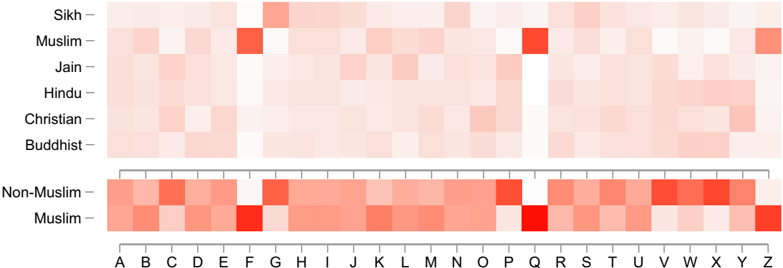
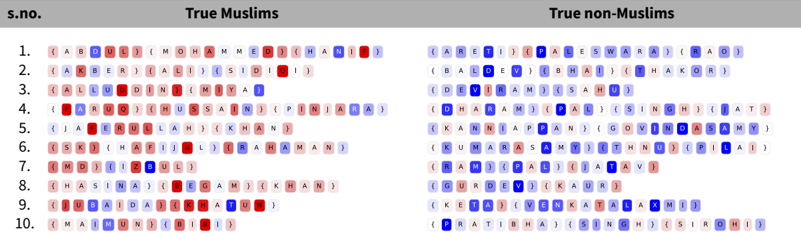
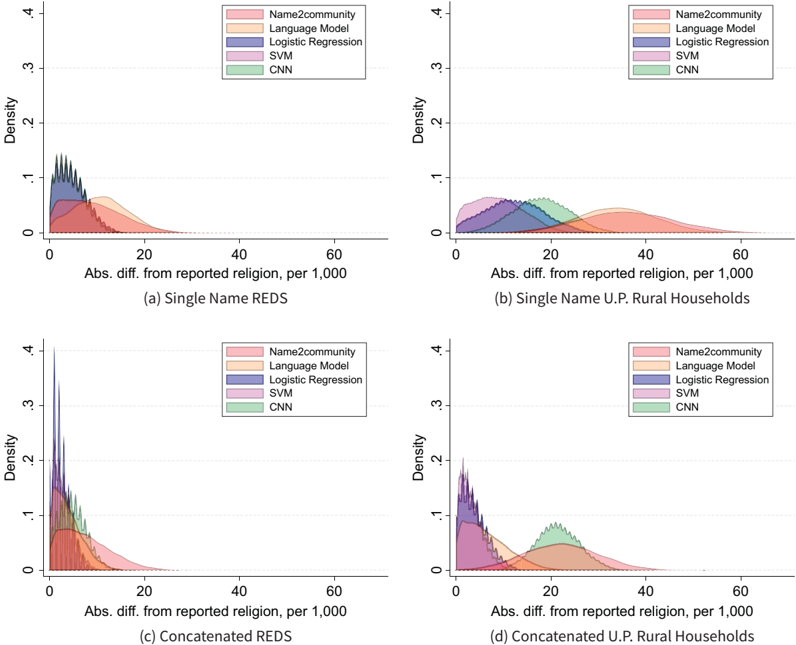
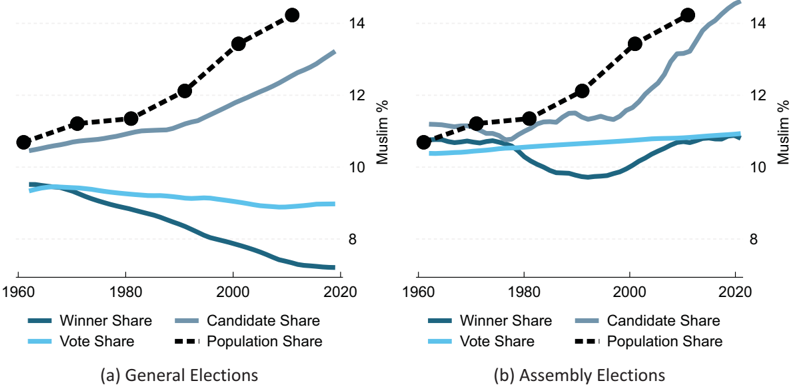
Large-scale microdata on group identity are critical for studies on identity politics and violence but remain largely unavailable for developing countries. We use personal names to infer religion in South Asia—where religion is a salient social division, and yet, disaggregated data on it are scarce. Existing work predicts religion using a dictionary-based method and, therefore, cannot classify unseen names. We provide character-based machine-learning models that can classify unseen names too with high accuracy. Our models are also much faster and, hence, scalable to large datasets. We explain the classification decisions of one of our models using the layer-wise relevance propagation technique. The character patterns learned by the classifier are rooted in the linguistic origins of names. We apply these to infer the religion of electoral candidates using historical data on Indian elections and observe a trend of declining Muslim representation. Our approach can be used to detect identity groups across the world for whom the underlying names might have different linguistic roots.
Overview
The claims and statistics of this paper haven’t been checked yet.
Run the check — free, no account needed. It reads the open-access text and checks the sources it cites.
Integrity signals
Registry
Cites
Statistics
Figures
Verification
Claims the paper makes
The claims and statistics of this paper haven’t been checked yet.
Run the check — free, no account needed. It reads the open-access text and checks the sources it cites.
Claims other papers make about this one
Each is checked against this paper’s own text: does it say what the citing paper says it does?
In the citing paper
“This broader understanding casts a wide net for the applicability of Article 9 GDPR, as machine learning techniques increasingly allow for the deduction of protected categories from otherwise innocuous data points [35,36].”
From Generative AI in EU law: Liability, privacy, intellectual property, and cybersecurity (2024) · cites this paper as [36]
Self-check
Percentages, sums and reported differences re-computed from the paper’s own numbers.
The self-check needs the paper’s full text.
Citations
Cites
Hochreiter, S., & Schmidhuber, J. (1997) · Neural Computation · doi:10.1162/neco.1997.9.8.1735 · Cited by 102,318
Delving Deep into Rectifiers: Surpassing Human-Level Performance on ImageNet Classification
He, K., Zhang, X., Ren, S., & Sun, J. (2015) · 2015 IEEE International Conference on Computer Vision (ICCV) · doi:10.1109/iccv.2015.123 · Cited by 19,741
Backpropagation Applied to Handwritten Zip Code Recognition
LeCun, Y., Boser, B., Denker, J. S., Henderson, D., Howard, R. E., Hubbard, W., & Jackel, L. D. (1989) · Neural Computation · doi:10.1162/neco.1989.1.4.541 · Cited by 11,891
Elman, J. L. (1990) · Cognitive Science · doi:10.1207/s15516709cog1402_1 · Cited by 11,212
Learning long-term dependencies with gradient descent is difficult
Bengio, Y., Simard, P., & Frasconi, P. (1994) · IEEE Transactions on Neural Networks · doi:10.1109/72.279181 · Cited by 8,542
Improving neural networks by preventing co-adaptation of feature detectors
Hinton, G. E., Srivastava, N., Krizhevsky, A., Sutskever, I., & Salakhutdinov, R. R. (2012) · arXiv · doi:10.48550/arxiv.1207.0580 · Cited by 6,382
A unified architecture for natural language processing: deep neural networks with multitask learning
Collobert, R., & Weston, J. (2008) · Proceedings of the 25th international conference on Machine learning - ICML '08 · doi:10.1145/1390156.1390177 · Cited by 5,058
Natural Language Processing (almost) from Scratch
Collobert, R., Weston, J., Bottou, L., Karlen, M., Kavukcuoglu, K., & Kuksa, P. P. (2011) · arXiv (Cornell University) · doi:10.48550/arxiv.1103.0398 · Cited by 4,962
On Pixel-Wise Explanations for Non-Linear Classifier Decisions by Layer-Wise Relevance Propagation
Bach, S., Binder, A., Montavon, G., Klauschen, F., Müller, K.-R., & Samek, W. (2015) · PLOS ONE · doi:10.1371/journal.pone.0130140 · Cited by 4,524
Bertrand, M., & Mullainathan, S. (2004) · American Economic Review · doi:10.1257/0002828042002561 · Cited by 4,504
Research works printed but not linked: 7
- 10.1162/rest_a_01040 · DOI
- Chang, 2010, Fourth International AAAI Conference on Weblogs and Social Media
- Thorat, 2015, Urban Rental Housing Market, Economic and Political Weekly, 27, 47
- 10.1086/250069 · DOI
- Cavnar, 1994, Proceedings of SDAIR-94, 3rd Annual Symposium on Document Analysis and Information Retrieval, 161
- Thorat, 2007, The Legacy of Social Exclusion: A Correspondence Study of Job Discrimination in India, Economic and Political Weekly, 42, 4141
- Schimmel, 1997, Islamic Names
Cited by
Generative AI in EU law: Liability, privacy, intellectual property, and cybersecurity
Novelli, C., Casolari, F., Hacker, P., Spedicato, G., & Floridi, L. (2024) · Computer Law & Security Review · doi:10.1016/j.clsr.2024.106066 · Cited by 124
Generative Ai in EU Law: Liability, Privacy, Intellectual Property, and Cybersecurity
Novelli, C., Casolari, F., Hacker, P., Spedicato, G., & Floridi, L. (2024) · doi:10.2139/ssrn.4821952 · Cited by 57
Metadata
- Authors
- Chaturvedi, R., & Chaturvedi, S.
- Venue
- Political Analysis
- Publisher
- Cambridge University Press (CUP)
- Published
- 2023-03-23
- Volume
- 32
- Issue
- 1
- Pages
- 34-49
- ISSN
- 1047-1987
- 1476-4989
- Cited by
- 18
- References
- 91
- Language
- en
About these checks
Registry, retraction, Cites and statistics results are computed, not judged, with one exception: a printed reference that no index lists is read once by a model before it counts as a citation error. Claims are extracted by a model and kept only when their quote appears verbatim in the text; each cited source is then checked, with a model’s help, for whether it says what the claim relies on. Those verdicts can be wrong — read the claim’s quote and the cited source before relying on one.
Statistics and arithmetic are recomputed, not judged.
Confidence bands are shown only for fields calibrated on our annotated test set. None is calibrated yet, so no band is shown.
What counts as a claim ›How we measure confidence ›How we check this ›
Are you an author, or do you see a problem with this page? Request a review
Data sources
Bibliographic data: Semantic Scholar, OpenAlex, Crossref.
Contains information from the Semantic Scholar Academic Graph Datasets, made available under the ODC Attribution License (ODC-BY 1.0).
Semantic Scholar’s data is described in: Kinney, R., et al. (2023). The Semantic Scholar Open Data Platform. arXiv:2301.10140.
