

The DOI matches its Crossref record; 91 of the 91 references it cites were found in a registry or an index.
It’s All in the Name: A Character-Based Approach to Infer Religion
Abstract
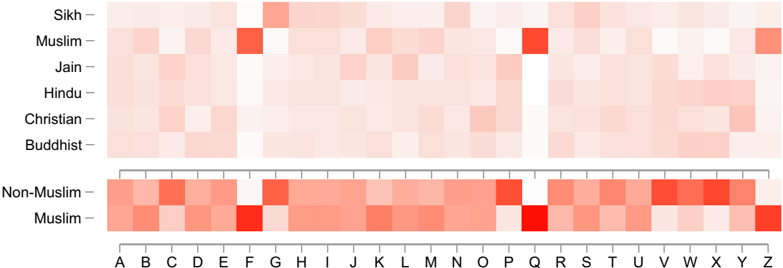
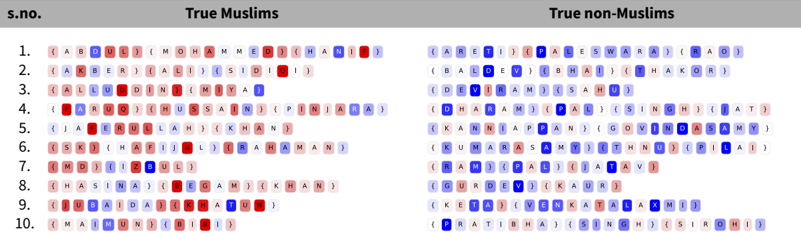
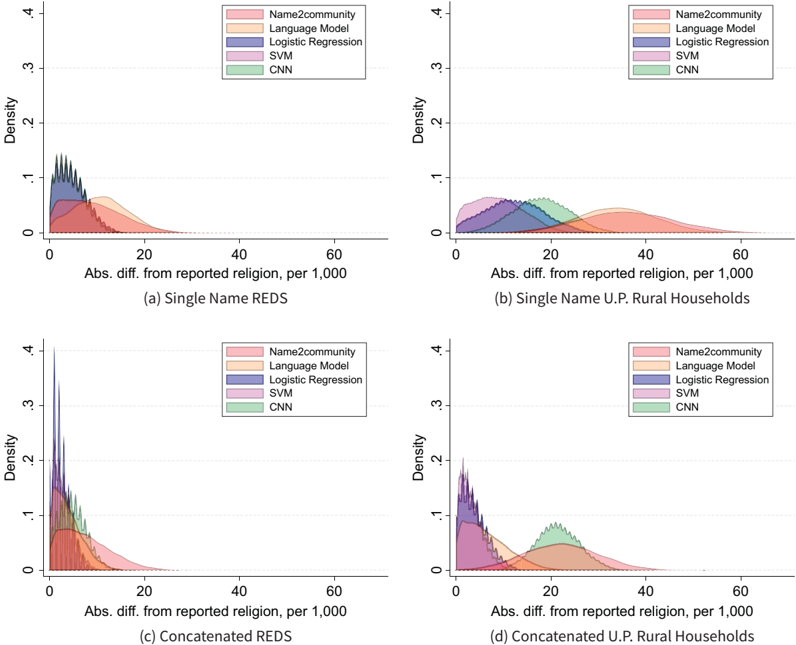
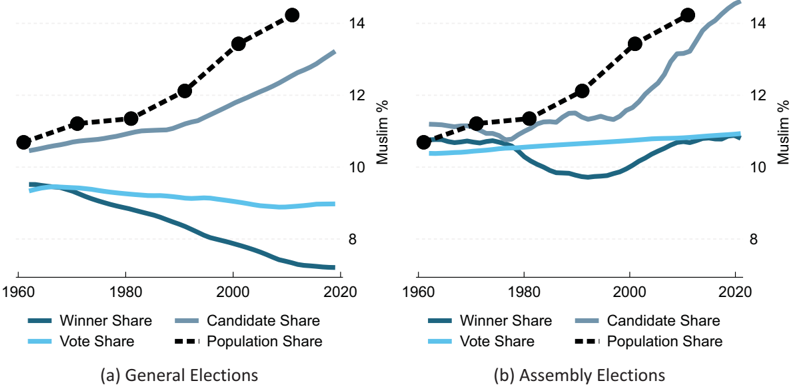
Large-scale microdata on group identity are critical for studies on identity politics and violence but remain largely unavailable for developing countries. We use personal names to infer religion in South Asia—where religion is a salient social division, and yet, disaggregated data on it are scarce. Existing work predicts religion using a dictionary-based method and, therefore, cannot classify unseen names. We provide character-based machine-learning models that can classify unseen names too with high accuracy. Our models are also much faster and, hence, scalable to large datasets. We explain the classification decisions of one of our models using the layer-wise relevance propagation technique. The character patterns learned by the classifier are rooted in the linguistic origins of names. We apply these to infer the religion of electoral candidates using historical data on Indian elections and observe a trend of declining Muslim representation. Our approach can be used to detect identity groups across the world for whom the underlying names might have different linguistic roots.
Overview
The claims and statistics of this paper haven’t been checked yet.
Run the check — free, no account needed. It reads the open-access text and checks the sources it cites.
Integrity signals
Registry
Cites
Statistics
Figures
Verification
Claims the paper makes
The claims and statistics of this paper haven’t been checked yet.
Run the check — free, no account needed. It reads the open-access text and checks the sources it cites.
Claims other papers make about this one
Each is checked against this paper’s own text: does it say what the citing paper says it does?
In the citing paper
“This broader understanding casts a wide net for the applicability of Article 9 GDPR, as machine learning techniques increasingly allow for the deduction of protected categories from otherwise innocuous data points [35,36].”
From Generative AI in EU law: Liability, privacy, intellectual property, and cybersecurity (2024) · cites this paper as [36]
Self-check
Percentages, sums and reported differences re-computed from the paper’s own numbers.
The self-check needs the paper’s full text.
Citations
Cites
Hochreiter, S., & Schmidhuber, J. (1997) · Neural Computation · doi:10.1162/neco.1997.9.8.1735 · Cited by 102,318
Delving Deep into Rectifiers: Surpassing Human-Level Performance on ImageNet Classification
He, K., Zhang, X., Ren, S., & Sun, J. (2015) · 2015 IEEE International Conference on Computer Vision (ICCV) · doi:10.1109/iccv.2015.123 · Cited by 19,741
Backpropagation Applied to Handwritten Zip Code Recognition
LeCun, Y., Boser, B., Denker, J. S., Henderson, D., Howard, R. E., Hubbard, W., & Jackel, L. D. (1989) · Neural Computation · doi:10.1162/neco.1989.1.4.541 · Cited by 11,891
Elman, J. L. (1990) · Cognitive Science · doi:10.1207/s15516709cog1402_1 · Cited by 11,212
Learning long-term dependencies with gradient descent is difficult
Bengio, Y., Simard, P., & Frasconi, P. (1994) · IEEE Transactions on Neural Networks · doi:10.1109/72.279181 · Cited by 8,542
Improving neural networks by preventing co-adaptation of feature detectors
Hinton, G. E., Srivastava, N., Krizhevsky, A., Sutskever, I., & Salakhutdinov, R. R. (2012) · arXiv · doi:10.48550/arxiv.1207.0580 · Cited by 6,382
A unified architecture for natural language processing: deep neural networks with multitask learning
Collobert, R., & Weston, J. (2008) · Proceedings of the 25th international conference on Machine learning - ICML '08 · doi:10.1145/1390156.1390177 · Cited by 5,058
Natural Language Processing (almost) from Scratch
Collobert, R., Weston, J., Bottou, L., Karlen, M., Kavukcuoglu, K., & Kuksa, P. P. (2011) · arXiv (Cornell University) · doi:10.48550/arxiv.1103.0398 · Cited by 4,962
On Pixel-Wise Explanations for Non-Linear Classifier Decisions by Layer-Wise Relevance Propagation
Bach, S., Binder, A., Montavon, G., Klauschen, F., Müller, K.-R., & Samek, W. (2015) · PLOS ONE · doi:10.1371/journal.pone.0130140 · Cited by 4,524
Bertrand, M., & Mullainathan, S. (2004) · American Economic Review · doi:10.1257/0002828042002561 · Cited by 4,504
(1989) · neural information processing systems · Cited by 3,736
Character-level Convolutional Networks for Text Classification
Zhang, X., Zhao, J., & LeCun, Y. (2015) · arXiv (Cornell University) · doi:10.48550/arxiv.1509.01626 · Cited by 3,205
People's opium? Religion and economic attitudes
Guiso, L., Sapienza, P., & Zingales, L. (2003) · Journal of Monetary Economics · doi:10.1016/s0304-3932(02)00202-7 · Cited by 1,793
Incorporating Nesterov Momentum into Adam
Dozat, T. (2016) · Cited by 1,595
Character-Aware Neural Language Models
Kim, Y., Jernite, Y., Sontag, D., & Rush, A. (2016) · Proceedings of the AAAI Conference on Artificial Intelligence · doi:10.1609/aaai.v30i1.10362 · Cited by 1,491
Srivastava, R. K., Greff, K., & Schmidhuber, J. (2015) · arXiv (Cornell University) · doi:10.48550/arxiv.1507.06228 · Cited by 1,246
Evaluating the Visualization of What a Deep Neural Network Has Learned
Samek, W., Binder, A., Montavon, G., Lapuschkin, S., & Muller, K.-R. (2017) · IEEE Transactions on Neural Networks and Learning Systems · doi:10.1109/tnnls.2016.2599820 · Cited by 1,164
The Rise and Decline of the American Ghetto
Vigdor, J. L., Glaeser, E. L., & Cutler, D. (1999) · Digital Access to Scholarship at Harvard (DASH) (Harvard University) · Cited by 1,020
Understanding the Demographics of Twitter Users
Mislove, A., Lehmann, S., Ahn, Y.-Y., Onnela, J.-P., & Rosenquist, J. (2021) · Proceedings of the International AAAI Conference on Web and Social Media · doi:10.1609/icwsm.v5i1.14168 · Cited by 759
The Causes and Consequences of Distinctively Black Names
Fryer, R. G., & Levitt, S. D. (2004) · The Quarterly Journal of Economics · doi:10.1162/0033553041502180 · Cited by 654
Oreopoulos, P. (2011) · American Economic Journal: Economic Policy · doi:10.1257/pol.3.4.148 · Cited by 642
Discriminating Gender on Twitter
Burger, J. D., Henderson, J. C., Kim, G., & Zarrella, G. (2011) · Cited by 580
Unmasking Clever Hans predictors and assessing what machines really learn
Lapuschkin, S., Wäldchen, S., Binder, A., Montavon, G., Samek, W., & Müller, K. (2019) · RePEc: Research Papers in Economics · Cited by 580
A Machine Learning Approach to Twitter User Classification
Pennacchiotti, M., & Popescu, A.-M. (2021) · Proceedings of the International AAAI Conference on Web and Social Media · doi:10.1609/icwsm.v5i1.14139 · Cited by 548
Field, E., Jayachandran, S., & Pande, R. (2010) · American Economic Review · doi:10.1257/aer.100.2.125 · Cited by 457
Identifying barriers to Muslim integration in France
Adida, C. L., Laitin, D. D., & Valfort, M.-A. (2010) · Proceedings of the National Academy of Sciences · doi:10.1073/pnas.1015550107 · Cited by 405
Iyer, S. (2016) · Journal of Economic Literature · doi:10.1257/jel.54.2.395 · Cited by 382
Interpretable deep neural networks for single-trial EEG classification
Sturm, I., Lapuschkin, S., Samek, W., & Müller, K.-R. (2016) · Journal of Neuroscience Methods · doi:10.1016/j.jneumeth.2016.10.008 · Cited by 374
Towards better understanding of gradient-based attribution methods for Deep Neural Networks
Ancona, M., Ceolini, E., Öztireli, C., & Groß, M. H. (2017) · Zurich Open Repository and Archive (University of Zurich) · doi:10.3929/ethz-b-000249929 · Cited by 368
Explaining Recurrent Neural Network Predictions in Sentiment Analysis
Arras, L., Montavon, G., Müller, K.-R., & Samek, W. (2017) · Proceedings of the 8th Workshop on Computational Approaches to Subjectivity, Sentiment and Social Media Analysis · doi:10.18653/v1/w17-5221 · Cited by 361
Trade, Institutions, and Ethnic Tolerance: Evidence from South Asia
JHA, S. (2013) · American Political Science Review · doi:10.1017/s0003055413000464 · Cited by 319
” How old do you think I am?” A study of language and age in Twitter
Nguyen, D., Gravel, R., Trieschnigg, D., & Meder, T. (2021) · Proceedings of the International AAAI Conference on Web and Social Media · doi:10.1609/icwsm.v7i1.14381 · Cited by 287
"What is relevant in a text document?": An interpretable machine learning approach
Arras, L., Horn, F., Montavon, G., Müller, K.-R., & Samek, W. (2017) · PLOS ONE · doi:10.1371/journal.pone.0181142 · Cited by 257
Backlash: The Unintended Effects of Language Prohibition in U.S. Schools after World War I
Fouka, V. (2020) · The Review of Economic Studies · doi:10.1093/restud/rdz024 · Cited by 256
Social, Economic and Educational Status of the Muslim Community of India
(2007) · Contemporary Education Dialogue · doi:10.1177/0973184913411149 · Cited by 251
Votes and Violence: Electoral Competition and Ethnic Riots in India.
Young, M. (2006) · Nations and Nationalism · doi:10.1111/j.1469-8129.2006.00235_11.x · Cited by 245
Improving Ecological Inference by Predicting Individual Ethnicity from Voter Registration Records
Imai, K., & Khanna, K. (2016) · Political Analysis · doi:10.1093/pan/mpw001 · Cited by 245
Elliott, M. N., Morrison, P. A., Fremont, A., McCaffrey, D. F., Pantoja, P., & Lurie, N. (2009) · Health Services and Outcomes Research Methodology · doi:10.1007/s10742-009-0047-1 · Cited by 224
Implications of an Economic Theory of Conflict: Hindu-Muslim Violence in India
Mitra, A., & Ray, D. (2014) · Journal of Political Economy · doi:10.1086/676316 · Cited by 222
Automatic Language Identification in Texts: A Survey
Jauhiainen, T., Lui, M., Zampieri, M., Baldwin, T., & Lindén, K. (2019) · Journal of Artificial Intelligence Research · doi:10.1613/jair.1.11675 · Cited by 205
Name-ethnicity classification from open sources
Ambekar, A. A., Ward, C. B., Mohammed, J., Male, S., & Skiena, S. (2009) · ACM SIGKDD International Conference on Knowledge Discovery and Data Mining (KDD) · doi:10.1145/1557019.1557032 · Cited by 204
Cascio, E., & Washington, E. (2013) · The Quarterly Journal of Economics · doi:10.1093/qje/qjt028 · Cited by 199
A review of name‐based ethnicity classification methods and their potential in population studies
Mateos, P. (2007) · Population Space and Place · doi:10.1002/psp.457 · Cited by 197
Layer-Wise Relevance Propagation for Deep Neural Network Architectures
Binder, A., Lapuschkin, S., Montavon, G., Müller, K., & Samek, W. (2016) · Lecture notes in electrical engineering · doi:10.1007/978-981-10-0557-2_87 · Cited by 169
What's in a Name? Using First Names as Features for Gender Inference in Twitter
Liu, W. J., & Ruths, D. A. (2013) · National Conference on Artificial Intelligence · Cited by 167
Abdelgadir, A., & Fouka, V. (2020) · American Political Science Review · doi:10.1017/s0003055420000106 · Cited by 158
How Black Candidates Affect Voter Turnout*
Washington, E. (2006) · The Quarterly Journal of Economics · doi:10.1162/qjec.121.3.973 · Cited by 153
Inferring Latent User Properties from Texts Published in Social Media
Volkova, S., Bachrach, Y., Armstrong, M., & Sharma, V. (2015) · Proceedings of the AAAI Conference on Artificial Intelligence · doi:10.1609/aaai.v29i1.9271 · Cited by 151
The puzzle of Muslim advantage in child survival in India
Bhalotra, S. R., Valente, C., & van Soest, A. (2009) · Journal of Health Economics · doi:10.1016/j.jhealeco.2009.11.002 · Cited by 127
The Majority‐Minority Divide in Attitudes toward Internal Migration: Evidence from Mumbai
Gaikwad, N., & Nellis, G. (2016) · American Journal of Political Science · doi:10.1111/ajps.12276 · Cited by 125
Nationality Classification Using Name Embeddings
Ye, J., Han, S., Hu, Y., Coşkun, B., Liu, M., Qin, H., & Skiena, S. (2017) · ACM International Conference on Information and Knowledge Management (CIKM) · doi:10.1145/3132847.3133008 · Cited by 125
Interpreting and Explaining Deep Neural Networks for Classification of Audio SignalsPreprint
Becker, S., Ackermann, M. R., Lapuschkin, S., Müller, K., & Samek, W. (2018) · arXiv (Cornell University) · Cited by 124
How Do Immigrants Respond to Discrimination? The Case of Germans in the US During World War I
Fouka, V. (2019) · American Political Science Review · doi:10.1017/s0003055419000017 · Cited by 124
A unified view of gradient-based attribution methods for Deep Neural NetworksPreprint
Ancona, M., Ceolini, E., Öztireli, C., & Groß, M. H. (2017) · arXiv (Cornell University) · doi:10.3929/ethz-b-000237705 · Cited by 121
Religion, politician identity and development outcomes: Evidence from India
Bhalotra, S. R., Clots‐Figueras, I., Cassan, G., & Iyer, L. (2013) · Journal of Economic Behavior & Organization · doi:10.1016/j.jebo.2013.09.006 · Cited by 114
ePluribus: Ethnicity on Social Networks
Chang, J., Rosenn, I., Bäckström, L., & Marlow, C. A. (2010) · Proceedings of the International AAAI Conference on Web and Social Media · doi:10.1609/icwsm.v4i1.14029 · Cited by 104
Analyzing Neuroimaging Data Through Recurrent Deep Learning Models
Thomas, A. W., Heekeren, H. R., Müller, K., & Samek, W. (2019) · Frontiers in Neuroscience · doi:10.3389/fnins.2019.01321 · Cited by 103
The Economic Payoff of Name Americanization
Biavaschi, C., Giulietti, C., & Siddique, Z. (2017) · Journal of Labor Economics · doi:10.1086/692531 · Cited by 99
Segregation, Rent Control, and Riots: The Economics of Religious Conflict in an Indian City
Field, E., Levinson, M., Pande, R., & Visaria, S. (2008) · American Economic Review · doi:10.1257/aer.98.2.505 · Cited by 87
Language Identification of Short Text Segments with N-gram Models
Vatanen, T., Väyrynen, J. J., & Virpioja, S. (2010) · Language Resources and Evaluation Conference (LREC) · doi:10.63317/5d3whbd4ovb2 · Cited by 79
Do Parties Matter for Ethnic Violence? Evidence From India
(2016) · doi:10.1561/100.00015051 · Cited by 71
Learning to See: Convolutional Neural Networks for the Analysis of Social Science Data
Torres, M., & Cantú, F. (2021) · Political Analysis · doi:10.1017/pan.2021.9 · Cited by 71
Exploring the Myth of Mixed Marriages in India: Evidence from a Nation-wide Survey
Goli, S., Singh, D., & Sekher, T. V. (2013) · Journal of Comparative Family Studies · doi:10.3138/jcfs.44.2.193 · Cited by 66
Segregation and Black Political Efficacy
Ananat, E., & Washington, E. (2007) · Journal of Public Economics · doi:10.1016/j.jpubeco.2009.02.003 · Cited by 61
Algan, Y., Malgouyres, C., Mayer, T., & Thoenig, M. (2021) · The Economic Journal · doi:10.1093/ej/ueab058 · Cited by 48
Do Muslim voters prefer Muslim candidates? Co-religiosity and voting behaviour in India
Heath, O., Verniers, G., & Kumar, S. (2015) · Electoral Studies · doi:10.1016/j.electstud.2015.01.005 · Cited by 47
Hate Crime Increases with Minoritized Group Rank
Cikara, M., Fouka, V., & Tabellini, M. (2021) · Nature Human Behaviour · doi:10.1038/s41562-022-01416-5 · Cited by 47
Religious Practice and Democracy in India
Chhibber, P. K. (2014) · Cambridge University Press eBooks · doi:10.1017/cbo9781139649735 · Cited by 43
Demographer: Extremely Simple Name Demographics
Knowles, R., Carroll, J., & Dredze, M. H. (2016) · Workshop on Natural Language Processing and Computational Social Science (NLP+CSS) · doi:10.18653/v1/w16-5614 · Cited by 42
Islam in South Asia in Practice
(2010) · Princeton University Press eBooks · doi:10.1515/9781400831388 · Cited by 41
Predicting Twitter User Demographics from Names Alone
Wood-Doughty, Z., Andrews, N., Marvin, R., & Dredze, M. H. (2018) · doi:10.18653/v1/w18-1114 · Cited by 41
Name-Ethnicity Classification and Ethnicity-Sensitive Name Matching
Treeratpituk, P., & Giles, C. L. (2021) · Proceedings of the AAAI Conference on Artificial Intelligence · doi:10.1609/aaai.v26i1.8324 · Cited by 40
Torvik, V. I., & Agarwal, S. (2016) · Illinois Digital Environment for Access to Learning and Scholarship (University of Illinois at Urbana-Champaign) · Cited by 37
What's in a Name? A Method for Extracting Information about Ethnicity from Names
Harris, J. A. (2015) · Political Analysis · doi:10.1093/pan/mpu038 · Cited by 34
Understanding Patch-Based Learning of Video Data by Explaining Predictions
Anders, C. J., Montavon, G., Samek, W., & Müller, K. (2019) · Lecture notes in computer science · doi:10.1007/978-3-030-28954-6_16 · Cited by 32
Ye, J., & Skiena, S. (2019) · ACM SIGKDD Conference on Knowledge Discovery and Data Mining (KDD) · doi:10.1145/3292500.3330751 · Cited by 31
Binder, A., Bockmayr, M. L., Hägele, M., Wienert, S., Heim, D., Hellweg, K., Stenzinger, A., Parlow, L., Budczies, J., Goeppert, B. F., et al. (2018) · arXiv (Cornell University) · doi:10.48550/arxiv.1805.11178 · Cited by 30
The Economics of Religion in India
Iyer, S. (2018) · Harvard University Press eBooks · doi:10.4159/9780674989313 · Cited by 30
Name Nationality Classification with Recurrent Neural Networks
Lee, J., Kim, H., Ko, M., Choi, D., Choi, J., & Kang, J. (2017) · International Joint Conference on Artificial Intelligence · doi:10.24963/ijcai.2017/289 · Cited by 29
Jensen, J. L., Karell, D., Tanigawa-Lau, C., Habash, N. Y., Oudah, M., & Fani, D. F. S. (2021) · Sociological Methodology · doi:10.1177/00811750211053370 · Cited by 27
Evaluation of language identification methods using 285 languages
Jauhiainen, T., Lindén, K., & Jauhiainen, H. (2017) · DSpace repository (University of Tartu) · Cited by 22
What’s in a Name? Probabilistic Inference of Religious Community from South Asian Names
Susewind, R. (2014) · Field Methods · doi:10.1177/1525822x14564275 · Cited by 21
On predicting religion labels in microblogging networks
Nguyen, M. T., & Lim, E. (2014) · doi:10.1145/2600428.2609547 · Cited by 19
Leader Identity and CoordinationPreprint
Bhalotra, S. R., Clots‐Figueras, I., Iyer, L. S., & Vecci, J. (n.d.) · RePEc: Research Papers in Economics · Cited by 18
Müller‐Crepon, C., & Hunziker, P. (2018) · Journal of Peace Research · doi:10.1177/0022343318764254 · Cited by 17
Language model adaptation for language and dialect identification of text
Jauhiainen, T., Lindén, K., & Jauhiainen, H. (2019) · Natural Language Engineering · doi:10.1017/s135132491900038x · Cited by 14
Minmaxing of Bayesian Improved Surname Geocoding and Geography Level Ups in Predicting Race
Clark, J. T., Curiel, J., & Steelman, T. S. (2021) · Political Analysis · doi:10.1017/pan.2021.31 · Cited by 12
Towards an Onomastics of South Asia
Emeneau, M. B. (1978) · Journal of the American Oriental Society · doi:10.2307/600948 · Cited by 9
Varshney-Wilkinson Dataset on Hindu-Muslim Violence in India, 1950-1995, Version 2
Varshney, A., & Wilkinson, S. (2006) · ICPSR Data Holdings · doi:10.3886/icpsr04342 · Cited by 7
The Importance of Being Earnest: What Drives the Gender Quota Effect in Politics?Preprint
Chaturvedi, S., Das, S., & Mahajan, K. (2021) · SSRN Electronic Journal · doi:10.2139/ssrn.3962068 · Cited by 4
Self-citationReplication Data for: It’s All in the Name: A Character Based Approach to Infer Religion
Chaturvedi, R., & Chaturvedi, S. (2022) · Harvard Dataverse · doi:10.7910/dvn/joevpn · Cited by 1
Self-citation
Research works printed but not linked: 7
- 10.1162/rest_a_01040 · DOI
- Chang, 2010, Fourth International AAAI Conference on Weblogs and Social Media
- Thorat, 2015, Urban Rental Housing Market, Economic and Political Weekly, 27, 47
- 10.1086/250069 · DOI
- Cavnar, 1994, Proceedings of SDAIR-94, 3rd Annual Symposium on Document Analysis and Information Retrieval, 161
- Thorat, 2007, The Legacy of Social Exclusion: A Correspondence Study of Job Discrimination in India, Economic and Political Weekly, 42, 4141
- Schimmel, 1997, Islamic Names
Cited by
Generative AI in EU law: Liability, privacy, intellectual property, and cybersecurity
Novelli, C., Casolari, F., Hacker, P., Spedicato, G., & Floridi, L. (2024) · Computer Law & Security Review · doi:10.1016/j.clsr.2024.106066 · Cited by 124
Generative Ai in EU Law: Liability, Privacy, Intellectual Property, and Cybersecurity
Novelli, C., Casolari, F., Hacker, P., Spedicato, G., & Floridi, L. (2024) · doi:10.2139/ssrn.4821952 · Cited by 57
Metadata
- Authors
- Chaturvedi, R., & Chaturvedi, S.
- Venue
- Political Analysis
- Publisher
- Cambridge University Press (CUP)
- Published
- 2023-03-23
- Volume
- 32
- Issue
- 1
- Pages
- 34-49
- ISSN
- 1047-1987
- 1476-4989
- Cited by
- 18
- References
- 91
- Language
- en
About these checks
Registry, retraction, Cites and statistics results are computed, not judged, with one exception: a printed reference that no index lists is read once by a model before it counts as a citation error. Claims are extracted by a model and kept only when their quote appears verbatim in the text; each cited source is then checked, with a model’s help, for whether it says what the claim relies on. Those verdicts can be wrong — read the claim’s quote and the cited source before relying on one.
Statistics and arithmetic are recomputed, not judged.
Confidence bands are shown only for fields calibrated on our annotated test set. None is calibrated yet, so no band is shown.
What counts as a claim ›How we measure confidence ›How we check this ›
Are you an author, or do you see a problem with this page? Request a review
Data sources
Bibliographic data: Semantic Scholar, OpenAlex, Crossref.
Contains information from the Semantic Scholar Academic Graph Datasets, made available under the ODC Attribution License (ODC-BY 1.0).
Semantic Scholar’s data is described in: Kinney, R., et al. (2023). The Semantic Scholar Open Data Platform. arXiv:2301.10140.
