

NEW BAYESIAN RADIOCARBON MODELS AND CERAMIC CHRONOLOGIES FOR EARLY BRONZE IV TELL ABU EN-NI‘AJ AND MIDDLE BRONZE AGE TELL EL-HAYYAT, JORDAN
Open accessThe DOI matches its Crossref record; 96 of the 98 references it cites were found in a registry or an index, and 2 are not checked yet; none of the 49 sources its claims cite is checked for support yet.
Abstract
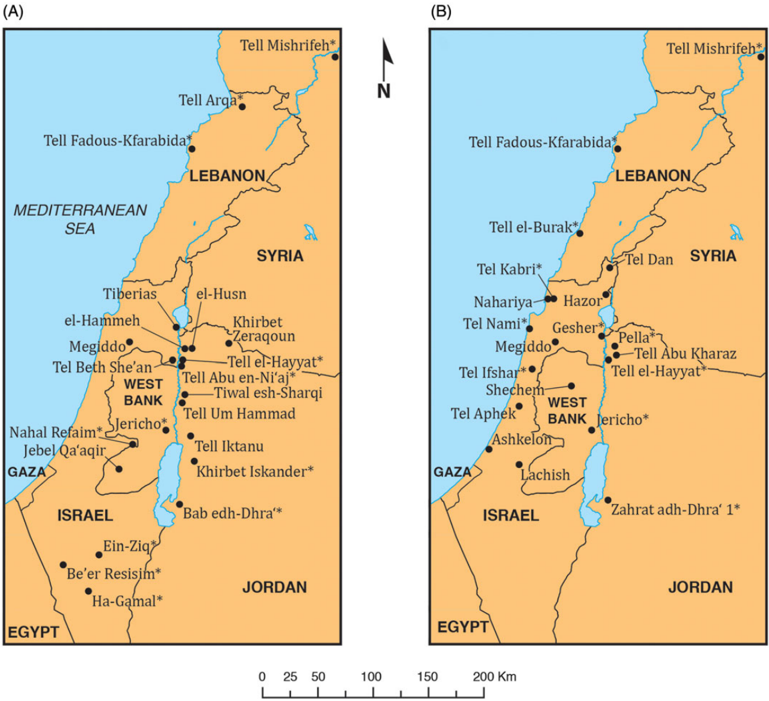
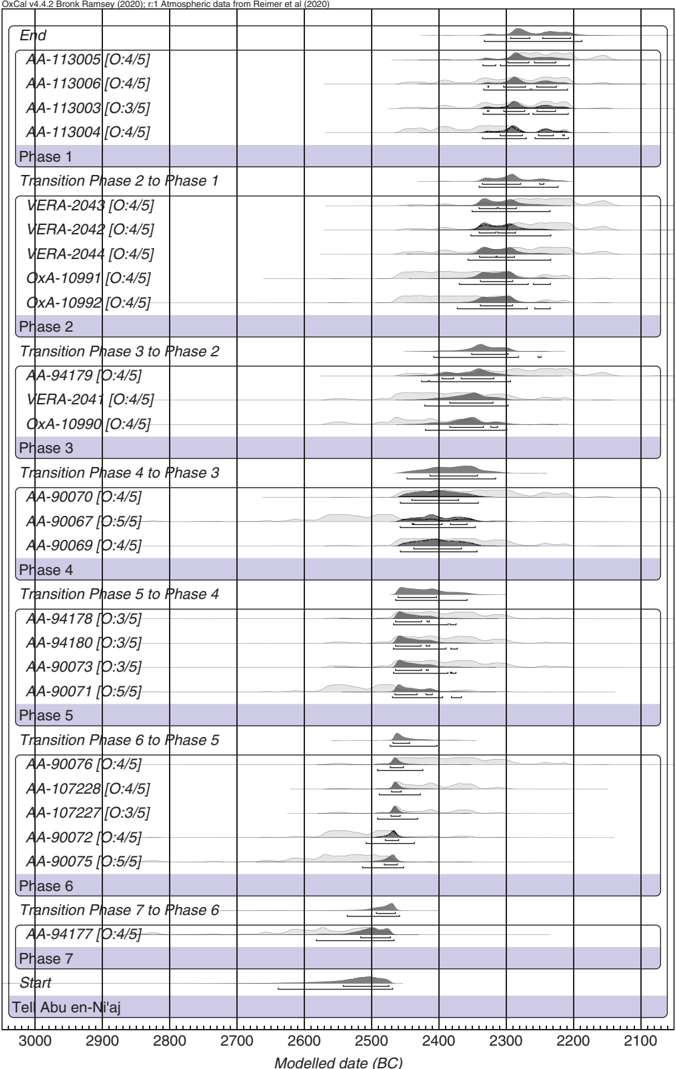
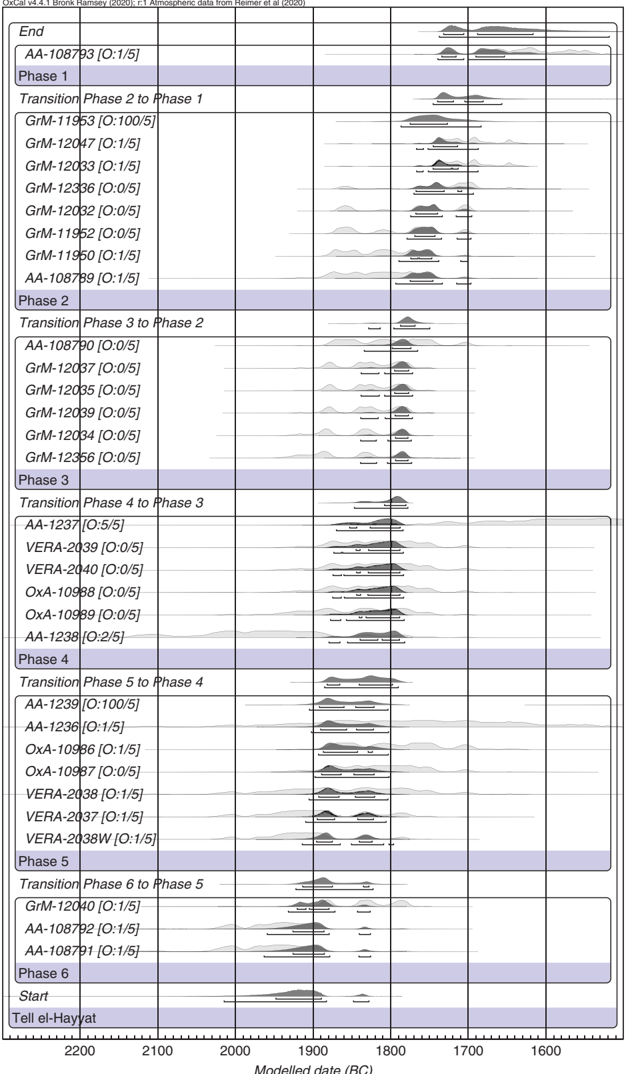
We present two new Bayesian 14 C models using IntCal20 that incorporate 17 new calibrated AMS ages for Early Bronze IV Tell Abu en-Ni‘aj and Middle Bronze Age Tell el-Hayyat, located in the northern Jordan Valley, Jordan. These freshly augmented suites of carbonized seed dates now include 25 AMS dates from Tell Abu en-Ni‘aj and 31 AMS dates from Tell el-Hayyat. The modeled founding date for Tell Abu en-Ni‘aj strengthens an emerging high chronology for Early Bronze IV starting by 2500 cal BC, while the end of its habitation by 2200 cal BC may exemplify a regional pattern of increasingly pervasive abandonment among late Early Bronze IV settlements in the Southern Levant. In turn, our modeled date for the Early Bronze IV/Middle Bronze Age transition at Tell el-Hayyat around 1900 cal BC pushes this interface about a century later than surmised traditionally, and its abandonment in Middle Bronze III marks an unexpectedly early end date before 1600 cal BC. These inferences, which coordinate Bayesian AMS models and typological ceramic sequences for Tell Abu en-Ni‘aj and Tell el-Hayyat, contribute to an ongoing revision of Early and Middle Bronze Age Levantine chronologies and uncoupling of their attendant interpretive links between the Southern Levant and Egypt.
Checked 2026-11-23 · 2 references not checked yet
Overview
CoChat Summary
TL;DR
New Bayesian models using IntCal20 and 17 new AMS ages (25 total from Tell Abu en-Ni‘aj; 31 total from Tell el-Hayyat) revise Early Bronze IV and Middle Bronze Age chronology in the northern Jordan Valley. They support EB IV founding by 2500 cal BC and abandonment by 2200 cal BC at Tell Abu en-Ni‘aj, and push the EB IV/MB transition at Tell el-Hayyat to around 1900 cal BC with abandonment before 1600 cal BC.
Key findings
- Tell Abu en-Ni‘aj: modeled occupation began by 2500 cal BC (Phase 7 start boundary), ended by 2200 cal BC (Phase 1 end boundary), and spanned up to 300 years; seven phases are estimated at about 25–40 years each.
- Tell el-Hayyat: earliest deposition by 1900 cal BC (Phase 6 start boundary); early Middle Bronze I occupation just after 1900 cal BC; Middle Bronze I/II transition shortly after 1800 cal BC; Middle Bronze II/III transition between 1800 and 1700 cal BC; abandonment by 1600 cal BC after approximately 300 years.
- The EB IV/MB Age transition at Tell el-Hayyat around 1900 cal BC is about a century later than traditionally surmised, while Tell Abu en-Ni‘aj’s end by 2200 cal BC may fit a regional pattern of late EB IV abandonment.
- Outlier analysis detected three Tell Abu en-Ni‘aj dates at ≥5% (AA-90075 Phase 6, AA-90071 Phase 5, AA-90067 Phase 4) and two Tell el-Hayyat dates >5% (AA-1239 Phase 5, GrM-11953 Phase 2), with AA-1237 at 5%.
Methods
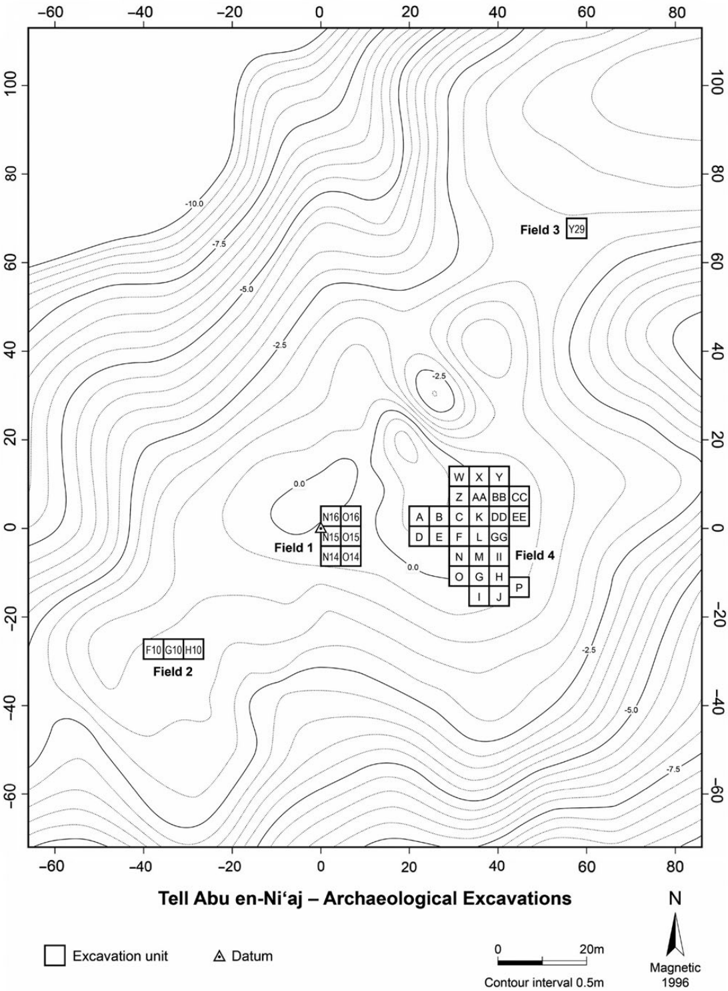
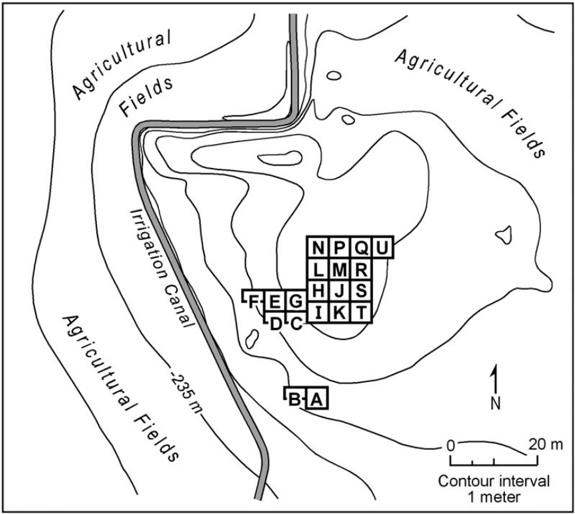
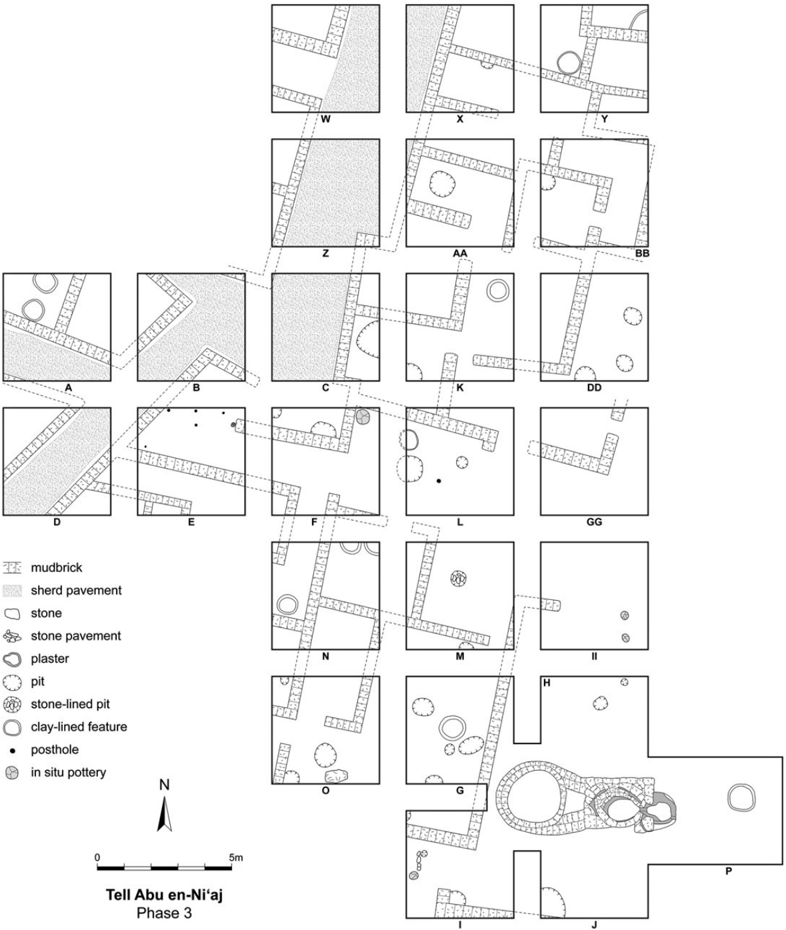
- Excavations: Tell Abu en-Ni‘aj in three seasons totaling 16 weeks; 27 contiguous 4×4 m units in Field 4 through seven phases; about 2.5% of site area. Tell el-Hayyat in three seasons totaling 24 weeks; 16 4×4 m and four 2×4 m units through six phases; about 8.0% of site area.
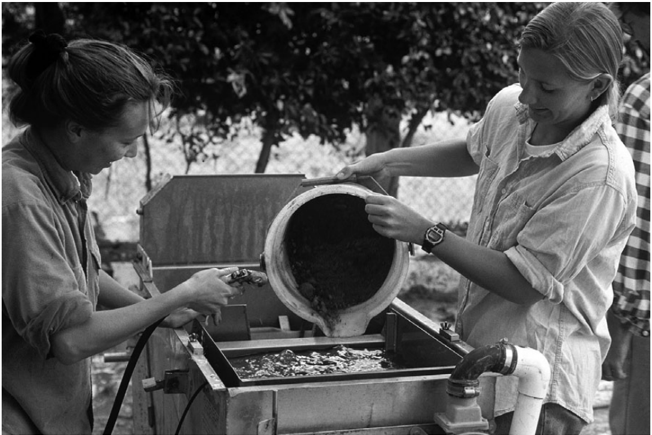
- Material: carbonized seeds recovered by water flotation and Flote-Tech 2000; AMS ages from seeds (mostly Triticum, Hordeum, Cerealia, Olea, Prosopis) rather than charcoal; 25 AMS dates from Tell Abu en-Ni‘aj and 31 from Tell el-Hayyat.
- Analysis: calibration and Bayesian modeling in OxCal 4.4.2 with IntCal20; contiguous stratigraphic phases, unordered samples within phases, and Outlier Analysis using the General model for short-lived samples.
Limitations
- Paper states: determining the beginning of the Middle Bronze Age is hampered by a paucity of sites with contiguous EB IV/MB I stratification like Tell el-Hayyat; Phase 7 at Tell Abu en-Ni‘aj has a single AMS sample and Phase 1 at Tell el-Hayyat has a single sample; the modest Phase 1 extent at Tell Abu en-Ni‘aj may reflect erosion.
- Paper states: Tell el-Hayyat has no Late Bronze Age stratum to cap the Middle Bronze Age sequence, and its Phase 5–1 ceramics may not extend to the very end of Middle Bronze III.
- Evident from text: some phases have few dates (e.g., Phase 6 at Tell el-Hayyat contributes three specimens; Phase 1 offers a single sample), and post-Bronze Age pits punctuate Phases 2 and 1 sediments, so modeled boundaries for those phases rest on limited or potentially disturbed contexts.
Model-written summary. Check it against the paper before relying on it.
Integrity signals
Registry
Cites
Statistics
Figures
Verification
Claims the paper makes
0 Valid · 2 Not valid · 31 Not checked · 80 Own results and interpretations
A result the paper reports from its own data — it cites no other source for it, so there is none to check. The quote shows it is in the paper.
In the paper
“while the end of its habitation by 2200 cal BC may exemplify a regional pattern of increasingly pervasive abandonment among late Early Bronze IV settlements in the Southern Levant.”
§ NEW BAYESIAN RADIOCARBON MODELS AND CERAMIC CHRONOLOGIES FOR EARLY BRONZE IV TELL ABU EN-NI'AJ AND MIDDLE BRONZE AGE TELL > Abstract
hedgedSingle case- Asserted: passes — The authors put it forward as true.
- Checkable: passes — It can be checked against evidence.
- Load-bearing: passes — The paper’s conclusions depend on it.
- Based: passes — The paper gives a reason why it holds.
A result the paper reports from its own data — it cites no other source for it, so there is none to check. The quote shows it is in the paper.
In the paper
“our modeled date for the Early Bronze IV/Middle Bronze Age transition at Tell el-Hayyat around 1900 cal BC pushes this interface about a century later than surmised traditionally”
§ NEW BAYESIAN RADIOCARBON MODELS AND CERAMIC CHRONOLOGIES FOR EARLY BRONZE IV TELL ABU EN-NI'AJ AND MIDDLE BRONZE AGE TELL > Abstract
plainSingle case- Asserted: passes — The authors put it forward as true.
- Checkable: passes — It can be checked against evidence.
- Load-bearing: passes — The paper’s conclusions depend on it.
- Based: passes — The paper gives a reason why it holds.
A result the paper reports from its own data — it cites no other source for it, so there is none to check. The quote shows it is in the paper.
In the paper
“The modeled founding date for Tell Abu en-Ni'aj strengthens an emerging high chronology for Early Bronze IV starting by 2500 cal BC”
§ NEW BAYESIAN RADIOCARBON MODELS AND CERAMIC CHRONOLOGIES FOR EARLY BRONZE IV TELL ABU EN-NI'AJ AND MIDDLE BRONZE AGE TELL > Abstract
plain- Asserted: passes — The authors put it forward as true.
- Checkable: passes — It can be checked against evidence.
- Load-bearing: passes — The paper’s conclusions depend on it.
- Based: passes — The paper gives a reason why it holds.
A result the paper reports from its own data — it cites no other source for it, so there is none to check. The quote shows it is in the paper.
In the paper
“We present two new Bayesian 14 C models using IntCal20 that incorporate 17 new calibrated AMS ages for Early Bronze IV Tell Abu en-Ni'aj and Middle Bronze Age Tell el-Hayyat, located in the northern Jordan Valley, Jordan.”
§ NEW BAYESIAN RADIOCARBON MODELS AND CERAMIC CHRONOLOGIES FOR EARLY BRONZE IV TELL ABU EN-NI'AJ AND MIDDLE BRONZE AGE TELL > Abstract
plain- Asserted: passes — The authors put it forward as true.
- Checkable: passes — It can be checked against evidence.
- Load-bearing: passes — The paper’s conclusions depend on it.
- Based: passes — The paper gives a reason why it holds.
A result the paper reports from its own data — it cites no other source for it, so there is none to check. The quote shows it is in the paper.
In the paper
“and its abandonment in Middle Bronze III marks an unexpectedly early end date before 1600 cal BC.”
§ NEW BAYESIAN RADIOCARBON MODELS AND CERAMIC CHRONOLOGIES FOR EARLY BRONZE IV TELL ABU EN-NI'AJ AND MIDDLE BRONZE AGE TELL > Abstract
plainSingle case- Asserted: passes — The authors put it forward as true.
- Checkable: passes — It can be checked against evidence.
- Load-bearing: passes — The paper’s conclusions depend on it.
- Based: passes — The paper gives a reason why it holds.
54 more claims
Create a free account to see all 113 claims and to verify the 25 references still open.
- It may state two separate claims as one. 35
- Probably not a substantial claim. 26
Self-check
Percentages, sums and reported differences re-computed from the paper’s own numbers.
Each contradiction between two passages listed here was confirmed by an independent check.
Rated minor: it would not touch a result — a value no result rests on, a p-value that stays on the same side of the significance level, or a conflict that is clerical, resolved elsewhere in the paper, or outside its own findings.
In the paper
§ Lab number Conventional 14 C age yr BP Calibrated 1σ ranges yr BC (probability) Calibrated 2σ ranges yr BC (probability) Archaeological context Table 1 (Continued ) # Lab number Conventional 14 C age yr BP Calibrated 1σ ranges yr BC (probability) Calibrated 2σ ranges yr BC (probability) Archaeological context Table 1 (Continued ) # Lab number Conventional 14 C age yr BP Calibrated 1σ ranges yr BC (probability) Calibrated 2σ ranges yr BC (probability) Archaeological context 7 AA-90071* 3981±44 2571-2515 (39.2%) 2623-2596 (2.5%) Phase 5, C.075.278, burned surface 2502-2462 (29.0%) 2385-2395 (86.2%)Hordeum seeds 2389-2344 (6.8%) 6 AA-90076 3905±45 2465-2341 (64.5%) 2558-2541 (1.6%) Phase 6, C.106.494, stone hearth 2317-2308 (3.7%) 2490-2280 (88.7%)Triticum dicoccum seeds 2253-2209 (5.1%) 5 AA-107228 3924±25 2469-2435 (26.9%) 2475-2336 (90.2%)Phase 6, C.111.548, pit 2426-2403 (17.6%) 2328-2298 (5.3%) Hordeum, Triticum, Pisum seeds 2380-2349 (23.8%) 4 AA-107227 3937±24 2473-2439 (31.9%) 2563-2536 (5.5%) Phase 6, GG.098.295,pit 2424-2404 (15.1%) 2493-2342 (89.2%)Hordeum, Triticum, Pisum seeds 2379-2350 (21.2%) 2316-2310 (0.8%) 3 AA-90072 3986±44 2571-2516 (40.4%) 2624-2399 (90.4%)Phase 6, C.091.406, burned surface 2501-2464 (27.9%) 2384-2346 (5.0%) Triticum dicoccum seeds 2 AA-90075* 4026±43 2580-2472 (68.3%) 2843-2814 (2.9%) Phase 6, C.086.387, burned surface 2673-2461 (92.6%)Cerealia seeds 1 AA-94177 4046±39 2626-2556 (35.8%) 2846-2812 (5.4%) Phase 7, GG.105.331,fire pit 2544-2488 (32.5%) 2742-2731 (1.0%) Cerealia seeds 2675-2468 (89.1%)
“Phases 5-2 provide six to seven samples each, while Phase 6 contributes three specimens and Phase 1 offers a single sample.”
§ Lab number Conventional 14 C age yr BP Calibrated 1σ ranges yr BC (probability) Calibrated 2σ ranges yr BC (probability) Archaeological context Table 2 (Continued ) # Lab number Conventional 14 C age yr BP Calibrated 1σ ranges yr BC (probability) Calibrated 2σ ranges yr BC (probability) Archaeological context Table 2 (Continued ) # Lab number Conventional 14 C age yr BP Calibrated 1σ ranges yr BC (probability) Calibrated 2σ ranges yr BC (probability) Archaeological context Table 2 (Continued ) # Lab number Conventional 14 C age yr BP Calibrated 1σ ranges yr BC (probability) Calibrated 2σ ranges yr BC (probability) Archaeological context 5 VERA-2037 3555±40 1954-1876 (50.4%) 2025-1992 (6.4%) Phase 5, E.102, ash lens 1843-1822 (10.5%) 1984-1862 (59.7%)Triticum aestivum seeds, humic acids 1796-1779 (7.4%) 1856-1766 (28.9%) 1757-1752 (0.5%) 4 VERA-2038W 3565±30 1954-1881 (65.2%) 2021-1995 (6.4%) Phase 5, H.067, ash lens 1837-1830 (3.1%) 1981-1873 (74.6%)Triticum aestivum seeds 1846-1817 (8.8%) 1802-1776 (5.7%) 3 GrM-12040 3524±13 1890-1875 (18.4%) 1921-1869 (29.2%)Phase 6, J.071.256, fill debris 1843-1821 (28.6%) 1850-1772 (66.2%)Hordeum seeds 1797-1779 (21.3%) 2 AA-108792 3588±28 2008-2004 (2.8%) 2028-1882 (94.7%)Phase 6, H.073.482, surface 1971-1895 (65.5%) 1836-1831 (0.8%) Hordeum seeds 1 AA-108791 3593±34 2014-2000 (9.2%) 2113-2101 (0.9%) Phase 6, H.073.482, surface 1976-1897 (59.0%) 2036-1878 (91.8%)Hordeum seeds 1841-1824 (2.1% > Occupational History of Tell Abu en-Ni'aj and Tell el-Hayyat
“The seven modeled radiocarbon determinations from Phase 2 (excluding Bayesian outlier GrM-11953) date to the 18th century cal BC”
Citations
Cites
Bayesian Analysis of Radiocarbon Dates
Bronk Ramsey, C. (2009) · Radiocarbon · doi:10.1017/s0033822200033865 · Cited by 8,725
The IntCal20 Northern Hemisphere Radiocarbon Age Calibration Curve (0–55 cal kBP)
Reimer, P. J., Austin, W. E. N., Bard, E., Bayliss, A., Blackwell, P. G., Bronk Ramsey, C., Butzin, M., Cheng, H., Edwards, R. L., Friedrich, M., et al. (2020) · Radiocarbon · doi:10.1017/rdc.2020.41 · Cited by 7,900
Dealing with outliers and offsets in radiocarbon dating
Bronk Ramsey, C. (2009) · Radiocarbon · doi:10.1017/s0033822200034093 · Cited by 1,204
Methods for Summarizing Radiocarbon Datasets
Ramsey, C. B. (2017) · Radiocarbon · doi:10.1017/rdc.2017.108 · Cited by 1,179
Zohary, D., & Spiegel-Roy, P. (1975) · Science · doi:10.1126/science.187.4174.319 · Cited by 790
The Archaeology of Society in the Holy Land
Routledge, B., & Levy, T. E. (1998) · The Classical World · doi:10.2307/4352203 · Cited by 636
Chronologies in Old World Archaeology.
Evans, J. D., & Ehrich, R. W. (1967) · Man · doi:10.2307/2798670 · Cited by 528
Zohary, D., & Hopf, M. (1973) · Science · doi:10.1126/science.182.4115.887 · Cited by 310
Olive oil history, production and by-product management
Kapellakis, I., Tsagarakis, K. P., & Crowther, J. C. (2007) · Reviews in Environmental Science and Bio/Technology · doi:10.1007/s11157-007-9120-9 · Cited by 284
Radiocarbon-Based Chronology for Dynastic Egypt
Ramsey, C. B., Dee, M. W., Rowland, J. M., Higham, T. F. G., Harris, S. A., Brock, F., Quiles, A., Wild, E. M., Marcus, E. S., & Shortland, A. J. (2010) · Science · doi:10.1126/science.1189395 · Cited by 282
Chronology of the Early Bronze Age in the Southern Levant: New Analysis for a High Chronology
Regev, J., De Miroschedji, P., Greenberg, R., Braun, E., Greenhut, Z., & Boaretto, E. (2012) · Radiocarbon · doi:10.1017/s003382220004724x · Cited by 233
van Zeist, W., & Bakker-Heeres, J. A. H. (2015) · Palaeohistoria · Cited by 221
Kenyon, K. M. (1954) · The Journal of the Royal Anthropological Institute of Great Britain and Ireland · doi:10.2307/2844004 · Cited by 194
Working with radiocarbon dates
Waterbolk, H. T. (1971) · Proceedings of the Prehistoric Society · doi:10.1017/s0079497x00012548 · Cited by 182
The Annual of the American Schools of Oriental Research
Hammond, P. C., & Albright, W. F. (1961) · Journal of Biblical Literature · doi:10.2307/3264569 · Cited by 155
The Archaeology of Society in the Holy Land. Thomas E. Levy and Kent Flannery.
Harrison, T. P. (2000) · Bulletin of the American Schools of Oriental Research · doi:10.2307/1357644 · Cited by 145
High-Precision Bayesian Modeling of Samples Susceptible to Inbuilt Age
Dee, M. W., & Ramsey, C. B. (2014) · Radiocarbon · doi:10.2458/56.16685 · Cited by 131
Early Urbanizations in the Levant: A Regional Narrative
Greenberg, R. (2002) · Cited by 107
Agricultural Intensification and the Secondary Products Revolution Along the Jordan Rift
Fall, P. L., Falconer, S. E., & Lines, L. (2002) · Human Ecology · doi:10.1023/a:1021193922860 · Cited by 104
Self-citationIllustrated taxonomy manual of weed seeds.
Delorit, R. J. (1970) · Cited by 97
Martin, A. C., & Barkley, W. D. (2023) · University of California Press eBooks · doi:10.2307/jj.8500978 · Cited by 88
Seeds of Civilization: Bronze Age Rural Economy and Ecology in the Southern Levant
Fall, P. L., Lines, L., & Falconer, S. E. (1998) · Annals of the Association of American Geographers · doi:10.1111/1467-8306.00087 · Cited by 85
Self-citationNorthern Cemetery of Beth Shan
Oren (1973) · BRILL eBooks · doi:10.1163/9789004671065 · Cited by 84
Prag, K. (1974) · Levant · doi:10.1179/007589174790217490 · Cited by 79
Manning, S. W., Höflmayer, F., Moeller, N., Dee, M. W., Ramsey, C. B., Fleitmann, D., Higham, T., Kutschera, W., & Wild, E. M. (2014) · Antiquity · doi:10.1017/s0003598x00115388 · Cited by 73
Self-citationThe Early Bronze Age of the Southern Levant: A Landscape Approach
Philip, G. (2003) · Journal of Mediterranean Archaeology · doi:10.1558/jmea.v16i1.103 · Cited by 68
Höflmayer, F., Dee, M., Genz, H., & Riehl, S. (2014) · Radiocarbon · doi:10.1017/s0033822200049572 · Cited by 67
Self-citationWalled Up to Heaven: The Evolution of Middle Bronze Age Fortification Strategies in the Levant
Burke, A. (2008) · doi:10.1163/9789004376687 · Cited by 66
Early Bronze Age Chronology: Radiocarbon Dates and Chronological Models from Tel Yarmuth (Israel)
Regev, J., De Miroschedji, P., & Boaretto, E. (2012) · Radiocarbon · doi:10.1017/s0033822200047238 · Cited by 64
Dever, W. G. (1987) · The Biblical Archaeologist · doi:10.2307/3210059 · Cited by 63
The EB IV-MB I Horizon in Transjordan and Southern Palestine
Dever, W. G. (1973) · Bulletin of the American Schools of Oriental Research · doi:10.2307/1356187 · Cited by 63
Recent Developments in Calibration for Archaeological and Environmental Samples
van der Plicht, J., Bronk Ramsey, C., Heaton, T. J., Scott, E. M., & Talamo, S. (2020) · Radiocarbon · doi:10.1017/rdc.2020.22 · Cited by 62
The East Jordan Valley Survey, 1975
Ibrahim, M. '., Sauer, J. A., & Yassine, K. (1976) · Bulletin of the American Schools of Oriental Research · doi:10.2307/1356299 · Cited by 62
Explorations in Eastern Palestine III
Glueck, N. (1936) · Bulletin of the American Schools of Oriental Research · doi:10.2307/1355390 · Cited by 60
Kutschera, W., Bietak, M., Wild, E. M., Ramsey, C. B., Dee, M., Golser, R., Kopetzky, K., Stadler, P., Steier, P., Thanheiser, U., et al. (2012) · Radiocarbon · doi:10.1017/s0033822200047172 · Cited by 58
Rise and collapse in the Southern Levant in the Early Bronze Age.
de Miroschedji, P. (2009) · Cited by 54
Cohen, S. (2009) · Bulletin of the American Schools of Oriental Research · doi:10.1086/basor25609312 · Cited by 52
On macroscopic traces of food plants in southwestern Asia (with some reference to pollen data)
van Zeist, W. (1976) · Philosophical transactions of the Royal Society of London. Series B, Biological sciences · doi:10.1098/rstb.1976.0068 · Cited by 51
Archaeobotanical inference of Bronze Age land use and land cover in the eastern Mediterranean
Klinge, J., & Fall, P. L. (2010) · Journal of Archaeological Science · doi:10.1016/j.jas.2010.05.022 · Cited by 51
Self-citationThe Early Bronze Age Remains at Tell eṣ-Ṣāfi/Gath: An Interim Report
Shai, I., Greenfield, H. J., Regev, J., Boaretto, E., Eliyahu-Behar, A., & Maeir, A. M. (2014) · Tel Aviv · doi:10.1179/0334435514z.00000000034 · Cited by 49
Bronze Age Rural Ecology and Village Life at Tell el-Hayyat, Jordan
Falconer, S. E., & Fall, P. L. (2006) · University of Michigan Press eBooks · doi:10.30861/9781841717999 · Cited by 49
Self-citationKhirbat Iskandar final report on the early bronze IV Area C gateway ; and cemeteries
Richard, S., & Cordova, C. E. (2010) · Cited by 43
Bietak, M., & Czerny, E. (2008) · Verlag der österreichischen Akademie der Wissenschaften eBooks · doi:10.1553/0x000487cb · Cited by 42
Höflmayer, F., Kamlah, J., Sader, H., Dee, M. W., Kutschera, W., Wild, E. M., & Riehl, S. (2016) · Bulletin of the American Schools of Oriental Research · doi:10.5615/bullamerschoorie.375.0053 · Cited by 41
Self-citationBruins, H. J., & van der Plicht, J. (2001) · Radiocarbon · doi:10.1017/s003382220003856x · Cited by 40
New Vistas on the EB IV ("MB I") Horizon in Syria-Palestine
Dever, W. G. (1980) · Bulletin of the American Schools of Oriental Research · doi:10.2307/1356506 · Cited by 40
The middle Bronze Age IIA cemetery at Gesher : final report /
Cohen, S., & Garfinkel, Y. (2007) · University of Michigan Library Repository · Cited by 39
Morris, E. F., & Cohen, S. (2002) · Journal of the American Oriental Society · doi:10.2307/3217657 · Cited by 35
New Radiocarbon Dates from Tel Kabri Support a High Middle Bronze Age Chronology
Höflmayer, F., Yasur-Landau, A., Cline, E. H., Dee, M. W., Lorentzen, B., & Riehl, S. (2016) · Radiocarbon · doi:10.1017/rdc.2016.27 · Cited by 35
Self-citationAntagonisms in Historical and Radiocarbon Chronology
Bietak, M. (2013) · Radiocarbon and the Chronologies of Ancient Egypt · doi:10.2307/j.ctvh1dmh2.12 · Cited by 34
Willis, A. J., Martin, A. C., & Barkley, W. D. (1977) · Journal of Ecology · doi:10.2307/2259093 · Cited by 33
EXCAVATIONS AT TELL UM HAMMAD, 1984
Helms, S. W. (1986) · Levant · doi:10.1179/lev.1986.18.1.25 · Cited by 33
Avner, U., & Carmi, I. (2001) · Radiocarbon · doi:10.1017/s0033822200038492 · Cited by 32
Dichotomous keys for the identification of the major Old World crops
Hubbard, R. N. L. B. (1992) · Review of Palaeobotany and Palynology · doi:10.1016/0034-6667(92)90049-m · Cited by 30
(2008) · Durham Research Online (Durham University) · doi:10.1558/equinox.19367 · Cited by 30
Bruins, H. J., & Van Der Plight, J. (1995) · Radiocarbon · doi:10.1017/s0033822200030666 · Cited by 29
Regev, J., Finkelstein, I., Adams, M. J., & Boaretto, E. (2015) · Ägypten und Levante · doi:10.1553/s241 · Cited by 28
Community, Polity, and Temple in a Middle Bronze Age Levantine Village
Magness-Gardiner, B., & Falconer, S. E. (1994) · Journal of Mediterranean Archaeology · doi:10.1558/jmea.v7i2.127 · Cited by 28
Self-citationExcavations at the Early Bronze IV Sites of Jebel Qa'aqir and Be'er Resisim
Dever, W. G. (2014) · doi:10.1163/9789004370159 · Cited by 28
The Southern Levant (Cisjordan) During the Early Bronze Age
Killebrew, A. E., Steiner, M. L., & de Miroschedji, P. (2013) · Oxford University Press eBooks · doi:10.1093/oxfordhb/9780199212972.013.022 · Cited by 26
Jericho and the Chronology of Palestine in the Early Bronze Age: a Radiometric Re-Assessment
Nigro, L., Calcagnile, L., Yasin, J., Gallo, E., & Quarta, G. (2018) · Radiocarbon · doi:10.1017/rdc.2018.76 · Cited by 26
Fischer, P. M. (1999) · Bulletin of the American Schools of Oriental Research · doi:10.2307/1357613 · Cited by 25
Fowler, K. D., Fayek, M., & Middleton, E. (2011) · Geoarchaeology · doi:10.1002/gea.20372 · Cited by 22
The Intermediate Early Bronze-Middle Bronze Age Sequences at Jericho and Tell Iktanu Reviewed
Prag, K. (1986) · Bulletin of the American Schools of Oriental Research · doi:10.2307/1357020 · Cited by 21
Introduction to the Levant During the Middle Bronze Age
Killebrew, A. E., Steiner, M. L., & Burke, A. A. (2013) · Oxford University Press eBooks · doi:10.1093/oxfordhb/9780199212972.013.027 · Cited by 21
Tell Abu al-Kharaz in the Jordan Valley, Vol. 2
Fischer, P. M. (2006) · Verlag der österreichischen Akademie der Wissenschaften eBooks · doi:10.1553/0x0013e3d8 · Cited by 21
Bâb edh-Dhrâ': Excavations at the Town Site (1975–1981), 2 part set
Rast, W. E., & Schaub, R. T. (2003) · Penn State University Press eBooks · doi:10.5325/j.ctv1bxh3z6 · Cited by 20
Bronze age fuel use and its implications for agrarian landscapes in the eastern Mediterranean
Fall, P. L., Falconer, S. E., & Klinge, J. (2015) · Journal of Archaeological Science Reports · doi:10.1016/j.jasrep.2015.09.004 · Cited by 20
Self-citationAn EB IV Cemetery in the North Jordan Valley
Wightman, G. J. (1988) · Levant · doi:10.1179/lev.1988.20.1.139 · Cited by 17
The Southern Levant (Transjordan) During the Middle Bronze Age
Killebrew, A. E., Steiner, M. L., & Bourke, S. (2013) · Oxford University Press eBooks · doi:10.1093/oxfordhb/9780199212972.013.031 · Cited by 17
Fall, P. L., Falconer, S. E., & Porson, S. (2019) · Journal of Archaeological Science Reports · doi:10.1016/j.jasrep.2019.101884 · Cited by 15
Self-citationD’Andrea, M., & Vacca, A. (2015) · Studia Eblaitica · doi:10.13173/stebla/2015/1/43 · Cited by 15
The 1980 Season at Pella of the Decapolis
Smith, R. H., McNicoll, A. W., Hennessy, J. B., Potts, T., Darwish, M., Shraideh, S., Saul, M. B., Moyer, J., & Campbell, E. (1981) · Bulletin of the American Schools of Oriental Research · doi:10.2307/1356657 · Cited by 15
Bourke, S., Zoppi, U., Meadows, J., Hua, Q., & Gibbins, S. (2009) · Radiocarbon · doi:10.1017/s003382220003397x · Cited by 14 · cited 3×
“Bronze Age stem from three AMS ages from Gesher (OxA-1955, median= 2014 cal BC), Pella (OZG-611, median= 1995 cal BC) and Zahrat adh-Dhra‘ 1 (OZH-756, median= 1992 cal BC) (Garfinkel and Cohen 2007; Bourke et al. 2009; Fall et al. 2019).”
BackgroundIllustrated toxonomy manual of weed seeds.
Delorit, R. J. (1970) · Cited by 14
Höflmayer, F. (2019) · Journal of Ancient Egyptian Interconnections · Cited by 13
Self-citationAncient Settlement of the Central Negev I
Authority, I. A., & Cohen, R. (1999) · Israel Antiquities Authority eBooks · doi:10.69704/iaarepv000.1996.75 · Cited by 13
Falconer, S. E., & Fall, P. L. (2019) · University of Michigan Press eBooks · doi:10.30861/9781407316925 · Cited by 13
Self-citationDevelopment of cell-vertex multidimensional upwind solvers for the compressible flow equations
Deconinck, H., Struijs, R., Paillère, H., Catalano, L. A., Palma, P. D., Napolitano, M., & Pascazio, G. (1993) · Quarterly - Centrum voor Wiskunde en Informatica · Cited by 13
Falconer, S. E., & Fall, P. L. (2016) · Radiocarbon · doi:10.1017/rdc.2016.26 · Cited by 12
Self-citationKennedy, M. A. (2015) · Bulletin of the American Schools of Oriental Research · doi:10.5615/bullamerschoorie.373.0199 · Cited by 12
Bruins, H. J., & van der Plicht, J. (2003) · University of Groningen research database (University of Groningen / Centre for Information Technology) · Cited by 12
The Southern Levant (Transjordan) During the Early Bronze Age
Killebrew, A. E., Steiner, M. L., & Richard, S. (2013) · Oxford University Press eBooks · doi:10.1093/oxfordhb/9780199212972.013.023 · Cited by 10
Introduction to the Levant During the Early Bronze Age
Killebrew, A. E., Steiner, M. L., & Greenberg, R. (2013) · Oxford University Press eBooks · doi:10.1093/oxfordhb/9780199212972.013.019 · Cited by 9
Bonacossi, D. M. (2008) · Cited by 8
Shechem I. The Middle Bronze IIB Pottery. Dan P. Cole.
Dever, W. G. (1989) · Bulletin of the American Schools of Oriental Research · doi:10.2307/1356855 · Cited by 8
Early Bronze Age IV Ceramic Regionalism in Central Jordan
Palumbo, G., & Peterman, G. L. (1993) · Bulletin of the American Schools of Oriental Research · doi:10.2307/1357360 · Cited by 7
A Middle Bronze Age I Cemetery in Tiberias
Tzaferis, V. (1968) · Cited by 7
Vestigial Features in MB I: An Illustration of Some Principles of Ceramic Typology
Dever, W. G. (1970) · Bulletin of the American Schools of Oriental Research · doi:10.2307/1356174 · Cited by 6
Peripheral Concerns: Urban Development in the Bronze Age Southern Levant
Cohen, S. (2016) · Equinox Publishing eBooks · doi:10.1558/isbn.9781781793718 · Cited by 6
Chapter 3 THE MIDDLE BRONZE AGE POTTERY
Jaffe, G. B. (2015) · Penn State University Press eBooks · doi:10.1515/9781575063881-005 · Cited by 2
The Middle Bronze Age IIA Cemetery at Gesher: Final Report. Yosef Garfinkel and Susan Cohen.
Lev-Tov, J. S. E. (2008) · Bulletin of the American Schools of Oriental Research · doi:10.1086/basor25609287 · Cited by 2
Joffe, A. H. (2002) · Bulletin of the American Schools of Oriental Research · doi:10.2307/1357864 · Cited by 1
Egypt in the Eastern Mediterranean during the Old Kingdom: An Archaeological Perspective
Sowada, K. N. (2009) · Academic Press / Vandenhoeck & Ruprecht · doi:10.5167/uzh-143040
Höflmayer, F., Dee, M. W., Genz, H., et al. (2016) · Radiocarbon · doi:10.2458/56.16932
Self-citation(2017) · Journal of Ancient Egyptian Interconnections
Self-citation(1991)
Glueck, N. (1951) · Bulletin of the American Schools of Oriental Research · doi:10.2307/3218831
Research works printed but not linked: 28
- Prag K. 2014. The southern Levant during the Intermediate Bronze Age. In: Steiner ML, Killebrew AE, editors. The archaeology of the Bayesian 14 C Models for Tell Abu en-Ni'aj and Tell El-Hayyat 75 https://doi.org/10.1017/RDC.2020.104 Published online by Cambridge University Press Levant c. 8000-332 BCE. Oxford: Oxford University Press. p. 388-400.
- Ben-Dor I. 1950. A Middle-Bronze Age temple at Nahariya. Quarterly of the Department of Antiquities in Palestine 24:1-42.
- Sharon 2014. Levantine chronology. In: Steiner ML, Killebrew AE, editors. The Archaeology of the Levant c. 8000-332 BCE. Oxford: Oxford University Press. p. 44-65.
- Kenyon KM, Holland TA. 1983. Excavations at Jericho 5, London: British School of Archaeology in Jerusalem.
- P L Fall et al. https://doi.org/10.1017/RDC.2020.104 Published online by Cambridge University Press
- Helms SW. 1983. The EB IV (EB-MB) Cemetery at Tiwal esh-Sharqi, in the Jordan Valley. Annual of the Department of Antiquities of Jordan 27: 55-85.
- Cohen SL. 2014. The southern Levant (Cisjordan) during the Middle Bronze Age. In: Steiner ML, Killebrew AE, editors. The Archaeology of the Levant c. 8000-332 BCE. Oxford: Oxford University Press. p. 451-464.
- Ben-Dor I. 1951. A Canaanite temple at Nahariyya. Eretz-Israel 1:17-28
- Mellart J. 1962. Preliminary report on the archaeological survey in the Yarmuk and Jordan Valley for the Point Four irrigation scheme. Annual of the Department of Antiquities of Jordan 6-7:126-157.
- Dever WG. 1995. Social structure in the Early Bronze IV period in Palestine. In: Levy TE, editor. The Archaeology of Society in the Holy Land. New York: Facts on File. p. 282-296.
- Prag K. 2001. The third millennium in Jordan: A perspective, past and future. In: al-Khraysheh F, editor. Studies in the History and Archaeology of Jordan. Vol. 7. Amman, Jordan: Department of Antiquities. p. 179-190.
- Falconer SE, Fall PL. 2009. Settling the valley: agrarian settlement and interaction along the Jordan Rift during the Bronze Age. In: Kaptijn E, Petit L, editors. A timeless vale: archaeological and related essays on the Jordan Valley. Archaeological Studies, Leiden University 19. Leiden: Leiden University Press. p. 97-107.
- Bruins H. 2007. Charcoal radiocarbon dates of Tell el-Dab'a. In: Bietak M, Czerny E, editors. The Synchronisation of Civilisations in the Easter Mediterranean in the Second Millennium B.C. III, Proceedings of the SCIEM 2000 2nd Euro- Conference Vienna, 28th May-1st June 2003. Wien: Verlag der Osterreichischen Akademie der Wissenschaften. p. 65-77.
- Joffe A. 1993. Settlement and Society in the Early Bronze Age I and II, Southern Levant. Sheffield: Sheffield Academic Press.
- Rast WE, Schaub RT. 1978. A preliminary report of excavations at Bab edh-Dhra', 1975. Annual of the American Schools of Oriental Research 43:1-32.
- Segal D, Carmi I. 1996. Rehovot radiocarbon date list V. 'Atiqot XXIX:79-106.
- Reimer PJ, Austin, WEN, Bard E, Bayliss A, Blackwell PG, Bronk Ramsey C, Butzin M, Cheng H, Edwards RL, Friedrich M, Grootes PM, Guilderson TP, Hajdas I, Heaton TJ, Hogg AG, Hughen KA, Kromer B, Manning SW, Muscheler R, Palmer JG, Pearson C, van der Plicht J, Reimer RW, Richards DA, Scott EM, Southon JR, Turney CSM, Wacker L, Adolphi F, Buntgen U, Capano M, Fahrni SM, Fogtmann-Schulz A, Friedrich R, Köhler P, Kudsk S, Miyake F, Olsen J, Reinig, Sakamoto M, Sookdeo A, Talamo S. 2020. The IntCal20 northern hemisphere radiocarbon age calibration curve (0-55 kBP). Radiocarbon 62. doi: 10.1017/RDC.2020. · doi:10.1017/rdc.2020
- Helbaek H. 1958. Appendix A. Plant economy in ancient Lachish. In: Tufnell O, editor. Lachish: Tell Ed Duweir 4, the Bronze Age. Oxford: Oxford University Press. p. 309-317.
- Guy PLO. 1938. Megiddo tombs. Chicago: University of Chicago Press. Oriental Institute Publications 33.
- Kramer C. 1982. Village ethnoarchaeology. Rural Iran in archaeological perspective. New York: Academic Press.
- Thalmann J-P. 2006. Tell Arqa -I. Les niveaux de l'age du Bronze. Vol. 1. Beirut: Institut Francais du Proche-Orient.
- Helbaek H. 1966. The plant remains from Nimrud. In: Mallowan MEL, editor. Nimrud and its Remains, Appendix I, Vol. 2. London: Collins. p. 613-620.
- Harding GL, Isserlin, BSJ. 1953. An Early Bronze Age cave at el-Husn. Palestine Exploration Fund Quarterly 6:1-13.
- van der Plicht J, Bronk Ramsey C, Heaton TJ, Scott EM, Talamo S. 2020. Recent developments in calibration for archaeological and environmental samples. Radiocarbon 62. doi: 10.1017/RDC.2020. · doi:10.1017/rdc.2020
- Mazzoni S. 1985. Frontieres ceramiques et le Haut Euphrate au Bronze Ancien IV. Mari Annales de Recherches Interdisciplinaire 4:561-577.
- Porson S, Fall PL, Falconer SE. 2019. Archaeobotanical analyses of carbonized plant remains from Tell Abu en-Ni'aj. In: Falconer SE, Fall PL. Early Bronze IV village life in the Jordan Valley: excavations at Tell Abu en-Ni'aj and Dharet Umm el-Marar, Jordan. British Archaeological Reports, International Series, 2922, Oxford: BAR Publishing. p. 131-138.
- Falconer SE, Fall PL. 2016. A radiocarbon sequence from Tell Abu en-Ni'aj, Jordan and its implications for Early Bronze IV chronology in the Southern Levant. Radiocarbon 58(3):615- 647. doi: 10.1017/RDC.2016. · doi:10.1017/rdc.2016
- Jacomet S. 2006. Identification of cereal remains from archaeological sites, 2nd edition. Archaeobotany Lab, IPAS. Basel: Basel University.
Cited by
A Synchronized Early Middle Bronze Age Chronology for Egypt, the Levant, and Mesopotamia
Höflmayer, F., & Manning, S. W. (2022) · Journal of Near Eastern Studies · doi:10.1086/718498 · Cited by 19
Self-citationPREHISTORIC BRONZE AGE RADIOCARBON CHRONOLOGY AT POLITIKO- TROULLIA , CYPRUS
Falconer, S. E., Ridder, E., Birch, S. E. P., & Fall, P. L. (2023) · Radiocarbon · doi:10.1017/rdc.2022.99 · Cited by 7
Self-citationTel Nami, Cyprus, and Egypt: Radiocarbon Dates and Early Middle Bronze Age Chronology
Höflmayer, F. (2021) · Palestine Exploration Quarterly · doi:10.1080/00310328.2020.1866329 · Cited by 7
Self-citationHAZOR EB III CITY ABANDONMENT AND IBA PEOPLE RETURN: RADIOCARBON CHRONOLOGY AND ITS IMPLICATIONS
Lev, R., Bechar, S., & Boaretto, E. (2021) · Radiocarbon · doi:10.1017/rdc.2021.76 · Cited by 6
Crop management and agricultural responses at Early Bronze IV Tell Abu en-Ni'aj, Jordan
Porson, S., Falconer, S. E., Birch, S. E. P., Ridder, E., & Fall, P. L. (2021) · Journal of Archaeological Science · doi:10.1016/j.jas.2021.105435 · Cited by 6
Self-citation
Metadata
- Authors
- Fall, P. L., Falconer, S. E., & Höflmayer, F.
- Affiliations
- University of North Carolina at Charlotte (US)
- Austrian Academy of Sciences (AT)
- Corresponding author
- Fall, Patricia L
- Venue
- Radiocarbon
- Publisher
- Cambridge University Press (CUP)
- Published
- 2020-11-03
- Volume
- 63
- Issue
- 1
- Pages
- 41-76
- ISSN
- 0033-8222 (ISSN-L)
- 1945-5755
- OpenAlex
- W3097742861
- Cited by
- 19
- References
- 95
- Citations by year
- 2026: 3 · 2025: 1 · 2024: 1 · 2023: 4 · 2022: 6 · 2021: 4
- FWCI
- 3.54
- Type
- journal article
- Language
- en
- Open access
- hybrid
- doi.org
- Locations
- Radiocarbon (publishedVersion, cc-by)
- Funders
- National Science Foundation (9904536, 9600995, 1850259)
- National Endowment for the Humanities (RO-21027, RO-22467-92, 2984-84)
- Wenner-Gren Foundation (10988, 10990, 10989, 10986, 10987, 10991)
- American Center of Research
- National Geographic Society (2984-84, 5629-96, 2598-83)
- Arizona State University
- University of Arizona
- University of Cambridge
- Austrian Science Fund (Y932)
- Topics
- Social Sciences › Archeology › Archaeology and ancient environmental studies
- Social Sciences › Arts and Humanities › Archeology (arts and humanities) › Ancient Mediterranean Archaeology and History
- Social Sciences › Arts and Humanities › Archeology (arts and humanities) › Ancient and Medieval Archaeology Studies
- Keywords
- Middle Bronze Age, ceramic chronology, IntCal20, settlement abandonment, Southern Levant, Jordan Valley
About these checks
Registry, retraction, Cites and statistics results are computed, not judged, with one exception: a printed reference that no index lists is read once by a model before it counts as a citation error. Claims are extracted by a model and kept only when their quote appears verbatim in the text; each cited source is then checked, with a model’s help, for whether it says what the claim relies on. Those verdicts can be wrong — read the claim’s quote and the cited source before relying on one.
A language model drew the claims from the paper on 2026-11-23, under version 3 of the claim definition (model deepseek-v4.1-flash, prompt extract-v3).
A second model labelled each claim on 2026-11-23 (model jev-1.13-20260917, definition revision gold-guideline-v0.2).
Statistics and arithmetic are recomputed, not judged.
Confidence bands are shown only for fields calibrated on our annotated test set. None is calibrated yet, so no band is shown.
What counts as a claim ›How we measure confidence ›How we check this ›
Are you an author, or do you see a problem with this page? Request a review
Data sources
Bibliographic data: Semantic Scholar, OpenAlex, Crossref.
Contains information from the Semantic Scholar Academic Graph Datasets, made available under the ODC Attribution License (ODC-BY 1.0).
Semantic Scholar’s data is described in: Kinney, R., et al. (2023). The Semantic Scholar Open Data Platform. arXiv:2301.10140.
