

Tilly Goes to Church: The Religious and Medieval Roots of European State Fragmentation
Open accessThe DOI matches its Crossref record; 150 of the 156 references it cites were found in a registry or an index, and 3 are not checked yet; 6 of the 36 sources its claims cite were checked for support.
Abstract
The starting point for many analyses of European state development is the historical fragmentation of territorial authority. The dominant bellicist explanation for state formation argues that this fragmentation was an unintended consequence of imperial collapse, and that warfare in the early modern era overcame fragmentation by winnowing out small polities and consolidating strong states. Using new data on papal conflict and religious institutions, I show instead that political fragmentation was the outcome of deliberate choices, that it is closely associated with papal conflict, and that political fragmentation persisted for longer than the bellicist explanations would predict. The medieval Catholic Church deliberately and effectively splintered political power in Europe by forming temporal alliances, funding proxy wars, launching crusades, and advancing ideology to ensure its autonomy and power. The roots of European state formation are thus more religious, older, and intentional than often assumed.
Verified 2026-11-22 · 3 references not checked yet
Overview
CoChat Summary
TL;DR
The paper argues that European territorial fragmentation was deliberately sustained by the medieval Catholic Church, especially through papal conflict against the Holy Roman Empire, rather than being an unintended prelude to early modern bellicist consolidation. Using grid-cell data from 1000–1800, it finds papal conflict is positively associated with fragmentation in the medieval period, while secular conflict does not consolidate states.
Key findings
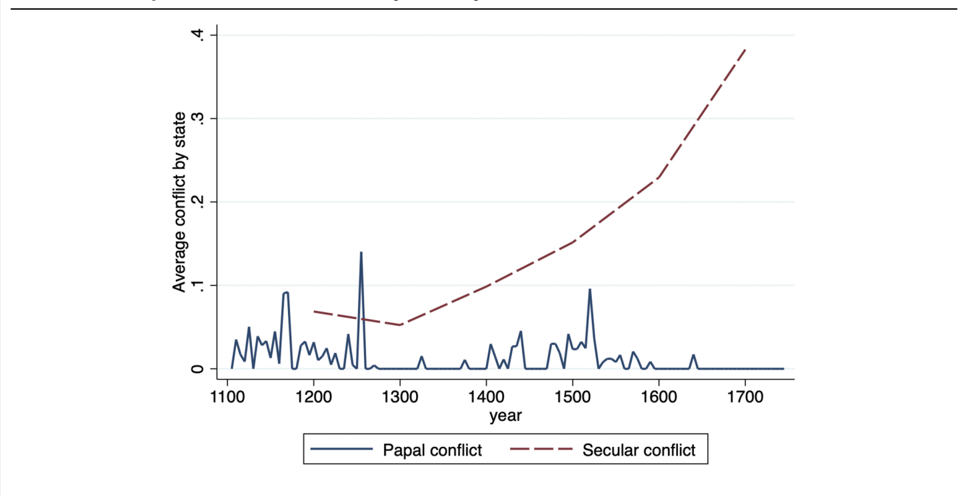
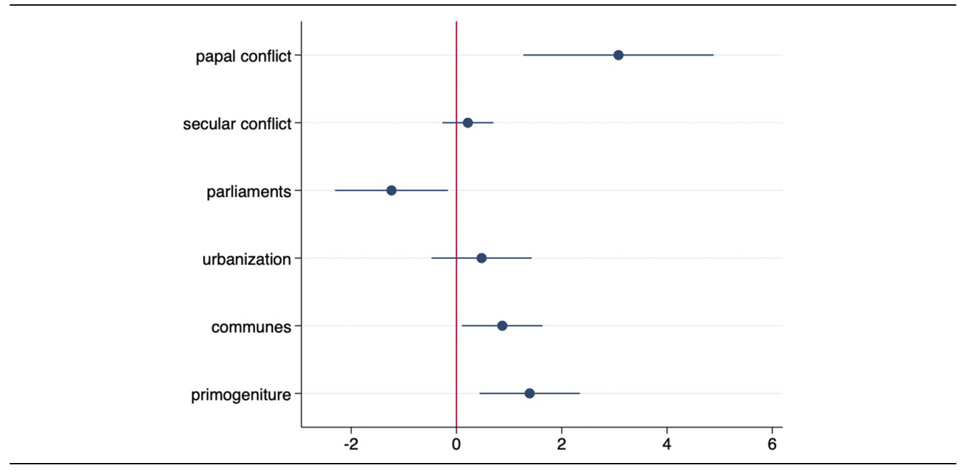
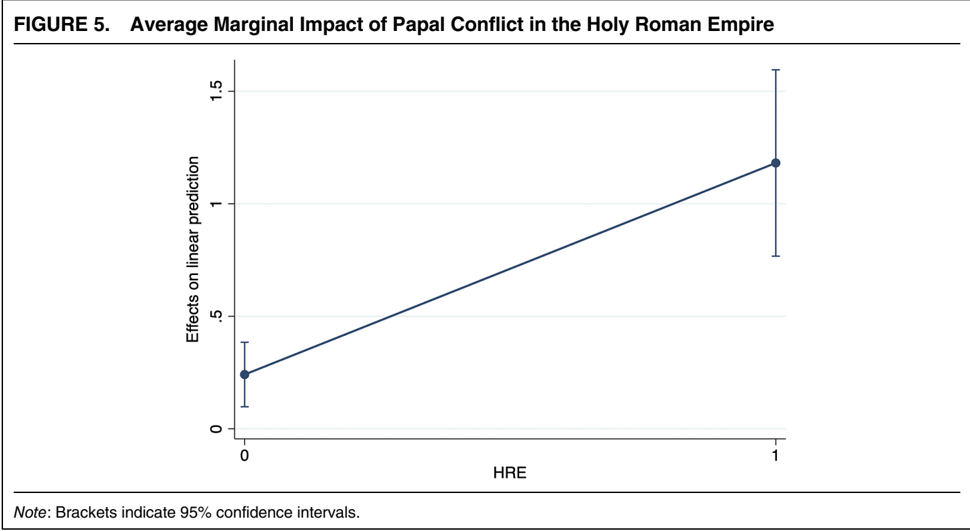
- Papal conflict is positively associated with territorial fragmentation across 1000–1800 (coefficient 3.655, p < 0.001) and in the medieval period (0.139 without controls; 0.184* with parliaments and urbanization). In the early modern period, the association is initially positive (0.540*, 0.462*) but disappears once Protestant status is included.
- Secular conflict is not associated with consolidation; in the early modern period it is positively associated with fragmentation (0.326* in model 6). Parliaments are negatively associated with fragmentation, urbanization positively, and Holy Roman Empire membership is not independently associated with fragmentation in the medieval models but is positive in early modern models.
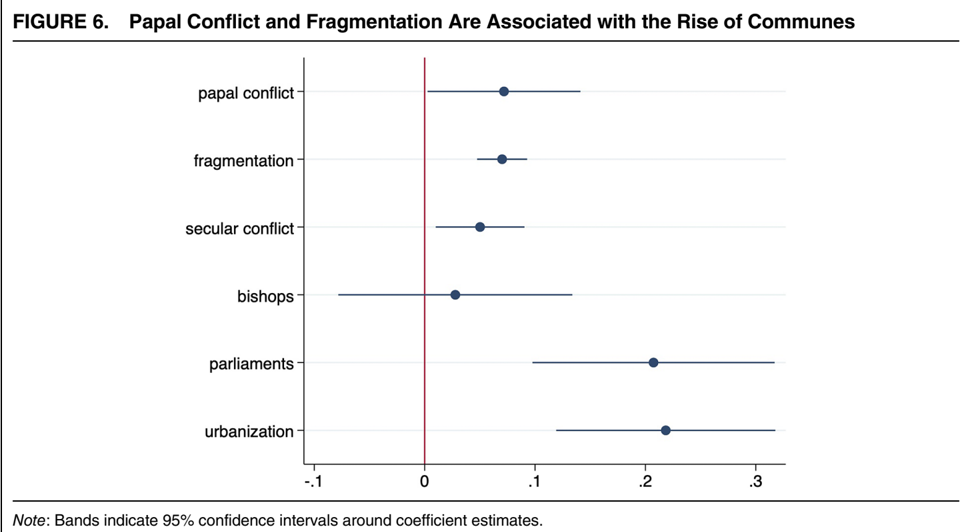
- Alternative religious explanations also correlate with fragmentation: primogeniture (1.390 overall; 0.374* medieval) and communes (0.870* overall; 0.663* medieval) are positively associated with fragmentation, while neither is associated with early modern fragmentation. Papal conflict is also positively associated with communes in the medieval period (0.109*; 0.056* with bishops included), and fragmentation and bishops are positively associated with communes.
- The Church used temporal alliances, proxy wars, crusades, depositions, and ideological arguments to fragment hostile rulers, chiefly the Holy Roman Empire; fragmentation persisted in Germany and Italy until their late nineteenth-century unification.
Methods
- Historical panel/grid-cell analysis of Western Christendom, 1000–1800, split into medieval (1000–1350) and early modern (1450–1750) periods, with over 105,000 grid cell-year observations. Fragmentation is proxied by the number of state boundaries crossing 100 × 100 km grid cells; papal conflict counts wars by proxy, papal depositions, political crusades, and attacks led or financed by popes over a rolling 5-year period.
- Controls include secular conflict, parliaments, urbanization, Holy Roman Empire membership, Protestant status, communes, primogeniture, and bishops. Main analysis uses OLS with two-way grid cell and year fixed effects, robust standard errors clustered around grid cells, plus robustness checks with alternative fragmentation measures, placebo tests, and Oster sensitivity tests.
Limitations
- Paper-stated: the observational design with fixed effects only approximates a difference-in-difference approach, though the paper argues reverse causation is implausible based on papal intentions, sequencing, and geographic patterns. The papal conflict measure counts incident types without weighting and can assign a value of 3 when one incident involves multiple types. Protestant data are measured at the city level, producing collinearity with papal conflict that disappears in state-level reruns. The analysis excludes Eastern-rite territories (Bulgaria, Greece, Romania, Russia, Serbia).
- Evident from the text: fragmentation is proxied by state borders within grid cells, and the periodization and coding choices shape the results; the early modern papal-conflict finding depends on controlling for Protestant status. The paper also notes the Church was not monolithic, excommunications were surprisingly weak weapons, and administrative institutional development is not equivalent to state capacity or the territorial state.
Model-written summary. Check it against the paper before relying on it.
Integrity signals
Registry
Cites
Statistics
Figures
Verification
Claims the paper makes
1 Valid · 6 Not valid · 13 Not checked · 81 Own results and interpretations
The cited sources that could be checked couldn’t confirm or dispute this claim.
In the paper
“To curry local support, both popes and emperors granted new charters with substantial privileges to lay officials and new political rights”
What the sources say
- Could not verifycites Witt 2012, 206 matched to “The Two Latin Cultures and the Foundation of Renaissance Humanism in Medieval Italy” (2012) sourceExperimental — accuracy not yet measured
The Ronald G. Witt passages (pp. 3–4) discuss communal institutions and papal influence, but do not say that popes or emperors granted charters, privileges to lay officials, or new political rights to gain local support. Searches for the claim’s wording and for French terms concerning charters and privileges found no passage addressing those grants. (LLM, conf=0.72)
plainstates a cause- Asserted: passes — The authors put it forward as true.
- Checkable: passes — It can be checked against evidence.
- Load-bearing: passes — The paper’s conclusions depend on it.
- Based: passes — The paper gives a reason why it holds.
- Could not verify
The cited sources support only part of this claim — read each source’s verdict below.
In the paper
“self-governing towns arose where the central government was too weak to assert control (Doucette and Møller 2021; Møller and Doucette 2022, 55ff; Wickham 2015, 9; 2016, 148ff; Watts 2009, 99).”
What the sources say
- Partly supportedcites Doucette and Møller 2021 matched to “The Collapse of State Power, the Cluniac Reform Movement, and the Origins of Urban Self-Government in Medieval Europe” (2021) sourceExperimental — accuracy not yet measured
The paper’s title links the collapse of state power to the origins of urban self-government (title; no page given). The passages available from our copy do not state the more specific claim that self-governing towns arose where central government was too weak to assert control. (LLM, conf=0.68)
- Not checked — no full text of the sourcecites Møller and Doucette 2022, 55ff matched to “The Catholic Church and European State Formation, AD 1000-1500” (2022) source
- Not checked — no full text of the sourcecites Watts 2009, 99 matched to “The Making of Polities: Europe, 1300–1500” (2009) source
plainstates a cause- Asserted: passes — The authors put it forward as true.
- Checkable: passes — It can be checked against evidence.
- Load-bearing: passes — The paper’s conclusions depend on it.
- Based: passes — The paper gives a reason why it holds.
- Partly supported
A result the paper reports from its own data — it cites no other source for it, so there is none to check. The quote shows it is in the paper.
In the paper
“Parliaments are negatively associated with fragmentation and cities are positively associated, in keeping with the existing literature.”
plainstates an association- Asserted: passes — The authors put it forward as true.
- Checkable: passes — It can be checked against evidence.
- Load-bearing: unclear — It is unclear whether the paper’s conclusions depend on it.
- Based: passes — The paper gives a reason why it holds.
- Rests on an assumption not shown here.
A result the paper reports from its own data — it cites no other source for it, so there is none to check. The quote shows it is in the paper.
In the paper
“Status as part of the Holy Roman Empire is not independently associated with fragmentation in the Middle Ages.”
plain- Asserted: passes — The authors put it forward as true.
- Checkable: passes — It can be checked against evidence.
- Load-bearing: passes — The paper’s conclusions depend on it.
- Based: passes — The paper gives a reason why it holds.
- Rests on an assumption not shown here.
None of the sources cited for this claim have been checked yet.
In the paper
“Primogeniture does not lower fragmentation, consistent with the argument that medieval dynastic unions did not permanently unite territory, and did not lead to the expansion of authority (Joseph 2015).”
plain- Asserted: passes — The authors put it forward as true.
- Checkable: passes — It can be checked against evidence.
- Load-bearing: unclear — It is unclear whether the paper’s conclusions depend on it.
- Based: passes — The paper gives a reason why it holds.
- Rests on an assumption not shown here.
61 more claims
Create a free account to see all 101 claims and to verify the 1 reference still open.
- It may state two separate claims as one. 28
- Probably not a substantial claim. 8
Self-check
Percentages, sums and reported differences re-computed from the paper’s own numbers.
Each contradiction between two passages listed here was confirmed by an independent check.
Rated minor: it would not touch a result — a value no result rests on, a p-value that stays on the same side of the significance level, or a conflict that is clerical, resolved elsewhere in the paper, or outside its own findings.
In the paper
§ Empirical Implications: The Rise of Communes · p. 15
“In the early modern period, in contrast, these variables no longer predict the rise of communes.”
§ CONCLUSION: MISSA FINITA EST? · p. 16
“| Papal conflict | 0.072* | 0.109*** | 0.056* | 0.103 | 0.134* |”
Rated minor: it would not touch a result — a value no result rests on, a p-value that stays on the same side of the significance level, or a conflict that is clerical, resolved elsewhere in the paper, or outside its own findings.
In the paper
§ The Church Gains Autonomy · p. 6
“Innocent IV (r. 1243 -54)”
§ Papal Conflict: Alliances and Wars by Proxy · p. 9
“Innocent IV (r. 1243 -51)”
Rated minor: it would not touch a result — a value no result rests on, a p-value that stays on the same side of the significance level, or a conflict that is clerical, resolved elsewhere in the paper, or outside its own findings.
In the paper
“the Thirty Years ' War (1618 -1848)”
Reported 30 · recomputed 230
Rated minor: it would not touch a result — a value no result rests on, a p-value that stays on the same side of the significance level, or a conflict that is clerical, resolved elsewhere in the paper, or outside its own findings.
In the paper
§ THE BELLICIST ACCOUNTS · p. 2
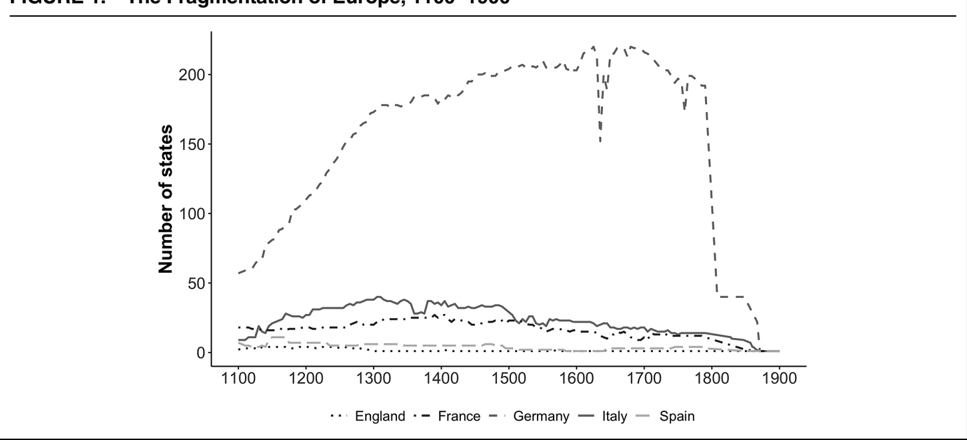
“a change from as many as 500 independent states in Europe in the year 1500 to 30 four centuries later”
§ THE MEDIEVAL CHURCH AS A FORCE IN STATE FORMATION · p. 3
“the number of states decreased from 500 in 1500 to 20 in 1900”
Rated minor: it would not touch a result — a value no result rests on, a p-value that stays on the same side of the significance level, or a conflict that is clerical, resolved elsewhere in the paper, or outside its own findings.
In the paper
§ The Church Gains Autonomy · p. 6
“When Henry IV began to name bishops, the Pope excommunicated him in 1075”
§ Weapons of the Meek? Papal Strategies of Confrontation · p. 8
“when German emperor Henry IV was excommunicated for the first time in 1076”
Citations
Cites
Unobservable Selection and Coefficient Stability: Theory and Evidence
Oster, E. (2019) · Journal of Business & Economic Statistics · doi:10.1080/07350015.2016.1227711 · Cited by 5,367 · cited 1×
“Oster (2019) proposes 1 as a conventional threshold.”
BackgroundNorth, D. C., & Weingast, B. R. (1989) · The Journal of Economic History · doi:10.1017/s0022050700009451 · Cited by 5,300
Territoriality and beyond: problematizing modernity in international relations
Ruggie, J. G. (1993) · International Organization · doi:10.1017/s0020818300004732 · Cited by 2,672
The Formation of National States in Western Europe
Lebrun, R. A., & Tilly, C. (1976) · The American Historical Review · doi:10.2307/1852456 · Cited by 2,512
Ideas and Foreign Policy: Beliefs, Institutions, and Political Change
(1993) · Cornell University Press eBooks · doi:10.7591/9781501724992 · Cited by 1,738
Lineages of the Absolutist State
Rothkrug, L., & Anderson, P. (1976) · The American Historical Review · doi:10.2307/1851205 · Cited by 1,694
Mann, M. (1986) · Cambridge University Press eBooks · doi:10.1017/cbo9780511570896 · Cited by 1,683
The origins of political order: from prehuman times to the French Revolution
(2011) · Choice Reviews Online · doi:10.5860/choice.49-1735 · Cited by 1,605
The Sovereign State and Its Competitors: An Analysis of Systems Change
Spruyt, H. (1994) · Princeton University Press eBooks · doi:10.1515/9780691213057 · Cited by 1,373
The Development of the Family and Marriage in Europe
Goody, J. (1983) · Cambridge University Press eBooks · doi:10.1017/cbo9780511607752 · Cited by 1,299
The Wealth and Poverty of Nations
Rosen, G. (1999) · Journal of Economic Issues · doi:10.1080/00213624.1999.11506142 · Cited by 1,237
Politics Among Nations: The Struggle for Power and Peace
Berger, P., & Fordham University Press (1950) · Thought · doi:10.5840/thought1950254197 · Cited by 1,237
Sovereignty, International Relations, and the Westphalian Myth
Osiander, A. (2001) · International Organization · doi:10.1162/00208180151140577 · Cited by 1,112
Democracy and the Global Order: From the Modern State to Cosmopolitan Governance
Fukuyama, F., & Held, D. (1996) · Foreign Affairs · doi:10.2307/20047664 · Cited by 1,068
Birth of the Leviathan: Building States and Regimes in Medieval and Early Modern Europe
Ertman, T. (1997) · doi:10.1017/cbo9780511529016 · Cited by 988
Herbst, J., & Herbst, J. (2017) · Princeton University Press · doi:10.23943/princeton/9780691164137.001.0001 · Cited by 835
Coercion, capital, and European states AD 990–1990
(1991) · World Development · doi:10.1016/0305-750x(91)90113-v · Cited by 794
The Pursuit of Power: Technology, Armed Force, and Society since A.D. 1000
McNeill, W. H. (1982) · University of Chicago Press eBooks · doi:10.7208/chicago/9780226160191.001.0001 · Cited by 783
Continuity and Transformation in the World Polity: Toward a Neorealist Synthesis
Ruggie, J. G. (1983) · World Politics · doi:10.2307/2010273 · Cited by 770
The European Miracle: Environments, Economies, and Geopolitics in the History of Europe and Asia
Woodruff, W., & Jones, E. L. (1982) · The American Historical Review · doi:10.2307/1870132 · Cited by 762
The Myth of 1648: Class, Geopolitics, and the Making of Modern International Relations
Teschke, B. (2003) · Cited by 749
Cities and economic development: from the dawn of history to the present
(1989) · Choice Reviews Online · doi:10.5860/choice.26-5772 · Cited by 730
Doner, R. F., Ritchie, B. K., & Slater, D. (2005) · International Organization · doi:10.1017/s0020818305050113 · Cited by 709
War and State Formation in Ancient China and Early Modern Europe
Hui, V. T.-B. (2005) · Cambridge University Press eBooks · doi:10.1017/cbo9780511614545 · Cited by 663
Revolutions in sovereignty: how ideas shaped modern international relations
(2001) · Choice Reviews Online · doi:10.5860/choice.39-0590 · Cited by 631
On the Medieval Origins of the Modern State
Cheyette, F. L., & Strayer, J. R. (1971) · The American Historical Review · doi:10.2307/1849265 · Cited by 506
Kings or People: Power and the Mandate to Rule
Bendix, R. (1978) · doi:10.1525/9780520351950 · Cited by 446
The Sinews of Power: War, Money, and the English State, 1688-1783.
Pocock, J. G. A., & Brewer, J. (1990) · Eighteenth-Century Studies · doi:10.2307/2738961 · Cited by 425
Fiefs and vassals: the medieval evidence reinterpreted
(1995) · Choice Reviews Online · doi:10.5860/choice.32-4068 · Cited by 389
The Rise and Fall of Classical Greece
Ober, J. (2015) · Princeton University Press eBooks · doi:10.1515/9781400865550 · Cited by 378
Before the Industrial Revolution: European Society and Economy, 1000-1700
Cameron, R., & Cipolla, C. M. (1977) · Journal of Interdisciplinary History · doi:10.2307/202891 · Cited by 358
The Historical Essays of Otto Hintze.
Paret, P., & Gilbert, F. (1976) · Military Affairs · doi:10.2307/1986853 · Cited by 353
War, Rivalry, and State Building in Latin America
Thies, C. G. (2005) · American Journal of Political Science · doi:10.1111/j.1540-5907.2005.00134.x · Cited by 344
The Big Bangs of IR: The Myths That Your Teachers Still Tell You about 1648 and 1919
de Carvalho, B., Leira, H., & Hobson, J. M. (2011) · Millennium: Journal of International Studies · doi:10.1177/0305829811401459 · Cited by 339
WESTERN SOCIETY AND THE CHURCH IN THE MIDDLE AGES
Barlow, F. (1971) · History · doi:10.1111/j.1468-229x.1971.tb02125.x · Cited by 338
(1999) · Cited by 315
Downing, B. (1993) · Princeton University Press eBooks · doi:10.1515/9780691222189 · Cited by 314
Before and Beyond Divergence: The Politics of Economic Change in China and Europe
Rosenthal, J.-L., & Wong, R. B. (2011) · Harvard University Press eBooks · doi:10.4159/harvard.9780674061293 · Cited by 314
The Evolution of International Society
Watson, A. (2009) · Routledge eBooks · doi:10.4324/9780203875643 · Cited by 305
War and the Birth of the Nation State
Bean, R. (1973) · The Journal of Economic History · doi:10.1017/s0022050700076531 · Cited by 303
Why Did Europe Conquer the World?
Hoffman, P. T. (2015) · Princeton University Press eBooks · doi:10.1515/9781400865840 · Cited by 302
The Long Road to the Industrial Revolution: The European Economy in a Global Perspective, 1000-1800
van Zanden, J. L. (2009) · BRILL eBooks · doi:10.1163/ej.9789004175174.i-346 · Cited by 290
Bosker, M., Buringh, E., & van Zanden, J. L. (2013) · The Review of Economics and Statistics · doi:10.1162/rest_a_00284 · Cited by 287
Glete, J. (2002) · Routledge eBooks · doi:10.4324/9780203465318 · Cited by 284
BLAYDES, L., & CHANEY, E. (2013) · American Political Science Review · doi:10.1017/s0003055412000561 · Cited by 276
The New Cambridge Medieval History
(1995) · Cambridge University Press eBooks · doi:10.1017/chol9780521362924 · Cited by 276
The state: its nature, development, and prospects
(1991) · Choice Reviews Online · doi:10.5860/choice.29-0574 · Cited by 258
Blood and Debt: War and the Nation-State in Latin America
Maxwell, K., & Centeno, M. A. (2002) · Foreign Affairs · doi:10.2307/20033317 · Cited by 256
Historical Sociology of International Relations
Nexon, D. H., Hobden, S., & Hobson, J. M. (2003) · Contemporary Sociology · doi:10.2307/1556525 · Cited by 245
Bisson, T. N. (1994) · Past and Present · doi:10.1093/past/142.1.6 · Cited by 242
Heart of Europe: A History of the Holy Roman Empire
Wilson, P. H. (2016) · Harvard University Press eBooks · doi:10.4159/9780674915909 · Cited by 241
Religion and economic growth: was Weber right?
Blum, U., & Dudley, L. (2001) · Journal of Evolutionary Economics · doi:10.1007/pl00003862 · Cited by 229 · cited 1×
“Cathedral chapters founded schools to study canon law, and kept records and relied on written documents, lowering transaction costs and allowing information to spread (Blum and Dudley 2001).”
Cowdrey, H. E. J. (1998) · Oxford University Press eBooks · doi:10.1093/acprof:oso/9780198206460.001.0001 · Cited by 226
The Rise of the Fiscal State in Europe c.1200–1815
(1999) · Oxford University Press eBooks · doi:10.1093/acprof:oso/9780198204022.001.0001 · Cited by 224
Medieval Universities, Legal Institutions, and the Commercial Revolution *
Cantoni, D., & Yuchtman, N. (2014) · The Quarterly Journal of Economics · doi:10.1093/qje/qju007 · Cited by 221 · cited 1×
“…the deep (and secular) history of the European state: the influence of the Crusades (Blaydes and Paik 2016), the development of legal systems (Cantoni and Yuchtman 2014; Møller 2019), cities and communes (Abramson 2017; Møller 2017), representative assemblies (Boucoyannis 2021; Stasa-vage…”
Rulers, Religion, and Riches: Why the West Got Rich and the Middle East Did Not
Rubin, J. (2017) · Cambridge University Press eBooks · doi:10.1017/9781139568272 · Cited by 218
Delivering Stability—Primogeniture and Autocratic Survival in European Monarchies 1000–1800
KOKKONEN, A., & SUNDELL, A. (2014) · American Political Science Review · doi:10.1017/s000305541400015x · Cited by 213
A Distant Mirror: The Calamitous 14th Century
Bachrach, B. S., & Tuchman, B. W. (1979) · The American Historical Review · doi:10.2307/1855427 · Cited by 212
The papal monarchy: the Western church from 1050 to 1250
(1990) · Choice Reviews Online · doi:10.5860/choice.27-3290 · Cited by 208
When Distance Mattered: Geographic Scale and the Development of European Representative Assemblies
STASAVAGE, D. (2010) · American Political Science Review · doi:10.1017/s0003055410000444 · Cited by 201 · cited 3×
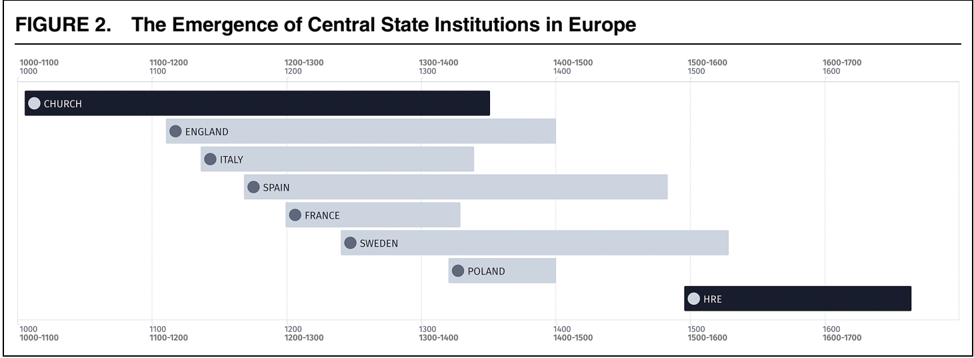
“Second, many of the institutions that the bellicists claim were the inadvertent result of early modern warfare, such as taxation, courts, central administrations, or parliaments, arose long before the pressures of war supposedly made them necessary (Blaydes and Paik 2016; Stasavage 2010; 2016).”
The Papacy, 1073–1198: Continuity and Innovation
Robinson, I. S. (1990) · Cambridge University Press eBooks · doi:10.1017/cbo9781139167772 · Cited by 178
The Church and Economic Activity in the Middle Ages.
Hilton, R. H., & Gilchrist, J. (1969) · The Economic History Review · doi:10.2307/2594159 · Cited by 176
The rise and decline of European parliaments, 1188–17891
VAN ZANDEN, J. L., BURINGH, E., & BOSKER, M. (2012) · The Economic History Review · doi:10.1111/j.1468-0289.2011.00612.x · Cited by 175
The Meaning of New Medievalism
FRIEDRICHS, J. (2001) · European Journal of International Relations · doi:10.1177/1354066101007004004 · Cited by 172
The evolution of international society
Buzan, B. (1992) · International Affairs · doi:10.2307/2622712 · Cited by 167
Seven Centuries of European Economic Growth and Decline
Fouquet, R., & Broadberry, S. (2015) · The Journal of Economic Perspectives · doi:10.1257/jep.29.4.227 · Cited by 165
An Imperial State at War: Britain from 1689 to 1815.
Bowen, H. V., & Stone, L. (1995) · The Economic History Review · doi:10.2307/2598417 · Cited by 164
The Economic Origins of the Territorial State
Abramson, S. F. (2017) · International Organization · doi:10.1017/s0020818316000308 · Cited by 161
Ideas of the State in Thirteenth and Fourteenth-Century Commentators on the Roman Law
Canning, J. P. (1983) · Transactions of the Royal Historical Society · doi:10.2307/3678987 · Cited by 145
Representation and Consent: Why They Arose in Europe and Not Elsewhere
Stasavage, D. (2016) · Annual Review of Political Science · doi:10.1146/annurev-polisci-043014-105648 · Cited by 142
The Making of Polities: Europe, 1300–1500
Watts, J. (2009) · doi:10.1017/cbo9780511818479 · Cited by 141
Feudal Europe, 800–1300: communal discourse and conflictual practices
Fischer, M. (1992) · International Organization · doi:10.1017/s0020818300027776 · Cited by 136
The Two Latin Cultures and the Foundation of Renaissance Humanism in Medieval Italy
Witt, R. G. (2012) · doi:10.1017/cbo9780511779299 · Cited by 129
The Medieval State: The Tyranny of a Concept?*
Davies, R. R. (2003) · Journal of Historical Sociology · doi:10.1111/1467-6443.00206 · Cited by 129
Military conflict and the rise of urban Europe
Dincecco, M., & Onorato, M. G. (2016) · Journal of Economic Growth · doi:10.1007/s10887-016-9129-4 · Cited by 120
Adopting a New Religion: The Case of Protestantism in 16th Century Germany
Cantoni, D. (2012) · The Economic Journal · doi:10.1111/j.1468-0297.2012.02495.x · Cited by 119
Europe in the High Middle Ages
Jordan, W. C. (2001) · Cited by 109
Historical sociology of international relations
(2002) · Choice Reviews Online · doi:10.5860/choice.40-2448 · Cited by 109
Max Weber: An Intellectual Biography
Ringer, F. (2004) · doi:10.7208/chicago/9780226720067.001.0001 · Cited by 107
The New Cambridge Medieval History
Abulafia, D. (1999) · Cambridge University Press eBooks · doi:10.1017/chol9780521362894 · Cited by 105
Why Europe? The Medieval Origins of Its Special Path
Mitterauer, M., & Chapple, G. (2010) · University of Chicago Press eBooks · doi:10.7208/chicago/9780226532387.001.0001 · Cited by 105
The Decline and Rise of Democracy: A Global History from Antiquity to Today
Stasavage, D. (2020) · Princeton University Press eBooks · doi:10.2307/j.ctvss3zz6 · Cited by 103
Escaping poverty: The origins of modern economic growth
Vries, P. (2013) · doi:10.14220/9783737001687 · Cited by 101 · cited 2×
“…See Hintze ([1906] 1975), Dincecco and Onorato (2016), Dincecco and Wang (2018), Hoffman (2015), Jones (1981), Landes (1998), Mann (1986), Rosenthal and Wong (2011), Schatz (1996), Stasavage (2010), Van Zanden (2009), Voigtländer and Voth (2013), and Vries (2013). institutions, such as common law.”
Beyond War and Contracts: The Medieval and Religious Roots of the European State
Grzymala-Busse, A. (2020) · Annual Review of Political Science · doi:10.1146/annurev-polisci-050718-032628 · Cited by 90
Europe in the Fourteenth and Fifteenth Centuries
Hay, D. (2016) · Routledge eBooks · doi:10.4324/9781315836782 · Cited by 90
The Military Revolution: Military Innovation and the Rise of the West, 1500-1800
Hall, B. S., DeVries, K. R., & Parker, G. (1990) · Technology and Culture · doi:10.2307/3106067 · Cited by 84
Gifts of Mars: Warfare and Europe's Early Rise to Riches
Voigtländer, N., & Voth, H. (2013) · The Journal of Economic Perspectives · doi:10.1257/jep.27.4.165 · Cited by 84
Violent Conflict and Political Development Over the Long Run: China Versus Europe
Dincecco, M., & Wang, Y. (2018) · Annual Review of Political Science · doi:10.1146/annurev-polisci-050317-064428 · Cited by 83
Society and Politics in Medieval Italy
Hyde, J. K. (1973) · doi:10.1007/978-1-349-15504-0 · Cited by 81
Blaydes, L., & Paik, C. (2016) · International Organization · doi:10.1017/s0020818316000096 · Cited by 74
Popes, Kings, and Endogenous Institutions: The Concordat of Worms and the Origins of Sovereignty
de Mesquita, B. B. (2000) · International Studies Review · doi:10.1111/1521-9488.00206 · Cited by 72
Beyond the Tilly Thesis: “Family Values” and State Formation in Latin Christendom
Gorski, P. S., & Sharma, V. S. (2017) · Cambridge University Press eBooks · doi:10.1017/9781316493694.005 · Cited by 71
Kinship, Property, and Authority: European Territorial Consolidation Reconsidered
Sharma, V. S. (2015) · Politics & Society · doi:10.1177/0032329215571279 · Cited by 70
Medieval origins of constitutional government in the West
Downing, B. M. (1989) · Theory and Society · doi:10.1007/bf00160755 · Cited by 69
Medieval tales: neorealist “science” and the abuse of history
Hall, R. B., & Kratochwil, F. V. (1993) · International Organization · doi:10.1017/s0020818300028034 · Cited by 68
The Growth of Papal Government in the Middle Ages
Wallach, L., & Ullmann, W. (1957) · Books Abroad · doi:10.2307/40097603 · Cited by 60
Path Dependence in European Development: Medieval Politics, Conflict, and State Building
Acharya, A. R., & Lee, A. (2019) · Comparative Political Studies · doi:10.1177/0010414019830716 · Cited by 60
Papal Primacy: From its Origins to the Present
Schatz, K. (1999) · Pro Ecclesia A Journal of Catholic and Evangelical Theology · doi:10.1177/106385129900800117 · Cited by 55
War and State Formation: Amending the Bellicist Theory of State Making
Spruyt, H. (2017) · Does War Make States? · doi:10.1017/9781316493694.004 · Cited by 52 · cited 2×
“It lasted well through the mid-nineteenth century, contrary to the bellicist argument that early modern warfare winnowed out and consolidated states (Spruyt 2017, 87).”
The Catholic Church and European State Formation, AD 1000-1500
Møller, J., & Stavnskær Doucette, J. (2022) · doi:10.1093/oso/9780192857118.001.0001 · Cited by 49 · cited 11×
“Further, as Doucette and Møller show, the Church itself diffused norms of local self-governance through bishops and monastic reform (Møller and Doucette 2022).”
InfluentialThe Medieval Roots of Democracy
Møller, J. Ø. (2015) · Journal of democracy · doi:10.1353/jod.2015.0042 · Cited by 46
THE DEVELOPMENT AND DECLINE OF MEDIEVAL VOTING INSTITUTIONS: A COMPARISON OF ENGLAND AND FRANCE
Barzel, Y., & Kiser, E. V. (1997) · Economic Inquiry · doi:10.1111/j.1465-7295.1997.tb01907.x · Cited by 44
Fichtner, P. S. (1976) · The American Historical Review · doi:10.1086/ahr/81.2.243 · Cited by 43
Møller, J. Ø. (2018) · Social Science History · doi:10.1017/ssh.2018.7 · Cited by 39
STATE AND NATION IN WESTERN EUROPE
Kiernan, V. G. (1965) · Past and Present · doi:10.1093/past/31.1.20 · Cited by 38
War, Conflict and the State Reconsidered
Sharma, V. S. (2017) · Cambridge University Press eBooks · doi:10.1017/9781316493694.008 · Cited by 38
The Rise of the Fiscal State in Europe, c. 1200–1815
Bonney, R. (1999) · Oxford University Press eBooks · doi:10.1093/acprof:oso/9780198204022.003.0001 · Cited by 38
Oakley, F. (2012) · Yale University Press eBooks · doi:10.12987/yale/9780300176339.001.0001 · Cited by 37
The Medieval Origins of Modern Legal Education: Between Church and State
Clark, D. S. (1987) · The American Journal of Comparative Law · doi:10.2307/840129 · Cited by 37
Latecomer State Formation: Political Geography and Capacity Failure in Latin America
Sommer, G. R. (2022) · Hispanic American Historical Review · doi:10.1215/00182168-9653713 · Cited by 36
Boucoyannis, D. (2021) · Cambridge University Press eBooks · doi:10.1017/9781316678367 · Cited by 35
Cities and the rise of states in Europe, AD 1000 to 1800
Hall, P. V. (1996) · Cities · doi:10.1016/0264-2751(96)88518-0 · Cited by 34
Political Authority in International Relations: Revisiting the Medieval Debate
López, J. C. (2020) · International Organization · doi:10.1017/s0020818319000390 · Cited by 34
Medieval Universities, Legal Institutions, and the Commercial RevolutionPreprint
Cantoni, D., & Yuchtman, N. (2013) · SSRN Electronic Journal · doi:10.2139/ssrn.2353301 · Cited by 34
The Decline and Rise of Democracy: A Global History from Antiquity to Today
Stasavage, D. (2020) · Princeton University Press eBooks · doi:10.1515/9780691201955 · Cited by 33
The Sleep of Behemoth: Disputing Peace and Violence in Medieval Europe, 1000–1200
Malegam, J. (2013) · doi:10.7591/9780801467899 · Cited by 32
Doucette, J. S., & Møller, J. (2021) · International Organization · doi:10.1017/s0020818320000284 · Cited by 29 · cited 4×
“Below,Iargue that the Church was a critical force in medieval state formation in Europe.”
InfluentialScheidel, W. (2019) · Princeton University Press eBooks · doi:10.1515/9780691198835 · Cited by 27
The Sleep of Behemoth: Disputing Peace and Violence in Medieval Europe, 1000-1200
Shogimen, T. (2014) · Journal of Church and State · doi:10.1093/jcs/csu119 · Cited by 26
Frontiers of Institutional Economics
Hodgson, G. M. (2001) · New Political Economy · doi:10.1080/13563460123448 · Cited by 22
Bringing the Church Back In: Ecclesiastical Influences on the Rise of Europe
Møller, J. Ø. (2019) · Politics and Religion · doi:10.1017/s1755048318000822 · Cited by 21
Paying for War and Building States: The Coalitional Politics of Debt Servicing and Tax Institutions
Saylor, R., & Wheeler, N. C. (2017) · World Politics · doi:10.1017/s0043887116000319 · Cited by 20
Church and State in the Middle Ages
Sullivan, J., & Smith, A. L. (1914) · The American Historical Review · doi:10.2307/1862295 · Cited by 19
The Italian communes. Recent work and current trends
Coleman, E. (1999) · Journal of Medieval History · doi:10.1016/s0304-4181(99)00010-x · Cited by 18
An introduction to medieval institutions
Zacour, N. P. (1969) · St Martin's Press eBooks · Cited by 16
Fichtner, P. S. (1976) · The American Historical Review · doi:10.2307/1851170 · Cited by 16
Whalen, B. E. (2019) · University of Pennsylvania Press eBooks · doi:10.9783/9780812296129 · Cited by 14
Teschke, B. (2017) · Cambridge University Press eBooks · doi:10.1017/9781316493694.002 · Cited by 14
Excommunication in Twelfth Century England
Helmholz, R. H. (1994) · Journal of Law and Religion · doi:10.2307/1051632 · Cited by 13
Medieval Origins of the Rule of Law: The Gregorian Reforms as Critical Juncture?
Møller, J. Ø. (2017) · Hague Journal on the Rule of Law · doi:10.1007/s40803-017-0053-2 · Cited by 13
Kaminsky, H. (2000) · Cambridge University Press eBooks · doi:10.1017/chol9780521362900.030 · Cited by 12
The Sleep of Behemoth: Disputing Peace and Violence in Medieval Europe, 1000-1200
Malegam, J. (2013) · doi:10.7591/cornell/9780801451324.001.0001 · Cited by 12
Otto Hintze, Stein Rokkan and Charles Tilly’s Theory of European State-building
Ertman, T. (2017) · Does War Make States? · doi:10.1017/9781316493694.003 · Cited by 10
Stollberg‐Rilinger, B. (2018) · Princeton University Press eBooks · doi:10.1515/9781400890262 · Cited by 10
Helmholz, R. H. (2015) · Cambridge University Press eBooks · doi:10.1017/cco9781139034401.025 · Cited by 7
The Christian imperial tradition – Greek and Latin
Angelov, D., & Herrin, J. (2012) · Cambridge University Press eBooks · doi:10.1017/cbo9781139136952.008 · Cited by 6
Wickham, C. (2018) · Princeton University Press eBooks · doi:10.23943/princeton/9780691181141.001.0001 · Cited by 6
Fried, J. (2015) · Harvard University Press eBooks · doi:10.4159/9780674735682 · Cited by 5
Reason, Conscience and Equity: Bishops as the King's Judges in Later Medieval England
Dodd, G. (2014) · History · doi:10.1111/1468-229x.12052 · Cited by 4
Baldwin, J. W. (2004) · Cambridge University Press eBooks · doi:10.1017/chol9780521414111.020 · Cited by 4
Poland in the eleventh and twelfth centuries
Wyrozumski, J. (2004) · The New Cambridge Medieval History · doi:10.1017/chol9780521414111.012 · Cited by 4 · cited 2×
“For example, Polish kings allied with the papacy and joined in the fight against the empire, and the papacy actively helped state builders to consolidate rule (Ertman 1997, 279 – 80; Wyrozumski 2004, 281).”
Bonner, E. A. (2003) · The Innes Review · doi:10.3366/inr.2003.54.2.142 · Cited by 3
Welfs, Hohenstaufen and Habsburgs
Toch, M. (1999) · Cambridge University Press eBooks · doi:10.1017/chol9780521362894.018 · Cited by 3
Between Sword and Prayer: Warfare and Medieval Clergy in Cultural Perspective
Kotecki, R., Maciejewski, J., & Ott, J. (2018) · doi:10.1163/9789004353626 · Cited by 3
Violent Conflict and Political Development Over the Long Run: China versus EuropePreprint
Dincecco, M., & Wang, Y. (2017) · SSRN Electronic Journal · doi:10.2139/ssrn.3032679 · Cited by 3
The Bishop as Lawmaker in Late Medieval Europe
Dorin, R. W. (2020) · Past & Present · doi:10.1093/pastj/gtaa045 · Cited by 1
Tüchle, H. (2016) · Sacramentum Mundi Online · doi:10.1163/2468-483x_smuo_com_002120 · Cited by 1
Grzymała-Busse, A. M. (2023) · Harvard Dataverse · doi:10.7910/dvn/dwqlib · Cited by 1
Self-citationThe concept of sacrum imperium in historical scholarship
Sulovsky, V. (2019) · History Compass · doi:10.1111/hic3.12586 · Cited by 1
Κotecki, R. (2017) · BRILL eBooks · doi:10.1163/9789004353626_012 · Cited by 1
The concept of sacrum imperium in historical scholarship
Sulovsky, V. (2019) · Apollo (University of Cambridge) · doi:10.17863/cam.41338 · Cited by 1
The Medieval State: The Tyranny of a Concept?
Davies, R. (n.d.) · Twenty Years of theJournal of Historical Sociology · doi:10.1002/9781444309706.ch15
The kingdom of Sicily under the Hohenstaufen and Angevins
Abulafia, D. (1999) · The New Cambridge Medieval History · doi:10.1017/chol9780521362894.024
Blood and Debt: War and the Nation-State in Latin America
Centeno, M. A. (2002) · doi:10.5325/j.ctv14gphb8
Riley-Smith, J. (2005) · Christianity: The Complete Guide · doi:10.5040/9781472972835.0067a
Jordan, W. C. (2002) · The Idea of Europe · doi:10.1017/cbo9780511496813.004
Research works printed but not linked: 21
- Ozment, Steven. 1980. The Age of Reform . New Haven, CT: Yale University Press.
- Weber, Max. 1958. The City . New York: Free Press.
- Mitteraurer, Michael. 2010. WhyEurope?TheMedievalOrigins of Its Special Path . Chicago, IL: University of Chicago Press.
- Obertyński, 1974, Historia Kościoła W Polsce
- Morgenthau, Hans. 1985. Politics among Nations . New York: McGraw-Hill.
- Brundage, James A. 2009. Law, Sex, and Christianity in Medieval Europe . Chicago, IL: Chicago University Press.
- Dupuy, R. Ernest, and Trevor N. Dupuy. 1993. The Harper Encyclopedia of Military History . New York: HarperCollins.
- Sharp, Sheila. 2001. ' The West Saxon Tradition of Dynastic Marriage with Special Reference to the Family of Edward the Elder. ' In Edward the Elder, 899 -824 , eds. Nick Higham and David Hill, 83 -5. London: Routledge.
- Wickham, Christopher. 2016. Medieval Europe . New Haven, CT: Yale University Press.
- Jedin, Hubert. 1993. The Medieval and Reformation Church . New York: Crossroad.
- Rokkan, Stein. 1975. ' Dimensions of State Formation and Nation Building: A Possible Paradigm for Research on Variations within Europe. ' In The Formation of National States in Western Europe , ed. Charles Tilly, 562 -600. Princeton NJ: Princeton University Press.
- Brooke, Zachary Nugent 1938. AHistory of Europe from 911 to 1198 . London: Methuen & Co.
- Bueno de Mesquita, 2022, The Invention of Power
- Riley-Smith, Jonathan. 2005. Crusades: A History . New York: Continuum Books.
- Levi, Margaret. 1988. Of Rule and Revenue . Berkeley: University of California Press.
- 10.2307/j.ctvc778tr · doi:10.2307/j.ctvc778tr
- Ergang, Robert 1971. Emergence of the National State . New York: Van Nostrand Reinhold.
- Krasner, Stephen. 1993. ' Westphalia and All That. ' In Ideas and Foreign Policy , eds. Judith Goldstein and Robert O. Keohane, 235 -64. Ithaca, NY: Cornell University Press.
- Grzymala-Busse, Anna. 2023a. Sacred Foundations: The Religious andMedieval Roots of the European State . Princeton, NJ: Princeton University Press.
- Schwartzberg, Melissa. 2014. Counting the Many: The Origins of Supermajority Rule . Cambridge: Cambridge University Press.
- Hintze, Otto. [1906] 1975. ' Military Organization and the Organization of the State. ' In The Historical Essays of Otto Hintze , ed. Felix Gilbert, 180 -215. New York: Oxford University Press.
Cited by
Suryanarayan, P. (2024) · Annual Review of Political Science · doi:10.1146/annurev-polisci-061621-084709 · Cited by 72
Foreign faith and rising state: An examination of state-building dynamics in late 16th-century Japan
Wang, M., Mitchell, A. M., & Yin, W. (2025) · Political Science Research and Methods · doi:10.1017/psrm.2025.10023 · Cited by 1
Trilateral politics in hierarchy, war, and state formation
McDonald, P. J., & Galambos, K. (2024) · International Theory · doi:10.1017/s1752971923000209 · Cited by 1
Slave Empire: Ottoman Islamic Slavery and State Formation
Sharman, J. C. (2026) · International Studies Quarterly · doi:10.1093/isq/sqag052 · Cited by 1
A Theory of Segmented Polities: The European Union in Perspective
Bátora, J., Fossum, J. E., & Trondal, J. (2026) · Cambridge University Press eBooks · doi:10.1017/9781009589345 · Cited by 2
Metadata
- Authors
- GRZYMALA-BUSSE, A.
- ORCID
- GRZYMALA-BUSSE, ANNA
- Venue
- American Political Science Review
- Publisher
- Cambridge University Press (CUP)
- Published
- 2023-04-20
- Volume
- 118
- Issue
- 1
- Pages
- 88-107
- ISSN
- 0003-0554 (ISSN-L)
- 1537-5943
- OpenAlex
- W4366495837
- Semantic Scholar
- 41597552ed2edda7aa990bd1cd941d09121e0613
- Cited by
- 11
- References
- 140
- Citations by year
- 2026: 5 · 2025: 3 · 2024: 3
- FWCI
- 85.20
- Type
- journal article
- Language
- en
- Open access
- hybrid
- doi.org
- Locations
- American Political Science Review (publishedVersion, cc-by)
- RePEc: Research Papers in Economics (submittedVersion)
- Funders
- University of Southern California
- John Simon Guggenheim Memorial Foundation
- Princeton University
- Ohio State University
- University of Wisconsin-Madison
- Harvard University
- Johns Hopkins University
- University of Cambridge
- Topics
- Social Sciences › Arts and Humanities › History › Medieval Literature and History
- Social Sciences › Arts and Humanities › History › European Political History Analysis
- Social Sciences › Arts and Humanities › History › Reformation and Early Modern Christianity
- Keywords
- state fragmentation, European state formation, Catholic Church, religious organizations, medieval Europe, proxy wars, Crusades, church-state relations, territorial authorities
About these checks
Registry, retraction, Cites and statistics results are computed, not judged, with one exception: a printed reference that no index lists is read once by a model before it counts as a citation error. Claims are extracted by a model and kept only when their quote appears verbatim in the text; each cited source is then checked, with a model’s help, for whether it says what the claim relies on. Those verdicts can be wrong — read the claim’s quote and the cited source before relying on one.
The claim verdicts this report counts are experimental: their accuracy is not yet measured.
A language model drew the claims from the paper on 2026-10-03, under version 3 of the claim definition (model deepseek-v4.1-flash, prompt extract-v3).
A second model labelled each claim on 2026-10-03 (model jev-1.13-20260917, definition revision gold-guideline-v0.2).
Cited sources are checked with a language model’s help (gpt-6-sol).
Statistics and arithmetic are recomputed, not judged.
Confidence bands are shown only for fields calibrated on our annotated test set. None is calibrated yet, so no band is shown.
What counts as a claim ›How we measure confidence ›How we check this ›
Are you an author, or do you see a problem with this page? Request a review
Data sources
Bibliographic data: Semantic Scholar, OpenAlex, Crossref.
Contains information from the Semantic Scholar Academic Graph Datasets, made available under the ODC Attribution License (ODC-BY 1.0).
Semantic Scholar’s data is described in: Kinney, R., et al. (2023). The Semantic Scholar Open Data Platform. arXiv:2301.10140.
