

Dietary modulation of the gut microbiota – a randomised controlled trial in obese postmenopausal women
Open accessThe DOI matches its Crossref record; 51 of the 51 references it cites were found in a registry or an index.
Abstract
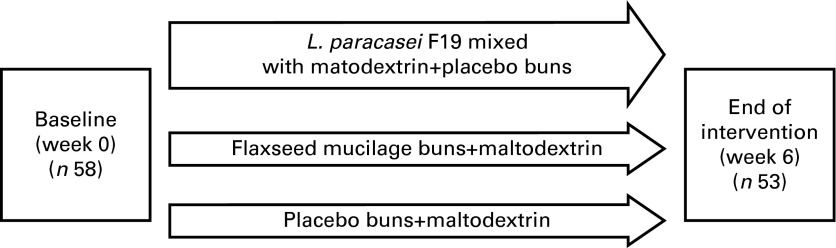
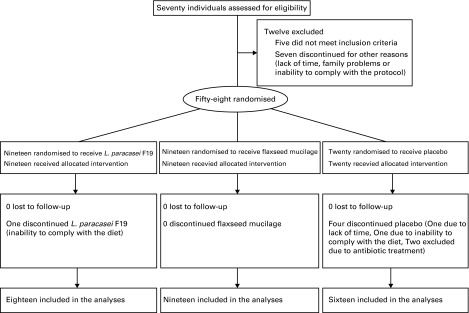
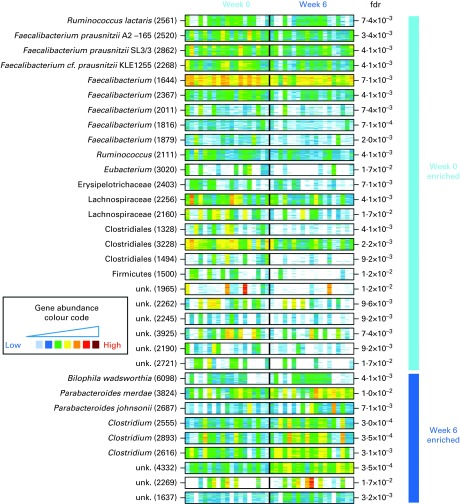
The gut microbiota has been implicated in obesity and its progression towards metabolic disease. Dietary interventions that target the gut microbiota have been suggested to improve metabolic health. The aim of the present study was to investigate the effect of interventions with Lactobacillus paracasei F19 or flaxseed mucilage on the gut microbiota and metabolic risk markers in obesity. A total of fifty-eight obese postmenopausal women were randomised to a single-blinded, parallel-group intervention of 6-week duration, with a daily intake of either L. paracasei F19 (9·4 × 10 10 colony-forming units), flaxseed mucilage (10 g) or placebo. Quantitative metagenomic analysis of faecal DNA was performed to identify the changes in the gut microbiota. Diet-induced changes in metabolic markers were explored using adjusted linear regression models. The intake of flaxseed mucilage over 6 weeks led to a reduction in serum C-peptide and insulin release during an oral glucose tolerance test ( P < 0·05) and improved insulin sensitivity measured by Matsuda index ( P < 0·05). Comparison of gut microbiota composition at baseline and after 6 weeks of intervention with flaxseed mucilage showed alterations in abundance of thirty-three metagenomic species ( P < 0·01), including decreased relative abundance of eight Faecalibacterium species. These changes in the microbiota could not explain the effect of flaxseed mucilage on insulin sensitivity. The intake of L. paracasei F19 did not modulate metabolic markers compared with placebo. In conclusion, flaxseed mucilage improves insulin sensitivity and alters the gut microbiota; however, the improvement in insulin sensitivity was not mediated by the observed changes in relative abundance of bacterial species.
Overview
The claims and statistics of this paper haven’t been checked yet.
Free: it reads the open-access text and checks the first 5 claims that cite a source we can check. Create a free account to check every claim.
Integrity signals
Registry
Cites
Statistics
Figures
Verification
Claims the paper makes
The claims and statistics of this paper haven’t been checked yet.
Free: it reads the open-access text and checks the first 5 claims that cite a source we can check. Create a free account to check every claim.
Claims other papers make about this one
Each is checked against this paper’s own text: does it say what the citing paper says it does?
The cited source says what the claim attributes to it.
In the citing paper
“A significant reduction in the αdiversity of fecal microbiota from baseline was detected in a trial involving flaxseed mucilage, measured by both the exponential of Shannon diversity index (-38,010; 95% CI: -64,473, -11,546; P = 0.007) as well as Simpson's inverse index (-17,515; 95% CI: -30,992, -4038; P = 0.014), although a between-group comparison was not reported (59).”
From Dietary fiber intervention on gut microbiota composition in healthy adults: a systematic review and meta-analysis (2018) · cites this paper as [59]
The check wasn’t confident either way, so it gives no verdict — never disputed.
In the citing paper
“Six RCTs indicated the method for random sequence generation was low risk [29, 34, 44, 47, 48, 52], three other studies indicated high risk [21, 41, 53], and the remaining studies have unclear risk of bias.”
From Comparisons of the effects of different flaxseed products consumption on lipid profiles, inflammatory cytokines and anthropometric indices in patients with dyslipidemia related diseases: systematic review and a dose-response meta-analysis of randomized controlled trials (2021) · cites this paper as [44]
Experimental — accuracy not yet measured
Self-check
Percentages, sums and reported differences re-computed from the paper’s own numbers.
The self-check needs the paper’s full text.
Citations
Cites
1 retracted
Million, M., Maraninchi, M., Henry, M., Armougom, F., Richet, H., Carrieri, P., Valero, R., Raccah, D., Vialettes, B., & Raoult, D. (2012) · International Journal of Obesity · doi:10.1038/ijo.2011.153 · Cited by 663
RetractedMatthews, D. R., Hosker, J. P., Rudenski, A. S., Naylor, B. A., Treacher, D. F., & Turner, R. C. (1985) · Diabetologia · doi:10.1007/bf00280883 · Cited by 31,502 · cited 3×
“With a sample size of eighteen participants per group, a statistical power of 80%, a two-sided significance level of 0·05 and with the assumption of equal variances, the study will identify the changes between independent groups in gut microbiota composition corresponding to 1 SD , e.g. a difference of 40000 gene count…”
InfluentialToprak, O., Kurt, H., Sarı, Y., Şarkış, C., Us, H., & Kırık, A. (2017) · Kidney and Blood Pressure Research · doi:10.1159/000468530 · Cited by 29,627
An obesity-associated gut microbiome with increased capacity for energy harvest
Turnbaugh, P. J., Ley, R. E., Mahowald, M. A., Magrini, V., Mardis, E. R., & Gordon, J. I. (2006) · Nature · doi:10.1038/nature05414 · Cited by 12,444 · cited 1×
“However, causality is suggested by studies in germ-free mice((8,9)), and one study in human subjects((10)).”
BackgroundA human gut microbial gene catalogue established by metagenomic sequencing
MetaHIT Consortium, Qin, J., Li, R., Raes, J., Arumugam, M., Burgdorf, K. S., Manichanh, C., Nielsen, T., Pons, N., Levenez, F., et al. (2010) · Nature · doi:10.1038/nature08821 · Cited by 11,624 · cited 2×
“paracasei F19 in the present study, although it cannot be excluded that the abundance of Lactobacillus species not included in the gene catalogue did change((29)).”
BackgroundMethodSelf-citationA core gut microbiome in obese and lean twins
Turnbaugh, P. J., Hamady, M., Yatsunenko, T., Cantarel, B. L., Duncan, A., Ley, R. E., Sogin, M. L., Jones, W. J., Roe, B. A., Affourtit, J. P., et al. (2009) · Nature · doi:10.1038/nature07540 · Cited by 7,823 · cited 1×
“Meta-genomic studies have suggested that obesity-related metabolic diseases are accompanied by alterations in gut bacteria gene composition and abundance (2–7) .”
BackgroundA metagenome-wide association study of gut microbiota in type 2 diabetes
Qin, J., Li, Y., Cai, Z., Li, S., Zhu, J., Zhang, F., Liang, S., Zhang, W., Guan, Y., Shen, D., et al. (2012) · Nature · doi:10.1038/nature11450 · Cited by 6,762 · cited 8×
“prausnitzii is more abundant in healthy individuals than in individuals with T2D((3,7)).”
BackgroundInfluentialSelf-citationThe gut microbiota as an environmental factor that regulates fat storage
Bäckhed, F., Ding, H., Wang, T., Hooper, L. V., Koh, G. Y., Nagy, A., Semenkovich, C. F., & Gordon, J. I. (2004) · Proceedings of the National Academy of Sciences · doi:10.1073/pnas.0407076101 · Cited by 6,245 · cited 1×
“However, causality is suggested by studies in germ-free mice((8,9)), and one study in human subjects((10)).”
BackgroundMatsuda, M., & DeFronzo, R. A. (1999) · Diabetes Care · doi:10.2337/diacare.22.9.1462 · Cited by 5,621 · cited 1×
“Data from the OGTT were evaluated by AUC analysis and by the Matsuda index((26)).”
MethodRichness of human gut microbiome correlates with metabolic markers
Le Chatelier, E., Nielsen, T., Qin, J., Prifti, E., Hildebrand, F., Falony, G., Almeida, M., Arumugam, M., Batto, J.-M., Kennedy, S., et al. (2013) · Nature · doi:10.1038/nature12506 · Cited by 4,662
Self-citation
Cited by
Items 101–175 of 175
Wu, W., Chen, Z., Han, J., Qian, L., Wang, W., Lei, J., & Wang, H. (2023) · Eating and Weight Disorders - Studies on Anorexia, Bulimia and Obesity · doi:10.1007/s40519-023-01593-w · Cited by 18
Hong, Q., Wang, J., Zhang, H., Liu, X., & Liu, Z. (2023) · Frontiers in Immunology · doi:10.3389/fimmu.2023.1265995 · Cited by 19
Beyond Diet and Exercise: The Impact of Gut Microbiota on Control of Obesity
Kamal, F. D., Dagar, M., Reza, T., Mandokhail, A. K., Bakht, D., Shahzad, M. W., Cabana, E. O. S., Mohsin, S. N., Chilla, S. P., & Bokhari, S. F. H. (2023) · Cureus · doi:10.7759/cureus.49339 · Cited by 22
“For instance, Lactobacillus paracasei has been associated with a healthy metabolic profile [36-38].”
BackgroundSkonieczna‐Żydecka, K., Kaźmierczak-Siedlecka, K., Kaczmarczyk, M., Śliwa‐Dominiak, J., Maciejewska, D., Janda, K., Stachowska, E., Łoniewska, B., Malinowski, D., Borecki, K., et al. (2020) · Journal of Clinical Medicine · doi:10.3390/jcm9061788 · Cited by 22
“Reference/ Year/Country/Sponsorship Microbiota Microbiota Related (Metabolites) Gut Barrier and Inflammatory Markers Methods 1 Boesmans et al./ 2018/ Belgium/ Non-industry [35] No impact on the microbiota richness and single genera abundances, only transcient gut colonization by probiotic strain used in the study No i…”
BackgroundInfluentialBłaszczuk, A., Barańska, A., Kanadys, W. M., Malm, M., Jach, M. E., Religioni, U., Wróbel, R., Herda, J., & Polz‐Dacewicz, M. (2022) · Nutrients · doi:10.3390/nu14122467 · Cited by 22
“Brache [60] 2015 Denmark Parallel group 6-week follow-up Age 60.”
BackgroundLi, Z., Li, Y., Pan, B., Wang, X., Wu, Y. F., Guo, K., Yang, M., Ma, M., Qiao, C., & Yang, K. (2022) · Probiotics and Antimicrobial Proteins · doi:10.1007/s12602-022-10037-3 · Cited by 18
Flaxseed and its products improve glycemic control: A systematic review and meta-analysis
Hajiahmadi, S., Khosravi, M., Hosseinzadeh, E., & Hosseinzadeh, M. (2021) · Obesity Medicine · doi:10.1016/j.obmed.2020.100311 · Cited by 16
Łoniewski, I., Szulińska, M., Kaczmarczyk, M., Podsiadło, K., Styburski, D., Skonieczna‐Żydecka, K., & Bogdański, P. (2022) · Journal of Translational Medicine · doi:10.1186/s12967-022-03801-0 · Cited by 18
“On the contrary, low bacterial gene counts with metabolic risk factors as demonstrated in a group of postmenopausal women with obesity [5].”
BackgroundAssessing the evidence for weight loss strategies in people with and without type 2 diabetes
Clifton, P. M. (2017) · World Journal of Diabetes · doi:10.4239/wjd.v8.i10.440 · Cited by 18
Kaur, K. K., Allahbadia, G., & Singh, M. (2019) · Advances in Obesity Weight Management & Control · doi:10.15406/aowmc.2019.09.00269 · Cited by 17
Zhang, W., Jia, X., Xu, Y., Xie, Q., Zhu, M., Zhao, Z., Hao, J., Li, H., Du, J., Liu, Y., et al. (2023) · Journal of Food Science · doi:10.1111/1750-3841.16474 · Cited by 14
“Both animal experiments and human trials have revealed that Lactobacillus spp. prompts weight loss and improves glucose and lipid metabolism (Brahe et al., 2015; Han-ying et al., 2021; Kanazawa et al., 2021; Park et al., 2013; Wang et al., 2020).”
Microbial-Based Bioactive Compounds to Alleviate Inflammation in Obesity
Apalowo, O. E., Adegoye, G. A., & Obuotor, T. M. (2024) · Current Issues in Molecular Biology · doi:10.3390/cimb46030119 · Cited by 13
“However, no significant effect was observed for insulin sensitivity, lipid metabolism, inflammatory markers, or anthropometric measures [118].”
BackgroundTreatment of insulin resistance: straight from the gut
Zhang, X., Zheng, X., & Yuan, Y. (2016) · Drug Discovery Today · doi:10.1016/j.drudis.2016.06.016 · Cited by 13
The effects of flaxseed supplementation on metabolic syndrome risk factors; A comprehensive review
Nattagh‐Eshtivani, E., Barghchi, H., Hatami, A., Barati, M., Heydari, A., Abdi-Moghadam, Z., Fard, M. V., Mohammadhasani, K., Miri, H., Talebi, S., et al. (2025) · Clinical Nutrition Open Science · doi:10.1016/j.nutos.2025.02.010 · Cited by 15
The Influence of Diet and Sex on the Gut Microbiota of Lean and Obese JCR:LA-cp Rats
Resch, C. T., Parikh, M., Austria, J. A., Proctor, S. D., Netticadan, T., Blewett, H., & Pierce, G. N. (2021) · Microorganisms · doi:10.3390/microorganisms9051037 · Cited by 13
“Proteobacteria and Porphyromonadaceae respond to flax oil [24], whereas Bifidobacterium and Faecalibacterium are sensitive to flax fiber [25,26].”
BackgroundEffect of the Gut Microbiota on Obesity and Its Underlying Mechanisms: an Update
Ling Ling, Q. I. A. N., Li, H. T., Zhang, L., Qi Chen, F. A. N. G., & Jia, W. (2015) · Biomedical and Environmental Sciences · doi:10.1016/s0895-3988(15)30116-1 · Cited by 18
Dietary Fiber‐Enriched Functional Beverages in the Market
Gunenc, A., Hosseinian, F. S., & Oomah, B. D. (2016) · Wiley eBooks · doi:10.1002/9781119138105.ch3 · Cited by 14
Dietary interventions, intestinal microenvironment, and obesity: a systematic review
dos Santos, J. G., Alves, B. C., Hammes, T. O., & Dall’Alba, V. (2019) · Nutrition Reviews · doi:10.1093/nutrit/nuz022 · Cited by 13
Andrews, R., Lacey, A., Roach, H., Tomlinson, R., Kidd, E. J., & Bache, K. (2025) · Clinical Nutrition ESPEN · doi:10.1016/j.clnesp.2025.07.009 · Cited by 10
Çolak, H., Larik, G. N. F., van Baak, M. A., & Canfora, E. E. (2025) · Clinical Nutrition · doi:10.1016/j.clnu.2025.08.003 · Cited by 10
Evaluating Gut Microbiota Modification as a Next-Generation Therapy for Obesity and Diabetes
Hossain, M. I., Akash, S. R., Faruk, M. O., Mimi, S. I., Chowdhury, I. H., Islam, M. S., Alam, M. M., & Ali, M. S. (2023) · Current Diabetes Reviews · doi:10.2174/1573399820666230515115307 · Cited by 7
Corbett, G. A., Moore, R., Feehily, C., Killeen, S. L., O’Brien, E. C., van Sinderen, D., Matthews, E., O’Flaherty, R., Rudd, P. M., Saldova, R., et al. (2024) · Microbiology Spectrum · doi:10.1128/spectrum.01130-24 · Cited by 7
In Vivo and In Vitro Studies on Dietary Fiber and Gut Health
Campos-Vega, R., Oomah, B. D., & Vergara‐Castañeda, H. A. (2016) · Wiley eBooks · doi:10.1002/9781119138105.ch6 · Cited by 12
Microbiome dynamics in breast cancer: Mechanisms, therapeutic impacts and research gaps
Effiong, M. E., Ikeji, N. C., Bella-Omunagbe, M., Afolabi, I. S., & Chinedu, S. N. (2025) · Critical Reviews in Oncology/Hematology · doi:10.1016/j.critrevonc.2025.104879 · Cited by 8
Turbić, A., Vandenput, L., Gandham, A., & Lorentzon, M. (2024) · Nutrients · doi:10.3390/nu16234219 · Cited by 7
“…with type 2 diabetes mellitus (T2DM), have been reported [21–24]. e ff ects of a probiotic or synbiotic (a mixture of probiotics and a prebiotic) intervention in postmenopausal women ranging from 6–12 weeks, including adults diagnosed with type 2 diabetes mellitus (T2DM), have been reported [21–24].”
Machado, C. Y. S. B., Fernandes, M. T. C., Mauro, C. S. I., Farinazzo, F. S., Prudêncio, S. H., & García, S. (2020) · Journal of Culinary Science & Technology · doi:10.1080/15428052.2020.1787287 · Cited by 6
“The linseed (Linum usitatissimum L.) contains approximately 30% of dietary fibers, of which onethird is viscous soluble fiber (mucilage) that induces beneficial effects in humans (Brahe et al., 2015).”
BackgroundShevlyakov, A., Nikogosov, D. A., Stewart, L.-A., & Toribio-Mateas, M. A. (2021) · Public Health Nutrition · doi:10.1017/s1368980021002524 · Cited by 5
Shin, J., Ahn, Y. J., Chung, W., Lim, M. Y., Hong, S. P., Kim, J., Park, M. H., & Nam, Y. (2021) · Frontiers in Nutrition · doi:10.3389/fnut.2021.743620 · Cited by 4
“Additionally, some interventions or cross-sectional studies report contradictory findings, including cases in which changes in diversity were not observed (40–42) or those in which diversity decreased after a plant-based diet (43, 44).”
BackgroundCardiovascular Protection by Dietary Polyphenols
Castro‐Barquero, S., Shahbaz, M., Estruch, R., & Casas, R. M. (2019) · Elsevier eBooks · doi:10.1016/b978-0-08-100596-5.22894-1 · Cited by 3
Moridpour, A. H., Goodarzi, M., Kavyani, Z., Nademi, N., Daneshvar, M., Musazadeh, V., & Faghfouri, A. H. (2023) · PharmaNutrition · doi:10.1016/j.phanu.2023.100366 · Cited by 4
Cho, J. M., Park, S.-K., Babu, A. K. S., Mookherjee, S., Hansen, M., Petersen, C., Zhong, Y., Jalili, T., Robeson, M. S., Wankhade, U. D., et al. (2026) · American Journal of Physiology-Gastrointestinal and Liver Physiology · doi:10.1152/ajpgi.00354.2025 · Cited by 2
Impact of probiotic supplementation and the role of gut microbiome in obesity
Prasanth, M. I., Malar, D. S., Kesika, P., Tencomnao, T., & Sivamaruthi, B. S. (2022) · Elsevier eBooks · doi:10.1016/b978-0-323-85170-1.00015-4 · Cited by 2
Modern approaches to the essence and assessment of gut dysbiosis. Review
Ткач, С. М., Dorofeev, A. E., & Dorofeeva, G. A. (2022) · Modern Gastroenterology · doi:10.30978/mg-2022-5-58 · Cited by 3
Moskva, K. A., Kikhtyak, O. P., Kikhtiak, T. A., Farmaha, M., Farmaha, M. L., & Leshchuk, Y. S. (2024) · INTERNATIONAL JOURNAL OF ENDOCRINOLOGY (Ukraine) · doi:10.22141/2224-0721.20.4.2024.1408 · Cited by 3
Probiotics and their significance in therapeutic nutrition
Jain, S., & Pratiksha (2020) · IP Journal of Nutrition Metabolism and Health Science · doi:10.18231/j.ijnmhs.2020.004 · Cited by 2
What Is the Involvement of Gut Microbiome in the Pathophysiology of Diabetes?
Kiełbowski, K., Plewa, P., Zadworny, J., Stodolak, P., Jędrasiak, A., Bakinowska, E., & Pawlik, A. (2025) · Biomolecules · doi:10.3390/biom15101463 · Cited by 1
“Human studies have demonstrated a correlation between serum TMAO levels (and its precursors) with the incidence of cardiovascular disease and T2D [29,64,65] (Figure 2).”
Sims, I. M., Carnachan, S. M., Macgregor-Dunn, M., Wang, Y., Acevedo-Fani, A., Singh, H., Hubl, U., Roy, D., & Nag, A. (2026) · Food Hydrocolloids · doi:10.1016/j.foodhyd.2026.112616 · Cited by 1
Physicochemical properties of flaxseed mucilage in relation to flax genotype and seed germinability
Korobkina, O., Анварович, С. Т., Kharina, M. V., & Mikshina, P. V. (2026) · Food Hydrocolloids · doi:10.1016/j.foodhyd.2026.112792 · Cited by 1
Guo, W., Liu, Z., & Ma, S. (2016) · Journal of Computational Biology · doi:10.1089/cmb.2016.0023 · Cited by 2
Do You Really Want a Hunter-gatherer Microbiota? Perils and Pitfalls for Your Gut
Ruscio, M. (2017) · Journal of Evolution and Health An Ancestral Health Society Publication · doi:10.15310/2334-3591.1045 · Cited by 1
“However, the blood sugar improvements did not correlate with changes in the microbiota [33].”
BackgroundThe Gut Microbiota and Obesity in Humans
Efthymakis, K., Leonello, R., Pace, F., & Neri, M. (2016) · Springer eBooks · doi:10.1007/978-3-319-30361-1_3 · Cited by 1
Strawberries and Gut Health in Postmenopausal Women
MacNeill, M. T. (2019) · DigitalCommons - CalPoly (California State Polytechnic University) · doi:10.15368/theses.2019.62 · Cited by 2
ghaderi, Z., Mobasseri, M., & Ostadrahimi, A. R. (2020) · Medical Journal of Tabriz University of Medical Sciences and Health Services · doi:10.34172/mj.2020.049
Lin, Z. (2018) · TSpace (University of Toronto) · Cited by 1
Galena, A. E. (2021) · University of North Florida Digital Commons (University of North Florida)
مروری بر اثرات مفید پروبیوتیک ها در پیشگیری و درمان بیماریها
Safdari, M., Razi, A., Safarirad, M., Pournaghi, S.-J., Shekari, S., Alesheikh, P., & Rameshrad, M. (2021) · Journal of North Khorasan University of Medical Sciences · doi:10.29252/nkjms-13019
Tahermohammadi, H. (2022) · Journal of Pediatrics Review · doi:10.32598/jpr.10.1.976.1
Impact of Probiotic and Prebiotic on Gut Microbiota in Pre-diabetes and Type 2 Diabetes
Ramos, F. M. M., Salgaço, M. K., Cesar, T. B., & Sivieri, K. (2022) · Springer eBooks · doi:10.1007/978-3-030-92196-5_3
BJN volume 114 issue 3 cover and back matter
(2015) · British Journal Of Nutrition · doi:10.1017/s0007114515003001
An Overview of Probiotics for Prevention and Treatment
Safdari, M., Razi, A., Safarirad, M., Pournaghi, S.-J., Shekari, S., Alesheikh, P., & Rameshrad, M. (2021) · Journal of North Khorasan University of Medical Sciences · doi:10.52547/nkums.13.1.64
Andrews, R., Lacey, A., Roach, H., Tomlinson, R., Kidd, E. J., & Bache, K. (2023) · OSF Preprints (OSF Preprints) · doi:10.31219/osf.io/a7hky · Cited by 1
Härter, J., Muza, L. S., Xavier, R. M., & Monticielo, O. A. (2023) · Clinical & Biomedical Research · doi:10.22491/2357-9730.125709 · Cited by 1
Bevilacqua, A., Palmieri, O., Corbo, M. R., Sinigaglia, M., Carella, A., Derossi, A., & Lamacchia, C. (2025) · Food Bioscience · doi:10.1016/j.fbio.2025.107666
Yang, C., Xia, H., Wan, M., Lu, Y., Xu, D., Yang, X., Yang, L., & Sun, G. (2021) · Figshare · doi:10.6084/m9.figshare.16786917
Yang, C., Xia, H., Wan, M., Lu, Y., Xu, D., Yang, X., Yang, L., & Sun, G. (2021) · Figshare · doi:10.6084/m9.figshare.16786932
Yang, C., Xia, H., Wan, M., Lu, Y., Xu, D., Yang, X., Yang, L., & Sun, G. (2021) · Figshare · doi:10.6084/m9.figshare.16786920
Łoniewski, I., Szulińska, M., Kaczmarczyk, M., Podsiadło, K., Styburski, D., Skonieczna‐Żydecka, K., & Bogdański, P. (2024) · Figshare · doi:10.6084/m9.figshare.26553089
D'Alessandro, M. (2023) · AMS Dottorato Institutional Doctoral Theses Repository (University of Bologna) · doi:10.48676/unibo/amsdottorato/10655 · Cited by 1
Yang, C., Xia, H., Wan, M., Lu, Y., Xu, D., Yang, X., Yang, L., & Sun, G. (2021) · Figshare · doi:10.6084/m9.figshare.16786926
Yang, C., Xia, H., Wan, M., Lu, Y., Xu, D., Yang, X., Yang, L., & Sun, G. (2021) · Figshare · doi:10.6084/m9.figshare.16786929
Yang, C., Xia, H., Wan, M., Lu, Y., Xu, D., Yang, X., Yang, L., & Sun, G. (2021) · Figshare · doi:10.6084/m9.figshare.16786923
Westfall, S. (2018) · eScholarship@McGill (McGill) · doi:10.82308/37892
Role of the neonatal intestinal microbiota in the eating behaviour programming in rat
Pocheron, A.-L. (2019) · theses.fr (ABES)
Pocheron, A.-L. (2019) · theses.fr (ABES) · doi:10.70675/29969b86z2649z4b67zb315za23a1106f4ef
Rocha, M. D. O., Messenburger, G. P., Nuñez, F. F., Lindenau, I., & Pieniz, S. (2026) · Obesity Reviews · doi:10.1111/obr.70158
Choi, Y.-J., Kim, Y., & Lee, Y. (2026) · Nutrition Research and Practice · doi:10.4162/nrp.2026.20.4.609
“Moreover, dietary components such as isoflavones and prebiotics, including dietary fiber, can modulate the gut microbiota and improve metabolic markers [17,18,23].”
Flynn, A. M., Hankir, A. K., Abdulrahman, M., Alrumaihi, N., & Carrick, F. R. (2026) · NeuroSci · doi:10.3390/neurosci7040090
“In postmenopausal women, where hormonal changes may contribute to microbiome alterations and increased inflammatory tone, exercise-induced improvements in gut microbial composition may help restore metabolic and immune balance [146,147].”
Efremov, D. P., & Zharkova, I. (2026) · Ползуновский вестник · doi:10.25712/astu.2072-8921.2026.02.015
Han, A. L., Ryu, M. S., Yang, H.-J., Jeong, D., Shin, S., Choi, K. H., & Lee, H. (2026) · Frontiers in Nutrition · doi:10.3389/fnut.2026.1849944
“Brahe et al. reported microbiota modulation without parallel metabolic outcome changes in postmenopausal women with obesity following dietary intervention (32).”
From morphology to metabolites: diversity and functional traits of flax (Linum spp.)
Rodrigues, A. I., Santos, M., Ferreira, H. F., Malheiro, A. C., & Bacelar, E. L. V. A. (2026) · Phytochemistry Reviews · doi:10.1007/s11101-026-10300-3
Metadata
- Authors
- Brahe, L. K., Le Chatelier, E., Prifti, E., Pons, N., Kennedy, S., Blædel, T., Håkansson, J., Dalsgaard, T. K., Hansen, T., Pedersen, O., Astrup, A., Ehrlich, S. D., & Larsen, L. H.
- Affiliations
- University of Copenhagen (DK)
- Institut National de Recherche pour l'Agriculture, l'Alimentation et l'Environnement (FR)
- Aarhus University (DK)
- Corresponding author
- Larsen, Lesli H.
- ORCID
- Venue
- British Journal of Nutrition
- Publisher
- Cambridge University Press (CUP)
- Published
- 2015-07-02
- Volume
- 114
- Issue
- 3
- Pages
- 406-417
- ISSN
- 0007-1145 (ISSN-L)
- 1475-2662
- PMC
- PMC4531470
- OpenAlex
- W1825195823
- Semantic Scholar
- e06a9e364bd91db4542b6ec29d85334766223a7b
- Cited by
- 171
- References
- 51
- Citations by year
- 2026: 8 · 2025: 7 · 2024: 13 · 2023: 16 · 2022: 14 · 2021: 27 · 2020: 18 · 2019: 23 · 2018: 16 · 2017: 13 · 2016: 12 · 2015: 4
- FWCI
- 6.51
- Type
- journal article
- Language
- en
- Open access
- hybrid
- doi.org
- Locations
- British Journal Of Nutrition (publishedVersion, cc-by)
- Europe PMC (PubMed Central) (publishedVersion, cc-by)
- PubMed Central (publishedVersion, cc-by)
- PubMed (publishedVersion)
- Research at the University of Copenhagen (University of Copenhagen) (publishedVersion, cc-by)
- HAL (submittedVersion, cc-by)
- Funders
- Agence Nationale de la Recherche (ANR-11-DPBS-0001)
- Lundbeckfonden
- Institut National de la Recherche Agronomique
- H. Lundbeck A/S
- Wageningen University and Research
- Topics
- Life Sciences › Biochemistry, Genetics and Molecular Biology › Molecular Biology › Gut microbiota and health
- Life Sciences › Agricultural and Biological Sciences › Food Science › Probiotics and Fermented Foods
- Health Sciences › Nursing › Nutrition and Dietetics › Microbial Metabolites in Food Biotechnology
- Keywords
- gut microbiota, obesity, postmenopausal women, flaxseed mucilage, dietary intervention, insulin sensitivity, insulin resistance, C-peptide, oral glucose tolerance test, Faecalibacterium, metabolic risk markers
- MeSH terms
- Insulin Secretion, Aged, C-Peptide, Diet, Feces, Female, Glucose Tolerance Test, Humans, Insulin, Insulin Resistance, Intestines, Lactobacillus, Middle Aged, Obesity, Single-Blind Method, Postmenopause, Flax, Probiotics, Prebiotics, Plant Mucilage
About these checks
Registry, retraction, Cites and statistics results are computed, not judged, with one exception: a printed reference that no index lists is read once by a model before it counts as a citation error. Claims are extracted by a model and kept only when their quote appears verbatim in the text; each cited source is then checked, with a model’s help, for whether it says what the claim relies on. Those verdicts can be wrong — read the claim’s quote and the cited source before relying on one.
Statistics and arithmetic are recomputed, not judged.
Confidence bands are shown only for fields calibrated on our annotated test set. None is calibrated yet, so no band is shown.
What counts as a claim ›How we measure confidence ›How we check this ›
Are you an author, or do you see a problem with this page? Request a review
Data sources
Bibliographic data: Semantic Scholar, OpenAlex, Crossref.
Contains information from the Semantic Scholar Academic Graph Datasets, made available under the ODC Attribution License (ODC-BY 1.0).
Semantic Scholar’s data is described in: Kinney, R., et al. (2023). The Semantic Scholar Open Data Platform. arXiv:2301.10140.
