

The cross-sectional association between snacking behaviour and measures of adiposity: the Fenland Study, UK
Open accessThe DOI matches its Crossref record; 36 of the 37 references it cites were found in a registry or an index.
Abstract
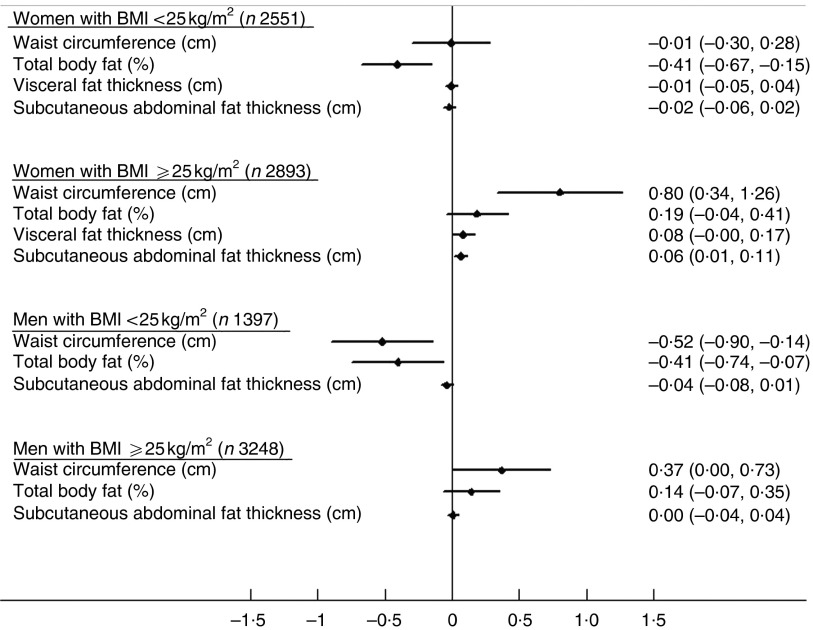
Unhealthy dietary behaviours may contribute to obesity along with energy imbalance. Both positive and null associations of snacking and BMI have been reported, but the association between snacking and total adiposity or pattern of fat deposition remains unevaluated. The objective of this study was to investigate the associations between snacking frequency and detailed adiposity measurements. A total of 10 092 adults residing in Cambridgeshire, England, self-completed eating pattern snacking frequency, FFQ and physical activity questionnaires. Measurements included anthropometry, body composition using dual-energy X-ray absorptiometry scan and ultrasound and assessment of physical activity energy expenditure using heart rate and movement sensing. Linear regression analyses were conducted adjusted for age, socio-demographics, dietary quality, energy intake, PAEE and screen time by sex and BMI status. Among normal-weight individuals (BMI<25 kg/m 2), each additional snack was inversely associated with obesity measures: lower total body fat in men and women (−0·41 (95 % CI −0·74, −0·07) %, −0·41 (−0·67, −0·15) %, respectively) and waist circumference (−0·52 (−0·90, −0·14) cm) in men. In contrast, among the overweight/obese (BMI≥25 kg/m 2), there were positive associations: higher waist circumference (0·80 (0·34, 0·28) cm) and subcutaneous fat (0·06 (0·01, 0·110) cm) in women and waist circumference (0·37 (0·00, 0·73) cm) in men. Comparing intakes of snack-type foods showed that participants with BMI≥25 kg/m 2 had higher intakes of crisps, sweets, chocolates and ice-creams and lower intakes of yoghurt and nuts compared with normal-weight participants. Adjusting for these foods in a model that included a BMI–snacking interaction term attenuated all the associations to null. Snacking frequency may be associated with higher or lower adiposity, with the direction of association being differential by BMI status and dependent on snack food choice. Improving snack choices could contribute to anti-obesity public health interventions.
Overview
The claims and statistics of this paper haven’t been checked yet.
Free: it reads the open-access text and checks the first 5 claims that cite a source we can check. Create a free account to check every claim.
Integrity signals
Registry
Cites
Statistics
Figures
Verification
Claims the paper makes
The claims and statistics of this paper haven’t been checked yet.
Free: it reads the open-access text and checks the first 5 claims that cite a source we can check. Create a free account to check every claim.
Claims other papers make about this one
Each is checked against this paper’s own text: does it say what the citing paper says it does?
The source backs part of the claim, not all of it — or backs it for a different population, condition or comparison.
In the citing paper
“Owing to the relative ease of data collection using wearables, there are now large repositories of datasets, e.g., UK Biobank [212], Capture-24 [21,198], and Fenland [145], but crucially, without annotations.”
From Past, Present, and Future of Sensor-based Human Activity Recognition Using Wearables: A Surveying Tutorial on a Still Challenging Task (2025) · cites this paper as [145]
Experimental — accuracy not yet measuredThe source backs part of the claim, not all of it — or backs it for a different population, condition or comparison.
In the citing paper
“Effective performance across differing sensor locations allows for leveraging large scale unlabeled datasetswhich are typically collected at the wrist (such as Capture-24 [4,18,81], Fenland [46,51], and Biobank [14]), to jumpstart recognition for rarer leg-based activities such as classifying freeze of gait.”
From Assessing the State of Self-Supervised Human Activity Recognition Using Wearables (2022) · cites this paper as [51]
Experimental — accuracy not yet measured
Self-check
Percentages, sums and reported differences re-computed from the paper’s own numbers.
The self-check needs the paper’s full text.
Citations
Cites
Diet, nutrition and the prevention of chronic diseases
Joint, W. (2002) · Medical Entomology and Zoology · Cited by 4,916
Goldberg, G. R., Black, A. E., Jebb, S. A., Cole, T. J., Murgatroyd, P. R., Coward, W. A., & Prentice, A. M. (1991) · PubMed · Cited by 2,372
Fao, J. (2004) · Medical Entomology and Zoology · Cited by 948
Gut hormones and the regulation of energy homeostasis
Murphy, K. G., & Bloom, S. R. (2006) · Nature · doi:10.1038/nature05484 · Cited by 778 · cited 1×
“Gut hormones are known to both curb and increase appetite – for example, ghrelin may increase appetite and oxyntomodulin and peptide YY3-36 may increase satiation ((32)).”
BackgroundReliability and validity of the combined heart rate and movement sensor Actiheart
Brage, S., Brage, N., Franks, P. W., Ekelund, U., & Wareham, N. J. (2005) · European Journal of Clinical Nutrition · doi:10.1038/sj.ejcn.1602118 · Cited by 667 · cited 1×
“PA was objectively assessed over 6 d using a combined heart rate and movement sensor((19)), with individual calibration of heart rate performed using a treadmill test((20)).”
MethodSelf-citationSedentary Behavior and Dietary Intake in Children, Adolescents, and Adults
Pearson, N., & Biddle, S. J. H. (2011) · American Journal of Preventive Medicine · doi:10.1016/j.amepre.2011.05.002 · Cited by 604
Brage, S., Brage, N., Franks, P. W., Ekelund, U., Wong, M.-Y., Andersen, L. B., Froberg, K., & Wareham, N. J. (2004) · Journal of Applied Physiology · doi:10.1152/japplphysiol.00703.2003 · Cited by 473 · cited 1×
“Data from free-living were pre-processed((21)) and modelled using a branched equation framework((22)) to estimate intensity timeseries, which were summarised over time as daily Physical physical activity energy expenditure (PAEE) (kJ/kg per d).”
MethodSelf-citationNutritional methods in the European Prospective Investigation of Cancer in Norfolk
Bingham, S. A., Welch, A. A., McTaggart, A., Mulligan, A. A., Runswick, S. A., Luben, R., Oakes, S., Khaw, K. T., Wareham, N., & Day, N. E. (2001) · Public Health Nutrition · doi:10.1079/phn2000102 · Cited by 419 · cited 7×
“Foods that could conceivably be consumed as snacks (snack-type foods) were identi fi ed from the FFQ and it included fruits, vegetables, yoghurts, nuts, crisps, cakes, biscuits, chocolate, ice-cream and sweets.”
MethodInfluentialSelf-citationExecutive Summary: FORESIGHT ‘Tackling Obesities: Future Choices’ project
Jebb, S. A., Kopelman, P., & Butland, B. (2007) · Obesity Reviews · doi:10.1111/j.1467-789x.2007.00344.x · Cited by 367
Poppitt, S., Swann, D., Black, A., & Prentice, A. (1998) · International Journal of Obesity · doi:10.1038/sj.ijo.0800584 · Cited by 363 · cited 1×
“As one of the major causes of dietary under-reporting is the failure to report foods eaten between meals((35)), reporting bias has the potential to create spurious results in any analysis of snacking.”
Background
Cited by
Items 101–132 of 132
Combined nutritional and environmental assessment: a case study of alternatives to potato crisps
Bosseaux, J., Mohareb, E., Sui, Y., & Wagstaff, C. (2025) · British Food Journal · doi:10.1108/bfj-09-2024-0886 · Cited by 1
Zanesco, S., Griffiths, C. E. M., Dalrymple, K. V., Zhang, R., Gibson, R., Maruthappu, T., & Hall, W. L. (2026) · Clinical and Experimental Dermatology · doi:10.1093/ced/llag117 · Cited by 1
Eating sweet foods habit and other factors that related to obesity on civil pilot in Indonesia
Nasution, R., Herqutanto, H., & Yuliana, Y. (2016) · Health Science Journal of Indonesia · doi:10.22435/hsji.v7i2.5437.134-139 · Cited by 1
“al over 10,092 adults in Fenland, UK revealed a significant relationship between obesity and habit of eating sweet foods where respondents who had BMI > 25 kg/m(2) consumed higher amounts of sweets, chocolate and ice cream.(6) Another study by Greenberg et.”
BackgroundXiang, C. Y., & Lian, C. W. (2021) · Malaysian Journal of Public Health Medicine · doi:10.37268/mjphm/vol.21/no.2/art.1001 · Cited by 2
Haresamudram, H., Essa, I. A., & Plötz, T. (2024) · International Conference on Activity and Behavior Computing (ABC) · doi:10.1109/abc61795.2024.10651688 · Cited by 1
“Naturally, the predominant setup for these methods involves performing pre-training on datasets with human movements, e.g., larger annotated datasets such as Mobiact [5], or big unlabeled datasets such as Capture-24 [6], [7], Fenland [8], [9], and UK Biobank [10].”
MethodMushrooms, Snacks, and Dairy Foods: Health Impacts, Consumption Patterns, and Dietary Guidance
Hess, J. (2018) · University of Minnesota Digital Conservancy (University of Minnesota) · Cited by 1
With food in mind: effects of mindset and BMI on food-related cognition and behavior
Pimpini, L. (2023) · Research Publications (Maastricht University) · doi:10.26481/dis.20231110lp · Cited by 1
Gaziano, L., Allara, E., Giambartolomei, C., Stacey, D., Zhao, J. H., Dashti, H., Jiang, T., Ritchie, S. C., Ferolito, B. R., Rasooly, D., et al. (2024) · medRxiv · doi:10.1101/2024.06.27.24309406 · Cited by 1
“(www.omicscience.org) 8 Briefly, protein levels were measured by SomaLogic Inc (Boulder, Colorado, US) with the SomaScan® V4 platform in 10,708 European-ancestry individuals from the Fenland cohort 17,68 .”
MethodHaresamudram, H., Tang, C. I., Suh, S., Lukowicz, P., & Ploetz, T. (2024) · arXiv · Cited by 31
“It was shown that such models–if trained properly–outperform conventional ML models, including neural networks, by substantial margins [101].”
Huseinovic, E. (2016) · Gothenburg University Publications Electronic Archive (Gothenburg University)
Nothing Else: A Healthier Snack Bar
Yan, M. R. (2016) · Tuwhera (Auckland University of Technology) · Cited by 5
Snacking During Pregnancy and its Relationship with Gestational Weight Gain
Pachta, D. M. (2017) · KU ScholarWorks (The University of Kansas)
Effects of Food Consumption on Self-rated Health: Evidence from Korean Adolescents.
Kim, E.-G., Chung, S. J., & Chung, M. G. (2018) · PubMed Central
Rapid survey on lifestyle changes and body weight gain among Algerians during COVID-19 lockdown
Boudou, F., Belakredar, A., Berroukche, A., Benhamza, M., & Bendahmane-Salmi, M. (2020) · The North African Journal of Food and Nutrition Research · doi:10.51745/najfnr.4.10.s3-s7
Croce, C. M. (2020) · TUScholarShare (Temple University)
The effect of priming and mindfulness on food choice and decision making
Farrar, S. T. (2020) · City Research Online (City University London) · Cited by 1
Hassanally, S. (2020) · DUT Open Scholar (Durban University of Technology) · doi:10.51415/10321/3820
Mohamed, A. M. S., Harding, M., & Harrington, J. M. (2021) · International Journal of Dental Research · doi:10.14419/ijdr.v8i2.31743
de Oliveira, G. P. (2021) · Digital Library of Theses and Dissertations (Universidade de São Paulo) · doi:10.11606/d.41.2021.tde-04052022-173940 · Cited by 2
Richard Hoffman PhD RNutr, F. R. S. A. (2022) · Wiley eBooks · doi:10.1002/9781119826743.ch2
Garcidueñas-Fimbres, T. E., Paz‐Graniel, I., Nishi, S. K., Salas‐Salvadó, J., & Babió, N. (2024) · doi:10.32920/26520985.v1
Pearce, M., Strain, T., Kim, Y., Sharp, S. J., Westgate, K. L., Wijndaele, K., Gonzales, T. I., Wareham, N. J., & Brage, S. (2020) · Figshare · doi:10.6084/m9.figshare.11992560
Self-citationJiang, K., Zhang, Y., Xie, C., Wang, T., Zhao, L., Zhao, W. Q., Shi, Z., Sharma, M., & Zhao, Y. (2024) · Figshare · doi:10.6084/m9.figshare.26657173
Khoo, J., Sadananthan, S. A., Yaligar, J., Velan, S. S., & Loh, W. J. (2025) · Research Square · doi:10.21203/rs.3.rs-6756323/v1
Snacking Is Not Just Hunger: Do Emotional Eating and Gender Associated with Snacking Habits?
Lubis, S. R., & Undarwati, A. (2026) · Journal of Educational Health and Community Psychology · doi:10.12928/jehcp.vi.32033
Okamoto, M., Nakamura, S., Watanabe, K., Chei, C., & Narimatsu, H. (2026) · Research Square · doi:10.21203/rs.3.rs-7796129/v1
de Gooijer, F. J., van Kraaij, A., Lasschuijt, M. P., Hermsen, S., Feskens, E. J. M., & Camps, G. (2026) · JMIR Formative Research · doi:10.2196/77046
“While the relationship between snacking and BMI remains inconclusive [7-9], individuals with overweight or obesity tend to consume more energy-dense snacks high in sugar and fat, and their snack consumption is positively associated with adiposity [10].”
The impact of chip thickness, size and flavour intensity on snacking consumption behaviour
Thibodeau, M., Kutepova, I., Tibos, S., & Yang, Q. (2026) · Food Quality and Preference · doi:10.1016/j.foodqual.2026.106152
Neira-Espejo, C. A., Sepúlveda-García, A. R., Rincón-Uribe, F. A., & Pedroso, J. D. S. (2026) · Terapia psicológica · doi:10.4067/s0718-48082026000200165
Acute stress attenuates the coupling between gastric interoception and snack consumption
Kipping, M., Gjini, R., Schulz, A., & Pollatos, O. (2026) · Appetite · doi:10.1016/j.appet.2026.108806
Metadata
- Authors
- O’Connor, L., Brage, S., Griffin, S. J., Wareham, N. J., & Forouhi, N. G.
- Affiliations
- University of Cambridge (GB)
- Corresponding author
- Forouhi, Nita G.
- Venue
- British Journal of Nutrition
- Publisher
- Cambridge University Press (CUP)
- Published
- 2015-09-07
- Volume
- 114
- Issue
- 8
- Pages
- 1286-1293
- ISSN
- 0007-1145 (ISSN-L)
- 1475-2662
- PMC
- PMC4594050
- OpenAlex
- W2138331450
- Semantic Scholar
- 27cccd235af4c801ea564bd07787d374c0b56732
- Cited by
- 125
- References
- 37
- Citations by year
- 2026: 6 · 2025: 5 · 2024: 12 · 2023: 11 · 2022: 12 · 2021: 15 · 2020: 15 · 2019: 11 · 2018: 13 · 2017: 15 · 2016: 10
- FWCI
- 13.55
- Type
- journal article
- Language
- en
- Open access
- hybrid
- doi.org
- Locations
- British Journal Of Nutrition (publishedVersion, cc-by)
- Europe PMC (PubMed Central) (publishedVersion, cc-by)
- PubMed Central (publishedVersion, cc-by)
- PubMed (publishedVersion)
- Apollo (University of Cambridge) (submittedVersion, cc-by)
- Funders
- Wellcome Trust
- National Institute for Health and Care Research (MC_UU_12015/1, NF-SI-0512-10135)
- University of Cambridge
- Cambridge University Hospitals
- Medical Research Council (MC_UU_12015/1, MC_UU_12015/5, MC_UU_12015/4, MC_UU_12015, MC_UU_12015/3)
- NIHR Cambridge Biomedical Research Centre
- Topics
- Health Sciences › Medicine › Public Health, Environmental and Occupational Health › Obesity, Physical Activity, Diet
- Health Sciences › Nursing › Nutrition and Dietetics › Nutrition, Health and Food Behavior
- Health Sciences › Medicine › Public Health, Environmental and Occupational Health › Nutritional Studies and Diet
- Keywords
- snacking frequency, adiposity, obesity, body fat distribution, waist circumference, subcutaneous adipose tissue, snack food choice, overweight and obesity, energy intake, physical activity energy expenditure
- MeSH terms
- Adult, Body Composition, Energy Intake, Cross-Sectional Studies, Diet, Feeding Behavior, Female, Fruit, United Kingdom, Humans, Male, Middle Aged, Motor Activity, Obesity, Surveys and Questionnaires, Sensitivity and Specificity, Socioeconomic Factors, Vegetables, Absorptiometry, Photon, Body Mass Index, Linear Models, Adiposity, Overweight, Waist Circumference, Sedentary Behavior, Snacks, Food Quality
About these checks
Registry, retraction, Cites and statistics results are computed, not judged, with one exception: a printed reference that no index lists is read once by a model before it counts as a citation error. Claims are extracted by a model and kept only when their quote appears verbatim in the text; each cited source is then checked, with a model’s help, for whether it says what the claim relies on. Those verdicts can be wrong — read the claim’s quote and the cited source before relying on one.
Statistics and arithmetic are recomputed, not judged.
Confidence bands are shown only for fields calibrated on our annotated test set. None is calibrated yet, so no band is shown.
What counts as a claim ›How we measure confidence ›How we check this ›
Are you an author, or do you see a problem with this page? Request a review
Data sources
Bibliographic data: Semantic Scholar, OpenAlex, Crossref.
Contains information from the Semantic Scholar Academic Graph Datasets, made available under the ODC Attribution License (ODC-BY 1.0).
Semantic Scholar’s data is described in: Kinney, R., et al. (2023). The Semantic Scholar Open Data Platform. arXiv:2301.10140.
