

The emerging importance of tackling sleep-diet interactions in lifestyle interventions for weight management
Open accessThe DOI matches its Crossref record; 84 of the 84 references it cites were found in a registry or an index.
Abstract
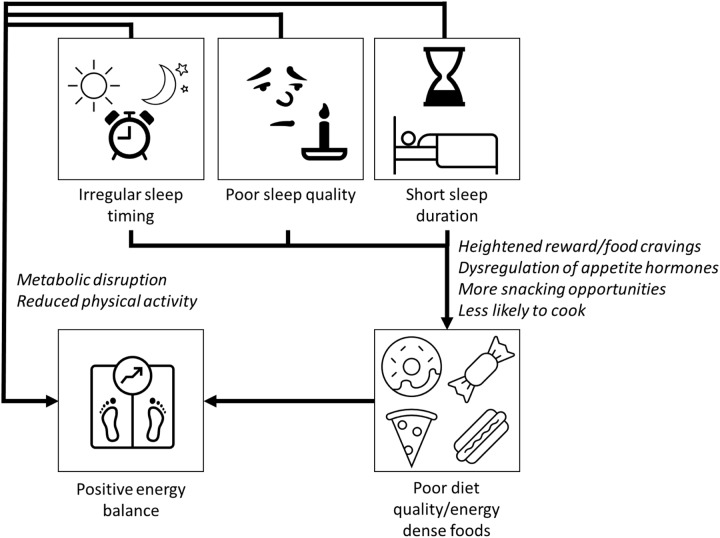
Sleep habits are directly related to risk of obesity, and this relationship may be partly mediated through food choices and eating behaviour. Short sleep duration, impaired sleep quality and suboptimal sleep timing are all implicated in weight gain and adverse cardiometabolic health, at least partly mediated through their associations with diet quality. Short-term sleep restriction leads to increased energy intake, and habitually short sleepers report dietary intakes that indicate a less healthy diet compared with adequate sleepers. Evidence is emerging that sleep extension interventions in short sleepers may reduce intake of sugars and overall energy intake. Poor sleep quality, night shift work patterns and social jetlag are also associated with lower diet quality and consumption of energy-dense foods. Incorporating sleep advice into weight management interventions may be more effective than energy-restricted diets and exercise advice alone. However, there are a lack of intervention studies that aim to lengthen sleep, improve sleep quality or adjust irregular sleep timing to investigate the impact on dietary intakes and eating behaviour in participants aiming to lose weight or maintain weight loss. Finally, future research should take account of individual characteristics such as age, sex, life stage and changing working practices when designing combined lifestyle interventions including sleep behaviour change for health and well-being.
Overview
The claims and statistics of this paper haven’t been checked yet.
Free: it reads the open-access text and checks the first 5 claims that cite a source we can check. Create a free account to check every claim.
Integrity signals
Registry
Cites
Statistics
Figures
Verification
Claims the paper makes
The claims and statistics of this paper haven’t been checked yet.
Free: it reads the open-access text and checks the first 5 claims that cite a source we can check. Create a free account to check every claim.
Claims other papers make about this one
Each is checked against this paper’s own text: does it say what the citing paper says it does?
In the citing paper
“Poor sleep habits can significantly impact sleep duration, sleep quality and sleep timing and have been associated with metabolic disruption, reduction in physical activity, increased energy intake, and poor diet quality and eating behaviors, leading to an increased risk of obesity [117].”
From Application of nutrition interventions with GLP-1 based therapies: A narrative review of the challenges and solutions (2025) · cites this paper as [117]
Self-check
Percentages, sums and reported differences re-computed from the paper’s own numbers.
The self-check needs the paper’s full text.
Citations
Cites
The Pittsburgh Sleep Quality Index: a new instrument for psychiatric practice and research
Buysse, D. J., Reynolds, C. F., Monk, T. H., Berman, S. R., & Kupfer, D. J. (1989) · Psychiatry Research · doi:10.1016/0165-1781(89)90047-4 · Cited by 35,234 · cited 2×
“Sleep quality is often evaluated subjectively both clinically and in research using the Pittsburg Sleep Quality Index (37) , which asks a series of questions to generate component scores for overall sleep quality, latency, duration, efficiency, disturbances, use of sleeping medications and daytime sleepiness and an ov…”
Social Jetlag: Misalignment of Biological and Social Time
Wittmann, M., Dinich, J., Merrow, M., & Roenneberg, T. (2006) · Chronobiology International · doi:10.1080/07420520500545979 · Cited by 2,625 · cited 1×
“This discordance between sleep onset and waking times across the work/non-work parts of the week is known as ‘social jetlag’, calculated as the different in sleep-midpoint between work days and non-work days(55).”
Taheri, S., Lin, L., Austin, D., Young, T., & Mignot, E. (2004) · PLoS Medicine · doi:10.1371/journal.pmed.0010062 · Cited by 2,477
National Sleep Foundation’s updated sleep duration recommendations: final report
Hirshkowitz, M., Whiton, K., Albert, S. M., Alessi, C., Bruni, O., DonCarlos, L., Hazen, N., Herman, J., Adams Hillard, P. J., Katz, E. S., et al. (2015) · Sleep Health · doi:10.1016/j.sleh.2015.10.004 · Cited by 2,348 · cited 1×
“The National Sleep Foundation recommends a sleep duration of 7–9 h per night for adults(23).”
Cappuccio, F. P., Cooper, D., D'Elia, L., Strazzullo, P., & Miller, M. A. (2011) · European Heart Journal · doi:10.1093/eurheartj/ehr007 · Cited by 2,146
Meta-Analysis of Short Sleep Duration and Obesity in Children and Adults
Cappuccio, F. P., Taggart, F. M., Kandala, N.-B., Currie, A., Peile, E., Stranges, S., & Miller, M. A. (2008) · Sleep · doi:10.1093/sleep/31.5.619 · Cited by 2,076 · cited 2×
“Thus, diet is likely to be a significant mediating factor in the well-established links between inadequate sleep and increased risk of CVD, type 2 diabetes and obesity (6 – 12) .”
Roenneberg, T., Allebrandt, K. V., Merrow, M., & Vetter, C. (2012) · Current Biology · doi:10.1016/j.cub.2012.03.038 · Cited by 1,407
Scott, A. J., Webb, T. L., Martyn-St James, M., Rowse, G., & Weich, S. (2021) · Sleep Medicine Reviews · doi:10.1016/j.smrv.2021.101556 · Cited by 1,094 · cited 1×
“However, there is strong evidence that improving sleep quality can positively impact mental health that is likely to enablehealthier dietary behaviours(42).”
Spiegel, K., Leproult, R., L’Hermite-Balériaux, M., Copinschi, G., Penev, P. D., & Van Cauter, E. (2004) · The Journal of Clinical Endocrinology & Metabolism · doi:10.1210/jc.2004-1003 · Cited by 1,006 · cited 1×
“Another explanation is dysregulation of appetite hormones such as ghrelin and leptin (68 – 70) , although evidence is somewhat inconsistent (71) .”
Sleep duration and risk of type 2 diabetes: a meta-analysis of prospective studies
Shan, Z., Ma, H., Xie, M., Yan, P., Guo, Y., Bao, W., Rong, Y., Jackson, C. L., Hu, F. B., & Liu, L. (2015) · Diabetes Care · doi:10.2337/dc14-2073 · Cited by 902
Research works printed but not linked: 1
- Public Health England & Food Standards Agency (2021) National Diet and Nutrition Survey: Diet, Nutrition and Physical Activity in 2020. A Follow up Study during COVID-19. London: PHE, FSA.
Cited by
Piperni, E., Nguyen, L. H., Manghi, P., Kim, H., Pasolli, E., Andreu‐Sánchez, S., Arrè, A., Bermingham, K. M., Blanco‐Míguez, A., Manara, S., et al. (2024) · Cell · doi:10.1016/j.cell.2024.06.018 · Cited by 115
Kurhaluk, N., & Tkaczenko, H. (2025) · Nutrients · doi:10.3390/nu17040665 · Cited by 62
“Ensuring a consistent sleep schedule with 7–9 h of restful sleep each night is therefore essential for maintaining hormonal balance and vascular health [296].”
Xiao, N., Ding, Y., Cui, B., Li, R., Qu, X.-R., Zhou, H., Au, K.-H., Fan, X.-D., Xie, J.-C., Huang, Y., et al. (2024) · The Innovation Medicine · doi:10.59717/j.xinn-med.2024.100090 · Cited by 43
Farrell, E. T., Wirth, M. D., McLain, A. C., Hurley, T. G., Shook, R. P., Hand, G. A., Hébert, J. R., & Blair, S. N. (2023) · Nutrients · doi:10.3390/nu15020419 · Cited by 24
“Additionally, associations between poor diet quality and social jetlag have been well established [79].”
BackgroundArslan, N., Bozkır, E., Koçak, T., Akın, M., & Yılmaz, B. (2024) · Nutrients · doi:10.3390/nu16162683 · Cited by 26
“These factors contribute to the development of non-communicable diseases like cardiovascular diseases, diabetes, obesity, and cancer, and result in a decline in overall health [20].”
The effect of mediterranean diet and chrononutrition on sleep quality: a scoping review
Patel, A., & Cheung, J. (2025) · Nutrition Journal · doi:10.1186/s12937-025-01095-8 · Cited by 29
“Circadian mis-alignment due to irregular sleep and poor dietary choices has also been observed and can increase risk of chronic diseases [31].”
Variability in Sleep Timing and Dietary Intake: A Scoping Review of the Literature
Rusu, A., Ciobanu, D. M., Inceu, G., Craciun, A. E., Fodor, A., Román, G., & Bala, C. G. (2022) · Nutrients · doi:10.3390/nu14245248 · Cited by 24
Nitta, L., Tahara, Y., Shinto, T., Makino, S., Kuwahara, M., Tada, A., Abe, N., Michie, M., & Shibata, S. (2023) · Nutrients · doi:10.3390/nu15092165 · Cited by 21
“Another study suggested that shorter sleep duration was associated with higher carbohydrate and overall energy intake, and that SJL may be independently associated with increased appetite [54].”
BackgroundGale, E. L., Cecil, J. E., & Williams, A. J. (2025) · Journal of Sleep Research · doi:10.1111/jsr.70029 · Cited by 22
“Moreover, these shared socioenvironmental determinants should be considered when designing studies (selecting the sample population, establishing inclusion and exclusion criteria for recruitment) (Hall 2022).”
Larsson, S. C., Hållström, E., Michaëlsson, K., & Titova, O. E. (2025) · Scientific Reports · doi:10.1038/s41598-025-10991-2 · Cited by 19
“Moreover, sleep disturbances may impair physical recovery, disrupt appetite regulation, and lead to weight gain, all of which can further reduce PA levels 19,20 .”
Fitch, A., Gigliotti, L., & Bays, H. E. (2025) · Obesity Pillars · doi:10.1016/j.obpill.2025.100205 · Cited by 14
“Poor sleep habits can significantly impact sleep duration, sleep quality and sleep timing and have been associated with metabolic disruption, reduction in physical activity, increased energy intake, and poor diet quality and eating behaviors, leading to an increased risk of obesity [117].”
Liu, S., Zhuo, K., Wang, Y., Wang, X., & Zhao, Y. (2024) · Biology · doi:10.3390/biology13070532 · Cited by 11
Carvalho, B. G., Ribeiro, A., da Mota, J. C. N. L., Carvalho, L. M., & Nicoletti, C. F. (2025) · Nutrition Research · doi:10.1016/j.nutres.2025.06.010 · Cited by 10
Miladi, S., Hammouda, O., Ameur, R., Miladi, S. C., Feki, W., & Driss, T. (2024) · Nutrients · doi:10.3390/nu16172919 · Cited by 9
“Previous research highlighted the significant influence of sensory, cognitive, and behavioral factors on the motor system, with the state of an individual’s nervous system at the time of movement execution [31].”
BackgroundMagalhães, A. C. O., Marques, C. G., Lucin, G. A., Nakamoto, F. P., Tufik, S., dos Santos, R. V. T., & Quaresma, M. V. L. D. S. (2023) · Sleep and Biological Rhythms · doi:10.1007/s41105-023-00490-0 · Cited by 9
“However, it is unclear if these poor outcomes are from poor sleep, diet-associated factors, or both [5] because the sleep-diet interaction is complex.”
Sleep duration and cardiovascular outcomes
Lichman, M., Przeradzki, J., Borycka, A., Jędrzejewska, B., Kotulska, M., Laskus, P., Lubczyńska, Z., Potocka, Z., Rząd, K., & Kochanowska, J. (2023) · Journal of Education Health and Sport · doi:10.12775/jehs.2023.31.01.002 · Cited by 5
“Natomiast mocne dowody wskazują na związek między wydłużonym czasem snu a ryzykiem rozwoju cukrzycy typu 2 (T2DM).”
InfluentialVilela, S., Vaz, A., & Oliveira, A. (2024) · Journal of Sleep Research · doi:10.1111/jsr.14172 · Cited by 5
“…may also provide more opportunities for snacking on food, leading to a dysregulation of hormones that influence appetite (such as leptin and ghrelin), affecting this way, the perception/regulation of hunger and satiety and increasing reinforcing effects driven by the reward system (Hall, 2022).”
Components in downstream health promotions to reduce sugar intake among adults: a systematic review
Hilmy, S. H. A., Nordin, N., Yusof, M. Y. P. M., Soh, T. Y. T., & Yusof, N. (2024) · Nutrition Journal · doi:10.1186/s12937-023-00884-3 · Cited by 6
Haszard, J. J., Jackson, R., Morrison, S., Meredith-Jones, K. A., Galland, B. C., Beebe, D. W., Elder, D. E., & Taylor, R. W. (2024) · International Journal of Behavioral Nutrition and Physical Activity · doi:10.1186/s12966-024-01607-5 · Cited by 6
“Similar results for the impact of sleep on diet have been reported in adult studies [44].”
BackgroundResultLi, D., Liang, G., Yin, Z.-J., Li, Y.-Z., Zheng, Y.-J., Yu, Q., Zhang, Y., & Pan, C.-W. (2023) · Chronobiology International · doi:10.1080/07420528.2023.2210667 · Cited by 5
“In addition, food choices and eating behavior may mediate the association between sleep habits and obesity (Hall 2022).”
do Carmo, S. G., Oliveira, J. P. T., Aragão, B. D. A., & Botelho, P. B. (2023) · Nutrients · doi:10.3390/nu15092148 · Cited by 6
“Poor quality sleep has also been associated with changes in appetite hormones, increased cravings for high-fat and high-sugar foods, and a reduced ability to regulate food intake [8,15].”
BackgroundYudkin, J. S., Jungbauer, R. M., Allicock, M. A., & Barlow, S. E. (2026) · PLoS ONE · doi:10.1371/journal.pone.0341635 · Cited by 4
“Research has shown that sleep plays a crucial role in pediatric weight management, with increased sleep contributing to reduced excess caloric consumption [54].”
Mazzotti, D. R., Waitman, L. R., Miller, J. J., Sundar, K. M., Stewart, N. H., Gozal, D., Song, X., & Collaborative, G. P. (2024) · Sleep Medicine · doi:10.1016/j.sleep.2023.11.1013 · Cited by 4
Moise, R. K., Chery, M. J., Wyrick, M., Zizi, F., Seixas, A. A., & Jean‐Louis, G. (2024) · Frontiers in Public Health · doi:10.3389/fpubh.2024.1359096 · Cited by 2
“Education and awareness around the importance of sleep and its related factors, such as diet, exercise, and mental health, are essential components of these interventions (25).”
BackgroundGholami, F., Barkhidarian, B., Soveid, N., Mirzababaei, A., Hajiheidari, A., Samadi, M., Deghanpour, F., Yekaninejad, M. S., Bahrampour, N., Clark, C. C. T., et al. (2023) · Nutrire · doi:10.1186/s41110-023-00227-6 · Cited by 2
“Poor sleep quality is reported to have adverse effects on several biological processes that may directly increase the risk of these chronic diseases [30].”
Marushko, Y. V., & Yesipova, S. I. (2025) · Family medicine European practices · doi:10.30841/2786-720x.2.2025.331981 · Cited by 1
Shen, J., Que, X., Li, J., Fu, P., Lü, Y., & Zhu, Q. (2025) · Journal of clinical lipidology · doi:10.1016/j.jacl.2025.10.055 · Cited by 1
Sikorska, A., Mian, E., Zapart, Z., Szepietowska, M., Nowicka, N., Bundyra, J., Sochocka, A., Gańska, O. Z., Janik, D., & Parda, J. (2026) · Quality in Sport · doi:10.12775/qs.2026.55.71311 · Cited by 1
Impact of daily diet on sleep quality
Shkolnik, M., Sapir, G., Shilo, S., Talmor‐Barkan, Y., Segal, E., & Rossman, H. (2026) · Nature Health · doi:10.1038/s44360-026-00182-2 · Cited by 1
Relationship between genetic risk, social jetlag, and obesity traits in a Turkish adult population
Işgın‐Atıcı, K., Turan-Demirci, B., Şendur, S. N., Lay, İ., Alikaşifoğlu, M., Erbas, T. A., Vimaleswaran, K. S., & Buyuktuncer, Z. (2026) · Chronobiology International · doi:10.1080/07420528.2026.2727573 · Cited by 1
Sleep Is Integral to School Health and Adolescent Wellbeing: An Evidence‐Based Call to Action
Saletin, J., Ziporyn, T. D., Wolfson, A. R., & Crowley, S. J. (2026) · Journal of School Health · doi:10.1111/josh.70251 · Cited by 1
Sobrepeso, obesidade e impactos na saúde dos trabalhadores em turnos
de Souza, T. C. O., Manfredi, P., & de Souza, I. F. (2023) · Revista Eletrônica Acervo Científico · doi:10.25248/reac.e13773.2023
Kasa-Vubu, J. Z., Waisanen, A., Sturza, J. S., Padmanabhan, V., & O'Brien, L. M. (2024) · F&S Reports · doi:10.1016/j.xfre.2024.09.001 · Cited by 1
“In the past decade, suboptimal sleep has emerged as a robust predictor of weight gain and adverse metabolic outcomes (25, 26).”
Relationship between physical activity and obesity among university students
Kamal, A. A., Abidinv, A. N. Z., Rahman, Z. A., & Muhaimin, A. A. (2025) · doi:10.56984/8zg7d19peb4
Ghanem, H. B., Kofas, M. M., Peterson, K. E., Cantoral, A., Aljahdali, A., Torres-Olascoaga, L. A., Téllez‐Rojo, M. M., & Jansen, E. C. (2025) · Journal of Nutrition · doi:10.1016/j.tjnut.2025.08.023
“Sleep deprivation is known to dysregulate metabolic pathways, including glucose homeostasis, which directly impacts how food is metabolized [40].”
Association of dietary habits with sleep quality among collegiate athletes
Dagar, D., Shrivastava, J., & Singh, G. (2025) · Nutrición clínica y dietética hospitalaria/Nutrición clínica, dietética hospitalaria · doi:10.12873/454dagar · Cited by 1
“Among young athletes, irregular meal patterns, meal skipping, and increased fast-food consumption are frequently reported 4 .”
The Interplay Between Evening Latency and Sleep‐Disturbing Diet on Sleep Quality Among Adults
Soares, L. D. L., Longo‐Silva, G., Lima, M. D. O., Melo, J., Leal, V. S., & de Menezes, R. C. E. (2025) · Journal of Human Nutrition and Dietetics · doi:10.1111/jhn.70176
Azhar Hilmy, S. H., Nordin, N., Yusof, M. Y. P. M., Soh, T. Y. T., & Yusof, N. (2024) · Figshare · doi:10.6084/m9.figshare.26668695
Azhar Hilmy, S. H., Nordin, N., Yusof, M. Y. P. M., Soh, T. Y. T., & Yusof, N. (2024) · Figshare · doi:10.6084/m9.figshare.26668692
Azhar Hilmy, S. H., Nordin, N., Yusof, M. Y. P. M., Soh, T. Y. T., & Yusof, N. (2024) · Figshare · doi:10.6084/m9.figshare.25017761
Azhar Hilmy, S. H., Nordin, N., Yusof, M. Y. P. M., Soh, T. Y. T., & Yusof, N. (2024) · Figshare · doi:10.6084/m9.figshare.25017928
Haszard, J. J., Jackson, R., Morrison, S., Meredith-Jones, K. A., Galland, B. C., Beebe, D. W., Elder, D. E., & Taylor, R. W. (2024) · Figshare · doi:10.6084/m9.figshare.26729548
de Mello, G. T., da Costa, R. M., Lopes, M. V., Szeszulski, J., & Silva, K. S. (2026) · American Journal of Health Education · doi:10.1080/19325037.2026.2629874
“…to address movement behaviors may be more effective for maximizing health benefits than addressing each behavior separately (Champion et al., 2019; Fournier et al., 2023; Hall, 2022; Meader et al., 2017), as modifying one behavior could have a synergistically positive impact on the others.”
Duman, E., & Alkın, V. (2026) · Gümüşhane Üniversitesi Sağlık Bilimleri Dergisi · doi:10.37989/gumussagbil.1791232
Palmer, I. M. A., Gulati, M., Sears, C. G., & Collins, H. E. (2026) · The Lancet Obstetrics Gynaecology & Women s Health · doi:10.1016/s3050-5038(26)00140-8
Nezhadrekabi, N., Aghaei, M., Isanazr, A., Hassanipour, S., Naghipour, M., Yeganeh, S., Joukar, F., & Mansour‐Ghanaei, F. (2026) · Health Science Reports · doi:10.1002/hsr2.73182
“Conversely, healthy dietary patterns may support better sleep quality and metabolic regulation, suggesting a bidirectional relationship between sleep and nutrition [14, 17].”
Varghese, R. T., Sharifi, I., & Akurati, S. (2026) · Endocrine Practice · doi:10.1016/j.eprac.2026.09.120
Metadata
- Authors
- Hall, W. L.
- Affiliations
- King's College London (GB)
- Corresponding author
- Hall, Wendy L.
- ORCID
- Hall, Wendy L.
- Venue
- British Journal Of Nutrition
- Publisher
- Cambridge University Press (CUP)
- Published
- 2022-05-23
- Volume
- 128
- Issue
- 3
- Pages
- 561-568
- ISSN
- 0007-1145 (ISSN-L)
- 1475-2662
- PMC
- PMC9340846
- OpenAlex
- W4281296588
- Semantic Scholar
- 005e1fc8be7fff462cfa2ef116668949b7509edc
- Cited by
- 46
- References
- 82
- Citations by year
- 2026: 10 · 2025: 11 · 2024: 16 · 2023: 8 · 2022: 1
- FWCI
- 8.28
- Type
- journal article
- Language
- en
- Open access
- hybrid
- doi.org
- Locations
- British Journal Of Nutrition (publishedVersion, cc-by)
- PubMed Central (publishedVersion, cc-by)
- PubMed (publishedVersion)
- Research Portal (King's College London) (publishedVersion, cc-by-nc-nd)
- Topics
- Social Sciences › Psychology › Experimental and Cognitive Psychology › Sleep and related disorders
- Social Sciences › Psychology › Experimental and Cognitive Psychology › Sleep and Work-Related Fatigue
- Life Sciences › Neuroscience › Endocrine and Autonomic Systems › Circadian rhythm and melatonin
- Keywords
- sleep duration, sleep quality, sleep timing, short sleepers, sleep extension, weight management, obesity, diet quality, eating behaviour, energy intake, night shift work, social jetlag, lifestyle intervention, weight loss maintenance, cardiometabolic health
- MeSH terms
- Diet, Feeding Behavior, Humans, Life Style, Obesity, Sleep
About these checks
Registry, retraction, Cites and statistics results are computed, not judged, with one exception: a printed reference that no index lists is read once by a model before it counts as a citation error. Claims are extracted by a model and kept only when their quote appears verbatim in the text; each cited source is then checked, with a model’s help, for whether it says what the claim relies on. Those verdicts can be wrong — read the claim’s quote and the cited source before relying on one.
Statistics and arithmetic are recomputed, not judged.
Confidence bands are shown only for fields calibrated on our annotated test set. None is calibrated yet, so no band is shown.
What counts as a claim ›How we measure confidence ›How we check this ›
Are you an author, or do you see a problem with this page? Request a review
Data sources
Bibliographic data: Semantic Scholar, OpenAlex, Crossref.
Contains information from the Semantic Scholar Academic Graph Datasets, made available under the ODC Attribution License (ODC-BY 1.0).
Semantic Scholar’s data is described in: Kinney, R., et al. (2023). The Semantic Scholar Open Data Platform. arXiv:2301.10140.
