

The DOI matches its Crossref record; 75 of the 75 references it cites were found in a registry or an index; none of the 146 sources its claims cite is checked for support yet.
Adolescent athletes have better general than sports nutrition knowledge and lack awareness of supplement recommendations: a systematic literature review
Open accessAbstract
Nutrition knowledge (NK) impacts food choices and may be improved through educational programmes. Identifying knowledge gaps related to NK among adolescent athletes may guide future nutrition education programmes. This review aimed to systematically review the level of NK in adolescent athletes based on the currently available published literature. The protocol for this review was registered with PROSPERO (CRD42022321765). A literature search was conducted in April 2022 using MEDLINE, CINAHL, SPORTDiscus, Web of Science and SCOPUS databases. The study design was not restricted, provided that a quantitative NK score was reported for adolescent athletes. Studies were limited to the English language and published between 2010 and April 2022. Studies were assessed for quality and risk of bias using the Academy of Nutrition and Dietetics Quality Appraisal Checklist. Data extracted included demographics, questionnaire name, number of items, validation status and mean total and subsection NK scores. Meta-analyses were inappropriate due to the heterogeneity of NK assessment tools; therefore, results were presented narratively. Thirty-two studies that assessed NK of 4553 adolescent athletes and 574 comparison participants were included. Critical appraisal of studies resulted in neutral rating ‘moderate quality’ for most (n 30) studies. Studies lacked justification for sample size and often used inadequately validated questionnaires. NK scores ranged from poor (33·3 %) to excellent (90·6 %). The level of NK across studies is difficult to determine due to heterogenous questionnaires often lacking appropriate validation. NK should be assessed using tools validated in the relevant population or revalidated tools previously used for other populations.
Overview
CoChat Summary
TL;DR
This systematic review of 32 studies (4553 adolescent athletes and 574 comparison participants) found nutrition knowledge scores ranged from poor (33·3 %) to excellent (90·6 %), but heterogeneous and often inadequately validated questionnaires made the overall level difficult to determine. Adolescent athletes scored higher in general nutrition knowledge than sports nutrition knowledge when directly compared and showed poor supplement knowledge.
Key findings
- Across 32 studies and 4553 adolescent athletes, total nutrition knowledge scores ranged from 33·3 % to 90·6 %; most studies (n 30) received a neutral “moderate quality” rating, and only two received a positive rating.
- When general nutrition knowledge (GNK) and sports nutrition knowledge (SNK) were directly compared within studies (n 4), GNK was the highest-scoring section in all cases; supplement knowledge was poor wherever reported, with Bird and Rushton reporting supplements as the greatest source of uncertainty (45 % “don’t know” responses).
- The review included 21 questionnaires across 32 studies; 16 studies used a questionnaire with 25 or fewer questions, 13 described using a “previously validated questionnaire,” and only two revalidated after modifying a questionnaire.
- Nine studies included 574 non-adolescent comparison participants; adult athletes scored numerically higher than adolescent athletes in all but one study comparing these groups, and in the one age-matched non-athlete comparison, adolescent athletes scored higher in all sections.
Methods
- Systematic literature review following PRISMA, registered with PROSPERO (CRD42022321765); searched MEDLINE, CINAHL, SPORTDiscus, Web of Science and SCOPUS in April 2022, limited to English-language studies published between 2010 and April 2022.
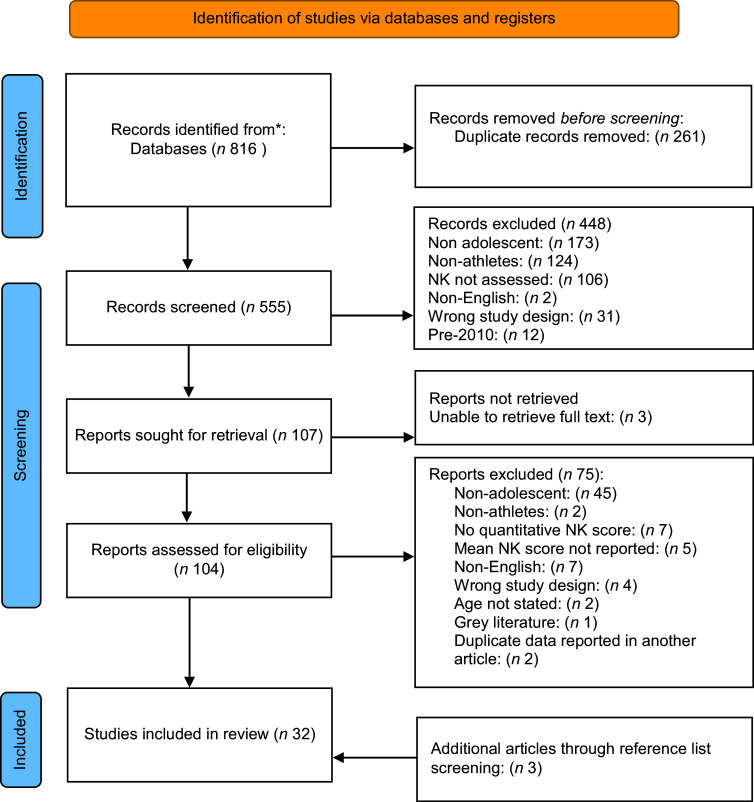
- Included original studies providing a quantitative nutrition knowledge score for adolescent athletes aged 10–19 years (WHO definition) in any organised sport; 816 records were identified, 555 screened after duplicate removal, 104 full texts screened, and 32 studies included.
- Data extraction covered demographics, questionnaire details, validation status, and mean total and subsection scores converted to percentages; quality/risk of bias was assessed with the Academy of Nutrition and Dietetics Quality Appraisal Checklist, and results were synthesised narratively because meta-analysis was inappropriate.
Limitations
- The paper states that meta-analysis was implausible because of heterogeneous nutrition knowledge questionnaires; possible publication bias arose from excluding studies published before 2010 (11 otherwise eligible studies), excluding non-English and grey literature, and being unable to source four studies for full-text screening.
- The paper also states study-level limitations: small sample sizes, lack of justification for sample size or description of the target population, use of unvalidated or insufficiently validated tools, few comparison groups (especially age-matched), and no author responses to requests for missing or inconsistent data.
- Evident from the text: only two studies received a positive quality rating; 19 studies had fewer than 100 participants; several studies modified previously validated questionnaires without revalidation; and geographic representation was limited (no African countries, Brazil the only South American country, Australia the only Oceanian country).
Model-written summary. Check it against the paper before relying on it.
Integrity signals
Registry
Cites
Statistics
Figures
Verification
Claims the paper makes
0 Valid · 1 Not valid · 88 Not checked · 121 Own results and interpretations
A result the paper reports from its own data — it cites no other source for it, so there is none to check. The quote shows it is in the paper.
In the paper
“Thirty-two studies that assessed NK of 4553 adolescent athletes and 574 comparison participants were included.”
§ Adolescent athletes have better general than sports nutrition knowledge and lack awareness of supplement recommendations: a systematic literature review > Abstract
plainn = 574- Asserted: passes — The authors put it forward as true.
- Checkable: passes — It can be checked against evidence.
- Load-bearing: passes — The paper’s conclusions depend on it.
- Based: passes — The paper gives a reason why it holds.
A result the paper states — it cites no source for it, so there is none to check. The quote shows it is in the paper.
In the paper
“NK scores ranged from poor (33·3 %) to excellent (90·6 %).”
§ Adolescent athletes have better general than sports nutrition knowledge and lack awareness of supplement recommendations: a systematic literature review > Abstract
plain- Asserted: passes — The authors put it forward as true.
- Checkable: passes — It can be checked against evidence.
- Load-bearing: unclear — It is unclear whether the paper’s conclusions depend on it.
- Based: passes — The paper gives a reason why it holds.
None of the sources cited for this claim have been checked yet.
In the paper
“Adult athletes’ mean score correct was reported as 66·7 %(23) and 70 %(42).”
§ Adolescent athletes have better general than sports nutrition knowledge and lack awareness of supplement recommendations: a systematic literature review > Results > Results of individual studies
What the sources say
- Not checked yetcites [23] Argôlo D, Borges J, Cavalcante A, et al. (2018) Poor dietary intake and low nutritional knowledge in adolescent and adult competitive athletes: a warning to table tennis players. Nutr Hosp 35, 1124– 1130. 30307296 source
- Not checked yetcites [42] Nascimento M, Silva D, Ribeiro S, et al. (2016) Effect of a nutritional intervention in athlete’s body composition, eating behaviour and nutritional knowledge: a comparison between adults and adolescents. Nutrients 8, 535. 27618088 PMC5037522 source
plain- Asserted: passes — The authors put it forward as true.
- Checkable: passes — It can be checked against evidence.
- Load-bearing: unclear — It is unclear whether the paper’s conclusions depend on it.
- Based: passes — The paper gives a reason why it holds.
A check of a cited source is scheduled, or we don’t hold its full text yet; the claim is checked once it runs.
In the paper
“Three studies(34,35,38) using the Heikkila et al.(58) questionnaire reported supplements to be the lowest scoring section.”
§ Adolescent athletes have better general than sports nutrition knowledge and lack awareness of supplement recommendations: a systematic literature review > Results > Results of individual studies
What the sources say
- Not checked yetcites [34] Heikkilä M, Lehtovirta M, Autio O, et al. (2019) The impact of nutrition education intervention with and without a mobile phone application on nutrition knowledge among young endurance athletes. Nutrients 11, 2249. 31540535 PMC6770376 source
A check is scheduled.
- Not matchedcites [35] Heikkilä M, Valve R, Lehtovirta M, et al. (2018) Nutrition knowledge among young Finnish endurance athletes and their coaches. Int J Sport Nutr Exerc Metab 28, 522– 527. 29252046
Couldn’t be matched to a paper in Crossref, so it can’t be checked.
- Not checked yetcites [38] Kettunen O, Heikkilä M, Linnamo V, et al. (2021) Nutrition knowledge is associated with energy availability and carbohydrate intake in young female cross-country skiers. Nutrients 13, 1769. 34067303 PMC8224650 source
A check is scheduled.
- Not matchedcites [58] Heikkila M, Valve R, Lehtovirta M, et al. (2018) Development of a nutrition knowledge questionnaire for young endurance athletes and their coaches. Scand J Med Sci Sports 28, 873– 880. 28975667
Couldn’t be matched to a paper in Crossref, so it can’t be checked.
plain- Asserted: passes — The authors put it forward as true.
- Checkable: passes — It can be checked against evidence.
- Load-bearing: passes — The paper’s conclusions depend on it.
- Based: passes — The paper gives a reason why it holds.
- Not checked yet
None of the sources cited for this claim have been checked yet.
In the paper
“Similarly, two studies(26,30) that used questionnaires based on Zinn et al. (59) reported poor scores.”
§ Adolescent athletes have better general than sports nutrition knowledge and lack awareness of supplement recommendations: a systematic literature review > Results > Results of individual studies
What the sources say
- Not checked yetcites [26] Bird SP & Rushton BD (2020) Nutritional knowledge of youth academy athletes. BMC Nutr 6, 35. 32821418 PMC7433089 source
- Not checked yetcites [30] Escribano-Ott I, Mielgo-Ayuso J & Calleja-González J (2021) A glimpse of the sports nutrition awareness in Spanish basketball players. Nutrients 14, 27. 35010902 PMC8746623 source
- Not checked yetcites [59] Zinn C, Schofield G & Wall C (2005) Development of a psychometrically valid and reliable sports nutrition knowledge questionnaire. J Sci Med Sport 8, 346– 351. 16248475 source
plain- Asserted: passes — The authors put it forward as true.
- Checkable: passes — It can be checked against evidence.
- Load-bearing: unclear — It is unclear whether the paper’s conclusions depend on it.
- Based: passes — The paper gives a reason why it holds.
41 more claims
Create a free account to see all 210 claims and to verify the 137 references still open.
- It may state two separate claims as one. 80
- Probably not a substantial claim. 128
Claims other papers make about this one
Each is checked against this paper’s own text: does it say what the citing paper says it does?
In the citing paper
“This distinction is important in adolescents because knowing what should be eaten does not necessarily mean that the athlete has the autonomy, money, time, cooking skills, family support, or club environment required to translate knowledge into behavior (4–6).”
In the citing paper
“Recent literature indicates that adolescent athletes may have better general than sport-specific nutrition knowledge, with persistent gaps around carbohydrate periodization, hydration, recovery nutrition, supplement use, and the relationship between diet, health, and performance (6).”
In the citing paper
“It is necessary because many young athletes have gaps in sport-specific nutrition knowledge (6, 15, 28, 32, 33).”
In the citing paper
“while Hulland et al. (6) found that adolescent-athlete studies often used inadequately validated questionnaires and lacked sample-size justification.”
In the citing paper
“Dietary behaviours are also shaped by broader individual and environmental influences, including cooking ability, the home food environment, time constraints and the influence of parents, peers and coaches”
From Dietary intake, nutrition knowledge, and behavior in youth team sport athletes: a scoping review and call to advance research and practice (2026) · cites this paper as [18]
4 more claims about this paper
Create a free account to see every claim other papers make about this one.
Self-check
Percentages, sums and reported differences re-computed from the paper’s own numbers.
Each contradiction between two passages listed here was confirmed by an independent check.
Rated major: it would touch a result — a value a result rests on, reported and recomputed p-values on opposite sides of the significance level, two passages that conflict with no sign which is right, or a cited work retracted before this paper was published.
In the paper
“a total of 555 articles were included for the title and abstract screening. Two hundred and sixteen articles were excluded during the title and abstract screening, including eleven articles that were published before 2010. A total of 107 articles were considered eligible for full-text screening”
§ Adolescent athletes have better general than sports nutrition knowledge and lack awareness of supplement recommendations: a systematic literature review > Results > Study selection
Reported 107 · recomputed 339
Rated major: it would touch a result — a value a result rests on, reported and recomputed p-values on opposite sides of the significance level, two passages that conflict with no sign which is right, or a cited work retracted before this paper was published.
In the paper
§ Adolescent athletes have better general than sports nutrition knowledge and lack awareness of supplement recommendations: a systematic literature review > Results > Results of individual studies
“however, the adult athletes scored lower within the GNK subsection than the adolescents.”
§ Adolescent athletes have better general than sports nutrition knowledge and lack awareness of supplement recommendations: a systematic literature review > Results > Study characteristics
“Argolo et al.(23), (2018); Brazil | GNK(3) | 55 | 12 | GNK: 82·5 | 23* | 66·7 | 10 | GNK: 97 | 9·4* | Neutral”
Rated minor: it would not touch a result — a value no result rests on, a p-value that stays on the same side of the significance level, or a conflict that is clerical, resolved elsewhere in the paper, or outside its own findings.
In the paper
§ Adolescent athletes have better general than sports nutrition knowledge and lack awareness of supplement recommendations: a systematic literature review > Results > Results of individual studies
“The results across adolescent athletes were comparable, with total mean correct reported as 72·7 %(34), 76 %(38) and 77·7 %(35).”
§ Adolescent athletes have better general than sports nutrition knowledge and lack awareness of supplement recommendations: a systematic literature review > Results > Study characteristics
“Heikkilä et al. (34), (2019); Finland | Nutrition recommendations, supplements, hydration, recovery, food choice/body image | Total participants: 77·7 | 7·6”
Rated minor: it would not touch a result — a value no result rests on, a p-value that stays on the same side of the significance level, or a conflict that is clerical, resolved elsewhere in the paper, or outside its own findings.
In the paper
§ Adolescent athletes have better general than sports nutrition knowledge and lack awareness of supplement recommendations: a systematic literature review > Results > Results of individual studies
“while pre- and post-exercise hydration mean % correct scores were similar at 47·2 % and 47·7 %, respectively.”
§ Adolescent athletes have better general than sports nutrition knowledge and lack awareness of supplement recommendations: a systematic literature review > Results > Results of individual studies
“post-exercise hydration received the lowest scores (mean % correct = 33·2 %)”
Rated minor: it would not touch a result — a value no result rests on, a p-value that stays on the same side of the significance level, or a conflict that is clerical, resolved elsewhere in the paper, or outside its own findings.
In the paper
§ Adolescent athletes have better general than sports nutrition knowledge and lack awareness of supplement recommendations: a systematic literature review > Results > Results of individual studies
“Subsection scores were reported in two studies(31,57), which both indicated the lowest scoring section to be ‘protein’ and the highest ‘energy/refuelling’.”
§ Adolescent athletes have better general than sports nutrition knowledge and lack awareness of supplement recommendations: a systematic literature review > Results > Study characteristics
“Hydration: 76·4, supplements 69·3, energy/refuelling 57·1, protein 39·2”
1 more finding
Create a free account to see every finding of this check.
Citations
Cites
The PRISMA 2020 statement: An updated guideline for reporting systematic reviews
Page, M. J., McKenzie, J. E., Bossuyt, P. M., Boutron, I., Hoffmann, T. C., Mulrow, C. D., Shamseer, L., Tetzlaff, J. M., Akl, E. A., Brennan, S. E., et al. (2021) · BMJ · doi:10.1136/bmj.n71 · Cited by 108,283
Thomas, D. T., Erdman, K. A., & Burke, L. M. (2016) · Journal of the Academy of Nutrition and Dietetics · doi:10.1016/j.jand.2015.12.006 · Cited by 1,359
Development of a general nutrition knowledge Questionnaire for adults
Parmenter, K., & Wardle, J. (1999) · European Journal of Clinical Nutrition · doi:10.1038/sj.ejcn.1600726 · Cited by 633
Nutrition in adolescent growth and development
Norris, S. A., Frongillo, E. A., Black, M. M., Dong, Y., Fall, C., Lampl, M., Liese, A. D., Naguib, M., Prentice, A., Rochat, T., et al. (2022) · The Lancet · doi:10.1016/s0140-6736(21)01590-7 · Cited by 518
Nutrition Knowledge in Athletes: A Systematic Review
Heaney, S., O’Connor, H., Michael, S., Gifford, J., & Naughton, G. (2011) · International Journal of Sport Nutrition and Exercise Metabolism · doi:10.1123/ijsnem.21.3.248 · Cited by 321
A Review of Factors Influencing Athletes’ Food Choices
Birkenhead, K. L., & Slater, G. (2015) · Sports Medicine · doi:10.1007/s40279-015-0372-1 · Cited by 240
Wells, K. R., Jeacocke, N. A., Appaneal, R., Smith, H. D., Vlahovich, N., Burke, L. M., & Hughes, D. (2020) · British Journal of Sports Medicine · doi:10.1136/bjsports-2019-101813 · Cited by 209
Singh, J. A., Siddiqi, M., Parameshwar, P. S., & Chandra‐Mouli, V. (2019) · Journal of Adolescent Health · doi:10.1016/j.jadohealth.2019.01.008 · Cited by 200
Trakman, G., Forsyth, A., Devlin, B., & Belski, R. (2016) · Nutrients · doi:10.3390/nu8090570 · Cited by 198
Self-citationObesidade, práticas alimentares e conhecimentos de nutrição em escolares
Triches, R. M., & Giugliani, E. R. J. (2005) · Revista de Saúde Pública · doi:10.1590/s0034-89102005000400004 · Cited by 184
Research works printed but not linked: 4
- Leite, 2016, Conocimiento sobre alimentacion y nutricion despues del desarrollo de actividades de educacion alimentaria entre ninos y adolescentes deportistas [Knowledge about food and nutrition after the development of food education activities among children and adolescent athletes], Pensar Prát, 19, 56
- Jusoh, 2014, Relationship between hydration status, hydration knowledge and fluid intake behaviour among school athletes of selected Perak sport schools, J Sports Sci Phys Educ, 3, 11
- Supriya, 2013, Knowledge, attitude and dietary practices of track and field athletic men and women aged 18–22, Int J Innov Res Dev, 2, 399
- 12. Trakman, GL (2018) The development and validation of the nutrition for sport knowledge questionnaire (NSKQ) and abridged nutrition for sport knowledge questionnaire (A-NSKQ) to investigate the sports nutrition knowledge of Australian athletes. Doctoral Thesis, La Trobe University Research Online, La Trobe University.
Cited by
Nutrition Knowledge and Perceived Dietary Requirements of Adolescent Student-Athletes: A Pilot Study
Jagim, A. R., Merfeld, B. R., Ambrosius, A., Carpenter, M., Fields, J. B., & Jones, M. T. (2024) · Nutrients · doi:10.3390/nu17010133 · Cited by 19
General and sport-specific nutrition knowledge and behaviors of adolescent athletes
Gibbs, R. L., & Becker, T. B. (2025) · Journal of the International Society of Sports Nutrition · doi:10.1080/15502783.2025.2477060 · Cited by 17
Daher, J., Mountjoy, M. L., & Khoury, D. T. D. E. (2024) · Nutrients · doi:10.3390/nu17010044 · Cited by 10
Fuller, A., & Bird, S. P. (2025) · Nutrients · doi:10.3390/nu17020361 · Cited by 5
Palani, B., Raj, Y. C. L., Kalmykova, Y., Sanjaykumar, S., & Korsun, S. M. (2024) · Physical rehabilitation and recreational health technologies · doi:10.15391/prrht.2024-9(3).05 · Cited by 5
Irwin, N., Ó Catháin, C., Ward, C., & Kelly, D. T. (2026) · Journal of the International Society of Sports Nutrition · doi:10.1080/15502783.2026.2671431 · Cited by 4
Lotti, S., Asensi, M. T., Creti, D., Mollo, E., Sarti, A., Sciattella, F., Dinu, M., Colombini, B., Rizzo, L., & Sofi, F. (2025) · Nutrients · doi:10.3390/nu17132213 · Cited by 4
Horváth, I. L., Kajner, G., Galbács, G., & Csupor, D. (2025) · Journal of Nutritional Science · doi:10.1017/jns.2025.10024 · Cited by 4
Piórecka, B., Holko, P., Olesiak, W., Sekulak, K., Cichocka-Mroczek, E., Stąpor, D., Kosowska, K., & Kawalec, P. (2024) · Nutrients · doi:10.3390/nu16213662 · Cited by 4
Calella, P., Dio, M. D., Pelullo, C. P., Giuseppe, G. D., Sansone, V., Liguori, F., Onofrio, V. D., Valerio, G., Liguori, G., & Gallé, F. (2024) · International Journal of Food Sciences and Nutrition · doi:10.1080/09637486.2024.2437468 · Cited by 3
Elite adolescent male soccer players require further education to improve sports nutrition knowledge
Hart, J., Smith, K., & Jackson, K. (2025) · Academia Nutrition and Dietetics · doi:10.20935/acadnutr7656 · Cited by 2
Victoria-Montesinos, D., García-Muñoz, A. M., Mercader-Ros, M. T., Jaraba-Salinero, Y., & Figueroa-Morales, F. (2026) · Frontiers in Nutrition · doi:10.3389/fnut.2026.1939289 · Cited by 1
Saftel, M. A., Leonte, N., Maftei, A., & Moanta, A. D. (2025) · Applied Sciences · doi:10.3390/app15031304 · Cited by 1
Enhancing sports nutrition knowledge in adolescent football players
Şentürk, G., Yıldırım, Z., Deliceoğlu, G., & Yılmaz, S. (2025) · Gençlik Araştırmaları Dergisi · doi:10.52528/genclikarastirmalari.1603750 · Cited by 1
Gulkhayo, K., Iroda, K., Rasul, S., Madina, E., Ananth, C., & kumar, T. A. (2025) · International Conference on Applied Artificial Intelligence and Computing (ICAAIC) · doi:10.1109/icaaic64647.2025.11330859 · Cited by 1
KETANGGUHAN MENTAL DAN KECEMASAN OLAHRAGA PADA ATLET REMAJA: ANALISIS BERDASARKAN JENIS KELAMIN
Sahasika, O. K., & Jannah, M. (2026) · Jurnal Pedagogik Olahraga · doi:10.24114/jpor.v11i2.72026 · Cited by 1
Cizlerová, N., & Hlinský, T. (2026) · Frontiers in Public Health · doi:10.3389/fpubh.2026.1868398 · Cited by 1
Hamdi, M., Abda, N., Harrouch, R., Mjahdi, M., & Legssyer, A. (2026) · Journal of Coaching and Sports Science · doi:10.58524/jcss.v5i4.1331 · Cited by 1
Protein supplementation on muscle recovery and soreness after intense badminton training sessions
Balaji, P., Suresh, C., Помещикова, І. П., Melnyk, A., & Sanjaykumar, S. (2025) · Physical rehabilitation and recreational health technologies · doi:10.15391/prrht.2025-10(1).01
Corr, M., & van Someren, K. A. (2025) · Women in Sport and Physical Activity Journal · doi:10.1123/wspaj.2024-0130
Layouni, S., Ksibi, S., Ach, T., Elmtaoua, S., Ceylan, H. İ., Ghali, H., Tiss, B., Ajili, M. A., Jemni, S., Muntean, R. I., et al. (2025) · Nutrients · doi:10.3390/nu17223598
Pendampingan Pengaturan Menu Sehat Seimbang Pra Pertandingan di Sahabat Basketball Club
Yasin, Y. K., Ichsania, N., Rachman, S. N., Sanrebayu, S., & Alimuddin, H. (2025) · Abdimas Toddopuli Jurnal Pengabdian Pada Masyarakat · doi:10.30605/atjpm.v7i1.7428
Profile of body mass index in swimming athletes aged 7–14 years
Assidiqi, M. H., Ariani, L. P. T., & Yoda, I. K. (2026) · Sriwijaya Journal of Sport · doi:10.55379/sjs.v5i2.234
Nutritional status and its relationship with performance and fatigue in adolescents
Azad, S. K., & Pandey, R. K. (2026) · International Journal of Physical Education & Sports Sciences · doi:10.29070/cp5ppx04
Isozaki, M., Nakamura, M., & Kakutani, Y. (2026) · Nutrients · doi:10.3390/nu18111711
Daher, J., Haines, J., Mountjoy, M. L., & Khoury, D. E. (2026) · Nutrients · doi:10.3390/nu18111808
Elghoul, Y., Mwesigwa, B., Douryang, M., Frimpong, R., Mahachi, C. B., Acquaye, S.-R., & Mkumbuzi, N. S. (2026) · Journal of science and medicine in sport · doi:10.1016/j.jsams.2026.07.010
Zhang, E. E., Deslippe, A. L., McKendry, J., & Cohen, T. R. (2026) · Frontiers in Nutrition · doi:10.3389/fnut.2026.1898385
Edukasi Terpadu Gizi, Pemulihan, dan Kesehatan Mental bagi Atlet Remaja Putri
Solechah, S. A., Setiawan, M. I., Yulidasari, F., Khairina, F., Hidayatullah, M., Ulfa, N., & Hafizha, N. M. (2026) · JURPIKAT (Jurnal Pengabdian Kepada Masyarakat) · doi:10.37339/jurpikat.v7i3.3371
Septianingrum, K., & Hakim, A. L. R. (2026) · COMPETITOR Jurnal Pendidikan Kepelatihan Olahraga · doi:10.67322/cpjok.v18i3.1144
Rohmawati, D. L., Aprinita, A. S., Safiano, S. M. Z., Qonita, F. I. H., Lestari, D. B., Firdaus, R. A., & Asmila, L. (2026) · SELAPARANG Jurnal Pengabdian Masyarakat Berkemajuan · doi:10.31764/jpmb.v10i3.39565
Tavčar, T. (2026) · Repository of the University of Primorsk (University of Primorska)
Villanueva, A. (2026) · Psychology and Education A Multidisciplinary Journal · doi:10.70838/pemj.640108
Yamamoto, T., Seguchi, M., Iio, Y., Tanaka, M., Kozai, H., Ejiri, H., Aoyama, Y., Mori, Y., & Ito, M. (2026) · Nutrients · doi:10.3390/nu18213609
Metadata
- Authors
- Hulland, S. C., Trakman, G. L., & Alcock, R. D.
- Affiliations
- La Trobe University (AU)
- Corresponding author
- Hulland, Susan C.
- Venue
- British Journal of Nutrition
- Publisher
- Cambridge University Press (CUP)
- Published
- 2023-12-06
- Volume
- 131
- Issue
- 8
- Pages
- 1362-1376
- ISSN
- 0007-1145 (ISSN-L)
- 1475-2662
- PMC
- PMC10950453
- OpenAlex
- W4389393403
- Semantic Scholar
- 5ff5b52810442fa0af961983dbd9422fb9dd11a4
- Cited by
- 34
- References
- 75
- Citations by year
- 2026: 17 · 2025: 12 · 2024: 5
- FWCI
- 1.05
- Type
- journal article
- Language
- en
- Open access
- hybrid
- doi.org
- Locations
- British Journal Of Nutrition (publishedVersion, cc-by)
- PubMed Central (publishedVersion, cc-by)
- PubMed (publishedVersion)
- Figshare (submittedVersion, cc-by)
- La Trobe University (cc-by)
- Topics
- Health Sciences › Nursing › Nutrition and Dietetics › Nutrition, Health and Food Behavior
- Health Sciences › Medicine › Public Health, Environmental and Occupational Health › Nutrition and Health Studies
- Health Sciences › Nursing › Nutrition and Dietetics › Dietetics, Nutrition, and Education
- Keywords
- youth athletes, nutrition knowledge, sports nutrition, supplement recommendations, nutrition education, questionnaire validation, food choice
- MeSH terms
- Adolescent, Female, Humans, Health Knowledge, Attitudes, Practice, Male, Sports, Dietary Supplements, Athletes, Sports Nutritional Sciences, Sports Nutritional Physiological Phenomena
About these checks
Registry, retraction, Cites and statistics results are computed, not judged, with one exception: a printed reference that no index lists is read once by a model before it counts as a citation error. Claims are extracted by a model and kept only when their quote appears verbatim in the text; each cited source is then checked, with a model’s help, for whether it says what the claim relies on. Those verdicts can be wrong — read the claim’s quote and the cited source before relying on one.
A language model drew the claims from the paper on 2026-11-14, under version 3 of the claim definition (model deepseek-v4.1-flash, prompt extract-v3).
A second model labelled each claim on 2026-11-14 (model jev-1.13-20260917, definition revision gold-guideline-v0.2).
Statistics and arithmetic are recomputed, not judged.
Confidence bands are shown only for fields calibrated on our annotated test set. None is calibrated yet, so no band is shown.
What counts as a claim ›How we measure confidence ›How we check this ›
Are you an author, or do you see a problem with this page? Request a review
Data sources
Bibliographic data: Semantic Scholar, OpenAlex, Crossref.
Contains information from the Semantic Scholar Academic Graph Datasets, made available under the ODC Attribution License (ODC-BY 1.0).
Semantic Scholar’s data is described in: Kinney, R., et al. (2023). The Semantic Scholar Open Data Platform. arXiv:2301.10140.
