

The DOI matches its Crossref record; 7 of the 7 references it cites were found in a registry or an index.
Are all ultra-processed foods bad? A critical review of the NOVA classification system
Abstract
The NOVA food classification system and its categorisation of ultra-processed foods (UPFs) have significantly influenced dietary guidelines worldwide, yet the assumption that all UPFs are uniformly harmful warrants critical examination. Here, a review of evidence revealed substantial heterogeneity in health outcomes across UPF subtypes, with products like sugar-sweetened beverages consistently associated with adverse outcomes while fortified cereals and certain dairy products demonstrate neutral or protective effects. The binary nature of NOVA’s classification fails to account for nutritional composition, fortification benefits, and cultural food traditions, creating inconsistencies in categorisation across different contexts. Methodological limitations in UPF research include inadequate dietary assessment tools, selective reporting of negative findings, and experimental design flaws that conflate processing with other dietary factors. Implementation challenges extend to socioeconomic accessibility, as UPFs often provide cost-effective nutrients for disadvantaged populations and environmental sustainability, where wholesale reduction could increase resource demands. Future directions should develop more nuanced classification systems that integrate processing methods with nutritional quality to better inform public health strategies rather than categorically rejecting all UPFs.
Overview
The claims and statistics of this paper haven’t been checked yet.
Run the check — free, no account needed. It reads the open-access text and checks the sources it cites.
Integrity signals
Registry
Cites
Statistics
Figures

Verification
Claims the paper makes
The claims and statistics of this paper haven’t been checked yet.
Run the check — free, no account needed. It reads the open-access text and checks the sources it cites.
Claims other papers make about this one
Each is checked against this paper’s own text: does it say what the citing paper says it does?
In the citing paper
“Although there is heterogeneity in health associations among UPF subgroups (23), and some food products reformulated for schools may contain lower sodium, fat, and calories, or more whole grains than similar items sold elsewhere, these “healthier” reformulated items may legitimize the consumption of UPFs (24).”
From Food Service Directors’ Knowledge and Beliefs About Ultraprocessed Foods in California’s San Joaquin Valley Schools (2026) · cites this paper as [23]
Self-check
Percentages, sums and reported differences re-computed from the paper’s own numbers.
The self-check needs the paper’s full text.
Citations
Cites
Ultra-processed foods: What they are and how to identify them
Monteiro, C. A., Cannon, G., Levy, R. B., Moubarac, J.-C., Louzada, M. L., Rauber, F., Khandpur, N., Cediel, G., Neri, D., Martinez-Steele, E., et al. (2019) · Public Health Nutrition · doi:10.1017/s1368980018003762 · Cited by 2,964
Hall, K. D., Ayuketah, A., Brychta, R., Cai, H., Cassimatis, T., Chen, K. Y., Chung, S. T., Costa, E., Courville, A., Darcey, V., et al. (2019) · Cell Metabolism · doi:10.1016/j.cmet.2019.05.008 · Cited by 1,971 · cited 2×
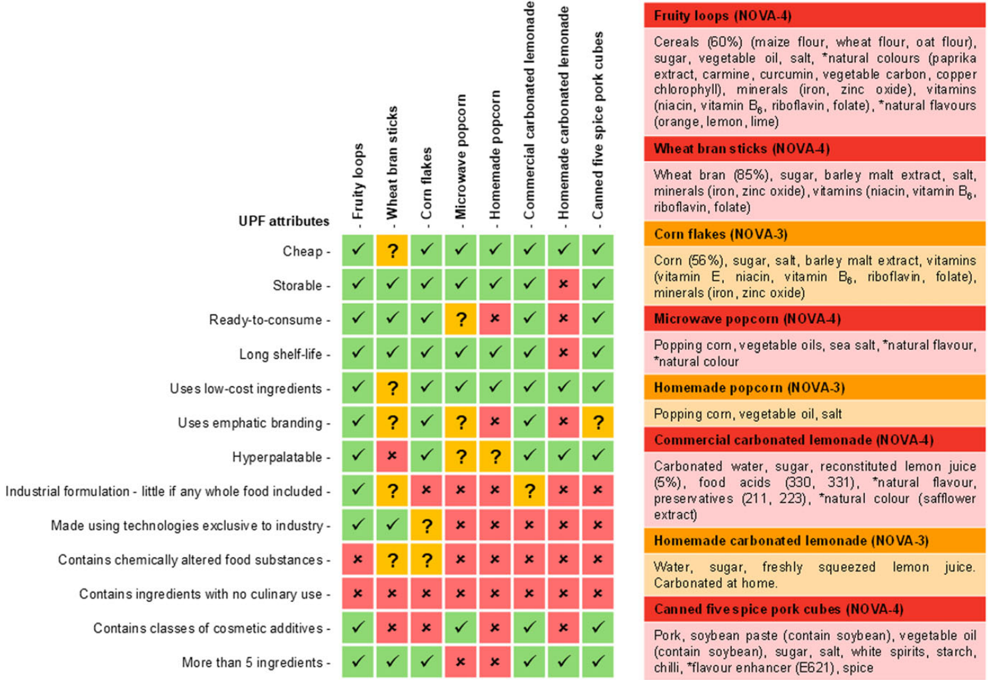
“For example, in the study by Hall et al. (56) , six out of seven dinners during the unprocessed diet period were salads (less palatable) compared with more palatable ‘ UPFs ’ , which may have influenced consumption patterns through palatability differences alone rather than processing status.”
Lane, M. M., Gamage, E., Du, S., Ashtree, D. N., McGuinness, A. J., Gauci, S., Baker, P., Lawrence, M., Rebholz, C. M., Srour, B., et al. (2024) · BMJ · doi:10.1136/bmj-2023-077310 · Cited by 1,153
Taillie, L. S., Bercholz, M., Popkin, B., Reyes, M., Colchero, M. A., & Corvalán, C. (2021) · The Lancet Planetary Health · doi:10.1016/s2542-5196(21)00172-8 · Cited by 274
Schwartz, L. M., Woloshin, S., Andrews, A., & Stukel, T. A. (2012) · BMJ · doi:10.1136/bmj.d8164 · Cited by 136
Mendoza, K., Smith-Warner, S. A., Rossato, S. L., Khandpur, N., Manson, J. E., Qi, L., Rimm, E. B., Mukamal, K. J., Willett, W. C., Wang, M., et al. (2024) · The Lancet Regional Health - Americas · doi:10.1016/j.lana.2024.100859 · Cited by 101
Are all ‘ultra-processed’ foods nutritional demons? A commentary and nutritional profiling analysis.
Derbyshire, E. (2019) · Trends in Food Science & Technology · doi:10.1016/j.tifs.2019.08.023 · Cited by 39
Research works printed but not linked: 75
- 10.3945/ajcn.114.089284 · DOI · Paper page
- 10.1017/S1368980017000428 · DOI
- 10.1111/dom.15922 · DOI · Paper page
- 10.1016/j.foodres.2023.112730 · DOI
- 10.3389/fnut.2023.1204695 · DOI
- 10.1093/ije/dyae106 · DOI
- 10.1017/S1368980017000234 · DOI · Paper page
- 10.1017/S0007114524000096 · DOI
- 10.1016/j.lanepe.2024.101108 · DOI
- 10.1016/j.amepre.2023.07.006 · DOI
- 10.1080/09637486.2021.1880552 · DOI · Paper page
- 10.1016/j.tifs.2021.02.059 · DOI
- 10.1111/nbu.12640 · DOI
- 10.4178/epih/e2014009 · DOI
- 10.1093/ajcn/nqac122 · DOI
- 10.3390/nu14193942 · DOI
- 10.1016/j.advnut.2023.09.009 · DOI
- 10.1016/j.tifs.2021.08.010 · DOI
- 10.1002/osp4.657 · DOI
- 10.1111/dom.16063 · DOI
- 10.1371/journal.pone.0004831 · DOI
- 10.1038/s41575-024-00893-5 · DOI
- 10.1016/j.copbio.2021.02.007 · DOI · Paper page
- 10.1093/ajcn/nqac123 · DOI
- 10.3389/fnut.2023.1098453 · DOI
- 10.1097/NT.0000000000000396 · DOI
- 10.1016/j.lanepe.2024.101043 · DOI
- 10.1159/000177635 · DOI
- 10.3390/nu13113948 · DOI
- 10.3389/fnut.2022.1035580 · DOI · Paper page
- 10.1016/j.tifs.2023.03.001 · DOI
- 10.1590/S0102-311X2010001100005 · DOI · Paper page
- 10.3390/su12156280 · DOI
- 10.1017/S0007114523000430 · DOI
- 10.1093/ajcn/nqac230 · DOI
- 10.3389/fnut.2019.00085 · DOI
- 10.1093/cdn/nzz104 · DOI
- 10.3390/nu16234039 · DOI
- 10.3389/fnut.2023.1149813 · DOI
- 10.1161/JAHA.124.035986 · DOI · Paper page
- 10.1016/j.tifs.2022.11.009 · DOI
- 10.1017/S1368980024000296 · DOI
- 10.53388/FH2024001 · DOI
- 10.1093/aje/kwm165 · DOI · Paper page
- 10.1136/bmj.o2938 · DOI
- 10.3945/an.111.000901 · DOI
- 10.1016/j.jfca.2007.02.005 · DOI
- 10.3390/nu13082783 · DOI
- 10.1111/1750-3841.17407 · DOI
- 2024, Commercial Determinants of Noncommunicable Diseases in the WHO European Region
- 10.3390/nu15194167 · DOI
- 10.1017/S136898002300229X · DOI
- 10.1371/journal.pmed.1004394 · DOI
- 10.3945/an.114.007120 · DOI · Paper page
- 10.3945/ajcn.117.160440 · DOI
- 10.1038/s41430-022-01099-1 · DOI · Paper page
- 10.3390/nu16111738 · DOI
- Hoelscher, 2023, Ultra-Processed Dietary Patterns and Growth, Body Composition, and Risk of Obesity: A Systematic Review Protocol
- 10.1016/j.tifs.2023.104270 · DOI
- 10.1017/S0954422422000117 · DOI
- 10.3390/nu13113838 · DOI
- 10.4093/dmj.2024.0659 · DOI
- 10.5694/j.1326-5377.2005.tb06992.x · DOI
- 10.3390/nu17010002 · DOI
- 10.1038/s41430-024-01515-8 · DOI
- 10.3390/nu17050859 · DOI
- 10.1111/dom.16044 · DOI
- 10.1016/j.tifs.2024.104505 · DOI
- 10.1017/S0007114522002793 · DOI
- 10.3390/foods12071520 · DOI
- 10.3390/nu13082778 · DOI
- 10.1016/j.spc.2024.10.008 · DOI
- 10.1017/S1368980022002117 · DOI
- 75. Oliveira, E , Frade, S , Gabe, KT et al. (2024) A novel food frequency questionnaire for Brazilian adults based on the Nova classification system: development, reproducibility and validation. medRxiv. 2024.04.19.24305963.
- 10.1093/cdn/nzy077 · DOI
Cited by
Sorted by citations
Gupta, A., Duran Gomez, A. Z., Matheson, D., Sharma, A., Richard, V., Ritchie, L. D., de la Rosa, A., Delgado, D., Islas, G., Hecht, C. A., et al. (2026) · Preventing Chronic Disease · doi:10.5888/pcd23.250379
Metadata
- Authors
- Louie, J. C. Y.
- Affiliations
- Swinburne University of Technology
- ORCID
- Louie, Jimmy Chun Yu
- Venue
- Proceedings of the Nutrition Society
- Publisher
- Cambridge University Press (CUP)
- Published
- 2025-08-04
- Volume
- 85
- Issue
- 3
- Pages
- 367-375
- ISSN
- 0029-6651
- 1475-2719
- Cited by
- 71
- References
- 7
- Language
- en
About these checks
Registry, retraction, Cites and statistics results are computed, not judged, with one exception: a printed reference that no index lists is read once by a model before it counts as a citation error. Claims are extracted by a model and kept only when their quote appears verbatim in the text; each cited source is then checked, with a model’s help, for whether it says what the claim relies on. Those verdicts can be wrong — read the claim’s quote and the cited source before relying on one.
Statistics and arithmetic are recomputed, not judged.
Confidence bands are shown only for fields calibrated on our annotated test set. None is calibrated yet, so no band is shown.
What counts as a claim ›How we measure confidence ›How we check this ›
Are you an author, or do you see a problem with this page? Request a review
