

The DOI matches its Crossref record; 24 of the 24 references it cites were found in a registry or an index; 1 of the 23 sources its claims cite were checked for support.
Food Service Directors’ Knowledge and Beliefs About Ultraprocessed Foods in California’s San Joaquin Valley Schools
Open accessAbstract
Introduction: Ultraprocessed foods (UPFs) are industrial formulations of ingredients typically not used in home cooking and often high in added sugars, saturated fat, or sodium. UPF intake is associated with obesity, type 2 diabetes, hypertension, and other chronic diseases. Although the National School Lunch Program and School Breakfast Program must meet US Department of Agriculture nutrition standards, federal standards do not specifically address food processing. However, reducing UPFs in schools is gaining momentum. As food service directors (FSDs) are key implementers of school nutrition policies, we sought to characterize their knowledge and beliefs about UPFs in school meals. Methods: In this qualitative study, we conducted 20 semistructured interviews with FSDs in California's low-income, largely rural San Joaquin Valley from January through June 2024. Two analysts double-coded transcripts and used inductive thematic analysis to identify key themes. Results: Of 20 FSDs, 16 completed the demographic survey. Participants' mean age was 49.5 years (IQR, 41.0-59.5), 15 were women, 8 identified as White, and 6 identified as Hispanic or Latino. Seven FSDs reported that they had never heard of UPFs. After receiving a definition, FSDs generally described UPFs as less healthy than scratch-cooked foods, although several perceived UPFs served in schools as healthier than UPFs sold elsewhere. FSDs cited student food insecurity, food safety concerns, and student acceptance as reasons for serving UPFs; others worried that serving UPFs at school could reinforce unhealthy eating habits. Conclusion: Training that is free of conflicts of interest and food labeling systems that are clearer may improve FSDs' ability to identify UPFs and implement policies to reduce UPFs in school meals.
Overview
AI snapshot
Written from the paper’s full text.
TL;DR
In qualitative interviews with 20 food service directors (FSDs) in California’s San Joaquin Valley, knowledge and beliefs about ultraprocessed foods (UPFs) varied widely, and 7 of 20 had never heard the term. After receiving a definition, many FSDs viewed UPFs as less healthy than scratch-cooked foods, but some saw school UPFs as healthier than UPFs sold elsewhere and cited food insecurity, food safety, and student acceptance as reasons for serving them.
Key findings
- Seven of 20 FSDs reported being unfamiliar with UPFs; among those 7, 6 were Freshly Prepared Meals grant recipients and 3 were from rural districts.
- Of 16 FSDs who completed the demographic survey, median age was 49.5 years (IQR, 41.0–59.5), 15 were women, 8 identified as White, and 6 as Hispanic or Latino; 6 estimated that more than 40% of foods purchased for school meals were UPFs.
- After a common UPF definition was presented, more than half characterized UPFs as less healthy than scratch-cooked foods, while two said UPFs were not necessarily less healthy; several perceived UPFs served in schools as healthier than those sold elsewhere.
- FSDs cited student food insecurity, food safety concerns, and student acceptance as reasons for serving UPFs, while others worried that serving UPFs at school could reinforce unhealthy eating habits.
Methods
- Qualitative study using 20 semistructured interviews (45–60 minutes each) conducted January–June 2024 with FSDs in California’s low-income, largely rural San Joaquin Valley.
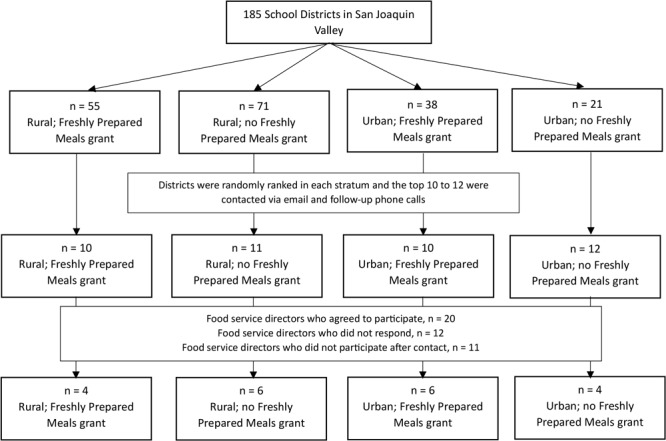
- Districts were stratified by Freshly Prepared Meals grant receipt and rural/urban locale, then randomly ranked; 43 FSDs were contacted and 20 consented (46%).
- Two analysts double-coded transcripts and used inductive thematic analysis; data saturation was reached after 20 interviews, and NVivo 12 was used to organize codes.
Limitations
- The paper states the sample was restricted to FSDs in California’s San Joaquin Valley, findings are not statistically generalizable, social desirability bias was possible, presenting a UPF definition before belief questions may have influenced later statements, Zoom interviews may have affected participation and interaction, and the small sample prevented comparative analysis across geography and income.
- The paper also notes that 4 of 20 participants did not complete the demographic survey, and no participants responded to the emailed summary of preliminary findings for feedback.
Model-written summary. Check it against the paper before relying on it.
Integrity signals
Registry
Cites
Statistics
Figures
Verification
Claims the paper makes
24 Own result · 19 Own method · 12 Not checked yet · 1 Supported so far · 1 Check pending · 1 No full text of the sources · 1 Own interpretation · 1 No basis given
A result the paper reports from its own data — it cites no other source for it, so there is none to check. The quote shows it is in the paper.
In the paper
“One felt that food safety takes priority: “It’s eggs or chicken. . . . Those would be the things that I would just worry about. Anything that creates more of a foodborne illness or an allergy . . . those are the things that are kind of scary to put in your kitchens” (ID 05).”
§ Food Service Directors’ Knowledge and Beliefs About Ultraprocessed Foods in California’s San Joaquin Valley Schools > Results > Perceptions of ultraprocessed foods
hedgeddirectSingle case- Asserted: passes — The authors put it forward as true.
- Checkable: passes — It can be checked against evidence.
- Load-bearing: unclear — It is unclear whether the paper’s conclusions depend on it.
- Based: passes — The paper gives a reason why it holds.
The paper states this without a source or data behind it here, so there is nothing to check it against. The quote shows it is in the paper.
In the paper
“After participants received the study’s UPF definition, many of them perceived UPFs available in schools as healthier than UPFs available at fast-food restaurants and grocery stores.”
§ Food Service Directors’ Knowledge and Beliefs About Ultraprocessed Foods in California’s San Joaquin Valley Schools > Discussion
plaindirect- Asserted: passes — The authors put it forward as true.
- Checkable: passes — It can be checked against evidence.
- Load-bearing: passes — The paper’s conclusions depend on it.
- Based: passes — The paper gives a reason why it holds.
A result the paper reports from its own data — it cites no other source for it, so there is none to check. The quote shows it is in the paper.
In the paper
“In semistructured interviews with 20 FSDs in a predominantly agricultural, low-income, rural region of California, we found varying knowledge and beliefs about UPFs.”
§ Food Service Directors’ Knowledge and Beliefs About Ultraprocessed Foods in California’s San Joaquin Valley Schools > Discussion
plain- Asserted: passes — The authors put it forward as true.
- Checkable: passes — It can be checked against evidence.
- Load-bearing: passes — The paper’s conclusions depend on it.
- Based: passes — The paper gives a reason why it holds.
A result the paper reports from its own data — it cites no other source for it, so there is none to check. The quote shows it is in the paper.
In the paper
“Some described UPFs as foods altered from their natural form: “Breaded nuggets, and you’d eat them, and they were like rubber, and I was like, what is it? There isn’t even any chicken in these things” (ID 07).”
§ Food Service Directors’ Knowledge and Beliefs About Ultraprocessed Foods in California’s San Joaquin Valley Schools > Results > Knowledge and understanding of ultraprocessed foods
plainSingle case- Asserted: passes — The authors put it forward as true.
- Checkable: passes — It can be checked against evidence.
- Load-bearing: unclear — It is unclear whether the paper’s conclusions depend on it.
- Based: passes — The paper gives a reason why it holds.
A result the paper reports from its own data — it cites no other source for it, so there is none to check. The quote shows it is in the paper.
In the paper
“The remaining 13 FSDs described UPFs as packaged foods containing additives and preservatives.”
§ Food Service Directors’ Knowledge and Beliefs About Ultraprocessed Foods in California’s San Joaquin Valley Schools > Results > Knowledge and understanding of ultraprocessed foods
plain- Asserted: passes — The authors put it forward as true.
- Checkable: passes — It can be checked against evidence.
- Load-bearing: unclear — It is unclear whether the paper’s conclusions depend on it.
- Based: passes — The paper gives a reason why it holds.
A result the paper reports from its own data — it cites no other source for it, so there is none to check. The quote shows it is in the paper.
In the paper
“Most FSDs said scratch-cooked foods tasted better than UPFs.”
§ Food Service Directors’ Knowledge and Beliefs About Ultraprocessed Foods in California’s San Joaquin Valley Schools > Results > Perceptions of ultraprocessed foods
plain- Asserted: passes — The authors put it forward as true.
- Checkable: passes — It can be checked against evidence.
- Load-bearing: unclear — It is unclear whether the paper’s conclusions depend on it.
- Based: passes — The paper gives a reason why it holds.
A result the paper reports from its own data — it cites no other source for it, so there is none to check. The quote shows it is in the paper.
In the paper
“This unfamiliarity occurred even among FSDs in districts that had dedicated Freshly Prepared Meals grant funding to support fresher, less-processed school meals.”
§ Food Service Directors’ Knowledge and Beliefs About Ultraprocessed Foods in California’s San Joaquin Valley Schools > Discussion
plain- Asserted: passes — The authors put it forward as true.
- Checkable: passes — It can be checked against evidence.
- Load-bearing: passes — The paper’s conclusions depend on it.
- Based: passes — The paper gives a reason why it holds.
A result the paper reports from its own data — it cites no other source for it, so there is none to check. The quote shows it is in the paper.
In the paper
“Several FSDs said ensuring that students ate at school took priority because of high food insecurity in the San Joaquin Valley; many noted that school meals were a major source of sustenance for their students.”
§ Food Service Directors’ Knowledge and Beliefs About Ultraprocessed Foods in California’s San Joaquin Valley Schools > Results > Perceptions of ultraprocessed foods
plaindirect- Asserted: passes — The authors put it forward as true.
- Checkable: passes — It can be checked against evidence.
- Load-bearing: unclear — It is unclear whether the paper’s conclusions depend on it.
- Based: passes — The paper gives a reason why it holds.
A result the paper reports from its own data — it cites no other source for it, so there is none to check. The quote shows it is in the paper.
In the paper
“Many FSDs mentioned external influences that shaped their beliefs about UPFs, including public discussion of UPFs, family roles and household experiences, and marketing.”
§ Food Service Directors’ Knowledge and Beliefs About Ultraprocessed Foods in California’s San Joaquin Valley Schools > Results > Perceptions of ultraprocessed foods
plaindirect- Asserted: passes — The authors put it forward as true.
- Checkable: passes — It can be checked against evidence.
- Load-bearing: unclear — It is unclear whether the paper’s conclusions depend on it.
- Based: passes — The paper gives a reason why it holds.
A result the paper reports from its own data — it cites no other source for it, so there is none to check. The quote shows it is in the paper.
In the paper
“Multiple FSDs said they read food labels when deciding which foods to purchase: “What’s important is that people who are cooking this food that they do read the . . . they print out the nutritionals [nutritional data] and they look at them” (ID 13).”
§ Food Service Directors’ Knowledge and Beliefs About Ultraprocessed Foods in California’s San Joaquin Valley Schools > Results > Perceptions of ultraprocessed foods
plainSingle case- Asserted: passes — The authors put it forward as true.
- Checkable: passes — It can be checked against evidence.
- Load-bearing: unclear — It is unclear whether the paper’s conclusions depend on it.
- Based: passes — The paper gives a reason why it holds.
- It may state two separate claims as one. 17
- Probably not a substantial claim. 33
The sources with a verdict support this claim; the rest weren’t checked yet, have no full text we could read, or their verdicts aren’t rated yet.
In the paper
“Although there is heterogeneity in health associations among UPF subgroups (23), and some food products reformulated for schools may contain lower sodium, fat, and calories, or more whole grains than similar items sold elsewhere, these “healthier” reformulated items may legitimize the consumption of UPFs (24).”
§ Food Service Directors’ Knowledge and Beliefs About Ultraprocessed Foods in California’s San Joaquin Valley Schools > Discussion
What the sources say
- Not checked yetcites [23] Louie, 2025, Are all ultra-processed foods bad? A critical review of the NOVA classification system, Proc Nutr Soc source
Checked before — its earlier verdict is held back until a new check runs.
- Supportedcites [24] Scrinis, 2018, Ultra-processed foods and the limits of product reformulation, Public Health Nutr source
Split into 2 atoms — 2 confirmed, 0 partially supported, 0 disputed, 0 misattributed, 0 unverifiable. Expand the claim to see per-atom verdicts.
hedgedconditional- Asserted: passes — The authors put it forward as true.
- Checkable: passes — It can be checked against evidence.
- Load-bearing: passes — The paper’s conclusions depend on it.
- Based: passes — The paper gives a reason why it holds.
It may state two separate claims as one.
- Not checked yet
A result the paper reports from its own data — it cites no other source for it, so there is none to check. The quote shows it is in the paper.
In the paper
“Of the 7 FSDs who expressed unfamiliarity with UPFs, 6 were Freshly Prepared Meals grant recipients, and 3 were from rural districts.”
§ Food Service Directors’ Knowledge and Beliefs About Ultraprocessed Foods in California’s San Joaquin Valley Schools > Results > Knowledge and understanding of ultraprocessed foods
plaincorrelational- Asserted: passes — The authors put it forward as true.
- Checkable: passes — It can be checked against evidence.
- Load-bearing: unclear — It is unclear whether the paper’s conclusions depend on it.
- Based: passes — The paper gives a reason why it holds.
It may state two separate claims as one.
A result the paper reports from its own data — it cites no other source for it, so there is none to check. The quote shows it is in the paper.
In the paper
“Some also thought UPFs could affect learning: “I tend to believe that it is a contributing factor to food addiction, obesity, and the ever-growing ADHD epidemic of kids not being able to pay attention, focus, and generally not learn” (ID 19).”
§ Food Service Directors’ Knowledge and Beliefs About Ultraprocessed Foods in California’s San Joaquin Valley Schools > Results > Perceptions of ultraprocessed foods
hedgedconditionalSingle case- Asserted: passes — The authors put it forward as true.
- Checkable: passes — It can be checked against evidence.
- Load-bearing: fails — The paper’s conclusions may not depend on it.
- Based: passes — The paper gives a reason why it holds.
Probably not a substantial claim. The paper’s conclusions may not depend on it.
A result the paper reports from its own data — it cites no other source for it, so there is none to check. The quote shows it is in the paper.
In the paper
“In addition, one FSD believed that foods prepared more recently were fresh and less processed: “[Domino’s pizza is] also a fresher product, you know, they’re building it morning of and cooking it. So, it’s not something that’s been sitting in the freezer for months” (ID 01).”
§ Food Service Directors’ Knowledge and Beliefs About Ultraprocessed Foods in California’s San Joaquin Valley Schools > Results > Perceptions of ultraprocessed foods
plainSingle case- Asserted: passes — The authors put it forward as true.
- Checkable: passes — It can be checked against evidence.
- Load-bearing: fails — The paper’s conclusions may not depend on it.
- Based: passes — The paper gives a reason why it holds.
Probably not a substantial claim. The paper’s conclusions may not depend on it.
A result the paper reports from its own data — it cites no other source for it, so there is none to check. The quote shows it is in the paper.
In the paper
“Among survey respondents, the median age was 49.5 years (IQR, 41.0–59.5); 15 identified as women, 8 as White, and 6 as Hispanic (Table).”
§ Food Service Directors’ Knowledge and Beliefs About Ultraprocessed Foods in California’s San Joaquin Valley Schools > Results > Participant demographics
plainn = 16- Asserted: passes — The authors put it forward as true.
- Checkable: passes — It can be checked against evidence.
- Load-bearing: fails — The paper’s conclusions may not depend on it.
- Based: passes — The paper gives a reason why it holds.
Probably not a substantial claim. The paper’s conclusions may not depend on it. It may state two separate claims as one.
A result the paper reports from its own data — it cites no other source for it, so there is none to check. The quote shows it is in the paper.
In the paper
“In total, 43 FSDs were contacted and 20 consented to participate (46%) (Figure).”
§ Food Service Directors’ Knowledge and Beliefs About Ultraprocessed Foods in California’s San Joaquin Valley Schools > Methods > Study population
plain- Asserted: passes — The authors put it forward as true.
- Checkable: passes — It can be checked against evidence.
- Load-bearing: fails — The paper’s conclusions may not depend on it.
- Based: passes — The paper gives a reason why it holds.
Probably not a substantial claim. The paper’s conclusions may not depend on it. It may state two separate claims as one.
A result the paper reports from its own data — it cites no other source for it, so there is none to check. The quote shows it is in the paper.
In the paper
“Two FSDs said UPFs were not necessarily less healthy than scratch-cooked foods.”
§ Food Service Directors’ Knowledge and Beliefs About Ultraprocessed Foods in California’s San Joaquin Valley Schools > Results > Perceptions of ultraprocessed foods
plain- Asserted: passes — The authors put it forward as true.
- Checkable: passes — It can be checked against evidence.
- Load-bearing: fails — The paper’s conclusions may not depend on it.
- Based: passes — The paper gives a reason why it holds.
Probably not a substantial claim. The paper’s conclusions may not depend on it.
A result the paper reports from its own data — it cites no other source for it, so there is none to check. The quote shows it is in the paper.
In the paper
“Of 20 participants, 16 completed the demographic survey.”
§ Food Service Directors’ Knowledge and Beliefs About Ultraprocessed Foods in California’s San Joaquin Valley Schools > Results > Participant demographics
plainn = 16- Asserted: passes — The authors put it forward as true.
- Checkable: passes — It can be checked against evidence.
- Load-bearing: fails — The paper’s conclusions may not depend on it.
- Based: passes — The paper gives a reason why it holds.
Probably not a substantial claim. The paper’s conclusions may not depend on it.
A result the paper reports from its own data — it cites no other source for it, so there is none to check. The quote shows it is in the paper.
In the paper
“Six of 16 survey respondents estimated that more than 40% of foods purchased for school meals were UPFs.”
§ Food Service Directors’ Knowledge and Beliefs About Ultraprocessed Foods in California’s San Joaquin Valley Schools > Results > Participant demographics
hedgedn = 16- Asserted: passes — The authors put it forward as true.
- Checkable: passes — It can be checked against evidence.
- Load-bearing: fails — The paper’s conclusions may not depend on it.
- Based: passes — The paper gives a reason why it holds.
Probably not a substantial claim. The paper’s conclusions may not depend on it.
A result the paper reports from its own data — it cites no other source for it, so there is none to check. The quote shows it is in the paper.
In the paper
“Several FSDs perceived that UPFs served in schools were healthier than UPFs served outside schools: “And you can get a Wild Mike [pizza] at the grocery store, but the one we’re serving . . . it’s more nutritious because it’s governed by the state to be nutritious for school food services” (ID 20).”
§ Food Service Directors’ Knowledge and Beliefs About Ultraprocessed Foods in California’s San Joaquin Valley Schools > Results > Perceptions of ultraprocessed foods
plainSingle case- Asserted: passes — The authors put it forward as true.
- Checkable: passes — It can be checked against evidence.
- Load-bearing: fails — The paper’s conclusions may not depend on it.
- Based: passes — The paper gives a reason why it holds.
Probably not a substantial claim. The paper’s conclusions may not depend on it.
A result the paper reports from its own data — it cites no other source for it, so there is none to check. The quote shows it is in the paper.
In the paper
“Geographic locale and Freshly Prepared Meals grant status were known for all participants; among the 16 who completed the demographic survey, 7 were from rural districts and 9 were grant recipients.”
§ Food Service Directors’ Knowledge and Beliefs About Ultraprocessed Foods in California’s San Joaquin Valley Schools > Results > Participant demographics
plainn = 16- Asserted: passes — The authors put it forward as true.
- Checkable: passes — It can be checked against evidence.
- Load-bearing: fails — The paper’s conclusions may not depend on it.
- Based: passes — The paper gives a reason why it holds.
Probably not a substantial claim. The paper’s conclusions may not depend on it. It may state two separate claims as one.
A result the paper reports from its own data — it cites no other source for it, so there is none to check. The quote shows it is in the paper.
In the paper
“Some FSDs said they thought UPFs could adversely impact health.”
§ Food Service Directors’ Knowledge and Beliefs About Ultraprocessed Foods in California’s San Joaquin Valley Schools > Results > Perceptions of ultraprocessed foods
hedged- Asserted: passes — The authors put it forward as true.
- Checkable: passes — It can be checked against evidence.
- Load-bearing: fails — The paper’s conclusions may not depend on it.
- Based: passes — The paper gives a reason why it holds.
Probably not a substantial claim. The paper’s conclusions may not depend on it.
A result the paper reports from its own data — it cites no other source for it, so there is none to check. The quote shows it is in the paper.
In the paper
“FSDs in this study had varying understandings of UPFs: 7 of 20 had not previously heard the term, whereas others described UPFs in ways consistent with common definitions, including packaged foods containing additives or preservatives and foods altered from their natural form.”
§ Food Service Directors’ Knowledge and Beliefs About Ultraprocessed Foods in California’s San Joaquin Valley Schools > Discussion > Conclusions
plain- Asserted: passes — The authors put it forward as true.
- Checkable: passes — It can be checked against evidence.
- Load-bearing: passes — The paper’s conclusions depend on it.
- Based: passes — The paper gives a reason why it holds.
It may state two separate claims as one.
What the paper did — it cites no source for this, so there is none to check. The quote shows it is in the paper.
In the paper
“Findings were also shared with the community advisory board, and the study team incorporated feedback.”
§ Food Service Directors’ Knowledge and Beliefs About Ultraprocessed Foods in California’s San Joaquin Valley Schools > Methods > Data collection
plain- Asserted: passes — The authors put it forward as true.
- Checkable: passes — It can be checked against evidence.
- Load-bearing: fails — The paper’s conclusions may not depend on it.
- Based: passes — The paper gives a reason why it holds.
Probably not a substantial claim. The paper’s conclusions may not depend on it. It may state two separate claims as one.
What the paper did — it cites no source for this, so there is none to check. The quote shows it is in the paper.
In the paper
“However, a written summary of preliminary findings was emailed to all participating FSDs for their feedback on the accuracy of the interpretations; no participants responded.”
§ Food Service Directors’ Knowledge and Beliefs About Ultraprocessed Foods in California’s San Joaquin Valley Schools > Methods > Data collection
plain- Asserted: passes — The authors put it forward as true.
- Checkable: passes — It can be checked against evidence.
- Load-bearing: fails — The paper’s conclusions may not depend on it.
- Based: passes — The paper gives a reason why it holds.
Probably not a substantial claim. The paper’s conclusions may not depend on it. It may state two separate claims as one.
In the paper
“The school districts were stratified into 4 groups based on receipt of the Freshly Prepared Meals grant (yes/no) and geographic locale (rural/urban) (16) to ensure representation across strata.”
§ Food Service Directors’ Knowledge and Beliefs About Ultraprocessed Foods in California’s San Joaquin Valley Schools > Methods > Study population
What the sources say
- Not checked yetcites [16] National Center for Education Statistics. NCES Locale Classifications and Criteria . Accessed February 20, 2025. https://nces.ed.gov/programs/edge/docs/LOCALE_CLASSIFICATIONS.pdf
plain- Asserted: passes — The authors put it forward as true.
- Checkable: passes — It can be checked against evidence.
- Load-bearing: fails — The paper’s conclusions may not depend on it.
- Based: passes — The paper gives a reason why it holds.
Probably not a substantial claim. The paper’s conclusions may not depend on it.
What the paper did — it cites no source for this, so there is none to check. The quote shows it is in the paper.
In the paper
“Two analysts (A.P.-T. and A.G., a female medical student who attended US public schools) reviewed the interviews to identify emergent topics and reached consensus through discussion.”
§ Food Service Directors’ Knowledge and Beliefs About Ultraprocessed Foods in California’s San Joaquin Valley Schools > Methods > Analysis
plain- Asserted: passes — The authors put it forward as true.
- Checkable: passes — It can be checked against evidence.
- Load-bearing: fails — The paper’s conclusions may not depend on it.
- Based: passes — The paper gives a reason why it holds.
Probably not a substantial claim. The paper’s conclusions may not depend on it. It may state two separate claims as one.
What the paper did — it cites no source for this, so there is none to check. The quote shows it is in the paper.
In the paper
“We convened a community advisory board to provide input on all study processes.”
§ Food Service Directors’ Knowledge and Beliefs About Ultraprocessed Foods in California’s San Joaquin Valley Schools > Methods > Study design
plain- Asserted: passes — The authors put it forward as true.
- Checkable: passes — It can be checked against evidence.
- Load-bearing: fails — The paper’s conclusions may not depend on it.
- Based: passes — The paper gives a reason why it holds.
Probably not a substantial claim. The paper’s conclusions may not depend on it.
What the paper did — it cites no source for this, so there is none to check. The quote shows it is in the paper.
In the paper
“Data saturation was reached after 20 interviews, when no new themes were observed.”
§ Food Service Directors’ Knowledge and Beliefs About Ultraprocessed Foods in California’s San Joaquin Valley Schools > Methods > Analysis
plain- Asserted: passes — The authors put it forward as true.
- Checkable: passes — It can be checked against evidence.
- Load-bearing: fails — The paper’s conclusions may not depend on it.
- Based: passes — The paper gives a reason why it holds.
Probably not a substantial claim. The paper’s conclusions may not depend on it.
What the paper did — it cites no source for this, so there is none to check. The quote shows it is in the paper.
In the paper
“The Stanford Institutional Review Board approved the study (IRB no. 70983).”
§ Food Service Directors’ Knowledge and Beliefs About Ultraprocessed Foods in California’s San Joaquin Valley Schools > Methods > Data collection
plain- Asserted: passes — The authors put it forward as true.
- Checkable: passes — It can be checked against evidence.
- Load-bearing: fails — The paper’s conclusions may not depend on it.
- Based: passes — The paper gives a reason why it holds.
Probably not a substantial claim. The paper’s conclusions may not depend on it.
What the paper did — it cites no source for this, so there is none to check. The quote shows it is in the paper.
In the paper
“Reflexivity was maintained by discussing potential biases and perspectives among the research team.”
§ Food Service Directors’ Knowledge and Beliefs About Ultraprocessed Foods in California’s San Joaquin Valley Schools > Methods > Analysis
plaindirect- Asserted: passes — The authors put it forward as true.
- Checkable: passes — It can be checked against evidence.
- Load-bearing: fails — The paper’s conclusions may not depend on it.
- Based: passes — The paper gives a reason why it holds.
Probably not a substantial claim. The paper’s conclusions may not depend on it.
What the paper did — it cites no source for this, so there is none to check. The quote shows it is in the paper.
In the paper
“Recruitment proceeded iteratively; as interviews were conducted, we reviewed emerging themes and continued contacting additional FSDs from the randomized lists until thematic saturation was achieved.”
§ Food Service Directors’ Knowledge and Beliefs About Ultraprocessed Foods in California’s San Joaquin Valley Schools > Methods > Study population
plain- Asserted: passes — The authors put it forward as true.
- Checkable: passes — It can be checked against evidence.
- Load-bearing: fails — The paper’s conclusions may not depend on it.
- Based: passes — The paper gives a reason why it holds.
Probably not a substantial claim. The paper’s conclusions may not depend on it.
In the paper
“This study was conducted in California’s San Joaquin Valley, a predominantly Hispanic/Latino, rural, and low-income region that produces 8% of the nation’s agricultural food (13).”
§ Food Service Directors’ Knowledge and Beliefs About Ultraprocessed Foods in California’s San Joaquin Valley Schools > Methods > Study population
What the sources say
- Not checked yetcites [13] Finocchio L, Paci J. San Joaquin Valley: Despite Poverty and Capacity Constraints, Health Care Access Improves . California Health Care Foundation; 2020. Accessed February 22, 2026. https://www.chcf.org/wp-content/uploads/2020/12/RegionalMarketAlmanac2020SanJoaquinValley.pdf
plain- Asserted: passes — The authors put it forward as true.
- Checkable: passes — It can be checked against evidence.
- Load-bearing: fails — The paper’s conclusions may not depend on it.
- Based: passes — The paper gives a reason why it holds.
Probably not a substantial claim. The paper’s conclusions may not depend on it. It may state two separate claims as one.
What the paper did — it cites no source for this, so there is none to check. The quote shows it is in the paper.
In the paper
“The study team designed the semistructured interview guide (https://researchinchildhealth.org/resources-ultra-processed-foods-in-school-meals) with input from the community advisory board.”
§ Food Service Directors’ Knowledge and Beliefs About Ultraprocessed Foods in California’s San Joaquin Valley Schools > Methods > Interview guide
plain- Asserted: passes — The authors put it forward as true.
- Checkable: passes — It can be checked against evidence.
- Load-bearing: fails — The paper’s conclusions may not depend on it.
- Based: passes — The paper gives a reason why it holds.
Probably not a substantial claim. The paper’s conclusions may not depend on it.
What the paper did — it cites no source for this, so there is none to check. The quote shows it is in the paper.
In the paper
“The analysts then double-coded all interviews, resolving discrepancies through discussion, adding new codes, and refining the codebook as necessary.”
§ Food Service Directors’ Knowledge and Beliefs About Ultraprocessed Foods in California’s San Joaquin Valley Schools > Methods > Analysis
plain- Asserted: passes — The authors put it forward as true.
- Checkable: passes — It can be checked against evidence.
- Load-bearing: fails — The paper’s conclusions may not depend on it.
- Based: passes — The paper gives a reason why it holds.
Probably not a substantial claim. The paper’s conclusions may not depend on it. It may state two separate claims as one.
None of the sources cited for this claim have been checked yet.
In the paper
“Although the National School Lunch Program and School Breakfast Program must meet US Department of Agriculture nutrition standards, federal standards do not specifically address food processing.”
- Also stated in: § Introduction · plain
“However, current federal school nutrition standards do not classify or limit foods by degree of processing; consequently, products that meet nutrient standards can still be UPFs (10).”
§ Food Service Directors’ Knowledge and Beliefs About Ultraprocessed Foods in California’s San Joaquin Valley Schools > Abstract > Introduction
What the sources say
- Not checked yetcites [10] The Lancet Regional Health—Americas, 2022, Unhealthy school meals: a solution to hunger or a problem for health?, Lancet Reg Health Am source
Checked before — its earlier verdict is held back until a new check runs.
plain- Asserted: passes — The authors put it forward as true.
- Checkable: passes — It can be checked against evidence.
- Load-bearing: passes — The paper’s conclusions depend on it.
- Based: passes — The paper gives a reason why it holds.
It may state two separate claims as one.
- Also stated in: § Introduction · plain
What the paper did — it cites no source for this, so there is none to check. The quote shows it is in the paper.
In the paper
“The researchers had no prior interactions with participating FSDs.”
§ Food Service Directors’ Knowledge and Beliefs About Ultraprocessed Foods in California’s San Joaquin Valley Schools > Methods > Data collection
plain- Asserted: passes — The authors put it forward as true.
- Checkable: passes — It can be checked against evidence.
- Load-bearing: fails — The paper’s conclusions may not depend on it.
- Based: passes — The paper gives a reason why it holds.
Probably not a substantial claim. The paper’s conclusions may not depend on it.
What the paper did — it cites no source for this, so there is none to check. The quote shows it is in the paper.
In the paper
“The guide was pilot-tested with 2 FSDs who were members of the community advisory board.”
§ Food Service Directors’ Knowledge and Beliefs About Ultraprocessed Foods in California’s San Joaquin Valley Schools > Methods > Interview guide
plain- Asserted: passes — The authors put it forward as true.
- Checkable: passes — It can be checked against evidence.
- Load-bearing: fails — The paper’s conclusions may not depend on it.
- Based: passes — The paper gives a reason why it holds.
Probably not a substantial claim. The paper’s conclusions may not depend on it.
What the paper did — it cites no source for this, so there is none to check. The quote shows it is in the paper.
In the paper
“Fifth, while further comparative analysis across contexts, such as geography and income level, could be beneficial in advising policy, this was not possible given the small sample size.”
§ Food Service Directors’ Knowledge and Beliefs About Ultraprocessed Foods in California’s San Joaquin Valley Schools > Discussion > Limitations and strengths
plain- Asserted: passes — The authors put it forward as true.
- Checkable: passes — It can be checked against evidence.
- Load-bearing: fails — The paper’s conclusions may not depend on it.
- Based: passes — The paper gives a reason why it holds.
Probably not a substantial claim. The paper’s conclusions may not depend on it.
What the paper did — it cites no source for this, so there is none to check. The quote shows it is in the paper.
In the paper
“As with most qualitative studies, findings are not intended to be statistically generalizable.”
§ Food Service Directors’ Knowledge and Beliefs About Ultraprocessed Foods in California’s San Joaquin Valley Schools > Discussion > Limitations and strengths
plain- Asserted: passes — The authors put it forward as true.
- Checkable: passes — It can be checked against evidence.
- Load-bearing: passes — The paper’s conclusions depend on it.
- Based: passes — The paper gives a reason why it holds.
Probably not a substantial claim.
What the paper did — it cites no source for this, so there is none to check. The quote shows it is in the paper.
In the paper
“Second, the potential for social desirability bias exists.”
§ Food Service Directors’ Knowledge and Beliefs About Ultraprocessed Foods in California’s San Joaquin Valley Schools > Discussion > Limitations and strengths
plain- Asserted: passes — The authors put it forward as true.
- Checkable: passes — It can be checked against evidence.
- Load-bearing: fails — The paper’s conclusions may not depend on it.
- Based: fails — The paper may give no reason why it holds.
Probably not a substantial claim. The paper’s conclusions may not depend on it. The paper may give no reason why it holds.
In the paper
“In a study of more than 250 US FSDs, 75% indicated that “pressure to serve foods that children enjoy versus healthy foods” was a barrier to improving healthy food choices in the school food environment (31).”
§ Food Service Directors’ Knowledge and Beliefs About Ultraprocessed Foods in California’s San Joaquin Valley Schools > Discussion
What the sources say
- Not checked — no full text of the sourcecites [31] Brouse, 2009, School food service directors’ perceptions of barriers to and strategies for improving the school food environment in the United States, Int J Health Promot Educ source
hedged- Asserted: passes — The authors put it forward as true.
- Checkable: passes — It can be checked against evidence.
- Load-bearing: fails — The paper’s conclusions may not depend on it.
- Based: passes — The paper gives a reason why it holds.
Probably not a substantial claim. The paper’s conclusions may not depend on it.
What the paper did — it cites no source for this, so there is none to check. The quote shows it is in the paper.
In the paper
“Strengths include the range of FSD perspectives obtained through stratified recruitment and the study’s contribution to an emerging literature on FSD knowledge and beliefs about UPFs.”
§ Food Service Directors’ Knowledge and Beliefs About Ultraprocessed Foods in California’s San Joaquin Valley Schools > Discussion > Limitations and strengths
plain- Asserted: passes — The authors put it forward as true.
- Checkable: passes — It can be checked against evidence.
- Load-bearing: fails — The paper’s conclusions may not depend on it.
- Based: passes — The paper gives a reason why it holds.
Probably not a substantial claim. The paper’s conclusions may not depend on it. It may state two separate claims as one.
None of the sources cited for this claim have been checked yet.
In the paper
“These foods also enable manufacturers to build brand loyalty among millions of children (25) and may encourage consumption of less healthy versions of reformulated products available outside of school (22).”
§ Food Service Directors’ Knowledge and Beliefs About Ultraprocessed Foods in California’s San Joaquin Valley Schools > Discussion
What the sources say
- Not checked yetcites [25] Nguyen, 2020, Transferring racial/ethnic marketing strategies from tobacco to food corporations: Philip Morris and Kraft General Foods, Am J Public Health source
Checked before — its earlier verdict is held back until a new check runs.
- Not checked yetcites [22] Jahn, 2018, Product reformulation and nutritional improvements after new competitive food standards in schools, Public Health Nutr source
Checked before — its earlier verdict is held back until a new check runs.
hedgedconditional- Asserted: passes — The authors put it forward as true.
- Checkable: passes — It can be checked against evidence.
- Load-bearing: passes — The paper’s conclusions depend on it.
- Based: passes — The paper gives a reason why it holds.
It may state two separate claims as one.
- Not checked yet
In the paper
“California is unusual in its universal school meals program, and the San Joaquin Valley is a largely low-income, rural agricultural region (13).”
§ Food Service Directors’ Knowledge and Beliefs About Ultraprocessed Foods in California’s San Joaquin Valley Schools > Discussion > Limitations and strengths
What the sources say
- Not checked yetcites [13] Finocchio L, Paci J. San Joaquin Valley: Despite Poverty and Capacity Constraints, Health Care Access Improves . California Health Care Foundation; 2020. Accessed February 22, 2026. https://www.chcf.org/wp-content/uploads/2020/12/RegionalMarketAlmanac2020SanJoaquinValley.pdf
plain- Asserted: passes — The authors put it forward as true.
- Checkable: passes — It can be checked against evidence.
- Load-bearing: fails — The paper’s conclusions may not depend on it.
- Based: passes — The paper gives a reason why it holds.
Probably not a substantial claim. The paper’s conclusions may not depend on it. It may state two separate claims as one.
In the paper
“Processed heat-and-serve meat products are typically precooked, which may reduce perceived food safety risks but does not eliminate the need for safe handling (29).”
§ Food Service Directors’ Knowledge and Beliefs About Ultraprocessed Foods in California’s San Joaquin Valley Schools > Discussion
What the sources say
- Not checked yetcites [29] US Department of Agriculture, Food and Nutrition Administration. Prevent foodborne illness by keeping school meals safe. Accessed March 17, 2025. https://www.fns.usda.gov/fs/school-meal-safety
hedgedconditional- Asserted: passes — The authors put it forward as true.
- Checkable: passes — It can be checked against evidence.
- Load-bearing: passes — The paper’s conclusions depend on it.
- Based: passes — The paper gives a reason why it holds.
It may state two separate claims as one.
What the paper did — it cites no source for this, so there is none to check. The quote shows it is in the paper.
In the paper
“Although it is possible that later statements about FSDs’ perceptions of UPFs were influenced by what was presented, we elicited participants’ initial knowledge of UPFs before presenting this definition.”
§ Food Service Directors’ Knowledge and Beliefs About Ultraprocessed Foods in California’s San Joaquin Valley Schools > Discussion > Limitations and strengths
hedgedconditional- Asserted: passes — The authors put it forward as true.
- Checkable: passes — It can be checked against evidence.
- Load-bearing: fails — The paper’s conclusions may not depend on it.
- Based: passes — The paper gives a reason why it holds.
Probably not a substantial claim. The paper’s conclusions may not depend on it. It may state two separate claims as one.
What the paper did — it cites no source for this, so there is none to check. The quote shows it is in the paper.
In the paper
“Fourth, conducting interviews via Zoom may have influenced participation and interaction patterns.”
§ Food Service Directors’ Knowledge and Beliefs About Ultraprocessed Foods in California’s San Joaquin Valley Schools > Discussion > Limitations and strengths
hedgedconditional- Asserted: passes — The authors put it forward as true.
- Checkable: passes — It can be checked against evidence.
- Load-bearing: fails — The paper’s conclusions may not depend on it.
- Based: fails — The paper may give no reason why it holds.
Probably not a substantial claim. The paper’s conclusions may not depend on it. The paper may give no reason why it holds.
None of the sources cited for this claim have been checked yet.
In the paper
“Given these concerns, there is substantial policy interest (eg, more stringent federal nutrition standards, school district procurement policies) in limiting access and availability of UPFs in schools (26–28).”
§ Food Service Directors’ Knowledge and Beliefs About Ultraprocessed Foods in California’s San Joaquin Valley Schools > Discussion
What the sources say
- Not checked yetcites [26] Popkin, 2021, Towards unified and impactful policies to reduce ultra-processed food consumption and promote healthier eating, Lancet Diabetes Endocrinol source
Checked before — its earlier verdict is held back until a new check runs.
- Not checked yetcites [27] Afshin, 2015, CVD prevention through policy: a review of mass media, food/menu labeling, taxation/subsidies, built environment, school procurement, worksite wellness, and marketing standards to improve diet, Curr Cardiol Rep source
Checked before — its earlier verdict is held back until a new check runs.
- Not checked yetcites [28] Scrinis, 2025, Policies to halt and reverse the rise in ultraprocessed food production, marketing, and consumption, Lancet source
plain- Asserted: passes — The authors put it forward as true.
- Checkable: passes — It can be checked against evidence.
- Load-bearing: fails — The paper’s conclusions may not depend on it.
- Based: passes — The paper gives a reason why it holds.
Probably not a substantial claim. The paper’s conclusions may not depend on it.
- Not checked yet
The paper relies on this without support.
Food service directors are critical in implementing school nutrition policies and guiding what is served in schools.
“Food service directors (FSDs) are critical in implementing school nutrition policies and guiding what is served in schools.”
“Food service directors are critical in implementing emerging school policies related to ultraprocessed foods.”
The paper relies on this without support.
No studies have examined FSDs’ understanding of UPFs.
“However, to our knowledge, no studies have examined their understanding of UPFs.”
The paper relies on this without support.
UPFs that have been reformulated to meet federal school nutrition guidelines are commonly served in schools.
“Although FSDs must follow federal school nutrition guidelines (17), UPFs that have been reformulated to meet these guidelines are commonly served in schools.”
Self-check
Percentages, sums and reported differences re-computed from the paper’s own numbers.
Each contradiction between two passages listed here was confirmed by an independent check.
Rated minor: it would not touch a result — a value no result rests on, a p-value that stays on the same side of the significance level, or a conflict that is clerical, resolved elsewhere in the paper, or outside its own findings.
In the paper
§ Food Service Directors’ Knowledge and Beliefs About Ultraprocessed Foods in California’s San Joaquin Valley Schools > Abstract > Results
“Participants’ mean age was 49.5 years (IQR, 41.0–59.5)”
§ Food Service Directors’ Knowledge and Beliefs About Ultraprocessed Foods in California’s San Joaquin Valley Schools > Results > Participant demographics
“Among survey respondents, the median age was 49.5 years (IQR, 41.0–59.5)”
Citations
Cites
Ultra-processed foods: What they are and how to identify them
Monteiro, C. A., Cannon, G., Levy, R. B., Moubarac, J.-C., Louzada, M. L., Rauber, F., Khandpur, N., Cediel, G., Neri, D., Martinez-Steele, E., et al. (2019) · Public Health Nutrition · doi:10.1017/s1368980018003762 · Cited by 2,964
The UN Decade of Nutrition, the NOVA food classification and the trouble with ultra-processing
Monteiro, C. A., Cannon, G., Moubarac, J.-C., Levy, R. B., Louzada, M. L. C., & Jaime, P. C. (2018) · Public Health Nutrition · doi:10.1017/s1368980017000234 · Cited by 2,333
Lane, M. M., Gamage, E., Du, S., Ashtree, D. N., McGuinness, A. J., Gauci, S., Baker, P., Lawrence, M., Rebholz, C. M., Srour, B., et al. (2024) · BMJ · doi:10.1136/bmj-2023-077310 · Cited by 1,153
Trends in Consumption of Ultraprocessed Foods Among US Youths Aged 2-19 Years, 1999-2018
Wang, L., Steele, E. M., Du, M., Pomeranz, J. L., O’Connor, L. E., Herrick, K., Luo, H., Zhang, X., Mozaffarian, D., & Zhang, F. F. (2021) · JAMA · doi:10.1001/jama.2021.10238 · Cited by 426
Ultra-processed foods and human health: the main thesis and the evidence
Monteiro, C. A., Louzada, M. L., Steele-Martinez, E., Cannon, G., Andrade, G. C., Baker, P., Bes-Rastrollo, M., Bonaccio, M., Gearhardt, A. N., Khandpur, N., et al. (2025) · The Lancet · doi:10.1016/s0140-6736(25)01565-x · Cited by 339
Popkin, B. M., Barquera, S., Corvalan, C., Hofman, K. J., Monteiro, C., Ng, S. W., Swart, E. C., & Taillie, L. S. (2021) · The Lancet Diabetes & Endocrinology · doi:10.1016/s2213-8587(21)00078-4 · Cited by 328
Ultra-processed foods and human health: from epidemiological evidence to mechanistic insights
Srour, B., Kordahi, M. C., Bonazzi, E., Deschasaux-Tanguy, M., Touvier, M., & Chassaing, B. (2022) · The Lancet Gastroenterology & Hepatology · doi:10.1016/s2468-1253(22)00169-8 · Cited by 303
Nutrition standards in the National School Lunch and School Breakfast Programs. Final rule.
(2012) · PubMed · Cited by 191
Ultra-processed foods and the limits of product reformulation
Scrinis, G., & Monteiro, C. A. (2018) · Public Health Nutrition · doi:10.1017/s1368980017001392 · Cited by 188
Afshin, A., Penalvo, J., Del Gobbo, L., Kashaf, M., Micha, R., Morrish, K., Pearson-Stuttard, J., Rehm, C., Shangguan, S., Smith, J. D., et al. (2015) · Current Cardiology Reports · doi:10.1007/s11886-015-0658-9 · Cited by 133
Research works printed but not linked: 1
- Yon, 2016, School nutrition directors’ perspectives on preparing for and implementing USDA’s new school meal regulations, J Child Nutr Manag, 40
Cited by
Still being checked.
Metadata
- Authors
- Gupta, A., Duran Gomez, A. Z., Matheson, D., Sharma, A., Richard, V., Ritchie, L. D., de la Rosa, A., Delgado, D., Islas, G., Hecht, C. A., Hecht, K., Patel, A. I., & Pedroza-Tobias, A.
- Affiliations
- Stanford Medicine (US)
- Department of Pediatrics, Stanford University School of Medicine, Palo Alto, California
- University Hospital of Geneva (CH)
- University of California Division of Agriculture and Natural Resources (US)
- Dolores Huerta Foundation, Bakersfield, California
- Cultiva La Salud, Fresno, California
- Corresponding author
- Gupta, Anjali
- ORCID
- Venue
- Preventing Chronic Disease
- Published
- 2026-07-09
- Volume
- 23
- Pages
- E23-E23
- ISSN
- 1545-1151 (ISSN-L)
- PMC
- PMC13353300
- OpenAlex
- W7167690443
- Semantic Scholar
- 78f0cd2758c86edf75a874c2ae403ac7ef1e51d1
- Cited by
- 0
- References
- 24
- FWCI
- 0.00
- Type
- journal article
- Language
- en
- Open access
- diamond
- doi.org
- Licence
- public-domain
- Locations
- Preventing Chronic Disease (publishedVersion, public-domain)
- PubMed (publishedVersion)
- PubMed Central (publishedVersion, cc-by)
- Funders
- U.S. Department of Health and Human Services
- Thompson Family Foundation
- National Institutes of Health
- Centers for Disease Control and Prevention
- National Heart, Lung, and Blood Institute (K24HL169841)
- National Institute of Diabetes and Digestive and Kidney Diseases (P30DK092924)
- Stanford Maternal and Child Health Research Institute
- Topics
- Health Sciences › Medicine › Public Health, Environmental and Occupational Health › Consumer Attitudes and Food Labeling
- Health Sciences › Medicine › Public Health, Environmental and Occupational Health › School Health and Nursing Education
- Health Sciences › Medicine › Public Health, Environmental and Occupational Health › Global Public Health Policies and Epidemiology
- Keywords
- ultra-processed foods, school meals, school nutrition policy, food processing, food labeling, food insecurity, food safety, chronic disease prevention, San Joaquin Valley
- MeSH terms
- Food, Processed, Adult, California, Female, Food Services, Humans, Health Knowledge, Attitudes, Practice, Male, Middle Aged, Schools, Nutrition Policy, Qualitative Research
About these checks
Registry, retraction, Cites and statistics results are computed, not judged, with one exception: a printed reference that no index lists is read once by a model before it counts as a citation error. Claims are extracted by a model and kept only when their quote appears verbatim in the text; each cited source is then checked, with a model’s help, for whether it says what the claim relies on. Those verdicts can be wrong — read the claim’s quote and the cited source before relying on one.
A language model drew the claims from the paper on 2026-11-11, under version 3 of the claim definition (model deepseek-v4.1-flash, prompt extract-v3).
A second model labelled each claim on 2026-11-11 (model jev-1.13-20260917, definition revision gold-guideline-v0.2).
Cited sources are checked with a language model’s help (gpt-6-sol).
Statistics and arithmetic are recomputed, not judged.
Confidence bands are shown only for fields calibrated on our annotated test set. None is calibrated yet, so no band is shown.
What counts as a claim ›How we measure confidence ›How we check this ›
Are you an author, or do you see a problem with this page? Request a review
How to cite
Cite CoChat for the checks on this page, and the paper for its own findings.
- This page
- CoChat. (2026). Citation check: Food Service Directors’ Knowledge and Beliefs About Ultraprocessed Foods in California’s San Joaquin Valley Schools. https://app.cochat.ai/papers/10.5888/pcd23.250379
- The paper
- Gupta, A., Duran Gomez, A. Z., Matheson, D., Sharma, A., Richard, V., Ritchie, L. D., de la Rosa, A., Delgado, D., Islas, G., Hecht, C. A., Hecht, K., Patel, A. I., & Pedroza-Tobias, A. (2026). Food Service Directors’ Knowledge and Beliefs About Ultraprocessed Foods in California’s San Joaquin Valley Schools. Preventing Chronic Disease. https://doi.org/10.5888/pcd23.250379
