

Guided self-help concreteness training as an intervention for major depression in primary care: a Phase II randomized controlled trial
Open accessThe DOI matches its Crossref record; 50 of the 50 references it cites were found in a registry or an index.
Abstract
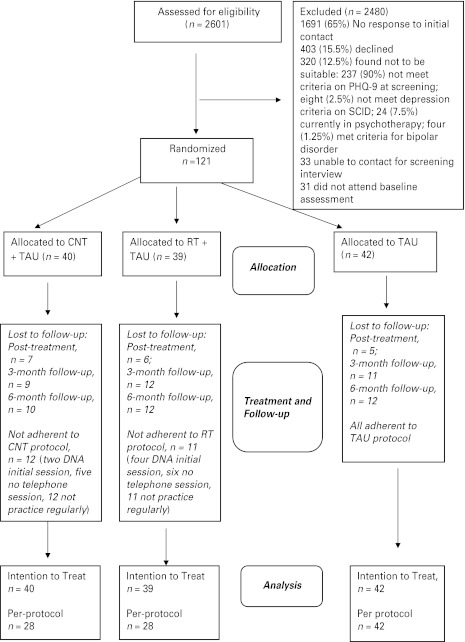
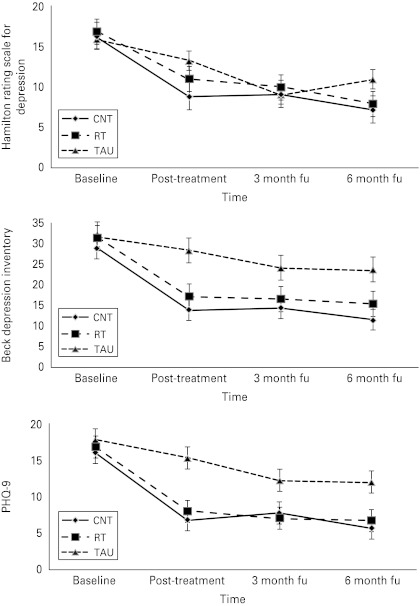
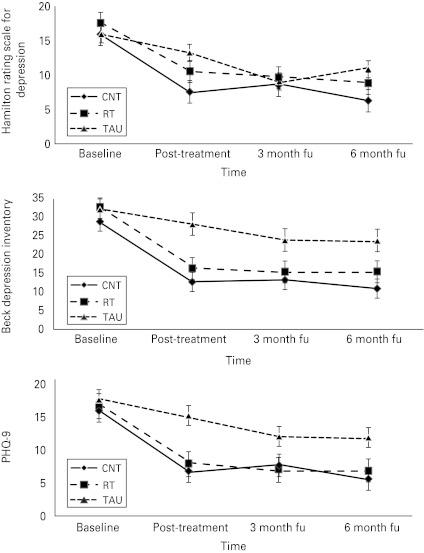
Background: The development of widely accessible, effective psychological interventions for depression is a priority. This randomized trial provides the first controlled data on an innovative cognitive bias modification (CBM) training guided self-help intervention for depression. Method: One hundred and twenty-one consecutively recruited participants meeting criteria for current major depression were randomly allocated to treatment as usual (TAU) or to TAU plus concreteness training (CNT) guided self-help or to TAU plus relaxation training (RT) guided self-help. CNT involved repeated practice at mental exercises designed to switch patients from an unhelpful abstract thinking habit to a helpful concrete thinking habit, thereby targeting depressogenic cognitive processes (rumination, overgeneralization). Results: The addition of CNT to TAU significantly improved depressive symptoms at post-treatment [mean difference on the Hamilton Rating Scale for Depression (HAMD) 4.28, 95% confidence interval (CI) 1.29–7.26], 3- and 6-month follow-ups, and for rumination and overgeneralization post-treatment. There was no difference in the reduction of symptoms between CNT and RT (mean difference on the HAMD 1.98, 95% CI −1.14 to 5.11), although CNT significantly reduced rumination and overgeneralization relative to RT post-treatment, suggesting a specific benefit on these cognitive processes. Conclusions: This study provides preliminary evidence that CNT guided self-help may be a useful addition to TAU in treating major depression in primary care, although the effect was not significantly different from an existing active treatment (RT) matched for structural and common factors. Because of its relative brevity and distinct format, it may have value as an additional innovative approach to increase the accessibility of treatment choices for depression.
Overview
The claims and statistics of this paper haven’t been checked yet.
Free: it reads the open-access text and checks the first 5 claims that cite a source we can check. Create a free account to check every claim.
Integrity signals
Registry
Cites
Statistics
Figures
Verification
Claims the paper makes
The claims and statistics of this paper haven’t been checked yet.
Free: it reads the open-access text and checks the first 5 claims that cite a source we can check. Create a free account to check every claim.
Claims other papers make about this one
Each is checked against this paper’s own text: does it say what the citing paper says it does?
The source backs part of the claim, not all of it — or backs it for a different population, condition or comparison.
In the citing paper
“Psychological functioning was measured using the Beck Depression Inventory (BDI) and Beck Depression Inventory-II (BDI-II) scale [124] in eight studies”
From Helping patients help themselves: A systematic review of self-management support strategies in primary health care practice (2019) · cites this paper as [72]
Experimental — accuracy not yet measuredThe source backs part of the claim, not all of it — or backs it for a different population, condition or comparison.
In the citing paper
“Thirteen RCTs targeting a range of conditions including asthma, T2DM, COPD, recurrent binge eating, chronic fatigue, major depression, low self-esteem, IBS and depression reported positive findings for all clinical and humanistic outcome measures (Table 4) [42, 66, 67, 72, 75, 80, 91, 92, 95, 100, 117].”
From Helping patients help themselves: A systematic review of self-management support strategies in primary health care practice (2019) · cites this paper as [72]
Experimental — accuracy not yet measuredThe cited source says what the claim attributes to it.
In the citing paper
“The intervention resulted in significantly fewer depressive symptoms post-treatment, relative to treatment as usual (ITT, p = 0.006, effect size d for change in Hamilton Rating Scale for Depression (HAMD) = 0.76; PP, p<0.0001, d = 1.06).”
From Helping patients help themselves: A systematic review of self-management support strategies in primary health care practice (2019) · cites this paper as [72]
The cited source says what the claim attributes to it.
In the citing paper
“Four high-quality studies provided positive evidence that SMS interventions delivered in primary care dominate usual standard of care, by improving patients’ clinical outcomes, HRQOL or psychological functioning [72, 91, 92, 100].”
From Helping patients help themselves: A systematic review of self-management support strategies in primary health care practice (2019) · cites this paper as [72]
Self-check
Percentages, sums and reported differences re-computed from the paper’s own numbers.
The self-check needs the paper’s full text.
Citations
Cites
The PHQ-9: Validity of a brief depression severity measure
Kroenke, K., Spitzer, R. L., & Williams, J. B. W. (2001) · Journal of General Internal Medicine · doi:10.1046/j.1525-1497.2001.016009606.x · Cited by 44,910
Hamilton, M. (1960) · Journal of Neurology, Neurosurgery & Psychiatry · doi:10.1136/jnnp.23.1.56 · Cited by 32,817 · cited 2×
“Our primary outcome was depressive symptoms assessed on the 17-item interviewer-rated HAMD (Hamilton, 1960 ; Williams, 1998), the most commonly used interview-based measure of depressive severity, with documented reliability and validity (range 0–52; cut-offs : minimal depression <8, high severity…”
MethodA Brief Measure for Assessing Generalized Anxiety Disorder: The GAD-7
Spitzer, R. L., Kroenke, K., Williams, J. B. W., & Löwe, B. (2006) · Archives of Internal Medicine · doi:10.1001/archinte.166.10.1092 · Cited by 31,765 · cited 4×
“…: 0–13 minimal, 14–19 mild, 20–28 moderate, 29–63 severe) and the PHQ-9 (Kroenke et al. 2001, range 0–27; cut-offs : 0–4 minimal, 5–10 mild, 11–15 moderate, 16–20 moderately severe, 20–27 severe), and a well-validated anxiety measure, the Generalized Anxiety Disorder-7 (GAD-7; Spitzer et al. 2006).”
InfluentialCONSORT 2010 Statement: updated guidelines for reporting parallel group randomised trials
the CONSORT Group, Schulz, K. F., Altman, D. G., & Moher, D. (2010) · BMC Medicine · doi:10.1186/1741-7015-8-18 · Cited by 13,371
Concurrent and Predictive Validity of a Self-reported Measure of Medication Adherence
Morisky, D. E., Green, L. W., & Levine, D. M. (1986) · Medical Care · doi:10.1097/00005650-198601000-00007 · Cited by 5,317 · cited 2×
“…the Morisky Medication Adherence instrument, a structured fouritem self-reported measure (scored 0–4, 0–1=good adherence ; o2 signals potential difficulties with adherence), with demonstrated reliability and validity (Morisky et al. 1986), to assess adherence with antidepressant medication.”
BackgroundMethodResponses to depression and their effects on the duration of depressive episodes
Nolen-Hoeksema, S. (1991) · Journal of Abnormal Psychology · doi:10.1037/0021-843x.100.4.569 · Cited by 4,529 · cited 1×
“Rumination is repetitive thinking about the causes, meanings and implications of symptoms, problems and upsetting events (Nolen-Hoeksema, 1991 ; Watkins, 2008).”
BackgroundCONSORT 2010 statement: updated guidelines for reporting parallel group randomized trials
Schulz, K. F., Altman, D. G., Moher, D., & for the CONSORT Group* (2010) · Annals of Internal Medicine · doi:10.7326/0003-4819-152-11-201006010-00232 · Cited by 3,824
Nolen-Hoeksema, S., & Morrow, J. (1991) · Journal of Personality and Social Psychology · doi:10.1037/0022-3514.61.1.115 · Cited by 3,276 · cited 1×
“At baseline and post-treatment, patients completed the 22-item Ruminative Response Scale of the Response Styles Questionnaire (RSQ; Nolen-Hoeksema & Morrow, 1991), the standard measure of depressive rumination, and a shortened version of the Attributional Style Questionnaire (ASQ; Peterson et al.…”
MethodThe role of rumination in depressive disorders and mixed anxiety/depressive symptoms.
Nolen-Hoeksema, S. (2000) · Journal of Abnormal Psychology · doi:10.1037//0021-843x.109.3.504 · Cited by 2,998
Cognitive Therapy and the Emotional Disorders
Ince, L. P. (1977) · American Journal of Psychotherapy · doi:10.1176/appi.psychotherapy.1977.31.4.633 · Cited by 2,892
Research works printed but not linked: 1
- Beck AT Steer RA Brown GK 1996 The Beck Depression Inventory, Second Edition The Psychological Corporation San Antonio, TX
Cited by
Items 101–160 of 160
Overgeneral autobiographical memories and their relationship to rumination
Watkins, E. R. (2015) · Cambridge University Press eBooks · doi:10.1017/cbo9781139626767.011 · Cited by 8
Self-citationThe “How” and the “Why” of Restoring Goal-Pursuit after a Failure
Gorlin, E. I., & Teachman, B. A. (2017) · Journal of Experimental Psychopathology · doi:10.5127/jep.051015 · Cited by 7
“In contrast, more abstract/why-focused thought tends to be more adaptive when processing positively valenced content (such as positive experiences or personal values), when in a relatively positive mood state, and/or when faced with a familiar and attainable goal (Watkins, 2008, 2011).”
BackgroundInfluentialRumination-Focused Cognitive Behavioral Therapy
Watkins, E. R. (2021) · Cambridge University Press eBooks · doi:10.1017/9781108355605.024 · Cited by 7
Self-citationPatients’ Experiences of Using a Self-help App for Posttraumatic Stress Disorder: Qualitative Study
Riisager, L. G., Christensen, A. B., Scharff, F. B., Arendt, I. T. P., Ismail, I., Lau, M. E., & Møeller, S. B. (2021) · JMIR Formative Research · doi:10.2196/26852 · Cited by 9
“Focusing on psychotherapy, a study on a guided self-help intervention using cognitive bias modification training found a significant treatment effect in patients with depression who reported having created a habitual use of the practiced self-help response [29].”
BackgroundSchoellbauer, J., Tement, S., & Korunka, C. (2023) · Journal of Happiness Studies · doi:10.1007/s10902-023-00628-4 · Cited by 11
“Focusing on concrete details such as what occurred where, when, and why has been shown to reduce rumination within depressive individuals (Watkins et al., 2012), and the deep encoding and storing of information in the long–term memory subsequently releases attentional resources in the working memory (Bartsch et al.”
BackgroundCarney, J. (2019) · Medical Humanities · doi:10.1136/medhum-2018-011459 · Cited by 8
Embodiment in Clinical Disorders and Treatment
Riskind, J. H., Schrader, S. W., & Loya, J. M. (2021) · Springer eBooks · doi:10.1007/978-3-030-78471-3_22 · Cited by 7
Watkins, E. R., Phillips, D., Cranston, T., Choueiri, H., Newton, M., Cook, H., & Taylor, G. J. (2024) · BMC Psychiatry · doi:10.1186/s12888-024-06079-2 · Cited by 6
Self-citationUpton, E. L., Venkatesha, V., Joubert, A. E., Mahoney, A., Moulds, M. L., Werner‐Seidler, A., & Newby, J. M. (2025) · Cognitive Therapy and Research · doi:10.1007/s10608-025-10593-2 · Cited by 6
“Moreover, RF-CBT reduces the risk of relapse in adolescents and adults with a history of depression (Jacobs et al., 2016 ), and prevents the development of anxiety and depressive disorders in adolescents and young adults who are at-risk owing to high trait levels of RNT (Cook et al., 2019 ; Topper et al., 2017).”
InfluentialShigematsu, J., Hako, S., Toyokuni, C., Kambara, K., Tanabe, S., Machino, A., Takebayashi, M., & Ogata, A. (2024) · Current Psychology · doi:10.1007/s12144-024-07062-6 · Cited by 7
“Training programs related to these factors include a web-based program (Kambara et al., 2023) incorporating concreteness training (Watkins et al., 2012), which is part of cognitive behavioral therapy programs focused on rumination, and web-based self-compassion training (Finlay-Jones et al., 2023).”
Habits in Depression: Understanding and Intervention
Watkins, E. R., Owens, M., & Cook, L. (2018) · Springer eBooks · doi:10.1007/978-3-319-97529-0_15 · Cited by 5
Self-citationGavric, D., Cameron, D., Waechter, S., Moscovitch, D. A., McCabe, R. E., & Rowa, K. (2023) · Journal of Anxiety Disorders · doi:10.1016/j.janxdis.2023.102744 · Cited by 4
Cognitive Behavioral Therapy for Depression
Todd, G., & Branch, R. (2021) · Cambridge University Press eBooks · doi:10.1017/9781108355605.021 · Cited by 5
Hitchcock, C., Funk, J., Cummins, R., Patel, S. D., Catarino, A., Takano, K., Dalgleish, T., & Ewbank, M. (2024) · Journal of Affective Disorders · doi:10.1016/j.jad.2024.01.134 · Cited by 5
Shifting away from negative inferences affects rumination and mood
Perlman, B., Burg, G., Avirbach, N., & Mor, N. (2024) · Behaviour Research and Therapy · doi:10.1016/j.brat.2024.104604 · Cited by 4
Funk, J., Kopf‐Beck, J., Takano, K., Watkins, E. R., & Ehring, T. W. (2025) · Journal of Behavior Therapy and Experimental Psychiatry · doi:10.1016/j.jbtep.2024.102014 · Cited by 7
“In contrast to the current study, a prior trial in patients with depression showed that guided concreteness training significantly reduced depressive symptoms and RNT relative to treat-ment as usual (Watkins et al., 2012).”
Self-citationDisambiguating the relationship between processing modes and mindfulness in Japan
Kambara, K., Kabir, R. S., Kira, Y., Ogata, A., & Barnard, P. J. (2023) · Cogent Psychology · doi:10.1080/23311908.2022.2151726 · Cited by 4
“Conversely, individuals with increased CET tend to have modified depression (Watkins et al., 2009, 2012), improved problem-solving (Kingston et al., 2014; Watkins & Moulds, 2005), and increased goal-striving (Kambara et al., 2019b).”
BackgroundPositive appraisal style: The mental immune system?
Luyten, L., Boddez, Y., & Hermans, D. (2015) · Behavioral and Brain Sciences · doi:10.1017/s0140525x14001629 · Cited by 4
“In line with this finding, recent studies have found that a concrete processing style (i.e., focusing on the specific perceptual details of an event) counteracts dysphoria (Watkins, Baeyens, & Read, 2009) and depression (Watkins et al., 2012).”
ResultNeuropsychologie en psychiatrie
Baeyens, C. (2019) · De Boeck Supérieur eBooks · doi:10.3917/dbu.amiev.2019.01.0157 · Cited by 3
Self-citationEffects of Rumination Processing Modes on the Tendency to Avoid Failure
Kambara, K., Ogata, A., & Kira, Y. (2017) · Current Psychology · doi:10.1007/s12144-017-9655-z · Cited by 3
Kirchler, S. V., Müller, C., Spock, Z., Ehring, T. W., Kopf‐Beck, J., & Tamm, J. (2025) · Behaviour Research and Therapy · doi:10.1016/j.brat.2025.104801 · Cited by 2
Xu, L., Yang, Y., Wang, S., & Lu, B. (2026) · BMC Psychology · doi:10.1186/s40359-026-04158-5 · Cited by 3
“Repetitive negative thinking refers to a maladaptive cognitive processing style in which individuals persistently and uncontrollably focus on negative content when encountering distressing events or emotions [1–3].”
Rosenfeld, E. A., Kennedy, K., Farchione, T. J., & Roberts, J. E. (2019) · Journal of Cognitive Psychotherapy · doi:10.1891/0889-8391.33.2.128 · Cited by 1
“…involves the repeated practicing of cognitive skills, such as focusing on sensory details of recent upsetting experiences, noticing the processes and sequences by which difficult events unfold, and specifying particular steps and behaviors that encourage “moving forward” (Watkins et al., 2012).”
BackgroundInfluentialThe Use of Technology to Augment Clinical Care in Depression and Anxiety Disorders: An Evidence Map
Maher, A. R., Apaydin, E. A., Raaen, L. B., Motala, A., Shanman, R., & Hempel, S. (2019) · RAND Corporation eBooks · doi:10.7249/rr2177 · Cited by 2
“…2011; Van den Berg et al., 2015; Van Straten, Cuijpers, and Smits, 2008; Vernmark et al., 2010; Wagner, Horn, and Maercker, 2014; Warmerdam et al., 2008; Watkins et al., 2012; Watts et al., 2013; Williams et al., 2013; Williams et al., 2015; Wims et al., 2010; Wolitzky-Taylor and Telch, 2010;…”
BackgroundDie Ruminationsfokussierte Kognitive Verhaltenstherapie
Ehring, T. W. (2020) · Zeitschrift für Psychiatrie Psychologie und Psychotherapie · doi:10.1024/1661-4747/a000414 · Cited by 2
Watkins, E. R. (2015) · Wiley eBooks · doi:10.1002/9781118900772.etrds0294 · Cited by 2
Self-citationCognitive behavioral therapies for rumination
Borders, A. (2020) · Elsevier eBooks · doi:10.1016/b978-0-12-812545-8.00010-3 · Cited by 1
Safi, J. M., Rescigno, S. M., & Shih, J. H. (2022) · Journal of Prevention and Health Promotion · doi:10.1177/26320770221111757 · Cited by 2
“Interventions targeting rumination that have shown decreases in depressive symptomology among mildly depressed or dysphoric populations were typically employed over multiple weeks (e.g., Watkins et al., 2012).”
MethodReward Processing in Motivational and Affective Disorders
Skandali, N. (2016) · Frontiers research topics · doi:10.3389/978-2-88919-986-0 · Cited by 1
The effects of rumination and automatic thoughts on burnout in nursing students
Shigematsu, J., Matsumoto, M., Kambara, K., Tanabe, S., Minami, H., Takebayashi, M., & Ogata, A. (2019) · Stress Science Research · doi:10.5058/stresskagakukenkyu.2019003 · Cited by 1
Clinician Knowledge of and Attitudes Toward Guided Self-Help
Plasencia, M., Farris, S. G., & Wilson, G. T. (2024) · Behavior Therapy · doi:10.1016/j.beth.2024.01.006 · Cited by 1
Rogiers, R., Baeken, C., Watkins, E. R., den Abbeele, D. V., Remue, J., Raedt, R. D., & Lemmens, G. M. D. (2022) · International Journal of Group Psychotherapy · doi:10.1080/00207284.2022.2066535 · Cited by 6
Self-citationWorry and rumination : underlying processes and transdiagnostic characteristics
Drost, J. (2014) · Leiden Repository (Leiden University) · Cited by 1
Avoidance and overgeneral memory
Ganly, T. (2018) · doi:10.26686/wgtn.17068511.v1 · Cited by 1
Depressives Grübeln: Konsequenzen, Theorie und Behandlung
Teismann, T., Hanning, S., von Brachel, R., & Willutzki, U. (2012) · Springer eBooks · doi:10.1007/978-3-642-25229-7_1
Thinking About Rumination: The Scholarly Contributions and Intellectual Legacy of
Lyubomirsky, S., Layous, K., Chancellor, J., & Nelson, S. K. (2015)
Derguy, C., Foucaud, J., & M’Baïlara, K. (2017) · Journal de Thérapie Comportementale et Cognitive · doi:10.1016/j.jtcc.2017.09.002
Wellness management and positive psychology app for smartphone platforms.
Στρατάκη, Ε., & Strataki, E. (2017)
Varieties of Psychotherapy for Major Depressive Disorder in Adults
David, D., Cristea, I. A., & Beck, A. T. (2017) · Wiley eBooks · doi:10.1002/9781119462996.ch2 · Cited by 1
認知療法,マインドフルネス,原始仏教:「思考」という諸刃の剣を賢く操るために
義徳, 伊. (2018) · 心理学評論 · doi:10.24602/sjpr.61.3_272 · Cited by 2
Supporting Female Adolescent Social and Emotional Health Through a Reading Intervention
Bulger, M. (2018) · Cited by 2
Avoidance and overgeneral memory
Ganly, T. (2018) · Open Access Victoria University of Wellington | Te Herenga Waka (Figshare) · doi:10.26686/wgtn.17068511 · Cited by 2
Robertson, C., Carney, J., & Trudell, S. (2021) · doi:10.31234/osf.io/v6ern
Depressives Grübeln: Konsequenzen, Theorie und Behandlung
Teismann, T., Hanning, S., von Brachel, R., & Willutzki, U. (2016) · Springer eBooks · doi:10.1007/978-3-662-50516-8_1
Lewis, E. J., & Joormann, J. (2018) · Oxford University Press eBooks · doi:10.1093/obo/9780199828340-0206
Protocolo de autocuidado para pacientes con psoriasis desde la farmacia comunitaria
Palomo, T. P., Valverde-Merino, M. I., Martínez, F. M., & Zarzuelo-Romero, M. J. (2023) · Pharmaceutical care España · doi:10.60103/phc.v25i3.805
The differential impact of worry profiles on depression during COVIS-19
Lassi, N. (2024) · Minerva Psychiatry · doi:10.23736/s2724-6612.24.02499-0
Tong, A., & Watkins, E. R. (2024) · Graduate Student Journal of Psychology · doi:10.52214/gsjp.v23i.12972
“There is indirect evidence of its effects on rumination where previous trials demonstrated that RFCBT has been effective in reducing depressive rumination (Hvenegaard et al., 2019; Watkins et al., 2011; Watkins et al., 2012).”
InfluentialSelf-citationDevelopment and validation of a measure of concrete and abstract thinking
Lorenz, H., Beierl, E. T., Tyson, G., & Wild, J. (2025) · PLoS ONE · doi:10.1371/journal.pone.0320009 · Cited by 2
Stenshol, K., Sætrevik, B., Watkins, E. R., & Risan, P. (2025) · Nordic Journal of Studies in Policing · doi:10.18261/njsp.12.1.6
Self-citationUmegaki, Y., Nakagawa, A., Todo, N., Baba, A., Mitsuda, D., Watkins, E. R., & Mullan, E. (2026) · BMC Psychology · doi:10.1186/s40359-026-04182-5
“Standalone concreteness training itself has shown efficacy as an intervention for depression [66].”
Self-citationKornacka, M. (2015) · theses.fr (ABES) · doi:10.70675/fe488327z86aaz4739za725zde8eaa00df4c · Cited by 3
Video game or exercise? College students’ perceptions and adherence to exergames
Kim, Y., & Kim, H.-S. (2026) · Psychology Health & Medicine · doi:10.1080/13548506.2026.2671932
Sorella, S., Matiz, A., Chittaro, L., Malinowski, P., & Crescentini, C. (2026) · Current Psychology · doi:10.1007/s12144-026-09946-1 · Cited by 1
“Watkins ( 2008 ) argued that abstract vs. concrete repetitive thoughts are respectively associated with unconstructive vs. constructive consequences of MW, in particular when considering mental disorders, such as major depression (Watkins et al., 2012 ).”
Effects of Rumination on State Shame in Adolescents: An Online Experimental Investigation
McDermott, L., Cooper, M., & Lau‐Zhu, A. (2026) · Cognitive Therapy and Research · doi:10.1007/s10608-026-10768-5 · Cited by 1
“…Rumination-focused Cognitive Behavioural Therapy (RF-CBT), which encourages a shift from abstract to concrete thinking during rumination, have been shown to be effective for depression and anxiety in adults (Watkins et al., 2011, 2012) and adolescents (Feldhaus et al., 2020; Jacobs et al., 2016).”
L'approche transdiagnostique en psychopathologie
Baeyens, C. (2026) · Dunod eBooks · doi:10.3917/dunod.mones.2026.01.0091
Self-citationIncreasing Mental Health Treatment-Seeking in Primary Care: Is Age Related to Intervention Response?
Doherty, J. (2013) · The Knowledge Bank (The Ohio State University)
Metadata
- Authors
- Watkins, E. R., Taylor, R. S., Byng, R., Baeyens, C., Read, R., Pearson, K., & Watson, L.
- Affiliations
- University of Exeter (GB)
- University of Plymouth (GB)
- Corresponding author
- Watkins, E. R.
- Venue
- Psychological Medicine
- Publisher
- Cambridge University Press (CUP)
- Published
- 2011-11-16
- Volume
- 42
- Issue
- 7
- Pages
- 1359-1371
- ISSN
- 0033-2917 (ISSN-L)
- 1469-8978
- PMC
- PMC3359637
- OpenAlex
- W2151504892
- Cited by
- 160
- References
- 50
- Citations by year
- 2026: 7 · 2025: 6 · 2024: 9 · 2023: 13 · 2022: 4 · 2021: 15 · 2020: 8 · 2019: 10 · 2018: 18 · 2017: 10 · 2016: 15 · 2015: 21 · 2014: 12 · 2013: 10 · 2012: 2
- FWCI
- 9.88
- Type
- journal article
- Language
- en
- Open access
- hybrid
- doi.org
- Licence
- cc-by-nc-sa
- www.cambridge.org/core/terms (unspecified)
- Locations
- Psychological Medicine (publishedVersion, cc-by-nc-sa)
- Europe PMC (PubMed Central) (publishedVersion, cc-by-nc-sa)
- PubMed Central (publishedVersion, cc-by-nc-sa)
- PubMed (publishedVersion)
- Open Research Exeter (University of Exeter) (publishedVersion)
- ENLIGHTEN (Jurnal Bimbingan dan Konseling Islam) (acceptedVersion)
- PEARL (University of Plymouth) (submittedVersion)
- HAL (submittedVersion)
- Figshare (submittedVersion)
- Funders
- Medical Research Council
- Topics
- Social Sciences › Psychology › Experimental and Cognitive Psychology › Anxiety, Depression, Psychometrics, Treatment, Cognitive Processes
- Social Sciences › Psychology › Applied Psychology › Digital Mental Health Interventions
- Social Sciences › Psychology › Clinical Psychology › Psychotherapy Techniques and Applications
- Keywords
- major depressive disorder, guided self-help, cognitive bias modification, rumination, overgeneralization, relaxation training, primary care, treatment accessibility
- MeSH terms
- Major Depressive Disorder, Female, Generalization, Psychological, Humans, Male, Middle Aged, Primary Health Care, Relaxation Therapy, Self Care, Severity of Illness Index, Thinking, Cognitive Behavioral Therapy, Outcome Assessment, Health Care, Intention to Treat Analysis
About these checks
Registry, retraction, Cites and statistics results are computed, not judged, with one exception: a printed reference that no index lists is read once by a model before it counts as a citation error. Claims are extracted by a model and kept only when their quote appears verbatim in the text; each cited source is then checked, with a model’s help, for whether it says what the claim relies on. Those verdicts can be wrong — read the claim’s quote and the cited source before relying on one.
Statistics and arithmetic are recomputed, not judged.
Confidence bands are shown only for fields calibrated on our annotated test set. None is calibrated yet, so no band is shown.
What counts as a claim ›How we measure confidence ›How we check this ›
Are you an author, or do you see a problem with this page? Request a review
Data sources
Bibliographic data: Semantic Scholar, OpenAlex, Crossref.
Contains information from the Semantic Scholar Academic Graph Datasets, made available under the ODC Attribution License (ODC-BY 1.0).
Semantic Scholar’s data is described in: Kinney, R., et al. (2023). The Semantic Scholar Open Data Platform. arXiv:2301.10140.
