

The neural basis of flashback formation: the impact of viewing trauma
Open accessThe DOI matches its Crossref record; 67 of the 67 references it cites were found in a registry or an index.
Abstract
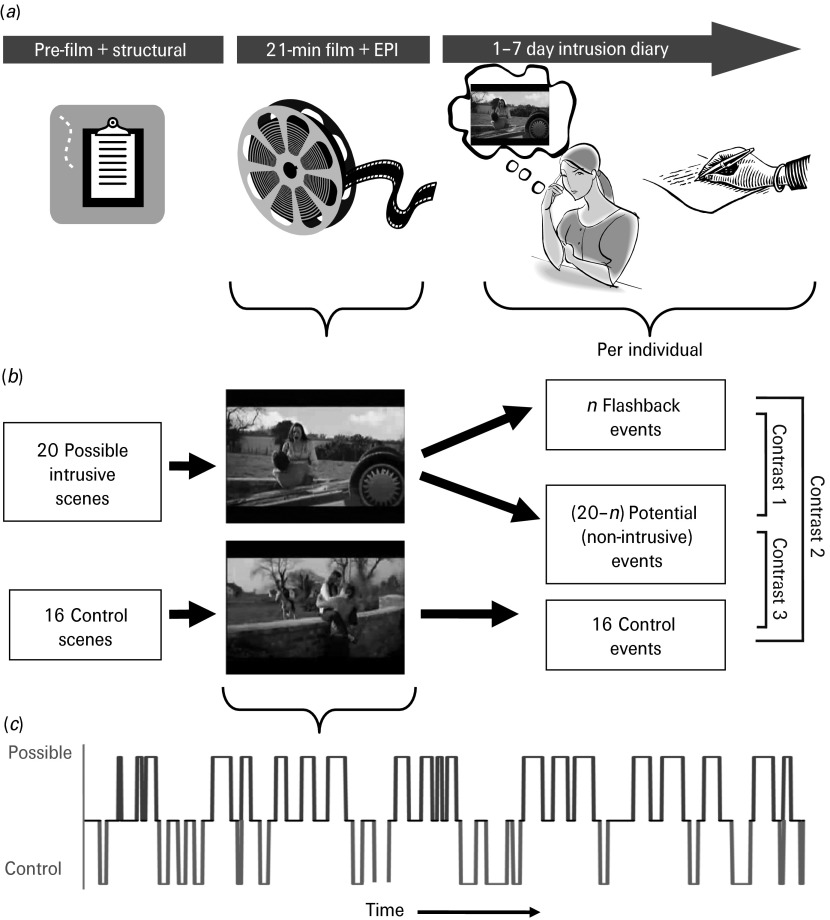
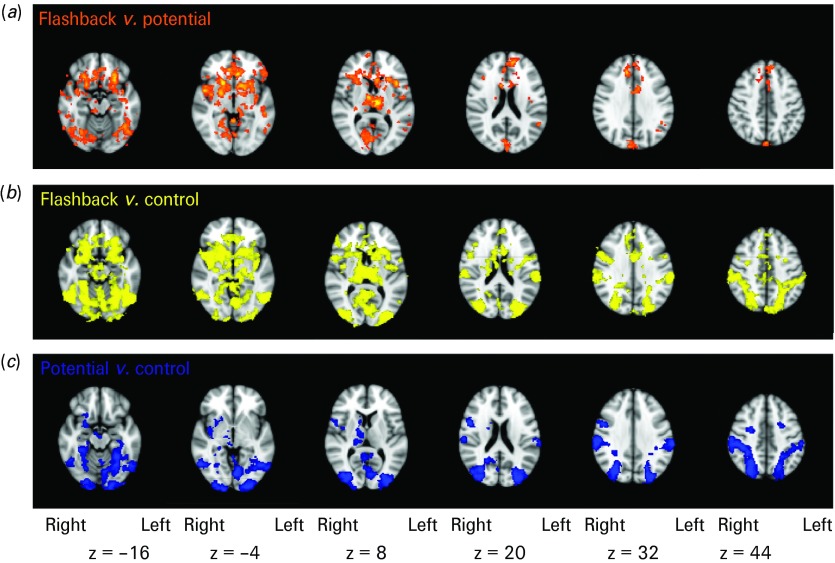
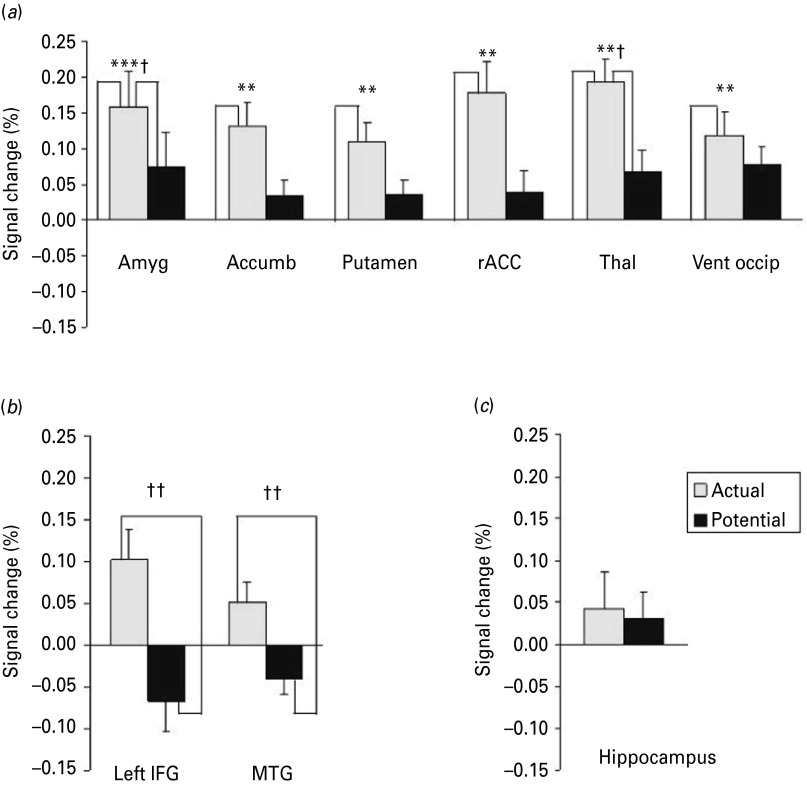
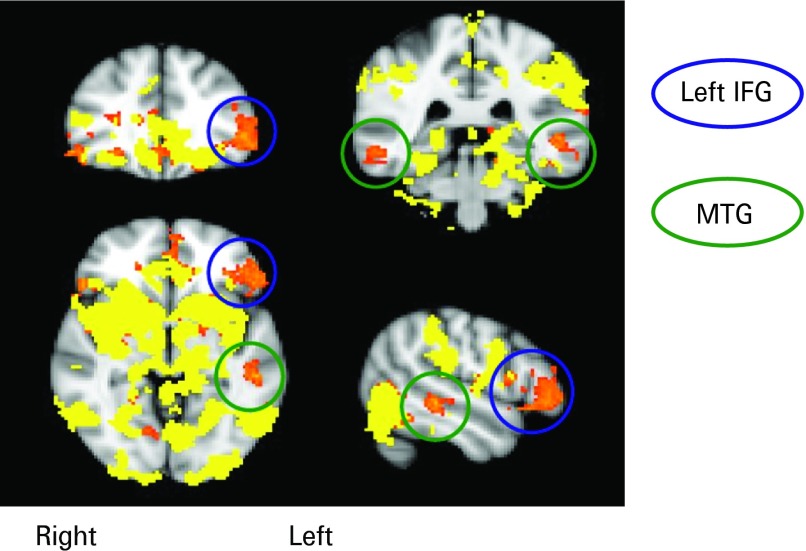
Background: Psychological traumatic events, such as war or road traffic accidents, are widespread. A small but significant proportion of survivors develop post-traumatic stress disorder (PTSD). Distressing, sensory-based involuntary memories of trauma (henceforth ‘flashbacks’) are the hallmark symptom of PTSD. Understanding the development of flashbacks may aid their prevention. This work is the first to combine the trauma film paradigm (as an experimental analogue for flashback development) with neuroimaging to investigate the neural basis of flashback aetiology. We investigated the hypothesis that involuntary recall of trauma (flashback) is determined during the original event encoding. Method: A total of 22 healthy volunteers viewed a traumatic film whilst undergoing functional magnetic resonance imaging (fMRI). They kept a 1-week diary to record flashbacks to specific film scenes. Using a novel prospective fMRI design, we compared brain activation for those film scenes that subsequently induced flashbacks with both non-traumatic control scenes and scenes with traumatic content that did not elicit flashbacks (‘potentials’). Results: Encoding of scenes that later caused flashbacks was associated with widespread increases in activation, including in the amygdala, striatum, rostral anterior cingulate cortex, thalamus and ventral occipital cortex. The left inferior frontal gyrus and bilateral middle temporal gyrus also exhibited increased activation but only relative to ‘potentials’. Thus, these latter regions appeared to distinguish between traumatic content that subsequently flashed back and comparable content that did not. Conclusions: Results provide the first prospective evidence that the brain behaves differently whilst experiencing emotional events that will subsequently become involuntary memories – flashbacks. Understanding the neural basis of analogue flashback memory formation may aid the development of treatment interventions for this PTSD feature.
Overview
The claims and statistics of this paper haven’t been checked yet.
Free: it reads the open-access text and checks the first 5 claims that cite a source we can check. Create a free account to check every claim.
Integrity signals
Registry
Cites
Statistics
Figures
Verification
Claims the paper makes
The claims and statistics of this paper haven’t been checked yet.
Free: it reads the open-access text and checks the first 5 claims that cite a source we can check. Create a free account to check every claim.
Claims other papers make about this one
Each is checked against this paper’s own text: does it say what the citing paper says it does?
The cited source says what the claim attributes to it.
In the citing paper
“So-called subsequent memory paradigms [141] have yielded several markers that predicted the later voluntary recollection of information [142], or the involuntary retrieval of experimental trauma [143–145].”
From Multiple memory systems, multiple time points: How science can inform treatment to control the expression of unwanted emotional memories (2018) · cites this paper as [145]
Self-check
Percentages, sums and reported differences re-computed from the paper’s own numbers.
The self-check needs the paper’s full text.
Citations
Cites
The Measurement of Observer Agreement for Categorical Data
Landis, J. R., & Koch, G. G. (1977) · Biometrics · doi:10.2307/2529310 · Cited by 81,148 · cited 1×
“An inter-rater reliability analysis using the k statistic (Landis & Koch, 1977 ; Fleiss, 1981) was performed (k=0.94, p<0.001), suggesting an excellent level of reliability for matching of diary entries to film scenes and that the flashbacks reported were indeed of the film (rather than other…”
MethodInfluential(1970) · Cited by 24,983
Statistical Methods for Rates and Proportions
Fleiss, J. L., Levin, B., & Paik, M. C. (2003) · Wiley Series in Probability and Statistics · doi:10.1002/0471445428 · Cited by 18,646
Posttraumatic Stress Disorder in the National Comorbidity Survey
Kessler, R. C. (1995) · Archives of General Psychiatry · doi:10.1001/archpsyc.1995.03950240066012 · Cited by 10,379 · cited 1×
“A small but clinically significant proportion of people who experience a trauma subsequently develop PTSD (Kessler et al. 1995).”
BackgroundA cognitive model of posttraumatic stress disorder
Ehlers, A., & Clark, D. M. (2000) · Behaviour Research and Therapy · doi:10.1016/s0005-7967(99)00123-0 · Cited by 6,147 · cited 4×
“The former, and much more common, intrusive memories are clinically important in the maintenance of PTSD (Ehlers & Clark, 2000 ; Foa et al. 2007).”
BackgroundInfluentialThe construction of autobiographical memories in the self-memory system
Conway, M. A., & Pleydell-Pearce, C. W. (2000) · Psychological Review · doi:10.1037/0033-295x.107.2.261 · Cited by 4,089 · cited 1×
“…of psychological processing at the time of trauma (peri-traumatic) is emphasized by the diagnostic criteria for PTSD (APA, 1994), clinical psychology theories (Conway & Pleydell-Pearce, 2000 ; Ehlers & Clark, 2000 ; Brewin & Holmes, 2003) and meta-analysis of PTSD predictors (Ozer et al. 2003).”
Predictors of posttraumatic stress disorder and symptoms in adults: a meta-analysis
Ozer, E. J., Best, S. R., Lipsey, T. L., & Weiss, D. S. (2003) · Psychological Bulletin · doi:10.1037/0033-2909.129.1.52 · Cited by 3,322 · cited 2×
“…of psychological processing at the time of trauma (peri-traumatic) is emphasized by the diagnostic criteria for PTSD (APA, 1994), clinical psychology theories (Conway & Pleydell-Pearce, 2000 ; Ehlers & Clark, 2000 ; Brewin & Holmes, 2003) and meta-analysis of PTSD predictors (Ozer et al. 2003).”
MethodForman, S. D., Cohen, J. D., Fitzgerald, M., Eddy, W. F., Mintun, M. A., & Noll, D. C. (1995) · Magnetic Resonance in Medicine · doi:10.1002/mrm.1910330508 · Cited by 3,202
Temporal Autocorrelation in Univariate Linear Modeling of FMRI Data
Woolrich, M. W., Ripley, B. D., Brady, M., & Smith, S. M. (2001) · NeuroImage · doi:10.1006/nimg.2001.0931 · Cited by 2,852 · cited 1×
“Linear Model) with local autocorrelation correction (Woolrich et al. 2001).”
THE AMYGDALA MODULATES THE CONSOLIDATION OF MEMORIES OF EMOTIONALLY AROUSING EXPERIENCES
McGaugh, J. L. (2004) · Annual Review of Neuroscience · doi:10.1146/annurev.neuro.27.070203.144157 · Cited by 2,296 · cited 2×
“…about the encoding and consolidation of deliberate (voluntary) memories (e.g. Wagner et al. 1998; Canli et al. 2000; Kensinger & Corkin, 2004 ; McGaugh, 2004 ; Francati et al. 2007; Roozendaal et al. 2008; Hughes & Shin, 2011), we predicted that encoding of traumatic material would involve…”
Background
Research works printed but not linked: 5
- National Institute for Health and Clinical Excellence (2005). Post-Traumatic Stress Disorder (PTSD): The Management of PTSD in Adults and Children in Primary and Secondary Care. National Institute for Health and Clinical Excellence: London
- WHO (2003). Mental Health in Emergencies: Mental and Social Aspects of Health of Populations Exposed to Extreme Stressors. World Health Organization: Geneva
- APA (1994). Diagnostic and Statistical Manual of Mental Disorders, 4th edn American Psychiatric Association: Washington, DC
- Beck AT, Steer RA, Brown GK (1996). Manual for the Beck Depression Inventory-II. Psychological Corporation: San Antonio, TX
- Foa EB, Hembree EA, Rothbaum BO (2007). Prolonged Exposure Therapy for PTSD: Emotional Processing of Traumatic Experiences. Oxford University Press: New York
Cited by
Items 201–218 of 218
Dirven, B. C. J., Negwer, M., Botan, A., Maas, R., van Melis, L. V. J., Merjenburgh, S., van Rijn, R., Grandjean, J., Homberg, J. R., Kozicz, T., et al. (2024) · bioRxiv (Cold Spring Harbor Laboratory) · doi:10.1101/2024.09.27.615412
Freysteinson, W. M., Işık, E., Ennis, J. A., Thomas, J. B., & Joseph, J. (2025) · Journal of Advanced Nursing · doi:10.1111/jan.70072
Zhang, H., Xu, H., Huang, L., Wang, Y., Deng, F., Wang, X., Tang, X., Wang, W., Fu, X., Tao, Y., et al. (2021) · Figshare · doi:10.6084/m9.figshare.15139460
Meine, L. E., Schaekel, L., Thörn, H., Ehlert, U., Maeder, M. B., Exadaktylos, A. K., Bingisser, R. M., Papassotiropoulos, A., de Quervain, D. J. ‐., Galatzer‐Levy, I. R., et al. (2025) · Scientific Reports · doi:10.1038/s41598-025-29775-9 · Cited by 2
Rousseau, P. (2018) · theses.fr (ABES) · doi:10.70675/0e977ac2z4714z4c14zabaez066dfd929516 · Cited by 4
Le film de boxe (1891-2023) : le combat d'un genre
Mellouli, M. (2023) · theses.fr (ABES) · doi:10.70675/af3d476cz1736z4ad3z84edz5027002ac945
A visual cortex origin of trauma memory intrusions: integrated evidence from TMS and fMRI
Dai, J., Xu, Z., Guo, J., Yu, K., & Wang, Y. (2026) · Psychological Medicine · doi:10.1017/s0033291726104309 · Cited by 1
“Using a subsequent memory paradigm (Bourne et al., 2013; Clark et al., 2016), we traced brain regions that discriminated Potential and Intrusive episodes from Control episodes during encoding.”
InfluentialKam, H. A., Felsenstein, T. E., Arora, I. H., Bartal, A., Pham, C. T., Chan, S. J., & Dekel, S. (2026) · Journal of Affective Disorders · doi:10.1016/j.jad.2026.122018 · Cited by 2
Jones, A. R., Baker, B. A., Adeyemo, R., McKenley, C., Hanks, M. A., Avila, N., Washington, L., Jang, H. S., Chae, D. H., & Hunter, E. A. (2026) · Journal of Racial and Ethnic Health Disparities · doi:10.1007/s40615-026-03066-z
Trauma and surprise in free energy models of the mind
Reis, R., & Rabeyron, T. (2026) · Neuropsychoanalysis · doi:10.1080/15294145.2026.2633513
“…consequences will be sensorial-perceptual phenomenon and especially the hallucinatory revival of traumatic experiences as seen in many PTSD cases (Bourne et al., 2013; Brewin, 2015), because the boundary between representations of the internal and external Exteroceptive sensory input is…”
Sanders, C. A., Ruder, M.-A., Bruce, S. E., & Philippi, C. L. (2026) · Psychiatry Research Neuroimaging · doi:10.1016/j.pscychresns.2026.112286
Passive or subliminal re-exposure is sufficient for fear modulation in eye-movement intervention
Hu, J., Guo, J., Fang, K., Wei, Z., Yao, Y., Wang, Y., & Wang, Y. (2026) · Behaviour Research and Therapy · doi:10.1016/j.brat.2026.105119
Die biologische Kommunikation des Systems
Bochdansky, T. (2026) · Springer eBooks · doi:10.1007/978-3-662-71737-0_2
Perceptuo-cognitive development in infancy and childhood
Seitz, R. J., Dalkner, N., Krafft, A. M., Paloutzian, R. F., & Angel, H. (2026) · Academia Neuroscience and Brain Research · doi:10.20935/acadneurosci8401 · Cited by 1
Aberg, K. C., Efrati, S., Idan, S., Merzbach, R., Paz, R., & Doenyas‐Barak, K. (2026) · Molecular Psychiatry · doi:10.1038/s41380-026-03845-4
Zhang, X., Liu, W., Chen, L., Zuo, C., Lan, H., Li, L., Kemp, G. J., Lui, S., Suo, X., & Gong, Q. (2026) · Psychological Medicine · doi:10.1017/s0033291726105388
“In addition to this traditional role, it is linked to sensory-based involuntary trauma memories, such as flashbacks, a hallmark symptom of PTSD (Bourne, Mackay, & Holmes, 2013).”
The Effect of Viewpoint Dependence in Spatial Memory Tasks on Intrusive Memories in Analogue Trauma
Polack, R. E. L. R. (2014) · UCL Discovery (University College London) · Cited by 1
Metadata
- Authors
- Bourne, C., Mackay, C. E., & Holmes, E. A.
- Affiliations
- Warneford Hospital (GB)
- MRC Cognition and Brain Sciences Unit (GB)
- Corresponding author
- Holmes, E. A.
- Venue
- Psychological Medicine
- Publisher
- Cambridge University Press (CUP)
- Published
- 2012-10-18
- Volume
- 43
- Issue
- 7
- Pages
- 1521-1532
- ISSN
- 0033-2917 (ISSN-L)
- 1469-8978
- PMC
- PMC3806039
- OpenAlex
- W2104838044
- Cited by
- 218
- References
- 67
- Citations by year
- 2026: 11 · 2025: 9 · 2024: 19 · 2023: 11 · 2022: 15 · 2021: 20 · 2020: 63 · 2019: 11 · 2018: 10 · 2017: 9 · 2016: 12 · 2015: 13 · 2014: 12 · 2013: 3
- FWCI
- 10.18
- Type
- journal article
- Language
- en
- Open access
- hybrid
- doi.org
- Locations
- Psychological Medicine (publishedVersion, cc-by)
- Europe PMC (PubMed Central) (publishedVersion, other-oa)
- PubMed Central (publishedVersion, cc-by)
- PubMed (publishedVersion)
- ePrints Soton (University of Southampton) (acceptedVersion)
- Funders
- Wellcome Trust (WT088217)
- National Institute for Health and Care Research
- University of Oxford
- Medical Research Council
- Topics
- Social Sciences › Psychology › Clinical Psychology › Posttraumatic Stress Disorder Research
- Life Sciences › Neuroscience › Cognitive Neuroscience › Memory Processes and Influences
- Life Sciences › Neuroscience › Cognitive Neuroscience › Memory and Neural Mechanisms
- Keywords
- flashbacks, post-traumatic stress disorder, involuntary memory, trauma film paradigm, amygdala, striatum, rostral anterior cingulate cortex, thalamus, inferior frontal gyrus, middle temporal gyrus
- MeSH terms
- Adult, Amygdala, Brain, Corpus Striatum, Female, Gyrus Cinguli, Humans, Magnetic Resonance Imaging, Male, Occipital Lobe, Prospective Studies, Mental Recall, Stress Disorders, Post-Traumatic, Stress, Psychological, Temporal Lobe, Thalamus, Young Adult, Functional Neuroimaging
About these checks
Registry, retraction, Cites and statistics results are computed, not judged, with one exception: a printed reference that no index lists is read once by a model before it counts as a citation error. Claims are extracted by a model and kept only when their quote appears verbatim in the text; each cited source is then checked, with a model’s help, for whether it says what the claim relies on. Those verdicts can be wrong — read the claim’s quote and the cited source before relying on one.
Statistics and arithmetic are recomputed, not judged.
Confidence bands are shown only for fields calibrated on our annotated test set. None is calibrated yet, so no band is shown.
What counts as a claim ›How we measure confidence ›How we check this ›
Are you an author, or do you see a problem with this page? Request a review
Data sources
Bibliographic data: Semantic Scholar, OpenAlex, Crossref.
Contains information from the Semantic Scholar Academic Graph Datasets, made available under the ODC Attribution License (ODC-BY 1.0).
Semantic Scholar’s data is described in: Kinney, R., et al. (2023). The Semantic Scholar Open Data Platform. arXiv:2301.10140.
