

A meta-analysis of the prevalence of attention deficit hyperactivity disorder in incarcerated populations
Open accessThe DOI matches its Crossref record; 58 of the 59 references it cites were found in a registry or an index.
Abstract
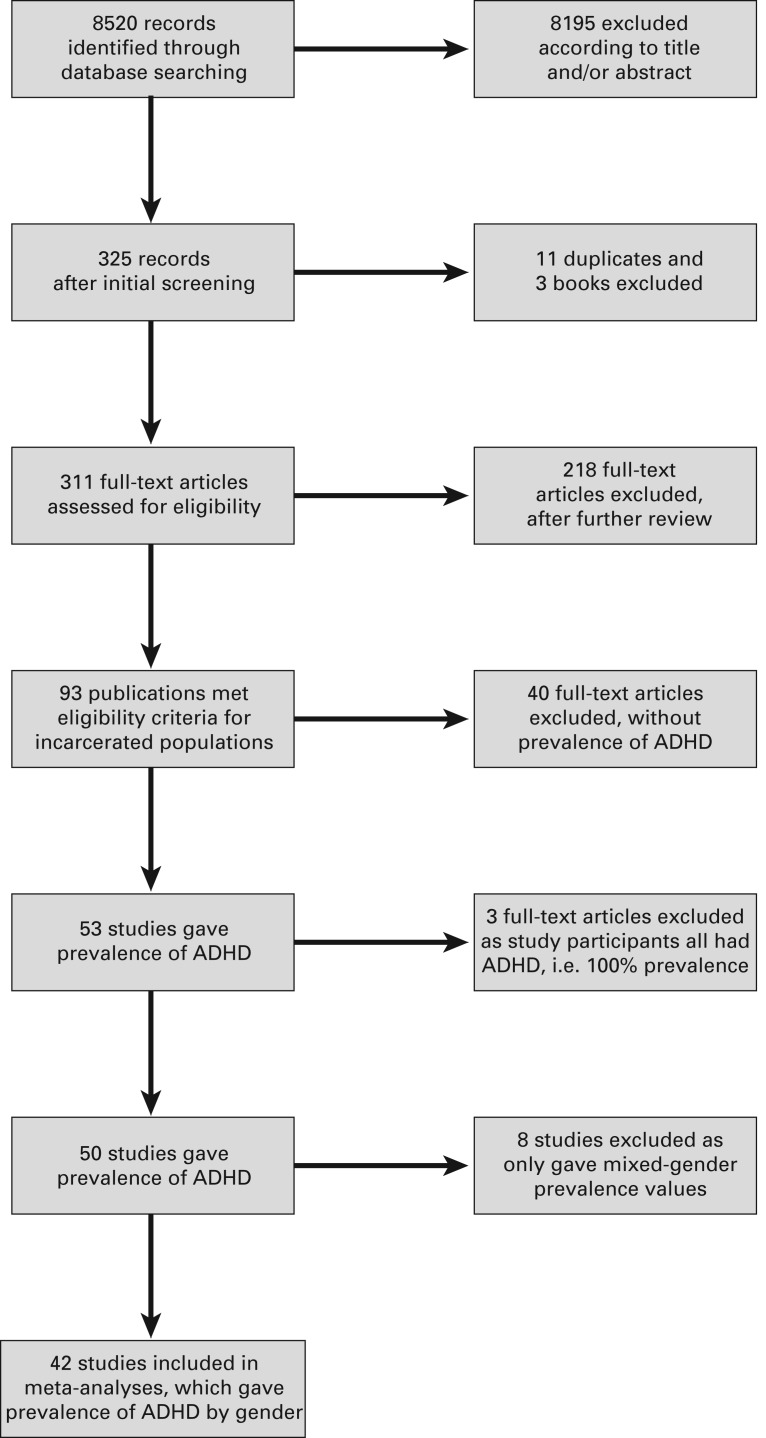
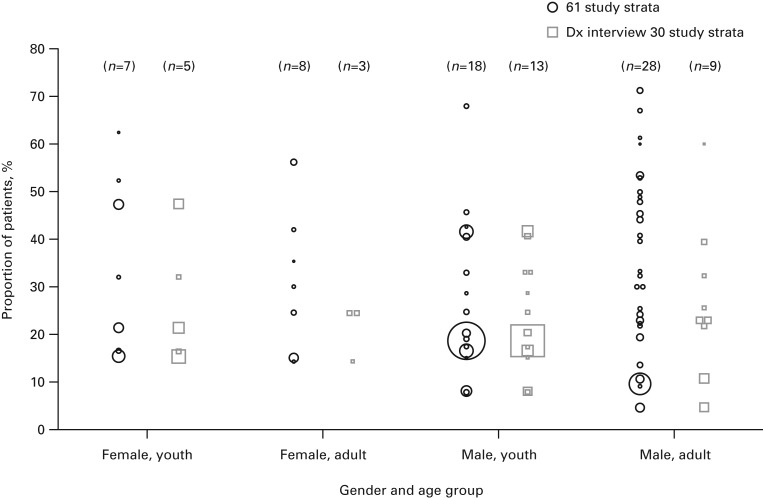
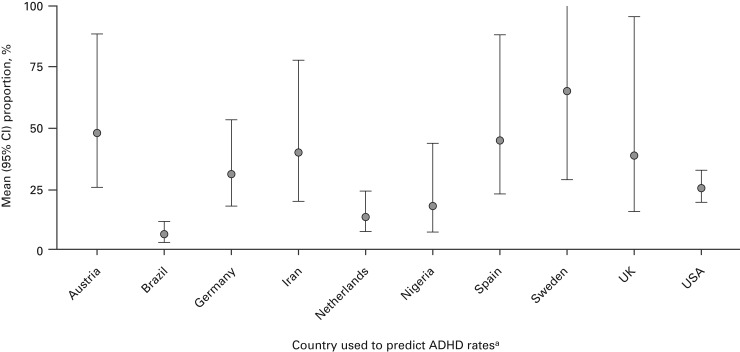
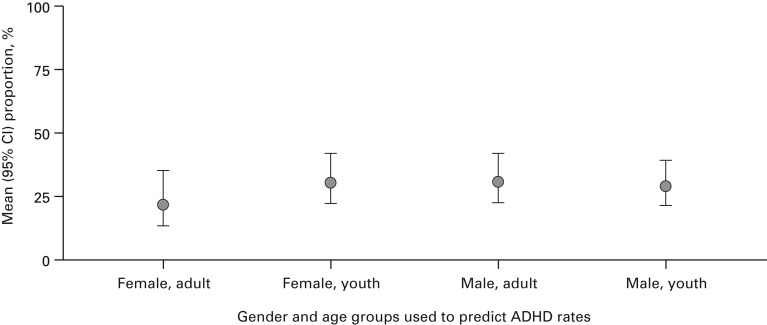
Background: Studies report the variable prevalence of attention deficit hyperactivity disorder (ADHD) in incarcerated populations. The aim of this meta-analysis was to determine the prevalence of ADHD in these populations. Method: Primary research studies reporting the prevalence (lifetime/current) of ADHD in incarcerated populations were identified. The meta-analysis used a mixed log-binomial model, including fixed effects for each covariate and a random study effect, to estimate the significance of various risk factors. Results: Forty-two studies were included in the analysis. ADHD prevalence was higher with screening diagnoses versus diagnostic interview (and with retrospective youth diagnoses versus current diagnoses). Using diagnostic interview data, the estimated prevalence was 25.5% and there were no significant differences for gender and age. Significant country differences were noted. Conclusions: Compared with published general population prevalence, there is a fivefold increase in prevalence of ADHD in youth prison populations (30.1%) and a 10-fold increase in adult prison populations (26.2%).
Overview
The claims and statistics of this paper haven’t been checked yet.
Free: it reads the open-access text and checks the first 5 claims that cite a source we can check. Create a free account to check every claim.
Integrity signals
Registry
Cites
Statistics
Figures
Verification
Claims the paper makes
The claims and statistics of this paper haven’t been checked yet.
Free: it reads the open-access text and checks the first 5 claims that cite a source we can check. Create a free account to check every claim.
Claims other papers make about this one
Each is checked against this paper’s own text: does it say what the citing paper says it does?
The cited source says what the claim attributes to it.
In the citing paper
“A meta-analysis comprising 21 studies and over 19,500 prison inmates found that the prevalence of ADHD in prisons based on interview diagnoses was 20.5% with no differences observed between males and females or adolescents and adults”
From The World Federation of ADHD International Consensus Statement: 208 Evidence-based conclusions about the disorder (2021) · cites this paper as Young et al., 2015
Self-check
Percentages, sums and reported differences re-computed from the paper’s own numbers.
The self-check needs the paper’s full text.
Citations
Cites
Meta-analysis in clinical trials
DerSimonian, R., & Laird, N. (1986) · Controlled Clinical Trials · doi:10.1016/0197-2456(86)90046-2 · Cited by 39,552 · cited 1×
“For this reason, models that allow for heterogeneity are recommended (DerSimonian & Laird, 1986; van Houwelingen et al. 2002).”
BackgroundLiberati, A., Altman, D. G., Tetzlaff, J., Mulrow, C., Gøtzsche, P. C., Ioannidis, J. P. A., Clarke, M., Devereaux, P. J., Kleijnen, J., & Moher, D. (2009) · PLoS Medicine · doi:10.1371/journal.pmed.1000100 · Cited by 28,164 · cited 1×
“The systematic review was performed in accordance with the Preferred Reporting Items for Systematic reviews and Meta-Analyses (PRISMA; Liberati et al. 2009) guidelines.”
MethodThe worldwide prevalence of ADHD: a systematic review and metaregression analysis
Polanczyk, G., de Lima, M. S., Horta, B. L., Biederman, J., & Rohde, L. A. (2007) · American Journal of Psychiatry · doi:10.1176/ajp.2007.164.6.942 · Cited by 5,346 · cited 4×
“2006), affecting 3–7% of youths (Asherson, 2004; Asherson et al. 2005; Polanczyk et al. 2007; Willcutt, 2012) and 1–5% of adults (Asherson, 2004; Asherson et al.”
BackgroundResultInfluentialKessler, R. C., Adler, L., Barkley, R., Biederman, J., Conners, C. K., Demler, O., Faraone, S. V., Greenhill, L. L., Howes, M. J., Secnik, K., et al. (2006) · American Journal of Psychiatry · doi:10.1176/ajp.2006.163.4.716 · Cited by 3,886 · cited 2×
“A meta-analysis of the prevalence of attention deficit hyperactivity disorder in incarcerated populations”
BackgroundMendelson, G. (1995) · Australian & New Zealand Journal of Psychiatry · doi:10.3109/00048679509064964 · Cited by 2,858
FARAONE, S. V., BIEDERMAN, J., & MICK, E. (2006) · Psychological Medicine · doi:10.1017/s003329170500471x · Cited by 2,267 · cited 2×
“ADHD is a common disorder that often persists into adulthood (Faraone et al. 2006), affecting 3–7% of youths (Asherson, 2004; Asherson et al.”
BackgroundThe Prevalence of DSM-IV Attention-Deficit/Hyperactivity Disorder: A Meta-Analytic Review
Willcutt, E. G. (2012) · Neurotherapeutics · doi:10.1007/s13311-012-0135-8 · Cited by 2,160 · cited 5×
“5:1) is much lower than the observed ratio of 4:1 in youths with ADHD (Montejano et al. 2011; Willcutt, 2012; McCarthy et al. 2012).”
BackgroundInfluentialPrevalence and correlates of adult attention-deficit hyperactivity disorder: meta-analysis
Simon, V., Czobor, P., Bálint, S., Mészáros, Á., & Bitter, I. (2009) · British Journal of Psychiatry · doi:10.1192/bjp.bp.107.048827 · Cited by 1,601 · cited 4×
“2007; Willcutt, 2012) and 1–5% of adults (Asherson, 2004; Asherson et al. 2005, 2012; Kessler et al. 2006; Simon et al. 2009; Willcutt, 2012).”
BackgroundResultInfluentialAdvanced methods in meta‐analysis: multivariate approach and meta‐regression
van Houwelingen, H. C., Arends, L. R., & Stijnen, T. (2002) · Statistics in Medicine · doi:10.1002/sim.1040 · Cited by 1,580 · cited 1×
“For this reason, models that allow for heterogeneity are recommended (DerSimonian & Laird, 1986; van Houwelingen et al. 2002).”
BackgroundFazel, S., Doll, H., & Långström, N. (2008) · Journal of the American Academy of Child & Adolescent Psychiatry · doi:10.1097/chi.obo13e31817eecf3 · Cited by 615 · cited 1×
“In recent years, a high prevalence of psychopathology (depression, psychotic illness, ADHD, conduct disorder) has been recognized in prison inmates (Fazel et al. 2008a,b; Bradley, 2009), and although more comprehensive mental health screens are being developed for use at prison reception to develop…”
Background
Research works printed but not linked: 4
- WHO (1992). The ICD-10 Classification of Mental and Behavioural Disorders: Clinical Descriptions and Diagnostic Guidelines. World Health Organization: Geneva.
- APA (1994). Diagnostic and Statistical Manual of Mental Disorders, Fourth Edition. DSM-IV. American Psychiatric Association: Washington, DC.
- Bradley K (2009). The Bradley Report. Lord Bradley's review of people with mental health problems or learning disabilities in the criminal justice system. Department of Health: London.
- Rasmussen K, Almvik R, Levander S (2000). ADHD in prisoners: an unfavourable index of criminal careers and a forensic challenge. Nordic Journal of Psychiatry 54 (Suppl. 43), 47.
Cited by
Items 201–300 of 352
The efficacy, ethics, & pitfalls of stimulants for justice system involved individuals
Boutwell, B. B., Kavish, N., & Narvey, C. S. (2020) · Neuroscience & Biobehavioral Reviews · doi:10.1016/j.neubiorev.2020.06.003 · Cited by 2
Rodríguez, C., García, T., Areces, D., Rodríguez‐Díaz, F. J., Arteaga-Henríquez, G., & Ramos‐Quiroga, J. A. (2021) · Scandinavian Journal of Psychology · doi:10.1111/sjop.12716 · Cited by 2
Baggio, S., Billieux, J., Dirkzwager, A., Iglesias, K., Moschetti, K., Perroud, N. A., Schneider, M. P., Vernaz, N., Wolff, H. J., & Heller, P. (2024) · Trials · doi:10.1186/s13063-023-07827-7 · Cited by 2
“As a result, ADHD is more prevalent in the incarcerated population than in the general population, and there is a growing recognition that ADHD in prison is a major problem [9, 11].”
BackgroundLeroux, E. J. (2019) · Carleton University's Institutional Repository (MacOdrum Library, Carleton University) · doi:10.22215/etd/2019-13504 · Cited by 5
Validity and Diagnostic Accuracy of an ADHD Symptom Rating Scale for Identifying Adults with ADHD
Graves, S. J. (2020) · Digital Scholarship - UNLV (University of Nevada Reno) · doi:10.34917/23469725 · Cited by 5
Barra, S., Turner, D., Müller, M., Hertz, P. G., Retz‐Junginger, P., Tüscher, O., Huß, M., & Retz, W. (2021) · European Archives of Psychiatry and Clinical Neuroscience · doi:10.1007/s00406-021-01308-1 · Cited by 2
Kelly, C. A., Kelly, C., Taylor, R., & Gullon-Scott, F. (2023) · Qeios · doi:10.32388/6odysg.9 · Cited by 3
Tcherni‐Buzzeo, M. (2023) · Journal of Developmental and Life-Course Criminology · doi:10.1007/s40865-023-00223-4 · Cited by 1
“ADHD is several times more common among criminal justice-involved juvenile populations (about 30% prevalence) and among adult prisoners (about 26% prevalence) compared to the general population prevalence of 3–7% among youth and 1–5% among adults (Young & Cocallis, 2021; Young et al., 2015).”
BackgroundPerkins, S. C., Ametrano, R. M., Leach, M., Kobrossi, J. P., Smith‐Darden, J. P., & Graham‐Bermann, S. A. (2024) · Youth & Society · doi:10.1177/0044118x241229733 · Cited by 2
Working with Neurodiversity in Forensic Rehabilitation Interventions
Kandola, S. S., & Walton, J. S. (2024) · Wiley eBooks · doi:10.1002/9781119893073.ch12 · Cited by 2
Diagnosis and Management of Comorbid ADHD in Patients with Substance Use Disorders
Busch, B. (2024) · Springer eBooks · doi:10.1007/978-3-031-72219-6_50 · Cited by 1
Promoting Equitable Engagement in Attention-Deficit/Hyperactivity Disorder Care
Alleyne, K., Fogler, J., Simon, K. M., Spinks‐Franklin, A., & Spencer, A. E. (2025) · Pediatric Annals · doi:10.3928/19382359-20241007-01 · Cited by 1
Nielsen, T. C., Nanan, R. K. H., Butler, T. G., Nassar, N., & Poulton, A. S. (2025) · Journal of Epidemiology & Community Health · doi:10.1136/jech-2025-224498 · Cited by 2
Egaña, I., Nogales-Garcia, M., Akhrimenko, V., González-Gómez, X., Rodil, R., Montes, R. M., Quintana, J. B., Mestre-Pintó, J. I., Orive, G., & Lertxundi, U. (2026) · Environmental Toxicology and Pharmacology · doi:10.1016/j.etap.2026.105021 · Cited by 1
Prison Education in England and Wales: A Critical Analysis Inside and Out
Glazzard, J., & Thomas, S. (2026) · Bristol University Press eBooks · doi:10.2307/jj.34980213 · Cited by 2
Theule, J., Cheung, K., & Ward, M. A. (2026) · Springer eBooks · doi:10.1007/978-3-032-03292-8_4 · Cited by 1
Organische psychische Störungen (einschließlich Anfallsleiden)
Rösler, M., & Retz, W. (2015) · Elsevier eBooks · doi:10.1016/b978-3-437-21273-4.00011-2 · Cited by 1
ADHD research: the power of population-based studies
Sciberras, E. (2014) · The Lancet Psychiatry · doi:10.1016/s2215-0366(14)70341-4 · Cited by 1
Eme, R. F. (2017) · Journal of Psychiatry and Psychiatric Disorders · doi:10.26502/jppd.2572-519x0017 · Cited by 1
“J Psychiatry Psychiatric Disord 2017; 1 (3): 180-189 181 in 15 countries reported an estimated prevalence of 25% [9].”
BackgroundSánchez, F. C. (2017) · Revista Española de Medicina Legal · doi:10.1016/j.remle.2017.07.001 · Cited by 1
Certification and Medico-Legal Aspects of Neurodevelopmental Disorders in India
Venkatesan, S., & Yashodharakumar, G. Y. (2018) · Advances in medical technologies and clinical practice book series · doi:10.4018/978-1-5225-7004-2.ch015 · Cited by 1
The Socioeconomic Burden of Adult ADHD
Pallanti, S., & Salerno, L. (2020) · Springer eBooks · doi:10.1007/978-3-030-39051-8_1 · Cited by 3
Attention Deficit Hyperactivity Disorder and Psychopathy in Adults
Retz, W. (2020) · Wiley eBooks · doi:10.1002/9781119159322.ch23 · Cited by 1
Christiansen, H., Hirsch, O., Beheshti, A., & Chavanon, M. (2021) · Current Psychology · doi:10.1007/s12144-021-01842-0 · Cited by 1
Social Health, Social Pressure, and Social Immunity
Pilyushenko, A. V. (2021) · Bulletin of Kemerovo State University Series Humanities and Social Sciences · doi:10.21603/2542-1840-2021-5-2-141-147 · Cited by 1
Psychiatrische Probleme im Justizvollzug
Opitz‐Welke, A., & Konrad, N. (2020) · Elsevier eBooks · doi:10.1016/b978-3-437-21273-4.00027-6 · Cited by 3
Etterlid-Hägg, V., Pauli, M., & Howner, K. (2023) · Journal of Attention Disorders · doi:10.1177/10870547231158764 · Cited by 1
Psychopharmacology in the Jail Setting
Kushner, D. B., Stossel, L. M., & Khan, M. A. “. (2023) · Oxford University Press eBooks · doi:10.1093/oso/9780197524794.003.0008 · Cited by 1
Is there a link between neurodiversity and stalking? a systematic review
Baciu, A., & Worthington, R. (2024) · Journal of Forensic Practice · doi:10.1108/jfp-01-2024-0001 · Cited by 1
Young, J. T. (2018) · Minerva Access (University of Melbourne) · Cited by 1
Buitelaar, N. J. L. (2020) · Radboud Repository (Radboud University) · Cited by 1
Neuropsychiatric and Social Consequences of Attention Deficit Hyperactivity Disorder in FemalesPreprint
Kelly, C. A., Kelly, C., Taylor, R., & Gullon-Scott, F. (2022) · Qeios · doi:10.32388/6odysg · Cited by 1
Ofobrukweta, K. (2025) · Open Access Institutional Repository at Robert Gordon University (Robert Gordon University) · doi:10.48526/rgu-wt-3020548 · Cited by 1
A longitudinal study of attention and inhibitory control in 6- to 11-year-old children
Lewis, F. C. (2017) · Minerva Access (University of Melbourne)
Eme, R. F. (2017) · Journal of General Practice · doi:10.4172/2329-9126.1000321
“7%which is three times greater than the prevalence rate in the general population [24].”
BackgroundEen ongeluk komt nooit alleen: De samenhang van delinquentie met verschillende problemen
van Dorp, M. (2019) · Bohn Stafleu van Loghum eBooks · doi:10.1007/978-90-368-1440-9_7
Families Journeying Together: Exploring Resilience in Families with Adolescents with ADHD
McMenemy, T. C. (2019) · doi:10.11575/prism/36139 · Cited by 1
Knowles, O., & Richards, E. (2019) · Neuropsychiatric Disease and Treatment · doi:10.2147/ndt.s231305
The Experiences of Black Parents in Choosing Intervention Programs for Juvenile Offenders
Hawkes, D. (2019) · ScholarWorks (Walden University)
Design and evaluation of a mobile decision support system for screening neurodevelopmental disorders
Cullen, B. R. (2020) · Otago University Research Archive (University of Otago)
Houtepen, J. A. B. M. (2020) · Data Archiving and Networked Services (DANS)
Aandachtsdeficiëntie-/hyperactiviteitsstoornis (ADHD)
Bijlenga, D., & Kooij, J. J. S. (2020) · Bohn Stafleu van Loghum eBooks · doi:10.1007/978-90-368-2524-5_14
Retz, W., & Rösler, M. (2020) · Elsevier eBooks · doi:10.1016/b978-3-437-21273-4.00013-6
Colonna, S. (2020) · ORCA Online Research @Cardiff (Cardiff University)
Bouchez, J., Rahioui, H., Bayle, F., & Caci, H. M. (2021) · EMC - Psychiatrie · doi:10.1016/s0246-1072(20)41282-9 · Cited by 1
Attention Deficit Hyperactivity Disorder in Males
Coghill, D. (2021) · Cambridge University Press eBooks · doi:10.1017/9781108646765.004
Aufmerksamkeitsdefizit-/Hyperaktivitätsstörungen im Kindes- und Erwachsenenalter
Christiansen, H., & Philipsen, A. (2021) · Elsevier eBooks · doi:10.1016/b978-3-437-22601-4.00020-6
Juvenile Crime and the Medical Treatment of Attention Deficit Hyperactivity DisorderPreprint
Anker, A. S. T., & Fallesen, P. (2022) · SocArXiv (OSF Preprints) · doi:10.31235/osf.io/sbvut
Gudjonsson, G. H. (2018) · Wiley eBooks · doi:10.1002/9781119315636.refs
Autistic Traits in Prison Populations
Rafaela, D. (2019) · Springer eBooks · doi:10.1007/978-1-4614-6435-8_102362-1
Mental Health in Offenders and Prison Populations
Byng, R., & Forrester, A. (2018) · Cambridge University Press eBooks · doi:10.1017/9781911623038.025
Autistic Traits in Prison Populations
Rafaela, D. (2021) · Springer eBooks · doi:10.1007/978-3-319-91280-6_102362
Neuropsychiatric and Social Consequences of Attention Deficit Hyperactivity Disorder in FemalesPreprint
Kelly, C. A., Kelly, C., Taylor, R., & Gullon-Scott, F. (2022) · Qeios · doi:10.32388/6odysg.3 · Cited by 2
Neuropsychiatric and Social Consequences of Attention Deficit Hyperactivity Disorder in FemalesPreprint
Kelly, C. A., Kelly, C., Taylor, R., & Gullon-Scott, F. (2022) · Qeios · doi:10.32388/6odysg.2
Pharming in adolescents – clinical case and literature review
Guijarro, J. J. D. F., de Lora, N. E. C., López, J. I., Gamo, B. M., & del Villar, C. M. (2022) · Neuroscience Applied · doi:10.1016/j.nsa.2022.100432
Capellazzi, M., Capuzzi, E., Caldiroli, A., Cova, F., Auxilia, A. M., Tagliabue, I., Rubelli, P., Truisi, E., Buoli, M., & Clerici, M. (2022) · Neuroscience Applied · doi:10.1016/j.nsa.2022.100433
Voulgaris, A. (2022) · Forensische Psychiatrie Psychologie Kriminologie · doi:10.1007/s11757-022-00749-1
“…Der/die Autor(en) 2022 Verschiedene Studien weisen darauf hin, dass in Gefängnispopulationen die Prävalenz für die Aufmerksamkeitsdefizit-/ Hyperaktivitätsstörung (ADHS) im Erwachsenenalter im Vergleich zur Normalbevölkerung deutlich erhöht ist und bei ungefähr 20% liegen soll (Young et al. 2015).”
BackgroundNeuropsychiatric and Social Consequences of Attention Deficit Hyperactivity Disorder in FemalesPreprint
Kelly, C. A., Kelly, C., Taylor, R., & Gullon-Scott, F. (2023) · Qeios · doi:10.32388/6odysg.4
Neuropsychiatric and Social Consequences of Attention Deficit Hyperactivity Disorder in FemalesPreprint
Kelly, C. A., Kelly, C., Taylor, R., & Gullon-Scott, F. (2023) · Qeios · doi:10.32388/6odysg.5
Neuropsychiatric and Social Consequences of Attention Deficit Hyperactivity Disorder in FemalesPreprint
Kelly, C. A., Kelly, C., Taylor, R., & Gullon-Scott, F. (2023) · Qeios · doi:10.32388/6odysg.6
Neuropsychiatric and Social Consequences of Attention Deficit Hyperactivity Disorder in FemalesPreprint
Kelly, C. A., Kelly, C., Taylor, R., & Gullon-Scott, F. (2023) · Qeios · doi:10.32388/6odysg.7
Neuropsychiatric and Social Consequences of Attention Deficit Hyperactivity Disorder in FemalesPreprint
Kelly, C. A., Kelly, C., Taylor, R., & Gullon-Scott, F. (2023) · Qeios · doi:10.32388/6odysg.8
SOCIO-DEMOGRAPHIC CHARACTERISTICS OF INCARCERATED MALE ADULTS WITH ADHD IN SELECTED PRISONS IN KENYA
Waruinge, N., Muaka, C. A., & Tuikong, S. (2023) · European Journal of Social Sciences Studies · doi:10.46827/ejsss.v8i6.1502
“Young et al. (2014) analysed data for 42 prisons across the globe and established the prevalence of ADHD amongst inmates to be at 25.5%; with subsequent findings suggesting a prevalence rate of 21.3 percent (Young et al., 2015).”
BackgroundInfluentialNeurodevelopmental disorders in people with intellectual disability across cultures
Shankar, R., Barrett, M., Kommu, J. V. S., & Biswas, A. B. (2023) · Oxford University Press eBooks · doi:10.1093/med/9780198857600.003.0003 · Cited by 1
Barbuti, M., Rosa, U. D., Moriconi, M., Bartolini, D., Schiavi, E., & Perugi, G. (2023) · Journal of Affective Disorders Reports · doi:10.1016/j.jadr.2023.100700
Grimley, A., & Bartels, L. (2024) · Psychiatry Psychology and Law · doi:10.1080/13218719.2023.2260861 · Cited by 1
“According to S. Young, Moss, et al. (2015), however, there is no statistically significant difference between the prevalence of ADHD among men and women in prison.”
InfluentialWyler, H., van Wijnkoop, M., Smith, A. J., Retz, W., Liebrenz, M., & Buadze, A. (2024) · Research Square · doi:10.21203/rs.3.rs-4106187/v1
Hammond, C., Murphy, L., & Huke, K. (2024) · Clinical Psychology Forum · doi:10.53841/bpscpf.2024.1.382.55
de la Peña, A. G., Loredo, M., Monge, B., Sánchez, P., & López-Pérez, P. J. (2025) · Revista de Investigación en Logopedia · doi:10.5209/rlog.93751
Moracha, E. N. (2025) · Asian Journal of Advanced Research and Reports · doi:10.9734/ajarr/2025/v19i1882
Brosens, D., Helland, W. A., Jones, L. Ø., Marynissen, S., & Morken, F. (2025) · Scandinavian Journal of Psychology · doi:10.1111/sjop.13101
Thomas, N. E., & Rutkofsky, I. H. (2025) · Springer eBooks · doi:10.1007/978-3-031-86114-7_3
Muchos adultos sufren TDAH sin saberlo: cómo detectarlo y hacerle frente
Arrondo, G. (2024) · The Conversation · doi:10.64628/aao.g377nrhg5
Untreated ADHD contributes to the school-to-prison pipeline and related racial disparities
Glenn, A. L., Thompson, O. K., & Mosley, T. K. (2025) · Children and Youth Services Review · doi:10.1016/j.childyouth.2025.108551
Procaccia, R., & Segre, G. (2025) · MALTRATTAMENTO E ABUSO ALL INFANZIA · doi:10.3280/mal2025-002003
Psychopathology from Crime to Release: Mental Health in the Criminal Justice System
Kurtar, E., & Eker, S. S. (2026) · Psikiyatride Guncel Yaklasimlar - Current Approaches in Psychiatry · doi:10.18863/pgy.1696583
Adlam, L. (2025) · Open Access Victoria University of Wellington | Te Herenga Waka (Figshare) · doi:10.26686/pnab-0b01
Spike, E., Srasuebkul, P., Kariminia, A., Butler, T. G., & Trollor, J. N. (2025) · BMJ Open · doi:10.1136/bmjopen-2025-102805
Oskarsson, S., Kuja‐Halkola, R., Andersson, A., Tuvblad, C., Brikell, I., D'Onofrio, B. M., Chang, Z., & Larsson, H. (2025) · Biological Psychiatry · doi:10.1016/j.biopsych.2025.10.007
Gürbüz, A. A., Kopuz, H. Y., & Çelebi, S. B. (2025) · International Journal of Developmental Neuroscience · doi:10.1002/jdn.70062
Baggio, S., Billieux, J., Dirkzwager, A., Iglesias, K., Moschetti, K., Perroud, N., Schneider, M., Vernaz, N., Wolff, H., & Heller, P. (2024) · Figshare · doi:10.6084/m9.figshare.24946694
Baggio, S., Billieux, J., Dirkzwager, A., Iglesias, K., Moschetti, K., Perroud, N., Schneider, M., Vernaz, N., Wolff, H., & Heller, P. (2024) · Figshare · doi:10.6084/m9.figshare.26660876
Baggio, S., Billieux, J., Dirkzwager, A., Iglesias, K., Moschetti, K., Perroud, N., Schneider, M., Vernaz, N., Wolff, H., & Heller, P. (2024) · Figshare · doi:10.6084/m9.figshare.24946327
Salari, N., Hooman, G., Abdoli, N., Rahmani, A., Shiri, M. H., Hashemian, A. H., Akbari, H., & Mohammadi, M. (2023) · Figshare · doi:10.6084/m9.figshare.22671312
Examining the experiences of justice-involved youth with mental health and substance use needs
Squires, L. E. (2023) · Memorial University Research Repository (Memorial University) · doi:10.48336/beyw-2p36
Additional file 1 of ADHD overdiagnosis and the role of patient gender among Iranian psychiatrists
Beheshti, A., Chavanon, M., Schneider, S., & Christiansen, H. (2021) · Figshare · doi:10.6084/m9.figshare.16829384
Att leva med ADHD : Vuxnas upplevelser
Ultsch, S., & Lindroth, C. (2024) · DiVA - University of Borås (Högskolan i Borås)
Fortin-Harvey, B. (2023) · Le dépôt institutionnel (Université du Québec à Trois-Rivières)
Kivunhoito fysioterapian keinoin: opas Pyhäselän vankilan henkilökunnan käyttöön
Erkkilä, M., Lehtonen, L., & Mustonen, F. (2024) · Theseus (Ammattikorkeakoulujen)
Marijuana, ADHD and Offense Severity: A study of incarcerated adolescent males in The Netherlands
Scheenstra, A. (2015) · Leiden Repository (Leiden University)
The voices of adolescents with ADHD: Perceptions, Experiences, Attitudes and Expectations
Alves, C. B. A. C. (2023) · Portuguese National Funding Agency for Science, Research and Technology (RCAAP Project by FCT)
Waitt, A. E. (2022) · Nottingham ePrints (University of Nottingham) · Cited by 1
Dugre, J. R. (2022) · Papyrus : Institutional Repository (Université de Montréal) · doi:10.71781/32328
Worth, S. (2024) · UCL Discovery (University College London)
UTMATTNINGSSYNDROM - Hos kvinnor & män, med och utan ADHD : En registerstudie
Ericsson, L. (2025) · Uppsala University Publications (Uppsala University)
Longitudinal Outcomes in Young Violent Offenders: Criminal Behaviour, Morbidity, and Mortality
Tärnhäll, A. (2024) · Lund University Publications (Lund University) · Cited by 1
Musah, J. (2024) · UCL Discovery (University College London)
A relação do abuso de substâncias e a psicopatologia em população reclusa.
Silva, T. R. V. D. (2020) · Portuguese National Funding Agency for Science, Research and Technology (RCAAP Project by FCT) · Cited by 1
Vankien terveys ja hyvinvointi 2023 : Wattu IV -vankiväestötutkimus
(2023) · STM:n Hallinnonalan avoin julkaisuarkisto (Julkari) · Cited by 10
Wintle, J., Shafi, A., Templeton, S., & Clarke, D. (2025) · Research Repository (University of Gloucestershire)
Metadata
- Authors
- Young, S., Moss, D., Sedgwick, O., Fridman, M., & Hodgkins, P.
- Affiliations
- Broadmoor Hospital (GB)
- King's College London (GB)
- Alfred Mann Foundation (US)
- Vertex Pharmaceuticals (United States) (US)
- Corresponding author
- Young, S.
- Venue
- Psychological Medicine
- Publisher
- Cambridge University Press (CUP)
- Published
- 2014-04-07
- Volume
- 45
- Issue
- 2
- Pages
- 247-258
- ISSN
- 0033-2917 (ISSN-L)
- 1469-8978
- PMC
- PMC4301200
- OpenAlex
- W2111356744
- Cited by
- 291
- References
- 59
- Citations by year
- 2026: 20 · 2025: 28 · 2024: 28 · 2023: 32 · 2022: 27 · 2021: 23 · 2020: 31 · 2019: 25 · 2018: 21 · 2017: 23 · 2016: 17 · 2015: 13 · 2014: 3
- FWCI
- 2.58
- Type
- journal article
- Language
- en
- Open access
- hybrid
- doi.org
- Locations
- Psychological Medicine (publishedVersion, cc-by)
- Europe PMC (PubMed Central) (publishedVersion, cc-by)
- PubMed Central (publishedVersion, cc-by)
- PubMed (publishedVersion)
- Research Portal (King's College London) (submittedVersion, other-oa)
- Funders
- Eli Lilly and Company
- National Institute for Health and Care Research
- Topics
- Health Sciences › Medicine › Psychiatry and Mental health › Attention Deficit Hyperactivity Disorder
- Social Sciences › Psychology › Clinical Psychology › Psychopathy, Forensic Psychiatry, Sexual Offending
- Social Sciences › Sociology and Political Science › Criminal Justice and Corrections Analysis
- Keywords
- attention deficit hyperactivity disorder, ADHD prevalence, prison population, youth prisons, adult prisons, risk factors, country differences
- MeSH terms
- Attention Deficit Disorder with Hyperactivity, Female, Humans, Male, Prisoners, Psychiatric Status Rating Scales, Comorbidity, Prevalence, Diagnostic and Statistical Manual of Mental Disorders
About these checks
Registry, retraction, Cites and statistics results are computed, not judged, with one exception: a printed reference that no index lists is read once by a model before it counts as a citation error. Claims are extracted by a model and kept only when their quote appears verbatim in the text; each cited source is then checked, with a model’s help, for whether it says what the claim relies on. Those verdicts can be wrong — read the claim’s quote and the cited source before relying on one.
Statistics and arithmetic are recomputed, not judged.
Confidence bands are shown only for fields calibrated on our annotated test set. None is calibrated yet, so no band is shown.
What counts as a claim ›How we measure confidence ›How we check this ›
Are you an author, or do you see a problem with this page? Request a review
Data sources
Bibliographic data: Semantic Scholar, OpenAlex, Crossref.
Contains information from the Semantic Scholar Academic Graph Datasets, made available under the ODC Attribution License (ODC-BY 1.0).
Semantic Scholar’s data is described in: Kinney, R., et al. (2023). The Semantic Scholar Open Data Platform. arXiv:2301.10140.
