

A meta-analysis of the prevalence of attention deficit hyperactivity disorder in incarcerated populations
Open accessThe DOI matches its Crossref record; 58 of the 59 references it cites were found in a registry or an index.
Abstract
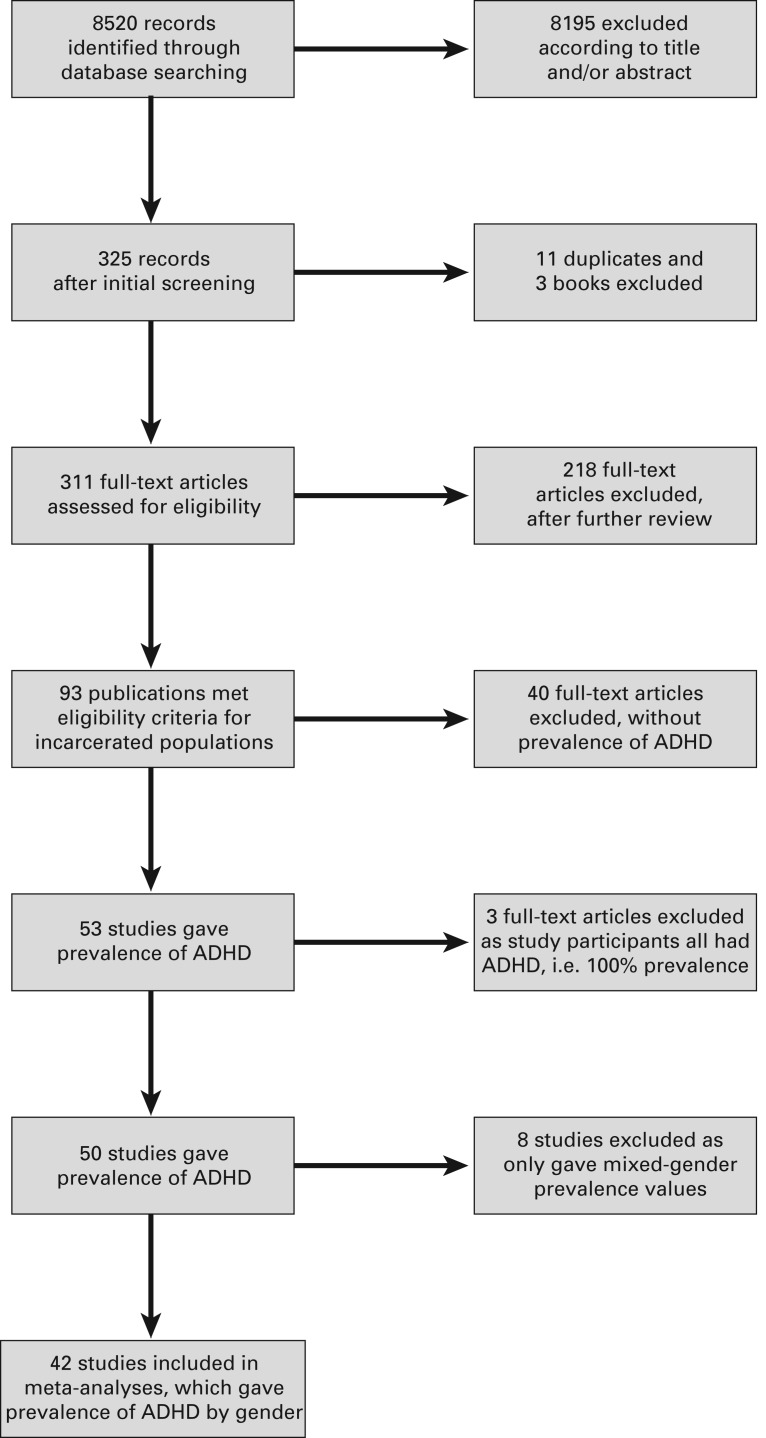
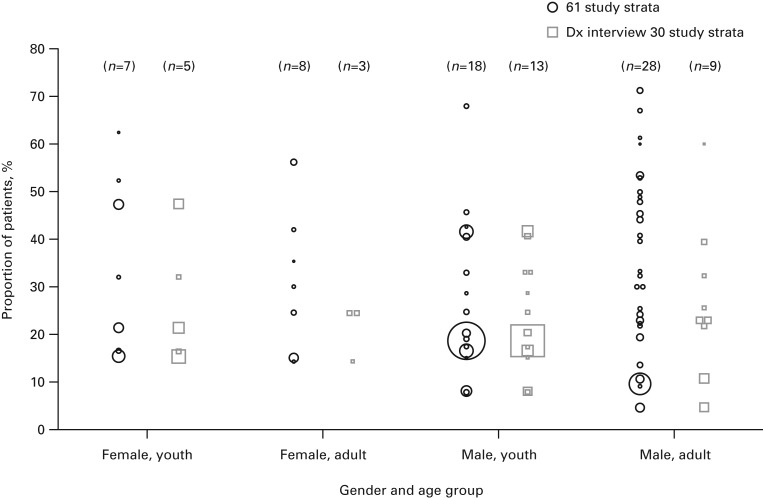
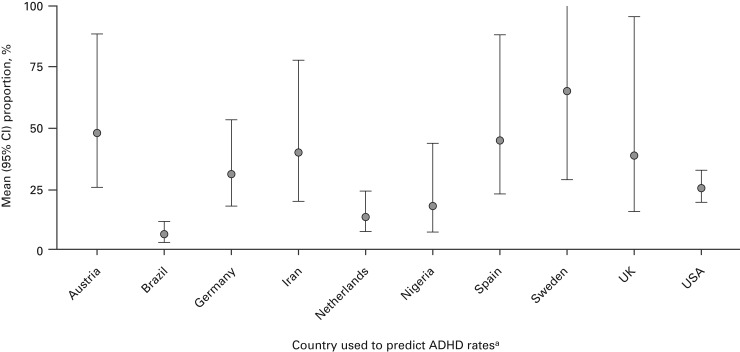
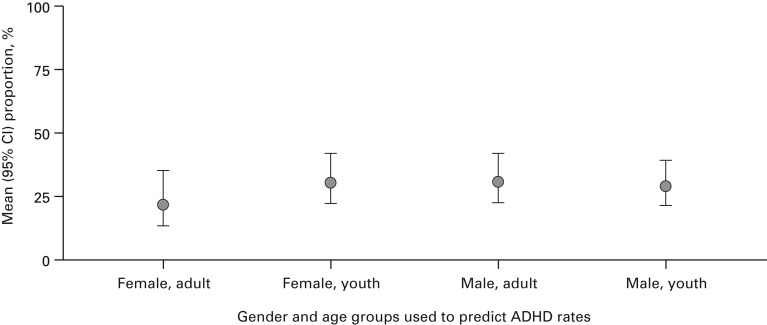
Background: Studies report the variable prevalence of attention deficit hyperactivity disorder (ADHD) in incarcerated populations. The aim of this meta-analysis was to determine the prevalence of ADHD in these populations. Method: Primary research studies reporting the prevalence (lifetime/current) of ADHD in incarcerated populations were identified. The meta-analysis used a mixed log-binomial model, including fixed effects for each covariate and a random study effect, to estimate the significance of various risk factors. Results: Forty-two studies were included in the analysis. ADHD prevalence was higher with screening diagnoses versus diagnostic interview (and with retrospective youth diagnoses versus current diagnoses). Using diagnostic interview data, the estimated prevalence was 25.5% and there were no significant differences for gender and age. Significant country differences were noted. Conclusions: Compared with published general population prevalence, there is a fivefold increase in prevalence of ADHD in youth prison populations (30.1%) and a 10-fold increase in adult prison populations (26.2%).
Overview
The claims and statistics of this paper haven’t been checked yet.
Free: it reads the open-access text and checks the first 5 claims that cite a source we can check. Create a free account to check every claim.
Integrity signals
Registry
Cites
Statistics
Figures
Verification
Claims the paper makes
The claims and statistics of this paper haven’t been checked yet.
Free: it reads the open-access text and checks the first 5 claims that cite a source we can check. Create a free account to check every claim.
Claims other papers make about this one
Each is checked against this paper’s own text: does it say what the citing paper says it does?
The cited source says what the claim attributes to it.
In the citing paper
“A meta-analysis comprising 21 studies and over 19,500 prison inmates found that the prevalence of ADHD in prisons based on interview diagnoses was 20.5% with no differences observed between males and females or adolescents and adults”
From The World Federation of ADHD International Consensus Statement: 208 Evidence-based conclusions about the disorder (2021) · cites this paper as Young et al., 2015
Self-check
Percentages, sums and reported differences re-computed from the paper’s own numbers.
The self-check needs the paper’s full text.
Citations
Cites
Meta-analysis in clinical trials
DerSimonian, R., & Laird, N. (1986) · Controlled Clinical Trials · doi:10.1016/0197-2456(86)90046-2 · Cited by 39,552 · cited 1×
“For this reason, models that allow for heterogeneity are recommended (DerSimonian & Laird, 1986; van Houwelingen et al. 2002).”
BackgroundLiberati, A., Altman, D. G., Tetzlaff, J., Mulrow, C., Gøtzsche, P. C., Ioannidis, J. P. A., Clarke, M., Devereaux, P. J., Kleijnen, J., & Moher, D. (2009) · PLoS Medicine · doi:10.1371/journal.pmed.1000100 · Cited by 28,164 · cited 1×
“The systematic review was performed in accordance with the Preferred Reporting Items for Systematic reviews and Meta-Analyses (PRISMA; Liberati et al. 2009) guidelines.”
MethodThe worldwide prevalence of ADHD: a systematic review and metaregression analysis
Polanczyk, G., de Lima, M. S., Horta, B. L., Biederman, J., & Rohde, L. A. (2007) · American Journal of Psychiatry · doi:10.1176/ajp.2007.164.6.942 · Cited by 5,346 · cited 4×
“2006), affecting 3–7% of youths (Asherson, 2004; Asherson et al. 2005; Polanczyk et al. 2007; Willcutt, 2012) and 1–5% of adults (Asherson, 2004; Asherson et al.”
BackgroundResultInfluentialKessler, R. C., Adler, L., Barkley, R., Biederman, J., Conners, C. K., Demler, O., Faraone, S. V., Greenhill, L. L., Howes, M. J., Secnik, K., et al. (2006) · American Journal of Psychiatry · doi:10.1176/ajp.2006.163.4.716 · Cited by 3,886 · cited 2×
“A meta-analysis of the prevalence of attention deficit hyperactivity disorder in incarcerated populations”
BackgroundMendelson, G. (1995) · Australian & New Zealand Journal of Psychiatry · doi:10.3109/00048679509064964 · Cited by 2,858
FARAONE, S. V., BIEDERMAN, J., & MICK, E. (2006) · Psychological Medicine · doi:10.1017/s003329170500471x · Cited by 2,267 · cited 2×
“ADHD is a common disorder that often persists into adulthood (Faraone et al. 2006), affecting 3–7% of youths (Asherson, 2004; Asherson et al.”
BackgroundThe Prevalence of DSM-IV Attention-Deficit/Hyperactivity Disorder: A Meta-Analytic Review
Willcutt, E. G. (2012) · Neurotherapeutics · doi:10.1007/s13311-012-0135-8 · Cited by 2,160 · cited 5×
“5:1) is much lower than the observed ratio of 4:1 in youths with ADHD (Montejano et al. 2011; Willcutt, 2012; McCarthy et al. 2012).”
BackgroundInfluentialPrevalence and correlates of adult attention-deficit hyperactivity disorder: meta-analysis
Simon, V., Czobor, P., Bálint, S., Mészáros, Á., & Bitter, I. (2009) · British Journal of Psychiatry · doi:10.1192/bjp.bp.107.048827 · Cited by 1,601 · cited 4×
“2007; Willcutt, 2012) and 1–5% of adults (Asherson, 2004; Asherson et al. 2005, 2012; Kessler et al. 2006; Simon et al. 2009; Willcutt, 2012).”
BackgroundResultInfluentialAdvanced methods in meta‐analysis: multivariate approach and meta‐regression
van Houwelingen, H. C., Arends, L. R., & Stijnen, T. (2002) · Statistics in Medicine · doi:10.1002/sim.1040 · Cited by 1,580 · cited 1×
“For this reason, models that allow for heterogeneity are recommended (DerSimonian & Laird, 1986; van Houwelingen et al. 2002).”
BackgroundFazel, S., Doll, H., & Långström, N. (2008) · Journal of the American Academy of Child & Adolescent Psychiatry · doi:10.1097/chi.obo13e31817eecf3 · Cited by 615 · cited 1×
“In recent years, a high prevalence of psychopathology (depression, psychotic illness, ADHD, conduct disorder) has been recognized in prison inmates (Fazel et al. 2008a,b; Bradley, 2009), and although more comprehensive mental health screens are being developed for use at prison reception to develop…”
Background
Research works printed but not linked: 4
- WHO (1992). The ICD-10 Classification of Mental and Behavioural Disorders: Clinical Descriptions and Diagnostic Guidelines. World Health Organization: Geneva.
- APA (1994). Diagnostic and Statistical Manual of Mental Disorders, Fourth Edition. DSM-IV. American Psychiatric Association: Washington, DC.
- Bradley K (2009). The Bradley Report. Lord Bradley's review of people with mental health problems or learning disabilities in the criminal justice system. Department of Health: London.
- Rasmussen K, Almvik R, Levander S (2000). ADHD in prisoners: an unfavourable index of criminal careers and a forensic challenge. Nordic Journal of Psychiatry 54 (Suppl. 43), 47.
Cited by
Items 301–352 of 352
Lang, J., Press, M., Wood, R., Inchley, J., Haughton, D., MacIntyre, A., & Russell, H. (2025) · ENLIGHTEN (Jurnal Bimbingan dan Konseling Islam)
Analyses on health status and care needs among older adults
Sun, J., Luo, H., & Zeng, Y. (2025) · Frontiers research topics · doi:10.3389/978-2-8325-6700-5
De la impulsividad a la delincuencia : mito o realidad. El rol del TDAH en las conductas delictivas
Raya Contreras, L., & de Dret, U. A. D. B. F. (2025) · Dipòsit Digital de Documents de la UAB (Universitat Autònoma de Barcelona)
Prison soundscapes and health effects: Insights from the literature
Chieng, J., Woodland, L., Williams, O. A., & Fenech, B. (2025) · Convention of the European Acoustics Association Forum Acusticum · doi:10.61782/fa.2025.0703
Boyd, C., Wrigley, M., Mulligan, A., Adamis, D., Kirley, A., Dudley, J. M., Liddy, N., & Bramham, J. (2026) · Irish Journal of Psychological Medicine · doi:10.1017/ipm.2025.10151
“2018; Young et al .”
Cognitive impairment in prison-based alcohol and other drug treatment programs: a systematic review
Nihill, K., Snow, P. C., Serry, T. A., & Murphy, K. A. (2025) · Journal of Forensic Psychiatry and Psychology · doi:10.1080/14789949.2025.2608709
“Attention Deficit Hyperactivity Disorder is present in 25–30% of incar-cerated individuals versus 2.5–5% generally (Young et al., 2018), and acquired brain injury may affect 30–60% of prison populations compared to 2–3% in the wider community (Williams et al., 2018).”
InfluentialDemirkol, S., & Kayım, F. (2026) · Çukurova Üniversitesi Sosyal Bilimler Enstitüsü Dergisi · doi:10.35379/cusosbil.1598579
Department for diagnostics and psychoeducation in attention deficit disorders and ADHD in adults
Touskova, T. P., Praško, J., Příhodová, T., Lechovská, V., Ocisková, M., Jurák, D., Pánek, D., Heinzl, M., Měchura, F., Lukášová, M., et al. (2026) · Psychiatrie pro praxi · doi:10.36290/psy.2026.003
The Neuropsychology of Executive Functioning and Violence
Meijers, J., Harte, J. M., & Meynen, G. (2026) · Wiley eBooks · doi:10.1002/9781118832202.ch20
Attention Deficit Hyperactivity Disorders and Developmental Criminality and Violence
Eme, R. F. (2026) · Wiley eBooks · doi:10.1002/9781118832202.ch6
ADHD: Neurodevelopmental Disorder or Evolutionary Mismatch?
Spinks-Franklin, A. I. A., Ihyembe, D., & Moore, T. (2026) · American Academy of PediatricsItasca, IL eBooks · doi:10.1542/9781610028493-ch13
Quality of Education and Training
Glazzard, J., & Thomas, S. (2026) · Bristol University Press eBooks · doi:10.2307/jj.34980213.16
Glazzard, J., & Thomas, S. (2026) · Bristol University Press eBooks · doi:10.2307/jj.34980213.18
6 Education Pathways and Vocational Training
Glazzard, J., & Thomas, S. (2026) · Bristol University Press eBooks · doi:10.2307/jj.34980213.14
Torales, J. C., Possuelo, L. G., Barrios, I., Estigarribia, G., Velázquez, G., O’Higgins, M. G., Castaldelli-Maia, J. M., Ventriglio, A., Smith, A. J., Buadze, A., et al. (2026) · Frontiers in Psychiatry · doi:10.3389/fpsyt.2026.1752901 · Cited by 1
“High rates of trauma exposure, substance dependence, mood instability, and personality pathology in incarcerated populations create substantial symptom overlap (13, 64).”
InfluentialADHD and problem behaviour: A neuropsychological approach
Lalatović, S., Popović-Ćitić, B., Krstić, N. S., & Pavlović, V. (2026) · Psiholoska istrazivanja · doi:10.5937/psistra0-60223
1 Education in Prisons: Setting the Context
Glazzard, J., & Thomas, S. (2026) · Bristol University Press eBooks · doi:10.51952/9781529253733.ch001
3 Prison Education in England and Wales
Glazzard, J., & Thomas, S. (2026) · Bristol University Press eBooks · doi:10.51952/9781529253733.ch003
Glazzard, J., & Thomas, S. (2026) · Bristol University Press eBooks · doi:10.51952/9781529253733.ch002
Glazzard, J., & Thomas, S. (2026) · Bristol University Press eBooks · doi:10.51952/9781529253733.fm003
Coverdale, L. (2026) · Bristol University Press eBooks · doi:10.51952/9781529253733.fm002
Glazzard, J., & Thomas, S. (2026) · Bristol University Press eBooks · doi:10.51952/9781529253733.fm001
Glazzard, J., & Thomas, S. (2026) · Bristol University Press eBooks · doi:10.51952/9781529253733.int001
Glazzard, J., & Thomas, S. (2026) · Bristol University Press eBooks · doi:10.51952/9781529253733.ch009
Glazzard, J., & Thomas, S. (2026) · Bristol University Press eBooks · doi:10.51952/9781529253733.ch007
Supporting Learners with Special Educational Needs and Disabilities in Prisons
Glazzard, J., & Thomas, S. (2026) · Bristol University Press eBooks · doi:10.51952/9781529253733.ch004
Glazzard, J., & Thomas, S. (2026) · Bristol University Press eBooks · doi:10.51952/9781529253733.bm001
Glazzard, J., & Thomas, S. (2026) · Bristol University Press eBooks · doi:10.51952/9781529253733.bm002
Glazzard, J., & Thomas, S. (2026) · Bristol University Press eBooks · doi:10.51952/9781529253733.con001
Glazzard, J., & Thomas, S. (2026) · Bristol University Press eBooks · doi:10.51952/9781529253733.ch005
Dahlmars, E.-S., & Kulmala, I. (2026) · Theseus (Ammattikorkeakoulujen)
Atkins, J. B., Ruilowa, O. A. T., Chea, D., & Chen, C. (2026) · Cureus · doi:10.7759/cureus.108669
“Meta-analytic evidence suggests that approximately one-quarter of incarcerated individuals meet criteria for ADHD, a prevalence several times higher than that observed in the general population [14,15].”
Indian Women and the Path to Sustainability: A Character Strengths Approach Across Generations
Banerjee, T., Bhattacharyya, D., & Mukherjee, A. (2026) · Springer eBooks · doi:10.1007/978-3-032-15911-3_4
Intersectionality in ADHD: Gender, Race, and Socioeconomic Status
Ayano, G., Pollard, C. M., Rooney, R. M., & Alati, R. (2026) · SpringerBriefs in modern perspectives on disability research. · doi:10.1007/978-981-95-8712-4_8
ADHD and Mental Health Comorbidities
Ayano, G., Pollard, C. M., Rooney, R. M., & Alati, R. (2026) · SpringerBriefs in modern perspectives on disability research. · doi:10.1007/978-981-95-8712-4_3
Position paper on the current context and challenges surrounding Youth Justice in the UK
Shafi, A. A., Williams, W. H., Case, S., Hazel, N., Hampson, K. S., Kent, H., Creaney, S., Hobson, J., Banwell-Moore, R., Little, R., et al. (2023) · doi:10.46289/jtfc8484
Responding to Neurodivergence in the Youth Justice System
Kent, H., Shafi, A. A., Hughes, N., Ankrah, A., Kyle, S., Procter‐Legg, T., Watch, A., Middleton, T., Gilmour, S., Whyte, D., et al. (2026) · doi:10.46289/kwxb1833
Perkins, S. C., Dubbaka, S., Wang, E., Wu, M., Su, W., Assaf, V., Park, J., Smith‐Darden, J. P., & Graham‐Bermann, S. A. (2026) · Journal of Child & Adolescent Trauma · doi:10.1007/s40653-026-00960-w
Wallin, K., Hanberger, L., Lundell, I. W., Alehagen, S., & Hultsjö, S. (2026) · Health Expectations · doi:10.1111/hex.70856
非行と発達障害及び逆境的小児期体験の関連 ―児童相談所の非行相談事例を用いた分析―
研, 太., 1420282801183171200, 和田, 一., 10709405, B000250366, スズキ, イ., 1420001326209848832, 40722559, ワダ, イ., 1420845751136608896, et al. (2026) · Institutional Repositories DataBase (IRDB) · doi:10.69254/0002000301
Aufmerksamkeitsdefizit-/Hyperaktivitätsstörungen im Erwachsenenalter
Philipsen, A. (2026) · Elsevier eBooks · doi:10.1016/b978-3-437-21352-6.00025-0
“It is a jump into the sorrowful unknown.” – The Incarceration of a Child Experienced by Mothers
Piiroinen, M. (2023) · UEF eRepo (University of Eastern Finland)
Marazzo, J., & Fishon, E. (2026) · Social Innovations Journal
Evaluative Complexities in Forensic Psychology: Methodological and Ethical considerations
(2026) · Frontiers research topics · doi:10.3389/978-2-8325-8734-8
Janeczek, P., & Kosowski, P. (2026) · Probacja · doi:10.5604/01.3001.0055.9410
Iordache, D.-I. (2026) · Revista de Psiquiatría y Psicología del Niño y del Adolescente · doi:10.65549/f8dpfe65
Kent, H., Williams, H., Tonks, J., & Hughes, N. (2026) · Springer eBooks · doi:10.1007/978-3-032-23120-8_12
The relationship between substance abuse and psychopathology in a prison population.
Silva, T. M. D. J. N. C. (2020) · Portuguese National Funding Agency for Science, Research and Technology (RCAAP Project by FCT)
Supporting the Rehabilitation of Neurodivergent Offenders: The Support Change Project
Banfield, T. (2026) · Routledge eBooks · doi:10.4324/9781003529958
Metadata
- Authors
- Young, S., Moss, D., Sedgwick, O., Fridman, M., & Hodgkins, P.
- Affiliations
- Broadmoor Hospital (GB)
- King's College London (GB)
- Alfred Mann Foundation (US)
- Vertex Pharmaceuticals (United States) (US)
- Corresponding author
- Young, S.
- Venue
- Psychological Medicine
- Publisher
- Cambridge University Press (CUP)
- Published
- 2014-04-07
- Volume
- 45
- Issue
- 2
- Pages
- 247-258
- ISSN
- 0033-2917 (ISSN-L)
- 1469-8978
- PMC
- PMC4301200
- OpenAlex
- W2111356744
- Cited by
- 291
- References
- 59
- Citations by year
- 2026: 20 · 2025: 28 · 2024: 28 · 2023: 32 · 2022: 27 · 2021: 23 · 2020: 31 · 2019: 25 · 2018: 21 · 2017: 23 · 2016: 17 · 2015: 13 · 2014: 3
- FWCI
- 2.58
- Type
- journal article
- Language
- en
- Open access
- hybrid
- doi.org
- Locations
- Psychological Medicine (publishedVersion, cc-by)
- Europe PMC (PubMed Central) (publishedVersion, cc-by)
- PubMed Central (publishedVersion, cc-by)
- PubMed (publishedVersion)
- Research Portal (King's College London) (submittedVersion, other-oa)
- Funders
- Eli Lilly and Company
- National Institute for Health and Care Research
- Topics
- Health Sciences › Medicine › Psychiatry and Mental health › Attention Deficit Hyperactivity Disorder
- Social Sciences › Psychology › Clinical Psychology › Psychopathy, Forensic Psychiatry, Sexual Offending
- Social Sciences › Sociology and Political Science › Criminal Justice and Corrections Analysis
- Keywords
- attention deficit hyperactivity disorder, ADHD prevalence, prison population, youth prisons, adult prisons, risk factors, country differences
- MeSH terms
- Attention Deficit Disorder with Hyperactivity, Female, Humans, Male, Prisoners, Psychiatric Status Rating Scales, Comorbidity, Prevalence, Diagnostic and Statistical Manual of Mental Disorders
About these checks
Registry, retraction, Cites and statistics results are computed, not judged, with one exception: a printed reference that no index lists is read once by a model before it counts as a citation error. Claims are extracted by a model and kept only when their quote appears verbatim in the text; each cited source is then checked, with a model’s help, for whether it says what the claim relies on. Those verdicts can be wrong — read the claim’s quote and the cited source before relying on one.
Statistics and arithmetic are recomputed, not judged.
Confidence bands are shown only for fields calibrated on our annotated test set. None is calibrated yet, so no band is shown.
What counts as a claim ›How we measure confidence ›How we check this ›
Are you an author, or do you see a problem with this page? Request a review
Data sources
Bibliographic data: Semantic Scholar, OpenAlex, Crossref.
Contains information from the Semantic Scholar Academic Graph Datasets, made available under the ODC Attribution License (ODC-BY 1.0).
Semantic Scholar’s data is described in: Kinney, R., et al. (2023). The Semantic Scholar Open Data Platform. arXiv:2301.10140.
