

Meta-analysis of emotion recognition deficits in major depressive disorder
Open accessThe DOI matches its Crossref record; 55 of the 55 references it cites were found in a registry or an index.
Abstract
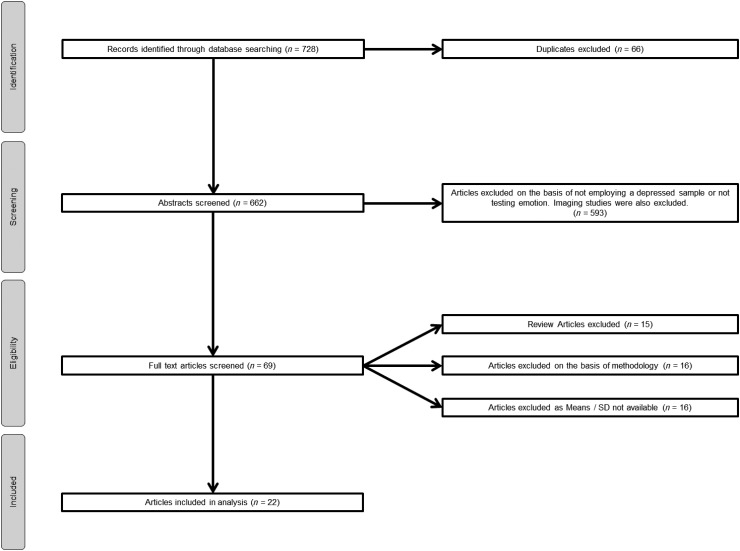
Background.: Many studies have explored associations between depression and facial emotion recognition (ER). However, these studies have used various paradigms and multiple stimulus sets, rendering comparisons difficult. Few studies have attempted to determine the magnitude of any effect and whether studies are properly powered to detect it. We conducted a meta-analysis to synthesize the findings across studies on ER in depressed individuals compared to controls. Method.: Studies of ER that included depressed and control samples and published before June 2013 were identified in PubMed and Web of Science. Studies using schematic faces, neuroimaging studies and drug treatment studies were excluded. Results.: Meta-analysis of k = 22 independent samples indicated impaired recognition of emotion [ k = 22, g = −0.16, 95% confidence interval (CI) −0.25 to −0.07, p < 0.001]. Critically, this was observed for anger, disgust, fear, happiness and surprise ( k 's = 7–22, g 's = −0.42 to −0.17, p 's < 0.08), but not sadness ( k = 21, g = −0.09, 95% CI −0.23 to +0.06, p = 0.23). Study-level characteristics did not appear to be associated with the observed effect. Power analysis indicated that a sample of approximately 615 cases and 615 controls would be required to detect this association with 80% power at an alpha level of 0.05. Conclusions.: These findings suggest that the ER impairment reported in the depression literature exists across all basic emotions except sadness. The effect size, however, is small, and previous studies have been underpowered.
Overview
The claims and statistics of this paper haven’t been checked yet.
Free: it reads the open-access text and checks the first 5 claims that cite a source we can check. Create a free account to check every claim.
Integrity signals
Registry
Cites
Statistics
Figures
Verification
Claims the paper makes
The claims and statistics of this paper haven’t been checked yet.
Free: it reads the open-access text and checks the first 5 claims that cite a source we can check. Create a free account to check every claim.
Claims other papers make about this one
Each is checked against this paper’s own text: does it say what the citing paper says it does?
The cited source says what the claim attributes to it.
In the citing paper
“taken together, results indicate a general deficit in emotion recognition of basic facial emotional expressions in patients with major depression (Dalili et al., 2015).”
From Social functioning in major depressive disorder (2016) · cites this paper as Dalili et al., 2015
Self-check
Percentages, sums and reported differences re-computed from the paper’s own numbers.
The self-check needs the paper’s full text.
Citations
Cites
Statistical Power Analysis for the Behavioral Sciences
Muller, K. (1989) · Technometrics · doi:10.1080/00401706.1989.10488618 · Cited by 99,167
Statistical power analysis for the behavioral sciences
(1990) · Computers, Environment and Urban Systems · doi:10.1016/0198-9715(90)90050-4 · Cited by 65,269
Bias in meta-analysis detected by a simple, graphical test
Egger, M., Smith, G. D., Schneider, M., & Minder, C. (1997) · BMJ · doi:10.1136/bmj.315.7109.629 · Cited by 56,722 · cited 2×
“Small study bias, which may reflect publication bias against null results, was assessed using Egger’s test (Egger et al. 1997).”
Meta-analysis in clinical trials
DerSimonian, R., & Laird, N. (1986) · Controlled Clinical Trials · doi:10.1016/0197-2456(86)90046-2 · Cited by 39,552 · cited 1×
“Data were analysed within a random-effects framework, with g values pooled using DerSimonian & Laird (1986) methods.”
Duval, S., & Tweedie, R. (2000) · Biometrics · doi:10.1111/j.0006-341x.2000.00455.x · Cited by 14,099 · cited 2×
“Adjusting for possible publication bias against null results using Duval and Tweedie ’ s trim and fi ll method (Duval & Tweedie, 2000) indicated a reduced effect-size estimate in the combined analysis ( g = − 0.08, 95% CI − 0.18 to +0.01), and the sadness ( g = +0.04, 95% CI − 0.12 to +0.20) and…”
InfluentialWhy Most Published Research Findings Are False
Ioannidis, J. P. A. (2005) · PLoS Medicine · doi:10.1371/journal.pmed.0020124 · Cited by 10,505
Power failure: why small sample size undermines the reliability of neuroscience
Button, K. S., Ioannidis, J. P. A., Mokrysz, C., Nosek, B. A., Flint, J., Robinson, E. S. J., & Munafò, M. R. (2013) · Nature Reviews Neuroscience · doi:10.1038/nrn3475 · Cited by 7,641 · cited 2×
“…characterized by de fi cits or biases in facial emotion recognition (ER), including schizophrenia (Addington et al. 2006), alcoholism (Philippot et al. 1999), autism (Celani et al. 1999), anxiety (Button et al. 2013 a ), bipolar disorder (Derntl et al. 2009), and depression (Rubinow & Post, 1992).”
Why Most Published Research Findings Are False
Ioannidis, J. P. A. (2005) · CHANCE · doi:10.1080/09332480.2005.10722754 · Cited by 4,702 · cited 1×
“The problems associated with low statistical power have recently been described, and include an increased likelihood that a statistically signi fi cant fi nding re fl ects a false positive (Ioannidis, 2005; Button et al. 2013 b ).”
Publication and related bias in meta-analysis
Sterne, J. A. C., Gavaghan, D., & Egger, M. (2000) · Journal of Clinical Epidemiology · doi:10.1016/s0895-4356(00)00242-0 · Cited by 2,282 · cited 1×
“Given the presence of small study bias, we adjusted using Duval and Tweedie ’ s trim-and-fi ll method (Duval & Tweedie, 2000) in order to account for small-study effects, where smaller studies in a meta-analysis tend to show larger treat-ment effects (Sterne et al. 2000).”
Neural mechanisms of the cognitive model of depression.
Disner, S. G., Beevers, C. G., Haigh, E. A. P., & Beck, A. T. (2011) · Nature Reviews Neuroscience · doi:10.1038/nrn3027 · Cited by 1,718 · cited 1×
“Contemporary theories of depression emphasize the importance of negative biases in ER as an important causal factor in illness etiology (Disner et al. 2011; Roiser et al. 2012).”
Research works printed but not linked: 1
- Wells GA, Shea B, O'Connell D, Peterson J, Welch V, Tugwell P (2000). The Newcastle-Ottawa Scale (NOS) for assessing the quality of nonrandomized studies in meta-analyses. Paper presented at the 3rd Symposium on Systematic Reviews: Beyond the Basics, Oxford.
Cited by
Social functioning in major depressive disorder
Kupferberg, A., Bicks, L., & Hasler, G. (2016) · Neuroscience & Biobehavioral Reviews · doi:10.1016/j.neubiorev.2016.07.002 · Cited by 663
“…emotion recognition for depressed patients and healthy controls (Hertel et al., 2009; Kan et al., 2004; Maniglio et al., 2014), taken together, results indicate a general deficit in emotion recognition of basic facial emotional expressions in patients with major depression (Dalili et al., 2015).”
Social brain, social dysfunction and social withdrawal
Porcelli, S., Van Der Wee, N., van der Werff, S., Aghajani, M., Glennon, J. C., van Heukelum, S., Mogavero, F., Lobo, A., Olivera, F. J., Lobo, E., et al. (2019) · Neuroscience & Biobehavioral Reviews · doi:10.1016/j.neubiorev.2018.09.012 · Cited by 391
Cotter, J., Granger, K., Backx, R., Hobbs, M., Looi, C. Y., & Barnett, J. H. (2018) · Neuroscience & Biobehavioral Reviews · doi:10.1016/j.neubiorev.2017.11.014 · Cited by 369
Theory of mind in major depressive disorder: A meta-analysis
Bora, E., & Berk, M. (2016) · Journal of Affective Disorders · doi:10.1016/j.jad.2015.11.023 · Cited by 304
Kupferberg, A., & Hasler, G. (2023) · Journal of Affective Disorders Reports · doi:10.1016/j.jadr.2023.100631 · Cited by 170
Bruder, G. E., Stewart, J. W., & McGrath, P. J. (2017) · Neuroscience & Biobehavioral Reviews · doi:10.1016/j.neubiorev.2017.04.021 · Cited by 214
“Individuals having a MDD show marked deficits in emotion recognition for faces (Dalili et al., 2015) and for emotional intonation (prosody) in the auditory domain (Bruder et al.”
Social cognition in multiple sclerosis: A systematic review and meta-analysis
Cotter, J., Firth, J., Enzinger, C., Kontopantelis, E., Yung, A. R., Elliott, R., & Drake, R. J. (2016) · Neurology · doi:10.1212/wnl.0000000000003236 · Cited by 170
“51).(8,41) To date, social cognitive research in MS has consisted of small, cross-sectional studies, conducted primarily in patients with a relapsing-remitting disease course and modest level of physical disability.”
BackgroundSocial cognition in alcohol use disorder: a meta-analysis: Social cognition in AUD
Bora, E., & Zorlu, N. (2017) · Addiction · doi:10.1111/add.13486 · Cited by 156
“are also known to be associated with medium-sized deficits in ToM and very modest impairment in emotion recognition [65,66].”
BackgroundMulti-level Attention Network using Text, Audio and Video for Depression Prediction
Ray, A., Kumar, S., Reddy, R., Mukherjee, P., & Garg, R. (2019) · Proceedings of the 9th International on Audio/Visual Emotion Challenge and Workshop · doi:10.1145/3347320.3357697 · Cited by 137
“conducted a thorough study for meta-analysis of the association between existing facial emotion recognition and depression [12].”
BackgroundStroud, J. B., Freeman, T. P., Leech, R., Hindocha, C., Lawn, W., Nutt, D. J., Curran, H. V., & Carhart-Harris, R. L. (2018) · Psychopharmacology · doi:10.1007/s00213-017-4754-y · Cited by 101
Vicario, C. M., Rafal, R. D., Martino, D., & Avenanti, A. (2017) · Neuroscience & Biobehavioral Reviews · doi:10.1016/j.neubiorev.2017.05.008 · Cited by 103
“However, a recent meta-analysis (Dalili et al., 2015) reported emotion recognition impairment across all basic emotions, except sadness.”
BackgroundVirtual reality facial emotion recognition in social environments: An eye-tracking study
Geraets, C. N. W., Tuente, S. K., Lestestuiver, B., van Beilen, M., Nijman, S. A., Marsman, J.-B., & Veling, W. (2021) · Internet Interventions · doi:10.1016/j.invent.2021.100432 · Cited by 94
Tracking the affective state of unseen persons
Chen, Z., & Whitney, D. C. (2019) · Proceedings of the National Academy of Sciences · doi:10.1073/pnas.1812250116 · Cited by 83
“Emotion recognition is also a key component of most measures of so-called emotional intelligence (3), and impairments in emotion recognition are associated with a variety of disorders ranging from autism (4) to schizophrenia (5) to major depression (6).”
BackgroundTroiano, E., Oberländer, L., & Klinger, R. (2023) · Computational Linguistics · doi:10.1162/coli_a_00461 · Cited by 132
“…et al. (2021) review them, pointing to peer status and friendship quality (Wang et al. 2019), to the possible state of depression of the observers (Dalili et al. 2015), and to their personality traits (Hall, Mast, and West 2016)—conscientiousness and openness are positively correlated to the…”
BackgroundKoenig, J., Parzer, P., Haigis, N., Liebemann, J., Jung, T., Resch, F., & Kaess, M. (2019) · Psychological Medicine · doi:10.1017/s0033291719003490 · Cited by 69
How and Why Are Irritability and Depression Linked?
Vidal‐Ribas, P., & Stringaris, A. K. (2021) · Child and Adolescent Psychiatric Clinics of North America · doi:10.1016/j.chc.2020.10.009 · Cited by 76
“However, these deficits are not specific to irritability; attentional biases towards negative stimuli and deficits in emotion recognition are also evident in people with depression [72-74].”
BackgroundEmotion recognition changes in a confinement situation due to COVID-19
Meléndez, J. C., Satorres, E., Reyes-Olmedo, M., Delhom, I., Real, E., & Lora, Y. (2020) · Journal of Environmental Psychology · doi:10.1016/j.jenvp.2020.101518 · Cited by 74
Pringle, A., & Harmer, C. J. (2015) · Dialogues in Clinical Neuroscience · doi:10.31887/dcns.2015.17.4/apringle · Cited by 61
Self-citationFacial expressions recognition and discrimination in Parkinson’s disease
Mattavelli, G. C., Barvas, E., Longo, C., Zappini, F., Ottaviani, D., Malaguti, M. C., Pellegrini, M. A., & Papagno, C. (2020) · Journal of Neuropsychology · doi:10.1111/jnp.12209 · Cited by 63
Accurate interpersonal perception: Many traditions, one topic
Hall, J. A., Mast, M. S., & West, T. V. (2016) · Cambridge University Press eBooks · doi:10.1017/cbo9781316181959.001 · Cited by 71
Functional architecture of visual emotion recognition ability: A latent variable approach.
Lewis, G. J., Lefevre, C. E., & Young, A. W. (2016) · Journal of Experimental Psychology General · doi:10.1037/xge0000160 · Cited by 62
Gender differences in functional connectivity during emotion regulation
Stoica, T., Knight, L. K., Naaz, F., Patton, S. C., & Depue, B. E. (2021) · Neuropsychologia · doi:10.1016/j.neuropsychologia.2021.107829 · Cited by 55
Qiao, E., Quesada, M. G., Antico, L., Bavelier, D., Vuilleumier, P. O., & Pichon, S. (2017) · PLoS ONE · doi:10.1371/journal.pone.0171375 · Cited by 57
Burstein, O., Shoshan, N., Doron, R., & Akirav, I. (2018) · Progress in Neuro-Psychopharmacology and Biological Psychiatry · doi:10.1016/j.pnpbp.2018.01.026 · Cited by 58
“Correspondingly, deficits in emotional recognition are characteristic of MDD (Dalili et al., 2015), and were linked with increased neural potentiation in the amygdala (van Wingen et al.”
InfluentialMonferrer, M., García, A. S., Ricarte, J. J., Montes, M. J., Fernández‐Caballero, A., & Fernández-Sotos, P. (2023) · Scientific Reports · doi:10.1038/s41598-023-31277-5 · Cited by 52
Tozzi, L., Staveland, B. R., Holt-Gosselin, B., Chesnut, M., Chang, S. E., Choi, D., Shiner, M., Wu, H., Lerma‐Usabiaga, G., Sporns, O., et al. (2020) · NeuroImage · doi:10.1016/j.neuroimage.2020.116715 · Cited by 51
“Several studies have shown that individuals suffering from depression are less accurate at identifying all emotions, especially happiness, sadness and neutral (Dalili et al., 2015; Milders et al., 2010; Sanchez et al., 2017; Watters and Williams, 2011).”
BackgroundLong‐term efficacy of Metacognitive Training for Depression (D‐ MCT ): A randomized controlled trial
Jelinek, L., Faissner, M., Moritz, S., & Kriston, L. (2019) · British Journal of Clinical Psychology · doi:10.1111/bjc.12213 · Cited by 39
Convergence of EEG and fMRI measures of reward anticipation
Gorka, S. M., Phan, K. L., & Shankman, S. A. (2015) · Biological Psychology · doi:10.1016/j.biopsycho.2015.09.007 · Cited by 45
“, 1992; Kring & Barch, 2014); as well as broad processing deficits of positive stimuli (Dalili et al., 2014).”
BackgroundDepping, M. S., Thomann, P. A., Wolf, N. D., Vasić, N., Sosic-Vasic, Z., Schmitgen, M. M., Sambataro, F., & Wolf, R. C. (2018) · European Neuropsychopharmacology · doi:10.1016/j.euroneuro.2018.07.100 · Cited by 47
Mortillaro, M., & Schlegel, K. (2023) · Journal of Intelligence · doi:10.3390/jintelligence11110210 · Cited by 52
MLM-EOE: Automatic Depression Detection via Sentimental Annotation and Multi-Expert Ensemble
Lin, Z., Wang, Y., Zhou, Y., Du, F., & Yang, Y. (2025) · IEEE Transactions on Affective Computing · doi:10.1109/taffc.2025.3585599 · Cited by 51
“Extensive medical research indicates that individuals with depression exhibit deficits in emotional expression and emotion recognition [10], [11].”
Nyquist, A. C., & Luebbe, A. M. (2019) · Clinical Child and Family Psychology Review · doi:10.1007/s10567-019-00302-3 · Cited by 47
Branco, L. D., Cotrena, C., Ponsoni, A., Salvador-Silva, R., Vasconcellos, S. J. L., & Fonseca, R. P. (2017) · Archives of Clinical Neuropsychology · doi:10.1093/arclin/acx080 · Cited by 44
Slaney, C., Sallis, H., Jones, H. J., Dardani, C., CHARGE Inflammation Working Group, Tilling, K. M., Munafo, M. R., Smith, G. D., Mahedy, L., & Khandaker, G. M. (2023) · Brain Behavior and Immunity · doi:10.1016/j.bbi.2023.02.010 · Cited by 43
“Poorer cognitive functioning is a core feature of many mental health disorders including depression, schizophrenia and Alzheimer’s disease (Bolt et al., 2019; Dalili et al., 2015; Fusar-Poli et al., 2012; Nikolin et al., 2021; Rock et al., 2014), and is highly prevalent in some physical illnesses including cancer (Jan…”
Rütgen, M., Pletti, C., Tik, M., Kraus, C., Pfabigan, D. M., Sladky, R., Klöbl, M., Woletz, M., Vanicek, T., Windischberger, C., et al. (2019) · Translational Psychiatry · doi:10.1038/s41398-019-0496-4 · Cited by 42
Saarinen, A. I. L., Keltikangas‐Järvinen, L., Jääskeläinen, E., Huhtaniska, S., Pudas, J., Tovar-Perdomo, S., Penttilä, M., Miettunen, J., & Lieslehto, J. (2021) · Biological Psychiatry Cognitive Neuroscience and Neuroimaging · doi:10.1016/j.bpsc.2021.01.002 · Cited by 47
Tripoli, G., Quattrone, D., Ferraro, L., Gayer-Anderson, C. E., Cascia, C. L., Barbera, D. L., Sartorio, C., Seminerio, F., Rodríguez, V., Tarricone, I., et al. (2022) · Schizophrenia Bulletin · doi:10.1093/schbul/sbac022 · Cited by 45
“10,18,60 However, our primary genomic interest was in the schizophrenia PRS analysis given that (1) the FEP sample has more nonaffective, schizophrenia spectrum psychosis than bipolar psychosis or depressive psychosis, and (2) prior findings indicate that schizophrenia PRS explains more variance in…”
Pupil mimicry and trust – Implication for depression
Wehebrink, K. S., Koelkebeck, K., Piest, S., Dreu, C. K. W. D., & Kret, M. E. (2017) · Journal of Psychiatric Research · doi:10.1016/j.jpsychires.2017.11.007 · Cited by 44
“been shown that patients with MDD are less adept at recognizing emotional expressions (Bourke et al., 2010; Demenescu et al., 2010; Dalili et al., 2015).”
BackgroundEmotional event perception is related to lexical complexity and emotion knowledge
Li, Z., Lu, H., Liu, D., Yu, A. N. C., & Gendron, M. (2023) · Communications Psychology · doi:10.1038/s44271-023-00039-4 · Cited by 42
“This would also allow for the investigation of clinical samples with documented differences in the perception of positive versus negative emotions 118,119 .”
Miller, S. A. (2022) · doi:10.1093/oso/9780197573174.001.0001 · Cited by 41
Li, D., Carnelley, K. B., & Rowe, A. C. (2022) · Personality and Social Psychology Bulletin · doi:10.1177/01461672221117690 · Cited by 39
“Included studies with high risk of bias can invalidate the results of a meta-analysis; therefore, we assessed the quality of individual studies using the following criteria (Dalili et al., 2015; Molloy et al., 2014): (a) Sufficient sample size (above 85).”
Döllinger, L., Laukka, P., Högman, L., Bänziger, T., Makower, I., Fischer, H., & Hau, S. (2021) · Frontiers in Psychology · doi:10.3389/fpsyg.2021.708867 · Cited by 44
Prisco, M. D., Oliva, V., Fico, G., Montejo, L., Possidente, C., Bracco, L., Fortea, L., Anmella, G., Hidalgo‐Mazzei, D., Fornaro, M., et al. (2023) · Progress in Neuro-Psychopharmacology and Biological Psychiatry · doi:10.1016/j.pnpbp.2023.110847 · Cited by 40
Genetic algorithms reveal profound individual differences in emotion recognition
Binetti, N., Roubtsova, N. S., Carlisi, C. O., Cosker, D. P., Viding, E. M., & Mareschal, I. (2022) · Proceedings of the National Academy of Sciences · doi:10.1073/pnas.2201380119 · Cited by 44
Kordsachia, C. C., Labuschagne, I., & Stout, J. C. (2016) · Neuroscience & Biobehavioral Reviews · doi:10.1016/j.neubiorev.2016.11.020 · Cited by 40
Bomfim, A. J. D. L., Ribeiro, R. A. D. S., & Chagas, M. H. N. (2019) · Trends in Psychiatry and Psychotherapy · doi:10.1590/2237-6089-2018-0054 · Cited by 42
Victims of Bullying: Emotion Recognition and Understanding
Franzen, M., de Jong, P. J., Veling, W., & Rot, M. A. H. (2021) · Frontiers in Psychology · doi:10.3389/fpsyg.2021.729835 · Cited by 40
Biases in processing of mood-congruent facial expressions in depression
Vleet, T. V., Stark‐Inbar, A., Merzenich, M. M., Jordan, J. T., Wallace, D. L., Lee, M. B., Dawes, H. E., Chang, E. F., & Nahum, M. (2019) · Psychiatry Research · doi:10.1016/j.psychres.2019.02.076 · Cited by 37
“Two recent metaanalyses found impairments in emotion recognition in depression in all emotions except sadness (Dalili et al., 2015; Demenescu et al., 2010), but with small effect sizes.”
BackgroundTsikandilakis, M., Bali, P., Derrfuß, J., & Chapman, P. (2019) · Cognition & Emotion · doi:10.1080/02699931.2019.1664415 · Cited by 41
Self-processing in relation to emotion and reward processing in depression
Hobbs, C., Sui, J., Kessler, D. S., Munafo, M. R., & Button, K. S. (2021) · Psychological Medicine · doi:10.1017/s0033291721003597 · Cited by 38
Neuronal Circuits for Social Decision-Making and Their Clinical Implications
Báez-Mendoza, R., Vázquez, Y., Mastrobattista, E. P., & Williams, Z. M. (2021) · Frontiers in Neuroscience · doi:10.3389/fnins.2021.720294 · Cited by 39
Vidal‐Ribas, P., Brotman, M. A., Salum, G. A., Kaiser, A. J. E., Meffert, L., Pine, D. S., Leibenluft, E., & Stringaris, A. K. (2018) · Depression and Anxiety · doi:10.1002/da.22810 · Cited by 36
Cognitive functioning in anxiety and depression: results from the ALSPAC cohort
Suddell, S. F., Mahedy, L., Skirrow, C., Penton‐Voak, I. S., Munafo, M. R., & Wootton, R. E. (2023) · Royal Society Open Science · doi:10.1098/rsos.221161 · Cited by 35
“Further studies highlight that anxiety and depression are associated with emotional processing biases, with affected individuals displaying a tendency to interpret social information more negatively than healthy controls [15,18].”
BackgroundSelf-citationFusion-based learning for stress recognition in smart home: An IoMT framework
Rezaee, K., Yang, X., Khosravi, M. R., Zhang, R., Lin, W., & Jeon, G. (2022) · Building and Environment · doi:10.1016/j.buildenv.2022.108988 · Cited by 35
Moore, A. A., Rappaport, L. M., Blair, J., Pine, D. S., Leibenluft, E., Brotman, M. A., Hettema, J. M., & Roberson‐Nay, R. (2019) · Journal of Child Psychology and Psychiatry · doi:10.1111/jcpp.13018 · Cited by 32
Alders, G. L., Davis, A. D., MacQUEEN, G. M., Strother, S. C., Hassel, S., Zamyadi, M., Sharma, G. B., Arnott, S. R., Downar, J. H., Harris, J. K., et al. (2019) · Journal of Affective Disorders · doi:10.1016/j.jad.2019.07.037 · Cited by 33
Baranger, D. A. A., Halchenko, Y. O., Satz, S., Ragozzino, R., Iyengar, S., Swartz, H. A., & Manelis, A. (2021) · NeuroImage Clinical · doi:10.1016/j.nicl.2021.102790 · Cited by 34
“The major strength of this approach is that it helps to reduce model bias, which occurs when the same participants are used to train and test a model (Davatzikos, 2019).”
BackgroundThe Emerging Science of People-Watching: Forming Impressions From Third-Party Encounters
Susanne Quadflieg, A., & Penton‐Voak, I. S. (2017) · Current Directions in Psychological Science · doi:10.1177/0963721417694353 · Cited by 33
Self-citationLe, J., Kou, J., Zhao, W., Fu, M., Zhang, Y., Becker, B., & Kendrick, K. M. (2020) · Translational Psychiatry · doi:10.1038/s41398-020-0830-x · Cited by 32
Wang, Y., Guobule, N., Li, M., & Li, J. (2021) · Journal of Affective Disorders · doi:10.1016/j.jad.2021.08.051 · Cited by 33
Social cognition and empathy in adults with obsessive compulsive disorder: A meta-analysis
Bora, E. (2022) · Psychiatry Research · doi:10.1016/j.psychres.2022.114752 · Cited by 35
Yoon, S., Kim, H. S., Kim, J., Lee, S., & Lee, S. (2015) · Psychiatry and Clinical Neurosciences · doi:10.1111/pcn.12369 · Cited by 32
Facial Emotion Recognition Abilities in Women Experiencing Eating Disorders
Wyssen, A., Lao, J., Rodger, H., Humbel, N., Lennertz, J., Schuck, K., Isenschmid, B., Milos, G. F., Trier, S. N., Whinyates, K., et al. (2019) · Psychosomatic Medicine · doi:10.1097/psy.0000000000000664 · Cited by 32
Kosonogov, V., & Titova, A. (2018) · International Journal of Psychology · doi:10.1002/ijop.12512 · Cited by 28
Neurocognitive performance as an endophenotype for mood disorder subgroups
Merikangas, A. K., Cui, L., Calkins, M. E., Moore, T. M., Gur, R. C., Gur, R. E., & Merikangas, K. R. (2017) · Journal of Affective Disorders · doi:10.1016/j.jad.2017.03.021 · Cited by 33
Acute fluoxetine modulates emotional processing in young adult volunteers
Capitão, L. P., Murphy, S. E., Browning, M. D., Cowen, P. J., & Harmer, C. J. (2015) · Psychological Medicine · doi:10.1017/s0033291715000240 · Cited by 34
“In a recent meta-analysis of Dalili et al. (2014), the recognition of sadness (but not of other emotions) was found to be preserved in depressed patients, which is consistent with contemporary models of depression emphasizing the role of negative cognitive bias in the aetiology and maintenance of…”
ResultSelf-citationPenton‐Voak, I. S., Adams, S. H., Button, K. S., Fluharty, M., Dalili, M. N., Browning, M. D., Holmes, E. A., Harmer, C. J., & Munafo, M. R. (2020) · Psychological Medicine · doi:10.1017/s0033291719004124 · Cited by 29
Self-citationTranscutaneous vagus nerve stimulation improves emotional processing
Zhao, T., Schiweck, C., Jamalambadi, H., Meyer, K., Brandt, E. S. L., Schneider, M., Aichholzer, M., Qubad, M., Bouzouina, A., Schillo, S., et al. (2024) · Journal of Affective Disorders · doi:10.1016/j.jad.2024.11.077 · Cited by 27
Markers of limbic system damage following SARS-CoV-2 infection
Thomasson, M., Voruz, P., Cionca, A., de Alcântara, I. J., Nuber‐Champier, A., Allali, G., Benzakour, L., Lalive, P. H., Lövblad, K., Braillard, O., et al. (2023) · Brain Communications · doi:10.1093/braincomms/fcad177 · Cited by 27
“20– 24 To the best of our knowledge, no study has yet assessed the impact of relevant secondary neuropsychiatric variables on the recognition of individual multimodal emotions, as a function of the severity of respiratory symptoms in the acute phase.”
BackgroundZhang, L., Liang, H., Bjureberg, J., Xiong, F., & Cai, Z. (2023) · Journal of Youth and Adolescence · doi:10.1007/s10964-023-01891-7 · Cited by 29
“The studies included by Dalili et al. (2015) primarily involve diagnosed adult individuals with depression, and they exhibit dif fi culties in recognizing all basic emotions except sadness.”
InfluentialSfärlea, A., Greimel, E., Platt, B., Dieler, A. C., & Schulte‐Körne, G. (2017) · Psychiatry Research · doi:10.1016/j.psychres.2017.09.048 · Cited by 28
“We expected the MD group to show emotion recognition deficits compared to HCs as well (as found for adult MD patients: see e.g. Demenescu et al., 2010; Dalili et al., 2015).”
BackgroundMethodVrijen, C., Hartman, C. A., & Oldehinkel, A. J. (2016) · European Child & Adolescent Psychiatry · doi:10.1007/s00787-016-0846-1 · Cited by 28
“sample sizes and varying measurements, instruments and experimental procedures [21, 22].”
BackgroundTherapeutic dose assessment of patient switching from atorvastatin to simvastatin.
Hess, G. P., Sanders, K. N., Hill, J. W., & Liu, L. Z. (2007) · PubMed · Cited by 25
Luo, L., Becker, B., Zheng, X., Zhao, Z., Xu, X., Zhou, F., Wang, J., Kou, J., Dai, J., & Kendrick, K. M. (2017) · Human Brain Mapping · doi:10.1002/hbm.23880 · Cited by 25
Lebert, A., Chaby, L., Garnot, C., & Vergilino‐Perez, D. (2020) · Experimental Brain Research · doi:10.1007/s00221-020-05941-5 · Cited by 23
Struck, N., Gärtner, T., Kircher, T. T. J., & Brakemeier, E. (2021) · Frontiers in Psychiatry · doi:10.3389/fpsyt.2020.608795 · Cited by 27
“In line with some previous findings [(21); however, see also (20)], patients with depression recognized anger with higher accuracy compared with healthy controls.”
BackgroundResultBraun, M. N., Müller-Klein, A., Sopp, M. R., Michael, T., Link-Dorner, U., & Lass‐Hennemann, J. (2024) · Applied Animal Behaviour Science · doi:10.1016/j.applanim.2024.106171 · Cited by 28
Facial recognition of happiness among older adults with active and remitted major depression
Shiroma, P. R., THURAS, P. D., Johns, B., & Lim, K. O. (2016) · Psychiatry Research · doi:10.1016/j.psychres.2016.06.020 · Cited by 28
Inter- and Intrapersonal Downsides of Accurately Perceiving Others’ Emotions
Schlegel, K. (2020) · Springer eBooks · doi:10.1007/978-3-030-34964-6_13 · Cited by 30
Impairments of Social Interaction in Depressive Disorder
AKINCI, E., Wieser, M.-O., Vanscheidt, S., Diop, S., Flasbeck, V., Akinci, B., Stiller, C., Juckel, G., & Mavrogiorgou, P. (2022) · Psychiatry Investigation · doi:10.30773/pi.2021.0289 · Cited by 26
DepressNet: A Multimodal Hierarchical Attention Mechanism approach for Depression Detection
Saggu, G. S., Gupta, K., & Arya, K. V. (2022) · International Journal of Engineering Sciences · doi:10.36224/ijes.150104 · Cited by 30
“In [10], authors have studied the relation between distress and existing facial emotion recognition through meta-analysis.”
BackgroundThe Impact of Social Anxiety Disorder on Emotional Expression Recognition: A Meta-analysis
Lacombe, C., Simoneau, K., Elalouf, K., & Collin, C. A. (2023) · Cognitive Therapy and Research · doi:10.1007/s10608-023-10376-7 · Cited by 24
A Developmental Twin Study of Emotion Recognition and Its Negative Affective Clinical Correlates
Rappaport, L. M., Carney, D. M., Verhulst, B., Neale, M. C., Blair, J., Brotman, M. A., Pine, D. S., Leibenluft, E., Hettema, J. M., & Roberson‐Nay, R. (2018) · Journal of the American Academy of Child & Adolescent Psychiatry · doi:10.1016/j.jaac.2018.05.028 · Cited by 25
“These correlations could be constrained to zero without appreciable loss of model fit for irritability, χ2 (5) = 2.”
BackgroundBone, J. K., Lewis, G., Button, K. S., Duffy, L., Harmer, C. J., Munafo, M. R., Penton‐Voak, I. S., Wiles, N., & Lewis, G. (2019) · Journal of Affective Disorders · doi:10.1016/j.jad.2019.06.025 · Cited by 24
Self-citationSocial Cognition in Multiple Sclerosis: A 3-Year Follow-Up MRI and Behavioral Study
Ziccardi, S., Pitteri, M., Genova, H. M., & Calabrese, M. (2021) · Diagnostics · doi:10.3390/diagnostics11030484 · Cited by 23
Differences in Facial Expression Recognition Between Unipolar and Bipolar Depression
Ma, R., Zhao, M., Chen, N., Liu, P., Hua, G., Liu, S., Jing, S., Ke, Z., Yunlong, T., Tan, S., et al. (2021) · Frontiers in Psychology · doi:10.3389/fpsyg.2021.619368 · Cited by 22
Measuring emotion recognition: Added value in diagnosing dementia of the Alzheimer’s disease type
Strijkert, F., Huitema, R. B., & Spikman, J. M. (2021) · Journal of Neuropsychology · doi:10.1111/jnp.12263 · Cited by 26
Neuromodulation of facial emotion recognition in health and disease: A systematic review
Nejati, V., Khorrami, A. S., & Fonoudi, M. (2022) · Neurophysiologie Clinique · doi:10.1016/j.neucli.2022.03.005 · Cited by 23
Li, M., Zhang, J., Jiang, C., Wang, J., Sun, R.-H., Jin, S.-Y., Zhang, N., & Zhou, Z. (2023) · Neuropsychiatric Disease and Treatment · doi:10.2147/ndt.s393264 · Cited by 22
“A meta-analysis of 23 studies has shown that MDD participants had lower accuracy in recognizing emotional facial expressions than healthy controls.3 This result is similar to another earlier meta-analysis found by Dalili et al.4 Furthermore, an earlier study has shown that major depressive patients show greater emotio…”
ResultLebert, A., Vergilino‐Perez, D., & Chaby, L. (2024) · PLoS ONE · doi:10.1371/journal.pone.0298069 · Cited by 22
Hagen, J., Ramkiran, S., Schnellbächer, G. J., Rajkumar, R., Collée, M., Khudeish, N., Veselinović, T., Shah, N. J., & Neuner, I. (2024) · Molecular Psychiatry · doi:10.1038/s41380-024-02669-4 · Cited by 23
Iffland, B., Klein, F., Schindler, S., Kley, H., & Neuner, F. (2021) · Cognitive Affective & Behavioral Neuroscience · doi:10.3758/s13415-021-00877-x · Cited by 21
“…in major depression revealed that individuals with depression are prone to evaluate positive, neutral, or ambiguous facial expressions more negatively than healthy controls and have impaired emotion recognition for every facial expression except sadness (Bourke et al., 2010; Dalili et al., 2015).”
BackgroundHow do antidepressants influence the BOLD signal in the developing brain?
Harris, J. J., & Reynell, C. (2016) · Developmental Cognitive Neuroscience · doi:10.1016/j.dcn.2016.12.003 · Cited by 33
Tang, E., Zhang, M., Chen, Y., Lin, Y., & Ding, H. (2022) · Journal of Affective Disorders · doi:10.1016/j.jad.2022.06.065 · Cited by 21
Putamen Volume is Negatively Correlated with the Ability to Recognize Fearful Facial Expressions
Uono, S., Sato, W., Kochiyama, T., Kubota, Y., Sawada, R., Yoshimura, S., & Toichi, M. (2017) · Brain Topography · doi:10.1007/s10548-017-0578-7 · Cited by 22
Maurage, P., Pabst, A., Lannoy, S., D’Hondt, F., de Timary, P., Gaudelus, B., & Peyroux, É. (2020) · Journal of Affective Disorders · doi:10.1016/j.jad.2020.10.022 · Cited by 19
Romero‐Martínez, Á., Sarrate‐Costa, C., & Moya‐Albiol, L. (2021) · Biology · doi:10.3390/biology10121334 · Cited by 21
Web-Based Cognitive Testing in Psychiatric Research: Validation and Usability Study
Lynham, A. J., Jones, I. R., & Walters, J. (2022) · Journal of Medical Internet Research · doi:10.2196/28233 · Cited by 18
“Studies have identified impairments in emotion recognition in participants with bipolar disorder [58,59], depression [60], autism [61], and posttraumatic stress disorder [62].”
BackgroundRichey, J. A., Gračanin, D., LaConte, S. M., Lisinski, J. M., Kim, I., Coffman, M. C., Antezana, L., Carlton, C. N., Garcia, K. M., & White, S. W. (2022) · Journal of Clinical Child & Adolescent Psychology · doi:10.1080/15374416.2022.2051528 · Cited by 19
“…disorders including individuals with intellectual disability (Zaja & Rojahn, 2008), schizophrenia (Johnston et al., 2005), parkinson’s disease (Assogna et al., 2008) and among elderly adults (Sullivan & Ruffman, 2004) as well as other psychiatric problems such as depression (Dalili et al., 2015).”
BackgroundChen, Y., Liu, C., Xin, F., Zou, H., Huang, Y., Wang, J., Dai, J., Zou, Z., Ferraro, S., Kendrick, K. M., et al. (2023) · Progress in Neuro-Psychopharmacology and Biological Psychiatry · doi:10.1016/j.pnpbp.2023.110716 · Cited by 18
Metadata
- Authors
- Dalili, M. N., Penton-Voak, I. S., Harmer, C. J., & Munafò, M. R.
- Affiliations
- University of Bristol (GB)
- University of Oxford (GB)
- Corresponding author
- Dalili, M. N.
- Venue
- Psychological Medicine
- Publisher
- Cambridge University Press (CUP)
- Published
- 2014-11-14
- Volume
- 45
- Issue
- 6
- Pages
- 1135-1144
- ISSN
- 0033-2917 (ISSN-L)
- 1469-8978
- PMC
- PMC4712476
- OpenAlex
- W2126009018
- Cited by
- 349
- References
- 55
- Citations by year
- 2026: 23 · 2025: 34 · 2024: 28 · 2023: 46 · 2022: 56 · 2021: 52 · 2020: 28 · 2019: 24 · 2018: 19 · 2017: 15 · 2016: 13 · 2015: 10
- FWCI
- 1.22
- Type
- journal article
- Language
- en
- Open access
- hybrid
- doi.org
- Locations
- Psychological Medicine (publishedVersion, cc-by)
- PubMed Central (publishedVersion, cc-by)
- PubMed (publishedVersion)
- Explore Bristol Research (acceptedVersion, other-oa)
- Bristol Research (University of Bristol) (submittedVersion, other-oa)
- Funders
- United Kingdom Clinical Research Collaboration
- Cancer Research UK
- National Institute for Health and Care Research
- British Heart Foundation
- Medical Research Council (MR/J011819/1)
- Economic and Social Research Council
- Topics
- Life Sciences › Neuroscience › Cognitive Neuroscience › Face Recognition and Perception
- Social Sciences › Psychology › Experimental and Cognitive Psychology › Anxiety, Depression, Psychometrics, Treatment, Cognitive Processes
- Life Sciences › Neuroscience › Cognitive Neuroscience › Neural and Behavioral Psychology Studies
- Keywords
- major depressive disorder, facial emotion recognition, emotion recognition deficits, basic emotions, sadness, anger, disgust, fear, happiness, surprise, study power, effect size
- MeSH terms
- Depressive Disorder, Major, Major Depressive Disorder, Emotions, Humans, Recognition, Psychology
About these checks
Registry, retraction, Cites and statistics results are computed, not judged, with one exception: a printed reference that no index lists is read once by a model before it counts as a citation error. Claims are extracted by a model and kept only when their quote appears verbatim in the text; each cited source is then checked, with a model’s help, for whether it says what the claim relies on. Those verdicts can be wrong — read the claim’s quote and the cited source before relying on one.
Statistics and arithmetic are recomputed, not judged.
Confidence bands are shown only for fields calibrated on our annotated test set. None is calibrated yet, so no band is shown.
What counts as a claim ›How we measure confidence ›How we check this ›
Are you an author, or do you see a problem with this page? Request a review
Data sources
Bibliographic data: Semantic Scholar, OpenAlex, Crossref.
Contains information from the Semantic Scholar Academic Graph Datasets, made available under the ODC Attribution License (ODC-BY 1.0).
Semantic Scholar’s data is described in: Kinney, R., et al. (2023). The Semantic Scholar Open Data Platform. arXiv:2301.10140.
