

Meta-analysis of emotion recognition deficits in major depressive disorder
Open accessThe DOI matches its Crossref record; 55 of the 55 references it cites were found in a registry or an index.
Abstract
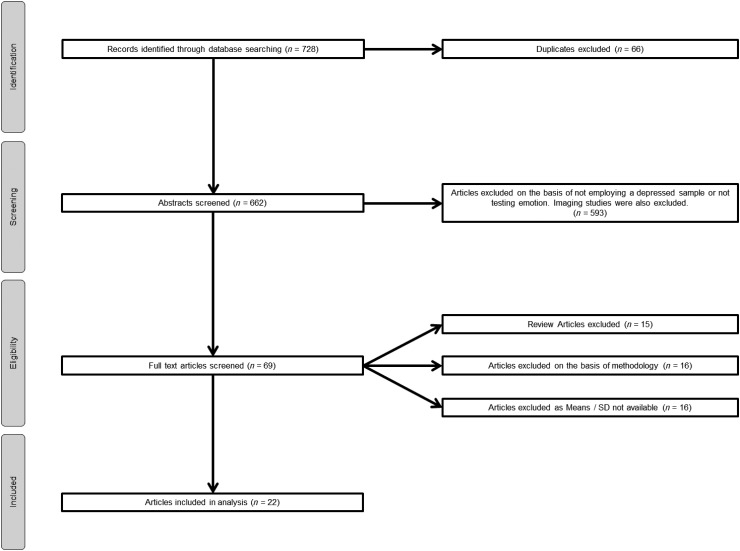
Background.: Many studies have explored associations between depression and facial emotion recognition (ER). However, these studies have used various paradigms and multiple stimulus sets, rendering comparisons difficult. Few studies have attempted to determine the magnitude of any effect and whether studies are properly powered to detect it. We conducted a meta-analysis to synthesize the findings across studies on ER in depressed individuals compared to controls. Method.: Studies of ER that included depressed and control samples and published before June 2013 were identified in PubMed and Web of Science. Studies using schematic faces, neuroimaging studies and drug treatment studies were excluded. Results.: Meta-analysis of k = 22 independent samples indicated impaired recognition of emotion [ k = 22, g = −0.16, 95% confidence interval (CI) −0.25 to −0.07, p < 0.001]. Critically, this was observed for anger, disgust, fear, happiness and surprise ( k 's = 7–22, g 's = −0.42 to −0.17, p 's < 0.08), but not sadness ( k = 21, g = −0.09, 95% CI −0.23 to +0.06, p = 0.23). Study-level characteristics did not appear to be associated with the observed effect. Power analysis indicated that a sample of approximately 615 cases and 615 controls would be required to detect this association with 80% power at an alpha level of 0.05. Conclusions.: These findings suggest that the ER impairment reported in the depression literature exists across all basic emotions except sadness. The effect size, however, is small, and previous studies have been underpowered.
Overview
The claims and statistics of this paper haven’t been checked yet.
Free: it reads the open-access text and checks the first 5 claims that cite a source we can check. Create a free account to check every claim.
Integrity signals
Registry
Cites
Statistics
Figures
Verification
Claims the paper makes
The claims and statistics of this paper haven’t been checked yet.
Free: it reads the open-access text and checks the first 5 claims that cite a source we can check. Create a free account to check every claim.
Claims other papers make about this one
Each is checked against this paper’s own text: does it say what the citing paper says it does?
The cited source says what the claim attributes to it.
In the citing paper
“taken together, results indicate a general deficit in emotion recognition of basic facial emotional expressions in patients with major depression (Dalili et al., 2015).”
From Social functioning in major depressive disorder (2016) · cites this paper as Dalili et al., 2015
Self-check
Percentages, sums and reported differences re-computed from the paper’s own numbers.
The self-check needs the paper’s full text.
Citations
Cites
Statistical Power Analysis for the Behavioral Sciences
Muller, K. (1989) · Technometrics · doi:10.1080/00401706.1989.10488618 · Cited by 99,167
Statistical power analysis for the behavioral sciences
(1990) · Computers, Environment and Urban Systems · doi:10.1016/0198-9715(90)90050-4 · Cited by 65,269
Bias in meta-analysis detected by a simple, graphical test
Egger, M., Smith, G. D., Schneider, M., & Minder, C. (1997) · BMJ · doi:10.1136/bmj.315.7109.629 · Cited by 56,722 · cited 2×
“Small study bias, which may reflect publication bias against null results, was assessed using Egger’s test (Egger et al. 1997).”
Meta-analysis in clinical trials
DerSimonian, R., & Laird, N. (1986) · Controlled Clinical Trials · doi:10.1016/0197-2456(86)90046-2 · Cited by 39,552 · cited 1×
“Data were analysed within a random-effects framework, with g values pooled using DerSimonian & Laird (1986) methods.”
Duval, S., & Tweedie, R. (2000) · Biometrics · doi:10.1111/j.0006-341x.2000.00455.x · Cited by 14,099 · cited 2×
“Adjusting for possible publication bias against null results using Duval and Tweedie ’ s trim and fi ll method (Duval & Tweedie, 2000) indicated a reduced effect-size estimate in the combined analysis ( g = − 0.08, 95% CI − 0.18 to +0.01), and the sadness ( g = +0.04, 95% CI − 0.12 to +0.20) and…”
InfluentialWhy Most Published Research Findings Are False
Ioannidis, J. P. A. (2005) · PLoS Medicine · doi:10.1371/journal.pmed.0020124 · Cited by 10,505
Power failure: why small sample size undermines the reliability of neuroscience
Button, K. S., Ioannidis, J. P. A., Mokrysz, C., Nosek, B. A., Flint, J., Robinson, E. S. J., & Munafò, M. R. (2013) · Nature Reviews Neuroscience · doi:10.1038/nrn3475 · Cited by 7,641 · cited 2×
“…characterized by de fi cits or biases in facial emotion recognition (ER), including schizophrenia (Addington et al. 2006), alcoholism (Philippot et al. 1999), autism (Celani et al. 1999), anxiety (Button et al. 2013 a ), bipolar disorder (Derntl et al. 2009), and depression (Rubinow & Post, 1992).”
Why Most Published Research Findings Are False
Ioannidis, J. P. A. (2005) · CHANCE · doi:10.1080/09332480.2005.10722754 · Cited by 4,702 · cited 1×
“The problems associated with low statistical power have recently been described, and include an increased likelihood that a statistically signi fi cant fi nding re fl ects a false positive (Ioannidis, 2005; Button et al. 2013 b ).”
Publication and related bias in meta-analysis
Sterne, J. A. C., Gavaghan, D., & Egger, M. (2000) · Journal of Clinical Epidemiology · doi:10.1016/s0895-4356(00)00242-0 · Cited by 2,282 · cited 1×
“Given the presence of small study bias, we adjusted using Duval and Tweedie ’ s trim-and-fi ll method (Duval & Tweedie, 2000) in order to account for small-study effects, where smaller studies in a meta-analysis tend to show larger treat-ment effects (Sterne et al. 2000).”
Neural mechanisms of the cognitive model of depression.
Disner, S. G., Beevers, C. G., Haigh, E. A. P., & Beck, A. T. (2011) · Nature Reviews Neuroscience · doi:10.1038/nrn3027 · Cited by 1,718 · cited 1×
“Contemporary theories of depression emphasize the importance of negative biases in ER as an important causal factor in illness etiology (Disner et al. 2011; Roiser et al. 2012).”
Research works printed but not linked: 1
- Wells GA, Shea B, O'Connell D, Peterson J, Welch V, Tugwell P (2000). The Newcastle-Ottawa Scale (NOS) for assessing the quality of nonrandomized studies in meta-analyses. Paper presented at the 3rd Symposium on Systematic Reviews: Beyond the Basics, Oxford.
Cited by
Items 101–200 of 366
Suslow, T., Wildenauer, K., & Günther, V. (2018) · Journal of Behavior Therapy and Experimental Psychiatry · doi:10.1016/j.jbtep.2018.10.004 · Cited by 18
Porter-Vignola, É., Booij, L., Chartier, G., Garel, P., & Herba, C. M. (2021) · Psychiatry Research · doi:10.1016/j.psychres.2021.113777 · Cited by 19
Pediatric anxiety associated with altered facial emotion recognition
Rappaport, L. M., Nardo, N. D., Brotman, M. A., Pine, D. S., Leibenluft, E., Roberson‐Nay, R., & Hettema, J. M. (2021) · Journal of Anxiety Disorders · doi:10.1016/j.janxdis.2021.102432 · Cited by 19
Socioemotional mechanisms of loneliness in subclinical psychosis
Leathem, L. D., Currin, D. L., Montoya, A. K., & Karlsgodt, K. H. (2021) · Schizophrenia Research · doi:10.1016/j.schres.2021.10.002 · Cited by 22
Vehlen, A., Kellner, A., Normann, C., Heinrichs, M., & Domes, G. (2023) · Journal of Psychiatric Research · doi:10.1016/j.jpsychires.2023.01.016 · Cited by 21
Herniman, S. E., Allott, K., Killackey, E. J., Hester, R., & Cotton, S. (2016) · Journal of Affective Disorders · doi:10.1016/j.jad.2016.08.068 · Cited by 19
Neuronal response to high negative affective stimuli in major depressive disorder: An fMRI study
Trettin, M., Dvorak, J., Hilke, M., Wenzler, S., Hagen, M., Ghirmai, N., Stäblein, M., Matura, S., Huthmacher, A.-C., Kraft, D., et al. (2021) · Journal of Affective Disorders · doi:10.1016/j.jad.2021.10.123 · Cited by 18
Dede, B., Delk, L. A., & White, B. C. (2020) · Personality and Individual Differences · doi:10.1016/j.paid.2020.110448 · Cited by 17
The Effects of Emotion Recognition Training on Interpersonal Effectiveness
Schlegel, K., & Hall, J. A. (2021) · Basic and Applied Social Psychology · doi:10.1080/01973533.2021.1883021 · Cited by 17
Ros, L., Satorres, E., Fernández‐Aguilar, L., Delhom, I., López‐Torres, J., Latorre, J. M., & Meléndez, J. C. (2021) · Applied Neuropsychology Adult · doi:10.1080/23279095.2021.1927037 · Cited by 17
“Secondly, given that several studies find that MDD individuals show difficulties in facial expression recognition (see Dalili et al., 2015, for a review), we also expect to find that MDD patients will process the affective words more automatically than the emotional faces.”
BackgroundEmBody/EmFace as a new open tool to assess emotion recognition from body and face expressions
Lott-Sandkamp, L. L., Spengler, F. B., Stächele, T., Schiller, B., & Heinrichs, M. (2022) · Scientific Reports · doi:10.1038/s41598-022-17866-w · Cited by 16
“Indeed, emotion recognition deficits are key symptoms of patients suffering from various neurological and psychiatric disorders, such as autism 5 , schizophrenia 72 , major depression 73 , and anxiety disorders 74,75 .”
BackgroundKeating, C. T., & Cook, J. L. (2023) · Scientific Reports · doi:10.1038/s41598-023-48469-8 · Cited by 21
“…Model raises a number of testable hypotheses that may help us better understand the etiology of the emotion recognition difficulties documented in numerous clinical conditions (e.g., depression, anxiety, psychosis, eating disorders, Parkinson’s disease, and autism spectrum disorder; see 41–47 ).”
BackgroundSpectral fingerprints of facial affect processing bias in major depression disorder
Jiang, H., Hua, L., Dai, Z., Tian, S., Yao, Z., Lü, Q., & Popov, T. G. (2019) · Social Cognitive and Affective Neuroscience · doi:10.1093/scan/nsz096 · Cited by 17
“It has been concluded that despite their presence, the effect size of behavioral abnormalities in response to affective faces is small and would require a substantial increase in sample size to be detected (Dalili et al., 2015).”
BackgroundDurmaz, O., & Baykan, H. (2020) · Indian Journal of Psychiatry · doi:10.4103/psychiatry.indianjpsychiatry_554_19 · Cited by 18
“[38] Moreover, in addition to findings yielded impaired ToM abilities in depression, some reports even found increased ToM abilities confirmed by the RMET test in having a history of depression or subthreshold depressed individuals and dysphoria.”
Early effects of duloxetine on emotion recognition in healthy volunteers
Bamford, S., Penton-Voak, I., Pinkney, V., Baldwin, D. S., Munafò, M. R., & Garner, M. (2015) · Journal of Psychopharmacology · doi:10.1177/0269881115570085 · Cited by 15
“This suggests that in relative terms individuals with major depression may be more sensitive to sadness than other emotions (Dalili et al., 2014).”
Self-citationMo, F., Gu, J., Zhao, K., & Fu, X. (2021) · Frontiers in Psychology · doi:10.3389/fpsyg.2021.703888 · Cited by 20
Ravi, S., Camacho, M. C., Fleming, B., Scudder, M. R., & Humphreys, K. L. (2023) · Biological Psychology · doi:10.1016/j.biopsycho.2023.108717 · Cited by 15
Qiu, L., Zhong, L., Li, J., Feng, W., Zhou, C., & Pan, J. (2024) · Neural Networks · doi:10.1016/j.neunet.2024.106643 · Cited by 18
Darke, H., Sundram, S., Cropper, S. J., & Carter, O. L. (2021) · Schizophrenia · doi:10.1038/s41537-021-00166-z · Cited by 15
In the mood to be social: Affective state influences facial emotion recognition in healthy adults.
Manierka, M. S., Rezaei, R., Palacios, S., Haigh, S. M., & Hutsler, J. J. (2021) · Emotion · doi:10.1037/emo0000999 · Cited by 18
Face masks affect perception of happy faces in deaf people
Amadeo, M. B., Escelsior, A., Amore, M., Serafini, G., da Silva, B. P., & Gori, M. (2022) · Scientific Reports · doi:10.1038/s41598-022-16138-x · Cited by 15
Schmuck, J., Schnuerch, R., Kirsten, H., Shivani, V., & Gibbons, H. (2023) · Psychophysiology · doi:10.1111/psyp.14325 · Cited by 15
Gehrer, N. A., Schönenberg, M., Duchowski, A. T., & Krejtz, K. (2018) · ACM Symposium on Eye Tracking Research and Applications (ETRA) · doi:10.1145/3204493.3204543 · Cited by 19
“…have been linked to the development and maintenance of various psychological disorders including autism [Uljarevic and Hamilton 2013], depression [Dalili et al. 2015], anxiety disorders [Demenescu et al. 2010], schizophrenia [Kohler et al. 2009], attention-deficit hyperactivity disorder [Bora…”
BackgroundPsychometric assessment of social cognitive tasks
Gourlay, C., Collin, P., Caron, P., D’Auteuil, C., & Scherzer, P. B. (2020) · Applied Neuropsychology Adult · doi:10.1080/23279095.2020.1807348 · Cited by 18
Mei, G., Li, Y., Chen, S., Cen, M., & Bao, M. (2020) · Psychiatry Research · doi:10.1016/j.psychres.2020.113499 · Cited by 14
“Although numerous studies have reported abnormalities in facial expression perception for depressed patients (for reviews, Dalili et al., 2015; Dellevigne et al., 2014), only a few studies examined the stability of these abnormalities over time.”
InfluentialTekin, U., Erermiş, H., Satar, A., Aydın, A. N., Köse, S., & Bildik, T. (2020) · Clinical Child Psychology and Psychiatry · doi:10.1177/1359104520973254 · Cited by 19
“However, the majority of data from previous studies indicated a reasonably consistent pattern of social cognitive impairment in depression (Bora & Berk, 2016; Dalili et al., 2015; Wolkenstein et al., 2011; Zobel et al., 2010).”
ResultAlexithymia Is Associated With Deficits in Visual Search for Emotional Faces in Clinical Depression
Suslow, T., Günther, V., Hensch, T., Kersting, A., & Bodenschatz, C. M. (2021) · Frontiers in Psychiatry · doi:10.3389/fpsyt.2021.668019 · Cited by 17
“However, the extent of these impairments seems to be rather small (44).”
BackgroundLebert, A., Chaby, L., Guillin, A., Chekroun, S., & Vergilino‐Perez, D. (2021) · Frontiers in Psychology · doi:10.3389/fpsyg.2021.730953 · Cited by 16
“The significant cut-off regarding the depression score is often used in studies involving emotions owing to the fact that emotional processing can be affected by the presence of significant depressive symptoms (Chaby et al., 2015; Dalili et al., 2015).”
Nakajima, R., Kinoshita, M., Okita, H., & Nakada, M. (2022) · NeuroImage Clinical · doi:10.1016/j.nicl.2022.103072 · Cited by 15
“Large and complex neural networks underlie the recognition of emotions in the human brain, and damage to these networks by various neurological disorders, such as Parkinson’s disease, Huntington’s disease, epilepsy, depression, and dementia, can cause deficits in emotion recognition (Argaud et al., 2018; Dalili et al.…”
BackgroundLiu, W., Li, H., Lin, X., Li, P., Zhu, X., Su, S., Shi, J., Lü, L., Deng, J., & Sun, X. (2022) · Frontiers in Aging Neuroscience · doi:10.3389/fnagi.2022.1001447 · Cited by 15
Theory of Mind deficits in childhood mental and neurodevelopmental disorders
Szamburska-Lewandowska, K., Konowałek, Ł., & Bryńska, A. (2020) · Psychiatria Polska · doi:10.12740/pp/onlinefirst/112708 · Cited by 14
Ecological micro-expression recognition characteristics of young adults with subthreshold depression
Zhu, C., Yin, M., Chen, X., Zhang, J., & Liu, D. (2019) · PLoS ONE · doi:10.1371/journal.pone.0216334 · Cited by 15
Facial Affect Recognition in Depression Using Human Avatars
Monferrer, M., García, A. S., Ricarte, J. J., Montes, M. J., Fernández-Sotos, P., & Fernández‐Caballero, A. (2023) · Applied Sciences · doi:10.3390/app13031609 · Cited by 13
van Engelen, M. E., Verfaillie, S. C. J., Dols, A., Oudega, M. L., Boellaard, R., Golla, S. S. V., den Hollander, M. E., Ossenkoppele, R., Scheltens, P., van Berckel, B. N. M., et al. (2023) · EJNMMI Research · doi:10.1186/s13550-023-01020-2 · Cited by 14
Apathy Associated With Impaired Recognition of Happy Facial Expressions in Huntington’s Disease
Osborne‐Crowley, K., Andrews, S. C., Labuschagne, I., Nair, A., Scahill, R. I., Craufurd, D., Tabrizi, S. J., Stout, J. C., & the TRACK-HD Investigators (2019) · Journal of the International Neuropsychological Society · doi:10.1017/s1355617718001224 · Cited by 14
A robust method for measuring an individual’s sensitivity to facial expressions
Delicato, L. S. (2020) · Attention Perception & Psychophysics · doi:10.3758/s13414-020-02043-w · Cited by 13
Sleep, inflammation, and perception of sad facial emotion: A laboratory-based study in older adults
Piber, D., Eisenberger, N. I., Olmstead, R., Cho, H. J., Breen, E. C., Boyle, C. C., Karmarkar, E. N., Guzman, M., Kim, H., & Irwin, M. R. (2020) · Brain Behavior and Immunity · doi:10.1016/j.bbi.2020.06.011 · Cited by 13
Massardo, T., Quintana, J. C., Risco, L., Corral, S. A., Spuler, J., Vicentini, D., Castro-Muñoz, G., Riedel, B., Villa, C., & Pereira, J. I. (2022) · Neuropsychobiology · doi:10.1159/000521104 · Cited by 16
Wezowski, K., & Penton‐Voak, I. S. (2024) · Royal Society Open Science · doi:10.1098/rsos.231944 · Cited by 12
“This is in agreement with several previous studies that investigated the impact of depression on emotion recognition abilities [29,38–40].”
ResultInfluentialSelf-citationDon't Get Too Excited - Eliciting Emotions in LLMs
Fazzi, G. F., Hinge, J. S., Heinrich, S., & Burelli, P. (2025) · CHI Conference Extended Abstracts on Human Factors in Computing Systems (CHI EA) · doi:10.1145/3706599.3720191 · Cited by 20
“However, factors such as age, mood, and mental health conditions (e.g., depression) influence how emotions are perceived, adding layers of variability [7, 8, 24, 28].”
Age, BMI, and inflammation: Associations with emotion recognition
Balter, L. J. T., Raymond, J. E., Aldred, S., Higgs, S., & Bosch, J. A. (2021) · Physiology & Behavior · doi:10.1016/j.physbeh.2021.113324 · Cited by 12
“Impairment of emotion recognition is a transdiagnostic mechanism implicated in a number of mental health disorders, most notably depression [4, 5].”
Impaired Recognition of Facial and Vocal Emotions in Mild Cognitive Impairment
Moreira, H. S., Costa, A. S., Machado, Á., Castro, S. L., Vicente, S. G., & Lima, C. F. (2021) · Journal of the International Neuropsychological Society · doi:10.1017/s135561772100014x · Cited by 13
Li, F., Li, X., & Kou, H. (2023) · Psychology Research and Behavior Management · doi:10.2147/prbm.s403512 · Cited by 13
Rutter, L. A., Norton, D. J., & Brown, T. A. (2019) · Journal of Psychopathology and Behavioral Assessment · doi:10.1007/s10862-019-09755-w · Cited by 12
“A meta-analysis on ER and depression concluded that ER is impaired across all basic emotions except sadness (Dalili et al. 2015).”
BackgroundFacial emotion recognition in remitted depressed women
Biyik, U., Keskin, D., Oğuz, K., Akdeniz, F., & Gönül, A. S. (2015) · Asian Journal of Psychiatry · doi:10.1016/j.ajp.2015.08.001 · Cited by 12
Chaves, A. C. S., dos Reis, F. J. J., Bandeira, P. M., Fernandes, O., & Sanchez, T. A. (2021) · Scandinavian Journal of Pain · doi:10.1515/sjpain-2020-0132 · Cited by 11
Yildirim-Celik, H., Eroglu-Koc, S., Oğuz, K., Karakoc, G., Erdoğan, Y., Haznedaroğlu, D. İ., Eker, M. C., & Gönül, A. S. (2022) · Journal of Affective Disorders · doi:10.1016/j.jad.2022.04.070 · Cited by 14
Franca, M., Bolognini, N., & Brysbaert, M. (2023) · Cognitive Research Principles and Implications · doi:10.1186/s41235-023-00521-x · Cited by 14
“In other conditions, emotion recognition may be compromised after appropriate development, for example after brain injury (Milders et al., 2003; Yuvaraj et al., 2013), and in neurological (Marcó García et al., 2019) or psychiatric diseases (Dalili et al., 2015; Kohler et al., 2010).”
BackgroundSánchez-López, Á., Romero, N., Maurage, P., & Raedt, R. D. (2017) · Journal of Behavior Therapy and Experimental Psychiatry · doi:10.1016/j.jbtep.2017.05.002 · Cited by 11
Psychosocial remediation in depressive disorders: A systematic review
Monferrer, M., Ricarte, J. J., Montes, M. J., Fernández‐Caballero, A., & Fernández-Sotos, P. (2021) · Journal of Affective Disorders · doi:10.1016/j.jad.2021.04.052 · Cited by 11
Dai, Z., Zhang, S., Wang, X., Wang, H., Zhou, H., Tian, S., Chen, Z., Lü, Q., & Yao, Z. (2021) · Journal of Neuroscience Research · doi:10.1002/jnr.24942 · Cited by 11
“This kind of mood- congruent bias makes MDD patients overexpress negative information (Dalili et al., 2015).”
BackgroundMothers' depressive symptoms and responses to preschoolers' emotions: moderated by child expression
Wu, Q., Hooper, E. G., Feng, X., Gerhardt, M., & Ku, S. (2018) · Journal of Applied Developmental Psychology · doi:10.1016/j.appdev.2018.09.005 · Cited by 12
Alders, G. L., Davis, A. D., MacQUEEN, G. M., Strother, S. C., Hassel, S., Zamyadi, M., Sharma, G. B., Arnott, S. R., Downar, J. H., Harris, J. K., et al. (2019) · Journal of Affective Disorders · doi:10.1016/j.jad.2019.11.068 · Cited by 14
Guan, M., Xie, Y., Wang, Z., Miao, Y., Li, X., Yu, S.-F., & Wang, H. (2025) · Translational Psychiatry · doi:10.1038/s41398-025-03376-6 · Cited by 11
“These biological processes contribute to understanding the molecular and cellular underpinnings of how rTMS exerts its effects.”
Gül, H., Torun, Y. T., Cakmak, F. H., & Gül, A. (2023) · Indian Journal of Psychiatry · doi:10.4103/indianjpsychiatry.indianjpsychiatry_284_22 · Cited by 12
“[34] In addition, a study which examined the FER skills of adolescents in three groups (major depression, anorexia nervosa and healthy controls) found no FER impairments among clinical groups.”
Cerebral response to emotional working memory based on vocal cues: an fNIRS study
Ohshima, S., Koeda, M., Kawai, W., Saito, H., Niioka, K., Okuno, K., Naganawa, S., Hama, T., Kyutoku, Y., & Dan, I. (2023) · Frontiers in Human Neuroscience · doi:10.3389/fnhum.2023.1160392 · Cited by 9
Emotional contrast and psychological function impact response inhibition to threatening faces
Greif, T. R., & Waring, J. D. (2018) · Motivation and Emotion · doi:10.1007/s11031-018-9709-z · Cited by 10
“In the context of mood disorders, the literature has reported that clinically depressed individuals have impaired recognition of negative and positive emotions except for sadness (Dalili et al. 2015).”
BackgroundChen, F., Lian, J., Zhang, G., & Guo, C. (2022) · Frontiers in Psychiatry · doi:10.3389/fpsyt.2022.889476 · Cited by 10
The Role of Social Cognition in Depression and Its Relationship to Early Maladaptive Schemas
Ghosh, D., & Halder, S. (2024) · Indian Journal of Psychological Medicine · doi:10.1177/02537176241233632 · Cited by 9
Increased sensitivity to sad faces in depressive symptomatology: A longitudinal study
Nakamura, A., Takizawa, R., & Shimoyama, H. (2018) · Journal of Affective Disorders · doi:10.1016/j.jad.2018.07.034 · Cited by 10
Training reduces error in rating the intensity of emotions.
Leitzke, B. T., Plate, R. C., & Pollak, S. D. (2020) · Emotion · doi:10.1037/emo0000763 · Cited by 9
Nowacki, J., Wingenfeld, K., Kaczmarczyk, M., Chae, W. R., Salchow, P., Deuter, C. E., Piber, D., & Otte, C. (2021) · Journal of Psychopharmacology · doi:10.1177/02698811211009797 · Cited by 9
“The meta-analysis of Dalili et al. (2015) found that MDD patients show difficulties in recognizing each basic emotion (e.g. happiness, surprise, anger, disgust, and fear) except for sadness.”
BackgroundInfluentialDong, K., & Zhao, G. (2022) · Current Psychology · doi:10.1007/s12144-022-02974-7 · Cited by 9
“Because several studies have shown that individuals suffering from depression are less accurate at identifying emotions (Dalili et al., 2015; Sanchez et al., 2017), have difficulty suppressing negative emotions (Lam et al.”
BackgroundAssessing the effectiveness of online emotion recognition training in healthy volunteers
Reed, Z. E., Suddell, S. F., Eastwood, A., Thomas, L., Dwyer, I., Penton‐Voak, I. S., Jarrold, C., Munafo, M. R., & Attwood, A. S. (2023) · Royal Society Open Science · doi:10.1098/rsos.230372 · Cited by 8
“For example, poorer emotion recognition has been found in individuals with depression (Dalili et al., 2015; Demenescu et al., 2010), and this may be a causal factor in the maintenance of depressive symptoms (Warren et al.”
BackgroundSelf-citationBrain serotonin transporter is associated with cognitive‐affective biases in healthy individuals
Armand, S., Ozenne, B., Svart, N., Frøkjær, V. G., Knudsen, G. M., Fisher, P. M., & Stenbæk, D. S. (2022) · Human Brain Mapping · doi:10.1002/hbm.25946 · Cited by 9
“rately recognise sad faces compared to happy faces (Bourke et al., 2010; Dalili et al., 2015) and miscategorise neutral faces as sad (Leppänen et al.”
BackgroundMalhi, G. S., Das, P., Outhred, T., Bryant, R. A., & Calhoun, V. D. (2022) · Bipolar Disorders · doi:10.1111/bdi.13261 · Cited by 9
Effects of two different social exclusion paradigms on ambiguous facial emotion recognition
Ghandchi, A., Golbabaei, S., & Borhani, K. (2023) · Cognition & Emotion · doi:10.1080/02699931.2023.2285862 · Cited by 9
“Moreover, given the e ff ects of depressive symptoms on socio-emotional processing (Chaby et al., 2015; Dalili et al., 2015), including measures of such factors could better specify the impacts of social exclusion on particularly ambiguous socio-emotional processing in future studies.”
BackgroundDopamine and light: effects on facial emotion recognition
Cawley, E., Tippler, M., Coupland, N. J., Benkelfat, C., Boivin, D. B., Rot, M. A. H., & Leyton, M. (2017) · Journal of Psychopharmacology · doi:10.1177/0269881117711707 · Cited by 9
“For example, currently depressed medication-free individuals can exhibit attentional biases to sad faces (Gotlib et al., 2004) and greater recognition of sad faces relative to other expressions (Dalili et al., 2015; Gollan et al., 2010).”
BackgroundKordsachia, C. C., Labuschagne, I., & Stout, J. C. (2018) · Neuropsychology · doi:10.1037/neu0000424 · Cited by 10
Imbert, L., Moirand, R., Bediou, B., Koenig, O., Chesnoy, G., Fakra, É., & Brunelin, J. (2022) · Biomedicines · doi:10.3390/biomedicines10102397 · Cited by 9
High Schizotypy Predicts Emotion Recognition Independently of Negative Affect
Dawes, C., Danielmeier, C., Haselgrove, M., & Moran, P. M. (2021) · Frontiers in Psychiatry · doi:10.3389/fpsyt.2021.738344 · Cited by 10
Hou, J., Schmitt, S., Zhao, X., Wang, J., Chen, J., Mao, Z., Qi, A., Lu, Z., Kircher, T. T. J., Yang, Y., et al. (2022) · Frontiers in Psychology · doi:10.3389/fpsyg.2022.812208 · Cited by 8
Hollender, A. E., Elsayed, N. M., Vogel, A. C., Tillman, R., Barch, D. M., Luby, J. L., & Gilbert, K. (2024) · Emotion · doi:10.1037/emo0001248 · Cited by 8
“…(albeit still mixed) literature on emotion labeling response bias that suggests depressed adults and adolescents over-identify sad emotion expressions and under-identify happy emotion expressions compared to nondepressed peers (Bourke et al., 2010; Dalili et al., 2015; Nyquist & Luebbe, 2020).”
BackgroundResultInfluentialReisch, A. A., Bessette, K. L., Jenkins, L. M., Skerrett, K. A., Gabriel, L. B., Kling, L. R., Stange, J. P., Ryan, K. A., Schreiner, M. W., Crowell, S. E., et al. (2023) · Frontiers in Psychiatry · doi:10.3389/fpsyt.2023.1181785 · Cited by 7
The role of functional emotion circuits in distinct dimensions of psychopathology in youth
Karl, V., Engen, H. G., Beck, D., Norbom, L. B., Ferschmann, L., Aksnes, E. R., Kjelkenes, R., Voldsbekk, I., Andreassen, O. A., Alnæs, D., et al. (2024) · Translational Psychiatry · doi:10.1038/s41398-024-03036-1 · Cited by 10
“Emotion recognition dif fi culties have been reported in adult patients with depression [12], anxiety [13], psychosis [14, 15], and among aggression-prone individuals [16].”
BackgroundWolpe, N., Harlev, D., Bergmann, E., Cam‐CAN, & Henson, R. N. (2025) · Journal of Neuroscience · doi:10.1523/jneurosci.0386-25.2025 · Cited by 9
“Additionally, the relatively mild depressive symptoms in our population-based cohort may have limited our ability to detect associations, as previous work found that emotion recognition de fi cits are more pronounced in individuals with greater symptom severity (Dalili et al., 2015).”
Associations of negative affective biases and depressive symptoms in a community-based sample
de Nooij, L., Adams, M. J., Hawkins, E. L., Romaniuk, L., Munafo, M. R., Penton‐Voak, I. S., Elliott, R., Bland, A. R., Waiter, G. D., Sandu, A., et al. (2022) · Psychological Medicine · doi:10.1017/s0033291722002720 · Cited by 7
Self-citationZhang, C., Lei, X., Ma, W., Long, J., Long, S., Chen, X., Luo, J., & Tao, Q. (2024) · Journal of Alzheimer s Disease · doi:10.3233/jad-230703 · Cited by 7
Suicide-related cognitions and emotional bias performance in a community sample
McManimen, S. L., Hay, J. M., Long, C. M., Bryan, C. J., & Aase, D. M. (2024) · Journal of Affective Disorders · doi:10.1016/j.jad.2024.01.005 · Cited by 7
Tang, N., Dong, Z., & Liu, L. (2018) · Lecture notes in computer science · doi:10.1007/978-3-319-91250-9_15 · Cited by 7
Neuroticism predicts increased sensitivity in identifying negative facial affect in young adults
Hopkins, J., Lang, C., Glenn, D. E., & Michalska, K. J. (2021) · UC Riverside Undergraduate Research Journal Submit · doi:10.5070/rj515355194 · Cited by 7
Impairment in reading negative social cues extends beyond the face in autism
Lott-Sandkamp, L. L., Spengler, F. B., & Heinrichs, M. (2023) · Journal of Psychiatric Research · doi:10.1016/j.jpsychires.2023.06.032 · Cited by 7
“Impaired emotion recognition is associated with various psychiatric conditions including autism spectrum disorder (ASD), schizophrenia, depression, social anxiety, and borderline personality disorder (Uljarevic and Hamilton, 2013; Kohler et al., 2010; Dalili et al., 2015; Chen et al., 2020; Daros et al., 2013).”
BackgroundPine, A. E., Barch, D. M., Luby, J. L., & Whalen, D. J. (2019) · Child Psychiatry & Human Development · doi:10.1007/s10578-019-00932-2 · Cited by 10
Impaired recognition of nonverbal expressions of emotions in depressed individuals
Hümmer, K., Coenen, J., Konstantinidis, I., Lausberg, H., & Helmich, I. (2021) · Psychiatry Research · doi:10.1016/j.psychres.2021.114031 · Cited by 8
Müller, J., Herpertz, J., Taylor, J., Suslow, T., Lane, R. D., & Donges, U. (2024) · BMC Psychiatry · doi:10.1186/s12888-024-05877-y · Cited by 7
“This finding fits with observations that depressed patients show deficits in the recognition of emotions in facial expressions and voices [61–63].”
ResultReading language of the eyes in female depression
Moosavi, J., Resch, A., Lecchi, A., Sokolov, A. N., Fallgatter, A. J., & Pavlova, M. A. (2024) · Cerebral Cortex · doi:10.1093/cercor/bhae253 · Cited by 6
Sudit, E. S., Luby, J. L., & Gilbert, K. (2021) · Child Psychiatry & Human Development · doi:10.1007/s10578-021-01203-9 · Cited by 7
A Scoping Review on the Effects of Emotional Stimuli on Language Processing in People With Aphasia
Blackett, D. S., & Harnish, S. M. (2022) · Journal of Speech Language and Hearing Research · doi:10.1044/2022_jslhr-22-00104 · Cited by 6
Majör Depresif Bozuklukta Zihin Kuramı
Karakuş, B. Ş. (2019) · Psikiyatride Guncel Yaklasimlar - Current Approaches in Psychiatry · doi:10.18863/pgy.383349 · Cited by 7
Staging of Cognition in Psychiatric Illness
Allott, K. (2019) · Cambridge University Press eBooks · doi:10.1017/9781139839518.007 · Cited by 8
Nakamura, A., Yomogida, Y., Ota, M., Matsuo, J., Ishida, I., Hidese, S., & Kunugi, H. (2021) · Journal of Affective Disorders Reports · doi:10.1016/j.jadr.2021.100295 · Cited by 6
The Role of Perspective-Taking on Ability to Recognize Fear
Wieckowski, A. T., Kim, I., Coffman, M. C., Bell, M. A., Richey, J. A., LaConte, S. M., Gračanin, D., & White, S. W. (2015) · Current Research in Psychology · doi:10.3844/crpsp.2015.22.30 · Cited by 6
Yang, Q. C., Fu, Y., Yang, Q., Yin, D., Zhao, Y., Wang, H., Zhang, H., Sun, Y., Xie, X., & Du, J. (2024) · Frontiers in Neuroscience · doi:10.3389/fnins.2024.1482849 · Cited by 6
Feng, B., Sheehan, R., Utama, P., Wang, Y., Bao, J., Robinson, O. J., Zang, Y., & Carlisi, C. O. (2025) · Mental Health Science · doi:10.1002/mhs2.70020 · Cited by 5
Ramli, F. F., Singh, N., Villa, L. M., Waters, S., Harmer, C. J., Cowen, P. J., & Godlewska, B. R. (2025) · Psychopharmacology · doi:10.1007/s00213-025-06857-0 · Cited by 6
Self-citationA Comprehensive Face Parsing Framework for Anxiety Detection Using Deep Learning
Panicker, S., & Gayathri, P. (2025) · IEEE Access · doi:10.1109/access.2025.3612325 · Cited by 5
“However, another study [40] concludes that depressed individuals display impaired FER for various negative emotions but not Sadness.”
Social problems in young children: the interplay of ADHD symptoms and facial emotion recognition
Dede, B., & White, B. A. (2023) · Cognition & Emotion · doi:10.1080/02699931.2023.2258582 · Cited by 5
“…process in the development of social competence (e.g. Cadesky et al., 2000), and emotion recognition de fi cits are a known risk factor for various negative psychosocial outcomes in youth, including poor social adjustment, antisocial behaviour, and internalising symptoms (e.g. Dalili et al., 2015).”
BackgroundHardy, S. J., Finkelstein, A. J., Milano, M. T., Schifitto, G., Sun, H., Holley, K., Usuki, K. Y., Weber, M. T., Zheng, D., Seplaki, C. L., et al. (2023) · Cancers · doi:10.3390/cancers15235544 · Cited by 5
“…there may be practice effects leading to an improvement in baseline scores between the baseline and 6-month timepoints; however, this is true for both patients who receive high and low RT doses to the amygdala; therefore, a comparison can be made between these two groups without accounting for…”
BackgroundSommer, N. R., & Schlegel, K. (2024) · Journal of Research in Personality · doi:10.1016/j.jrp.2024.104467 · Cited by 7
Raj, A., Shukla, M., & Kumari, A. (2024) · Psychologie Française · doi:10.1016/j.psfr.2024.01.002 · Cited by 5
Metadata
- Authors
- Dalili, M. N., Penton-Voak, I. S., Harmer, C. J., & Munafò, M. R.
- Affiliations
- University of Bristol (GB)
- University of Oxford (GB)
- Corresponding author
- Dalili, M. N.
- Venue
- Psychological Medicine
- Publisher
- Cambridge University Press (CUP)
- Published
- 2014-11-14
- Volume
- 45
- Issue
- 6
- Pages
- 1135-1144
- ISSN
- 0033-2917 (ISSN-L)
- 1469-8978
- PMC
- PMC4712476
- OpenAlex
- W2126009018
- Cited by
- 349
- References
- 55
- Citations by year
- 2026: 23 · 2025: 34 · 2024: 28 · 2023: 46 · 2022: 56 · 2021: 52 · 2020: 28 · 2019: 24 · 2018: 19 · 2017: 15 · 2016: 13 · 2015: 10
- FWCI
- 1.22
- Type
- journal article
- Language
- en
- Open access
- hybrid
- doi.org
- Locations
- Psychological Medicine (publishedVersion, cc-by)
- PubMed Central (publishedVersion, cc-by)
- PubMed (publishedVersion)
- Explore Bristol Research (acceptedVersion, other-oa)
- Bristol Research (University of Bristol) (submittedVersion, other-oa)
- Funders
- United Kingdom Clinical Research Collaboration
- Cancer Research UK
- National Institute for Health and Care Research
- British Heart Foundation
- Medical Research Council (MR/J011819/1)
- Economic and Social Research Council
- Topics
- Life Sciences › Neuroscience › Cognitive Neuroscience › Face Recognition and Perception
- Social Sciences › Psychology › Experimental and Cognitive Psychology › Anxiety, Depression, Psychometrics, Treatment, Cognitive Processes
- Life Sciences › Neuroscience › Cognitive Neuroscience › Neural and Behavioral Psychology Studies
- Keywords
- major depressive disorder, facial emotion recognition, emotion recognition deficits, basic emotions, sadness, anger, disgust, fear, happiness, surprise, study power, effect size
- MeSH terms
- Depressive Disorder, Major, Major Depressive Disorder, Emotions, Humans, Recognition, Psychology
About these checks
Registry, retraction, Cites and statistics results are computed, not judged, with one exception: a printed reference that no index lists is read once by a model before it counts as a citation error. Claims are extracted by a model and kept only when their quote appears verbatim in the text; each cited source is then checked, with a model’s help, for whether it says what the claim relies on. Those verdicts can be wrong — read the claim’s quote and the cited source before relying on one.
Statistics and arithmetic are recomputed, not judged.
Confidence bands are shown only for fields calibrated on our annotated test set. None is calibrated yet, so no band is shown.
What counts as a claim ›How we measure confidence ›How we check this ›
Are you an author, or do you see a problem with this page? Request a review
Data sources
Bibliographic data: Semantic Scholar, OpenAlex, Crossref.
Contains information from the Semantic Scholar Academic Graph Datasets, made available under the ODC Attribution License (ODC-BY 1.0).
Semantic Scholar’s data is described in: Kinney, R., et al. (2023). The Semantic Scholar Open Data Platform. arXiv:2301.10140.
