

Meta-analysis of emotion recognition deficits in major depressive disorder
Open accessThe DOI matches its Crossref record; 55 of the 55 references it cites were found in a registry or an index.
Abstract
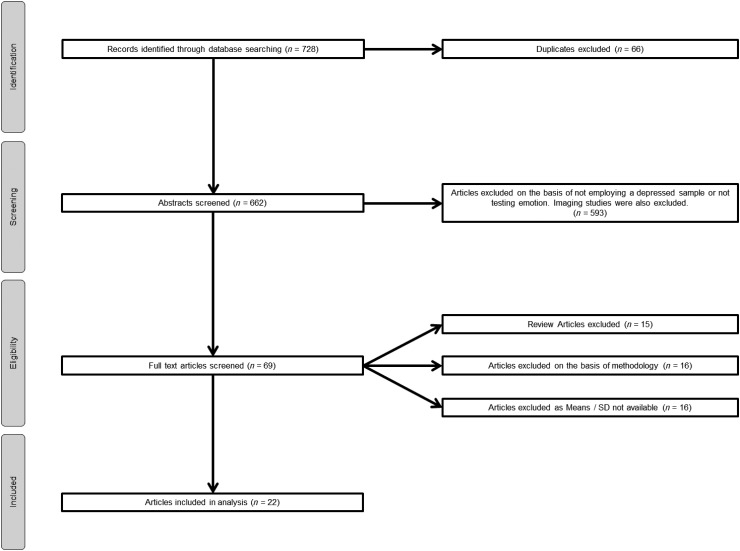
Background.: Many studies have explored associations between depression and facial emotion recognition (ER). However, these studies have used various paradigms and multiple stimulus sets, rendering comparisons difficult. Few studies have attempted to determine the magnitude of any effect and whether studies are properly powered to detect it. We conducted a meta-analysis to synthesize the findings across studies on ER in depressed individuals compared to controls. Method.: Studies of ER that included depressed and control samples and published before June 2013 were identified in PubMed and Web of Science. Studies using schematic faces, neuroimaging studies and drug treatment studies were excluded. Results.: Meta-analysis of k = 22 independent samples indicated impaired recognition of emotion [ k = 22, g = −0.16, 95% confidence interval (CI) −0.25 to −0.07, p < 0.001]. Critically, this was observed for anger, disgust, fear, happiness and surprise ( k 's = 7–22, g 's = −0.42 to −0.17, p 's < 0.08), but not sadness ( k = 21, g = −0.09, 95% CI −0.23 to +0.06, p = 0.23). Study-level characteristics did not appear to be associated with the observed effect. Power analysis indicated that a sample of approximately 615 cases and 615 controls would be required to detect this association with 80% power at an alpha level of 0.05. Conclusions.: These findings suggest that the ER impairment reported in the depression literature exists across all basic emotions except sadness. The effect size, however, is small, and previous studies have been underpowered.
Overview
The claims and statistics of this paper haven’t been checked yet.
Free: it reads the open-access text and checks the first 5 claims that cite a source we can check. Create a free account to check every claim.
Integrity signals
Registry
Cites
Statistics
Figures
Verification
Claims the paper makes
The claims and statistics of this paper haven’t been checked yet.
Free: it reads the open-access text and checks the first 5 claims that cite a source we can check. Create a free account to check every claim.
Claims other papers make about this one
Each is checked against this paper’s own text: does it say what the citing paper says it does?
The cited source says what the claim attributes to it.
In the citing paper
“taken together, results indicate a general deficit in emotion recognition of basic facial emotional expressions in patients with major depression (Dalili et al., 2015).”
From Social functioning in major depressive disorder (2016) · cites this paper as Dalili et al., 2015
Self-check
Percentages, sums and reported differences re-computed from the paper’s own numbers.
The self-check needs the paper’s full text.
Citations
Cites
Statistical Power Analysis for the Behavioral Sciences
Muller, K. (1989) · Technometrics · doi:10.1080/00401706.1989.10488618 · Cited by 99,167
Statistical power analysis for the behavioral sciences
(1990) · Computers, Environment and Urban Systems · doi:10.1016/0198-9715(90)90050-4 · Cited by 65,269
Bias in meta-analysis detected by a simple, graphical test
Egger, M., Smith, G. D., Schneider, M., & Minder, C. (1997) · BMJ · doi:10.1136/bmj.315.7109.629 · Cited by 56,722 · cited 2×
“Small study bias, which may reflect publication bias against null results, was assessed using Egger’s test (Egger et al. 1997).”
Meta-analysis in clinical trials
DerSimonian, R., & Laird, N. (1986) · Controlled Clinical Trials · doi:10.1016/0197-2456(86)90046-2 · Cited by 39,552 · cited 1×
“Data were analysed within a random-effects framework, with g values pooled using DerSimonian & Laird (1986) methods.”
Duval, S., & Tweedie, R. (2000) · Biometrics · doi:10.1111/j.0006-341x.2000.00455.x · Cited by 14,099 · cited 2×
“Adjusting for possible publication bias against null results using Duval and Tweedie ’ s trim and fi ll method (Duval & Tweedie, 2000) indicated a reduced effect-size estimate in the combined analysis ( g = − 0.08, 95% CI − 0.18 to +0.01), and the sadness ( g = +0.04, 95% CI − 0.12 to +0.20) and…”
InfluentialWhy Most Published Research Findings Are False
Ioannidis, J. P. A. (2005) · PLoS Medicine · doi:10.1371/journal.pmed.0020124 · Cited by 10,505
Power failure: why small sample size undermines the reliability of neuroscience
Button, K. S., Ioannidis, J. P. A., Mokrysz, C., Nosek, B. A., Flint, J., Robinson, E. S. J., & Munafò, M. R. (2013) · Nature Reviews Neuroscience · doi:10.1038/nrn3475 · Cited by 7,641 · cited 2×
“…characterized by de fi cits or biases in facial emotion recognition (ER), including schizophrenia (Addington et al. 2006), alcoholism (Philippot et al. 1999), autism (Celani et al. 1999), anxiety (Button et al. 2013 a ), bipolar disorder (Derntl et al. 2009), and depression (Rubinow & Post, 1992).”
Why Most Published Research Findings Are False
Ioannidis, J. P. A. (2005) · CHANCE · doi:10.1080/09332480.2005.10722754 · Cited by 4,702 · cited 1×
“The problems associated with low statistical power have recently been described, and include an increased likelihood that a statistically signi fi cant fi nding re fl ects a false positive (Ioannidis, 2005; Button et al. 2013 b ).”
Publication and related bias in meta-analysis
Sterne, J. A. C., Gavaghan, D., & Egger, M. (2000) · Journal of Clinical Epidemiology · doi:10.1016/s0895-4356(00)00242-0 · Cited by 2,282 · cited 1×
“Given the presence of small study bias, we adjusted using Duval and Tweedie ’ s trim-and-fi ll method (Duval & Tweedie, 2000) in order to account for small-study effects, where smaller studies in a meta-analysis tend to show larger treat-ment effects (Sterne et al. 2000).”
Neural mechanisms of the cognitive model of depression.
Disner, S. G., Beevers, C. G., Haigh, E. A. P., & Beck, A. T. (2011) · Nature Reviews Neuroscience · doi:10.1038/nrn3027 · Cited by 1,718 · cited 1×
“Contemporary theories of depression emphasize the importance of negative biases in ER as an important causal factor in illness etiology (Disner et al. 2011; Roiser et al. 2012).”
Research works printed but not linked: 1
- Wells GA, Shea B, O'Connell D, Peterson J, Welch V, Tugwell P (2000). The Newcastle-Ottawa Scale (NOS) for assessing the quality of nonrandomized studies in meta-analyses. Paper presented at the 3rd Symposium on Systematic Reviews: Beyond the Basics, Oxford.
Cited by
Items 201–300 of 366
Fieldhouse, J. L. P., van Engelen, M. E., Handgraaf, D., de Boer, S. C. M., Hooft, J. J. V. ’., Schouws, S. N. T. M., van Grootheest, D., Kerssens, C. J., Duits, F. H., van Harten, A. C., et al. (2024) · European Journal of Neurology · doi:10.1111/ene.16426 · Cited by 6
“However, prominent social cognitive deficits in bvFTD may resemble socioemotional profiles of PPD as well, such as state-dependent difficulties in emotion recognition in MDD, autism spectrum disorder (ASD), and schizophrenia [6–8].”
BackgroundKim, B., Hur, J., Park, D.-S., Moon, H., & Choi, S. (2022) · Current Psychology · doi:10.1007/s12144-022-03144-5 · Cited by 5
Argento, O., Spanò, B., Serra, L., Incerti, C. C., Bozzali, M., Caltagirone, C., Francia, A., Fratino, M., Nocentini, U., Piacentini, C., et al. (2021) · European Journal of Neurology · doi:10.1111/ene.15155 · Cited by 5
Gene expression associated with human brain activations in facial expression recognition
Wang, Z., Ji, Y., Fu, Y., Liu, F., Du, X., Liu, H., Zhu, W., Xue, K., Qin, W., & Zhang, Q. (2022) · Brain Imaging and Behavior · doi:10.1007/s11682-022-00633-w · Cited by 5
Reis, J. A. S., Rossi, G. N., Osório, F. D. L., Bouso, J. C., Hallak, J. E. C., & SANTOS, R. G. D. (2023) · Neuroscience & Biobehavioral Reviews · doi:10.1016/j.neubiorev.2023.105367 · Cited by 7
Lithium effects on impulsivity and emotional processing
Ramli, F. F., Harmer, C. J., Cowen, P. J., & Godlewska, B. R. (2025) · Scientific Reports · doi:10.1038/s41598-025-29216-7 · Cited by 4
“…evaluating emotional recognition deficits in major depressive disorder reported that the recognition of sad facial expression was preserved in this population, and that the recognition of happy and sad facial expressions was not associated with the medication status (medicated vs. unmedicated) 38 .”
Self-citationSheeber, L., Lougheed, J. P., Hollenstein, T., Leve, C. S., Mudiam, K. R., Diercks, C. M., & Allen, N. B. (2023) · Journal of Psychopathology and Clinical Science · doi:10.1037/abn0000854 · Cited by 5
The effect of emotion recognition and mindfulness on depression symptoms: A case–control study
Aydın, O., Tvrtković, S., Çakıroğlu, E., Ünal‐Aydın, P., & Danacı, A. E. (2023) · Scandinavian Journal of Psychology · doi:10.1111/sjop.12992 · Cited by 6
Peripheral inflammation is associated with impaired sadness recognition in euthymic bipolar patients
Chang, C.-Y., Chang, H. H., Wu, C. Y., Tsai, Y. T., Lu, T., Chang, W. H., Hsu, C., Chen, P. S., & Tseng, H. (2024) · Journal of Psychiatric Research · doi:10.1016/j.jpsychires.2024.03.049 · Cited by 4
Liu, Y., Dong, K., & Sun, L. (2025) · Journal of Affective Disorders · doi:10.1016/j.jad.2025.04.038 · Cited by 5
Sommer, N. R., Carrard, V., Bourquin, C., Berney, A., & Schlegel, K. (2025) · Scientific Reports · doi:10.1038/s41598-025-02025-8 · Cited by 6
“ERA is impaired in a wide range of mental disorders (e.g., major depression 22,23 ) and is discussed to play an important role in their onset and maintenance 24 .”
Baranger, D. A. A., Halchenko, Y. O., Satz, S., Ragozzino, R., Iyengar, S., Swartz, H. A., Phillips, M. L., & Manelis, A. (2021) · Biological Psychiatry · doi:10.1016/j.biopsych.2021.02.907 · Cited by 4
Major Depressive Disorder: A Comparative Study on Social-Emotional Cognition and Executive Functions
Mônego, B. G., Fonseca, R. P., Teixeira, A. L., Barbosa, I. G., de Souza, L. C., & Bandeira, D. R. (2022) · Psicologia Teoria e Pesquisa · doi:10.1590/0102.3772e38217.en · Cited by 6
Guillin, A., Chaby, L., & Vergilino‐Perez, D. (2023) · Cognition & Emotion · doi:10.1080/02699931.2023.2258585 · Cited by 4
“Given that emotional processing may be a ff ected by the presence of signi fi cant mood disorders (Chaby et al., 2015; Dalili et al., 2015), we controlled for the absence of severe depression in our participants using a standard measure (i.e. a score between 0 and 17 on the French Beck Depression…”
MethodSocial comparison affect emotional processing in subthreshold depression: evidence from an ERP study
Du, X., Li, Y., Chen, X., & Jiang, J. (2023) · Current Psychology · doi:10.1007/s12144-023-05529-6 · Cited by 5
Soto, F. A., & Beevers, C. G. (2024) · Biological Psychiatry Cognitive Neuroscience and Neuroimaging · doi:10.1016/j.bpsc.2024.01.011 · Cited by 4
“More speci fi cally, depression is associated with a general impairment in the processing of emotional faces and a tendency to interpret ambiguous faces (e.g., neutral or morphed) as expressing negative emotion (11 – 14).”
BackgroundPsomiades, M., Fonteneau, C., Suaud‐Chagny, M., Haesebaert, F., & Brunelin, J. (2016) · Santé mentale au Québec · doi:10.7202/1036972ar · Cited by 5
“Néanmoins, de nombreuses autres études ont montré des associations entre les déficits des processus émotionnels et la symptomatologie des patients atteints de dépression (Dalili et al., 2015 ; Rottenberg et al., 2002).”
BackgroundKeating, C. T., & Cook, J. L. (2022) · PsyArXiv (OSF Preprints) · doi:10.31234/osf.io/476dk · Cited by 4
Kuruoğlu, R., Suddell, S. F., & Penton‐Voak, I. S. (2025) · Current Psychology · doi:10.1007/s12144-025-08280-2 · Cited by 4
“These training effects generalise to other, untrained faces suggesting that the procedure may modify emotion perception outside of the laboratory task (Dalili et al., 2015 ).”
Self-citationEconomides, A., Laouris, Y., Conson, M., & Esposito, A. A. (2020) · Smart innovation, systems and technologies · doi:10.1007/978-981-15-5093-5_39 · Cited by 4
Training emotion recognition in depression—An experimental study
Preis, M. A., Schlegel, K., Rehbein, S., Lorenz, K., & Brockmeyer, T. (2025) · British Journal of Clinical Psychology · doi:10.1111/bjc.12540 · Cited by 3
“Meta-analyses have shown that MDD is associated with reduced ERA (Dalili et al., 2015; Krause et al., 2021).”
Emotional and interpersonal mechanisms in community SSRI treatment of social anxiety disorder
Rappaport, L. M., Hunter, M. D., Russell, J. J., Pinard, G., Bleau, P., & Moskowitz, D. S. (2021) · Journal of Psychiatry and Neuroscience · doi:10.1503/jpn.190164 · Cited by 3
Alvi, T., Rosenfield, D., Sunahara, C. S., Wallmark, Z., Lee, J., & Tabak, B. A. (2022) · Clinical Psychological Science · doi:10.1177/21677026221104735 · Cited by 4
“…social anxiety, meta-analyses have more consistently found that depression may be associated with impairments in both higher-level empathy (e.g., theory of mind; Berecz et al., 2016; Bora & Berk, 2016; Schreiter et al., 2013) and lower-level empathy (e.g., emotion recognition; Dalili et al., 2015).”
BackgroundJurchiș, R., Costea, A. R., & Opre, A. N. (2023) · Motivation and Emotion · doi:10.1007/s11031-023-10022-5 · Cited by 3
“…they preferentially look at negative facial expressions (Armstrong & Olatunji, 2012; Sanchez et al., 2017) and (b) they exhibit a reduced ability in identifying most facial expressions, except for sadness (Dalili et al., 2015; Krause et al., 2021; Shiroma et al., 2016; Zwick & Wolkenstein, 2017).”
BackgroundPilloni, G., Cho, H., Tian, T. E., Beringer, J., Bikson, M., & Charvet, L. E. (2023) · Neuromodulation Technology at the Neural Interface · doi:10.1016/j.neurom.2023.07.006 · Cited by 3
Mazhar, A., & Bailey, C. S. (2024) · Cognition & Emotion · doi:10.1080/02699931.2024.2408652 · Cited by 3
“Similarly, we expected sad biases to associate with anxious and withdrawn behaviours given that both are common aspects of depression and may have a common underlying mechanism (Dalili et al., 2015; Everaert et al., 2012).”
Convolutional Neural Network Based Expression Classification with Face Alignment
Han, Z., Huang, H., & Wang, J. (2018) · International Conference on Information, Cybernetics, and Computational Social Systems (ICCSS) · doi:10.1109/iccss.2018.8572342 · Cited by 3
“The recognition of expression is thus a promising research topic in computer vision, which can be widely applied in various fields including medicine [1], education [2], marketing [3], security and monitoring [4].”
BackgroundExplicit and Implicit Processing of Facial Expressions in Depression
Velichkovsky, B. B., Sultanova, F. R., & Tatarinov, D. V. (2021) · Experimental Psychology (Russia) · doi:10.17759/exppsy.2021140202 · Cited by 3
Jahanitabesh, A., Alogna, V. K., & Halberstadt, J. B. (2021) · Australian Journal of Psychology · doi:10.1080/00049530.2021.1965860 · Cited by 4
Lim, K., Yang, Z., Rashid, N. A. A., Tan, B., Dauwels, J., & Lee, J. (2021) · Journal of Affective Disorders · doi:10.1016/j.jad.2021.09.023 · Cited by 3
Nam, Y., & Lee, C. (2022) · IEEE Access · doi:10.1109/access.2022.3221453 · Cited by 6
Kumari, A., Shukla, M., & Singh, R. K. (2024) · European Journal of Mental Health · doi:10.5708/ejmh.19.2024.0026 · Cited by 2
Padaigaitė, E., Hammerton, G., Heron, J. E., Eyre, O., Michelini, G., Wilson-Newman, A., Garavini, C., Eley, T. C., Thapar, A., & Riglin, L. (2025) · Journal of the American Academy of Child & Adolescent Psychiatry · doi:10.1016/j.jaac.2025.03.023 · Cited by 3
Depressive symptoms are associated with impaired body affect recognition for neutral expressions
Grzelak, L. N., Glazer, J. E., Klemballa, D. M., Nabb, C. B., Mittal, V. A., Walther, S., Shankman, S. A., & Letkiewicz, A. M. (2025) · Journal of Affective Disorders · doi:10.1016/j.jad.2025.119531 · Cited by 3
Socio-cognitive processes in mild-moderate depression
Raghavendra, P. A., Hegde, S., Philip, M., & Muralidharan, K. (2025) · Frontiers in Psychology · doi:10.3389/fpsyg.2025.1541725 · Cited by 3
Venkateshan, S., & Oinonen, K. A. (2025) · Women s Health · doi:10.1177/17455057251359761 · Cited by 3
“55,59 Women with PCOS face higher risks for these and other mental health disorders.”
The Role of Alexithymia in Social Learning and Feedback-Driven Social Inferences
Hosseinnezhad, M., Golbabaei, S., Bigham, M., & Borhani, K. (2026) · Computational Psychiatry · doi:10.5334/cpsy.153 · Cited by 2
“…et al., 2018; Van Der Velde et al., 2015), alongside the co-occurrence of this condition in many psychiatric disorders that have been linked to impairment in social interactions (Akinci et al., 2022; Dalili et al., 2015), it is critical to investigate whether this condition impairs social learning.”
Judgmental perception of co-speech gestures in MDD
den Bossche, C. V., Wolf, D., Rekittke, L.-M., Mittelberg, I., & Mathiak, K. (2021) · Journal of Affective Disorders · doi:10.1016/j.jad.2021.04.085 · Cited by 3
Weiss, E. M., Deisenhammer, E., Fink, A., Marksteiner, J., Canazei, M., & Papousek, I. (2022) · Brain Sciences · doi:10.3390/brainsci12030356 · Cited by 2
“Meta-analyses suggested that there is a significant theory of mind (ToM) deficit with medium effect size in major depressive disorder [46], but there only exists a small impact of depression on facial emotion recognition capacity [47].”
BackgroundAttachment Styles and Theory of Mind Functions in Patients with Fibromyalgia Syndrome
Ege, F., & Ege, F. Ç. (2022) · Advances in Cognitive Psychology · doi:10.5709/acp-0358-9 · Cited by 2
The role of emotional factors in face processing abilities in autism spectrum conditions
Baxter, N., & Hobson, H. (2024) · Research in Autism · doi:10.1016/j.rasd.2024.102400 · Cited by 2
Bérubé, A., Pétrin, R., & Blais, C. (2024) · Frontiers in Psychiatry · doi:10.3389/fpsyt.2024.1374872 · Cited by 3
Boboc, B., & Oinonen, K. A. (2024) · Women s Health · doi:10.1177/17455057241259176 · Cited by 2
Fabrício, D. D. M., Maximiano‐Barreto, M. A., Luchesi, B. M., Muniz, M., & Chagas, M. H. N. (2024) · Psicologia Reflexão e Crítica · doi:10.1186/s41155-024-00325-y · Cited by 2
“We also used the Patient Health Questionnaire-2 (PHQ-2) to screen for symptoms of depression, which could affect the recognition of emotions (Bourke et al., 2010; Dalili et al., 2015).”
Emotional Detection of Patients Major Depressive Disorder in Medical Diagnosis
Ketcham, M., Piyaneeranart, M., & Ganokratanaa, T. (2018) · International Conference on Signal-Image Technology & Internet-Based Systems (SITIS) · doi:10.1109/sitis.2018.00058 · Cited by 2
Community Participation and Risk for Depressive Symptoms in Rural Areas
Jungbauer, D., Glasser, M. L., & Veerle, G. (2020) · Journal of Depression and Anxiety Disorders · doi:10.36959/362/473 · Cited by 2
Kemala, C. N., Jongsma, M. L. A., Hendrawan, D., & Becker, E. S. (2023) · Psychological Research on Urban Society · doi:10.7454/proust.v6i1.1105 · Cited by 4
Desarrollo de un instrumento para evaluar la empatía emocional en escolares mexicanos
Barrera-Valdivia, P., Méndez, R. V., Czyewska, M., Mendoza-Meraz, G., & Hidalgo, A. C. (2020) · TECNOCIENCIA CHIHUAHUA · doi:10.54167/tecnociencia.v13i3.473 · Cited by 2
“Por ejemplo, se ha encontrado una menor precisión en el reconocimiento de emociones en grupos deprimidos en comparación con grupos no deprimidos (Lee et al., 2005; Dalili et al., 2014).”
BackgroundKoelkebeck, K., Bauer, J., Suslow, T., & Ohrmann, P. (2021) · Frontiers in Psychology · doi:10.3389/fpsyg.2021.677549 · Cited by 2
“In a neuroimaging study that assessed neural activation patterns to varying degrees of emotional valence, Deeley et al. (2007) showed that patients with highfunctioning ASD generally activated face perception areas less than neurotypical controls on all basic emotions (including fear).”
BackgroundDevelopment of a theoretically and empirically grounded emotion knowledge training for the young
Hovasapian, A., Huyghe, V. E. I., Schlegel, K., & Fontaine, J. R. J. (2022) · Open Research Europe · doi:10.12688/openreseurope.14391.1 · Cited by 1
“, the excessive use of rumination or suppression) as well as deficits in the ability to accurately recognize other people’s emotions to be related to mental health disorders such as bipolar disorder (Glenn & Klonsky, 2009), anxiety, depression, aggression, and eating pathology (Brockmeyer et al., 2016; Dalili et al.,…”
BackgroundDetection of Depression and Anxiety through Speech, Voice, and Sentiment Analysis
S. M. M. Naidu, Y. A. C. (2023) · Proceeding International Conference on Science and Engineering · doi:10.52783/cienceng.v11i1.177 · Cited by 1
Impaired Emotional Processing in Major Depressive Disorder. Accuracy versus Processing Speed
Nemeş, B., Coman, H. G., Herta, D. C., TRIFU, R. N., & Cozman, D. (2024) · Journal of Evidence-Based Psychotherapies · doi:10.24193/jebp.2024.2.13 · Cited by 1
Psychopathy Unmasked: The Rise and Fall of a Dangerous Diagnosis
Larsen, R. R. (2025) · The MIT Press eBooks · doi:10.7551/mitpress/15188.001.0001 · Cited by 5
Autosuggestion and mental imagery bias the perception of social emotions
Myga, K. A., Longo, M. R., Kuehn, E., & Azañón, E. (2025) · Cognition · doi:10.1016/j.cognition.2025.106235 · Cited by 1
Kumpasoğlu, G. B., Campbell, C., Saunders, R., Nolte, T., Montague, P. R., Pilling, S., Leibowitz, J., & Fonagy, P. (2025) · Journal of Personality Assessment · doi:10.1080/00223891.2025.2571173 · Cited by 2
“…between groups, potentially due to the inclusion of individuals with common mental health issues known for impairing social functionality, such as social anhedonia and impaired emotional recognition, thereby complicating their ability to comprehend and interact with others (Dalili et al., 2015).”
Influence of premenstrual syndrome on attentional capture by expressions in the luteal phase
Álvarez, F., Veiga-Zarza, E., Fernández‐Folgueiras, U., Pita, M., Kessel, D., & Carretié, L. (2025) · Hormones and Behavior · doi:10.1016/j.yhbeh.2025.105846 · Cited by 1
BN-BrainTF: Brain Network Community-Aware Global–Local Transformer for EEG-Based Emotion Recognition
Kim, T., Wang, G., & Lee, W. H. (2025) · IEEE Access · doi:10.1109/access.2025.3634141 · Cited by 3
“Emotion recognition has become a rapidly growing field due to its potential applications in various areas, including mental health diagnosis [6], [7], [8], user experience evaluation [9], [10], brain-computer interfaces [11], and human-computer interaction [12], [13].”
Robust associations of emotional intelligence with human flourishing: A second-order meta-analysis
Robinson, T. J., & Zell, E. (2026) · Proceedings of the National Academy of Sciences · doi:10.1073/pnas.2532963123 · Cited by 1
Chou, I. W. Y., Manelis, A., Swartz, H. A., Leung, O., Phillips, M. L., So, S. F., Chu, C. W., Lu, H., Lam, L. C. W., & Mak, A. D. P. (2026) · Journal of Affective Disorders · doi:10.1016/j.jad.2026.121957 · Cited by 1
Padaigaitė, E., Hammerton, G., Heron, J. E., Eyre, O., Michelini, G., Wilson-Newman, A., Garavini, C., Eley, T. C., Thapar, A., & Riglin, L. (2026) · Journal of the American Academy of Child & Adolescent Psychiatry · doi:10.1016/j.jaac.2026.06.001 · Cited by 1
Bourne, V. J., & Vladeanu, M. (2015) · Cognition & Emotion · doi:10.1080/02699931.2015.1089841 · Cited by 2
Bat‐Pitault, F., Fonséca, D. D., Flori, S., Porcher-Guinet, V., Stagnara, C., Patural, H., Franco, P., & Deruelle, C. (2016) · L Encéphale · doi:10.1016/j.encep.2016.03.017 · Cited by 1
Dietrichkeit, M., Moritz, S., & Jelinek, L. (2020) · Zeitschrift für Psychiatrie Psychologie und Psychotherapie · doi:10.1024/1661-4747/a000415 · Cited by 1
Social Inferences as Mediators of Wellbeing in Depression
Giurgi-Oncu, C., Bredicean, C. A., Frandeș, M., ENĂTESCU, V. R., Papavă, I., Rivis, I. A., & Ursoniu, S. (2021) · Neuropsychiatric Disease and Treatment · doi:10.2147/ndt.s309009 · Cited by 1
“Although “Fear” is a negative emotion that can be regarded as a motivational force, with an important role in interpersonal relationships and when deciding on how to act in a certain situation, current literature on this topic harmonizes with our findings, namely, that this emotion is poorly recognized in major depres…”
ResultMultimodal Semi-supervised Bipolar Disorder Classification
AbaeiKoupaei, N., & Osman, H. A. (2021) · Lecture notes in computer science · doi:10.1007/978-3-030-91608-4_56 · Cited by 3
Consequences: Social Development
Miller, S. A. (2022) · Oxford University Press eBooks · doi:10.1093/oso/9780197573174.003.0007 · Cited by 1
Hobbs, C., Beck, M., Denham, F., Pettitt, L., Faraway, J. J., Munafo, M. R., Sui, J., Kessler, D. S., & Button, K. S. (2022) · Journal of Psychopharmacology · doi:10.1177/02698811221116928 · Cited by 1
“Depression is associated with increased sensitivity to negative relative to positive information across cognitive domains (Dalgleish and Watts, 1990; Dalili et al., 2015; Roiser and Sahakian, 2013).”
BackgroundSijtsma, M., Marjoram, D. K. S., Gallagher, H. L., Grealy, M., Brennan, D., Mathias, C., Cavanagh, J., & Pollick, F. E. (2023) · Psychiatry Research Neuroimaging · doi:10.1016/j.pscychresns.2023.111728 · Cited by 2
“Their findings commonly indicate impairments in emotion recognition and mood-congruent biases, meaning that perception is influenced by one ’ s emotional state (Dalili et al., 2015; Joormann and Gotlib, 2006; Pen-ton-Voak et al., 2017).”
Wu, X., Yang, Q., Xie, Y., Xia, L., Li, J., An, W., & Lu, X. (2025) · Journal of Alzheimer s Disease · doi:10.1177/13872877251335891 · Cited by 1
“Its deterioration not only precipitates neurodegenerative disorders (e.g., AD) 53 but also exacerbates psychiatric comorbidities (depression, 54 schizophrenia 55 ) and somatic conditions (long COVID, 56 malignancies), collectively increasing all-cause mortality.”
Emotion recognition, symptoms of depression, and fluid intelligence after frontal lobe lesions
Murphy, F. C., Dermody, N., Watson, P., Scott, S. K., Calder, A. J., Peers, P. V., & Manly, T. (2025) · Neuropsychologia · doi:10.1016/j.neuropsychologia.2025.109170 · Cited by 1
“According to one meta-analysis of 22 studies of face emotion recognition in depressed non-brain-injured people, depression was significantly associated with impaired recognition of anger, disgust, fear, happiness and surprise, but not sadness (Dalili et al., 2015).”
InfluentialAssessing the effectiveness of multi-session online emotion recognition training in autistic adults
Reed, Z. E., Bastiani, O., Eastwood, A., Penton‐Voak, I. S., Jarrold, C., Munafo, M. R., & Attwood, A. S. (2025) · PLoS ONE · doi:10.1371/journal.pone.0327424 · Cited by 1
“…impacted total hits, given that previous studies have demonstrated emotion recognition difficulties and biases for some mental health conditions [30,31], 2) excluding participants who had encountered technical issues during the study (e.g., completing a session over multiple days or 2 on the same…”
Self-citationSocial noise interferes with learning in a volatile environment
Shin, D. W., Kim, J., Jeong, B., Kim, K. W., Shim, G., & Yoon, T. (2019) · Scientific Reports · doi:10.1038/s41598-019-44101-w · Cited by 2
Craighead, W. E., Klein, D. N., Gillespie, C. F., Ritschel, L. A., & Phillips, K. E. (2017) · Wiley eBooks · doi:10.1002/9781394258949.ch7 · Cited by 1
Shimpi, S., Thombre, S., Reddy, S. A., Sharma, R., & Singh, S. (2020) · arXiv (Cornell University) · doi:10.48550/arxiv.2009.05651 · Cited by 1
Zhu, S., Zhao, Y., Lu, H., Guo, F., Lin, C., Qiu, H., & Jiang, K. (2024) · Research Square · doi:10.21203/rs.3.rs-3865806/v1 · Cited by 1
Accuracy in perceiving facial expressions of emotion in psychopathology
Griffiths, P., & Ashwin, C. (2016) · Cambridge University Press eBooks · doi:10.1017/cbo9781316181959.009 · Cited by 2
Fonteneau, C. (2018) · theses.fr (ABES) · doi:10.70675/b06abc42zba9az4c0bz8cbfzef0dd775e14e · Cited by 1
Face processing impairments in schizophrenia and other psychiatric disorders
Darke, H. (2018) · Minerva Access (University of Melbourne)
Borges, V. F. (2018) · Digital Library of Theses and Dissertations (Universidade de São Paulo) · doi:10.11606/t.17.2019.tde-08042019-170231
Cognitive Processes to Understand Alcohol Use Disorder
Máttyássy, A. (2019) · SZTE Repository of Dissertations (University of Szeged) · doi:10.14232/phd.10244
Measuring Affective Processes In Traumatic Brain Injury
Keatley, E. S. (2019) · Scholarship at UWindsor (University of Windsor)
The Effects of Mindful Self-Focused Attention on Emotional Clarity in Depressed individuals
Lee, J. Y., & Kim, C.-D. (2019) · Korea Journal of Counseling · doi:10.15703/kjc.20.6.201912.159
Hudson, A. R., Orlemann, C., Tricht, T. V., Braß, M., & Mueller, S. C. (2020) · International Journal of Social Psychiatry · doi:10.1177/0020764020914918
Effects of Trauma on Comorbidity and Emotion Recognition in Antisocial Adolescents
Weijman, E. L. (2018)
Remmers, C. (2020) · Psychotherapie: Praxis · doi:10.1007/978-3-662-60318-5_13
Functional and Structural Neuroplasticity in Depression
Alders, G. L. (2019) · MacSphere (McMaster University) · doi:10.71548/18202
An Integrative Review of Facial Emotion Information Processing in Depression
Jo, E., & Kim, J. (2020) · Korean Journal of Stress Research · doi:10.17547/kjsr.2020.28.2.41
Social enviroments and mental health: Exploring new worlds with virtual reality
Geraets, C. N. W. (2020) · University of Groningen research database (University of Groningen / Centre for Information Technology) · doi:10.33612/diss.135815994
الغضب والتعبیر عن الذات کمنبئین بالأفکار الآلیة المرتبطة بالاکتئاب لدى عینة من طلاب الجامعة
البهنساوی, أ. (2020) · مجلة البحث العلمي في الآداب · doi:10.21608/jssa.2020.116740
Zamarrenho, L. G. (2020) · Digital Library of Theses and Dissertations (Universidade de São Paulo) · doi:10.11606/t.17.2020.tde-23082020-104553
Igrutinović, N., Batinić, B., & Mihajlović, G. (2021) · EABR. Experimental and Applied Biomedical Research · doi:10.2478/sjecr-2020-0048
The neural architecture of emotional intelligence.
Stoica, T. (2021) · ThinkIR: The University of Louisville's Institutional Repository (University of Louisville) · doi:10.18297/etd/3623 · Cited by 1
Franzen, M. (2022) · University of Groningen research database (University of Groningen / Centre for Information Technology) · doi:10.33612/diss.198284603 · Cited by 1
THE RELATIONSHIP BETWEEN DEPRESSION AND PERSONALITY
Kudaibergenova, S. K., sandugash.kudaibergenova@kaznu.kz, Kamzanova, A. T., Zholdassova, M., Madalieva, Z. B., Nessipbayev, S., & Kustubayeva, A. (2020) · BULLETIN OF THE NATIONAL ACADEMY OF SCIENCES OF THE REPUBLIC OF KAZAKHSTAN ( THE BULLETIN) · doi:10.32014/2020.2518-1467.167
Miller, S. A. (2022) · Oxford University Press eBooks · doi:10.1093/oso/9780197573174.003.0009
Miller, S. A. (2022) · Oxford University Press eBooks · doi:10.1093/oso/9780197573174.003.0004
Miller, S. A. (2022) · Oxford University Press eBooks · doi:10.1093/oso/9780197573174.003.0001
Understanding of Cognitive States
Miller, S. A. (2022) · Oxford University Press eBooks · doi:10.1093/oso/9780197573174.003.0002
Consequences: Cognitive Development
Miller, S. A. (2022) · Oxford University Press eBooks · doi:10.1093/oso/9780197573174.003.0006
Metadata
- Authors
- Dalili, M. N., Penton-Voak, I. S., Harmer, C. J., & Munafò, M. R.
- Affiliations
- University of Bristol (GB)
- University of Oxford (GB)
- Corresponding author
- Dalili, M. N.
- Venue
- Psychological Medicine
- Publisher
- Cambridge University Press (CUP)
- Published
- 2014-11-14
- Volume
- 45
- Issue
- 6
- Pages
- 1135-1144
- ISSN
- 0033-2917 (ISSN-L)
- 1469-8978
- PMC
- PMC4712476
- OpenAlex
- W2126009018
- Cited by
- 349
- References
- 55
- Citations by year
- 2026: 23 · 2025: 34 · 2024: 28 · 2023: 46 · 2022: 56 · 2021: 52 · 2020: 28 · 2019: 24 · 2018: 19 · 2017: 15 · 2016: 13 · 2015: 10
- FWCI
- 1.22
- Type
- journal article
- Language
- en
- Open access
- hybrid
- doi.org
- Locations
- Psychological Medicine (publishedVersion, cc-by)
- PubMed Central (publishedVersion, cc-by)
- PubMed (publishedVersion)
- Explore Bristol Research (acceptedVersion, other-oa)
- Bristol Research (University of Bristol) (submittedVersion, other-oa)
- Funders
- United Kingdom Clinical Research Collaboration
- Cancer Research UK
- National Institute for Health and Care Research
- British Heart Foundation
- Medical Research Council (MR/J011819/1)
- Economic and Social Research Council
- Topics
- Life Sciences › Neuroscience › Cognitive Neuroscience › Face Recognition and Perception
- Social Sciences › Psychology › Experimental and Cognitive Psychology › Anxiety, Depression, Psychometrics, Treatment, Cognitive Processes
- Life Sciences › Neuroscience › Cognitive Neuroscience › Neural and Behavioral Psychology Studies
- Keywords
- major depressive disorder, facial emotion recognition, emotion recognition deficits, basic emotions, sadness, anger, disgust, fear, happiness, surprise, study power, effect size
- MeSH terms
- Depressive Disorder, Major, Major Depressive Disorder, Emotions, Humans, Recognition, Psychology
About these checks
Registry, retraction, Cites and statistics results are computed, not judged, with one exception: a printed reference that no index lists is read once by a model before it counts as a citation error. Claims are extracted by a model and kept only when their quote appears verbatim in the text; each cited source is then checked, with a model’s help, for whether it says what the claim relies on. Those verdicts can be wrong — read the claim’s quote and the cited source before relying on one.
Statistics and arithmetic are recomputed, not judged.
Confidence bands are shown only for fields calibrated on our annotated test set. None is calibrated yet, so no band is shown.
What counts as a claim ›How we measure confidence ›How we check this ›
Are you an author, or do you see a problem with this page? Request a review
Data sources
Bibliographic data: Semantic Scholar, OpenAlex, Crossref.
Contains information from the Semantic Scholar Academic Graph Datasets, made available under the ODC Attribution License (ODC-BY 1.0).
Semantic Scholar’s data is described in: Kinney, R., et al. (2023). The Semantic Scholar Open Data Platform. arXiv:2301.10140.
