

Meta-analysis of emotion recognition deficits in major depressive disorder
Open accessThe DOI matches its Crossref record; 55 of the 55 references it cites were found in a registry or an index.
Abstract
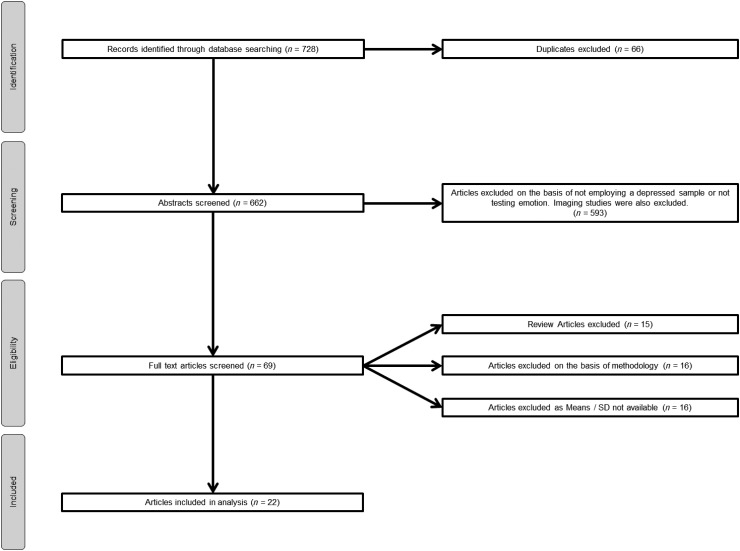
Background.: Many studies have explored associations between depression and facial emotion recognition (ER). However, these studies have used various paradigms and multiple stimulus sets, rendering comparisons difficult. Few studies have attempted to determine the magnitude of any effect and whether studies are properly powered to detect it. We conducted a meta-analysis to synthesize the findings across studies on ER in depressed individuals compared to controls. Method.: Studies of ER that included depressed and control samples and published before June 2013 were identified in PubMed and Web of Science. Studies using schematic faces, neuroimaging studies and drug treatment studies were excluded. Results.: Meta-analysis of k = 22 independent samples indicated impaired recognition of emotion [ k = 22, g = −0.16, 95% confidence interval (CI) −0.25 to −0.07, p < 0.001]. Critically, this was observed for anger, disgust, fear, happiness and surprise ( k 's = 7–22, g 's = −0.42 to −0.17, p 's < 0.08), but not sadness ( k = 21, g = −0.09, 95% CI −0.23 to +0.06, p = 0.23). Study-level characteristics did not appear to be associated with the observed effect. Power analysis indicated that a sample of approximately 615 cases and 615 controls would be required to detect this association with 80% power at an alpha level of 0.05. Conclusions.: These findings suggest that the ER impairment reported in the depression literature exists across all basic emotions except sadness. The effect size, however, is small, and previous studies have been underpowered.
Overview
The claims and statistics of this paper haven’t been checked yet.
Free: it reads the open-access text and checks the first 5 claims that cite a source we can check. Create a free account to check every claim.
Integrity signals
Registry
Cites
Statistics
Figures
Verification
Claims the paper makes
The claims and statistics of this paper haven’t been checked yet.
Free: it reads the open-access text and checks the first 5 claims that cite a source we can check. Create a free account to check every claim.
Claims other papers make about this one
Each is checked against this paper’s own text: does it say what the citing paper says it does?
The cited source says what the claim attributes to it.
In the citing paper
“taken together, results indicate a general deficit in emotion recognition of basic facial emotional expressions in patients with major depression (Dalili et al., 2015).”
From Social functioning in major depressive disorder (2016) · cites this paper as Dalili et al., 2015
Self-check
Percentages, sums and reported differences re-computed from the paper’s own numbers.
The self-check needs the paper’s full text.
Citations
Cites
Statistical Power Analysis for the Behavioral Sciences
Muller, K. (1989) · Technometrics · doi:10.1080/00401706.1989.10488618 · Cited by 99,167
Statistical power analysis for the behavioral sciences
(1990) · Computers, Environment and Urban Systems · doi:10.1016/0198-9715(90)90050-4 · Cited by 65,269
Bias in meta-analysis detected by a simple, graphical test
Egger, M., Smith, G. D., Schneider, M., & Minder, C. (1997) · BMJ · doi:10.1136/bmj.315.7109.629 · Cited by 56,722 · cited 2×
“Small study bias, which may reflect publication bias against null results, was assessed using Egger’s test (Egger et al. 1997).”
Meta-analysis in clinical trials
DerSimonian, R., & Laird, N. (1986) · Controlled Clinical Trials · doi:10.1016/0197-2456(86)90046-2 · Cited by 39,552 · cited 1×
“Data were analysed within a random-effects framework, with g values pooled using DerSimonian & Laird (1986) methods.”
Duval, S., & Tweedie, R. (2000) · Biometrics · doi:10.1111/j.0006-341x.2000.00455.x · Cited by 14,099 · cited 2×
“Adjusting for possible publication bias against null results using Duval and Tweedie ’ s trim and fi ll method (Duval & Tweedie, 2000) indicated a reduced effect-size estimate in the combined analysis ( g = − 0.08, 95% CI − 0.18 to +0.01), and the sadness ( g = +0.04, 95% CI − 0.12 to +0.20) and…”
InfluentialWhy Most Published Research Findings Are False
Ioannidis, J. P. A. (2005) · PLoS Medicine · doi:10.1371/journal.pmed.0020124 · Cited by 10,505
Power failure: why small sample size undermines the reliability of neuroscience
Button, K. S., Ioannidis, J. P. A., Mokrysz, C., Nosek, B. A., Flint, J., Robinson, E. S. J., & Munafò, M. R. (2013) · Nature Reviews Neuroscience · doi:10.1038/nrn3475 · Cited by 7,641 · cited 2×
“…characterized by de fi cits or biases in facial emotion recognition (ER), including schizophrenia (Addington et al. 2006), alcoholism (Philippot et al. 1999), autism (Celani et al. 1999), anxiety (Button et al. 2013 a ), bipolar disorder (Derntl et al. 2009), and depression (Rubinow & Post, 1992).”
Why Most Published Research Findings Are False
Ioannidis, J. P. A. (2005) · CHANCE · doi:10.1080/09332480.2005.10722754 · Cited by 4,702 · cited 1×
“The problems associated with low statistical power have recently been described, and include an increased likelihood that a statistically signi fi cant fi nding re fl ects a false positive (Ioannidis, 2005; Button et al. 2013 b ).”
Publication and related bias in meta-analysis
Sterne, J. A. C., Gavaghan, D., & Egger, M. (2000) · Journal of Clinical Epidemiology · doi:10.1016/s0895-4356(00)00242-0 · Cited by 2,282 · cited 1×
“Given the presence of small study bias, we adjusted using Duval and Tweedie ’ s trim-and-fi ll method (Duval & Tweedie, 2000) in order to account for small-study effects, where smaller studies in a meta-analysis tend to show larger treat-ment effects (Sterne et al. 2000).”
Neural mechanisms of the cognitive model of depression.
Disner, S. G., Beevers, C. G., Haigh, E. A. P., & Beck, A. T. (2011) · Nature Reviews Neuroscience · doi:10.1038/nrn3027 · Cited by 1,718 · cited 1×
“Contemporary theories of depression emphasize the importance of negative biases in ER as an important causal factor in illness etiology (Disner et al. 2011; Roiser et al. 2012).”
Research works printed but not linked: 1
- Wells GA, Shea B, O'Connell D, Peterson J, Welch V, Tugwell P (2000). The Newcastle-Ottawa Scale (NOS) for assessing the quality of nonrandomized studies in meta-analyses. Paper presented at the 3rd Symposium on Systematic Reviews: Beyond the Basics, Oxford.
Cited by
Items 301–366 of 366
Miller, S. A. (2022) · Oxford University Press eBooks · doi:10.1093/oso/9780197573174.003.0010
Variations of First-Order Paradigms
Miller, S. A. (2022) · Oxford University Press eBooks · doi:10.1093/oso/9780197573174.003.0005
Understanding of Affective States
Miller, S. A. (2022) · Oxford University Press eBooks · doi:10.1093/oso/9780197573174.003.0003
Miller, S. A. (2022) · Oxford University Press eBooks · doi:10.1093/oso/9780197573174.003.0008
Mazzaferro, M. M. (2022) · Graduate Student Journal of Psychology · doi:10.52214/gsjp.v19i.10023
Mônego, B. G., Fonseca, R. P., Teixeira, A. L., Barbosa, I. G., de Souza, L. C., & Bandeira, D. R. (2022) · Psicologia Teoria e Pesquisa · doi:10.1590/0102.3772e38217.pt · Cited by 1
Neurobiologia del cervello sociale nei disturbi d'ansia e dell'umore - Mini-review
Porcelli, S. (2023) · QUADERNI DI PSICOTERAPIA COGNITIVA · doi:10.3280/qpc51-2022oa15181
Trait absorption predicts enhanced face emotion intensity discrimination among military recruits
Marquardt, C. A., Hitz, A. C., Hill, J., Erbes, C. R., & Polusny, M. A. (2023) · Motivation and Emotion · doi:10.1007/s11031-023-10014-5 · Cited by 1
“Many forms of psychopathology have been associated with impaired face emotion perception including depression (Dalili et al., 2015; Krause et al., 2021), anxiety (Demenescu et al., 2010), posttraumatic stress disorder (PTSD; Plana et al., 2014), psychosis-proneness (Germine & Hooker, 2011), and…”
Rafiee, Y. (2023) · eDiss (Georg-August-Universität Göttingen) · doi:10.53846/goediss-10083
Understanding the Components of Theory of Mind in Depression: An Exploratory Study
Ghosh, D., & Halder, S. (2023) · Indian Journal of Social Psychiatry · doi:10.4103/ijsp.ijsp_112_23
THEORETICAL APPROACHES TO THE PSYCHOLOGY OF CYBERTERRORISM
Havle, N., & Aksoy, S. (2024) · DergiPark
Kriminal Görüşmelerde Sözsüz Davranış Analizi
Metin, A. (2023) · DergiPark (Istanbul University)
Miller, S. A. (2022) · Oxford University Press eBooks · doi:10.1093/oso/9780197573174.002.0006
Miller, S. A. (2022) · Oxford University Press eBooks · doi:10.1093/oso/9780197573174.002.0003
Miller, S. A. (2022) · Oxford University Press eBooks · doi:10.1093/oso/9780197573174.002.0004
Combined Antidepressant Effect of Acetyl-L-Carnitine and Bupropion against Experimental Animal Model
Padhy, J., Samal, P. K., Choudhary, R., Shree, J., & Vaishnaw, B. (2024) · International Journal of Pharmaceutical Sciences and Drug Research · doi:10.25004/ijpsdr.2024.160103
The impact of face masks on autistic and non-autistic adults’ face processing abilities
Baxter, N., Harlow, L., Harrison, E., Smith, C. A., & Hobson, H. (2024) · Research in Autism · doi:10.1016/j.rasd.2024.102485
Pu, M., Yao, Y.-W., Li, X., & Han, C. (2025) · Frontiers research topics · doi:10.3389/978-2-8325-5916-1
Déficits du traitement émotionnel dans l’épisode dépressif caractérisé
Imbert, L. (2024) · theses.fr (ABES) · doi:10.70675/6081cad6zd768z4dc5z97cez522e35a98bbb
Keating, C. T., & Cook, J. L. (2025) · The Cognitive Psychology Bulletin · doi:10.53841/bpscog.2025.1.10.6
ASPECTOS NEUROPSICOLÓGICOS DE ADULTOS MENONITAS COM DEPRESSÃO
Mallmann, M. B., Leal, A. C., & Barbosa, E. G. (2025) · doi:10.29327/5552288.2024-2
The Effect of Acylcarnitines on Cognitive Function: A Two‐Sample Mendelian Randomization Study
Luan, S., Zhang, J., Wang, C., Wang, Z., & Zhou, J. (2025) · Brain and Behavior · doi:10.1002/brb3.70646
Modelling learning trajectories of facial emotion recognition training in autistic childrenPreprint
Mahmoud, O., Hoxha, D., Penton‐Voak, I. S., Jarrold, C., Munafo, M. R., Attwood, A. S., & Reed, Z. E. (2025) · medRxiv · doi:10.1101/2025.09.29.25336883
Self-citationSynthetic Facial Emotional Expression Recognition in People with Depressive Symptoms
Milo, R., Cuciniello, M., Amorese, T., Esposito, A. A., & Cordasco, G. (2025) · IEEE International Conference on Cognitive Infocommunications · doi:10.1109/coginfocom66819.2025.11200697
“Additionally, the expected negative response bias towards”
Facial emotion recognition based on ResNet18 with multi-dimensional attention mechanisms
Yang, X., Wu, C., Meng, T., & Li, C. (2025) · Memetic Computing · doi:10.1007/s12293-025-00476-0
“To validate the impact of sequential integration of channel (C), spatial (S), and multi-scale (M) attention mechanisms with residual architecture on emotion recognition efficacy, we conducted ablation experiments testing six permutation sequences on the DEAP dataset (Table 5).”
InfluentialKuruoğlu, R., Wootton, R. E., Madley‐Dowd, P., & Penton‐Voak, I. S. (2025) · medRxiv · doi:10.1101/2025.10.28.25338883
Self-citationAltered acetylcholine modulations and corticoaccumbal pathway in P11-linked social dysfunction
Dautan, D., Camargo, A., Branzell, N., Brioschi, V. I., Doyon, D., Covatta, E., Marongiu, R., Kaplitt, M. G., Chergui, K., Zhang, X., et al. (2025) · Molecular Psychiatry · doi:10.1038/s41380-025-03324-2 · Cited by 1
Emotion regulation dynamics in empathy in young children
Israeli‐Ran, L., Laor, T. K., & Uzefovsky, F. (2025) · Scientific Reports · doi:10.1038/s41598-025-26201-y · Cited by 1
“This finding is in line with other research showing similar difficulty in processing positive stimuli in adults showing higher depression symptoms 92 and children with internalizing 93 and externalizing behavior problems 94 .”
Behavioral Addictions and Stress Reactivity as Predictors of Social Cognition in University Students
Zerhouni, O., & Romo, L. (2025) · Social Cognition · doi:10.1521/soco.2025.43.6.603
Colbourne, L. (2024) · Oxford University Research Archive (ORA) (University of Oxford) · doi:10.5287/ora-zgob1aq1q
van Engelen, M.-P. E., Verfaillie, S. C. J., Dols, A., Oudega, M. L., Boellaard, R., Golla, S. S. V., den Hollander, M., Ossenkoppele, R., Scheltens, P., van Berckel, B. N. M., et al. (2023) · Figshare · doi:10.6084/m9.figshare.23788259
Müller, J., Herpertz, J., Taylor, J., Suslow, T., Lane, R. D., & Donges, U.-S. (2024) · Figshare · doi:10.6084/m9.figshare.26182188
Efeito do consumo de benzodiazepinas e de antidepressivos na capacidade de tomada de perspetiva
Soares, M. R. L. (2022) · Portuguese National Funding Agency for Science, Research and Technology (RCAAP Project by FCT) · doi:10.34626/vhrr-1r07
Cheng, P. (2023) · eScholarship@McGill (McGill) · doi:10.82308/27460
Rojek-Sito, K., & Rojek-Sito, K. (2023) · RCIN (Digital Repository of the Scientifics Institutes) (Institute of Archaeology and Ethnology of the Polish Academy of Sciences)
Towards personalized medicine in psychosis: the roles of social cognition and metacognition
Ferrer-Quintero, M. (2022) · Tesis Doctorals en Xarxa (Consorci de Serveis Universitaris de Catalunya)
Ozkaya, S. (2025) · Queen Mary Research Online (Queen Mary University of London)
Ergenlerde sosyal biliş ve arkadaş ilişkileri arasındaki ilişkide mantikdııi inançlarin aracı rolü
Batık Yılmaz, A. (2021) · Pamukkale University Open Access Archive (Pamukkale University) · Cited by 1
García‐Pérez, Á. (2025) · Repositorio de Patentes de la Universidad de Almería (Universidad de Almería)
Jónsdóttir, J. K., & Sigurðardóttir, S. T. (2023) · Skemman
The Mind’s Eye: How Emotional Stimuli Shape Working Memory and Face Recognition in Depression
Tzai, E., Trikaki, E., Afendouli, P., Louka, P., & Pilafas, G. (2025) · Dialogues in Clinical Neuroscience & Mental Health · doi:10.26386/obrela.v8i4.316
Chen, R., Dong, Z., Geng, R., Li, H., Wang, Y., Li, Y., Ding, Q., Zhang, Y., Ding, X., Huang, J., et al. (2026) · Behavioral Sciences · doi:10.3390/bs16020178
“Evidence has revealed that MDD patients commonly exhibit impaired emotion recognition, indicated by reduced accuracy in the identification of happy facial expressions in severe individuals (Dalili et al., 2014; Krause et al., 2021).”
Crisp, C., Fallon, S. J., Burns, A., Kuruoğlu, R., Ferrar, J., Wiles, N., Kessler, D. S., Munafo, M. R., & Penton-Voak, I. M. (2026) · medRxiv · doi:10.64898/2026.01.27.26344720
Self-citationAre Digital Characters Suitable for Emotion Recognition Tasks? An Evaluation Study Using MetaHumans
Bruno, F., Hussain, R., Chessa, M., Sacco, G., Manera, V., Addoum, A., & Solari, F. (2026) · doi:10.1145/3780045.3780054
“…et al. [25] used dynamic avatars transitioning from neutral to one of six basic emotions, with varying levels of movement, and demonstrated reduced recognition accuracy in patients with depression compared to healthy controls, aligning with previous findings on affective processing deficits [7].”
Demographic and clinical influences on emotion prosody recognition
Simcik, M., Andel, R., Pavlik, J., Marusič, P., Amlerová, J., & Hort, J. (2026) · Frontiers in Psychology · doi:10.3389/fpsyg.2026.1900291
“Studies focusing on specific emotions reveal that depression impairs the recognition of most basic emotions, possibly with the exception of sadness (Dalili et al., 2014).”
Arrington, M. N., Caboy, L., Sigler, J., Silber, S., Dorn, L. D., Roisman, G. I., & Scherf, K. S. (2025) · Visual Cognition · doi:10.1080/13506285.2026.2645183
Marqueurs sommeil et émotionnels du risque de dépression chez les mères et leurs enfants
Bat‐Pitault, F. (2015) · theses.fr (ABES) · doi:10.70675/fa6c7b65z45fez4abeza467zb1158d3546d0
Shen, Y., Wu, P., Tuo, Z., Wang, L., Liu, Y., Wang, Z., Deng, C., Wang, Y., Wu, F., Jiang, X., et al. (2026) · Journal of Affective Disorders · doi:10.1016/j.jad.2026.121770
Wang, X., Wang, P., Niu, M., Yangyang, C., Almulla, A. F., Chen, C., Li, J., Zhang, Y., & Maes, M. H. J. (2026) · Journal of Affective Disorders · doi:10.1016/j.jad.2026.121840
Cui, B. H., & Bex, P. J. (2026) · bioRxiv (Cold Spring Harbor Laboratory) · doi:10.64898/2026.06.01.729421
Dalati, Y. (2026) · Refubium (Universitätsbibliothek der Freien Universität Berlin) · doi:10.17169/refubium-51105
Guillin, A., Vergilino‐Perez, D., & Chaby, L. (2026) · Current Psychology · doi:10.1007/s12144-026-09538-z
“We controlled for this variable as emotional processing may be altered by significant depressive symptoms (Chaby et al., 2015; Dalili et al., 2015 ).”
Lin, Y.-C., Meng, Q., Lopez-Tucker, A., Utkarsh, J., Sterner, F., Conley, M. I., Skalaban, L. J., Watts, R., Gee, D. G., Baskin-sommers, A. R., et al. (2026) · Biological Psychiatry Global Open Science · doi:10.1016/j.bpsgos.2026.100799
Neugebauer, S. (2026) · Journal of Neuroscience · doi:10.1523/jneurosci.0193-26.2026
Perception of Facially Expressed Emotions of People With Visual Disabilities, Including Intensity
Kim, H. N., Ugboya, I., & Ogunmwonyi, V. (2026) · Journal of Visual Impairment & Blindness · doi:10.1177/0145482x261471157
“For example, emotion recognition accuracy was found to be negatively associated with depression (Dalili et al., 2015), antisocial traits (Marsh & Blair, 2008), and neuroticism (Hall et al., 2009).”
Spatiotemporal Feature Learning via Transformer and LSTM for Affective Computing Using fNIRS
Hou, Y., & Xu, K. (2026) · International Conference on Bioinformatics and Intelligent Computing (BIC) · doi:10.1145/3809986.3810124
“Accurate emotion recognition holds broad prospects in both clinical and technical fields, as it can assist in the diagnosis of emotional disorders [3] and promote adaptive human-computer interaction [4].”
Emotion Recognition from fNIRS Signals Using a CNN-Transformer Architecture
Hou, Y., & Xu, K. (2026) · International Conference on Cyber Security, Artificial Intelligence and Digital Economy (CSAIDE) · doi:10.1145/3819836.3819925
Objectification and facial emotion recognition: The moderating roles of loneliness and depression
Saito, T., & Watanabe, K. (2026) · British Journal of Social Psychology · doi:10.1111/bjso.70127
“…research has consistently demonstrated an association between depression and impairment in emotion recognition, with the severity of such impairments correlating with the intensity of depressive symptoms (Dalili et al., 2015; Porter-Vignola et al., 2021; for a review, see Krause et al., 2021).”
Zhou, H., Zhang, S., Yang, J., & Ren, S. (2026) · Journal of Nonverbal Behavior · doi:10.1007/s10919-026-00529-z
Seeing through the mind: Explainable multimodal AI for depression detection—A review
Arora, L., & Jain, S. (2026) · Biomedical Signal Processing and Control · doi:10.1016/j.bspc.2026.111258
Pfeiffer, P., Zavaliangos‐Petropulu, A., Taraku, B., Schneider, J., Norris, V., Kozikowski, S. D., Woods, R., Boucher, M., Jog, M., & Narr, K. L. (2026) · Biological Psychiatry Cognitive Neuroscience and Neuroimaging · doi:10.1016/j.bpsc.2026.09.014
Aydin, U., Şahinbaş, R., & Gökbay, İ. Z. (2026) · Neural Computing and Applications · doi:10.1007/s00521-026-12410-7
Kawakami, S., Uono, S., Murai, T., & Otsuka, S. (2026) · Autism Research · doi:10.1002/aur.70382
Yang, C.-C., Tsai, Y., Chiu, S.-S., Liu, T., & Juan, C.-H. (2026) · Cognitive Affective & Behavioral Neuroscience · doi:10.3758/s13415-026-01505-2
Metadata
- Authors
- Dalili, M. N., Penton-Voak, I. S., Harmer, C. J., & Munafò, M. R.
- Affiliations
- University of Bristol (GB)
- University of Oxford (GB)
- Corresponding author
- Dalili, M. N.
- Venue
- Psychological Medicine
- Publisher
- Cambridge University Press (CUP)
- Published
- 2014-11-14
- Volume
- 45
- Issue
- 6
- Pages
- 1135-1144
- ISSN
- 0033-2917 (ISSN-L)
- 1469-8978
- PMC
- PMC4712476
- OpenAlex
- W2126009018
- Cited by
- 349
- References
- 55
- Citations by year
- 2026: 23 · 2025: 34 · 2024: 28 · 2023: 46 · 2022: 56 · 2021: 52 · 2020: 28 · 2019: 24 · 2018: 19 · 2017: 15 · 2016: 13 · 2015: 10
- FWCI
- 1.22
- Type
- journal article
- Language
- en
- Open access
- hybrid
- doi.org
- Locations
- Psychological Medicine (publishedVersion, cc-by)
- PubMed Central (publishedVersion, cc-by)
- PubMed (publishedVersion)
- Explore Bristol Research (acceptedVersion, other-oa)
- Bristol Research (University of Bristol) (submittedVersion, other-oa)
- Funders
- United Kingdom Clinical Research Collaboration
- Cancer Research UK
- National Institute for Health and Care Research
- British Heart Foundation
- Medical Research Council (MR/J011819/1)
- Economic and Social Research Council
- Topics
- Life Sciences › Neuroscience › Cognitive Neuroscience › Face Recognition and Perception
- Social Sciences › Psychology › Experimental and Cognitive Psychology › Anxiety, Depression, Psychometrics, Treatment, Cognitive Processes
- Life Sciences › Neuroscience › Cognitive Neuroscience › Neural and Behavioral Psychology Studies
- Keywords
- major depressive disorder, facial emotion recognition, emotion recognition deficits, basic emotions, sadness, anger, disgust, fear, happiness, surprise, study power, effect size
- MeSH terms
- Depressive Disorder, Major, Major Depressive Disorder, Emotions, Humans, Recognition, Psychology
About these checks
Registry, retraction, Cites and statistics results are computed, not judged, with one exception: a printed reference that no index lists is read once by a model before it counts as a citation error. Claims are extracted by a model and kept only when their quote appears verbatim in the text; each cited source is then checked, with a model’s help, for whether it says what the claim relies on. Those verdicts can be wrong — read the claim’s quote and the cited source before relying on one.
Statistics and arithmetic are recomputed, not judged.
Confidence bands are shown only for fields calibrated on our annotated test set. None is calibrated yet, so no band is shown.
What counts as a claim ›How we measure confidence ›How we check this ›
Are you an author, or do you see a problem with this page? Request a review
Data sources
Bibliographic data: Semantic Scholar, OpenAlex, Crossref.
Contains information from the Semantic Scholar Academic Graph Datasets, made available under the ODC Attribution License (ODC-BY 1.0).
Semantic Scholar’s data is described in: Kinney, R., et al. (2023). The Semantic Scholar Open Data Platform. arXiv:2301.10140.
