

Appraisals of psychotic experiences: an experimental investigation of symptomatic, remitted and non-need-for-care individuals
Open accessThe DOI matches its Crossref record; 50 of the 51 references it cites were found in a registry or an index.
Abstract
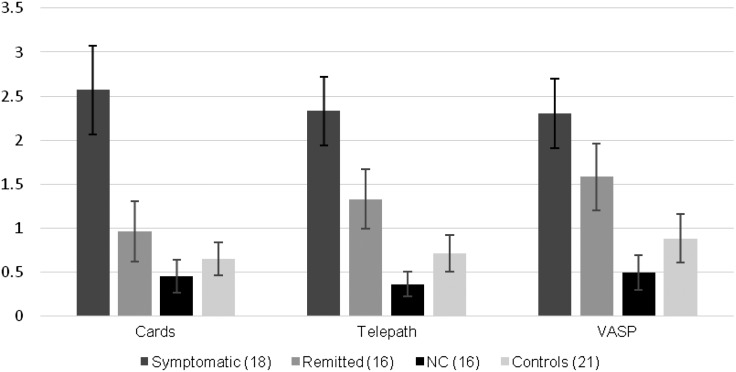
BACKGROUND: Appraisals are suggested to play a determining role in the clinical outcome of psychotic experiences (PEs). We used experimental tasks that mimic PEs to investigate appraisals in individuals with PEs with and without a 'need-for-clinical-care', and psychosis patients whose symptoms have remitted. We predicted that patients would appraise the tasks as threatening regardless of current symptom level, while non-clinical and control groups would appraise them as non-threatening. METHOD: Appraisals following three anomalous experiences-inducing tasks [Telepath, Cards task, Virtual acoustic space paradigm (VASP)] were examined in 71 individuals: symptomatic (n = 18) and remitted (n = 16) psychosis patients; non-clinical group with PEs (n = 16); controls without PEs (n = 21). RESULTS: As predicted, symptomatic patients endorsed more threatening appraisals for all tasks than non-clinical and control groups, who did not differ from each other. However, remitted patients were less likely to endorse threatening appraisals of the Cards and Telepath than their symptomatic counterparts, although they did not differ in global ratings of how striking, threatening and distressing they found the tasks. Moreover, remitted participants endorsed more threatening appraisals of the Telepath and VASP than non-clinical participants, and of the VASP than controls. Remitted participants also rated all three tasks as globally more threatening than the non-clinical group and controls. CONCLUSIONS: Clinical outcome may not necessarily be driven by the presence of symptoms, with threatening appraisals of PEs representing a key factor. The remitted group's intermediate appraisal scores imply that the relationship between appraisal and clinical outcome is not straightforward, and potential mediating factors need to be determined.
Overview
The claims and statistics of this paper haven’t been checked yet.
Free: it reads the open-access text and checks the first 5 claims that cite a source we can check. Create a free account to check every claim.
Integrity signals
Registry
Cites
Statistics
Figures
Verification
Claims the paper makes
The claims and statistics of this paper haven’t been checked yet.
Free: it reads the open-access text and checks the first 5 claims that cite a source we can check. Create a free account to check every claim.
Claims other papers make about this one
Each is checked against this paper’s own text: does it say what the citing paper says it does?
The cited source says what the claim attributes to it.
In the citing paper
“In pilot studies that used analogues of hearing voices and thought interference, patients scored higher on maladaptive appraisals than did non-clinical groups with persistent psychotic experiences,14 even when their symptoms had remitted.15”
From Clinical relevance of appraisals of persistent psychotic experiences in people with and without a need for care: an experimental study (2017) · cites this paper as [15]
The cited source says what the claim attributes to it.
In the citing paper
“Controlling for differences inherent to group status is inappropriate22 and, therefore, we tested for group differences on our hypothesised variables without including established risk factors for psychosis (eg, IQ, ethnicity, and sex) or factors inherent to need-for-care status (eg, education, impaired functioning, anxiety, and depression) as covariates.14, 15, 23”
From Clinical relevance of appraisals of persistent psychotic experiences in people with and without a need for care: an experimental study (2017) · cites this paper as [15]
The cited source says what the claim attributes to it.
In the citing paper
“Our findings support our hypotheses, replicate those of previous pilot studies,14, 15 and support cognitive models8, 9 that emphasise the central role of maladaptive appraisals of anomalous experiences in psychosis and need for care.”
From Clinical relevance of appraisals of persistent psychotic experiences in people with and without a need for care: an experimental study (2017) · cites this paper as [15]
Self-check
Percentages, sums and reported differences re-computed from the paper’s own numbers.
The self-check needs the paper’s full text.
Citations
Cites
(1995) · Cited by 6,909
Henry, J. D., & Crawford, J. R. (2005) · British Journal of Clinical Psychology · doi:10.1348/014466505x29657 · Cited by 5,801
Kapur, S. (2003) · American Journal of Psychiatry · doi:10.1176/appi.ajp.160.1.13 · Cited by 2,813 · cited 2×
“T his could be due to increased striatal dopamine in clinical individuals, producing greater aberrant sa lience (Kapur 2003), and thus increased PEs (Howes & Murray 2014).”
Backgroundvan Os, J., Linscott, R. J., Myin-Germeys, I., Delespaul, P., & Krabbendam, L. (2009) · Psychological Medicine · doi:10.1017/s0033291708003814 · Cited by 2,343 · cited 2×
“Recent reviews and meta-analyses show a continuity of psychosis in the general population that includes healthy states (Van Os et al. 2009; Linscott & Van Os, 2013).”
BackgroundMisunderstanding analysis of covariance.
Miller, G. A., & Chapman, J. P. (2001) · Journal of Abnormal Psychology · doi:10.1037/0021-843x.110.1.40 · Cited by 2,136 · cited 2×
“…that statistical methods used to control for group differences, such as analysis of covariance, should only be used to control for random variance, and it is therefore invalid to control for preexisting, non-random group differences common to psychopathology research (Miller & Chapman, 2001).”
BackgroundMethod(2011) · Cited by 2,025
Scale for the Assessment of Negative Symptoms
Andreasen, N. C. (2014) · PsycTESTS Dataset · doi:10.1037/t12696-000 · Cited by 1,866
A cognitive model of the positive symptoms of psychosis
GARETY, P. A., KUIPERS, E., FOWLER, D., FREEMAN, D., & BEBBINGTON, P. E. (2001) · Psychological Medicine · doi:10.1017/s0033291701003312 · Cited by 1,546 · cited 4×
“…models of psychosis suggest that appraisals can be distinguished or ‘decoupled’ from actual psychotic experiences (PEs), and play a key role in the transition to a clinical ‘need-for-care’ (Bentall et al. 2001; Garety et al. 2001, 2007; Morrison, 2001; Bentall et al. 2007; Howes & Murray, 2014).”
BackgroundInfluentialDominance statistics: Ordinal analyses to answer ordinal questions.
Cliff, N. (1993) · Psychological Bulletin · doi:10.1037//0033-2909.114.3.494 · Cited by 1,485
Linscott, R. J., & van Os, J. (2013) · Psychological Medicine · doi:10.1017/s0033291712001626 · Cited by 1,181
PERSECUTORY DELUSIONS: A REVIEW AND THEORETICAL INTEGRATION
Bentall, R. P., Corcoran, R., Howard, R., Blackwood, N., & Kinderman, P. (2001) · Clinical Psychology Review · doi:10.1016/s0272-7358(01)00106-4 · Cited by 876
Schizophrenia: an integrated sociodevelopmental-cognitive model
Howes, O. D., & Murray, R. M. (2014) · The Lancet · doi:10.1016/s0140-6736(13)62036-x · Cited by 864
Understanding The New Statistics: Effect Sizes, Confidence Intervals, and Meta-Analysis
Cumming, G. (2013) · Routledge eBooks · doi:10.4324/9780203807002 · Cited by 790
Headphone simulation of free-field listening. I: Stimulus synthesis
Wightman, F. L., & Kistler, D. J. (1989) · The Journal of the Acoustical Society of America · doi:10.1121/1.397557 · Cited by 674
Morrison, A. P. (2001) · Behavioural and Cognitive Psychotherapy · doi:10.1017/s1352465801003010 · Cited by 673 · cited 4×
“…models of psychosis suggest that appraisals can be distinguished or ‘decoupled’ from actual psychotic experiences (PEs), and play a key role in the transition to a clinical ‘need-for-care’ (Bentall et al. 2001; Garety et al. 2001, 2007; Morrison, 2001; Bentall et al. 2007; Howes & Murray, 2014).”
BackgroundInfluentialNew scales for the assessment of schizotypy
Mason, O., Claridge, G., & Jackson, M. (1995) · Personality and Individual Differences · doi:10.1016/0191-8869(94)00132-c · Cited by 635
Time for some a priori thinking about post hoc testing
Ruxton, G. D., & Beauchamp, G. (2008) · Behavioral Ecology · doi:10.1093/beheco/arn020 · Cited by 599
Psychosis Screening Questionnaire
Bebbington, P., & Nayani, T. (2014) · PsycTESTS Dataset · doi:10.1037/t30040-000 · Cited by 541
Scale for the Assessment of Positive Symptoms
Andreasen, N. C. (2018) · PsycTESTS Dataset · doi:10.1037/t48377-000 · Cited by 502
Connecting neurosis and psychosis: the direct influence of emotion on delusions and hallucinations
Freeman, D., & Garety, P. A. (2003) · Behaviour Research and Therapy · doi:10.1016/s0005-7967(02)00104-3 · Cited by 484
Cognitive Behaviour Therapy for Psychosis: Theory and Practice
Fowler, D., Garety, P. A., & Kuipers, L. (1999) · Medical Entomology and Zoology · Cited by 381
Mason, O., & Claridge, G. (2006) · Schizophrenia Research · doi:10.1016/j.schres.2005.12.845 · Cited by 379
Implications for neurobiological research of cognitive models of psychosis: a theoretical paper
GARETY, P. A., BEBBINGTON, P., FOWLER, D., FREEMAN, D., & KUIPERS, E. (2007) · Psychological Medicine · doi:10.1017/s003329170700013x · Cited by 347 · cited 2×
“…models of psychosis suggest that appraisals can be distinguished or ‘decoupled’ from actual psychotic experiences (PEs), and play a key role in the transition to a clinical ‘need-for-care’ (Bentall et al. 2001; Garety et al. 2001, 2007; Morrison, 2001; Bentall et al. 2007; Howes & Murray, 2014).”
BackgroundThe past and future of delusions research: from the inexplicable to the treatable
Garety, P. A., & Freeman, D. (2013) · British Journal of Psychiatry · doi:10.1192/bjp.bp.113.126953 · Cited by 341
Daalman, K., Boks, M. P. M., Diederen, K. M. J., de Weijer, A. D., Blom, J. D., Kahn, R. S., & Sommer, I. E. C. (2011) · The Journal of Clinical Psychiatry · doi:10.4088/jcp.09m05797yel · Cited by 293
Determinants of occurrence and recovery from hallucinations in daily life
Delespaul, P., deVries, M., & van Os, J. (2002) · Social Psychiatry and Psychiatric Epidemiology · doi:10.1007/s001270200000 · Cited by 247
Long-Term Outcome of Patients with Schizophrenia: A Review
Jobe, T. H., & Harrow, M. (2005) · The Canadian Journal of Psychiatry · doi:10.1177/070674370505001403 · Cited by 240
Kramer, I., Simons, C. J. P., Wigman, J. T. W., Collip, D., Jacobs, N., Derom, C., Thiery, E., van Os, J., Myin-Germeys, I., & Wichers, M. (2014) · Schizophrenia Bulletin · doi:10.1093/schbul/sbs194 · Cited by 151 · cited 1×
“Studies using experience sampling methods show subtle fluctuations in the relationship between negative affect, stress and symptom intensity (Delespaul & Van Os, 2002; Peters et al. 2012; Kramer et al. 2014).”
BackgroundPeters, E., Ward, T., Jackson, M., Morgan, C., Charalambides, M., McGuire, P., Woodruff, P., Jacobsen, P., Chadwick, P., & Garety, P. A. (2016) · World Psychiatry · doi:10.1002/wps.20301 · Cited by 151 · cited 1×
“We previously carried out sensitivity analyses in a larger sample to examine whether group differences in appraisals of the same tasks were affected by the inclusion or exclusion of correct guesses (Peters et al. 2015), and found that observed group differences remained the same.”
BackgroundSelf-citationEvaluation of positive and negative symptoms in schizophrenia
Andreasen, N. C., & Grove, W. M. (1986) · Psychiatry and Psychobiology · doi:10.1017/s0767399x00003199 · Cited by 120
A multisite investigation of the reliability of the Scale for the Assessment of Negative Symptoms
(1994) · American Journal of Psychiatry · doi:10.1176/ajp.151.10.1453 · Cited by 105
Brett, C., Heriot‐Maitland, C., McGuire, P., & Peters, E. (2014) · British Journal of Clinical Psychology · doi:10.1111/bjc.12036 · Cited by 99 · cited 2×
“…2007], we previously found that non-need-for-care individuals normalize their experiences as psychologically explainable phenomena, or integrate them within a spiritual or paranormal framework (Brett et al. 2007; Lovatt et al. 2010), which in turn is predictive of less distress (Brett et al. 2014).”
BackgroundSelf-citationBrett, C. M. C., Peters, E. P., Johns, L. C., Tabraham, P., Valmaggia, L. R., & Mcguire, P. K. (2007) · British Journal of Psychiatry · doi:10.1192/bjp.191.51.s23 · Cited by 97 · cited 10×
“Unusual Experiences Screening Questionnaire [UESQ; derived from the Appraisals of Anomalous Experiences Interview (Brett et al. 2007) and the Psychosis Screening Questionnaire (Bebbington & Nayani, 1995)] The two screening measures were merged to avoid repetition of items.”
BackgroundMethodInfluentialSelf-citationThe Importance of Effect Magnitude
Kirk, R. E. (2003) · Handbook of Research Methods in Experimental Psychology · doi:10.1002/9780470756973.ch5 · Cited by 94
Prospects for a cognitive‐developmental account of psychotic experiences
Bentall, R. P., Fernyhough, C., Morrison, A. P., Lewis, S., & Corcoran, R. (2007) · British Journal of Clinical Psychology · doi:10.1348/014466506x123011 · Cited by 92
Howes, O. D., Shotbolt, P., Bloomfield, M., Daalman, K., Demjaha, A., Diederen, K. M. J., Ibrahim, K., Kim, E., McGuire, P., Kahn, R. S., et al. (2013) · Schizophrenia Bulletin · doi:10.1093/schbul/sbr195 · Cited by 91
Affective processes in the onset and persistence of psychosis
Krabbendam, L., & van Os, J. (2005) · European Archives of Psychiatry and Clinical Neuroscience · doi:10.1007/s00406-005-0586-6 · Cited by 84
Guest, L. (2000) · The British Journal of Psychiatry · doi:10.1192/bjp.177.5.474 · Cited by 83
Psychotic-like experiences, appraisals, and trauma
Lovatt, A., Mason, O., Brett, C., & Peters, E. (2010) · Journal of Nervous & Mental Disease · doi:10.1097/nmd.0b013e3181f97c3d · Cited by 80 · cited 6×
“AANEX – short form (Lovatt et al. 2010) The short-form AANEX-Inventory consists of 17 items covering five factors: ‘meaning–reference’ (e.g. ideas of reference); ‘paranormal–hallucinatory’ (e.g. visual or somatic hallucinations); ‘cognitive–attention’ (e.g. thought block); ‘dissociative–perceptual’…”
BackgroundInfluentialSelf-citationRice, P. (2000) · Mental Health Practice · doi:10.7748/mhp.4.1.29.s20 · Cited by 75
A qualitative comparison of psychotic‐like phenomena in clinical and non‐clinical populations
Heriot‐Maitland, C., Knight, M., & Peters, E. (2012) · British Journal of Clinical Psychology · doi:10.1111/j.2044-8260.2011.02011.x · Cited by 73 · cited 1×
“Non-clinical participants were recruited from specialist sources using a sampling strategy developed in previous studies (Heriot-Maitland et al. 2012; Ward et al. 2014).”
MethodSelf-citationAppraisals, psychotic symptoms and affect in daily life
Peters, E., Lataster, T., Greenwood, K., Kuipers, E., Scott, J., Williams, S., Garety, P., & Myin-Germeys, I. (2012) · Psychological Medicine · doi:10.1017/s0033291711001802 · Cited by 45
Self-citationBerry, K., Bucci, S., Kinderman, P., Emsley, R., & Corcoran, R. (2014) · Psychiatry Research · doi:10.1016/j.psychres.2014.12.009 · Cited by 42
Whitney, K. A., Shepard, P. H., Mariner, J., Mossbarger, B., & Herman, S. M. (2010) · Applied Neuropsychology · doi:10.1080/09084282.2010.499787 · Cited by 41
357 – Appraisals, psychotic symptoms and affect in daily life
PETERS, E. R., Myin‐Germeys, I., Williams, S., Greenwood, K., Kuipers, E., Scott, J. L., & Garety, P. A. (2008) · Schizophrenia Research · doi:10.1016/j.schres.2007.12.424 · Cited by 40
Self-citationWard, T. A., Gaynor, K. J., Hunter, M. D., Woodruff, P. W. R., Garety, P. A., & Peters, E. R. (2014) · Schizophrenia Bulletin · doi:10.1093/schbul/sbt094 · Cited by 38
Self-citationThe psychological processes underlying symptoms of thought interference in psychosis
Linney, Y., & PETERS, E. R. (2007) · Behaviour Research and Therapy · doi:10.1016/j.brat.2007.07.011 · Cited by 27
Self-citationThe Jumping-to-Conclusions Bias in New Religious Movements
Lim, M. H., Gleeson, J. F., & Jackson, H. J. (2012) · Journal of Nervous & Mental Disease · doi:10.1097/nmd.0b013e31826b6eb4 · Cited by 13
Effects of Appraisals of Anomalous Experience on Distress in People at Risk of Psychosis
Taylor, H. E., Parker, S., Mansell, W., & Morrison, A. P. (2012) · Behavioural and Cognitive Psychotherapy · doi:10.1017/s1352465812000227 · Cited by 6
The relation between AKT1, cannabis use and metabolic risk factors in psychosis
Liemburg, E. J., Bruins, J., van Beveren, N. J. M., Bruggeman, R., & Alizadeh, B. Z. (2015) · University of Groningen research database (University of Groningen / Centre for Information Technology) · doi:10.1093/schbul/sbv010
Research works printed but not linked: 2
- Wechsler D (2001). Wechsler Test of Adult Reading: WTAR. Psychological Corporation: San Antonio, TX.
- Peters E, Ward T, Jackson M, Morgan C, Woodruff P, McGuire P, Garety P (2015). Exploring psychotic experiences in non-need for care populations: findings from the unique study (Unusual Experiences Enquiry Study). Schizophrenia Bulletin 41, S186.
Cited by
Taves, A. (2020) · Perspectives on Psychological Science · doi:10.1177/1745691619895047 · Cited by 140
Valmaggia, L., Day, F., & Rus‐Calafell, M. (2016) · Social Psychiatry and Psychiatric Epidemiology · doi:10.1007/s00127-016-1245-0 · Cited by 80
Peters, E., Ward, T., Jackson, M., Woodruff, P., Morgan, C., McGuire, P., & Garety, P. A. (2017) · The Lancet Psychiatry · doi:10.1016/s2215-0366(17)30409-1 · Cited by 66
Self-citationMason, L., PETERS, E. R., Williams, S., & Kumari, V. (2017) · Translational Psychiatry · doi:10.1038/tp.2016.263 · Cited by 36
Self-citationOvergeneral autobiographical memory bias in clinical and non-clinical voice hearers
Jacobsen, P. C., PETERS, E. R., Ward, T., Garety, P. A., Jackson, M. C., & Chadwick, P. (2018) · Psychological Medicine · doi:10.1017/s0033291718000570 · Cited by 33
Self-citation
Metadata
- Authors
- Underwood, R., Kumari, V., & Peters, E.
- Affiliations
- King's College London (GB)
- South London and Maudsley NHS Foundation Trust (GB)
- Corresponding author
- Peters, E.
- Venue
- Psychological Medicine
- Publisher
- Cambridge University Press (CUP)
- Published
- 2016-01-25
- Volume
- 46
- Issue
- 6
- Pages
- 1249-1263
- ISSN
- 0033-2917 (ISSN-L)
- 1469-8978
- PMC
- PMC4825099
- OpenAlex
- W2258096442
- Cited by
- 14
- References
- 51
- Citations by year
- 2023: 2 · 2021: 3 · 2020: 1 · 2019: 3 · 2018: 2 · 2017: 2 · 2016: 1
- FWCI
- 2.37
- Type
- journal article
- Language
- en
- Open access
- hybrid
- doi.org
- Locations
- Psychological Medicine (publishedVersion, cc-by)
- PubMed Central (publishedVersion, cc-by)
- PubMed (publishedVersion)
- Research Portal (King's College London) (submittedVersion, cc-by-nd)
- Brunel University Research Archive (BURA) (Brunel University London) (submittedVersion)
- Funders
- King's College London
- Institute of Psychiatry, Psychology and Neuroscience, King’s College London
- Medical Research Council
- Topics
- Health Sciences › Medicine › Psychiatry and Mental health › Schizophrenia research and treatment
- Social Sciences › Arts and Humanities › Philosophy › Mental Health and Psychiatry
- Life Sciences › Neuroscience › Cognitive Neuroscience › Hallucinations in medical conditions
- Keywords
- psychotic experiences, threat appraisal, anomalous experiences, telepathy, clinical outcomes
- MeSH terms
- Adult, Cognition, Female, Humans, Interview, Psychological, Male, Middle Aged, Psychiatric Status Rating Scales, Psychological Tests, Psychotic Disorders, Surveys and Questionnaires, Case-Control Studies, Needs Assessment, Young Adult
About these checks
Registry, retraction, Cites and statistics results are computed, not judged, with one exception: a printed reference that no index lists is read once by a model before it counts as a citation error. Claims are extracted by a model and kept only when their quote appears verbatim in the text; each cited source is then checked, with a model’s help, for whether it says what the claim relies on. Those verdicts can be wrong — read the claim’s quote and the cited source before relying on one.
Statistics and arithmetic are recomputed, not judged.
Confidence bands are shown only for fields calibrated on our annotated test set. None is calibrated yet, so no band is shown.
What counts as a claim ›How we measure confidence ›How we check this ›
Are you an author, or do you see a problem with this page? Request a review
Data sources
Bibliographic data: Semantic Scholar, OpenAlex, Crossref.
Contains information from the Semantic Scholar Academic Graph Datasets, made available under the ODC Attribution License (ODC-BY 1.0).
Semantic Scholar’s data is described in: Kinney, R., et al. (2023). The Semantic Scholar Open Data Platform. arXiv:2301.10140.
