

Stabilising sleep for patients admitted at acute crisis to a psychiatric hospital (OWLS): an assessor-blind pilot randomised controlled trial
Open accessThe DOI matches its Crossref record; 33 of the 35 references it cites were found in a registry or an index.
Abstract
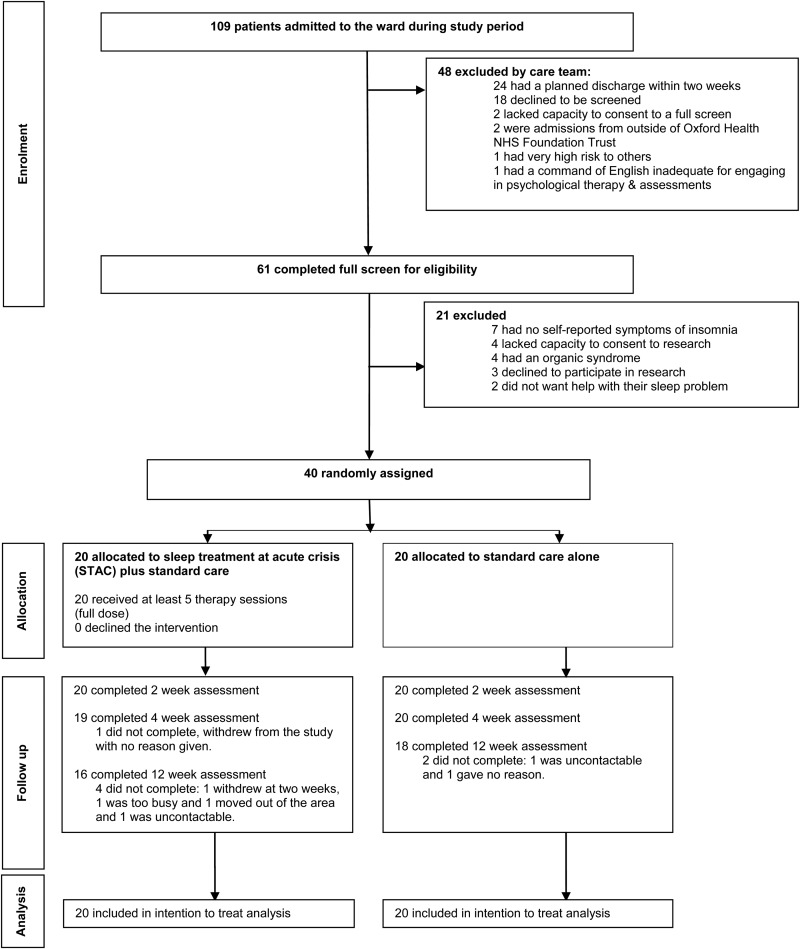
Background: When patients are admitted onto psychiatric wards, sleep problems are highly prevalent. We carried out the first trial testing a psychological sleep treatment at acute admission (Oxford Ward sLeep Solution, OWLS). Methods: This assessor-blind parallel-group pilot trial randomised patients to receive sleep treatment at acute crisis [STAC, plus standard care (SC)], or SC alone (1 : 1). STAC included cognitive–behavioural therapy (CBT) for insomnia, sleep monitoring and light/dark exposure for circadian entrainment, delivered over 2 weeks. Assessments took place at 0, 2, 4 and 12 weeks. Feasibility outcomes assessed recruitment, retention of participants and uptake of the therapy. Primary efficacy outcomes were the Insomnia Severity Index and Warwick–Edinburgh Mental Wellbeing Scale at week 2. Analyses were intention-to-treat, estimating treatment effect with 95% confidence intervals. Results: Between October 2015 and July 2016, 40 participants were recruited (from 43 assessed eligible). All participants offered STAC completed treatment (mean sessions received = 8.6, s.d. = 1.5). All participants completed the primary end point. Compared with SC, STAC led to large effect size (ES) reductions in insomnia at week 2 (adjusted mean difference −4.6, 95% CI −7.7 to −1.4, ES −0.9), a small improvement in psychological wellbeing (adjusted mean difference 3.7, 95% CI −2.8 to 10.1, ES 0.3) and patients were discharged 8.5 days earlier. One patient in the STAC group had an adverse event, unrelated to participation. Conclusions: In this challenging environment for research, the trial was feasible. Therapy uptake was high. STAC may be a highly effective treatment for sleep disturbance on wards with potential wider benefits on wellbeing and admission length.
Overview
The claims and statistics of this paper haven’t been checked yet.
Free: it reads the open-access text and checks the first 5 claims that cite a source we can check. Create a free account to check every claim.
Integrity signals
Registry
Cites
Statistics
Figures
Verification
Claims the paper makes
The claims and statistics of this paper haven’t been checked yet.
Free: it reads the open-access text and checks the first 5 claims that cite a source we can check. Create a free account to check every claim.
Claims other papers make about this one
Each is checked against this paper’s own text: does it say what the citing paper says it does?
The cited source says what the claim attributes to it.
In the citing paper
“To our knowledge, a form of CBT-I for acute insomnia in severely ill inpatients has only been investigated by two research groups [16,45].”
From Cognitive behavioral therapy for insomnia in patients with mental disorders and comorbid insomnia: A systematic review and meta-analysis (2022) · cites this paper as [45]
The cited source says what the claim attributes to it.
In the citing paper
“Preliminary work in patients with major psychiatric comorbidity suggested feasibility and efficacy of a CBT-I-based psychological sleep treatment in outpatient [9] and inpatient settings [10, 11].”
The check wasn’t confident either way, so it gives no verdict — never disputed.
In the citing paper
“Light therapy is also effective as second-line treatment for non-seasonal depression, although it usually takes longer (2–5 weeks) than in SAD to achieve a therapeutic effect [2, 75, 87].”
From Effects of light on human circadian rhythms, sleep and mood (2019) · cites this paper as [75]
Experimental — accuracy not yet measuredThe check wasn’t confident either way, so it gives no verdict — never disputed.
In the citing paper
“BLT is nowadays established as first-line treatment for SAD [61, 75] leading to an amelioration of symptoms after a few days of treatment.”
From Effects of light on human circadian rhythms, sleep and mood (2019) · cites this paper as [75]
Experimental — accuracy not yet measuredIn the citing paper
“Serious adverse events were reported by Freeman et al. in patients with psychosis [44] and Sheaves et al. in psychiatric inpatients [45].The events were suicide attempts and violent incidents.All serious adverse events were considered unrelated to the study intervention.”
From Cognitive behavioral therapy for insomnia in patients with mental disorders and comorbid insomnia: A systematic review and meta-analysis (2022) · cites this paper as [45]
Self-check
Percentages, sums and reported differences re-computed from the paper’s own numbers.
The self-check needs the paper’s full text.
Citations
Cites
The Positive and Negative Syndrome Scale (PANSS) for schizophrenia.
Kay, S. R., Fiszbein, A., & Opler, L. A. (1987) · Schizophrenia Bulletin · doi:10.1093/schbul/13.2.261 · Cited by 21,378 · cited 1×
“Secondary efficacy outcome measures included interviewer-rated assessments of psychiatric symptoms [Positive and Negative Syndromes Scale (PANSS, Kay et al. 1987) and Young Mania Rating Scale (YMRS, Young et al. 1978)].”
EuroQol: a new facility for the measurement of health-related quality of life
(1990) · Health Policy · doi:10.1016/0168-8510(90)90421-9 · Cited by 15,736 · cited 3×
“The internal consistency of the EQ-5D in the present study was 0.56.”
InfluentialA Rating Scale for Mania: Reliability, Validity and Sensitivity
Young, R. C., Biggs, J. T., Ziegler, V. E., & Meyer, D. A. (1978) · British Journal of Psychiatry · doi:10.1192/bjp.133.5.429 · Cited by 8,744 · cited 1×
“Secondary efficacy outcome measures included interviewer-rated assessments of psychiatric symptoms [Positive and Negative Syndromes Scale (PANSS, Kay et al. 1987) and Young Mania Rating Scale (YMRS, Young et al. 1978)].”
Validation of the Insomnia Severity Index as an outcome measure for insomnia research
Bastien, C. (2001) · Sleep Medicine · doi:10.1016/s1389-9457(00)00065-4 · Cited by 8,067 · cited 8×
“At week 0, all patients ’ ISI scores indicated clinically significant insomnia symptoms (ISI ⩾ 8).”
InfluentialThe Warwick-Edinburgh Mental Well-being Scale (WEMWBS): development and UK validation
Tennant, R., Hiller, L., Fishwick, R., Platt, S., Joseph, S., Weich, S., Parkinson, J., Secker, J., & Stewart-Brown, S. (2007) · Health and Quality of Life Outcomes · doi:10.1186/1477-7525-5-63 · Cited by 5,031 · cited 4×
“Minimisation balanced groups by stratifying on the ISI (symptoms of insomnia, score 0 – 14 v. insomnia disorder, score >14), the Warwick – Edinburgh Mental Wellbeing Scale (WEMWBS; low wellbeing, score 0 – 35 v. high wellbeing, score 36 – 70) and participant diagnosis made by the ward consultant psychiatrist (non-affe…”
InfluentialAssessment of suicidal intention: The Scale for Suicide Ideation.
Beck, A. T., Kovacs, M., & Weissman, A. (1979) · Journal of Consulting and Clinical Psychology · doi:10.1037//0022-006x.47.2.343 · Cited by 3,419 · cited 1×
“Suicidal ideation was assessed via the Beck Suicide Scale (BSS, Beck et al. , 1979).”
Assessment of client/patient satisfaction: development of a general scale
Larsen, D. L., Attkisson, C. C., Hargreaves, W. A., & Nguyen, T. D. (1979) · Evaluation and Program Planning · doi:10.1016/0149-7189(79)90094-6 · Cited by 2,887 · cited 2×
“Patient satisfaction was assessed by an adapted version of the Client Satisfaction Questionnaire (Larsen et al. 1979) at the end of the therapy.”
Qaseem, A., Kansagara, D., Forciea, M. A., Cooke, M., Denberg, T. D., & for the Clinical Guidelines Committee of the American College of Physicians* (2016) · Annals of Internal Medicine · doi:10.7326/m15-2175 · Cited by 1,965 · cited 1×
“Sleep problems are pervasive on inpatient wards, despite the sedative effects of multiple medications (Waters et al. 2012), which is the common service response to patient reports of sleep difficulties (Rehman et al. 2016).”
On the use of a pilot sample for sample size determination
Browne, R. H. (1995) · Statistics in Medicine · doi:10.1002/sim.4780141709 · Cited by 1,007 · cited 1×
“A sample size of 30 has been recommended for use in pilot studies where the treatment effect is expected to be large (Browne, 1995).”
Manber, R., Edinger, J. D., Gress, J. L., Pedro-Salcedo, M. G. S., Kuo, T. F., & Kalista, T. (2008) · Sleep · doi:10.1093/sleep/31.4.489 · Cited by 868
Research works printed but not linked: 4
- American Psychiatric Association (2013) Diagnostic and Statistical Manual of Mental Disorders, 5th edn Arlington, VA: American Psychiatric Association.
- Espie CA (2010) Overcoming Insomnia and Sleep Problems. London: Constable & Robinson.
- IBM Corp (2015) IBM SPSS Statistics for Windows 23.0. Armonk, NY: IBM Corp., Version 23.0.
- Crisp N (2015) Improving acute inpatient psychiatric care for adults in England (interim report). The commission to review the provision of acute inpatient psychiatric care for adults.
Cited by
Scott, A. J., Webb, T. L., Martyn-St James, M., Rowse, G., & Weich, S. (2021) · Sleep Medicine Reviews · doi:10.1016/j.smrv.2021.101556 · Cited by 1,094
Sleep disturbance and psychiatric disorders
Freeman, D., Sheaves, B., Waite, F., Harvey, A. G., & Harrison, P. J. (2020) · The Lancet Psychiatry · doi:10.1016/s2215-0366(20)30136-x · Cited by 843
Self-citationEffects of light on human circadian rhythms, sleep and mood
Blume, C., Garbazza, C., & Spitschan, M. (2019) · Somnologie · doi:10.1007/s11818-019-00215-x · Cited by 695
“Light therapy is also effective as second-line treatment for non-seasonal depression, although it usually takes longer (2–5 weeks) than in SAD to achieve a therapeutic effect [2, 75, 87].”
BackgroundInfluentialPerlis, M. L., Posner, D., Riemann, D., Bastien, C. H., Teel, J., & Thase, M. (2022) · The Lancet · doi:10.1016/s0140-6736(22)00879-0 · Cited by 395
Hertenstein, E., Trinca, E., Wunderlin, M., Schneider, C. L., Züst, M. A., Fehér, K. D., Su, T., Straten, A. V., Berger, T., Baglioni, C., et al. (2022) · Sleep Medicine Reviews · doi:10.1016/j.smrv.2022.101597 · Cited by 391
Sleep disorders in early psychosis: incidence, severity, and association with clinical symptoms
Reeve, S., Sheaves, B., & Freeman, D. (2019) · Schizophrenia Bulletin · doi:10.1093/schbul/sby129 · Cited by 182
Sleep and schizophrenia: From epiphenomenon to treatable causal target
Waite, F., Sheaves, B., Isham, L., Reeve, S., & Freeman, D. (2020) · Schizophrenia Research · doi:10.1016/j.schres.2019.11.014 · Cited by 149
Self-citationFaulkner, S., Bee, P., Meyer, N., Dijk, D., & Drake, R. (2019) · Sleep Medicine Reviews · doi:10.1016/j.smrv.2019.04.012 · Cited by 115
Perspectives in affective disorders: Clocks and sleep
Wirz‐Justice, A., & Benedetti, F. (2020) · European Journal of Neuroscience · doi:10.1111/ejn.14362 · Cited by 108
Self-citationSleep disturbances in schizophrenia spectrum and bipolar disorders – a transdiagnostic perspective
Laskemoen, J. F., Simonsen, C., Büchmann, C. B., Barrett, E. A., Bjella, T. D., Lagerberg, T. V., Vedal, T. S. J., Andreassen, O. A., Melle, I. S., & Aas, M. (2019) · Comprehensive Psychiatry · doi:10.1016/j.comppsych.2019.02.006 · Cited by 120
Barrera, A., Gee, C., Wood, A., Gibson, O., Bayley, D., & Geddes, J. (2020) · Evidence-Based Mental Health · doi:10.1136/ebmental-2019-300136 · Cited by 79
“17 18 Therefore, the clinical usefulness of a system that avoids that nursing observations disrupt patients’ sleep would be significant, in terms of reducing insomnia, promoting mental health recovery and improving patient’s experience.”
BackgroundReeve, S., Nickless, A., Sheaves, B., & Freeman, D. (2018) · Psychiatry Research · doi:10.1016/j.psychres.2018.08.090 · Cited by 69
Self-citationAdapted CBT to stabilize sleep on psychiatric wards: a transdiagnostic treatment approach
Sheaves, B., Isham, L., Bradley, J., Espie, C., Barrera, A., Waite, F., Harvey, A. G., Attard, C., & Freeman, D. (2018) · Behavioural and Cognitive Psychotherapy · doi:10.1017/s1352465817000789 · Cited by 55
“The psychological intervention for sleep, tailored to an acute care setting, led to quicker and potentially fuller recovery of insomnia than standard care alone (Sheaves et al., 2017).”
BackgroundLewis, K. J. S., Richards, A., Karlsson, R., Leonenko, G., Jones, S. E., Jones, H. J., Gordon-Smith, K., Forty, L., Escott-Price, V., Owen, M. J., et al. (2020) · JAMA Psychiatry · doi:10.1001/jamapsychiatry.2019.4079 · Cited by 51
Hwang, D.-K., Nam, M., & Lee, Y.-J. G. (2019) · Psychiatry Research · doi:10.1016/j.psychres.2019.02.002 · Cited by 56
Jernelöv, S., Larsson, Y., Llenas, M., Nasri, B., & Kaldo, V. (2019) · BMC Psychiatry · doi:10.1186/s12888-019-2216-2 · Cited by 53
Blodgett, J. M., Birch, J. M., Musella, M., Harkness, F., & Kaushal, A. (2022) · International Journal of Environmental Research and Public Health · doi:10.3390/ijerph192315845 · Cited by 66
Carruthers, S. P., Brunetti, G., & Rossell, S. L. (2021) · Sleep Medicine · doi:10.1016/j.sleep.2021.05.011 · Cited by 42
Are Circadian Disturbances a Core Pathophysiological Component of Schizophrenia?
Delorme, T. C., Srivastava, L. K., & Cermakian, N. (2020) · Journal of Biological Rhythms · doi:10.1177/0748730420929448 · Cited by 50
“In addition, in male patients admitted to a psychiatric ward, CBT-I, in combination with controlling light/dark exposure and discussion on sleep monitoring, led to larger reductions in self-reported insomnia symptoms and earlier discharge compared with standard care alone (Sheaves et al., 2018).”
Waite, F., Černis, E., Kabir, T., Iredale, E., Johns, L., Maughan, D., Diamond, R., Seddon, R., Williams, N., Yu, L.-M., et al. (2023) · The Lancet Psychiatry · doi:10.1016/s2215-0366(23)00203-1 · Cited by 37
Self-citationSchneider, C. L., Hertenstein, E., Fehér, K., Maier, J. G., Cantisani, A., Moggi, F., Berger, T., & Nissen, C. (2020) · SLEEP Advances · doi:10.1093/sleepadvances/zpaa005 · Cited by 37
Waite, F., Bradley, J., Chadwick, E., Reeve, S., Bird, J. C., & Freeman, D. H. (2018) · Frontiers in Psychiatry · doi:10.3389/fpsyt.2018.00375 · Cited by 38
Self-citationWood, L., Williams, C., Billings, J., & Johnson, S. (2019) · Psychology and Psychotherapy: Theory, Research and Practice · doi:10.1111/papt.12199 · Cited by 33
Jacobsen, P., Peters, E., Robinson, E. J., & Chadwick, P. (2020) · BMC Psychiatry · doi:10.1186/s12888-020-02608-x · Cited by 32
Langsrud, K., Kallestad, H., Vaaler, A., Almvik, R., Palmstierna, T., & Morken, G. (2018) · Psychiatry Research · doi:10.1016/j.psychres.2018.03.012 · Cited by 31
“5 days earlier than patients that only got treatment as usual (Sheaves et al., 2017).”
InfluentialCrowther, M. E., Saunders, W. J., Sletten, T. L., Drummond, S. P. A., & Bei, B. (2023) · Journal of Sleep Research · doi:10.1111/jsr.14023 · Cited by 21
“Stimulus control has been adapted by allowing individuals to either move to a chair within their sleeping environment or sit up in bed for relaxing activities (Martin et al., 2017; Sheaves et al., 2018b).”
BackgroundMethodInfluentialCognitive behavioural therapy for insomnia in inpatient psychiatric care: a systematic review
Schneider, C. L., Hertenstein, E., & Nissen, C. (2023) · Journal of Sleep Research · doi:10.1111/jsr.14041 · Cited by 23
“(Crönlein et al., 2014; Hsu et al., 2015; Sheaves et al., 2018).”
BackgroundResultInfluentialLet there be blue-depleted light: in-patient dark therapy, circadian rhythms and length of stay
Scott, J. L., Langsrud, K., Goulding, I. R., & Kallestad, H. (2020) · BJPsych Advances · doi:10.1192/bja.2020.47 · Cited by 16
“However, for in-patients personalised interventions such as the use of individual light boxes is only feasible or practical in selected units (Sheaves 2018).”
Barrett, E. A., Aminoff, S. R., Simonsen, C., & Romm, K. L. (2020) · Comprehensive Psychiatry · doi:10.1016/j.comppsych.2020.152207 · Cited by 20
Azargoonjahromi, A., & Bahrampour, Z. (2025) · Sleep Medicine · doi:10.1016/j.sleep.2025.106690 · Cited by 21
Sleep and circadian difficulties in schizophrenia: presentations, understanding, and treatment
Freeman, D., & Waite, F. (2025) · Psychological Medicine · doi:10.1017/s0033291725000297 · Cited by 14
“These have led to small randomized controlled trials for people diagnosed with psychosis and current delusions and hallucinations (BEST) (Freeman et al., 2015), patients at acute episode admitted to psychiatric hospital (OWLS) (Sheaves, Freeman, et al., 2018), patients with current persecutory delusions and nightmares…”
Self-citationWood, L., Williams, C., Pinfold, V., Nolan, F., Morrison, A. P., Morant, N., Lloyd-Evans, B., Lewis, G., Lay, B., Jones, R., et al. (2022) · Pilot and Feasibility Studies · doi:10.1186/s40814-022-01160-7 · Cited by 12
“within 6–8 sessions [14, 41], and are suitable for inpatients [41].”
BackgroundMcDonald, K. C., Smith, T. D., Broadbent, M. T. M., Patel, R., Geddes, J. R., & Saunders, K. (2020) · European Psychiatry · doi:10.1192/j.eurpsy.2020.39 · Cited by 11
“Further MI and SD are modifiable, and their stabilization may lead to improvements that allow for shorter hospitalizations [28].”
BackgroundDoghramji, K., Tanielian, M., Certa, K., & Zhan, T. (2018) · The Journal of Nervous and Mental Disease · doi:10.1097/nmd.0000000000000888 · Cited by 14
Sleep problems and complexity of mental health needs in adolescent psychiatric inpatients
Boafo, A., Dion, K., Greenham, S. L., Barrowman, N. J., Reddy, D. N., Koninck, J. D., & Robillard, R. (2021) · Journal of Psychiatric Research · doi:10.1016/j.jpsychires.2021.05.005 · Cited by 12
Behavioral Interventions to Reduce Cardiovascular Risk Among People with Severe Mental Disorder
Baker, A. L., Forbes, E., Pohlman, S., & McCarter, K. (2022) · Annual Review of Clinical Psychology · doi:10.1146/annurev-clinpsy-072720-012042 · Cited by 9
Novel psychotherapies for insomnia
Angelillo, M., Lancee, J., & Hertenstein, E. (2025) · Journal of Sleep Research · doi:10.1111/jsr.14470 · Cited by 9
“Key components that have been identified as effective include: bedtime restriction (Callaway et al., 2023; Schneider et al., 2020), circadian adaptation (Callaway et al., 2023; Sheaves et al., 2018), as well as sleep and circadian education (Callaway et al., 2023; Schneider et al., 2020).”
InfluentialKragh, M., Dyrberg, H., Kristiansen, S. T., Speed, M. S., Pedersen, P., & Martiny, K. (2025) · Journal of Sleep Research · doi:10.1111/jsr.70088 · Cited by 11
Staff and resident perceptions of mental and behavioural health environments
Shepley, M. M., Peditto, K., Sachs, N. A., Pham, Y.-N., Barankevich, R., Crouppen, G., & Dresser, K. (2021) · Building Research & Information · doi:10.1080/09613218.2021.1963653 · Cited by 11
“…2018), noise (Brown et al., 2020; Camuccio et al., 2019; Haines et al., 2017; Veale et al., 2020), light (Haines et al., 2017; Okkels et al., 2020; Sheaves et al., 2018; Veale et al., 2020), maintenance and cleanliness (Brunero et al., 2009; Cleary et al., 2009; Smith & Jones, 2014), and…”
González-Rodríguez, A., Labad, J., & Seeman, M. V. (2020) · Clocks & Sleep · doi:10.3390/clockssleep2040030 · Cited by 10
“Sheaves and collaborators [94] carried out an assessor-blind pilot two-week randomized controlled trial in 40 patients admitted to hospital in acute psychiatric crisis.”
BackgroundIrregular Sleep-Wake Rhythm Disorder
Oyegbile, T. O., & Videnović, A. (2019) · Neurologic Clinics · doi:10.1016/j.ncl.2019.04.002 · Cited by 9
Scott, J. L., Langsrud, K., Vethe, D., Kjørstad, K., Vestergaard, C. L., Faaland, P. M., Lydersen, S., Vaaler, A., Morken, G., Torgersen, T., et al. (2019) · Trials · doi:10.1186/s13063-019-3582-2 · Cited by 10
Batalla-Martín, D., Martorell‐Poveda, M., Eraso, Á. G. B., Gordo, A. M., Lleal, H. B., Melendez, R., Girona, R. Q., & López‐Ruiz, M. (2023) · Journal of Clinical Medicine · doi:10.3390/jcm12196147 · Cited by 7
“The CBT-I has also shown efficacy in patients with schizophrenic disorder and has been studied in group interventions [23], individuals [24,25], and also in interventions during hospital admission [26,27].”
Sleep quality and adverse incidents in secure mental health settings
Hartescu, I., Gardiner, P. M., Girardi, A., Breen, K. C., Roychowdhury, A., Wallang, P. M., & Morgan, K. (2022) · Journal of Forensic Psychiatry and Psychology · doi:10.1080/14789949.2022.2073902 · Cited by 7
“…mainly employing the principles of cognitive behavioural therapy for insomnia (CBTI), have demonstrated the feasibility and potential utility of sleep management programmes delivered in acute psychiatric hospital settings (Novak et al., 2020; Paterson et al., 2021; Sheaves et al., 2018a, 2018b).”
MethodGardiner, P. M., Kinnafick, F., Breen, K. C., Girardi, A., & Hartescu, I. (2022) · Journal of Forensic Psychiatry and Psychology · doi:10.1080/14789949.2022.2111320 · Cited by 7
“Behavioural interventions (n = 10) (Brupbacher et al., 2021; Chien et al., 2015; Ellis et al., 2019; Ferszt et al., 2015; Haynes et al., 2011; Hegde et al., 2020; Holzinger et al., 2020; Randall et al., 2019; Sheaves et al., 2018) yielded the largest estimated pooled effect size; d = 0.”
BackgroundResultInfluentialJohnsen, L., Bird, J. C., Salkovskis, P. M., James, A. C., Stratford, H. J., & Sheaves, B. (2023) · Journal of Sleep Research · doi:10.1111/jsr.14056 · Cited by 8
“CBT-I is a brief treatment, typically six sessions, and it has also proven feasible to deliver intensively over 2 weeks in adult inpatients (Sheaves et al., 2018).”
BackgroundResultInfluentialSelf-citationMetse, A. P., Fehily, C. M. C., Clinton‐McHarg, T., Wynne, O., Lawn, S., Wiggers, J., & Bowman, J. (2021) · BMC Public Health · doi:10.1186/s12889-021-10504-6 · Cited by 8
Stafford, A., Oduola, S., & Reeve, S. (2024) · Sleep Medicine · doi:10.1016/j.sleep.2024.09.002 · Cited by 7
“Further research is warranted regarding sleep treatment decisions on inpatient wards, especially since it is established that sleep can be successfully treated via appropriate means in these settings and that this improvement continues post-discharge [64].”
BackgroundSelf-citationTrinca, E., Hertenstein, E., Wunderlin, M., Schneider, C. L., Züst, M. A., Fehér, K. D., Su, T., van Straten, A., Berger, T., Riemann, D. W., et al. (2022) · Sleep Medicine · doi:10.1016/j.sleep.2022.05.311 · Cited by 5
Jacobsen, P. C., Berry, K., Clarkson, L., Hiscocks, R., Hopkins, I., Morgan, C., Tandon, D., Teale, A., Tyler, N., & Wood, L. (2024) · BMC Psychiatry · doi:10.1186/s12888-024-06294-x · Cited by 6
The Management of Sleep Disturbances in Patients with Schizophrenia: A Case Series
Vaněk, J., Praško, J. P., Genzor, S., & Mizera, J. (2022) · Psychology Research and Behavior Management · doi:10.2147/prbm.s388702 · Cited by 6
“Many sleep parameters, such as the amount of slow-wave sleep and REM latency, are significantly correlated with clinical variables, including disease severity, positive symptoms, negative symptoms, outcome, neurocognitive impairment, and brain structure.(2) Palmese et al studied the prevalence of insomnia in schizophr…”
BackgroundInfluentialTanskanen, T. E., Wegelius, A., Härkönen, T., Gummerus, E.-M., Stenberg, J., Selinheimo, S., Alakuijala, A., Tenhunen, M. L., Paajanen, T. I., Järnefelt, H., et al. (2024) · BMJ Open · doi:10.1136/bmjopen-2023-076129 · Cited by 4
“In the second RCT, Sheaves et al 40 reported that treatment of insomnia during the acute crisis phase in patients with schizophrenia spectrum and other psychotic disorders (45%), bipolar disorder (35”
BackgroundFaulkner, S., Drake, R., Ogden, M., Gardani, M., & Bee, P. (2022) · PLoS ONE · doi:10.1371/journal.pone.0269453 · Cited by 7
“Adapted CBTi for people with schizophrenia and related disorders delivered by clinical psychologists has shown positive results, with significantly better sleep outcomes than treatment as usual [8, 33, 38–40].”
Wood, L., Morrison, A. P., Lay, B., Williams, C., & Johnson, S. (2024) · Psychosis · doi:10.1080/17522439.2024.2386176 · Cited by 5
“…and auditory hallucinations, including one which targeted insomnia in inpatient settings, demonstrating the potential for a brief targeted protocol-driven approach in this setting to be effective (Craig et al., 2018; Freeman, Dunn, et al., 2015; Freeman, Waite, et al., 2015; Sheaves et al., 2017).”
Walker, K., Griffiths, C., & Willis, A. (2024) · Advances in Mental Health · doi:10.1080/18387357.2024.2302118 · Cited by 6
“Improved sleep was experienced by many which is linked to reduced anxiety, depression and psychotic experiences and better well-being (Freeman et al., 2015; Sheaves et al., 2018).”
Waite, F., Evans, S., Rebello, A., Sharpe, T., Otaiku, J., Iredale, E., Kabir, T., Černis, E., & Freeman, D. H. (2025) · British Journal of Clinical Psychology · doi:10.1111/bjc.70002 · Cited by 4
“…was informed by standard CBT sleep protocols (Espie, 2006; Harvey, 2002) and protocols for treating sleep disruption in patients with psychosis (Sheaves, Isham, et al., 2018; Waite, Myers, et al., 2016) with specific adaptations for young patients at high risk of psychosis, such as addressing…”
Self-citationAboaja, A. M., Dewa, L. H., Perry, A., Carey, J. F., Steele, R., Abdelsamie, A., Alhasan, G. T. A., Sharma, I. S., Watson, F., & Cairney, S. A. (2024) · Sleep Medicine Reviews · doi:10.1016/j.smrv.2024.101950 · Cited by 8
Wood, L., Morrison, A. P., Birken, M., Dare, C. R. J., Guerin, E., Nyikavaranda, P., Malde‐Shah, N., Persaud, K., Ford, P., Nebo, C., et al. (2025) · EClinicalMedicine · doi:10.1016/j.eclinm.2025.103380 · Cited by 6
CBT‐I Protocols for Insomnia Co‐morbid with Other Mental Disorders
Hertenstein, E., Nissen, C., & Freeman, D. H. (2022) · Wiley eBooks · doi:10.1002/9781119891192.ch13 · Cited by 4
Self-citationGardiner, P. M., Kinnafick, F., Breen, K. C., & Hartescu, I. (2025) · Journal of Sleep Research · doi:10.1111/jsr.70095 · Cited by 3
“Previous interventions with psychiatric inpatients have identified higher baseline ISI scores than the current sample, perhaps providing an increased opportunity to see a statistically significant decrease in score post-intervention (e.g., Sheaves et al. (2018)).”
Management of insomnia in inpatient psychiatric care: a clinical practice evaluation
Schneider, C. L., Anselin, M., Hertenstein, E., Monari, S., Mikutta, C. A., Angelillo, M., Richard-Lepouriel, H., Soldati, L., Kosel, M., Marini, V., et al. (2026) · European Archives of Psychiatry and Clinical Neuroscience · doi:10.1007/s00406-026-02206-0 · Cited by 2
“However, few studies have started to adapt CBT-I to the needs of severely ill patients and health care teams in inpatient psychiatric care (for instance [7, 8],; for systematic review please refer to [9 ]).”
CBT-I for patients with schizophrenia and other psychotic disorders
Tubbs, A. S., & Grandner, M. A. (2021) · Elsevier eBooks · doi:10.1016/b978-0-12-822872-2.00015-3 · Cited by 4
Jacobsen, P. C. (2019) · Psychosis · doi:10.1080/17522439.2019.1597382 · Cited by 3
Wood, L., Williams, C., Pinfold, V., Nolan, F., Morrison, A. P., Morant, N., Lloyd-Evans, B., Lewis, G., Lay, B., Jones, R., et al. (2021) · doi:10.21203/rs.3.rs-270658/v1 · Cited by 1
Kallestad, H., Langsrud, K., Simpson, M. R., Vestergaard, C. L., Vethe, D., Kjørstad, K., Faaland, P. M., Lydersen, S., Morken, G., Kruge, I. U., et al. (2024) · PLoS Medicine · doi:10.1371/journal.pmed.1004380 · Cited by 4
Wood, L., Morrison, A. P., Williams, C., Lay, B., & Johnson, S. (2025) · Behavioural and Cognitive Psychotherapy · doi:10.1017/s1352465825101008 · Cited by 1
“Poor sleep or insomnia is also a recognised problem for people experiencing psychosis in crisis, and can be exacerbated in those receiving care from inpatient settings due to the noisy ward environment (Sheaves et al ., 2017).”
NARRATIVE REVIEW: THE IMPACT OF BLUE LIGHT EXPOSURE ON MENTAL HEALTH AND CIRCADIAN RHYTHM
Gniedziejko, M., Roszak, J., Bernecka, P., Sójkowska-Sławińska, O., Leśniewska, A., Macuk, P., Strumnik, N., Malec, K., & Konat, J. (2025) · International Journal of Innovative Technologies in Social Science · doi:10.31435/ijitss.3(47).2025.3964 · Cited by 1
Townsend, L. D., Gee, N. R., Friedmann, E., Mueller, M. K., Thakre, T. P., & Barker, S. (2026) · Healthcare · doi:10.3390/healthcare14020154 · Cited by 1
“A variety of interventions have been explored, including yoga [11], high intensity interval training (HIIT) [12], sleep coaching [13], acceptance and commitment therapy [14–16], mindfulness-based crisis intervention [17], and brief cognitive behavior modules [18–20].”
Olten, B., Unlu, H., Sharma, M., & McCall, W. V. (2026) · Current Sleep Medicine Reports · doi:10.1007/s40675-026-00358-y · Cited by 1
“…behavioral intervention, incorporating CBT-I principles and circadian stabilization strategies, was compared to standard care alone in a pilot randomized con - trolled trial conducted among patients with heterogenous list of psychiatric disorders admitted for acute psychiatric crisis [ 26 ].”
Better Sleep: Evidence-Based Interventions
Waite, F., & Sheaves, B. (2019) · Elsevier eBooks · doi:10.1016/b978-0-12-815012-2.00020-1 · Cited by 2
Self-citationHertenstein, E., Schneider, C. L., & Nissen, C. (2023) · DMW - Deutsche Medizinische Wochenschrift · doi:10.1055/a-2182-0463 · Cited by 1
“[20] Sheaves B, Freeman D, Isham L et al.”
BackgroundJacobsen, P. C., McCrum, R. L., Gee, S., & Philpott, R. (2019) · Journal of Psychiatric Intensive Care · doi:10.20299/jpi.2019.009 · Cited by 1
“This is consistent with other recent UK inpatient trials, which have also shown that brief interventions are feasible and acceptable for people with acute psychotic symptoms (Sheaves et al. 2017; Wood et al. 2017).”
ResultReiter, H., & Humphreys, L. (2020) · Clinical Case Studies · doi:10.1177/1534650120953614 · Cited by 1
Schizofreniespectrum- en andere psychotische stoornissen
van Deth, R. (2017) · Bohn Stafleu van Loghum eBooks · doi:10.1007/978-90-368-1045-6_2
Differences in Genetic Liability for Insomnia and Hypersomnia in Bipolar Disorder SubtypesPreprint
Lewis, K. S., Richards, A. L., Leonenko, G., Jones, S. E., Jones, H. J., Gordon‐Smith, K., Forty, L., Escott‐Price, V., Owen, M. J., Weedon, M. N., et al. (2019) · bioRxiv (Cold Spring Harbor Laboratory) · doi:10.1101/569376
Themes of Worry Among Psychiatric Inpatients That Persist Through Acute Hospitalization
Engstrom, P., Bolton, M., Bautista, C. A., & Barnes, T. (2020) · Journal of the American Psychiatric Nurses Association · doi:10.1177/1078390320973761
Sleep Disturbance During an Acute Manic Episode
Allen, M., Gharbaoui, Y., Wu, C., Gawad, N. A., & Gordon, M. (2021) · Springer eBooks · doi:10.1007/978-3-030-59309-4_13
Особенности строительства берегозащитных сооружений в городе
Новиков, В. Ю. (2014) · Интернет-журнал Науковедение
Schizofreniespectrum- en andere psychotische stoornissen
Peters, A., Brakema, L., van de Hoeve, M., Spoelstra, K., & Knegtering, H. (2020) · Bohn Stafleu van Loghum eBooks · doi:10.1007/978-90-368-2524-5_10
Jacobsen, P. C. (2018) · PsyArXiv (OSF Preprints) · doi:10.31234/osf.io/2ypz3
Hertenstein, E., Schneider, C. L., & Nissen, C. (2023) · PSYCH up2date · doi:10.1055/a-1879-8841
“[20] Sheaves B, Freeman D, Isham L et al.”
BackgroundKim, J., & Lee, Y. (2023) · Chronobiology in Medicine · doi:10.33069/cim.2023.0024
“Recently, studies have investigated the applicability, feasibility, and effectiveness of CBT-I in patients with persistent delusions and hallucinations [15,16], patients with schizophrenia and related psychoses with distressing psychotic symptoms [17,18], people with psychotic experiences in the general population [19…”
BackgroundWilhelmsen‐Langeland, A., Saxvig, I. W., Gradisar, M., Vågenes, V. A., Pallesen, S., Sørensen, L., Fasmer, O. B., Koenig, J., Bjorvatn, B., & Osnes, B. (2025) · BMJ Open · doi:10.1136/bmjopen-2024-090997
Furukawa, Y., Salahuddin, N. H., Mao, J., Bighelli, I., & Leucht, S. (2025) · Journal of Psychiatric Research · doi:10.1016/j.jpsychires.2025.09.083
Trauma-informed, Compassionate Crisis and Inpatient Care: For adults with complex emotional needs
Riches, C., Mitchell, S., & Ashton, A. (2025) · doi:10.1093/9780191915543.001.0001
Metse, A. P., Fehily, C. M. C., Clinton‐McHarg, T., Wynne, O., Lawn, S., Wiggers, J., & Bowman, J. A. (2021) · Figshare · doi:10.6084/m9.figshare.14176250
The Relationship between Mental and Sleep Disorders: A Literature Review
Sakalauskaitë-Juodeikienë, E., & Jaraminas, A. (2026) · Neurologijos seminarai · doi:10.15388/ns.2024.28.102.8
“Įrodyta, kad, be tinkamai parinktų vaistų, nemigai gydyti veiksminga KET-N, ku-rią galima taikyti pagal specialų protokolą: 9 individualias sesijas per 2 savaites dar hospitalizaci-jos psichikos sveikatos centre metu [55].”
Riches, C., Mitchell, S., & Ashton, A. (2025) · Oxford University Press eBooks · doi:10.1093/9780191915543.002.0004
Riches, C., Mitchell, S., & Ashton, A. (2025) · Oxford University Press eBooks · doi:10.1093/9780191915543.003.0009
Foundations and Guiding Principles
Riches, C., Mitchell, S., & Ashton, A. (2025) · Oxford University Press eBooks · doi:10.1093/9780191915543.003.0001
Riches, C., Mitchell, S., & Ashton, A. (2025) · Oxford University Press eBooks · doi:10.1093/9780191915543.003.0012
Understanding Fear and Compassion
Riches, C., Mitchell, S., & Ashton, A. (2025) · Oxford University Press eBooks · doi:10.1093/9780191915543.003.0003
Riches, C., Mitchell, S., & Ashton, A. (2025) · Oxford University Press eBooks · doi:10.1093/9780191915543.003.0006
Riches, C., Mitchell, S., & Ashton, A. (2025) · Oxford University Press eBooks · doi:10.1093/9780191915543.003.0010
Riches, C., Mitchell, S., & Ashton, A. (2025) · Oxford University Press eBooks · doi:10.1093/9780191915543.003.0002
Crisis Response and Safety Planning
Riches, C., Mitchell, S., & Ashton, A. (2025) · Oxford University Press eBooks · doi:10.1093/9780191915543.003.0004
Admission and Initial Meetings on the Ward
Riches, C., Mitchell, S., & Ashton, A. (2025) · Oxford University Press eBooks · doi:10.1093/9780191915543.003.0005
Riches, C., Mitchell, S., & Ashton, A. (2025) · Oxford University Press eBooks · doi:10.1093/9780191915543.003.0008
Structural, Historical, Cultural, and Gender Issues
Riches, C., Mitchell, S., & Ashton, A. (2025) · Oxford University Press eBooks · doi:10.1093/9780191915543.003.0011
Riches, C., Mitchell, S., & Ashton, A. (2025) · Oxford University Press eBooks · doi:10.1093/9780191915543.003.0007
Metadata
- Authors
- Sheaves, B., Freeman, D., Isham, L., McInerney, J., Nickless, A., Yu, L.-M., Rek, S., Bradley, J., Reeve, S., Attard, C., Espie, C. A., Foster, R., Wirz-Justice, A., Chadwick, E., & Barrera, A.
- Affiliations
- Oxford Health NHS Foundation Trust (GB)
- University of Oxford (GB)
- Warneford Hospital (GB)
- Berkshire Healthcare NHS Foundation Trust (GB)
- Corresponding author
- Sheaves, Bryony
- ORCID
- Venue
- Psychological Medicine
- Publisher
- Cambridge University Press (CUP)
- Published
- 2017-11-07
- Volume
- 48
- Issue
- 10
- Pages
- 1694-1704
- ISSN
- 0033-2917 (ISSN-L)
- 1469-8978
- PMC
- PMC6088775
- OpenAlex
- W2765740014
- Cited by
- 104
- References
- 35
- Citations by year
- 2026: 7 · 2025: 26 · 2024: 7 · 2023: 8 · 2022: 11 · 2021: 9 · 2020: 12 · 2019: 14 · 2018: 8 · 2017: 1
- FWCI
- 12.47
- Type
- journal article
- Language
- en
- Open access
- hybrid
- doi.org
- Locations
- Psychological Medicine (publishedVersion, cc-by)
- Europe PMC (PubMed Central) (publishedVersion, cc-by)
- PubMed Central (publishedVersion, cc-by)
- PubMed (publishedVersion)
- Explore Bristol Research (submittedVersion, cc-by)
- UEA Digital Repository (University of East Anglia) (submittedVersion)
- Bristol Research (University of Bristol) (submittedVersion, cc-by)
- Funders
- Wellcome Trust (098461, 098461/Z/12/Z, 098461/Z/12, 098461/Z)
- National Institute for Health and Care Research (RP-2014-05-003, 2014-05-003)
- Topics
- Social Sciences › Psychology › Experimental and Cognitive Psychology › Sleep and related disorders
- Social Sciences › Psychology › Clinical Psychology › Psychotherapy Techniques and Applications
- Social Sciences › Psychology › Experimental and Cognitive Psychology › Anxiety, Depression, Psychometrics, Treatment, Cognitive Processes
- Keywords
- insomnia, sleep disorders, psychiatric inpatients, acute psychiatric admission, cognitive behavioral therapy for insomnia, circadian entrainment, sleep monitoring, psychological well-being, length of hospital stay, treatment feasibility
- MeSH terms
- Adult, Mental Disorders, Circadian Rhythm, Feasibility Studies, Female, Hospitals, Psychiatric, Humans, Male, Middle Aged, Phototherapy, Pilot Projects, Sleep Wake Disorders, Cognitive Behavioral Therapy, Single-Blind Method, Outcome Assessment, Health Care
About these checks
Registry, retraction, Cites and statistics results are computed, not judged, with one exception: a printed reference that no index lists is read once by a model before it counts as a citation error. Claims are extracted by a model and kept only when their quote appears verbatim in the text; each cited source is then checked, with a model’s help, for whether it says what the claim relies on. Those verdicts can be wrong — read the claim’s quote and the cited source before relying on one.
Statistics and arithmetic are recomputed, not judged.
Confidence bands are shown only for fields calibrated on our annotated test set. None is calibrated yet, so no band is shown.
What counts as a claim ›How we measure confidence ›How we check this ›
Are you an author, or do you see a problem with this page? Request a review
Data sources
Bibliographic data: Semantic Scholar, OpenAlex, Crossref.
Contains information from the Semantic Scholar Academic Graph Datasets, made available under the ODC Attribution License (ODC-BY 1.0).
Semantic Scholar’s data is described in: Kinney, R., et al. (2023). The Semantic Scholar Open Data Platform. arXiv:2301.10140.
