

Dismantling cognitive-behaviour therapy for panic disorder: a systematic review and component network meta-analysis
Open accessThe DOI matches its Crossref record; 35 of the 35 references it cites were found in a registry or an index.
Abstract
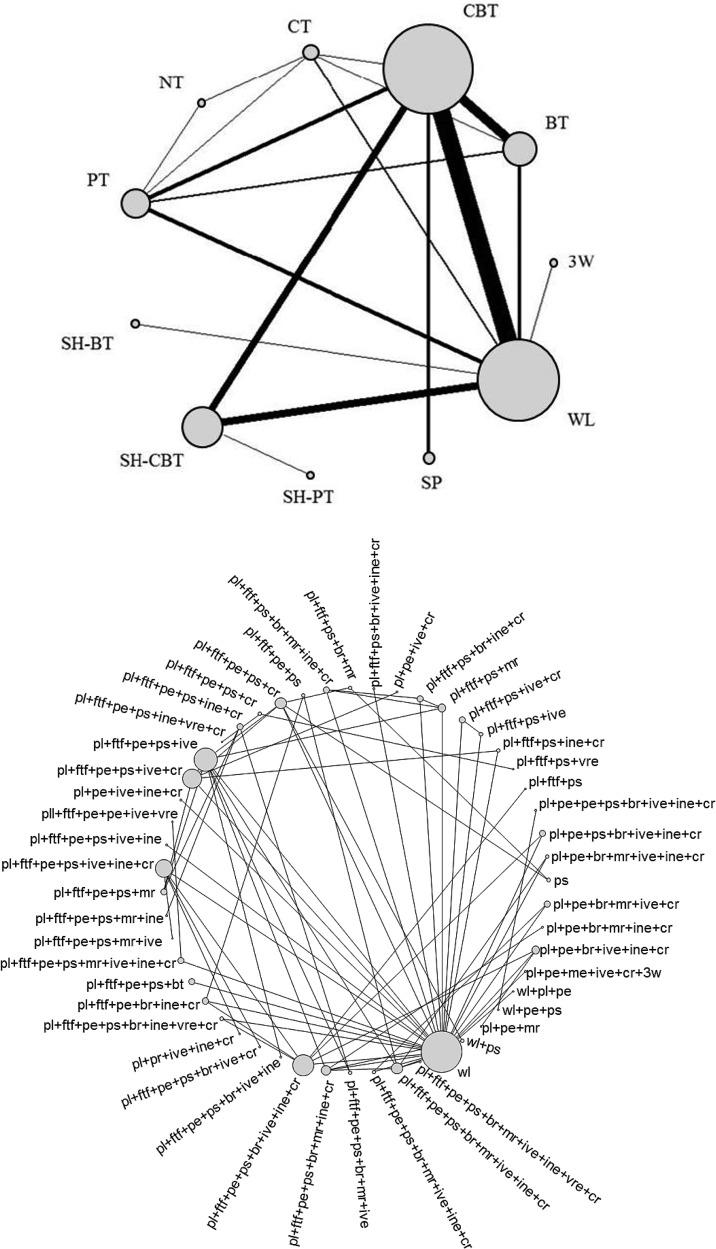
Cognitive-behaviour therapy (CBT) for panic disorder may consist of different combinations of several therapeutic components such as relaxation , breathing retraining , cognitive restructuring , interoceptive exposure and/or in vivo exposure . It is therefore important both theoretically and clinically to examine whether specific components of CBT or their combinations are superior to others in the treatment of panic disorder. Component network meta-analysis (NMA) is an extension of standard NMA that can be used to disentangle the treatment effects of different components included in composite interventions. We searched MEDLINE, EMBASE, PsycINFO and Cochrane Central, with supplementary searches of reference lists and clinical trial registries, for all randomized controlled trials comparing different CBT-based psychological therapies for panic disorder with each other or with control interventions. We applied component NMA to disentangle the treatment effects of different components included in these interventions. After reviewing 2526 references, we included 72 studies with 4064 participants. Interoceptive exposure and face-to-face setting were associated with better treatment efficacy and acceptability. Muscle relaxation and virtual-reality exposure were associated with significantly lower efficacy. Components such as breathing retraining and in vivo exposure appeared to improve treatment acceptability while having small effects on efficacy. The comparison of the most v. the least efficacious combination, both of which may be provided as ‘evidence-based CBT,’ yielded an odds ratio for the remission of 7.69 (95% credible interval: 1.75 to 33.33). Effective CBT packages for panic disorder would include face-to-face and interoceptive exposure components, while excluding muscle relaxation and virtual-reality exposure .
Overview
The claims and statistics of this paper haven’t been checked yet.
Free: it reads the open-access text and checks the first 5 claims that cite a source we can check. Create a free account to check every claim.
Integrity signals
Registry
Cites
Statistics
Figures
Verification
Claims the paper makes
The claims and statistics of this paper haven’t been checked yet.
Free: it reads the open-access text and checks the first 5 claims that cite a source we can check. Create a free account to check every claim.
Claims other papers make about this one
Each is checked against this paper’s own text: does it say what the citing paper says it does?
The cited source doesn’t support the claim as written.
In the citing paper
“confirms the results of several studies which found that effective CBT for PD is based on interoceptive exposure while excluding other components such as cognitive restructuring (Longmore & Worrell., 2007; Pompoli et al., 2018).”
From Managing emotions in panic disorder: A systematic review of studies related to emotional intelligence, alexithymia, emotion regulation, and coping (2023) · cites this paper as Pompoli et al., 2018
Checked by a reasoning model — may be wrong.
Experimental — accuracy not yet measuredThe source backs part of the claim, not all of it — or backs it for a different population, condition or comparison.
In the citing paper
“Exposure and interoceptive exposure are two of the most effective components of face-to-face CBT [26, 27].”
From Efficacy of an Internet-based intervention with self-applied exposure therapy in virtual reality for people with panic disorder: study protocol for a randomized controlled trial (2023) · cites this paper as [26]
Experimental — accuracy not yet measuredThe source backs part of the claim, not all of it — or backs it for a different population, condition or comparison.
In the citing paper
“Exposure therapy is an evidence-based treatment for anxiety and considered to be an essential element of CBT protocols (Parker et al., 2018;Pompoli et al., 2018).”
From A mixed methods study of autistic adults' mental health therapy experiences (2023) · cites this paper as Pompoli et al., 2018
Experimental — accuracy not yet measuredIn the citing paper
“the cNMA of CBT for panic disorder has identified muscle relaxation as detrimental.”
Self-check
Percentages, sums and reported differences re-computed from the paper’s own numbers.
The self-check needs the paper’s full text.
Citations
Cites
The Cochrane Collaboration's tool for assessing risk of bias in randomised trials
Higgins, J. P. T., Altman, D. G., Gotzsche, P. C., Juni, P., Moher, D., Oxman, A. D., Savovic, J., Schulz, K. F., Weeks, L., Sterne, J. A. C., et al. (2011) · BMJ · doi:10.1136/bmj.d5928 · Cited by 33,817
Dermyshi, E., Wang, Y., Yan, C., Hong, W., Qiu, G., Gong, X., & Zhang, T. (2017) · Neonatology · doi:10.1159/000454668 · Cited by 24,451
Hutton, B., Salanti, G., Caldwell, D. M., Chaimani, A., Schmid, C. H., Cameron, C., Ioannidis, J. P. A., Straus, S., Thorlund, K., Jansen, J. P., et al. (2015) · Annals of Internal Medicine · doi:10.7326/m14-2385 · Cited by 8,269 · cited 1×
“The analyses have been conducted in adherence to a pre-specified protocol registered in PROSPERO (CRD42015027601) and the results are reported following the PRISMA extension statement for network meta-analysis (Hutton et al. 2015).”
Self-citationConsistency and inconsistency in network meta-analysis: concepts and models for multi-arm studies
Higgins, J. P. T., Jackson, D., Barrett, J. K., Lu, G., Ades, A. E., & White, I. R. (2012) · Research Synthesis Methods · doi:10.1002/jrsm.1044 · Cited by 2,098
The BUGS project: evolution, critique and future directions
Lunn, D., Spiegelhalter, D., Thomas, A., & Best, N. (2009) · Statistics in Medicine · doi:10.1002/sim.3680 · Cited by 1,876 · cited 1×
“We fitted the model in a Bayesian framework, using OpenBUGS (Lunn et al. 2009) and uncertainty in the results was conveyed by the 95% credible intervals (CrI).”
Katzman, M. A., Bleau, P., Blier, P., Chokka, P., Kjernisted, K., Van Ameringen, M., & the Canadian Anxiety Guidelines Initiative Group on behalf of the Anxiety Disorders Association of Canada/Association Canadienne des troubles anxieux and McGill University (2014) · BMC Psychiatry · doi:10.1186/1471-244x-14-s1-s1 · Cited by 1,090 · cited 1×
“Among various psychological therapies, guidelines recommend the use of cognitive-behaviour psychotherapy (CBT) (American Psychiatric Association, 1998; Royal Australian & New Zealand College of Psychiatrists, 2003; NICE, 2011; Katzman et al. 2014).”
Turner, R. M., Davey, J., Clarke, M. J., Thompson, S. G., & Higgins, J. P. (2012) · International Journal of Epidemiology · doi:10.1093/ije/dys041 · Cited by 837 · cited 5×
“In order to interpret the magnitude of the estimated heterogeneity (τ), for each outcome we compared the estimated heterogeneity with the expected value, defined in accordance with the empirical distributions for comparing non-pharmacological interventions for a subjective outcome (Turner et al. 2012) (median for hete…”
InfluentialCuijpers, P., Donker, T., van Straten, A., Li, J., & Andersson, G. (2010) · Psychological Medicine · doi:10.1017/s0033291710000772 · Cited by 832 · cited 2×
“Although two previous reviews, exploring self-help v. face-to-face CBT for various anxiety disorders (Cuijpers et al. 2010; Lewis et al. 2012), did not detect important differences between the two delivery forms when analyses were restricted to studies focusing on panic disorder, a more recent…”
Kessler, R. C., Chiu, W. T., Jin, R., Ruscio, A. M., Shear, K., & Walters, E. E. (2006) · Archives of General Psychiatry · doi:10.1001/archpsyc.63.4.415 · Cited by 795 · cited 2×
“Panic disorder is common in the general population, with a life-time prevalence of 3.7% without agoraphobia and 1.1% with agoraphobia (Kessler et al. 2006).”
InfluentialApplied relaxation: Description of a coping technique and review of controlled studies
Öst, L.-G. (1987) · Behaviour Research and Therapy · doi:10.1016/0005-7967(87)90017-9 · Cited by 605
Research works printed but not linked: 4
- 6. Clark DM and Salkovskis PM (1986) Cognitive Treatment of Panic: Therapist's Manual. Oxford: Department of Psychiatry, University of Oxford.
- 2. American Psychiatric Association (2013) Diagnostic and Statistical Manual of Mental Disorders, 5th edn. Arlington, VA: American Psychiatric Association.
- 17. Karekla M (2004) A comparison between acceptance enhanced cognitive behav- ioral and panic control treatment for panic disorder. Doctoral Dissertation, New York: University at Albany, State University of New York.
- 23. NICE (2011) Generalised Anxiety Disorder and Panic Disorder in Adults: Management. London: National Institute for Health and Care Excellence.
Cited by
Items 101–200 of 249
Samantaray, N. N., Singh, P., & Sudhir, P. M. (2022) · Asian Journal of Psychiatry · doi:10.1016/j.ajp.2022.103069 · Cited by 5
Gan, Y., Huang, S., Luo, M.-Q., Chen, M., & Zheng, H. (2022) · Acupuncture in Medicine · doi:10.1177/09645284221085280 · Cited by 6
Chapter 5. Transference-Focused Psychotherapy for Levels of Personality Pathology Severity
Clarkin, J. F., Caligor, E., & Sowislo, J. F. (2022) · American Psychiatric Association Publishing eBooks · doi:10.1176/appi.books.9781615375233.gg05 · Cited by 6
Chapter 4. Theory and Practice of Mentalization-Based Treatment
BATEMAN, A. W., Choi-Kain, L. W., & Unruh, B. T. (2022) · American Psychiatric Association Publishing eBooks · doi:10.1176/appi.books.9781615375233.gg04 · Cited by 8
Can mindfulness modify your thoughts? A study in the context of social phobia
Salam, A., & Sharma, M. P. (2021) · European Review of Applied Psychology · doi:10.1016/j.erap.2021.100727 · Cited by 3
Muotri, R. W., Luciano, A. C., Guirado, A. G., Neto, F. L., & Bernik, M. (2026) · Frontiers in Psychiatry · doi:10.3389/fpsyt.2025.1739639 · Cited by 6
Chapter 2. Techniques of Psychodynamic Psychotherapy
Gabbard, G. O., & Crisp-Han, H. (2022) · American Psychiatric Association Publishing eBooks · doi:10.1176/appi.books.9781615375233.gg02 · Cited by 4
de Oliveira‐Souza, A. I. S., da Silva, J. B., Gross, D. P., da Costa, B. R., Ballenberger, N., Pereira, T., Dennett, L., & Armijo-Olivo, S. L. (2025) · Systematic Reviews · doi:10.1186/s13643-024-02737-4 · Cited by 9
Cognitive-Behavioral Treatment for Breathlessness in Lung Cancer: A Randomized Controlled Trial
Lo, S. B., Arrato, N. A., Presley, C. J., McGinty, H. L., Otto, M. W., & Andersen, B. L. (2025) · Annals of the American Thoracic Society · doi:10.1513/annalsats.202406-580oc · Cited by 3
Wintermann, G., Noack, R., Steudte‐Schmiedgen, S., & Weidner, K. (2022) · PLoS ONE · doi:10.1371/journal.pone.0273413 · Cited by 7
“In particular, interoceptive exposure is associated with better treatment efficacy and acceptability [19].”
BackgroundPerceptual Dysfunction in Eating Disorders
Reilly, E. E., Brown, T. A., & Frank, G. (2024) · Current topics in behavioral neurosciences · doi:10.1007/7854_2024_470 · Cited by 3
Waqas, A., Sikander, S., Malik, A., Atif, N., & Rahman, A. (2024) · Cambridge Prisms Global Mental Health · doi:10.1017/gmh.2024.116 · Cited by 5
“Individual Patient Data meta-analytical approaches are increasingly being used to identify different treatment elements to match with different subtypes of depression [(Furukawa et al., 2021; Pompoli et al., 2018).”
Stangier, U., Kohl, V., Görg, N., Sendig, L., Hufschmidt, B., Bonarius, D., Nemani, A., Ebert, M., & Hofmann, S. G. (2024) · Trials · doi:10.1186/s13063-024-08689-3 · Cited by 2
Bäckman, L., Weineland, S., Vernmark, K., Radvogin, E., Bjälkebring, P., Enbuske, E., Hermansson, I., Johansson, N., Petersen, N., & Hursti, T. (2026) · Scandinavian Journal of Psychology · doi:10.1111/sjop.70045 · Cited by 2
“Cognitive Behavioral Therapy (CBT) is a well-established treatment for PD (Pompoli et al. 2018; Rabasco et al. 2022).”
A Series of Panic Disorder Cases Treated with Detached Mindfulness
Atmaca, M., Tabara, M. F., & Gürok, M. G. (2024) · ALPHA PSYCHIATRY · doi:10.5152/alphapsychiatry.2024.241614 · Cited by 3
Virtual Reality in the Treatment of Panic Disorder in the Last Decade: A Systematic Review
Gonçalves, L. L., Ferreira-Garcia, R., Quagliato, L. A., Appolinário, J. C., & Nardi, A. E. (2025) · Clinical Practice and Epidemiology in Mental Health · doi:10.2174/0117450179358928250123064503 · Cited by 3
Guth, M., Wiebe, A., Ekhlas-Schumann, M., Rodenjohann, A., Rohlfsen, F., Buchholz, J., Selaskowski, B., Philipsen, A., & Braun, N. (2025) · Journal of Medical Internet Research · doi:10.2196/76389 · Cited by 11
“Interoceptive exposure and in vivo exposure are considered core features of CBT for PD with and without agoraphobia, and a component network meta-analysis identified interoceptive exposure as a particularly effective component of such therapies [7,9].”
Çokluk, G. F. (2026) · Frontiers in Psychiatry · doi:10.3389/fpsyt.2025.1691529 · Cited by 2
Biomarkers of Anxiety Acquisition and Generalization in Virtual Reality Experiments
Genheimer, H., Pauli, P., & Andreatta, M. (2022) · Zeitschrift für Klinische Psychologie und Psychotherapie · doi:10.1026/1616-3443/a000658 · Cited by 2
Emotional Support Dialog System Through Recursive Interactions Among Large Language Models
Chen, K., Lian, H., Gao, Y., & Li, Y. (2024) · Communications in computer and information science · doi:10.1007/978-981-97-0601-3_13 · Cited by 2
Schultz, J., Baumeister, A., Schmotz, S., Schuurmans, L., & Jelinek, L. (2025) · Deutsches Ärzteblatt international · doi:10.3238/arztebl.m2024.0246 · Cited by 4
Tailoring Interoceptive Exposure for Patients With Medical Comorbidities
Farris, S. G., Kibbey, M. M., Derby, L., Keller, B., Hoyt, D. L., Brinkman, H. R., Alderman, B. L., & Leyro, T. M. (2024) · Cognitive and Behavioral Practice · doi:10.1016/j.cbpra.2024.11.001 · Cited by 2
Huppert, J. D. (2021) · Elsevier eBooks · doi:10.1016/b978-0-12-818697-8.00226-0 · Cited by 4
Hamatani, S., Matsumoto, K., Kunisato, Y., Okawa, S., Yamashita, M., & Mizuno, Y. (2023) · BMJ Open · doi:10.1136/bmjopen-2022-068547 · Cited by 2
Cognitive and emotional vulnerability to panic disorder: presenting an integrative model
Oussi, A., & Bouvet, C. (2023) · Current Psychology · doi:10.1007/s12144-023-05163-2 · Cited by 5
“…with panic, may not be the most effective, and confirms the results of several studies that have shown that effective therapy for PD is based primarily on interoceptive exposure, while excluding cognitive reappraisal (Longmore & Worrell, 2007; Pompoli et al., 2018; Sánchez-Meca et al., 2010).”
Chapter 35. Combining Medications and Psychotherapy
Mintz, D. L. (2022) · American Psychiatric Association Publishing eBooks · doi:10.1176/appi.books.9781615375233.gg35 · Cited by 5
Chapter 21. Theories and Techniques of Group Therapy
Bhatt-Mackin, S. M., & Leszcz, M. (2022) · American Psychiatric Association Publishing eBooks · doi:10.1176/appi.books.9781615375233.gg21 · Cited by 2
Chapter 32. Professional Boundaries and Ethics in Psychotherapy
Gabbard, G. O., & Crisp-Han, H. (2022) · American Psychiatric Association Publishing eBooks · doi:10.1176/appi.books.9781615375233.gg32 · Cited by 1
Farris, S. G., Zvolensky, M. J., Garey, L., & Businelle, M. S. (2025) · Cognitive Behaviour Therapy · doi:10.1080/16506073.2024.2447722 · Cited by 2
“There is a strong evidence basis for the efficacy of IE exercises as a specific treatment component in panic disorder (Craske et al., 1997, 2003; Gould et al., 1995; Ito et al., 1996; Pompoli et al., 2018) as well as to target anxiety sensitivity (Fitzgerald et al., 2021).”
Ko, Y., Lee, J., Ham, K., Cho, Y., Shin, Y., Min, C., Kim, K., Jang, W. S., Jung, H., & Kim, J. (2025) · JMIR Formative Research · doi:10.2196/76843 · Cited by 2
“For panic disorder, CBT involves psychoeducation, cognitive restructuring, interoceptive and situational exposure, and breathing retraining [5].”
Luo, Y., Miao, Y., Zhao, Y., Li, J., Guo, R., & Wu, Y. X. (2026) · Worldviews on Evidence-Based Nursing · doi:10.1111/wvn.70136 · Cited by 2
Pahlen, L., Fechtelpeter, J., Hufschmidt, B., Kohl, V., Ebert, M., Fiehn, H., Nemani, A., Hofmann, S. G., & Stangier, U. (2026) · Psychotherapy Research · doi:10.1080/10503307.2026.2666624 · Cited by 1
Kang, D. H., Hwang, H., Kim, D. S., 김혜리, Kwak, S., Kim, C., & Choi, S. (2026) · Internet Interventions · doi:10.1016/j.invent.2026.100977 · Cited by 1
“…efficacy, but many previously evaluated programs deliver a fixed sequence of modules with limited accommodation for individual differences in treatment progress or symptom fluctuation (Jung et al., 2025; Allen et al., 2016; Pompoli et al., 2018; Farvolden et al., 2005; Rubel et al., 2024).”
Cognitive Behavioral Therapy for Anxiety Disorders
Todd, G., & Branch, R. (2021) · Cambridge University Press eBooks · doi:10.1017/9781108355605.003 · Cited by 1
Twohig, M. P., Petersen, J. M., & Miguel, G. G. S. (2022) · Springer eBooks · doi:10.1007/978-3-031-11677-3_14 · Cited by 2
Chapter 13. Theories of Interpersonal Therapy
Lipsitz‐Odess, I., Lipsitz, J. D., & Markowitz, J. C. (2022) · American Psychiatric Association Publishing eBooks · doi:10.1176/appi.books.9781615375233.gg13 · Cited by 1
Chapter 6. Applications of Psychodynamic Psychotherapy to Specific Disorders
Leichsenring, F., & Steinert, C. (2022) · American Psychiatric Association Publishing eBooks · doi:10.1176/appi.books.9781615375233.gg06 · Cited by 3
Chapter 26. How Our Mind Becomes Racialized: Implications for the Therapeutic Encounter
Stoute, B. J. (2022) · American Psychiatric Association Publishing eBooks · doi:10.1176/appi.books.9781615375233.gg26 · Cited by 2
Fear Conditioning Biases in Anxiety Disorders: A Matter of Interpretation?
Scheveneels, S., & Boddez, Y. (2023) · CBT: science into practice · doi:10.1007/978-3-031-23650-1_7 · Cited by 1
Cognitive-Behavioral Therapy for Panic Disorder
Baker, A. W., & Levine, D. S. (2023) · Current clinical psychiatry · doi:10.1007/978-3-031-29368-9_7 · Cited by 1
Belltall, A., Mazzinari, G., Eochagáin, A. N., Wall, T., Neto, A. S., Díaz‐Cambronero, Ó., Sessler, D. I., Buggy, D. J., Cata, J. P., & Hollmann, M. W. (2024) · BMJ Open · doi:10.1136/bmjopen-2024-089024 · Cited by 1
“33 We will first fit the models by considering the influence of individual components as additive.”
Canello, T., Tlaie, A., Chalise, K., Schölvinck, M. L., Pia, L., & Havenith, M. N. (2026) · Scientific Reports · doi:10.1038/s41598-026-59995-6 · Cited by 3
Yığman, F., Efe, C., Ekici, E., & Özdel, K. (2021) · International Journal of Cognitive Therapy · doi:10.1007/s41811-021-00099-6 · Cited by 1
In‐Albon, T., & Margraf, J. (2020) · Springer eBooks · doi:10.1007/978-3-662-61814-1_47 · Cited by 1
Chapter 8. Techniques of Cognitive-Behavioral Therapy
Wright, J. H., Reis, J., & Casey, D. (2022) · American Psychiatric Association Publishing eBooks · doi:10.1176/appi.books.9781615375233.gg08 · Cited by 4
Gao, F., He, H., Yan, B., Yang, J., Fan, Y., Bingbing, Z., He, X., Ma, Q., Li, B., Gao, Y., et al. (2020) · medRxiv · doi:10.1101/2020.02.27.20028605 · Cited by 1
“We only applied this definition of CBT because it is the most widely studied, and it has been validated that the co-administration of cognitive and behavioral therapeutic components is superior to administering behavioral components alone.(12) We included both individual and group therapies.”
MethodFurukawa, Y., Sakata, M., Yamamoto, R., Nakajima, S., Kikuchi, S., Inoue, M., Ito, M., Noma, H., Takashina, H. N., Funada, S., et al. (2023) · medRxiv · doi:10.1101/2023.05.19.23290084 · Cited by 2
Self-citationCochrane, M. (2018) · UVic’s Research and Learning Repository (University of Victoria)
保健医療分野への認知行動療法の適用と課題—うつ病・不安症/不安関連障害・摂食障害について—
順一, 齋., 望, 富., & 宏昭, 熊. (2020) · doi:10.24468/jjbct.19-003
Mancini, F., & Rogier, G. (2021) · QUADERNI DI PSICOTERAPIA COGNITIVA · doi:10.3280/qpc48-2021oa12143
Rakowska, J. M. (2021) · Wydawnictwa Uniwersytetu Warszawskiego eBooks · doi:10.31338/uw.9788323547655 · Cited by 2
Bailey, R. (2021) · Cambridge University Press eBooks · doi:10.1017/9781108355605.005 · Cited by 1
Margraf, J., & Pittig, A. (2021) · Elsevier eBooks · doi:10.1016/b978-3-437-21352-6.00012-2 · Cited by 1
Jones, A. W., McKenzie, J. E., Osadnik, C. R., Stovold, E. M., Cox, N. S., Burge, A. T., Lahham, A., Lee, J. Y. T., Hoffman, M., & Holland, A. E. (2022) · Cochrane Database of Systematic Reviews · doi:10.1002/14651858.cd015153 · Cited by 1
(2022) · Elsevier eBooks · doi:10.1016/b978-2-294-77735-6.00014-8
Waqas, A., & Rahman, A. (2022) · Elsevier eBooks · doi:10.1016/b978-0-323-91709-4.00010-x · Cited by 2
Chapter 14. Techniques of Individual Interpersonal Psychotherapy
Swartz, H. A. (2022) · American Psychiatric Association Publishing eBooks · doi:10.1176/appi.books.9781615375233.gg14 · Cited by 1
Chapter 17. Techniques of Individual Supportive Psychotherapy
Rosenthal, R. N., Urmanche, A. A., & Muran, J. C. (2022) · American Psychiatric Association Publishing eBooks · doi:10.1176/appi.books.9781615375233.gg17 · Cited by 2
Chapter 36. Supervision and Consultation in Psychotherapy
Crisp-Han, H., & Gabbard, G. O. (2022) · American Psychiatric Association Publishing eBooks · doi:10.1176/appi.books.9781615375233.gg36
Chapter 15. Efficacy, Indications, and Applications of Individual Interpersonal Psychotherapy
Markowitz, J. C. (2022) · American Psychiatric Association Publishing eBooks · doi:10.1176/appi.books.9781615375233.gg15
Chapter 20. Theories and Techniques of Couple Therapy
Lebow, J. L., & Garcia, R. (2022) · American Psychiatric Association Publishing eBooks · doi:10.1176/appi.books.9781615375233.gg20
Chapter 34. Psychotherapy and Cyberspace
Yellowlees, P., & Shore, J. H. (2022) · American Psychiatric Association Publishing eBooks · doi:10.1176/appi.books.9781615375233.gg34
Chapter 12. Dialectical Behavior Therapy: Efficacy, Applications, and Adaptations
Sonley, A. K. I., Boritz, T. Z., & McMain, S. (2022) · American Psychiatric Association Publishing eBooks · doi:10.1176/appi.books.9781615375233.gg12
Chapter 10. Theory in Dialectical Behavior Therapy
Chapman, A. L., & Kaufman, E. A. (2022) · American Psychiatric Association Publishing eBooks · doi:10.1176/appi.books.9781615375233.gg10
Chapter 31. Psychotherapy With Trans and Gender Diverse People
McIntosh, C., & Brown, N. (2022) · American Psychiatric Association Publishing eBooks · doi:10.1176/appi.books.9781615375233.gg31
Winston, A., & Punko, D. (2022) · American Psychiatric Association Publishing eBooks · doi:10.1176/appi.books.9781615375233.gg18
Chapter 30. Psychotherapy With Bisexual Patients
Marcus, B. F. (2022) · American Psychiatric Association Publishing eBooks · doi:10.1176/appi.books.9781615375233.gg30
Chapter 24. South Asian Americans
Tummala–Narra, P., & Kanwal, G. S. (2022) · American Psychiatric Association Publishing eBooks · doi:10.1176/appi.books.9781615375233.gg24 · Cited by 1
Chapter 19. Family Therapy: Systemic Concepts and Methods
Rolland, J. S., & Walsh, F. W. (2022) · American Psychiatric Association Publishing eBooks · doi:10.1176/appi.books.9781615375233.gg19
Chapter 11. Treatment Techniques in Dialectical Behavior Therapy
Swenson, C. (2022) · American Psychiatric Association Publishing eBooks · doi:10.1176/appi.books.9781615375233.gg11
Gaztambide, D. J. (2022) · American Psychiatric Association Publishing eBooks · doi:10.1176/appi.books.9781615375233.gg25 · Cited by 1
Chapter 16. Theory of Individual Supportive Psychotherapy
Lippert, C. N., Roberts, L. W., Winston, A., & Goldstein, M. (2022) · American Psychiatric Association Publishing eBooks · doi:10.1176/appi.books.9781615375233.gg16 · Cited by 1
Chapter 3. Techniques of Brief Psychodynamic Psychotherapy
Dewan, M. J., Weerasekera, P., Stormon, L., & Jackson, D. J. (2022) · American Psychiatric Association Publishing eBooks · doi:10.1176/appi.books.9781615375233.gg03
Ueng-McHale, J. Y., & Chin, C. R. (2022) · American Psychiatric Association Publishing eBooks · doi:10.1176/appi.books.9781615375233.gg23 · Cited by 3
Chapter 27. Issues Arising in Psychotherapy With LGBTQ+ Patients
Drescher, J., & Fadus, M. C. (2022) · American Psychiatric Association Publishing eBooks · doi:10.1176/appi.books.9781615375233.gg27
Chapter 28. Psychotherapy With Lesbians
Moga, D. E., & Reading, R. A. (2022) · American Psychiatric Association Publishing eBooks · doi:10.1176/appi.books.9781615375233.gg28
Chapter 22. African Americans and Psychotherapeutic Treatment: Challenges and Opportunities
Powell, D. R., & Hart, A. (2022) · American Psychiatric Association Publishing eBooks · doi:10.1176/appi.books.9781615375233.gg22 · Cited by 1
Chapter 29. Psychotherapy With Gay Men
McCommon, B. (2022) · American Psychiatric Association Publishing eBooks · doi:10.1176/appi.books.9781615375233.gg29
Bhatt-Mackin, S. M., McEpplan, A., Dobson, K. S., & Cottraux, J. A. (2022) · American Psychiatric Association Publishing eBooks · doi:10.1176/appi.books.9781615375233.gg09
Hossein, D., Yamini, S., & Vazsonyi, A. T. (2023) · Journal of Family Psychology · doi:10.1037/fam0001161.supp
Axelsson, E., Santoft, F., Särnholm, J., & Ljótsson, B. (2023) · Behavioural and Cognitive Psychotherapy · doi:10.1017/s1352465823000541
“…disorder adhered to a published manual (Carlbring et al ., 2001) and emphasized exposure and response prevention including interoceptive exposure (Pompoli et al ., 2018), while also incorporating the identification and systematic exploration of negative automatic thoughts, breathing retraining,…”
Oussi, A., & Bouvet, C. (2024) · Nordic Psychology · doi:10.1080/19012276.2023.2299474 · Cited by 1
“…psychological and pharmacological treatments for panic disorder (PD) over the past 40 years (see meta-analyses from Andrisano et al., 2013; Pompoli et al., 2018), many individuals, especially disadvantaged populations (low socioeconomic status), globally, do not have access to these…”
Cognitive-Behavioral Therapy, Behavioral Therapy, and Cognitive Therapy
Huguenel, B. M., Miyares, P. E., Wilhelm, S., & Sprich, S. E. (2024) · Elsevier eBooks · doi:10.1016/b978-0-443-11844-9.00015-1 · Cited by 1
da Silva, J. L. C. N., de Albuquerque, L. D. S., & Santo, M. N. D. E. (2024) · doi:10.22533/at.ed.4142413084
Silva, J. C., Cordeiro, L. J. S., Câmara, B. M. N., Andrade, F. C., de Miranda, J. C., Cardoso, L. B., de Goes, M. L. V. M. L., & de Souza, L. A. (2024) · doi:10.22533/at.ed.414241308
QUEIMADURAS NA EMERGÊNCIA CLÍNICA
Chagas, C. J. J. M., Ferreira, T. S., & Neto, Á. B. D. S. (2024) · doi:10.22533/at.ed.41424130810
de Oliveira, A. I. P., Barbosa, N. D., & Viégas, M. D. A. (2024) · doi:10.22533/at.ed.4142413088
Câmara, B. M. N., de Goes, M. L. V. M. L., & Moura, E. D. A. (2024) · doi:10.22533/at.ed.41424130817
DESIDRATAÇÃO NA EMERGÊNCIA PEDIÁTRICA
de Souza, L. A., Alves, L. V. D. S., & Flores, N. D. D. F. (2024) · doi:10.22533/at.ed.4142413087
LEPTOSPIROSE NA EMERGÊNCIA CLÍNICA
de Oliveira, N. A. F., Santos, P. G. S., & Pacheco, L. M. D. M. (2024) · doi:10.22533/at.ed.41424130813
Cardoso, L. B., Rocha, M. G. C. D. V., & Viégas, M. D. A. (2024) · doi:10.22533/at.ed.41424130815
INTUBAÇÃO OROTRAQUEAL NA EMERGÊNCIA
de Miranda, J. C., Andrade, F. C., & Laranjeira, A. C. M. (2024) · doi:10.22533/at.ed.4142413082
Costa, N. T., & Sobrinho, M. C. D. A. (2024) · doi:10.22533/at.ed.4142413083
Ramos, I. M. P., de Almeida, M. A., & Fidelis, F. A. P. (2024) · doi:10.22533/at.ed.41424130811
Cordeiro, L. J. S., & Viégas, M. D. A. (2024) · doi:10.22533/at.ed.4142413081
ACIDENTE VASCULAR CEREBRAL ISQUÊMICO
Balbino, L. J., Borges, K. K. D. A. V., & Barbosa, L. M. M. (2024) · doi:10.22533/at.ed.41424130812
Campêlo, B. S., de Araújo, D. L. F., & Filho, E. V. G. (2024) · doi:10.22533/at.ed.4142413089
de Felice, G., & Pincus, D. (2024) · Psychiatry International · doi:10.3390/psychiatryint5040054
Muotri, R. W., Luciano, A. C., Guirado, A. G., Neto, F. L., & Bernik, M. (2024) · SSRN Electronic Journal · doi:10.2139/ssrn.4977828
(2024) · Elsevier eBooks · doi:10.1016/b978-0-443-23565-8.09996-8
Metadata
- Authors
- Pompoli, A., Furukawa, T. A., Efthimiou, O., Imai, H., Tajika, A., & Salanti, G.
- Affiliations
- Kyoto University (JP)
- University of Bern (CH)
- Corresponding author
- Furukawa, Toshi A.
- Venue
- Psychological Medicine
- Publisher
- Cambridge University Press (CUP)
- Published
- 2018-01-25
- Volume
- 48
- Issue
- 12
- Pages
- 1945-1953
- ISSN
- 0033-2917 (ISSN-L)
- 1469-8978
- PMC
- PMC6137372
- OpenAlex
- W2785377192
- Cited by
- 249
- References
- 35
- Citations by year
- 2026: 30 · 2025: 36 · 2024: 36 · 2023: 29 · 2022: 60 · 2021: 28 · 2020: 14 · 2019: 9 · 2018: 7
- FWCI
- 2.31
- Type
- journal article
- Language
- en
- Open access
- hybrid
- doi.org
- Locations
- Psychological Medicine (publishedVersion, cc-by)
- Europe PMC (PubMed Central) (publishedVersion, cc-by)
- PubMed Central (publishedVersion, cc-by)
- PubMed (publishedVersion)
- Bern Open Repository and Information System (University of Bern) (submittedVersion, cc-by)
- Open Access CRIS of the University of Bern
- Funders
- Eli Lilly and Company
- Pfizer
- Japan Society for the Promotion of Science (26670314)
- Topics
- Social Sciences › Psychology › Experimental and Cognitive Psychology › Anxiety, Depression, Psychometrics, Treatment, Cognitive Processes
- Social Sciences › Psychology › Applied Psychology › Digital Mental Health Interventions
- Social Sciences › Psychology › Clinical Psychology › Psychotherapy Techniques and Applications
- Keywords
- panic disorder, cognitive behavioral therapy, interoceptive exposure, in vivo exposure, breathing retraining, muscle relaxation, virtual reality exposure, cognitive restructuring, treatment acceptability, treatment efficacy, face-to-face therapy, remission
- MeSH terms
- Network Meta-Analysis, Humans, Outcome and Process Assessment, Health Care, Cognitive Behavioral Therapy, Panic Disorder
About these checks
Registry, retraction, Cites and statistics results are computed, not judged, with one exception: a printed reference that no index lists is read once by a model before it counts as a citation error. Claims are extracted by a model and kept only when their quote appears verbatim in the text; each cited source is then checked, with a model’s help, for whether it says what the claim relies on. Those verdicts can be wrong — read the claim’s quote and the cited source before relying on one.
Statistics and arithmetic are recomputed, not judged.
Confidence bands are shown only for fields calibrated on our annotated test set. None is calibrated yet, so no band is shown.
What counts as a claim ›How we measure confidence ›How we check this ›
Are you an author, or do you see a problem with this page? Request a review
Data sources
Bibliographic data: Semantic Scholar, OpenAlex, Crossref.
Contains information from the Semantic Scholar Academic Graph Datasets, made available under the ODC Attribution License (ODC-BY 1.0).
Semantic Scholar’s data is described in: Kinney, R., et al. (2023). The Semantic Scholar Open Data Platform. arXiv:2301.10140.
