

The DOI matches its Crossref record; 104 of the 104 references it cites were found in a registry or an index.
What is mood? A computational perspective
Open accessAbstract
The neurobiological understanding of mood, and by extension mood disorders, remains elusive despite decades of research implicating several neuromodulator systems. This review considers a new approach based on existing theories of functional brain organisation. The free energy principle (a.k.a. active inference), and its instantiation in the Bayesian brain, offers a complete and simple formulation of mood. It has been proposed that emotions reflect the precision of - or certainty about - the predicted sensorimotor/interoceptive consequences of action. By extending this reasoning, in a hierarchical setting, we suggest mood states act as (hyper) priors over uncertainty (i.e. emotions). Here, we consider the same computational pathology in the proprioceptive and interoceptive (behavioural and autonomic) domain in order to furnish an explanation for mood disorders. This formulation reconciles several strands of research at multiple levels of enquiry.
Overview
The claims and statistics of this paper haven’t been checked yet.
Run the check — free, no account needed. It reads the open-access text and checks the sources it cites.
Integrity signals
Registry
Cites
Statistics
Figures
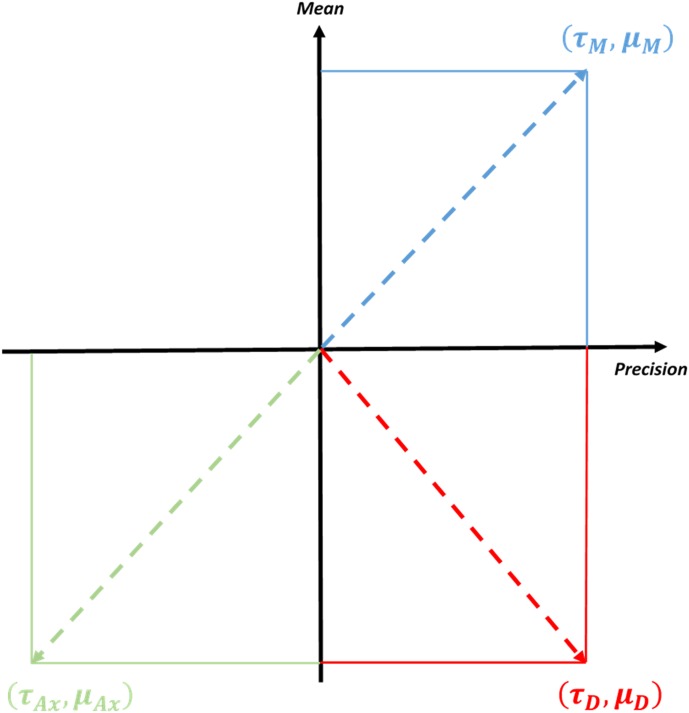
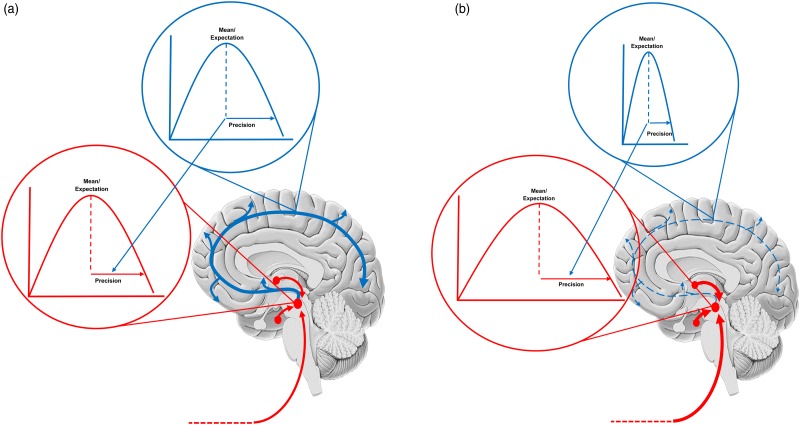
Verification
Claims the paper makes
The claims and statistics of this paper haven’t been checked yet.
Run the check — free, no account needed. It reads the open-access text and checks the sources it cites.
Claims other papers make about this one
Each is checked against this paper’s own text: does it say what the citing paper says it does?
The cited source says what the claim attributes to it.
In the citing paper
“High-level priors constraining more domain-general affective states such as mood (Clark et al. 2018) would also be relaxed under the REBUS model.”
From Consciousness in active inference: Deep self-models, other minds, and the challenge of psychedelic-induced ego-dissolution (2021) · cites this paper as Clark et al. 2018
Self-check
Percentages, sums and reported differences re-computed from the paper’s own numbers.
The self-check needs the paper’s full text.
Citations
Cites
Molecular Mechanisms of Depression: Perspectives on New Treatment Strategies
Lang, U. E., & Borgwardt, S. (2013) · Cellular Physiology and Biochemistry · doi:10.1159/000350094 · Cited by 8,525
The free-energy principle: a unified brain theory?
Friston, K. (2010) · Nature Reviews Neuroscience · doi:10.1038/nrn2787 · Cited by 8,120 · cited 2×
“However, modern accounts of brain function reject the classical notion of the brain as a passive organ in favour of theories of embodiment and self-organisation (Friston, 2010; Seth, 2013; Corlett & Fletcher, 2014).”
BackgroundHelplessness: On Depression, Development, and Death
Seligman, M. E. P. (1975) · CERN Document Server (European Organization for Nuclear Research) · Cited by 6,181
Epigenetic programming by maternal behavior
Weaver, I. C. G., Cervoni, N., Champagne, F. A., D'Alessio, A. C., Sharma, S., Seckl, J. R., Dymov, S., Szyf, M., & Meaney, M. J. (2004) · Nature Neuroscience · doi:10.1038/nn1276 · Cited by 6,177 · cited 2×
“However, they also showed that methylation rates rapidly declined in rodents who were maternally groomed and nurtured while rates remained elevated in neglected pups (Weaver et al. 2004).”
BackgroundResultStress, adaptation, and disease. Allostasis and allostatic load
McEWEN, B. S. (1998) · Annals of the New York Academy of Sciences · doi:10.1111/j.1749-6632.1998.tb09546.x · Cited by 5,092 · cited 1×
“This hierarchical minimisation of prediction errors allows allostatic control over homoeostatic reflexes (Sterling & Eyer, 1988; McEwen, 1998; Ramsay & Woods, 2014).”
BackgroundA Meta-Analysis of Cytokines in Major Depression
Dowlati, Y., Herrmann, N., Swardfager, W., Liu, H., Sham, L., Reim, E. K., & Lanctôt, K. L. (2010) · Biological Psychiatry · doi:10.1016/j.biopsych.2009.09.033 · Cited by 4,729 · cited 1×
“Mood disorders are heterogeneous and complex and depend upon the interplay of several neuromodulator systems and genetic and epigenetic factors (Hirschfeld, 2000; Holsboer, 2000; Nestler & Carlezon, 2006; Nutt et al. 2007; Dowlati et al. 2010; Möhler, 2012).”
BackgroundFriston, K. J., Harrison, L., & Penny, W. (2003) · NeuroImage · doi:10.1016/s1053-8119(03)00202-7 · Cited by 4,583
Requirement of hippocampal neurogenesis for the behavioral effects of antidepressants
Santarelli, L., Saxe, M., Gross, C., Surget, A., Battaglia, F., Dulawa, S., Weisstaub, N., Lee, J., Duman, R., Arancio, O., et al. (2003) · Science · doi:10.1126/science.1083328 · Cited by 4,321 · cited 1×
“Similarly, it has been argued that pharmacotherapy may work via its effects on neurogenesis and synaptic plasticity (Santarelli et al. 2003; Anacker et al. 2011; Castrén & Hen, 2013) and that stressors may leave an indelible scar on key neurobiological systems that disrupts their structure and/or…”
BackgroundHeim, C., & Nemeroff, C. B. (2001) · Biological Psychiatry · doi:10.1016/s0006-3223(01)01157-x · Cited by 2,791 · cited 1×
“In this regard, active inference may explain the established finding that childhood trauma poses a risk for various psychopathologies (Bernet & Stein, 1999; Heim & Nemeroff, 2001; Heim et al. 2008).”
BackgroundCanonical Microcircuits for Predictive Coding
Bastos, A. M., Usrey, W. M., Adams, R. A., Mangun, G. R., Fries, P., & Friston, K. J. (2012) · Neuron · doi:10.1016/j.neuron.2012.10.038 · Cited by 2,421 · cited 2×
“In current predictive coding formulations of the Bayesian brain, expectation and prediction error units are thought to occupy deep and superficial pyramidal layers of cortex, respectively (Friston & Kiebel, 2009; Bastos et al. 2012; Shipp et al. 2013); such that predictions generated, from expectations, at one level o…”
Background
Cited by
Sorted by citations
REBUS and the anarchic brain: Toward a unified model of the brain action of psychedelics
Carhart-Harris, R. L., & Friston, K. J. (2019) · Pharmacological Reviews · doi:10.1124/pr.118.017160 · Cited by 1,180
“We also propose that these pathologic beliefs are ascribed excessive precision, weight, or influence in many psychiatric disorders (Clark et al., 2018).”
BackgroundBeing a Beast Machine: The Somatic Basis of Selfhood
Seth, A. K., & Tsakiris, M. (2018) · Trends in Cognitive Sciences · doi:10.1016/j.tics.2018.08.008 · Cited by 371
“Clark and colleagues similarly emphasize precision, associating major depression with being certain about encountering uncertain environments, thereby precluding effective allostatic regulation [83].”
Emotion words, emotion concepts, and emotional development in children: A constructionist hypothesis
Hoemann, K., Xu, F., & Barrett, L. F. (2019) · Developmental Psychology · doi:10.1037/dev0000686 · Cited by 354
A step-by-step tutorial on active inference and its application to empirical data
Smith, R., Friston, K. J., & Whyte, C. J. (2022) · Journal of Mathematical Psychology · doi:10.1016/j.jmp.2021.102632 · Cited by 246
Deeply Felt Affect: The Emergence of Valence in Deep Active Inference
Hesp, C., Smith, R., Parr, T., Allen, M., Friston, K. J., & Ramstead, M. J. D. (2021) · Neural Computation · doi:10.1162/neco_a_01341 · Cited by 246
“In other contexts, it has been suggested that action model precision updates (what we have labeled AC ) could be used to inform selective attention (e.g., Clark et al., 2018; Palacios, Razi, Parr, Kirchhoff, & Friston, 2019).”
BackgroundSelf-citation
Metadata
- Authors
- Clark, J. E., Watson, S., & Friston, K. J.
- Affiliations
- Newcastle University (GB)
- Cumbria Northumberland Tyne and Wear NHS Foundation Trust (GB)
- University College London (GB)
- Corresponding author
- Clark, James E
- Venue
- Psychological Medicine
- Publisher
- Cambridge University Press (CUP)
- Published
- 2018-02-26
- Volume
- 48
- Issue
- 14
- Pages
- 2277-2284
- ISSN
- 0033-2917 (ISSN-L)
- 1469-8978
- PMC
- PMC6340107
- OpenAlex
- W2789154098
- Cited by
- 204
- References
- 104
- Citations by year
- 2026: 21 · 2025: 28 · 2024: 21 · 2023: 36 · 2022: 34 · 2021: 21 · 2020: 23 · 2019: 17 · 2018: 3
- FWCI
- 2.14
- Type
- journal article
- Language
- en
- Open access
- hybrid
- doi.org
- Locations
- Psychological Medicine (publishedVersion, cc-by)
- Europe PMC (PubMed Central) (publishedVersion, cc-by)
- PubMed Central (publishedVersion, cc-by)
- PubMed (publishedVersion)
- UCL Discovery (University College London) (submittedVersion)
- Newcastle University ePrints (Newcastle Univesity) (cc-by)
- Funders
- Wellcome Trust (088130, 088130/Z/09/Z)
- National Institute for Health and Care Research
- Newcastle University
- Topics
- Life Sciences › Neuroscience › Cognitive Neuroscience › Embodied and Extended Cognition
- Life Sciences › Neuroscience › Cognitive Neuroscience › Neural and Behavioral Psychology Studies
- Social Sciences › Psychology › Experimental and Cognitive Psychology › Anxiety, Depression, Psychometrics, Treatment, Cognitive Processes
- Keywords
- mood, mood disorders, free energy principle, active inference, Bayesian brain, emotions, interoception, proprioception, uncertainty, hyperprior, computational psychiatry
- MeSH terms
- Affect, Brain, Humans, Models, Theoretical, Mood Disorders
About these checks
Registry, retraction, Cites and statistics results are computed, not judged, with one exception: a printed reference that no index lists is read once by a model before it counts as a citation error. Claims are extracted by a model and kept only when their quote appears verbatim in the text; each cited source is then checked, with a model’s help, for whether it says what the claim relies on. Those verdicts can be wrong — read the claim’s quote and the cited source before relying on one.
Statistics and arithmetic are recomputed, not judged.
Confidence bands are shown only for fields calibrated on our annotated test set. None is calibrated yet, so no band is shown.
What counts as a claim ›How we measure confidence ›How we check this ›
Are you an author, or do you see a problem with this page? Request a review
