

The DOI matches its Crossref record; 17 of the 17 references it cites were found in a registry or an index.
Mental health and well-being trends among children and young people in the UK., 1995–2014: Analysis of repeated cross-sectional national health surveys
Open accessAbstract
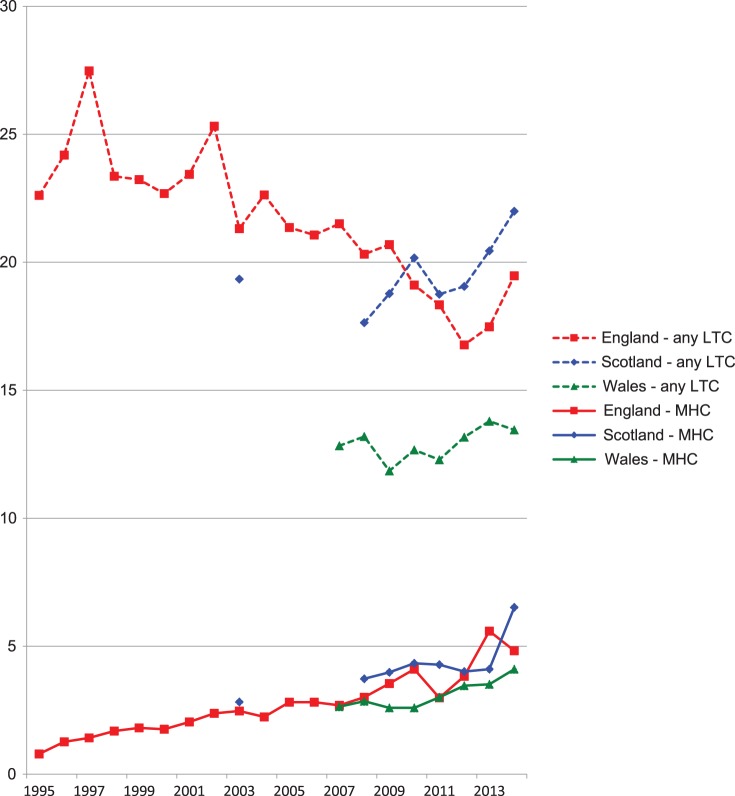
BACKGROUND: There is a growing concern about the mental health of children and young people (CYP) in the UK, with increasing demand for counselling services, admissions for self-harm and referrals to mental health services. We investigated whether there have been similar recent trends in selected mental health outcomes among CYP in national health surveys from England, Scotland and Wales. METHODS: Data were analysed from 140 830 participants (4-24 years, stratified into 4-12, 13-15, 16-24 years) in 36 national surveys in England, Scotland and Wales, 1995-2014. Regression models were used to examine time trends in seven parent/self-reported variables: general health, any long-standing health condition, long-standing mental health condition; Warwick-Edinburgh Mental Wellbeing Score (WEMWBS), above-threshold Strengths and Difficulties Questionnaire Total (SDQT) score, SDQ Emotion (SDQE) score, General Health Questionnaire (GHQ) score. RESULTS: Across all participants aged 4-24, long-standing mental health conditions increased in England (0.8-4.8% over 19 years), Scotland (2.3-6.0%, 11 years) and Wales (2.6-4.1%, 7 years) (all p < 0.001). Among young children (4-12 years), the proportion reporting high SDQT and SDQE scores decreased significantly among both boys and girls in England [SDQE: odds ratio (OR) 0.97 (0.96-0.98), p < 0.001] and girls in Scotland [SDQE: OR 0.96 (0.93-0.99), p = 0.005]. The proportion with high SDQE scores (13-15 years) decreased in England [OR 0.98 (0.96-0.99), p = 0.006] but increased in Wales [OR 1.07 (1.03-1.10), p < 0.001]. The proportion with high GHQ scores decreased among English women (16-24 years) [OR 0.98 (0.98-0.99), p = 0.002]. CONCLUSIONS: Despite a striking increase in the reported prevalence of long-standing mental health conditions among UK CYP, there was relatively little change in questionnaire scores reflecting psychological distress and emotional well-being.
Overview
The claims and statistics of this paper haven’t been checked yet.
Run the check — free, no account needed. It reads the open-access text and checks the sources it cites.
Integrity signals
Registry
Cites
Statistics
Figures
Verification
Claims the paper makes
The claims and statistics of this paper haven’t been checked yet.
Run the check — free, no account needed. It reads the open-access text and checks the sources it cites.
Claims other papers make about this one
Each is checked against this paper’s own text: does it say what the citing paper says it does?
In the citing paper
“An increase in the prevalence of mental health problems and suicide among young people has also been reported in other countries (Padmanathan, Bould, Winstone, Moran, & Gunnell, 2020;Pitchforth et al., 2018;Thorisdottir, Asgeirsdottir, Sigurvinsdottir, Allegrante, & Sigfusdottir, 2017;Wiens et al., 2020).”
From The relationship between screen time and mental health in young people: A systematic review of longitudinal studies (2021) · cites this paper as Pitchforth et al., 2018
Self-check
Percentages, sums and reported differences re-computed from the paper’s own numbers.
The self-check needs the paper’s full text.
Citations
Cites
Kessler, R. C., Berglund, P., Demler, O., Jin, R., Merikangas, K. R., & Walters, E. E. (2005) · Archives of General Psychiatry · doi:10.1001/archpsyc.62.6.593 · Cited by 20,391
Murray, C. J. L., Vos, T., Lozano, R., Naghavi, M., Flaxman, A. D., Michaud, C., Ezzati, M., Shibuya, K., Salomon, J. A., Abdalla, S., et al. (2012) · The Lancet · doi:10.1016/s0140-6736(12)61689-4 · Cited by 8,888
Our future: a Lancet commission on adolescent health and wellbeing
Patton, G. C., Sawyer, S. M., Santelli, J. S., Ross, D. A., Afifi, R., Allen, N. B., Arora, M., Azzopardi, P., Baldwin, W., Bonell, C., et al. (2016) · The Lancet · doi:10.1016/s0140-6736(16)00579-1 · Cited by 3,785
Self-citationThe Validity of Two Versions of the GHQ in the WHO Study of Mental Illness in General Health Care
GOLDBERG, D. P., GATER, R., SARTORIUS, N., USTUN, T. B., PICCINELLI, M., GUREJE, O., & RUTTER, C. (1997) · Psychological Medicine · doi:10.1017/s0033291796004242 · Cited by 3,657
Goodman, R., Ford, T., Simmons, H., Gatward, R., & Meltzer, H. (2000) · British Journal of Psychiatry · doi:10.1192/bjp.177.6.534 · Cited by 1,818
Self-citationAssociation Between Duration of Untreated Psychosis and Outcome in Cohorts of First-Episode Patients
Marshall, M., Lewis, S. W., Lockwood, A., Drake, R., Jones, P. B., & Croudace, T. J. (2005) · Archives of General Psychiatry · doi:10.1001/archpsyc.62.9.975 · Cited by 1,595
Are child and adolescent mental health problems increasing in the 21st century? A systematic review
Bor, W., Dean, A. J., Najman, J., & Hayatbakhsh, R. (2014) · Australian & New Zealand Journal of Psychiatry · doi:10.1177/0004867414533834 · Cited by 853
Annual Research Review: Secular trends in child and adolescent mental health
Collishaw, S. (2015) · Journal of Child Psychology and Psychiatry · doi:10.1111/jcpp.12372 · Cited by 788
Goodman, R., Ford, T. J., Simmons, H. C., Gatward, R., & Meltzer, H. (2003) · International Review of Psychiatry · doi:10.1080/0954026021000046128 · Cited by 707
Self-citationClarke, A., Friede, T., Putz, R., Ashdown, J., Martin, S., Blake, A., Adi, Y., Parkinson, J., Flynn, P., Platt, S., et al. (2011) · BMC Public Health · doi:10.1186/1471-2458-11-487 · Cited by 493
Research works printed but not linked: 7
- 2016, Rise in children hospitalised for self-harm as thousands contact Childline
- Green, 2005, Mental Health of Children and Young People in Great Britain, 2004. A Survey Carried out by the Office for National Statistics on Behalf of the Department of Health and the Scottish Executive
- Hagell, 2015, Key Data on Adolescence 2015
- Parry-Langdon, 2008, Three years on: survey of the development and emotional well-being of children and young people
- 2016, Keeping young people in mind – findings from a survey of schools across England
- Mcshane, 2015, Future in Mind: Promoting, Protecting and Improving our Children and Young People's Mental Health and Wellbeing
- 2016, Implementing the Early Intervention in Psychosis Access and Waiting Time Standard
Cited by
Sorted by citations
Tang, S., Werner-Seidler, A., Torok, M., Mackinnon, A. J., & Christensen, H. (2021) · Clinical Psychology Review · doi:10.1016/j.cpr.2021.102021 · Cited by 284
Wiens, K., Bhattarai, A., Pedram, P., Dores, A., Williams, J., Bulloch, A., & Patten, S. (2020) · Epidemiology and Psychiatric Sciences · doi:10.1017/s2045796020000281 · Cited by 285
Butler, N., Quigg, Z., Bates, R., Jones, L., Ashworth, E., Gowland, S., & Jones, M. (2022) · School Mental Health · doi:10.1007/s12310-022-09502-9 · Cited by 254
Common mental disorders prevalence in adolescents: A systematic review and meta-analyses
da Silva, S. A., Silva, S. U., Ronca, D. B., Gonçalves, V. S. S., Dutra, E. S., & de Carvalho, K. M. B. (2020) · PLoS ONE · doi:10.1371/journal.pone.0232007 · Cited by 292
Mechanisms linking social media use to adolescent mental health vulnerability
Orben, A., Meier, A., Dalgleish, T., & Blakemore, S.-J. (2024) · Nature Reviews Psychology · doi:10.1038/s44159-024-00307-y · Cited by 220
Metadata
- Authors
- Pitchforth, J., Fahy, K., Ford, T., Wolpert, M., Viner, R. M., & Hargreaves, D. S.
- Affiliations
- University College London (GB)
- University of Exeter (GB)
- Anna Freud Centre (GB)
- Nuffield Trust (GB)
- Corresponding author
- Hargreaves, Dougal S.
- Venue
- Psychological Medicine
- Publisher
- Cambridge University Press (CUP)
- Published
- 2018-09-11
- Volume
- 49
- Issue
- 8
- Pages
- 1275-1285
- ISSN
- 0033-2917 (ISSN-L)
- 1469-8978
- PMC
- PMC6518382
- OpenAlex
- W2891723609
- Cited by
- 227
- References
- 17
- Citations by year
- 2026: 13 · 2025: 39 · 2024: 46 · 2023: 34 · 2022: 28 · 2021: 35 · 2020: 26 · 2019: 5 · 2018: 1
- FWCI
- 19.64
- Type
- journal article
- Language
- en
- Open access
- hybrid
- doi.org
- Locations
- Psychological Medicine (publishedVersion, cc-by)
- PubMed Central (publishedVersion, cc-by)
- PubMed (publishedVersion)
- UCL Discovery (University College London) (submittedVersion)
- Figshare (submittedVersion, cc-by)
- Open Research Exeter (University of Exeter) (submittedVersion, cc-by)
- Spiral (Imperial College London) (submittedVersion, cc-by)
- Apollo (University of Cambridge) (submittedVersion, cc-by)
- Apollo (cc-by)
- Funders
- McGill University
- University of Cambridge
- Topics
- Social Sciences › Psychology › Clinical Psychology › Child and Adolescent Psychosocial and Emotional Development
- Health Sciences › Medicine › Psychiatry and Mental health › Mental Health Treatment and Access
- Health Sciences › Medicine › Public Health, Environmental and Occupational Health › Health and Medical Studies
- Keywords
- child and adolescent mental health, mental health trends, well-being, Strengths and Difficulties Questionnaire, Warwick-Edinburgh Mental Well-being Scale, General Health Questionnaire, emotional symptoms, self-rated mental health, sex differences, age differences, health status, chronic disease
- MeSH terms
- Adolescent, Mental Disorders, Child, Child, Preschool, Cross-Sectional Studies, England, Female, Health Surveys, Humans, Male, Mental Health, Psychometrics, Regression Analysis, Scotland, Wales, Prevalence, Young Adult
About these checks
Registry, retraction, Cites and statistics results are computed, not judged, with one exception: a printed reference that no index lists is read once by a model before it counts as a citation error. Claims are extracted by a model and kept only when their quote appears verbatim in the text; each cited source is then checked, with a model’s help, for whether it says what the claim relies on. Those verdicts can be wrong — read the claim’s quote and the cited source before relying on one.
Statistics and arithmetic are recomputed, not judged.
Confidence bands are shown only for fields calibrated on our annotated test set. None is calibrated yet, so no band is shown.
What counts as a claim ›How we measure confidence ›How we check this ›
Are you an author, or do you see a problem with this page? Request a review
