

Continuum beliefs and mental illness stigma: a systematic review and meta-analysis of correlation and intervention studies
Open accessThe DOI matches its Crossref record; 81 of the 82 references it cites were found in a registry or an index.
Abstract
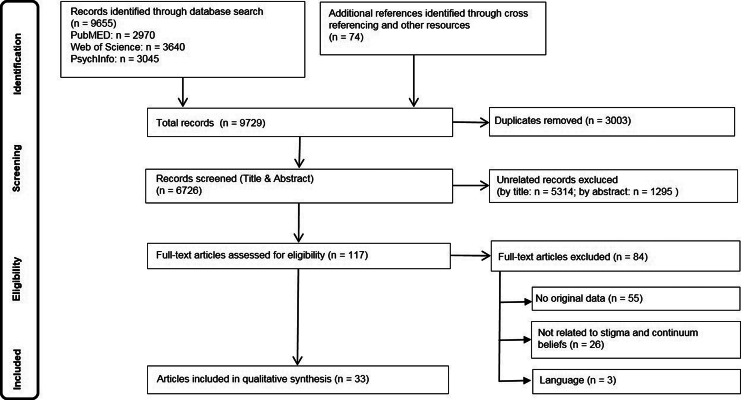
BACKGROUND: Promulgating a continuum model of mental health and mental illness has been proposed as a way to reduce stigma by decreasing notions of differentness. This systematic review and meta-analysis examines whether continuum beliefs are associated with lower stigma, and whether continuum interventions reduce stigma. METHODS: Following a pre-defined protocol (PROSPERO: CRD42019123606), we searched three electronic databases (PubMed, Web of Science, and PsycINFO) yielding 6726 studies. After screening, we included 33 studies covering continuum beliefs, mental illness, and stigma. Of these, 13 studies were included in meta-analysis. RESULTS: Continuum beliefs are consistently associated with lower stigma. Interventions were effective at manipulating continuum beliefs but differ in their effects on stigmatising attitudes. CONCLUSIONS: We discuss whether and to what extent attitudes towards people with mental illness can be improved by providing information on a mental health-mental illness continuum. It appeared to be relevant whether interventions promoted a feeling of 'us' and a process of identification with the person with mental illness. We discuss implications for the design of future interventions.
Overview
The claims and statistics of this paper haven’t been checked yet.
Free: it reads the open-access text and checks the first 5 claims that cite a source we can check. Create a free account to check every claim.
Integrity signals
Registry
Cites
Statistics
Figures
Verification
Claims the paper makes
The claims and statistics of this paper haven’t been checked yet.
Free: it reads the open-access text and checks the first 5 claims that cite a source we can check. Create a free account to check every claim.
Claims other papers make about this one
Each is checked against this paper’s own text: does it say what the citing paper says it does?
In the citing paper
“One review reported that promoting continuum beliefs about mental health-that is, a continuum between mental health and mental health conditions (rather than a dichotomous approach)-gave mixed results for stigma and even found increased stigma in some studies.216”
From The Lancet Commission on ending stigma and discrimination in mental health (2022) · cites this paper as [216]
Self-check
Percentages, sums and reported differences re-computed from the paper’s own numbers.
The self-check needs the paper’s full text.
Citations
Cites
Preferred Reporting Items for Systematic Reviews and Meta-Analyses: the PRISMA statement
Moher, D., Liberati, A., Tetzlaff, J., Altman, D. G., & for the PRISMA Group (2009) · BMJ · doi:10.1136/bmj.b2535 · Cited by 83,823
Measuring inconsistency in meta-analyses
Higgins, J. P. T., Thompson, S. G., Deeks, J. J., & Altman, D. G. (2003) · BMJ · doi:10.1136/bmj.327.7414.557 · Cited by 63,139
Preferred reporting items for systematic reviews and meta-analyses: the PRISMA Statement.
(2009) · PubMed Central · Cited by 44,859
Preferred Reporting Items for Systematic Reviews and Meta-Analyses: The PRISMA Statement
Moher, D., Liberati, A., Tetzlaff, J., & Altman, D. G. (2009) · Journal of Clinical Epidemiology · doi:10.1016/j.jclinepi.2009.06.005 · Cited by 19,575
Borenstein, M., Hedges, L. V., Higgins, J. P. T., & Rothstein, H. R. (2009) · doi:10.1002/9780470743386 · Cited by 14,225
An Integrative Theory of Intergroup Conflict
Tajfel, H., & Turner, J. (2000) · Organizational Identity · doi:10.1093/oso/9780199269464.003.0005 · Cited by 12,487
The Social psychology of intergroup relations
Austin, W. G., & Worchel, S. (1979) · Medical Entomology and Zoology · Cited by 11,622
Borenstein, M., Hedges, L. V., Higgins, J. P. T., & Rothstein, H. R. (2021) · doi:10.1002/9781119558378 · Cited by 9,799
Link, B. G., & Phelan, J. C. (2001) · Annual Review of Sociology · doi:10.1146/annurev.soc.27.1.363 · Cited by 8,848
Downs, S. H., & Black, N. (1998) · Journal of Epidemiology and Community Health · doi:10.1136/jech.52.6.377 · Cited by 8,252 · cited 1×
“We assessed methodological quality using a modified version (see online Supplementary Appendix 2) of a 27 item-checklist originally developed to evaluate clinical intervention studies (Downs & Black, 1998) to allow a comparable risk of bias assessment.”
Method
Cited by
The Lancet Commission on ending stigma and discrimination in mental health
Thornicroft, G., Sunkel, C., Alikhon Aliev, A., Baker, S., Brohan, E., el Chammay, R., Davies, K., Demissie, M., Duncan, J., Fekadu, W., et al. (2022) · The Lancet · doi:10.1016/s0140-6736(22)01470-2 · Cited by 748
The stigma of alcohol-related liver disease and its impact on healthcare
Schomerus, G., Leonhard, A., Manthey, J., Morris, J., Neufeld, M., Kilian, C., Speerforck, S., Winkler, P., & Corrigan, P. W. (2022) · Journal of Hepatology · doi:10.1016/j.jhep.2022.04.026 · Cited by 179
Ooi, L. Q. R., Chen, J., Zhang, S., Kong, R., Tam, A., Li, J., Dhamala, E., Zhou, J. H., Holmes, A. J., & Yeo, B. T. T. (2022) · NeuroImage · doi:10.1016/j.neuroimage.2022.119636 · Cited by 154
McLaren, T., Peter, L.-J., Tomczyk, S., Muehlan, H., Schomerus, G., & Schmidt, S. (2023) · BMC Public Health · doi:10.1186/s12889-022-14937-5 · Cited by 111
“Evidence is sparse for continuum beliefs of people with depression [25], however there are indications that a continuum model increases perceived similarities with a depression vignette [28].”
BackgroundResultDimensional models of personality disorders: Challenges and opportunities
Monaghan, C., & Bizumić, B. (2023) · Frontiers in Psychiatry · doi:10.3389/fpsyt.2023.1098452 · Cited by 82
“Although we know little about whether the dimensional PD approaches would reduce stigma, a recent systematic review shows that continuum beliefs about mental disorders tend to reduce stigma compared to categorical beliefs (199).”
BackgroundPublic stigma and treatment preferences for alcohol use disorders
Finn, S. W., Mejldal, A., & Nielsen, A. S. (2023) · BMC Health Services Research · doi:10.1186/s12913-023-09037-y · Cited by 74
“framing AUD as part of a continuum rather than a dichotomous disorder) could be especially relevant for future studies, as it has also been found to reduce stigma for psychiatric disorders [30].”
BackgroundThe “alcoholic other”: Harmful drinkers resist problem recognition to manage identity threat
Morris, J. K., Moss, A. C., Albery, I. P., & Heather, N. (2021) · Addictive Behaviors · doi:10.1016/j.addbeh.2021.107093 · Cited by 56
Why stigma matters in addressing alcohol harm
Morris, J. K., & Schomerus, G. (2023) · Drug and Alcohol Review · doi:10.1111/dar.13660 · Cited by 59
(Mis)understanding alcohol use disorder: Making the case for a public health first approach
Morris, J. K., Boness, C. L., & Burton, R. (2023) · Drug and Alcohol Dependence · doi:10.1016/j.drugalcdep.2023.111019 · Cited by 46
“Rather, emphasizing psychological and societal facets of AUD (McGinty and Barry, 2020; Rundle et al., 2021), continuum models (Morris et al., 2023b; Peter et al., 2021), context dependent framings (Pennington et al., 2023), or other models of responsibility (Pickard, 2017; Schomerus et al., 2022)…”
Finn, S. W., Mejldal, A., & Nielsen, A. S. (2023) · Archives of Public Health · doi:10.1186/s13690-023-01085-4 · Cited by 47
“The possible benefits of this are twofold, firstly the use of continuum beliefs, compared to the traditional binary belief model, has been found to reduce stigma for psychiatric disorders [27].”
BackgroundEcological Momentary Interventions in Public Mental Health Provision
Schulte‐Strathaus, J. C. C., Rauschenberg, C., Baumeister, H., & Reininghaus, U. (2022) · Studies in neuroscience, psychology and behavioral economics · doi:10.1007/978-3-030-98546-2_25 · Cited by 34
Parent experiences during and after adolescent suicide crisis: A qualitative study
Weissinger, G., Evans, L., Fossen, C. A. V., Winston‐Lindeboom, P., Ruan‐Iu, L., & Rivers, A. S. (2023) · International Journal of Mental Health Nursing · doi:10.1111/inm.13137 · Cited by 37
Schomerus, G., Schindler, S., Baumann, E., & Angermeyer, M. C. (2022) · Social Psychiatry and Psychiatric Epidemiology · doi:10.1007/s00127-022-02272-4 · Cited by 30
“A recent systematic review and meta-analysis found that continuum beliefs are associated with lower social distance, lower fear, lower perceptions of dangerousness and unpredictability, and stronger pro-social reactions [16].”
BackgroundChan, K. K. S., Fung, W. T. W., Leung, D. C. K., & Tsui, J. K. C. (2022) · Health & Social Care in the Community · doi:10.1111/hsc.14047 · Cited by 34
Should we promote alcohol problems as a continuum? Implications for policy and practice
Morris, J. K., Boness, C. L., & Witkiewitz, K. A. (2023) · Drugs Education Prevention and Policy · doi:10.1080/09687637.2023.2187681 · Cited by 25
“A recent systematic review of 13 studies concluded that continuum beliefs regarding mental health issues were associated with lower stigmatizing attitudes, particularly where a feeling of ‘us’ (rather than ‘us’ vs ‘them’) was captured (Peter et al., 2021).”
BackgroundContinuum beliefs of mental illness: a systematic review of measures
Tomczyk, S., Schlick, S., Gansler, T., McLaren, T., Muehlan, H., Peter, L.-J., Schomerus, G., & Schmidt, S. (2022) · Social Psychiatry and Psychiatric Epidemiology · doi:10.1007/s00127-022-02345-4 · Cited by 29
“Similarly, anti-stigma campaigns could include continuum belief measures to measure efficacy concerning public health impact, due to mostly robust negative associations between continuum beliefs and stigmatizing attitudes [36].”
BackgroundMethodInfluentialLess than human: dehumanisation of people who use heroin
Sumnall, H. R., Atkinson, A. M., Gage, S. H., Hamilton, I., & Montgomery, C. (2021) · Health Education · doi:10.1108/he-07-2021-0099 · Cited by 26
The DSM-5 Level of Personality Functioning Scale
Zimmermann, J., Hopwood, C. J., & Krueger, R. F. (2023) · Oxford University Press eBooks · doi:10.1093/med-psych/9780197542521.003.0025 · Cited by 47
Hazell, C. M., Fixsen, A. M., & Berry, C. (2022) · PLoS ONE · doi:10.1371/journal.pone.0273254 · Cited by 23
“In a recent review, the opposing perspective of a non-categorical approach (also referred to as the continuum approach) was shown to generally be associated with a reduction in mental health stigma [17].”
BackgroundInfluentialMental Health Treatment: Exploring the Potential of Augmented Reality and Virtual Reality
Singha, R., & Singha, S. (2024) · Advances in medical technologies and clinical practice book series · doi:10.4018/979-8-3693-1123-3.ch006 · Cited by 19
McLaren, T., Peter, L.-J., Tomczyk, S., Muehlan, H., Stolzenburg, S., Schomerus, G., & Schmidt, S. (2021) · BMC Public Health · doi:10.1186/s12889-021-12125-5 · Cited by 19
“With a new scale, taken and adapted from different measurements (considering the meta-analysis of [42]) continuum belief of mental illness is assessed.”
Leonhard, A., Leonhard, C., Sander, C., & Schomerus, G. (2022) · Addictive Behaviors · doi:10.1016/j.addbeh.2022.107426 · Cited by 14
Can ‘justified disapproval’ be separated from addiction stigma? An empirical focus is required
Morris, J. K., Kummetat, J. L., & Schomerus, G. (2024) · Addiction Research & Theory · doi:10.1080/16066359.2024.2394424 · Cited by 14
“…(Schomerus et al. 2022), contextual models of addiction (Acuff et al. 2024; Witkiewitz and Tucker 2024), and con-tinuum-aligned models of use and harm that better reflect the nature of substance use and problems (Vanyukov 2023a) and reduce othering (Peter et al. 2021; Morris et al. 2024).”
Finn, S. W., Mejldal, A., & Nielsen, A. S. (2023) · Addiction Science & Clinical Practice · doi:10.1186/s13722-023-00400-2 · Cited by 14
“been found to reduce stigma for psychiatric disorders [39].”
BackgroundContinuum beliefs and the perception of similarities and differences to a person with depression
Buckwitz, V., Bommes, J. N., Hinshaw, S. P., & Schomerus, G. (2022) · Comprehensive Psychiatry · doi:10.1016/j.comppsych.2022.152314 · Cited by 16
Cavelti, M., Sharp, C., Chanen, A. M., & Kaess, M. (2022) · Child and Adolescent Mental Health · doi:10.1111/camh.12618 · Cited by 15
Yip, C. C. H., Fung, W. T. W., Leung, D. C. K., & Chan, K. K. S. (2022) · Quality of Life Research · doi:10.1007/s11136-022-03218-8 · Cited by 12
“Although increasing efforts have been made to study psychiatric stigma in Western countries, there has been little research on this topic conducted in Chinese settings [28].”
BackgroundMethodJuergensen, V., Peter, L.-J., Steyrl, D., Lor, C. S., Bui, A. P., McLaren, T., Muehlan, H., Tomczyk, S., Schmidt, S., & Schomerus, G. (2024) · Frontiers in Public Health · doi:10.3389/fpubh.2024.1504720 · Cited by 14
Gallego, R. I. F., & Tejero, L. M. S. (2023) · International Journal of Disaster Risk Reduction · doi:10.1016/j.ijdrr.2023.103616 · Cited by 20
Distressing memories: A continuum from wellness to PTSD
Martalek, A., Dubertret, C., Fovet, T., Strat, Y. L., & Tebeka, S. (2024) · Journal of Affective Disorders · doi:10.1016/j.jad.2024.07.076 · Cited by 10
Fernandez, D. K., Deane, F. P., & Vella, S. A. (2021) · Psychiatry Research · doi:10.1016/j.psychres.2021.114293 · Cited by 12
Ponew, A., Brieger, A., Lust, C., Speerforck, S., von Peter, S., & Stuetzle, S. (2023) · Frontiers in Psychiatry · doi:10.3389/fpsyt.2023.1114274 · Cited by 9
“Previous studies have shown that higher continuum beliefs are associated with more pro-social emotional reactions toward and lower desire for distance from individuals with mental illness in the general public (6, 32).”
Libera, C. D., Goosse, M., Larøi, F., & Willems, S. J. (2023) · Comprehensive Psychiatry · doi:10.1016/j.comppsych.2023.152379 · Cited by 11
TikTok style videos and mental health: effects on stigma, self-pathologizing, and help-seeking
Claps, E. V., Li, A., Conrow, A. R., Schiess, N., Mullins, R., & Swift, J. K. (2025) · Current Psychology · doi:10.1007/s12144-025-07716-z · Cited by 12
“Further, biological and neurological explanations do not attempt to de-mystify the experience of other mental health concerns (Peter et al., 2021 ; Walsh & Foster, 2021).”
Does identity as a drinker predict problem recognition motivation in harmful drinkers?
Albery, I. P., Long, N., Kelly, I., Frings, D., & Morris, J. K. (2024) · Social Science & Medicine · doi:10.1016/j.socscimed.2024.116967 · Cited by 7
Aldalaeen, M. O., Haddad, R. H., Ahmad, T. B., & Dao-ayen, N. (2025) · Mental Health and Social Inclusion · doi:10.1108/mhsi-01-2025-0008 · Cited by 8
Bryant, E., Touyz, S. W., & Maguire, S. (2023) · Journal of Eating Disorders · doi:10.1186/s40337-023-00786-z · Cited by 7
“As a lived experience researcher and two clinician researchers with a combined 80 years’ experience of eating disorders, it is confronting to comprehend the degree to which our community still misunderstands and makes assumptions about the competency or likability of people with mental illness, an illness which after…”
BackgroundDebate: Stigma implications for diagnosing personality disorders in adolescents
Sheehan, L. L., Gaurean, B., & Corrigan, P. W. (2022) · Child and Adolescent Mental Health · doi:10.1111/camh.12556 · Cited by 9
Fernandez, D. K., Deane, F. P., & Vella, S. A. (2022) · International Journal of Mental Health and Addiction · doi:10.1007/s11469-022-00766-5 · Cited by 9
“, 2016; Thibodeau & Peterson, 2018), the promotion of continuum beliefs has nonetheless been identified as a promising tool for stigma reduction (Peter et al., 2021).”
BackgroundResultInfluentialMcLaren, T., Peter, L.-J., Tomczyk, S., Muehlan, H., Schomerus, G., & Schmidt, S. (2023) · Frontiers in Psychiatry · doi:10.3389/fpsyt.2023.1232848 · Cited by 12
“The material was written after extensive research on the target constructs, including a systematic review of correlation and intervention studies on continuum beliefs and mental illness stigma (35), and refined after cognitive debriefings (36) with people with depression ( N = 15).”
BackgroundMeng, H., Zhang, R., Wang, G., Yang, Y., Qin, P., Lee, J., & Lee, Y. (2025) · CHI Conference on Human Factors in Computing Systems · doi:10.1145/3706598.3714255 · Cited by 19
“…constructs and build conceptual models that both substantiated core propositions of attribution theory [21] and other stigma-related frameworks [64, 98, 110], and also went beyond them by generating novel hypotheses such as the dual impact of past experiences on both cognitive and emotional…”
InfluentialMay, J. (2025) · Neuroethics · doi:10.1007/s12152-025-09603-7 · Cited by 8
“On this island off the coast of Tanzania, people with schizophrenia who experience hallucinations are regarded as being taken over by spirits, which is unfortunate, but it happens to everyone from time to time, even if to a lesser degree among the neurotypical [61].”
The Factorial Structure of Stigma and Its Targets
Oaten, M., Stevenson, R. J., Occhipinti, S., Tapp, C., & Case, T. I. (2022) · Social Psychology · doi:10.1027/1864-9335/a000479 · Cited by 6
Medero, K., & Hovick, S. R. A. (2023) · Journal of Health Communication · doi:10.1080/10810730.2023.2267498 · Cited by 10
“…illnesses that carry more stigma, such efforts have noted the use of narratives about healing and treatment (McGinty, Goldman, Pescosolido, & Barry, 2015) or depicting mental illness along a continuum (Peter et al., 2021) can increase public understanding and support for those with mental illness.”
BackgroundStigma as a local process: Stigma associated with opioid dependency in a rural-mixed Indiana county
Railey, A. F., & Greene, A. R. (2024) · International Journal of Drug Policy · doi:10.1016/j.drugpo.2024.104327 · Cited by 8
Grohmann, E., Al-Addous, A., Sander, C., Dogan-Sander, E., Baumann, E., Angermeyer, M. C., & Schomerus, G. (2024) · Social Psychiatry and Psychiatric Epidemiology · doi:10.1007/s00127-024-02660-y · Cited by 6
“Continuum beliefs decreased between 2011 and 2020 [23, 48].”
BackgroundStewart, E., Fien, S., Peden, A. E., & Lawes, J. C. (2025) · Journal of Safety Research · doi:10.1016/j.jsr.2024.12.009 · Cited by 7
Finch, E. F., & Mellen, E. (2025) · Personality and Mental Health · doi:10.1002/pmh.70015 · Cited by 9
Horwood, G., & Augoustinos, M. (2022) · Qualitative Health Research · doi:10.1177/10497323221102240 · Cited by 7
“In contrast, understanding depression as a continuum is associated with lower levels of stigma, likely because depression is understood as a more severe version of experiences that we all have, and people who are depressed are therefore recognised as ‘someone like us’ (Peter et al., 2021).”
BackgroundJuergensen, V., Göbel, M., Link, B. G., Buckwitz, V., Schomerus, G., & Speerforck, S. (2024) · SSM - Mental Health · doi:10.1016/j.ssmmh.2024.100332 · Cited by 7
Nething, E., Stoll, E., Dobson, K. S., Szeto, A. C. H., & Tomczyk, S. (2024) · BMJ Open · doi:10.1136/bmjopen-2024-084916 · Cited by 5
“Research shows that the continuum concept is significantly associated with the reduction of stigma in correlative and interventional studies 19 20 — even for various highly stigmatised illnesses (eg, eating disorders, addiction and schizophrenia).”
BackgroundInterventions to decrease health students' stigma toward schizophrenia: A scoping review
Chen, X., Wang, S., Liao, X., Li, Y., Leung, S. F., & Bressington, D. T. (2024) · International Journal of Nursing Studies · doi:10.1016/j.ijnurstu.2024.104837 · Cited by 11
Becker, T., Müller, T., Ikkos, G., & Speerforck, S. (2024) · International Review of Psychiatry · doi:10.1080/09540261.2024.2364846 · Cited by 8
“Apart from diagnostic classification systems, dimensional thinking using continuum beliefs is promising to reduce the stigma of mental illnesses (Peter et al., 2021), and it might be useful in defining social and individual responsibility with respect to substance use disorders (Schomerus &…”
Children of parents with a mental illness – stigma questionnaire: validation and revision
Stracke, M., Dobener, L.-M., & Christiansen, H. (2024) · Frontiers in Psychiatry · doi:10.3389/fpsyt.2024.1376627 · Cited by 7
Buckwitz, V., Juergensen, V., Göbel, M., Schomerus, G., & Speerforck, S. (2023) · Social Psychiatry and Psychiatric Epidemiology · doi:10.1007/s00127-023-02423-1 · Cited by 7
“Still, the relationship between increased PoS and reduced SD is only partially mediated by CB pointing out that besides social perception, information processing around the belief in a continuum of symptoms matters too [15].”
BackgroundWai, N., Bizumić, B., Monaghan, C., Sheppard, H., & Greenwood, L. (2024) · Journal of Personality Disorders · doi:10.1521/pedi.2024.38.5.415 · Cited by 5
Schomerus, G., Kummetat, J. L., Angermeyer, M. C., & Link, B. G. (2024) · Social Psychiatry and Psychiatric Epidemiology · doi:10.1007/s00127-024-02807-x · Cited by 10
“…the continuum between mental health and illness is of particular relevance if it is not solely framed as an abstract continuum between two poles (health and illness, or normality and abnormality, as measured with our items on general continuum beliefs), but also between “us” and “them” [14, 22].”
Pang, F., Datu, J. A. D., & Lu, M. (2023) · International Journal of Developmental Disabilities · doi:10.1080/20473869.2023.2205192 · Cited by 5
“…help decrease the negative ASD stereotype of being disinterested in social relationships (Jaswal and Akhtar 2018, John et al. 2018), adding support for continuum beliefs of ASD (i.e. everybody experiences ASD symptoms to some degree), and leading to better attitude towards ASD (Peter et al. 2021).”
Caiada, M., Valéry, K.-M., Felix, S., Guionnet, S., Tison, E., Gonin, M., Bonilla-Guerrero, J., Destaillats, J.-M., Pillaud, N., & Prouteau, A. (2024) · Journal of Mental Health · doi:10.1080/09638237.2024.2390378 · Cited by 6
Development of the children's wellbeing continuum: Fostering conversation in child mental health
Paton, K., Darling, S., Nowell, C., Gandhi, S., Jorm, A. F., Hart, L., Yap, M. B. H., & Oberklaid, F. (2024) · Mental Health & Prevention · doi:10.1016/j.mhp.2024.200385 · Cited by 7
Saguem, B. N., Ouanes, S., Rhouma, A., & Nakhli, J. (2022) · Applied Psychology Health and Well-Being · doi:10.1111/aphw.12405 · Cited by 5
Hodgins, V., O’Driscoll, G. A., & Titone, D. A. (2022) · Applied Psycholinguistics · doi:10.1017/s0142716422000340 · Cited by 8
“…with greater stigma; recent large studies targeting stigma have found that framing psychotic symptoms as being on a continuum of normal experience reduces stigma and increases participants’ felt similarity with people with schizophrenia (e.g., Violeau et al, 2020; reviewed in Peter et al, 2021).”
BackgroundYes, I can! Development and validation of the self-efficacy for self-help scale
Tomczyk, S., Heineck, S., McLaren, T., Peter, L.-J., Schomerus, G., Schmidt, S., & Muehlan, H. (2023) · Journal of Affective Disorders · doi:10.1016/j.jad.2023.03.028 · Cited by 8
Public Stigma and Continuum Beliefs Across Personality Disorder Severity Levels
Stricker, J., Hasenburg, L., Jakob, L., Weigl, T., & Pietrowsky, R. (2024) · Journal of Personality Disorders · doi:10.1521/pedi.2024.38.1.75 · Cited by 7
Zimmermann, J., Witthöft, M., Cicero, D. C., Forbes, M. K., Hopwood, C. J., Kotov, R., Krueger, R. F., Sellbom, M., Simms, L. J., Wright, A. G. C., et al. (2024) · PsyArXiv (OSF Preprints) · doi:10.31234/osf.io/kp8yx · Cited by 5
A scoping review and categorization of music and health psychometric inventories
Koehler, F., Silverman, M. J., Riegelman, A., Abbazio, J. M., & Saarikallio, S. H. (2025) · Psychology of Music · doi:10.1177/03057356251322071 · Cited by 6
“Although conceptualizing health and illness on a continuum may lower stigma (Peter et al., 2021), labeling clinical and non-clinical populations in a binary manner may be detrimental.”
Koch, C. D. C., Coughlan, H., & Cannon, M. D. (2022) · Irish Journal of Psychological Medicine · doi:10.1017/ipm.2022.43 · Cited by 5
Jahn, I., Jelinek, L., Moritz, S., & Stengler, K. (2023) · Psychiatrische Praxis · doi:10.1055/a-1997-9592 · Cited by 3
“[25] zeigten in einer Metaanalyse von bevölkerungsbezogenen Studien, dass die Einstellungen gegenüber psychisch Erkrankten weiterhin von Ablehnung als auch Stigmatisierungstendenzen geprägt sind.”
BackgroundHorwood, G., Augoustinos, M., & Due, C. (2023) · SSM - Mental Health · doi:10.1016/j.ssmmh.2023.100204 · Cited by 5
Warbrick, L. A., Dunn, B. D., Moran, P., Campbell, J., Kessler, D. S., Marchant, K., Farr, M., Ryan, M. T., Parkin, M., Sharpe, R. A., et al. (2023) · Pilot and Feasibility Studies · doi:10.1186/s40814-023-01394-z · Cited by 3
“Broader literature also shows mental illness stigma can be significantly improved by interventions that shift categorical to continuum beliefs [23].”
BackgroundNagel, L. C., Tesky, V. A., Schall, A., Müller, T., König, J., Pantel, J., & Stangier, U. (2023) · Heliyon · doi:10.1016/j.heliyon.2023.e23379 · Cited by 4
“A meta-analysis showed that continuum beliefs about mental illness are consistently associated with lower stigma [68].”
BackgroundFernandez, D. K., Singh, S., Deane, F. P., & Vella, S. A. (2022) · Community Mental Health Journal · doi:10.1007/s10597-022-01005-w · Cited by 5
“, perceptual disturbances when under stress being misinterpreted as occurring outside of the person) in order to reduce stigma by dissolving in-group and out-group distinctions (Link & Phelan, 2001; Peter et al., 2021).”
BackgroundWalsh, D., & Foster, J. (2022) · International Journal of Environmental Research and Public Health · doi:10.3390/ijerph191710618 · Cited by 5
“non-continuum beliefs suggest that they have small mixed effects on public stigma [15].”
BackgroundInfluential“Not me, I’m in control!” A systematic meta-synthesis of othering amongst heavier drinkersPreprint
Morris, J. K., Oh, E., Verstraet, L., Bam, V., Manchanda, R., Jenkins, C. L., Mills, T., Albery, I. P., & Oldham, M. (2024) · Research Square · doi:10.21203/rs.3.rs-5180322/v1 · Cited by 3
Sittner, M., Rechenberg, T., Speerforck, S., Angermeyer, M. C., & Schomerus, G. (2024) · Epidemiology and Psychiatric Sciences · doi:10.1017/s204579602400043x · Cited by 2
“Continuum beliefs are associated with less stigmatizing attitudes (Angermeyer et al. , 2015; Peter et al. , 2021), correlating with reduced fear and social distance, decreased perception of dangerousness and unpredictability, and stronger pro-social responses (Peter et al. , 2021).”
BackgroundMakas, S., Batmaz, H., Aslan, E. L., & Çelik, E. (2025) · Current Psychology · doi:10.1007/s12144-025-08069-3 · Cited by 6
“…perspective has been applied in a variety of contexts, including the evaluation of mental health services (Akay et al., 2023), the relationship between mental health and care dependency (Schomerus et al., 2016 ), and the reduction of stigma associated with mental illness (Peter et al., 2021).”
Improving education in perinatal mental health, a participatory qualitative analysis
Dubreucq, M., Dupont, C., Thiollier, M., Tebeka, S., Fourneret, P., Leboyer, M., Savelon, S. V., Massoubre, C., & Dubreucq, J. (2025) · Scientific Reports · doi:10.1038/s41598-025-04781-z · Cited by 2
Parrott, W. J., Jackson, M., & Krayer, A. (2025) · Health Expectations · doi:10.1111/hex.70333 · Cited by 2
“Additionally, continuum messaging around psychosis, presenting psychotic symptoms as existing along a spectrum in the general population, as opposed to a discrete ‘ all ‐ or ‐ nothing ’ category, may also have a role in reducing stigma [28].”
“Not me, I’m in control!” a systematic meta-synthesis of othering amongst heavier drinkers
Morris, J. K., Oh, E., Verstraet, L., Bam, V., Manchanda, R., Jenkins, C. L., Mills, T., Albery, I. P., & Oldham, M. (2026) · Addiction Research & Theory · doi:10.1080/16066359.2025.2609632 · Cited by 5
“Continuum beliefs have been associated with lower stigma in mental health domains (Peter et al. 2021) and proposed to hold multiple benefits in the context of alcohol, including via increased problem recognition, increased acceptability of drinking reduction goals, and indeed reduced stigma via…”
Social stigma and self-stigmatization as barriers to seeking professional psychological help
Kreitor, K. A. (2026) · Academic Visions · doi:10.66556/2786-586x.58.kreitor-k · Cited by 2
Psychological problems, biomedical models, and stigma: A commentary on Lahey et al. (2022)
Hinshaw, S. P. (2022) · JCPP Advances · doi:10.1002/jcv2.12119 · Cited by 2
“A recent systematic review and meta‐analysis (Peter et al., 2021) reveals that when individuals view mental disorders (especially conditions like depression) as lying on a continuum with normative affect Key points � The article of Lahey et al. (2022) made a convincing case that…”
BackgroundScholze, K., Reich, H., Passow, P., Sander, C., Czaplicki, A., & Hegerl, U. (2023) · BMC Psychiatry · doi:10.1186/s12888-023-04907-5 · Cited by 4
“There are also other types of beliefs, such as continuum beliefs [54] and fatalistic beliefs [55], which could be considered in future studies.”
BackgroundNormalizing Abnormal Psychology: An Anti-Ableist Approach
Owenz, M. B., Aydemir-Döke, D., & Spencer, D. (2024) · Teaching of Psychology · doi:10.1177/00986283241259744 · Cited by 2
“An alternative model is to present disorders on a continuum, which emphasizes the shared humanity in many of the diagnostic criteria, re fl ects current research on diagnoses (Fernandez et al., 2023), and correlates with less stig-matizing views (Peter et al., 2021).”
Bracho, M.-J., Salas, C., Tobar‐Fredes, R., Aliaga, Á., & Kinkead, A. (2025) · Neuropsychological Rehabilitation · doi:10.1080/09602011.2024.2449061 · Cited by 2
“Interventions to reduce stigma have been widely studied in other health contexts, such as mental health issues (Hansson et al., 2017; Peter et al., 2021), sensory and intellectual disabilities (Ginevra et al., 2021), and HIV (Feyissa et al., 2018).”
Wang, X., Lv, Q., Lu, M., & Qu, W. (2025) · Scientific Reports · doi:10.1038/s41598-025-95723-2 · Cited by 4
Lemmer, D., Moessner, M., Arnaud, N., Baumeister, H., Mutter, A., Klemm, S.-L., König, E., Plener, P. L., Rummel‐Kluge, C., Thomasius, R., et al. (2025) · Scientific Reports · doi:10.1038/s41598-025-11315-0 · Cited by 4
Stricker, J., Jakob, L., & Pietrowsky, R. (2023) · Social Psychiatry and Psychiatric Epidemiology · doi:10.1007/s00127-023-02543-8 · Cited by 2
“Correspondingly, strong empirical evidence indicates that continuum beliefs are related to more positive attitudes toward persons with mental disorders (for a meta-analysis, see [4]).”
BackgroundResultInfluentialShillington, K. J., Vanderloo, L. M., Burke, S. M., Ng, V., Tucker, P., & Irwin, J. D. (2024) · PeerJ · doi:10.7717/peerj.17193 · Cited by 5
Tay, J. L., Goh, Y. S., Tay, Y. F., & Klainin‐Yobas, P. (2023) · International Journal of Nursing Practice · doi:10.1111/ijn.70160 · Cited by 1
Ohayon, S., Goldzweig, G., Vilchinsky, N., & Hasson‐Ohayon, I. (2024) · The Journal of Nervous and Mental Disease · doi:10.1097/nmd.0000000000001775 · Cited by 1
Messiah or pariah? Psychosis, science, and finding meaning in lived experience
Larrauri, C. A. (2024) · Schizophrenia · doi:10.1038/s41537-024-00486-w · Cited by 1
Kulwicka, K., & Gąsiorowska, A. (2024) · Springer eBooks · doi:10.1007/978-3-031-32046-0_121-1 · Cited by 1
Helmus, K. L., van Doorn, M., de Koning, M. B., Myin‐Germeys, I., Schirmbeck, F. N., van Amelsvoort, T., Nieman, D. H., Jaspers, M., Popma, A., & de Haan, L. (2025) · Frontiers in Psychiatry · doi:10.3389/fpsyt.2024.1390949 · Cited by 2
“…there has been a shift towards recommending promoting continuum beliefs (e.g. understanding that mental health problems can be seen on a continuum from mild to severe; to some degree all humans suffer from them) rather than explicitly targeting the reduction of stigmatizing attitudes (16, 37).”
InfluentialPeter, L.-J., McLaren, T., Tomczyk, S., Muehlan, H., Schmidt, S., & Schomerus, G. (2025) · BMC Psychiatry · doi:10.1186/s12888-024-06467-8 · Cited by 2
“Nevertheless, it is crucial to highlight a notable research gap in the assessment of continuum beliefs [17, 20].”
InfluentialLewer, K., Patterson, C., Drury, P., Cordina, J., Villeneuve‐Smith, S., Roberts, M., Yousiph, T., Robson, G., Jay, E., & Moxham, L. J. (2025) · Nurse Education Today · doi:10.1016/j.nedt.2025.106639 · Cited by 2
Riskanter Cannabiskonsum: Vorschlag einer Arbeitsdefinition
Manthey, J., Gantner, A., Neumeier, E., & Scherbaum, N. (2025) · Suchttherapie · doi:10.1055/a-2554-7205 · Cited by 1
“Ein kontinuierli-cher Ansatz kann zudem eine geeignete Möglichkeit zur Reduzie-rung von Stigmatisierungsprozessen darstellen [12].”
Ashok, S., Solomon, S., & Tipandjan, A. (2025) · Indian Journal of Psychiatry · doi:10.4103/indianjpsychiatry_1190_24 · Cited by 1
“As evidence suggests that stigma and attitudes may vary with the type of mental illness, with more stigma to schizophrenia, [6,18] results may overestimate actual levels in general, and be more appropriate for schizophrenia.”
Campo‐Arias, A., Herazo, E., & Iglesias, J. M. O. (2025) · Nursing Research and Practice · doi:10.1155/nrp/5516224 · Cited by 1
“Tis situation is concerning because limited mental literacy is one of the main factors contributing to the stigma and discrimination of mental disorders [20, 21].”
Neurobiological illness models of schizophrenia and stigma reduction: has that ship sailed?
Sterzer, P., Rohner, N., & Huber, C. G. (2025) · Schizophrenia · doi:10.1038/s41537-025-00717-8 · Cited by 2
“It is associated with lower stereotyping, reduced fear, and less social rejection of people with psychosis 35 , as well as better access to treatment 35 – 37 .”
Proskynitopoulos, P. J., Käding, V. R., Schomerus, G., Buchholz, A., Batra, A., Taubert, R., Bleich, S., Egbers, S. H., & Glahn, A. (2026) · European Addiction Research · doi:10.1159/000552134 · Cited by 1
“…of AUD, which recognizes alcohol use as a spectrum ranging from low-risk consumption to severe dependence, has been associated with more positive emotional reactions and reduced desire for social distance compared with a categorical understanding that frames AUD as a binary condition [20, 21].”
Metadata
- Authors
- Peter, L.-J., Schindler, S., Sander, C., Schmidt, S., Muehlan, H., McLaren, T., Tomczyk, S., Speerforck, S., & Schomerus, G.
- Affiliations
- Leipzig University (DE)
- University Hospital Leipzig (DE)
- Universität Greifswald (DE)
- Corresponding author
- Peter, Lina-Jolien
- ORCID
- Venue
- Psychological Medicine
- Publisher
- Cambridge University Press (CUP)
- Published
- 2021-04
- Volume
- 51
- Issue
- 5
- Pages
- 716-726
- ISSN
- 0033-2917 (ISSN-L)
- 1469-8978
- PMC
- PMC8108391
- OpenAlex
- W3141136845
- Cited by
- 141
- References
- 82
- Citations by year
- 2026: 14 · 2025: 24 · 2024: 39 · 2023: 32 · 2022: 28 · 2021: 4
- FWCI
- 4.03
- Type
- journal article
- Language
- en
- Open access
- hybrid
- doi.org
- Locations
- Psychological Medicine (publishedVersion, cc-by)
- PubMed Central (publishedVersion, cc-by)
- PubMed (publishedVersion)
- Funders
- Deutsche Forschungsgemeinschaft (SCHO 1337/4, SCHO-1337/4-2, SCHM 2683/4, SCHM 2683/4-2)
- Universität Leipzig
- Universität Greifswald
- Topics
- Health Sciences › Medicine › Psychiatry and Mental health › Mental Health Treatment and Access
- Social Sciences › Psychology › Clinical Psychology › Psychology and Mental Health
- Social Sciences › Sociology and Political Science › Social and Intergroup Psychology
- Keywords
- mental health stigma, stigma reduction interventions, attitudes toward mental illness
- MeSH terms
- Physical Distancing, Mental Disorders, Emotions, Humans, Psychological Distance, Stereotyping, Social Stigma
About these checks
Registry, retraction, Cites and statistics results are computed, not judged, with one exception: a printed reference that no index lists is read once by a model before it counts as a citation error. Claims are extracted by a model and kept only when their quote appears verbatim in the text; each cited source is then checked, with a model’s help, for whether it says what the claim relies on. Those verdicts can be wrong — read the claim’s quote and the cited source before relying on one.
Statistics and arithmetic are recomputed, not judged.
Confidence bands are shown only for fields calibrated on our annotated test set. None is calibrated yet, so no band is shown.
What counts as a claim ›How we measure confidence ›How we check this ›
Are you an author, or do you see a problem with this page? Request a review
Data sources
Bibliographic data: Semantic Scholar, OpenAlex, Crossref.
Contains information from the Semantic Scholar Academic Graph Datasets, made available under the ODC Attribution License (ODC-BY 1.0).
Semantic Scholar’s data is described in: Kinney, R., et al. (2023). The Semantic Scholar Open Data Platform. arXiv:2301.10140.
