

Continuum beliefs and mental illness stigma: a systematic review and meta-analysis of correlation and intervention studies
Open accessThe DOI matches its Crossref record; 81 of the 82 references it cites were found in a registry or an index.
Abstract
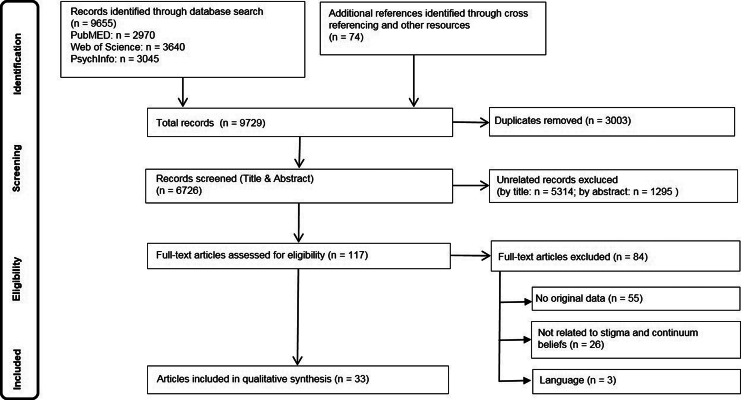
BACKGROUND: Promulgating a continuum model of mental health and mental illness has been proposed as a way to reduce stigma by decreasing notions of differentness. This systematic review and meta-analysis examines whether continuum beliefs are associated with lower stigma, and whether continuum interventions reduce stigma. METHODS: Following a pre-defined protocol (PROSPERO: CRD42019123606), we searched three electronic databases (PubMed, Web of Science, and PsycINFO) yielding 6726 studies. After screening, we included 33 studies covering continuum beliefs, mental illness, and stigma. Of these, 13 studies were included in meta-analysis. RESULTS: Continuum beliefs are consistently associated with lower stigma. Interventions were effective at manipulating continuum beliefs but differ in their effects on stigmatising attitudes. CONCLUSIONS: We discuss whether and to what extent attitudes towards people with mental illness can be improved by providing information on a mental health-mental illness continuum. It appeared to be relevant whether interventions promoted a feeling of 'us' and a process of identification with the person with mental illness. We discuss implications for the design of future interventions.
Overview
The claims and statistics of this paper haven’t been checked yet.
Free: it reads the open-access text and checks the first 5 claims that cite a source we can check. Create a free account to check every claim.
Integrity signals
Registry
Cites
Statistics
Figures
Verification
Claims the paper makes
The claims and statistics of this paper haven’t been checked yet.
Free: it reads the open-access text and checks the first 5 claims that cite a source we can check. Create a free account to check every claim.
Claims other papers make about this one
Each is checked against this paper’s own text: does it say what the citing paper says it does?
In the citing paper
“One review reported that promoting continuum beliefs about mental health-that is, a continuum between mental health and mental health conditions (rather than a dichotomous approach)-gave mixed results for stigma and even found increased stigma in some studies.216”
From The Lancet Commission on ending stigma and discrimination in mental health (2022) · cites this paper as [216]
Self-check
Percentages, sums and reported differences re-computed from the paper’s own numbers.
The self-check needs the paper’s full text.
Citations
Cites
Preferred Reporting Items for Systematic Reviews and Meta-Analyses: the PRISMA statement
Moher, D., Liberati, A., Tetzlaff, J., Altman, D. G., & for the PRISMA Group (2009) · BMJ · doi:10.1136/bmj.b2535 · Cited by 83,823
Measuring inconsistency in meta-analyses
Higgins, J. P. T., Thompson, S. G., Deeks, J. J., & Altman, D. G. (2003) · BMJ · doi:10.1136/bmj.327.7414.557 · Cited by 63,139
Preferred reporting items for systematic reviews and meta-analyses: the PRISMA Statement.
(2009) · PubMed Central · Cited by 44,859
Preferred Reporting Items for Systematic Reviews and Meta-Analyses: The PRISMA Statement
Moher, D., Liberati, A., Tetzlaff, J., & Altman, D. G. (2009) · Journal of Clinical Epidemiology · doi:10.1016/j.jclinepi.2009.06.005 · Cited by 19,575
Borenstein, M., Hedges, L. V., Higgins, J. P. T., & Rothstein, H. R. (2009) · doi:10.1002/9780470743386 · Cited by 14,225
An Integrative Theory of Intergroup Conflict
Tajfel, H., & Turner, J. (2000) · Organizational Identity · doi:10.1093/oso/9780199269464.003.0005 · Cited by 12,487
The Social psychology of intergroup relations
Austin, W. G., & Worchel, S. (1979) · Medical Entomology and Zoology · Cited by 11,621
Borenstein, M., Hedges, L. V., Higgins, J. P. T., & Rothstein, H. R. (2021) · doi:10.1002/9781119558378 · Cited by 9,799
Link, B. G., & Phelan, J. C. (2001) · Annual Review of Sociology · doi:10.1146/annurev.soc.27.1.363 · Cited by 8,848
Downs, S. H., & Black, N. (1998) · Journal of Epidemiology and Community Health · doi:10.1136/jech.52.6.377 · Cited by 8,252 · cited 1×
“We assessed methodological quality using a modified version (see online Supplementary Appendix 2) of a 27 item-checklist originally developed to evaluate clinical intervention studies (Downs & Black, 1998) to allow a comparable risk of bias assessment.”
Method
Cited by
Items 101–141 of 141
Silva, D. D. C., Martins, A. C., & Garcia‐Marques, T. (2026) · International Journal of Social Psychology Revista de Psicología Social · doi:10.1177/02134748261472783 · Cited by 1
Dave, B., & O’Connor, C. (2022) · Journal of Affective Disorders Reports · doi:10.1016/j.jadr.2022.100403 · Cited by 3
Determinanten der Inanspruchnahme psychischer Gesundheitsversorgung – ein integratives Modell
Peter, L.-J., McLaren, T., Tomczyk, S., Muehlan, H., Schmidt, S., & Schomerus, G. (2023) · Public Health Forum · doi:10.1515/pubhef-2023-0051 · Cited by 4
Newman, S. J., Baker, M., & Hammonds, L. S. (2025) · Creative Nursing · doi:10.1177/10784535241307039 · Cited by 2
“Mental health may be described as being on a continuum from no symptoms through increasingly severe symptoms (Peter et al., 2021).”
Board of Directors’ Column: Novel IDEAS Moving Whole Health Forward
Okoli, C. T. C. (2022) · Journal of the American Psychiatric Nurses Association · doi:10.1177/10783903221130034 · Cited by 1
“Indeed, observing that the variations from mental health to mental illness fall on a continuum can go a long way in de-stigmatizing the notion of mental ill health (Peter et al., 2021).”
BackgroundAn exploration of the continuum beliefs intervention on the stigma of mental disorders
石宇婧, 李., 石宇婧, 宗亚辉, & 谢久书 (2022) · Advances in Psychological Science · doi:10.3724/sp.j.1042.2023.00288 · Cited by 2
“00 09 4v 1 9 4.2 针对社会分类的连续体信念干预 自我归类理论(Self-Categorization Theory)认为,社会分类除了具备自动化特征以外, 还具有一定的控制性,会受到自我的信念、需要和动机等因素的影响,且可以通过学习和训 练加以改变(Zinn, Lavric, Levine, & Koschate, 2022)。现有的连续体信念干预研究也发现,连 续体信念能够改变人们对精神障碍患者的社会分类。这种改变也是降低精神障碍污名化的关 键。具体而言,连续体信念通过增强人们与精神障碍患者的感知相似性,从而有效降低了群 体间差异的显著性,即从“我们”和“他们”融合成为更具包容性的“我们”(Violeau, Va…”
InfluentialHodgins, V., O’Driscoll, G. A., & Titone, D. A. (2022) · doi:10.31234/osf.io/8b65u · Cited by 1
Peter, L.-J., Juergensen, V., Steyrl, D., Lor, C. S., Bui, A. P., McLaren, T., Muehlan, H., Schmidt, S., & Schomerus, G. (2024) · Research Square · doi:10.21203/rs.3.rs-4025619/v1 · Cited by 1
Sittner, M., Rechenberg, T., Speerforck, S., Angermeyer, M. C., & Schomerus, G. (2024) · Research Square · doi:10.21203/rs.3.rs-4125072/v1 · Cited by 1
Wang, X., Lv, Q., Lu, M., & Qu, W. (2024) · Research Square · doi:10.21203/rs.3.rs-4606742/v1 · Cited by 1
Ricardo, M. M., Henderson, C. E., Reed, K., Salami, T. K., & Drislane, L. E. (2022) · Addiction Research & Theory · doi:10.1080/16066359.2022.2090543
A comprehensive study on the cognitive mechanisms and neural substrates of hallucination proneness
Johnson, J. F. (2022) · Research Publications (Maastricht University) · doi:10.26481/dis.20221101jj
Singh, R., & Ramdeo, S. (2023) · Springer eBooks · doi:10.1007/978-3-031-30225-1_4
Editorial: Reviews in psychiatry 2022: personality disorders
Bach, B., & Beghi, M. (2023) · Frontiers in Psychiatry · doi:10.3389/fpsyt.2023.1279335
Belova, Y. (2024) · Социологические исследования · doi:10.31857/s0132162524060095
Lee, W., Zhan, M., & Shin, J. (2024) · SSM - Mental Health · doi:10.1016/j.ssmmh.2024.100386
Bangash, A. (2025) · Oxford University Press eBooks · doi:10.1093/9780191964343.003.0031
Grundlagen der Diagnostik und Therapie
(2024) · Elsevier eBooks · doi:10.1016/b978-3-437-22487-4.16001-0
Yu, B. C. L., Peng, S. X., Chen, S. X., & Ng, J. C. K. (2025) · SSM - Mental Health · doi:10.1016/j.ssmmh.2025.100490
Kulwicka, K., & Gąsiorowska, A. (2025) · Springer eBooks · doi:10.1007/978-3-031-73363-5_121
Wallhed Finn, S., Mejldal, A., & Nielsen, A. S. (2023) · Figshare · doi:10.6084/m9.figshare.23884394
Bryant, E., Touyz, S., & Maguire, S. (2024) · Figshare · doi:10.6084/m9.figshare.26582630
Warbrick, L. A., Dunn, B. D., Moran, P. A., Campbell, J., Kessler, D., Marchant, K., Farr, M., Ryan, M. T., Parkin, M., Sharpe, R., et al. (2024) · Figshare · doi:10.6084/m9.figshare.24257591
Additional file 1 of Public stigma and treatment preferences for alcohol use disorders
Finn, S. W., Mejldal, A., & Nielsen, A. S. (2024) · Figshare · doi:10.6084/m9.figshare.26563848
Warbrick, L. A., Dunn, B. D., Moran, P. A., Campbell, J., Kessler, D., Marchant, K., Farr, M., Ryan, M. T., Parkin, M., Sharpe, R., et al. (2023) · Figshare · doi:10.6084/m9.figshare.24257442
Additional file 2 of Public stigma and treatment preferences for alcohol use disorders
Finn, S. W., Mejldal, A., & Nielsen, A. S. (2024) · Figshare · doi:10.6084/m9.figshare.26563851
Scholze, K., Reich, H., Passow, P., Sander, C., Czaplicki, A., & Hegerl, U. (2023) · Figshare · doi:10.6084/m9.figshare.23434948
Bryant, E., Touyz, S., & Maguire, S. (2024) · Figshare · doi:10.6084/m9.figshare.26582627
Bryant, E., Touyz, S., & Maguire, S. (2024) · Figshare · doi:10.6084/m9.figshare.26582633
Stoll, E., Jakobsen, G., Hörz‐Sagstetter, S., Nething, E., & Tomczyk, S. (2026) · Frontiers in Psychology · doi:10.3389/fpsyg.2026.1759801
“…view on mental illness (as mirrored in the open questions responses) and therefore a more profound understanding of mental illness being a continuum rather than a dichotomous state, a belief, which is connected to lower mental illness stigma (Peter et al., 2021; Tomczyk et al., 2023).”
Bizumić, B., Dixon, K., Hayes, A., & Pham, S. (2026) · Journal of Mental Health · doi:10.1080/09638237.2026.2646300
“Another limitation is that terminology invokes a categorical approach to MHCs, leading to more prejudice than a continuum or dimensional approach (Peter et al., 2021; Wai et al., 2024).”
Santé mentale en période périnatale : comment améliorer la formation des sages-femmes ?
Dubreucq, M. (2024) · theses.fr (ABES) · doi:10.70675/6ea7911dze01dz4c07z8bbaz5970126227bf
Relations intimes & troubles psychiques sévères : vers une amélioration des accompagnements
Caiada, M. (2024) · theses.fr (ABES) · doi:10.70675/82354f0fz192az442fz8b0dz79dd75be1564
Kuang, K., Liu, S., & Chen, R. (2026) · Health Communication · doi:10.1080/10410236.2026.2670547
Learning Mechanisms in Alcohol Use Disorders
Heinz, A., Icoez, S., Treusch, Y., Chiara, G. D., & Halil, M. G. (2026) · Addiction Biology · doi:10.1111/adb.70168 · Cited by 1
On the conceptualization and measurement of handedness
Lindell, A. K. (2026) · Laterality Asymmetries of Body Brain and Cognition · doi:10.1080/1357650x.2026.2708707
Retka, J., Stoll, E., Nething, E., Uhlig, S. M., Schwiebert, C., & Tomczyk, S. (2026) · Discover Mental Health · doi:10.1007/s44192-026-00551-z
“Continuum beliefs can be conceptualized as a central component of the stigma process and may therefore serve as a cognitive mechanism for stigma reduction by reshaping beliefs about mental health and illness, particularly by reducing notions of “different-ness” [36].”
InfluentialSCREENING STIGMA: POPULAR CULTURE'S ROLE IN SHAPING MENTAL HEALTH PERCEPTIONS
Tripathi, A., & Joshi, P. (2026) · International Journal of Research -GRANTHAALAYAH · doi:10.29121/granthaalayah.v14.i7.2026.7098
Speerforck, S., Leonhard, A., Angermeyer, M. C., & Schomerus, G. (2026) · Frontiers in Psychiatry · doi:10.3389/fpsyt.2026.1869356
Diagnóstico Clínico y Socialización Profesional: Influencia en las Atribuciones y Decisiones Penales
Aragón, E. S., Palomares-Rodríguez, J. M., & Quevedo-Blasco, R. (2026) · Revista Iberoamericana de Justicia Terapéutica · doi:10.70478/rijt.2026.13.01
Autism Research and Social Psychology: Reciprocal Learnings and Mutual Benefit
Khudiakova, V., & O’Connor, C. (2026) · Neurodiversity · doi:10.1177/27546330261496731 · Cited by 1
Metadata
- Authors
- Peter, L.-J., Schindler, S., Sander, C., Schmidt, S., Muehlan, H., McLaren, T., Tomczyk, S., Speerforck, S., & Schomerus, G.
- Affiliations
- Leipzig University (DE)
- University Hospital Leipzig (DE)
- Universität Greifswald (DE)
- Corresponding author
- Peter, Lina-Jolien
- ORCID
- Venue
- Psychological Medicine
- Publisher
- Cambridge University Press (CUP)
- Published
- 2021-04
- Volume
- 51
- Issue
- 5
- Pages
- 716-726
- ISSN
- 0033-2917 (ISSN-L)
- 1469-8978
- PMC
- PMC8108391
- OpenAlex
- W3141136845
- Cited by
- 141
- References
- 82
- Citations by year
- 2026: 14 · 2025: 24 · 2024: 39 · 2023: 32 · 2022: 28 · 2021: 4
- FWCI
- 4.03
- Type
- journal article
- Language
- en
- Open access
- hybrid
- doi.org
- Locations
- Psychological Medicine (publishedVersion, cc-by)
- PubMed Central (publishedVersion, cc-by)
- PubMed (publishedVersion)
- Funders
- Deutsche Forschungsgemeinschaft (SCHO 1337/4, SCHO-1337/4-2, SCHM 2683/4, SCHM 2683/4-2)
- Universität Leipzig
- Universität Greifswald
- Topics
- Health Sciences › Medicine › Psychiatry and Mental health › Mental Health Treatment and Access
- Social Sciences › Psychology › Clinical Psychology › Psychology and Mental Health
- Social Sciences › Sociology and Political Science › Social and Intergroup Psychology
- Keywords
- mental health stigma, stigma reduction interventions, attitudes toward mental illness
- MeSH terms
- Physical Distancing, Mental Disorders, Emotions, Humans, Psychological Distance, Stereotyping, Social Stigma
About these checks
Registry, retraction, Cites and statistics results are computed, not judged, with one exception: a printed reference that no index lists is read once by a model before it counts as a citation error. Claims are extracted by a model and kept only when their quote appears verbatim in the text; each cited source is then checked, with a model’s help, for whether it says what the claim relies on. Those verdicts can be wrong — read the claim’s quote and the cited source before relying on one.
Statistics and arithmetic are recomputed, not judged.
Confidence bands are shown only for fields calibrated on our annotated test set. None is calibrated yet, so no band is shown.
What counts as a claim ›How we measure confidence ›How we check this ›
Are you an author, or do you see a problem with this page? Request a review
Data sources
Bibliographic data: Semantic Scholar, OpenAlex, Crossref.
Contains information from the Semantic Scholar Academic Graph Datasets, made available under the ODC Attribution License (ODC-BY 1.0).
Semantic Scholar’s data is described in: Kinney, R., et al. (2023). The Semantic Scholar Open Data Platform. arXiv:2301.10140.
