

Continuum beliefs and mental illness stigma: a systematic review and meta-analysis of correlation and intervention studies
Open accessThe DOI matches its Crossref record; 81 of the 82 references it cites were found in a registry or an index.
Abstract
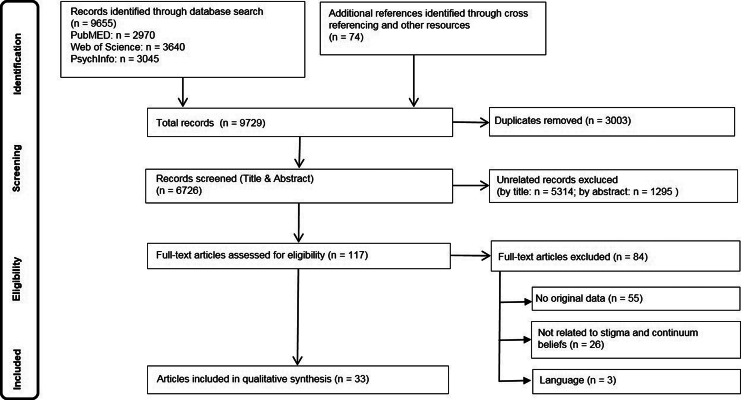
BACKGROUND: Promulgating a continuum model of mental health and mental illness has been proposed as a way to reduce stigma by decreasing notions of differentness. This systematic review and meta-analysis examines whether continuum beliefs are associated with lower stigma, and whether continuum interventions reduce stigma. METHODS: Following a pre-defined protocol (PROSPERO: CRD42019123606), we searched three electronic databases (PubMed, Web of Science, and PsycINFO) yielding 6726 studies. After screening, we included 33 studies covering continuum beliefs, mental illness, and stigma. Of these, 13 studies were included in meta-analysis. RESULTS: Continuum beliefs are consistently associated with lower stigma. Interventions were effective at manipulating continuum beliefs but differ in their effects on stigmatising attitudes. CONCLUSIONS: We discuss whether and to what extent attitudes towards people with mental illness can be improved by providing information on a mental health-mental illness continuum. It appeared to be relevant whether interventions promoted a feeling of 'us' and a process of identification with the person with mental illness. We discuss implications for the design of future interventions.
Overview
The claims and statistics of this paper haven’t been checked yet.
Free: it reads the open-access text and checks the first 5 claims that cite a source we can check. Create a free account to check every claim.
Integrity signals
Registry
Cites
Statistics
Figures
Verification
Claims the paper makes
The claims and statistics of this paper haven’t been checked yet.
Free: it reads the open-access text and checks the first 5 claims that cite a source we can check. Create a free account to check every claim.
Claims other papers make about this one
Each is checked against this paper’s own text: does it say what the citing paper says it does?
In the citing paper
“One review reported that promoting continuum beliefs about mental health-that is, a continuum between mental health and mental health conditions (rather than a dichotomous approach)-gave mixed results for stigma and even found increased stigma in some studies.216”
From The Lancet Commission on ending stigma and discrimination in mental health (2022) · cites this paper as [216]
Self-check
Percentages, sums and reported differences re-computed from the paper’s own numbers.
The self-check needs the paper’s full text.
Citations
Cites
Preferred Reporting Items for Systematic Reviews and Meta-Analyses: the PRISMA statement
Moher, D., Liberati, A., Tetzlaff, J., Altman, D. G., & for the PRISMA Group (2009) · BMJ · doi:10.1136/bmj.b2535 · Cited by 83,823
Measuring inconsistency in meta-analyses
Higgins, J. P. T., Thompson, S. G., Deeks, J. J., & Altman, D. G. (2003) · BMJ · doi:10.1136/bmj.327.7414.557 · Cited by 63,139
Preferred reporting items for systematic reviews and meta-analyses: the PRISMA Statement.
(2009) · PubMed Central · Cited by 44,859
Preferred Reporting Items for Systematic Reviews and Meta-Analyses: The PRISMA Statement
Moher, D., Liberati, A., Tetzlaff, J., & Altman, D. G. (2009) · Journal of Clinical Epidemiology · doi:10.1016/j.jclinepi.2009.06.005 · Cited by 19,575
Borenstein, M., Hedges, L. V., Higgins, J. P. T., & Rothstein, H. R. (2009) · doi:10.1002/9780470743386 · Cited by 14,225
An Integrative Theory of Intergroup Conflict
Tajfel, H., & Turner, J. (2000) · Organizational Identity · doi:10.1093/oso/9780199269464.003.0005 · Cited by 12,487
The Social psychology of intergroup relations
Austin, W. G., & Worchel, S. (1979) · Medical Entomology and Zoology · Cited by 11,623
Borenstein, M., Hedges, L. V., Higgins, J. P. T., & Rothstein, H. R. (2021) · doi:10.1002/9781119558378 · Cited by 9,799
Link, B. G., & Phelan, J. C. (2001) · Annual Review of Sociology · doi:10.1146/annurev.soc.27.1.363 · Cited by 8,848
Downs, S. H., & Black, N. (1998) · Journal of Epidemiology and Community Health · doi:10.1136/jech.52.6.377 · Cited by 8,252 · cited 1×
“We assessed methodological quality using a modified version (see online Supplementary Appendix 2) of a 27 item-checklist originally developed to evaluate clinical intervention studies (Downs & Black, 1998) to allow a comparable risk of bias assessment.”
MethodPRESS Peer Review of Electronic Search Strategies: 2015 Guideline Statement
McGowan, J., Sampson, M., Salzwedel, D. M., Cogo, E., Foerster, V., & Lefebvre, C. (2016) · Journal of Clinical Epidemiology · doi:10.1016/j.jclinepi.2016.01.021 · Cited by 5,700
Assessing heterogeneity in meta-analysis: Q statistic or I² index?
Huedo-Medina, T. B., Sánchez-Meca, J., Marín-Martínez, F., & Botella, J. (2006) · Psychological Methods · doi:10.1037/1082-989x.11.2.193 · Cited by 4,256
Clement, S., Schauman, O., Graham, T., Maggioni, F., Evans-Lacko, S., Bezborodovs, N., Morgan, C., Rüsch, N., Brown, J. S. L., & Thornicroft, G. (2015) · Psychological Medicine · doi:10.1017/s0033291714000129 · Cited by 3,152 · cited 1×
“…illness stigma increases symptom burden, poses a barrier to help-seeking and fosters treatment avoidance (Angermeyer, van der Auwera, Carta, & Schomerus, 2017; Clement et al., 2015; Eisenberg, Downs, Golberstein, & Zivin, 2009; Henderson, Evans-Lacko, & Thornicroft, 2013; Schulze et al., 2020).”
BackgroundHow should meta‐regression analyses be undertaken and interpreted?
Thompson, S. G., & Higgins, J. P. T. (2002) · Statistics in Medicine · doi:10.1002/sim.1187 · Cited by 3,026 · cited 1×
“Interpretation needs to be done with caution due to the low number of studies (Thompson & Higgins, 2002).”
BackgroundInterpretation of random effects meta-analyses
Riley, R. D., Higgins, J. P. T., & Deeks, J. J. (2011) · BMJ · doi:10.1136/bmj.d549 · Cited by 2,884
Meta-Analysis: Recent Developments in Quantitative Methods for Literature Reviews
Rosenthal, R., & DiMatteo, M. R. (2001) · Annual Review of Psychology · doi:10.1146/annurev.psych.52.1.59 · Cited by 1,780
On the Use of Beta Coefficients in Meta-Analysis.
Peterson, R. A., & Brown, S. P. (2005) · Journal of Applied Psychology · doi:10.1037/0021-9010.90.1.175 · Cited by 1,643
The Social Rejection of Former Mental Patients: Understanding Why Labels Matter
Link, B. G., Cullen, F. T., Frank, J., & Wozniak, J. F. (1987) · American Journal of Sociology · doi:10.1086/228672 · Cited by 1,265 · cited 3×
“Measurement of stereotypes was more heterogeneous, with frequently [Stereotypes about Schizophrenia (Angermeyer & Matschinger, 2004); Semantic Differential Tool (Olmsted & Durham, 1976)] and rarely used inventories [Perceived Dangerousness Scale (Link et al., 1987), Explicit Measure of Self-Stereotype Association (Vio…”
MethodStigma and Help Seeking for Mental Health Among College Students
Eisenberg, D., Downs, M. F., Golberstein, E., & Zivin, K. (2009) · Medical Care Research and Review · doi:10.1177/1077558709335173 · Cited by 1,193
Thornicroft, G., Brohan, E., Rose, D., Sartorius, N., & Leese, M. (2009) · The Lancet · doi:10.1016/s0140-6736(08)61817-6 · Cited by 1,189
A systematic review of gamification in e-Health
Sardi, L., Idri, A., & Fernández-Alemán, J. L. (2017) · Journal of Biomedical Informatics · doi:10.1016/j.jbi.2017.05.011 · Cited by 1,015
Turner, J. C., & Oakes, P. J. (1986) · British Journal of Social Psychology · doi:10.1111/j.2044-8309.1986.tb00732.x · Cited by 988 · cited 2×
“Second, continuum beliefs should be tested in relation to the construct of social identity (Tajfel & Turner, 1979; Turner & Oakes, 1986), to investigate perceptions of in-/out-group together with continuum belief interventions.”
BackgroundMental Illness Stigma, Help Seeking, and Public Health Programs
Henderson, C., Evans-Lacko, S., & Thornicroft, G. (2013) · American Journal of Public Health · doi:10.2105/ajph.2012.301056 · Cited by 959
Suurmond, R., van Rhee, H., & Hak, T. (2017) · Research Synthesis Methods · doi:10.1002/jrsm.1260 · Cited by 881
Angermeyer, M. C., & Matschinger, H. (2003) · Acta Psychiatrica Scandinavica · doi:10.1034/j.1600-0447.2003.00150.x · Cited by 608 · cited 2×
“Associations are most robust where stigma is most severe (Angermeyer & Matschinger, 2003a, 2003b).”
BackgroundMethodLasalvia, A., Zoppei, S., Van Bortel, T., Bonetto, C., Cristofalo, D., Wahlbeck, K., Bacle, S. V., Van Audenhove, C., van Weeghel, J., Reneses, B., et al. (2013) · The Lancet · doi:10.1016/s0140-6736(12)61379-8 · Cited by 445
DSM-5 and RDoC: progress in psychiatry research?
Casey, B. J., Craddock, N., Cuthbert, B. N., Hyman, S. E., Lee, F. S., & Ressler, K. J. (2013) · Nature Reviews Neuroscience · doi:10.1038/nrn3621 · Cited by 434 · cited 1×
“…Cacioppo & Gardner, 1993; Collins, 2006), topics only loosely related to mental health and illness, like wellbeing (Aggarwal & Sriram, 2018), classification issues (Casey et al., 2013) or the continuum within categories of specific mental disorders (Andrulonis, Glueck, Stroebel, & Vogel, 1982).”
BackgroundDoes gamification increase engagement with online programs? A systematic review
Looyestyn, J., Kernot, J., Boshoff, K., Ryan, J., Edney, S., & Maher, C. (2017) · PLOS ONE · doi:10.1371/journal.pone.0173403 · Cited by 411
Public beliefs about schizophrenia and depression: similarities and differences
Angermeyer, M. C., & Matschinger, H. (2003) · Social Psychiatry and Psychiatric Epidemiology · doi:10.1007/s00127-003-0676-6 · Cited by 329 · cited 2×
“Associations are most robust where stigma is most severe (Angermeyer & Matschinger, 2003a, 2003b).”
BackgroundMethodClosed Ranks: An Experiment in Mental Health Education
Cumming, E., & Cumming, J. (1957) · Harvard University Press eBooks · doi:10.4159/harvard.9780674491779 · Cited by 278
Crazy? So what! Effects of a school project on students' attitudes towards people with schizophrenia
Schulze, B., Richter‐Werling, M., Matschinger, H., & Angermeyer, M. C. (2003) · Acta Psychiatrica Scandinavica · doi:10.1034/j.1600-0447.2003.02444.x · Cited by 268 · cited 2×
“Low initial stigma prior to the interventions could have caused a ceiling effect and needs to be considered as a reason for low effect-sizes (Schulze et al., 2003; Shiraishi et al., 2019).”
BackgroundAngermeyer, M. C., van der Auwera, S., Carta, M. G., & Schomerus, G. (2017) · World Psychiatry · doi:10.1002/wps.20383 · Cited by 253
Self-citationSchomerus, G., Matschinger, H., & Angermeyer, M. C. (2013) · Psychiatry Research · doi:10.1016/j.psychres.2013.02.006 · Cited by 192
Angermeyer, M. C., & Matschinger, H. (2004) · Schizophrenia Bulletin · doi:10.1093/oxfordjournals.schbul.a007120 · Cited by 191 · cited 2×
“Measurement of stereotypes was more heterogeneous, with frequently [Stereotypes about Schizophrenia (Angermeyer & Matschinger, 2004); Semantic Differential Tool (Olmsted & Durham, 1976)] and rarely used inventories [Perceived Dangerousness Scale (Link et al., 1987), Explicit Measure of Self-Stereotype Association (Vio…”
MethodRoth, P. L., Le, H., Oh, I.-S., Van Iddekinge, C. H., & Bobko, P. (2018) · Journal of Applied Psychology · doi:10.1037/apl0000293 · Cited by 155
Plato versus Aristotle: Categorical and dimensional models for common mental disorders
Goldberg, D. P. (2000) · Comprehensive Psychiatry · doi:10.1016/s0010-440x(00)80002-4 · Cited by 150
The public stigma of mental illness means a difference between you and me
Corrigan, P. W., Bink, A. B., Fokuo, J. K., & Schmidt, A. (2015) · Psychiatry Research · doi:10.1016/j.psychres.2014.12.047 · Cited by 145 · cited 2×
“…by designing audio-visual vignettes (Corrigan et al., 2015, 2017; Dolphin & Hennessy, 2017; Morris et al., 2020), or extending the intervention to more time points (Corrigan et al., 2015; Thibodeau, 2019; Thibodeau et al., 2018) are likely to improve personal involvement of the respondent as well.”
BackgroundBorderline Personality Subcategories
ANDRULONIS, P. A., GLUECK, B. C., STROEBEL, C. F., & VOGEL, N. G. (1982) · The Journal of Nervous and Mental Disease · doi:10.1097/00005053-198211000-00006 · Cited by 121
Clement, S., Jarrett, M., Henderson, C., & Thornicroft, G. (2010) · Epidemiologia e Psichiatria Sociale · doi:10.1017/s1121189x00001627 · Cited by 120
Schomerus, G., Angermeyer, M. C., Baumeister, S. E., Stolzenburg, S., Link, B. G., & Phelan, J. C. (2016) · European Psychiatry · doi:10.1016/j.eurpsy.2015.11.006 · Cited by 109 · cited 2×
“Two studies found reduced desire for social distance in the continuumcompared to control conditions: β = 0.175, p = 0.003, reverse coded (Schomerus et al., 2016); F(2,175) = 3.21, p = 0.02 (Cole & Warman, 2019).”
BackgroundResultInfluentialEmotional reactions to people with mental illness
Angermeyer, M. C., Holzinger, A., & Matschinger, H. (2010) · Epidemiologia e Psichiatria Sociale · doi:10.1017/s1121189x00001573 · Cited by 108
The Working Mind: A Meta-Analysis of a Workplace Mental Health and Stigma Reduction Program
Dobson, K. S., Szeto, A. C. H., & Knaak, S. J. (2019) · The Canadian Journal of Psychiatry · doi:10.1177/0706743719842559 · Cited by 106
The Road to Mental Readiness for First Responders: A Meta-Analysis of Program Outcomes
Szeto, A., Dobson, K. S., & Knaak, S. (2019) · The Canadian Journal of Psychiatry · doi:10.1177/0706743719842562 · Cited by 102
Hansson, L., Stjernswärd, S., & Svensson, B. (2016) · Acta Psychiatrica Scandinavica · doi:10.1111/acps.12609 · Cited by 95
What underlies medical donor attitudes and behavior?
Cacioppo, J. T., & Gardner, W. L. (1993) · Health Psychology · doi:10.1037/0278-6133.12.4.269 · Cited by 90
Examining differences in the stigma of depression and schizophrenia
Norman, R. M. G., Windell, D., & Manchanda, R. (2010) · International Journal of Social Psychiatry · doi:10.1177/0020764010387062 · Cited by 89
User Manual for Meta-Essentials: Workbooks for Meta-AnalysisPreprint
van Rhee, H., Suurmond, R., & Hak, T. (2018) · SSRN Electronic Journal · doi:10.2139/ssrn.3241355 · Cited by 87
Stability of Mental Health Attitudes: A Semantic Differential Study
Olmsted, D. W., & Durham, K. (1976) · Journal of Health and Social Behavior · doi:10.2307/2136465 · Cited by 79
Perosanz, J. J. I., & Esteban, F. J. F. (2017) · International journal of communication · Cited by 79
Cyber Buddy Is Better than No Buddy: A Test of the Köhler Motivation Effect in Exergames
Feltz, D. L., Forlenza, S., Winn, B. M., & Kerr, N. L. (2014) · Games for Health Journal · doi:10.1089/g4h.2013.0088 · Cited by 76
Wiesjahn, M., Jung, E., Kremser, J. D., Rief, W., & Lincoln, T. M. (2015) · Journal of Behavior Therapy and Experimental Psychiatry · doi:10.1016/j.jbtep.2015.09.007 · Cited by 75 · cited 2×
“05), while other studies found no effects or even an increase in blame compared to the categorical condition (Wiesjahn et al., 2016).”
BackgroundResultInfluentialInaccuracy of regression results in replacing bivariate correlations
Aloe, A. M. (2015) · Research Synthesis Methods · doi:10.1002/jrsm.1126 · Cited by 74
Changing public stigma with continuum beliefs
Corrigan, P. W., Schmidt, A., Bink, A. B., Nieweglowski, K., Al-Khouja, M. A., Qin, S., & Discont, S. (2017) · Journal of Mental Health · doi:10.1080/09638237.2016.1207224 · Cited by 74
Schwarz, A. F., Huertas‐Delgado, F. J., Cardon, G., & DeSmet, A. (2020) · Games for Health Journal · doi:10.1089/g4h.2019.0058 · Cited by 72
Morris, J. K., Albery, I. P., Heather, N., & Moss, A. C. (2020) · Addictive Behaviors · doi:10.1016/j.addbeh.2020.106292 · Cited by 68
Apps, Avatars, and Robots: The Future of Mental Healthcare
Miller, E., & Polson, D. (2019) · Issues in Mental Health Nursing · doi:10.1080/01612840.2018.1524535 · Cited by 63
Angermeyer, M. C., Millier, A., Rémuzat, C., Refaï, T., Schomerus, G., & Toumi, M. (2014) · International Journal of Social Psychiatry · doi:10.1177/0020764014543312 · Cited by 55
Speerforck, S., Stolzenburg, S., Hertel, J., Grabe, H. J., Strauß, M., Carta, M. G., Angermeyer, M. C., & Schomerus, G. (2019) · Psychiatry Research · doi:10.1016/j.psychres.2019.112570 · Cited by 51 · cited 4×
“Results of methodological quality assessment The modified version of Downs & Black Quality Assessment (see online Supplementary Appendix 2) revealed an overall quality between 47% (Cumming & Cumming, 1957) and 100% (Speerforck et al., 2019) with 17 studies scoring 80% or higher.”
BackgroundInfluentialHow continuum beliefs can reduce stigma of schizophrenia: The role of perceived similarities
Violeau, L., Valéry, K.-M., Fournier, T., & Prouteau, A. (2020) · Schizophrenia Research · doi:10.1016/j.schres.2020.04.014 · Cited by 50 · cited 5×
“, 1987), Explicit Measure of Self-Stereotype Association (Violeau et al., 2020)] and also heterogeneous subscales (dangerousness and/or unpredictability and responsibility/blame).”
BackgroundMethodInfluentialDon't call me nuts: an international perspective on the stigma of mental illness
Corrigan, P. W. (2004) · Acta Psychiatrica Scandinavica · doi:10.1111/j.1600-0047.2004.00316.x · Cited by 49 · cited 1×
“Other factors to improve identification could involve the gender of the vignette character (Angermeyer et al., 2015), as well as cultural, ethnic, and national characteristics (Corrigan, 2004).”
BackgroundAre continuum beliefs about psychotic symptoms associated with stereotypes about schizophrenia?
Wiesjahn, M., Brabban, A., Jung, E., Gebauer, U. B., & Lincoln, T. M. (2012) · Psychosis · doi:10.1080/17522439.2012.740068 · Cited by 49
Makowski, A. C., Mnich, E. E., Ludwig, J., Daubmann, A., Bock, T. A., Lambert, M., Härter, M. C., Dirmaier, J., Tlach, L., Liebherz, S., et al. (2016) · Psychiatry Research · doi:10.1016/j.psychres.2016.01.029 · Cited by 47
Shiraishi, N., Watanabe, N., Katsuki, F., Sakaguchi, H., & Akechi, T. (2019) · BMC Psychiatry · doi:10.1186/s12888-019-2252-y · Cited by 42 · cited 1×
“Low initial stigma prior to the interventions could have caused a ceiling effect and needs to be considered as a reason for low effect-sizes (Schulze et al., 2003; Shiraishi et al., 2019).”
BackgroundMakowski, A. C., Mnich, E. E., Angermeyer, M. C., & Knesebeck, O. V. D. (2016) · PeerJ · doi:10.7717/peerj.2360 · Cited by 34 · cited 3×
“Eight studies examined the effects of broader interventions, e.g. a mental health awareness campaign (Makowski et al., 2016b) or school-based project (Schulze, Richter-Werling, Matschinger, & Angermeyer, 2003) that explicitly used continuum messages, but also included others.”
BackgroundResultThibodeau, R., Shanks, L. N., & Smith, B. P. (2017) · Journal of Behavior Therapy and Experimental Psychiatry · doi:10.1016/j.jbtep.2017.08.002 · Cited by 32 · cited 9×
“Compared to the categorical group, less pro-social reactions were found (Thibodeau et al., 2018), but most studies reported no significant changes (Table 3).”
BackgroundResultInfluentialSubramaniam, M., Abdin, E., Picco, L., Shahwan, S., Jeyagurunathan, A., Vaingankar, J. A., & Chong, S. A. (2017) · BMJ Open · doi:10.1136/bmjopen-2016-014993 · Cited by 31 · cited 4×
“For ADHD, more than six times as many people agreed than disagreed (Speerforck et al., 2019); for alcohol use disorder, agreement rates were around one-third, while slightly more than 40% disagreed (Schomerus et al., 2013; Subramaniam et al., 2017).”
BackgroundInfluentialHelmus, K. L., Schaars, I. K., Wierenga, H., de Glint, E., & van Os, J. (2019) · Frontiers in Psychiatry · doi:10.3389/fpsyt.2019.00243 · Cited by 30
Al-Hazmi, A. (2015) · Nigerian Journal of Clinical Practice · doi:10.4103/1119-3077.151067 · Cited by 27 · cited 1×
“Excluded studies focused on medical stigma (Al-Hazmi, 2015; Cacioppo & Gardner, 1993; Collins, 2006), topics only loosely related to mental health and illness, like wellbeing (Aggarwal & Sriram, 2018), classification issues (Casey et al., 2013) or the continuum within categories of specific mental…”
BackgroundContinuum beliefs and schizophrenia stigma: Correlational and experimental evidence.
Thibodeau, R. (2017) · Stigma and Health · doi:10.1037/sah0000061 · Cited by 27 · cited 3×
“Single effect-sizes vary from a majority of small positive correlations to three small and moderate negative correlations (Thibodeau, 2017; Thibodeau et al., 2018; Thibodeau & Peterson, 2018).”
BackgroundCollins, P. Y. (2006) · Social Science & Medicine · doi:10.1016/j.socscimed.2006.03.003 · Cited by 26 · cited 1×
“Excluded studies focused on medical stigma (Al-Hazmi, 2015; Cacioppo & Gardner, 1993; Collins, 2006), topics only loosely related to mental health and illness, like wellbeing (Aggarwal & Sriram, 2018), classification issues (Casey et al., 2013) or the continuum within categories of specific mental…”
BackgroundLabelling effects and adolescent responses to peers with depression: an experimental investigation
Dolphin, L., & Hennessy, E. (2017) · BMC Psychiatry · doi:10.1186/s12888-017-1389-9 · Cited by 26 · cited 2×
“Undergoing efforts to further improve continuum interventions, by designing audio-visual vignettes (Corrigan et al., 2015, 2017; Dolphin & Hennessy, 2017; Morris et al., 2020), or extending the intervention to more time points (Corrigan et al., 2015; Thibodeau, 2019; Thibodeau et al., 2018) are…”
BackgroundInfluentialSchulze, L. N., Klinger-König, J., Stolzenburg, S., Wiese, J., Speerforck, S., der Auwera, S. V., Völzke, H., Grabe, H. J., & Schomerus, G. (2020) · Psychiatry Research · doi:10.1016/j.psychres.2020.112819 · Cited by 23 · cited 1×
“…illness stigma increases symptom burden, poses a barrier to help-seeking and fosters treatment avoidance (Angermeyer, van der Auwera, Carta, & Schomerus, 2017; Clement et al., 2015; Eisenberg, Downs, Golberstein, & Zivin, 2009; Henderson, Evans-Lacko, & Thornicroft, 2013; Schulze et al., 2020).”
BackgroundThibodeau, R., & Peterson, K. M. (2018) · Psychiatry Research · doi:10.1016/j.psychres.2018.10.070 · Cited by 21 · cited 2×
“Single effect-sizes vary from a majority of small positive correlations to three small and moderate negative correlations (Thibodeau, 2017; Thibodeau et al., 2018; Thibodeau & Peterson, 2018).”
BackgroundInfluentialSchlier, B., Scheunemann, J., & Lincoln, T. M. (2016) · Psychiatry Research · doi:10.1016/j.psychres.2016.04.085 · Cited by 19 · cited 2×
“Two studies found reduced desire for social distance in the continuumcompared to control conditions: β = 0.175, p = 0.003, reverse coded (Schomerus et al., 2016); F(2,175) = 3.21, p = 0.02 (Cole & Warman, 2019).”
BackgroundResultInfluentialThibodeau, R. (2019) · Stigma and Health · doi:10.1037/sah0000211 · Cited by 18 · cited 4×
“Certainly, face-to-face contact would improve the respondent’s personal involvement (Thibodeau, 2019), however, our results indicate that text- or video-based interventions are also capable of promoting a continuum of mental health and illness which includes the respondents and encourages them to…”
BackgroundInfluentialMetaanalyse–praktische Schritte und Entscheidungen im Umsetzungsprozess
Schewe, A. F., Hulsheger, U. R., & Maier, G. W. (2014) · Zeitschrift für Arbeits- und Organisationspsychologie A&O · doi:10.1026/0932-4089/a000165 · Cited by 17
The stigma of mental illness: Testing for the implicit bias in diagnostic labels
Schlier, B., & Lincoln, T. M. (2019) · Psychiatry Research · doi:10.1016/j.psychres.2019.03.028 · Cited by 14 · cited 1×
“Nevertheless, studies that record attitudes through implicit assessment (Schlier & Lincoln, 2019) or measurable behaviour, e.g. seating distance (Thibodeau, 2017), are exceptions.”
BackgroundExploring Well-Being among Mental Health Professionals in India
Aggarwal, P., & Sriram, S. (2018) · Psychological Studies · doi:10.1007/s12646-018-0470-x · Cited by 12 · cited 1×
“…(Al-Hazmi, 2015; Cacioppo & Gardner, 1993; Collins, 2006), topics only loosely related to mental health and illness, like wellbeing (Aggarwal & Sriram, 2018), classification issues (Casey et al., 2013) or the continuum within categories of specific mental disorders (Andrulonis, Glueck,…”
BackgroundCole, J. L., & Warman, D. M. (2019) · Journal of Obsessive-Compulsive and Related Disorders · doi:10.1016/j.jocrd.2019.100478 · Cited by 9 · cited 2×
“For dangerousness, effects have been found pre to post, t(58) = 3.10, p = 0.003 (Cole & Warman, 2019), as well as compared to the categorical condition (Thibodeau et al., 2018).”
BackgroundInfluentialChavarría, M. A. (2000) · doi:10.15760/etd.904 · Cited by 3 · cited 1×
“This idea challenges the border between what’s normal and abnormal by emphasizing that the difference is based on degrees, not absolute differences’ (Alvarado Chavarría, 2000, p. 94).”
BackgroundClinicians' Perceptions of Trauma Treatment for People with Intellectual Disabilities
Schoech, K. E. (2017) · ScholarWorks (Walden University) · Cited by 3
Cited by
The Lancet Commission on ending stigma and discrimination in mental health
Thornicroft, G., Sunkel, C., Alikhon Aliev, A., Baker, S., Brohan, E., el Chammay, R., Davies, K., Demissie, M., Duncan, J., Fekadu, W., et al. (2022) · The Lancet · doi:10.1016/s0140-6736(22)01470-2 · Cited by 748
The stigma of alcohol-related liver disease and its impact on healthcare
Schomerus, G., Leonhard, A., Manthey, J., Morris, J., Neufeld, M., Kilian, C., Speerforck, S., Winkler, P., & Corrigan, P. W. (2022) · Journal of Hepatology · doi:10.1016/j.jhep.2022.04.026 · Cited by 179
Ooi, L. Q. R., Chen, J., Zhang, S., Kong, R., Tam, A., Li, J., Dhamala, E., Zhou, J. H., Holmes, A. J., & Yeo, B. T. T. (2022) · NeuroImage · doi:10.1016/j.neuroimage.2022.119636 · Cited by 154
McLaren, T., Peter, L.-J., Tomczyk, S., Muehlan, H., Schomerus, G., & Schmidt, S. (2023) · BMC Public Health · doi:10.1186/s12889-022-14937-5 · Cited by 111
“Evidence is sparse for continuum beliefs of people with depression [25], however there are indications that a continuum model increases perceived similarities with a depression vignette [28].”
BackgroundResultDimensional models of personality disorders: Challenges and opportunities
Monaghan, C., & Bizumić, B. (2023) · Frontiers in Psychiatry · doi:10.3389/fpsyt.2023.1098452 · Cited by 82
“Although we know little about whether the dimensional PD approaches would reduce stigma, a recent systematic review shows that continuum beliefs about mental disorders tend to reduce stigma compared to categorical beliefs (199).”
Background
Metadata
- Authors
- Peter, L.-J., Schindler, S., Sander, C., Schmidt, S., Muehlan, H., McLaren, T., Tomczyk, S., Speerforck, S., & Schomerus, G.
- Affiliations
- Leipzig University (DE)
- University Hospital Leipzig (DE)
- Universität Greifswald (DE)
- Corresponding author
- Peter, Lina-Jolien
- ORCID
- Venue
- Psychological Medicine
- Publisher
- Cambridge University Press (CUP)
- Published
- 2021-04
- Volume
- 51
- Issue
- 5
- Pages
- 716-726
- ISSN
- 0033-2917 (ISSN-L)
- 1469-8978
- PMC
- PMC8108391
- OpenAlex
- W3141136845
- Cited by
- 141
- References
- 82
- Citations by year
- 2026: 14 · 2025: 24 · 2024: 39 · 2023: 32 · 2022: 28 · 2021: 4
- FWCI
- 4.03
- Type
- journal article
- Language
- en
- Open access
- hybrid
- doi.org
- Locations
- Psychological Medicine (publishedVersion, cc-by)
- PubMed Central (publishedVersion, cc-by)
- PubMed (publishedVersion)
- Funders
- Deutsche Forschungsgemeinschaft (SCHO 1337/4, SCHO-1337/4-2, SCHM 2683/4, SCHM 2683/4-2)
- Universität Leipzig
- Universität Greifswald
- Topics
- Health Sciences › Medicine › Psychiatry and Mental health › Mental Health Treatment and Access
- Social Sciences › Psychology › Clinical Psychology › Psychology and Mental Health
- Social Sciences › Sociology and Political Science › Social and Intergroup Psychology
- Keywords
- mental health stigma, stigma reduction interventions, attitudes toward mental illness
- MeSH terms
- Physical Distancing, Mental Disorders, Emotions, Humans, Psychological Distance, Stereotyping, Social Stigma
About these checks
Registry, retraction, Cites and statistics results are computed, not judged, with one exception: a printed reference that no index lists is read once by a model before it counts as a citation error. Claims are extracted by a model and kept only when their quote appears verbatim in the text; each cited source is then checked, with a model’s help, for whether it says what the claim relies on. Those verdicts can be wrong — read the claim’s quote and the cited source before relying on one.
Statistics and arithmetic are recomputed, not judged.
Confidence bands are shown only for fields calibrated on our annotated test set. None is calibrated yet, so no band is shown.
What counts as a claim ›How we measure confidence ›How we check this ›
Are you an author, or do you see a problem with this page? Request a review
Data sources
Bibliographic data: Semantic Scholar, OpenAlex, Crossref.
Contains information from the Semantic Scholar Academic Graph Datasets, made available under the ODC Attribution License (ODC-BY 1.0).
Semantic Scholar’s data is described in: Kinney, R., et al. (2023). The Semantic Scholar Open Data Platform. arXiv:2301.10140.
