

Efficacy of dialectical behavior therapy for adolescent self-harm and suicidal ideation: a systematic review and meta-analysis
Open accessThe DOI matches its Crossref record; 63 of the 65 references it cites were found in a registry or an index; 18 of the 37 sources its claims cite were checked for support.
Abstract
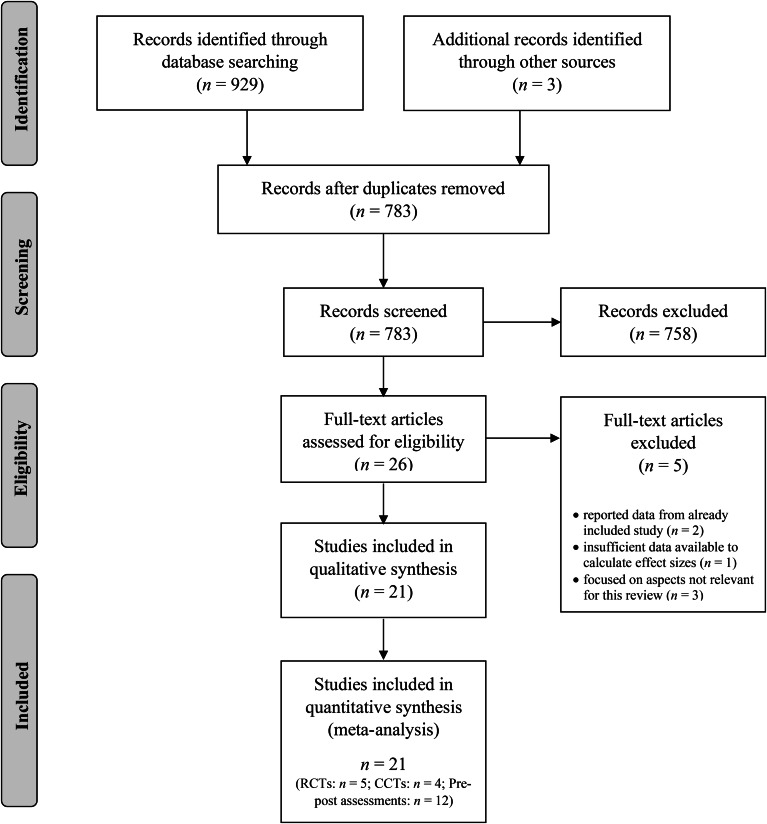
Background: Given the widespread nature and clinical consequences of self-harm and suicidal ideation among adolescents, establishing the efficacy of developmentally appropriate treatments that reduce both self-harm and suicidal ideation in the context of broader adolescent psychopathology is critical. Methods: We conducted a systematic review and meta-analysis of the Dialectical Behaviour Therapy for Adolescents (DBT-A) literature on treating self-injury in adolescents (12–19 years). We searched for eligible trials and treatment evaluations published prior to July 2020 in MEDLINE/PubMed, Scopus, Google Scholar, EMBASE, and the Cochrane Library databases for clinical trials. Twenty-one studies were identified [five randomized-controlled trials (RCTs), three controlled clinical trials (CCTs), and 13 pre-post evaluations]. We extracted data for predefined primary (self-harm, suicidal ideation) and secondary outcomes (borderline personality symptoms; BPD) and calculated treatment effects for RCTs/CCTs and pre-post evaluations. This meta-analysis was pre-registered with OSF: osf.io/v83e7. Results: Overall, the studies comprised 1673 adolescents. Compared to control groups, DBT-A showed small to moderate effects for reducing self-harm ( g = −0.44; 95% CI −0.81 to −0.07) and suicidal ideation ( g = −0.31, 95% CI −0.52 to −0.09). Pre-post evaluations suggested large effects for all outcomes (self-harm: g = −0.98, 95% CI −1.15 to −0.81; suicidal ideation: g = −1.16, 95% CI −1.51 to −0.80; BPD symptoms: g = −0.97, 95% CI −1.31 to −0.63). Conclusions: DBT-A appears to be a valuable treatment in reducing both adolescent self-harm and suicidal ideation. However, evidence that DBT-A reduces BPD symptoms was only found in pre-post evaluations.
Overview
CoChat Summary
TL;DR
This systematic review and meta-analysis of 21 studies (1673 adolescents) found that DBT-A reduced self-harm and suicidal ideation compared with control interventions, with small-to-moderate controlled effects and large pre-post reductions. Evidence that DBT-A reduces BPD symptoms came only from pre-post evaluations because only one controlled study assessed that outcome.
Key findings
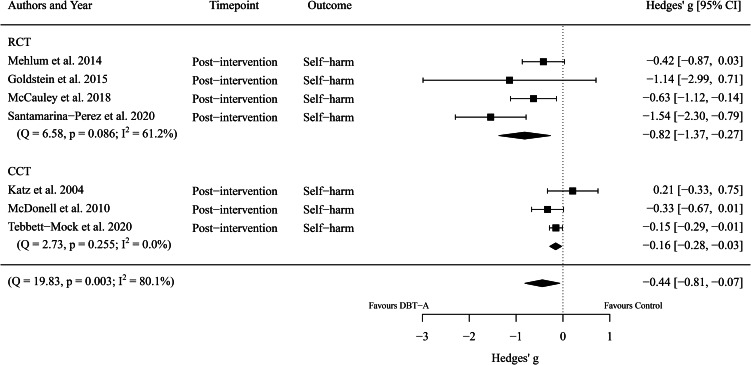
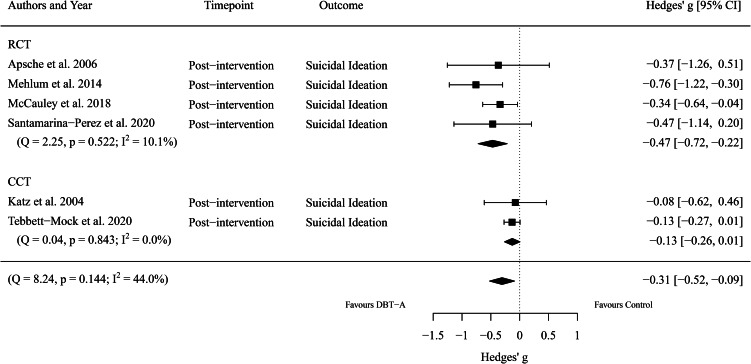
- Across 21 studies (5 RCTs, 3 CCTs, 13 pre-post evaluations; 1673 adolescents), DBT-A versus control reduced self-harm (g = −0.44, 95% CI −0.81 to −0.07, p = 0.021, I² = 80.13%) and suicidal ideation (g = −0.31, 95% CI −0.52 to −0.09, p = 0.006, I² = 44.05%).
- Pre-post DBT-A evaluations showed large reductions in self-harm (g = −0.98, 95% CI −1.15 to −0.81; k = 16, n = 498), suicidal ideation (g = −1.16, 95% CI −1.51 to −0.80; k = 11, n = 299), and BPD symptoms (g = −0.97, 95% CI −1.31 to −0.63; k = 5, n = 218).
- Only one controlled study (Mehlum et al., 2014) assessed BPD symptoms and found no significant group difference, so no meta-analysis of controlled BPD effects was conducted.
- Longer treatment duration was associated with larger reductions in suicidal ideation in controlled comparisons (b = −0.08, p = 0.012) and in BPD symptoms in pre-post evaluations (b = −0.29, p = 0.016); age and gender composition did not moderate outcomes (all ps > 0.05).
Methods
- Systematic review and meta-analysis pre-registered with OSF; searched MEDLINE/PubMed, Scopus, Google Scholar, EMBASE, and the Cochrane Library through 31 July 2020 for clinical trials of DBT-A in adolescents aged 12–19 who had engaged in self-injury at least once, including RCTs, CCTs, and pre-post evaluations.
- Random-effects models calculated Hedges’ g for controlled post-intervention comparisons and pre-post changes; primary outcomes were self-harm and suicidal ideation, with BPD symptoms as a secondary outcome; heterogeneity was assessed with I², moderators via meta-regression, and publication bias via Egger’s regression and trim-and-fill.
- Data were extracted independently by two authors with a third resolving differences; the 21 included studies comprised 1673 adolescents (1063 DBT-A, 610 control), mean age 15.4 years (s.d. = 1.3), 82% female, and average dropout 7% (range 0–40%).
Limitations
- Paper-stated limitations: only one RCT assessed DBT-A versus control for BPD symptoms, preventing meta-analysis; self-harm analyses had moderately high heterogeneity, possibly due to different control interventions and assessment methods, with 58.8% (k = 7) of studies using unvalidated clinical interviews, medical records, diary cards, or in-house instruments; few effects contributed to some estimates and confidence intervals were wide; most samples were predominantly female (81.0%, k = 17 had ≥75% young women), limiting conclusions for young men and gender-diverse youth.
- Paper-stated risk-of-bias findings: statistical problems were common, with 57.1% of studies rated high risk of bias due to low sample sizes; high risk of measurement bias was 38.1% and high risk of confounding bias was 33.3%.
- Evident from the text: no study accounted for the combined effect of pharmacological treatment with DBT-A, despite 63% of participants receiving concurrent psychopharmacological intervention and 11 studies not providing sufficient medication data.
Model-written summary. Check it against the paper before relying on it.
Integrity signals
Registry
Cites
Statistics
Figures
Verification
Claims the paper makes
13 Valid · 1 Not valid · 14 Not checked · 53 Own results and interpretations
The cited sources support only part of this claim — read each source’s verdict below.
In the paper
“A growing body of research demonstrates that therapeutic interventions for self-harm and suicidal ideation in general show limited efficacy (Fox et al., 2020; Kothgassner et al., 2020), highlighting the importance of isolating specific therapies which show promise for further development.”
§ Efficacy of dialectical behavior therapy for adolescent self-harm and suicidal ideation: a systematic review and meta-analysis > Discussion
What the sources say
- Not checked — no full text of the sourcecites Fox et al., 2020 matched to “Interventions for suicide and self-injury: A meta-analysis of randomized controlled trials across nearly 50 years of research.” (2020) source
- Partly supportedcites Kothgassner et al., 2020 matched to “Does treatment method matter? A meta-analysis of the past 20 years of research on therapeutic interventions for self-harm and suicidal ideation in adolescents” (2020) sourceExperimental — accuracy not yet measured
The Results report small improvements in self-harm and suicidal ideation relative to active controls, supporting a qualified description of limited comparative effects. But the Conclusions call those gains statistically significant and clinically important, and the meta-analysis concerns adolescents rather than people in general. The claim omits those qualifications. (LLM, conf=0.86)
boosted- Asserted: passes — The authors put it forward as true.
- Checkable: passes — It can be checked against evidence.
- Load-bearing: passes — The paper’s conclusions depend on it.
- Based: passes — The paper gives a reason why it holds.
Every source the paper cites for this claim was checked and supports it.
In the paper
“In terms of BPD symptoms, Mehlum et al. (2014) conducted the only RCT which assessed the efficacy of DBT-A in reducing BPD symptoms.”
§ Efficacy of dialectical behavior therapy for adolescent self-harm and suicidal ideation: a systematic review and meta-analysis > Results
What the sources say
- Supportedcites Mehlum et al. (2014) matched to “Dialectical Behavior Therapy for Adolescents With Repeated Suicidal and Self-harming Behavior: A Randomized Trial” (2014) source
The Introduction says no RCTs of DBT-A had previously been published, and the Discussion calls this the first randomized trial of DBT-A. The Other Outcomes section reports that the trial assessed borderline symptoms; it found no significant between-group difference. Thus the paper supports that the trial assessed efficacy for this outcome, not that DBT-A was proven to reduce BPD symptoms. (LLM, conf=0.91)
plainn = 39- Asserted: passes — The authors put it forward as true.
- Checkable: passes — It can be checked against evidence.
- Load-bearing: passes — The paper’s conclusions depend on it.
- Based: passes — The paper gives a reason why it holds.
- Supported
Every source the paper cites for this claim was checked and supports it.
In the paper
“To date, two reviews evaluating the efficacy of psychosocial treatments for reducing adolescent self-harm and suicidal ideation have highlighted DBT-A as a promising treatment (Glenn, Franklin, & Nock, 2015; Kothgassner, Robinson, Goreis, Ougrin, & Plener, 2020).”
§ Efficacy of dialectical behavior therapy for adolescent self-harm and suicidal ideation: a systematic review and meta-analysis > Abstract > Conclusions
What the sources say
- Supportedcites Glenn, Franklin, & Nock, 2015 matched to “Evidence-Based Psychosocial Treatments for Self-Injurious Thoughts and Behaviors in Youth” (2015) source
In the Dialectical behavior therapy (DBT) section, the review calls pilot studies of longer DBT interventions in youth “promising.” It also cautions that randomized trials were needed and classifies DBT as experimental; the citing sentence’s description of it as promising does not claim established efficacy. (LLM, conf=0.90)
- Supportedcites Kothgassner, Robinson, Goreis, Ougrin, & Plener, 2020 matched to “Does treatment method matter? A meta-analysis of the past 20 years of research on therapeutic interventions for self-harm and suicidal ideation in adolescents” (2020) source
In the Discussion (Applicability of the results; page not supplied), this meta-analysis reports that DBT-A was the only therapy type with significantly better self-harm outcomes than active controls and also showed a benefit for suicidal ideation. Its Conclusion calls for further investigation of DBT-A’s benefits, supporting the description of it as promising. (LLM, conf=0.94)
plainstates a possible cause- Asserted: passes — The authors put it forward as true.
- Checkable: passes — It can be checked against evidence.
- Load-bearing: passes — The paper’s conclusions depend on it.
- Based: passes — The paper gives a reason why it holds.
- Supported
Every source the paper cites for this claim was checked and supports it.
In the paper
“Secondary analysis of McCauley et al. (2018) revealed that adolescents who reported higher emotion dysregulation at baseline, and whose parents reported greater psychopathology and emotion dysregulation demonstrated greater reduction in self-harm following 6-months of DBT-A treatment (Adrian et al., 2019).”
§ Efficacy of dialectical behavior therapy for adolescent self-harm and suicidal ideation: a systematic review and meta-analysis > Discussion
What the sources say
- Supportedcites Adrian et al., 2019 matched to “Predictors and moderators of recurring self‐harm in adolescents participating in a comparative treatment trial of psychological interventions” (2019) source
Split into 2 atoms — 2 confirmed, 0 partially supported, 0 disputed, 0 misattributed, 0 unverifiable. Expand the claim to see per-atom verdicts.
plainstates an association- Asserted: passes — The authors put it forward as true.
- Checkable: passes — It can be checked against evidence.
- Load-bearing: unclear — It is unclear whether the paper’s conclusions depend on it.
- Based: passes — The paper gives a reason why it holds.
- Supported
The cited sources support only part of this claim — read each source’s verdict below.
In the paper
“Preliminary research provides tentative support for these mechanisms of change.”
§ Efficacy of dialectical behavior therapy for adolescent self-harm and suicidal ideation: a systematic review and meta-analysis > Discussion
What the sources say
- Not checked — no full text of the sourcecites Yeo et al., 2020 matched to “Self‐harm and self‐regulation in urban ethnic minority youth: a pilot application of dialectical behavior therapy for adolescents” (2020) source
- Partly supportedcites Adrian et al., 2019 matched to “Predictors and moderators of recurring self‐harm in adolescents participating in a comparative treatment trial of psychological interventions” (2019) sourceExperimental — accuracy not yet measured
The Discussion (page unavailable) says that adolescents and parents with higher baseline emotion dysregulation responded better to DBT than to supportive therapy, a finding the authors describe as aligning with DBT theory. This offers tentative, indirect support for a proposed mechanism, but the study tested baseline moderators of treatment response, not whether changes in those mechanisms caused improvement. (LLM, conf=0.82)
- Partly supportedcites Kuehn, King, Linehan, & Harned, 2020 matched to “Modeling the suicidal behavior cycle: understanding repeated suicide attempts among individuals with borderline personality disorder and a history of attempting suicide” (2020) sourceExperimental — accuracy not yet measured
The Discussion reports a weak association between access to emotion-regulation strategies and subsequent suicide attempts, offering limited support for one proposed DBT mechanism. But the Method describes an adult BPD sample receiving DBT, not DBT-A, and the Discussion says no within-person changes predicted subsequent attempts. The findings therefore do not establish mechanisms of change in DBT-A. (LLM, conf=0.87)
hedgedstates an association- Asserted: passes — The authors put it forward as true.
- Checkable: passes — It can be checked against evidence.
- Load-bearing: unclear — It is unclear whether the paper’s conclusions depend on it.
- Based: passes — The paper gives a reason why it holds.
42 more claims · 1 with their cited sources checked
Create a free account to see all 81 claims and to verify the 2 references still open.
- It may state two separate claims as one. 17
- Probably not a substantial claim. 17
- The quote only partly states this claim. 4
Claims other papers make about this one
Each is checked against this paper’s own text: does it say what the citing paper says it does?
The source backs part of the claim, not all of it — or backs it for a different population, condition or comparison.
In the citing paper
“However, few studies have investigated the effectiveness of DBT-A when delivered in routine clinical practice.”
From Evaluation of dialectical behavior therapy for adolescents in routine clinical practice: a pre-post study (2024) · cites this paper as [12]
Experimental — accuracy not yet measuredThe source backs part of the claim, not all of it — or backs it for a different population, condition or comparison.
In the citing paper
“The sample of patients in the current study is comparable to the inclusion criteria, age and gender in 10 of the 13 pre-post studies included in their systematic review and meta-analysis, supporting the feasibility of DBT-A on this population [12].”
From Evaluation of dialectical behavior therapy for adolescents in routine clinical practice: a pre-post study (2024) · cites this paper as [12]
Experimental — accuracy not yet measuredThe source backs part of the claim, not all of it — or backs it for a different population, condition or comparison.
In the citing paper
“Recent research suggests promising results for the use of third wave therapies with young people [30, 31].”
From Examining cognitive behavioral therapy interventions for unaccompanied minors: a systematic review and qualitative research synthesis. (2025) · cites this paper as [31]
Experimental — accuracy not yet measuredThe cited source says what the claim attributes to it.
In the citing paper
“A recent systematic review and meta-analysis including 21 studies conducted in inpatient and outpatient settings, and university research clinics and routine clinical care with in total 1673 adolescents receiving DBT-A, found small to moderate between group effects for reducing self-harm frequency compared to control conditions, and large within-group effects of DBT-A in pre-post evaluations [12].”
From Evaluation of dialectical behavior therapy for adolescents in routine clinical practice: a pre-post study (2024) · cites this paper as [12]
The cited source says what the claim attributes to it.
In the citing paper
“Dialectical behavioral therapy for Adolescents (DBT-A) is an evidence-based intervention for reducing self-harm.”
From Evaluation of dialectical behavior therapy for adolescents in routine clinical practice: a pre-post study (2024) · cites this paper as [12]
3 more claims about this paper
Create a free account to see every claim other papers make about this one.
Self-check
Percentages, sums and reported differences re-computed from the paper’s own numbers.
Each contradiction between two passages listed here was confirmed by an independent check.
Rated minor: it would not touch a result — a value no result rests on, a p-value that stays on the same side of the significance level, or a conflict that is clerical, resolved elsewhere in the paper, or outside its own findings.
In the paper
§ Efficacy of dialectical behavior therapy for adolescent self-harm and suicidal ideation: a systematic review and meta-analysis > Results
“An average of 7% of participants dropped-out across studies (range: 0–40%)”
§ Efficacy of dialectical behavior therapy for adolescent self-harm and suicidal ideation: a systematic review and meta-analysis > Results
“| Courtney and Flament (2015) | Pre-post | 42 | Canada | – | 93% | Adolescents 15 and above (16.5) | 3 | Outpatient | SIQ score >30, or self-injury in the past 4 months | SH (chart review) BPD (LPI) | 51% |”
Rated minor: it would not touch a result — a value no result rests on, a p-value that stays on the same side of the significance level, or a conflict that is clerical, resolved elsewhere in the paper, or outside its own findings.
In the paper
§ Efficacy of dialectical behavior therapy for adolescent self-harm and suicidal ideation: a systematic review and meta-analysis > Results
“Five effect sizes encompassing 1159 participants (DBT-A: n = 604, Control: n = 555, k = 6) were extracted.”
§ Efficacy of dialectical behavior therapy for adolescent self-harm and suicidal ideation: a systematic review and meta-analysis > Results
“Five effect sizes encompassing 1159 participants”
Rated minor: it would not touch a result — a value no result rests on, a p-value that stays on the same side of the significance level, or a conflict that is clerical, resolved elsewhere in the paper, or outside its own findings.
In the paper
§ Efficacy of dialectical behavior therapy for adolescent self-harm and suicidal ideation: a systematic review and meta-analysis > Method > Search strategy and inclusion criteria
“adolescents aged 12–19 who had engaged in self-injury at least once”
§ Efficacy of dialectical behavior therapy for adolescent self-harm and suicidal ideation: a systematic review and meta-analysis > Results
“| Perepletchikova et al. (2011) | Pre-post | 11 | USA | – | 55% | 8–11 years 6 months (9.83)”
Rated minor: it would not touch a result — a value no result rests on, a p-value that stays on the same side of the significance level, or a conflict that is clerical, resolved elsewhere in the paper, or outside its own findings.
In the paper
§ Efficacy of dialectical behavior therapy for adolescent self-harm and suicidal ideation: a systematic review and meta-analysis > Results
“Mehlum et al. (2014) conducted the only RCT which assessed the efficacy of DBT-A in reducing BPD symptoms.”
§ Efficacy of dialectical behavior therapy for adolescent self-harm and suicidal ideation: a systematic review and meta-analysis > Results
“| McCauley et al. (2018) | RCT | 173 | USA | Individual and groupsupportive therapy | 94% | 12–18 (14.9) | 6 | ED, inpatient, outpatient services, and community services | 1+ lifetime suicide attempt; elevated past-month suicidal ideation (⩾24 on the SIQ-Jr); ⩾3 lifetime self-injury episodes, including 1 episode in the 12 weeks before screening, 3+ BPD criteria | SH (SASII), SI (SIQ-Jr), BPD (SCID-II) | 40% |”
Citations
Cites
Statistical Power Analysis for the Behavioral Sciences
Muller, K. (1989) · Technometrics · doi:10.1080/00401706.1989.10488618 · Cited by 99,167
Statistical power analysis for the behavioral sciences
(1990) · Computers, Environment and Urban Systems · doi:10.1016/0198-9715(90)90050-4 · Cited by 65,269
Measuring inconsistency in meta-analyses
Higgins, J. P. T., Thompson, S. G., Deeks, J. J., & Altman, D. G. (2003) · BMJ · doi:10.1136/bmj.327.7414.557 · Cited by 63,139 · cited 1×
“Heterogeneity across study outcomes was reported with I 2 values, where 25% indicates low heterogeneity, 50% moderate, and 75% high heterogeneity (Higgins, Thompson, Deeks, & Altman, 2003).”
Conducting Meta-Analyses in R with the metafor Package
Viechtbauer, W. (2010) · Journal of Statistical Software · doi:10.18637/jss.v036.i03 · Cited by 20,464 · cited 1×
“Effect size calculations and meta-analyses were conducted with the metafor package for R (Viechtbauer, 2010).”
Lakens, D. (2013) · Frontiers in Psychology · doi:10.3389/fpsyg.2013.00863 · Cited by 10,303 · cited 1×
“M pre )/ SD pooled , where M post is the mean of the measure after the intervention and M pre the mean before the intervention, with SD pooled as the standard deviation for both measurements, defined as SD pooled = SQRT(SD pre 2 + SD post 2 )/2 (Lakens, 2013).”
(2000) · Cited by 9,198
A Nonparametric “Trim and Fill” Method of Accounting for Publication Bias in Meta-Analysis
Duval, S., & Tweedie, R. (2000) · Journal of the American Statistical Association · doi:10.1080/01621459.2000.10473905 · Cited by 2,955 · cited 1×
“Egger ’ s regressions were conducted to estimate publication bias (Sterne & Egger, 2005), with adjusted effect sizes calculated using trim-and-fill analyses and, based on funnel plot asymmetry, numbers of imputed missing studies (Duval & Tweedie, 2000).”
Self-harm and suicide in adolescents
Hawton, K., Saunders, K. E., & O'Connor, R. C. (2012) · The Lancet · doi:10.1016/s0140-6736(12)60322-5 · Cited by 2,306 · cited 1×
“Suicide is the leading cause of death for female adolescents and the third highest cause of death for male adolescents in the western world (Collaboration GBoDP, 2016; Hawton, Saunders, & O ’ Connor, 2012).”
Meta-analysis of experiments with matched groups or repeated measures designs
Dunlap, W. P., Cortina, J. M., Vaslow, J. B., & Burke, M. J. (1996) · Psychological Methods · doi:10.1037/1082-989x.1.2.170 · Cited by 1,693 · cited 2×
“For analyses regarding pre-post treatment effects, we computed the standardized mean difference (Hedges’ g) based on means and standard deviations (Dunlap et al., 1996) before and after DBT-A intervention using the formula g = (Mpost-Mpre)/ SDpooled, where Mpost is the mean of the measure after the intervention and Mp…”
Non-suicidal self-injury among adolescents: Diagnostic correlates and relation to suicide attempts
NOCK, M., JOINERJR, T., GORDON, K., LLOYDRICHARDSON, E., & PRINSTEIN, M. (2006) · Psychiatry Research · doi:10.1016/j.psychres.2006.05.010 · Cited by 1,617
Research works printed but not linked: 2
- American Psychiatric Association (2006). American Psychiatric Association practice guidelines for the treatment of psychiatric disorders. Washington DC: American Psychiatric Pub.
- Cochrane Collaboration (2014). Review manager (RevMan) [computer program]. version 5.3. Copenhagen: The Nordic Cochrane Centre.
Cited by
Items 101–200 of 283
Werneck, A. O., Tian, X., Lu, W., Li, D., Liu, T., Wu, S., Li, X., Wang, R., Gao, Y., Li, X., et al. (2025) · Journal of Psychiatric Research · doi:10.1016/j.jpsychires.2025.12.025 · Cited by 5
Self-citationSyed, S., Pascual-Sánchez, A., Adesiyan, P., Rabot, K., Sanson, L. J., Eaton, R., & Ougrin, D. (2026) · Journal of the American Academy of Child & Adolescent Psychiatry · doi:10.1016/j.jaac.2026.01.006 · Cited by 4
Tan, J., & Zhang, L. F. (2026) · ALPHA PSYCHIATRY · doi:10.31083/ap48183 · Cited by 6
White, A., Dunn, N. E., Matsunaga, E., & Dimeff, L. A. (2022) · Child and Adolescent Mental Health · doi:10.1111/camh.12605 · Cited by 5
Kennedy, A., Gray, C., Sheridan, N., Dunn, L. C., Stewart, J., Drouin, S., Elliott, H., Adeponle, A. B., Barrowman, N. J., Sucha, E., et al. (2025) · Child and Adolescent Psychiatry and Mental Health · doi:10.1186/s13034-025-00941-1 · Cited by 5
“Recruitment sources (primarily outpatient settings) and the percentage of adolescents taking psychotropic medication (72% of participants) also suggest a comparable level of acuity in our sample [8, 51].”
InfluentialZhang, C., Qu, D., Chong, D., Lei, C., Shen, Y., Cui, X., He, Y., Li, Y., Ou, J., & Chen, R. (2025) · Journal of Child Psychology and Psychiatry · doi:10.1111/jcpp.70054 · Cited by 5
Cross-Cultural Representations of NSSI
Wilson, M. (2023) · Oxford University Press eBooks · doi:10.1093/oxfordhb/9780197611272.013.6 · Cited by 4
Bai, J., & Guo, X. (2024) · Entertainment Computing · doi:10.1016/j.entcom.2024.100722 · Cited by 7
Mazloumi, F., Pourasghar, M., & Shariatnia, K. (2024) · doi:10.61838/kman.jayps.5.5.11 · Cited by 3
Cornelisse, S., Schmahl, C. G., Enning, F., Bohus, M., Hohmann, S., Banaschewski, T., Wappler, F., Bürger, A., & Kleindienst, N. (2023) · Kindheit und Entwicklung · doi:10.1026/0942-5403/a000400 · Cited by 3
Self-citationNonsuicidal Self-Injury in Adolescents: Research and Clinical Practice
Balázs, J., & Brunner, R. M. (2024) · Cambridge University Press eBooks · doi:10.1017/9781009067287.003 · Cited by 3
Rodriguez-Seijas, C. A., Rogers, B. G., & Asadi, S. (2022) · doi:10.31234/osf.io/msy7t · Cited by 3
Burstein, O., Zevin, Z. T., & Geva, R. (2025) · Frontiers in Psychology · doi:10.3389/fpsyg.2025.1524008 · Cited by 4
von den Driesch, L., Cavelti, M., Josi, J., Koenig, J., Reichl, C., & Kaess, M. (2025) · Journal of Psychiatric Research · doi:10.1016/j.jpsychires.2025.04.033 · Cited by 2
Santos, B., Bettin, B. P. C., & de Almeida, R. M. M. (2025) · Neuroscience & Biobehavioral Reviews · doi:10.1016/j.neubiorev.2025.106323 · Cited by 7
von den Driesch, L., Koenig, J., Reichl, C., Sigrist, C., Sele, S., & Kaess, M. (2025) · Journal of Affective Disorders · doi:10.1016/j.jad.2025.120578 · Cited by 4
Personality disorder in young people: Development, assessment, diagnosis, and treatment
Klemenčič, S., Radobuljac, M. D., & Sharp, C. (2025) · International Journal of Behavioral Development · doi:10.1177/01650254251396252 · Cited by 3
“…most closely align with the LPF measure (Sharp et al., 2015; Wright et al., 2016 et al., 2008), Dialectical behavior therapy for adolescents (DBT-A; Kothgassner et al., 2021), Schema-focused therapy (SFT; Farrell et al., 2009) for adults and to some point Mentalization-based treatment for…”
Julià, A., Jaén, I., Giménez, M. C., García‐Palacios, A., Pascual, J. C., Estévez, A. S., Lara, A., Méndez, I., Romero, S., Puntí, J., et al. (2026) · JMIR Research Protocols · doi:10.2196/86413 · Cited by 6
“Established treatments such as dialectical behavior therapy (DBT), cognitive behavioral therapy (CBT), and mentalization-based therapy have shown efficacy in reducing NSSI, especially among young adults with BPD traits, but are resource intensive and limited in accessibility [10-12].”
Bartsch, D. R., Price, J. C., Tilley, L. A. N., Dahlenburg, S. C., Cousins, S., Usman, M., Magann, S., & Everitt, C. M. (2026) · BMC Psychiatry · doi:10.1186/s12888-026-07871-y · Cited by 2
“Dialectical behavioural therapy for adolescents (DBT-A) is an evidenced-based psychotherapy which has demonstrated small-to moderate effects for reducing self-harm and suicidal ideation compared to control groups [16].”
Saccaro, L. F., Giff, A., Parincu, Z., Piguet, C., Greiner, C., & Prada, P. (2026) · Journal of Affective Disorders · doi:10.1016/j.jad.2026.121375 · Cited by 6
Zhang, Y., Hou, J., Guo, M., Zhou, Y., Zhang, X., Wang, C., & Yan, F. (2026) · Frontiers in Psychiatry · doi:10.3389/fpsyt.2026.1777266 · Cited by 2
Carrasco, M. Á. (2023) · Revista de Psicología Clínica con Niños y Adolescentes · doi:10.21134/rpcna.2023.10.1.7 · Cited by 10
Rakitzi, S. (2023) · Springer eBooks · doi:10.1007/978-3-031-27837-2_2 · Cited by 3
Bravo, L. G., Frazier, T. A., Garcia, B. A., Briggs, E., Ford, J. D., Jones, C. B., Livas-Stein, G., Gonzalez-Guarda, R., & Woods-Giscombé, C. L. (2024) · Children and youth services review · doi:10.1016/j.childyouth.2024.107603 · Cited by 3
Vardikhan, S. K. I., Hassanzadeh, R., & Emadian, S. O. (2024) · Health Nexus · doi:10.61838/kman.hn.2.1.7 · Cited by 11
Psychiatric aspect of suicide in a sample of Iraqi people
Al-Masoodi, A. T. M., Hussien, K. N., Yasir, A. A., Hassan, S., & Jawad, M. R. (2023) · Medical Journal of Babylon · doi:10.4103/mjbl.mjbl_343_23 · Cited by 2
Ip, J., McMain, S., Chapman, A. L., & Kuo, J. R. (2024) · Behaviour Research and Therapy · doi:10.1016/j.brat.2024.104594 · Cited by 9
Kim, Y.-J., Kim, J., Kang, H., Lee, J., Kim, S., Shin, I., & Kim, J. (2024) · Psychiatry Investigation · doi:10.30773/pi.2024.0080 · Cited by 2
“Combining evidence-based cognitive therapy can also be another option to improve antidepressant response 32 for those who are predicted to be less effective in antidepressants.”
BackgroundLee, J. M., Lee, J., & Neilson, E. C. (2025) · International Journal of Bullying Prevention · doi:10.1007/s42380-025-00321-5 · Cited by 2
Turan, B., & Akıncı, M. A. (2022) · Clinical Child Psychology and Psychiatry · doi:10.1177/13591045221088710 · Cited by 2
“Although DBTwas designed for adults in the beginning, DBT-A has been shown to be a particularly competent therapeutic approach for adolescents with a tendency toward self-harm (Chugani et al., 2021; Fleischhaker et al., 2011; Kothgassner et al., 2021; Ratnaweera et al., 2021).”
BackgroundTéllez, C. D., Muñoz, L. G., Farré, M. L., Rodríguez, L. S., Morer, Á., & Lázaro, L. (2022) · Revista de Psiquiatría Infanto-Juvenil · doi:10.31766/revpsij.v39n3a2 · Cited by 2
Evaluación y manejo clínico de las autolesiones en la adolescencia: protocolo basado en la evidencia
Álvarez, M., Bilbao, E., González, A., Guitián, D., Jiménez, I., & Martínez, M. B. (2022) · GuíaSalud eBooks · doi:10.46995/pr_4 · Cited by 7
Haro, M. V. N. (2023) · Revista de Psicología Clínica con Niños y Adolescentes · doi:10.21134/rpcna.2023.10.1.8 · Cited by 6
Die Borderline-Persönlichkeitsstörung im Jugendalter
Bürger, A., & Kaess, M. (2023) · Kindheit und Entwicklung · doi:10.1026/0942-5403/a000407 · Cited by 2
Robinson, K. (2021) · Open Access Victoria University of Wellington | Te Herenga Waka (Figshare) · doi:10.26686/wgtn.16960195.v1 · Cited by 2
Self-citationWang, X., Wang, H., & Liu, J. (2023) · Current Psychology · doi:10.1007/s12144-023-05151-6 · Cited by 4
Manasyan, A., Malkoff, N., Cannata, B., Stanton, E. W., Yenikomshian, H. A., Gillenwater, J. T., & Stoycos, S. A. (2024) · Journal of Burn Care & Research · doi:10.1093/jbcr/irae168 · Cited by 2
Bitran, A., Kleiman, E. M., & Rizvi, S. L. (2024) · Cognitive and Behavioral Practice · doi:10.1016/j.cbpra.2024.10.001 · Cited by 2
Developing a DBT-Informed Adolescent Partial Hospitalization Program to Increase Equity and Access
Rubenson, M. P., McGinnis, C., Hoffmann, C. V., Arora, K., Carney, B., Simmons, S., Baker, A., Renella, M., Kettman, C., & Thompson, A. D. (2024) · Evidence-Based Practice in Child and Adolescent Mental Health · doi:10.1080/23794925.2024.2440915 · Cited by 1
“It has been effectively adapted for adolescents (Kothgassner et al., 2021; Rathus & Miller, 2007) including those in higher levels of care (Tebbett-Mock et al., 2021; Waitz et al., 2021).”
Bosworth, C. E., Watsford, C. R., Buckmaster, D., & Rickwood, D. (2024) · Clinical Psychology & Psychotherapy · doi:10.1002/cpp.70027 · Cited by 3
Stecher, S., Batejan, K. L., Baker, R. R., Sanchez-Sarmiento, A. M., Worden, P. M., & Tung, E. S. (2025) · Adolescent Psychiatry · doi:10.2174/0122106766337495250203064209 · Cited by 1
Den Übergang meistern: das Adoleszentenzentrum für Störungen der Emotionsregulation
Rausch, J., & Schmahl, C. G. (2025) · PiD - Psychotherapie im Dialog · doi:10.1055/a-2342-2916 · Cited by 1
Self-citationA Novel Five-Step Clinical Framework for Suicide Prevention
Santos, É. S., & Antúnez, A. E. A. (2025) · Journal of Contemporary Psychotherapy · doi:10.1007/s10879-025-09687-5 · Cited by 2
Alaze, A., Grosser, J., Razum, O., & Miani, C. (2025) · PLOS Global Public Health · doi:10.1371/journal.pgph.0005190 · Cited by 1
“Self-harm, in turn, is associated with an increased risk for suicide [17].”
Visualized Analysis of Adolescent Non-Suicidal Self-Injury and Comorbidity Networks
Zhang, Z., Guo, J., Zhao, Y., Li, X., & Qi, C. (2025) · Behavioral Sciences · doi:10.3390/bs15111513 · Cited by 3
“…for reducing adolescent self-harm and suicidal ideation by teaching core skills in emotion regulation, interpersonal effectiveness, and stress coping, thereby helping adolescents manage affective impulses and psychological pain and lowering the risk of extreme behaviors (Kothgassner et al., 2021).”
Non-Suicidal Self-Injury in Adolescence and Youth
Петрова, Н. Н. (2025) · Psikhiatriya · doi:10.30629/2618-6667-2025-23-4-103-116 · Cited by 1
Zhang, W., Zhang, Y., Xu, T., Wang, Y., Yu, E., & Jing, Y. (2025) · BMC Psychiatry · doi:10.1186/s12888-025-07705-3 · Cited by 3
“Additionally, MDD is a major risk factor for non-suicidal self-injury (NSSI) [2], involving deliberate self-infliction of harm without suicidal intent, including behaviors such as cutting, burning, bruising, biting, and scratching [3].”
Minutolo, A., Pontillo, M., Apicella, M., Maglio, G., D’Amario, G., Serra, G., Santa, G. D., Boldrini, F., Labonia, M., Averna, R., et al. (2026) · Journal of Clinical Medicine · doi:10.3390/jcm15031012 · Cited by 1
“Furthermore, treatments addressing ED, such as Dialectical Behavioral Therapy (DBT), are effective for adolescents with self-harm and severe mood disorders [15].”
Kwak, H., & Ahn, U. K. (2026) · Behavioral Sciences · doi:10.3390/bs16020308 · Cited by 2
“Multiple randomized controlled trials have demonstrated the efficacy of DBT-based interventions for adolescents presenting with NSSI and suicidal behaviors (Kothgassner et al., 2021; Asarnow et al., 2017).”
Prevalence and Correlates of Emotion Dysregulation in Children: Results from the ABCD Study
Koleilat, R., Sabalbal, A., Baroud, E., & Shamseddeen, W. A. (2026) · Journal of Child and Adolescent Psychopharmacology · doi:10.1177/10445463251415488 · Cited by 1
Maglio, G., Pontillo, M., Apicella, M., Minutolo, A., Serra, G., D’Amario, G., Santa, G. D., Andracchio, E., Labonia, M., Averna, R., et al. (2026) · Psychiatry Research · doi:10.1016/j.psychres.2026.117151 · Cited by 1
Self-reported prevalence and correlates of sex as self-injury in a Swedish high school population
Fast, M., Svedin, C. G., Bladh, M. K., Jonsson, L. S., Landberg, Å., & Fredlund, C. (2026) · European Child & Adolescent Psychiatry · doi:10.1007/s00787-026-03107-2 · Cited by 1
Camp, J., Bodea, M., Skerven, K., Papoulias, C., Swales, M. A., & Smith, P. (2026) · The Cognitive Behaviour Therapist · doi:10.1017/s1754470x26100695 · Cited by 1
Dialectical Behavior Therapy for Preventing and Reducing Suicidal Behaviors: A Current Review
KUŞLUVAN, M. (2021) · Kesit Akademi · doi:10.29228/kesit.52778 · Cited by 4
Haro, M. V. N. (2023) · Revista de Psicología Clínica con Niños y Adolescentes · doi:10.21134/rpcna.2023.10.8 · Cited by 1
Buerger, A., Scheiner, C., Panning, L., Huetter, S., Kölch, M. G., & Kleindienst, N. (2023) · Kindheit und Entwicklung: Zeitschrift für Klinische Kinderpsychologie · doi:10.1026/0942-5403/a000398 · Cited by 1
Naylor, A., Buckmaster, D., Watsford, C. R., McIntyre, E., & Rickwood, D. (2023) · Clinical Psychologist · doi:10.1080/13284207.2023.2227768 · Cited by 3
Dialektisk atferdsterapi for barn: En pilotstudie av ferdighetstreningsgrupper for foreldre
Coldevin, M., Skyberg, M. D., Kirchhofer, S. M., Løken, P. M. H.-M., Jenssen, S., & Stubberud, J. (2024) · Tidsskrift for Norsk psykologforening · doi:10.52734/ommb8005 · Cited by 2
Case Report: Treatment policy for female adolescents in the grip of chronic suicidality
de Koppel, M. V., Mérelle, S. Y. M., Stikkelbroek, Y. A. J., van der Heijden, P. T., Spijker, J., Popma, A., & Creemers, D. H. M. (2024) · Frontiers in Child and Adolescent Psychiatry · doi:10.3389/frcha.2024.1384439 · Cited by 2
Moshkabadi, E. G., Heydari, S., & Fakhri, M. (2024) · doi:10.61838/kman.jayps.5.5.15 · Cited by 3
Simpson, B., Beatty, D., & Broadbent, C. L. (2024) · Evidence-Based Practice in Child and Adolescent Mental Health · doi:10.1080/23794925.2024.2358483 · Cited by 1
“Moreover, the results of a comprehensive meta-analysis examining DBT-A (Kothgassner et al., 2021), which included both randomized clinical trial and open trial data, corroborate the findings from these individual studies.”
Challenges with Alternatives to Inpatient Psychiatric Hospitalization
Simmons, S. W., Rubenson, M. P., & Hajirnis, A. V. (2024) · Issues in clinical child psychology · doi:10.1007/978-3-031-62749-1_23 · Cited by 1
Chen, J. T., DiPierro, M., Cullinan-Ludwig, C., & Stinson, D. (2024) · Issues in clinical child psychology · doi:10.1007/978-3-031-62749-1_25 · Cited by 1
Agustoni, G., Hess, L., Kaess, M., & Reichl, C. (2025) · Die Psychotherapie · doi:10.1007/s00278-025-00782-5 · Cited by 1
Hosseini, M. S., Roshani, R., Larmaei, S. T., Janaghard, R. R., & Entezari, Z. (2025) · Quarterly Journal of Child Mental Health · doi:10.61882/jcmh.12.2.5 · Cited by 1
“Suicidal ideation in children and adolescents is often not a temporary reaction but rather the result of chronic psychological disorders such as depression, anxiety, and persistent stress (6, 7).”
Afshari, I. S., Niri, V. S., Goke, F. F., Sheykhangafshe, F. B., & Esrafilian, F. (2025) · Health and Development Journal · doi:10.34172/jhad.1178 · Cited by 2
“For those with suicidal thoughts, validation is a crucial component, as it helps them feel understood and accepted, reducing the sense of isolation and unworthiness that often accompany such thoughts (28).”
InfluentialStein, A. G., & Johnson, B. N. (2023) · Springer eBooks · doi:10.1007/978-3-030-85493-5_389-1 · Cited by 4
Ayala-Corredor, C., Clavijo-Bocanegra, D. L., Palacios-Ariza, M. A., Forero-Quintana, L., Niño, A., Rincon-López, J. V., & Villalba-Niño, S. Y. (2023) · Research Square · doi:10.21203/rs.3.rs-3389541/v1 · Cited by 1
Ani, C. C. (2021) · Child and Adolescent Mental Health · doi:10.1111/camh.12512
#instantmessaging and the Unbearable Distress of Being Online
Kothgassner, O. D., & Felnhofer, A. (2022) · Digital Psychology · doi:10.24989/dp.v3i1.2164
“…Inclusion in a 10-year-old Girl Treated for a Brain Tumor Thomas Pletschko, Clarissa Pelzer, Martin Röhsner, Gerda Rockenbauer & Agnes Turner 2020; Kothgassner et al., 2021) we need more awareness of this problem and a better understanding of mechanisms behind it to develop sufficient…”
BackgroundSelf-citationMuehlenkamp, J. J., & Owens, C. A. (2022) · Elsevier eBooks · doi:10.1016/b978-0-323-91497-0.00086-2
Freund und Feind in der Therapie von Persönlichkeitsstörungen – die »Allgemeinpsychiatrie«
Severus, W. E., & Großkopf, C. M. (2022) · PTT - Persönlichkeitsstörungen: Theorie und Therapie · doi:10.21706/ptt-26-3-296
Lawrence‐Sidebottom, D., Huffman, L. G., Huberty, J., Guerra, R., Parikh, A., Roots, M., & Roots, K. (2023) · doi:10.2196/preprints.48902
Espenes, K., & Tørmoen, A. J. (2023) · Suicidologi/Nytt i suicidologi · doi:10.5617/suicidologi.10337
“(e.g., Mehlum et al., 2014; Kothgassner et al., 2021).”
BackgroundAyala-Corredor, C., Clavijo-Bocanegra, D. L., Ariza, M. P., Forero-Quintana, L., Niño, A., Rincon-López, J. V., & Villalba-Niño, S. Y. (2023) · Research Square · doi:10.21203/rs.3.rs-3617181/v1 · Cited by 2
Siraei, F., & Bigdeli, H. (2023) · Journal of Assessment and Research in Applied Counseling · doi:10.61838/kman.jarac.5.4.8 · Cited by 1
Boudoukha, A. H., Denis, H., & Villemonteix, T. (2000) · HAL · doi:10.1016/s0246-1072(23)43625-5
Interventions to Reduce the Development of Suicidal Ideations in College Students
Karizma, T., Sriati, A., & Nurhakim, F. (2023) · Jurnal Keperawatan Silampari · doi:10.31539/jks.v7i1.6592
Farmanbar, F., Maredpour, A., & MALEKZADEH, M. H. (2024) · doi:10.61838/kman.jayps.5.2.7 · Cited by 1
López, R., Turnamian, M. R., & Liu, R. T. (2024) · Journal of Clinical Child & Adolescent Psychology · doi:10.1080/15374416.2024.2344735 · Cited by 1
“Of note, dialectical behavior therapy for adolescents (DBT-A), an effective treatment for self-injurious thoughts and behavior among youth, incorporates mindfulness-based strategies and interpersonal skills (Kothgassner et al., 2021; Miller et al., 2006).”
Does outpatient psychotherapy decrease self-harm in the adolescent population?
Kandakkil, S. P., Sharma, V., & Kobayashi, Y. (2024) · Evidence-Based Practice · doi:10.1097/ebp.0000000000002197
Advances in Management of Personality Disorders in a Residential Setting
Young, M. (2024) · Advances in Psychiatry and Behavioral Health · doi:10.1016/j.ypsc.2024.05.010 · Cited by 1
Singer, I., Gagnon, M., & Leclerc, J. B. (2024) · Campbell Systematic Reviews · doi:10.1002/cl2.1427 · Cited by 1
“In addition, Kothgassner et al. (2021) found that DBT had weak to moderate effects for reducing self ‐ harm (effect size= − 0.44, p =0.021) and suicidal ideation (effect size= − 0.31) in children ( n =1673).”
BackgroundInfluentialAmira, I., Hendrawati, H., Maulana, I., & Rosidin, U. (2024) · Malahayati Nursing Journal · doi:10.33024/mnj.v6i8.14904
A Systematic Analysis on the Effectiveness of Mobile Applications for Suicide Prevention
Büyükbayram, A., & Erfidan, S. C. (2024) · İzmir Katip Çelebi Üniversitesi Sağlık Bilimleri Fakültesi Dergisi · doi:10.61399/ikcusbfd.1544262
Lord, S., Cooper, S. M., & Siddaway, A. P. (2024) · Clinical Psychology Forum · doi:10.53841/bpscpf.2024.1.381.13
Psychosocial Theories and Their Implications for Psychiatry
Lex, C., & Meyer, T. D. (2025) · Cambridge University Press eBooks · doi:10.1017/9781009334730.008
Xie, X., Zhao, X., Zhuo, F., Li, J., Song, D., Yang, Y., & Kong, L. (2025) · Journal of Pediatric Health Care · doi:10.1016/j.pedhc.2024.09.009 · Cited by 1
(2000) · Time to knit · doi:10.1016/s1633-776x(24)49055-8
Current Treatments for Pediatric Psychiatric Disorders
Siper, P. M., Trelles, M. P., Kufert, Y., & Grice, D. E. (2025) · Oxford University Press eBooks · doi:10.1093/med/9780197640654.003.0067
Früherkennung und -behandlung der Borderline-Persönlichkeitsstörung
Feurer, E., Kaess, M., & Cavelti, M. (2025) · Kinder- und Jugendmedizin · doi:10.1055/a-2471-3978 · Cited by 1
Ramzan, N., Camp, J., & Tranah, T. (2025) · The Cognitive Behaviour Therapist · doi:10.1017/s1754470x25000017
“Research shows that DBT for adolescents (DBT-A) effectively reduces self-harm, suicidal ideation, and accident and emergency department (A&E) visits compared with control interventions in adolescent populations (Bahji et al ., 2021; Kothgassner et al ., 2021).”
Reichert, R. A., Fidalgo, T. M., de Oliveira, A. J., de MICHELI, D., Andrade, A. L. M., & da Silveira, D. X. (2025) · Springer eBooks · doi:10.1007/978-3-031-82614-6_17
Neuropsychological Interventions in Forensic Settings
Reddy, K. J. (2025) · Springer eBooks · doi:10.1007/978-3-031-83771-5_7
Campos, M., Canetti, A., & Blumkin, Z. K. (2025) · Evidence-Based Practice in Child and Adolescent Mental Health · doi:10.1080/23794925.2025.2485081
“Currently, there are over 33 RCTs of standard DBT that have demonstrated its efficacy and effectiveness (DeCou et al., 2019; M. Harned, 2023; Kothgassner et al., 2021).”
Autoagresja w teorii i praktyce psychologicznej
Michałowska, S. N. (2025) · Rozprawy i Studia - Uniwersytet Szczeciński · doi:10.18276/978-83-7972-888-6
Risks Associated with Recent Self-Harm in Preadolescent and Adolescent Youth: Parent-Report
McGillivray, L., Wong, Q. J. J., Gan, D. Z. Q., Rheinberger, D., Baffsky, R., & Torok, M. H. (2025) · Archives of Suicide Research · doi:10.1080/13811118.2025.2495970 · Cited by 1
“…is central to psychological well-being (Gross et al., 2019), teaching these skills to young people would be beneficial, regardless of psychological profile, and may help to prevent mental ill-health (Klein et al., 2022), including suicidal ideation and self-harm (Kothgassner et al., 2021).”
Developing a suicide risk prediction model for hospitalized adolescents with depression in China
Zhao, J., Li, Y., Chen, Y., & Shuid, A. N. (2025) · Frontiers in Psychiatry · doi:10.3389/fpsyt.2025.1532828 · Cited by 2
Dialektisch-behaviorale Therapie bei Essstörungen im Jugendalter am Beispiel der Anorexia nervosa
Bürger, A., & Föcker, M. (2025) · Verhaltenstherapie · doi:10.1159/000546213
Metadata
- Authors
- Kothgassner, O. D., Goreis, A., Robinson, K., Huscsava, M. M., Schmahl, C., & Plener, P. L.
- Affiliations
- Medical University of Vienna (AT)
- University of Vienna (AT)
- Victoria University of Wellington (NZ)
- Heidelberg University (DE)
- Universität Ulm (DE)
- Corresponding author
- Kothgassner, Oswald D.
- ORCID
- Venue
- Psychological Medicine
- Publisher
- Cambridge University Press (CUP)
- Published
- 2021-04-20
- Volume
- 51
- Issue
- 7
- Pages
- 1057-1067
- ISSN
- 0033-2917 (ISSN-L)
- 1469-8978
- PMC
- PMC8188531
- OpenAlex
- W3155916368
- Cited by
- 288
- References
- 65
- Citations by year
- 2026: 77 · 2025: 72 · 2024: 62 · 2023: 42 · 2022: 25 · 2021: 9
- FWCI
- 4.59
- Type
- journal article
- Language
- en
- Open access
- hybrid
- doi.org
- Locations
- Psychological Medicine (publishedVersion, cc-by)
- PubMed Central (publishedVersion, cc-by)
- PubMed (publishedVersion)
- Topics
- Social Sciences › Psychology › Clinical Psychology › Personality Disorders and Psychopathology
- Social Sciences › Psychology › Clinical Psychology › Suicide and Self-Harm Studies
- Health Sciences › Medicine › Psychiatry and Mental health › Bipolar Disorder and Treatment
- Keywords
- dialectical behavior therapy for adolescents, DBT-A, adolescent self-harm, suicidal ideation, borderline symptoms, treatment efficacy, adolescents, self-harm
- MeSH terms
- Dialectical Behavior Therapy, Adolescent, Borderline Personality Disorder, Female, Humans, Male, Self-Injurious Behavior, Young Adult, Suicidal Ideation
About these checks
Registry, retraction, Cites and statistics results are computed, not judged, with one exception: a printed reference that no index lists is read once by a model before it counts as a citation error. Claims are extracted by a model and kept only when their quote appears verbatim in the text; each cited source is then checked, with a model’s help, for whether it says what the claim relies on. Those verdicts can be wrong — read the claim’s quote and the cited source before relying on one.
The claim verdicts this report counts are experimental: their accuracy is not yet measured.
A language model drew the claims from the paper on 2026-10-10, under version 3 of the claim definition (model deepseek-v4.1-flash, prompt extract-v3).
A second model labelled each claim on 2026-10-10 (model jev-1.13-20260917, definition revision gold-guideline-v0.2).
Cited sources are checked with a language model’s help (gpt-6-sol).
Statistics and arithmetic are recomputed, not judged.
Confidence bands are shown only for fields calibrated on our annotated test set. None is calibrated yet, so no band is shown.
What counts as a claim ›How we measure confidence ›How we check this ›
Are you an author, or do you see a problem with this page? Request a review
Data sources
Bibliographic data: Semantic Scholar, OpenAlex, Crossref.
Contains information from the Semantic Scholar Academic Graph Datasets, made available under the ODC Attribution License (ODC-BY 1.0).
Semantic Scholar’s data is described in: Kinney, R., et al. (2023). The Semantic Scholar Open Data Platform. arXiv:2301.10140.
